Article

Dual-Domain Illumination Prior for Low-Light Remote Sensing Image Enhancement

1
Donghai Laboratory, Zhoushan 316021, China
2
School of Information Engineering, Zhejiang Ocean University, Zhoushan 316021, China
3
School of Mathematical Sciences, Anhui University, Hefei 230601, China
4
School of Mathematical Sciences, Northeast Normal University, Changchun 130024, China
5
Xinjiang Jurong Energy (Group) Co., Ltd., Urumqi 841603, China
6
College of Electronic and Information Engineering, Tongji University, Shanghai 201804, China
*
Author to whom correspondence should be addressed.
Remote Sens. 2026, 18(16), 2817; https://doi.org/10.3390/rs18162817
Submission received: 30 June 2026 / Revised: 2 August 2026 / Accepted: 18 August 2026 / Published: 20 August 2026

Highlights

What are the main findings?
  • We identify a dual-domain prior design strategy that jointly calibrates per-color-channel Fourier amplitude and spatial-domain per-channel statistics and fuses their outputs through a selective gated mechanism (SCFF). The resulting illumination prior is integrated with the host backbone to support subsequent detail restoration.
  • DDIP is jointly optimized with the tested enhancement backbones as an auxiliary illumination-prior module for low-light image restoration. Across the evaluated datasets, it yields PSNR and SSIM gains over the corresponding backbone baselines.
What are the implications of the main findings?
  • Lightweight integration and prior design. DDIP is jointly optimized with the tested CNN-, Transformer-, and Mamba-based enhancement networks as an auxiliary illumination-prior branch, while their main restoration blocks remain unchanged. Within the evaluated settings, the results support combining frequency-domain and spatial-domain illumination statistics in a unified prior branch alongside end-to-end low-light enhancement networks.
  • Evidence within the evaluated scope. The reported comparisons cover iSAID-dark, a limited downstream object-detection evaluation on its high-resolution scenes, and five general low-light benchmarks. They do not establish performance on untested sensors, modalities, or real nighttime remote sensing data.

Abstract

Low-light conditions degrade remote sensing imagery by reducing contrast, distorting color, and obscuring fine terrain structures and small objects critical for Earth observation. Accurate illumination adjustment under spatially varying scene content remains challenging for existing enhancement methods, and many prior-guided approaches operate exclusively in either the spatial domain or the frequency domain. In this work, we propose a Dual-Domain Illumination Prior (DDIP), a trainable dual-domain illumination-prior module that is jointly optimized with each host backbone and exploits frequency-domain and spatial-domain illumination statistics. DDIP comprises three components: a Frequency-Domain Illumination Distribution Prior (FIDP) that performs per-color-channel amplitude calibration in Fourier space to improve global brightness; a Spatial-Domain Illumination Distribution Prior (SIDP), adapted from IDP-Net, that performs multi-scale sub-region statistical correction for local illumination adjustment; and a Selective Core Feature Fusion (SCFF) module that adaptively combines the frequency-domain output, the spatial-domain output, and the original input through an attention-based gating mechanism with dual pooling. DDIP is integrated with each host backbone while leaving its main restoration blocks unchanged. In the controlled reconstruction comparisons on iSAID-dark and the evaluated general low-light benchmarks, equipping the tested backbone networks with DDIP improves PSNR and SSIM over their corresponding baselines. Complementary LPIPS and CIELAB lightness measurements characterize perceptual similarity and lightness behavior, while a fixed-detector object-detection evaluation on the tested high-resolution iSAID-dark scenes examines the effect of the enhancement pipelines under the reported synthetic low-light conditions. The ablation studies further examine the contribution of the module components within the reported experimental settings.

1. Introduction

Images captured under low-light conditions suffer from low contrast, color distortion, and amplified sensor noise. In remote sensing, these degradations can impair visual quality and downstream tasks such as aerial object detection [1], land-cover classification [2], and disaster monitoring [3]. Remote sensing imagery poses challenges beyond those of generic low-light photography: high spatial resolution with dense small objects; heterogeneous land cover types (vegetation, water, infrastructure) with distinct reflectance characteristics; and long shadows cast by terrain or buildings that produce spatially complex illumination distributions. Dedicated low-light remote sensing enhancement methods have been developed to address these challenges [4]. Low-light remote sensing image enhancement aims to improve global illumination and recover fine-grained scene details obscured in dark regions.
Low-light enhancement has been approached through three broad methodological directions. Physics-based methods, such as Retinex theory [5,6,7] and variational formulations [8,9], offer interpretable priors but rely on assumptions that can be difficult to satisfy under the heterogeneous land covers and strong directional shadows typical of remote sensing scenes. Deep learning methods, spanning CNNs [10,11], Transformers [12,13], and Mamba-based architectures [14], have expanded representational capacity and are typically designed as complete end-to-end networks. Among prior-guided approaches, histogram equalization (HE) [15] and gamma correction (GC) [16] use global pixel-level statistics for enhancement; SNR-Net [17] introduces spatially varying enhancement through SNR-guided feature fusion and attention; CSNorm [18] selectively normalizes lightness-relevant feature channels; and IDP-Net [19] establishes the relationship between per-channel statistics and illumination as an explicit prior. These methods illustrate the effectiveness of spatial-domain priors for enhancement guidance, but they operate on spatial-domain statistics and do not integrate frequency-domain illumination cues. Meanwhile, frequency-domain illumination statistics—in particular, the correlation between Fourier amplitude and global brightness [20]—have been exploited in dedicated deep architectures [20,21,22,23], where frequency-domain operations are embedded as integral network stages rather than as separate illumination-prior branches integrated with a host backbone while leaving its main restoration blocks unchanged.
Existing dual-domain low-light enhancement methods, including remote-sensing-oriented approaches [4], combine spatial and frequency information within complete architectures. Accordingly, this work formulates spatial-frequency dual-domain illumination calibration as a jointly optimized illumination-prior module for low-light remote sensing image enhancement.
Building on the above observations, we propose the Dual-Domain Illumination Prior (DDIP), a dual-domain illumination-prior module jointly optimized with each host backbone, that integrates frequency-domain amplitude calibration, spatial-domain statistical correction, and selective dual-domain fusion into a unified illumination prior. DDIP is integrated with each tested enhancement backbone while leaving its main restoration blocks unchanged.
The main contributions of this work are as follows:
  • Dual-domain illumination prior with frequency-domain calibration. We formulate a dual-domain illumination-prior module (DDIP), jointly optimized with each host backbone, that integrates per-color-channel Fourier amplitude calibration with spatial-domain statistical correction into a unified prior branch. The frequency-domain component (FIDP) independently calibrates the Fourier amplitude of each RGB channel to correct global brightness while preserving phase-related structural information. The spatial calibration branch is adapted from IDP-Net [19] with a lightweight multi-scale refinement strategy.
  • Selective core feature fusion (SCFF). We design an attention-based fusion mechanism with dual pooling (global average and max) that allocates per-channel branch-wise weights to adaptively combine the frequency-domain output, the spatial-domain output, and the original input. This lightweight gating module integrates the three sources while maintaining a direct contribution from the original input before the host backbone performs texture restoration.
  • Evaluation across backbones and datasets. We evaluate DDIP with five CNN-, Transformer-, and Mamba-based backbones on the iSAID-dark remote sensing dataset [4] and on five general low-light benchmarks. Complementary perceptual and illumination-oriented metrics and a fixed-detector evaluation on high-resolution iSAID-dark scenes further assess the tested enhancement outputs. These experiments assess performance within the reported backbone–dataset settings.

2. Related Work

The literature most relevant to DDIP spans spatial-domain illumination priors, frequency-domain enhancement, and dual-domain designs developed for remote sensing and general low-light imaging.

2.1. Spatial-Domain Illumination Priors

Illumination-prior methods embed statistical knowledge about illumination distributions to constrain enhancement. They range from coarse global corrections—histogram equalization (HE) [15] and gamma correction (GC) [16], which do not explicitly adapt to spatially varying illumination—to spatially adaptive learned modules. SNR-Net [17] uses an SNR prior to guide spatially varying fusion between convolutional and Transformer features; CSNorm [18] selectively normalizes lightness-relevant feature channels to improve adaptation; IDP-Net [19] formalizes the per-channel mean–standard-deviation–illumination relationship; and LightQANet [24] learns illumination-related factors and incorporates them through light-aware prompts. Together, these methods show how spatial-domain statistics can guide illumination adjustment.

2.2. Frequency-Domain Enhancement

In Fourier-based low-light enhancement research, the core motivation is well established: the amplitude component of the Fourier transform correlates with global illumination, while the phase component encodes spatial structures and, when preserved, retains the original textural information of the image [20]. FSR-Net [25] applies a deep Fourier network to adjust amplitude for shadow removal, and UHDFour [26] extends this idea to ultra-high-definition low-light enhancement by processing amplitude and phase under a low-resolution regime before restoring high-resolution details. FourLLIE [20] introduces a two-stage pipeline in which an AmplitudeNet estimates a Fourier-domain amplitude transformation map, and a subsequent spatial-frequency fusion network (SFNet) interleaves Fourier and spatial blocks across multiple depths. Each of these methods demonstrates the effectiveness of Fourier-domain processing for illumination recovery.

2.3. Dual-Domain Enhancement: From Remote Sensing to General Low-Light Applications

In remote sensing, dual-domain designs address nighttime aerial imagery challenges. DFFN [4] proposes a spatial-frequency dual-domain feature fusion network for low-light remote sensing enhancement, and DEPFusion [27] introduces dual-domain enhancement with Fourier detail recovery for UAV multispectral object detection. FSDENet [28] applies frequency- and spatial-domain processing to remote sensing semantic segmentation, providing an example in a separate interpretation task. DFFN couples spatial–frequency feature extraction and fusion within a purpose-built end-to-end enhancement architecture. DEPFusion combines dual-domain enhancement with a multispectral UAV detection objective. These settings differ from the RGB enhancement setting studied here. DDIP is not presented as a replacement for either architecture, and the current RGB experiments do not establish performance on multispectral inputs.
Beyond remote sensing, dual-domain methods for general low-light enhancement follow similar principles. FECNet [21] employs spatial–frequency interaction where amplitude and phase branches exchange information throughout encoding and decoding. DMFourLLIE [22] adopts a dual-stage multi-branch Fourier architecture, and LTCF-Net [29] integrates Fourier transforms within a Transformer-based luminance-chrominance framework. SPJFNet [23] combines wavelet and Fourier processing in a dual-frequency design with self-mining guidance, while Joint-WF-Priors [30] constructs joint wavelet–Fourier priors for zero-shot diffusion enhancement.
These studies integrate spatial and frequency information within complete enhancement architectures. Their frequency-domain operations are embedded as integral network stages rather than formulated as separate illumination-prior branches jointly optimized with a host backbone while leaving its main restoration blocks unchanged. This distinction motivates the formulation adopted in the present work.

2.4. Summary and Motivation

Spatial-domain priors capture local illumination variations, while frequency-domain priors characterize global brightness; in remote sensing imagery, where both large-area underexposure and heterogeneous land covers coexist, the two priors complement each other. Prior work has demonstrated that dual-domain processing is effective within complete network architectures; extending this capability to a dual-domain illumination-prior module jointly optimized with each tested host backbone while leaving its main restoration blocks unchanged is the central motivation of DDIP.

3. Method

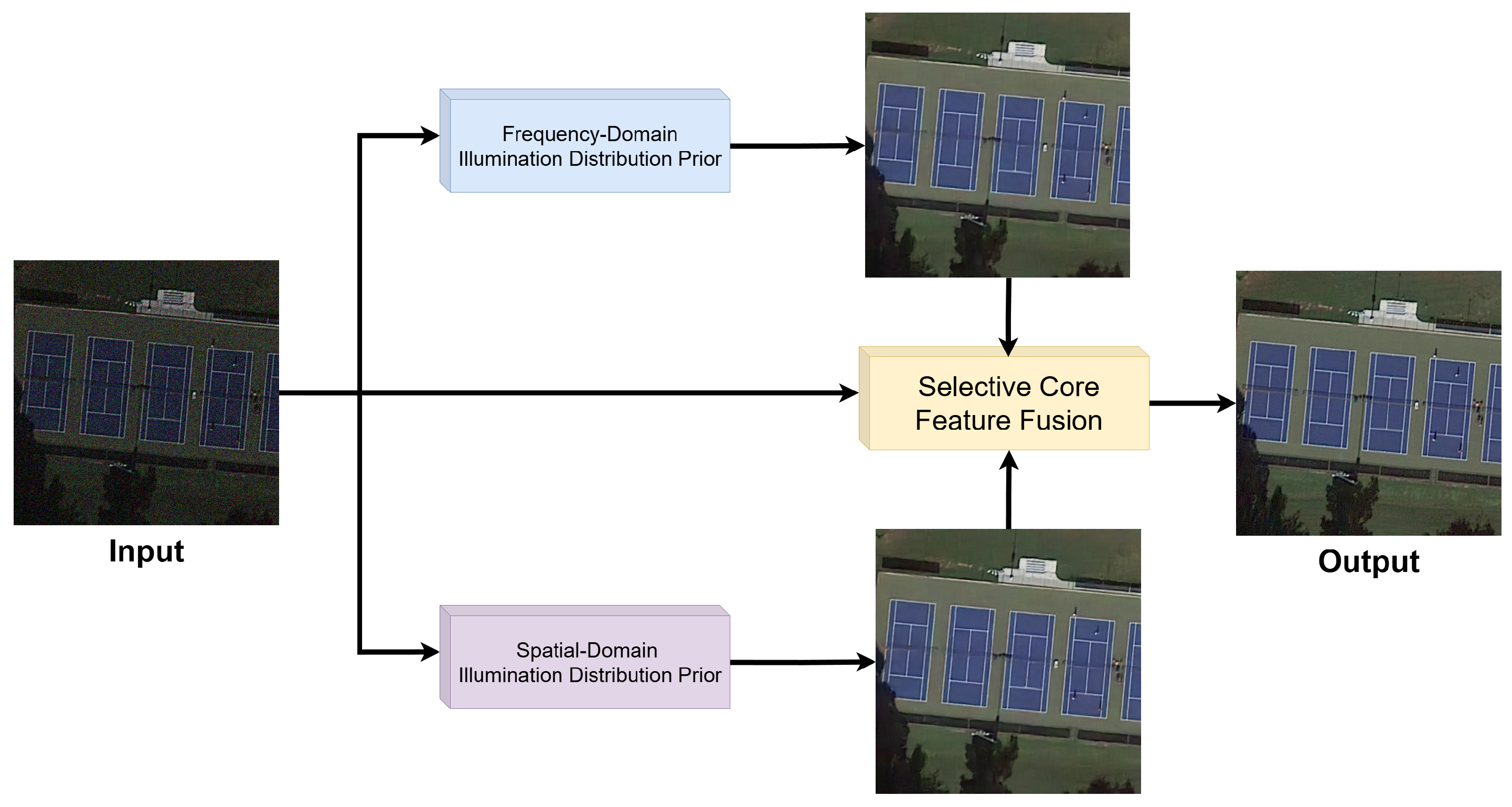
We propose a jointly optimized illumination-prior module, the Dual-Domain Illumination Prior (DDIP), which comprises three components, as shown in Figure 1. The Frequency-Domain Illumination Distribution Prior (FIDP) performs per-color-channel Fourier amplitude calibration to correct global brightness degradation in low-light images. The Spatial-Domain Illumination Distribution Prior (SIDP), adapted from IDP-Net [19], conducts multi-scale sub-region statistical correction to address local illumination non-uniformity caused by heterogeneous land covers in remote sensing scenes. The Selective Core Feature Fusion (SCFF) module adaptively integrates the calibrated outputs from both domains with the original input, balancing global brightness restoration and local detail preservation. Although the abbreviation DIP is commonly used for Deep Image Prior [31], DDIP denotes the distinct Dual-Domain Illumination Prior proposed here; it is trained jointly with the host enhancement backbone rather than used as an instance-specific optimization framework.

3.1. Frequency-Domain Illumination Distribution Prior

For an input image x, we use the orthonormal two-dimensional discrete Fourier transform, defined as
F x u , v = 1 H W h = 0 H 1 w = 0 W 1 x h , w e j 2 π h H u + w W v ,
where j is the imaginary unit, h and w are the spatial coordinates, H and W are the height and width of the image, and u and v are the coordinates in Fourier space. The inverse transform follows the corresponding orthonormal convention, consistent with the implementation.
The inverse Fourier transform is denoted by F 1 . The amplitude component A x and the phase component P x are given by
A x u , v = R 2 x u , v + I 2 x u , v ,
P x u , v = atan2 I x u , v , R x u , v ,
where R x and I x are the real and imaginary parts of F x , respectively.
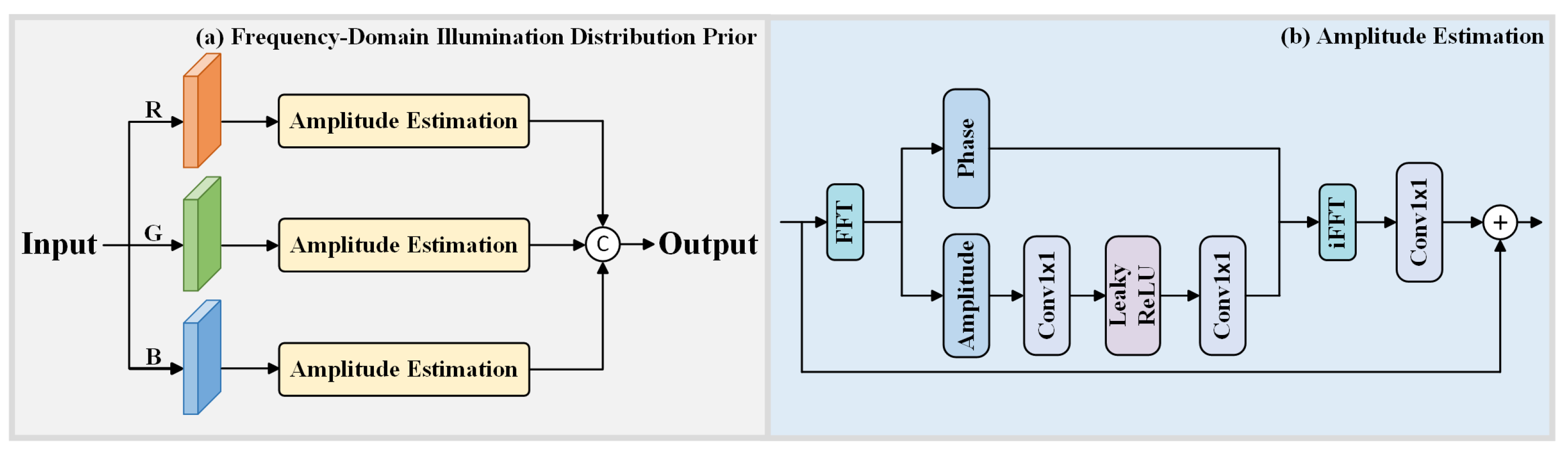
As shown in Figure 2, FIDP operates on the red, green, and blue channels of the low-light image X independently. This separation allows the prior to accommodate channel-specific amplitude distributions without coupling the color channels during Fourier calibration. For channel c { R , G , B } , let A c and P c denote the Fourier amplitude and phase, respectively. An independent pointwise mapper g c produces an amplitude residual Δ c ; the three mappers have the structure Conv ( 1 8 ) LeakyReLU ( 0.2 ) Conv ( 8 1 ) and do not share weights. The residual is converted into a bounded multiplicative modulation, after which the original phase is combined with the calibrated amplitude for inverse transformation. A channel-wise affine adjustment and clipping complete the branch. The formulation is as follows:
A c = F ( X c ) , P c = F ( X c ) , c { R , G , B } ,
Δ c = g c ( A c ) , A c = A c 1 + η tanh ( Δ c ) ,
X ˜ c = Re F 1 A c exp ( j P c ) ,
X c FIDP = clip γ c X ˜ c + β c , 0 , 1 , γ c = γ min + γ max γ min sigmoid ( a c ) , β c = β max tanh ( b c ) ,
X FIDP = Concat ch X R FIDP , X G FIDP , X B FIDP .
Here, η controls the amplitude-residual range; a c and b c are unconstrained learned channel-wise affine parameters; sigmoid ( · ) denotes the logistic sigmoid function; and γ min , γ max , and β max determine the admissible gain and shift ranges. The operator Concat ch ( · ) denotes concatenation along the RGB channel dimension. In the reported implementation, η = 0.5 , ( γ min , γ max ) = ( 0.8 , 1.2 ) , and β max = 0.1 . Hence, the amplitude multiplier remains in ( 0.5 , 1.5 ) , the affine gain remains positive, and the channel-wise shift is bounded. The operator clip ( · , 0 , 1 ) restricts the reconstructed intensity to the normalized image range.
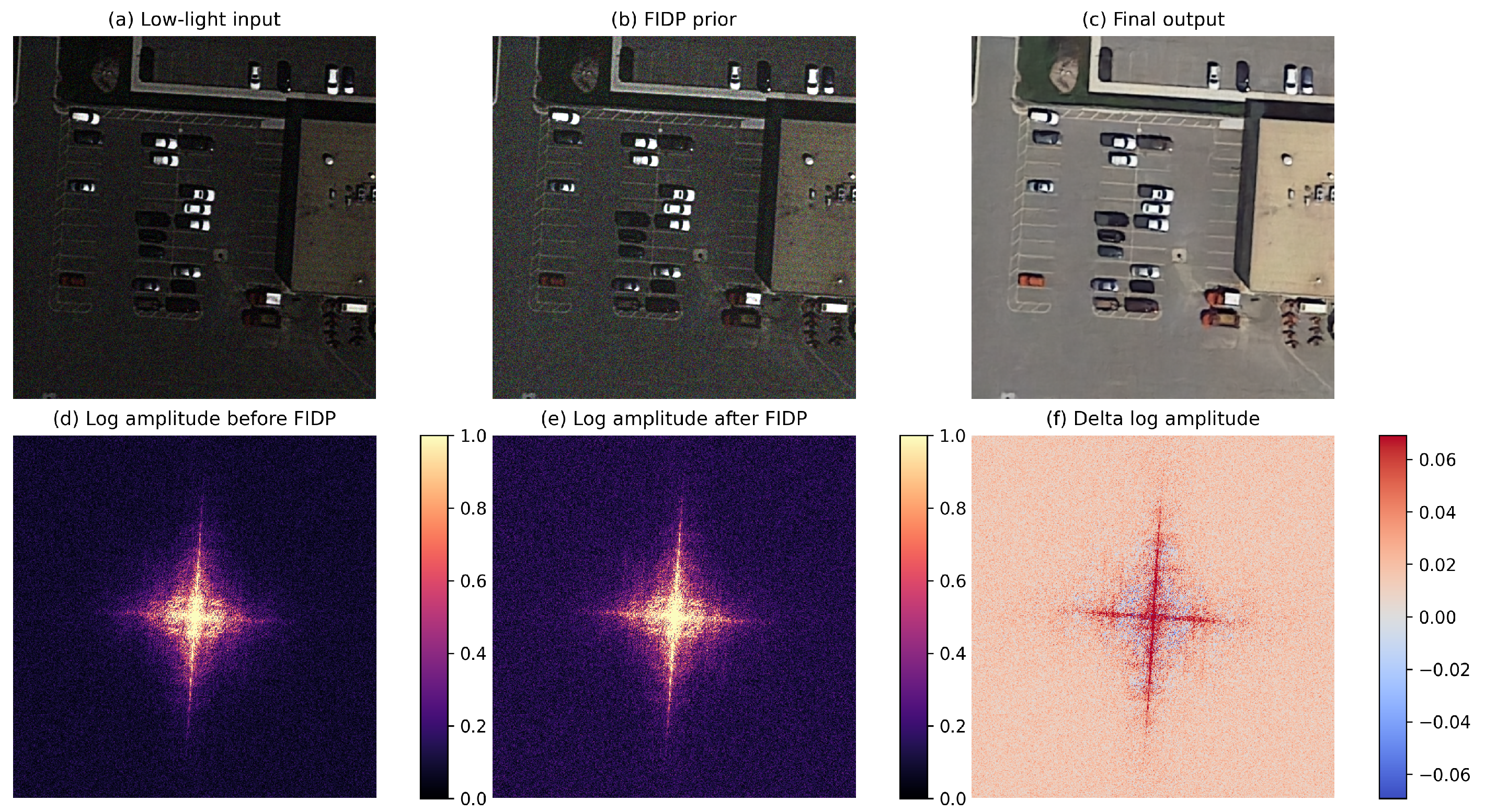
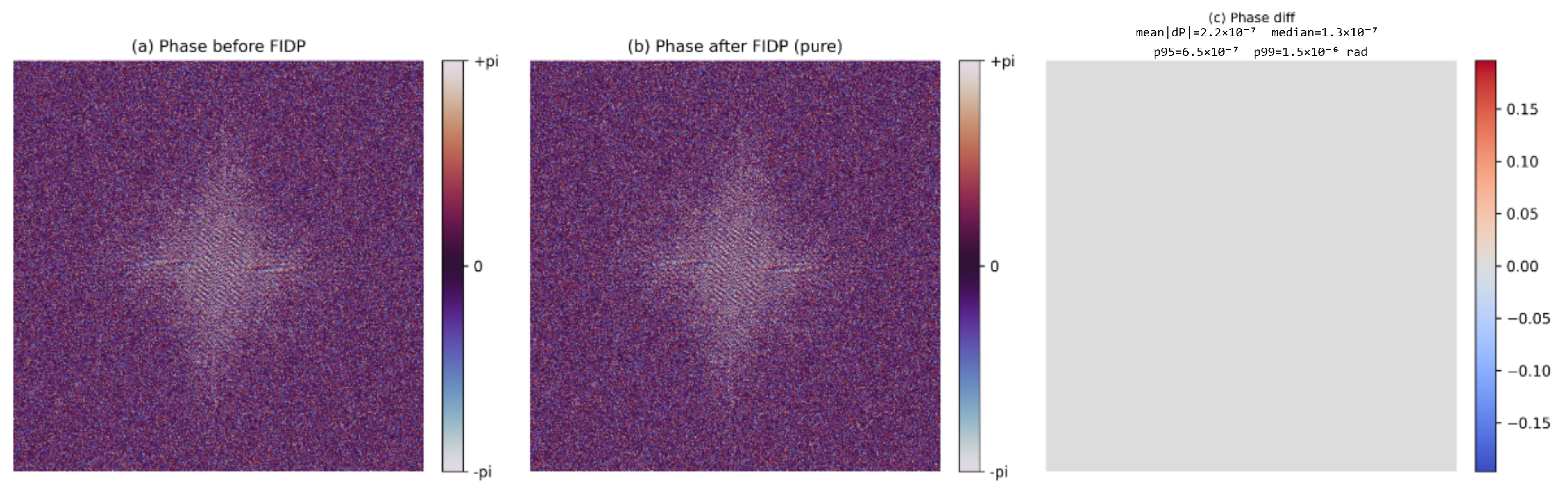
Frequency-domain processing offers a useful decomposition for low-light enhancement: the Fourier amplitude reflects global intensity statistics, while the phase component encodes the spatial arrangement of image structures. FIDP calibrates the amplitude and reuses the original phase during inverse reconstruction. Figure 3 visualizes the low-light input, the FIDP prior, the final enhanced output, and the log-amplitude change induced by FIDP; Figure 4 shows the corresponding phase behavior. These figures illustrate the operation of FIDP but are not used as quantitative evidence of exact spectral matching. In optical remote sensing imagery, the three RGB channels may exhibit different intensity distributions; FIDP therefore processes the channels independently.
For a real-valued input channel, the Fourier spectrum is conjugate symmetric. Since A c is symmetric and the same pointwise 1 × 1 amplitude mapper g c is applied at every frequency location, the calibrated amplitude A c retains this symmetry. Combining A c with the unchanged phase P c therefore preserves conjugate symmetry up to floating-point precision. We verified this numerically on the 66 paired iSAID-dark validation images used for the fixed-checkpoint diagnostic: before taking the real component after inverse FFT, the aggregate mean and maximum magnitudes of the imaginary residual were 3.40 × 10 8 and 8.85 × 10 7 , respectively, and the ratio between mean imaginary and mean real magnitudes was 1.40 × 10 7 . Thus, discarding the residual imaginary component removes only numerical round-off rather than image information.
Scope beyond RGB. The present implementation and all reported experiments operate on three-channel RGB optical imagery. In principle, the formulation could be extended to a B-band remote sensing image by applying FIDP amplitude calibration and SIDP local-statistics correction on a per-band basis. However, multispectral data can exhibit band-dependent radiometric properties and cross-band correlations; whether the corresponding mappers should be independently learned, partially shared, or explicitly coupled requires dedicated empirical study. This is therefore a theoretical extension only and does not establish performance on multispectral imagery.

3.2. Spatial-Domain Illumination Distribution Prior (Based on IDP-Net [19])

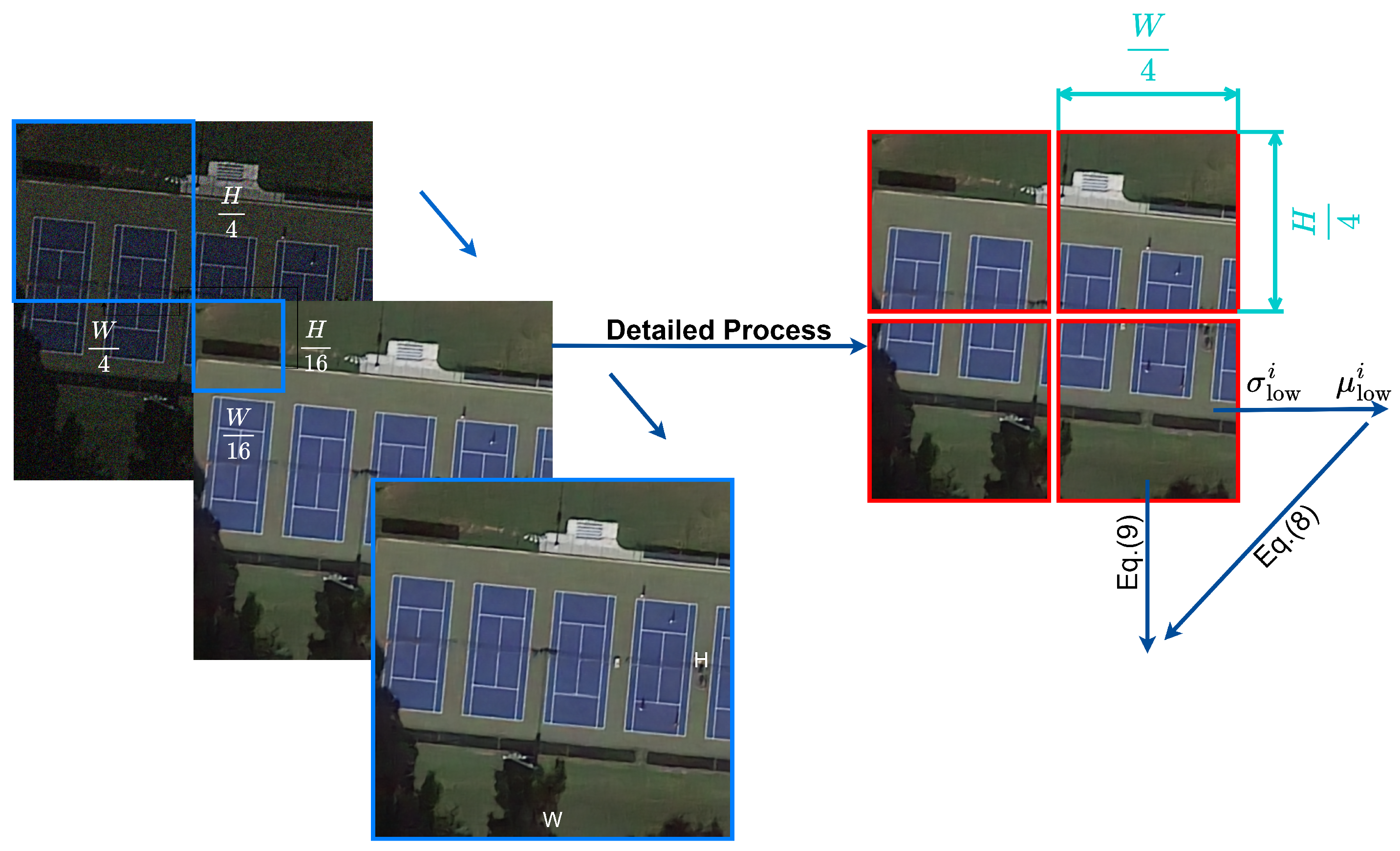
Building on the statistical relationship among per-channel mean, standard deviation, and illumination established by IDP-Net [19], we adapted the Spatial-Domain Illumination Distribution Prior (SIDP) with a stagewise multi-scale refinement strategy. As shown in Figure 5, the input is partitioned into a medium-scale 4 × 4 grid, a fine-scale 16 × 16 grid, and a single global region. At each level, per-channel mean and standard deviation are computed within every region, and learnable affine mappings adjust these statistics toward their normal-light counterparts. The calibrated outputs are applied sequentially from medium to fine to global scale, producing the final output X SIDP .
The three-scale refinement strategy is adapted from IDP-Net [19]. The representative configuration uses the ordered grid sizes [ 4 , 16 , 1 ] , corresponding to medium-scale, fine-scale, and global calibration. This compact design introduces 36 learnable scalar parameters and 0.16 GFLOPs at 512 × 512 resolution; the underlying statistical formulation follows IDP-Net [19].

3.3. Selective Core Feature Fusion

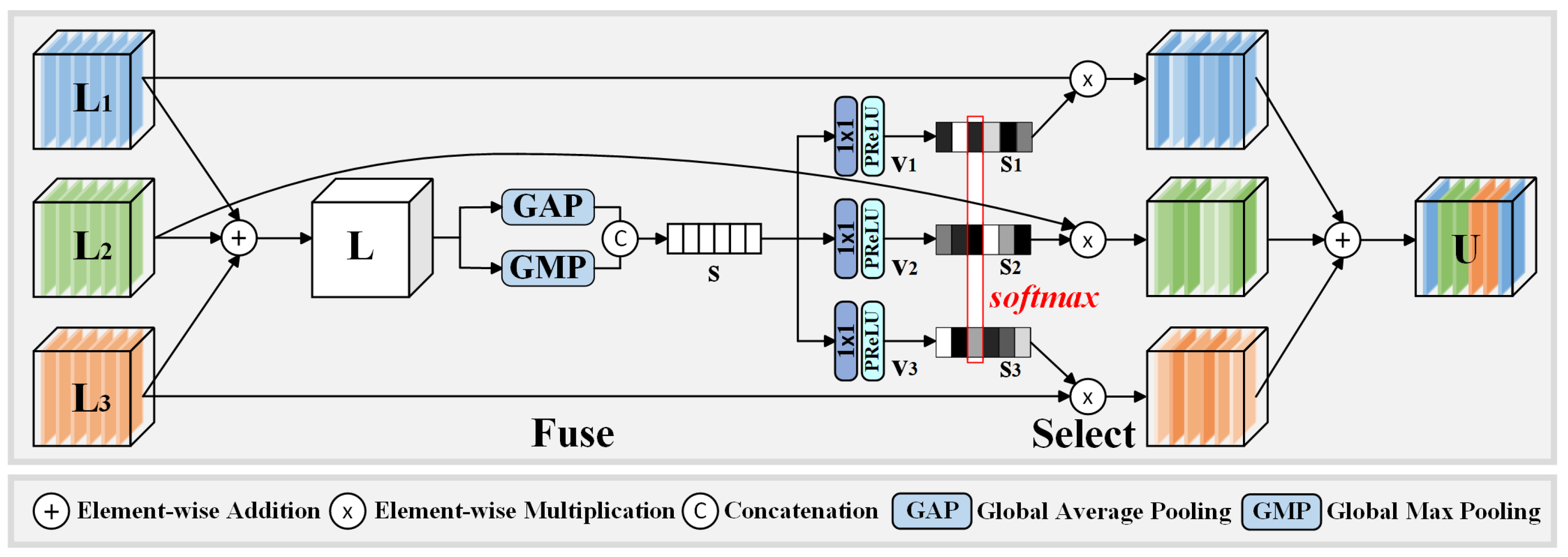
Simple feature aggregation methods such as summation or concatenation may not adequately balance the distinct characteristics of frequency-domain and spatial-domain branch outputs. Summation imposes uniform weighting, while concatenation stacks the outputs without modeling inter-domain interactions. Inspired by prior feature fusion strategies [10,32], we designed the Selective Core Feature Fusion (SCFF) to adaptively combine the FIDP branch, the SIDP branch, and the original input image. SCFF employs dual pooling (global average pooling, GAP, and global max pooling, GMP) to generate channel descriptors: GAP captures the global distribution of each input channel, while GMP retains the most salient activation, together providing complementary characterizations of channel-wise importance.
As shown in Figure 6, SCFF balances the three branch contributions through weight estimation and information fusion. The former generates per-channel attention weights from dual-pooling descriptors and a branch-wise softmax, whereas the latter combines the sources by channel-wise weighted summation.
Weight Estimation. SCFF considers the FIDP output ( L 1 ) , the input low-light image ( L 2 ) , and the SIDP output ( L 3 ) as three candidate sources and forms L = L 1 + L 2 + L 3 . Global average pooling and global max pooling are applied to L, and the resulting descriptors are aggregated as s. The pooled descriptor is first compressed by a 1 × 1 convolution and PReLU; a second 1 × 1 projection produces the branch-wise logits V 1 , V 2 , and V 3 . After stacking and reshaping to [ B , 3 , C , 1 , 1 ] , these logits are normalized by a branch-wise softmax with temperature τ . The resulting tensor s [ 0 , 1 ] B × 3 × C × 1 × 1 supplies channel-wise reliability scores whose three branch values sum to one. In the reported implementation, τ = 2.0 . The scores are broadcast over the spatial dimensions when applied to the corresponding branch outputs, allowing SCFF to emphasize the source that is more informative for a given channel and degradation condition.
Information Fusion. The three branch outputs L 1 , L 2 , and L 3 lie in [ 0 , 1 ] , so no additional rescaling is required. Their reliability-weighted aggregation is U = s 1 L 1 + s 2 L 2 + s 3 L 3 , where s 1 , s 2 , s 3 [ 0 , 1 ] B × C × 1 × 1 are the FIDP, original-input, and SIDP scores extracted from s , and ⊙ denotes element-wise multiplication with spatial broadcasting. An explicit fidelity path then produces U out = ( 1 α ) U + α L 2 , where α [ 0 , 1 ] controls the contribution of the original input. We use α = 0.3 in the reported implementation. Consequently, the original input maintains a direct contribution to the fused representation even when selective attention favors one calibrated branch. After projection, U out is added to the shallow features of the host backbone, as shown in Figure 7. The main restoration blocks remain unchanged, and MIRNet-v2 retains its original image-residual path.
Through dual-pooling reliability estimation, selective branch weighting, and an explicit input-fidelity path, SCFF integrates the candidate dual-domain cues without requiring equal branch contributions. Its role is to select useful illumination information while maintaining a direct path from the input before the host backbone performs subsequent texture restoration.

3.4. Loss Function

The training objective consists of two components: a reconstruction loss that drives pixel-level enhancement quality, and a frequency-domain amplitude loss that supervises global illumination calibration.
For the reconstruction loss, we adopt the L 1 loss between the enhanced image X ^ and the ground-truth image G T :
L r = G T X ^ 1 ,
where · 1 denotes the L 1 norm.
For the amplitude loss, we directly supervise the FIDP output in the frequency domain, since the Fourier amplitude is closely correlated with illumination. This term encourages FIDP to function as a global illumination calibrator, while the reconstruction loss allows the downstream backbone to refine residual textures and local structures. The amplitude loss is defined as:
L a m p = A G T A X FIDP 1 ,
where A G T and A X FIDP denote the amplitude components of the ground truth and the FIDP output, respectively.
The total loss is a weighted sum of the two terms:
L t o t a l = L r + λ L a m p ,
where λ is the amplitude-loss weight. The reported main results use λ = 0.01 ; its sensitivity within the tested range is examined in Section 4.5.

4. Results and Discussion

The experiments cover enhancement quality on iSAID-dark, a fixed-detector object-detection evaluation on high-resolution scenes, supplementary results on five general low-light benchmarks, and controlled analyses of the DDIP components and design parameters.

4.1. Datasets and Experimental Setup

Datasets. The primary evaluation was conducted on the publicly available iSAID-dark dataset released by Yao et al. [4]. This dataset was constructed from the iSAID aerial image benchmark by applying a physically motivated illumination degradation model to high-quality daytime images, producing varying exposure levels and spatially uneven lighting. The prepared split used by our enhancement experiments contained 3755 paired training images and 66 paired validation images at a spatial resolution of 512 × 512 pixels. The scenes contain complex terrain textures and dense multi-scale objects, making illumination correction and detail preservation challenging.
General Benchmarks. Supplementary results are reported on five low-light datasets: LOL-v1 [33], LOL-v2-Real [34], LOL-v2-Syn [34], LSRW-Nikon [35], and LSRW-Huawei [35] (training/test splits: 485/15, 689/100, 900/100, 3150/20, and 2450/30, respectively).
Comparison Baselines. The controlled results were the adjacent backbone/DDIP pairs, for which the baseline and DDIP-equipped variant were trained and evaluated under matched settings within each pair. FECNet, SNR-Net, FourLLIE, LLFormer, and ZERO-IG are literature-based contextual references reported with citations to their source methods, whereas DFFN was evaluated using the authors’ publicly released iSAID checkpoint. These contextual rows were not treated as results reproduced under the matched host-backbone protocols. Accordingly, only the adjacent backbone/DDIP pairs and their explicitly reported “+” gains were interpreted as controlled comparisons in this study; no gain was computed against a contextual method row.
Training Configuration. For each controlled backbone/DDIP pair, the baseline and DDIP-equipped variant used matched data splits, preprocessing, optimization schedules, patch and batch settings, iteration budgets, and evaluation scripts. No official pre-trained weights were used for either member of a controlled pair. DDIP was integrated as an illumination-prior branch before the main restoration blocks. This description excludes the separately reported DFFN reference, for which the released checkpoint was used as stated below. Unless otherwise stated, the principal reported setup used PyTorch 1.13 [36] and an NVIDIA RTX 4090 GPU. The learning rate was initialized at 3.0 × 10 4 and decreased to 1.0 × 10 6 using cosine annealing [37]. During training, input images were randomly cropped to 256 × 256 patches. We employed the Adam optimizer [38] with β 1 = 0.9 and β 2 = 0.999 . The principal iteration budget was 3.0 × 10 5 with a batch size of four. The Peak Signal-to-Noise Ratio (PSNR) and Structural Similarity Index (SSIM) [39] were used as standard evaluation metrics. In all tables, the upward arrow (↑) indicates that higher values are preferable, and the downward arrow (↓) indicates that lower values are preferable.
For the complementary perceptual and illumination-oriented analysis, we additionally report the Learned Perceptual Image Patch Similarity (LPIPS) [40], the mean absolute error of the CIELAB lightness channel (Lab L * MAE), and the signed mean L * bias on the 66 paired images in the iSAID-dark validation set under the Standard setting. LPIPS was computed using the official AlexNet linear model. LPIPS and Lab L * MAE compare the enhanced result with the paired normal-light reference, while the signed mean L * bias indicates whether the output is globally darker or brighter than that reference; a bias magnitude closer to zero indicates closer global lightness. In addition to the controlled backbone/DDIP pairs, DFFN was evaluated using the authors’ publicly released iSAID checkpoint as an external architecture-level reference. These metrics were computed after inference and were not used as training losses.

4.2. Low-Light Remote Sensing Image Enhancement

Experiment Settings. DDIP was evaluated with CNN-, Transformer-, and Mamba-based backbones on iSAID-dark [4] under two settings. In the Standard setting, models were trained and tested on 512 × 512 images. In the High-resolution setting, the models trained at 512 × 512 were applied directly to full-resolution 1920 × 1080 aerial images without fine-tuning. This cross-resolution setting tested whether illumination correction and fine-grained geospatial detail could be retained at a substantially higher input resolution.
Analysis of Results. Table 1 reports the quantitative results on iSAID-dark. Each DDIP-equipped backbone improves upon its corresponding baseline in the reported PSNR and SSIM comparisons. In the Standard setting, Retinexformer+DDIP achieves the highest PSNR of 26.04 dB, while SPJFNet [23] + DDIP improves by 2.0 dB over its base network.
Complementary Illumination and Perceptual Analysis. Table 2 provides complementary evidence beyond the primary PSNR/SSIM evaluation. With RetinexMamba, DDIP reduces Lab L * MAE from 4.6589 to 4.2976 and the absolute mean L * bias from 2.1474 to 1.3362, while LPIPS increases from 0.2222 to 0.2261. With MIRNet-v2, DDIP reduces LPIPS from 0.2223 to 0.2143, Lab L * MAE from 4.6245 to 4.2304, and the absolute mean L * bias from 1.2311 to 1.1555. With Restormer, DDIP reduces Lab L * MAE by 12.47% and the absolute mean L * bias by 22.22%, while LPIPS remains nearly unchanged. With Retinexformer, DDIP reduces LPIPS by 4.98%, but Lab L * MAE increases by 3.92% and the absolute mean L * bias changes from 0.9762 to 1.2401. Thus, changes in the complementary metrics vary across host architectures, and no single perceptual or illumination metric is used to claim uniform superiority. DFFN is included as an external architecture-level reference rather than a paired DDIP ablation. All values were computed after inference using saved outputs and did not enter the training objectives.
DFFN is a representative dual-domain architecture for low-light remote sensing image enhancement. In the Standard setting of Table 1, the PSNR values of Retinexformer+DDIP (26.04 dB) and MIRNet-v2+DDIP (25.94 dB) exceed the contextual DFFN result (25.30 dB) by 0.74 dB and 0.60 dB, respectively. Because DFFN was evaluated as a separate end-to-end architecture, these differences are not treated as paired DDIP gains.
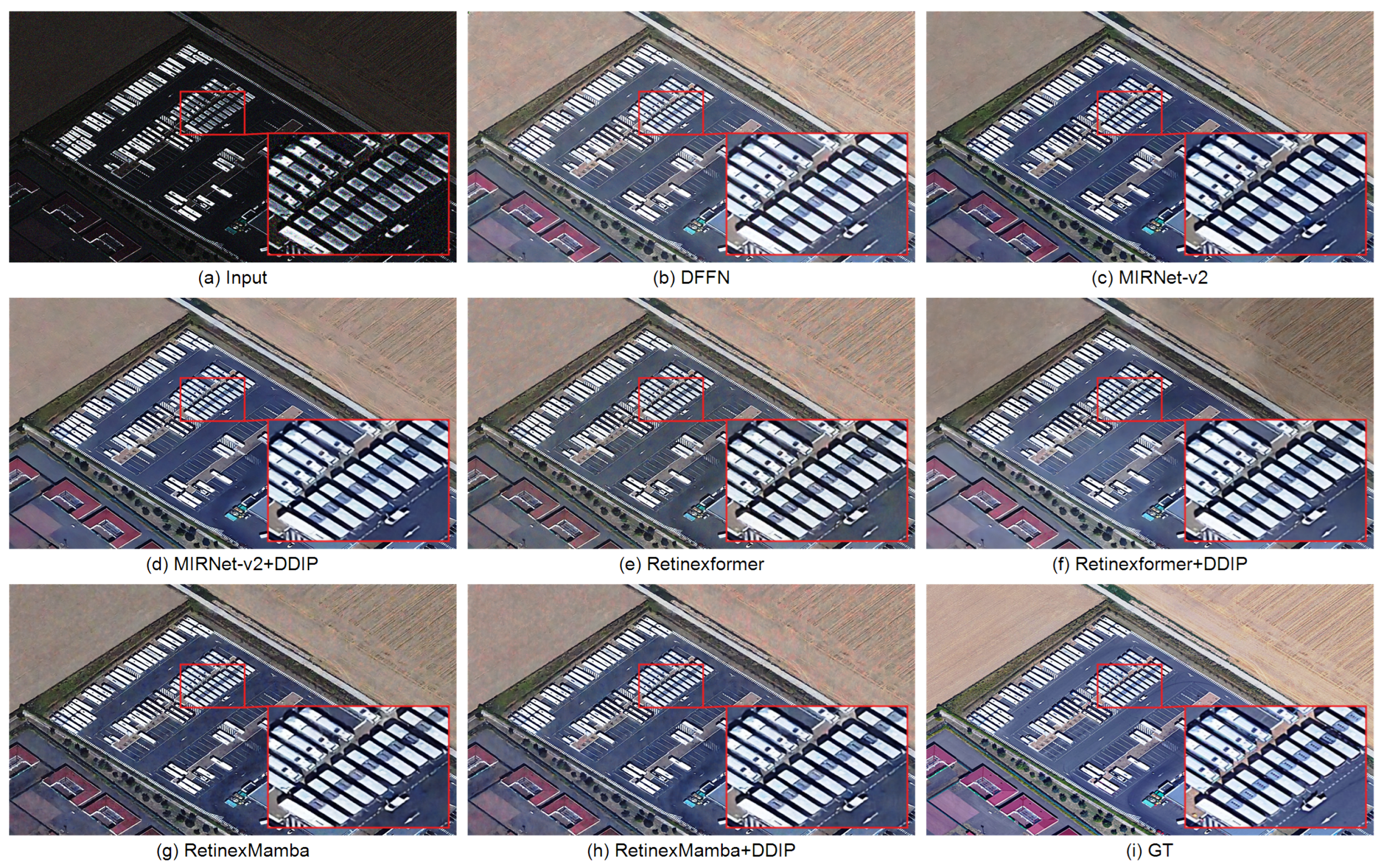
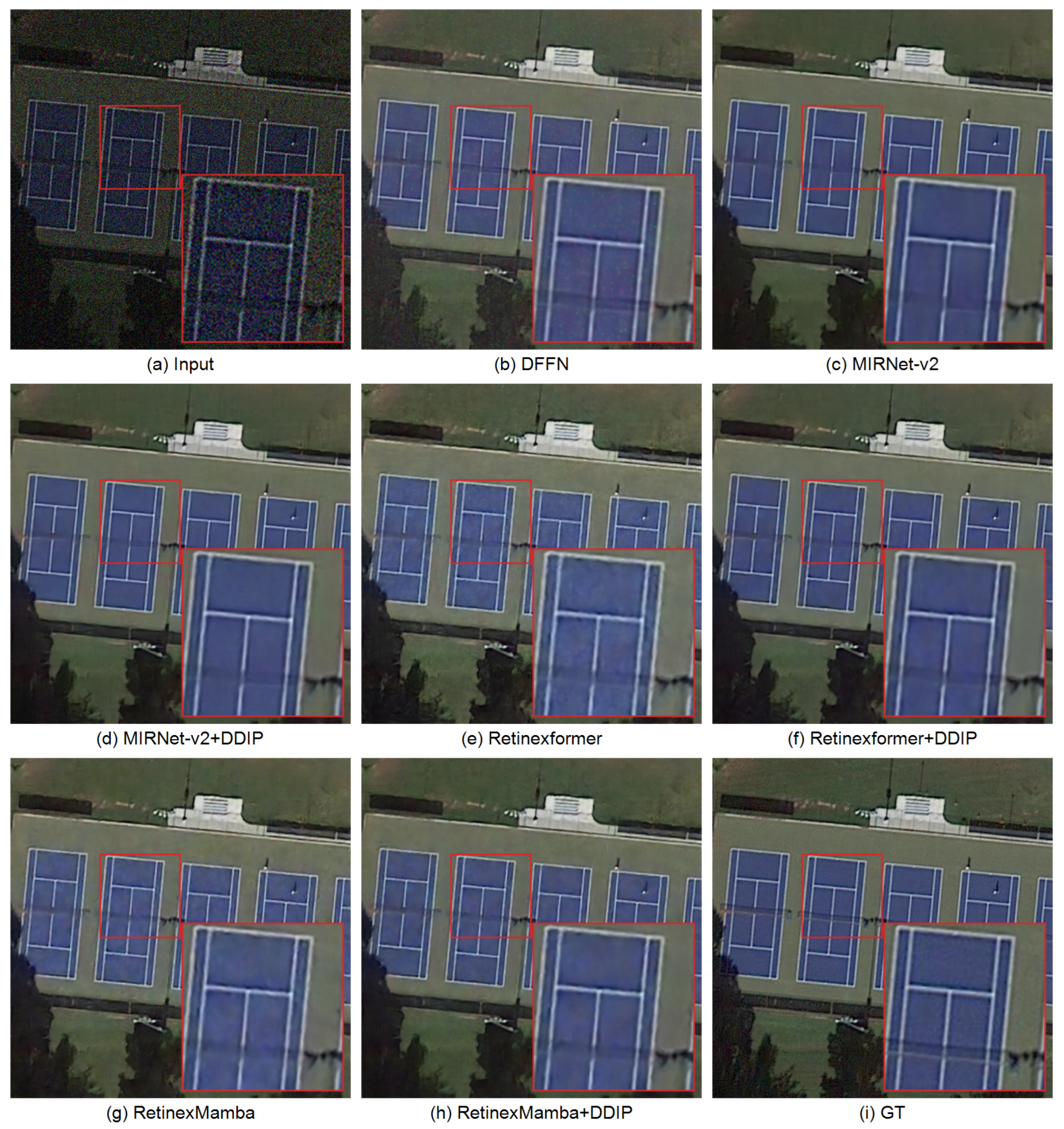
The qualitative comparisons in Figure 8 and Figure 9 further illustrate the reported results on the iSAID-dark dataset under the Standard and High-resolution settings. The baseline SPJFNet [23] shows a performance decline when applied to the high-resolution inputs (PSNR decreasing from 21.50 dB to 18.55 dB). In this setting, SPJFNet+DDIP’s PSNR is 1.69 dB higher than that of SPJFNet. These results suggest that dual-domain illumination calibration merits further study for remote-sensing imagery at varying resolutions. The gains reported for the tested CNN-, Transformer-, and Mamba-based backbones are specific to iSAID-dark and the stated experimental configuration. DDIP is jointly optimized with each host backbone; the frequency-domain branch is intended to calibrate global brightness, while the spatial-domain branch is intended to address localized illumination variation.

4.3. Downstream Object Detection Evaluation

Experiment Settings. To assess whether the tested enhancement outputs benefited a downstream remote-sensing task, we trained a YOLOv8n detector once on normal-illumination iSAID images derived from DOTA v1.0, using the corresponding official iSAID instance annotations. The detector was then fixed; no detector retraining was performed for any low-light or enhanced input. The test set comprised 24 high-resolution iSAID-dark validation scenes, partitioned into 144 detector tiles. For each scene, we evaluated the raw synthetic low-light images at three illumination levels (Low-15, Low-20, and Low-30), together with the outputs of RetinexMamba, RetinexMamba+DDIP, MIRNet-v2, MIRNet-v2+DDIP, Restormer, Restormer+DDIP, Retinexformer, Retinexformer+DDIP, and DFFN. All variants used the same image tiles and annotations. DFFN used the authors’ publicly released iSAID checkpoint and was included as an external architecture-level reference; it was not treated as a controlled DDIP pair. We report COCO-style mAP 50 : 95 (denoted as mAP), mAP 50 , and small-object AP. These checkpoints are used here as application-oriented comparisons of enhancement pipelines; this experiment does not replace the controlled backbone-level ablations in Section 4.5.
Analysis of Results. The fixed-detector evaluation in Table 3 shows that the tested enhancement pipelines substantially improve detection performance relative to the raw synthetic low-light inputs under the evaluated conditions. Relative to the corresponding host backbones, DDIP increases mean mAP by 0.48, 0.46, and approximately 0.08 percentage points for MIRNet-v2, Restormer, and RetinexMamba, respectively; the last value was calculated from the unrounded results. For Retinexformer, the mean mAP changes only marginally, whereas its mean mAP 50 and mean AP small decrease. For RetinexMamba, the mean AP small increases from 14.83% to 15.41%, and the largest gain occurs under the Low-20 condition; its mean mAP 50 decreases slightly from 45.27% to 45.12%. The improvement is therefore more evident for the MIRNet-v2 and Restormer hosts and is not uniform across all backbones, degradation levels, or metrics. In particular, the present experiment does not support the claim that DDIP consistently improves small-object AP. The official DFFN checkpoint provides an external architecture-level reference of 29.75% mean mAP and 45.60% mean mAP 50 ; this row is not used to infer a DDIP gain.

4.4. Supplementary Evaluation on Standard Low-Light Benchmarks

We additionally evaluated DDIP on five standard low-light benchmarks. While the primary contribution targets remote sensing imagery (Section 4.2), these experiments assess DDIP in the reported non-remote-sensing settings and do not constitute additional remote-sensing validation.
Experiment Settings. MIRNet-v2 [11], Restormer [13], Retinexformer [12], and EvLight [41] served as base networks, with DDIP inserted before each for controlled backbone-versus-backbone+DDIP comparisons (see Figure 7). Additional baseline methods are listed in Section 4.1. A cross-dataset evaluation was performed between LOL-v2-Real [34] and LSRW-Huawei [35]: models trained on one dataset were tested on the other under the specified train–test pairing.
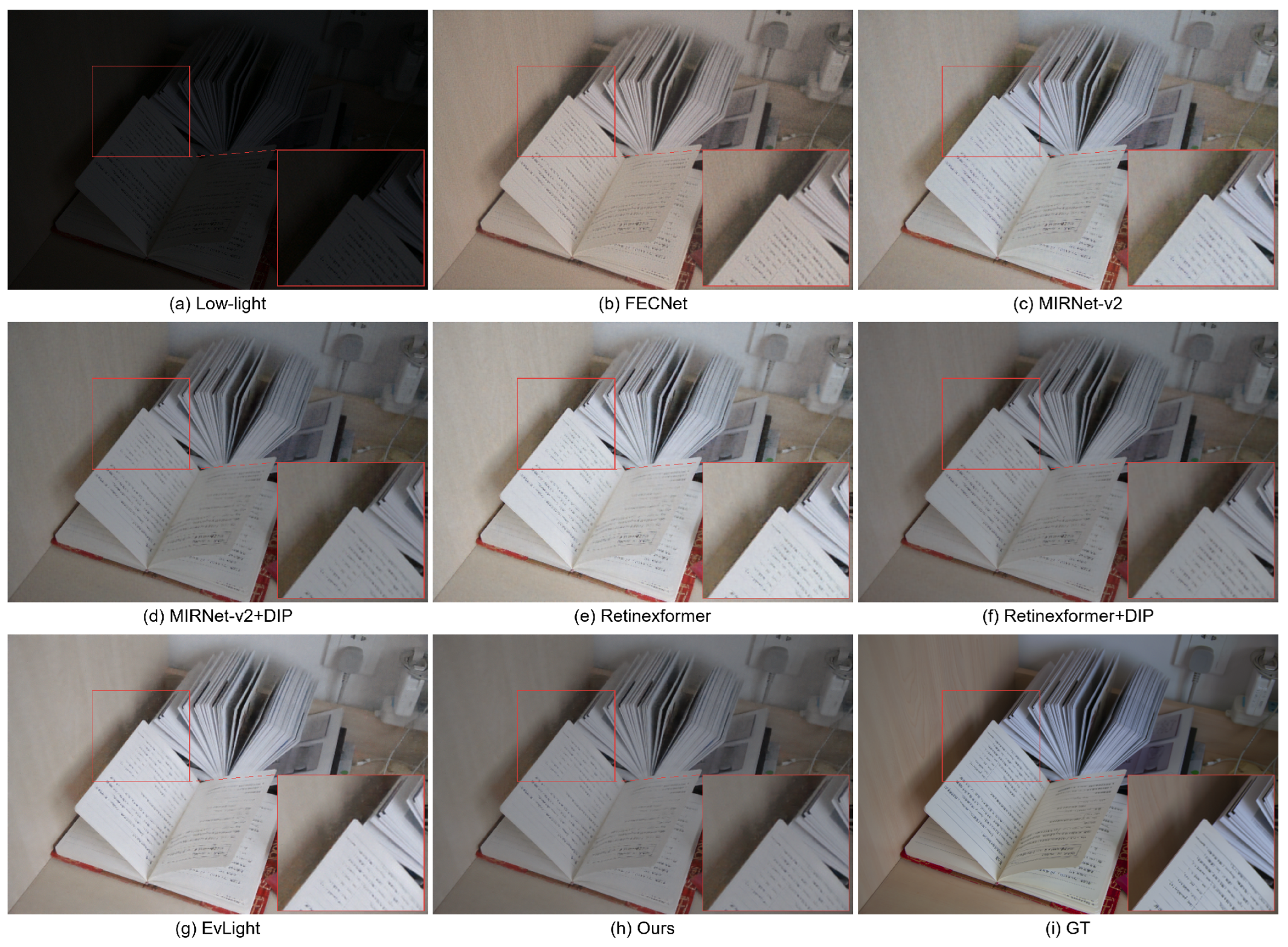
Analysis of Results. Table 4 and Table 5 report the quantitative results on the LOL-v1, LOL-v2-Real, LOL-v2-Syn, LSRW-Nikon, and LSRW-Huawei datasets. Across these benchmarks, equipping the reported base networks with DDIP yields positive PSNR and SSIM differences. The largest PSNR increases on the five datasets are 0.94 dB, 0.61 dB, 1.34 dB, 0.41 dB, and 0.38 dB, respectively. The qualitative comparison in Figure 10 suggests that DDIP contributes to correcting the illumination distribution of the base networks while preserving spatial structures. These results are limited to the evaluated datasets and training settings.
Table 6 reports the cross-dataset results. FECNet, FourLLIE, and LLFormer are included as reference baselines; because their architectures are not used as modular host backbones here, DDIP is integrated into MIRNet-v2, Restormer, and Retinexformer for the paired comparisons. In this setting, the DDIP-equipped backbones retain positive PSNR and SSIM gains over their corresponding baselines. This finding is restricted to the two reported train–test dataset pairs.

4.5. Ablation Study

To examine the contribution of each component, we conducted controlled backbone-level ablations on the iSAID-dark [4] dataset with MIRNet-v2 under the Standard setting. Table 7 evaluates FIDP, SIDP, and SCFF within the full enhancement pipeline. Table 8 provides a separate standalone fusion analysis on LOL-v1 [33]; because it uses a different dataset and evaluation configuration, it is not combined with Table 7 to estimate the total DDIP overhead. The ablation focused on controlled component and fusion comparisons. We did not extract modules from other complete architectures for module-only comparisons because doing so would not have reproduced their original end-to-end systems.
Component Ablation. The “Only FIDP” and “Only SIDP” configurations isolate the frequency-domain and spatial-domain priors, respectively, while “No SCFF” retains both prior branches without the selective fusion module. Table 7 shows that the full DDIP configuration performs better than either single-domain configuration and the version without SCFF. It achieves a PSNR of 25.94 dB and SSIM of 0.8570, compared with 25.50 dB and 0.7913 for the baseline. Within this controlled setting, the results support the joint use of the two illumination priors and selective cross-domain fusion.
SIDP Scale and Order Sensitivity. The default sequence [ 4 , 16 , 1 ] combines medium-scale ( 4 × 4 ), fine-scale ( 16 × 16 ), and global calibration so that the spatial branch can model heterogeneous local illumination together with scene-wide brightness. In the retraining-controlled rows of Table 9, removing the fine-scale level changes PSNR by 0.0032 dB and SSIM by 0.0006 . Thus, after retraining, the tested scale-count change produces only a small difference. The fixed-checkpoint rows examine processing order while preserving the same learned parameters. The default, local-order-reversed, and global-first sequences obtain 25.9471/0.8522, 25.9481/0.8522, and 25.9436/0.8522, respectively. The 0.0045 dB PSNR span and unchanged four-decimal SSIM show limited order sensitivity for the tested images. This fixed-checkpoint result is interpreted as an inference-time diagnostic rather than an independently trained architectural ablation, and values from the two protocols are not compared directly. The three-level formulation remains the hierarchical default rather than being presented as uniquely optimal; the preferred spatial partition may depend on image resolution and illumination degradation.
Amplitude-Loss-Weight Sensitivity. Table 10 evaluates λ { 0 , 0.001 , 0.01 } . The maximum PSNR variation is 0.0986 dB. The setting λ = 0.001 obtains the highest observed PSNR, whereas λ = 0.01 obtains the highest observed SSIM. These small differences indicate that DDIP is not highly sensitive to the tested range of amplitude-loss weights; no statistical-significance claim is made from these single runs. The reported main results and the scale comparison retain λ = 0.01 to preserve the original training protocol.
SCFF Ablation. We conducted a component-level comparison on LOL-v1 [33] between SCFF and three alternative aggregation strategies: Sum, Concat, and Selective Kernel Feature Fusion (SKFF) [10]. Only the fusion strategy was replaced, while the remaining standalone dual-domain analysis configuration was kept unchanged. Therefore, the FLOPs and parameter counts in Table 8 should be interpreted as the total complexity of the standalone fusion-analysis configuration rather than the parameter size of each fusion block alone. The differences among rows reflect the relative cost introduced by each fusion strategy. Compared with SKFF, SCFF obtains a 0.12 dB higher PSNR and 0.003 higher SSIM under the reported configuration, with the same rounded FLOPs.
SCFF Parameter Sensitivity. Table 11 reports a fixed-checkpoint inference diagnostic. Varying τ from 1.0 to 4.0 leaves the measured PSNR and SSIM unchanged at the reported precision. For the fidelity coefficient, the default α = 0.3 gives the highest PSNR among the tested values. Setting α = 0 disables the explicit input-fidelity path and reduces PSNR by 0.0899 dB, whereas increasing α to 0.6 reduces both PSNR and SSIM. The small SSIM increase at α = 0 reflects a PSNR–SSIM trade-off rather than a uniform gain. This fixed-checkpoint analysis characterizes local sensitivity around the selected configuration and is not interpreted as a retraining-controlled architectural ablation.
Inference Overhead of DDIP. Table 12 reports end-to-end inference latency and throughput for MIRNet-v2 with and without DDIP at two representative resolutions. At 512 × 512 , the reported DDIP configuration adds 14.6 ms of latency (a 5.6% relative increase), with FPS changing from 3.82 to 3.62. At 1920 × 1080 , the reported absolute latency difference is 126.0 ms, with FPS changing from 0.48 to 0.45. Static inspection of the tested implementation further shows that DDIP adds 502 parameters (from 5,858,560 to 5,859,062 parameters; 0.009% of the host parameter count). The numbers of incremental parameters are 81 in FIDP, 36 in SIDP, 65 in SCFF, and 320 in the prior-projection layer. These measurements describe the tested implementation, hardware, and host backbone; they do not provide module-level profiling or establish latency behavior for untested backbones or resolutions.


5. Conclusions

This paper presented a Dual-Domain Illumination Prior (DDIP), a jointly optimized illumination-prior module for low-light remote sensing image enhancement. Component ablations examined the contributions of FIDP, SIDP, and SCFF by comparing the full dual-domain configuration with single-domain and reduced-fusion variants. The controlled reconstruction comparisons on iSAID-dark reported PSNR and SSIM gains for the tested CNN-, Transformer-, and Mamba-based backbones. The fixed-detector analysis on high-resolution iSAID-dark scenes showed that the tested enhancement pipelines improved detection performance relative to raw low-light inputs under the evaluated protocol, whereas the incremental DDIP effect was backbone- and metric-dependent and did not consistently improve mean AP small across the reported pairs. The supplementary evaluation on five general low-light benchmarks reported results beyond the remote-sensing setting but did not establish general performance for untested data or sensors.
For remote sensing applications, DDIP addresses large-area underexposure through frequency-domain amplitude calibration and localized illumination non-uniformity through multi-scale spatial statistical correction. The evaluation included PSNR, SSIM, LPIPS, and Lab L * measurements, together with a fixed-detector object-detection experiment on synthetic high-resolution iSAID-dark scenes. Nevertheless, the current evidence is limited to RGB optical imagery, synthetic degradation, 24 high-resolution scenes comprising 144 detector tiles, and one detector. It does not establish performance on real nighttime remote-sensing imagery, other sensing modalities, or untested sensors and platforms. The downstream comparison is an application-oriented evaluation rather than a retraining-controlled ablation of DDIP. Broader real-world and multi-sensor validation remains necessary.

Author Contributions

Conceptualization, C.W. and L.H.; methodology, C.W. and Z.P.; software, C.W.; validation, C.W., Z.P., J.L., and H.C.; formal analysis, C.W. and L.H.; investigation, C.W., Z.P. and R.L.; resources, R.L. and L.M.; data curation, C.W. and Z.P.; writing—original draft preparation, C.W.; writing—review and editing, C.W., L.H., H.C. and C.Y.; visualization, C.W. and Z.P.; supervision, L.H., J.L., L.M. and C.Y.; project administration, L.H. and R.L.; funding acquisition, L.H., R.L. and L.M. All authors have read and agreed to the published version of the manuscript.

Funding

This research was funded by the Zhoushan “Zhou Chuang Wei Lai” Hai Na Plan, grant number 2025307, and supported by Jurong Energy Co., Ltd. and Zhoushan Yuchen Electric Power Engineering Co., Ltd.

Data Availability Statement

The LOL-v1 and LOL-v2 datasets are publicly available at https://daooshee.github.io/BMVC2018website/ (accessed on 12 March 2026). The LSRW dataset is publicly available at https://github.com/JianghaiSCU/R2RNet (accessed on 12 March 2026). The iSAID-dark dataset is publicly available at https://github.com/iijjlk/DFFN (accessed on 30 April 2026), released by Yao et al. [4].

Acknowledgments

The authors thank the laboratory of Zhejiang Ocean University for providing computational resources and experimental support.

Conflicts of Interest

Author Rongsheng Lin was employed by the company Xinjiang Jurong Energy. The remaining authors declare that the research was conducted in the absence of any commercial or financial relationships that could be construed as a potential conflict of interest.

References

  1. Li, Y.; Hou, Q.; Zheng, Z.; Cheng, M.-M.; Yang, J.; Li, X. Large selective kernel network for remote sensing object detection. In Proceedings of the IEEE/CVF International Conference on Computer Vision (ICCV), Paris, France, 2–6 October 2023; pp. 16748–16759. [Google Scholar]
  2. Habiba, U.; Aghababaei, H.; Belgiu, M. Land cover classification of Sentinel-1 images at subpixel level using deep learning. Remote Sens. Lett. 2026, 17, 607–620. [Google Scholar] [CrossRef] [Scilit]
  3. Alkarkhi, M.; Idris, N.H.; Abd Rahman, M.Z. Integration of deep learning with superpixel segmentation for automated assessment of building damage following disasters: A case study of the Port of Beirut explosion. Int. J. Remote Sens. 2025, 46, 9622–9652. [Google Scholar] [CrossRef] [Scilit]
  4. Yao, Z.; Fan, G.; Fan, J.; Gan, M.; Chen, C.L.P. Spatial-frequency dual-domain feature fusion network for low-light remote sensing image enhancement. IEEE Trans. Geosci. Remote Sens. 2024, 62, 1–16. [Google Scholar] [CrossRef] [Scilit]
  5. Land, E.H. The retinex theory of color vision. Sci. Am. 1977, 237, 108–128. [Google Scholar] [CrossRef] [Scilit] [PubMed]
  6. Land, E.H. Recent advances in retinex theory and some implications for cortical computations: Color vision and the natural image. Proc. Natl. Acad. Sci. USA 1983, 80, 5163–5169. [Google Scholar] [CrossRef] [Scilit] [PubMed]
  7. Land, E.H. An alternative technique for the computation of the designator in the retinex theory of color vision. Proc. Natl. Acad. Sci. USA 1986, 83, 3078–3080. [Google Scholar] [CrossRef] [Scilit] [PubMed]
  8. Fu, X.; Zeng, D.; Huang, Y.; Zhang, X.P.; Ding, X. A weighted variational model for simultaneous reflectance and illumination estimation. In Proceedings of the IEEE Conference on Computer Vision and Pattern Recognition (CVPR), Las Vegas, NV, USA, 26 June–1 July 2016; pp. 2782–2790. [Google Scholar]
  9. Li, M.; Liu, J.; Yang, W.; Sun, X.; Guo, Z. Structure-revealing low-light image enhancement via robust retinex model. IEEE Trans. Image Process. 2018, 27, 2828–2841. [Google Scholar] [CrossRef] [Scilit] [PubMed]
  10. Zamir, S.W.; Arora, A.; Khan, S.; Hayat, M.; Khan, F.S.; Yang, M.-H.; Shao, L. Learning enriched features for real image restoration and enhancement. In Computer Vision—ECCV 2020; Springer: Berlin/Heidelberg, Germany, 2020; pp. 492–511. [Google Scholar]
  11. Zamir, S.W.; Arora, A.; Khan, S.; Hayat, M.; Khan, F.S.; Yang, M.-H.; Shao, L. Learning enriched features for fast image restoration and enhancement. IEEE Trans. Pattern Anal. Mach. Intell. 2023, 45, 1934–1948. [Google Scholar] [CrossRef] [Scilit] [PubMed]
  12. Cai, Y.; Bian, H.; Lin, J.; Wang, H.; Timofte, R.; Zhang, Y. Retinexformer: One-stage retinex-based transformer for low-light image enhancement. In Proceedings of the IEEE/CVF International Conference on Computer Vision, Paris, France, 2–6 October 2023; pp. 12504–12513. [Google Scholar]
  13. Zamir, S.W.; Arora, A.; Khan, S.; Hayat, M.; Khan, F.S.; Yang, M.-H. Restormer: Efficient transformer for high-resolution image restoration. In Proceedings of the IEEE/CVF Conference on Computer Vision and Pattern Recognition (CVPR), New Orleans, LA, USA, 21–24 June 2022; pp. 5728–5739. [Google Scholar]
  14. Bai, J.; Yin, Y.; He, Q.; Li, Y.; Zhang, X. RetinexMamba: Retinex-based Mamba for low-light image enhancement. In Proceedings of the International Conference on Neural Information Processing (ICONIP); Springer: Berlin/Heidelberg, Germany, 2024; pp. 427–442. [Google Scholar]
  15. Abdullah-Al-Wadud, M.; Kabir, M.H.; Dewan, M.A.A.; Chae, O. A dynamic histogram equalization for image contrast enhancement. IEEE Trans. Consum. Electron. 2007, 53, 593–600. [Google Scholar] [CrossRef] [Scilit]
  16. Farid, H. Blind inverse gamma correction. IEEE Trans. Image Process. 2001, 10, 1428–1433. [Google Scholar] [CrossRef] [PubMed]
  17. Xu, X.; Wang, R.; Fu, C.W.; Jia, J. SNR-aware low-light image enhancement. In Proceedings of the IEEE/CVF Conference on Computer Vision and Pattern Recognition (CVPR), New Orleans, LA, USA, 21–24 June 2022; pp. 17714–17724. [Google Scholar]
  18. Yao, M.; Huang, J.; Jin, X.; Xu, R.; Zhou, S.; Zhou, M.; Xiong, Z. Generalized lightness adaptation with channel selective normalization. In Proceedings of the IEEE/CVF International Conference on Computer Vision (ICCV), Paris, France, 2–6 October 2023; pp. 10668–10679. [Google Scholar]
  19. Wang, C.; Zhou, Y.; He, L.; Lin, F.; Chen, H.; Deng, L.-J. Illumination distribution prior for low-light image enhancement. In Proceedings of the 32nd ACM International Conference on Multimedia, Melbourne, VIC, Australia, 28 October–1 November 2024; pp. 9116–9125. [Google Scholar]
  20. Wang, C.; Wu, H.; Jin, Z. FourLLIE: Boosting low-light image enhancement by Fourier frequency information. In Proceedings of the 31st ACM International Conference on Multimedia, Ottawa, ON, Canada, 29 October–3 November 2023; pp. 7459–7469. [Google Scholar]
  21. Huang, J.; Liu, Y.; Zhao, F.; Yan, K.; Zhang, J.; Huang, Y.; Zhou, M.; Xiong, Z. Deep Fourier-based exposure correction network with spatial-frequency interaction. In European Conference on Computer Vision (ECCV); Springer: Berlin/Heidelberg, Germany, 2022; pp. 163–180. [Google Scholar]
  22. Zhang, T.; Liu, P.; Zhao, M.; Lv, H. DMFourLLIE: Dual-stage and multi-branch Fourier network for low-light image enhancement. In Proceedings of the 32nd ACM International Conference on Multimedia (ACM MM), Melbourne, VIC, Australia, 28 October–1 November 2024; pp. 7434–7443. [Google Scholar] [CrossRef] [Scilit]
  23. Zhang, T.; Liu, P.; Zhang, Z.; Zhou, Q. SPJFNet: Self-mining prior-guided joint frequency enhancement for ultra-efficient dark image restoration. In Proceedings of the AAAI Conference on Artificial Intelligence, Singapore, 20–27 January 2026; Volume 40, pp. 12798–12806. [Google Scholar] [CrossRef] [Scilit]
  24. Wu, X.; Lai, Z.; Hou, X.; Zhou, J.; Zhang, Y.-N.; Shen, L. LightQANet: Quantized and adaptive feature learning for low-light image enhancement. arXiv 2025, arXiv:2510.14753. [Google Scholar]
  25. Yu, J.; He, P.; Peng, Z. FSR-Net: Deep Fourier network for shadow removal. In Proceedings of the 31st ACM International Conference on Multimedia, Ottawa, ON, Canada, 29 October–3 November 2023; pp. 2335–2343. [Google Scholar]
  26. Li, C.; Guo, C.L.; Zhou, M.; Liang, Z.; Zhou, S.; Feng, R.; Loy, C.C. Embedding Fourier for ultra-high-definition low-light image enhancement. arXiv 2023, arXiv:2302.11831. [Google Scholar]
  27. Li, S.; Liu, Z.; Hong, Z.; Zhou, Z.; Cao, X. DEPFusion: Dual-domain enhancement and priority-guided Mamba fusion for UAV multispectral object detection. arXiv 2025, arXiv:2509.07327. [Google Scholar]
  28. Fu, J.; Yu, Y.; Wang, L. FSDENet: A frequency and spatial domains based detail enhancement network for remote sensing semantic segmentation. IEEE J. Sel. Top. Appl. Earth Obs. Remote Sens. 2025, 18, 19378–19392. [Google Scholar] [CrossRef] [Scilit]
  29. Zhang, G.; Feng, J. LTCF-Net: A transformer-enhanced dual-channel Fourier framework for low-light image restoration. arXiv 2024, arXiv:2411.15740. [Google Scholar]
  30. He, J.; Palaiahnakote, S.; Ning, A.; Xue, M. Zero-shot low-light image enhancement via joint frequency domain priors guided diffusion. arXiv 2024, arXiv:2411.13961. [Google Scholar]
  31. Ulyanov, D.; Vedaldi, A.; Lempitsky, V. Deep image prior. In Proceedings of the IEEE/CVF Conference on Computer Vision and Pattern Recognition (CVPR), Salt Lake City, UT, USA, 18–22 June 2018; pp. 9446–9454. [Google Scholar]
  32. Li, X.; Wang, W.; Hu, X.; Yang, J. Selective kernel networks. In Proceedings of the IEEE/CVF Conference on Computer Vision and Pattern Recognition (CVPR), Long Beach, CA, USA, 16–20 June 2019; pp. 510–519. [Google Scholar]
  33. Wei, C.; Wang, W.; Yang, W.; Liu, J. Deep retinex decomposition for low-light enhancement. arXiv 2018, arXiv:1808.04560. [Google Scholar]
  34. Yang, W.; Wang, W.; Huang, H.; Wang, S.; Liu, J. Sparse gradient regularized deep retinex network for robust low-light image enhancement. IEEE Trans. Image Process. 2021, 30, 2072–2086. [Google Scholar] [CrossRef] [Scilit] [PubMed]
  35. Hai, J.; Xuan, Z.; Yang, R.; Hao, Y.; Zou, F.; Lin, F.; Han, S. R2RNet: Low-light image enhancement via real-low to real-normal network. J. Vis. Commun. Image Represent. 2023, 90, 103712. [Google Scholar] [CrossRef] [Scilit]
  36. Paszke, A.; Gross, S.; Massa, F.; Lerer, A.; Bradbury, J.; Chanan, G.; Killeen, T.; Lin, Z.; Gimelshein, N.; Antiga, L.; et al. PyTorch: An imperative style, high-performance deep learning library. Adv. Neural Inf. Process. Syst. 2019, 32, 8024–8035. [Google Scholar]
  37. Loshchilov, I.; Hutter, F. SGDR: Stochastic gradient descent with warm restarts. arXiv 2016, arXiv:1608.03983. [Google Scholar]
  38. Kingma, D.P.; Ba, J. Adam: A method for stochastic optimization. arXiv 2014, arXiv:1412.6980. [Google Scholar]
  39. Wang, Z.; Bovik, A.C.; Sheikh, H.R.; Simoncelli, E.P. Image quality assessment: From error visibility to structural similarity. IEEE Trans. Image Process. 2004, 13, 600–612. [Google Scholar] [CrossRef] [Scilit] [PubMed]
  40. Zhang, R.; Isola, P.; Efros, A.A.; Shechtman, E.; Wang, O. The unreasonable effectiveness of deep features as a perceptual metric. In Proceedings of the IEEE/CVF Conference on Computer Vision and Pattern Recognition (CVPR), Salt Lake City, UT, USA, 18–22 June 2018; pp. 586–595. [Google Scholar]
  41. Liang, G.; Chen, K.; Li, H.; Lu, Y.; Wang, L. Towards robust event-guided low-light image enhancement: A large-scale real-world event-image dataset and novel approach. In Proceedings of the IEEE/CVF Conference on Computer Vision and Pattern Recognition (CVPR), Seattle, WA, USA, 17–21 June 2024; pp. 23–33. [Google Scholar]
  42. Wang, T.; Zhang, K.; Shen, T.; Luo, W.; Stenger, B.; Lu, T. Ultra-high-definition low-light image enhancement: A benchmark and transformer-based method. In Proceedings of the AAAI Conference on Artificial Intelligence, Washington, DC, USA, 7–14 February 2023; pp. 2654–2662. [Google Scholar]
  43. Shi, Y.; Liu, D.; Zhang, L.; Tian, Y.; Xia, X.; Fu, X. Zero-IG: Zero-shot illumination-guided joint denoising and adaptive enhancement for low-light images. In Proceedings of the IEEE/CVF Conference on Computer Vision and Pattern Recognition (CVPR), Seattle, WA, USA, 17–21 June 2024; pp. 3015–3024. [Google Scholar]
Figure 1. The architecture of the proposed Dual-Domain Illumination Prior (DDIP). It consists of a Frequency-Domain Illumination Distribution Prior (FIDP), a Spatial-Domain Illumination Distribution Prior (SIDP), and a Selective Core Feature Fusion (SCFF) module. DDIP calibrates the illumination distribution in both domains and fuses the dual-domain outputs into a prior supplied to the host backbone.
Remotesensing 18 02817 g001
Figure 2. Channel-wise organization of the Frequency-Domain Illumination Prior (FIDP). Each RGB channel is calibrated independently; the exact bounded amplitude modulation, inverse reconstruction, affine adjustment, and clipping used in the implementation are defined in Equations (4)–(8).
Remotesensing 18 02817 g002
Figure 3. Visualization of FIDP amplitude calibration. The top row shows the low-light input, the FIDP prior, and the final enhanced output; the bottom row shows the log-amplitude spectra before and after FIDP and their difference. The figure illustrates the operation of the branch and is not used as quantitative evidence of exact spectral matching.
Remotesensing 18 02817 g003
Figure 4. Phase spectra before and after FIDP calibration. The inverse reconstruction combines the calibrated amplitude with the original phase; the displayed spectra show limited phase variation.
Remotesensing 18 02817 g004
Figure 5. The architecture of the spatial-domain illumination distribution prior (SIDP). The input image is divided into sub-regions at multiple spatial scales. For each sub-region and color channel c { R , G , B } , the mean μ low c and standard deviation σ low c are computed and transformed through learnable affine mappings to obtain enhanced statistics μ high c and σ high c . The local illumination distribution is then corrected using the enhanced statistics. The final output X SIDP is obtained by progressively applying medium-scale ( H W / 16 ), fine-scale ( H W / 256 ), and global ( H W ) calibration. Equation tags embedded in the schematic follow the original IDP-Net formulation [19]; they are not equation numbers in the present paper.
Remotesensing 18 02817 g005
Figure 6. Architecture of the Selective Core Feature Fusion (SCFF) module.
Remotesensing 18 02817 g006
Figure 7. Integration of DDIP with the host backbone.
Remotesensing 18 02817 g007
Figure 8. Qualitative comparison on the high-resolution iSAID-dark [4] images. In every panel, the small red box marks the same region of interest, and the lower-right inset shows the corresponding enlarged local patch.
Remotesensing 18 02817 g008
Figure 9. Qualitative comparison on the iSAID-dark [4] dataset. In every panel, the small red box marks the same region of interest, and the lower-right inset shows the corresponding enlarged local patch.
Remotesensing 18 02817 g009
Figure 10. Qualitative comparison of different methods on LOL-v1 [33].
Remotesensing 18 02817 g010
Table 1. Quantitative comparison on the iSAID-dark dataset. Boldface identifies the DDIP-equipped results; parenthetical values give the gain over the corresponding backbone. The DFFN row provides an architecture-level contextual reference; the controlled comparisons are the adjacent backbone/DDIP pairs.
MethodiSAID-Dark (Standard)iSAID-Dark (High-Resolution)
PSNR ↑SSIM ↑PSNR ↑SSIM ↑
DFFN (2024) [4]25.300.78422.470.721
RetinexMamba (2024) [14]25.300.83422.880.730
RetinexMamba+DDIP25.80 (+0.50)0.842 (+0.008)23.20 (+0.32)0.738 (+0.008)
SPJFNet (2026) [23]21.500.74318.550.521
SPJFNet+DDIP23.50 (+2.00)0.771 (+0.028)20.24 (+1.69)0.586 (+0.065)
MIRNet-v2 (2022) [11]25.500.79122.830.672
MIRNet-v2+DDIP25.94 (+0.44)0.857 (+0.066)23.42 (+0.59)0.684 (+0.012)
Restormer (2022) [13]24.100.76322.400.640
Restormer+DDIP25.60 (+1.50)0.776 (+0.013)22.90 (+0.50)0.660 (+0.020)
Retinexformer (2023) [12]25.650.77822.960.670
Retinexformer+DDIP26.04 (+0.39)0.795 (+0.017)23.10 (+0.14)0.680 (+0.010)
Table 2. Complementary perceptual and illumination-oriented evaluation on the 66 paired images in the iSAID-dark validation set under the Standard setting. All metrics use the paired normal-light reference. Lower LPIPS and Lab L * MAE are preferable; an absolute mean L * bias closer to zero is preferable.
Input/Enhancement PipelineLPIPS ↓Lab L * MAE ↓Mean L * Bias (→0)
Raw low-light input0.846429.1586 28.9468
DFFN (official checkpoint) [4]0.21704.2533 + 0.0320
RetinexMamba0.22224.6589 2.1474
RetinexMamba+DDIP0.22614.2976 1.3362
MIRNet-v20.22234.6245 1.2311
MIRNet-v2+DDIP0.21434.2304 1.1555
Restormer0.23205.0772 2.2570
Restormer+DDIP0.23224.4443 1.7555
Retinexformer0.22714.1006 0.9762
Retinexformer+DDIP0.21584.2614 1.2401
Table 3. Downstream object-detection performance (%) under three synthetic low-light levels. A single fixed YOLOv8n detector is used for all inputs. Each entry reports mAP 50 : 95 / mAP 50 ; the final column is the mean AP small over the three low-light levels.
Input ImageLow-15Low-20Low-30MeanMean AP small
Raw low-light2.71/4.125.91/9.2618.07/28.068.90/13.824.65
DFFN (official checkpoint) [4]26.18/40.9929.50/44.8033.58/51.0129.75/45.6015.76
RetinexMamba25.66/40.4928.79/43.5233.59/51.8029.35/45.2714.83
RetinexMamba+DDIP25.23/39.8029.91/45.0033.13/50.5629.42/45.1215.41
MIRNet-v226.50/41.2230.61/46.1733.47/50.5630.19/45.9817.56
MIRNet-v2+DDIP26.41/41.6531.39/47.0934.20/51.5830.67/46.7716.64
Restormer24.26/38.1529.18/43.6733.15/50.2428.86/44.0215.90
Restormer+DDIP25.51/41.1829.53/45.3732.92/51.7629.32/46.1014.82
Retinexformer25.94/41.1330.01/45.3034.22/52.8830.06/46.4416.61
Retinexformer+DDIP26.15/40.9030.30/46.0233.85/51.5930.10/46.1716.10
Table 4. Quantitative comparison of different methods on LOL-v1, LOL-v2-Real, and LOL-v2-Syn datasets. The controlled evidence is the adjacent backbone/DDIP pairing; other method rows are contextual references and are not used to calculate the reported gains.
MethodLOL-v1LOL-v2-RealLOL-v2-Syn
PSNR ↑SSIM ↑PSNR ↑SSIM ↑PSNR ↑SSIM ↑
FECNet (2022) [21]23.440.83820.670.79522.570.894
SNR-Net (2022) [17]24.150.84021.480.84824.570.899
FourLLIE (2023) [20]24.150.83922.340.84824.570.899
LLFormer (2023) [42]23.650.84322.400.83824.600.925
ZERO-IG (2024) [43]22.180.77220.760.83322.660.890
MIRNet-v2 (2022) [11]24.740.85121.980.83322.640.890
MIRNet-v2+DDIP25.380.85622.480.83523.980.907
Restormer (2022) [13]22.430.82321.980.83724.110.926
Restormer+DDIP23.370.86222.590.84225.120.930
Retinexformer (2023) [12]25.160.84522.800.84025.670.930
Retinexformer+DDIP25.440.84723.250.84526.080.939
EvLight (2024) [41]25.540.84822.650.85025.360.932
EvLight+DDIP25.840.85223.070.85325.880.937
Table 5. Quantitative comparison on LSRW-Huawei and LSRW-Nikon datasets. Boldface identifies the DDIP-equipped results; parenthetical values give the gain over the corresponding backbone. The controlled evidence is the adjacent backbone/DDIP pairing; other method rows are contextual references and are not used to calculate the reported gains.
MethodLSRW-HuaweiLSRW-Nikon
PSNR ↑SSIM ↑PSNR ↑SSIM ↑
FECNet (2022) [21]21.090.61217.060.500
SNR-Net (2022) [17]20.670.59117.540.482
FourLLIE (2023) [20]21.300.62217.820.504
LLFormer (2023) [42]20.360.60717.940.519
ZERO-IG (2024) [43]19.840.59416.220.471
MIRNet-v2 (2022) [11]19.810.60817.300.506
MIRNet-v2+DDIP20.11 (+0.30)0.614 (+0.006)17.67 (+0.37)0.508 (+0.002)
Restormer (2022) [13]21.010.60918.180.501
Restormer+DDIP21.42 (+0.41)0.615 (+0.006)18.39 (+0.21)0.505 (+0.004)
Retinexformer (2023) [12]21.370.63118.060.517
Retinexformer+DDIP21.61 (+0.24)0.641 (+0.010)18.44 (+0.38)0.523 (+0.006)
EvLight (2024) [41]22.340.62918.540.527
EvLight+DDIP22.73 (+0.39)0.644 (+0.015)18.79 (+0.25)0.531 (+0.004)
Table 6. Cross-dataset evaluation results. Models were trained on one dataset and tested on the other. Boldface identifies the DDIP-equipped results; parenthetical values give the gain over the corresponding backbone. The paired host-backbone rows constitute the controlled DDIP comparisons; the FECNet, FourLLIE, and LLFormer rows are contextual references.
MethodLOL-v2-Real → HuaweiHuawei → LOL-v2-Real
PSNR ↑SSIM ↑PSNR ↑SSIM ↑
FECNet [21]17.190.58318.400.675
FourLLIE [20]16.230.55518.570.662
LLFormer [42]15.330.48617.950.582
MIRNet-v2 [11]17.870.51618.160.682
MIRNet-v2+DDIP18.58 (+0.71)0.538 (+0.022)19.46 (+1.30)0.724 (+0.042)
Restormer [13]19.580.54720.140.705
Restormer+DDIP19.94 (+0.36)0.555 (+0.008)20.76 (+0.62)0.728 (+0.023)
Retinexformer [12]19.020.58320.220.717
Retinexformer+DDIP19.31 (+0.29)0.594 (+0.011)20.74 (+0.52)0.734 (+0.017)
Table 7. Backbone-level ablation studies on the DDIP components. Backbone: MIRNet-v2. Dataset: iSAID-dark (Standard setting).
MethodFIDPSIDPSCFFPSNR ↑SSIM ↑
Only FIDPYesNoNo25.540.7985
Only SIDPNoYesNo25.570.8004
No SCFFYesYesNo25.680.7994
BaselineNoNoNo25.500.7913
OursYesYesYes25.940.8570
Table 8. Ablation studies on feature fusion strategies. The reported FLOPs and parameters denote the total complexity of the standalone fusion-analysis configuration used for this component-level comparison, rather than the parameter count of the fusion block alone. Differences among rows indicate the additional cost incurred by replacing the fusion strategy.
MethodPSNR ↑SSIM ↑FLOPs (G)Params (M)
Sum20.730.7410.54443.03
Concat20.700.7420.54443.05
SKFF21.370.7510.54643.08
SCFF (Ours)21.490.7540.54643.09
Table 9. SIDP scale-count and order sensitivity on the iSAID-dark Standard validation setting with MIRNet-v2+DDIP. “Retrained” denotes independently optimized scale-count configurations. “Fixed checkpoint” denotes inference using the same saved network weights while changing only the order of the three learned SIDP levels on 66 paired validation images. Results should be compared within the same protocol. The grid size n denotes the number of sub-regions per spatial dimension; n = 1 denotes global calibration.
SIDP Grid Sizes nSpatial LevelsProtocolNo. of LevelsParametersPSNR ↑SSIM ↑
Three-level default [ 4 , 16 , 1 ] Medium, fine, globalRetrained33625.94000.8570
Two-level variant [ 4 , 1 ] Medium, globalRetrained22425.93680.8564
Default [ 4 , 16 , 1 ] Medium, fine, globalFixed checkpoint33625.94710.8522
Local-order-reversed [ 16 , 4 , 1 ] Fine, medium, globalFixed checkpoint33625.94810.8522
Global-first [ 1 , 4 , 16 ] Global, medium, fineFixed checkpoint33625.94360.8522
Table 10. Sensitivity to the FIDP amplitude-loss weight λ on the iSAID-dark Standard validation setting.
λ PSNR ↑SSIM ↑
025.96040.8545
0.00126.03860.8552
0.0125.94000.8570
Table 11. Fixed-checkpoint inference sensitivity of SCFF on 66 paired iSAID-dark validation images. Changes are reported relative to the default setting ( τ , α ) = ( 2.0 , 0.3 ) using the same saved checkpoint; this post hoc diagnostic does not retrain the model or replace the controlled results in Table 7.
Setting τ α ΔPSNR (dB)ΔSSIM
Default2.00.30.00000.0000
Lower temperature1.00.30.00000.0000
Higher temperature4.00.30.00000.0000
No fidelity blending2.00.0 0.0899 + 0.0041
Stronger fidelity blending2.00.6 0.6230 0.0124
Table 12. Inference latency and throughput comparison of MIRNet-v2 with and without DDIP, measured on an NVIDIA RTX 4090 GPU at two input resolutions. Parameter counts are static implementation values; DDIP adds 502 parameters.
MethodParams (M)512 × 5121920 × 1080
Latency (ms)FPSLatency (ms)FPS
MIRNet-v2 (2022)5.858560262.03.822082.00.48
MIRNet-v2+DDIP5.859062276.63.622208.00.45
Overhead + 0.000502 + 14.6 0.20 + 126.0 0.03
Disclaimer/Publisher’s Note: The statements, opinions and data contained in all publications are solely those of the individual author(s) and contributor(s) and not of MDPI and/or the editor(s). MDPI and/or the editor(s) disclaim responsibility for any injury to people or property resulting from any ideas, methods, instructions or products referred to in the content.