Article

HRRP Reconstruction Method for Coded Interrupted Sampling Radar Echoes Based on Multi-Frame Sequential Priors

College of Electronic Science and Technology, National University of Defense Technology, Changsha 410073, China
*
Author to whom correspondence should be addressed.
Remote Sens. 2026, 18(16), 2842; https://doi.org/10.3390/rs18162842
Submission received: 14 July 2026 / Revised: 19 August 2026 / Accepted: 21 August 2026 / Published: 21 August 2026

Highlights

What are the main findings?
  • A CI-OMP algorithm is proposed for HRRP reconstruction of coded interrupted sampling (CIS) radar echoes.
  • Multi-frame sequential priors improve scattering-center recovery under CIS.
  • CI-OMP reduces the NMSE by 1.71 dB and improves the PSLR by 7.56 dB at ρ = 0.20.
  • Candidate intervals reduce the atom-matching search range by approximately 54–75% under different duty ratios and by approximately 50–83% under different SNRs.
What are the implications of the main findings?
  • CI-OMP improves HRRP reconstruction under low-duty-ratio and low-to-medium-SNR conditions.
  • The method provides a lightweight prior-assisted sparse recovery framework for CIS radar.

Abstract

High-resolution range profile (HRRP) reconstruction is essential for extracting range-direction scattering characteristics in wideband radar remote sensing, particularly in synthetic aperture radar (SAR) and inverse synthetic aperture radar (ISAR) imaging. Coded interrupted sampling (CIS) can improve radar low probability of intercept (LPI) performance by controlling signal transmission with a binary sequence. However, the reduced number of valid echo samples may degrade HRRP reconstruction, especially under low-duty-ratio and low signal-to-noise ratio (SNR) conditions. Conventional orthogonal matching pursuit (OMP) processes each frame independently and ignores the inter-frame continuity of scattering-center positions, which may lead to false selections and missed detections. To address this problem, this paper proposes a candidate-interval-assisted orthogonal matching pursuit (CI-OMP) algorithm based on multi-frame sequential priors. Stable scattering-center positions are extracted from historical reconstruction results and expanded into candidate intervals to guide atom matching in the current frame. Simulation results show that CI-OMP outperforms standard OMP in terms of normalized mean squared error (NMSE), tolerant support recovery rate (Tol-SRR), and peak-to-sidelobe ratio (PSLR). At a duty ratio of 0.20, CI-OMP reduces the NMSE by 1.71 dB and improves the PSLR by 7.56 dB compared with OMP. In addition, the candidate-interval strategy reduces the atom-search range by approximately 54–75% under different duty ratios and by approximately 50–83% under different SNRs, demonstrating improved search efficiency. These results demonstrate that CI-OMP improves the accuracy, robustness, and search efficiency of HRRP reconstruction for CIS radar echoes, particularly under low-duty-ratio and low-to-medium-SNR conditions.

1. Introduction

The high-resolution range profile (HRRP) describes the distribution of dominant scattering centers of an extended target along the radar line of sight. It is widely used in radar target recognition, feature extraction, and one-dimensional high-resolution imaging [1]. In radar remote sensing, HRRP also provides an important projection basis for inverse synthetic aperture radar (ISAR) and synthetic aperture radar (SAR) imaging [1,2]. Since the echo energy of aircraft, ships, vehicles, and other extended targets is often concentrated in a small number of dominant scattering centers, HRRP reconstruction can be naturally formulated as a sparse recovery problem [1,2,3,4,5].
This paper focuses on HRRP reconstruction for coded interrupted sampling (CIS) radar echoes. CIS is an amplitude-domain coding modulation scheme that controls the on-off states of radar transmission and reception using a predefined binary sequence. By forming pulse fragments with controllable temporal positions and interval patterns, CIS changes the time-domain envelope, spectral distribution, and ambiguity characteristics of the radar waveform. Recent studies on waveform diversity and coded modulation have shown that coding-based or reconfigurable modulation can effectively reshape radar responses in the range-Doppler and imaging domains [6,7,8,9,10]. For example, pseudorandom coding metasurfaces and phase-switched screens have been used for flexible range-Doppler modulation [7,8], while periodic-coded phase modulation and joint amplitude-frequency modulation have been investigated for ISAR and SAR image transformation [9,10]. These developments indicate that coded modulation is becoming an important technique for improving radar waveform flexibility and electromagnetic adaptability. However, such modulation also changes the structure of received echoes and may complicate subsequent target feature reconstruction. It is worth distinguishing the CIS strategy in this work from the interrupted sampling scheme in [11]. In [11], the random interruption is a hardware-driven passive measure to address the transmit–receive overlap problem in anechoic chamber simulations, whereas CIS in this work is a waveform-level active modulation for LPI enhancement. Moreover, the reconstruction in [11] employs standard compressed sensing (CS) without exploiting multi-frame priors, whereas our work utilizes inter-frame temporal continuity through the proposed CI-OMP algorithm.
Under CIS conditions, HRRP formation becomes more challenging because only a portion of the echo samples is available. The reduced number of valid samples weakens true scattering peaks and makes sidelobe peaks, noise-induced peaks, and false peaks more prominent. This effect becomes more severe under low-duty-ratio or low signal-to-noise ratio (SNR) conditions, where the sparse support of the HRRP may be incorrectly identified. It should be emphasized that CIS differs from interrupted sampling repeater jamming (ISRJ). ISRJ is an external interception-and-forwarding interference mechanism that retransmits intercepted radar signals to generate false targets or suppression effects [12,13]. In contrast, CIS in this work is a self-imposed waveform modulation strategy implemented at the radar transceiver. Therefore, the problem addressed here is not anti-jamming against an external jammer, but sparse HRRP reconstruction from intentionally interrupted observations.
Existing approaches for HRRP reconstruction or radar sparse recovery under incomplete observations include deep unfolding networks, dynamic compressed sensing, block-sparse recovery, and sparse Bayesian learning [14,15,16,17,18,19,20,21,22,23,24]. Although these methods have achieved promising performance in different radar scenarios, their direct application to CIS-based HRRP reconstruction still has limitations. Learning-based methods generally require large training datasets covering various coding patterns, target structures, and SNR levels, which are difficult to obtain in practical radar remote sensing. Probabilistic and structured sparse recovery methods often involve hyperparameter tuning, iterative inference, or high-dimensional matrix operations, which may limit their real-time applicability [22,23,24].
In addition to these general-purpose frameworks, the use of prior information has been widely recognized as an effective strategy in radar imaging. For instance, Li et al. incorporated an MRF clustering prior for ISAR imaging [25], while Hu et al. combined sparsity with signal support prior for MIMO radar 3-D imaging [26]. More relevant to the present work, You et al. proposed a dynamic compressed sensing strategy for sequential HRRP generation, where the profile is recursively updated as pulses are received [27]. That approach also exploits inter-frame temporal persistence. However, the single-frame recursive update in [27] may propagate errors when the prior becomes unreliable, whereas aggregating information over a longer historical window can provide more robust guidance. Additionally, unlike [25,26], which require iterative optimization or high-dimensional tensor operations, a lightweight strategy can preserve computational simplicity. While utilizing prior information is important, how to design and incorporate it effectively under specific conditions remains a key research direction.
Orthogonal matching pursuit (OMP) is attractive because of its simple structure, low computational cost, and clear physical interpretation [28]. However, standard OMP relies only on current-frame observations and searches over the full range-cell domain. Under CIS-induced sample deficiency, false peaks may produce correlations comparable to those of true scattering centers, leading to false selection, missed detection, and range-position deviation. This issue is important because continuous radar observations usually contain exploitable inter-frame continuity. After range alignment and within short inter-frame intervals, dominant scattering centers often vary slowly rather than change abruptly. Therefore, scattering centers that appear stably in historical frames are likely to remain near similar range cells in the current frame [22,29,30]. If this sequential information is ignored, the reconstruction algorithm must repeatedly search the entire range-cell domain and becomes more vulnerable to noise and sidelobes.
To address this problem, this paper proposes a candidate-interval-assisted orthogonal matching pursuit (CI-OMP) algorithm for sparse HRRP reconstruction under CIS conditions. The proposed method extracts stable scattering-center positions from historical frames and expands them into candidate range intervals for current-frame atom selection. In this way, the search process is guided by multi-frame sequential priors rather than being performed blindly over the full range-cell domain.
The main contributions are as follows:
(1)
An HRRP sparse observation model under CIS conditions is established, and the influence of reduced valid samples on true scattering peaks, sidelobe peaks, noise-induced peaks, and false peaks is analyzed.
(2)
A CI-OMP algorithm based on multi-frame sequential priors is proposed. Stable historical scattering-center positions are converted into candidate search intervals to guide current-frame atom selection.
(3)
Comparative experiments under different duty-ratio and SNR conditions are conducted. The proposed method is evaluated using normalized mean squared error, tolerant support recovery rate, peak-to-sidelobe ratio, and search efficiency.
The remainder of this paper is organized as follows. Section 2 presents the CIS radar signal model and the HRRP sparse observation model. Section 3 describes the proposed CI-OMP method. Section 4 reports the experimental results. Section 5 concludes this paper.

2. Coded Interrupted Sampling Radar Signal Model and Sparse Representation

This section establishes the CIS signal model. It then formulates the HRRP echo model using dominant scattering centers and derives its sparse range-domain representation. Finally, the interrupted sampling process is incorporated into a sparse observation model, which serves as the mathematical foundation for the reconstruction method presented in Section 3.

2.1. Coded Interrupted Sampling Signal Model

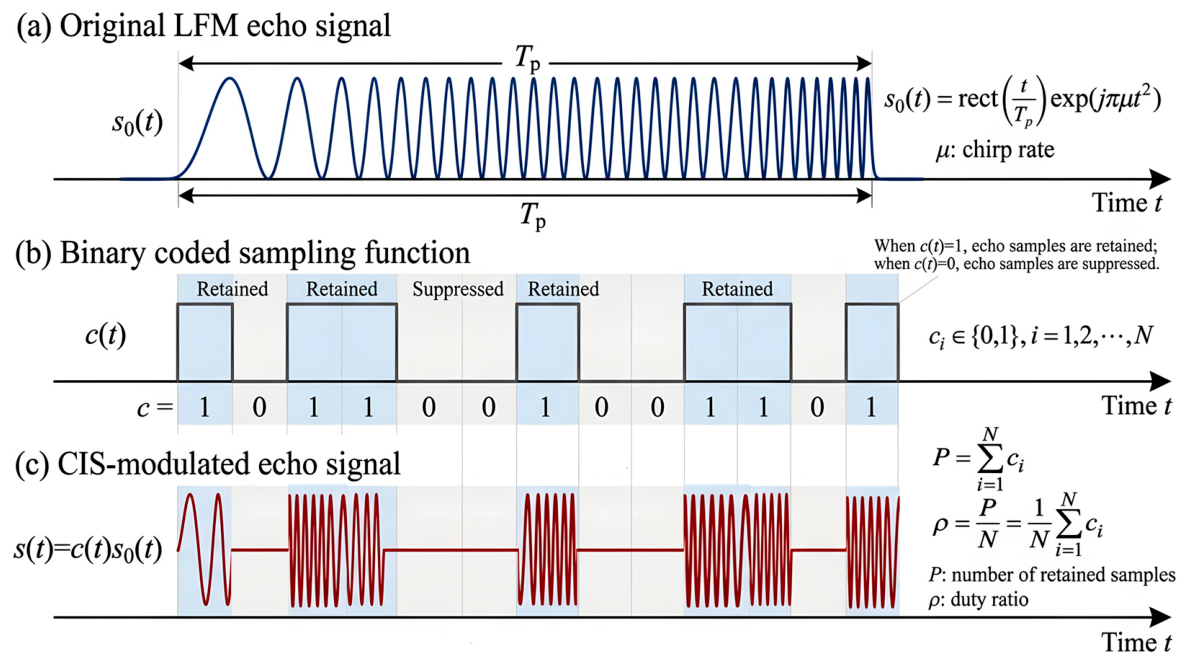
As shown in Figure 1, CIS is a radar signal modulation scheme that selectively preserves and suppresses echo samples according to a predefined binary coding sequence within a single pulse or observation period [11,31]. Unlike uniform interrupted sampling, CIS determines the retained positions via the coding sequence, thereby enabling a more flexible observation structure. For HRRP reconstruction, this modulation alters the distribution of echo samples while introducing incomplete observations, which transforms the range-profile formation from a complete observation problem into a reconstruction problem under limited samples.
The baseband linear-frequency-modulated (LFM) signal without interrupted modulation is given by
s 0 ( t ) = rect t T p exp ( j π μ t 2 )
where rect t / T p denotes a rectangular window function with pulse width T p , and μ is the chirp rate. Introducing a binary coded sampling function c t 0 , 1 , the equivalent observation signal after CIS processing can be expressed as
s ( t ) = c ( t ) s 0 ( t )
Equation (2) indicates that CIS selectively retains the original echo according to the binary coding function. When   c t = 1 , the echo sample is retained; when c t = 0 , it is suppressed. Consequently, the complete echo is truncated into several discontinuous fragments, which is mathematically equivalent to partial sampling.
Discretizing a single observation period into N sampling points yields the coding sequence
c = [ c 1 , c 2 , , c N ] T ,   c i { 0 , 1 }
where c i = 1 indicates that the i-th sampling point is retained, and c i = 0 indicates suppression. Let the number of valid observation points be
P = i = 1 N c i
The duty ratio of valid observations is defined as
ρ = P N = 1 N i = 1 N c i
The duty ratio ρ is defined as the fraction of retained samples in a single observation period. A small duty ratio drastically cuts the quantity of valid samples for HRRP formation and discards partial echo information. It is worth noting that the statistical noise model of retained samples remains unchanged under low-duty sampling. Nevertheless, the reduction in observation dimensionality renders the following reconstruction far more vulnerable to noise disturbances, modeling mismatches, and inter-range-cell echo correlations.
From the frequency-domain perspective, CIS is equivalent to multiplying the original echo by the coding sequence, which corresponds to the convolution of their spectra. This operation may cause spectral broadening and sidelobe elevation. After range compression, HRRP is prone to several phenomena, including weakened true scattering-center peaks, elevated sidelobe peaks, and increased false peaks. These effects constitute the main reason why HRRP reconstruction becomes difficult under Coded Interrupted Sampling conditions.

2.2. HRRP Sparse Observation Model Under Coded Interrupted Sampling

Under wideband radar observation, the HRRP of an extended target can be modeled as the coherent superposition of echoes from multiple scattering centers along the radar line of sight. Since the echo energy of typical targets is concentrated in a few dominant scattering centers, the HRRP exhibits sparsity in the range dimension.
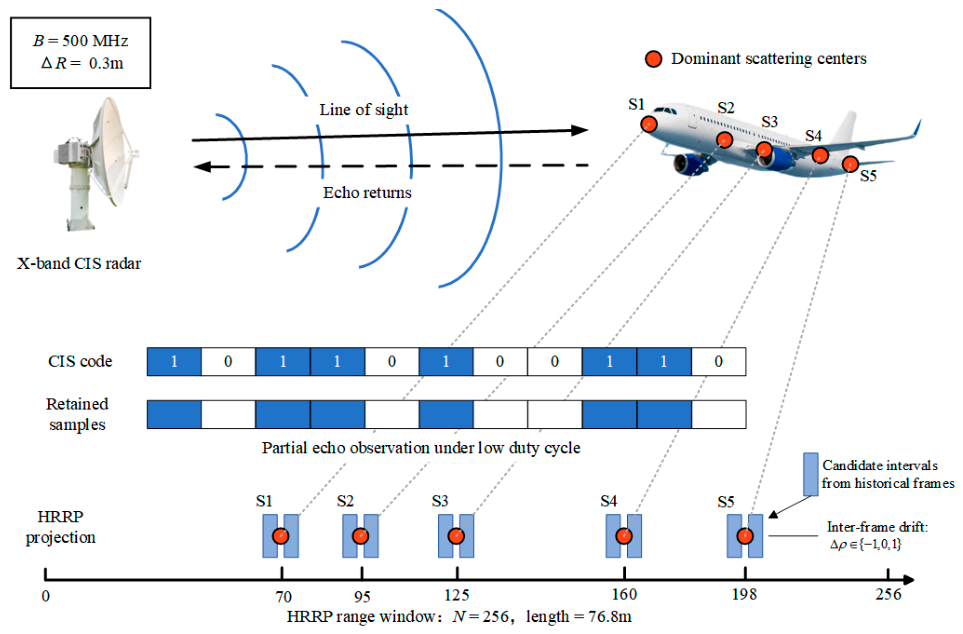
Figure 2 illustrates the HRRP observation scenario of an aircraft target under CIS. A wideband X-band radar observes the target along the radar line of sight, and several dominant scattering centers are projected onto the corresponding HRRP range cells. Under CIS, only the echo samples corresponding to coding value 1 are retained, whereas the remaining samples are suppressed. Therefore, the received data consist of discontinuous echo fragments rather than complete observations.
As shown in Figure 2, incomplete CIS observations reduce the available information for distinguishing true scattering-center responses from sidelobe and noise-induced peaks, especially under low-duty-cycle conditions. In continuous multi-frame observation, the dominant scattering-center locations usually exhibit only small frame-to-frame drift after range alignment. Therefore, stable scattering-center locations are extracted from historical frames.
Let the range dimension be discretized into N range cells. For the m-th frame, the scattering-center distribution is denoted by x N . If the target contains at most K dominant scattering centers and K N , then
x 0 K
Let Φ N × N denote the range-response dictionary under complete sampling. The complete echo of the m-th frame can be expressed as
s r m = Φ x m
where the j-th column of Φ represents the received echo response corresponding to a unit scattering center located in the j-th range cell.
Under CIS, only the echo samples where the coding sequence equals 1 are retained, whereas the remaining samples are suppressed. Consequently, the received data consist of discontinuous echo fragments, which reduces the information available for distinguishing true scattering centers from sidelobe and noise-induced peaks. This selective reception process is represented by a selection matrix G ( m ) { 0 , 1 } P m × N , where P m is the number of retained samples in the m-th frame. Accordingly, the retained echo can be written as
y ˜ m = G m s r m + n ˜ m = G m Φ x m + n ˜ m
where n ˜ ( m ) denotes the noise term at the retained sampling positions. For notational simplicity, y ˜ ( m ) and n ˜ ( m ) are hereafter denoted as y ( m ) and n ( m ) , respectively. Defining the equivalent sensing matrix as A m = G m Φ , the CIS-based HRRP observation model can be written as
y m = A ( m ) x ( m ) + n ( m ) ,   m = 1 , 2 , , M
Here, A m = G m Φ is the equivalent sensing matrix determined jointly by the range-response dictionary and the CIS pattern of the m-th frame. Its j-th column represents the retained echo response of a unit scattering center located in the j-th range cell.
Since P ( m ) is typically smaller than N , particularly under low-duty-ratio conditions, estimating x ( m ) from y ( m ) constitutes an underdetermined sparse reconstruction problem. Under the sparsity constraint in Equation (6), the HRRP reconstruction for the m-th-frame can be formulated as
x ^ m = arg min x m y ( m ) A ( m ) x m 2 2 ,   s . t .   x m 0 K
Equation (10) shows that HRRP reconstruction under CIS requires identifying dominant scattering-center locations and estimating their complex amplitudes from incomplete observations. Under low-duty-ratio or low-SNR conditions, sidelobe, noise-induced, and false peaks may yield matched responses comparable to those of true scattering centers, thereby reducing the stability of frame-by-frame OMP reconstruction. In addition, independently searching all range cells in each frame ignores the inter-frame continuity of dominant scattering centers and increases computational cost. To address these limitations, the next section introduces multi-frame sequential priors to guide current-frame atom selection using stable scattering-center locations extracted from historical frames.

3. Frame-Sequential HRRP Compressed Sensing Reconstruction Method

Based on the sparse observation model established in Section 2 and the difficulties of single-frame reconstruction under low-duty-ratio and low-SNR conditions, the CI-OMP algorithm is proposed. It incorporates scattering-center positions that appear stably in historical frames into the OMP range-cell search, narrowing the search range to candidate intervals and reducing the probability of mistakenly selecting sidelobe or false peaks.

3.1. Overall Framework of the Proposed CI-OMP Method

In sequential wideband radar HRRP reconstruction, dominant scattering centers generally exhibit inter-frame continuity under limited target-aspect variation, whereas noise-induced peaks and mismatch-related false atoms tend to occur randomly across range cells. Based on this characteristic, CI-OMP exploits multi-frame sequential priors to guide the sparse reconstruction of CIS radar echoes, thereby improving the reliability of atom selection under low-duty-ratio or low-SNR conditions.
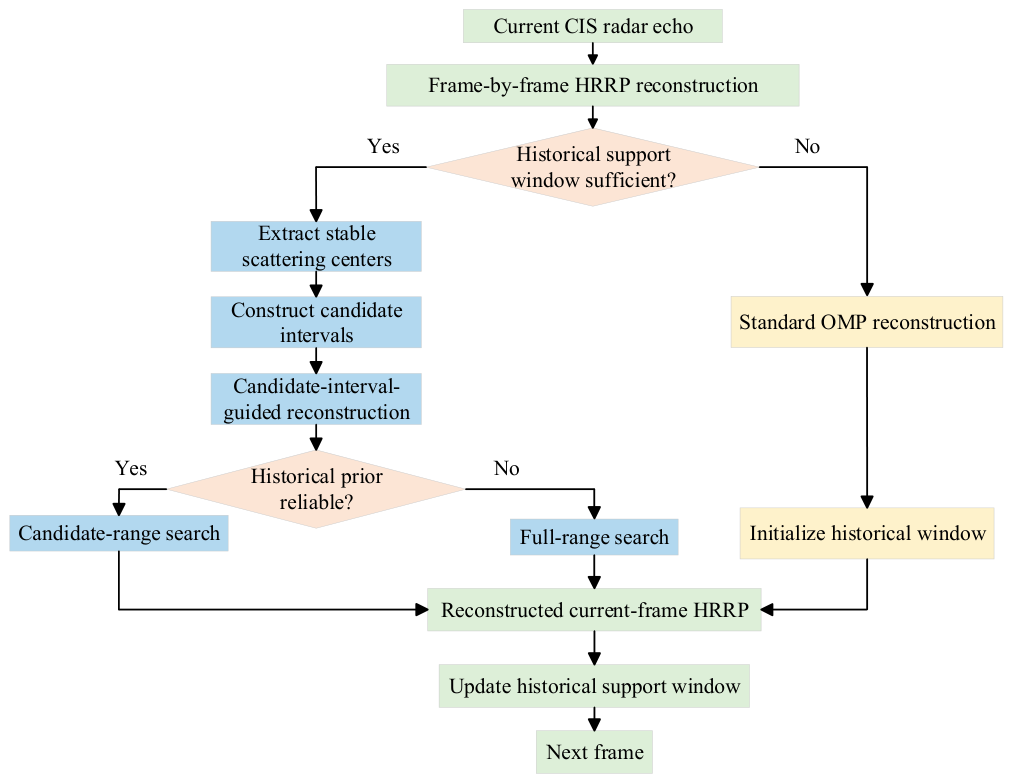
The overall flowchart of CI-OMP is shown in Figure 3. When historical support information is insufficient, standard OMP is applied frame by frame to initialize and update the historical window. Once sufficient historical HRRPs have been accumulated, stable scattering-center locations and their occurrence frequencies are extracted from the historical supports and used to construct candidate range intervals and stability weights. Current-frame reconstruction is then performed through weighted atom selection, followed by orthogonal projection and residual updating. The construction of the candidate intervals and the atom-selection procedure are detailed in Section 3.2 and Section 3.3, respectively.
Compared with standard OMP, CI-OMP concentrates atom selection within candidate intervals associated with stable historical scattering centers, thereby mitigating sidelobe- and ghost-peak-induced false selections while reducing the effective atom-search space. Historical information guides only support localization, whereas the complex amplitudes of the scattering centers are estimated from the current-frame observations.

3.2. Extraction of Historical-Frame Scattering Centers and Construction of Candidate Range Intervals

For the current m-th frame, the historical scattering-center position set is first constructed from the previous L frames
S hist ( m ) = l = 1 L S ^ m l
This set contains the range cells identified as dominant scattering centers within the historical window. Positions that appear repeatedly across multiple frames are more likely to correspond to stable target structures, whereas occasional single-frame peaks are more likely to arise from noise, sidelobes, or interrupted-sampling-induced false peaks.
Owing to target attitude variations, range migration, and reconstruction errors, the historical scattering-center positions cannot be directly used as the sole search points for the current frame. Therefore, these positions are expanded by Δ range cells to the left and right to form the candidate range interval
C ( m ) = q j S hist ( m ) ,   | q j | Δ
where Δ is the interval half-width, and C ( m ) is the set of range cells prioritized for search in the current frame. This interval allows small scattering-center migrations while reducing the participation of false peaks located far from the historical target structure.
The parameter Δ controls the positional constraint strength. A small Δ risks excluding true scattering centers owing to migration or positioning errors, whereas a large Δ weakens false-peak suppression. Thus, Δ should balance tolerance for small positional offsets against suppression of false peaks.
To distinguish stable positions from occasional peaks, a positional stability weight is assigned according to the occurrence frequency of each range cell within the historical window:
w j ( m ) = 1 + α 1 L l = 1 L 1 j S ^ m l
where 1 ( ) is the indicator function, and α ≥ 0 is the historical weighting coefficient. Range cells that appear repeatedly receive increased weights. When α = 0, historical stability weighting is disabled. This weighting scheme is a soft mechanism: no range cell is completely excluded from the search, and the primary selection criterion remains the current-frame matched response. This weight only adjusts search priority within the candidate interval; the current-frame matched response remains the primary criterion for range-cell selection.
For the first frame, or when insufficient historical frames are available, the algorithm uses standard OMP for initialization. Candidate-interval-assisted search is enabled after sufficient historical results have been accumulated.
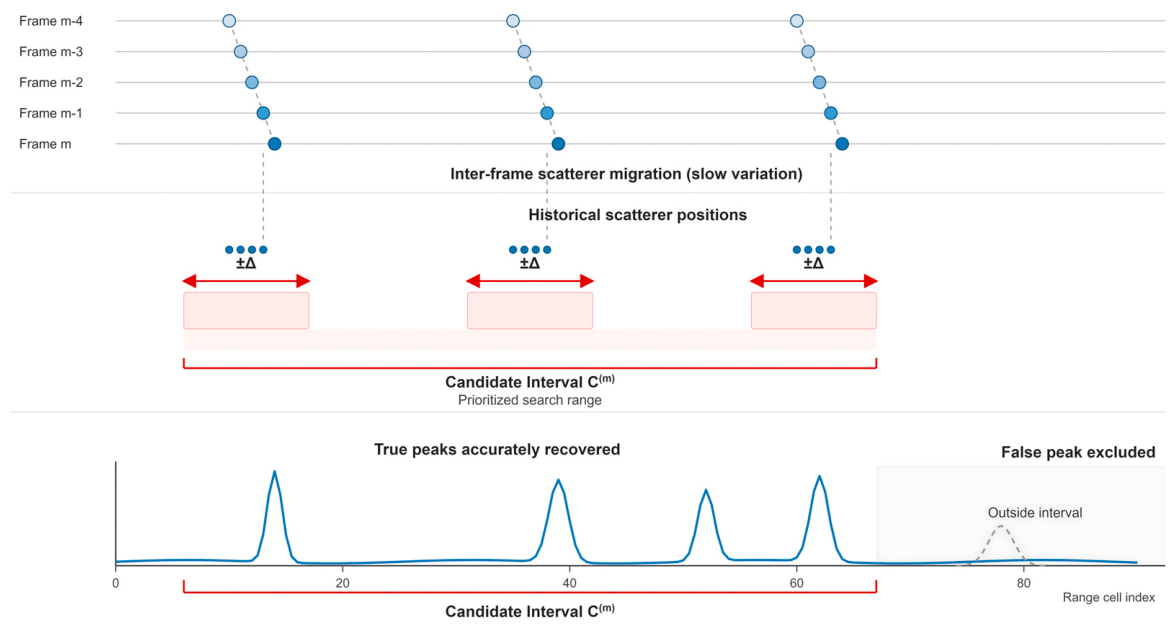
Figure 4 illustrates the inter-frame migration of scattering centers and the construction of candidate range intervals. The blue circles represent the scattering-center positions recovered from the historical frames, while the dashed lines indicate their slow positional variation across consecutive frames. These historical positions are expanded by ± Δ range cells, and the resulting intervals are merged to form the candidate set C ( m ) for the current frame. As illustrated in the lower part of the figure, the true scattering-center peaks remain within the candidate intervals despite small inter-frame shifts, whereas an isolated false peak outside these intervals is excluded from the prioritized search. Thus, the candidate intervals preserve tolerance to scattering-center migration while reducing false atom selection.

3.3. Candidate-Interval-Assisted OMP Reconstruction

During current-frame reconstruction, CI-OMP retains the iterative atom matching and orthogonal projection framework of standard OMP while incorporating historical scattering-center priors into the atom-selection stage. When the number of available historical frames is smaller than the historical-window length L , standard OMP is applied frame by frame to reconstruct the current HRRP and initialize the historical support window. Once sufficient historical support has been accumulated, the stable scattering-center locations extracted in Section 3.2 are used to construct the candidate range intervals and the corresponding stability weights. The candidate-interval-assisted reconstruction procedure is described below.
Let r t 1 ( m ) denote the residual before the t-th iteration of the m-th frame and let S ^ t 1 m denote the support selected during the preceding iterations. When the candidate range set C ( m ) , i.e.,
Ω t ( m ) = C ( m ) S ^ t 1 m
Within this search region, CI-OMP selects the range cell that provides the strongest weighted correlation with the current residual. To incorporate the sequential scattering-center prior, the stability weight is introduced into the atom-matching criterion as
j t = arg max j Ω t ( m )   w j ( m ) a j ( m ) H r t 1 ( m )
where a j ( m ) is the j-th atom of the equivalent echo-response matrix A m , corresponding to the j-th range cell, and H denotes the conjugate transpose. Equation (15) selects the atom that best matches the current residual within the historically indicated search region. Range cells that occur consistently in the historical support window are assigned moderately higher priorities, whereas the current-frame atom–residual correlation remains the dominant selection criterion.
If the candidate search region is empty or contains no available unselected range cells, the search region is expanded to the full range-cell domain:
Ω t ( m ) = { 1 , 2 , , N } S ^ t 1 m
where N is the total number of range cells. This ensures that the algorithm retains the global search capability of standard OMP when historical information is temporarily insufficient.
After a new range cell has been selected, the current-frame support is updated as
S ^ t m = S ^ t 1 m { j t }
The complex scattering-center amplitudes are then estimated over the updated support using the current-frame observations:
x ^ S ^ t ( m ) ( m ) = arg min z y ( m ) A S ^ t ( m ) ( m ) z 2 2
where A S ^ t ( m ) ( m ) is the submatrix of A m containing the atoms indexed by S ^ t m . Equation (18) estimates the complex amplitudes exclusively from the current-frame observations over the selected support. Historical information is used only to guide support localization and does not directly participate in scattering-center amplitude estimation.
The residual is subsequently updated by subtracting the reconstructed echo from the current-frame observation:
r t ( m ) = y ( m ) A S ^ t ( m ) x ^ S ^ t m
The above atom-selection, amplitude-estimation, and residual-update procedures are repeated until the sparsity upper bound K is reached or the residual norm falls below the preset threshold ϵ . After the reconstruction of the m-th frame is completed, the recovered support supp ( x ^ m ) is added to the historical window and used to guide the reconstruction of subsequent frames. The complete CI-OMP procedure is summarized in Algorithm 1.
Algorithm 1. Candidate-Interval Assisted Orthogonal Matching Pursuit (CI-OMP).
Input:   The   observed   echo   y ( m ) ,   the   equivalent   echo - response   matrix   A ( m ) , the sparsity upper bound K , the historical window length L , the candidate-interval width Δ , the historical weighting coefficient α , and the residual threshold ϵ .
Output:  The   HRRP   reconstruction   x ^ m of the m-th frame.
     1.
if the number of available historical frames is less than L
     2.
x ^ m O M P ( y ( m ) , A ( m ) , K , ϵ )
     3.
Update   the   historical   window   with   supp ( x ^ m )
     4.
return   x ^ m
     5.
end if
     6.
S h i s t m l = 1 L S ^ m l
     7.
C m { q | j S h i s t m , | q j | Δ }
     8.
w j ( m ) 1 + ( α / L )   l 1 L 1 j S ^ m l
     9.
r 0 ( m ) y ( m ) , S ^ 0 ( m ) , t 1
     10.
while   t K   and   | | r t 1 ( m ) | | 2 > ε do
     11.
Ω t ( m ) C ( m )   \ S ^ t 1 m
     12.
if   Ω t ( m ) = then
     13.
Ω t ( m ) { 1 , 2 , , N } \   S ^ t 1 m
     14.
end if
     15.
j t * argmax j Ω t ( m ) w j ( m ) | ( a j ( m ) ) H r t 1 ( m ) |
     16.
S ^ t m S ^ t 1 m j t *
     17.
x ^ S ^ t m argmin z | | y ( m ) A S ^ t ( m ) z | | 2 2
     18.
r t ( m ) y ( m ) A S ^ t ( m ) x ^ S ^ t ( m )
     19.
t t + 1
     20.
end while
     21.
x ^ ( S ^ t ) c ( m ) 0
     22.
Update   the   historical   window   with   supp ( x ^ m )
     23.
return   x ^ m

4. Simulation Experiments and Analysis

4.1. Simulation Scenario and Evaluation Metrics

To verify the performance of multi-frame sequential priors on HRRP reconstruction under CIS modulation, a continuous observation scenario of an airborne target by a broadband radar was simulated. The radar operates in the X-band with a transmitted signal bandwidth of B = 500 MHz, yielding a range resolution of Δ R = c / 2 B = 0.3   m . The range dimension was discretized into N = 256 cells, corresponding to a range window of 76.8 m. Under short-time continuous observation, the dominant scattering centers exhibit only small frame-to-frame variations. The position of the i-th scattering center is modeled as
p i ( m ) = p i ( m 1 ) + Δ p i ( m )
where a position change occurs with probability 0.35 and is limited to one range cell (0.3 m) between adjacent frames. The amplitudes follow a first-order smooth evolution with a smoothing coefficient of 0.90 and a perturbation magnitude of 0.05, while the phases follow a random walk with an increment standard deviation of 0.08 rad. These settings produce correlated but nonidentical HRRP profiles across frames.
A five-point scattering-center model of an aircraft is assumed. The model parameters are listed in Table 1.
To quantify HRRP reconstruction performance, the normalized mean squared error (NMSE) and tolerance-support recovery rate (Tol-SRR) were adopted as the primary metrics, with the peak-to-sidelobe ratio (PSLR) as an auxiliary metric. NMSE measures the overall error between the reconstructed HRRP and the true HRRP and is defined as
NMSE = x ^ ( m ) x ( m ) 2 2 x ( m ) 2 2
where x ( m ) is the true HRRP of the m-th frame, and x ^ ( m ) is the corresponding reconstruction result. A smaller NMSE indicates that the reconstructed result is closer to the true HRRP.
Tol-SRR evaluates the recovery of scattering-center locations. Let S ( m ) be the set of true scattering-center locations, S ^ ( m ) the estimated set, and δ the position tolerance. A true scattering center is considered correctly recovered if an estimated location exists within δ range cells. Tol-SRR is defined as
Tol - SRR m = 1 | S ( m ) | i S ( m ) 1 min j S ^ ( m ) | i j | δ
where 1 ( ) is the indicator function. A higher Tol-SRR indicates better recovery of true scattering-center locations.
The exact scattering-center recovery rate (Exact-SRR) is also defined as a variant of Tol-SRR with zero position tolerance (δ = 0). Exact-SRR measures the fraction of true scattering centers whose recovered positions exactly match the true positions. While Exact-SRR is more stringent, it is sensitive to discretization effects and is used primarily for parameter sensitivity analysis (Section 4.5). For general performance evaluation, Tol-SRR with δ = 1 range cell is adopted.
To further measure the separability between true scattering centers and sidelobe or false peaks, the target-peak region is defined as the neighborhood of the true scattering centers.
T ( m ) = q i S ( m ) , | q i | δ
Based on this region, the PSLR of the reconstructed HRRP in the m-th frame is defined as
PSLR ( m ) = 20 log 10 max q T ( m ) | x ^ q ( m ) | max q T ( m ) | x ^ q ( m ) | + η
where x ^ q ( m ) is the reconstructed amplitude at the q-th range cell, and η = 1 × 10 10 is a small positive constant to avoid division by zero. A higher PSLR indicates that the target peaks are more prominent relative to non-target peaks.
To evaluate the search efficiency of CI-OMP, the average search cardinality ratio (ASCR) is adopted. Let Ω m , t denote the set of range cells searched during the t-th iteration of the m-th frame, T m the number of iterations for the m-th frame, and M the number of continuously observed frames. Then,
R ASCR = m = 1 M t = 1 T m Ω m , t m = 1 M t = 1 T m ( N t + 1 )
where N is the total number of range cells. For standard OMP, at the t-th iteration, the search space excludes the already selected t 1 atoms, so its cardinality is N t + 1 . Thus, the denominator in (25) exactly equals the total search cost of standard OMP, yielding R A S C R = 1 for standard OMP. For CI-OMP, a smaller R A S C R indicates a greater reduction in the search scale achieved by the candidate-interval strategy. Equivalently, this corresponds to a search space compression of 1 R A S C R × 100 % compared with standard OMP.
All reported results are averaged over Monte Carlo trials. Error bars in the figures denote the 95% confidence interval, computed using the paired-sample t-distribution.

4.2. Reconstruction Performance Under Different Duty Ratios

To evaluate the influence of the duty ratio on HRRP reconstruction under CIS, the SNR was fixed at 0 dB, and the duty ratio was varied from 0.08 to 0.25. This low-to-medium duty-ratio range was selected to represent the challenging CIS conditions relevant to LPI enhancement, under which only a small proportion of the echo samples are retained. In this regime, the reduced number of valid samples makes conventional sparse reconstruction less reliable, thereby allowing the benefit of the multi-frame sequential prior to be evaluated more clearly. The target HRRP contained five dominant scattering centers at range cells 70, 95, 125, 160, and 198. For CI-OMP, the historical-window length, candidate-interval half-width, and Tol-SRR tolerance were set to L = 5 , Δ = 4 , and δ = 1 range cell, respectively. Matched filtering (MF), standard OMP, a warm-started OMP (WS-OMP) baseline, and CI-OMP were compared using representative reconstruction results and Monte Carlo statistics. WS-OMP restricts atom search to the neighborhood of the previous frame’s support and serves as a single-frame prior baseline to isolate the benefit of multi-frame statistics. MF directly applies pulse compression to the interrupted echoes without sparse reconstruction and is included as a conventional radar-processing baseline to demonstrate the benefit of sparse reconstruction in suppressing sidelobes and false peaks.
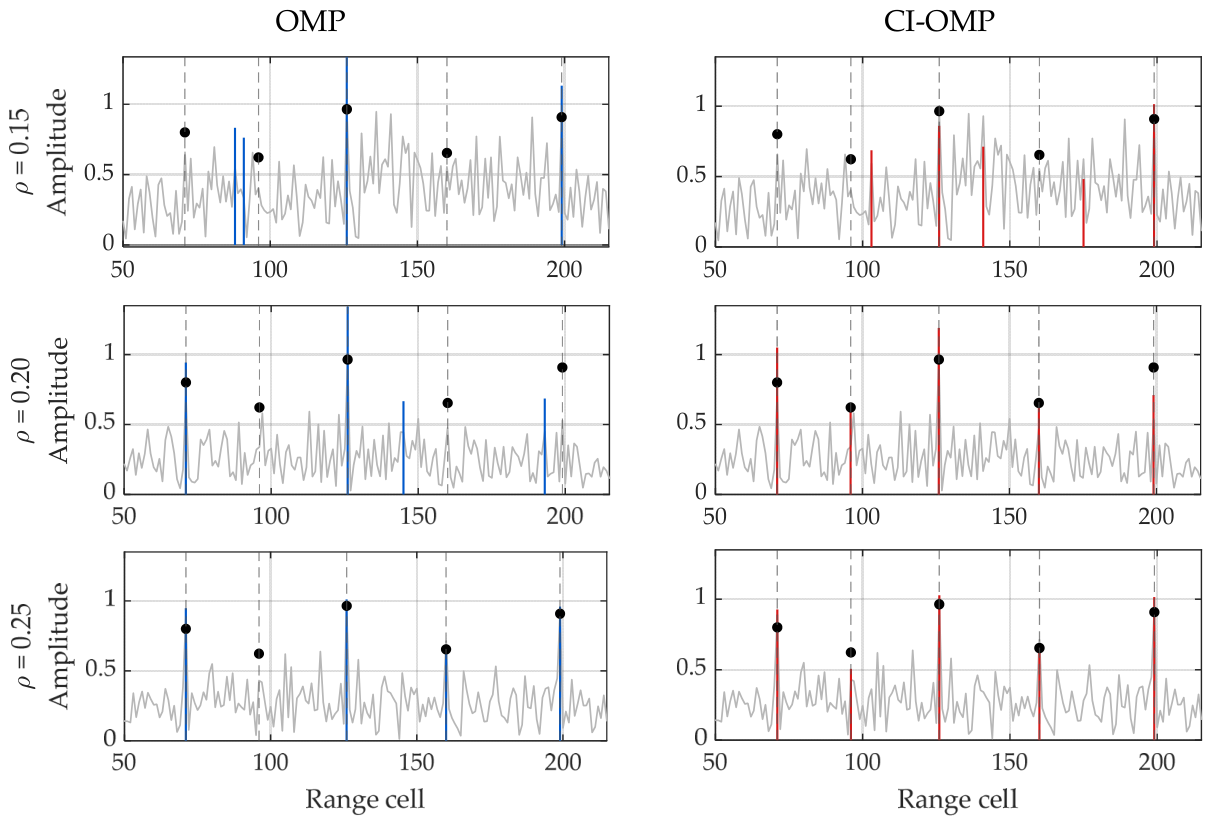
Figure 5 presents representative HRRP reconstruction results under different duty ratios. In the figure, the gray stems denote the matched-filtering output, the black markers indicate the true scattering-center locations, and the blue and red stems represent the reconstructed HRRPs obtained by OMP and CI-OMP, respectively. At low duty ratios, only a small portion of the echo samples is retained, resulting in pronounced sidelobe and false-peak components in the matched-filtering output. In this case, standard OMP tends to select locally strong false peaks, leading to missed scattering centers or range-position deviations. In contrast, CI-OMP provides more stable reconstructions, with the recovered peaks more concentrated around the true scattering-center locations and fewer obvious false peaks.
As the duty ratio increases, more valid echo samples become available, and the reconstruction performance of both OMP and CI-OMP improves. However, CI-OMP still exhibits better agreement with the true HRRP. In the medium-duty-ratio cases, OMP can recover part of the true scattering structure, but residual false peaks and position offsets remain. When the duty ratio reaches ρ = 0.20 and ρ = 0.25 , the reconstructed peaks of CI-OMP are highly consistent with the true scattering-center positions, indicating improved localization stability and peak separability.
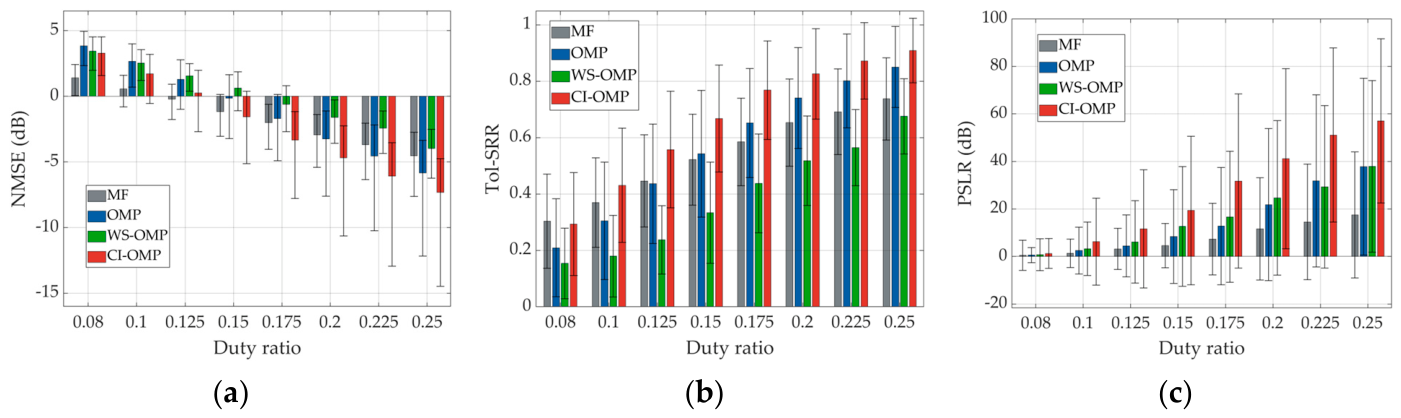
To further verify the statistical reliability of the visual results, Monte Carlo experiments were conducted under different duty ratios. The results were averaged over 100 independent trials. The error bars in Figure 6 represent 95% confidence intervals, confirming the statistical significance of the observed performance differences. Figure 6 presents the NMSE, Tol-SRR, and PSLR results of MF, OMP, WS-OMP, and CI-OMP.
As presented in Figure 6a, the NMSE values of all four methods, expressed in decibels, generally decrease as the duty ratio increases because more valid echo samples become available for HRRP reconstruction. At extremely low duty ratios, MF exhibits a lower NMSE than OMP, WS-OMP, and CI-OMP. In this severely undersampled regime, sparse support estimation becomes unstable, and incorrect atom selection may produce large localization and amplitude errors. In contrast, although the MF output contains broadened peaks and high sidelobes, its energy remains distributed around the true scattering-center locations, which can result in a smaller global NMSE. However, this does not indicate more accurate scattering-center recovery, as reflected by its lower Tol-SRR and PSLR in Figure 6b,c. As the duty ratio increases, sparse reconstruction becomes more reliable, and both WS-OMP and CI-OMP achieve lower NMSE than standard OMP, with CI-OMP achieving the lowest NMSE owing to the use of multi-frame sequential priors. Specifically, as ρ increases from 0.08 to 0.25, the NMSE of OMP decreases from 2.4211 dB to 0.2633 dB, that of WS-OMP decreases from 2.1548 dB to 0.2011 dB, whereas that of CI-OMP decreases from 2.1440 dB to 0.1791 dB.
Figure 6b compares the Tol-SRR of all methods. CI-OMP consistently achieves the highest Tol-SRR, followed by WS-OMP, with standard OMP exhibiting the lowest Tol-SRR. Over the tested duty-ratio range, the Tol-SRR of OMP increases from 0.2029 to 0.8524, that of WS-OMP increases from 0.3280 to 0.9019, while that of CI-OMP increases from 0.2937 to 0.9171. The improvement is more evident in the medium-to-low duty-ratio region. For example, at ρ = 0.125 and ρ = 0.15 , CI-OMP improves Tol-SRR over OMP by 0.1445 and 0.1356, respectively, and over WS-OMP by 0.0879 and 0.0821, respectively. These results demonstrate that CI-OMP is more robust in locating true scattering centers than both standard OMP and WS-OMP when the current-frame echo samples are insufficient.
Figure 6c presents the PSLR results. CI-OMP achieves higher PSLR than both OMP and WS-OMP under different duty ratios. At ρ = 0.20 , the PSLR of OMP is 18.51 dB, that of WS-OMP is 21.38 dB, which is 7.56 dB higher than that of OMP. This result is consistent with the visual comparison in Figure 5, where CI-OMP produces cleaner peak structures and fewer false peaks. When the duty ratio further increases to ρ = 0.25 , the performance gap between OMP, WS-OMP, and CI-OMP begins to decrease because the current-frame observations become increasingly sufficient for reliable reconstruction by standard OMP. Nevertheless, CI-OMP still maintains lower NMSE, higher Tol-SRR, and higher PSLR over the tested duty-ratio range.
Table 2 summarizes the performance gains of CI-OMP over standard OMP and WS-OMP at representative duty ratios. All reported improvements are statistically significant at the 0.05 level based on paired-sample 95% confidence intervals, confirming that the observed performance gains are not due to random variation. Compared with standard OMP, CI-OMP improves NMSE by 0.78–1.71 dB, increases Tol-SRR by 0.0647–0.1445, and improves PSLR by 4.57–7.56 dB. Compared with WS-OMP, CI-OMP improves NMSE by 0.82–3.34 dB, increases Tol-SRR by 0.233–0.335, and improves PSLR by 2.95–19.12 dB. The gains are most evident in the medium-duty-ratio range. For example, at ρ = 0.20 , CI-OMP improves the NMSE by 1.71 dB over OMP and by 3.06 dB over WS-OMP, and improves PSLR by 7.56 dB over OMP and by 16.43 dB over WS-OMP. These quantitative results confirm that CI-OMP improves both HRRP reconstruction accuracy and scattering-center localization when the available echo samples are sufficient to support meaningful reconstruction.
As the duty ratio continues to increase, the current-frame observations become increasingly sufficient for reliable support recovery, and the additional benefit provided by the multi-frame sequential prior is expected to gradually diminish. In the limiting case of ρ 1 , the difference between OMP, WS-OMP, and CI-OMP is expected to approach zero because all three methods rely on increasingly complete current-frame observations.
Overall, the duty-ratio experiments demonstrate that CI-OMP provides more accurate and stable HRRP reconstruction than both standard OMP and WS-OMP, particularly at low-to-medium duty ratios. The consistent improvements in NMSE, Tol-SRR, and PSLR verify the effectiveness of the proposed candidate-interval strategy, which outperforms the simpler warm-start approach by leveraging stable scattering-center priors extracted from a multi-frame historical window rather than directly propagating the previous frame’s support.

4.3. Reconstruction Performance Under Different SNRs

To evaluate the noise robustness of the proposed method, the duty ratio was fixed at ρ = 0.20 , and the SNR was varied from −8 dB to 5 dB. The same target HRRP and CI-OMP parameters as in Section 4.2 were used.
Four methods were compared: MF, standard OMP, WS-OMP, and CI-OMP. The comparison isolates the benefit of different strategies for incorporating multi-frame sequential priors under varying noise levels. Figure 7 presents representative HRRP reconstruction results under different SNRs; Figure 8 presents the statistical results in terms of NMSE, Tol-SRR, and PSLR, and Table 3 summarizes the performance gains of CI-OMP over standard OMP and WS-OMP at representative SNR levels. For the Monte Carlo evaluation, the performance was calculated from frames 6 to 20 to avoid the initial transient stage in which historical information is insufficient, and the results were averaged over 100 independent trials.
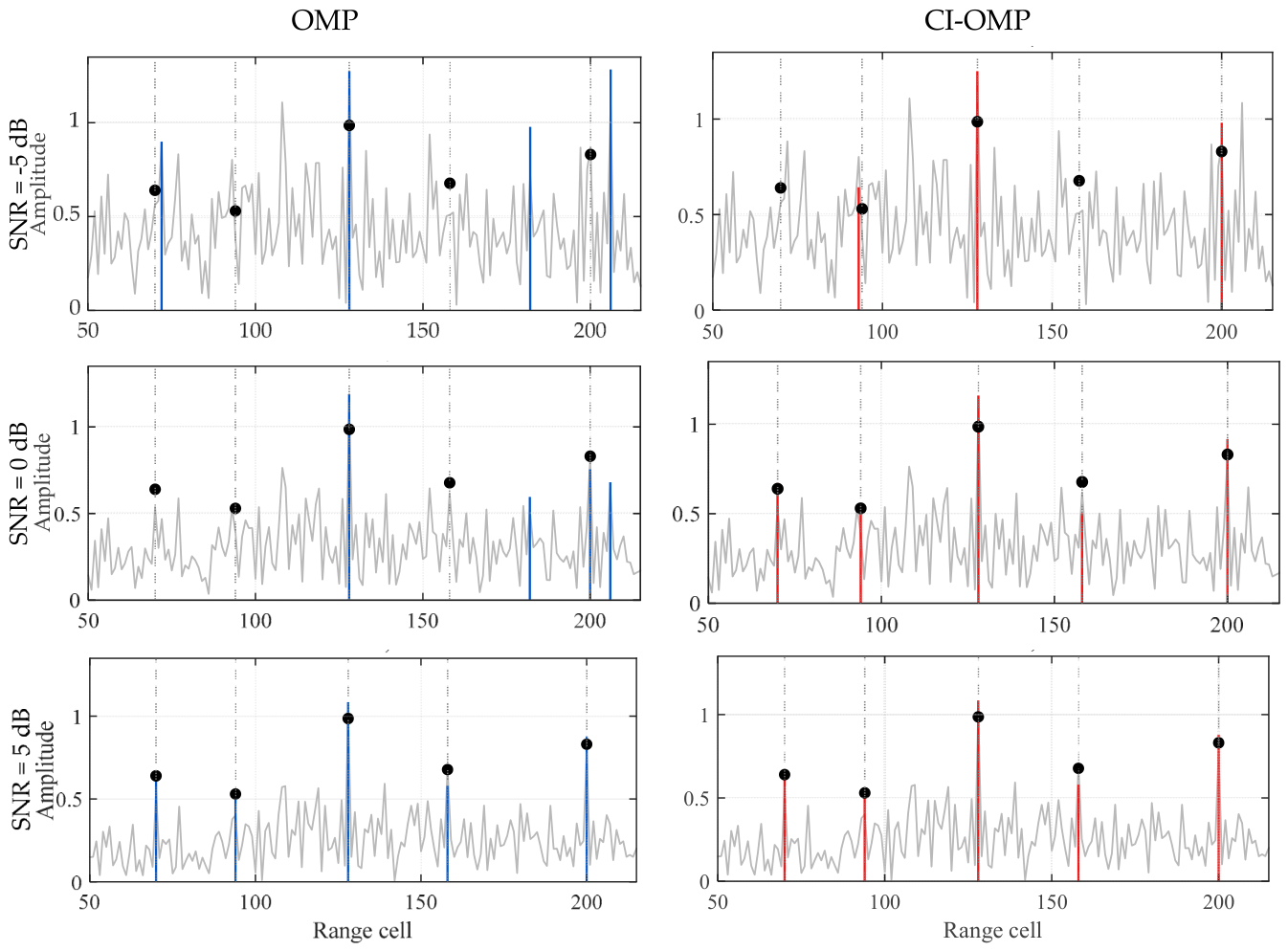
As presented in Figure 7, at the very low SNR of −5 dB, neither OMP nor CI-OMP can completely recover the true HRRP structure. Both methods exhibit missed detections and incorrect peak selections, indicating that the current observations are too severely degraded to support reliable reconstruction. Nevertheless, CI-OMP recovers more true scattering centers and produces fewer prominent false peaks than OMP, showing a limited but observable improvement under this extremely noisy condition.
When the SNR increases to 0 dB, the historical sequential prior employed by CI-OMP begins to play an effective role, and the difference between the two methods becomes pronounced. Standard OMP still selects several non-target range cells and misses some true scattering centers. In contrast, CI-OMP successfully recovers all five scattering centers, achieving complete support recovery, and its reconstructed peaks are well aligned with the true scattering-center locations.
At an SNR of 5 dB, the current-frame observation becomes sufficiently reliable, and the true scattering-center responses can be effectively distinguished from the sidelobe and false-peak components in the MF output. Consequently, both OMP and CI-OMP recover all five scattering centers, and their reconstructed HRRP profiles are essentially identical. Overall, Figure 7 shows that CI-OMP offers its most significant advantage at low SNR, provides only limited improvement when both methods fail at very low SNR, and converges to standard OMP at sufficiently high SNR.
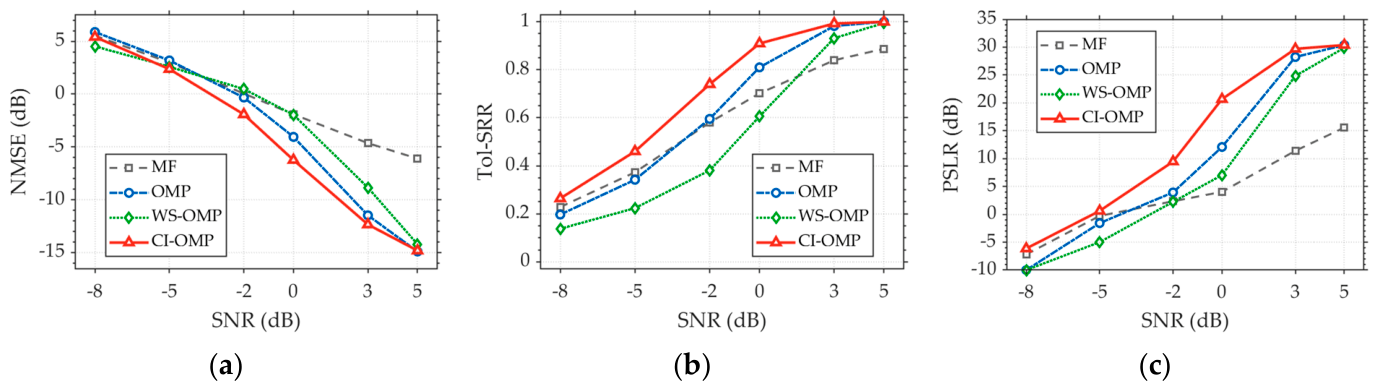
As shown in Figure 8a, the NMSE of all four methods decreases as the SNR increases, indicating that the HRRP reconstruction error is reduced when noise interference becomes weaker. The error bars represent 95% confidence intervals, demonstrating the statistical reliability of the observed performance differences. MF exhibits relatively high reconstruction error over most SNR conditions because it cannot effectively suppress the sidelobe and false-peak components introduced by interrupted sampling. Compared with standard OMP, both WS-OMP and CI-OMP achieve lower NMSE in the low-to-medium SNR range. CI-OMP consistently achieves the lowest NMSE across all tested SNRs. As summarized in Table 3, the NMSE reductions of CI-OMP relative to OMP are 1.61 dB and 2.21 dB at −2 dB and 0 dB, respectively, and relative to WS-OMP are 2.41 dB and 4.28 dB at −2 dB and 0 dB, respectively. This confirms that CI-OMP improves reconstruction accuracy when the current-frame matching response is disturbed by noise.
Figure 8b compares the Tol-SRR results. CI-OMP achieves higher Tol-SRR than both OMP and WS-OMP from −8 dB to 3 dB, with the most noticeable improvements appearing at −5 dB, −2 dB, and 0 dB. In this SNR range, noise-induced peaks and sidelobe peaks may have amplitudes comparable to those of true scattering centers, making both standard OMP and WS-OMP more likely to select incorrect range cells. WS-OMP improves over standard OMP by initializing with the previous frame’s support, but it does not fully suppress false selections when the previous frame’s prior is inaccurate. As the SNR increases beyond 3 dB, the Tol-SRR values of OMP, WS-OMP, and CI-OMP gradually converge because the current-frame observation alone becomes sufficient for stable scattering-center localization.
Figure 8c presents the PSLR results. CI-OMP achieves higher PSLR than both OMP and WS-OMP under low-to-medium SNR conditions. According to Table 3, the PSLR improvements of CI-OMP over OMP are 12.81 dB, 4.17 dB, and 8.01 dB at −5 dB, −2 dB, and 0 dB, respectively, and the PSLR improvements of CI-OMP over WS-OMP are 7.17 dB, 7.23 dB, and 13.63 dB at −8 dB, −2 dB, and 0 dB, respectively. These results are consistent with the representative HRRP reconstructions in Figure 7, where CI-OMP produces cleaner peak structures and fewer non-target peaks. When the SNR increases to 3 dB and 5 dB, the PSLR improvement becomes smaller because standard OMP can already distinguish the main scattering centers from the background peaks under relatively high-quality observations.
Table 3 summarizes the performance gains of CI-OMP over OMP and WS-OMP at different SNRs. All reported improvements are statistically significant at the 0.05 level based on paired-sample 95% confidence intervals, confirming that the observed performance gains are not due to random variation. CI-OMP generally improves NMSE, Tol-SRR, and PSLR, with its clearest overall advantage appearing at low-to-medium SNRs. The maximum NMSE and Tol-SRR improvements over OMP are 2.21 dB at 0 dB and 0.142 at −2 dB, respectively. Compared with WS-OMP, CI-OMP achieves even larger gains: the maximum NMSE improvement is 4.28 dB at 0 dB, and the maximum Tol-SRR improvement is 0.358 at −2 dB. Although the PSLR improvement reaches 18.29 dB at −8 dB, the low absolute Tol-SRR values at −8 and −5 dB indicate that gains under these extremely noisy conditions should be interpreted as relative metric improvements rather than reliable recovery of the complete scattering-center structure. At high SNRs, the performance gap narrows as current-frame observations become more reliable, consistent with Figure 8.
Overall, the SNR experiments demonstrate that CI-OMP outperforms both OMP and WS-OMP under low-to-medium SNR conditions, with consistent improvements in NMSE, Tol-SRR, and PSLR. The candidate-interval strategy, which leverages multi-frame historical priors, proves more effective than both the uninformed greedy search of OMP and the single-frame warm-start of WS-OMP. The advantage is most pronounced when noise-induced false peaks interfere with atom selection and diminishes at high SNRs when current-frame observations become sufficient.

4.4. Search Efficiency and Computational Complexity Analysis

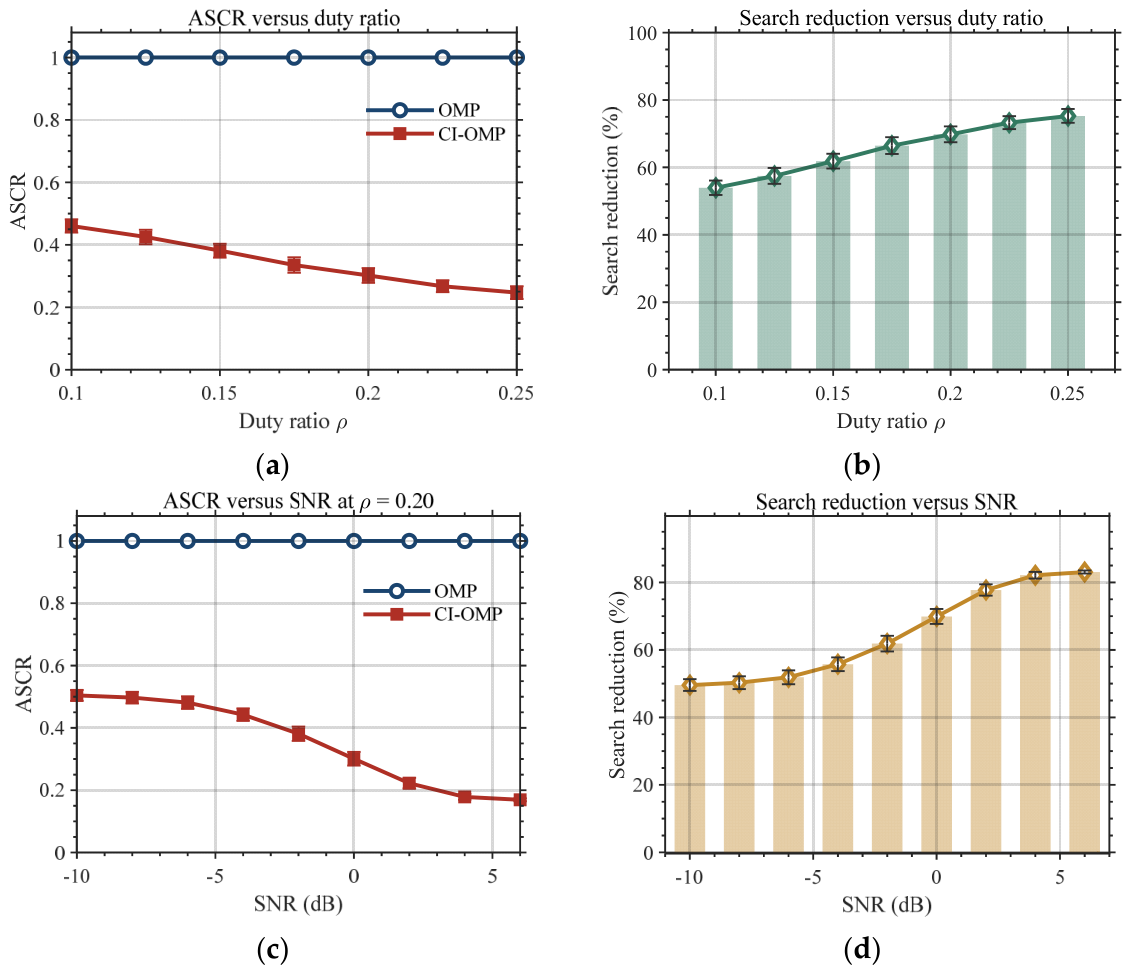
The search efficiency of CI-OMP is evaluated using the ASCR, where standard OMP serves as the baseline with an ASCR of one. A lower ASCR indicates a smaller atom search scale and thus higher search efficiency. The search-reduction ratio is calculated as 1 R A S C R × 100 % , where R A S C R denotes the ASCR of CI-OMP.
Figure 9 presents the search-efficiency comparison between standard OMP and CI-OMP under different duty-ratio and SNR conditions. According to Figure 9a, standard OMP maintains an ASCR of one because it searches over the full range-cell domain at each iteration. In contrast, CI-OMP consistently achieves a much lower ASCR by restricting atom matching to candidate range intervals constructed from historical scattering-center supports. As the duty ratio increases from 0.10 to 0.25, the ASCR of CI-OMP decreases from approximately 0.46 to 0.25. Accordingly, the atom-search-range reduction increases from approximately 54% to 75%, as illustrated in Figure 9b. For example, at ρ = 0.20 , CI-OMP achieves an ASCR of approximately 0.30, corresponding to an atom-search-range reduction of approximately 70%. These results indicate that the proposed candidate-interval strategy can effectively compress the scattering-center search range under different sampling conditions.
The SNR-dependent results in Figure 9c,d further verify the search-efficiency advantage of CI-OMP. With ρ fixed at 0.20, the ASCR of CI-OMP decreases from approximately 0.50 at an SNR of −10 dB to approximately 0.17 at 6 dB. The corresponding atom-search-range reduction therefore increases from approximately 50% to 83%, as presented in Figure 9d. Even under the severe noise condition of −10 dB, CI-OMP still reduces nearly half of the atom search scale. At an SNR of 0 dB, the atom-search-range reduction is approximately 70%, and it reaches approximately 83% at 6 dB. This trend indicates that more reliable historical scattering-center priors allow CI-OMP to concentrate the atom search on a narrower and more informative range region.
From a computational-complexity perspective, ASCR reflects the reduction in the dominant atom-search cost. In terms of the atom-search stage, which dominates the overall computational cost of OMP-based reconstruction, the search complexity is reduced from approximately O K N in standard OMP to O K R A S C R N in CI-OMP, excluding occasional fallback searches. The least-squares projection and residual update stages remain unchanged between the two methods.

4.5. Parameter Sensitivity and Ablation Analysis

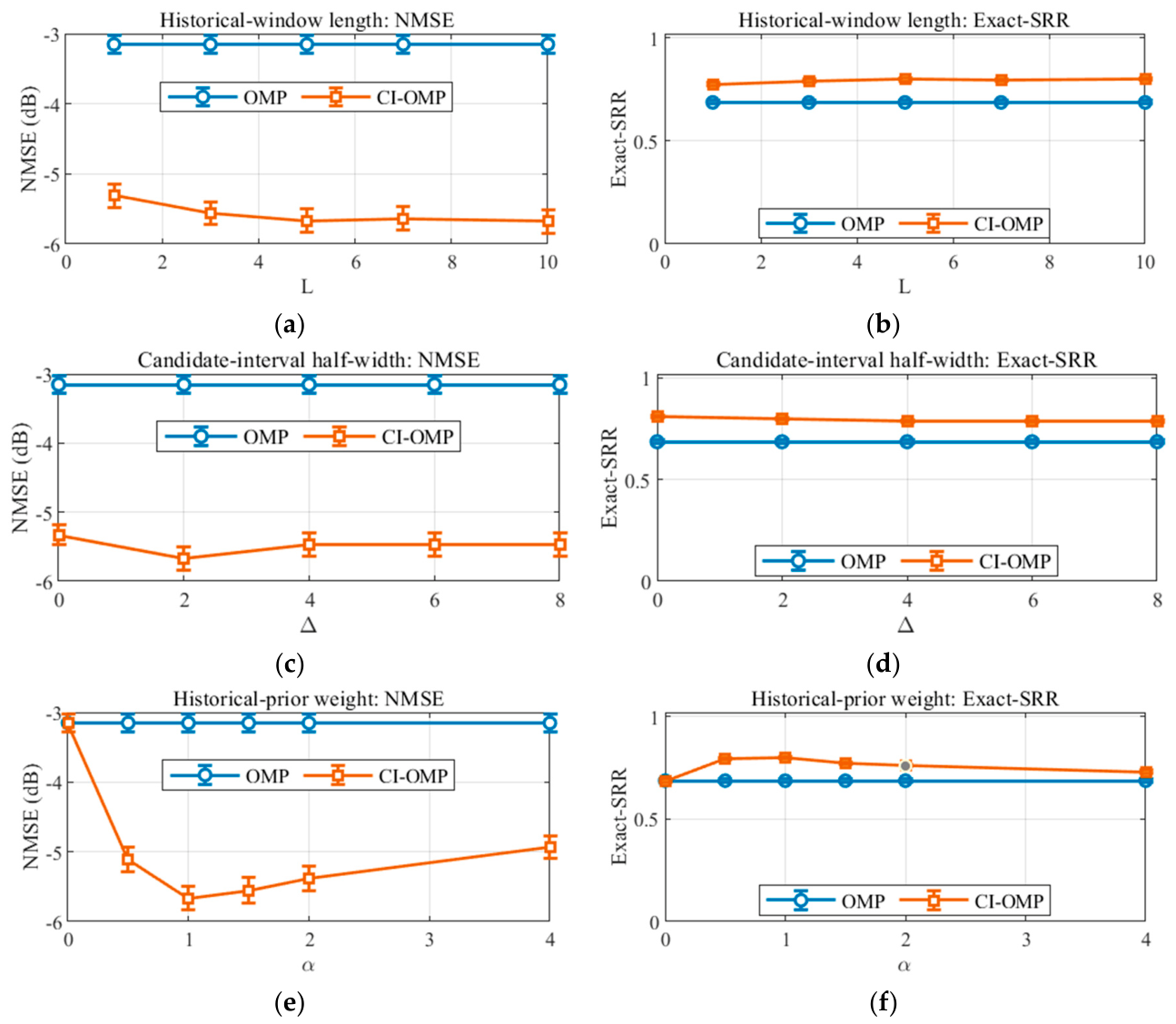
The sensitivity of CI-OMP to its three principal parameters—the historical-window length L, the candidate-interval half-width Δ, and the historical-prior weight α—was investigated under a challenging coded interrupted-sampling condition. The HRRP dimension and sparsity level were set to N = 256 and K = 5, respectively. Each 25-frame sequence was tested at ρ = 0.20 and SNR = 0 dB. All results were averaged over 100 paired Monte Carlo trials using identical target realizations, noise samples, and sampling patterns for OMP and CI-OMP. During each one-factor-at-a-time scan, the remaining two parameters were fixed at L = 5, Δ = 4, and α = 1.
Regarding the ablation of the candidate-interval strategy, WS-OMP provides an effective ablation. WS-OMP reuses the previous frame’s support without constructing candidate intervals or employing historical weighting. The three methods form a progressive ablation hierarchy: standard OMP (no prior), WS-OMP (single-frame persistence without intervals), and CI-OMP (multi-frame intervals with weighting). The performance gap between WS-OMP and CI-OMP, as demonstrated in Table 2 and Table 3, quantifies the candidate-interval strategy’s contribution. The parameter sensitivity analysis below examines how L, Δ, and α influence CI-OMP’s performance.
Figure 10 presents the sensitivity of NMSE and Exact-SRR to the three parameters. Increasing L from 1 to 5 reduces the NMSE from −5.31 to −5.67 dB and increases the Exact-SRR from 0.7757 to 0.7976. Further increasing L provides only marginal improvement: L = 10 achieves −5.68 dB, only 0.01 dB lower than L = 5. This indicates that most useful historical information accumulates within approximately five frames. Therefore, L = 5 is selected as a practical compromise between reconstruction accuracy and storage/processing costs.
The candidate-interval scan reveals a trade-off between amplitude reconstruction and strict support localization. Although Δ = 0 produces the highest Exact-SRR (0.8207), it yields a higher NMSE of −5.33 dB compared with Δ = 4, which achieves the lowest NMSE of −5.67 dB. Δ = 0 forces exact matching to historical scattering-center locations, maximizing the support hit rate when scattering centers remain stationary. However, scattering centers in our simulation migrate slowly due to aspect-angle changes (with a migration probability of 0.35 per frame, as described in Section 4.1). When Δ = 0, these migrated scattering centers cannot be correctly localized, leading to amplitude estimation errors and consequently higher NMSE, despite the high Exact-SRR for stationary centers. In contrast, Δ = 4 provides sufficient tolerance to accommodate slow scattering-center migrations while still constraining the search space, achieving the best overall reconstruction fidelity. An excessively wide interval (e.g., Δ = 8) weakens the spatial constraint and allows more false-peak selections.
This result demonstrates that Exact-SRR alone is insufficient for evaluating reconstruction fidelity, and the optimal Δ = 4 represents the best trade-off between localization tolerance and false-peak suppression. Accordingly, Δ = 4 is selected for subsequent experiments.
The influence of α further confirms the contribution of the historical weighting mechanism. When α = 0, the historical weight is removed, but the search remains confined to the candidate intervals constructed from the multi-frame prior, thereby isolating the contribution of the weighting mechanism alone. As shown in Table 4, increasing α from 0 to 1 improves the NMSE from −3.15 to −5.67 dB and increases the Exact-SRR from 0.6906 to 0.8031, representing a 2.52 dB NMSE improvement attributable to the weighting mechanism. However, excessively large values of α (e.g., α = 4) gradually degrade performance because an overly strong historical prior reduces the algorithm’s adaptability to current-frame variations.
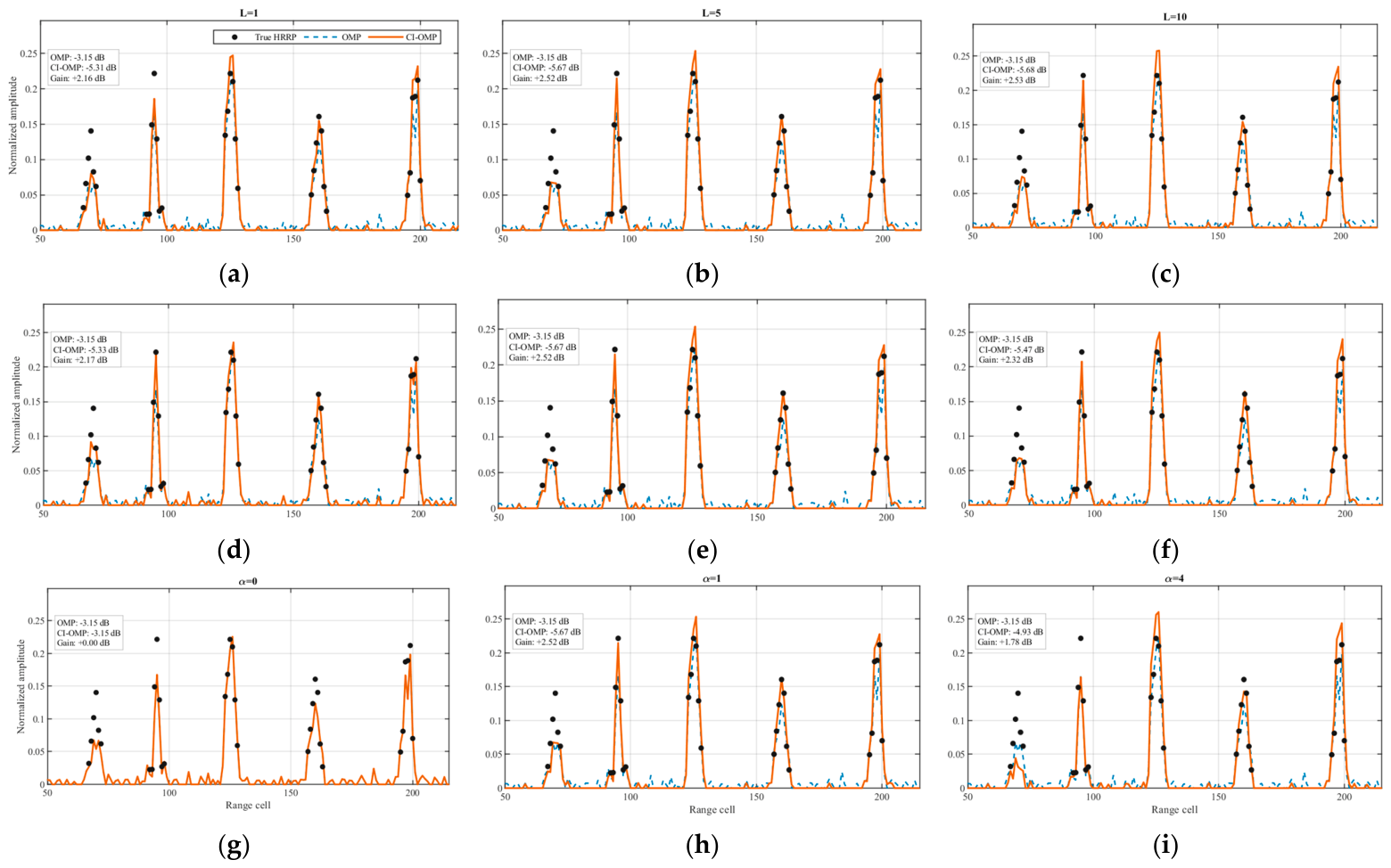
Figure 11 provides a visual verification of these statistical trends. Compared with OMP, CI-OMP better preserves the dominant scattering-center locations and suppresses spurious background components. The α = 0 case benefits only from the candidate-interval constraint, while α = 1 fully leverages both the candidate-interval strategy and the historical weighting mechanism. Based on the combined quantitative and visual analyses, L = 5, Δ = 4, and α = 1 are adopted as the reference configuration for CI-OMP. Notably, these parameters are optimized for the current simulation conditions and may be adjusted under different operational scenarios, such as faster scattering-center migrations or more severe noise levels. Adaptive parameter-selection strategies will be explored in future work.


5. Conclusions

In this paper, a candidate-interval-assisted orthogonal matching pursuit (CI-OMP) algorithm based on multi-frame sequential priors is proposed for HRRP reconstruction of CIS radar echoes. The method exploits the slow variation of scattering-center positions across consecutive frames by constructing candidate intervals from stable historical scattering centers to guide current-frame atom selection. Simulation results show that CI-OMP improves reconstruction accuracy, scattering-center recovery, and peak separability compared with standard OMP, particularly under low-duty-ratio and low-to-medium-SNR conditions. The candidate intervals also reduce the search range while maintaining reliable reconstruction performance. Several limitations are worth noting: the fallback mechanism is included primarily as a technical safeguard without systematic validation under corrupted priors, and a fully controlled ablation of the candidate-interval constraint remains to be designed. Future work will investigate adaptive fallback strategies, comprehensive ablation frameworks, adaptive window selection, dynamic prior updates, and validation with measured radar data in complex maneuvering-target scenarios.

Author Contributions

Conceptualization, Z.Z. and Q.W.; methodology, Z.Z. and Q.W.; software, Z.Z. and X.L.; validation, Z.Z., X.L. and Z.G.; formal analysis, Z.Z. and Q.W.; investigation, Z.Z. and X.L.; resources, S.X. and F.Z.; data curation, Z.Z.; writing—original draft preparation, Z.Z.; writing—review and editing, Q.W., X.L., Z.G., S.X. and F.Z.; visualization, Z.Z. and X.L.; supervision, Q.W. and S.X.; project administration, Q.W.; funding acquisition, Q.W. All authors have read and agreed to the published version of the manuscript.

Funding

This research was funded by the National Natural Science Foundation of China (NSFC), grant number 62541134.

Data Availability Statement

The MATLAB (R2024a) simulation code used in this study is available from the corresponding author upon reasonable request for academic purposes. The data presented in this study are available on request from the corresponding author.

Conflicts of Interest

The authors declare no conflicts of interest.

Abbreviations

The following abbreviations are used in this manuscript:
HRRPHigh-resolution range profile
CISCoded interrupted sampling
ISRJInterrupted Sampling Repeater Jamming
LPILow Probability of Intercept
MFMatched Filtering
CI-OMPCandidate-interval-assisted orthogonal matching pursuit
OMPOrthogonal matching pursuit
ISARInverse synthetic aperture radar
SARSynthetic aperture radar
SNRSignal-to-noise ratio
NMSENormalized mean squared error
SRRSupport recovery rate
Tol-SRRTolerant support recovery rate
PLSRPeak-to-sidelobe ratio

References

  1. Xu, G.; Zhang, B.; Yu, H.; Chen, J.; Xing, M.; Hong, W. Sparse synthetic aperture radar imaging from compressed sensing and machine learning: Theories, applications, and trends. IEEE Geosci. Remote Sens. Mag. 2022, 10, 32–69. [Google Scholar] [CrossRef] [Scilit]
  2. Zhang, L.; Qiao, Z.J.; Xing, M.D.; Li, Y.C.; Bao, Z. High-resolution ISAR imaging with sparse stepped-frequency waveforms. IEEE Trans. Geosci. Remote Sens. 2011, 49, 4630–4651. [Google Scholar] [CrossRef] [Scilit]
  3. Donoho, D.L. Compressed sensing. IEEE Trans. Inf. Theory 2006, 52, 1289–1306. [Google Scholar] [CrossRef] [Scilit]
  4. Bayer, F.; Mathy, M.; Krim, H.; Gershman, A.B. Fast, efficient, and viable compressed sensing, low-rank, and robust principle component analysis algorithms for radar signal processing. Remote Sens. 2023, 15, 2216. [Google Scholar] [CrossRef] [Scilit]
  5. Quan, Y.H.; Wu, Y.J.; Duan, L.N.; Xing, M.D. A review of radar signal processing based on sparse recovery. J. Radars 2024, 13, 46–67. [Google Scholar] [CrossRef]
  6. Jia, J.; Han, C.; Zhang, Y.; Wang, X. Review on low intercept radar signal design technology. In Proceedings of the 2022 IEEE 4th International Conference on Power, Intelligent Computing and Systems (ICPICS), Shenyang, China, 29–31 July 2022. [Google Scholar] [CrossRef] [Scilit]
  7. Chen, L.; Wang, J.; Ma, Y.; Zhang, A.; Qu, S. High-Degree-of-Freedom Range-Doppler Modulation via Optimized Pseudo-Random Coding Metasurface. IEEE Trans. Antennas Propag. 2026, 74, 5769–5782. [Google Scholar] [CrossRef] [Scilit]
  8. Chen, L.; Wang, J.; Liu, X.; Feng, D.; Sun, G. A flexible range-Doppler modulation method for pulse-Doppler radar using phase-switched screen. IEEE Trans. Antennas Propag. 2025, 73, 6774–6787. [Google Scholar] [CrossRef] [Scilit]
  9. Wu, Q.; Wang, Y.; Liu, X.; Gu, Z.; Xu, Z.; Xiao, S. ISAR image transform via joint intrapulse and interpulse periodic-coded phase modulation. IEEE Sens. J. 2025, 25, 28788–28799. [Google Scholar] [CrossRef] [Scilit]
  10. Liu, X.; Wu, Q.; Pan, X.; Wang, J.; Zhao, F. SAR image transform based on amplitude and frequency shifting joint modulation. IEEE Sens. J. 2025, 25, 7043–7052. [Google Scholar] [CrossRef] [Scilit]
  11. Liu, X.B.; Liu, J.; Zhao, F.; Ai, X.F.; Wang, G.Y. A novel strategy for pulse radar HRRP reconstruction based on randomly interrupted transmitting and receiving in radio frequency simulation. IEEE Trans. Antennas Propag. 2018, 66, 2569–2580. [Google Scholar] [CrossRef] [Scilit]
  12. Wang, X.; Li, B.; Liu, W.; Chen, H. Anti-interrupted sampling repeater jamming based on intra-pulse frequency modulation slope agile radar waveform joint FrFT. Digit. Signal Process. 2024, 147, 104418. [Google Scholar] [CrossRef] [Scilit]
  13. Ji, Y.; Wei, S.; Lu, Y. Anti-interrupted-sampling repeater jamming method based on frequency agility waveform and sparse recovery. EURASIP J. Adv. Signal Process. 2024, 2024, 55. [Google Scholar] [CrossRef] [Scilit]
  14. Li, R.; Wang, X.; Li, G.; Zhang, Y.; Liu, W. TEFISTA-Net: A learnable method for high-resolution range profile reconstruction with low-frequency ultra-wideband radar. Signal Process. 2024, 214, 109257. [Google Scholar] [CrossRef] [Scilit]
  15. Dong, H.; Dai, F.; Zhang, J. High-speed target HRRP reconstruction based on fast mean-field sparse Bayesian unrolled network. Remote Sens. 2025, 17, 8. [Google Scholar] [CrossRef] [Scilit]
  16. Pu, T.; Feng, X.; Wang, Y.; Li, B. Radar HRRP estimation based on deep unfolding networks under interrupted sampling repeater jamming. In Proceedings of the 2024 IEEE 7th International Conference on Electronic Information and Communication Technology (ICEICT), Harbin, China, 26–29 June 2024. [Google Scholar] [CrossRef] [Scilit]
  17. Li, Y.; Huang, T.; Liu, Y.; Wang, X.; Eldar, Y.C. Block sparse recovery with redundant measurement matrices and its application in frequency agile radar. IEEE Trans. Aerosp. Electron. Syst. 2024, 60, 8960–8975. [Google Scholar] [CrossRef] [Scilit]
  18. Wang, H.; Wang, F. Research on anti-range migration sparse reconstruction algorithm in target parameter estimation of frequency-agile radar. IEEE Trans. Instrum. Meas. 2023, 72, 8507313. [Google Scholar] [CrossRef] [Scilit]
  19. Wang, Y.; Li, Y.; Song, J.; Zhao, G. Randomized stepped frequency radar extended target HRRP-velocity joint estimation based on SBL-DGAMP-Net. IEEE Geosci. Remote Sens. Lett. 2024, 21, 3507005. [Google Scholar] [CrossRef] [Scilit]
  20. Wu, Z.; Zhao, F.; Zhang, L.; Wang, X.; Li, Y. Fast frequency-diverse radar imaging based on adaptive sampling iterative soft-thresholding deep unfolding network. Remote Sens. 2023, 15, 3284. [Google Scholar] [CrossRef] [Scilit]
  21. Cai, Z.; Bai, X.; Zhao, J. Range-Doppler processing for passive radar based on joint tracking and dynamic compressed sensing. In Proceedings of the 2024 IEEE International Conference on Signal, Information and Data Processing (ICSIDP), Chongqing, China, 2–4 August 2024. [Google Scholar] [CrossRef] [Scilit]
  22. Lu, Z.; Jiang, W.; Wang, Y.; Li, Y. Cognitive radar waveform design method under the joint constraints of transmit energy and spectrum bandwidth. Remote Sens. 2023, 15, 5187. [Google Scholar] [CrossRef] [Scilit]
  23. Aubry, A.; Carotenuto, V.; De Maio, A. Multi-snapshot spectrum sensing for cognitive radar via block-sparsity exploitation. IEEE Trans. Signal Process. 2019, 67, 1396–1406. [Google Scholar] [CrossRef] [Scilit]
  24. Aubry, A.; Babu, P.; De Maio, A.; Pallotta, L. Off-grid multi-snapshot spectrum sensing for cognitive radar. IEEE Trans. Aerosp. Electron. Syst. 2025, 61, 8641–8658. [Google Scholar] [CrossRef] [Scilit]
  25. Li, S.; Amin, M.; Zhao, G.; Sun, H. Radar imaging by sparse optimization incorporating MRF clustering prior. IEEE Geosci. Remote Sens. Lett. 2020, 17, 1139–1143. [Google Scholar] [CrossRef] [Scilit]
  26. Hu, X.; Tong, N.; Guo, Y.; Ding, S. MIMO radar 3-D imaging based on multi-dimensional sparse recovery and signal support prior information. IEEE Sens. J. 2018, 18, 3152–3162. [Google Scholar] [CrossRef] [Scilit]
  27. You, P.; Liu, Z.; Wang, H.; Wei, X.; Li, X. Dynamic compressed HRRP generation for random stepped-frequency radar based on complex-valued fast sequential homotopy. Sensors 2014, 14, 8283–8304. [Google Scholar] [CrossRef] [Scilit] [PubMed]
  28. Tropp, J.A.; Gilbert, A.C. Signal recovery from random measurements via orthogonal matching pursuit. IEEE Trans. Inf. Theory 2007, 53, 4655–4666. [Google Scholar] [CrossRef] [Scilit]
  29. Jiang, W.; Wang, Y.; Li, Y.; Lin, Y.; Shen, W. Radar target characterization and deep learning in radar automatic target recognition: A review. Remote Sens. 2023, 15, 3742. [Google Scholar] [CrossRef] [Scilit]
  30. Ziniel, J.; Schniter, P. Dynamic compressive sensing of time-varying signals via approximate message passing. IEEE Trans. Signal Process. 2013, 61, 5270–5284. [Google Scholar] [CrossRef] [Scilit]
  31. Wu, Q.H.; Li, X.B.; Liu, J.; Zhao, F.; Xiao, S.P. A radar imaging method using nonperiodic interrupted sampling linear frequency modulation signal. IEEE Sens. J. 2018, 18, 8294–8302. [Google Scholar] [CrossRef] [Scilit]
Figure 1. Schematic diagram of CIS signal formation.
Remotesensing 18 02842 g001
Figure 2. Schematic illustration of the HRRP sparse observation model under coded interrupted sampling.
Remotesensing 18 02842 g002
Figure 3. Overall framework of the CI-OMP method.
Remotesensing 18 02842 g003
Figure 4. Inter-frame scatterer migration and candidate interval construction.
Remotesensing 18 02842 g004
Figure 5. Representative HRRP reconstruction results of OMP and CI-OMP under different duty ratios.
Remotesensing 18 02842 g005
Figure 6. HRRP reconstruction performance comparison of MF, OMP, WS-OMP, and CI-OMP under different duty ratios: (a) reconstruction error evaluated by NMSE; (b) tolerant scattering-center recovery rate evaluated by Tol-SRR; (c) peak-to-sidelobe ratio evaluated by PSLR. Error bars indicate 95% confidence intervals.
Remotesensing 18 02842 g006
Figure 7. Representative HRRP reconstruction results of OMP and CI-OMP under different SNRs.
Remotesensing 18 02842 g007
Figure 8. HRRP reconstruction performance comparison of MF, OMP, WS-OMP, and CI-OMP under different SNRs: (a) reconstruction error evaluated by NMSE; (b) tolerant scattering-center recovery rate evaluated by Tol-SRR; (c) peak-to-sidelobe ratio evaluated by PSLR. Error bars indicate 95% confidence intervals.
Remotesensing 18 02842 g008
Figure 9. Search efficiency evaluation based on ASCR. (a) ASCR comparison between OMP and CI-OMP under different duty ratios. (b) Search reduction of CI-OMP under different duty ratios. (c) ASCR comparison between OMP and CI-OMP under different SNRs. (d) Search reduction of CI-OMP under different SNRs.
Remotesensing 18 02842 g009
Figure 10. Parameter sensitivity of CI-OMP under ρ = 0.20 and SNR = 0 dB: (a) NMSE versus L; (b) Exact-SRR versus L; (c) NMSE versus Δ; (d) Exact-SRR versus Δ; (e) NMSE versus α; and (f) Exact-SRR versus α. The results are averaged over 100 paired Monte Carlo trials.
Remotesensing 18 02842 g010
Figure 11. Representative HRRP reconstructions obtained by OMP and CI-OMP under different parameter settings at ρ = 0.20 and SNR = 0 dB: (a) L = 1; (b) L = 5; (c) L = 10; (d) Δ = 0; (e) Δ = 4; (f) Δ = 8; (g) α = 0; (h) α = 1; (i) α = 4.
Remotesensing 18 02842 g011
Table 1. Parameters of the five-point aircraft scattering model.
IndexRelative Range/mRelative Amplitude
10.00.8
27.50.6
316.51.0
427.00.7
538.40.9
Table 2. Performance gains of CI-OMP over OMP and WS-OMP under representative duty ratios.
ρ NMSE Gain vs. OMP/dBNMSE Gain vs. WS-OMP/dBTol-SRR Gain vs. OMPTol-SRR Gain vs. WS-OMPPSLR Gain vs. OMP/dBPSLR Gain vs. WS-OMP/dB
0.100.940.820.1260.2513.732.95
0.1251.051.320.1210.3217.185.46
0.151.422.180.1250.33510.966.69
0.201.433.060.0850.30819.3216.43
0.251.493.340.0580.23319.2719.12
Table 3. Performance gains of CI-OMP over OMP under different SNRs.
SNR/dBNMSE Gain vs. OMP/dBNMSE Gain vs. WS-OMP/dBTol-SRR Gain vs. OMPTol-SRR Gain vs. WS-OMPPSLR Gain vs. OMP/dBPSLR Gain vs. WS-OMP/dB
−80.47−0.890.0670.1263.967.17
−50.820.220.1180.2362.205.61
−21.602.410.1440.3585.537.23
02.194.280.0990.3038.5813.63
30.873.490.0100.0611.464.85
50.090.590.0000.0050.000.50
Table 4. Sensitivity of CI-OMP to its three key parameters.
ParameterValueNMSE (dB)Exact-SRR
Historical-window length L1−5.310.7803
3−5.560.7977
5−5.670.8031
7−5.640.8018
10−5.680.8046
Candidate-interval half-width Δ0−5.330.8207
2−5.480.7928
4−5.670.8117
6−5.480.7927
8−5.470.7926
Historical-prior weight α0−3.150.6906
0.5−5.110.7977
1.0−5.670.8031
1.5−5.560.7787
2.0−5.380.7629
4.0−4.930.7338
Disclaimer/Publisher’s Note: The statements, opinions and data contained in all publications are solely those of the individual author(s) and contributor(s) and not of MDPI and/or the editor(s). MDPI and/or the editor(s) disclaim responsibility for any injury to people or property resulting from any ideas, methods, instructions or products referred to in the content.