Article

Towards Lightweight and Accurate Remote-Sensing Image Super-Resolution via Reparameterized Feature Enhancement Network
1
School of Mechanical Engineering and Automation, Fuzhou University, Fuzhou 350108, China
2
Zhipu AI, Beijing 100084, China
*
Author to whom correspondence should be addressed.
Remote Sens. 2026, 18(17), 2850; https://doi.org/10.3390/rs18172850
Submission received: 29 June 2026 / Revised: 10 August 2026 / Accepted: 20 August 2026 / Published: 22 August 2026

Highlights

What are the main findings?
  • We propose a reparameterized feature enhancement network (RepFEN), featuring two dedicated modules: the multi-scale reparameterized module (MRepM) to strengthen multi-scale local textures and structural boundaries and the partial-channel gated attention module (PCGAM) to boost fine-grained detail restoration.
  • The proposed RepFEN achieves superior super-resolution performance on two remote sensing image (RSI) datasets and five natural image benchmarks, surpassing mainstream lightweight RSI super-resolution methods while using fewer parameters.
What are the implications of the main findings?
  • The framework provides an efficient lightweight and accurate solution for RSI super-resolution, suitable for real-time processing on resource-constrained satellite and edge platforms.
  • Its core innovation— multi-branch reparameterized convolution coupled with partial-channel gated attention—provides a generalizable design paradigm to balance reconstruction accuracy and inference efficiency for broader lightweight RSI restoration tasks.

Abstract

Remote sensing image super-resolution (RSISR) provides an effective means of improving spatial detail for Earth observation and satellite image interpretation. However, existing methods often rely on increasingly complex network designs with deeper hierarchies and expanded channel capacities to pursue higher performance, resulting in heavy models with high computational cost, which restricts their deployment on resource-constrained platforms. To address this challenge, we propose a novel reparameterized feature enhancement network (RepFEN) for lightweight and accurate RSISR tasks. Specifically, a multi-scale reparameterized module (MRepM) is designed to capture multi-scale spatial information and enhance texture representation. Furthermore, a partial-channel gated attention module (PCGAM) is introduced to selectively enhance discriminative features along the channel dimension, effectively improving fine-grained detail restoration. By integrating structural reparameterization and multi-scale lightweight modules, the proposed method achieves a better balance between reconstruction accuracy and inference efficiency. Extensive experiments on both remote sensing and natural image super-resolution benchmarks demonstrate that our method achieves superior performance compared to existing state-of-the-art methods, while maintaining minimal computational overhead, showing significant potential for real-world applications.

1. Introduction

Single-image super-resolution (SISR) aims to reconstruct a high-resolution (HR) image from its low-resolution (LR) counterpart and has become a fundamental issue in low-level vision. With extensive applications of remote sensing technology, the demand for higher spatial resolution in remote sensing imagery continues to grow [1]. High-resolution (HR) imagery provides a fundamental basis for intelligent remote sensing image interpretation and directly affects the performance of mid-level and high-level vision tasks, such as object detection based on multi-scale memory networks [2] and selective zero-shot scene classification [3]. Moreover, the rich structural and textural information contained in HR imagery is crucial for numerous applications, including environmental surveys [4], military reconnaissance [5,6], and accurate ground object analysis [7,8,9]. However, the constraints of sensor hardware and transmission bandwidth often result in a decline in image quality. Directly upgrading optical systems or launching new satellites remains costly and inflexible. Consequently, remote sensing image super-resolution (RSISR) has attracted increasing attention as a cost-effective solution to enhance spatial resolution from existing LR data.
With advances in deep learning (DL), image super-resolution (SR) methods have made significant progress in natural image processing. Early DL-based SR models primarily improve reconstruction accuracy through deeper network architectures and expanded feature dimensions [10,11,12,13]. Building on these advances, subsequent studies further pursue lightweight and effective network designs to improve feature representation under efficiency constraints [14,15,16,17]. These advances in natural image SR have also promoted the development of RSISR.
Compared to natural images, the reconstruction of remote sensing images presents greater challenges. The main reasons are that they typically contain more complex urban structures, larger-scale variations, and fine-grained textures distributed across vast areas. These characteristics require stronger context modeling and higher robustness to complex degradations. To address these challenges, many RSISR methods adopt residual learning and hierarchical feature extraction [18]. Some methods further introduce multi-scale designs and attention mechanisms [19]. More recent studies explore transformer-based TTST [20], diffusion-based EDiffSR [21], edge-aware GAN, and closed-loop networks [22,23], as well as frequency-assisted Mamba models for long-range dependency modeling [24]. Although the above methods have advanced reconstruction quality, they typically rely on deep backbone networks or complex architectural designs. This results in significant memory and computational overhead, which limits its wider application on resource-constrained airborne or real-time remote sensing platforms.
Recently, many researchers have increasingly focused on lightweight RSISR. Several researchers have attempted to design lightweight feature enhancement and fusion modules [25,26] to improve reconstruction efficiency. Networks with feedback mechanisms and distillation enhancement designs typically adopt compact backbones and perform iterative refinement to recover fine textures under limited computational resources [27]. Beyond purely CNN-based designs, MSGAN [28] integrates graph attention and multi-scale lattice blocks to jointly capture local and long-range relations, while EAFF-Net [29] combines CNN and transformer branches and adaptively integrates their local and global representations. Although these methods improve performance by capturing long-range dependencies, they still introduce a significant computational overhead. Subsequently, ReFDN [30] introduces re-parameterization into RSISR, reducing the number of inference parameters from 918K during training to 343K. However, ReFDN lacks multi-scale modeling capabilities, making it difficult to effectively reconstruct remote sensing targets at different scales. Recently, some researchers also attempted to enhance representational capabilities through ingenious architectural designs [31]. For example, RFANSR [32] enhances the receptive field by cascading multi-scale convolutional kernels, thereby improving multi-scale feature extraction capabilities. DFCFNet [33] employs a complementary fusion structure with local and non-local branches to enhance global feature modeling. However, these approaches introduce additional computational costs and struggle to decouple training from inference, resulting in high computational complexity during inference and limiting their broader application. Overall, these approaches reduce computational overhead while retaining competitive reconstruction quality compared with earlier heavy RSISR models. However, under strict computational constraints, jointly representing multi-scale local textures and long-range contextual information remains difficult, which can lead to detail loss and reconstruction distortions in complex remote sensing scenes.
To address these issues, we develop RepFEN, a reparameterized feature enhancement network tailored to lightweight and accurate RSISR. Motivated by the pronounced scale diversity and repetitive spatial patterns in remote sensing scenes, our method jointly enhances scale-varying local representations and broader-range contextual dependencies under lightweight constraints. Specifically, we construct a novel, reparameterized feature enhancement module (RepFEM) as the core unit of the network. To better extract local texture and structural information under different receptive fields, we design a multi-scale reparameterized module (MRepM) in each RepFEM. During inference, its multi-branch structure can be converted into compact equivalent convolutions, which improves efficiency without sacrificing representation ability. Following MRepM, we further introduce a partial-channel gated attention module (PCGAM) to refine broader-range contextual dependencies and repetitive spatial patterns in remote sensing images. PCGAM generates context-adaptive gating weights through multi-scale interactions and selectively recalibrates certain channels, thereby enhancing contextual representation capabilities with limited computational overhead. Benefiting from the joint effect of MRepM and PCGAM, RepFEN achieves efficient feature enhancement in a lightweight manner. As illustrated in Figure 1, compared with the state-of-the-art ReFDN [30], RepFEN improves PSNR by 0.28 dB while using 6.4% fewer parameters.
The main contributions of this work are summarized as follows:
  • We propose a novel, reparameterized feature enhancement network (RepFEN), which achieves a good balance among reconstruction accuracy, model compactness, and computational efficiency on both generic SR benchmarks and remote sensing datasets.
  • We design a multi-scale reparameterized module (MRepM) that employs a two-group multi-branch convolutional architecture during training and collapses it into compact single-branch kernels at inference, effectively aggregating local multi-scale features and improving detail restoration under strict efficiency constraints.
  • A partial-channel gated attention module (PCGAM) is introduced to generate content-adaptive gating weights through multi-scale interaction and selectively recalibrate them along partial channels. This design improves contextual representation and modeling of repetitive spatial patterns with low computational overhead.
The rest of this paper is structured as follows. Section 2 reviews relevant RSISR and attention-based methods. Section 3 presents the architecture and key components of RepFEN. Section 4 reports the experimental settings, ablation studies, comparative results, and efficiency evaluation. Section 5 discusses the characteristics and limitations of the proposed method, followed by the conclusion in Section 6.

2. Related Work

2.1. Super-Resolution for Remote Sensing Images

RSISR extends single-image SR to aerial and satellite imagery, facing significant challenges such as complex urban structures and large-scale variations. Early RSISR studies largely built upon generic CNN-based SISR models and transferred them to remote sensing imagery. For instance, SRCNN [10] and VDSR [11] were commonly retrained on aerial and satellite imagery to recover high-frequency details. Lei et al. [18] developed the Local–Global Combined Network (LGCNet), where local structural cues are coupled with global contextual information to strengthen RSI feature representation. Haut et al. [34] developed the deep compendium model, where residual units and dense skip connections are combined to represent salient structures across multiple scales. Dong et al. [35] introduced a dense sampling SR network (DSSR) for large-scale RSI reconstruction, using dense sampling and feature aggregation to progressively refine image representations. These CNN-based frameworks significantly outperform interpolation methods, but their deep backbones and heavy convolutional pipelines make large-scale deployment on RS data computationally demanding.
Subsequently, many researchers attempted to incorporate attention mechanisms and sophisticated designs to better enhance the rich textures and long-range dependencies in remote sensing images. Pan et al. [36] employed residual dense back-projection to improve RSI reconstruction at large scale factors. Lei et al. [37] presented TransENet by introducing transformer-style cross-level interactions for stronger global modeling and further adopted multi-scale windowing for global–local trade-offs. Shi et al. [38] combined convolutional processing with transformer-based modeling for RSISR, aiming to improve feature encoding and structural reconstruction. Jiang et al. [39] introduced an edge-enhanced GAN that uses mask processing to suppress noise-contaminated edge artifacts and recover sharper contours. To overcome fixed scale factors, Wu et al. [40] proposed SADN and Chen et al. [41] proposed FunSR to improve scale generalization with continuous-scale modeling. It should also be noted that multiband fusion and hypersharpening methods can enhance spatial details by exploiting auxiliary high-resolution observations [42,43]. Different from these multi-source resolution enhancement methods, this study focuses on lightweight RSISR and aims to recover accurate high-resolution details under limited computational cost. Despite the progress of existing RSISR methods, they still struggle to jointly preserve fine textures, maintain global consistency, and ensure computational efficiency. Accordingly, improving reconstruction quality requires more effective exploitation of the intrinsic structural information in remote sensing images.

2.2. Lightweight Image Super-Resolution

Driven by application demands, researchers have begun to focus on research of lightweight image SR networks. For example, Dong et al. [44] accelerated SRCNN with FSRCNN by moving feature extraction to the LR domain and postponing upsampling to a learned deconvolution layer. Shi et al. [45] subsequently developed ESPCN, where sub-pixel convolution performs efficient reconstruction directly at the network output. Beyond these early compact models, Li et al. [46] presented the CARN network with cascaded residual blocks for fast and accurate SISR. Hui et al. [15] proposed IMDN, which distills and selectively fuses hierarchical features through information multi-distillation blocks. Liu et al. [16] further developed RFDN by introducing residual feature distillation connections to better balance reconstruction accuracy and model compactness. These works show that careful redesign of feature extraction, upsampling, and distillation modules can yield efficient SR models suited to lightweight scenarios.
Inspired by lightweight SISR, a series of domain-specific lightweight networks have been proposed for RSISR. For example, FeNet [26] designs lattice feature enhancement blocks with channel separation to improve feature representation under strict parameter budgets. CTN [25] replaces standard convolutions with contextual transformation layers for efficient local-context modeling. EAFF-Net [29] adaptively fuses CNN and transformer features, while AMFFN [47] performs attention-based multilevel feature fusion for hierarchical remote sensing representations. More recently, MSGAN [28] and DAFEN [31] further enhanced structural detail representation through graph attention or dual-attention fusion. RFANSR [32] expands the receptive field through progressive medium-sized kernels for efficient feature aggregation, while DFCFNet [33] adopts a local–nonlocal dual-branch design to jointly capture detailed textures and global contextual information. Additionally, ReFDN [30] and Rep-Mamba [48] show that lightweight RSISR can also benefit from carefully designed compact blocks and efficient inference-time structures. Structural reparameterization has further become an effective strategy for improving lightweight SR efficiency. Relevant studies show that multi-branch training and compact inference can improve the trade-off between reconstruction performance and efficiency [49,50,51]. The advancements in lightweight SISR have provided valuable insights for lightweight RSISR research and offer useful guidance for our work.

2.3. Attention Mechanism

Attention mechanisms have proven effective in image SR for selectively enhancing information-rich features. In SISR, spatial reweighting improves feature discrimination in deep residual networks, while transformer architectures extend feature interaction through attention. Gu et al. [52] introduced DRSEN by embedding squeeze-and-excitation blocks to enhance salient targets. Dong et al. [35] developed DSSR by incorporating width-wise and channel attention to enhance feature representation for large-scale scenes. More recent RSISR studies tend to adopt structured attention and selective attention to model long-range dependencies more efficiently. Xiao et al. [20] proposed TTST to preserve informative tokens via Top-K token selection and suppress redundancy. Kang et al. [53] presented ESTNet to reduce channel redundancy and expand spatial perception through multi-group window self-attention. Zhang et al. [54] combined convolutional processing with transformer-based interaction to jointly encode local and global information. Beyond specific attention modules, efficient vision backbones also provide useful insights for lightweight attention design. MobileNet [55] reduces computation through depthwise separable convolutions, and ShuffleNet [56] further improves efficiency with pointwise group convolutions and channel shuffle. Additionally, SHViT [57] shows that applying attention to only a subset of channels can effectively reduce the overhead of global modeling.
Overall, existing methods still struggle to effectively balance local features and long-range dependencies under resource-constrained conditions. Therefore, RepFEN designs a progressive feature enhancement network that progresses from local to global levels, achieving better reconstruction performance with a lower computational burden.

3. Methodology

In this section, we first introduce the overall structure of RepFEN. Then, we sequentially present the key components: RepFEM, MRepM, and PCGAM.

3.1. Network Architecture

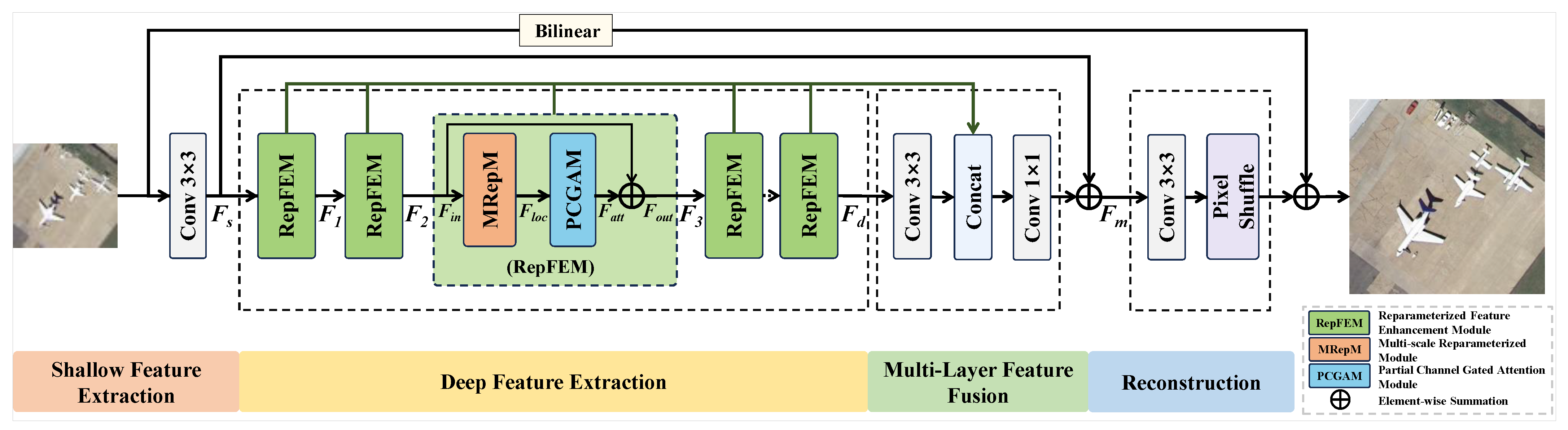
Figure 2 illustrates the overall RepFEN architecture, which includes shallow feature extraction, deep feature extraction, multi-layer feature fusion, and reconstruction. Given an input low-resolution image I L R R H × W × 3 , RepFEN produces the super-resolved output I S R R s H × s W × 3 , where s denotes the upscaling factor and H × W represents the spatial resolution of I L R . The overall mapping can be formulated as
F s = H s f ( I L R )
F d = H d f ( F s )
F m = H m f ( F d ) + F s
I S R = H r e ( F m ) + Bilinear ( I L R )
where F s , F d , and F m correspond to the shallow, deep, and fused feature representations, respectively. H s f ( · ) encodes I L R into F s , after which H d f ( · ) generates the deep representation F d . The fusion operator H m f ( · ) combines F d with F s through residual addition to obtain F m , and H r e ( · ) converts F m into the residual image used for final reconstruction. It is worth noting that Bilinear ( I L R ) denotes the bilinearly upsampled result of I L R . As a parameter-free interpolation pathway, this branch supplies low-frequency information with negligible model overhead, leaving the learned residual pathway to concentrate on restoring high-frequency details.
To obtain more effective feature representations under lightweight constraints, we specifically design the deep feature extraction H d f . As the core part of RepFEN, H d f is constructed by cascading multiple RepFEMs, where each RepFEM contains two key units: the MRepM and the PCGAM. Through their joint effect, H d f can simultaneously enhance local high-frequency details and global structural consistency, thereby providing more discriminative deep representations for subsequent multi-layer feature fusion and image reconstruction.
We optimize the whole RepFEN using the L 1 loss. Given a training set consisting of N LR-HR image pairs, denoted as { I L R i , I H R i } i = 1 N , where I H R i is the corresponding ground-truth high-resolution image; the loss function is defined as
L ( θ ) = 1 N i = 1 N I S R i I H R i 1 ,
where θ denotes all learnable parameters of RepFEN. This loss directly constrains the pixel-wise discrepancy between the reconstructed output and the reference image, which helps stabilize training and improve reconstruction fidelity.

3.2. Reparameterized Feature Enhancement Module

To enhance local details and structural textures in remote sensing images, we design a lightweight yet effective RepFEM, which strengthens local structural information while simultaneously modeling global self-similar textures under a compact architecture.
Given an input feature map F in , RepFEM first employs MRepM to extract richer local high-frequency and structural details, producing a locally enhanced feature F loc . The feature F loc is then fed into PCGAM, which establishes long-range dependencies and exploits internal self-similarity with low computational overhead, yielding an attention-enhanced feature F att . The contextual feature F a t t is finally added back to F i n through a residual path to obtain F o u t . The transformation of RepFEM can be expressed as follows:
F loc = H MRepM ( F in )
F att = H PCGAM ( F loc )
F out = F in + F att
where F i n and F o u t respectively represent the input and output feature maps of RepFEM. F l o c and F a t t represent the locally enhanced and attention refined features. H MRepM and H PCGAM denote the feature transformation processes of MRepM and PCGAM, respectively.
In this design, there is a synergistic relationship between MRepM and PCGAM, characterized by progressive feature enhancement from the local to the global level. Specifically, MRepM employs a multi-branch, multi-scale design that utilizes parallel processing and reparameterization of convolutional kernels of different sizes to achieve efficient local feature enhancement. Subsequently, PCGAM employs a gated, multi-scale design that expands the receptive field through progressively larger convolutional kernels to enhance global contextual information. This complementary design ensures the effective capture of both fine-grained local details and long-range spatial dependencies, thus achieving high-quality reconstruction. The detailed designs of MRepM and PCGAM are presented in the following text.

3.3. Multi-Scale Reparameterized Module

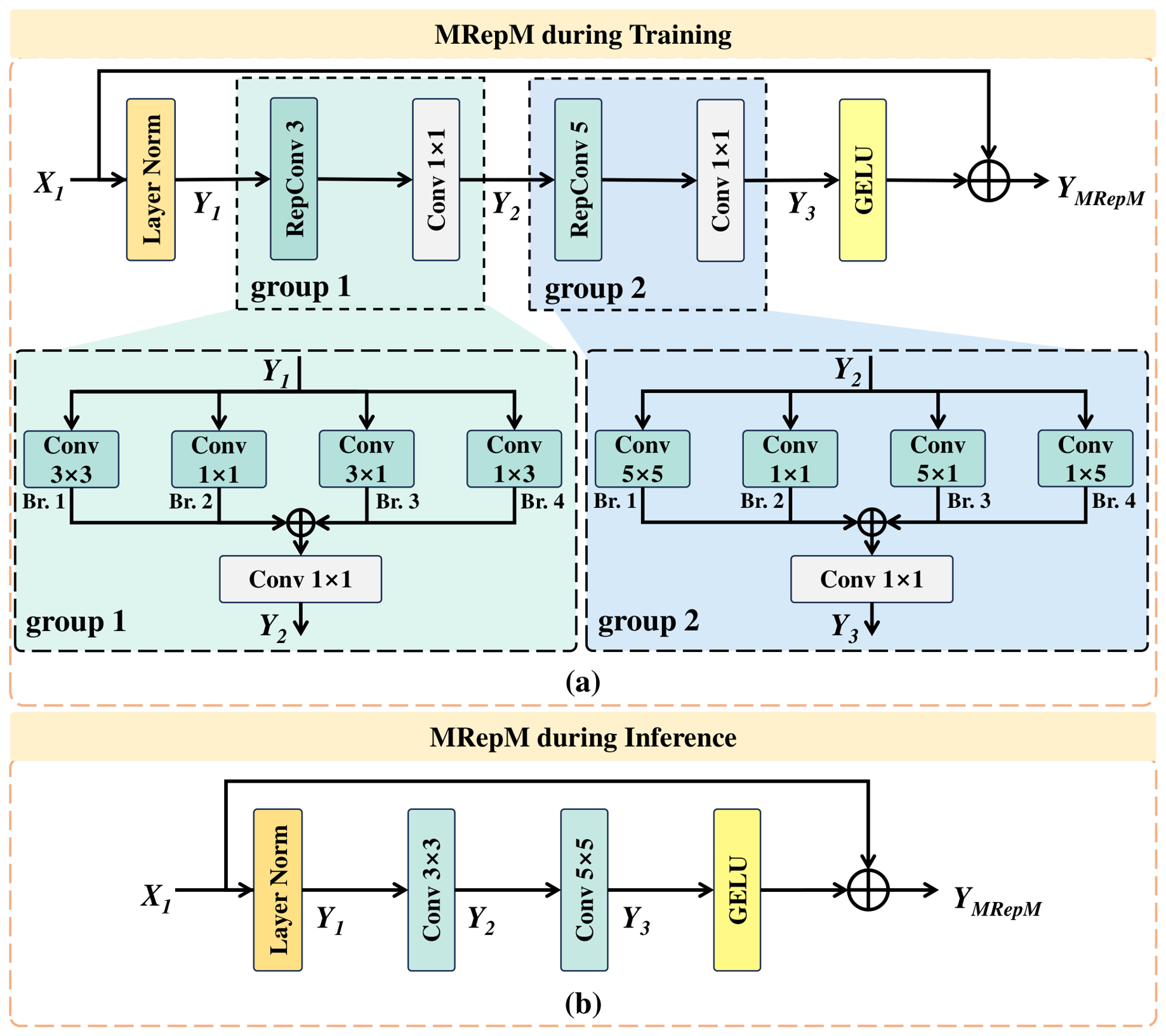
Remote sensing images exhibit significant scale diversity, containing both fine-scale details, such as ships and vehicles, and large-scale structures, such as buildings and farmland. To address this issue, MRepM employs two sets of complementary multiscale designs, as shown in Figure 3. Specifically, the first group captures local textures via 3 × 3 main branches, while the second group encodes broader spatial patterns via 5 × 5 main branches. During training, each group learns rich, multiscale representations through four parallel branches; during inference, the entire multi-branch structure is folded into compact 3 × 3 and 5 × 5 equivalent convolutions via structural reparameterization. This allows the inference model to benefit from multi-scale training without requiring additional parameters or FLOPs, which is crucial for remote sensing applications deployed on resource-constrained platforms.

3.3.1. Two-Group, Multi-Branch Design

In RSISR networks, recovering fine textures and structural boundaries requires local features with different receptive fields under a limited computational budget. Existing reparameterized convolutional units, such as RepVGG [49], ECBSR [50], and RepRFN [51], mainly improve inference efficiency by converting training-time multi-branch structures into compact convolutional forms.
Accordingly, MRepM integrates structural reparameterization into multi-scale local feature extraction. As illustrated in Figure 3, it adopts a two-group, multi-branch, parallel convolutional structure. The two groups use different main receptive fields, and the branches within each group provide complementary local responses. This design strengthens fine textures and structural details during training, while the multi-branch structure can be equivalently folded into compact convolutions during inference. In addition, layer normalization is applied at the module entrance, GELU activation is used at the exit, and an internal residual connection is introduced to stabilize feature propagation without extra parameters. These operations help alleviate gradient instability and preserve high-frequency details under a lightweight design.
The first group of MRepM consists of four parallel convolutional branches followed by a 1 × 1 tail fusion convolution. The parallel branches provide complementary multi-scale and directional responses, which are subsequently aggregated by the tail convolution. During inference, the entire group is equivalently folded into a single 3 × 3 convolution through structural reparameterization. The expression for this process is as follows:
Y 1 = L N ( X 1 )
Y 2 = f Conv 1 × 1 H RepConv 3 ( Y 1 )
where X 1 denotes the input feature to the proposed MRepM module, L N ( · ) represents the layer normalization operation, and Y 1 is the normalized feature output. The function f Conv ( · ) denotes the convolution operations. H RepConv 3 ( · ) denotes the group 1 reparameterized convolution operation, which corresponds to a multi-branch convolutional structure during training, as illustrated in Figure 3a. Y 2 represents the output features of the group 1 convolution operation.
Group 2 follows the same multi-branch organization but adopts a 5 × 5 main convolution to extend spatial perception beyond that of group 1. Its broader neighborhood responses complement the fine local structures extracted in the preceding group, thereby improving the representation of scale-varying patterns in RSIs. The expression for this process is as follows:
Y 3 = f Conv 1 × 1 H RepConv 5 ( Y 2 )
Y MRepM = GELU ( Y 3 ) + X 1
where the function f Conv ( · ) denotes the convolution operations. Y 3 denotes the output feature of the group 2 transformation. H RepConv 5 ( · ) denotes the group 2 reparameterized convolution operation. G E L U ( · ) denotes the Gaussian error linear unit activation function. Y MRepM represents the final output feature of the MRepM module.

3.3.2. Structural Reparameterization

During training, the two-group, multi-branch, convolutional structure is preserved to sufficiently learn multi-scale features. During inference, the kernels and biases of all branches within each group are first aligned by zero padding and then linearly aggregated into a single equivalent convolution kernel. The equivalent weights and biases of the first and second groups can be formulated as
K group { s } = K tail i = 1 4 K i , s { 1 , 2 }
B group { s } = K tail i = 1 4 B i + B tail , s { 1 , 2 }
where K tail and B tail denote the weight and bias of the subsequent 1 × 1 convolution, respectively. K i and B i denote the aligned kernel and bias of the i-th parallel branch, respectively. { s } indicates the possible groups. Before aggregation, the branch kernels are center-aligned and zero-padded to 3 × 3 in group 1 and 5 × 5 in group 2.
Based on these equivalent convolution parameters, the original multi-branch feature transformation in MRepM can be reformulated as a single-path mapping composed of only one 3 × 3 convolution and one 5 × 5 convolution. This process can be expressed as
Y 2 = f B group 1 K group 1 Conv 3 × 3 ( Y 1 )
Y 3 = f B group 2 K group 2 Conv 5 × 5 ( Y 2 )
where f B group 1 K group 1 Conv 3 × 3 ( · ) and f B group 2 K group 2 Conv 5 × 5 ( · ) represent the reparameterized 3 × 3 and 5 × 5 convolutional layers, respectively. As shown in Figure 3b, the layer normalization, GELU activation, and internal residual connection are retained the same during inference. Benefiting from the “multi-branch in training, single-branch in inference” design, MRepM preserves numerically equivalent outputs within floating-point precision while substantially reducing the number of parameters and FLOPs.

3.4. Partial Channel Gated Attention Module

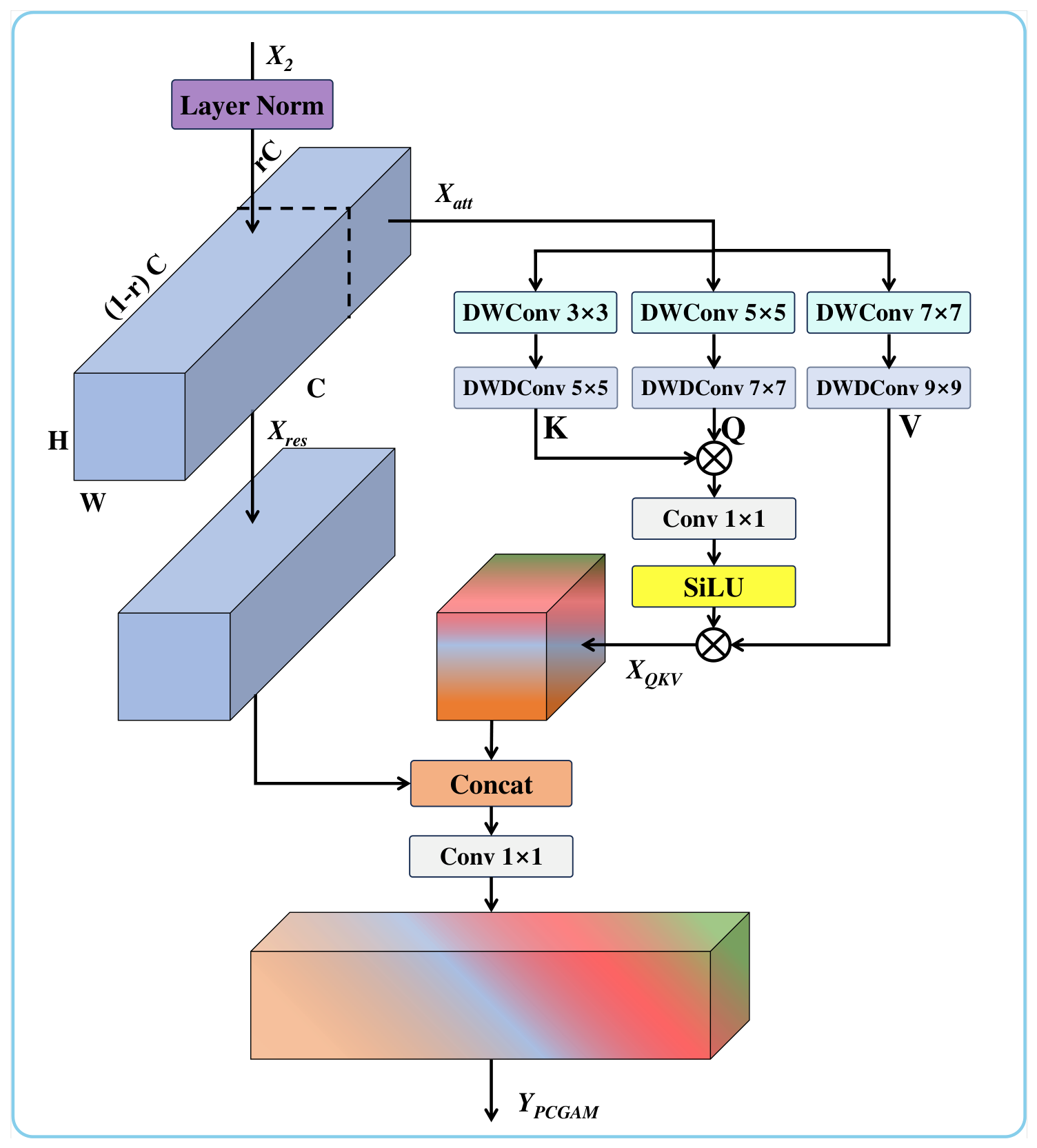
Remote sensing images contain a large number of repetitive, self-similar textures, such as buildings, roads, and farmland. Therefore, in super-resolution processing of remote sensing images, leveraging long-range dependencies and self-similar textures under lightweight constraints is crucial for optimizing local features enhanced by MRepM. Existing efficient attention methods reduce the cost of global modeling through token selection, window-based attention, or partial-channel self-attention [20,53,57]. However, these designs are usually formulated as general attention or backbone units, and they do not explicitly combine partial-channel global modeling with the multi-scale local cues required by remote sensing images. To complement MRepM, we design PCGAM as a lightweight global refinement module, as illustrated in Figure 4. Specifically, PCGAM applies attention processing only to a subset of channels, with convolution kernel sizes designed to increase progressively to better capture long-range dependencies. The remaining channels are processed via lightweight convolutions. This enables the model to effectively capture global contextual information without significantly increasing the computational burden.
PCGAM begins by normalizing the incoming feature map with LayerNorm to stabilize subsequent feature processing. The normalized channels are then partitioned according to the ratio r: one subset enters the gated-attention pathway, whereas the remaining channels form the residual pathway. The specific formula is expressed as follows:
X att , X res = F Split F L N ( X 2 ) , [ r C , ( 1 r ) C ]
where X 2 R C × H × W denotes the input feature map of PCGAM, F L N ( · ) represents the layer normalization operation, and F S p l i t ( · ) denotes the channel-wise feature separation. X att and X res correspond to the features assigned to the gated attention and residual branches, respectively. The variable r indicates the proportion of channels allocated to the attention branch. The remaining channels retain complementary information and are subsequently fused with the processed features through the final 1 × 1 projection. Given the inherent channel redundancy in deep features and the fact that global context in RSISR depends primarily on spatial receptive fields, PCGAM can still capture long-range dependencies with lower computational overhead, even though it applies the attention mechanism to only a subset of channels.
The selected attention features are passed through several convolutional branches with different receptive fields to capture multi-scale information. For each branch, we construct the K, Q, and V maps with progressively enlarged receptive fields, enabling gated feature interactions to capture information from local structures to broader-range context and enhance feature representation. This process can be expressed as
K = f DWDConv 5 × 5 f DWConv 3 × 3 X att
Q = f DWDConv 7 × 7 f DWConv 5 × 5 X att
V = f DWDConv 9 × 9 f DWConv 7 × 7 X att
where f DWConv ( · ) denotes depth-wise convolution (DWConv) operations. Similarly, f DWDConv ( · ) represents depth-wise dilated convolution operations. K, Q, and V denote multi-scale contextual feature representations encoded with different receptive fields. To obtain such multi-scale representations, we adopt a progressive receptive-field design for the three branches. Specifically, the K branch adopts a 3 × 3 DWConv followed by a 5 × 5 DWDConv. It is used to preserve fine-grained responses, such as local edges, corners, and small objects. The Q branch uses a 5 × 5 DWConv followed by a 7 × 7 DWDConv. It introduces a larger neighborhood context to capture middle-scale structures, such as roads, building boundaries, and regional textures. The V branch further employs a 7 × 7 DWConv followed by a 9 × 9 DWDConv. It further enlarges the receptive field and enhances the modeling of repetitive textures and spatial consistency in remote sensing images.
Such a progressive design enables PCGAM to aggregate features from different spatial ranges. It helps capture local details, middle-scale structures, and wider contextual patterns in a complementary manner. Meanwhile, all these operations are implemented with depth-wise convolutions. Therefore, multi-scale contextual information can be introduced with limited computational overhead, which helps balance reconstruction quality and inference efficiency.
After obtaining the multi-scale K, Q, and V features, PCGAM computes the interaction between Q and K to generate attention responses. The interaction map is then activated by SiLU and multiplied by V to enhance informative features. Finally, the resulting attention features are concatenated with the residual channel features and fused through convolution to produce the high-quality output feature map. The detailed computation is as follows:
X Q K V = F SiLU f Conv 1 × 1 Q K V
Y PCGAM = f Conv 1 × 1 F concat ( X Q K V , X res )
where F SiLU ( · ) represents the SiLU activation function. X Q K V indicates the output feature map generated by the gated attention mechanism. The function F concat ( · ) denotes channel-wise concatenation and Y PCGAM refers to the final output features of the PCGAM module.

4. Experiments and Results

4.1. Dataset and Metrics

We evaluate the proposed RepFEN on various remote sensing datasets and benchmark datasets. Due to the limited availability of open-source lightweight SR models for remote sensing imagery, we train and test the proposed model separately on remote sensing datasets and general benchmarks to comprehensively assess its performance. For RSISR evaluation, AID [58] and UCMerced [59] are adopted as the remote sensing datasets. AID provides 10,000 images from 30 scene categories, each with a spatial resolution of 600 × 600 pixels, whereas UCMerced contains 2100 images from 21 scene categories, each with a spatial resolution of 256 × 256 pixels. Following [30,37], we divide the AID dataset into the training and test set according to the ratio of 8:2. The models are tested on the AID and UCMerced datasets to assess their SR performance.
To further assess the generalization of RepFEN, the network is trained on 3450 images from DF2K [60]. It is then evaluated on Set5 [61], Set14 [62], BSD100 [63], Urban100 [64], and Manga109 [65] at × 2 , × 3 , and × 4 , together with representative lightweight SR methods. All training pairs are generated using bicubic downsampling. Reconstruction fidelity is quantified by PSNR and SSIM on the luminance Y component of the YCbCr color space. Efficiency is characterized where applicable using parameter count, FLOPs, and inference latency.

4.2. Implementation Details

To enhance the diversity of the training data, random data augmentation strategies were applied, including rotations of 0°, 90°, 180°, and 270°, as well as horizontal flipping in random combinations. Adam was adopted for optimization, together with an exponential moving average (EMA) using a decay factor of 0.999.
A common RepFEN configuration was maintained throughout the experiments, comprising eight cascaded RepFEM blocks with 48 feature channels and 1 × 10 5 optimization iterations. For experiments on remote sensing datasets, RepFEN was trained on the AID training set, whereas for experiments on generic SR benchmarks, it was trained on the DF2K dataset. The entire training process was conducted on an NVIDIA RTX 3090 GPU, while all model testing and inference-efficiency measurements were performed on an NVIDIA RTX 2080Ti GPU. For × 4 SR, FLOPs were calculated based on an SR output resolution of 256 × 256 for UCMerced and 1280 × 720 for the generic SR benchmarks. All experiments were implemented in PyTorch 1.8.0 based on the BasicSR toolbox.

4.3. Ablation Studies

4.3.1. Effects of the Key Modules in RepFEN

To evaluate the contribution of the key components in RepFEM to both reconstruction accuracy and efficiency, we perform ablation studies by selectively removing MRepM and PCGAM and monitoring the resulting changes in performance. We first construct a compact baseline by replacing all of the RepFEMs in the deep feature extraction stage with eight conventional residual blocks (ResBlocks) [66], while keeping all other network components unchanged. For comparison, we further construct three alternative feature-block configurations, namely, MRepM-only, PCGAM-only, and the complete RepFEM composed of cascaded MRepM and PCGAM. Each configuration is independently evaluated using the same experimental protocol. As summarized in Table 1, although the parameter-matched ResBlock baseline has a model size comparable to that of the complete RepFEN, it exhibits lower reconstruction accuracy and inference efficiency. The complete RepFEM improves the PSNR by 0.27 dB and 0.35 dB on Urban100 and Manga109, respectively, while reducing the inference latency from 8.36 ms to 6.66 ms, corresponding to an improvement of approximately 20.3%. This comparison indicates that the advantage of RepFEM mainly arises from its dedicated feature-enhancement design rather than increased model capacity.
To further disentangle the contributions of the two components, the MRepM-only and PCGAM-only configurations are analyzed separately. The MRepM-only configuration further demonstrates the effectiveness of the proposed local feature extractor. Compared with the ResBlock baseline, it achieves PSNR gains of 0.16 dB and 0.26 dB on Urban100 and Manga109, respectively, with lower parameters, FLOPs, and inference latency. In contrast, the PCGAM-only variant has extremely low model complexity but relatively limited reconstruction accuracy, indicating that PCGAM is more suitable for contextual refinement than for independently undertaking complete local feature extraction. When PCGAM is cascaded after MRepM, the complete RepFEM further improves the PSNR by 0.11 dB and 0.09 dB over MRepM-only on Urban100 and Manga109, respectively. Meanwhile, the inference latency increases only from 6.09 ms to 6.66 ms, introducing approximately 9.4% additional overhead. These results demonstrate that MRepM establishes effective multi-scale local representations, while PCGAM further refines contextual information with limited computational cost, confirming their complementary roles in RepFEM.
In addition to the feature enhancement component in the network body, we further investigated the impact of the bilinear global residual branch on the entire RepFEN architecture. As shown in Table 2, this branch brings PSNR gains of 0.15 dB and 0.20 dB on Urban100 and Manga109, respectively. By providing a parameter-free, low-frequency reconstruction basis, it reduces the reconstruction burden of the main branch and enables the network to focus more effectively on high-frequency detail recovery.

4.3.2. Effects of Reparameterization in MRepM

To assess the effect of structural reparameterization in MRepM, we compare the original training model with its reparameterized inference counterpart, as shown in Table 3. After reparameterization, the numbers of parameters and FLOPs are significantly reduced, while the PSNR/SSIM metrics remain almost unchanged. The Δ max and Δ mean denote the maximum and mean absolute element-wise differences between their SR output tensors, respectively. The measured output differences are Δ max = 2.24 × 10 6 and Δ mean = 6.39 × 10 8 . These negligible differences further verify the exact equivalence of the training and reparameterized inference models. Meanwhile, the inference time per image is improved by nearly a factor of two. These results confirm that applying structural reparameterization to MRepM markedly boosts the runtime efficiency of the network while preserving the reconstruction quality.

4.3.3. Influence of the Structural Design in MRepM

To further investigate the influence of the structural design of MRepM on feature representation, we analyze both the convolutional group organization and the internal multi-branch composition. In addition to ablating group 1 and group 2 individually, we construct two additional variants for comparison. In the single mixed-group variant, the convolutional branches originally distributed across group 1 and group 2 are integrated into a single parallel group. In the single 7 × 7 variant, one group is removed, and the multi-branch transformation in the remaining group is replaced with a single 7 × 7 convolution. The subsequent 1 × 1 projection is retained in both variants, while the remaining network components and training settings are kept unchanged.
As shown in Table 4, retaining only group 1 or group 2 leads to noticeable performance degradation, with group 2 performing relatively better owing to its larger receptive field. Although the single mixed-group and single 7 × 7 variants outperform the individual-group configurations, they still fall short of the complete two-group design. Specifically, the complete MRepM improves the PSNR over the single mixed-group variant by 0.10 dB on both Urban100 and Manga109 and outperforms the single 7 × 7 variant by 0.07 dB and 0.14 dB, respectively, together with consistent SSIM improvements. These results indicate that simply concentrating more branches within a single stage cannot replace the progressive feature transformation provided by the cascaded groups, while merely enlarging the convolution kernel lacks the complementary multi-scale representation offered by the multi-branch design. By successively organizing the two groups dominated by 3 × 3 and 5 × 5 receptive fields, the complete MRepM progressively enhances fine local details and broader structural information, thereby achieving the best reconstruction performance.
To further investigate the effect of the multi-branch structure in MRepM, we compare variants with different branch configurations, as shown in Table 5. As additional branches are progressively introduced, the reconstruction performance generally improves, and enabling all four branches yields the best overall results. These observations show that MRepM strengthens the representational capacity and reconstruction quality of the network by fusing multi-scale local features through parallel branches.

4.3.4. Effect of the Channel Proportion in PCGAM

To evaluate the importance of the channel proportion r in PCGAM, we compare several variants with different values of r, as summarized in Table 6. When r = 1 , the model achieves the highest PSNR and SSIM. However, this performance gain comes with a clear increase in model complexity. The FLOPs and inference time reach 20.7G and 11.05 ms, respectively. Setting r = 0.5 provides a moderate trade-off between reconstruction accuracy and inference efficiency. When r is further reduced to 0.25, the efficiency is significantly improved. The FLOPs and inference time are reduced to 14.8G and 6.66 ms, respectively. Meanwhile, compared with r = 1 , the reconstruction accuracy only drops slightly, with PSNR decreases of 0.10 dB and 0.12 dB in Urban100 and Manga109, respectively. For lightweight RSISR, such a small accuracy loss is acceptable because the nearly 40% reduction in inference time is more valuable for efficient deployment. These results indicate that performing gated contextual modulation on only a subset of channels can retain effective contextual representation of PCGAM, while avoiding unnecessary computational redundancy. Therefore, r = 0.25 is adopted as the default channel proportion in the final RepFEN model. It provides a better balance between reconstruction accuracy and inference speed, which is consistent with the lightweight design goal of our method.

4.3.5. Influence of the Structural Design in PCGAM

To investigate how the structural design of PCGAM affects reconstruction performance, we conduct ablation studies from two perspectives: the configuration of gated attention branches and the combination of convolutional kernel scales.
As shown in Table 7, when the Q, K, and V branches are all disabled, this configuration still retains the partial-channel partition and final fusion pathway of PCGAM and is therefore different from the MRepM-only variant in Table 1, where PCGAM is completely removed. In the Q K V -disabled configuration, X att is directly concatenated with X res and passed through the final 1 × 1 projection. When single Q/K is enabled, the branch feature is generated as SiLU ( Conv 1 × 1 ( Q ) ) . When the single V branch is enabled, it is directly spliced with the other path. Further enabling K introduces the element-wise QK interaction, while enabling all three branches additionally applies V-based modulation. For all configurations, the resulting branch feature is concatenated with X res and fused by the final 1 × 1 convolution, while all other network components and training settings remain unchanged. Disabling all Q-K-V gated stages leads to a clear drop in PSNR/SSIM, while progressively activating these branches consistently improves the reconstruction performance. Nevertheless, the Q-only and QK variants still perform below the MRepM-only configuration in Table 1, indicating that incomplete gated interaction is insufficient to effectively refine the features extracted by MRepM. Only when the complete Q-K-V pathway is enabled can PCGAM provide effective contextual modulation and further enhance the features extracted by MRepM. When all three branches are enabled, the average PSNR on Urban and Manga109 datasets is approximately 0.52 dB higher than that of the variant without the Q, K, and V branches.
To further analyze the effect of the convolutional kernel scales used to generate K, Q, and V, we compare different scale configurations, as reported in Table 8. When the K, Q, and V generation branches use only a single-scale convolutional combination, the reconstruction performance on both test datasets decreases. This indicates that a single receptive field is insufficient to capture multi-scale structural and textural information in complex images. In contrast, the proposed multi-scale fusion in PCGAM improves the average PSNR on Urban100 and Manga109 by approximately 0.17 dB and 0.12 dB over the single-scale 3 × 3 and 5 × 5 configurations, respectively. These results indicate that the multi-scale convolutions in PCGAM capture complementary local features under different receptive fields and, together with the multi-branch gated attention, significantly enhance the feature representation capability and overall SR reconstruction performance.

4.4. Comparison with State-of-the-Art Methods

After verifying the effectiveness of the proposed components, we further compare the complete RepFEN with representative state-of-the-art SR methods to evaluate its overall reconstruction performance, generalization ability, and efficiency.

4.4.1. Quantitative Results

To validate the effectiveness of RepFEN in the field of remote sensing, we select several representative RSISR models for comparison, including LGCNet [18], DCM [34], CTN [25], ACT [67], TransENet [37], ReFDN [30], and RepRFN [51]. For each competing method, evaluation on the remote sensing test sets is performed using the pretrained weights released by its authors.
Table 9 reports the quantitative results of the compared methods on UCMerced and AID at different scale factors. RepFEN achieves competitive reconstruction performance across both datasets. Compared with ReFDN, RepFEN improves the average PSNR by approximately 0.21 dB and 0.23 dB on UCMerced and AID, respectively. Furthermore, RepFEN achieves average PSNR gains of approximately 0.17 dB on UCMerced and 0.10 dB on AID over RepRFN, demonstrating its favorable reconstruction capability among lightweight RSISR methods.
To further validate the generalization ability of the model, we compare it with five widely used benchmark datasets: Set5 [61], Set14 [62], BSD100 [63], Urban100 [64], and Manga109 [65], and perform comprehensive comparisons with various representative lightweight super-resolution models, including SRCNN [10], FSRCNN [44], IMDN [15], RFDN [16], ECBSR [50], RepRFN [51], BMFENet [68], and IFIN-S [69]. The experimental results are shown in Table 10. Across the × 2 , × 3 , and × 4 settings, RepFEN attains higher reconstruction scores than most lightweight competitors on the evaluated benchmarks. The results on benchmark datasets demonstrate that RepFEN exhibits strong generalization, confirming its exceptional reconstruction performance.

4.4.2. Qualitative Results

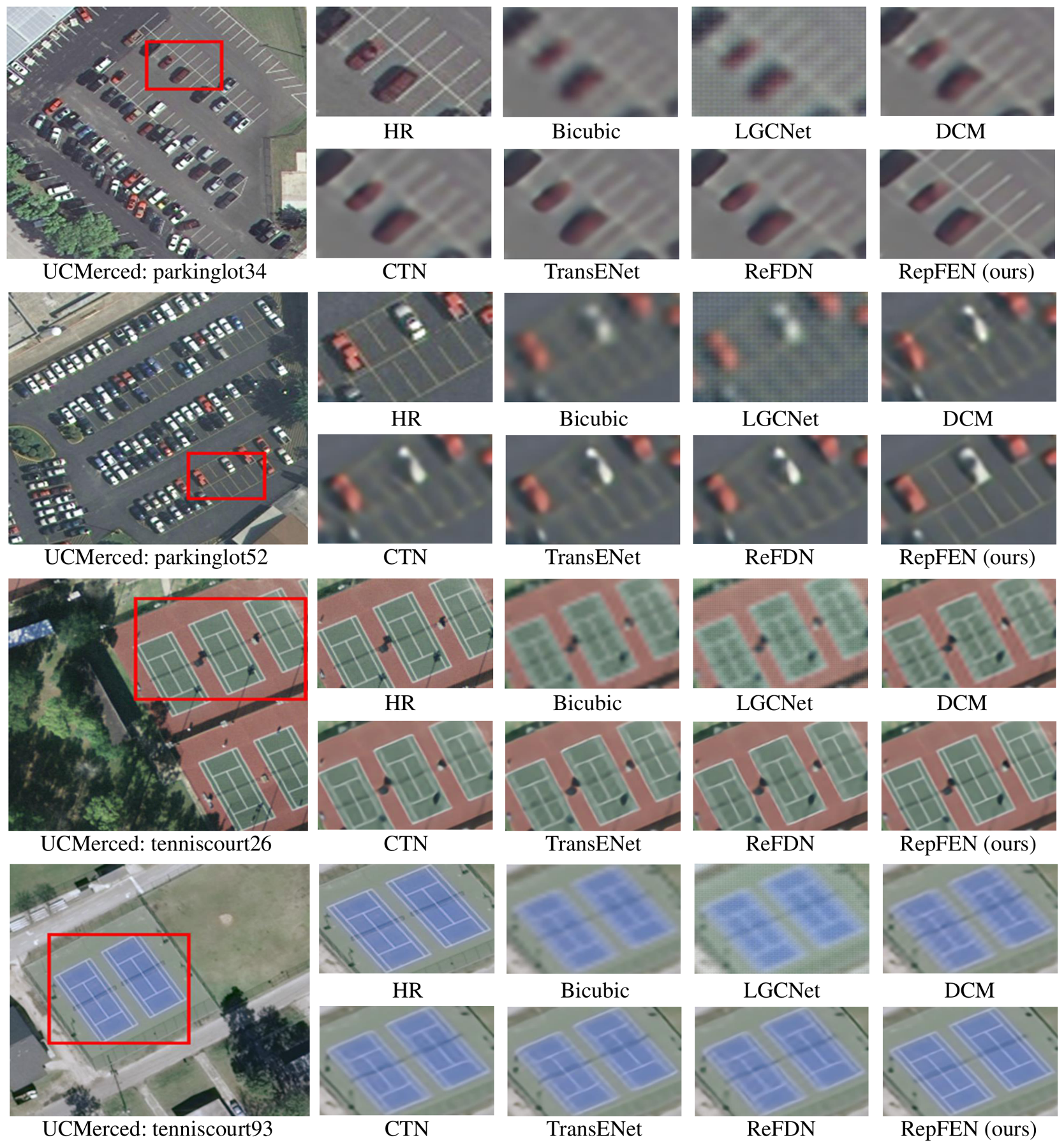
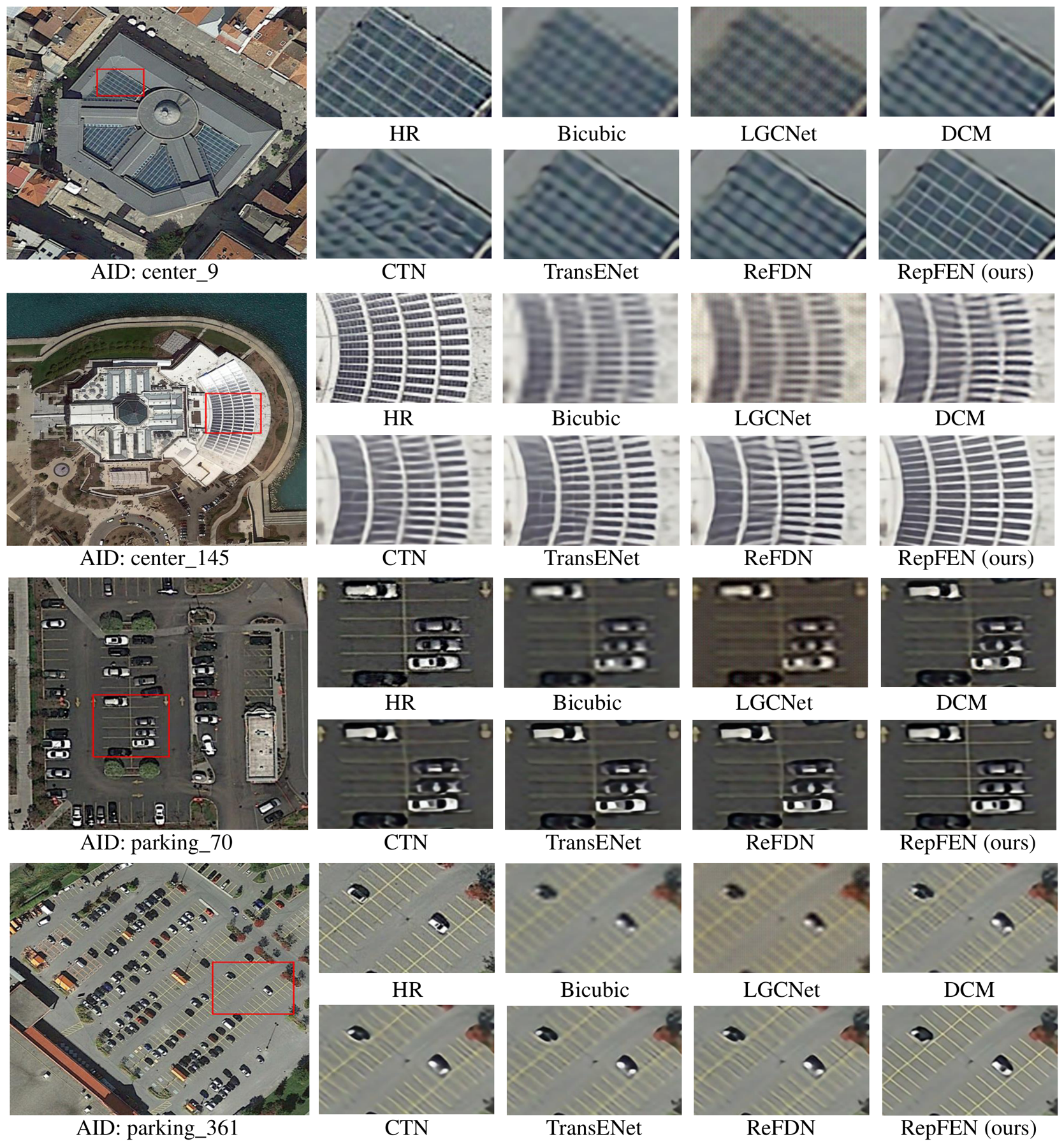
To evaluate the visual performance of the proposed RepFEN, we compare the × 4 super-resolution results on the UCMerced and AID test datasets. As shown in Figure 5 and Figure 6, the texture details and edge features reconstructed from the UCMerced and AID datasets further confirm the superior performance of RepFEN. Notably, in the images “parkinglot52” from Figure 5 and “parking_361” from Figure 6, many competing methods introduce blurring at the edges, whereas RepFEN generates more accurate and precise lines. Similarly, in the images “tenniscourt93” from Figure 5 and “center_145” from Figure 6, the competing methods fail to effectively reconstruct the full texture structure, introducing artifacts and causing image overlap. In contrast, RepFEN restores clearer and more complete texture details. Overall, the proposed RepFEN outperforms other methods in reconstructing high-quality remote sensing images, providing superior visual performance.
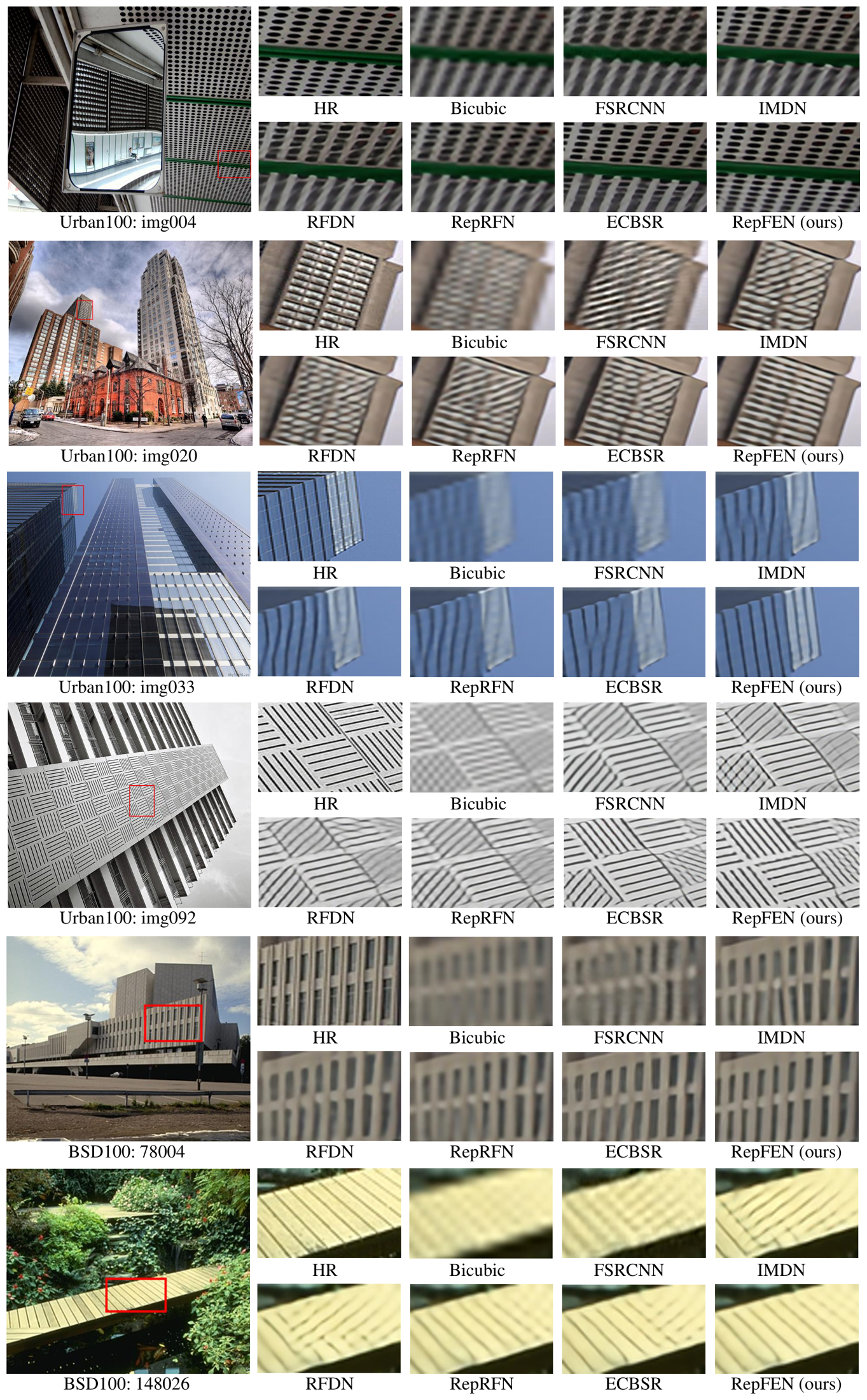
We further compare the reconstruction results of different models on Urban100 and BSD100, as shown in Figure 7. RepFEN preserves edge and texture structures more faithfully than the compared methods. Notably, in the image “BSD100: 148026”, the edge information and texture details produced by competing methods are blurry and inaccurate, while RepFEN mitigates the blurring effect and restores more accurate and sharp edge details. Similarly, in the images “Urban100: img004” and “Urban100: img092”, significant structural distortions and severe artifacts appear in the competing methods, whereas RepFEN recovers finer high-frequency structures and produces sharper edges and contours that are more consistent with the HR reference. Based on the above analysis, our RepFEN demonstrates competitive performance across various super-resolution tasks.

4.4.3. Performance and Efficiency Comparisons

To compare the efficiency of different RSISR methods, we evaluate all networks on the ×4 SR UCMerced dataset using the same NVIDIA RTX 2080Ti GPU. Note that LGCNet, DCM, CTN, and ReFDN are lightweight RSISR models. The resolution of LR input is 64 × 64 and inference time was tested over 100 iterations to ensure a fair comparison, following [25,29]. As shown in Table 11, experimental results indicate that RepFEN achieves strong reconstruction performance with low computational cost and efficient inference. When compared to existing lightweight RSISR methods, RepFEN performs remarkably well. These results indicate the potential of RepFEN for real-time deployment in lightweight RSISR applications.
Further comparisons between RepFEN and other lightweight super-resolution methods using standard benchmark datasets were conducted. All networks were tested on NVIDIA RTX 2080Ti GPU with LR input of 320 × 180 on the Urban100 and Manga109 datasets, following common SR settings [25,26] for fair comparison. As shown in Table 12, RepFEN combines low computational cost with strong reconstruction accuracy relative to the compared lightweight SR methods. The experimental results validate the effectiveness and practicality of RepFEN in lightweight remote sensing super-resolution.

5. Discussion

Experimental results show that RepFEN combines strong reconstruction quality with low model complexity and efficient inference for lightweight RSISR. This advantage primarily stems from the collaborative design of reparameterized, multi-scale local enhancement and partial-channel gated contextual modeling. Remote sensing images usually contain complex urban structures, thin roads, small objects, and repetitive textures distributed over large spatial regions. These characteristics require the network to recover high-frequency local details while maintaining sufficient contextual consistency. In RepFEN, MRepM focuses on enhancing local texture and structural representations through multi-scale reparameterized convolutions, while PCGAM further refines repetitive spatial patterns and broader-range contextual dependencies through content-adaptive gated modulation with limited computational overhead. The ablation results indicate that both modules contribute to reconstruction performance, while their joint use yields the strongest overall performance, supporting their complementary roles in local detail enhancement and lightweight contextual modeling.
These findings demonstrate that RepFEN is theoretically suitable for real-time processing on resource-constrained satellite and edge platforms. Nevertheless, there is still room for improvement and there exist several limitations of this work. First, while the multi-branch training structure of MRepM enhances representation capability, its fixed scale may not fully cover targets with extreme scale variations in remote sensing images. Second, despite the progress made by RepFEN, insufficient LR information at high magnification factors such as ×8 and ×16 can still easily lead to performance bottlenecks. Finally, although RepFEN has achieved an effective balance between reconstruction performance and efficiency, there is still potential for further reduction in the number of parameters and computational complexity for more extreme edge devices. In future work, we will explore dynamic scale allocation strategies and incorporate prior information such as text prompts to further improve reconstruction performance at high magnification levels and in extremely complex scenes. Furthermore, we will develop specialized methods such as structured pruning and knowledge distillation to achieve even greater lightweight optimization while maintaining performance.

6. Conclusions

This work developed RepFEN, a lightweight and accurate RSISR network based on reparameterized feature enhancement, to reduce the computational burden and inference latency of existing methods. Specifically, we proposed RepFEM, which consists of MRepM and PCGAM, to simultaneously enhance local detail recovery and global structure modeling. During training, MRepM employs multi-branch, multi-scale convolutions to strengthen feature representation. During inference, these branches can be folded into compact convolutions, thereby reducing computational cost. In addition, we introduced PCGAM to refine broader-range contextual dependencies and repetitive spatial patterns with low computational overhead, which further improves discriminative feature representation in complex remote sensing scenes. Extensive experimental results on two remote sensing datasets and five natural SR benchmarks show that our RepFEN achieves a better balance between reconstruction quality and model complexity.

Author Contributions

Conceptualization, F.H.; methodology, F.H.; software, R.W.; validation, R.W.; investigation, R.W., X.Y. and G.R.; resources, Y.Y.; data curation, F.H., R.W. and X.Y.; writing—original draft preparation, F.H., R.W. and X.Y.; writing—review and editing, R.W., L.C., Z.Q. and Y.Y.; supervision, F.H. and Y.Y.; funding acquisition, L.C., Z.Q. and F.H. All authors have read and agreed to the published version of the manuscript.

Funding

This work was supported in part by the National Natural Science Foundation of China under grant 62405060.

Data Availability Statement

Data are contained within the article.

Conflicts of Interest

Author Yangping Yuan was employed by the company Zhipu AI. The remaining authors declare that the research was conducted in the absence of any commercial or financial relationships that could be construed as a potential conflict of interest.

References

  1. Li, D.; Wang, M.; Guo, H.; Jin, W. On China’s earth observation system: Mission, vision and application. Geo-Spat. Inf. Sci. 2025, 28, 303–321. [Google Scholar] [CrossRef] [Scilit]
  2. Zheng, T.; Jiang, K.; Xiao, Y.; Zhao, S.; Yao, H. M3amba: Memory mamba is all you need for whole slide image classification. In Proceedings of the 2025 IEEE/CVF Conference on Computer Vision and Pattern Recognition (CVPR); IEEE: Piscataway, NJ, USA, 2025; pp. 15601–15610. [Google Scholar]
  3. Lu, S.; Pan, Z.; Wang, X. Think twice: Test-time reasoning for robust clip zero-shot classification. In Proceedings of the 2025 IEEE/CVF International Conference on Computer Vision (ICCV); IEEE: Piscataway, NJ, USA, 2025; pp. 2919–2929. [Google Scholar]
  4. Lechner, A.M.; Foody, G.M.; Boyd, D.S. Applications in remote sensing to forest ecology and management. One Earth 2020, 2, 405–412. [Google Scholar] [CrossRef] [Scilit]
  5. Wang, Z.g.; Kang, Q.; Xun, Y.j.; Shen, Z.q.; Cui, C.b. Military reconnaissance application of high-resolution optical satellite remote sensing. In Proceedings of the International Symposium on Optoelectronic Technology and Application 2014: Optical Remote Sensing Technology and Applications; SPIE: Bellingham, WA, USA, 2014; Volume 9299, pp. 301–305. [Google Scholar]
  6. Wu, J.; Luo, C.; Qiu, Z.; Chen, L.; Ni, R.; Li, Y.; Huang, F.; Wu, J. DFINet: Dynamic feedback iterative network for infrared small target detection. Pattern Recognit. 2026, 169, 111958. [Google Scholar] [CrossRef] [Scilit]
  7. Bochkovskiy, A.; Wang, C.Y.; Liao, H.Y.M. Yolov4: Optimal speed and accuracy of object detection. arXiv 2020, arXiv:2004.10934. [Google Scholar]
  8. Chen, L.; Liu, H.; Qiu, Z.; Bai, H.; Guan, L.; Huang, F.; Qiu, Q. A High-Quality Data Augmentation Method for Infrared Small Target Detection. IEEE Trans. Geosci. Remote Sens. 2026, 64, 1–17. [Google Scholar] [CrossRef] [Scilit]
  9. Qiu, Z.; Ma, Y.; Fan, F.; Huang, J.; Wu, M. Adaptive scale patch-based contrast measure for dim and small infrared target detection. IEEE Geosci. Remote Sens. Lett. 2020, 19, 7000305. [Google Scholar] [CrossRef] [Scilit]
  10. Dong, C.; Loy, C.C.; He, K.; Tang, X. Learning a deep convolutional network for image super-resolution. In Proceedings of the European Conference on Computer Vision; Springer: Cham, Switzerland, 2014; pp. 184–199. [Google Scholar]
  11. Kim, J.; Lee, J.K.; Lee, K.M. Accurate image super-resolution using very deep convolutional networks. In Proceedings of the IEEE Conference on Computer Vision and Pattern Recognition; IEEE: Piscataway, NJ, USA, 2016; pp. 1646–1654. [Google Scholar]
  12. Lim, B.; Son, S.; Kim, H.; Nah, S.; Mu Lee, K. Enhanced deep residual networks for single image super-resolution. In Proceedings of the IEEE Conference on Computer Vision and Pattern Recognition Workshops; IEEE: Piscataway, NJ, USA, 2017; pp. 136–144. [Google Scholar]
  13. Zhang, Y.; Li, K.; Li, K.; Wang, L.; Zhong, B.; Fu, Y. Image super-resolution using very deep residual channel attention networks. In Proceedings of the European Conference on Computer Vision (ECCV); Springer: Cham, Switzerland, 2018; pp. 286–301. [Google Scholar]
  14. Hui, Z.; Wang, X.; Gao, X. Fast and accurate single image super-resolution via information distillation network. In Proceedings of the IEEE Conference on Computer Vision and Pattern Recognition; IEEE: Piscataway, NJ, USA, 2018; pp. 723–731. [Google Scholar]
  15. Hui, Z.; Gao, X.; Yang, Y.; Wang, X. Lightweight image super-resolution with information multi-distillation network. In Proceedings of the 27th ACM International Conference on Multimedia; Association for Computing Machinery: New York, NY, USA, 2019; pp. 2024–2032. [Google Scholar]
  16. Liu, J.; Tang, J.; Wu, G. Residual feature distillation network for lightweight image super-resolution. In Proceedings of the European Conference on Computer Vision; Springer: Cham, Switzerland, 2020; pp. 41–55. [Google Scholar]
  17. Luo, X.; Xie, Y.; Zhang, Y.; Qu, Y.; Li, C.; Fu, Y. Latticenet: Towards lightweight image super-resolution with lattice block. In Proceedings of the European Conference on Computer Vision; Springer: Cham, Switzerland, 2020; pp. 272–289. [Google Scholar]
  18. Lei, S.; Shi, Z.; Zou, Z. Super-resolution for remote sensing images via local–global combined network. IEEE Geosci. Remote Sens. Lett. 2017, 14, 1243–1247. [Google Scholar] [CrossRef] [Scilit]
  19. Zhang, D.; Shao, J.; Li, X.; Shen, H.T. Remote sensing image super-resolution via mixed high-order attention network. IEEE Trans. Geosci. Remote Sens. 2020, 59, 5183–5196. [Google Scholar] [CrossRef] [Scilit]
  20. Xiao, Y.; Yuan, Q.; Jiang, K.; He, J.; Lin, C.W.; Zhang, L. TTST: A top-k token selective transformer for remote sensing image super-resolution. IEEE Trans. Image Process. 2024, 33, 738–752. [Google Scholar] [CrossRef] [Scilit] [PubMed]
  21. Xiao, Y.; Yuan, Q.; Jiang, K.; He, J.; Jin, X.; Zhang, L. EDiffSR: An efficient diffusion probabilistic model for remote sensing image super-resolution. IEEE Trans. Geosci. Remote Sens. 2023, 62, 5601514. [Google Scholar] [CrossRef] [Scilit]
  22. Ren, Z.; He, L.; Lu, J. Context aware edge-enhanced GAN for remote sensing image super-resolution. IEEE J. Sel. Top. Appl. Earth Obs. Remote Sens. 2023, 17, 1363–1376. [Google Scholar] [CrossRef] [Scilit]
  23. Zhang, H.; Zhang, C.; Xie, F.; Jiang, Z. A closed-loop network for single infrared remote sensing image super-resolution in real world. Remote Sens. 2023, 15, 882. [Google Scholar] [CrossRef] [Scilit]
  24. Xiao, Y.; Yuan, Q.; Jiang, K.; Chen, Y.; Zhang, Q.; Lin, C.W. Frequency-assisted mamba for remote sensing image super-resolution. IEEE Trans. Multimed. 2025, 27, 1783–1796. [Google Scholar] [CrossRef] [Scilit]
  25. Wang, S.; Zhou, T.; Lu, Y.; Di, H. Contextual transformation network for lightweight remote-sensing image super-resolution. IEEE Trans. Geosci. Remote Sens. 2021, 60, 5615313. [Google Scholar] [CrossRef] [Scilit]
  26. Wang, Z.; Li, L.; Xue, Y.; Jiang, C.; Wang, J.; Sun, K.; Ma, H. FeNet: Feature Enhancement Network for Lightweight Remote-Sensing Image Super-Resolution. IEEE Trans. Geosci. Remote Sens. 2022, 60, 1–12. [Google Scholar] [CrossRef] [Scilit]
  27. Wang, J.; Wu, Y.; Wang, L.; Wang, L.; Alfarraj, O.; Tolba, A. Lightweight feedback convolution neural network for remote sensing images super-resolution. IEEE Access 2021, 9, 15992–16003. [Google Scholar] [CrossRef] [Scilit]
  28. Wang, Y.; Shao, Z.; Lu, T.; Huang, X.; Wang, J.; Zhang, Z.; Zuo, X. Lightweight remote sensing super-resolution with multi-scale graph attention network. Pattern Recognit. 2025, 160, 111178. [Google Scholar] [CrossRef] [Scilit]
  29. Hao, S.; Liu, S.; Jia, X.; Lu, H.; He, Y. Efficient adaptive feature fusion network for remote-sensing image super-resolution. IEEE Signal Process. Lett. 2024, 31, 3089–3093. [Google Scholar] [CrossRef] [Scilit]
  30. Zhang, T.; Bian, C.; Zhang, X.; Chen, H.; Chen, S. Lightweight remote-sensing image super-resolution via re-parameterized feature distillation network. IEEE Geosci. Remote Sens. Lett. 2023, 20, 1–5. [Google Scholar] [CrossRef] [Scilit]
  31. Chen, W.; Qu, S.; Luo, L.; Lu, Y. Dual Attention Fusion Enhancement Network for Lightweight Remote-Sensing Image Super-Resolution. Remote Sens. 2025, 17, 1078. [Google Scholar] [CrossRef] [Scilit]
  32. Yan, X.; Song, W.; Feng, X.; Guo, W.; Ning, K. RFANSR: Receptive Field Aggregation Network for Lightweight Remote Sensing Image Super-Resolution. Remote Sens. 2025, 17, 4028. [Google Scholar] [CrossRef] [Scilit]
  33. Zhang, M.; Wang, Q.; Zhang, W.; Chen, X.; Pan, J.; Guo, H. DFCFNet: A Local–Nonlocal Dual-Branch Feature Complementary Fusion Network for Remote Sensing Image Super-Resolution. Remote Sens. 2026, 18, 1626. [Google Scholar] [CrossRef] [Scilit]
  34. Haut, J.M.; Paoletti, M.E.; Fernández-Beltran, R.; Plaza, J.; Plaza, A.; Li, J. Remote sensing single-image superresolution based on a deep compendium model. IEEE Geosci. Remote Sens. Lett. 2019, 16, 1432–1436. [Google Scholar] [CrossRef] [Scilit]
  35. Dong, X.; Sun, X.; Jia, X.; Xi, Z.; Gao, L.; Zhang, B. Remote sensing image super-resolution using novel dense-sampling networks. IEEE Trans. Geosci. Remote Sens. 2020, 59, 1618–1633. [Google Scholar] [CrossRef] [Scilit]
  36. Pan, Z.; Ma, W.; Guo, J.; Lei, B. Super-resolution of single remote sensing image based on residual dense backprojection networks. IEEE Trans. Geosci. Remote Sens. 2019, 57, 7918–7933. [Google Scholar] [CrossRef] [Scilit]
  37. Lei, S.; Shi, Z.; Mo, W. Transformer-based multistage enhancement for remote sensing image super-resolution. IEEE Trans. Geosci. Remote Sens. 2021, 60, 5615611. [Google Scholar] [CrossRef] [Scilit]
  38. Shi, N.; Zhou, H.; Ye, C.; Yao, B.; Wu, Y.; Li, B. FCTNet: A CNN-transformer hybrid for single remote sensing image super-resolution. In Proceedings of the 2024 IEEE International Symposium on Parallel and Distributed Processing with Applications (ISPA); IEEE: Piscataway, NJ, USA, 2024; pp. 368–377. [Google Scholar]
  39. Jiang, K.; Wang, Z.; Yi, P.; Wang, G.; Lu, T.; Jiang, J. Edge-enhanced GAN for remote sensing image superresolution. IEEE Trans. Geosci. Remote Sens. 2019, 57, 5799–5812. [Google Scholar] [CrossRef] [Scilit]
  40. Wu, H.; Ni, N.; Zhang, L. Learning dynamic scale awareness and global implicit functions for continuous-scale super-resolution of remote sensing images. IEEE Trans. Geosci. Remote Sens. 2023, 61, 5602315. [Google Scholar] [CrossRef] [Scilit]
  41. Chen, K.; Li, W.; Lei, S.; Chen, J.; Jiang, X.; Zou, Z.; Shi, Z. Continuous remote sensing image super-resolution based on context interaction in implicit function space. IEEE Trans. Geosci. Remote Sens. 2023, 61, 4702216. [Google Scholar] [CrossRef] [Scilit]
  42. Arienzo, A.; Garzelli, A.; Alparone, L.; Vivone, G. Full-Scale Regression Modeling of Spatial Details for Single-/Multi-Platform Hypersharpening. IEEE Trans. Geosci. Remote Sens. 2025, 63, 5646216. [Google Scholar] [CrossRef] [Scilit]
  43. Liu, Q.; Wang, T.; Jin, Q.; Hu, J.; Li, L.; Lam, K.M. Bi-domain fusion pyramid network for pansharpening with deep anisotropic diffusion. Inf. Fusion 2025, 122, 103212. [Google Scholar] [CrossRef] [Scilit]
  44. Dong, C.; Loy, C.C.; Tang, X. Accelerating the super-resolution convolutional neural network. In Proceedings of the European Conference on Computer Vision; Springer: Cham, Switzerland, 2016; pp. 391–407. [Google Scholar]
  45. Shi, W.; Caballero, J.; Huszár, F.; Totz, J.; Aitken, A.P.; Bishop, R.; Rueckert, D.; Wang, Z. Real-time single image and video super-resolution using an efficient sub-pixel convolutional neural network. In Proceedings of the IEEE Conference on Computer Vision and Pattern Recognition; IEEE: Piscataway, NJ, USA, 2016; pp. 1874–1883. [Google Scholar]
  46. Li, Y.; Agustsson, E.; Gu, S.; Timofte, R.; Van Gool, L. Carn: Convolutional anchored regression network for fast and accurate single image super-resolution. In Proceedings of the European Conference on Computer Vision (ECCV) Workshops; Springer: Cham, Switzerland, 2018; pp. 166–181. [Google Scholar]
  47. Wang, H.; Cheng, S.; Li, Y.; Du, A. Lightweight remote-sensing image super-resolution via attention-based multilevel feature fusion network. IEEE Trans. Geosci. Remote Sens. 2023, 61, 2005715. [Google Scholar] [CrossRef] [Scilit]
  48. Jiang, K.; Yang, M.; Xiao, Y.; Wu, J.; Wang, G.; Feng, X.; Jiang, J. Rep-Mamba: Re-Parameterization in Vision Mamba for Lightweight Remote Sensing Image Super-Resolution. IEEE Trans. Geosci. Remote Sens. 2025, 63, 5637012. [Google Scholar] [CrossRef] [Scilit]
  49. Ding, X.; Zhang, X.; Ma, N.; Han, J.; Ding, G.; Sun, J. Repvgg: Making vgg-style convnets great again. In Proceedings of the IEEE/CVF Conference on Computer Vision and Pattern Recognition; IEEE: Piscataway, NJ, USA, 2021; pp. 13733–13742. [Google Scholar]
  50. Zhang, X.; Zeng, H.; Zhang, L. Edge-oriented convolution block for real-time super resolution on mobile devices. In Proceedings of the 29th ACM International Conference on Multimedia; Association for Computing Machinery: New York, NY, USA, 2021; pp. 4034–4043. [Google Scholar]
  51. Deng, W.; Yuan, H.; Deng, L.; Lu, Z. Reparameterized residual feature network for lightweight image super-resolution. In Proceedings of the IEEE/CVF Conference on Computer Vision and Pattern Recognition; IEEE: Piscataway, NJ, USA, 2023; pp. 1712–1721. [Google Scholar]
  52. Gu, J.; Sun, X.; Zhang, Y.; Fu, K.; Wang, L. Deep residual squeeze and excitation network for remote sensing image super-resolution. Remote Sens. 2019, 11, 1817. [Google Scholar] [CrossRef] [Scilit]
  53. Kang, X.; Duan, P.; Li, J.; Li, S. Efficient swin transformer for remote sensing image super-resolution. IEEE Trans. Image Process. 2024, 33, 6367–6379. [Google Scholar] [CrossRef] [Scilit] [PubMed]
  54. Zhang, W.; Tan, Z.; Lv, Q.; Li, J.; Zhu, B.; Liu, Y. An efficient hybrid CNN-transformer approach for remote sensing super-resolution. Remote Sens. 2024, 16, 880. [Google Scholar] [CrossRef] [Scilit]
  55. Howard, A.; Sandler, M.; Chu, G.; Chen, L.C.; Chen, B.; Tan, M.; Wang, W.; Zhu, Y.; Pang, R.; Vasudevan, V.; et al. Searching for mobilenetv3. In Proceedings of the IEEE/CVF International Conference on Computer Vision; IEEE: Piscataway, NJ, USA, 2019; pp. 1314–1324. [Google Scholar]
  56. Zhang, X.; Zhou, X.; Lin, M.; Sun, J. Shufflenet: An extremely efficient convolutional neural network for mobile devices. In Proceedings of the IEEE Conference on Computer Vision and Pattern Recognition; IEEE: Piscataway, NJ, USA, 2018; pp. 6848–6856. [Google Scholar]
  57. Yun, S.; Ro, Y. Shvit: Single-head vision transformer with memory efficient macro design. In Proceedings of the IEEE/CVF Conference on Computer Vision and Pattern Recognition; IEEE: Piscataway, NJ, USA, 2024; pp. 5756–5767. [Google Scholar]
  58. Xia, G.S.; Hu, J.; Hu, F.; Shi, B.; Bai, X.; Zhong, Y.; Zhang, L.; Lu, X. AID: A benchmark data set for performance evaluation of aerial scene classification. IEEE Trans. Geosci. Remote Sens. 2017, 55, 3965–3981. [Google Scholar] [CrossRef] [Scilit]
  59. Yang, Y.; Newsam, S. Bag-of-visual-words and spatial extensions for land-use classification. In Proceedings of the 18th SIGSPATIAL International Conference on Advances in Geographic Information Systems; Association for Computing Machinery: New York, NY, USA, 2010; pp. 270–279. [Google Scholar]
  60. Agustsson, E.; Timofte, R. Ntire 2017 challenge on single image super-resolution: Dataset and study. In Proceedings of the IEEE Conference on Computer Vision and Pattern Recognition Workshops; IEEE: Piscataway, NJ, USA, 2017; pp. 126–135. [Google Scholar]
  61. Bevilacqua, M.; Roumy, A.; Guillemot, C.; Alberi-Morel, M.L. Low-complexity single-image super-resolution based on nonnegative neighbor embedding. In Proceedings of the British Machine Vision Conference (BMVC), Surrey, UK, 3–7 September 2012. [Google Scholar]
  62. Zeyde, R.; Elad, M.; Protter, M. On single image scale-up using sparse-representations. In Proceedings of the International Conference on Curves and Surfaces; Springer: Cham, Switzerland, 2010; pp. 711–730. [Google Scholar]
  63. Martin, D.; Fowlkes, C.; Tal, D.; Malik, J. A database of human segmented natural images and its application to evaluating segmentation algorithms and measuring ecological statistics. In Proceedings of the Eighth IEEE International Conference on Computer Vision. ICCV 2001; IEEE: Piscataway, NJ, USA, 2001; Volume 2, pp. 416–423. [Google Scholar]
  64. Huang, J.B.; Singh, A.; Ahuja, N. Single image super-resolution from transformed self-exemplars. In Proceedings of the IEEE Conference on Computer Vision and Pattern Recognition; IEEE: Piscataway, NJ, USA, 2015; pp. 5197–5206. [Google Scholar]
  65. Matsui, Y.; Ito, K.; Aramaki, Y.; Fujimoto, A.; Ogawa, T.; Yamasaki, T.; Aizawa, K. Sketch-based manga retrieval using manga109 dataset. Multimed. Tools Appl. 2017, 76, 21811–21838. [Google Scholar] [CrossRef] [Scilit]
  66. Zagoruyko, S.; Komodakis, N. Wide residual networks. arXiv 2016, arXiv:1605.07146. [Google Scholar]
  67. Yoo, J.; Kim, T.; Lee, S.; Kim, S.H.; Lee, H.; Kim, T.H. Enriched cnn-transformer feature aggregation networks for super-resolution. In Proceedings of the IEEE/CVF Winter Conference on Applications of Computer Vision; IEEE: Piscataway, NJ, USA, 2023; pp. 4956–4965. [Google Scholar]
  68. Wu, T.; Zhao, R.; Lv, M.; Jia, Z.; Li, L.; Wang, Z.; Ma, H. Lightweight remote sensing image super-resolution via background-based multiscale feature enhancement network. IEEE Geosci. Remote Sens. Lett. 2024, 21, 7509405. [Google Scholar] [CrossRef] [Scilit]
  69. Wang, L.; Li, X.; Tian, W.; Peng, J.; Chen, R. Lightweight interactive feature inference network for single-image super-resolution. Sci. Rep. 2024, 14, 11601. [Google Scholar] [CrossRef] [Scilit] [PubMed]
  70. Cao, W.; Lei, X.; Shi, J.; Liang, W.; Liu, J.; Bai, Z. HASN: Hybrid attention separable network for efficient image super-resolution. Vis. Comput. 2025, 41, 3423–3435. [Google Scholar] [CrossRef] [Scilit]
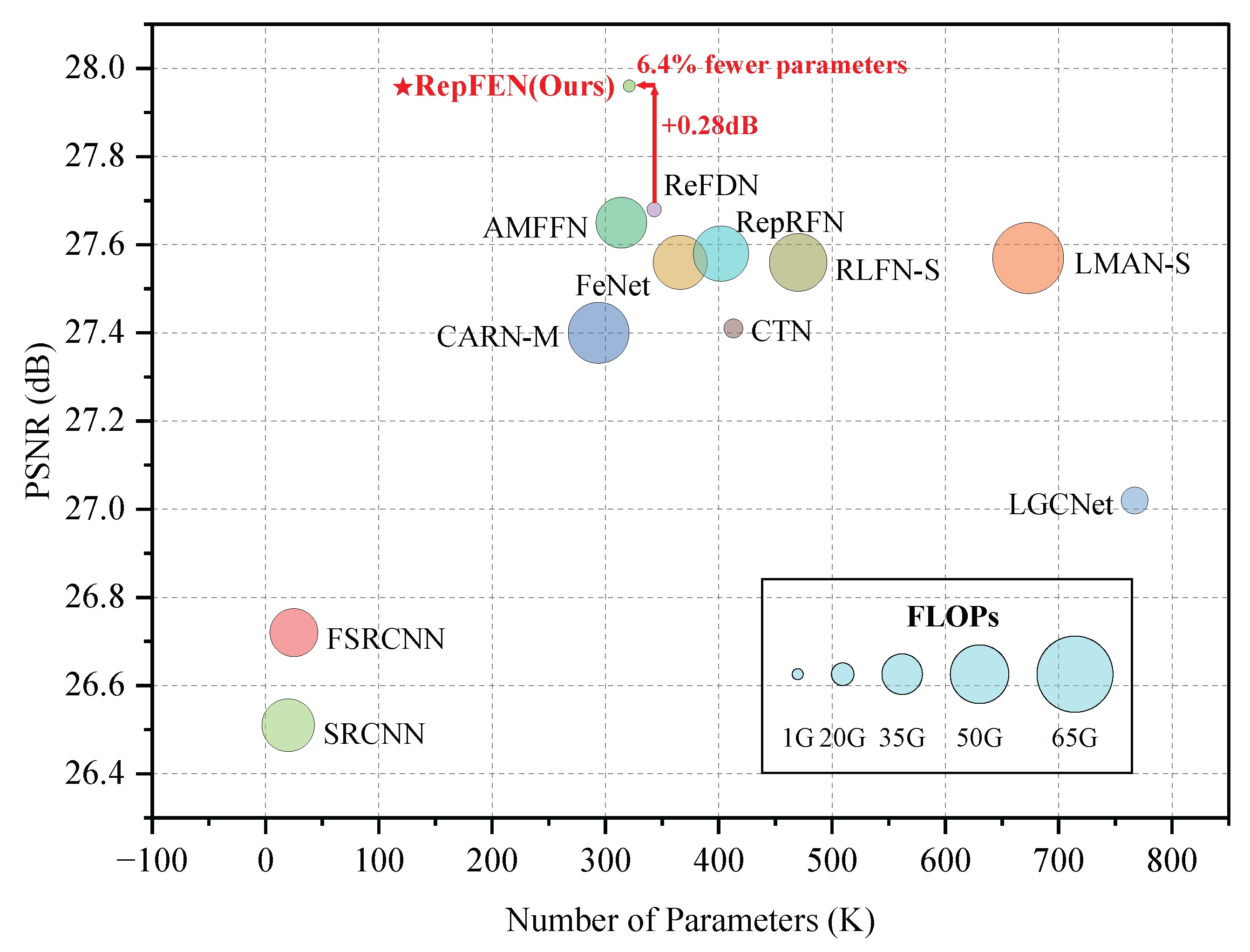
Figure 1. Comparison of model size and PSNR among RepFEN and lightweight SR methods on UCMerced for ×4 SR. RepFEN maintains competitive reconstruction accuracy with a compact parameter count.
Remotesensing 18 02850 g001
Figure 2. Overall architecture of the proposed RepFEN. The network consists of four primary parts: shallow feature extraction, deep feature extraction, multi-layer feature fusion, and image reconstruction. The deep feature extraction module learns compact and discriminative SR features by coupling reparameterized multi-scale enhancement with partial-channel gated attention in RepFEMs. Additionally, the bilinear global residual branch preserves low-frequency information and facilitates detail recovery.
Remotesensing 18 02850 g002
Figure 3. Structure of multi-scale reparameterized module (MRepM) in training and inference phases. (a) MRepM adopts a two-group multi-branch structure during training. (b) MRepM is converted into a compact single-branch structure through structural reparameterization during inference.
Remotesensing 18 02850 g003
Figure 4. Structure of partial-channel gated attention module (PCGAM).
Remotesensing 18 02850 g004
Figure 5. Qualitative comparison of RepFEN with representative SR methods on UCMerced for × 4 SR.
Remotesensing 18 02850 g005
Figure 6. Qualitative comparison of RepFEN with representative SR methods on AID for × 4 SR.
Remotesensing 18 02850 g006
Figure 7. Qualitative comparison of RepFEN with representative lightweight SR methods on benchmark datasets for × 4 SR.
Remotesensing 18 02850 g007
Table 1. Ablation experiments on the baseline selection and the designs of MRepM and PCGAM on the Urban100 and Manga109 datasets for × 4 SR. Numbers in red represent the best performance.
MethodScaleParams
(K)
FLOPs
(G)
Time
(ms)
Urban100
PSNR/SSIM
Manga109
PSNR/SSIM
ResBlockMRepMPCGAM
× 4 32718.88.3626.23/0.785530.63/0.9093
30712.76.0926.39/0.794630.89/0.9138
413.42.1525.75/0.767629.56/0.8927
32114.86.6626.50/0.795530.98/0.9149
Table 2. Ablation study of the bilinear interpolation branch on the Urban100 and Manga109 datasets for × 4 SR. Numbers in red represent the best performance.
MethodScaleUrban100Manga109
PSNR/SSIMPSNR/SSIM
w/o Bilinear × 4 26.35/0.790730.78/0.9122
w/Bilinear26.50/0.795530.98/0.9149
Table 3. Ablation experiments on the design of structural reparameterization on the Manga109 dataset for × 4 SR. Numbers in red represent the best performance.
MethodScaleParams
(K)
FLOPs
(G)
Time
(ms)
Manga109
PSNR/SSIM
Δ max / Δ mean
( × 10 6 )
Training Model × 4 101147.713.0230.98/0.9149 2.24 / 0.0639
Inference Model32114.86.6630.98/0.9149
Table 4. Ablation experiments on different convolution-group configurations of MRepM on the Urban100 and Manga109 datasets for × 4 SR. Numbers in red represent the best performance.
MethodScaleUrban100Manga109
PSNR/SSIMPSNR/SSIM
group1 only × 4 26.19/0.791530.63/0.9102
group2 only26.39/0.793730.74/0.9123
single mixed group26.40/0.792430.88/0.9135
single 7 × 7 group26.43/0.793530.84/0.9131
group1 + group2 (ours)26.50/0.795530.98/0.9149
Table 5. Ablation experiments on the design of the number of branches in MRepM on Urban100 and Manga109 datasets for × 4 SR. Numbers in red represent the best performance. Results are reported as means ± standard deviations over three random seeds.
MRepMParamsUrban100Manga109
Br1Br2Br3Br4(K)PSNRSSIMPSNRSSIM
32126.395 ± 0.0130.7943 ± 0.000430.854 ± 0.0140.9133 ± 0.0004
32126.431 ± 0.0170.7944 ± 0.000630.921 ± 0.0010.9141 ± 0.0001
32126.469 ± 0.0100.7950 ± 0.000330.948 ± 0.0100.9145 ± 0.0001
32126.492 ± 0.0070.7954 ± 0.000130.966 ± 0.0130.9148 ± 0.0001
Table 6. Ablation experiments on the design of channel proportion r on Urban100 and Manga109 datasets for × 4 SR. Numbers in red represent the best performance. Results are reported as means ± standard deviations over three random seeds.
PCGAMParamsFLOPsTimeUrban100Manga109
(K)(G)(ms)PSNRSSIMPSNRSSIM
r = 1 34620.711.0526.594 ± 0.0040.7969 ± 0.000231.087 ± 0.0150.9163 ± 0.0002
r = 0.5 33016.18.7326.525 ± 0.0060.7958 ± 0.000331.019 ± 0.0070.9155 ± 0.0001
r = 0.25 32114.86.6626.492 ± 0.0070.7954 ± 0.000130.966 ± 0.0130.9148 ± 0.0001
Table 7. Ablation study on the Q, K, and V branches in PCGAM on Urban100 and Manga109 datasets for × 4 SR. Numbers in red represent the best performance.
PCGAMScaleUrban100Manga109
Q K V PSNR/SSIMPSNR/SSIM
× 4 26.04/0.783830.41/0.9063
26.19/0.786830.59/0.9094
26.16/0.786130.55/0.9087
26.23/0.789230.65/0.9105
26.32/0.793130.72/0.9118
26.50/0.795530.98/0.9149
Table 8. Ablation experiments on the design of convolution operations with different scales in PCGAM on Urban100 and Manga109 datasets for ×4 SR. Numbers in red represent the best performance.
PCGAMUrban100
PSNR/SSIM
Manga109
PSNR/SSIM
DWConv 3 × 3 + DWDConv 3 × 326.36/0.793330.79/0.9120
DWConv 5 × 5 + DWDConv 5 × 526.40/0.794130.85/0.9132
Multi-scale fusion in PCGAM26.50/0.795530.98/0.9149
Table 9. Quantitative comparison of RepFEN and competitive SR algorithms on UCMerced and AID datasets. For RepFEN, results are reported as means ± standard deviations over three random seeds. Numbers in red represent the best performance and numbers in blue indicate the second-best results.
MethodScaleUCMercedAID
PSNRSSIMPSNRSSIM
Bicubic × 2 30.760.878932.390.8906
LGCNet [18]33.480.923534.800.9320
DCM [34]33.650.927435.210.9366
CTN [25]33.590.925535.220.9369
ACT [67]33.880.928335.170.9362
TransENet [37]34.030.930135.280.9374
ReFDN [30]34.060.930435.240.9368
RepRFN [51]34.180.929135.290.9390
RepFEN (Ours)34.148 ± 0.0240.9313 ± 0.000335.329 ± 0.0100.9381 ± 0.0002
Bicubic × 3 27.460.763129.080.7863
LGCNet [18]29.280.823830.730.8417
DCM [34]29.520.839431.310.8561
CTN [25]29.440.831931.310.8561
ACT [67]29.800.839531.390.8579
TransENet [37]29.920.840831.450.8595
ReFDN [30]29.850.840531.350.8566
RepRFN [51]29.960.845331.480.8610
RepFEN (Ours)30.112 ± 0.0060.8416 ± 0.000131.551 ± 0.0080.8621 ± 0.0001
Bicubic × 4 25.650.672527.300.7036
LGCNet [18]27.020.733328.610.7626
DCM [34]27.220.752829.170.7824
CTN [25]27.410.751229.180.7828
ACT [67]27.540.753129.190.7836
TransENet [37]27.770.763029.380.7909
ReFDN [30]27.680.759629.200.7835
RepRFN [51]27.580.761129.410.7889
RepFEN (Ours)27.958 ± 0.0020.7659 ± 0.000229.585 ± 0.0050.7965 ± 0.0002
Table 10. Quantitative comparison of RepFEN and lightweight SR algorithms on benchmark datasets. Results are reported in terms of PSNR/SSIM, and “-” indicates unavailable results. For each dataset and scale, red and blue denote the highest and second-highest PSNR/SSIM values, respectively. Tied values share the same highlighting.
MethodScaleParamsFLOPsSet5Set14BSD100Urban100Manga109
(K)(G)PSNR/SSIMPSNR/SSIMPSNR/SSIMPSNR/SSIMPSNR/SSIM
Bicubic × 2 --33.66/0.929930.24/0.868829.56/0.843126.88/0.840330.80/0.9339
SRCNN [10]5752.736.66/0.954232.42/0.906331.36/0.887929.50/0.894635.74/0.9661
FSRCNN [44]12637.00/0.955832.63/0.908831.53/0.892029.88/0.902036.67/0.9694
IMDN [15]694158.838.00/0.960533.63/0.917732.19/0.899632.17/0.928338.88/0.9774
RFDN [16]534102.738.05/0.960633.68/0.918432.16/0.899432.12/0.927838.88/0.9773
ECBSR [50]596137.3137.90/0.961533.34/0.917832.10/0.901831.71/0.9250-
RepRFN [51]38685.1237.99/0.960933.57/0.917932.18/0.900431.95/0.926138.80/0.9774
BMFENet [68]46511538.04/0.960533.62/0.918032.22/0.900432.29/0.9300-
IFIN-S [69]451110.638.00/0.960633.66/0.918132.18/0.899632.14/0.928438.70/0.9771
RepFEN (Ours)30364.438.17/0.961133.86/0.921032.30/0.901932.68/0.933839.31/0.9781
Bicubic × 3 --30.39/0.868227.55/0.774227.21/0.738524.46/0.734926.95/0.8556
SRCNN [10]5752.732.75/0.909029.28/0.820928.41/0.786326.24/0.798930.59/0.9107
FSRCNN [44]12533.16/0.914029.43/0.824228.53/0.791026.43/0.808030.98/0.9212
IMDN [15]70371.534.36/0.927030.32/0.841729.09/0.804628.17/0.851933.61/0.9445
RFDN [16]54152.134.41/0.928030.34/0.842029.09/0.805028.21/0.852533.67/0.9449
RepRFN [51]39238.434.33/0.927230.30/0.841529.08/0.805827.95/0.847333.48/0.9434
BMFENet [68]47051.734.34/0.927130.27/0.840729.08/0.804928.18/0.8534-
IFIN-S [69]45951.034.45/0.927830.47/0.844229.13/0.806428.32/0.856033.78/0.9460
RepFEN (Ours)31028.734.58/0.928930.53/0.845429.24/0.809328.63/0.860233.97/0.9475
Bicubic × 4 --28.42/0.810426.00/0.702725.96/0.667523.14/0.657724.89/0.7866
SRCNN [10]5752.730.48/0.862827.49/0.750326.90/0.710124.52/0.722127.66/0.8505
FSRCNN [44]124.630.71/0.865727.59/0.753526.98/0.715024.62/0.728027.90/0.8517
IMDN [15]71540.932.21/0.894828.58/0.781127.56/0.735326.04/0.783830.45/0.9075
RFDN [16]55026.532.24/0.895228.61/0.781927.57/0.736026.11/0.785830.58/0.9089
ECBSR [50]60334.7331.92/0.894628.34/0.781727.48/0.739325.81/0.7773-
RepRFN [51]40222.132.15/0.895228.63/0.782427.60/0.737726.09/0.783430.52/0.9075
BMFENet [68]47729.432.22/0.895128.61/0.781227.54/0.735526.04/0.7852-
IFIN-S [69]47031.632.27/0.895828.68/0.783427.62/0.738126.17/0.789030.64/0.9106
RepFEN (Ours)32114.832.41/0.897728.80/0.786927.74/0.741726.50/0.795530.98/0.9149
Table 11. Comparison network performance: Params, FLOPs, Time, PSNR, and SSIM results on the UCMerced dataset (×4 SR). Numbers in red represent the best performance and numbers in blue indicate the second-best results.
MethodParams
(K)
FLOPs
(G)
Time
(ms)
UCMerced
PSNR/SSIM
LGCNet [18]7673.1127.02/0.7333
DCM [34]217713.0327.22/0.7528
CTN [25]4131.81627.41/0.7512
TransENet [37]37,4597.92727.77/0.7630
ReFDN [30]3431.3627.68/0.7596
RepFEN (Ours)3211.1127.96/0.7661
Table 12. Comparison network performance: Params, FLOPs, Time, PSNR, and SSIM results on the Urban and the Manga109 datasets (×4 SR). Numbers in red represent the best performance and numbers in blue indicate the second-best results.
MethodParams
(K)
FLOPs
(G)
Time
(ms)
Urban100
PSNR/SSIM
Manga109
PSNR/SSIM
IMDN [15]71540.911.5526.04/0.783830.45/0.9075
RFDN [16]55026.59.7926.11/0.785830.58/0.9089
LatticeNet [17]77743.614.8926.14/0.784430.46/0.9061
HASN [70]43526.626.6226.13/0.786930.50/0.9077
RepRFN [51]40222.18.9326.09/0.783430.52/0.9075
RepFEN (Ours)32114.86.6626.50/0.795530.98/0.9149
Disclaimer/Publisher’s Note: The statements, opinions and data contained in all publications are solely those of the individual author(s) and contributor(s) and not of MDPI and/or the editor(s). MDPI and/or the editor(s) disclaim responsibility for any injury to people or property resulting from any ideas, methods, instructions or products referred to in the content.