Article

LOA-Net: Lightweight Orientation-Aware Network for Road Extraction from Remote Sensing Imagery

1
Department of Information and Communication Command, Information Support Force Engineering University, Wuhan 430035, China
2
Electronic Information School, Wuhan University, Wuhan 430072, China
3
National Graduate School, University of Defense Technology, Changsha 410073, China
*
Author to whom correspondence should be addressed.
Remote Sens. 2026, 18(16), 2716; https://doi.org/10.3390/rs18162716
Submission received: 13 July 2026 / Revised: 4 August 2026 / Accepted: 10 August 2026 / Published: 12 August 2026

Highlights

  • What are the main findings?
  • Road-aligned deformable convolution (RA-DCN) performs road-aligned four-parameter sampling and explicitly supervises the predicted orientation, effectively capturing road topology.
  • LOA-Net couples a compact encoder with an efficient RA-DCN decoder. With only 34.8 M parameters, the fewest of all compared models, it attains the highest IoU and F1 on both CHN6-CUG and DeepGlobe, surpassing the strongest competitor by up to +4.72 IoU and +3.48 F1.
  • What are the implications of the main findings?
  • Constraining deformable sampling to a road-aligned subspace with explicit geometric supervision improves the model’s road-extraction capability.
  • Consistent gains across the urban CHN6-CUG and the rural DeepGlobe benchmarks indicate that the method achieves strong road-extraction performance and generalizes well, while its low parameter count makes it well suited for efficient road extraction on resource-constrained edge platforms.

Abstract

Accurate extraction of road networks from high-resolution remote sensing imagery is a fundamental task underpinning autonomous-driving navigation, urban spatial planning, and the dynamic updating of geographic information databases. Although existing road extraction methods attain outstanding pixel-level segmentation accuracy and topological integrity, most follow an accuracy-first design paradigm that relies on heavyweight backbones and increasingly complex decoders, incurring a parameter volume and storage overhead that constitute the principal bottleneck for deploying them on resource-constrained edge platforms such as unmanned aerial vehicles, mobile terminals, and onboard satellite processors. Conversely, models that pursue extreme lightweighting often fail to preserve the thin, continuous, linear structure of roads, tending to produce topological breaks in the extracted road networks. To bridge the performance gap between segmentation accuracy and model size, we propose LOA-Net, a lightweight orientation-aware road extraction network. LOA-Net introduces a Road-Aligned Deformable Convolution (RA-DCN) that adaptively aligns the sampling region with the road geometry and explicitly supervises the predicted road orientation, thereby accurately capturing road connectivity while substantially reducing the parameter count. Experiments on the CHN6-CUG and DeepGlobe benchmarks show that LOA-Net surpasses representative state-of-the-art methods on both IoU and F1, while achieving the lowest parameter count of all compared models and a computational complexity comparable to its peers, striking an excellent trade-off between segmentation performance and a mobile-friendly footprint that makes it well suited for road extraction from remote sensing imagery in resource-constrained scenarios.

1. Introduction

Road networks are among the most fundamental elements of geospatial infrastructure, and accurate road maps provide foundational support for many domains such as autonomous driving, urban planning, vehicle navigation, and disaster management. Traditional map-production pipelines are accurate yet slow, labor-intensive, and costly, and they struggle to keep pace with the rapid expansion and reshaping of road networks. Owing to their broad coverage, multi-temporal availability, and increasingly fine spatial resolution, satellite and aerial remote sensing imagery has become a primary data source for large-scale map updating. Automatic road extraction from such imagery has emerged as a fundamental remote-sensing image-processing and scene-understanding task [1,2].
Driven by the success of deep learning, road extraction has shifted from hand-crafted feature matching toward data-driven semantic segmentation. Since the introduction of fully convolutional networks (FCN) [3], encoder–decoder architectures such as U-Net [4], together with atrous-convolution-based models such as DeepLab [5], have established a solid foundation for pixel-level road prediction. These general semantic-segmentation networks were quickly specialized for road tasks. D-LinkNet, the winner of the 2018 DeepGlobe road-extraction challenge, augments LinkNet with dilated convolutions to better capture thin and elongated structures [6]. Most of these models are built upon deep ResNet [7] and attain favorable pixel-level accuracy.
Extracting roads from high-resolution imagery nonetheless remains challenging. Roads are spatially thin, long, and continuously connected, whereas buildings, trees, and shadows frequently occlude road surfaces, and spectrally similar backgrounds such as bare soil and parking lots introduce additional confusion. Consequently, pixel-wise segmentation models tend to produce fragmented, disconnected road masks with incorrect topology, which is detrimental to downstream routing and navigation. To address this, an increasing amount of research has begun to focus on road connectivity and topology, with approaches including joint segmentation and orientation learning [8] and topology-aware losses [9]. Methods in recent years embed road-topology structural reasoning directly within the network. CoANet employs a connectivity attention module together with direction-specific strip convolutions to capture long-range, road-aligned context and pair-wise pixel dependencies [2], SGCN adopts split depth-wise separable graph convolution to balance trunk-road and small-road extraction [10], and RCFS-Net fuses full-stage features to handle occluded roads [11].
Although these advances have markedly improved extraction accuracy and structural correctness, they are largely accuracy-oriented, relying on heavyweight backbones and multi-branch, multi-stage network structures. Such models typically incur large parameter counts, heavy memory footprints, and considerable energy consumption, resulting in limited scalability and a mismatch with the practical deployment needs of road extraction. Road-extraction tasks now often have to run on resource-constrained hardware such as UAVs and satellites [1], and on such edge platforms, large models are impractical, while the latency, bandwidth, and energy costs of offloading every prediction to the cloud are prohibitive. There is consequently a pressing need for lightweight road-extraction methods that combine efficient architectures, model compression, and inference acceleration to retain competitive accuracy and structural fidelity while sharply reducing computational cost, thereby bridging the gap between algorithmic design and practical edge deployment.
The computer-vision community has made substantial progress on efficient neural architecture design. Depth-wise-separable architectures such as MobileNet [12] and GhostNet [13], together with compound-scaled EfficientNet [14], substantially reduce computation, while model-compression techniques (pruning, quantization, and knowledge distillation [15]) offer complementary routes. Meanwhile, some road-extraction works have begun to adopt efficiency-oriented designs: D-LinkNet and SGCN leverage dilated or depth-wise separable convolutions to control cost [6,10], and more recent lightweight road extractors such as BIR-Net [16], FAMNet [17], and fKAN-UNet [18] explicitly target resource-constrained platforms with compact backbones and efficient decoders. However, aggressive lightweighting frequently comes at the expense of accuracy, because the thin and topologically constrained nature of roads renders them especially sensitive to the reduced capacity, aggressive downsampling, and information loss that accompany compact networks. How to build a road-extraction model that is simultaneously lightweight, accurate, and connectivity-preserving therefore remains an open and important problem.
Achieving this goal calls for a holistic design, and this work pursues optimization along two fronts. The first is backbone lightweighting: replacing the heavyweight encoder with a lightweight backbone that preserves feature-extraction quality while reducing the parameter budget. The second is decoder efficiency: streamlining redundant modules in the decoder and adopting direction-adaptive deformable convolution so that the sampling geometry conforms to the road structure, thereby improving road-extraction efficiency.
Following this strategy, this paper proposes LOA-Net, a lightweight road-extraction network that aims to deliver high extraction accuracy and well-preserved road connectivity under tight computational budgets, targeting deployable performance on resource-limited remote-sensing platforms. The main contributions of this work are summarized as follows.
  • We design a road-aligned deformable convolution (RA-DCN) that employs four-parameter sampling aligned with the road and explicitly supervises the predicted orientation, thereby effectively capturing road topology at low computational cost.
  • We propose a lightweight orientation-aware network (LOA-Net) that jointly employs a compact encoder and an efficient RA-DCN decoder, achieving high-quality road extraction at a low parameter cost.
  • Extensive experiments on the CHN6-CUG [19] and DeepGlobe [20] benchmarks show that LOA-Net surpasses state-of-the-art methods in extraction accuracy while using the fewest parameters of all compared models, fully demonstrating its efficient and lightweight design.
The remainder of this paper is organized as follows. Section 2 reviews related work on road extraction, connectivity preservation, and lightweight network design. Section 3 describes the proposed method in detail. Section 4 reports the experimental setup and results. Section 5 discusses the results and the limitations of the proposed method, and Section 6 concludes the paper.

2. Related Work

2.1. Road Extraction from Remote Sensing Imagery

Road extraction has been predominantly formulated as a binary semantic segmentation problem. The field was reshaped by fully convolutional networks [3] and the encoder–decoder family: U-Net [4], with its skip connections that fuse low- and high-level features, and LinkNet [21] reuse encoder features to recover fine spatial detail, whereas atrous-convolution models such as DeepLab [5] enlarge the receptive field to capture multi-scale context. These general backbones were quickly specialized for roads. D-LinkNet [6], the winner of the DeepGlobe road-extraction challenge [20], augments LinkNet with dilated convolutions in its center block to better delineate thin and elongated structures. More recent specialized extractors push accuracy further along complementary axes: SwinMSMDFFNet augments a CNN encoder with an auxiliary Swin Transformer to inject global self-attention [22], whereas OARENet introduces an occlusion-aware decoder to recover roads under dense occlusions [23]. Despite strong pixel-level performance, these methods share two limitations: they typically rely on heavyweight backbones such as ResNet [7] and are optimized for per-pixel accuracy, paying little attention to the topological structure of the road network.

2.2. Road Connectivity and Topology Preservation

Given that roads are thin and continuously connected, fragmented masks with broken topology are of little use for downstream routing and navigation, which has motivated a second line of research. One paradigm treats topology as a post-processing or explicit graph-construction problem: DeepRoadMapper [24] completes missing connections through shortest-path reasoning, RoadTracer [25] iteratively grows a road graph under a CNN-based decision function, and Sat2Graph [26] encodes the road network as a graph tensor. These graph-based approaches can enforce connectivity but are often slow and prone to error accumulation in complex scenes. The other paradigm embeds structural or topological cues directly into learning: Mosinska et al. [9] introduce a topology-aware loss to preserve thin structures, Batra et al. [8] jointly learn segmentation and road orientation, SGCN [10] employs split depth-wise separable graph convolution to balance trunk-road and small-road extraction, and RCFS-Net [11] fuses full-stage features to handle occluded roads. Most relevant to this work, CoANet [2] aligns convolutions with road geometry through direction-specific strip convolutions and a connectivity attention module that predicts pair-wise pixel connectivity, while DBASNet [27] employs a dual-branch decoder to balance terrain segmentation with road-topological integrity, and more recent methods such as CEBRNet [28] and ProX-Net [29] continue to pursue connectivity and topological correctness. Although effective, these methods achieve better connectivity by introducing extra branches, auxiliary modules, or iterative/post-processing steps, which increase model size and inference cost, the very opposite of the lightweight objective pursued here.
Beyond graph- and loss-level structural cues, deformable convolution [30] offers a complementary route to geometry-aware feature aggregation. Its successor DCNv2 [31] lets each kernel position predict a 2D sampling offset so that the receptive field can adapt to the underlying structure, and CoANet’s Strip Convolution Module (SCM) constrains this idea to four fixed directions (horizontal, vertical, and two diagonals) using bar-shaped kernels, and recent road extractors such as AFDANet [32] and fKAN-UNet [18] extend this direction-aligned family with multi-directional strip convolutions. While attractive for roads, these direction-aligned designs share a limitation that motivates the present work: their sampling directions are confined to a fixed discrete set and cannot adapt to arbitrary road angles, wasting capacity on directions that do not match the local road orientation, whereas the fully unconstrained offsets of DCNv2 frequently displace sampling points off thin road surfaces (1–3 pixels wide) into adjacent buildings, soil, or vegetation. Critically, neither provides any direct supervision on whether the predicted sampling direction is geometrically correct: the segmentation loss conflates offset quality with numerous other factors, and the offset field can converge to configurations that are locally optimal for pixel classification but geometrically meaningless. These observations motivate the Road-Aligned Deformable Convolution proposed in Section 3.2, which constrains the sampling geometry to a road-aligned subspace and explicitly supervises the predicted road direction.

2.3. Lightweight Network Architectures

The efficiency techniques underlying this work originate from the broader literature on compact CNN design. MobileNet [12] popularized depth-wise separable convolutions together with inverted residuals and linear bottlenecks, substantially reducing computation, GhostNet [13] generates feature maps from cheap linear operations, and EfficientNet [14] provides principled compound scaling of depth, width, and resolution, while model-compression techniques (pruning, quantization, and knowledge distillation [15]) offer complementary routes to compact networks, and distillation strategies have likewise advanced adjacent dense-prediction problems such as single-image super-resolution [33]. A few road-extraction works have begun to adopt efficiency-oriented operators. For instance, D-LinkNet [6] and SGCN [10] exploit dilated or depth-wise separable convolutions to control cost. However, aggressive lightweighting typically erodes accuracy and, more critically for roads, connectivity, because the thin and topology-constrained nature of roads makes them especially sensitive to the reduced capacity and information loss introduced by compact networks [16,34]. Among these efficient families, modern pure-convolutional architectures such as ConvNeXt [35] and its successor ConvNeXt-V2 [36] are particularly attractive for road extraction: their large kernels preserve the fine spatial detail and thin-road signal that aggressive mobile-style downsampling tends to discard, while their depthwise design and continuous model-size scaling provide a fine-grained accuracy–efficiency trade-off well suited to resource-constrained remote-sensing deployment. Beyond road extraction, compact encoder–decoder designs have also advanced other dense remote-sensing tasks such as lightweight building change detection [37]. Outside the remote-sensing setting, deep learning has likewise advanced intelligent monitoring and dynamic modeling across other engineering domains, including machine-vision-driven physics-informed state detection of pantograph–catenary systems [38], meta-learning-based dynamic modeling of high-speed rail subsystems [39], cross-domain bearing condition monitoring [40], and quality-of-transmission forecasting in optical communication networks [41].
In summary, the existing literature reveals a clear and unresolved trade-off between accuracy and efficiency. Accuracy- and topology-oriented road extractors deliver strong segmentation and well-connected results but at a heavy computational cost that hinders edge deployment and large-scale processing, whereas compact architectures achieve efficiency yet struggle to preserve the thin, connected structure of roads. Methods that are simultaneously lightweight at both the backbone and the road-specific module levels while preserving accuracy and connectivity remain scarce, which motivates the holistic design pursued in this work.

3. Methodology

This section presents the proposed LOA-Net, a lightweight orientation-aware road-extraction network that embodies the two-pronged lightweighting strategy described in Section 1. Its central innovation is a Road-Aligned Deformable Convolution (RA-DCN) module that explicitly aligns the deformable sampling grid with local road orientation. Section 3.1 provides an overview of the architecture. Section 3.2 details the RA-DCN module, including the road-direction-based offset parameterization, the double-angle orientation representation, the module structure, and the structure-tensor-based orientation supervision. Section 3.3 presents the multi-task loss function.

3.1. Overall Architecture

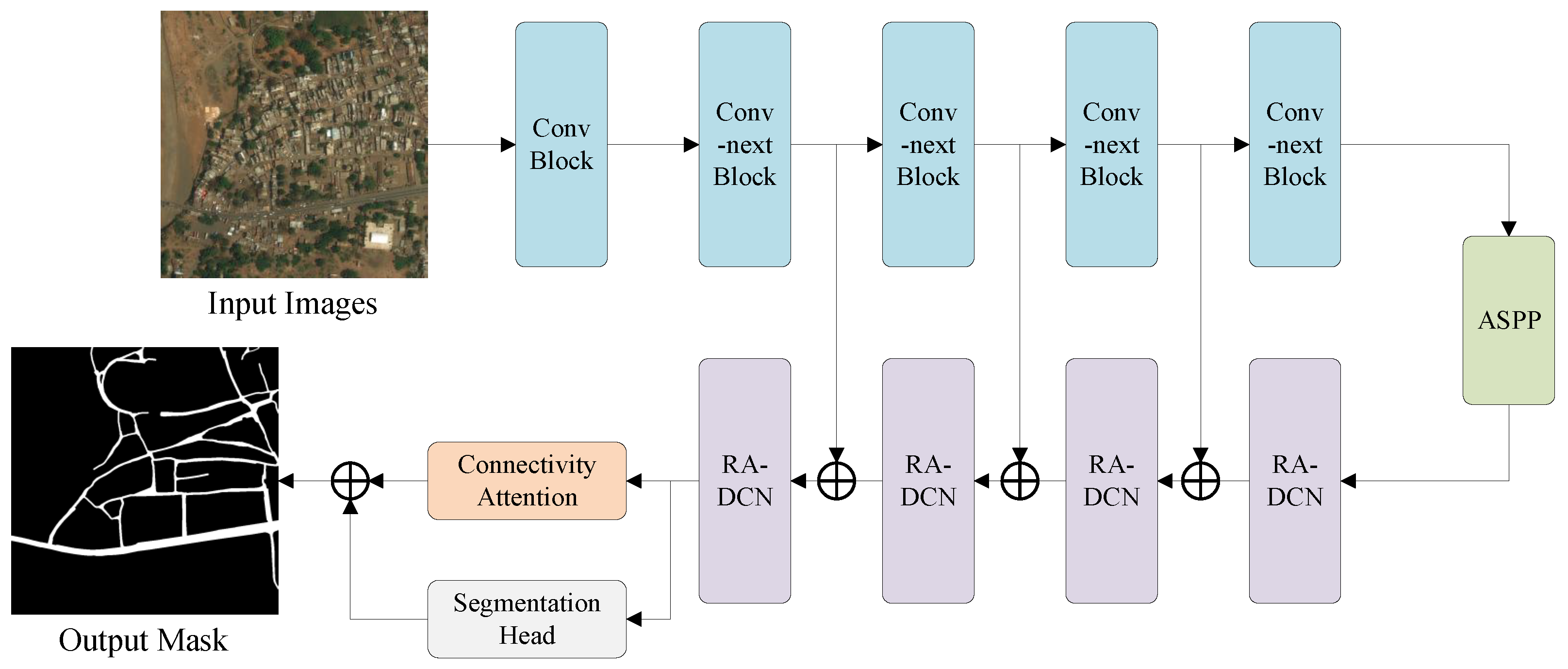
As illustrated in Figure 1, LOA-Net follows the encoder–decoder paradigm: a compact encoder first extracts multi-scale features, an Atrous Spatial Pyramid Pooling (ASPP) module aggregates multi-scale context at the bottleneck, and a Road-Aligned Deformable Convolution (RA-DCN) decoder, detailed in Section 3.2, progressively fuses these features into a full-resolution road mask. The design simultaneously serves two goals: keeping the overall network compact for resource-constrained remote-sensing deployment, and enabling the decoder’s sampling geometry to follow the varying local direction of roads.
To preserve the fine spatial detail required to delineate thin roads under a low parameter budget, the encoder side replaces the heavy ResNet-class backbones of prior road extractors with a ConvNeXt-V2-Tiny backbone [36], a modern pure-convolutional architecture (depthwise large-kernel convolutions with Global Response Normalization) that runs at its native output stride of 32, so that ImageNet-pretrained weights load without modification and the costliest stages operate at low spatial resolution. The encoder produces four feature maps { e 1 , e 2 , e 3 , e 4 } at strides { 4 , 8 , 16 , 32 } , the deepest of which, e 4 , is processed by the ASPP module with rates { 1 , 2 , 4 , 8 } into a 256-channel multi-scale context representation that serves the decoder.
Given that roads are thin, elongated, and continuously curvilinear, the decoder must follow their varying local direction rather than sample on a fixed grid. Accordingly, the decoder contains four RA-DCN blocks that progressively fuse high-level semantic features with low-level spatial detail via skip connections, mirroring the U-Net–style architecture of CoANet but replacing the fixed strip convolutions with direction-adaptive deformable convolutions. Starting from the ASPP output at stride 32, each block upsamples its input by 2 × and concatenates the projected encoder feature ( e 3 , e 2 , e 1 in turn), and a final bilinear upsampling restores the input resolution. After the decoder produces a full-resolution feature map, a connectivity attention branch (inherited from CoANet [2]) supervises pair-wise pixel connectivity at short ( d = 1 ) and medium ( d = 3 ) ranges to preserve road topology. The final segmentation head produces a single-channel road probability map via sigmoid activation.
The architecture thus decomposes the lightweight objective into complementary and individually substitutable roles. The ConvNeXt-V2-T encoder supplies high-quality multi-scale features at a low parameter cost. The ASPP module injects the global context needed to disambiguate roads from spectrally similar backgrounds. The RA-DCN decoder adapts its sampling geometry to the local road direction to preserve thin and connected structures. The connectivity branch then provides an explicit topological supervisory signal. Of these, only the RA-DCN decoder is specific to this work, whereas the encoder, ASPP, and connectivity branch are established components retained for their proven effectiveness, so that the gains reported later can be attributed to road-aligned deformable decoding rather than to incidental architectural choices. This clean separation of roles is also what enables the controlled ablation in Section 4.6, which varies one component at a time.

3.2. Road-Aligned Deformable Convolution

The RA-DCN module is the core contribution of this work and the embodiment of the decoder-efficiency pillar. As discussed in Section 2.2, CoANet’s fixed-direction strip convolutions cannot adapt to arbitrary road angles. RA-DCN is designed to overcome this limitation: (1) a road-direction-based offset parameterization that constrains the sampling geometry to a road-aligned subspace, enabling the sampling grid to stretch along the road tangent and contract across the road normal while requiring only a compact 13-channel per-pixel predictor comprising four road-aligned parameters (orientation and two scale factors) and nine modulation masks, and (2) explicit orientation supervision that directly regularizes the predicted road direction via a dedicated auxiliary loss, as described in Section 3.2.4. The former delivers decoder efficiency while the latter preserves connectivity, and the two work in concert.

3.2.1. Road-Direction-Based Offset Parameterization

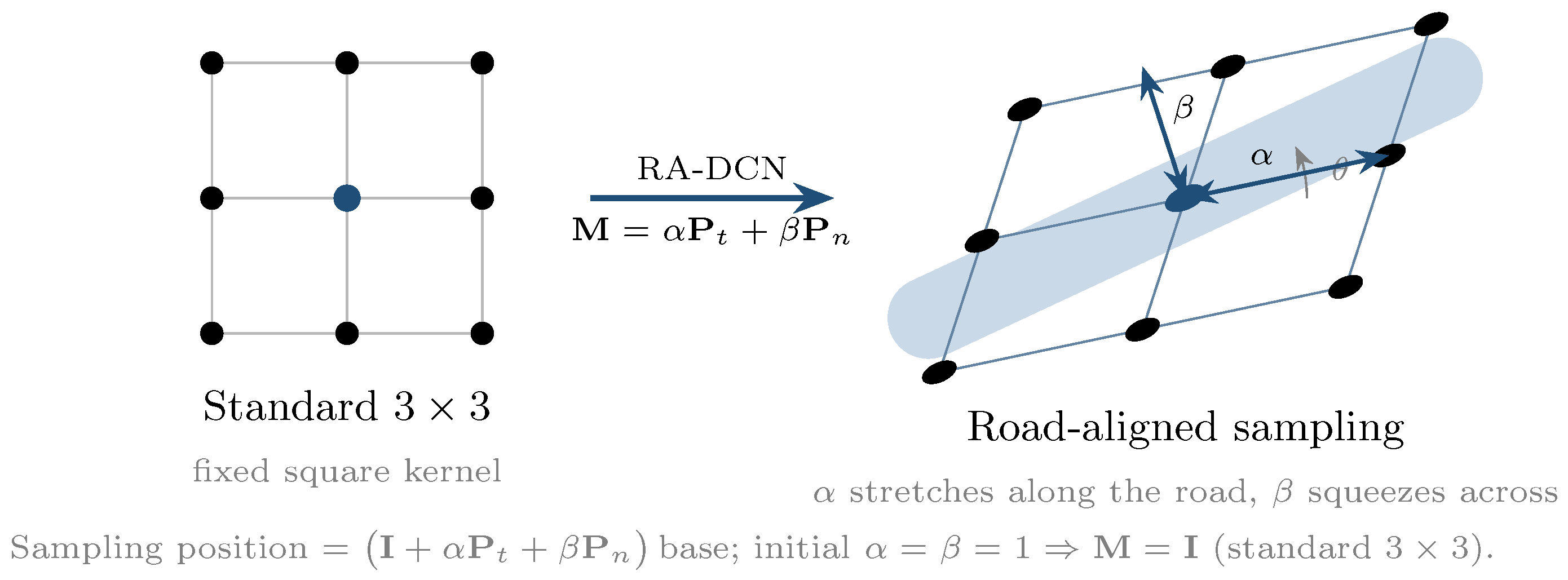
At each spatial location, RA-DCN predicts a local road orientation angle θ and two scalar scale factors α and β that independently control the sampling extent along the road tangent and normal directions. For the standard 3 × 3 kernel, let b i = ( b i y , b i x ) { 1 , 0 , 1 } 2 denote the i-th base kernel position ( i = 1 , , 9 ). The deformable sampling offset for position i is defined as
δ i = α P t + β P n b i = M b i ,
where P t and P n are the orthogonal projection matrices onto the tangent direction t = ( cos θ , sin θ ) and the normal direction n = ( sin θ , cos θ ) :
P t = t t , P n = n n , P t + P n = I .
The combined matrix M = α P t + β P n thus scales by α along the road and by β across the road, producing an anisotropic, orientation-aware sampling pattern. Expanding M in terms of θ :
M = α cos 2 θ + β sin 2 θ ( α β ) cos θ sin θ ( α β ) cos θ sin θ α sin 2 θ + β cos 2 θ .
The per-position offset components ( δ i y , δ i x ) are then obtained by a single 2 × 2 matrix-vector product M b i , which is computed in closed form without any iterative optimization.
This formulation provides two important properties:
  • Identity initialization. When α = β = 1 , we have M = P t + P n = I , and the offset reduces to the base position δ i = b i . The module therefore initializes as a standard 3 × 3 convolution, ensuring stable convergence at the start of training regardless of the (randomly initialized) orientation prediction.
  • Anisotropic road-aligned sampling. The decoupled scales α and β allow the network to sample farther along the road α to bridge gaps under occlusion while constraining the cross-road span β to avoid sampling off-road pixels, a structural inductive bias for thin, elongated structures, as visualized in Figure 2.

3.2.2. Double-Angle Orientation Representation

A tangent vector t and its negation t describe the same road direction, so directly regressing θ via a squared-error loss would penalize valid predictions that differ by π radians. To obtain a representation that is invariant to this sign ambiguity, we parameterize the orientation by the doubled angle [42]:
p = cos 2 θ , q = sin 2 θ .
Under θ θ + π , both p and q remain unchanged, so any loss applied to ( p , q ) is inherently 180°-invariant. The trigonometric quantities required for the projection matrices in (3) are recovered from ( p , q ) via the half-angle identities:
cos 2 θ = 1 + p 2 , sin 2 θ = 1 p 2 , cos θ sin θ = q 2 ,
which are smooth and avoid the discontinuous atan 2 operation. Substituting (5) into (3) yields M as a closed-form function of ( p , q , α , β ) , making the entire offset reconstruction differentiable end-to-end.

3.2.3. Module Structure

Each of the nine sampling positions is additionally gated by a learnable modulation weight m i ( 0 , 1 ) , obtained by applying a sigmoid to the predicted logit. This modulation mask is particularly beneficial for road extraction: when a sampling point falls on an occluder such as tree canopy or building shadow, the network can suppress its contribution by driving m i toward zero.
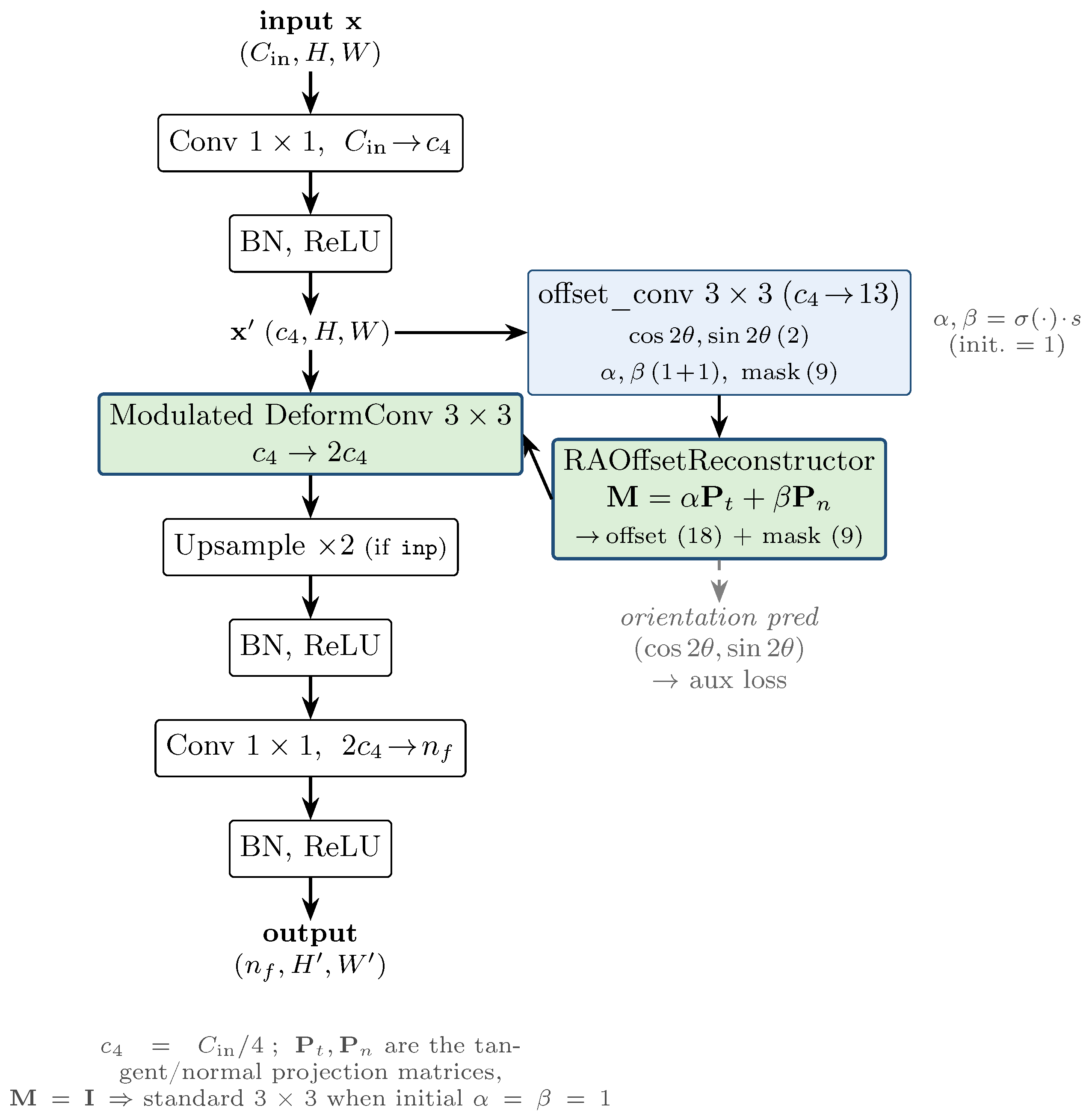
The complete RA-DCN decoder block is illustrated in Figure 3. A 1 × 1 convolution first reduces the channel dimension ( c c / 4 ). A single 3 × 3 convolution then predicts 13 channels per pixel:
  • 2 channels for the orientation ( p , q ) ;
  • 1 channel each for α and β (passed through σ ( · ) · s with scale s = 2 so that the initial value σ ( 0 ) · 2 = 1 yields the identity initialization);
  • 9 channels for the modulation logits { m i } .
The 18-channel offset tensor is reconstructed from ( p , q , α , β ) via the formulas above, and a modulated deformable convolution [31] is applied with the reconstructed offsets and sigmoid-gated masks. The output is then processed by BN–ReLU– 1 × 1 convolution to restore the channel dimension.
Four RA-DCN blocks form the decoder. At each level, the decoder output is concatenated with the corresponding encoder feature (adapted by a 1 × 1 convolution), and two of the four blocks perform 2 × bilinear upsampling. The final full-resolution feature is obtained by a further 2 × upsampling.

3.2.4. Orientation Field Supervision

A distinctive feature of RA-DCN is that the predicted orientation ( p , q ) is explicitly supervised, rather than being trained only indirectly through the downstream task loss. To provide this supervision, a per-pixel orientation ground truth ( p , q ) is derived from the binary road mask M via the structure tensor [42], a classical tool for local orientation estimation.
Horizontal and vertical gradients ( g x , g y ) are first computed by applying the Sobel operator to M . The structure tensor is then formed by smoothing the outer products of gradients over a local w × w window ( w = 7 ):
J ( x , y ) = g x 2 w g x g y w g x g y w g y 2 w = a b b c ,
where · w denotes box filtering. The dominant eigenvector of J (corresponding to the larger eigenvalue) points along the direction of maximum gradient variation, i.e., the road normal. The tangent direction, the eigenvector of the smaller eigenvalue, is recovered analytically as
p = c a ( c a ) 2 + 4 b 2 , q = 2 b ( c a ) 2 + 4 b 2 .
Pixels where M = 0 (background) have undefined orientation and are set to ( p , q ) = ( 0 , 0 ) , and they are excluded from the loss via the road-pixel mask. A key design choice is that the orientation ground truth is computed on-the-fly from the transformed road mask after data augmentation (rotation, flipping, scaling, cropping). This guarantees that the orientation field is always geometrically consistent with the current training crop, without requiring a separate augmentation pass or pre-computed orientation labels.

3.3. Loss Function

The network is trained with a multi-task objective that combines pixel-level segmentation, road connectivity, topological skeleton matching, and the RA-DCN orientation supervision.
Segmentation loss. The primary task is binary road segmentation, supervised by the combination of binary cross-entropy and Dice loss:
L seg = L BCE ( y ^ , y ) + L Dice ( y ^ , y ) ,
where y ^ is the sigmoid-activated prediction and y is the ground-truth mask.
clDice loss. To explicitly preserve topological continuity, the clDice loss [43] is applied. Soft skeletons S ( y ^ ) and S ( y ) are extracted via differentiable morphological operations (iterative soft erosion and dilation). The clDice loss is defined as
L cldice = 1 2 T prec T sens T prec + T sens ,
where T prec = S ( y ^ ) y S ( y ^ ) + ϵ measures skeleton precision and T sens = S ( y ) y ^ S ( y ) + ϵ measures skeleton sensitivity (⊙ denotes element-wise product). This term penalizes broken connections that pixel-wise losses tolerate.
Connectivity loss. The connectivity attention branch predicts pair-wise pixel connectivity at two ranges ( d = 1 and d = 3 ) [2], supervised by binary cross-entropy:
L con = 0.6 L BCE C ^ d 1 , C d 1 + 0.4 L BCE C ^ d 3 , C d 3 .
Orientation loss. The L = 4 RA-DCN decoder blocks produce orientation predictions { ( p ^ l , q ^ l ) } l = 1 L at four different resolutions. Each prediction is bilinearly upsampled to the ground-truth resolution, and the squared error is computed and averaged over road pixels:
L orient = 1 L l = 1 L x , y 1 M ( x , y ) ( p ^ l p ) 2 + ( q ^ l q ) 2 x , y 1 M ( x , y ) ,
where 1 M is the road binary mask used as a weighting factor. Given that ( p , q ) is 180°-invariant by construction, this MSE loss is free from the sign-ambiguity artifacts that would arise from regressing an angle directly.
Total loss. The overall training objective is
L = L seg + λ cldice L cldice + λ con L con + λ orient L orient ,
where the weighting coefficients are set to λ cldice = 0.5 , λ con = 0.2 , and λ orient = 0.1 based on validation performance. The orientation term is the smallest, reflecting its role as a regularizer for the RA-DCN sampling geometry rather than a primary task objective.

4. Experiments

To validate the effectiveness and efficiency of the proposed LOA-Net, extensive experiments were conducted on two widely used road-extraction benchmarks. This section first introduces the datasets, the evaluation metrics, and the implementation details, and then presents quantitative and qualitative comparisons against state-of-the-art methods as well as ablation studies that isolate the contribution of each component.

4.1. Datasets

Two public road-extraction benchmarks (CHN6-CUG [19] and DeepGlobe [20]) were used so as to evaluate the method under a variety of conditions.
CHN6-CUG [19]. The CHN6-CUG Roads Dataset is a large-scale, pixel-level very-high-resolution (VHR) satellite imagery dataset covering six representative cities in China, with a base map acquired from Google Earth at a spatial resolution of approximately 0.5 m/pixel. Each image is 512 × 512 pixels with manually annotated binary road masks. The dataset comprises 4511 images in total, split into 3608 for training and 903 for testing.
DeepGlobe [20]. The DeepGlobe 2018 road-extraction dataset provides RGB satellite imagery at a ground sampling distance (GSD) of 50 cm/pixel and a size of 1024 × 1024 pixels, acquired from rural areas of Thailand, Indonesia, and India. It supplies pixel-level binary road masks and contains 6226 images in total. We use 4696 images for training and 1530 for testing, and additionally hold out a small validation subset from the training set for model selection. The training images are randomly cropped to 512 × 512 pixels. It complements CHN6-CUG with rural road scenes from a different geographic region (Southeast and South Asia), enabling assessment of cross-region generalization.
Collectively, the two datasets exhibit substantial heterogeneity (varying road widths, dense urban structures, occlusions by buildings, tree canopies, and shadows, and spectrally similar backgrounds), providing a rigorous test bed for both segmentation accuracy and structural preservation.

4.2. Evaluation Metrics

Road extraction is fundamentally a binary segmentation task, and we evaluate segmentation accuracy with the standard pixel-level metrics defined below.
Pixel-based metrics are derived from the numbers of true positives (TP), false positives (FP), true negatives (TN), and false negatives (FN) between a predicted road mask and the ground truth. We report Precision, Recall, the F1-score (equivalent to the Dice coefficient), and Intersection over Union (IoU):
Precision = T P T P + F P
Recall = T P T P + F N
F 1 = 2 · T P 2 · T P + F P + F N
IoU = T P T P + F P + F N
The IoU is used as the primary pixel-level indicator of segmentation quality. In addition, the mIoU is reported as an overall measure of segmentation performance.
Given the centrality of efficiency to this work, we additionally report the number of parameters (Params), the computational cost (GFLOPs), and the inference speed (FPS). These measures enable a direct assessment of the accuracy–efficiency trade-off against competing methods.

4.3. Implementation Details

All experiments were implemented in PyTorch 2.7.1 on a single 32 GB NVIDIA GeForce RTX 5090 GPU using Python 3.9 and CUDA 12.8. The ConvNeXt-V2 backbone was initialized from ImageNet-22k pretraining [36], while the ASPP, RA-DCN decoder, and connectivity branch were trained from scratch.
Stochastic gradient descent (SGD) with Nesterov momentum of 0.9 and weight decay of 5 × 10 4 was adopted as the optimizer. The initial learning rate was set to 5 × 10 3 for the backbone and 1 × 10 2 for the decoder and connectivity branch, and was decayed following the poly policy lr = lr 0 × ( 1 iter / max _ iter ) 0.9 . All models were trained for 75 epochs with a batch size of 8. To ensure full reproducibility, every experiment reported in this paper used a fixed random seed of 1. During training, data augmentation including random rotation (±180°), horizontal flipping, random scaling, random cropping to 512 × 512 , and Gaussian blurring was applied. The orientation ground truth was computed on-the-fly from the augmented road mask using the structure-tensor method of Section 3.2.4, with a smoothing window of 7 × 7 (this choice is examined in Section 4.6). The RA-DCN scale parameter was set to s = 2 , and the loss weights were λ cldice = 0.5 , λ con = 0.2 , and λ orient = 0.1 .

4.4. Comparison with State-of-the-Art Methods

To evaluate the proposed LOA-Net, we compare it against eight representative methods on both the CHN6-CUG and DeepGlobe datasets. DeepLab-V3+ [44] is a general semantic-segmentation model widely used as a baseline, whereas D-LinkNet [6] (the winner of the DeepGlobe road-extraction challenge), UGD-DLinkNet [45] (an attention- and uncertainty-enhanced D-LinkNet for occluded roads), CoANet [2], NL-LinkNet [34], RCFS-Net [11], BMDCNet [46], and HSN-Net [47] are specialized road-extraction networks. For fair comparison, all competing methods were evaluated under the same data splits.
The specialized road extractors substantially outperform the general DeepLab-V3+ and D-LinkNet baselines on both datasets, confirming the benefit of road-specific structural modeling. The comparison is organized into a quantitative analysis and a qualitative analysis, presented in Section 4.4.1 and Section 4.4.2, respectively, and each reported for the CHN6-CUG and DeepGlobe datasets in turn. Five pixel-level metrics are used throughout: mIoU, IoU, Precision, Recall, and F1-score, and baseline values are taken from the original publications or reproduced under the identical settings.

4.4.1. Quantitative Analysis

Table 1 and Table 2 report the quantitative comparison on the two datasets under the five pixel-level metrics, with the best result in each column highlighted in bold.
CHN6-CUG. Table 1 reports the results on the CHN6-CUG dataset. Among the compared methods, the GADC-KANNet and FDMamba results (marked with an asterisk) are quoted from their original papers, in which both methods were evaluated on the same official test set used in this work.
On CHN6-CUG, LOA-Net achieves the highest mIoU of 79.43 % , IoU of 62.03 % , and F1-score of 76.56 % , surpassing the strongest competing method DualStrip-Net by + 3.01 and + 2.33 points in IoU and F1, respectively. The columns in which LOA-Net does not lead are Precision, where the cited FDMamba reaches 75.51 % , and Recall, held by CoANet at 88.80 % . Nevertheless, LOA-Net still delivers the best F1-score, i.e. the most favorable precision–recall balance.
DeepGlobe. Table 2 reports the quantitative comparison on the DeepGlobe dataset under the same five metrics.
On DeepGlobe, LOA-Net attains the highest mIoU of 82.54 % , IoU of 66.98 % , and F1-score of 80.22 % , exceeding HSN-Net by + 4.72 and + 3.48 points in IoU and F1, and additionally leading in Recall at 87.18 % , which indicates fewer fragmented roads. The only column in which LOA-Net does not lead is Precision, where RCFS-Net trades Recall for Precision and consequently yields a lower F1, whereas LOA-Net again delivers the best F1-score.

4.4.2. Qualitative Analysis

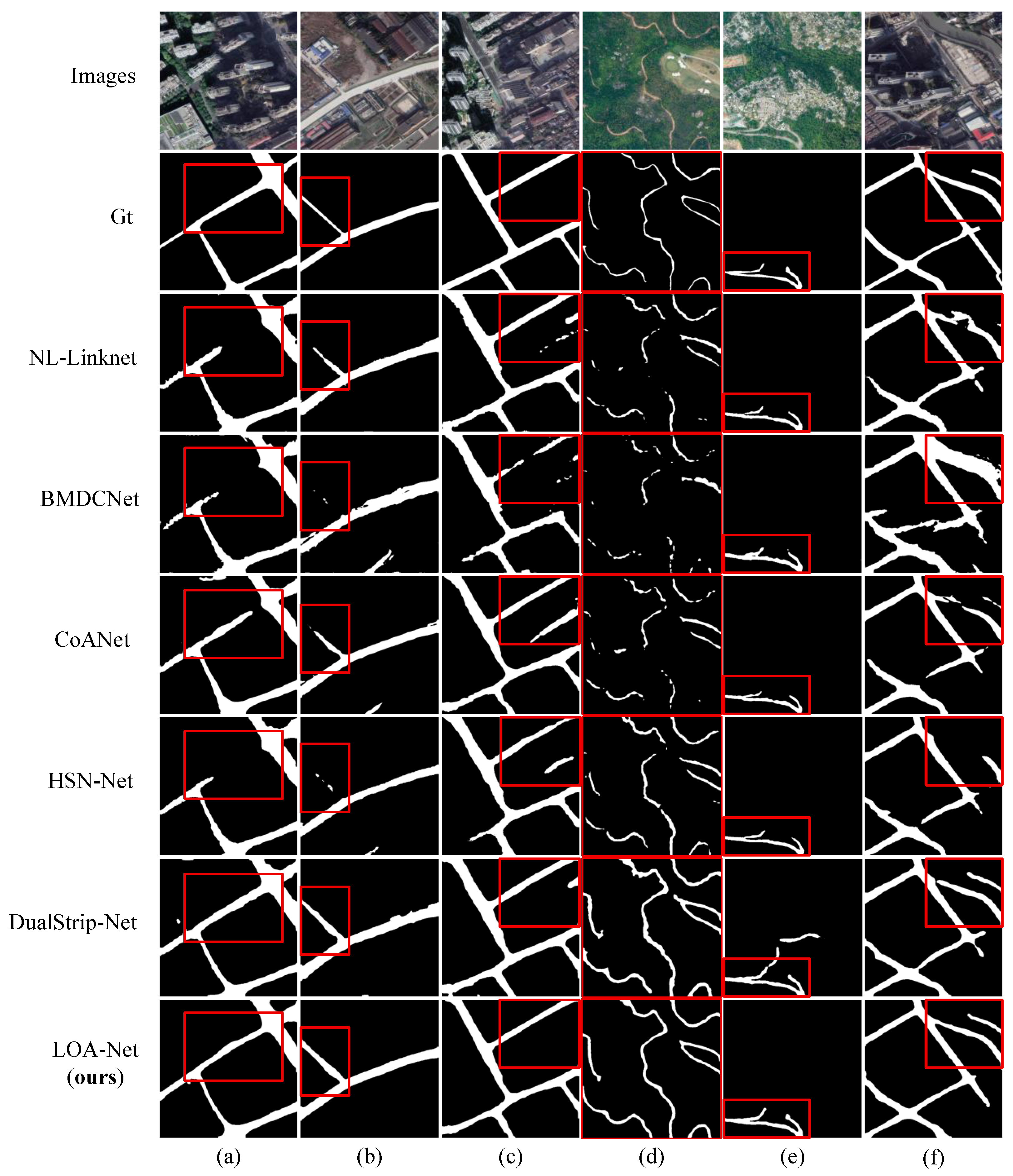
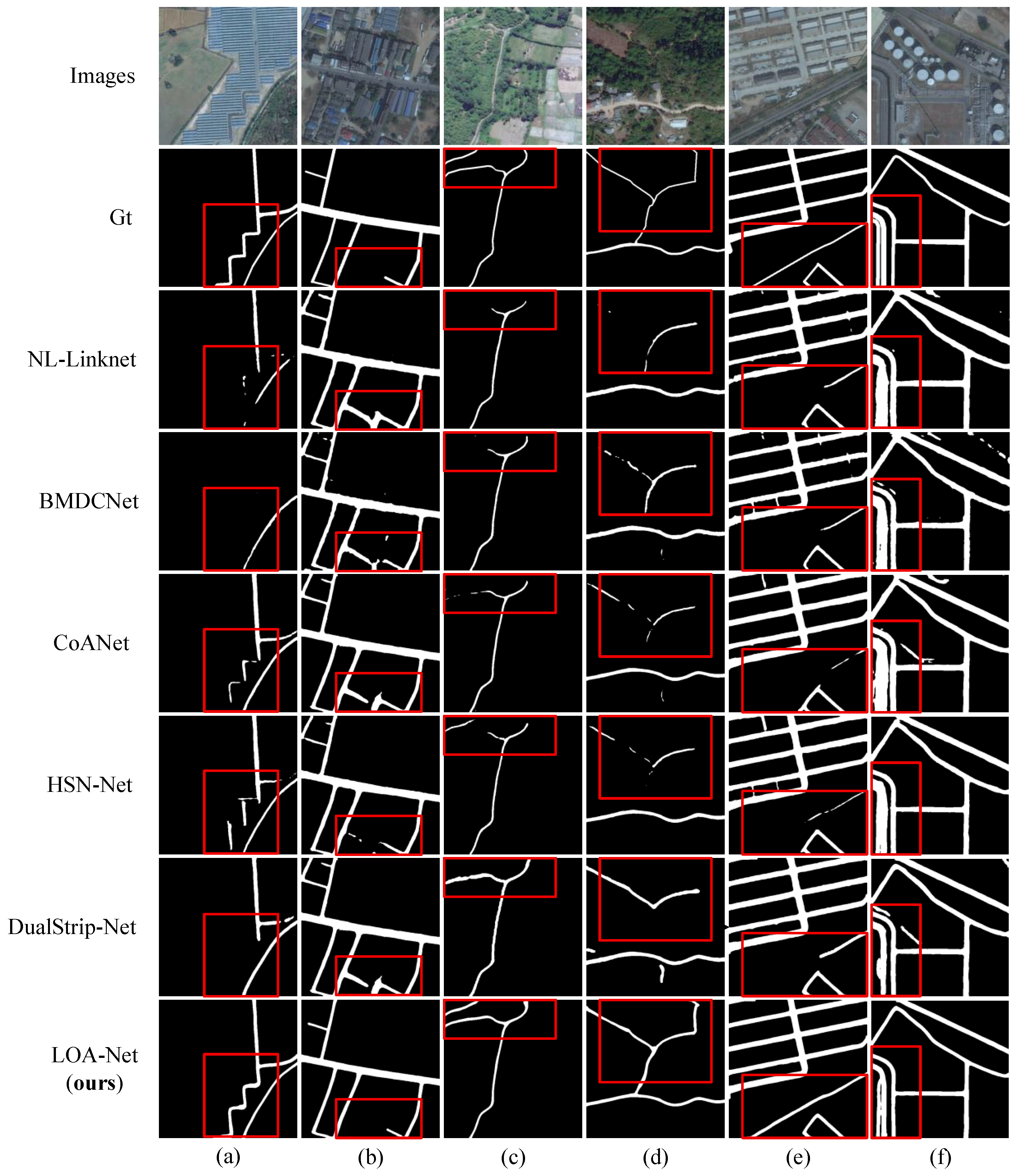
Figure 4 and Figure 5 visualize the road-extraction results of LOA-Net and representative competing methods on challenging scenes from the two datasets, where the red boxes mark the regions in which the methods differ most.
CHN6-CUG. As shown in Figure 4, the general baseline D-LinkNet tends to break thin roads and produce noisy boundaries, whereas the specialized extractors (CoANet and HSN-Net) recover most of the road skeleton. In the red-boxed regions, LOA-Net delivers cleaner predictions with a more favorable precision–recall balance (preserving the road structure while suppressing spurious responses), which is consistent with its leading IoU and F1-score in Table 1.
DeepGlobe. As shown in Figure 5, the rural scenes of DeepGlobe are dominated by narrow, low-contrast roads on which the competing methods frequently produce fragmented predictions. In the red-boxed regions, LOA-Net preserves the thin rural roads that the baselines sever and yields a more complete road network, matching its best Recall ( 87.18 % ) and F1-score in Table 2.
Overall, these results demonstrate that the orientation-aware RA-DCN decoder, within the overall compact design of LOA-Net, preserves both pixel-level accuracy and road connectivity at a fraction of the computational cost of the heaviest extractors, as detailed in Table 3.

4.5. Efficiency Analysis

Lightweight design is a further core objective of this work, and we compare LOA-Net with the competing methods along the efficiency dimension. Table 3 lists the parameter count, computational cost (GFLOPs), and inference speed of all compared models, with FPS measured under identical conditions on a single NVIDIA RTX 5090 GPU.
The parameter count is the core metric of lightweighting. As Table 3 shows, LOA-Net runs with only 34.8 M parameters, less than half of CoANet at 74.7 M and DeepLab-V3+ at 59.9 M. The parameter count directly determines the size of the model weights and the on-device storage overhead, and with the smallest parameter count LOA-Net is therefore particularly well suited to storage- and memory-constrained mobile and edge devices. In terms of computational cost, LOA-Net requires 115.5 GFLOPs at 512 × 512 input. The geometry-aware RA-DCN decoder introduces a moderate overhead, so LOA-Net ranks third-lowest in GFLOPs, which places it in the upper-middle rather than at the absolute lowest, yet the two lower-cost methods, BMDCNet (65.8) and NL-LinkNet (94.1), both attain markedly lower IoU and F1, and every remaining competitor is both heavier and less accurate. LOA-Net therefore delivers the highest accuracy at a moderate computational cost, striking the most favorable accuracy–efficiency trade-off. In terms of inference speed, LOA-Net reaches 95.6 FPS, and although not the fastest among the compared methods it sits in the upper-middle range and is sufficient for real-time processing. More importantly, every model that is faster than LOA-Net attains lower recognition accuracy. LOA-Net is therefore the only compared method that simultaneously achieves the highest accuracy and the fewest parameters, indicating that lightweight design and recognition accuracy can be attained together rather than traded off against each other.
Comparison with lightweight peers. The efficiency comparison is most informative when restricted to models of comparable size. Among the sub-60 M extractors in Table 3, namely NL-LinkNet (47.9 M), DualStrip-Net (59.3 M), and BMDCNet (45.9 M), LOA-Net is the only one below 40 M at 34.8 M, yet it also attains the highest IoU and F1 on both datasets (Table 1 and Table 2). LOA-Net therefore dominates every lightweight competitor on accuracy and footprint at the same time, rather than trading one for the other. This is also the central evidence that the gain stems from the road-aligned design rather than from a heavier backbone. The encoder (ConvNeXt-V2-T), the ASPP context module, and the connectivity branch are all established, off-the-shelf components shared in spirit with prior work, and none of them is novel in isolation. The originality of LOA-Net resides entirely in the RA-DCN decoder, which constrains deformable sampling to a road-aligned subspace and supervises the predicted orientation with a structure-tensor field, a mechanism absent from all of the compared methods. The ablation in Section 4.6 isolates this contribution directly: replacing RA-DCN with a residual decoder costs 4.97 IoU points, and under an identical backbone RA-DCN outperforms both the unconstrained DCNv2 decoder by 5.18 IoU and the fixed-direction SCM decoder by 2.59 IoU, confirming that road-aligned, orientation-supervised decoding, rather than the surrounding modules, is what enables a compact decoder to preserve road connectivity.

4.6. Ablation Studies

We conduct three ablation studies on both the CHN6-CUG and DeepGlobe datasets: a component-wise contribution analysis, a decoder design comparison, and a sensitivity analysis of the orientation ground-truth smoothing window.
Component-wise contribution. Table 4 disables one component at a time from the full model. Replacing RA-DCN with a plain residual decoder removes both the road-aligned sampling geometry and the orientation head, removing ASPP strips the multi-scale context aggregation at the bottleneck, and disabling the orientation supervision leaves the RA-DCN offsets trained only through the segmentation loss, without any geometric regularization. Removing any single component degrades IoU and F1. Disabling the orientation supervision is the most damaging change, as IoU falls by 6.68 points to 55.35% and F1 by 5.30 points to 71.26%, leaving an unsupervised RA-DCN below even the simpler residual decoder. Without the structure-tensor field to regularize the offsets, the deformable sampling grid drifts and road connectivity suffers. Replacing RA-DCN with a residual decoder costs 4.97 points of IoU, from 62.03% down to 57.06%, and 3.90 points of F1, which confirms the value of the road-aligned sampling geometry. Removing ASPP is the least harmful of the three, with IoU dropping only 1.73 points to 60.30% and F1 only 1.33 points to 75.23%. Within this variant recall falls more than precision, by 2.05 points against 0.83, which indicates that the multi-scale context at the bottleneck mainly helps recover missed thin roads rather than suppress false positives, which makes ASPP the most replaceable of the three components. The full model, with all components active, attains the best IoU of 62.03% and F1 of 76.56%. The same conclusion holds on DeepGlobe: the full model again attains the highest IoU (66.98%) and F1 (80.22%), and removing any single component lowers both.
Decoder design. Table 5 isolates the decoder as the single varying factor under the same backbone. The residual decoder is a plain baseline without any road-specific structure. The fixed-direction strip decoder, SCM, aggregates context along four fixed directions and cannot adapt to arbitrary road angles. DCNv2 introduces unconstrained deformable sampling but relies on a heavier 27-channel predictor with no directional inductive bias and no geometric supervision. RA-DCN instead constrains the sampling grid to a road-aligned subspace through a compact 13-channel predictor and is explicitly supervised by the structure-tensor orientation field. Among the four, RA-DCN attains the highest IoU of 62.03% and F1 of 76.56%, beating the strongest baseline SCM by 2.59 IoU and 2.00 F1 and surpassing DCNv2 by 5.18 IoU and 4.07 F1. The unconstrained DCNv2 decoder reaches only 56.85% IoU, slightly below even the plain residual baseline at 57.06%: without a directional inductive bias its offsets frequently drift off the thin road surface, so the heavier 27-channel predictor brings no benefit. The fixed-direction SCM is the strongest baseline at 59.44% IoU, because its bar kernels are at least aligned with the road, yet its four discrete directions still cannot match the continuously angle-adaptive RA-DCN. RA-DCN also leads on both precision and recall at once, at 69.14% and 85.76% against SCM’s 67.04% and 83.99%, so there is no precision–recall trade-off to negotiate, and its higher recall reflects more road recovered rather than background over-segmented. On DeepGlobe, RA-DCN again leads on IoU (66.98%), F1 (80.22%), and Recall (87.18%), and the strongest baseline is the unconstrained DCNv2 (IoU 65.39%, F1 79.08%, above both the residual and SCM baselines), which RA-DCN surpasses by 1.59 IoU and 1.14 F1. These results indicate that road-aligned, orientation-supervised deformable decoding is what allows a compact decoder to preserve road connectivity.
Smoothing window of the orientation ground truth. Table 6 examines how the box-smoothing window w of the structure tensor (Section 3.2.4) affects the orientation ground truth and, through it, the final segmentation. This window trades directional stability against spatial resolution. With a small window ( w = 5 ), the gradient outer products are averaged over fewer pixels, so the estimated orientation stays localized but is more susceptible to annotation noise, sub-pixel jaggedness along road edges, and short gaps in the mask, so the resulting field is noisier and the less coherent directions translate into less reliable road-aligned sampling in RA-DCN. With a large window ( w = 9 ), the same noise is suppressed more strongly and the orientation is stable along straight, well-separated segments, but the field is over-smoothed near sharp bends, intersections, and closely spaced parallel roads, where directions from neighboring structures bleed into one another and the single dominant orientation no longer faithfully tracks the local road tangent. The default w = 7 balances the two regimes: large enough to damp gradient noise on thin roads, yet small enough to retain the local direction changes on which RA-DCN depends. Empirically, w = 7 is the most accurate setting on both datasets. On DeepGlobe it attains the best IoU of 66.98% and F1 of 80.22%, outperforming w = 5 by 1.46/1.05 points (IoU/F1) and w = 9 by 1.26/0.91 points, while on CHN6-CUG it likewise leads with IoU of 62.03% and F1 of 76.56%, exceeding w = 5 by 1.01/0.77 points and w = 9 by 0.78/0.59 points. In both datasets the three windows stay within a narrow IoU band (1.46 points on DeepGlobe and 1.01 on CHN6-CUG), so the performance is not critically sensitive to w, while w = 7 is consistently the most accurate. We therefore adopt w = 7 throughout this paper.

5. Discussion

Overall, the results consistently point to the same design principle, namely that constraining the deformable sampling grid to a road-aligned subspace and explicitly supervising the predicted orientation lets a compact decoder preserve the thin, connected structure of roads. The ablations support this from two sides. Constraining the sampling geometry prevents the off-road drift that makes the unconstrained DCNv2 decoder fall below even the plain residual baseline on CHN6-CUG, and explicit orientation supervision proves to be the single most influential component, since its removal causes the largest drop in IoU and F1 on both datasets. The efficiency analysis further shows that these gains arise from the road-aligned design rather than from added capacity, because LOA-Net attains the highest IoU and F1 with the fewest parameters and a moderate computational cost, and every lighter or faster competitor is less accurate. The consistency of these gains across the urban CHN6-CUG benchmark and the rural DeepGlobe benchmark indicates that the approach generalizes across scenes with markedly different road morphology and backgrounds.
Several limitations should be noted. RA-DCN predicts a single orientation per pixel, which is ambiguous at intersections where multiple roads meet, so crossings are recovered less reliably than straight or gently curving segments. The orientation supervision is derived from the road mask and is therefore sensitive to annotation noise on very thin roads, and the bounded sampling extent cannot bridge large contiguous occlusions. The efficiency characterization also rests on parameter count, GFLOPs, and GPU-level throughput rather than on measured on-device latency, and evaluation is confined to two optical RGB benchmarks.
Future work will extend the orientation formulation to multi-hypothesis prediction for intersections, strengthen the robustness of the orientation ground truth, validate on-device latency on embedded accelerators, generalize the method to other sensors such as SAR and to other thin, elongated geospatial objects such as rivers and railways, and explore data-efficient road extraction under limited annotations using vision foundation models with parameter-efficient adaptation [52].

6. Conclusions

This work addressed the conflict between segmentation accuracy and computational efficiency in road extraction from high-resolution remote sensing imagery. We proposed LOA-Net, whose central contribution is Road-Aligned Deformable Convolution (RA-DCN), a decoder module that constrains the deformable sampling grid to a road-aligned subspace through a compact four-parameter, direction-decoupled representation and regularizes the predicted orientation with a structure-tensor field. Paired with a lightweight ConvNeXt-V2 encoder, a standard ASPP context module, and a connectivity branch under a multi-task objective, RA-DCN unifies decoder efficiency and connectivity preservation within a single module.
The main findings are as follows. Constrained, explicitly supervised road-aligned sampling is more effective than either fixed-direction strip convolutions or unconstrained deformable convolution, especially for thin and occluded roads, and it enables a compact decoder to match or surpass far heavier extractors. Accordingly, LOA-Net achieves the best IoU and F1 among the compared methods on both the CHN6-CUG and DeepGlobe benchmarks while using the fewest parameters (34.8 M), demonstrating that accuracy, connectivity, and a small footprint can be achieved together.

Author Contributions

Conceptualization, B.H. and Y.L.; methodology, B.H. and Z.L.; software, B.H.; validation, Y.L. and Y.S.; formal analysis, Z.L.; investigation, Y.L. and R.Y.; resources, Z.G. and Y.Z.; data curation, Z.L.; writing—original draft preparation, B.H.; writing—review and editing, B.H., Y.L., Z.L. and R.Y.; visualization, Z.G. All authors have read and agreed to the published version of the manuscript.

Funding

This research received no external funding.

Data Availability Statement

The CHN6-CUG and DeepGlobe benchmark datasets used in this study are publicly available from their official sources. The source code is publicly available at https://github.com/hb281/loanet-main (accessed on 9 August 2026).

Acknowledgments

We would like to express our sincere gratitude to the editors and the anonymous reviewers for their valuable time, careful evaluation, and constructive comments, which have greatly improved the quality of this manuscript. During the preparation of this manuscript, the authors used GLM 5.2 for English language polishing and expression optimization.

Conflicts of Interest

The authors declare no conflicts of interest.

References

  1. Yuan, Q.; Shen, H.; Li, T.; Li, Z.; Li, S.; Jiang, Y.; Xu, H.; Tan, W.; Yang, Q.; Wang, J.; et al. Deep learning in environmental remote sensing: Achievements and challenges. Remote Sens. Environ. 2020, 241, 111716. [Google Scholar] [CrossRef] [Scilit]
  2. Mei, J.; Li, R.J.; Gao, W.; Cheng, M.M. CoANet: Connectivity attention network for road extraction from satellite imagery. IEEE Trans. Image Process. 2021, 30, 8540–8552. [Google Scholar] [CrossRef] [Scilit] [PubMed]
  3. Long, J.; Shelhamer, E.; Darrell, T. Fully convolutional networks for semantic segmentation. In Proceedings of the IEEE Conference on Computer Vision and Pattern Recognition (CVPR), Boston, MA, USA, 7–12 June 2015; pp. 3431–3440. [Google Scholar]
  4. Ronneberger, O.; Fischer, P.; Brox, T. U-Net: Convolutional networks for biomedical image segmentation. In Proceedings of the Medical Image Computing and Computer-Assisted Intervention (MICCAI), Munich, Germany, 5–9 October 2015; pp. 234–241. [Google Scholar]
  5. Chen, L.C.; Papandreou, G.; Schroff, F.; Adam, H. Rethinking atrous convolution for semantic image segmentation. arXiv 2017, arXiv:1706.05587. [Google Scholar] [CrossRef] [Scilit]
  6. Zhou, L.; Zhang, C.; Wu, M. D-LinkNet: LinkNet with pretrained encoder and dilated convolution for high resolution satellite imagery road extraction. In Proceedings of the IEEE Conference on Computer Vision and Pattern Recognition Workshops (CVPRW), Salt Lake City, UT, USA, 18–22 June 2018; pp. 182–186. [Google Scholar]
  7. He, K.; Zhang, X.; Ren, S.; Sun, J. Deep residual learning for image recognition. In Proceedings of the IEEE Conference on Computer Vision and Pattern Recognition (CVPR), Las Vegas, NV, USA, 27–30 June 2016; pp. 770–778. [Google Scholar]
  8. Batra, S.; Singh, S.; Pang, G.; Basu, S.; Jawahar, C.V.; Paluri, M. Improved road connectivity by joint learning of orientation and segmentation. In Proceedings of the IEEE/CVF Conference on Computer Vision and Pattern Recognition (CVPR), Long Beach, CA, USA, 15–20 June 2019; pp. 10385–10393. [Google Scholar]
  9. Mosinska, A.; Marquez-Neila, P.; Kozinski, M.; Fua, P. Beyond the pixel-wise loss for topology-aware delineation. In Proceedings of the IEEE Conference on Computer Vision and Pattern Recognition (CVPR), Salt Lake City, UT, USA, 18–23 June 2018; pp. 3136–3145. [Google Scholar]
  10. Zhou, G.; Chen, W.; Gui, Q.; Li, X.; Wang, L. Split depth-wise separable graph-convolution network for road extraction in complex environments from high-resolution remote-sensing images. IEEE Trans. Geosci. Remote Sens. 2022, 60, 5614115. [Google Scholar] [CrossRef] [Scilit]
  11. Yang, Z.; Zhou, D.; Yang, Y.; Zhang, J.; Chen, Z. Road extraction from satellite imagery by road context and full-stage feature. IEEE Geosci. Remote Sens. Lett. 2023, 20, 8000405. [Google Scholar] [CrossRef] [Scilit]
  12. Sandler, M.; Howard, A.; Zhu, M.; Zhmoginov, A.; Chen, L.C. MobileNetV2: Inverted residuals and linear bottlenecks. In Proceedings of the IEEE Conference on Computer Vision and Pattern Recognition (CVPR), Salt Lake City, UT, USA, 18–22 June 2018; pp. 4510–4520. [Google Scholar]
  13. Han, K.; Wang, Y.; Tian, Q.; Guo, J.; Xu, C.; Xu, C. GhostNet: More features from cheap operations. In Proceedings of the IEEE/CVF Conference on Computer Vision and Pattern Recognition (CVPR), Seattle, WA, USA, 13–19 June 2020; pp. 1580–1589. [Google Scholar]
  14. Tan, M.; Le, Q.V. EfficientNet: Rethinking model scaling for convolutional neural networks. In Proceedings of the 36th International Conference on Machine Learning (ICML), Long Beach, CA, USA, 9–15 June 2019; pp. 6105–6114. [Google Scholar]
  15. Hinton, G.; Vinyals, O.; Dean, J. Distilling the knowledge in a neural network. arXiv 2015, arXiv:1503.02531. [Google Scholar] [CrossRef] [Scilit]
  16. Kuang, X.; Cheng, F.; Wu, C.; Lei, H.; Zhang, Z. BIR-Net: A lightweight and efficient bilateral interaction road extraction network. IEEE J. Sel. Top. Appl. Earth Obs. Remote Sens. 2024, 17, 14194–14207. [Google Scholar] [CrossRef] [Scilit]
  17. Zhang, Y.; Sun, N.; Chen, L.; Liu, L.; Zhu, H. FAMNet: Lightweight road extraction network with fused attention and multilevel cascaded ASPP. IEEE J. Sel. Top. Appl. Earth Obs. Remote Sens. 2025, 18, 25616–25629. [Google Scholar] [CrossRef] [Scilit]
  18. Jayakumar, T.V.; Mishra, D.; Ramiya, A.M.; Singla, J.G. fKAN-UNet: Lightweight road segmentation with fractional spectral modeling and directional convolutions. IEEE Geosci. Remote Sens. Lett. 2026, 23, 8000905. [Google Scholar] [CrossRef] [Scilit]
  19. Zhu, Q.; Zhong, Y.; Zhao, B.; Zhang, W.; Han, W.; Li, J.; Liu, X. A global context-aware and batch-independent network for road extraction from VHR satellite imagery. ISPRS J. Photogramm. Remote Sens. 2021, 175, 353–365. [Google Scholar] [CrossRef] [Scilit]
  20. Demir, I.; Kopal, F.; Rosenbaum, D.; Heiden, D.; Stewart, W.; Lerner, J.; Zou, C.; Samaras, D.; Saltz, J.; Ramamurthy, K.N.; et al. DeepGlobe 2018: A challenge to parse earth through satellite images. In Proceedings of the IEEE Conference on Computer Vision and Pattern Recognition Workshops (CVPRW), Salt Lake City, UT, USA, 18–22 June 2018; pp. 172–179. [Google Scholar]
  21. Chaurasia, A.; Culurciello, E. LinkNet: Exploiting encoder representations for efficient semantic segmentation. In Proceedings of the IEEE Visual Communications and Image Processing (VCIP), St. Petersburg, FL, USA, 10–13 December 2017; pp. 1–4. [Google Scholar]
  22. Wang, Y.; Tong, L.; Yang, J.; Qin, S. Swin transformer embedding MSMDFFNet for road extraction from remote sensing images. IEEE Geosci. Remote Sens. Lett. 2025, 22, 6006105. [Google Scholar] [CrossRef] [Scilit]
  23. Yang, R.; Zhong, Y.; Liu, Y.; Lu, X.; Zhang, L. Occlusion-aware road extraction network for high-resolution remote sensing imagery. IEEE Trans. Geosci. Remote Sens. 2024, 62, 5619316. [Google Scholar] [CrossRef] [Scilit]
  24. Mattyus, G.; Luo, W.; Urtasun, R. DeepRoadMapper: Extracting road topology from aerial images. In Proceedings of the IEEE International Conference on Computer Vision (ICCV), Venice, Italy, 22–29 October 2017; pp. 3438–3446. [Google Scholar]
  25. Bastani, F.; He, S.; Abbar, S.; Alizadeh, M.; Balakrishnan, H.; Chawla, S.; Madden, S.; DeWitt, D. RoadTracer: Automatic extraction of road networks from aerial images. In Proceedings of the IEEE Conference on Computer Vision and Pattern Recognition (CVPR), Salt Lake City, UT, USA, 18–22 June 2018; pp. 4720–4728. [Google Scholar]
  26. He, S.; Bastani, F.; Abbar, S.; Alizadeh, M.; Balakrishnan, H.; Chawla, S.; Madden, S. Sat2Graph: Road graph extraction through graph-tensor encoding. In Proceedings of the European Conference on Computer Vision (ECCV), Glasgow, UK, 23–28 August 2020; pp. 51–67. [Google Scholar]
  27. Huang, B.; Lu, Y.; Yin, C.; Yang, R.; Tao, Y.; Shi, Y.; Wang, S.; Zhao, Q. DBASNet: A double-branch adaptive segmentation network for remote sensing image. Pattern Recognit. Lett. 2026, 201, 9–14. [Google Scholar] [CrossRef] [Scilit]
  28. Qu, S.; Zhou, H.; Yang, X.; Pang, Z. CEBRNet: Connectivity enhancement and boundary refinement network for road extraction from satellite imagery. IEEE Geosci. Remote Sens. Lett. 2024, 21, 6010005. [Google Scholar] [CrossRef] [Scilit]
  29. Huang, Z.; Ren, C.; Wei, Z.; Luo, Q.; Li, H.; Huang, H.; Liu, Y. ProX-Net: Orthogonal projection meets proximal topology for efficient and robust remote sensing image interpretation. IEEE J. Sel. Top. Appl. Earth Obs. Remote Sens. 2026, 19, 13640–13655. [Google Scholar] [CrossRef] [Scilit]
  30. Dai, J.; Qi, H.; Xiong, Y.; Li, Y.; Zhang, G.; Hu, H.; Wei, Y. Deformable convolutional networks. In Proceedings of the IEEE International Conference on Computer Vision (ICCV), Venice, Italy, 22–29 October 2017; pp. 764–773. [Google Scholar]
  31. Zhu, X.; Hu, H.; Lin, S.; Dai, J. Deformable ConvNets v2: More deformable, better results. In Proceedings of the IEEE/CVF Conference on Computer Vision and Pattern Recognition (CVPR), Long Beach, CA, USA, 15–20 June 2019; pp. 9308–9316. [Google Scholar]
  32. Deng, X.; Li, M.; Chen, Z. AFDANet: An adaptive full-stage feature fusion and directional-aware network for road extraction in remote sensing images. IEEE Geosci. Remote Sens. Lett. 2025, 22, 6010505. [Google Scholar] [CrossRef] [Scilit]
  33. Yan, J.; Wang, Q.; Cheng, Y.; Su, Z.; Zhang, F.; Zhong, M.; Liu, L.; Jin, B.; Zhang, W. Optimized single-image super-resolution reconstruction: A multimodal approach based on reversible guidance and cyclical knowledge distillation. Eng. Appl. Artif. Intell. 2024, 133, 108496. [Google Scholar] [CrossRef] [Scilit]
  34. Wang, Y.; Seo, J.; Jeon, T. NL-LinkNet: Toward lighter but more accurate road extraction with nonlocal operations. IEEE Geosci. Remote Sens. Lett. 2022, 19, 3000105. [Google Scholar] [CrossRef] [Scilit]
  35. Liu, Z.; Mao, H.; Wu, C.Y.; Feichtenhofer, C.; Darrell, T.; Xie, S. A ConvNet for the 2020s. In Proceedings of the IEEE/CVF Conference on Computer Vision and Pattern Recognition (CVPR), New Orleans, LA, USA, 18–24 June 2022; pp. 11976–11987. [Google Scholar]
  36. Woo, S.; Debnath, S.; Hu, R.; Li, X.; Liu, J.; Jin, H.; Dai, S.; Jampani, V.; Yang, D.J.; Hochul, I.; et al. ConvNeXt-V2: Co-designing and scaling ConvNeXts with Selective Adversarial Self-Supervised. In Proceedings of the IEEE/CVF Conference on Computer Vision and Pattern Recognition (CVPR), Vancouver, BC, Canada, 18–22 June 2023; pp. 17553–17563. [Google Scholar]
  37. Shi, Y.; Yang, R.; Huang, B.; Gu, Z.; Lu, Y.; Yin, C.; Wen, Y.; Zhong, Y. POCA-Lite: A lightweight change-detection architecture with geometry-aware auxiliary supervision and feedback fusion. Remote Sens. 2026, 18, 1673. [Google Scholar] [CrossRef] [Scilit]
  38. Yan, J.; Zhou, N.; Cheng, Y.; Zhang, F.; Wang, H.; Wang, M.; Jin, B.; Li, M.; Lu, Q.; Zhang, W. Application of machine-vision-driven physics-informed neural networks in pantograph–catenary system state detection. Mech. Syst. Signal Process. 2026, 257, 114577. [Google Scholar] [CrossRef] [Scilit]
  39. Yan, J.; Chen, B.; Zhang, F.; Cheng, Y.; Wang, H.; Wang, H.; Wang, M.; Li, T.; Zhang, W. Meta-learning-based graph convolutional wavelet network for intelligent dynamic modeling of high-speed rail subsystems. IEEE Trans. Veh. Technol. 2026; Early Access. [CrossRef] [Scilit]
  40. Zhang, F.; Yan, J.; Chen, B.; Li, Z.; Wang, J.; Cheng, Y.; Li, T. Cross-domain bearing condition monitoring based on spectrum normalization, domain alignment, and dynamic fusion. IEEE Trans. Instrum. Meas. 2026, 75, 2513819. [Google Scholar] [CrossRef] [Scilit]
  41. Zhong, Y.; Yin, C.; Yang, Y.; Yang, R.; Wen, Y.; Jiang, Y.; Tao, Y.; Shi, Y.; Huang, B. Long-term QoT forecasting in dynamic optical networks via decomposition-driven parallel temporal modeling. Photonics 2026, 13, 485. [Google Scholar] [CrossRef] [Scilit]
  42. Jaderberg, M.; Simonyan, K.; Zisserman, A.; Kavukcuoglu, K. Spatial transformer networks. Adv. Neural Inf. Process. Syst. (NeurIPS) 2015, 28, 2017–2025. [Google Scholar]
  43. Shit, S.; Pauly, J.; Konukoglu, E.; Ezhov, I.; Unger, A.; Zhylka, A.; Pluim, J.P.; Bauer, U.; Menze, B.H. clDice: A novel topology-preserving loss function for tubular structure segmentation. In Proceedings of the IEEE/CVF Conference on Computer Vision and Pattern Recognition (CVPR), Virtual, 19–25 June 2021; pp. 16555–16564. [Google Scholar]
  44. Chen, L.C.; Zhu, Y.; Papandreou, G.; Schroff, F.; Adam, H. Encoder–decoder with atrous separable convolution for semantic image segmentation. arXiv 2018, arXiv:1802.02611. [Google Scholar] [CrossRef] [Scilit]
  45. Yang, P.; Xiao, H.; Lin, C.; Xie, X. UGD-DLinkNet: An Enhanced Network for Occluded Road Extraction Using Attention Mechanisms and Uncertainty Estimation. IEEE J. Sel. Top. Appl. Earth Obs. Remote Sens. 2025, 18, 24144–24161. [Google Scholar] [CrossRef] [Scilit]
  46. Wang, C.; Lu, J.; Chen, Z. BMDCNet: A satellite imagery road extraction algorithm based on multilevel road feature. IEEE Geosci. Remote Sens. Lett. 2024, 21, 6017205. [Google Scholar] [CrossRef] [Scilit]
  47. Huang, B.; Lu, Y.; Yang, R.; Tao, Y.; Wang, S.; Shi, Y. HSN-Net: A hybrid segmentation neural network for high-resolution road extraction. IEEE Geosci. Remote Sens. Lett. 2025, 22, 2502105. [Google Scholar] [CrossRef] [Scilit]
  48. Li, J.; He, J.; Li, W.; Chen, J.; Yu, J. RoadCorrector: A Structure-Aware Road Extraction Method for Road Connectivity and Topology Correction. IEEE Trans. Geosci. Remote Sens. 2024, 62, 5616018. [Google Scholar] [CrossRef] [Scilit]
  49. Hu, J.; Li, Q.; Wang, Q. DualStrip-Net: A Strip-Based Unified Framework for Weakly- and Semi-Supervised Road Segmentation From Satellite Images. IEEE Trans. Geosci. Remote Sens. 2025, 63, 5617514. [Google Scholar] [CrossRef] [Scilit]
  50. Jayakumar, T.V.; Mishra, D.; Ramiya, A.M.; Singla, J.G. Gradient-Aware Directional Convolution With Kolmogorov Arnold Network-Enhanced Feature Fusion for Road Extraction. IEEE J. Sel. Top. Appl. Earth Obs. Remote Sens. 2025, 18, 23072–23089. [Google Scholar] [CrossRef] [Scilit]
  51. Wang, Z.; Yuan, S.; Li, R.; Xu, N.; You, Z.; Huang, D.S. FDMamba: Frequency-Driven Dual-Branch Mamba Network for Road Extraction From Remote Sensing Images. IEEE Trans. Geosci. Remote Sens. 2025, 63, 5643419. [Google Scholar] [CrossRef] [Scilit]
  52. Shi, Y.; Yang, R.; Yin, C.; Lu, Y.; Huang, B.; Wen, Y.; Zhong, Y.; Gu, Z. MV-S2CD: A modality-bridged vision foundation model-based framework for unsupervised optical–SAR change detection. Remote Sens. 2026, 18, 931. [Google Scholar] [CrossRef] [Scilit]
Figure 1. Overall architecture of LOA-Net: a ConvNeXt-V2-Tiny encoder, an ASPP module, a four-stage RA-DCN decoder with skip connections, and a connectivity-attention branch (detailed in Section 3.1). Here, ⊕ denotes channel concatenation.
Remotesensing 18 02716 g001
Figure 2. Geometry of the road-aligned sampling pattern: relative to the standard 3 × 3 grid (left), the deformable kernel (right) stretches along the local road tangent and contracts across the normal.
Remotesensing 18 02716 g002
Figure 3. Structure of the RA-DCN decoder block: a channel-reduction 1 × 1 convolution, a 3 × 3 predictor of the road-aligned parameters, an offset reconstructor (RAOffsetReconstructor) feeding a modulated deformable convolution, and the auxiliary orientation supervision (dashed).
Remotesensing 18 02716 g003
Figure 4. Qualitative comparison of road-extraction results on the CHN6-CUG dataset. Red boxes highlight the regions that exhibit the main visual differences among the compared methods. (af) are six different semantic-segmentation scenes.
Remotesensing 18 02716 g004
Figure 5. Qualitative comparison of road-extraction results on the DeepGlobe dataset. Red boxes highlight the regions that exhibit the main visual differences among the compared methods. (af) are six different semantic-segmentation scenes.
Remotesensing 18 02716 g005
Table 1. Quantitative comparison of different methods on the CHN6-CUG dataset (%). mIoU, IoU, Precision, Recall and F1-score are listed, where the bold text indicates the best result per column.
MethodmIoUIoUPrec.Rec.F1
DeepLab-V3+ [44]73.3851.6855.8587.3868.15
D-LinkNet [6]74.3153.3057.2188.6269.54
CoANet [2]75.0054.4758.4988.8070.53
NL-LinkNet [34]76.8757.6362.5787.9573.12
RCFS-Net [11]77.5458.7065.1185.6473.98
RoadCorrector [48]77.5558.7268.9274.5171.59
BMDCNet [46]74.5453.5958.6386.1669.78
HSN-Net [47]77.6158.8565.0486.0874.09
DualStrip-Net [49]77.6859.0264.7287.0274.23
GADC-KANNet [50] *-57.2073.7572.1371.36
FDMamba [51] *-59.0675.5177.2471.78
LOA-Net (ours)79.4362.0369.1485.7676.56
* Values cited from the original publications of GADC-KANNet and FDMamba.
Table 2. Quantitative comparison of different methods on the DeepGlobe dataset (%). mIoU, IoU, Precision, Recall and F1-score are listed, where the bold text indicates the best result per column.
MethodmIoUIoUPrec.Rec.F1
DeepLab-V3+ [44]75.3553.8661.0482.0870.02
D-LinkNet [6]75.4654.0761.2182.2670.19
CoANet [2]79.3361.1168.3985.1675.86
NL-LinkNet [34]78.6159.7667.4384.0074.81
RCFS-Net [11]79.3560.8078.7572.7375.62
RoadCorrector [48]78.5361.5273.1879.0575.98
BMDCNet [46]78.4259.4266.9584.0974.55
HSN-Net [47]79.9962.2670.8583.7176.74
DualStrip-Net [49]78.2259.0965.0886.5374.29
LOA-Net (ours)82.5466.9874.3087.1880.22
Table 3. Efficiency comparison of different methods. Params, GFLOPs, and FPS are listed, where the bold text indicates the best result per column and the arrows (↓/↑) mark the favorable direction.
MethodResolutionParams (M) ↓GFLOPs ↓FPS ↑
DeepLab-V3+ [44] 512 × 512 59.9150.9108.1
CoANet [2] 512 × 512 74.7158.778.4
NL-LinkNet [34] 512 × 512 47.994.1101.5
RCFS-Net [11] 512 × 512 76.7364.1100.5
BMDCNet [46] 512 × 512 45.965.832.5
HSN-Net [47] 512 × 512 171.2316.042.1
DualStrip-Net [49] 512 × 512 59.3177.1107.8
LOA-Net (ours) 512 × 512 34.8115.595.6
Table 4. Leave-one-out ablation on the CHN6-CUG and DeepGlobe datasets (%). Each row removes one component from the full LOA-Net: RA-DCN is replaced by a residual decoder, and ASPP/Orient. Sup. are removed. All variants use the same ConvNeXt-V2-T backbone. A checkmark indicates the component is active, and within each dataset block the bold text marks the best result per column.
VariantRA-DCNASPPOrient.mIoUIoUPrec.Rec.F1
(i) CHN6-CUG
w/o RA-DCN (residual decoder) 76.7257.0666.4680.1472.66
w/o ASPP 78.4960.3068.3183.7175.23
w/o Orient. Sup. 75.7655.3564.8079.1471.26
Full LOA-Net79.4362.0369.1485.7676.56
(ii) DeepGlobe
w/o RA-DCN (residual decoder) 81.5765.1075.2482.8578.86
w/o ASPP 81.8665.7073.7485.7779.30
w/o Orient. Sup. 81.8565.6774.1585.1679.28
Full LOA-Net82.5466.9874.3087.1880.22
Orientation supervision is defined only on the RA-DCN decoder, so the “w/o RA-DCN” variant has no orientation head.
Table 5. Decoder comparison on the CHN6-CUG and DeepGlobe datasets (%). All variants use the same ConvNeXt-V2-T backbone and ASPP, and only the decoder differs (RA-DCN additionally uses orientation supervision). Within each dataset block, the bold text marks the best result per column.
DecodermIoUIoUPrec.Rec.F1
(i) CHN6-CUG
Residual decoder (baseline)76.7257.0666.4680.1472.66
SCM [2]78.0059.4467.0483.9974.56
DCNv2 [31]76.6156.8566.4879.7072.49
RA-DCN (ours)79.4362.0369.1485.7676.56
(ii) DeepGlobe
Residual decoder (baseline)81.5765.1075.2482.8578.86
SCM [2]81.3064.6672.6885.4478.54
DCNv2 [31]81.6965.3973.4785.6179.08
RA-DCN (ours)82.5466.9874.3087.1880.22
Table 6. Sensitivity of the orientation ground-truth smoothing window w (%). All variants use the full LOA-Net, and only the structure-tensor box-smoothing window used to compute the on-the-fly orientation ground truth (Section 3.2.4) differs. Within each dataset block, the bold text marks the best result per column.
Window wmIoUIoUPrec.Rec.F1
(i) CHN6-CUG
w = 5 78.8861.0268.8084.3775.79
w = 7 (default)79.4362.0369.1485.7676.56
w = 9 79.0061.2568.6185.1075.97
(ii) DeepGlobe
w = 5 81.7665.5273.1886.2279.17
w = 7 (default)82.5466.9874.3087.1880.22
w = 9 81.8865.7274.4684.8579.31
Disclaimer/Publisher’s Note: The statements, opinions and data contained in all publications are solely those of the individual author(s) and contributor(s) and not of MDPI and/or the editor(s). MDPI and/or the editor(s) disclaim responsibility for any injury to people or property resulting from any ideas, methods, instructions or products referred to in the content.