1. Introduction
UAVs provide very-high-resolution observations of damaged, inaccessible, and safety-critical areas, revealing roads, buildings, vegetation, water, vehicles, debris, and damaged infrastructure. Semantic segmentation converts these observations into pixel-level thematic maps that support emergency mapping, damage assessment, and recovery planning. Public benchmarks such as FloodNet [
1] and RescueNet [
2], together with recent aerial flood benchmarks and disaster-oriented segmentation studies [
3,
4,
5], have facilitated the development and evaluation of UAV disaster-scene segmentation methods. These benchmarks and studies primarily report performance in the original image orientation. In deployment, however, UAV flight headings and camera yaw orientations can change across sorties or even within the same mission. The same road, building, vehicle, water boundary, or damaged region may therefore appear at different in-plane orientations while retaining the same semantic meaning. In-plane orientation variation differs from region, season, sensor, and spectral-domain shifts [
6], yet it raises the same deployment concern: performance measured under one acquisition condition may not predict map repeatability under another. Canonical-orientation mIoU alone is therefore insufficient to measure the repeatability of UAV disaster maps under changing image orientations.
Two complementary strategies can be used to address orientation-dependent prediction variation. The first is training-time rotation augmentation, which exposes images and dense labels to additional orientations. This approach is straightforward, introduces no architectural inference overhead, and can provide a strong practical baseline. Nevertheless, the resulting robustness is learned implicitly from the sampled training transformations; augmentation does not directly constrain how internal spatial and token operations respond to rotation. The second strategy is architecture-level transformation modeling. Architecture-level approaches encode geometric priors through group-equivariant convolution, steerable filters, rotation-aware detection, and rotation-equivariant segmentation networks [
7,
8,
9,
10,
11,
12,
13,
14]. These studies show that transformation behavior can be addressed within network operators, although practical segmentation pipelines still face padding, interpolation, and spatial-alignment effects. Rotation augmentation supplies transformation exposure during training, whereas architecture-level consistency changes how the model responds to transformed inputs. The two approaches can be combined, and their usefulness varies with the dataset, reliability target, and inference budget.
This issue is particularly relevant to hierarchical segmentation Transformers. Modern segmentation models combine local convolution, multistage feature reduction, token pooling, and attention-based context aggregation. Representative CNN and Transformer architectures include FCN [
15], U-Net [
16], PSPNet [
17], DeepLabv3+ [
18], DenseASPP [
19], Swin Transformer [
20], SegFormer [
21], MaskFormer [
22], Mask2Former [
23], and LRFormer [
24]. LRFormer is especially relevant because it reduces attention cost by computing self-attention in a low-resolution token space. However, its spatial-token pathway contains several operations whose responses may change under image rotation, including convolutional positional encoding, local depthwise convolution, overlapping patch embedding, strided downsampling, adaptive token pooling, and low-resolution attention aggregation. These operations are coupled along the feature hierarchy: a rotated input changes the local sampling pattern seen by spatial convolutions, the altered responses are then subsampled by stride-dependent reductions, and the resulting tokens are pooled and aggregated by attention in a low-resolution coordinate system. Existing rotation-aware methods motivate explicit geometric modeling, but the combined effects of stride-1 convolution, strided sampling, token pooling, and attention within a hierarchical segmentation Transformer remain less systematically addressed. Modifying only a convolutional kernel or only an attention operation may therefore leave other orientation-sensitive stages in the spatial-token pathway unaddressed. Accordingly, we examine whether coordinated treatment of these operation classes can reduce right-angle inconsistency, whether one diagonal training representative can reduce the remaining orthogonal–diagonal gap, and how this design compares with continuous random-rotation augmentation under matched training exposure.
We address this gap using the four grid-preserving rotations of the discrete group: , , , and . These transformations map a regular square-pixel lattice onto itself through exact index permutations and can therefore be applied without interpolation. In contrast, diagonal rotations such as , , , and require interpolation-based resampling and introduce additional boundary and sampling effects. We therefore use for the interpolation-free architectural path and evaluate diagonal rotations as a separate empirical robustness problem. The architecture-only variant, C4Former, redesigns three rotation-sensitive operation classes in LRFormer: stride-1 spatial convolution, strided downsampling, and low-resolution pooling attention. It uses -symmetrized kernels, feature-rotation averaged downsampling, and aligned four-view pooling attention with constrained branch fusion.
To complement the grid-preserving
construction, DC4Former introduces a single-diagonal augmentation (SDA) based on the discrete eight-angle decomposition
The transformation provides one training representative of the complementary diagonal set, while composition with the four rotations relates this representative to the remaining diagonal orientations. The diagonal transformation requires interpolation, and the complete segmentation pipeline contains finite boundaries, padding, decoder resizing, and bounded adaptive fusion. Under these practical conditions, C4Former targets approximate consistency over the four grid-preserving rotations, and DC4Former combines this architecture-level constraint with diagonal training exposure to improve empirical orientation stability over the evaluated eight-angle and 24-angle protocols.
We evaluate the proposed design on FloodNet and RescueNet through three complementary questions: whether the operator-aware redesign reduces right-angle inconsistency, whether single-diagonal exposure improves robustness beyond , and how the resulting reliability compares with continuous random-rotation augmentation. The evaluation combines multi-seed eight-angle and 24-angle tests, internal feature/logit/prediction consistency diagnostics, complete operator ablations, matched RandRot controls, and inference-cost measurements. These analyses separate the effects of architecture-level consistency, diagonal training exposure, and computational cost.
The main contributions of this paper are summarized as follows:
We develop an operator-aware -consistent LRFormer backbone by separately redesigning three rotation-sensitive operation classes: stride-1 spatial convolution, strided downsampling, and low-resolution pooling attention. The attention pathway aligns four rotated low-resolution branches and applies constrained adaptive fusion as a bounded correction to uniform averaging. Together, these operator-specific designs form the C4Former architecture.
We extend C4Former with a single diagonal training augmentation motivated by the discrete decomposition . This design combines a grid-preserving architectural basis with training exposure to one representative of the complementary diagonal set, forming DC4Former. Because the augmentation is applied only during training, it introduces no additional inference cost relative to C4Former.
We conduct a controlled multi-seed evaluation that combines matched RandRot controls, complete operator ablations, internal consistency diagnostics, eight-angle and 24-angle tests, and inference-cost measurements. The results characterize the respective contributions of architecture-level consistency and training-time rotation exposure, together with their dataset-dependent reliability–latency trade-off.
The present implementation is instantiated on LRFormer. Extending the same operator-aware design principle to other hierarchical segmentation Transformers and improving the reliability–latency trade-off remain directions for future work.
3. Materials and Methods
3.1. Overview of DC4Former
Throughout this section, scalars are written in italics, vectors in bold lowercase, and images, kernels, feature tensors, or spatial maps in bold uppercase; model and transformation symbols denote operators. Let
denote a batch of input UAV images, and let
F denote a semantic segmentation model that outputs a logit tensor
after resizing to the input resolution. Let
denote the semantic class-index set. The corresponding prediction map is
, with
. For a counterclockwise rotation operator
with angle
, where
, a
-consistent segmentation model is expected to approximately satisfy
This approximate commutation relation means that rotating an input before inference should yield nearly the same result as rotating the corresponding prediction afterward. Here, the symbol ≈ denotes closeness after spatial alignment rather than exact pixel-wise equality. Small residual discrepancies can arise from image boundaries, padding, decoder interpolation, and bounded adaptive fusion. We use the term C4-consistent to emphasize this approximate implementation-level behavior under transformations. Directional feature learning and transformation consistency describe different properties: a model can learn orientation-dependent filters or features while leaving the relation between and the inverse-aligned response unconstrained. Standard segmentation backbones can violate this relation more strongly because their spatial-token operations are not designed around transformations.
In this paper, C4 consistency denotes the architecture-level behavior targeted by C4Former for the four grid-preserving right-angle rotations. Orientation stability denotes the empirical stability of segmentation accuracy across the evaluated rotation protocols, including both the angles and the diagonal or intermediate angles. C4Former therefore addresses the in-group consistency part of the problem, whereas DC4Former combines C4Former with diagonal training exposure and is evaluated for broader orientation stability.
The method focuses on the four grid-preserving rotations, , , , and , because they map a regular square-pixel lattice onto itself through exact index permutations without interpolation. In contrast, rotations such as , , , and require interpolation-based resampling and introduce boundary and sampling discrepancies. Inspection of LRFormer’s spatial-token pathway identifies three major sources of rotation sensitivity: stride-1 spatial operators, strided downsampling operators, and low-resolution pooling attention. C4Former introduces three corresponding designs:
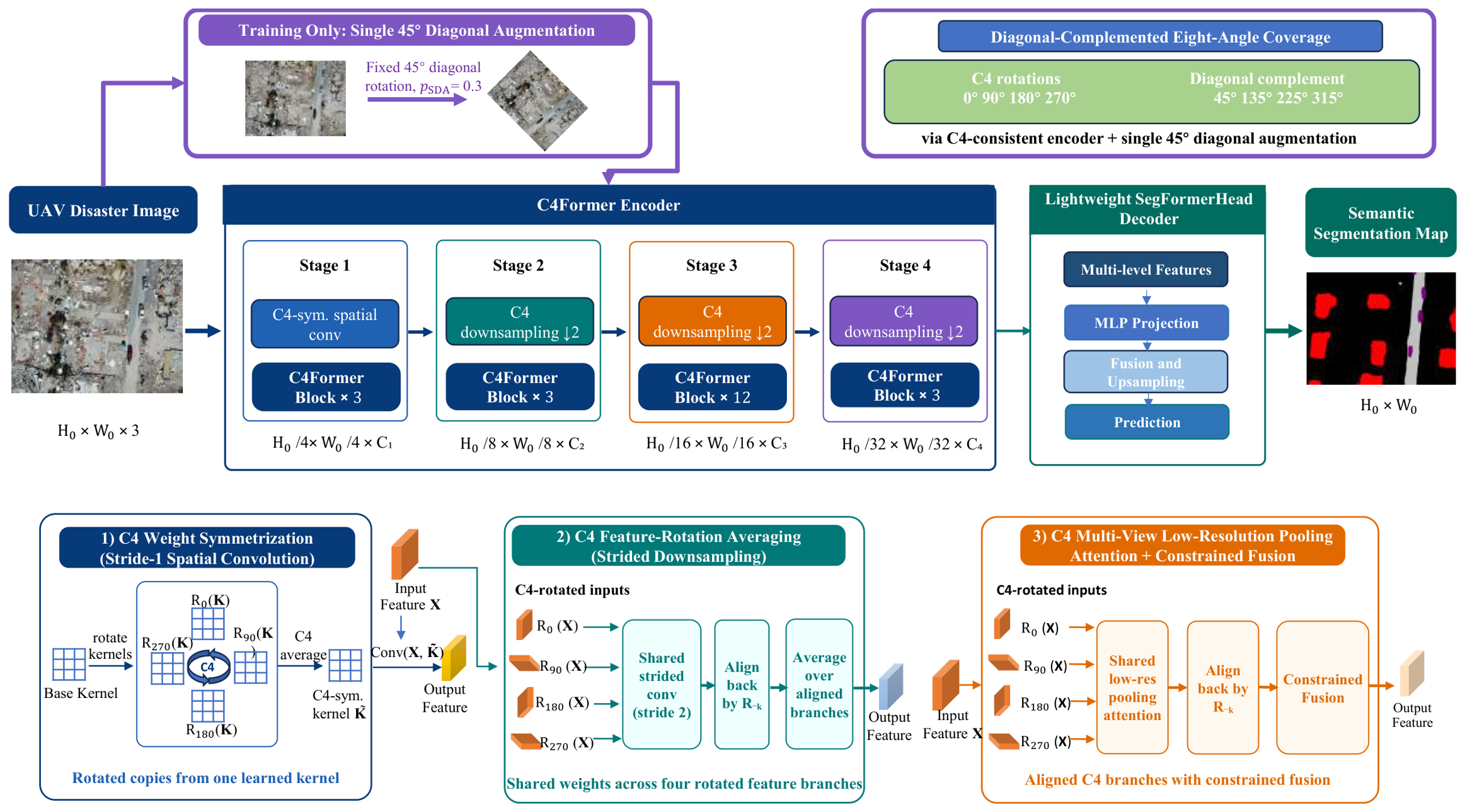
C4 weight symmetrization for stride-1 spatial convolutions;
C4 feature-rotation averaging for strided downsampling layers;
C4 multi-view formulation for low-resolution pooling attention.
DC4Former separates in-group consistency from out-of-group exposure. At the architecture level, C4Former replaces the rotation-sensitive parts of LRFormer with operator-aware
-consistent counterparts. At the training level, DC4Former adds a single diagonal representative. The encoder redesign targets interpolation-free
rotations, whereas the
augmentation exposes the model to a representative diagonal orientation without changing the inference pipeline.
Table 1 summarizes how each source of rotation sensitivity is addressed.
Figure 1 shows the DC4Former pipeline. Given an input UAV image, the encoder follows the multi-stage LRFormer-S backbone. Rotation-sensitive operators are replaced or reformulated according to their operator classes. Stride-1 spatial convolutions use C4 weight symmetrization, strided downsampling layers use C4 feature-rotation averaging, and low-resolution pooling attention uses a C4 multi-view formulation. The four encoder outputs are aggregated by a lightweight SegFormerHead MLP decoder, which is kept fixed for all LRFormer-family variants to isolate the effects of the encoder redesign and SDA.
DC4Former combines C4Former with single-diagonal augmentation during training. The augmentation exposes the model to , which serves as one representative of the complementary diagonal coset evaluated at , , , and . Its main practical advantage is that it introduces no inference overhead relative to C4Former. We use neither a test-time rotation ensemble nor an auxiliary rotation-consistency loss. The design combines operator-level consistency with training-time diagonal exposure.
3.2. Operator-Aware C4-Consistent Encoder
The C4Former encoder applies a different consistency mechanism to each operation class because stride-1 convolution, strided sampling, and pooled-token attention respond differently to rotation. The following subsections describe these three coordinated treatments.
3.2.1. C4 Weight Symmetrization for Stride-1 Spatial Operators
LRFormer contains several stride-1 spatial operators, such as convolutional positional encoding and depthwise local enhancement in the IRB module. These operations preserve the spatial resolution, but their learned kernels may still become orientation-biased. For a stride-1 spatial convolution, let
denote the input feature tensor, let
denote the convolution kernel with group number
g and spatial kernel size
, and let
denote the output feature tensor under resolution-preserving padding. We construct a C4-symmetrized kernel by averaging its four orthogonal rotations:
The symmetrized kernel retains the shape of the learned kernel,
. Here,
rotates only the two spatial kernel dimensions and does not permute the input or output channel indices. The output feature is then computed as
where
denotes convolution.
The symmetrized kernel is invariant to rotation, i.e., for any . Subject to compatible padding and boundary handling, convolution with this kernel commutes with rotation. Because the four kernels are averaged before convolution, the layer adds no learnable parameters and requires only one convolution per forward pass. We apply this operation to non- stride-1 spatial convolutions, including convolutional positional encoding and IRB depthwise convolutions.
3.2.2. C4 Feature-Rotation Averaging for Strided Downsampling
Kernel symmetrization is suitable for stride-1 convolutions, but it is insufficient for strided downsampling. The reason is that downsampling changes the spatial sampling grid, and the sampling positions after rotation are not equivalent to simply rotating the convolution kernel. Therefore, the downsampling operator itself must be treated as a rotation-sensitive component.
Let
denote a shared-weight strided downsampling operator that maps
to
, where
and
are determined by the stride, padding, and kernel size. Let
denote inverse rotation. We define its
feature-rotation averaged form as
After inverse alignment, each branch and the averaged output satisfy . Specifically, the input feature is rotated into four orthogonal coordinate systems, processed by the same shared-weight downsampling operator, inversely aligned, and averaged. Re-indexing the summation shows that, under grid-preserving rotations and compatible boundary handling, . Unlike kernel symmetrization alone, this formulation explicitly accounts for the rotated sampling lattice.
Compared with stride-1 kernel symmetrization, this operation is more computationally demanding because it evaluates four rotated branches. Therefore, we apply it only to strided spatial embedding layers, including the stem and overlapping patch-embedding layers, where rotation changes the sampling lattice directly. It adds computation but does not introduce additional learnable parameters.
3.2.3. C4 Multi-View Low-Resolution Pooling Attention with Constrained Fusion
The original LRFormer reduces attention cost by computing self-attention over low-resolution pooled tokens. However, token pooling layouts and attention interactions may change when the input feature map is rotated. As a result, low-resolution pooling attention can become another source of rotation sensitivity.
Let
denote the input feature map of the attention block. The implementation first applies aspect-ratio-aware adaptive pooling to the query path. Let
denote the resulting pooled-query dimensions; the configured base query-pooling size is
at all four encoder stages, and the pooled dimensions are adjusted according to the input aspect ratio. For the
and
branches, the query and key/value pooling dimensions are exchanged. Let
denote the low-resolution pooling-attention computation before output projection and upsampling. For each
orientation, we compute an aligned attention branch:
where the native pooled dimensions are
for
and
for
. After inverse alignment, each branch satisfies
. Each branch first processes the feature map under a rotated coordinate system and then aligns the low-resolution output back to the canonical pooled-query coordinates. The uniform
mean-fusion version is defined as
This formulation defines the uniform reference path, which is later evaluated as C4Former-Mean.
After inverse alignment, all branch outputs share a common pooled-query coordinate system. Uniform averaging is -consistent because rotating the input cyclically permutes the branch index while rotating each aligned output.
Uniform mean fusion assigns equal weights to the four aligned branches and serves as the reference aggregation rule. Its fixed branch contributions may limit input-dependent adaptivity in complex disaster scenes. For example, roads, flooded regions, debris, and damaged structures may exhibit local anisotropic patterns for which equal branch weighting is less flexible. We therefore introduce a constrained lightweight branch fusion module that retains uniform averaging as the reference component while allowing a bounded input-dependent correction.
Given the aligned low-resolution branch features
, a shared lightweight spatial scorer predicts branch-score maps
The adaptive weights
are computed as
where
is a learnable temperature. We then interpolate between the adaptive weights and the uniform branch-weight vector
:
where
is a learnable scalar logit,
is a fixed upper bound, and
. The weights are broadcast along the channel dimension when multiplying the branch features. The fused low-resolution feature is
where ⊙ denotes element-wise multiplication. The fused feature is flattened into
tokens, processed by the output projection, reshaped to
, and bilinearly resized to
. The attention-block output therefore has shape
, or equivalently
in the token representation.
Uniform
averaging remains the reference component in this fusion. When
, the module reduces to
mean fusion. When
, the adaptive branch contributes a bounded correction, while the uniform
component retains a mixture coefficient of at least
. Exact consistency would additionally require the predicted weights to rotate and cyclically permute with the branches. Although the shared scorer and aligned inputs encourage this behavior, we conservatively treat the resulting module as approximately
-consistent and verify its behavior empirically. Because the final layer of the branch scorer is zero-initialized, all four adaptive softmax weights are exactly
at initialization. The final branch weights are therefore also exactly uniform at initialization, independent of the initial gate value. The gate logit
is initialized to
, which controls how rapidly the model can depart from uniform fusion during training. This initialization provides a conservative starting point; the effect of different
values is evaluated empirically in
Section 4.7. For
, the mixture coefficient of the uniform component is at least 0.75, which prevents the adaptive branch from becoming an unconstrained four-branch selector.
The following bounds characterize how
limits the branch weights and the gate-driven gradient. For notational simplicity, the bound is written for one spatial location after channel broadcasting. Let
be the uniform branch-weight vector and let
denote the four adaptive softmax weights at that location. The final branch-weight vector can be written as
. Because
and
, each scalar component satisfies
Thus,
constrains each branch weight to
and preserves at least 75% of the uniform
component. Compared with
, which confines each branch weight to
,
provides a wider adaptive range while still preventing any branch from receiving a majority weight. Writing
, the fused feature is
, and the scalar-gate gradient is
These bounds show that the deviation from mean fusion and the gate-driven gradient scale with
. The gradient bound in Equation (14) is limited to the scalar gate
and describes how
constrains the sensitivity of the fused feature to this gate. Gradients through the branch scorer, attention module, and other network parameters are outside the scope of this derivation. The effect of
on rotation stability and training behavior is evaluated empirically in
Section 4.7.
3.3. Single-Diagonal Augmentation for Out-of-Group Rotations
C4Former targets the grid-preserving
group:
The four
elements correspond to distinct spatial index mappings and are therefore processed as separate transformations. Using zero-based row–column coordinates on an
feature map, and treating
as the mapping from an original feature coordinate to the rotated feature coordinate, the four mappings are
,
,
, and
. The
and
transforms exchange the spatial dimensions. Each branch is therefore inverse-aligned separately before fusion. However, diagonal rotations such as
,
,
, and
are outside this group and require interpolation. DC4Former addresses this out-of-group component through one diagonal representative:
During training, a fixed rotation is applied independently to each sampled crop with probability . The rotation is a replacement transform in the data pipeline: when selected, the rotated image and label replace that sample’s unrotated versions before packing, with no additional training sample appended. SDA preserves the mini-batch size and the number of optimization iterations. In expectation, 30% of sampled crops are presented at and 70% retain their current orientation. This exposes the model to one representative of the complementary diagonal coset. If the architecture behaves consistently under , the remaining diagonal orientations are related to this representative by orthogonal rotations. This argument is a structural motivation for the evaluated eight-angle behavior. Diagonal rotations require interpolation, and the complete model is evaluated for empirical orientation stability around an approximately C4-consistent architecture.
In the LRFormer-based implementation, C4Former applies the above operator-aware design to three computational pathways. The stride-1 spatial pathway uses C4 weight-symmetrized convolution for positional encoding and IRB depthwise convolution. The strided pathway applies feature-rotation averaged convolution in the stem and overlapping patch-embedding layers. The attention pathway computes four rotated low-resolution attention branches, inversely aligns them, and applies either mean fusion or constrained lightweight fusion. The stage-level downsampling convolutions inside the attention module remain ordinary shared-weight convolutions; the enclosing four-view rotation, inverse-alignment, and fusion procedure supplies their rotation-consistent treatment.
In the ablation study, the uniform mean-fusion version is used to evaluate the contribution of the C4 multi-view attention pathway without adaptive correction. The architecture-only model with constrained lightweight branch fusion is denoted as C4Former. DC4Former further adds the single- augmentation during training. Throughout this work, every LRFormer-family variant uses the same MMSegmentation SegFormerHead decoder. It receives the four encoder outputs with channel dimensions , projects and fuses them using 256 decoder channels, and applies dropout with probability 0.1. Keeping this decoder fixed isolates the effects of the C4-consistent encoder and diagonal-complemented training strategy.
3.4. Datasets
We evaluate the proposed method on two public UAV disaster semantic segmentation datasets, FloodNet [
1] and RescueNet [
2]. FloodNet contains high-resolution post-flood UAV imagery with semantic categories including building-flooded, building-non-flooded, road-flooded, road-non-flooded, water, trees, vehicles, pools, grass, and background. RescueNet contains high-resolution UAV imagery collected after Hurricane Michael, with categories including background, water, building-no-damage, building-medium-damage, building-major-damage, building-total-damage, vehicle, road-clear, road-blocked, tree, and pool.
For all experiments, we use the fixed train/val/test splits provided by the official dataset releases. The evaluation sets contain 448 FloodNet images and 450 RescueNet images. Within each dataset, the same images are used for canonical-orientation and rotation-wise testing, so differences across angles are not confounded by sample composition. FloodNet is evaluated with 10 semantic classes and RescueNet with 11. All classes, including background, are used during training and inference. The training loss ignores only pixels labeled 255, which correspond to invalid or padded semantic regions. Foreground mIoU is an evaluation metric only: it excludes background class 0 and averages 9 FloodNet foreground classes or 10 RescueNet foreground classes.
3.5. Training and Evaluation Protocol
All reported experiments used NVIDIA GeForce RTX 4090 GPUs (NVIDIA Corporation, Santa Clara, CA, USA) and the same software stack, comprising Python 3.10.18, PyTorch 2.1.2, CUDA 11.8, MMCV 2.1.0, MMEngine 0.10.4, MMSegmentation 1.1.0, and OpenCV 4.11.0. Training, checkpoint selection, rotation-wise inference, and FLOP analysis follow this software setup. Runtime measurements follow the input-size and batch-size protocols specified below; the full-image latency measurement uses the stated warm-up protocol. All parameter counts, FLOP values, and FPS values in
Table 2 are measured using
inputs. FPS is measured with inference batch size 1 on a single RTX 4090, without test-time augmentation. The C4Former encoder adopts LRFormer-S with
and depths
. The low-resolution pooling sizes are set to
, and the drop-path rate is 0.15. All LRFormer-family models use the same lightweight SegFormerHead decoder with 256 decoder channels and dropout probability 0.1. The input crop size is
.
Because the source UAV images are large, training samples are generated by online random cropping at pixels. We characterize the training budget by the total number of processed crops, computed as the training batch size multiplied by the number of optimization iterations; this crop-level count provides a more direct budget measure than epochs over the original full-resolution images. For FloodNet, each run used a batch size of 16 for 75,000 iterations, corresponding to processed crops; for RescueNet, each run used a batch size of 17 for 125,000 iterations, corresponding to processed crops. The best checkpoint was selected according to canonical-orientation () validation mIoU. Within each dataset, all reported models use the same crop-level training exposure. External baselines use the same crop size and rotation-wise evaluation protocol. No method uses a test-time rotation ensemble. Unless otherwise stated, all backbones were initialized from ImageNet-pretrained weights under the same initialization policy.
We optimize with AdamW using an initial learning rate of , weight decay of 0.05, , and . Mixed-precision training uses dynamic loss scaling. The learning rate is linearly warmed up for 1500 iterations and then follows polynomial decay with power 0.9 and a minimum of . Gradients are clipped to a maximum norm of 1.0. LRFormer-family ablation settings were trained with three random seeds (0, 42, and 3407), and the corresponding results are reported as mean and standard deviation. The corresponding dense-stress summaries also report mean and standard deviation across these seeds. External baseline comparisons are reported as seed-0 reference runs because they provide a common baseline overview. In the rotation-augmentation analysis, the matched LRFormer-RandRot and C4Former-RandRot comparison is reported over three seeds, whereas the additional angular-sampling variants remain seed-0 diagnostic controls. With only three independent runs per setting, formal significance tests would have low statistical power and unstable variance estimates. We therefore do not report p-values or use significance claims to support the comparisons. The configurations set deterministic=False; fixed seeds standardize stochastic initialization and sampling but do not guarantee bitwise-deterministic reproduction.
For the constrained lightweight branch fusion module, we use as a shared structural cap for both datasets. This bound retains at least 75% of the uniform component while allowing a limited adaptive correction. For the single-diagonal augmentation setting, we likewise use as a shared probability for both datasets. Both hyperparameters were held fixed throughout the main comparative experiments and were not tuned separately for FloodNet and RescueNet. The training pipeline first applies shortest-edge random resizing over scales from 0.5 to 2.0 times 512 pixels, with a maximum size of 2048 pixels, followed by a random crop with a maximum single-class ratio of 0.75. It then applies a fixed rotation with probability , using image padding value 0, semantic-label padding value 255, and auto_bound=False, followed by photometric distortion. The transformed sample replaces the current crop, so the batch cardinality and training iteration count remain unchanged. This augmentation is used only during training and does not introduce additional inference overhead. Thus, LRFormer and LRFormer-SDA share the same model complexity, and C4Former and DC4Former also share the same model complexity.
To separate architecture-level consistency from training-time rotation exposure, we also evaluate rotation-augmentation controls. LRFormer-RandRot and C4Former-RandRot use the same continuous random-rotation rule, sampling one angle from with probability 0.3; these two matched RandRot settings are trained with three random seeds. LRFormer-FourDiag samples one diagonal angle from with probability 0.3, LRFormer-DenseRot samples one angle from a grid with probability 0.3, and C4Former-RandDiag applies the four-diagonal random augmentation to the C4Former architecture. When applied, each augmentation replaces the current crop with no extra sample appended to the mini-batch. None of these controls uses test-time rotation augmentation. These controls assess how much of the rotation-stability improvement can be explained by training-time rotation exposure under matched training and evaluation settings. Except for the matched RandRot comparison, the additional angular-sampling variants are reported as seed-0 diagnostic references.
Unless otherwise specified, the reported mIoU in the rotation-wise experiments denotes foreground mIoU, where the background class is excluded. The metric averages 9 foreground classes on FloodNet and 10 foreground classes on RescueNet. This setting highlights disaster-related semantic categories and avoids background-dominated conclusions. The canonical-orientation comparison and per-class analysis are also reported using foreground mIoU for consistency.
Evaluation Metrics and Rotation-Wise Protocol
We evaluate each model at eight angles:
The grid-preserving orthogonal rotation group is defined as
and the out-of-group diagonal rotation set is defined as
For each angle
, we report
. We further compute the orthogonal mean, diagonal mean, eight-angle mean, worst-angle mIoU, and rotation-wise standard deviation:
To quantify rotation-induced performance degradation, we report the relative mIoU drop (RMD):
A lower RMD indicates better rotation-wise stability. A negative RMD means that the average non-zero-angle mIoU is slightly higher than the canonical
mIoU.
Consolidated quantitative test protocol. The setting is used for training crops and the standardized complexity/FPS measurements, but the accuracy-evaluation pipeline does not crop test images to . For canonical and rotation-wise accuracy evaluation, each test image is resized with preserved aspect ratio using Resize(scale=(2048,512), keep_ratio=True), padded as required to satisfy the model’s size divisor of 32, and processed using whole-image inference (mode=whole); no sliding-window inference or test-time crop is used. At the canonical orientation, all 450 RescueNet test images are resized to and padded to . Among the 448 FloodNet test images, 383 images are resized to and padded to , while the remaining 65 images are resized to and padded to . The test batch size is 1. For each evaluated angle, the resized full image and its semantic mask are transformed before packing and inference. All methods use the same angle-specific transform and valid-pixel mask. Right-angle rotations are implemented as exact index permutations without interpolation; the and transforms exchange the height and width dimensions. Non-right-angle rotations use a fixed canvas (auto_bound=False); RGB images use bilinear interpolation and invalid regions are filled with 0, whereas semantic masks use nearest-neighbor interpolation and invalid regions are assigned ignore label 255. Predictions and labels are aligned to a common metric grid before confusion-matrix accumulation. Pixels labeled 255 are excluded from the confusion matrix and all reported metrics. Foreground mIoU additionally excludes background class 0 and averages the remaining 9 FloodNet classes or 10 RescueNet classes.
We adopt a fixed-canvas protocol to evaluate every rotation within the same canonical raster extent. This setting is motivated by UAV camera frames and disaster-mapping tiles, which are commonly processed using fixed tensor dimensions rather than angle-dependent expanded canvases. Allowing the canvas to expand at non-right angles would introduce angle-dependent input dimensions and preserve additional spatial support, thereby coupling orientation effects with changes in tensor size and retained scene content. Under the fixed-canvas protocol, the evaluation measures end-to-end orientation reliability within a finite image frame, including the effects of interpolation, boundary truncation, changes in valid support, and model response. For each evaluated angle, all methods use the same rotation center, interpolation and filling rules, and the same corresponding valid-pixel mask, enabling controlled relative comparison under this deployment-motivated setting.
Practical inference-cost protocol. In addition to the standardized FPS measurement, we report full-image latency and peak GPU memory under the canonical whole-image evaluation pipeline. Here, “full-image” refers to the resized whole test image after aspect-ratio-preserving preprocessing, rather than the raw-resolution UAV image. The measurement follows the same Resize(scale=(2048,512), keep_ratio=True), padding, and whole-image inference setting used for quantitative evaluation. For RescueNet, this produces a resized image of , which is padded by the data preprocessor to before whole-image inference. Latency is measured with batch size 1 on a single RTX 4090 after 20 warm-up images, and the remaining 430 test images are used for timing. Rotation preprocessing, test-time augmentation, visualization, result saving, and metric computation are excluded from the latency measurement. Peak GPU memory denotes the maximum allocated GPU memory during the measured inference loop.
Right-angle rotations are grid-preserving and require no interpolation. Nevertheless, the rotation-wise scores under
,
,
, and
are expected to be close but not necessarily bitwise identical. Aspect-ratio-preserving resizing, height–width exchange, size-divisor padding, decoder resizing, valid-pixel masking, and finite image boundaries can introduce small residual differences, even though the right-angle rotation itself is an exact grid permutation. Dataset-dependent differences among the right-angle scores are therefore consistent with finite-canvas and padding effects under the common protocol, rather than indicating an implementation inconsistency. Non-right-angle results necessarily reflect both model sensitivity and interpolation effects; because every method receives the same transformed inputs and valid-pixel masks, the protocol supports controlled relative comparison. We further quantify this distinction with an image-level rotation–inverse-rotation round-trip diagnostic in
Supplementary Table S1 over the eight principal angles:
,
,
, and
introduce zero reconstruction error, whereas
,
,
, and
produce non-zero normalized MAE and reduced gradient retention. This diagnostic uses an expanded intermediate canvas and valid-region scoring to isolate interpolation-induced resampling from boundary truncation, whereas the segmentation evaluation uses the fixed-canvas protocol described above.
For qualitative visualization, we use a separate visualization protocol to avoid visually misleading cropping artifacts under non-orthogonal rotations. Specifically, non-right-angle inputs are rotated on an enlarged canvas with constant padding, and the predicted masks are then inversely warped back to the original coordinate system. The RGB disagreement maps are generated only after this alignment step and are used for visual analysis rather than official mIoU computation.
4. Results
4.1. Canonical-Orientation Results and Complexity
We first compare the standard
segmentation performance and model complexity of the proposed method with representative CNN-based, Transformer-based, and UAV/remote-sensing segmentation baselines. The compared methods include PSPNet [
17], DeepLabv3+ [
18], UPerNet [
59], SegFormer-B1 [
21], Mask2Former [
23], UNetFormer [
60], LRFormer [
24], C4Former, and DC4Former. Parameter counts and FLOPs are computed with an input size of
, and FPS is measured using
inputs with batch size 1 on a single NVIDIA RTX 4090 GPU without test-time augmentation.
Mask2Former achieves the highest canonical-orientation mIoU on both datasets, whereas LRFormer and the proposed variants remain in a similar accuracy range. The proposed variants do not consistently improve the score. C4Former mainly improves the orthogonal-angle mean, whereas DC4Former improves the All-8 mean on both datasets; the corresponding worst-angle results are examined in the rotation-wise evaluation. Relative to LRFormer, C4Former adds only 0.18M parameters, but increases FLOPs from 29.25G to 40.59G and reduces standardized throughput from 65.58 to 20.17 FPS. The multi-view operations incur substantial runtime overhead, and weight sharing across branches does not eliminate this cost.
Table 3 relates the standardized throughput to a representative resized whole-image evaluation pipeline. LRFormer processes one resized-and-padded RescueNet test image in 44.13 ms, whereas C4Former/DC4Former require 95.60 ms. The peak allocated GPU memory remains 1.51 GB for both model groups. The additional cost is therefore latency rather than memory footprint.
4.2. Rotation-Wise Evaluation
Table 4 and
Table 5 provide seed-0 contextual comparisons with external baselines, whereas the main LRFormer-family conclusions are based on the multi-seed results reported in
Table 6,
Table 7,
Table 8,
Table 9 and
Table 10. External baselines are used as contextual seed-0 references, while conclusions about the proposed LRFormer-family variants are drawn from the corresponding three-seed experiments.
4.2.1. FloodNet
Table 4 reports the angle-wise foreground mIoU on FloodNet. Canonical-orientation performance and rotation stability show different behavior. Mask2Former obtains the highest
mIoU among external baselines, but its worst-angle mIoU is 69.82%. SegFormer-B1 and UNetFormer show relatively small standard deviations on FloodNet, but their overall mIoU remains lower than the stronger baselines. This low variation mainly reflects lower overall performance on FloodNet; on RescueNet, UNetFormer’s standard deviation rises to 9.45.
The seed-0 FloodNet reference suggests that single-diagonal augmentation and the C4-consistent architecture are complementary. Relative to LRFormer, LRFormer-SDA improves diagonal performance but retains visible angle-wise variation, whereas C4Former makes the four orthogonal scores identical to two decimal places while leaving a diagonal gap. These identical rounded right-angle mIoU values reflect metric rounding; the prediction-level diagnostic in
Table 6 reports non-zero pixel disagreement after inverse alignment. In this seed-0 reference, DC4Former substantially reduces this gap: it improves All-8 mIoU by 4.34 points and worst-angle mIoU by 7.08 points over LRFormer, while reducing the standard deviation from 2.62 to 0.30. Although its
mIoU is 0.54 points lower than LRFormer, DC4Former improves the rotated-angle and worst-angle scores, indicating reduced rotation-induced variation as the main source of the gain.
4.2.2. RescueNet
Table 5 reports the angle-wise foreground mIoU on RescueNet. Compared with FloodNet, RescueNet exhibits stronger rotation sensitivity for most external baselines. Diagonal rotations are particularly challenging: the worst-angle mIoU of the external baselines ranges from 37.78% to 52.84% under the fixed-canvas protocol.
The seed-0 RescueNet reference shows stronger rotation sensitivity. Mask2Former attains the highest mIoU, but its worst-angle score is 52.84%, close to LRFormer’s 53.20%. DC4Former raises LRFormer’s All-8 mIoU by 9.69 points and its worst-angle mIoU by 14.46 points, reducing the standard deviation from 4.96 to 0.28. The improvement comes mainly from more stable performance after rotation, especially at the worst angle, while the unrotated score remains comparable.
4.2.3. Qualitative Visualization of Rotation Consistency
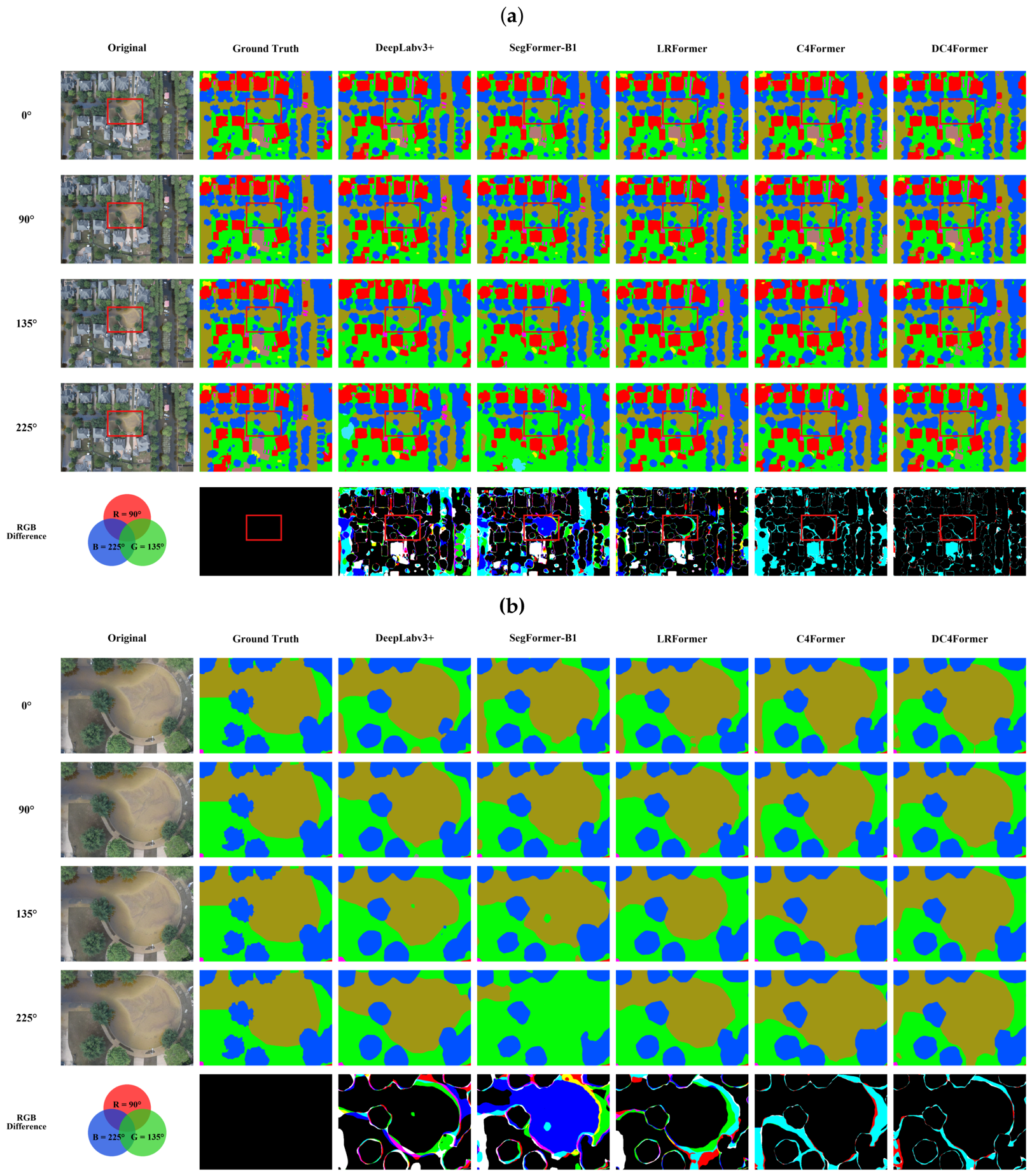
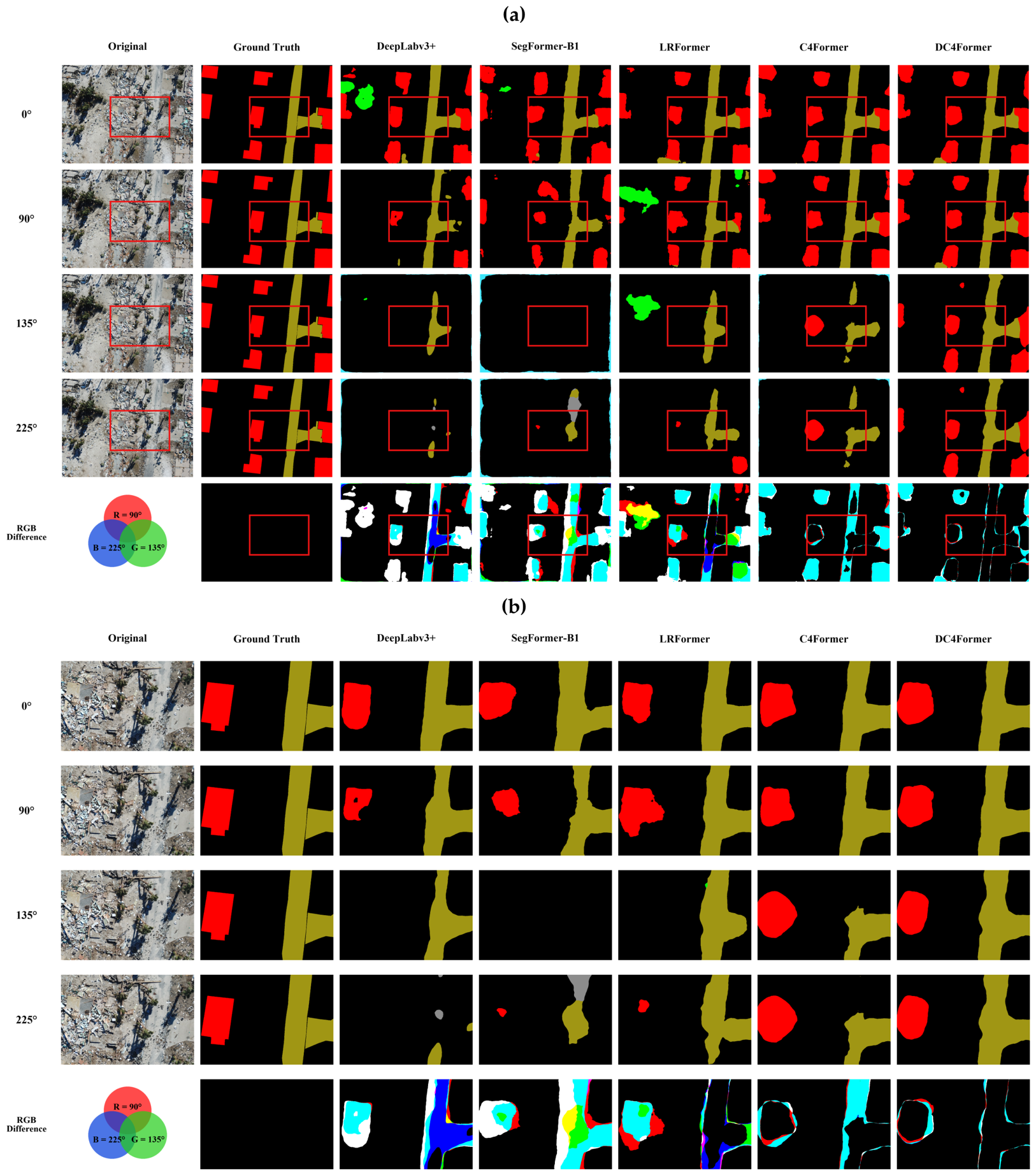
Figure 2 and
Figure 3 compare representative seed-0 predictions on FloodNet and RescueNet. Rotated-input predictions are aligned back to the original
coordinate system before visualization. Columns show the original image, ground truth, and model predictions; rows show
,
,
,
, and an RGB disagreement map. Red, green, and blue denote prediction changes induced by
,
, and
, respectively, and mixed colors indicate overlapping disagreement.
The qualitative figures include boxed overviews and zoomed regions of interest. The FloodNet zoom focuses on a road-flooded region and its water boundary, where several baselines change labels under diagonal rotations. The RescueNet zoom focuses on building-total-damage and road-blocked regions, two disaster categories for which orientation changes can alter small connected structures. These local views show where the rotation-wise scores in
Table 4 and
Table 5 arise spatially; they are not used as additional metrics.
In the zoomed panels, rotation-sensitive predictions appear as colored bands around the FloodNet road-flooded boundary and as shifted or missing components in the RescueNet building-total-damage and road-blocked regions. This visual pattern is consistent with the reduced right-angle prediction disagreement of C4Former and DC4Former and with the lower eight-angle standard deviation of DC4Former.
The qualitative examples are generated from the seed-0 checkpoints and serve as representative visual comparisons; the corresponding multi-seed quantitative evidence is reported in
Table 6,
Table 7,
Table 8,
Table 9 and
Table 10.
4.3. Feature- and Prediction-Level C4 Consistency
We conduct a C4-consistency diagnostic using the LRFormer, C4Former, and DC4Former checkpoints to examine whether the improved rotation-wise behavior is also reflected in internal features and predictions. The diagnostic uses the same test images, aspect-ratio-preserving resize and padding, exact right-angle transforms, whole-image inference, ignore-index handling, and metric-grid alignment as the rotation-wise evaluation protocol. For each test image, the
,
,
, and
versions are passed through the same checkpoint. The rotated feature maps, raw logits, and predictions are then inverse-rotated to the
coordinate system and compared on their common spatial support. Let
denote the resized input image tensor and let
denote the stage-
l encoder feature. For encoder stage
l, the relative C4 inconsistency at angle
is computed as
where
,
, and
are stage-specific channel and spatial dimensions, and
is a small numerical constant. We also report the relative L2 error of the aligned raw logits, the foreground mIoU between aligned predictions, and the pixel disagreement rate.
Table 6 averages the non-zero right angles over three random seeds.
The diagnostic indicates that C4Former and DC4Former reduce inconsistency before the final mIoU is computed. On FloodNet, C4Former reduces the Stage-4 relative L2 error from 0.59 to 0.24, raises prediction-consistency foreground mIoU from 81.51% to 96.14%, and lowers pixel disagreement from 7.95% to 0.97%. On RescueNet, the corresponding prediction-consistency mIoU increases from 68.84% to 94.74%, while pixel disagreement decreases from 9.23% to 1.23%. These results distinguish canonical-orientation feature quality from rotation consistency: after inverse alignment, LRFormer exhibits substantially larger feature and prediction discrepancies between rotated-input and canonical-input responses than C4Former and DC4Former. Full stage-wise and model-wise results are provided in
Supplementary Table S4.
4.4. Dense Rotation Stress Test
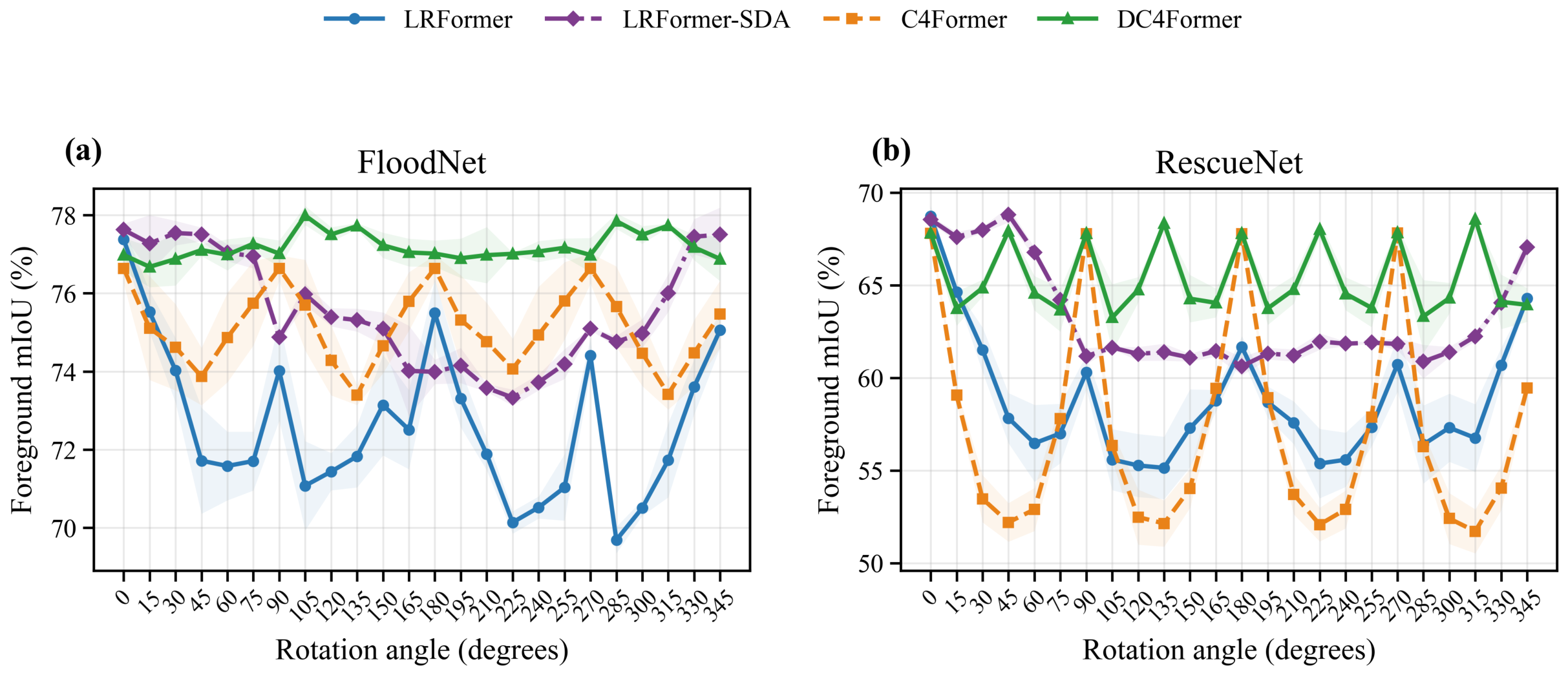
The main eight-angle protocol evaluates the orientations and their diagonal complements. The 24-angle protocol further evaluates whether stability learned from the rotations and one diagonal representative extends to sampled intermediate orientations. It provides a discrete stress test of sampled intermediate rotations under the same fixed-canvas protocol. The dense rotation stress test covers LRFormer, LRFormer-SDA, C4Former, and DC4Former over the complete – range at intervals, including the original eight angles and 16 intermediate angles. All 24 angles use the same fixed-canvas quantitative protocol, interpolation rules, valid-pixel masking, evaluation images, and foreground mIoU definition described above.
Figure 4 visualizes the three-seed mean response of LRFormer, LRFormer-SDA, C4Former, and DC4Former beyond the eight principal orientations.
Table 7 reports the corresponding 24-angle summary statistics for the same four settings. The table computes summary metrics per seed before cross-seed averaging, so the minima of the plotted mean curves are visual references and may differ from the reported Worst-24 values. On FloodNet, DC4Former raises the mean 24-angle foreground mIoU from 72.64% to 77.19% over LRFormer and reduces the 24-angle standard deviation from 1.99 to 0.39. On RescueNet, the corresponding mean improves from 58.79% to 65.40%, and the standard deviation falls from 3.40 to 1.91. For DC4Former on RescueNet, Std.-24 is 1.91, compared with Std.-8 of 0.33, indicating greater variation across the full 24-angle protocol than across the eight principal orientations. On FloodNet, C4Former has a higher Mean-24 and Worst-24 and a lower Std.-24 than LRFormer. On RescueNet, C4Former has a lower Mean-24 and Worst-24 and a higher Std.-24 than LRFormer. Interpolation-induced changes to boundaries and small fragmented structures may contribute to this dataset-dependent pattern. The 24-angle protocol therefore functions as a controlled stress test of sampled intermediate rotations.
4.5. Diagnostic Rotation-Augmentation Controls
Table 8 reports rotation-augmentation controls designed to examine the roles of training-time rotation exposure and architecture. The three-seed comparison is assigned to Schemes 1 and 5 because their shared continuous RandRot rule provides the matched control needed to assess the architectural effect under fixed training-time rotation exposure. Schemes 2–4 serve as seed-0 diagnostics of angular-sampling patterns.
Together, these auxiliary controls show that finite diagonal sampling, denser sampling, and the addition of the architecture produce dataset-dependent reliability patterns. Their primary role is to characterize the interaction between angular evaluation or training exposure and architecture.
The matched RandRot comparison shows that rotation augmentation is a strong training-time baseline with no additional inference cost. This behavior is plausible for a high-capacity Transformer-based segmenter: repeated random rotations expose the same training scenes and labels under many sampled orientations, allowing the model to learn orientation-conditioned appearance patterns empirically. On FloodNet, LRFormer-RandRot has slightly higher three-seed mean All-8 and Worst-8 values than C4Former-RandRot, by 0.44 and 0.32 points, respectively. Under this matched protocol, adding the architecture does not increase these two mean metrics on FloodNet.
In contrast, RescueNet shows a reliability advantage from adding the C4 architecture under the same continuous RandRot rule. C4Former-RandRot improves All-8 from 66.43% to 67.04%, raises Worst-8 from 64.26% to 66.62%, and reduces Std.-8 from 1.30 to 0.28. The 24-angle stress metrics follow the same reliability pattern within this matched attribution comparison, with Worst-24 improving from 64.26% to 66.16% and Std.-24 decreasing from 1.10 to 0.35. These results characterize a dataset-dependent trade-off between inference efficiency and worst-orientation reliability under matched rotation exposure. This section uses C4Former-RandRot for attribution under matched rotation exposure; the final deployment comparison between DC4Former and LRFormer-RandRot is discussed in
Section 5.
4.6. Ablation Study
The ablation study follows the LRFormer-family design path in
Table 9. The configurations separate single-diagonal augmentation, the three individual
operator classes, their pairwise combinations, the full mean-fusion
architecture, the full constrained-fusion
architecture, and the final diagonal-complemented model. Settings C–E isolate
spatial kernel symmetrization,
feature-rotation averaged downsampling, and
multi-view attention. Settings F–H examine the three pairwise combinations. Settings I and J compare mean and constrained fusion when all three
operator classes are enabled, and setting K adds SDA to form DC4Former.
SDA alone (B) mainly affects the diagonal angles. The diagonal mean increases from 71.35% to 75.54% on FloodNet and from 56.27% to 63.60% on RescueNet. The orthogonal means change only slightly, from 75.32% to 75.40% on FloodNet and from 62.85% to 63.04% on RescueNet. This behavior matches the role of SDA as training exposure to one diagonal representative, with the LRFormer operators left unchanged.
The single-module rows show different behavior across the three operator classes. On FloodNet, the isolated spatial, downsampling, and attention settings give close All-8 values of 73.90%, 73.99%, and 74.15%. On RescueNet, C4 Downsampling only and C4 Attention only raise All-8 to 60.44% and 60.39%, while C4 Spatial only gives 58.60% and lowers the diagonal mean to 53.44%. The pairwise rows follow the same dataset- and angle-dependent behavior. On RescueNet, C4 Downsampling + Attention gives the strongest pairwise All-8 and Worst scores, 60.62% and 55.65%, whereas the pairwise settings containing C4 Spatial have lower diagonal means.
On RescueNet, C4Former-Mean raises the orthogonal mean from 62.85% to 68.02% relative to LRFormer; its diagonal mean decreases from 56.27% to 52.34%, and its rotation-wise standard deviation increases from 4.17 to 7.85. The expanded RescueNet ablation reveals a consistent pattern in the diagonal results. All configurations containing spatial kernel symmetrization (C, F, G, I, and J) have lower diagonal means than LRFormer, whereas the configurations without this component (D, E, and H) do not exhibit the same decline. The nearly identical diagonal means of C4Former-Mean and C4Former, 52.34% and 52.03%, further show that replacing uniform fusion with constrained fusion is insufficient to recover the lost diagonal performance. The observed degradation is therefore more closely linked to the -symmetrized spatial pathway than to the choice of branch-fusion rule.
After diagonal resampling, fine edges and small structures are represented by local patterns that differ from those seen during training without diagonal rotation exposure. The branch rotations inside the network remain exact right-angle index permutations of the resulting discrete feature maps; the resampling change is introduced before these internal transformations. By tying local-filter responses across the four right-angle orientations, spatial symmetrization reduces the degrees of freedom available for orientation-specific adaptation to the altered local statistics. This effect may be more pronounced on RescueNet because discrimination among building-damage grades and blocked-road regions may draw on fragmented structures, irregular boundaries, narrow obstruction cues, and subtle local appearance differences. The interaction between interpolation-altered cues and tied spatial responses is consistent with the stronger right-angle/diagonal trade-off observed on RescueNet. Because the redesigned operators interact throughout the feature hierarchy, the current ablation does not establish a unique causal mechanism.
Adding SDA to the constrained
architecture gives the final setting K. On RescueNet, All-8 increases from 59.56% for LRFormer to 68.01%, Worst-8 increases from 54.90% to 67.66%, and Std.-8 decreases from 4.17 to 0.33. Among settings A–K in
Table 10, setting K gives the highest All-8 and Worst-8 scores and the lowest rotation-wise standard deviation on both datasets. The component effects are complementary but non-additive:
downsampling and
attention provide modest standalone gains; the
-symmetrized spatial pathway improves right-angle consistency but is also the component most closely linked to the RescueNet diagonal decline; constrained fusion provides a bounded adaptive correction without removing this architecture-only trade-off; and SDA supplies the diagonal training exposure needed for the final eight-angle stability.
DC4Former obtains a slightly negative mean RMD (
) on both datasets. RMD compares the canonical
result with the average across the other seven orientations, and its sign characterizes this canonical-versus-nonzero comparison.
Table 10 directly reports the relative performance of the diagonal and orthogonal subsets. The diagonal mean mIoU exceeds the orthogonal mean by only 0.39 points on FloodNet and 0.40 points on RescueNet. Diagonal rotations introduce sampling changes because they require interpolation on the fixed canvas. After targeted training exposure, the final segmentation scores can approach parity despite this sampling-related challenge. The RescueNet ablation illustrates this distinction: C4Former obtains orthogonal and diagonal means of 67.79% and 52.03%, respectively, whereas DC4Former, which adds SDA, obtains 67.81% and 68.21%. The diagonal-minus-orthogonal difference changes from
points for C4Former to 0.40 points for DC4Former, while the orthogonal mean changes by only 0.02 points. On both datasets, the magnitude of the mean RMD (
) is smaller than its cross-seed standard deviation (
on FloodNet and
on RescueNet). The negative mean RMD represents a small model- and protocol-dependent residual comparable in magnitude to the observed cross-seed variability. Taken together, these results show that DC4Former achieves approximately balanced performance across diagonal and orthogonal orientations under the evaluated protocol.
The ablation supports the design choice used in DC4Former. The
operators target grid-preserving right-angle rotations, where pixels or feature cells can be permuted without resampling. Diagonal rotations require interpolation and fixed-canvas boundary handling, which change RGB sampling, label boundaries, and small-structure geometry. The full eight-angle round-trip diagnostic in
Supplementary Table S1 supports this distinction between interpolation-free
transformations and interpolation-based diagonal inputs. Within the LRFormer-family ablation, the best orientation reliability is obtained when the
operator path is combined with constrained fusion and diagonal training exposure.
4.7. Sensitivity to the Constrained Fusion Bound
The main comparative experiments use
as the shared structural cap for both datasets. We additionally evaluate the sensitivity of the constrained branch fusion using the full C4Former architecture, the same fixed-canvas evaluation protocol, and seed 0, with only
varied. Detailed rotation-wise results are reported in
Supplementary Table S5. To check whether larger bounds cause optimization instability,
Supplementary Figure S1 reports the smoothed training-loss and validation-mIoU trajectories for
, and
Supplementary Table S6 reports the best validation checkpoint iteration and score. The rotation-wise results vary moderately over
, and larger upper bounds lack a monotonic or cross-dataset-consistent improvement.
On FloodNet, larger values improve several seed-0 metrics, with
giving the highest All-8 and Worst-8 scores. The same trend is not reproduced on RescueNet, where
gives the highest All-8 score, while
gives the highest Worst-8 score and lowest Std.-8. The convergence diagnostics show that the
, 0.5, and 1.0 runs complete the prescribed schedules without NaNs, loss explosion, or numerical divergence. The training-loss curves follow similar decreasing trajectories, whereas the best validation checkpoints occur at different iterations across settings. Relaxing the cap does not cause optimization failure, but it can affect late-stage validation behavior and the selected checkpoint iteration. The main experiments retain the shared conservative setting
used throughout the comparative evaluation. Under the branch-weight bounds in
Section 3.2.3, this moderate setting preserves a dominant uniform component, prevents any branch from receiving a majority weight, and provides a wider adaptive range than
. The sensitivity results characterize its stability across the tested range without claiming dataset-specific or universal optimality.
4.8. Sensitivity to the Diagonal Augmentation Probability
The main comparative experiments use
for both datasets, with this probability held fixed rather than tuned separately for each dataset. We additionally evaluate
under the same evaluation protocol using seed 0 to characterize the coarse response to stronger diagonal exposure. The seed-0 results for
and
are closer, so these two settings are additionally evaluated with all three predefined seeds to estimate cross-seed variability. The
setting remains a seed-0 diagnostic reference because it reduces the FloodNet metrics and provides no consistent cross-dataset advantage in the coarse comparison. Full results are reported in
Supplementary Table S2. The three-seed comparison shows that
gives stronger main eight-angle metrics on RescueNet and remains competitive on FloodNet. These results characterize the observed dataset dependence without establishing a universally optimal augmentation probability.
A separate seed-0 C4Former-Mean-SDA diagnostic is provided in
Supplementary Table S3. In this diagnostic, SDA reduces the diagonal-orientation gap of the mean-fusion C4 baseline, but DC4Former retains higher All-8 and Worst-8 scores on RescueNet. The residual seed-0 difference is consistent with an effect of the fusion design, but this diagnostic does not establish the stability or magnitude of that effect across training runs.
4.9. Per-Class and Class-Wise Stability Analysis
4.9.1. Per-Class IoU Analysis
We report per-class IoU under the canonical
setting for FloodNet and RescueNet in
Table 11 and
Table 12. The background class is omitted from the averaged foreground mIoU.
At the canonical orientation, DC4Former produces class-level scores that are generally close to those of the stronger baselines, with strengths that vary by dataset. On FloodNet, it gives the highest flooded-road IoU and stays close to the leading values for buildings, water, and vegetation. On RescueNet, Mask2Former and LRFormer obtain higher scores for several classes. The per-class tables therefore provide canonical-accuracy context, and the following analysis evaluates rotation stability for selected disaster-relevant categories.
4.9.2. Class-Wise Rotation Stability
Table 13 reports three-seed, eight-angle class-wise statistics for categories tied to post-disaster mapping decisions: flooded buildings, flooded roads, water regions, building-damage levels, and blocked roads. These classes are selected because they represent inundation extent, road passability, and structural damage, and because their thin boundaries or fragmented regions can be sensitive to image orientation. All-8 denotes the mean class IoU over the eight principal angles; Diag. denotes the mean over the four diagonal angles, Worst denotes the minimum across the eight angles, and Std. denotes the corresponding rotation-wise standard deviation. The comparison between LRFormer and DC4Former assesses whether the model-level orientation-reliability improvement extends to the selected disaster-relevant semantic categories.
For the selected disaster-relevant categories, the class-wise analysis follows the model-level orientation-stability trend. On FloodNet, DC4Former raises the three-seed mean worst-angle IoU for flooded roads from 51.05% to 67.54% and reduces its rotation-wise standard deviation from 5.96 to 1.92. On RescueNet, building-major-damage and road-blocked classes show large gains. Their mean worst-angle IoUs increase from 37.44% and 21.92% to 59.93% and 46.09%, respectively. Their rotation-wise standard deviations also fall below 1.0. These selected class-level results provide additional evidence of improved orientation reliability for several operationally important categories.
5. Discussion
The results separate two sources of orientation reliability: consistency within and exposure to rotations outside it. C4Former nearly equalizes performance at , , , and . The feature- and prediction-level diagnostic further shows that the improvement extends beyond the final segmentation metrics: the C4-modified encoders exhibit lower stage-wise feature discrepancy, raw-logit discrepancy, and aligned-prediction disagreement under right-angle rotations. By symmetrizing stride-1 kernels, averaging rotated downsampling responses, and aligning four low-resolution attention branches, the encoder reduces the orientation-specific responses introduced by LRFormer’s spatial-token operations. These operations act on grid-preserving right-angle rotations, where pixels or feature cells can be permuted without resampling. Diagonal rotations introduce interpolation and boundary changes on the fixed canvas. In the evaluated models, diagonal training exposure complements the encoder’s architectural consistency and improves robustness to these changes. DC4Former does not reconstruct high-frequency information removed during diagonal resampling; its measured effect is improved segmentation stability when the network receives interpolation-affected inputs.
The four branches represent the action on the sampled image lattice. Changes in UAV flight heading and camera yaw orientation can rotate the same scene relative to this lattice, so the model should preserve spatial correspondence across transformed inputs. On a regular square-pixel grid, , , , and are exact index permutations and form the complete grid-preserving set targeted by the encoder. A step requires interpolation and changes the sampled values and boundary support. The RescueNet ablation illustrates this boundary: C4Former reaches an orthogonal-angle mean of 67.79% and a diagonal-angle mean of 52.03%, with a rotation-wise standard deviation of 7.88. After adding the single training complement, DC4Former raises the diagonal mean to 68.21% and reduces the standard deviation to 0.33. Single-diagonal augmentation provides this exposure in a structured way. Applied to standard LRFormer, it improves diagonal accuracy while leaving the backbone operators unchanged. Applied to C4Former, it introduces one representative of while the architecture handles the grid-preserving rotations. The three-seed ablation supports complementary roles for the two components: -consistent operators reduce right-angle variation, while diagonal exposure reduces the remaining orthogonal–diagonal gap. The 24-angle stress test further evaluates sampled intermediate rotations, with dataset- and protocol-dependent behavior relative to augmentation. The experiments evaluate as a grid-preserving architectural basis and examine whether diagonal training exposure extends its stability beyond the four right-angle rotations.
Diagonal training exposure therefore mitigates the diagonal decline associated with the architecture-only C4Former. Future architectural mitigation can follow three directions. First, a bounded unsymmetrized residual kernel path could give the model a limited local-adaptation route after diagonal resampling. Second, applying spatial symmetrization only at selected stages or channels could avoid tying responses where interpolation-altered local cues require more flexibility. Third, resampling-aware anti-aliasing before local filtering could reduce interpolation artifacts in fine edges, narrow obstructions, and fragmented damage cues. Dedicated experiments are needed to test whether these alternatives preserve right-angle consistency while improving adaptation to interpolation-altered inputs.
The matched RandRot comparison indicates that rotation exposure is a strong training-time baseline with no additional inference cost and a dataset-dependent interaction with the C4 architecture. On FloodNet, LRFormer-RandRot remains slightly stronger than C4Former-RandRot, so continuous random rotation is already highly effective. On RescueNet, however, adding the C4 architecture under the same RandRot exposure improves worst-orientation reliability and reduces rotation-wise variation. This matched experiment serves as an attribution analysis by holding training-time rotation exposure fixed while changing the architecture. The final deployment comparison with DC4Former is addressed separately below. DC4Former takes a different route from dense random exposure: it changes how rotation-sensitive operators process features and uses one diagonal representative to complement the path. These routes can also be combined when deployment constraints allow.
The final comparison leads to different deployment choices for DC4Former and LRFormer-RandRot. On FloodNet, LRFormer-RandRot remains slightly higher than DC4Former in All-8, Worst-8, Mean-24, and Worst-24. On RescueNet, DC4Former provides a clearer advantage over the eight principal orientations, increasing All-8 from 66.43% to 68.01%, increasing Worst-8 from 64.26% to 67.66%, and reducing Std.-8 from 1.30 to 0.33. LRFormer-RandRot remains stronger in the RescueNet 24-angle stress test, with higher Mean-24 and Worst-24 and a lower Std.-24. The deployment choice depends on the primary requirement. DC4Former should be selected when reliability across the eight principal orientations is prioritized, particularly for rotation-sensitive data such as RescueNet. LRFormer-RandRot should be selected when inference efficiency or robustness across densely sampled angles is more important. Because only three seeds are used, these comparisons are reported descriptively, with no formal significance claims.
The main gain lies in lower orientation-induced variation, with canonical accuracy remaining comparable. For disaster mapping, reduced sensitivity to flight heading or image orientation is desirable because it improves the repeatability of the resulting semantic maps. Across three seeds on RescueNet, LRFormer loses 13.81 mIoU points between its canonical and worst orientations, compared with 0.16 points for DC4Former. The canonical per-class results show comparable class-level accuracy, while the class-wise rotation analysis is consistent with improved stability for disaster-relevant classes. Orientation reliability is therefore a separate model property and should be evaluated alongside canonical mIoU.
The principal cost is inference latency, with limited parameter growth and unchanged measured peak memory footprint. C4 feature-rotation averaged downsampling and multi-view attention increase FLOPs and require repeated feature transformations, reducing standardized throughput from 65.58 to 20.17 FPS relative to LRFormer. Under the canonical resized whole-image evaluation pipeline on RescueNet, latency increases from 44.13 ms/image for LRFormer to 95.60 ms/image for C4Former/DC4Former. The measured peak allocated GPU memory remains 1.51 GB for both model groups. At 95.60 ms/image, processing the 450-image RescueNet test set would require approximately 43 s of model inference. This calculation excludes data loading, metric computation, visualization, and result saving. Such throughput is compatible with reliability-oriented server-side or near-offline workflows, including post-flood road-passability mapping, inundation-boundary extraction, affected-building or vehicle inventories, and batch map production after UAV flights. It is less suitable for low-power onboard real-time deployment.
The latency difference between LRFormer and DC4Former is 51.47 ms/image. We use this measured increment for a first-order estimate of possible savings from future selective processing. A future stage- or channel-selective implementation could activate a smaller fraction of the current computation. For illustration, under a simple linear-cost assumption for the incremental computation, active fractions of 25%, 50%, and 75% give estimated total latencies of 57.00, 69.87, and 82.73 ms/image, respectively. These values correspond to latency reductions of 40.38%, 26.91%, and 13.46% relative to the full DC4Former latency. Actual latency would also depend on selection overhead, memory access, and hardware scheduling. Knowledge distillation and lightweight multi-view attention provide complementary directions for reducing inference cost.
The present evaluation uses FloodNet and RescueNet, fixed-canvas rotations, and the specified discrete eight- and 24-orientation protocols. Evaluation on additional UAV disaster datasets would further assess the generality of the observed reliability–latency trade-off.
The proposed operator-aware principle may also be transferable to other remote-sensing perception tasks, including object detection, change detection, and instance-level damage assessment, because many backbones contain similar rotation-sensitive spatial, downsampling, and attention or pooling operations. However, extending the design beyond semantic segmentation requires additional task-specific components. Detection heads, for example, introduce geometric factors such as anchor assignment, bounding-box regression, RoI alignment, or angle-aware box parameterization in oriented detection. Extending DC4Former beyond segmentation would therefore require task-specific head design and evaluation, which we leave for future work.