Article

Performance Analysis of BDS-3 PPP-B2b During the Satellite In-Orbit Upgrade Period

1
School of Navigation, Wuhan University of Technology, Wuhan 430063, China
2
School of Artificial Intelligence, Wuhan University of Technology, Wuhan 430070, China
3
Intelligent Transportation Systems Research Center, Wuhan University of Technology, Wuhan 430063, China
4
Hubei Key Laboratory of Cooperative Vehicle Infrastructure and Traffic Control, Hubei University of Arts and Science, Xiangyang 441053, China
*
Author to whom correspondence should be addressed.
These authors contributed equally to this work.
Remote Sens. 2026, 18(17), 2936; https://doi.org/10.3390/rs18172936
Submission received: 20 July 2026 / Revised: 23 August 2026 / Accepted: 28 August 2026 / Published: 1 September 2026

Highlights

What are the main findings?
  • Based on LDPC channel decoding, the stable recording of PPP-B2b messages in the BDS in-orbit upgrade scenario is realized.
  • The influence of in-orbit upgrade on the broadcast and reception performance of PPP-B2b is systematically analyzed from two aspects, the space segment and ground segment.
  • Based on the IGS Asia-Pacific regional station data, it is verified that the BeiDou in-orbit upgrade improves the actual PPP-B2b precise point positioning performance.
What are the implications of the main findings?
  • This analysis paper gives the performance of non-basic navigation services under the background of satellite in-orbit upgrade.
  • This analysis paper provides background information for the solution of in-orbit abnormal phenomena that may occur frequently in the future.

Abstract

The satellite-based precise point positioning service represented by BeiDou third-generation (BDS-3) PPP-B2b provides all-day, high-availability, and weak communication-dependent precise positioning solutions for GNSS real-time undifferenced users. However, during the in-orbit upgrade and maintenance of BDS, the changes of GEO satellites for signal broadcast and the IGSO/MEO satellite PRN for SSR correction results in continuous fluctuations in service coverage, availability and service performance. Therefore, this paper uses the commercial receiver to measure the original channel encoding information, realizes the navigation message LDPC decoding and PPP-B2b message recovery and performs performance analysis. The results show that at least two GEO satellites continuously broadcast PPP-B2b correction messages during the upgrade periods. The average delay of B2b product recovery after a single satellite upgrade is about 1 h. After the upgrade of all satellites, the PDOP value of the service region is reduced by 12.5 % on average. The static PPP experiments is carried out on the MGEX station in the IGS Asia-Pacific region for one month. The results show that the average horizontal and vertical convergence times are 35.83 and 15.35 min, and the average horizontal and vertical positioning accuracy are 2.12 cm and 2.77 cm, respectively, which are 17.2 % , 11.68 % , 26.9 % and 40.5 % lower than those before the upgrade.

1. Introduction

Global navigation satellite systems (GNSS) have been widely applied in geodesy and terrestrial reference frame maintenance [1], high-precision positioning and intelligent transportation [2,3], as well as geophysical activity monitoring and disaster early warning [4,5]. Owing to their real-time broadcasting capability and independence from terrestrial communication networks, satellite-based precise point positioning (PPP) services have become a preferred solution for high-precision applications based on undifferenced GNSS observations [6,7]. Since the completion of the global BDS-3 constellation in 2020, the BeiDou Navigation Satellite System has continuously provided PPP services to BDS and GPS users in the Asia-Pacific region through PPP-B2b signals broadcast by geostationary Earth orbit (GEO) satellites. This capability offers a promising means of delivering continuous and highly available precise positioning services to users in areas with limited terrestrial communication infrastructure, such as ocean-faring vessels and offshore oil and gas platforms [8].
In April 2026, BDS underwent an in-orbit upgrade and maintenance campaign [9]. Several BDS-2 satellites approaching the end of their operational lifetimes were decommissioned, while five BDS-3 backup satellites were transferred from test status to operational availability [10]. The upgrade also optimized the constellation’s pseudo-random noise (PRN) code configuration [11]. In particular, the PRN assignments of GEO satellites used for PPP-B2b signal broadcasting, and those of inclined geosynchronous orbit (IGSO) and medium Earth orbit (MEO) satellites for which orbit and clock corrections are generated, were reconfigured. These changes resulted in persistent variations in service coverage, the number of satellites with available corrections, and overall service performance. Moreover, some commercial receivers employ hard-coded mappings between PRN codes and signal-processing channels. Following the PRN reassignment, such receivers were unable to properly receive, decode, or output PPP-B2b corrections, leading to complete service interruptions at the user end.
A number of studies have investigated the performance and applications of PPP-B2b products. Tao et al compared the PPP-B2b real-time service with real-time products generated by the Centre National d’Études Spatiales (CNES) [12]. They assessed the initial service performance of PPP-B2b in terms of orbit and clock correction accuracy, signal-in-space ranging error (SISRE), and real-time PPP positioning performance, thereby demonstrating the feasibility of using PPP-B2b products for satellite-based real-time precise positioning. Liu et al. and Sun et al. conducted comprehensive evaluations of the regional service capability of PPP-B2b over China and surrounding areas and its long-term operational stability, respectively [13,14].
At for the application, PPP-B2b has been extended to offshore real-time positioning, time transfer, integrated PPP/inertial navigation systems (PPP/INS), single-frequency and multi-frequency PPP, atmospheric water-vapor retrieval, and coseismic deformation monitoring [15,16,17,18,19]. Various methods have also been proposed to mitigate short-term service interruptions through error compensation, anomaly detection, clock prediction, and enhanced positioning [20], Yuan et al. developed a PPP-B2b-RTK method in which single-reference-station state-space representation corrections were introduced to augment the PPP-B2b service, enabling rapid ambiguity resolution and centimeter-level kinematic positioning [6]. Overall, previous studies have mainly focused on product quality, positioning performance, and enhanced applications under normal PPP-B2b operating conditions or short-duration signal interruptions. By contrast, the prolonged fluctuations in service availability and performance caused by a large-scale BDS on-orbit upgrade have not yet been systematically investigated.
To address this unexpected situation, this paper evaluates variations in PPP-B2b service performance during the BDS in-orbit upgrade and maintenance campaign. Raw channel-coded B2b navigation-message data were continuously collected using a commercial receiver, and the PPP-B2b messages were recovered through low-density parity-check (LDPC) decoding. The service was then assessed in terms of continuity during PRN reassignment, user positioning performance, and the recovery latency of precise correction products. Finally, based on the original observation data of the MGEX station in the IGS Asia-Pacific region, the PPP-B2b static positioning experiments are carried out for one month (April, 2026). This paper analyzes the PPP-B2b service during the BDS in-orbit upgrade from three aspects: space segment broadcast, ground segment reception and PPP-B2b positioning performance, aiming to evaluate the impact of a planned upgrade and maintenance campaign on satellite-based precision products.

2. Materials and Methods

In this section, we first introduce the symbol structure and error correction coding definition of a PPP-B2b navigation message, then introduce the method of LDPC decoding from the original received symbol sequence to recover the PPP-B2b correction message, and then give the method of recovering orbit, clock and DCB products from the PPP-B2b correction message. To evaluate the positioning performances of PPP-B2b, a dual-frequency PPP-B2b precise point positioning model based on an undifferenced and uncombined model is applied. Finally, we design the whole analysis process for space segment broadcast, ground segment reception and PPP.

2.1. Structure of the PPP-B2b Navigation Message

Since the completion of the BDS-3 construction in 2020, the PPP-B2b navigation message has been broadcast on the B2b signal by the BDS-3 GEO satellites for nearly 6 years. According to the interface control document (ICD), PPP-B2b mainly broadcasts precision products for PPP users, including precision orbits, clock corrections relative to BDS CNAV-1 and GPS LNAV ephemeris, differential code bias (DCB) corrections, and mask sequences used to indicate the product ’s corresponding satellite [21]. Figure 1 shows the frame structure of PPP-B2b navigation messages.
As illustrated in the top part of Figure 1, before channel coding, each message frame comprises 486 bits, including a 6-bit message type identifier (MesTypeID), a 456-bit message data field, and a 24-bit cyclic redundancy check (CRC). The CRC is calculated using the MesTypeID and message data fields.
The 486-bit block is first mapped to 81 symbols over GF ( 2 6 ) and subsequently encoded using a 64-ary LDPC (16,281) code. The encoded sequence contains 162 non-binary code symbols, which correspond to 972 transmitted symbols. A fixed 16-symbol preamble, a 6-symbol satellite PRN field, and a 6-symbol service-status field are combined with the coded sequence to form a complete frame of 1000 symbols.
The first symbol of each frame is aligned with an integer-second boundary of BeiDou Time, and the frame duration is 1 s. The preamble is fixed to 0xEB90 and is transmitted in most-significant-bit-first order, corresponding to the binary sequence 1110 1011 1001 0000. The satellite PRN field identifies the transmitting satellite. The most significant bit of the service-status field indicates PPP service availability: a value of 0 denotes an available service, whereas a value of 1 denotes an unavailable service; the remaining symbols are reserved. Because this field changes infrequently, information from several consecutive frames may be accumulated to reduce demodulation errors.
MesTypeID determines the internal organization of the 456-bit message data field. As summarized in the bottom part of Figure 1, message type 1 provides a 255-bit satellite mask that identifies the satellites for which correction information is broadcast. Message type 2 contains orbit corrections and user range accuracy indicators for up to six satellites in each frame. Message type 3 provides code-bias corrections, for which both the number of satellites and the number of biases associated with each satellite may vary. Message type 4 contains clock corrections for groups of up to 23 satellites selected using the satellite mask and the subtype field.
Before the decoded corrections are applied, the relevant issue-of-data parameters should be checked. In particular, IOD SSR is used to associate different message types, IODP links the satellite mask to the corresponding correction data, IODN connects the orbit corrections to the matched broadcast ephemeris, and IOD Corr indicates whether the orbit and clock corrections for the same satellite can be used together.
The code-bias correction is applied to a code observation obtained from signal s as:
l s = l s DCB s
where l s is the original observation, DCB s is the code bias associated with the corresponding signal and tracking mode, and l s is the corrected observation. The correction should be applied before observations from different frequencies are jointly processed.
The orbit corrections are provided in the radial, along-track, and cross-track directions. The corrected satellite position is calculated as:
X orb = X brdc δ X
with:
e r = r r , e c = r   r · r r , e a = e c e r δ X = e r e a e c δ O r δ O a δ O c
where rand r and r · are the satellite position and velocity obtained from the matched broadcast ephemeris, and δ O r , δ O a , and δ O c are the radial, along-track, and cross-track corrections, respectively. Finally, the corrected satellite clock offset is obtained from:
t sat = t brdc C 0 c
where t brdc denotes the broadcast satellite clock offset, C 0 is the decoded clock correction in metres, and c is the speed of light. The corrected code observations, satellite positions, and clock offsets are then used in the subsequent positioning computation.

2.2. The LDPC Encode and Decode Method of PPP-B2b Symbol Sequences

As shown in Section 2.1, the PPP-B2b navigation message symbol sequence directly demodulated from the BDS signal carrier consists of 1000 symbols. To analyze the performance of PPP-B2b during the BDS in-orbit upgrade periods, LDPC decoding is required for the last 972 bits to recover the original 486 bytes PPP-B2b navigation message. According to the BDS PPP-B2b Interface Control Document, the LDPC encoding method is as follows. Given the parity-check matrix H = [ H 1 , H 2 ] of a non-binary LDPC ( n , k ) code, the generator matrix G can be computed. Using G, the input information sequence m of length k is encoded to produce a codeword c of length n:
c = ( c 0 , c 1 , , c n 1 ) = m · G = [ m , p ]
where c i ( 0 i < n ) denotes the i-th symbol of the codeword c , and p = m · ( H 2 1 · H 1 ) T is the parity sequence. The generator matrix G is obtained through the following procedure:
  • Express the ( n k ) × n matrix H as:
    H = [ H 1 , H 2 ]
    where H 1 is of size ( n k ) × k and H 2 is of size ( n k ) × ( n k ) .
  • Transform H into systematic form by left-multiplying it with H 2 1 , yielding a parity-check matrix whose right part is the identity matrix:
    H ^ = [ H 2 1 · H 1 , I n k ]
    where I n k denotes the ( n k ) × ( n k ) identity matrix.
  • Obtain the generator matrix as:
    G = [ I k , ( H 2 1 · H 1 ) T ]
    where I k is the k × k identity matrix.
As for the LDPC decoding method, the main process is shown as follows. The codeword c = ( c 0 , c 1 , , c n 1 ) generated by a non-binary LDPC ( n , k ) code is modulated and transmitted over a channel. At the receiver, the corresponding received sequence y = ( y 0 , y 1 , , y n 1 ) is obtained, where y i = ( y i , 0 , y i , 1 , , y i , r 1 ) is the channel observation corresponding to the code symbol c i , with c i GF ( q ) , q = 2 r , 0 i < n . Using the parity-check matrix H of the non-binary LDPC code, a check on the received sequence y can be performed as follows. A bitwise hard decision is made on y to obtain a hard-decision codeword:
c ^ = ( c ^ 0 , c ^ 1 , , c ^ n 1 )
and the checksum is computed as:
s = c ^ H T .
If s = 0 , then c ^ is output as the correct decoding result; otherwise, it indicates that the decoding is erroneous. The parity-check matrix H specifies the connectivity between check nodes and variable nodes of the LDPC code. Connected check and variable nodes exchange belief information. For an m × n parity-check matrix H , let:
h i , j GF ( q )
denote the element in the i-th row and j-th column of H . Each row of H corresponds to a check node CN i , and each column corresponds to a variable node VN j . The following two index sets are defined:
M j = { i : 0 i < m , h i , j 0 } , 0 j < n N i = { j : 0 j < n , h i , j 0 } , 0 i < m
If h i , j 0 , then check node CN i and variable node VN j are connected and can exchange belief messages. The belief vector passed from variable node VN j to its connected check node CN i ( i M j ) is denoted by:
V 2 C j i
which is used to compute the syndrome at check node CN i . The belief vector passed from check node CN i to its connected variable node VN j ( j N i ) is denoted by:
C 2 V j i
which is used to determine the symbol value at variable node VN j . By employing a belief propagation (BP) decoding algorithm, the messages V 2 C j i and C 2 V j i are iteratively updated to correct the received sequence y, thereby producing an estimate of the transmitted codeword c.
Therefore, we can invert the original symbol sequence c s broadcast by the satellite transmitter according to the received and successfully decoded PPP-B2b message m r , and calculate the symbol error rate (SER) and the completely correct symbol rate (CCSR) between c s and the received symbol sequence c r as follows:
SER = count incorrect count symbol × 100 % CCSR = N true N message × 100 %
where count incorrect is the count of incorrect symbols of all the undecoded symbol sequences and count symbol is the count of all symbols. N true is the number of messages satisfying c s = c r while N message is the number of all messages.

2.3. The Undifferenced and Uncombined PPP Evaluation Model

As shown in Section 2.1, PPP-B2b mainly provides precise orbit, clock and DCB state space representation (SSR) corrections to precise point positioning (PPP) users. Therefore, evaluating the effect of PPP-B2b products for precise point positioning is the main method to evaluate its service performance. In this paper, we use an undifferenced and uncombined observation model to verify the PPP positioning performance of PPP-B2b products during the BDS in-orbit upgrade periods [2]. The raw observation of satellite s by receiver r on frequency f i can be modeled as:
P r s , i = p r s + c ( t r t s ) + I r s , i + T r + v r s + e r , p s , i λ i Φ r s , i = p r s + c ( t r t s ) + λ i N r s , i I r s , i + T r + v r s + e r , l s , i
where P r s , i and Φ r s , i are the pseudo range and carrier phase observations; λ i is the wave length of the carrier on frequency f i ; p r s presents the distance between the receiver and satellite; t r and t s are the clock bias of the receiver and satellite; I r s , i is the ionosphere delay while T r is the tropospheric delay; and N r s , i represents the ambiguity while v r s is the remaining modelable errors such as earth rotation, relativistic effects, and so on. In detail, the I r s , i and T r be parameterized as follows for estimation:
I r s , i = 40.28 × 10 16 f i 2 STEC , T r = MF dry · ZHD r + MF wet · ZWD r
where STEC is the slant total electronic content expressed in terms of the total electron content unit (TECu) while f i is the frequency of the carrier phase expressed in Hz ; ZHD r is the zenith tropospheric hydrostatic delay which can be calculated by an empirical model such as Hopfield or Saastamoinen, while ZWD r is the zenith tropospheric wet delay, usually computed as one of the estimation parameters; and MF dry and MF wet are the mapping functions for translating the zenith tropospheric delay to slant delay. Equations (16) and (17) form the function model of uncombined precise point positioning (UCPPP). As for the random error e in the original GNSS observations e r , p s , i and e r , l s , i , this paper uses the stochastic model based on the elevation angle to process as follows:
σ s , p 2 = a 2 + b 2 c o s ( E ) σ s , l 2 = K σ s , p 2
where σ s , p 2 is the prior variance of pseudorange noise while σ s , l 2 is the prior variance of carrier phase noise. In this paper, the hyperparameter a is set as 0.3 m, b is 0.3 m and k is 0.01. Using the extended Kalman filter (EKF), the parameters of the receiver position can be estimated and the coordinate sequence can be obtained. Taking the daily solution file issued by the International GNSS Service (IGS) as the reference center, the coordinate sequence can be converted to the north, east and vertical directions to obtain the three-dimensional positioning error sequences e n , e e and e u . The positioning error is calculated by the root mean square (RMS) as follows:
RMS = e T e N
where e is the vector of error sequence in a certain direction and N is the length of e . By setting a certain convergence strategy and judgment criterion, the RMS of the experimental station can be counted, and the performance description of PPP positioning can be obtained, which can be used to analyze the performance of PPP-B2 bproducts. More details are shown in Section 3.3.

2.4. The Whole Design of Analysis of PPP-B2b During BDS In-Orbit Upgrade

According to the BeiDou user notice [10,11], the main purposes of the BeiDou in-orbit upgrade include the following aims: (1) the retirement of the BDS-2 satellite; (2) some BDS-3 satellites PRN codes are changed to the original BDS-2 satellites PRN codes; and (3) five BDS-3 backup satellites are enabled. Since the PPP-B2b navigation message is broadcast on the GEO satellite of BDS-3, it mainly provides the orbit, clock and differential code bias (DCB) correction of the BDS-3 IGSO/MEO satellites. The BDS-3 in-orbit upgrade will bring the following uncertainties to the PPP-B2b service: (1) The change of the PRN code of the BDS-3 GEO satellite may bring about a change in the coverage of the GEO signal, which in turn affects the range of the PPP-B2b message receiving regions. (2) Partial PRN changes in BDS-3 IGSO/MEO satellites may cause PPP-B2b product interruption and delay recovery, and the mask messages are frequently updated. (3) The 5 BDS-3 backup satellites may cause changes in the number of satellites available for PPP-B2b products and changes in DCB constraints.
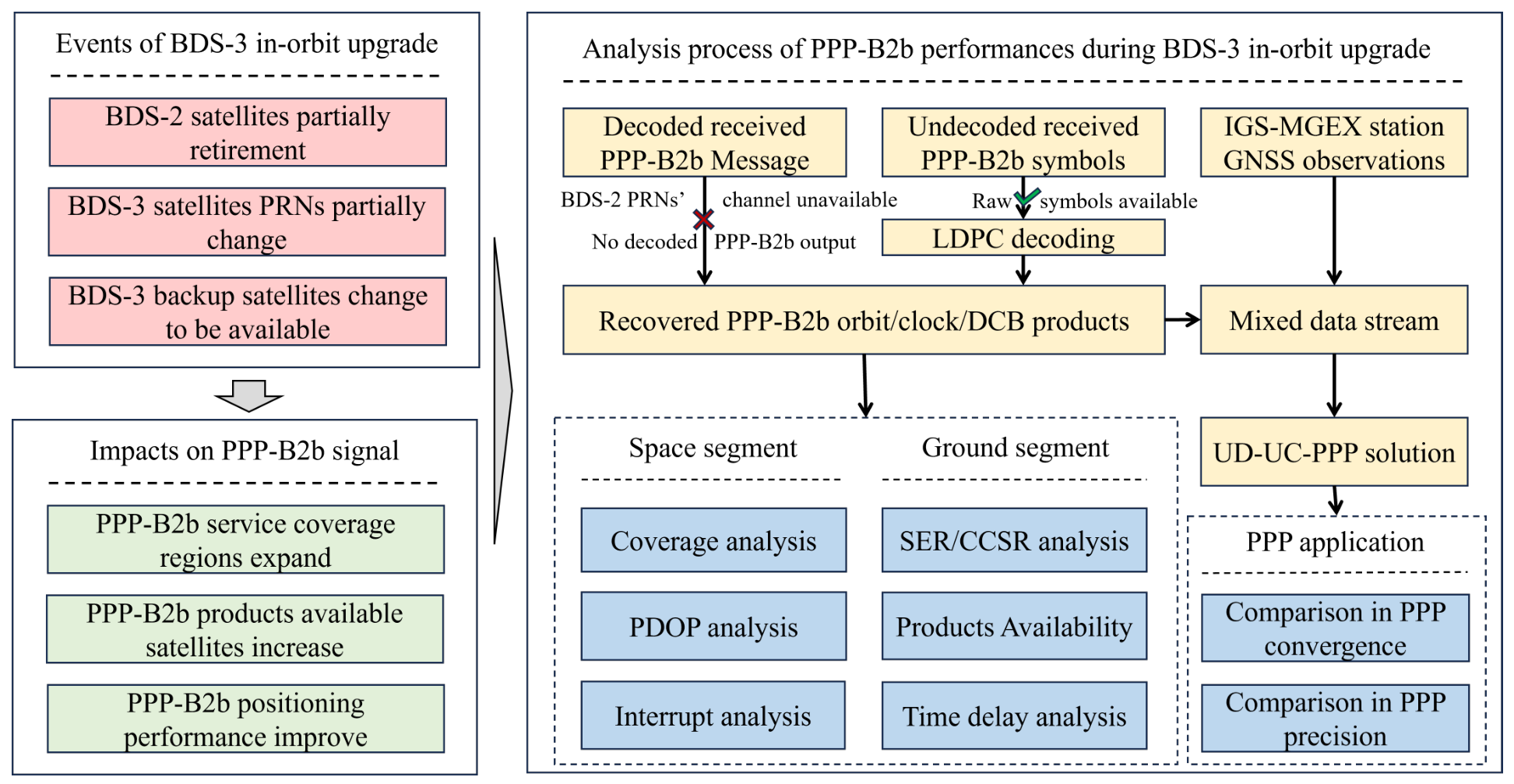
In order to analyze the impacts of the above situations on the performance of PPP-B2b products, this paper designs a series of comprehensive analyses from three aspects: space segment broadcast, ground reception availability and PPP positioning precision. Firstly, to address the problem that some commercial receivers shield the B2b receiving channel of BDS-2 satellite, which leads to the failure of PPP-B2b message output after the BDS-3 GEO on-orbit upgrade, LDPC decoding is performed on the symbol sequences before the original channel decoding to recover the PPP-B2b message. Based on the recovered PPP-B2b products, the service coverage, service recovery delay and average Position Dilution of Precision (PDOP) are analyzed in the space segment. Then, the symbol sequences broadcast by the satellite are inverted by LDPC encoding at the ground reception segment; and the symbol error rate (SER), the completely correct symbol rate (CCSR), and the IGSO/MEO satellites products’ recovery delay and product satellite–ground link delay are analyzed. Finally, based on the observations of IGS Asia-Pacific regional stations, static UD-UC-PPP tests are conducted to evaluate the performance of positioning during the upgrade. The above impacts and analysis design are illustrated in Figure 2.

3. Results

In this section, LDPC decoding and PPP-B2b message recovery are carried out based on the original navigation message channel coding data of the BDS-3 B2b signal recorded by a commercial receiver for one month in April 2026. The availability and coverage of PPP-B2b service during BeiDou in-orbit upgrade and maintenance are analyzed from two perspectives of space segment broadcast and ground receiving. Then, the single-day static PPP-B2b solution of IGS-MGEX stations in the Asia-Pacific region is carried out, and the accuracy change results during upgrade and maintenance are given.

3.1. Analysis of Space-Segment PPP-B2b Broadcast Coverage and Availability

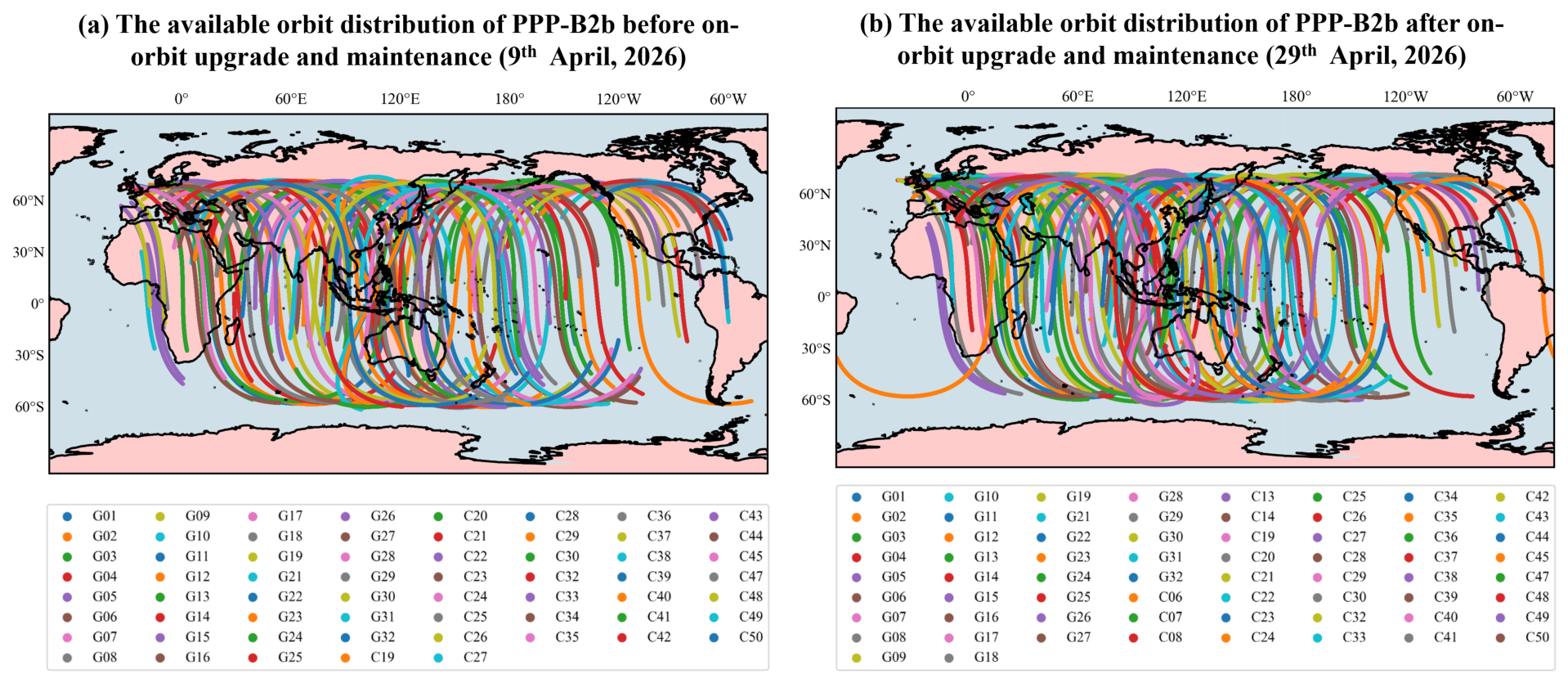
According to the advisory notice to BDS users issued by the BeiDou Navigation Satellite System (http://en.beidou.gov.cn/WHATSNEWS/202603/t20260326_29267.html, accessed on 7 July 2026), the April 2026 in-orbit upgrade campaign consisted of three main phases: a preparation phase from 31 March to 10 April 2026, during which five BDS-3 backup satellites were changed to be available for service; a test upgrade phase on 10 April, during which IGSO-01 was upgraded; and an intensive upgrade phase from 15 to 21 April, during which the remaining satellites were upgraded. To investigate the impact of the BDS in-orbit upgrade on PPP-B2b service performance, one month of continuous raw channel-coded navigation-message data from the BDS-3 B2b signal was collected using a commercial receiver at a reference station established in the Wuhan–Xianning region. The PPP-B2b correction messages were decoded and parsed using the procedure described in Section 2.1. Figure 3 shows the orbital distributions of satellites with available PPP-B2b corrections before the upgrade on 9 April and after its completion on 29 April.
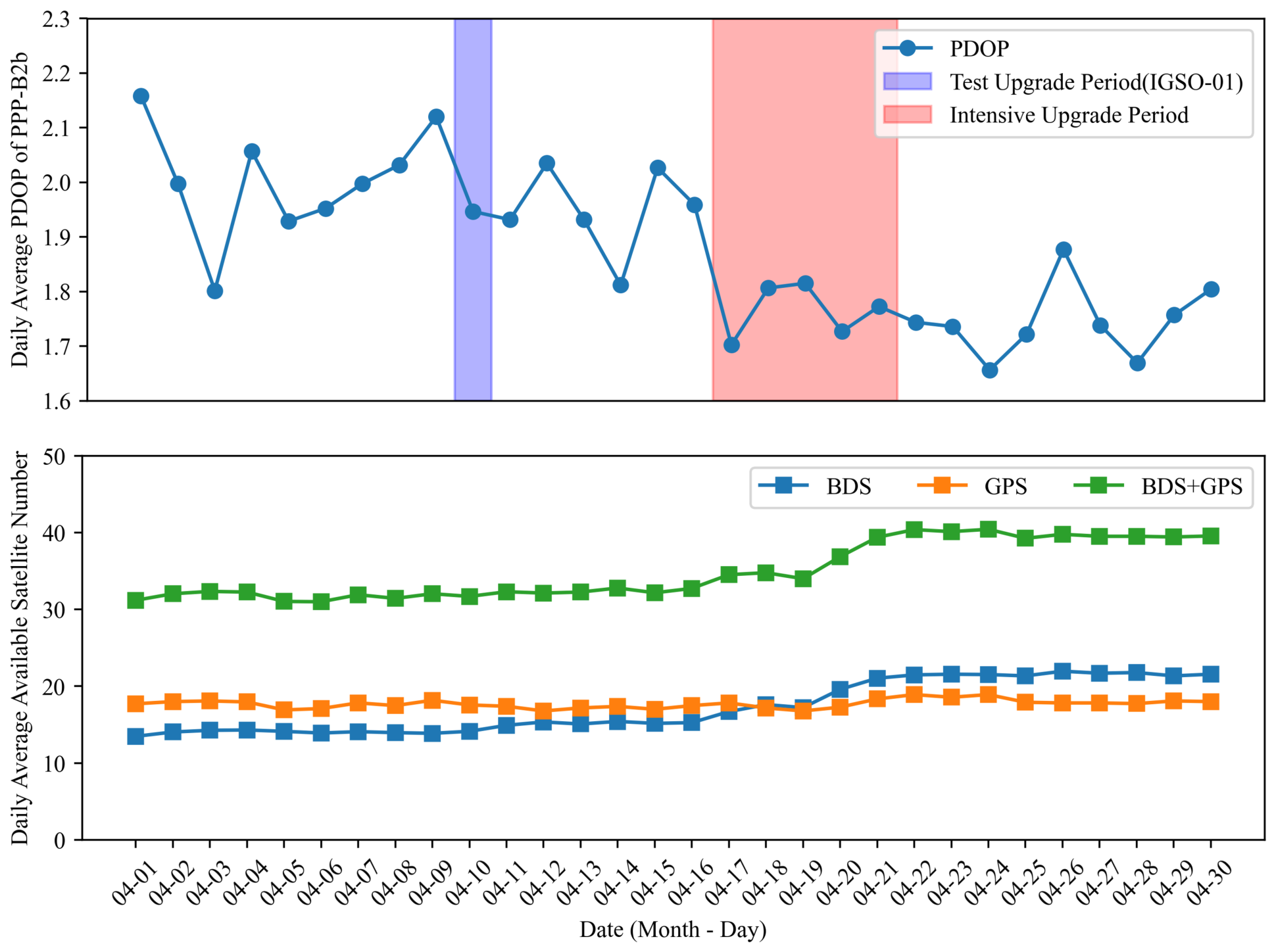
The comparison in Figure 3 shows that the spatial coverage of satellites with available PPP-B2b corrections improved after the BDS in-orbit upgrade. To further quantify the overall effects of the constellation reconfiguration, Figure 4 presents the daily mean number of satellites with available PPP-B2b corrections and the corresponding position dilution of precision (PDOP) during the upgrade period.
As shown in Figure 4, before the intensive upgrade phase, the number of BDS satellites with available PPP-B2b corrections was slightly lower than the corresponding number of GPS satellites. Following completion of the intensive upgrade, the number of available BDS satellites increased, and the satellite geometry within the service region improved. The BDS-only PDOP decreased from 1.99 to 1.74, representing an average reduction of 12.5% relative to the pre-upgrade level. It should be noted that most BDS-2 satellites were decommissioned during the upgrade, thereby reducing, to some extent, the number of satellites available to users of relative-positioning and standard-precision positioning services. However, for the BDS component, PPP-B2b corrections have been provided only for BDS-3 satellites since the service was introduced. In addition, five BDS-3 backup satellites were declared available during the preparation phase, and their precise correction products were directly updated as part of the upgrade. Consequently, the daily mean number of BDS satellites with available PPP-B2b corrections increased substantially from 14.1 to 21.5, corresponding to an increase of 52.4% relative to the pre-upgrade level.
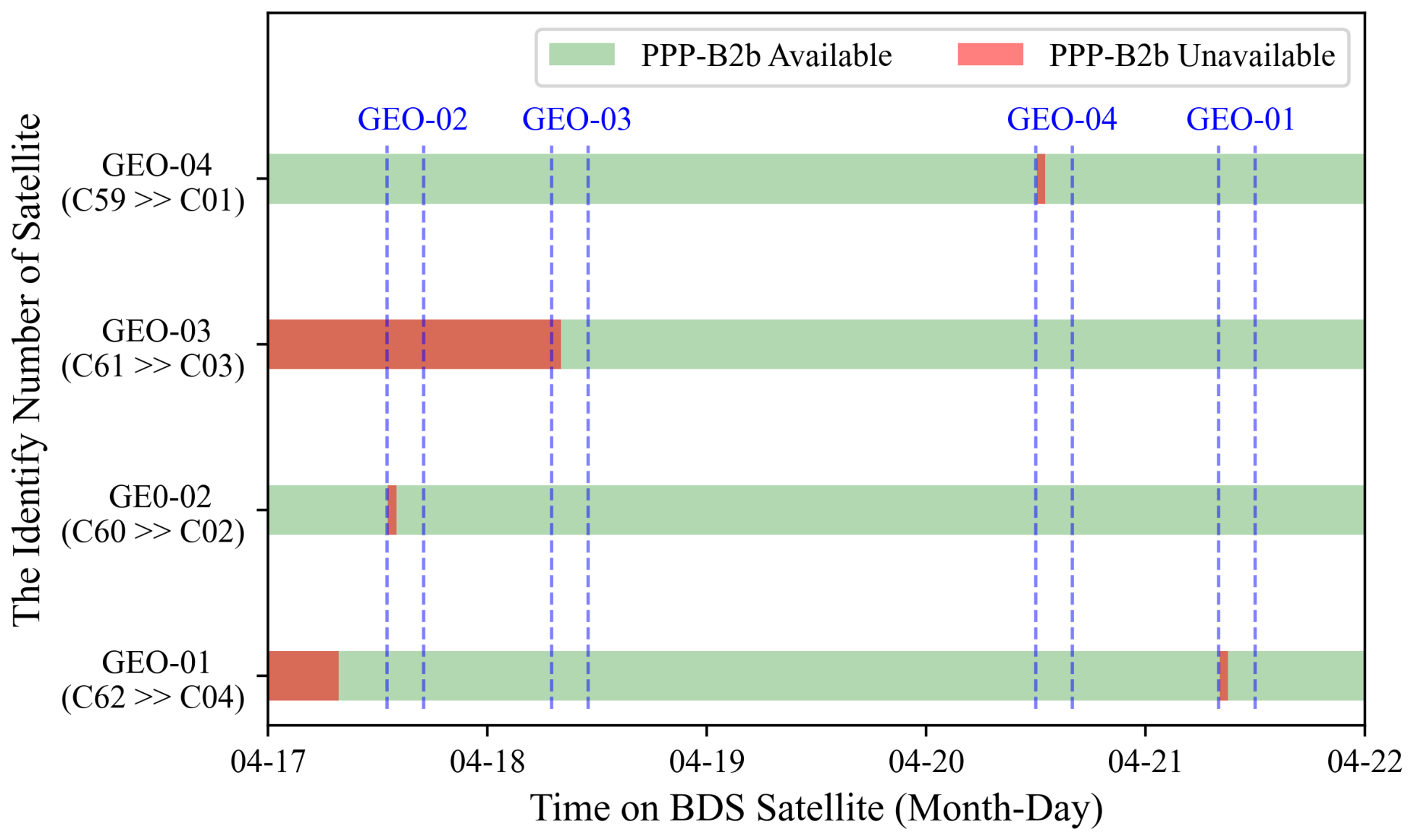
To ensure stable service coverage over a wider area, PPP-B2b corrections are broadcast through the space segment by BDS-3 geostationary Earth orbit (GEO) satellites, including GEO-02, formerly designated C60; GEO-03, formerly designated C61 (which was always in test mode before the upgrade period); GEO-04, formerly designated C59; and GEO-01, formerly designated C62. During the upgrade, the original BDS-2 GEO satellites were decommissioned, and the pseudo-random noise (PRN) codes of the BDS-3 GEO satellites were reassigned to PRNs previously allocated to the BDS-2 satellites. This reassignment caused short-term interruptions in PPP-B2b broadcasting from individual GEO satellites. Figure 5 shows the temporal variation in the availability of PPP-B2b correction messages broadcast by each GEO satellite during the upgrade. The exact upgrading times are obtained by IGS post-broadcast ephemeris products (ftp://igs.gnsswhu.cn/pub/gps/data/daily/2026/100/26p/, accessed on 7 July 2026). The exact times of PPP-B2b recovery of each GEO satellite are obtained by the PPP-B2b messages.
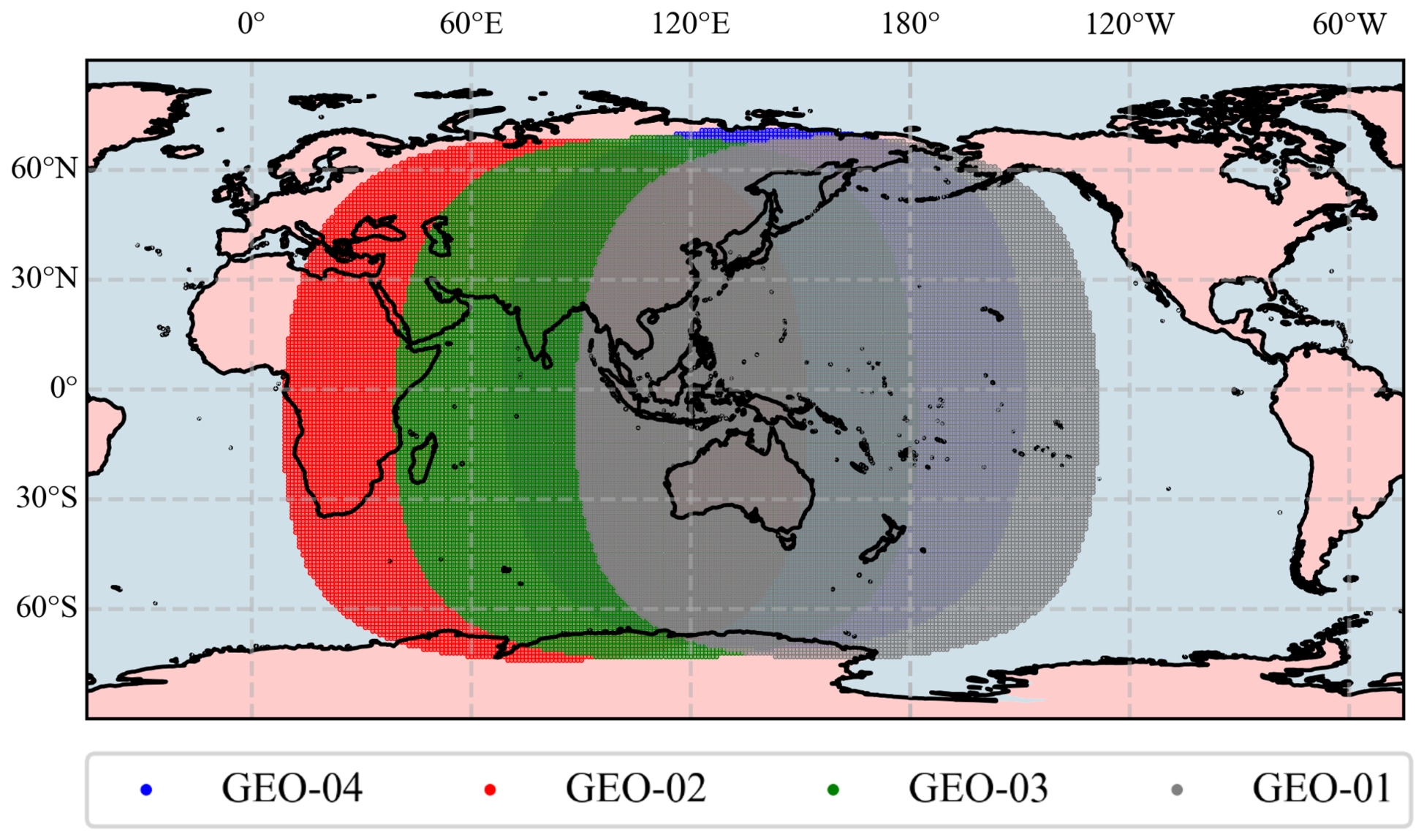
As shown in Figure 5, GEO-02 was the first satellite to undergo the upgrade. Before the GEO-02 upgrade began, PPP-B2b broadcasting from GEO-01 transitioned from test status to available status. PPP-B2b broadcasting from GEO-03 remained in test status before the upgrade and became available within approximately one hour after the upgrade began. All four BDS-3 GEO satellites completed the PRN switchover and resumed PPP-B2b message broadcasting approximately one hour after the start of their respective upgrades. The recovery times ranged from 3204 to 3614 s. Throughout the upgrade window, at least two GEO satellites were broadcasting PPP-B2b correction messages at any given time, thereby minimizing the reduction in service coverage caused by the upgrade. Using an elevation cutoff angle of 10°, Figure 6 shows the PPP-B2b service coverage achievable from each GEO satellite during the upgrade.
Figure 5 and Figure 6 jointly show that, before the BDS in-orbit upgrade and maintenance activities, PPP-B2b correction messages were available only from GEO-02 and GEO-04. Nevertheless, because of their suitable orbital positions, these two satellites covered most of the land and maritime areas in the Asia-Pacific region. After the GEO-02 upgrade began, there was a one-hour period during which only GEO-01 and GEO-04 continuously broadcast PPP-B2b correction messages. During this period, service on the western side of the Asia-Pacific region was interrupted, and the service boundary contracted from central Africa to the Indian subcontinent, whereas service on the eastern side of the Asia-Pacific region remained unaffected. In other words, at least two GEO satellites were broadcasting PPP-B2b correction messages at any given time throughout the BDS in-orbit upgrade. After the upgrade was completed, all four in-orbit GEO satellites provided PPP-B2b service. Compared with the pre-upgrade configuration, service coverage over the eastern Pacific was expanded, thereby providing more stable correction broadcasts for open-ocean users.

3.2. Ground-User Reception Performance and Availability of PPP-B2b Correction Messages

PPP-B2b correction messages are modulated using BPSK or TBD modulation and protected against transmission errors using a non-binary low-density parity-check (LDPC) code over GF(64). The original 486-bit message is encoded into 972 message symbols. Together with a 16-symbol synchronization header, a 6-symbol pseudo-random noise (PRN) field, and a 6-symbol reserved field, these symbols constitute a basic frame of 1000 symbols.
At present, major receiver manufacturers generally adopt proprietary strategies and protocols for the reception, recording, and output of PPP-B2b correction messages. These strategies can be broadly classified into two categories: (1) outputting PPP-B2b correction messages after LDPC decoding and (2) directly outputting the undecoded raw symbol sequences of PPP-B2b correction messages. The first strategy follows the conventional processing architecture used for navigation-message decoding, in which the computationally intensive and frequently executed channel-decoding process is performed within the receiver channel, and only the decoded messages are output. This strategy substantially reduces the burden associated with data recording, storage, and post-processing.
However, low-cost receivers commonly disable BDS-3 signal reception channels associated with PRN codes previously assigned to BDS-2 satellites. Consequently, after the in-orbit upgrade and PRN reassignment, receivers employing this strategy may no longer be able to output PPP-B2b correction messages. Under the second strategy, the frame-synchronized raw symbol sequences are output directly. Although users must subsequently perform offline LDPC decoding to recover the PPP-B2b correction messages, this strategy is not affected by receiver-channel blocking and therefore enables uninterrupted operation throughout the BDS in-orbit upgrade. Table 1 summarizes the reception situations of PPP-B2b correction messages by three commercial receivers during the upgrade.
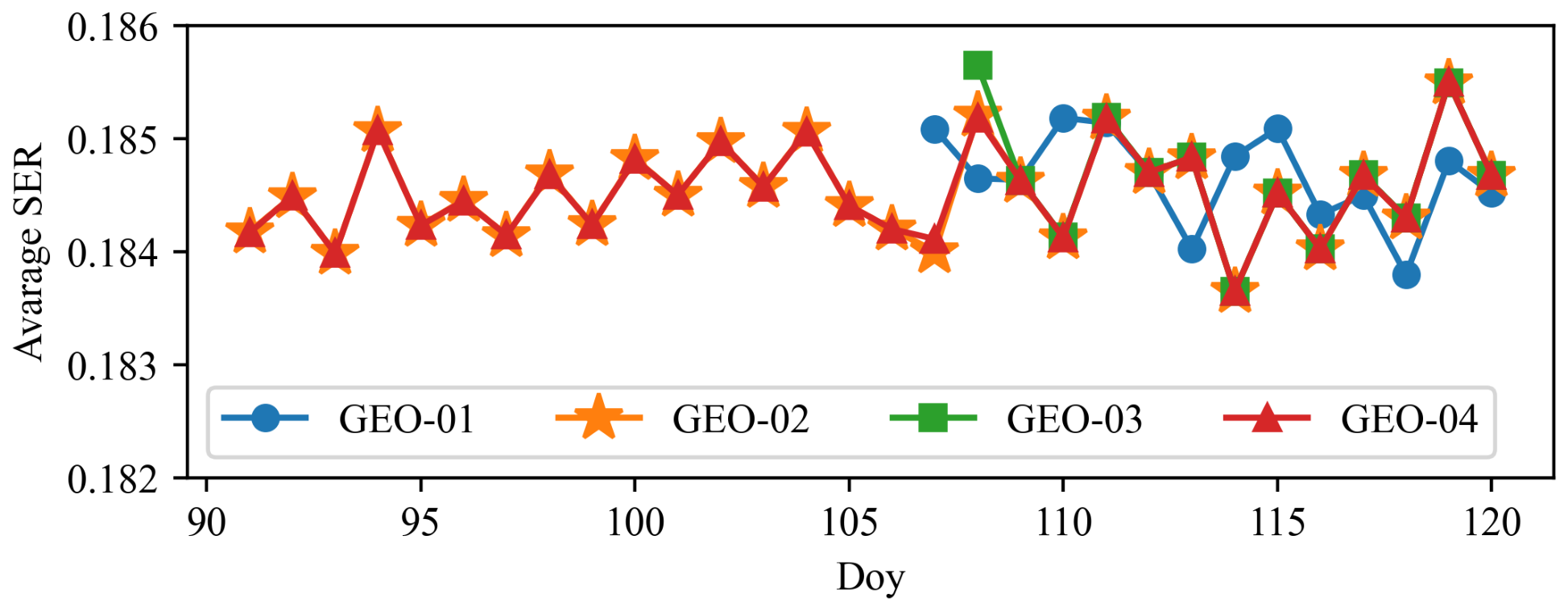
Using a continuously operating reference station established near Wuhan, China, this study collected raw PPP-B2b symbol sequences continuously for one month in April 2026 using a Septentrio PolaRx5 reference-station receiver. The decoded messages were re-encoded using the LDPC scheme to reconstruct the actual symbol sequences transmitted by the satellites. These reconstructed sequences were then compared with the measured symbol sequences received by the receiver. Figure 7 shows the variation in the PPP-B2b symbol error rate (SER) during the BDS in-orbit upgrade.
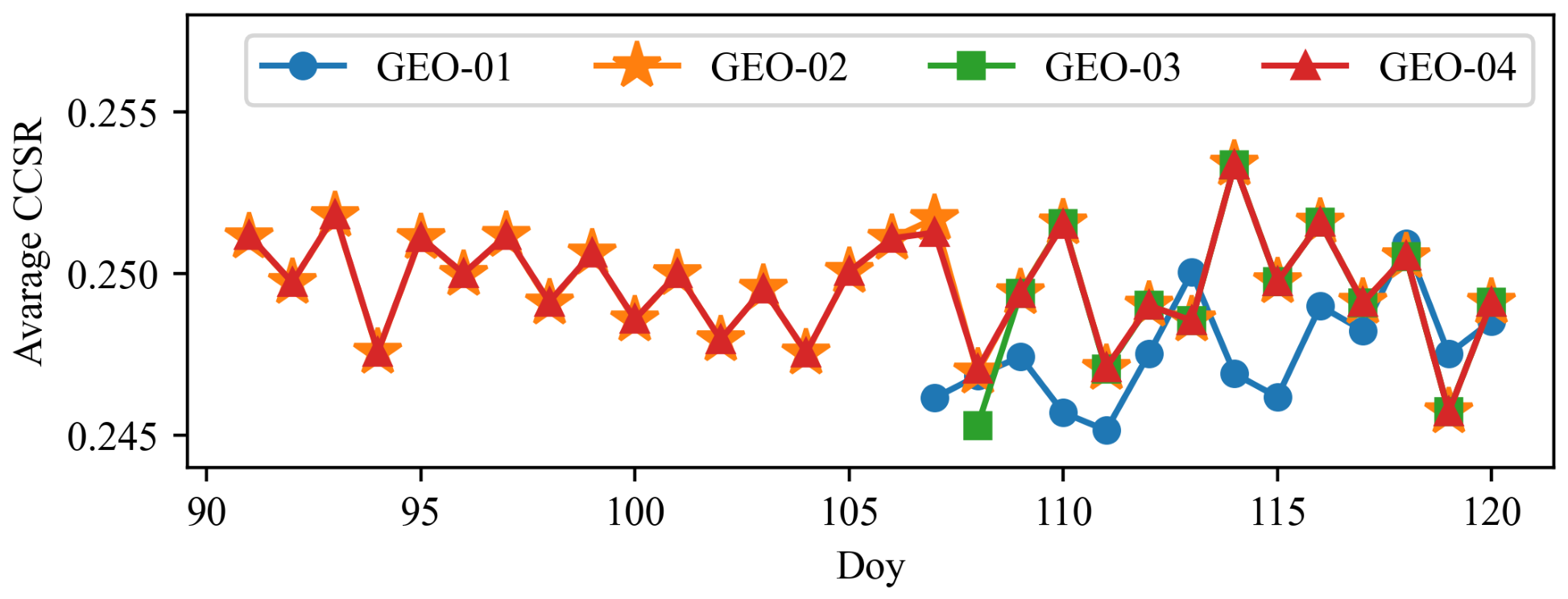
As shown in Figure 7, no appreciable change in the symbol error rate of the received raw symbol sequences was observed before and after the upgrade. The symbol error rate remained approximately 0.18, with no evident differences among the GEO satellites. These results indicate that the in-orbit upgrade itself did not affect the ability of the ground receiver to receive PPP-B2b signals. The proportion of received channel-coded sequences that were completely identical to the corresponding sequences transmitted by the satellites was further calculated, and its variation is shown in Figure 8.
The results similarly indicate that the proportion of signals received without any transmission errors remained essentially unchanged before and after the upgrade, at approximately 0.25. This result further demonstrates the error-correction capability of the LDPC-based transmission scheme for satellite downlink signals. Although only approximately one quarter of the received symbol sequences are aligned to the sequences transmitted by the satellites, the correct PPP-B2b correction messages could still be fully recovered through LDPC decoding.
In addition to temporary changes in user-side PPP-B2b reception availability caused by the upgrading and maintenance of the GEO broadcasting satellites, the upgrading and PRN reassignment of the IGSO and MEO satellites targeted by the PPP-B2b orbit, clock, and bias corrections may also affect PPP-B2b message availability. Specifically, when an IGSO or MEO satellite enters its upgrade window, the entry corresponding to its original PRN is cleared from the satellite mask contained in the PPP-B2b correction messages. After the upgrade is completed, the mask entry corresponding to the newly assigned PRN is set as available after a certain interval, thereby completing the remapping of the associated precise products. This process introduces a service recovery delay. To quantify this delay, the decoded messages were classified according to satellite and message type. The time at which PPP-B2b service was restored after the completion of each satellite upgrade was then identified, and the corresponding PPP-B2b correction recovery latencies were calculated. The results are presented in Table 2.
As shown in Table 2, among all satellites covered by PPP-B2b products, the products for four satellites became available again within two minutes. The products for another four satellites were recovered within approximately one hour, whereas the remaining three satellites required more than six hours but less than thirteen hours to recover. Further examination of the satellite health-status indicators showed that the upgrade windows of MEO-23 and MEO-25 extended from 22:00 on 18 April to 02:00 on 19 April 2026 and from 23:00 on 19 April to 03:00 on 20 April 2026, respectively. Their relatively long service recovery times may therefore have resulted from the upgrade windows spanning two consecutive days. MEO-26 was the final IGSO/MEO satellite to undergo the upgrade and exhibited a recovery delay of more than 12 h. By this stage, however, a sufficient number of satellites were already available within the system, and the effect of this delay on overall service performance was therefore limited. The mean availability recovery delay was also calculated for all satellites covered by PPP-B2b products. Notably, the two remaining BDS-2 IGSO satellites, IGSO-06 and IGSO-07, had not yet been included in the set of satellites covered by PPP-B2b products. This finding suggests that the service provider continued to generate space-based precise products primarily for BDS-3 IGSO and MEO satellites to ensure the consistency and stability of the service-wide reference conventions, including the DCB datum.
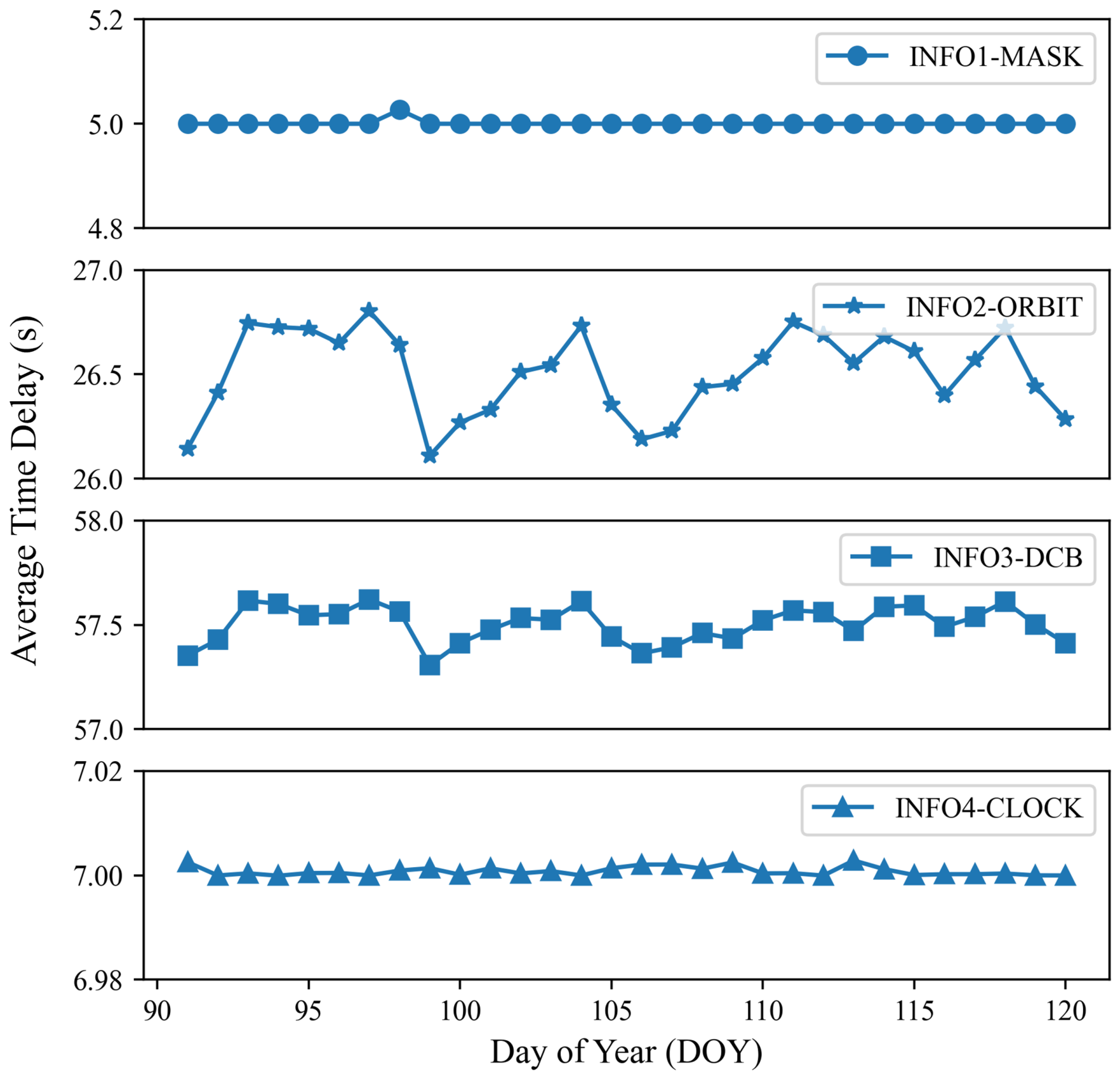
The delays reported in Table 2 were calculated primarily from the on-satellite time tags contained in the PPP-B2b correction messages and therefore mainly characterize the delay with which the ground service provider uploads product information to the broadcasting satellites. For an actual ground user, however, a finite delay occurs between the injection of a broadcast message into a satellite and its reception by the user. An excessive delay could result in a mismatch between the received corrections and the corrections applicable at the actual reception epoch, potentially leading to PPP positioning failure. Because the signal propagation time from a GEO satellite to a ground receiver is less than 1 s, the difference between the receiver timestamp and the onboard time tag contained in a PPP-B2b message can be used to approximately characterize changes in the message-delivery delay. Figure 9 shows the daily mean differences between the reception timestamps and onboard time tags for the four types of PPP-B2b correction messages: satellite mask, orbit correction, DCB, and clock correction.
As shown in Figure 9, no appreciable change in the daily mean delay of any message type was observed before and after the BDS upgrade. The delays of the satellite-mask, orbit-correction, DCB, and clock-correction messages remained approximately 5.0, 26.5, 57.5, and 7.0 s, respectively, with variations of less than 1.0 s. The maximum daily mean delays were further compared with the update intervals and validity periods specified for the four message types in the BDS Interface Control Document (ICD), as summarized in Table 3.
The results show that, both before and after the BDS in-orbit upgrade, the reception delays of INFO 1, INFO 2 and INFO 3 remained shorter than their update intervals. Therefore, ground receivers were able to obtain valid PPP-B2b mask, orbit and DCB correction messages within the prescribed validity periods. However, the reception delay of INFO 4 is about 1 s longer than the update interval, which does not affect users with sampling interval greater than or equal to 1 s, but it will affect the observed value of the 1 s interval between the last second of the first message validity period and the first second of the next message validity period. Future research should pay more attention to the impact of this problem on high-frequency users. More detailed positioning experiments are presented in Section 3.3.

3.3. Analysis of the Precision Change of PPP-B2b Single-Day Static Solution in the Asia-Pacific Region

Section 3.1 and Section 3.2 analyze the coverage, overall performance improvement and user availability of PPP-B2b during the in-orbit upgrade and maintenance of BeiDou (April, 2026) from the perspectives of on-board broadcasting and ground reception. On this basis, this section uses PPP-B2b products to perform PPP calculations on a total of eight continuously operating static stations in the IGS Asia-Pacific region, and analyzes the impact of BeiDou upgrade maintenance on the actual positioning performance of the service area.
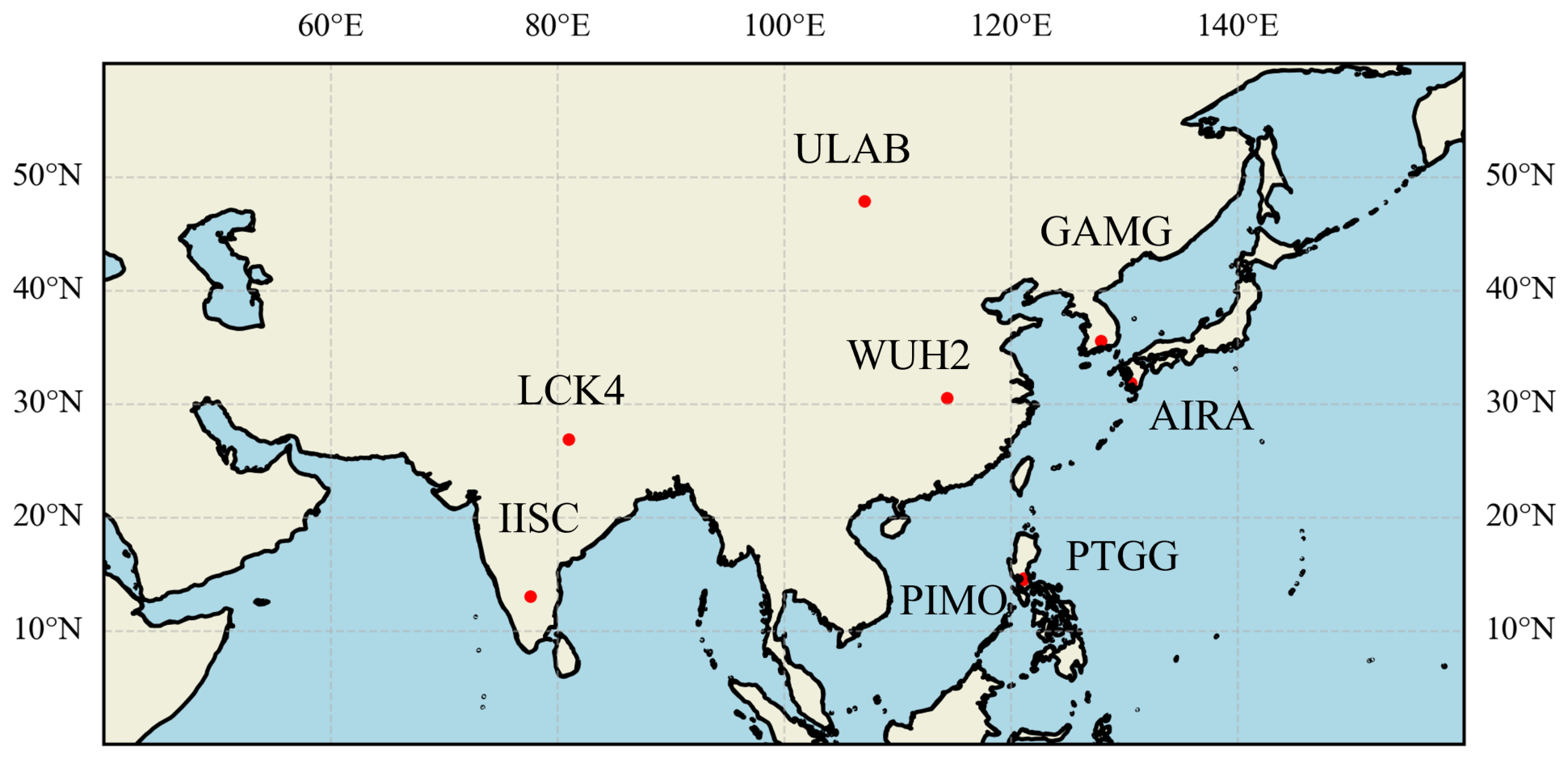
Figure 10 shows the geographical distribution of the selected stations. Considering the coverage fluctuation of PPP-B2b during the in-orbit upgrade and maintenance of BeiDou, the selected stations in this section are located in the minimum service coverage shown in Figure 6, that is, the reachable range of GEO-01 and GEO-04.
In order to evaluate the impact of BDS in-orbit upgrade and maintenance on the positioning performance of PPP-B2b service in the whole month of April 2026, this study conducted static day-solution tests based on the PPP-B2b orbit, clock error and DCB products on the above selected IGS Asia-Pacific regional stations. The static PPP solution is performed for one month continuously, and the PPP engine is reset every 24 h. The convergence threshold is that the horizontal positioning error of 10 consecutive epochs is less than 10 cm, and the vertical positioning error is less than 20 cm. The convergence time and the precision after convergence are counted. Other specific settings of PPP are shown in Table 4.
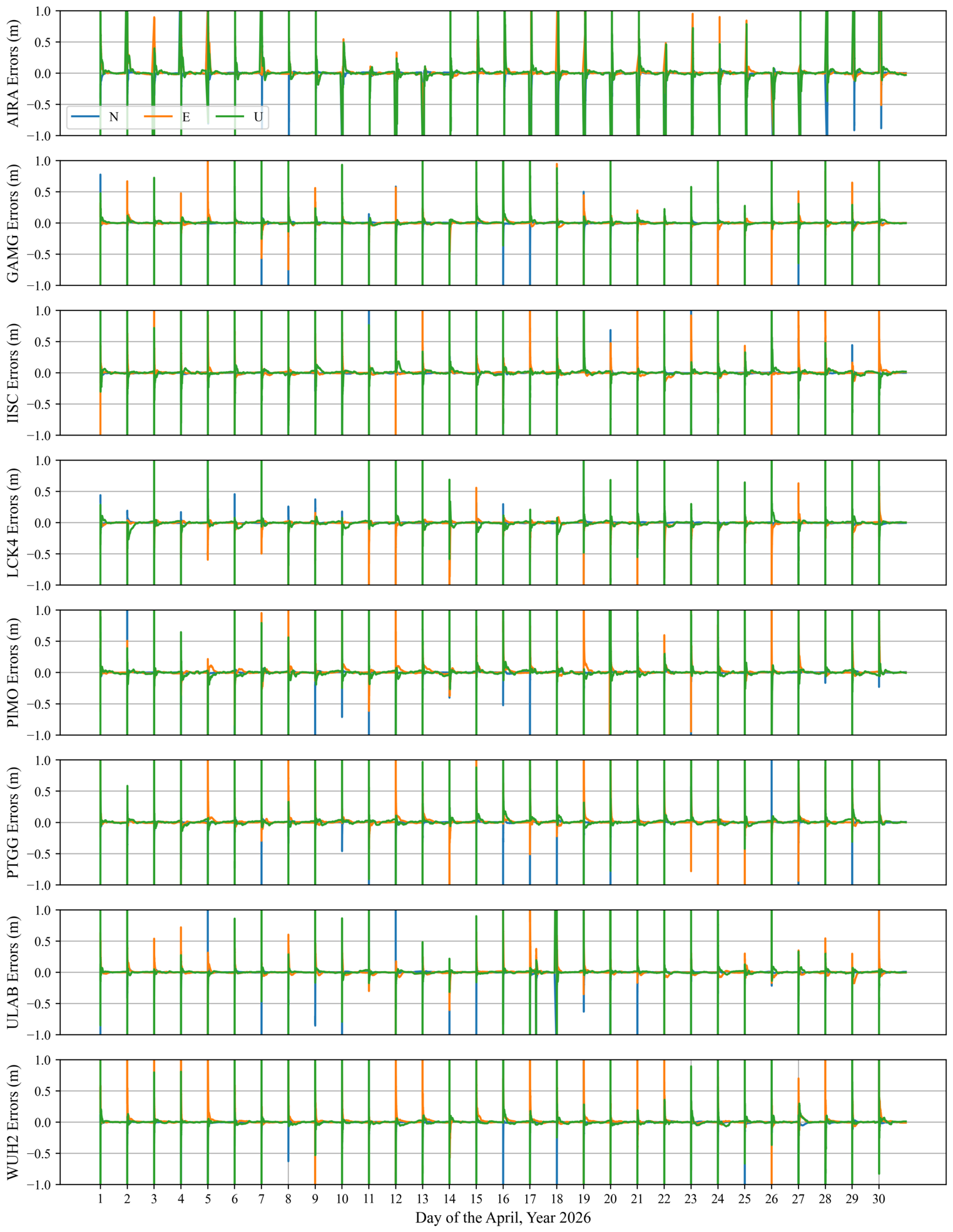
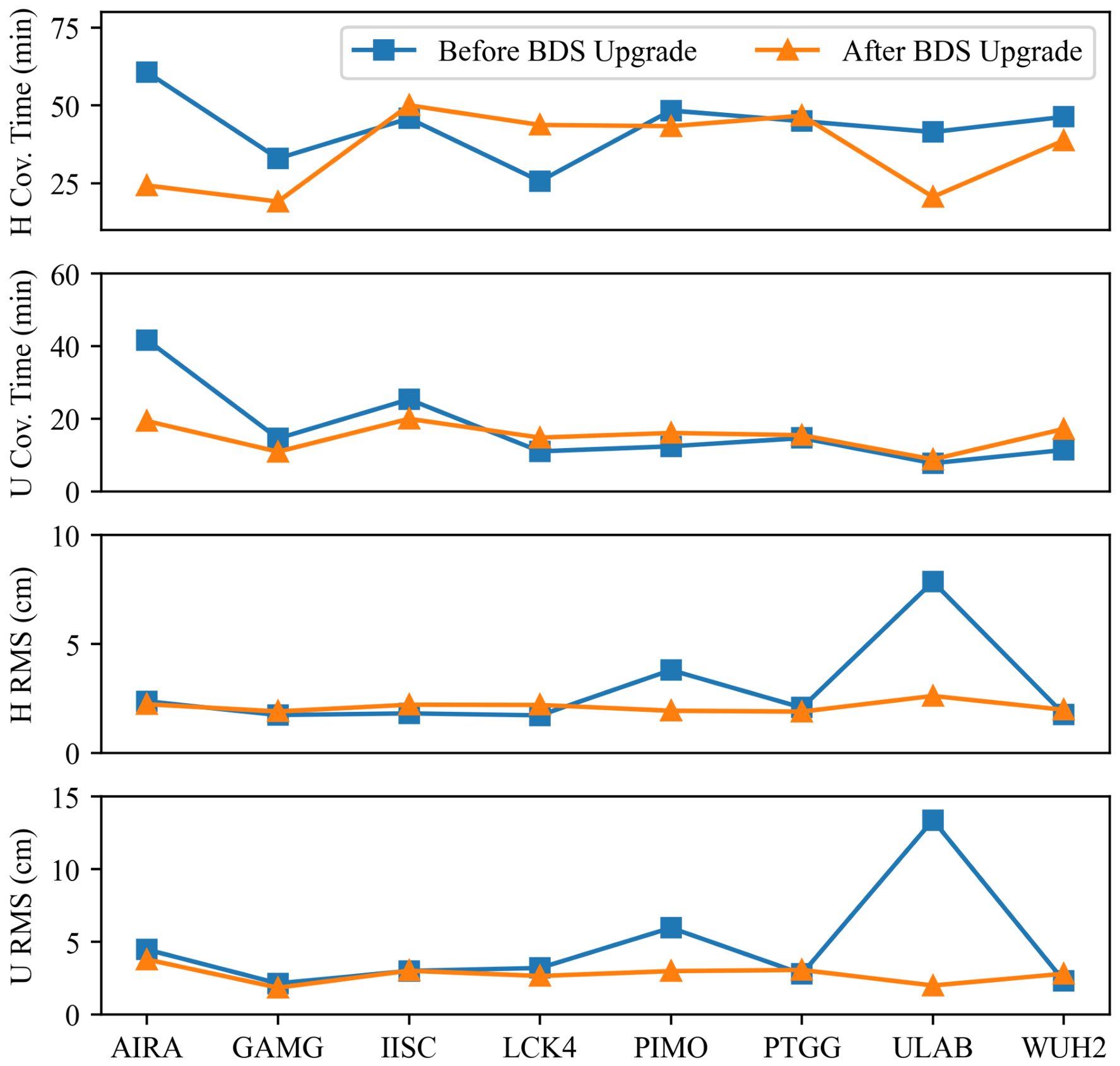
Figure 11 shows all the positioning error sequences of the selected stations. The true value of selected stations’ positions are given by the IGS daily solution files (in SNX file format, accessed at ftp://igs.gnsswhu.cn/pub/gps/products/, accessed on 7 July 2026). Figure 12 shows the comparison of the horizontal and vertical convergence epochs and positioning accuracy of each station before and after the in-orbit upgrade.
The results show that before the end of the BDS upgrade (1 April to 21 April), the average convergence time of all stations was 43.27 min, and after the upgrade, it was shortened to 35.83 min, which was 17.2 % lower than that before the upgrade. The average vertical convergence time was shortened from 17.38 min to 15.35 min, which was 11.68 % lower than that before upgrading. The average positioning accuracy is reduced from 2.90 cm to 2.12 cm, which is 26.9 % lower than that before upgrading. The average vertical positioning accuracy is reduced from 4.66 cm to 2.77 cm, which is 40.5 % lower than that before the upgrade. This shows that, through the BDS in-orbit upgrade, five BDS three-generation backup satellites enter the PPP-B2b product sequence, which not only reduces the PDOP value in the service area, but also improves the PPP-B2b basic precise point positioning performance to a certain extent.

4. Discussion

The results in this paper indicate that the BDS-3 in-orbit upgrade introduced temporary disturbances to PPP-B2b service continuity, but the overall service remained robust during the reconfiguration process. Compared with previous studies that mainly evaluated PPP-B2b under normal operating conditions or short-term interruptions, this study focuses on system behavior during a large-scale constellation adjustment. The findings suggest that service redundancy among GEO satellites and the reconstruction of the correction-satellite set can effectively mitigate the impact of individual satellite upgrades. Meanwhile, the stability of the received raw symbol sequences indicates that the main challenges during the upgrade were related more to service reconfiguration and receiver compatibility than to degradation of the satellite-to-ground transmission link. This also highlights the importance of receiver adaptability when PRN assignments or satellite configurations are changed.
Several limitations should be considered. The ground-reception analysis was based on observations from a single reference station, while the positioning tests mainly considered static stations within the Asia-Pacific service region. Therefore, the conclusions may not fully represent users near coverage boundaries or in highly dynamic environments. In addition, the observation period was limited to the upgrade campaign, and short-term variations in satellite geometry, atmospheric conditions, and local environments may also affect the positioning results. Future studies should extend the monitoring period, include more spatially distributed receivers, and further evaluate kinematic and high-rate PPP-B2b applications. Particular attention should also be paid to receiver compatibility and message-latency effects to better assess the long-term robustness of PPP-B2b during future constellation maintenance and reconfiguration.

5. Conclusions

In this study, a series of performance variations of the BDS-3 PPP-B2b service during the April 2026 satellite in-orbit upgrade is investigated from the perspectives of the space segment, ground segment, and PPP positioning performance. Raw channel-coded B2b symbol sequences collected by a commercial receiver were decoded using a non-binary LDPC decoder, enabling the continuous recovery and analysis of PPP-B2b correction messages despite the PRN reassignment and receiver-channel incompatibility encountered during the upgrade. The results provide a comprehensive assessment of the continuity, availability, and positioning benefits of the PPP-B2b service during the unexpected events.
From the space-segment perspective, the in-orbit upgrade temporarily interrupted PPP-B2b broadcasting from an individual GEO satellite because of PRN reassignment. Nevertheless, at least two GEO satellites continuously transmitted valid correction messages throughout the upgrade, thereby maintaining the basic service capability over most of the Asia-Pacific region. The PPP-B2b broadcasting function of each upgraded GEO satellite was generally restored within approximately one hour, with recovery times ranging from 3204 to 3614 s. After completion of the upgrade, all four GEO satellites provided PPP-B2b services, and the coverage was extended toward the eastern Pacific, improving the broadcast redundancy and service availability for maritime users. Meanwhile, the inclusion of five BDS-3 backup satellites increased the daily mean number of BDS satellites with available PPP-B2b corrections from 14.1 to 21.5, corresponding to an increase of 52.4 % . The average BDS-only PDOP decreased from 1.99 to 1.74, representing an improvement of approximately 12.5 % in satellite geometry.
From the ground-segment perspective, the raw-symbol reception quality remained stable during the upgrade. Neither the symbol error rate nor the completely correct symbol rate exhibited an appreciable change before and after PRN reassignment. The mean reception delays of the mask, orbit, DCB, and clock messages remained approximately 5.0, 26.5, 57.5, and 7.0 s, respectively, and were all within their prescribed validity periods. In addition, the recovery delays of PPP-B2b products for upgraded IGSO/MEO satellites varied from several seconds to more than 12 h, although the influence of the longest delays on overall availability was mitigated by the sufficient number of other corrected satellites.
From the PPP positioning perspective, the constellation enhancement and improved satellite geometry produced clear benefits for static PPP-B2b positioning at eight IGS-MGEX stations in the Asia-Pacific region. After the upgrade, the average horizontal convergence time decreased from 43.27 to 35.83 min, while the average vertical convergence time decreased from 17.38 to 15.35 min, corresponding to improvements of 17.2 % and 11.68 % , respectively. The horizontal positioning RMS decreased from 2.90 to 2.12 cm, and the vertical RMS decreased from 4.66 to 2.77 cm, representing accuracy improvements of 26.9 % and 40.5 % , respectively.
In conclusion, this paper comprehensively analyzes the performance of PPP-B2b products during BDS-3 in-orbit upgrade from the perspectives of satellite broadcast strategy inversion and ground user reception and application. The results show that the satellite-based precision products, as one of the basic services of BDS-3, can achieve synchronous adaptation in the planned upgrade and maintenance campaign, and the range and time of negative effects are suppressed to the greatest extent. Future works should be focused on the impacts on GNSS users in special scenarios such as kinematic users and deformation monitoring users. In addition, this upgrade has proved the over-the-air (OTA) capability of the BDS satellites; the corresponding ground response strategy should also be developed in the face of possible upgrade events in the future.

Author Contributions

Conceptualization, Z.Y. (Zeen Yang), W.H. and Z.Y. (Ziyu Yang); methodology, Z.Y. (Zeen Yang); validation, W.H. and Z.Y. (Ziyu Yang); investigation, Z.Y. (Zeen Yang), W.H. and Z.Y. (Ziyu Yang); resources, X.C. and N.B.; writing—original draft preparation, W.H.; writing—review and editing, C.Q. and Z.J.; visualization, Z.J. and C.Q.; supervision, C.Q.; project administration, C.Q.; funding acquisition, C.Q. All authors have read and agreed to the published version of the manuscript.

Funding

This research was supported by the National Natural Science Foundation of China (42301506).

Data Availability Statement

All data in this study are available from the authors for academic purposes on request.

Acknowledgments

The authors would like to thank the support of the International GNSS Service for providing global observations.

Conflicts of Interest

The authors declare no conflicts of interest.

References

  1. Li, X.; Huang, S.; Yuan, Y.; Zhang, K.; Lou, J. Geocenter motions derived from BDS observations: Effects of the solar radiation pressure model and constellation configuration. Remote Sens. 2023, 15, 1243. [Google Scholar] [CrossRef] [Scilit]
  2. Zhou, F.; Dong, D.; Li, W.; Jiang, X.; Wickert, J.; Schuh, H. GAMP: An open-source software of multi-GNSS precise point positioning using undifferenced and uncombined observations. GPS Solut. 2018, 22, 33. [Google Scholar] [CrossRef] [Scilit]
  3. Wang, Y.; Qian, C.; Liu, H. WHU-Smartphone: A Large-Scale Multi-Traffic Scene GNSS Dataset of Android Smartphones and a Low-Cost GNSS Module. IEEE Trans. Intell. Transp. Syst. 2024, 25, 17993–18005. [Google Scholar] [CrossRef] [Scilit]
  4. Wang, P.; Liu, H.; Nie, G.; Yang, Z.; Wu, J.; Qian, C.; Shu, B. Performance evaluation of a real-time high-precision landslide displacement detection algorithm based on GNSS virtual reference station technology. Measurement 2022, 199, 111457. [Google Scholar] [CrossRef] [Scilit]
  5. Chen, K.; Chai, H.; Li, J.; Wei, G.; Lyu, M.; Cui, W.; Shi, C.; Li, L.; Wang, P.; Lu, W.; et al. An overview of GNSS for tsunami early warning: From lithosphere to ionosphere. Sci. China Earth Sci. 2026, 69, 898–912. [Google Scholar] [CrossRef] [Scilit]
  6. Yuan, L.; Li, B.; Miao, W.; Ge, H.; Wu, Z. PPP-B2b-RTK: A PPP-B2b augmentation method by using the SSR corrections from a single reference station. GPS Solut. 2025, 29, 124. [Google Scholar] [CrossRef] [Scilit]
  7. Zheng, K.; Ye, Z.; Zhao, J.; Ma, Q.; Fu, W.; Hu, J.; Liu, K.; Tang, L.; Zhang, X. Real-time PPP with the fusion of Galileo HAS and BDS-3 PPP-B2b. Measurement 2025, 257, 118829. [Google Scholar] [CrossRef] [Scilit]
  8. Geng, T.; Li, Z.; Xie, X.; Liu, W.; Li, Y.; Zhao, Q. Real-time ocean precise point positioning with BDS-3 service signal PPP-B2b. Measurement 2022, 203, 111911. [Google Scholar] [CrossRef] [Scilit]
  9. China Satellite Navigation Office. China Plans to Implement In-Orbit Upgrades of the BeiDou Navigation Satellite System. Available online: http://en.beidou.gov.cn/WHATSNEWS/202603/t20260326_29267.html (accessed on 7 July 2026).
  10. China Satellite Navigation Office. Beidou System User Notice 20260001-0005. Available online: https://www.csno-tarc.cn/notice/noticeDetail?id=998&lang=en (accessed on 7 July 2026).
  11. China Satellite Navigation Office. Constellation State Changes During Beidou System Upgrade. Available online: https://www.csno-tarc.cn/notice/noticeDetail?id=990&lang=en (accessed on 7 July 2026).
  12. Tao, J.; Liu, J.; Hu, Z.; Zhao, Q.; Chen, G.; Ju, B. Initial assessment of the BDS-3 PPP-B2b RTS compared with the CNES RTS. GPS Solut. 2021, 25, 131. [Google Scholar] [CrossRef] [Scilit]
  13. Liu, Y.; Yang, C.; Zhang, M. Comprehensive analyses of PPP-B2b performance in China and surrounding areas. Remote Sens. 2022, 14, 643. [Google Scholar] [CrossRef] [Scilit]
  14. Sun, S.; Wang, M.; Liu, C.; Meng, X.; Ji, R. Long-term performance analysis of BDS-3 precise point positioning (PPP-B2b) service. GPS Solut. 2023, 27, 69. [Google Scholar] [CrossRef] [Scilit]
  15. Yang, H.; Ren, X.; Liu, M.; Zhang, X. Dual-frequency to five-frequency real-time precise point positioning using new BDS-3 PPP-B2b service. Earth Plan. Space 2024, 76, 82. [Google Scholar] [CrossRef] [Scilit]
  16. Tang, J.; Lyu, D.; Zeng, F.; Ge, Y.; Zhang, R. Comprehensive analysis of PPP-B2b service and its impact on BDS-3/GPS real-time PPP time transfer. Remote Sens. 2022, 14, 5366. [Google Scholar] [CrossRef] [Scilit]
  17. Xu, X.; Nie, Z.; Wang, Z.; Wang, B.; Du, Q. Performance assessment of BDS-3 PPP-B2b/INS loosely coupled integration. Remote Sens. 2022, 14, 2957. [Google Scholar] [CrossRef] [Scilit]
  18. Yang, H.; Ji, S.; Weng, D.; Wang, Z.; He, K.; Chen, W. Assessment of the feasibility of PPP-B2b service for real-time coseismic displacement retrieval. Remote Sens. 2021, 13, 5011. [Google Scholar] [CrossRef] [Scilit]
  19. Yang, H.; He, X.; Ferreira, V.; Ji, S.; Xu, Y.; Song, S. Assessment of precipitable water vapor retrieved from precise point positioning with PPP-B2b service. Earth Sci. Inform. 2023, 16, 315–328. [Google Scholar] [CrossRef] [Scilit]
  20. Chen, Y.; Wang, X.; Zhou, K.; Zhang, J.; Qiu, C.; Li, H.; Xin, S. Real-time precise point positioning during outages of the PPP-B2b service. Remote Sens. 2023, 15, 784. [Google Scholar] [CrossRef] [Scilit]
  21. China Satellite Navigation Office. BeiDou Navigation Satellite System Signal in Space Interface Control Document Precise Point Positioning Service Signal PPP-B2b (Version 1.0). Available online: http://www.beidou.gov.cn/xt/gfxz/202008/P020230516574071340728.pdf (accessed on 7 July 2026).
  22. Yang, Y.; Song, L.; Xu, T. Robust estimator for correlated observations based on bifactor equivalent weights. J. Geod. 2002, 76, 353–358. [Google Scholar] [CrossRef] [Scilit]
  23. Wu, J.; Wu, S.; Hajj, G.; Bertiger, W.; Lichten, S. Effects of antenna orientation on GPS carrier phase. Manuscripta Geod. 1993, 18, 91–98. [Google Scholar] [CrossRef] [Scilit]
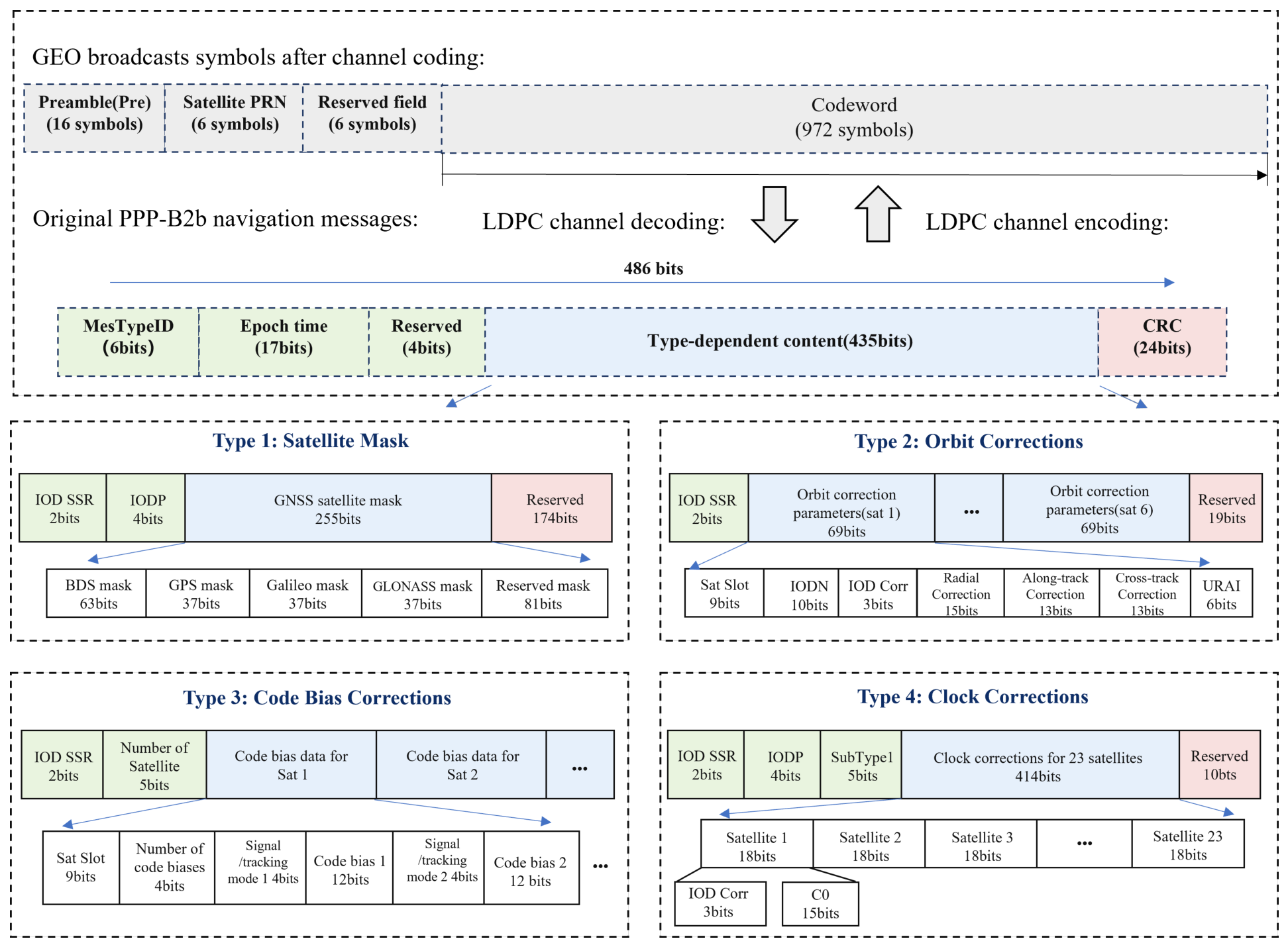
Figure 1. The frame structures of PPP-B2b navigation messages, including the channel coding, orbit, clock, DCB and mask information.
Remotesensing 18 02936 g001
Figure 2. The whole process of analysis of PPP-B2b performance during the BDS in-orbit upgrade.
Remotesensing 18 02936 g002
Figure 3. The orbital distributions of satellites with available PPP-B2b corrections before the upgrade on 9 April and after its completion on 29 April.
Remotesensing 18 02936 g003
Figure 4. Daily average number of satellites with available PPP-B2b corrections and corresponding PDOP during the BDS in-orbit upgrade.
Remotesensing 18 02936 g004
Figure 5. Temporal availability of PPP-B2b correction messages broadcast by the GEO satellites during the in-orbit upgrade. The blue lines show the time periods of each satellite’s upgrade. The specific upgraded satellite number is marked above the blue lines.
Remotesensing 18 02936 g005
Figure 6. Achievable PPP-B2b service coverage of each GEO satellite.
Remotesensing 18 02936 g006
Figure 7. Symbol error rate of raw channel-coded PPP-B2b correction messages received by a commercial receiver during the BDS in-orbit upgrade.
Remotesensing 18 02936 g007
Figure 8. Completely corrected symbol rate (CCSR) of received PPP-B2b channel-coded sequences during the BDS in-orbit upgrade.
Remotesensing 18 02936 g008
Figure 9. Daily average latencies between the reception timestamps and on-satellite time tags of different PPP-B2b message types before and after the BDS in-orbit upgrade.
Remotesensing 18 02936 g009
Figure 10. The distribution of selected test IGS-MGEX stations.
Remotesensing 18 02936 g010
Figure 11. The PPP-B2b position error sequences of selected test IGS-MGEX stations.
Remotesensing 18 02936 g011
Figure 12. The comparison of the horizontal and vertical convergence epochs and positioning accuracy of each station before and after the in-orbit upgrade.
Remotesensing 18 02936 g012
Table 1. Reception strategies of PPP-B2b correction messages by three commercial GNSS receivers.
GNSS ModuleReception StrategyPPP-B2b Message Output
Unicore UM982Strategy 1PPP-B2b message output ceased after the PRN reassignment of GEO-01 and had remained unavailable for three months.
ComNav K803Strategy 1PPP-B2b message output ceased after the PRN reassignment of GEO-01. Output resumed following a firmware update on 30 April, after an interruption of 21 days.
Septentrio PolaRx5Strategy 2Undecoded PPP-B2b symbol sequences were output continuously, with no interruption.
Table 2. Recovery delays of PPP-B2b products following the completion of individual satellite upgrades.
SatellitePRN ReassignmentUpgrade Start Epoch (BDT Second of Day)Upgrade Completion Epoch (BDT Second of Day)Recovery Epochs of the Mask, Orbit, DCB, and Clock Messages (BDT Second of Day)Availability Recovery Delay of PPP-B2b Orbit/Clock Messages (Second)
IGSO-01C38→C0643,18657,58644,014/57,591/57,552/57,5926
IGSO-02C39→C07−1414,386910/17,943/17,904/17,9443558
IGSO-03C40→C0821,58635,98622,462/39,543/39,504/39,5443558
MEO-23C45→C39−72147186−6386/75,543/75,504/29,50068,357
MEO-28C50→C1414,38628,78615,262/32,391/32,352/32,3923606
MEO-27C49→C1328,78643,18629,518/46,791/46,752/46,7923606
MEO-25C47→C11−361410,786−2834/53,991/53,952/53,99243,206
MEO-22C44→C3114,38628,78615,118/28,743/28,752/28,7926
MEO-21C43→C3828,78643,18629,614/43,191/43,152/43,1926
MEO-24C46→C40−361410,786−2/10,845/10,806/10,84660
MEO-26C48→C1214,38628,78615,022/75,543/75,504/75,54446,758
Table 3. Comparison of the update intervals, validity periods, and maximum delays of different PPP-B2b message types.
Message TypeUpdate IntervalValidity PeriodMaximum Delay
INFO148 s96 s5.03 s
INFO248 s96 s26.8 s
INFO348 s86,400 s57.6 s
INFO46 s12 s7.00 s
Table 4. The processing settings of the static UD-UC-PPP solution test.
ItemStrategy
Observation modelUndifferenced and uncombined model
Estimation methodsExtended kalman filter
Weighting schemeIGGIII [22]
Approximate satellite positions and clocksBDS-3 CNAV-1 + GPS LNAV broadcast ephemeris
Precise satellite positions and clocks correctionsBDS-3 PPP-B2b INFO 2 + INFO 4
Receiver positions and clocksEstimation
Signal-specific biasesBDS-3 PPP-B2b INFO 3
ZHDSaastamoinen
ZWDEstimation
Tropospheric mapping functionGMF
IonosphereEstimation
Phase wind-upCorrected by model [23]
Phase center offset (PCO)Corrected with igs20.atx
Phase center variation (PCV)Corrected with igs20.atx
Solid tidesCorrected by IERS 2010
Ocean tidesCorrected by FES2014
Earth rotationCorrected in geometric range
Relativistic effectsCorrected in satellite clock
Stochastic modelElevation dependent model
Elevation cut-off threshold10.0°
Pre-fit exclude threshold30 m
Post-fit exclude threshold4 σ
Max iterative times8
Disclaimer/Publisher’s Note: The statements, opinions and data contained in all publications are solely those of the individual author(s) and contributor(s) and not of MDPI and/or the editor(s). MDPI and/or the editor(s) disclaim responsibility for any injury to people or property resulting from any ideas, methods, instructions or products referred to in the content.