Optimal Formation Flying for Single-Pass Multi-Baseline Across-Track Synthetic Aperture Radar Interferometry
 ,
,  , and
, and
Highlights
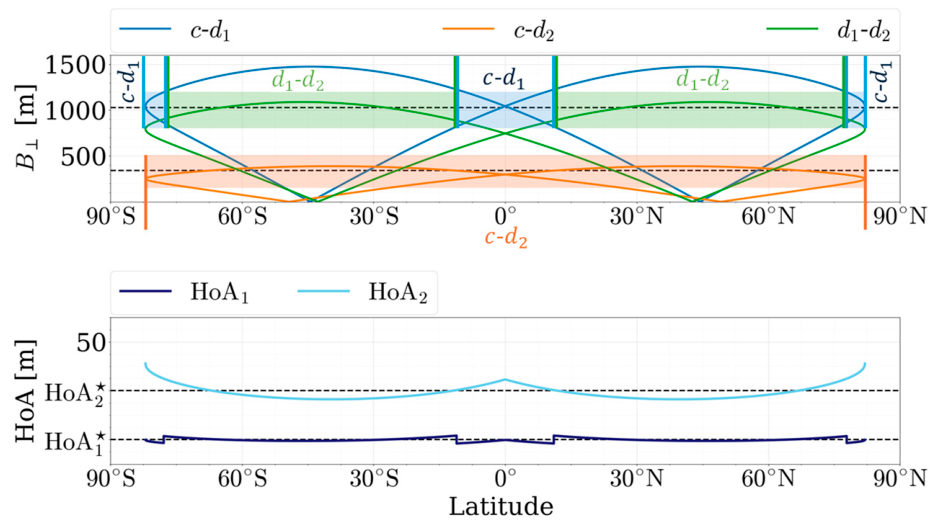
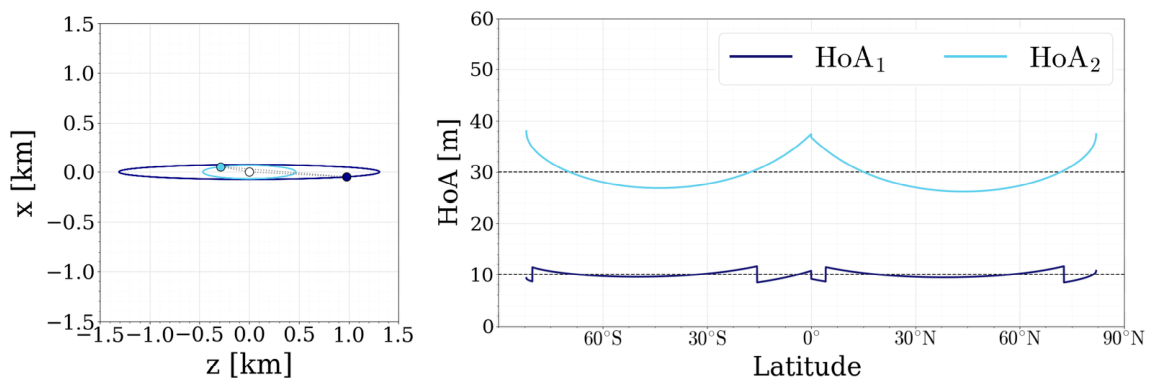
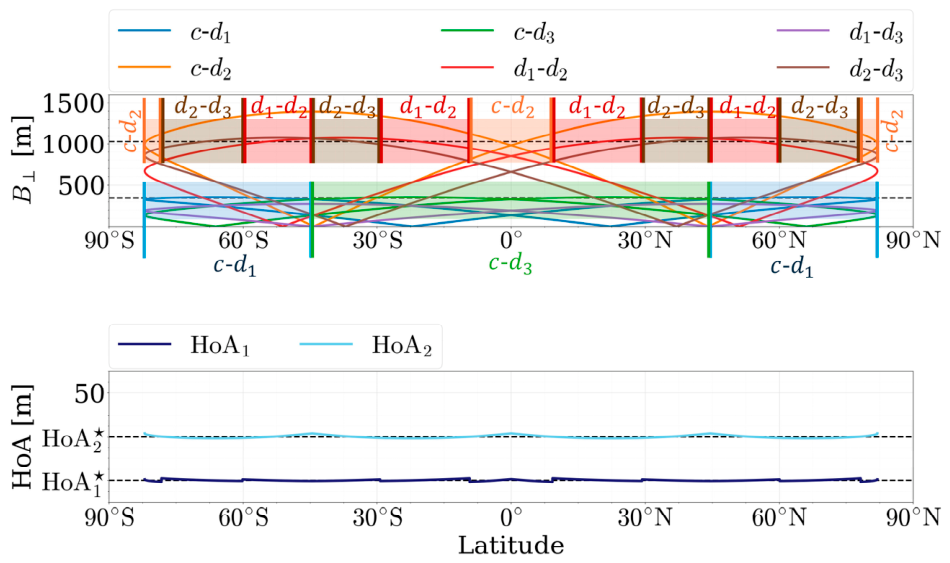
- The proposed approach allows the designing of single-pass interferometric systems with formations of three or more satellites flying with time-variant baselines and achieving two desired heights of ambiguity at all latitudes, so that digital elevation models can be generated globally through multi-baseline single-pass Synthetic Aperture Radar interferometry.
- The solutions are compliant with safety and low propellant consumption requirements, as they leverage nested helix orbits.
- The availability of two heights of ambiguity allows the optimum baseline and height accuracy of the digital elevation model to be reached, while guaranteeing robustness to phase unwrapping errors.
- The proposed configurations enable the design of single-pass interferometric systems with uniform performance of the digital elevation model at all latitudes with only three satellites.
Abstract
1. Introduction
2. Materials and Methods
2.1. Relative Dynamics Framework
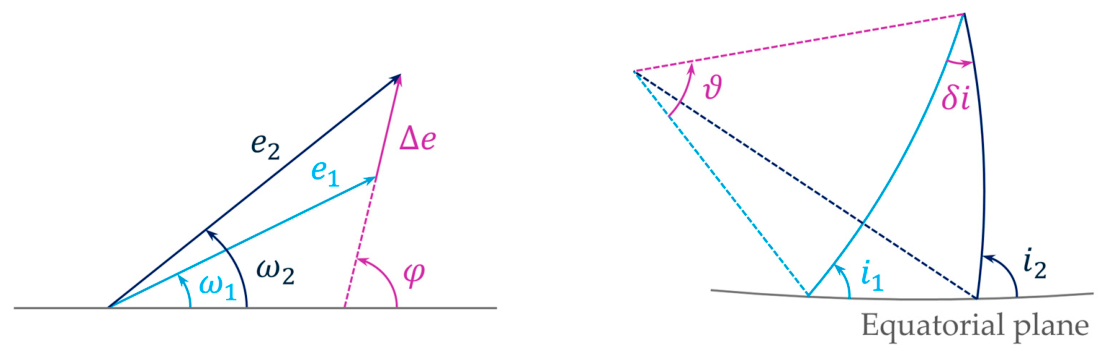
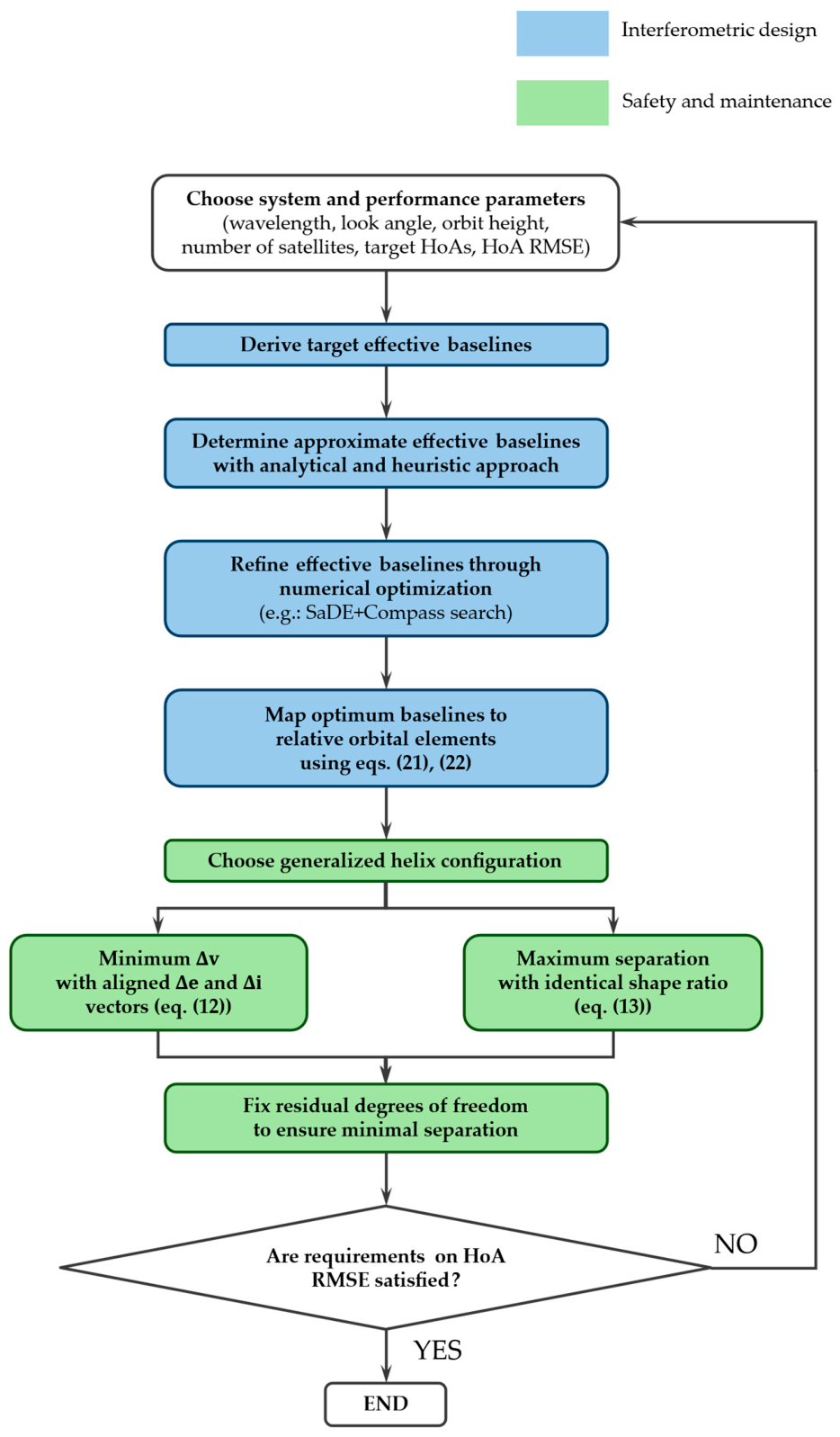
- The parametrization of the kinematics based on the relative orbital elements (ROEs) (Section 2.1.1).
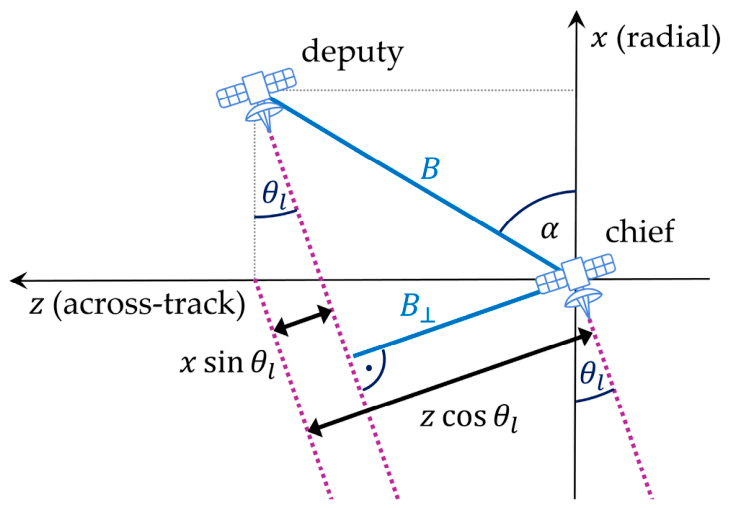
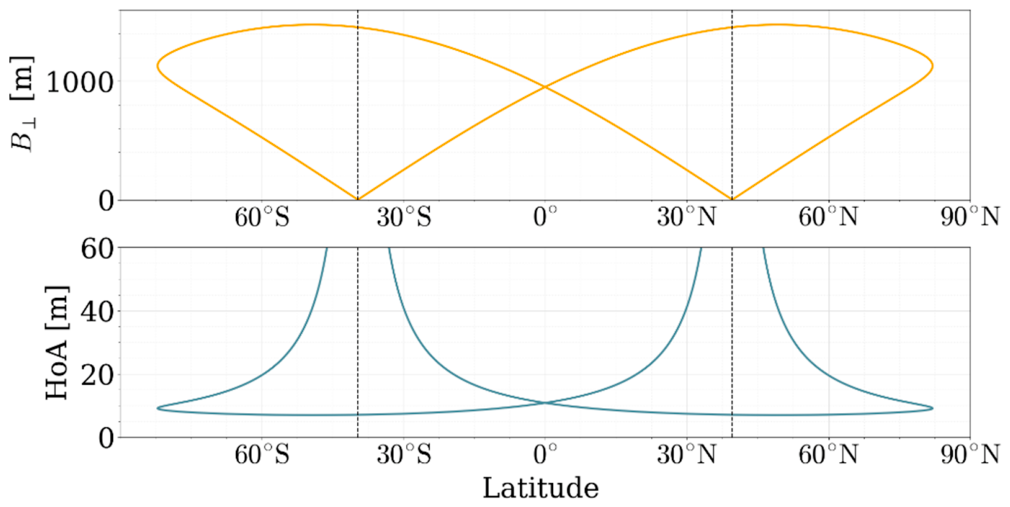
- The parametric expression of the HoA, formulated in the ROE space (Section 2.1.2).
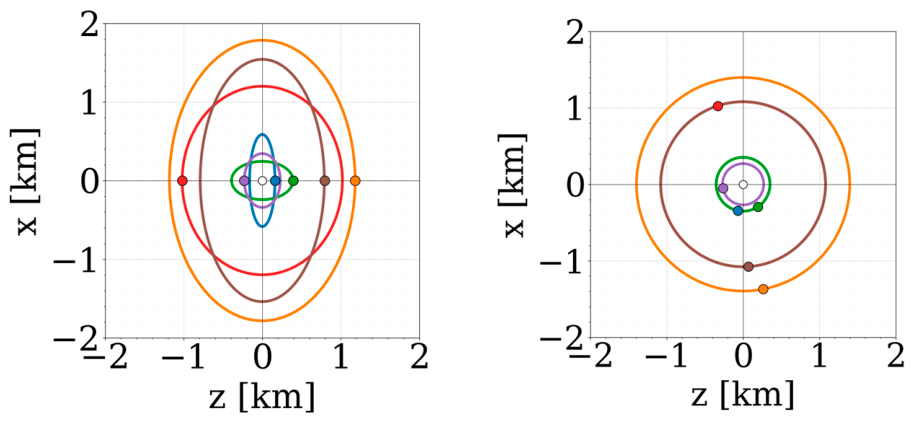
- The characteristics of satellite formations that allow acquisitions without risking a collision, specifically focusing on the helix formation concept adapted to formations of more than two satellites (Section 2.1.3).
2.1.1. ROE Formulation of the Relative Dynamics
- The x-axis points from the center of the Earth to the chief satellite’s position;
- The z-axis points in the direction of the angular momentum of the chief’s orbit;
- The y-axis completes the right-handed system.
2.1.2. Parametric Expression of the HoA
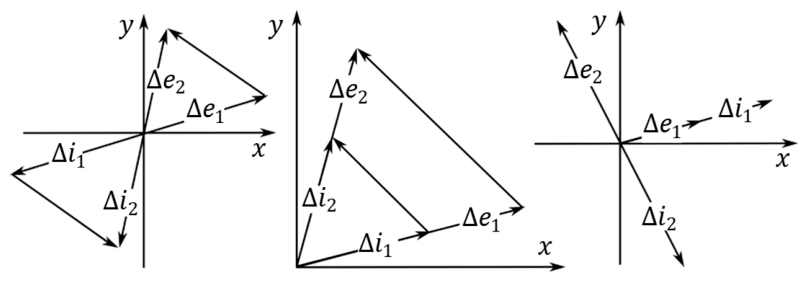
2.1.3. Generalized Helix Formation
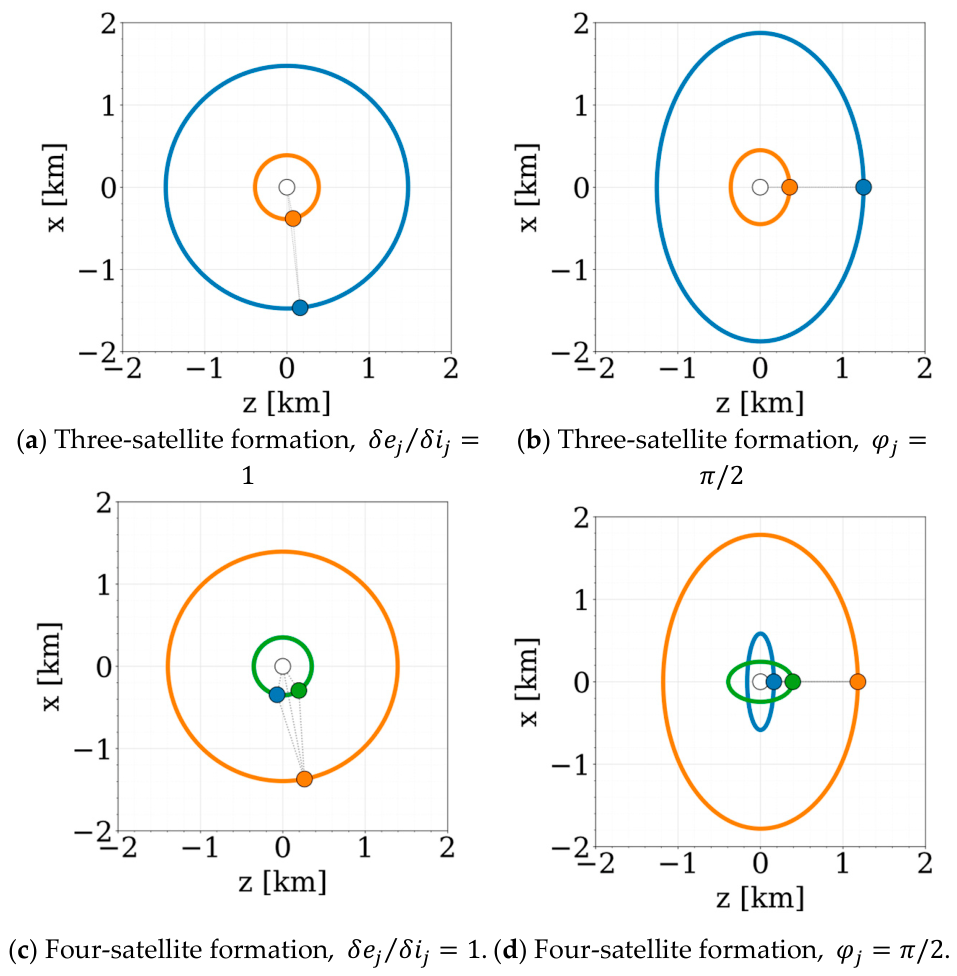
- Common orientation of the eccentricity vectors. All the eccentricity vectors are collinear:
- -
- The magnitudes of the relative eccentricity and inclination for all deputy spacecraft.
- -
- The orientation of the first deputy’s relative eccentricity and inclination.
- -
- The orientation of the other deputies’ relative eccentricity and inclination, which is parallel to the orientation of the first deputy.
- 2.
- Same orbit shape ratio. All deputies have identical ratios between the magnitude of the relative eccentricity and the relative inclination, i.e.,
- -
- The orientations of the relative eccentricity and inclination for all deputy spacecraft.
- -
- The magnitude of the first deputy’s relative eccentricity and inclination.
- -
- The magnitude of the other deputies’ relative eccentricity, whereas that of the relative inclination is fixed by Equation (13).
2.2. Mathematical Formulation of the Optimization Problem
2.2.1. Single-Baseline Problem
2.2.2. Multi-Baseline Problem
2.2.3. Remarks on the Optimization Problem
2.3. Methodologies for the Solution of the Multi-Objective Optimization Problem
2.3.1. Heuristic Approach
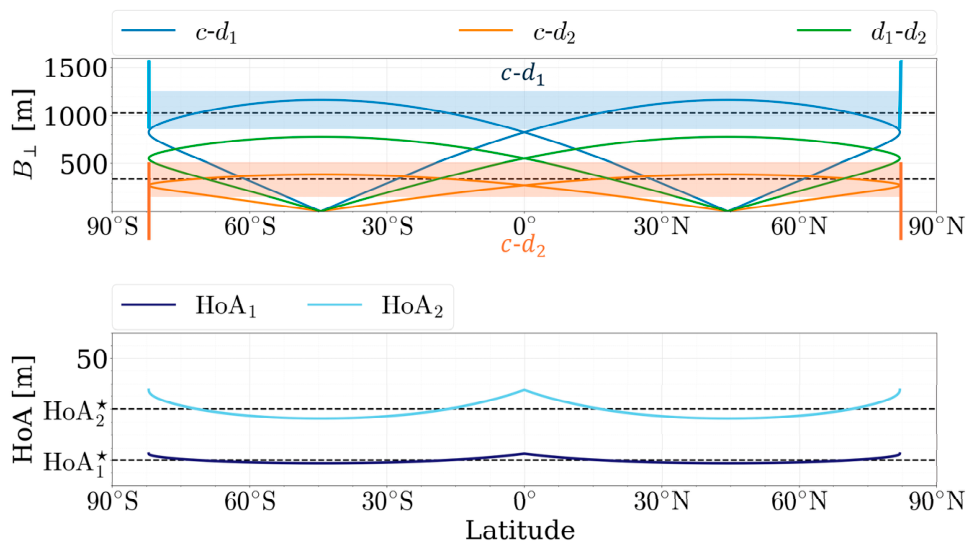
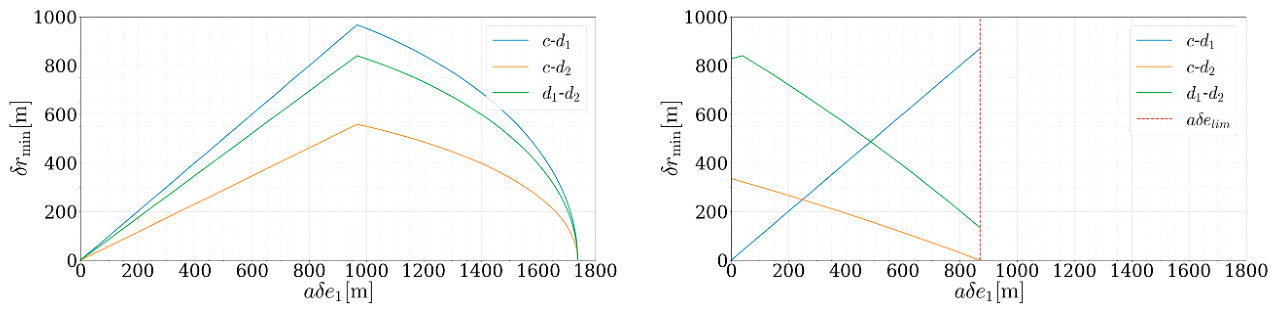
- In a formation consisting of a chief c and two deputies , the two deputies are positioned so that the pairs minimize Equation (14) for each of the two objective values of .
- The relative RMSE for each of the two nominal s is computed.
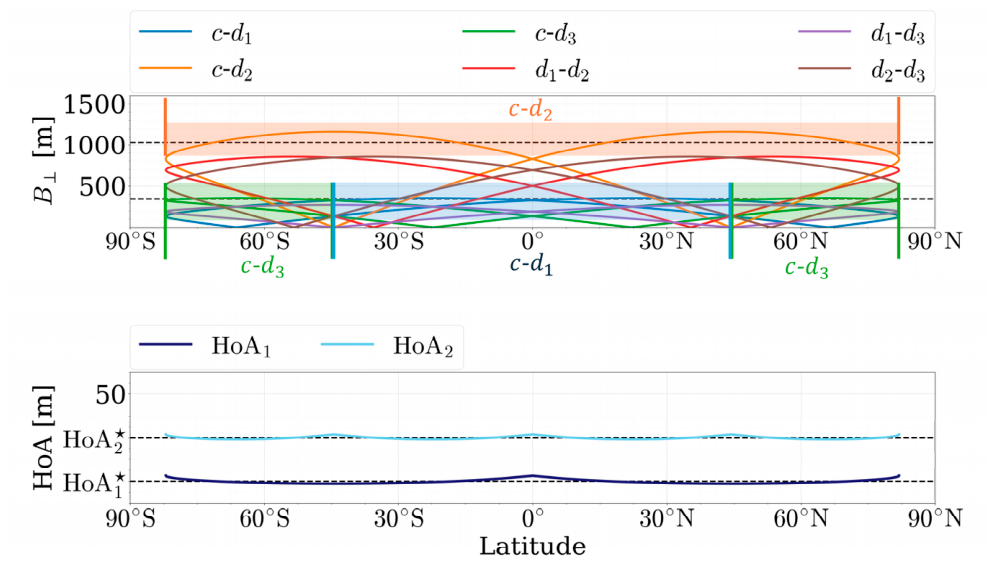
- A new deputy is added to the formation so that the pair is optimized with respect to the with the worst relative root mean square error (RMSE).
- If multiple pairs share the same target , their phases are recomputed so that the functions are equally spaced in the interval . This is done by imposing that they respectively reach the minimum HoA in correspondence with the argument of latitude , given by:
- 5.
- The procedure is iterated until a formation with the desired number of deputies is achieved.
2.3.2. Numerical Approach
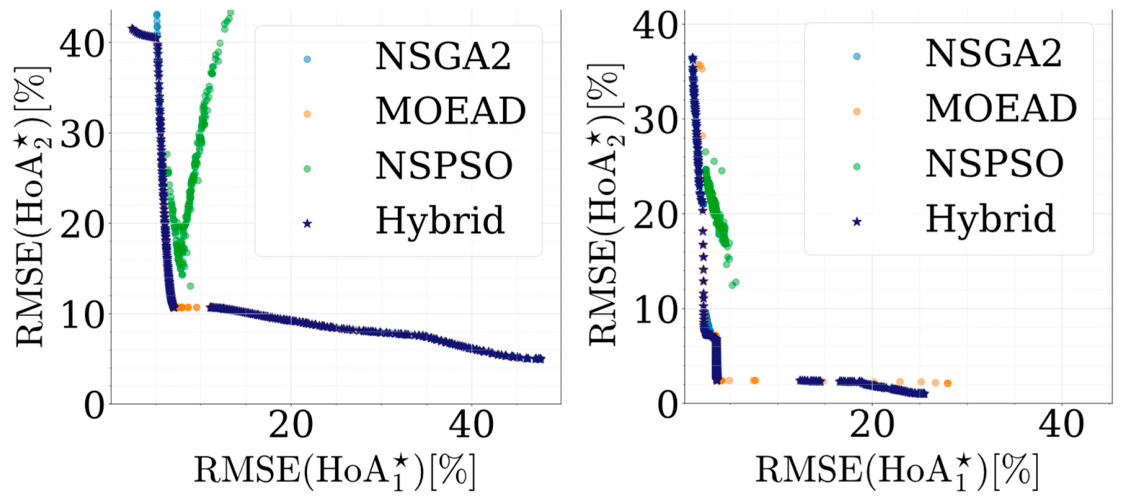
- Covariance Matrix Adaptation Evolution Strategy (CMA-ES). This is one of the most well-established and first evolution strategy algorithms to be developed, considered as the benchmark against which the others are compared [32].
- Self-adaptive Differential Evolution (SaDE). This algorithm dynamically adapts its control parameters (mutation and crossover strategies) during the run, thus removing the need for manual fine-tuning [33].
- Artificial Bee Colony (ABC). Its main advantage is the lower sensitivity to local minima. However, it generally provides slower convergence than the others [34].
2.4. Formation Maintenance Background
2.4.1. Orbital Disturbances’ Model
2.4.2. Impulsive Control Strategies in ROE Space
- (coupled – management): A small non-zero difference in the semi-major axes is introduced so that, with known in-plane maneuver scheduling, oscillates around its nominal value without diverging. This approach avoids dedicated along-track maneuvers but introduces a constant offset in the radial direction;
- (threshold-triggered along-track maneuver): A dedicated along-track correction is applied once the along-track separation exceeds a prescribed threshold (e.g., 100 m in the reported representative case).
3. Results
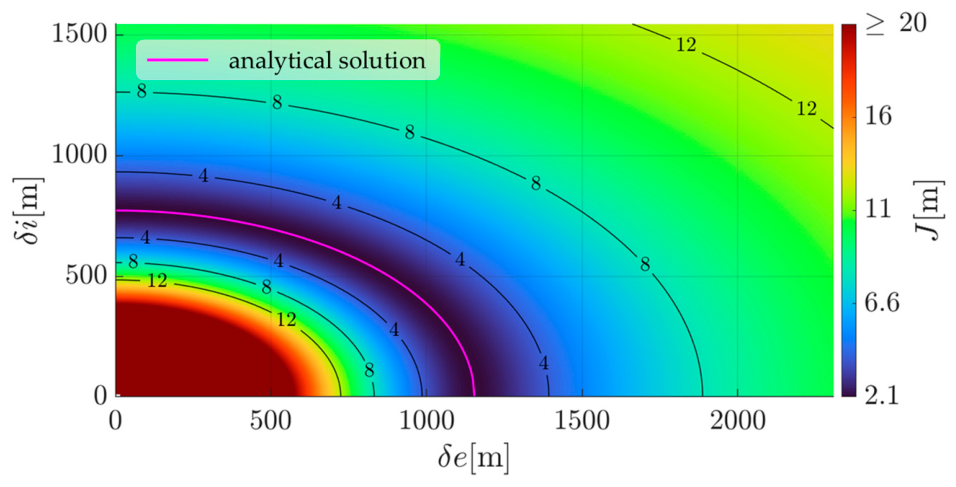
3.1. Solution of the Single-Baseline Optimization Problem
3.2. Solution of the Multi-Objective Optimization Problem
3.2.1. Heuristic Solution
3.2.2. Numerical Solution
3.2.3. Effect of Earth’s Rotation
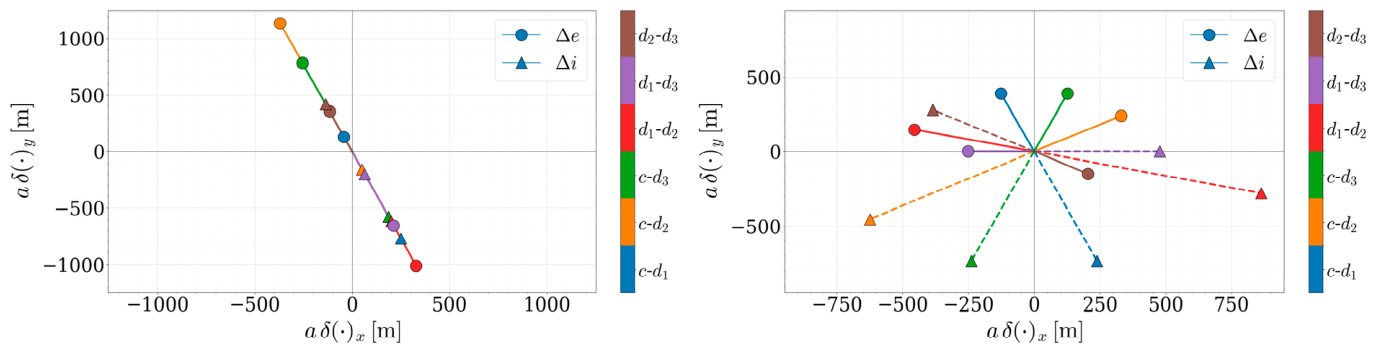
3.3. Optimal Generalized Helix Formations
3.3.1. Safe Configuration with Orbits with Identical Shape Ratios
3.3.2. Safe Configuration with Common Orientation of the Eccentricity Vectors
3.4. Formation Maintenance
- Helix formation considering a control strategy based on (coupled management, see Section 2.4).
- Helix formation considering a control strategy based on (threshold-triggered along-track maneuver, see Section 2.4).
- Helix formation with considering a control strategy based on . In this last case, the strategy is not reported since the numerical results are practically indistinguishable.
3.5. Design Synthesis and Exemplary Configurations
4. Discussion
Author Contributions
Funding
Data Availability Statement
Conflicts of Interest
Abbreviations
| DEM | Digital elevation model |
| DLR | German Aerospace Center |
| ECEF | Earth-Centered–Earth-Fixed |
| ESA | European Space Agency |
| HCW | Hill–Clohessy–Wiltshire equations |
| HoA | Height of ambiguity |
| LEO | Low Earth Orbit |
| RMSE | Root mean square error |
| ROE | Relative orbital elements |
| SAR | Synthetic Aperture Radar |
| SNR | Signal-to-noise ratio |
| SSO | Sun-synchronous orbit |
References
- Moreira, A.; Prats-Iraola, P.; Younis, M.; Krieger, G.; Hajnsek, I.; Papathanassiou, K.P. A Tutorial on Synthetic Aperture Radar. IEEE Geosci. Remote Sens. Mag. 2013, 1, 6–43. [Google Scholar] [CrossRef] [Scilit]
- Bamler, R.; Hartl, P. Synthetic Aperture Radar Interferometry. Inverse Probl. 1998, 14, R1. [Google Scholar] [CrossRef] [Scilit]
- Rosen, P.A.; Hensley, S.; Joughin, I.R.; Li, F.K.; Madsen, S.N.; Rodriguez, E.; Goldstein, R.M. Synthetic Aperture Radar Interferometry. Proc. IEEE 2000, 88, 333–382. [Google Scholar] [CrossRef] [Scilit]
- Hanssen, R.F. Radar Interferometry: Data Interpretation and Error Analysis; Remote Sensing and Digital Image Processing; Springer: Dordrecht, The Netherlands, 2001; Volume 2. [Google Scholar]
- Ferretti, A.; Prati, C.; Rocca, F. Permanent Scatterers in SAR Interferometry. IEEE Trans. Geosci. Remote Sens. 2001, 39, 8–20. [Google Scholar] [CrossRef] [Scilit]
- Berardino, P.; Fornaro, G.; Lanari, R.; Sansosti, E. A New Algorithm for Surface Deformation Monitoring Based on Small Baseline Differential SAR Interferograms. IEEE Trans. Geosci. Remote Sens. 2002, 40, 2375–2383. [Google Scholar] [CrossRef] [Scilit]
- Ferretti, A.; Fumagalli, A.; Novali, F.; Prati, C.; Rocca, F.; Rucci, A. A New Algorithm for Processing Interferometric Data-Stacks: SqueeSAR. IEEE Trans. Geosci. Remote Sens. 2011, 49, 3460–3470. [Google Scholar] [CrossRef] [Scilit]
- Krieger, G.; Moreira, A. Spaceborne Bi- and Multistatic SAR: Potential and Challenges. IEE Proc.—Radar Sonar Navig. 2006, 153, 184–198. [Google Scholar] [CrossRef] [Scilit]
- Moreira, A.; Krieger, G.; Villano, M.; Younis, M.; Prats-Iraola, P.; Zink, M. Spaceborne Synthetic Aperture Radar: Future Technologies and Mission Concepts. Proc. IEEE 2025, 114, 183–219. [Google Scholar] [CrossRef] [Scilit]
- Hu, C.; Li, Y.; Chen, Z.; Liu, F.; Zhang, Q.; Monti-Guarnieri, A.V.; Hobbs, S.; Anghel, A.; Datcu, M. Distributed Spaceborne SAR: A Review of Systems, Applications, and the Road Ahead. IEEE Geosci. Remote Sens. Mag. 2025, 13, 329–361. [Google Scholar] [CrossRef] [Scilit]
- Krieger, G.; Moreira, A.; Fiedler, H.; Hajnsek, I.; Werner, M.; Younis, M.; Zink, M. TanDEM-X: A Satellite Formation for High-Resolution SAR Interferometry. IEEE Trans. Geosci. Remote Sens. 2007, 45, 3317–3341. [Google Scholar] [CrossRef] [Scilit]
- Hajnsek, I.; Busche, T.; Abdullahi, S.; Bachmann, M.; Baumgartner, S.V.; Bojarski, A.; Bueso-Bello, J.-L.; Esch, T.; Fritz, T.; Alonso-Gonzalez, A.; et al. TanDEM-X: The 4D Mission Phase for Earth Surface Dynamics: Science Activities Highlights and New Data Products after 15 Years of Bistatic Operations. IEEE Geosci. Remote Sens. Mag. 2025, 13, 116–151. [Google Scholar] [CrossRef] [Scilit]
- D’Amico, S.; Montenbruck, O. Proximity Operations of Formation-Flying Spacecraft Using an Eccentricity/Inclination Vector Separation. J. Guid. Control Dyn. 2012, 29, 554–563. [Google Scholar] [CrossRef] [Scilit]
- Koenig, A.W.; D’Amico, S. Robust and Safe N-Spacecraft Swarming in Perturbed Near-Circular Orbits. J. Guid. Control Dyn. 2018, 41, 1643–1662. [Google Scholar] [CrossRef] [Scilit]
- Scala, F.; Peixoto, M.N.; Krieger, G.; Villano, M. On the Safety of Multiple Satellite Formations for Synthetic Aperture Radar Applications. J. Guid. Control Dyn. 2025, 48, 414–423. [Google Scholar] [CrossRef] [Scilit]
- Lopez-Dekker, P.; Stoffelen, A.; Kääb, A.; Hooper, A.; Rabus, B.; Chapron, B.; Buongiorno Nardelli, B.; Muller, C.; Pasquero, C.; Muller, J.-P.; et al. Harmony: Science Objectives and Mission Overview. In Proceedings of the ESA Living Planet Symposium 2022, Bonn, Germany, 23–27 May 2022. [Google Scholar]
- Cotugno, F.; Theodosiou, A.; Rommen, B.; Manunta, M.; Lanari, R.; Salvato, M.; Pelliccia, F.; Renga, A. Optimization of Formation Parameters for Single-Pass/Cross-Track Interferometry Through the Harmony Mission. Remote Sens. 2026, 18, 877. [Google Scholar] [CrossRef] [Scilit]
- Deng, Y.; Zhang, H.; Liu, K.; Wang, W.; Ou, N.; Han, H.; Yang, R.; Ren, J.; Wang, J.; Ren, X.; et al. Hongtu-1: The First Spaceborne Single-Pass Multibaseline SAR Interferometry Mission. IEEE Trans. Geosci. Remote Sens. 2025, 63, 5202518. [Google Scholar] [CrossRef] [Scilit]
- Massonnet, D. Capabilities and Limitations of the Interferometric Cartwheel. IEEE Trans. Geosci. Remote Sens. 2001, 39, 506–520. [Google Scholar] [CrossRef] [Scilit]
- Lachaise, M.; Fritz, T.; Balss, U.; Bamler, R.; Eineder, M. Phase Unwrapping Correction with Dual-Baseline Data for the TanDEM-X Mission. In 2012 IEEE International Geoscience and Remote Sensing Symposium; IEEE: Piscataway, NJ, USA, 2012; pp. 5566–5569. [Google Scholar]
- Lachaise, M.; Fritz, T.; Bamler, R. The Dual-Baseline Phase Unwrapping Correction Framework for the TanDEM-X Mission Part 1: Theoretical Description and Algorithms. IEEE Trans. Geosci. Remote Sens. 2018, 56, 780–798. [Google Scholar] [CrossRef] [Scilit]
- Eineder, M.; Adam, N. A Maximum-Likelihood Estimator to Simultaneously Unwrap, Geocode, and Fuse SAR Interferograms from Different Viewing Geometries into One Digital Elevation Model. IEEE Trans. Geosci. Remote Sens. 2005, 43, 24–36. [Google Scholar] [CrossRef] [Scilit]
- Nogueira Peixoto, M.; Krieger, G.; Moreira, A.; Waldschmidt, C.; Villano, M. On the Exploitation of CubeSats for Highly Accurate and Robust Single-Pass SAR Interferometry. IEEE Trans. Geosci. Remote Sens. 2023, 61, 5217216. [Google Scholar] [CrossRef] [Scilit]
- Scala, F.; Villano, M. Optimal Orbit Altitude of Satellite Formations for Across-Track SAR Interferometry. IEEE Trans. Geosci. Remote Sens. 2026, 64, 5201619. [Google Scholar] [CrossRef] [Scilit]
- D’Amico, S. Autonomous Formation Flying in Low Earth Orbit. Ph.D. Thesis, Technische Universiteit Delft, Delft, The Netherlands, 2010. [Google Scholar]
- Clohessy, W.H.; Wiltshire, R.S. Terminal Guidance System for Satellite Rendezvous. J. Aerosp. Sci. 1960, 27, 653–658. [Google Scholar] [CrossRef] [Scilit]
- D’Errico, M. (Ed.) Distributed Space Missions for Earth System Monitoring; Springer: New York, NY, USA, 2013. [Google Scholar]
- Longari, R.; Scala, F.; Gaias, G.; Krieger, G.; Villano, M. Incidence Angle Optimization for Formation-Flying Across-Track SAR Interferometry. IEEE Geosci. Remote Sens. Lett. 2026, 23, 4004005. [Google Scholar] [CrossRef] [Scilit]
- Fiedler, H.; Boerner, E.; Mittermayer, J.; Krieger, G. Total Zero Doppler Steering—A New Method for Minimizing the Doppler Centroid. IEEE Geosci. Remote Sens. Lett. 2005, 2, 141–145. [Google Scholar] [CrossRef] [Scilit]
- Rodrigues-Silva, E.; Matar, J.; Rodriguez-Cassola, M.; Sakar, N.; Katz, R.; Kahle, R.; Moreira, A. Relative Orbit Design and Optimization for Distributed SAR Formations. IEEE Trans. Geosci. Remote Sens. 2025, 63, 5222514. [Google Scholar] [CrossRef] [Scilit]
- Polak, E. Optimization: Algorithms and Consistent Approximations; Springer: Berlin/Heidelberg, Germany, 2012. [Google Scholar]
- Hansen, N.; Ostermeier, A. Completely Derandomized Self-Adaptation in Evolution Strategies. Evol. Comput. 2001, 9, 159–195. [Google Scholar] [CrossRef] [Scilit] [PubMed]
- Qin, A.K.; Huang, V.L.; Suganthan, P.N. Differential Evolution Algorithm with Strategy Adaptation for Global Numerical Optimization. IEEE Trans. Evol. Comput. 2009, 13, 398–417. [Google Scholar] [CrossRef] [Scilit]
- Karaboga, D.; Basturk, B. A Powerful and Efficient Algorithm for Numerical Function Optimization: Artificial Bee Colony (ABC) Algorithm. J. Glob. Optim. 2007, 39, 459–471. [Google Scholar] [CrossRef] [Scilit]
- Kolda, T.G.; Lewis, R.M.; Torczon, V. Optimization by Direct Search: New Perspectives on Some Classical and Modern Methods. SIAM Rev. 2003, 45, 385–482. [Google Scholar] [CrossRef] [Scilit]
- Vallado, D.A. Fundamentals of Astrodynamics and Applications; Springer: Berlin/Heidelberg, Germany, 2001. [Google Scholar]
- Picone, J.M.; Hedin, A.E.; Drob, D.P.; Aikin, A.C. NRLMSISE-00 Empirical Model of the Atmosphere: Statistical Comparisons and Scientific Issues. J. Geophys. Res. 2002, 107, 1468. [Google Scholar] [CrossRef] [Scilit]
- Willis, M.; D’Amico, S. Analytical Description of Relative Position and Velocity on J2-Perturbed Eccentric Orbits. In Proceedings of the 31st AAS/AIAA Space Flight Mechanics Meeting, Virtual, 31 January–4 February 2021. [Google Scholar]
- Gaias, G.; D’Amico, S. Impulsive Maneuvers for Formation Reconfiguration Using Relative Orbital Elements. J. Guid. Control Dyn. 2015, 38, 1036–1049. [Google Scholar] [CrossRef] [Scilit]
- Deb, K.; Pratap, A.; Agarwal, S.; Meyarivan, T. A Fast and Elitist Multiobjective Genetic Algorithm: NSGA-II. IEEE Trans. Evol. Comput. 2002, 6, 182–197. [Google Scholar] [CrossRef] [Scilit]
- Zhang, Q.; Li, H. MOEA/D: A Multiobjective Evolutionary Algorithm Based on Decomposition. IEEE Trans. Evol. Comput. 2007, 11, 712–731. [Google Scholar] [CrossRef] [Scilit]
- Liu, Y. A Fast and Elitist Multi-Objective Particle Swarm Algorithm: NSPSO. In 2008 IEEE International Conference on Granular Computing; IEEE: Piscataway, NJ, USA, 2008; pp. 470–475. [Google Scholar]
- Villano, M. SwitchSAR: A Novel SAR Mode for Low NESZ Stripmap Imaging. In Proceedings of the European Conference on Synthetic Aperture Radar, EUSAR, Baden-Baden, Germany, 8–11 June 2026. [Google Scholar]
- Martone, M.; Gollin, N.; Rizzoli, P.; Krieger, G. Performance-Optimized Quantization for SAR and InSAR Applications. IEEE Trans. Geosci. Remote Sens. 2022, 60, 5229922. [Google Scholar] [CrossRef] [Scilit]
- Gollin, N.; Martone, M.; Imbembo, E.; Ghiglione, M.; Knoll, S.; Krieger, G.; Rizzoli, P. AI-BAQ: Deep Learning for Adaptive SAR Raw Data Quantization. IEEE Trans. Geosci. Remote Sens. 2025, 63, 5220620. [Google Scholar] [CrossRef] [Scilit]








| Parameter | Value |
|---|---|
| Orbit type | SSO with inclination ≈ 97.5° |
| Formation categories | xz-PCO, Helix |
| N° satellites | 3, 4 |
| Altitude range | [500 km, 580 km] |
| Atmosphere density | [1, 5]·10−12 kg/m3 |
| CB | 0.021 [m2/kg] |
| ΔCB | [0%, 50%] · CB |
| Orbital tube diameter | 250 m |
| Baseline range | ≈[200 m, 2000 m] |
| Incidence angle | 37.0° |
| Look angle | 33.8° |
| Wavelength | 0.031 m (X-band) |
| Nominal HoAs | {10 m, 30 m} |
| ROE | Deputy 1 | Deputy 2 |
|---|---|---|
| 1160 m | 386 m | |
| 348.8° | 348.8° | |
| 1160 m | 386 m | |
| 168.8° | 168.8° |
| ROE | Deputy 1 | Deputy 2 | Deputy 3 |
|---|---|---|---|
| 350 m | 1160 m | 350 m | |
| 326.3° | 348.8° | 11.3° | |
| 350 m | 1160 m | 350 m | |
| 326.3° | 348.8° | 11.3° |
| 0 | |||||
| ROE | Deputy 1 | Deputy 2 |
|---|---|---|
| 1475 m | 388 m | |
| 353.7° | 348.8° | |
| 1475 m | 388 m | |
| 173.7° | 168.8° |
| ROE | Deputy 1 | Deputy 2 | Deputy 3 |
|---|---|---|---|
| 351 m | 1394 m | 352 m | |
| 11.3° | 349.1° | 326.4° | |
| 351 m | 1394 m | 352 m | |
| 11.3° | 349.1° | 326.4° |
| ROE | Deputy 1 | Deputy 2 |
|---|---|---|
| 1875 m | 449 m | |
| 90° | 90° | |
| 1255 m | 357 m | |
| 270° | 270° |
| ROE | Deputy 1 | Deputy 2 | Deputy 3 |
|---|---|---|---|
| 584 m | 1782 m | 242 m | |
| 90° | 90° | 90° | |
| 161 m | 1180 m | 391 m | |
| 270° | 270° | 270° |
| 3 Satellites | 4 Satellites | ||||
|---|---|---|---|---|---|
| 10 m | 20 m | ||||
| 10 m | 30 m | ||||
| 10 m | 40 m | ||||
| 10 m | 50 m | ||||
| Optimization | Minimum Distance [m] | ||
|---|---|---|---|
| in Hill frame | 269 | 5.5 | 8.0 |
| in ECEF | 68 | 4.9 | 7.4 |
| (ϑ − φ)1 | (ϑ − φ)j | φj − φ1 | δ1j ∈ [0, π/2] | δ1j ∈ [π/2, π] | δ1j ∈ [π, 3π/2] | δ1j ∈ [3π/2, 2π] |
|---|---|---|---|---|---|---|
| 0 | 0 | 0 | ≤ | — | — | |
| 0 | 0 | π | — | — | ||
| 0 | π | 0 | --— | — | ||
| 0 | π | π | -- | — | ||
| π | 0 | 0 | — | — | ||
| π | 0 | π | — | — | ||
| π | π | 0 | — | — | ||
| π | π | π | — | — |
| [kg/m3] | ΔCB [m2/kg] | Absolute Drag Compensation [m/s/T] | [m/s/T] | [m/s/T] | for [m/s/T] |
|---|---|---|---|---|---|
| 1 × 10⁻¹² | 0 | 0.033 | 0.017 | 0.017 | 0.0004 |
| 1 × 10⁻¹² | 5 × 10⁻³ | 0.033 | 0.019 | 0.019 | 0.0018 |
| 1 × 10⁻¹² | 1 × 10⁻² | 0.033 | 0.021 | 0.021 | 0.0033 |
| 3 × 10⁻¹² | 5 × 10⁻³ | 0.054 | 0.022 | 0.022 | 0.0051 |
| 3 × 10⁻¹² | 1 × 10⁻² | 0.054 | 0.028 | 0.027 | 0.0099 |
| 5 × 10⁻¹² | 5 × 10⁻³ | 0.081 | 0.026 | 0.026 | 0.0083 |
| 5 × 10⁻¹² | 1 × 10⁻² | 0.081 | 0.034 | 0.044 | 0.0168 |
| [kg/m3] |
ΔCB [m2/kg] |
Absolute Drag Compensation
[m/s/T] |
S1 [m/s/T] |
S2 [m/s/T] |
for
[m/s/T] |
|---|---|---|---|---|---|
| 1 × 10⁻¹² | 0 | 0.044 | 0.024 | 0.024 | 0.0009 |
| 1 × 10⁻¹² | 5 × 10⁻³ | 0.044 | 0.027 | 0.027 | 0.0018 |
| 1 × 10⁻¹² | 1 × 10⁻² | 0.044 | 0.029 | 0.029 | 0.0037 |
| 3 × 10⁻¹² | 5 × 10⁻³ | 0.072 | 0.032 | 0.032 | 0.0060 |
| 3 × 10⁻¹² | 1 × 10⁻² | 0.072 | 0.039 | 0.039 | 0.0149 |
| 5 × 10⁻¹² | 5 × 10⁻³ | 0.108 | 0.037 | 0.037 | 0.0208 |
| 5 × 10⁻¹² | 1 × 10⁻² | 0.108 | 0.049 | 0.049 | 0.0248 |
| No. of Satellites | Configuration | Target HoAs | Max Effective Baseline | Min Distance x-z Plane | HoA RMSE | Orbit | Year |
|---|---|---|---|---|---|---|---|
| 3 | same shape ratio | 10 m 30 m | 1475.12 m | 416.62 m | 7.0% 10.4% | 0.028 m/s | 115.33 m/s |
| 3 | aligned vectors | 10 m 30 m | 1475.12 m | 357.52 m | 7.0% 10.4% | 0.010 m/s | 40.78 m/s |
| 4 | same shape ratio | 10 m 30 m | 1394.88 m | 269.43 m | 3.5% 2.3% | 0.039 m/s | 160.64 m/s |
| 4 | aligned vectors | 10 m 30 m | 1394.88 m | 161.59 m | 3.5% 2.3% | 0.015 m/s | 61.37 m/s |
Disclaimer/Publisher’s Note: The statements, opinions and data contained in all publications are solely those of the individual author(s) and contributor(s) and not of MDPI and/or the editor(s). MDPI and/or the editor(s) disclaim responsibility for any injury to people or property resulting from any ideas, methods, instructions or products referred to in the content. |
© 2026 by the authors. Licensee MDPI, Basel, Switzerland. This article is an open access article distributed under the terms and conditions of the Creative Commons Attribution (CC BY) license.
Share and Cite
Longari, R.; Scala, F.; Gaias, G.; Krieger, G.; Villano, M. Optimal Formation Flying for Single-Pass Multi-Baseline Across-Track Synthetic Aperture Radar Interferometry. Remote Sens. 2026, 18, 3041. https://doi.org/10.3390/rs18173041
Longari R, Scala F, Gaias G, Krieger G, Villano M. Optimal Formation Flying for Single-Pass Multi-Baseline Across-Track Synthetic Aperture Radar Interferometry. Remote Sensing. 2026; 18(17):3041. https://doi.org/10.3390/rs18173041
Chicago/Turabian StyleLongari, Riccardo, Francesca Scala, Gabriella Gaias, Gerhard Krieger, and Michelangelo Villano. 2026. "Optimal Formation Flying for Single-Pass Multi-Baseline Across-Track Synthetic Aperture Radar Interferometry" Remote Sensing 18, no. 17: 3041. https://doi.org/10.3390/rs18173041
APA StyleLongari, R., Scala, F., Gaias, G., Krieger, G., & Villano, M. (2026). Optimal Formation Flying for Single-Pass Multi-Baseline Across-Track Synthetic Aperture Radar Interferometry. Remote Sensing, 18(17), 3041. https://doi.org/10.3390/rs18173041