Article

Scattering-Aware Latent Field Modulation for Synthetic Aperture Radar Object Detection

Faculty of Applied Sciences, Macao Polytechnic University, Macao, China
*
Author to whom correspondence should be addressed.
Remote Sens. 2026, 18(17), 3058; https://doi.org/10.3390/rs18173058
Submission received: 14 July 2026 / Revised: 7 August 2026 / Accepted: 1 September 2026 / Published: 7 September 2026
(This article belongs to the Section Remote Sensing Image Processing)

Abstract

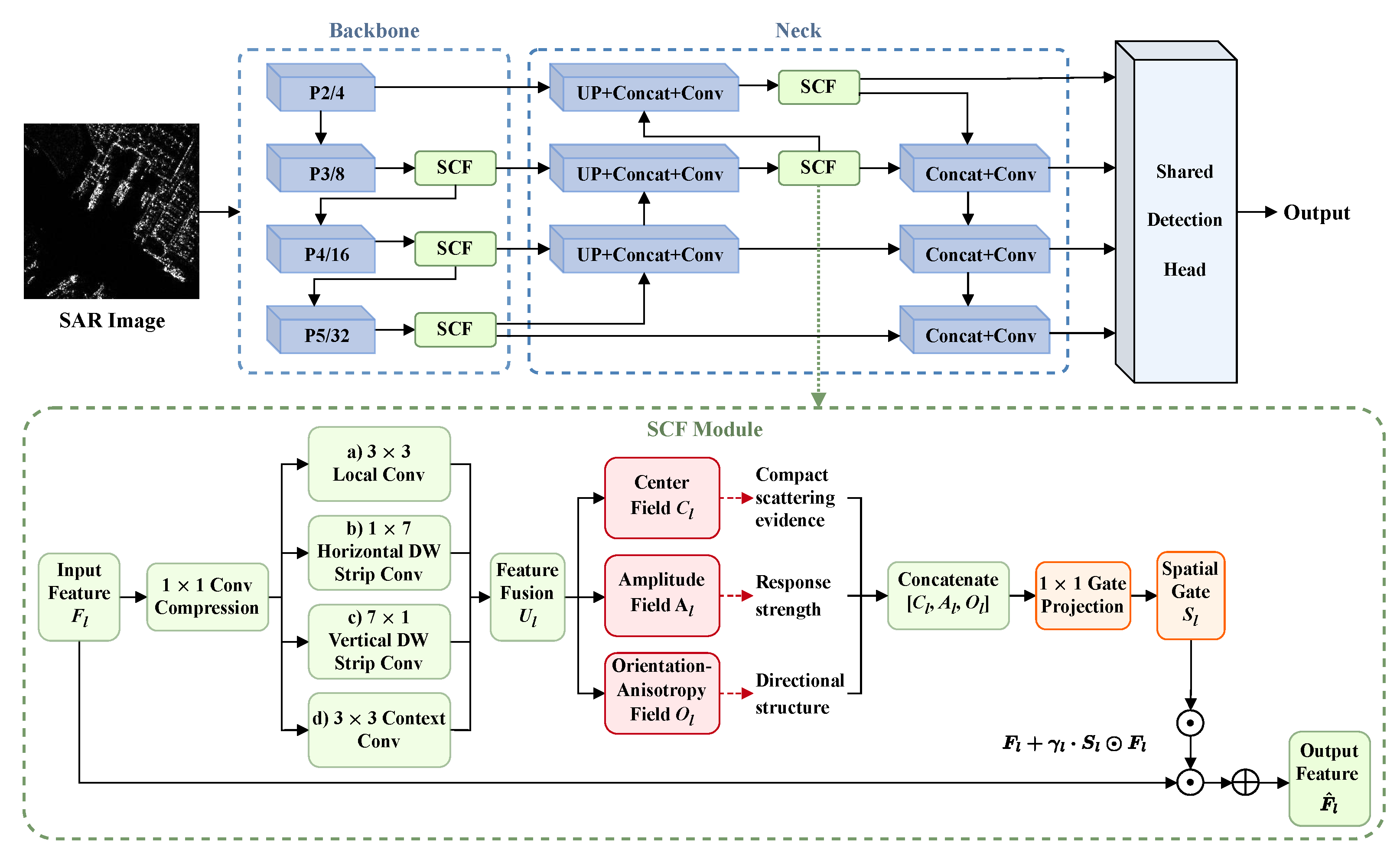
Synthetic aperture radar (SAR) object detection remains challenging, as target evidence is often sparse, discontinuous, and heavily influenced by speckle noise, sidelobes, shadows, and clutter-like background scattering. Existing dense detectors usually process SAR images as ordinary grayscale images, which causes feature modulation to rely on unrestricted saliency responses that may simultaneously enhance true targets and bright background scatterers. To address this issue, we propose a SAR-inspired Scattering-Center Field (SCF) modulation framework for multi-scale dense object detection. The SCF module is designed as a tensor-preserving feature adapter that decomposes feature modulation into three internal latent fields: a center-like evidence field, a response-amplitude field, and an orientation-anisotropy field. These fields are inferred from intermediate features through lightweight local, strip-convolution, and contextual branches, and then they are subsequently fused into an identity-initialized residual spatial gate. The proposed module requires no scattering-center annotations, segmentation masks, auxiliary field supervision, phase history, polarimetric data, or additional post-processing. Consequently, it can be seamlessly integrated into standard dense detection pipelines without altering labels or prediction heads. Experiments are conducted on four publicly available SAR detection datasets, namely SSDD, SAR-AIRcraft-1.0, SAR-Ship, and MSAR-1.0. The proposed detector achieves mAP50/mAP50-95 scores of 0.954/0.682 on SSDD, 0.930/0.661 on SAR-AIRcraft-1.0, 0.971/0.676 on SAR-Ship, and 0.688/0.482 on MSAR-1.0. These results indicate that SCF provides a lightweight and detector-compatible modulation mechanism for improving SAR object detection under sparse target responses and cluttered imaging conditions.
Keywords: feature modulation; object detection; remote sensing; scattering center; synthetic aperture radar feature modulation; object detection; remote sensing; scattering center; synthetic aperture radar