Retrieval of Vegetation Nitrogen from Hyperspectral Remote Sensing: A Critical Review of Recent Methodological Advances




Highlights
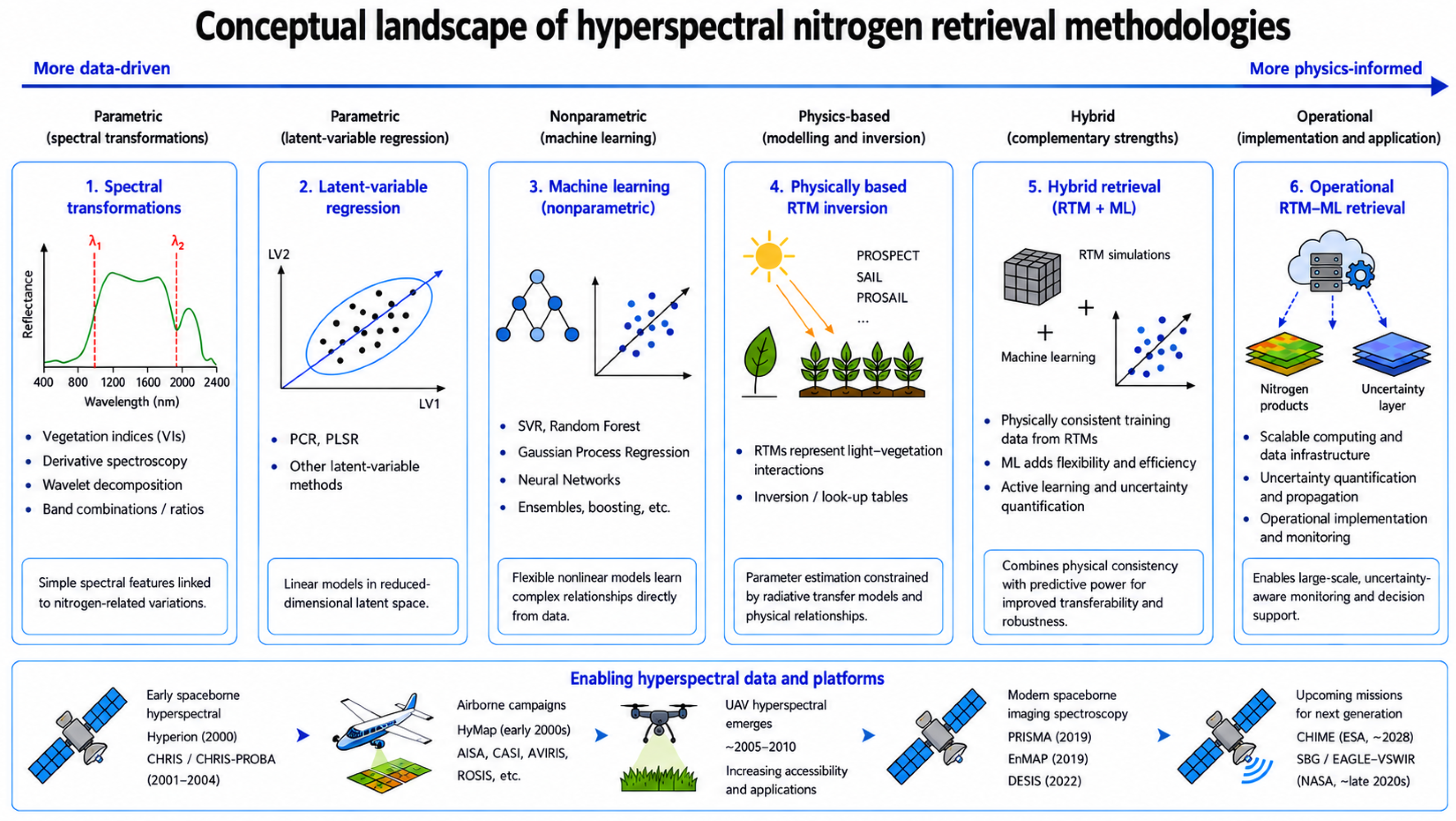
- Hyperspectral nitrogen retrieval has evolved from empirical spectral indices and linear regression towards nonlinear machine learning, physically based radiative transfer modeling (RTM), and hybrid RTM–ML retrieval frameworks that provide complementary advances in predictive flexibility, physical consistency, and the potential for robust and transferable retrieval.
- Empirical, machine learning, and physically based approaches are progressively converging into complementary hybrid retrieval frameworks rather than representing competing methodological paradigms.
- Future progress will depend less on incremental algorithmic improvements than on advances in protein-sensitive leaf and canopy RTMs, uncertainty propagation, standardized reference datasets, and hybrid RTM–ML retrieval frameworks.
- The growing availability of operational imaging spectroscopy missions will accelerate robust, transferable, and uncertainty-aware retrieval of nitrogen-related vegetation variables across species, ecosystems, and spatial scales.
Abstract
1. Introduction
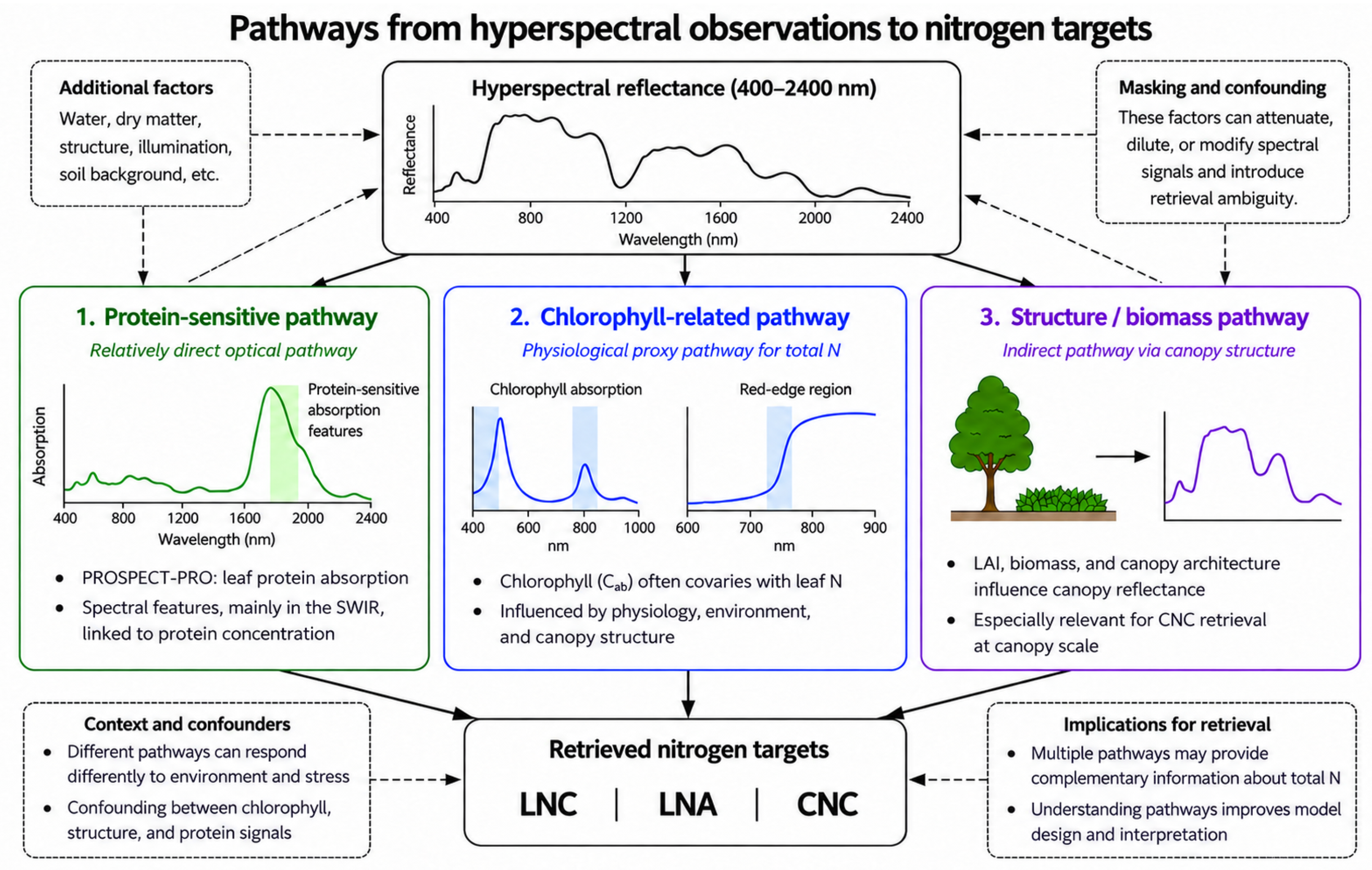
- Parametric regression methodsestablish an explicit mathematical relationship between spectral observations and nitrogen-related vegetation variables. They include (i) user-defined models, such as vegetation indices derived from known spectral relationships, and (ii) statistical regression models whose parameters are estimated from calibration data within a predefined mathematical structure.
- Nonparametric regression methods do not assume a predefined functional form of the relationship between spectra and nitrogen variables. Instead, the relationship is learned directly from the data using nonlinear ML algorithms.
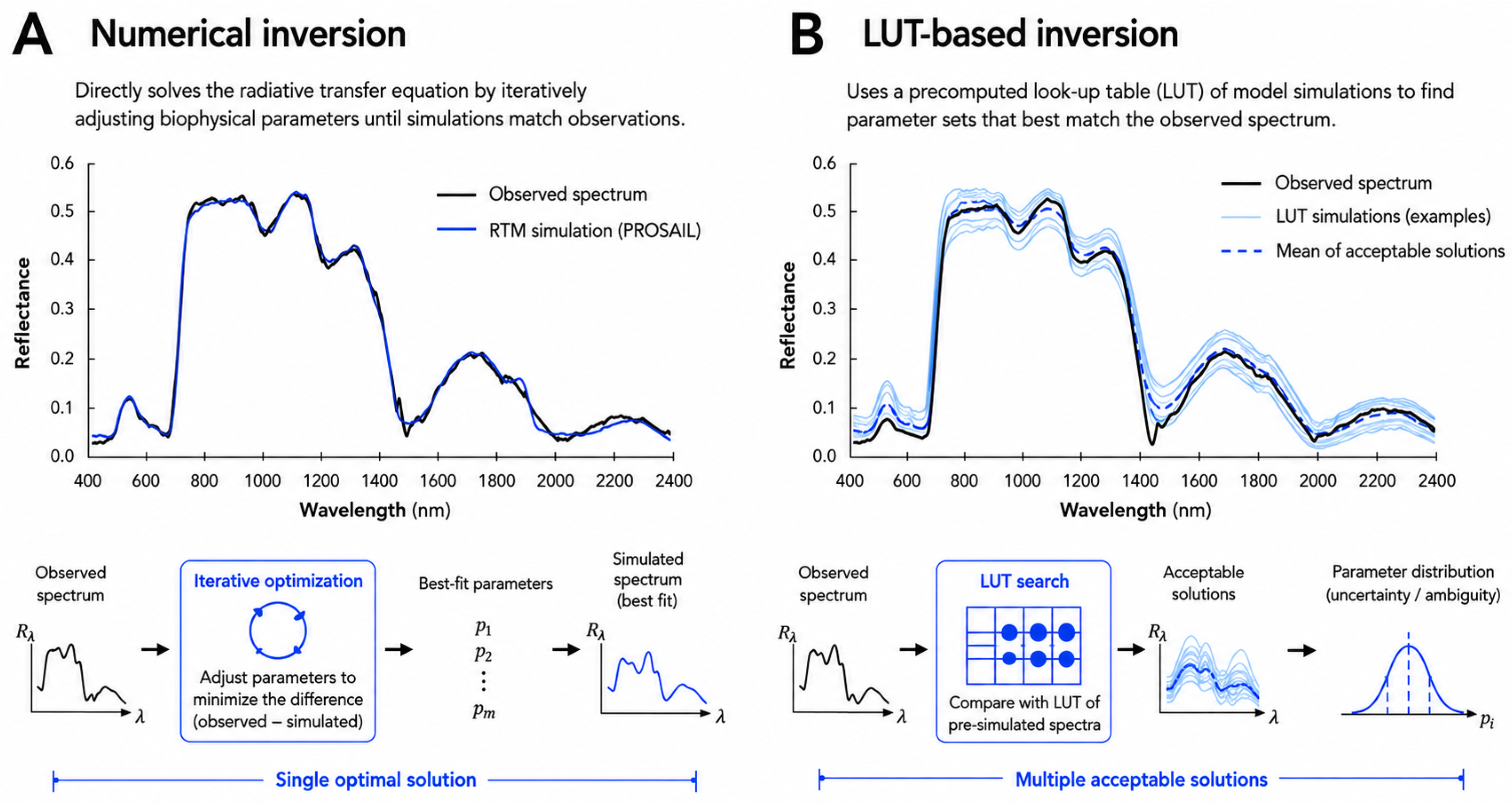
- RTM inversion methods, founded on radiative transfer theory, establish causal relationships between photon interactions and model parameters. These methods are grounded in mathematical representations of light propagation embodied in radiative transfer models (RTMs).
- Hybrid regression methods combine physically based radiative transfer models with statistical or ML approaches, aiming to exploit the physical consistency of RTMs together with the flexibility and computational efficiency of data-driven algorithms.
2. Parametric Regression Methods
2.1. Discrete Spectral Band Approaches: Vegetation Indices
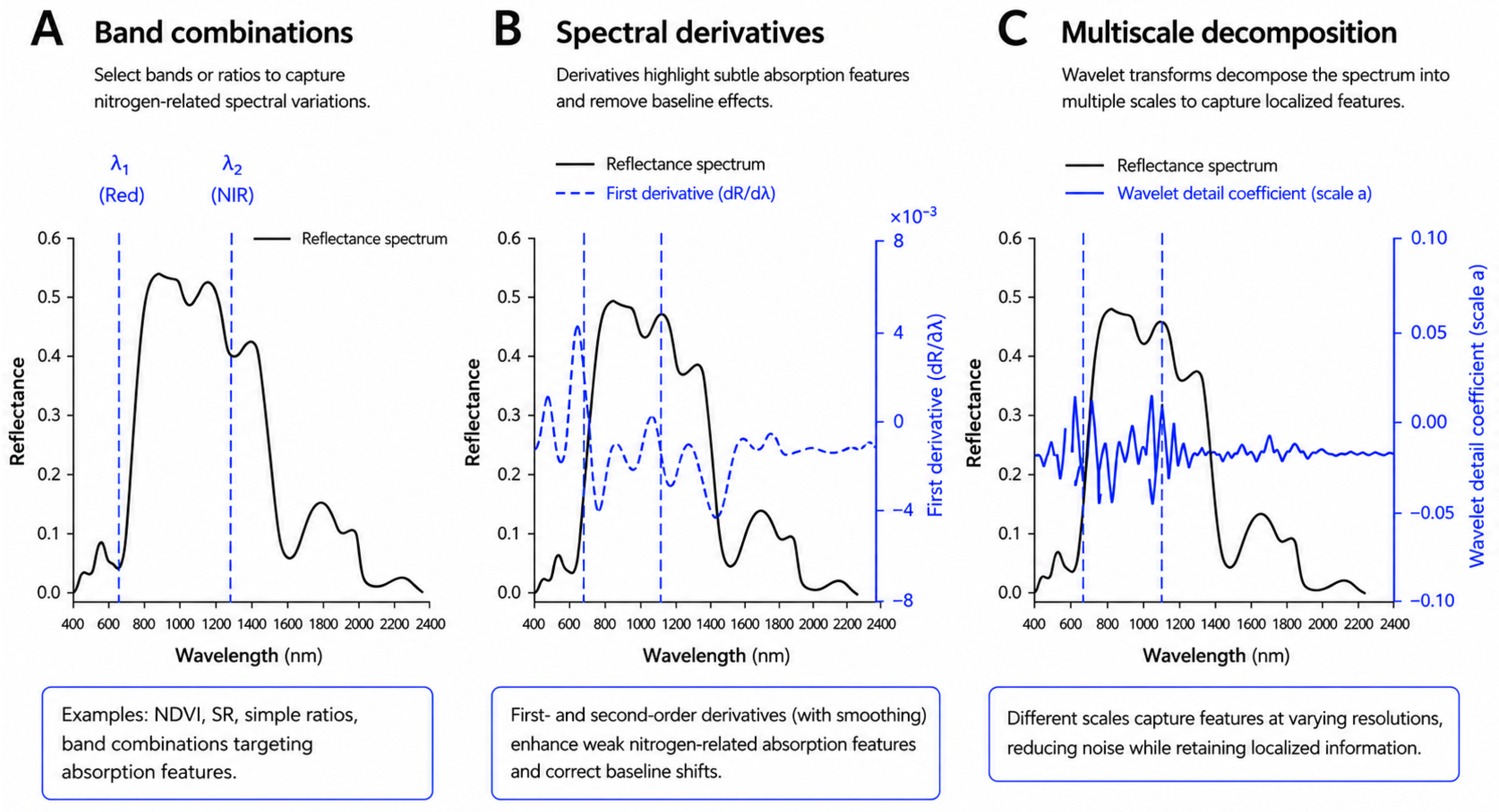
2.2. Spectral Transformation Techniques
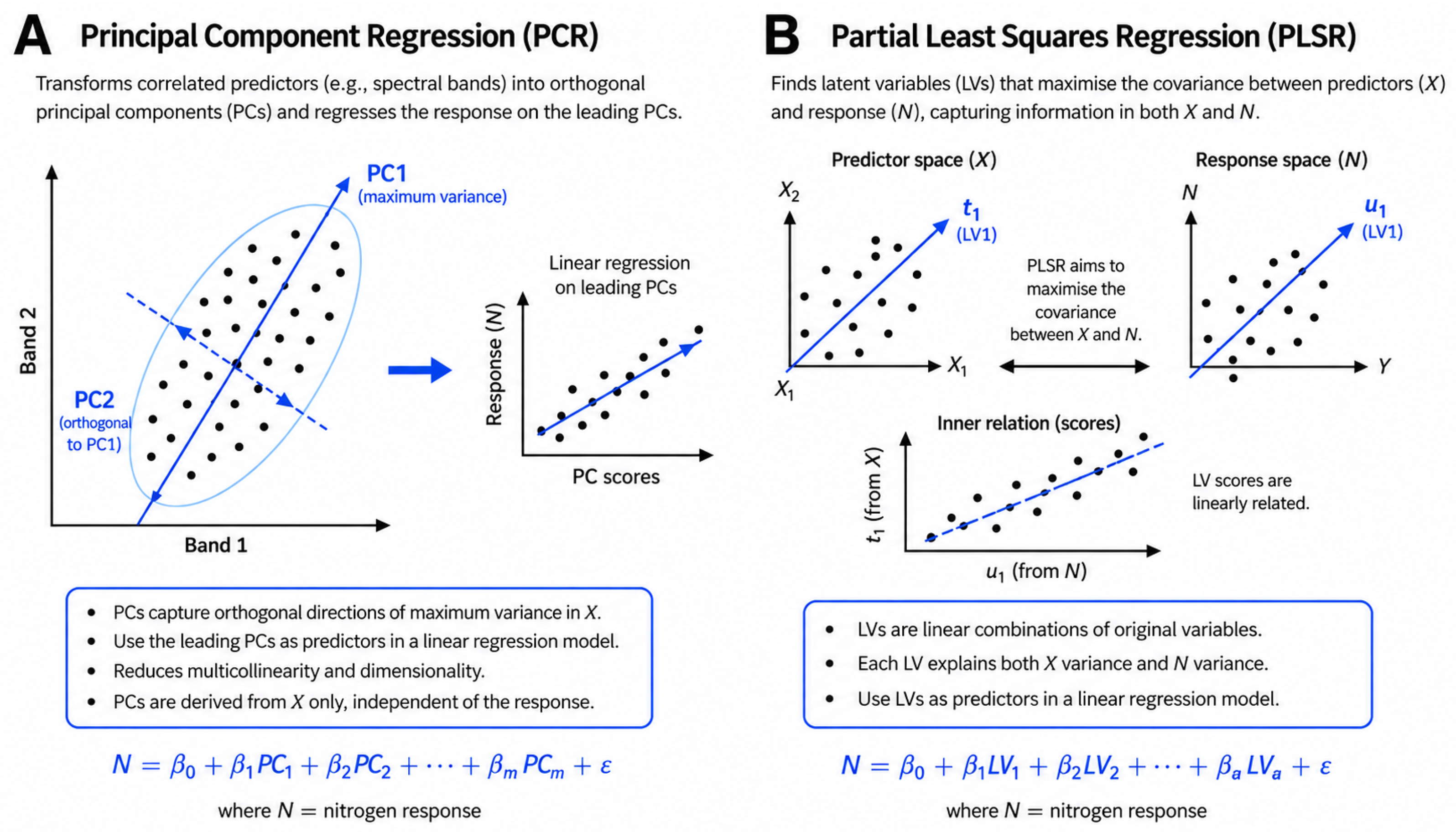
2.3. Parametric Regression Methods with Implicit Parameterization
3. Nonparametric Regression Methods
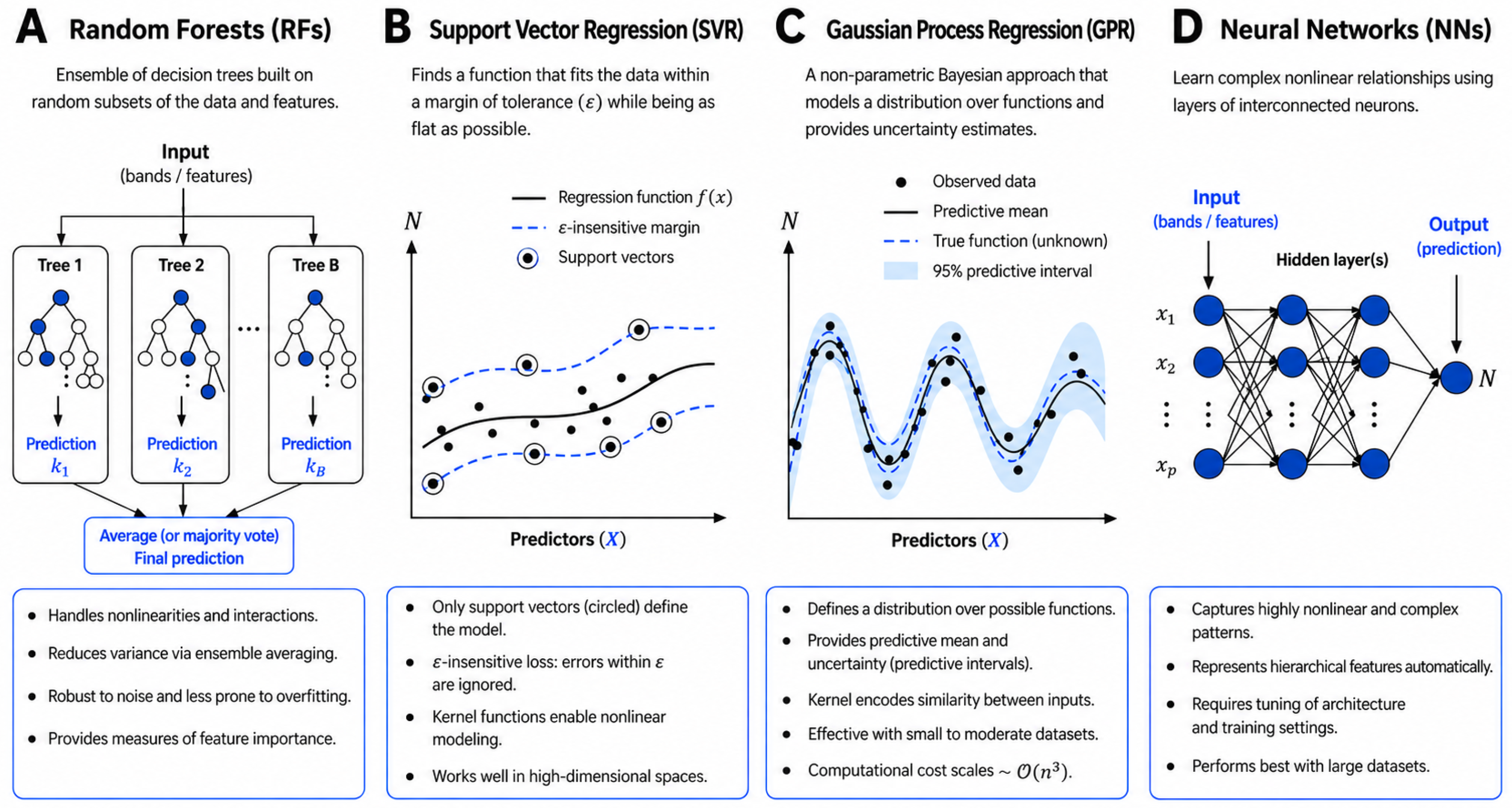
3.1. Decision-Tree and Ensemble-Learning Methods
3.2. Kernel-Based Regression Methods
3.3. Neural Networks
4. Radiative Transfer Model Inversion
RTM Inversion Strategies
5. Hybrid RTM–ML Retrieval Frameworks
5.1. NN-Based Hybrid Retrieval
5.2. Kernel-Based Hybrid Retrieval
5.3. Emerging Hybrid RTM–ML Retrieval Frameworks
6. Discussion
Synthesis and Outlook
7. Conclusions
Author Contributions
Funding
Data Availability Statement
Acknowledgments
Conflicts of Interest
References
- Evans, J.R. Photosynthesis and Nitrogen Relationships in Leaves of C3 Plants. Oecologia 1989, 78, 9–19. [Google Scholar] [CrossRef] [Scilit] [PubMed]
- Field, C.B.; Mooney, H.A. The photosynthesis–nitrogen relationship in wild plants. In On the Economy of Plant Form and Function; Givnish, T.J., Ed.; Cambridge University Press: Cambridge, UK, 1986; pp. 25–55. [Google Scholar]
- Wright, I.J.; Reich, P.B.; Westoby, M.; Ackerly, D.D.; Baruch, Z.; Bongers, F.; Cavender-Bares, J.; Chapin, T.; Cornelissen, J.H.C.; Diemer, M.; et al. The worldwide leaf economics spectrum. Nature 2004, 428, 821–827. [Google Scholar] [CrossRef] [Scilit] [PubMed]
- Kattge, J.; Knorr, W. Temperature acclimation in a biochemical model of photosynthesis: A reanalysis of data from 36 species. Plant Cell Environ. 2007, 30, 1176–1190. [Google Scholar] [CrossRef] [Scilit] [PubMed]
- Berger, K.; Verrelst, J.; Féret, J.B.; Wang, Z.; Wocher, M.; Strathmann, M.; Danner, M.; Mauser, W.; Hank, T. Crop Nitrogen Monitoring: Recent Progress and Principal Developments in the Context of Imaging Spectroscopy Missions. Remote Sens. Environ. 2020, 242, 111758. [Google Scholar] [CrossRef] [Scilit] [PubMed]
- Fourty, T.; Baret, F.; Jacquemoud, S.; Schmuck, G.; Verdebout, J. Leaf optical properties with explicit description of its biochemical composition: Direct and inverse problems. Remote Sens. Environ. 1996, 56, 104–117. [Google Scholar] [CrossRef] [Scilit]
- Féret, J.B.; Berger, K.; de Boissieu, F.; Malenovský, Z. PROSPECT-PRO for estimating content of nitrogen-containing leaf proteins and other carbon-based constituents. Remote Sens. Environ. 2021, 252, 112173. [Google Scholar] [CrossRef] [Scilit]
- Onoda, Y.; Hikosaka, K.; Hirose, T. Allocation of nitrogen to cell walls decreases photosynthetic nitrogen-use efficiency. Funct. Ecol. 2004, 18, 419–425. [Google Scholar] [CrossRef] [Scilit]
- Curran, P.J. Remote sensing of foliar chemistry. Remote Sens. Environ. 1989, 30, 271–278. [Google Scholar] [CrossRef] [Scilit]
- Kokaly, R.F. Investigating a physical basis for spectroscopic estimates of leaf nitrogen concentration. Remote Sens. Environ. 2001, 75, 153–161. [Google Scholar] [CrossRef] [Scilit]
- Johnson, L.F. Nitrogen influence on fresh-leaf NIR spectra. Remote Sens. Environ. 2001, 78, 314–320. [Google Scholar] [CrossRef] [Scilit]
- Yu, K.; Belwalkar, A.; Wang, W.; Hu, Y.; Hunegnaw, A.; Nurunnabi, A.; Ruf, T.; Li, F.; Jia, L.; Kooistra, L.; et al. UAV hyperspectral remote sensing for crop nitrogen monitoring: Progress, challenges, and perspectives. Smart Agric. Technol. 2025, 12, 101507. [Google Scholar] [CrossRef] [Scilit]
- Pearlman, J.S.; Barry, P.S.; Segal, C.C.; Shepanski, J.; Beiso, D.; Carman, S.L. Hyperion, a Space-Based Imaging Spectrometer. IEEE Trans. Geosci. Remote Sens. 2003, 41, 1160–1173. [Google Scholar] [CrossRef] [Scilit]
- Barnsley, M.J.; Settle, J.J.; Cutter, M.A.; Lobb, D.R.; Teston, F. The PROBA/CHRIS Mission: A Low-Cost Smallsat for Hyperspectral, Multi-Angle, Observations of the Earth Surface and Atmosphere. IEEE Trans. Geosci. Remote Sens. 2004, 42, 1512–1520. [Google Scholar] [CrossRef]
- Loizzo, R.; Daraio, M.; Guarini, R.; Longo, F.; Lorusso, R.; Dini, L.; Lopinto, E. Prisma Mission Status and Perspective. In Proceedings of the IGARSS 2019—2019 IEEE International Geoscience and Remote Sensing Symposium, Yokohama, Japan, 28 July–2 August 2019; pp. 4503–4506. [Google Scholar] [CrossRef] [Scilit]
- Guanter, L.; Kaufmann, H.; Segl, K.; Foerster, S.; Rogass, C.; Chabrillat, S.; Kuester, T.; Hollstein, A.; Rossner, G.; Chlebek, C.; et al. The EnMAP Spaceborne Imaging Spectroscopy Mission for Earth Observation. Remote Sens. 2015, 7, 8830. [Google Scholar] [CrossRef] [Scilit]
- Celesti, M.; Rast, M.; Adams, J.; Boccia, V.; Gascon, F.; Isola, C.; Nieke, J. The Copernicus Hyperspectral Imaging Mission for the Environment (Chime): Status and Planning. In Proceedings of the IGARSS 2022—2022 IEEE International Geoscience and Remote Sensing Symposium, Kuala Lumpur, Malaysia, 17–22 July 2022; IEEE: New York, NY, USA, 2022; pp. 5011–5014. [Google Scholar]
- National Academies of Sciences, Engineering, and Medicine. Thriving on Our Changing Planet: A Decadal Strategy for Earth Observation from Space; The National Academies Press: Washington, DC, USA, 2018. [Google Scholar]
- Verrelst, J.; Camps Valls, G.; Muñoz Marí, J.; Rivera, J.; Veroustraete, F.; Clevers, J.; Moreno, J. Optical remote sensing and the retrieval of terrestrial vegetation bio-geophysical properties—A review. ISPRS J. Photogramm. Remote Sens. 2015, 108, 273–290. [Google Scholar] [CrossRef] [Scilit]
- Verrelst, J.; Malenovskỳ, Z.; Van der Tol, C.; Camps-Valls, G.; Gastellu-Etchegorry, J.P.; Lewis, P.; North, P.; Moreno, J. Quantifying vegetation biophysical variables from imaging spectroscopy data: A review on retrieval methods. Surv. Geophys. 2019, 40, 589–629. [Google Scholar] [CrossRef] [Scilit] [PubMed]
- Verrelst, J.; Kovács, D.D.; Rivera-Caicedo, J.P. Vegetation Trait Mapping with Optical Remote Sensing: Recent Advances in Methods and Applications. In Comprehensive Remote Sensing, 2nd ed.; Elsevier: Amsterdam, The Netherlands, 2026; Volume 3, pp. 31–66. [Google Scholar] [CrossRef] [Scilit]
- Baret, F.; Buis, S. Estimating canopy characteristics from remote sensing observations: Review of methods and associated problems. In Advances in Land Remote Sensing: System, Modeling, Inversion and Application; Liang, S., Ed.; Springer: Dordrecht, The Netherlands, 2008; pp. 173–201. [Google Scholar] [CrossRef] [Scilit]
- Yang, H.; Yin, H.; Li, F.; Hu, Y.; Yu, K. Machine learning models fed with optimized spectral indices to advance crop nitrogen monitoring. Field Crop. Res. 2023, 293, 108844. [Google Scholar] [CrossRef] [Scilit]
- Huang, S.; Tang, L.; Hupy, J.P.; Wang, Y.; Shao, G. A commentary review on the use of normalized difference vegetation index (NDVI) in the era of popular remote sensing. J. For. Res. 2021, 32, 1–6. [Google Scholar] [CrossRef] [Scilit]
- Zeng, Y.; Hao, D.; Huete, A.; Dechant, B.; Berry, J.; Chen, J.M.; Joiner, J.; Frankenberg, C.; Bond-Lamberty, B.; Ryu, Y.; et al. Optical vegetation indices for monitoring terrestrial ecosystems globally. Nat. Rev. Earth Environ. 2022, 3, 477–493. [Google Scholar] [CrossRef] [Scilit]
- Fu, Y.; Yang, G.; Pu, R.; Li, Z.; Li, H.; Xu, X.; Song, X.; Yang, X.; Zhao, C. An overview of crop nitrogen status assessment using hyperspectral remote sensing: Current status and perspectives. Eur. J. Agron. 2021, 124, 126241. [Google Scholar] [CrossRef] [Scilit]
- Guo, P.T.; Li, M.F.; Luo, W.; Cha, Z.Z. Estimation of foliar nitrogen of rubber trees using hyperspectral reflectance with feature bands. Infrared Phys. Technol. 2019, 102, 103021. [Google Scholar] [CrossRef] [Scilit]
- Patel, M.K.; Ryu, D.; Western, A.W.; Fitzgerald, G.J.; Perry, E.M.; Suter, H.; Young, I.M. A New Multispectral Index for Canopy Nitrogen Concentration Applicable Across Growth Stages in Ryegrass and Barley. Precis. Agric. 2024, 25, 486–519. [Google Scholar] [CrossRef] [Scilit]
- Li, J.; Ge, Y.; Puntel, L.A.; Heeren, D.M.; Bai, G.; Balboa, G.R.; Gamon, J.A.; Arkebauer, T.J.; Shi, Y. Devising optimized maize nitrogen stress indices in complex field conditions from UAV hyperspectral imagery. Precis. Agric. 2025, 26, 3. [Google Scholar] [CrossRef] [Scilit]
- Fan, Y.; Chen, Y.; Wu, S.; Kuang, W.; Tan, J.; Zha, Y.; Fang, B.; Yang, P. Study on the Automatic Selection of Sensitive Hyperspectral Bands for Rice Nitrogen Retrieval Based on a Maximum Inscribed Rectangle. Agronomy 2025, 15, 406. [Google Scholar] [CrossRef] [Scilit]
- Farella, M.M.; Barnes, M.L.; Breshears, D.D.; Mitchell, J.; van Leeuwen, W.J.D.; Gallery, R.E. Evaluation of vegetation indices and imaging spectroscopy to estimate foliar nitrogen across disparate biomes. Ecosphere 2022, 13, e3992. [Google Scholar] [CrossRef] [Scilit]
- Rubio-Delgado, J.; Pérez, C.J.; Vega-Rodríguez, M.A. Predicting Leaf Nitrogen Content in Olive Trees Using Hyperspectral Data for Precision Agriculture. Precis. Agric. 2021, 22, 1–21. [Google Scholar] [CrossRef] [Scilit]
- Lyu, H.; Grafton, M.; Ramilan, T.; Irwin, M.; Sandoval, E. Assessing the Leaf Blade Nutrient Status of Pinot Noir Using Hyperspectral Reflectance and Machine Learning Models. Remote Sens. 2023, 15, 1497. [Google Scholar] [CrossRef] [Scilit]
- Patel, M.K.; Ryu, D.; Western, A.W.; Suter, H.; Young, I.M. Which multispectral indices robustly measure canopy nitrogen across seasons: Lessons from an irrigated pasture crop. Comput. Electron. Agric. 2021, 182, 106000. [Google Scholar] [CrossRef] [Scilit]
- Soltanikazemi, M.; Minaei, S.; Shafizadeh-Moghadam, H.; Mahdavian, A. Field-scale estimation of sugarcane leaf nitrogen content using vegetation indices and spectral bands of Sentinel-2: Application of random forest and support vector regression. Comput. Electron. Agric. 2022, 200, 107130. [Google Scholar] [CrossRef] [Scilit]
- Xu, T.; Wang, F.; Shi, Z.; Xie, L.; Yao, X. Dynamic estimation of rice aboveground biomass based on spectral and spatial information extracted from hyperspectral remote sensing images at different combinations of growth stages. ISPRS J. Photogramm. Remote Sens. 2023, 202, 169–183. [Google Scholar] [CrossRef] [Scilit]
- Li, C.; Li, X.; Meng, X.; Xiao, Z.; Wu, X.; Wang, X.; Ren, L.; Li, Y.; Zhao, C.; Yang, C. Hyperspectral Estimation of Nitrogen Content in Wheat Based on Fractional Difference and Continuous Wavelet Transform. Agriculture 2023, 13, 1017. [Google Scholar] [CrossRef] [Scilit]
- Peng, Y.; Zhong, W.; Peng, Z.; Tu, Y.; Xu, Y.; Li, Z.; Liang, J.; Huang, J.; Liu, X.; Fu, Y. Enhanced Estimation of Rice Leaf Nitrogen Content via the Integration of Hybrid Preferred Features and Deep Learning Methodologies. Agronomy 2024, 14, 1248. [Google Scholar] [CrossRef] [Scilit]
- Wang, D.; Struik, P.C.; Liang, L.; Yin, X. Estimating leaf and canopy nitrogen contents in major field crops across the growing season from hyperspectral images using nonparametric regression. Comput. Electron. Agric. 2025, 233, 110147. [Google Scholar] [CrossRef] [Scilit]
- Geladi, P.; Kowalski, B. Partial least-squares regression: A tutorial. Anal. Chim. Acta 1986, 185, 1–17. [Google Scholar] [CrossRef] [Scilit]
- Wold, S.; Kettaneh-Wold, N.; Skagerberg, B. Nonlinear PLS modeling. Chemom. Intell. Lab. Syst. 1989, 7, 53–65. [Google Scholar] [CrossRef] [Scilit]
- Jolliffe, I.T. Principal Component Analysis; Springer: Berlin/Heidelberg, Germany; New York, NY, USA, 1986. [Google Scholar]
- Yin, C.; Lv, X.; Zhang, L.; Ma, L.; Wang, H.; Zhang, L.; Zhang, Z. Hyperspectral UAV Images at Different Altitudes for Monitoring the Leaf Nitrogen Content in Cotton Crops. Remote Sens. 2022, 14, 2576. [Google Scholar] [CrossRef] [Scilit]
- Carlier, A.; Dandrifosse, S.; Dumont, B.; Mercatoris, B. Comparing CNNs and PLSr for estimating wheat organs biophysical variables using proximal sensing. Front. Plant Sci. 2023, 14, 1204791. [Google Scholar] [CrossRef] [Scilit] [PubMed]
- Patel, M.K.; Padarian, J.; Western, A.W.; Fitzgerald, G.J.; McBratney, A.B.; Perry, E.M.; Suter, H.; Ryu, D. Retrieving canopy nitrogen concentration and aboveground biomass with deep learning for ryegrass and barley: Comparing models and determining waveband contribution. Field Crop. Res. 2023, 294, 108859. [Google Scholar] [CrossRef] [Scilit]
- Chen, X.; Li, F.; Chang, Q.; Miao, Y.; Yu, K. Improving winter wheat plant nitrogen concentration prediction by combining proximal hyperspectral sensing and weather information with machine learning. Comput. Electron. Agric. 2025, 232, 110072. [Google Scholar] [CrossRef] [Scilit]
- Hu, C.; Zhao, T.; Duan, Y.; Zhang, Y.; Wang, X.; Li, J.; Zhang, G. Visible-near infrared hyperspectral imaging for non-destructive estimation of leaf nitrogen content under water-saving irrigation in protected tomato cultivation. Front. Plant Sci. 2025, 16, 1676457. [Google Scholar] [CrossRef] [Scilit] [PubMed]
- Salibian-Barrera, M. Robust nonparametric regression: Review and practical considerations. Econom. Stat. 2026, 39, 294–309. [Google Scholar] [CrossRef] [Scilit]
- Wang, L.; Chen, S.; Peng, Z.; Huang, J.; Wang, C.; Jiang, H.; Zheng, Q.; Li, D. Phenology effects on physically based estimation of paddy rice canopy traits from UAV hyperspectral imagery. Remote Sens. 2021, 13, 1792. [Google Scholar] [CrossRef] [Scilit]
- Nishikawa, H.; Oenema, J.; Sijbrandij, F.; Jindo, K.; Noij, G.J.; Hollewand, F.; Meurs, B.; Hoving, I.; van der Vlugt, P.; Kempenaar, C. Dry Matter Yield and Nitrogen Content Estimation in Grassland Using Hyperspectral Sensor. Remote Sens. 2023, 15, 419. [Google Scholar] [CrossRef] [Scilit]
- Li, F.; Zhao, C.; Ma, Y.; Lv, N.; Guo, Y. UAV-based multitier feature selection improves nitrogen content estimation in arid-region cotton. Front. Plant Sci. 2025, 16, 1639101. [Google Scholar] [CrossRef] [Scilit] [PubMed]
- Breiman, L.; Friedman, J.H.; Olshen, R.A.; Stone, C.J. Classification and Regression Trees; Wadsworth International Group: Belmont, CA, USA, 1984. [Google Scholar]
- Breiman, L. Random Forests. Mach. Learn. 2001, 45, 5–32. [Google Scholar] [CrossRef] [Scilit]
- Friedman, J.H. Greedy function approximation: A gradient boosting machine. Ann. Stat. 2001, 29, 1189–1232. [Google Scholar] [CrossRef] [Scilit]
- Chen, T.; Guestrin, C. XGBoost: A scalable tree boosting system. In Proceedings of the 22nd ACM SIGKDD International Conference on Knowledge Discovery and Data Mining, San Francisco, CA, USA, 13–17 August 2016; pp. 785–794. [Google Scholar] [CrossRef] [Scilit]
- Ke, G.; Meng, Q.; Finley, T.; Wang, T.; Chen, W.; Ma, W.; Ye, Q.; Liu, T.Y. LightGBM: A highly efficient gradient boosting decision tree. Adv. Neural Inf. Process. Syst. 2017, 30, 3146–3154. [Google Scholar]
- Yang, B.; Ma, J.; Yao, X.; Cao, W.; Zhu, Y. Estimation of leaf nitrogen content in wheat based on fusion of spectral features and deep features from near infrared hyperspectral imagery. Sensors 2021, 21, 613. [Google Scholar] [CrossRef] [Scilit] [PubMed]
- Tian, T.; Wang, J.; Tao, Y.; Ji, F.; He, Q.; Sun, C.; Zhang, Q. Estimating Rice Leaf Nitrogen Content and Field Distribution Using Machine Learning with Diverse Hyperspectral Features. Agronomy 2024, 14, 2760. [Google Scholar] [CrossRef] [Scilit]
- Zou, Y.; Pei, J.; Fang, H.; Liu, Y.; Geng, J.; Huang, H.; Wang, T.; Huang, J. Organ-Level Nitrogen Diagnosis in Rice by Integrating Hyperspectral Spectroscopy with Advanced Feature Selection Techniques. Eur. J. Agron. 2026, 177, 128109. [Google Scholar] [CrossRef] [Scilit]
- Lundberg, S.M.; Lee, S.I. A Unified Approach to Interpreting Model Predictions. In Advances in Neural Information Processing Systems 30; Curran Associates, Inc.: Red Hook, NY, USA, 2017; pp. 4765–4774. [Google Scholar]
- Xu, L.; Chen, L.; Luo, Q.; Zhao, S.; Huang, J.; Wang, K.; Yang, Z.; Weng, X.; Fang, K.; Feng, H. Leveraging UAV hyperspectral imaging for crop physiology and biochemistry: A comprehensive review of feature extraction and selection methods. Plant Phenomics 2025, 2025, 100141. [Google Scholar] [CrossRef] [Scilit] [PubMed]
- Xin, C.; Bai, J.; Zheng, H.; Liu, R.; Zhao, Y.; Shi, D.; He, J.; Zhu, Y. Cross-scale mapping of Leaf Nitrogen Content in arid desert shrubs by integrating UAV and satellite data under sparse sample conditions. Int. J. Remote Sens. 2026, 47, 7647–7675. [Google Scholar] [CrossRef] [Scilit]
- Schölkopf, B.; Smola, A.J. Learning with Kernels: Support Vector Machines, Regularization, Optimization, and Beyond; MIT Press: Cambridge, MA, USA, 2002. [Google Scholar] [CrossRef] [Scilit]
- Vapnik, V.; Golowich, S.; Smola, A. Support vector method for function approximation, regression estimation, and signal processing. Adv. Neural Inf. Process. Syst. 1997, 9, 281–287. [Google Scholar]
- Suykens, J.A.K.; Vandewalle, J. Least squares support vector machine classifiers. Neural Process. Lett. 1999, 9, 293–300. [Google Scholar] [CrossRef] [Scilit]
- Rasmussen, C.E.; Williams, C.K.I. Gaussian Processes for Machine Learning; The MIT Press: Cambridge, MA, USA, 2006. [Google Scholar]
- Mountrakis, G.; Im, J.; Ogole, C. Support vector machines in remote sensing: A review. ISPRS J. Photogramm. Remote Sens. 2011, 66, 247–259. [Google Scholar] [CrossRef] [Scilit]
- Yang, B.; Wang, M.; Sha, Z.; Wang, B.; Chen, J.; Yao, X.; Cheng, T.; Cao, W.; Zhu, Y. Evaluation of aboveground nitrogen content of winter wheat using digital imagery of unmanned aerial vehicles. Sensors 2019, 19, 4416. [Google Scholar] [CrossRef] [Scilit] [PubMed]
- Su, X.; Nian, Y.; Yue, H.; Zhu, Y.; Li, J.; Wang, W.; Sheng, Y.; Ma, Q.; Liu, J.; Wang, W.; et al. Improving Wheat Leaf Nitrogen Concentration (LNC) Estimation across Multiple Growth Stages Using Feature Combination Indices (FCIs) from UAV Multispectral Imagery. Agronomy 2024, 14, 1052. [Google Scholar] [CrossRef] [Scilit]
- García-Soria, J.L.; Morata, M.; Berger, K.; Pascual-Venteo, A.B.; Rivera-Caicedo, J.P.; Verrelst, J. Evaluating epistemic uncertainty estimation strategies in vegetation trait retrieval using hybrid models and imaging spectroscopy data. Remote Sens. Environ. 2024, 310, 114228. [Google Scholar] [CrossRef] [Scilit]
- Berger, K.; Verrelst, J.; Féret, J.B.; Hank, T.; Wocher, M.; Mauser, W.; Camps-Valls, G. Retrieval of aboveground crop nitrogen content with a hybrid machine learning method. Int. J. Appl. Earth Obs. Geoinf. 2020, 92, 102174. [Google Scholar] [CrossRef] [Scilit] [PubMed]
- Pascual-Venteo, A.B.; Portalés, E.; Berger, K.; Tagliabue, G.; Garcia, J.L.; Pérez-Suay, A.; Rivera-Caicedo, J.P.; Verrelst, J. Prototyping crop traits retrieval models for CHIME: Dimensionality reduction strategies applied to PRISMA data. Remote Sens. 2022, 14, 2448. [Google Scholar] [CrossRef] [Scilit] [PubMed]
- Haykin, S. Neural Networks—A Comprehensive Foundation, 2nd ed.; Prentice Hall: Saddle River, NJ, USA, 1999. [Google Scholar]
- LeCun, Y.; Bottou, L.; Bengio, Y.; Haffner, P. Gradient-based learning applied to document recognition. Proc. IEEE 1998, 86, 2278–2324. [Google Scholar] [CrossRef] [Scilit]
- Vaswani, A.; Shazeer, N.; Parmar, N.; Uszkoreit, J.; Jones, L.; Gomez, A.N.; Kaiser, Ł.; Polosukhin, I. Attention Is All You Need. In Advances in Neural Information Processing Systems 30; Guyon, I., von Luxburg, U., Bengio, S., Wallach, H., Fergus, R., Vishwanathan, S.V.N., Garnett, R., Eds.; Curran Associates, Inc.: Red Hook, NY, USA, 2017; pp. 5998–6008. [Google Scholar]
- Gallo, I.; Boschetti, M.; Rehman, A.U.; Candiani, G. Self-Supervised Convolutional Neural Network Learning in a Hybrid Approach Framework to Estimate Chlorophyll and Nitrogen Content of Maize from Hyperspectral Images. Remote Sens. 2023, 15, 4765. [Google Scholar] [CrossRef] [Scilit]
- Pullanagari, R.; Dehghan-Shoar, M.; Yule, I.J.; Bhatia, N. Field spectroscopy of canopy nitrogen concentration in temperate grasslands using a convolutional neural network. Remote Sens. Environ. 2021, 257, 112353. [Google Scholar] [CrossRef] [Scilit]
- Chen, Z.; Zou, H.; Wang, X.; Zhang, N.; Tao, G.; Li, J.; Qiao, S.; Xu, S. Estimating Leaf Area Index and Leaf Nitrogen Content for Individual Populus Tree Using UAV Hyperspectral Data with Dual-Branch Deep Learning Architecture. IEEE Trans. Geosci. Remote Sens. 2026, 64, 4404718. [Google Scholar] [CrossRef] [Scilit]
- Yin, H.; Yang, H.; Li, F.; Hu, Y.; Yu, K. Estimating Potato Nitrogen Content Using Active Transfer Learning Based on UAV Hyperspectral Imagery. IEEE Trans. Geosci. Remote Sens. 2026, 64, 4403112. [Google Scholar] [CrossRef] [Scilit]
- Jacquemoud, S.; Verhoef, W.; Baret, F.; Bacour, C.; Zarco-Tejada, P.; Asner, G.; François, C.; Ustin, S. PROSPECT + SAIL models: A review of use for vegetation characterization. Remote Sens. Environ. 2009, 113, S56–S66. [Google Scholar] [CrossRef] [Scilit]
- Verhoef, W. Light scattering by leaf layers with application to canopy reflectance modeling: The SAIL model. Remote Sens. Environ. 1984, 16, 125–141. [Google Scholar] [CrossRef] [Scilit]
- Qi, J.; Xie, D.; Yin, T.; Yan, G.; Gastellu-Etchegorry, J.P.; Li, L.; Zhang, W.; Mu, X.; Norford, L.K. LESS: LargE-Scale remote sensing data and image simulation framework over heterogeneous 3D scenes. Remote Sens. Environ. 2019, 221, 695–706. [Google Scholar] [CrossRef] [Scilit]
- Oswald, D.; Pourreza, A.; Chakraborty, M.; Khalsa, S.D.S.; Brown, P.H. 3D radiative transfer modeling of almond canopy for nitrogen estimation by hyperspectral imaging. Precis. Agric. 2025, 26. [Google Scholar] [CrossRef] [Scilit]
- Jacquemoud, S.; Baret, F. PROSPECT: A model of leaf optical properties spectra. Remote Sens. Environ. 1990, 34, 75–91. [Google Scholar] [CrossRef] [Scilit]
- Feret, J.B.; François, C.; Asner, G.P.; Gitelson, A.A.; Martin, R.E.; Bidel, L.P.R.; Ustin, S.L.; le Maire, G.; Jacquemoud, S. PROSPECT-4 and 5: Advances in the leaf optical properties model separating photosynthetic pigments. Remote Sens. Environ. 2008, 112, 3030–3043. [Google Scholar] [CrossRef] [Scilit]
- Li, D.; Wu, Y.; Berger, K.; Kuang, Q.; Feng, W.; Chen, J.M.; Wang, W.; Zheng, H.; Yao, X.; Zhu, Y.; et al. Estimating Canopy Nitrogen Content by Coupling PROSAIL-PRO with a Nitrogen Allocation Model. Int. J. Appl. Earth Obs. Geoinf. 2024, 135, 104280. [Google Scholar] [CrossRef] [Scilit]
- Ranghetti, M.; Boschetti, M.; Ranghetti, L.; Tagliabue, G.; Panigada, C.; Gianinetto, M.; Verrelst, J.; Candiani, G. Assessment of maize nitrogen uptake from PRISMA hyperspectral data through hybrid modelling. Eur. J. Remote Sens. 2023, 56, 2117650. [Google Scholar] [CrossRef] [Scilit] [PubMed]
- Peanusaha, S.; Pourreza, A.; Kamiya, Y.; Fidelibus, M.W.; Chakraborty, M. Nitrogen retrieval in grapevine (Vitis vinifera L.) leaves by hyperspectral sensing. Remote Sens. Environ. 2024, 302, 113966. [Google Scholar] [CrossRef] [Scilit]
- Li, J.; Ge, Y.; Puntel, L.A.; Heeren, D.M.; Bai, G.; Balboa, G.R.; Gamon, J.A.; Arkebauer, T.J.; Shi, Y. Integrating UAV Hyperspectral Data and Radiative Transfer Model Simulation to Quantitatively Estimate Maize Leaf and Canopy Nitrogen Content. Int. J. Appl. Earth Obs. Geoinf. 2024, 129, 103817. [Google Scholar] [CrossRef] [Scilit]
- Berger, K.; Atzberger, C.; Danner, M.; D’Urso, G.; Mauser, W.; Vuolo, F.; Hank, T. Evaluation of the PROSAIL model capabilities for future hyperspectral model environments: A review study. Remote Sens. 2018, 10, 85. [Google Scholar] [CrossRef] [Scilit]
- Govaerts, Y.M.; Verstraete, M.M. Raytran: A Monte Carlo ray-tracing model to compute light scattering in three-dimensional heterogeneous media. IEEE Trans. Geosci. Remote Sens. 1998, 36, 493–505. [Google Scholar] [CrossRef] [Scilit]
- North, P. Three-dimensional forest light interaction model using a monte carlo method. IEEE Trans. Geosci. Remote Sens. 1996, 34, 946–956. [Google Scholar] [CrossRef] [Scilit]
- Lewis, P. Three-dimensional plant modelling for remote sensing simulation studies using the Botanical Plant Modelling System. Agronomie 1999, 19, 185–210. [Google Scholar] [CrossRef] [Scilit]
- Gastellu-Etchegorry, J.; Demarez, V.; Pinel, V.; Zagolski, F. Modeling radiative transfer in heterogeneous 3-D vegetation canopies. Remote Sens. Environ. 1996, 58, 131–156. [Google Scholar] [CrossRef] [Scilit]
- Verrelst, J.; Rivera, J.; Leonenko, G.; Alonso, L.; Moreno, J. Optimizing LUT-Based RTM Inversion for Semiautomatic Mapping of Crop Biophysical Parameters from Sentinel-2 and -3 Data: Role of Cost Functions. IEEE Trans. Geosci. Remote Sens. 2014, 52, 257–269. [Google Scholar] [CrossRef] [Scilit]
- Miraglio, T.; Adeline, K.; Huesca, M.; Ustin, S.; Briottet, X. Monitoring LAI, chlorophylls, and carotenoids content of a woodland savanna using hyperspectral imagery and 3D radiative transfer modeling. Remote Sens. 2019, 12, 28. [Google Scholar] [CrossRef] [Scilit]
- Qian, X.; Liu, L. Retrieving crop leaf chlorophyll content using an improved look-up-table approach by combining multiple canopy structures and soil backgrounds. Remote Sens. 2020, 12, 2139. [Google Scholar] [CrossRef] [Scilit]
- Wocher, M.; Berger, K.; Danner, M.; Mauser, W.; Hank, T. RTM-based dynamic absorption integrals for the retrieval of biochemical vegetation traits. Int. J. Appl. Earth Obs. Geoinf. 2020, 93, 102219. [Google Scholar] [CrossRef] [Scilit]
- Bhadra, S.; Sagan, V.; Sarkar, S.; Braud, M.; Mockler, T.C.; Eveland, A.L. PROSAIL-Net: A transfer learning-based dual stream neural network to estimate leaf chlorophyll and leaf angle of crops from UAV hyperspectral images. ISPRS J. Photogramm. Remote Sens. 2024, 210, 1–24. [Google Scholar] [CrossRef] [Scilit]
- Dehghan-Shoar, M.H.; Kereszturi, G.; Pullanagari, R.R.; Orsi, A.A.; Yule, I.J.; Hanly, J. A Physically Informed Multi-Scale Deep Neural Network for Estimating Foliar Nitrogen Concentration in Vegetation. Int. J. Appl. Earth Obs. Geoinf. 2024, 130, 103917. [Google Scholar] [CrossRef] [Scilit]
- Yang, S.; Belwalkar, A.; Li, D.; Ge, Y.; Cheng, T.; Wu, F.; Peng, L.; Li, D.; Yu, K. DeepSpecN: A new hybrid method combining PROSPECT-PRO and Conv-Transformer to estimate leaf nitrogen content from leaf reflectance. Plant Phenomics 2025, 7, 100125. [Google Scholar] [CrossRef] [Scilit] [PubMed]
- Yang, B.; Zhou, L.; Yang, G.; Zhang, G.; Qi, J.; Li, C. Integrating Hyperspectral Radiation Transfer Modeling and Deep Transfer Learning to Estimate Nitrogen Density in Winter Wheat Canopies. Artif. Intell. Agric. 2026, 16, 753–763. [Google Scholar] [CrossRef] [Scilit]
- Estévez, J.; Vicent, J.; Rivera-Caicedo, J.P.; Morcillo-Pallarés, P.; Vuolo, F.; Sabater, N.; Camps-Valls, G.; Moreno, J.; Verrelst, J. Gaussian processes retrieval of LAI from Sentinel-2 top-of-atmosphere radiance data. ISPRS J. Photogramm. Remote Sens. 2020, 167, 289–304. [Google Scholar] [CrossRef] [Scilit] [PubMed]
- Estévez, J.; Berger, K.; Vicent, J.; Rivera-Caicedo, J.P.; Wocher, M.; Verrelst, J. Top-of-atmosphere retrieval of multiple crop traits using variational heteroscedastic Gaussian processes within a hybrid workflow. Remote Sens. 2021, 13, 1589. [Google Scholar] [CrossRef] [Scilit] [PubMed]
- Verrelst, J.; Dethier, S.; Rivera, J.P.; Munoz-Mari, J.; Camps-Valls, G.; Moreno, J. Active Learning Methods for Efficient Hybrid Biophysical Variable Retrieval. IEEE Geosci. Remote Sens. Lett. 2016, 13, 1012–1016. [Google Scholar] [CrossRef] [Scilit]
- Verrelst, J.; Berger, K.; Rivera-Caicedo, J.P. Intelligent sampling for vegetation nitrogen mapping based on hybrid machine learning algorithms. IEEE Geosci. Remote Sens. Lett. 2020, 18, 2038–2042. [Google Scholar] [CrossRef] [Scilit] [PubMed]
- Verrelst, J.; Rivera-Caicedo, J.P.; Reyes-Muñoz, P.; Morata, M.; Amin, E.; Tagliabue, G.; Panigada, C.; Hank, T.; Berger, K. Mapping landscape canopy nitrogen content from space using PRISMA data. ISPRS J. Photogramm. Remote Sens. 2021, 178, 382–395. [Google Scholar] [CrossRef] [Scilit] [PubMed]
- Candiani, G.; Tagliabue, G.; Panigada, C.; Verrelst, J.; Picchi, V.; Rivera Caicedo, J.P.; Boschetti, M. Evaluation of hybrid models to estimate chlorophyll and nitrogen content of maize crops in the framework of the future CHIME mission. Remote Sens. 2022, 14, 1792. [Google Scholar] [CrossRef] [Scilit] [PubMed]
- De Clerck, E.; Kovács, D.D.; Berger, K.; Schlerf, M.; Verrelst, J. Optimizing hybrid models for canopy nitrogen mapping from Sentinel-2 in Google Earth Engine. ISPRS J. Photogramm. Remote Sens. 2024, 218, 530–545. [Google Scholar] [CrossRef] [Scilit]
- Tagliabue, G.; Panigada, C.; Savinelli, B.; Vignali, L.; Rossini, M. Appraising retrieval schemes from spaceborne hyperspectral imagery for mapping leaf and canopy traits in forest ecosystems. Remote Sens. Environ. 2026, 333, 115145. [Google Scholar] [CrossRef] [Scilit]
- Dehghan-Shoar, M.H.; Orsi, A.A.; Pullanagari, R.R.; Yule, I.J. A hybrid model to predict nitrogen concentration in heterogeneous grassland using field spectroscopy. Remote Sens. Environ. 2023, 285, 113385. [Google Scholar] [CrossRef] [Scilit]
- Fazli, S.; Maharjan, S.; Li, W.; Fisher, J.B.; Thomas, R.; Romero Galvan, F.; Shirkey, G.; El-Askary, H. Unraveling Crop Nitrogen-Water Dynamics with Hyperspectral-Thermal Sensing in Northern Central Valley, California. Earth Syst. Environ. 2026, 10, 3901–3923. [Google Scholar] [CrossRef] [Scilit]
- Li, P.; Poblete, T.; Hornero, A.; Aryal, J.; Zarco-Tejada, P.J. Distinct Contribution of the Blue Spectral Region and Far-Red Solar-Induced Fluorescence to Needle Nitrogen and Phosphorus Assessment in Coniferous Nutrient Trials with Hyperspectral Imagery. Remote Sens. Environ. 2025, 328, 114915. [Google Scholar] [CrossRef] [Scilit]
- Verrelst, J.; García-Soria, J.L.; Reyes-Muñoz, P.; De Clerck, E.; Morata, M.; Rivera-Caicedo, J.P. Epistemic and aleatoric uncertainty in optical vegetation trait retrieval: Concepts, Methods, and Outlook. ISPRS J. Photogramm. Remote Sens. 2026, 234, 20–45. [Google Scholar] [CrossRef] [Scilit]
- Jia, M.; Zhu, J.; Ma, C.; Alonso, L.; Li, D.; Cheng, T.; Tian, Y.; Zhu, Y.; Yao, X.; Cao, W. Difference and Potential of the Upward and Downward Sun-Induced Chlorophyll Fluorescence on Detecting Leaf Nitrogen Concentration in Wheat. Remote Sens. 2018, 10, 1315. [Google Scholar] [CrossRef] [Scilit]
- Jia, M.; Colombo, R.; Rossini, M.; Celesti, M.; Zhu, J.; Cogliati, S.; Cheng, T.; Tian, Y.; Zhu, Y.; Cao, W.; et al. Estimation of Leaf Nitrogen Content and Photosynthetic Nitrogen Use Efficiency in Wheat Using Sun-Induced Chlorophyll Fluorescence at the Leaf and Canopy Scales. Eur. J. Agron. 2021, 122, 126192. [Google Scholar] [CrossRef] [Scilit]
- Camino, C.; González-Dugo, V.; Hernández, P.; Sillero, J.C.; Zarco-Tejada, P.J. Improved Nitrogen Retrievals with Airborne-Derived Fluorescence and Plant Traits Quantified from VNIR-SWIR Hyperspectral Imagery in the Context of Precision Agriculture. Int. J. Appl. Earth Obs. Geoinf. 2018, 70, 105–117. [Google Scholar] [CrossRef] [Scilit]
- Wang, Y.; Suárez, L.; Poblete, T.; González-Dugo, V.; Ryu, D.; Zarco-Tejada, P.J. Evaluating the Role of Solar-Induced Fluorescence (SIF) and Plant Physiological Traits for Leaf Nitrogen Assessment in Almond Using Airborne Hyperspectral Imagery. Remote Sens. Environ. 2022, 279, 113141. [Google Scholar] [CrossRef] [Scilit]
- Cawse-Nicholson, K.; Townsend, P.A.; Schimel, D.; Assiri, A.M.; Blake, P.L.; Buongiorno, M.F.; Campbell, P.K.E.; Carmon, N.; Casey, K.A.; Correa-Pabón, R.E.; et al. NASA’s Surface Biology and Geology Designated Observable: A Perspective on Surface Imaging Algorithms. Remote Sens. Environ. 2021, 257, 112349. [Google Scholar] [CrossRef] [Scilit]
- Cerasola, V.A.; Orsini, F.; Pennisi, G.; Moretti, G.; Bona, S.; Mirone, F.; Verrelst, J.; Berger, K.; Gianquinto, G. Hyperspectral Imaging for Precision Nitrogen Management: A Comparative Exploration of Two Methodological Approaches to Estimate Optimal Nitrogen Rate in Processing Tomato. Smart Agric. Technol. 2025, 10, 100802. [Google Scholar] [CrossRef] [Scilit]




| Method | Description | Ref. |
|---|---|---|
| Decision Trees (DTs) | DTs recursively partition the predictor space into decision rules and can represent nonlinear relationships and spectral interactions without requiring linearity assumptions. They are readily interpretable but can exhibit high variance when applied to high-dimensional hyperspectral predictors. | [52] |
| Random Forests (RFs) | RF combines trees trained on bootstrap samples with random predictor selection at each split, improving robustness and reducing overfitting. This makes RF well suited to high-dimensional and correlated hyperspectral predictors and enables assessment of spectral-variable importance. | [53] |
| Boosted Trees | Boosted-tree methods sequentially correct residual errors and can capture complex nonlinear relationships in hyperspectral data. GBDT, XGBoost, and LightGBM provide regularized and computationally efficient implementations, although performance remains dependent on representative training data and appropriate model tuning. | [54,55,56] |
| Method | Description | Ref. |
|---|---|---|
| Support Vector Regression (SVR) | SVR uses kernel functions to model nonlinear relationships in high-dimensional hyperspectral data while controlling model complexity through regularization and an ϵ-insensitive loss. It is particularly suitable when calibration datasets are limited relative to spectral dimensionality. | [64] |
| Kernel Ridge Regression (KRR) | KRR combines kernel-based nonlinear regression with regularized least squares, enabling efficient modeling of complex relationships among highly correlated hyperspectral predictors while controlling overfitting through an L2 penalty. | [65] |
| Gaussian Process Regression (GPR) | GPR provides nonlinear probabilistic regression for high-dimensional hyperspectral data, yielding predictive estimates together with associated uncertainty. Kernel formulation and ARD can additionally support spectral-variable relevance analysis, making GPR attractive for uncertainty-aware retrieval and active learning. | [66] |
| Method | Description | Ref. |
|---|---|---|
| Neural Networks (NNs) | NNs use interconnected layers to learn nonlinear relationships between high-dimensional hyperspectral predictors and target variables. Their flexibility allows complex spectral responses to be represented, although performance depends strongly on training-data quantity and representativeness. | [73] |
| Convolutional Neural Networks (CNNs) | CNNs use convolutional filters and parameter sharing to learn local spectral patterns and, for image data, spectral–spatial features directly from hyperspectral observations, reducing reliance on manually engineered features. | [74] |
| Transformer Networks | Transformers use self-attention to capture long-range dependencies among spectral bands and, in spectral–spatial implementations, across image features, making them promising for modeling complex hyperspectral relationships. | [75] |
| Method Family | Physical Consistency | Learning Capacity | Operational Efficiency | Transfer- Ability | Interpret- Ability | Uncertainty Quantification |
|---|---|---|---|---|---|---|
| Vegetation indices | Limited | Limited | High | Moderate | High | Limited |
| Spectral transformations | Limited | Low | High | Moderate | High | Limited |
| PLSR/PCR | Limited | Moderate | High | Moderate | High | Limited–moderate |
| Ensemble learning | Limited | High | High | Moderate | Moderate | Moderate |
| Kernel-based regression | Limited | High | High | Moderate–high | High | High |
| Deep learning | Limited | Very high | High | Moderate | Limited–moderate | Moderate |
| RTM inversion | High | Limited | Low | Moderate–high | High | Moderate–high |
| Hybrid RTM–ML retrieval | High | High | High | Moderate–high | High | Moderate–high |
| Method Family | Current Status | Main Advantages | Main Limitations | Likely Future Role |
|---|---|---|---|---|
| Vegetation indices | Established empirical approaches | Simple; computationally efficient; interpretable; transferable between sensors with compatible bands. | Limited spectral information; often require crop- or application-specific optimization. | Operational indicators; benchmark methods; complementary predictors in advanced retrieval frameworks. |
| Spectral transformations | Established preprocessing techniques | Enhance weak nitrogen-related signals; reduce noise; improve hyperspectral feature extraction. | Do not directly retrieve nitrogen variables; require subsequent regression or inversion. | Preprocessing for ML, RTM inversion, and hybrid retrieval frameworks. |
| PLSR/PCR | Established statistical regression approaches | Computationally efficient; robust to multicollinearity; transparent; suitable as benchmark methods. | Limited representation of complex nonlinear relationships; reduced transferability across sensors and vegetation conditions. | Interpretable baseline methods; benchmarking of more advanced retrieval algorithms. |
| Ensemble learning (RF, GBDT, XGBoost, LightGBM) | Mature nonlinear ML approaches | Strong predictive performance; robustness; limited preprocessing; compatible with feature selection and model interpretation. | Dependence on representative calibration data; limited extrapolation beyond the training domain; no intrinsic uncertainty estimates without additional strategies. | Operational empirical retrieval; feature selection; model interpretation. |
| Kernel-based regression (SVR, KRR, GPR) | Mature nonlinear regression approaches | Strong generalization with limited samples; effective for high-dimensional spectra; applicable to empirical and hybrid retrieval. GPR additionally provides predictive uncertainty and ARD-based relevance analysis. | Computational scaling for large datasets; sensitivity to kernel selection and calibration-data representativeness. | Uncertainty-aware retrieval; hybrid RTM–ML inversion; active learning; scalable operational implementation. |
| Deep learning (CNNs, transformers) | Rapidly developing approaches | Direct learning of spectral and spectral–spatial representations; reduced reliance on manually engineered features. | Large representative training datasets required; challenges in transferability, interpretability, and uncertainty characterization. | Growing role with expanding hyperspectral archives, transfer learning, and self-supervised learning. |
| Physically based RTM inversion | Established physically based framework | Physically consistent retrieval; improved transferability across sensors, acquisition geometries, and vegetation conditions. | Ill-posed nitrogen retrieval due to weak protein-sensitive signals, parameter equifinality, and sensitivity to RTM assumptions. | Protein-sensitive RTMs; improved parameter constraints; Bayesian inversion; more realistic simulation strategies. |
| Hybrid RTM–ML retrieval | Rapidly maturing retrieval framework | Combines physically consistent RTM simulations with ML flexibility and computational efficiency; potential for improved transferability and uncertainty-aware retrieval. | Dependence on RTM realism, parameterization, simulation representativeness, and reduction of the synthetic–observed spectral gap. | Promising framework for transferable, scalable, uncertainty-aware, and operational hyperspectral nitrogen retrieval. |
Disclaimer/Publisher’s Note: The statements, opinions and data contained in all publications are solely those of the individual author(s) and contributor(s) and not of MDPI and/or the editor(s). MDPI and/or the editor(s) disclaim responsibility for any injury to people or property resulting from any ideas, methods, instructions or products referred to in the content. |
© 2026 by the authors. Licensee MDPI, Basel, Switzerland. This article is an open access article distributed under the terms and conditions of the Creative Commons Attribution (CC BY) license.
Share and Cite
Verrelst, J.; Belwalkar, A.; Yu, K.; Morata, M.; Patel, M.K. Retrieval of Vegetation Nitrogen from Hyperspectral Remote Sensing: A Critical Review of Recent Methodological Advances. Remote Sens. 2026, 18, 3093. https://doi.org/10.3390/rs18183093
Verrelst J, Belwalkar A, Yu K, Morata M, Patel MK. Retrieval of Vegetation Nitrogen from Hyperspectral Remote Sensing: A Critical Review of Recent Methodological Advances. Remote Sensing. 2026; 18(18):3093. https://doi.org/10.3390/rs18183093
Chicago/Turabian StyleVerrelst, Jochem, Anirudh Belwalkar, Kang Yu, Miguel Morata, and Manish Kumar Patel. 2026. "Retrieval of Vegetation Nitrogen from Hyperspectral Remote Sensing: A Critical Review of Recent Methodological Advances" Remote Sensing 18, no. 18: 3093. https://doi.org/10.3390/rs18183093
APA StyleVerrelst, J., Belwalkar, A., Yu, K., Morata, M., & Patel, M. K. (2026). Retrieval of Vegetation Nitrogen from Hyperspectral Remote Sensing: A Critical Review of Recent Methodological Advances. Remote Sensing, 18(18), 3093. https://doi.org/10.3390/rs18183093