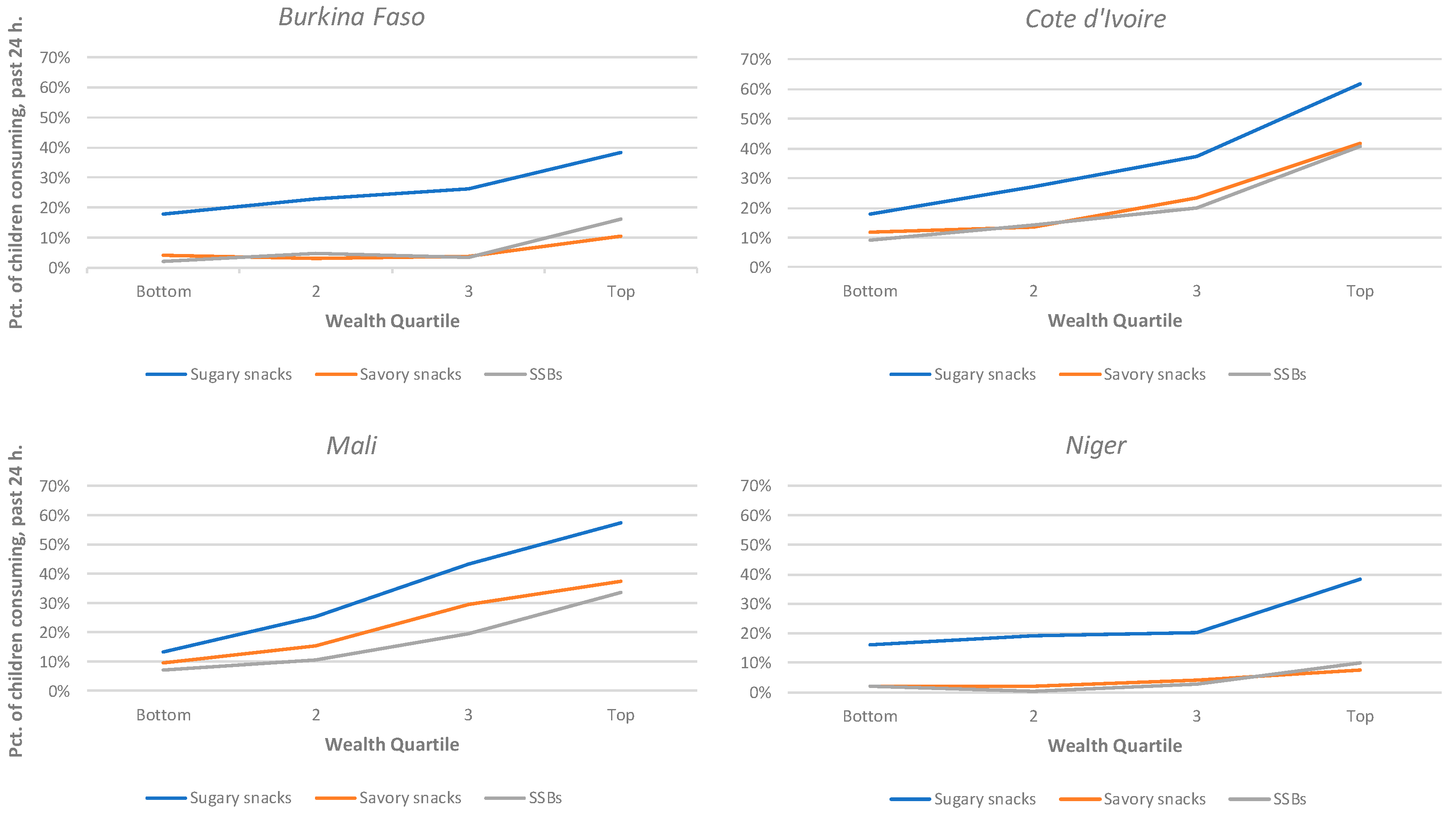
Commercial Snack Food and Beverage Consumption Prevalence among Children 6–59 Months in West Africa


Abstract
1. Introduction
2. Material and Methods
3. Results
4. Discussion
5. Conclusions
Author Contributions
Funding
Acknowledgments
Conflicts of Interest
References
- Popkin, B.M.; Adair, L.S.; Ng, S.W. Global nutrition transition and the pandemic of obesity in developing countries. Nutr Rev. 2012, 70, 3–21. [Google Scholar] [CrossRef]
- 2018 Global Nutrition Report: Shining a Light to Spur Action on Nutrition; Development Initiatives: Bristol, UK, 2018.
- Adair, L.S.; Popkin, B.M. Are child eating patterns being transformed globally? Obes Res. 2005, 13, 1281–1299. [Google Scholar] [CrossRef] [PubMed]
- Pries, A.M.; Huffman, S.L.; Champeny, M.; Adhikary, I.; Benjamin, M.; Coly, A.N.; Diop, E.H.I.; Mengkheang, K.; Sy, N.Y.; Dhungel, S.; et al. Consumption of commercially produced snack foods and sugar–sweetened beverages during the complementary feeding period in four African and Asian urban contexts. Matern Child Nutr. 2017, 13 (Suppl. 2), e12412. [Google Scholar] [CrossRef]
- Kant, A.K. Reported Consumption of Low–Nutrient–Density Foods by American Children and Adolescents: Nutritional and Health Correlates, NHANES III, 1988 to 1994. Arch. Pediatr. Adolesc Med. 2003, 157, 789–796. [Google Scholar] [CrossRef]
- Welsh, J.A.; Cogswell, M.E.; Rogers, S.; Rockett, H.; Mei, Z.; Grummer–Strawn, L.M. Overweight among low–income preschool children associated with the consumption of sweet drinks: Missouri, 1999–2002. Pediatrics 2005, 115, e223–e229. [Google Scholar] [CrossRef] [PubMed]
- Tinanoff, N.; Palmer, C.A. Dietary Determinants of Dental Caries and Dietary Recommendations for Preschool Children. J. Public Health Dent. 2000, 60, 197–206. [Google Scholar] [CrossRef]
- Johansson, I.; Lif Holgerson, P.; Kressin, N.R.; Nunn, M.E.; Tanner, A.C. Snacking Habits and Caries in Young Children. Caries Res. 2010, 44, 421–430. [Google Scholar] [CrossRef]
- Nicklas, T.A.; Yang, S.–.J.; Baranowski, T.; Zakeri, I.; Berenson, G. Eating patterns and obesity in children. The Bogalusa Heart Study. Am. J. Prev Med. 2003, 25, 9–16. [Google Scholar] [CrossRef]
- Phillips, S.M.; Bandini, L.G.; Naumova, E.N.; Cyr, H.; Colclough, S.; Dietz, W.H.; Must, A. Energy–dense snack food intake in adolescence: Longitudinal relationship to weight and fatness. Obes Res. 2004, 12, 461–472. [Google Scholar] [CrossRef]
- Asfaw, A. Does consumption of processed foods explain disparities in the body weight of individuals? The case of Guatemala. Health Econ. 2011, 20, 184–195. [Google Scholar] [CrossRef]
- Tavares, L.F.; Fonseca, S.C.; Garcia Rosa, M.L.; Yokoo, E.M. Relationship between ultra–processed foods and metabolic syndrome in adolescents from a Brazilian Family Doctor Program. Public Health Nutr. 2012, 15, 82–87. [Google Scholar] [CrossRef]
- Pries, A.M.; Filteau, S.; Ferguson, E.L. Snack food and beverage consumption and young child nutrition in low– and middle–income countries: A systematic review. Matern Child Nutr. 2019, 15 (Suppl. 4), e12729. [Google Scholar] [CrossRef] [PubMed]
- Faber, M.; Benadé, A. Breastfeeding, complementary feeding and nutritional status of 6–12–month–old infants in rural KwaZulu–Natal. S. Afr. J. Clin. Nutr. 2007, 20, 16–24. [Google Scholar]
- PMA2020 Nutrition Survey Results: Burkina Faso August 2018. Performance Monitoring and Accountability 2020. August 2018. Available online: http://www.pma2020.org/sites/default/files/Burkinafaso_Nutrition_R2_02272019_Final_English.pdf (accessed on 2 October 2019).
- PMA2020 Nutrition Survey Results: Kenya August 2018. Performance Monitoring and Accountability 2020. August 2018. Available online: http://www.pma2020.org/sites/default/files/Kenya_Nutrition_2Pager_022719.pdf (accessed on 2 October 2019).
- Huffman, S.L.; Piwoz, E.G.; Vosti, S.A.; Dewey, K.G. Babies, soft drinks and snacks: A concern in low– and middle–income countries? Matern Child Nutr. 2014, 10, 562–574. [Google Scholar] [CrossRef]
- Staatz, J.; Hollinger, F. West African Food Systems and Changing Consumer Demands. OECD 2016, 26. [Google Scholar] [CrossRef]
- Amugsi, D.A.; Dimbuene, Z.T.; Kyobutungi, C. Correlates of the double burden of malnutrition among women: An analysis of cross sectional survey data from sub–Saharan Africa. BMJ Open 2019, 9, e029545. [Google Scholar] [CrossRef]
- Zeba, A.N.; Delisle, H.F.; Renier, G. Dietary patterns and physical inactivity, two contributing factors to the double burden of malnutrition among adults in Burkina Faso, West Africa. J. Nutr. Sci. 2014. Available online: https://www.ncbi.nlm.nih.gov/pmc/articles/PMC4473138/ (accessed on 2 October 2019).
- World Health Organization. Global Report on Diabetes. 2016. Available online: https://apps.who.int/iris/bitstream/handle/10665/204871/9789241565257_eng.pdf;jsessionid=6753E8F17248F32219C52E402CA88C5B?sequence=1 (accessed on 2 October 2019).
- Institut National de la Statistique et de la Démographie (INSD) et ICF International. Enquête Démographique et de Santé et à Indicateurs Multiples du Burkina Faso 2010; INSD et ICF International: Calverton, MD, USA, 2012. [Google Scholar]
- Institut National de la Statistique (INS) et ICF International. Enquête Démographique et de Santé et à Indicateurs Multiples du Niger 2012; INS et ICF International: Calverton, MD, USA, 2013. [Google Scholar]
- Institut National de la Statistique (INS) et ICF International. Enquête Démographique et de Santé et à Indicateurs Multiples de Côte d’Ivoire 2011-2012; INS et ICF International: Calverton, MD, USA, 2012. [Google Scholar]
- Cellule de Planification et de Statistique (CPS/SSDSPF), Institut National de la Statistique (INSTAT/MPATP), INFO-STAT et ICF International. Enquête Démographique et de Santé au Mali 2012-2013; CPS, INSTAT, INFO-STAT et ICF International: Rockville, MD, USA, 2014. [Google Scholar]
- World Health Organization. Vaccination Coverage Cluster Surveys: Reference Manual Version 3; World Health Organization: Geneva, Switzerland, July 2014. Available online: https://www.who.int/immunization/monitoring_surveillance/Vaccination_coverage_cluster_survey_with_annexes.pdf (accessed on 3 October 2019).
- Feeley, A.B.; Ndeye Coly, A.; Sy Gueye, N.Y.; Diop, E.I.; Pries, A.M.; Champeny, M.; Zehner, E.R.; Huffman, S.L. Promotion and consumption of commercially produced foods among children: Situation analysis in an urban setting in Senegal. Matern Child. Nutr. 2016, 12 (Suppl. 2), 64–76. [Google Scholar] [CrossRef] [PubMed]
- Vitta, B.S.; Benjamin, M.; Pries, A.M.; Champeny, M.; Zehner, E.; Huffman, S.L. Infant and young child feeding practices among children under 2 years of age and maternal exposure to infant and young child feeding messages and promotions in Dar es Salaam, Tanzania. Matern Child. Nutr. 2016, 12 (Suppl. 2), 77–90. [Google Scholar] [CrossRef]
- Stata Statistical Software: Release 15; StataCorp LLC: College Station, TX, USA, 2017.
- WHO. Indicators for Assessing Infant and Young Child. Feeding Practices: Part. 1 Definitions; World Health Organization: Geneva, Switzerland, 2008. [Google Scholar]
- Monteiro, C.A.; Levy, R.B.; Claro, R.M.; de Castro, I.R.R.; Cannon, G. Increasing consumption of ultra–processed foods and likely impact on human health: Evidence from Brazil. Public Health Nutr. 2011, 14, 5–13. [Google Scholar] [CrossRef]
- Lucan, S.C.; Karpyn, A.; Sherman, S. Storing empty calories and chronic disease risk: Snack–food products, nutritive content, and manufacturers in Philadelphia corner stores. J. Urban. Health. 2010, 87, 394–409. [Google Scholar] [CrossRef]
- Waseem, A.; Nafees, M.; Murtaza, G.; Sajjad, A.; Mehmood, Z.; Siddiqi, A.R. Salt Toxicity (Sodium Intake): A Serious Threat to Infants and Children of Pakistan. Iran. J. Public Health. 2014, 43, 1204–1211. [Google Scholar] [PubMed]
- Moodie, R.; Stuckler, D.; Monteiro, C.; Sheron, N.; Neal, B.; Thamarangsi, T.; Lincoln, P.; Casswell, S.; Lancet NCD Action Group. Profits and pandemics: Prevention of harmful effects of tobacco, alcohol, and ultra–processed food and drink industries. Lancet 2013, 381, 670–679. [Google Scholar] [CrossRef]
- Kimmons, J.E.; Dewey, K.G.; Haque, E.; Chakraborty, J.; Osendarp, S.J.M.; Brown, K.H. Low Nutrient Intakes among Infants in Rural Bangladesh Are Attributable to Low Intake and Micronutrient Density of Complementary Foods. J. Nutr. 2005, 135, 444–451. [Google Scholar] [CrossRef] [PubMed]
- Bhargava, A.; Amialchuk, A. Added sugars displaced the use of vital nutrients in the National Food Stamp Program Survey. J. Nutr. 2007, 137, 453–460. [Google Scholar] [CrossRef][Green Version]
- Gibson, S.A. Non–milk extrinsic sugars in the diets of pre–school children: Association with intakes of micronutrients, energy, fat and NSP. Br. J. Nutr. 1997, 78, 367–378. [Google Scholar] [CrossRef]
- Marriott, B.P.; Olsho, L.; Hadden, L.; Connor, P. Intake of added sugars and selected nutrients in the United States, National Health and Nutrition Examination Survey (NHANES) 2003–2006. Crit Rev. Food Sci Nutr. 2010, 50, 228–258. [Google Scholar] [CrossRef]
- Murakami, K.; Livingstone, M.B.E. Decreasing the number of small eating occasions (<15 % of total energy intake) regardless of the time of day may be important to improve diet quality but not adiposity: A cross–sectional study in British children and adolescents. Br. J. Nutr. 2016, 115, 332–341. [Google Scholar]
- Webb, K.L.; Lahti-Koski, M.; Rutishauser, I.; Hector, D.J.; Knezevic, N.; Gill, T.; Peat, J.K.; Leeder, S.R.; CAPS Team. Consumption of ‘extra’ foods (energy–dense, nutrient–poor) among children aged 16–24 months from western Sydney, Australia. Public Health Nutr. 2006, 9, 1035–1044. [Google Scholar] [CrossRef]
- Pries, A.M.; Rehman, A.M.; Filteau, S.; Sharma, N.; Upadhyay, A.; Ferguson, E.L. Unhealthy Snack Food and Beverage Consumption Is Associated with Lower Dietary Adequacy and Length–for–Age z–Scores among 12–23–Month–Olds in Kathmandu Valley, Nepal. J. Nutr. 2019, 149, 1843–1851. [Google Scholar] [CrossRef]
- DiMeglio, D.P.; Mattes, R.D. Liquid versus solid carbohydrate: Effects on food intake and body weight. Int J. Obes Relat Metab Disord. 2000, 24, 794–800. [Google Scholar] [CrossRef]
- Mattes, R.D.; Campbell, W.W. Effects of food form and timing of ingestion on appetite and energy intake in lean young adults and in young adults with obesity. J. Am. Diet. Assoc. 2009, 109, 430–437. [Google Scholar] [CrossRef] [PubMed]
- Birch, L.L.; Doub, A.E. Learning to eat: Birth to age 2 y. Am. J. Clin. Nutr. 2014, 99, 723–728. [Google Scholar] [CrossRef] [PubMed]
- Mennella, J.A. Ontogeny of taste preferences: Basic biology and implications for health. Am. J. Clin. Nutr. 2014, 99, 704S–711S. [Google Scholar] [CrossRef] [PubMed]
- World Health Organization. Global Status Report on Noncommunicable Diseases 2010: Description of the Global Burden of NCDs, Their Risk Factors and Determinants; World Health Organization: Geneva, Switzerland, 2011; p. 176. [Google Scholar]
- Headey, D.D.; Alderman, H.H. The Relative Caloric Prices of Healthy and Unhealthy Foods Differ Systematically across Income Levels and Continents. J. Nutr. 2019. [Google Scholar] [CrossRef]


| Burkina Faso | Cote d’Ivoire | Mali | Niger | |
|---|---|---|---|---|
| Stunting among children 6–59 months | Rural: 37.3% Urban: 21.3% | Rural: 34.9% Urban: 20.5% | Rural: 41.9% Urban: 23.2% | Rural: 45.9% Urban: 29.6% |
| Anemia among children 6–59 months | Rural: 89.9% Urban: 77.6% | Rural: 79.3% Urban: 67.2% | Rural: 84.9% Urban: 67.5% | Rural: 69.8% Urban: 73.9% |
| Minimum dietary diversity among children 6–23 months | Rural: 3.9% Urban: 11.5% | Rural: 5.8% Urban: 20.0% | Rural: 31.3% Urban: 49.7% | Rural: 6.4% Urban: 30.4% |
| Burkina Faso | Cote d’Ivoire | Mali | Niger | |
|---|---|---|---|---|
| Caregiver age (y) * | 33.0 (32.2–33.8) | 33.2 (32.3–34.1) | 31.7 (30.8–32.5) | 31.3 (30.5–32.1) |
| Caregiver sex (% female) | 86.3% (2801) | 83.4% (2918) | 84.4% (1885) | 91.3% (2600) |
| Child age (m) * | 31.8 (31.2–32.3) | 32.6 (31.9–33.3) | 31.0 (30.4–31.6) | 30 (29.5–31.1) |
| Aged 6–23 (m) | 36.9% (1172) | 35.1% (1263) | 32.3% (720) | 26.3% (1030) |
| Aged 2–5 (y) | 63.1% (2059) | 48.9% (2275) | 67.7% (1492) | 73.7% (1805) |
| Child sex (% female) | 48.0% (1562) | 48.6% (1707) | 49.2% (1086) | 50.9% (1416) |
| Urban residence (%) | 10.3% (666) | 52.8% (1738) | 26.7% (1509) | 7.9% (347) |
| Use of improved water source | 90.2% (2947) | 83.9% (2946) | 74.3% (1679) | 61.5% (1769) |
| Improved toilet access | 23.1% (860) | 27.6% (918) | 35.0% (850) | 9.6% (343) |
| Caregiver completed primary school | 25.3% (935) | 39.5% (1315) | 36.5% (836) | 17.9% (558) |
| n | 3231 | 3538 | 2212 | 2556 |
| Ages 6–23.9 months | ||||||||||||||||
| Burkina Faso | Cote d’Ivoire | Mali | Niger | |||||||||||||
| Rural | Urban | Total | p | Rural | Urban | Total | p | Rural | Urban | Total | p | Rural | Urban | Total | p | |
| Sugary drinks | 2.8% (27) | 17.9% (43) | 4.3% (70) | 0.000 | 9.1% (51) | 21.7% (102) | 15.4% (153) | 0.000 | 8.9% (42) | 28.4% (73) | 14.6% (115) | 0.000 | 1.6% (7) | 8.9% (6) | 2.3% (13) | 0.001 |
| Savory or sugary snacks | 19.3% (182) | 38.7% (89) | 21.3% (273) | 0.000 | 26.1% (149) | 42.0% (218) | 34.0% (367) | 0.000 | 26.7% (125) | 61.8% (142) | 36.7% (267) | 0.000 | 17.9% (116) | 48.0% (53) | 20.7% (169) | 0.000 |
| Any | 20.3% (191) | 45.3% (106) | 22.8% (299) | 0.000 | 27.6% (159) | 45.9% (236) | 36.7% (395) | 0.000 | 27.9% (132) | 64.2% (149) | 38.4% (281) | 0.000 | 18.6% (118) | 49.0% (54) | 21.4% (172) | 0.000 |
| n | 937 | 235 | 1172 | 670 | 593 | 1263 | 477 | 250 | 727 | 687 | 108 | 795 | ||||
| Ages 2–5 years | ||||||||||||||||
| Burkina Faso | Cote d’Ivoire | Mali | Niger | |||||||||||||
| Rural | Urban | Total | p | Rural | Urban | Total | p | Rural | Urban | Total | p | Rural | Urban | Total | p | |
| Sugary drinks | 5.2% (84) | 24.9% (107) | 7.3% (191) | 0.000 | 13.3% (125) | 36.2% (337) | 25.8% (462) | 0.000 | 12.6% (126) | 36.3% (170) | 18.5% (296) | 0.000 | 3.3% (45) | 19.9% (42) | 4.6% (87) | 0.000 |
| Savory or sugary snacks | 27.1% (429) | 54.1% (235) | 29.9% (667) | 0.000 | 30.0% (282) | 61.3% (598) | 47.0% (880) | 0.000 | 34.3% (328) | 72.3% (303) | 43.7% (631) | 0.000 | 27.2% (402) | 64.9% (140) | 30.2% (542) | 0.000 |
| Any | 27.8% (440) | 60.1% (259) | 31.2% (702) | 0.000 | 32.5% (308) | 64.9% (640) | 50.1% (948) | 0.000 | 36.2% (347) | 76.5% (324) | 46.3% (671) | 0.000 | 27.2% (406) | 65.6% (141) | 30.4% (547) | 0.000 |
| n | 1607 | 452 | 2059 | 1138 | 1175 | 2313 | 1032 | 460 | 1492 | 1605 | 221 | 1826 | ||||
| RURAL AREAS | ||||||||||||
| Ages 6–23.9 months | ||||||||||||
| Burkina Faso | Cote d’Ivoire | Mali | Niger | |||||||||
| Bottom | Top | p | Bottom | Top | p | Bottom | Top | p | Bottom | Top | p | |
| Sugary drinks | 0.5% (1) | 3.8% (10) | 0.032 | 8.4% (51) | 7.7% (102) | 0.872 | 5.5% (7) | 13.5% (15) | 0.0319 | 1.8% (1) | 0.5% (2) | 0.259 |
| Savory or sugary snacks | 9.9% (17) | 22.6% (60) | 0.004 | 24.5% (149) | 20.7% (218) | 0.526 | 14.6% (17) | 36.0% (41) | 0.000 | 8.0% (12) | 26.6% (45) | 0.000 |
| Any | 9.9% (17) | 24.6% (65) | 0.001 | 25.8% (159) | 24.0% (236) | 0.782 | 16.8% (20) | 38.3% (44) | 0.001 | 8.0% (12) | 26.6% (45) | 0.000 |
| n | 171 | 262 | 145 | 163 | 118 | 119 | 146 | 182 | ||||
| Ages 2–5 years | ||||||||||||
| Sugary drinks | 1.2% (4) | 7.6% (31) | 0.000 | 12.3% (25) | 20.0% (337) | 0.202 | 8.7% (22) | 21.7% (53) | 0.002 | 1.0% (3) | 8.0% (25) | 0.001 |
| Savory or sugary snacks | 12.9% (42) | 39.3% (160) | 0.000 | 26.8% (282) | 35.7% (598) | 0.119 | 16.6% (39) | 53.8% (128) | 0.000 | 13.5% (46) | 42.5% (145) | 0.000 |
| Any | 12.9% (42) | 45.3% (163) | 0.000 | 29.1% (308) | 38.0% (640) | 0.104 | 18.7% (44) | 57.8% (137) | 0.000 | 13.8% (47) | 42.2% (145) | 0.000 |
| n | 318 | 404 | 282 | 268 | 250 | 259 | 351 | 391 | ||||
| URBAN AREAS | ||||||||||||
| Ages 6–23.9 months | ||||||||||||
| Burkina Faso | Cote d’Ivoire | Mali | Niger | |||||||||
| Bottom | Top | p | Bottom | Top | p | Bottom | Top | p | Bottom | Top | p | |
| Sugary drinks | 2.8% (2) | 44.8% (24) | 0.0000 | 11.5% (10) | 32.6% (52) | 0.005 | 20.6% (17) | 25.5% (17) | 0.5851 | 6.4% (1) | 4.7% (1) | 0.8327 |
| Savory or sugary snacks | 39.6% (23) | 58.8% (31) | 0.0703 | 19.4% (28) | 55.5% (92) | 0.000 | 43.7% (29) | 71.8% (40) | 0.0104 | 37.2% (11) | 67.3% (16) | 0.1081 |
| Any | 41.3% (24) | 73.6% (40) | 0.0002 | 24.1% (32) | 58.1% (96) | 0.000 | 46.3% (31) | 68.9% (40) | 0.0698 | 37.2% (11) | 67.3% (16) | 0.1081 |
| n | 56 | 55 | 159 | 174 | 62 | 60 | 28 | 23 | ||||
| Ages 2–5 years | ||||||||||||
| Sugary drinks | 9.6% (11) | 41.1% (48) | 0.0001 | 17.4% (36) | 48.8% (144) | 0.000 | 26.6% (34) | 40.2% (47) | 0.0303 | 13.3% (6) | 23.8% (16) | 0.3463 |
| Savory or sugary snacks | 41.3% (44) | 69.2% (82) | 0.0009 | 33.7% (73) | 74.8% (221) | 0.000 | 60.2% (59) | 72.5% (84) | 0.1395 | 59.7% (29) | 80.1% (49) | 0.1661 |
| Any | 41.9% (45) | 78.4% (93) | 0.0000 | 35.1% (78) | 80.3% (238) | 0.000 | 64.4% (65) | 79.7% (94) | 0.0488 | 59.2% (29) | 80.1% (49) | 0.1551 |
| Cote d’Ivoire | ||||||
| Savory or sugary snacks | SSBs | |||||
| Odds ratio | 95% CI | p | Odds ratio | 95% CI | p | |
| Female child | 1.044 | 0.873–1.250 | 0.634 | 1.043 | 0.849–1.281 | 0.688 |
| Child age (m) | 1.019 | 1.013–1.025 | 0.000 | 1.022 | 1.015–1.029 | 0.000 |
| Respondent completed primary education | 1.500 | 1.206–1.866 | 0.000 | 1.422 | 1.057–1.913 | 0.020 |
| Households in top wealth quartile | 3.072 | 2.350–4.014 | 0.000 | 2.666 | 1.874–3.794 | 0.000 |
| Urban area | 1.751 | 1.249–2.455 | 0.001 | 1.928 | 1.287–2.889 | 0.002 |
| Constant (baseline odds) | 0.175 | 0.125–0.245 | 0.000 | 0.102 | 0.035–0.081 | 0.000 |
| n | 3193 | 3137 | ||||
| Mali | ||||||
| Savory or sugary snacks | SSBs | |||||
| Odds ratio | 95% CI | p | Odds ratio | 95% CI | p | |
| Female child | 0.909 | 0.748–1.104 | 0.332 | 0.991 | 0.769–1.277 | 0.941 |
| Child age (m) | 1.014 | 1.007–1.021 | 0.000 | 1.012 | 1.005–1.019 | 0.001 |
| Respondent completed primary education | 1.455 | 1.112–1.904 | 0.007 | 1.379 | 0.975–1.950 | 0.069 |
| Households in top wealth quartile | 2.431 | 1.660–3.560 | 0.000 | 2.070 | 1.333–3.216 | 0.001 |
| Urban area | 2.887 | 2.024–4.116 | 0.000 | 2.504 | 1.609–3.897 | 0.000 |
| Constant (baseline odds) | 0.258 | 0.184–0.361 | 0.000 | 0.185 | 0.049–0.112 | 0.000 |
| n | 2075 | 2102 | ||||
| Niger | ||||||
| Savory or sugary snacks | SSBs | |||||
| Odds ratio | 95% CI | p | Odds ratio | 95% CI | p | |
| Female child | 0.856 | 0.683–1.072 | 0.173 | 0.921 | 0.657–1.293 | 0.634 |
| Child age (m) | 1.028 | 1.021–1.034 | 0.000 | 1.034 | 1.018–1.050 | 0.000 |
| Respondent completed primary education | 2.051 | 1.383–3.043 | 0.000 | 2.273 | 1.009–5.122 | 0.048 |
| Households in top wealth quartile | 1.707 | 1.175–2.481 | 0.005 | 4.227 | 2.017–8.853 | 0.000 |
| Urban area | 2.491 | 1.493–4.155 | 0.001 | 2.140 | 0.831–5.512 | 0.114 |
| Constant (baseline odds) | 0.104 | 0.077–0.142 | 0.000 | 0.005 | 0.002–0.012 | 0.000 |
| n | 2651 | 2683 | ||||
| Burkina Faso | ||||||
| Savory or sugary snacks | SSBs | |||||
| Odds ratio | 95% CI | p | Odds ratio | 95% CI | p | |
| Female child | 1.013 | 0.863–1.189 | 0.873 | 1.068 | 0.805–1.418 | 0.646 |
| Child age (m) | 1.018 | 1.013–1.023 | 0.000 | 1.023 | 1.014–1.033 | 0.000 |
| Respondent completed primary education | 2.076 | 1.738–2.481 | 0.000 | 1.920 | 1.238–2.979 | 0.004 |
| Households in top wealth quartile | 1.558 | 1.282–1.892 | 0.000 | 3.244 | 2.094–5.026 | 0.000 |
| Urban area | 1.938 | 1.577–2.381 | 0.000 | 2.838 | 1.713–4.702 | 0.000 |
| Constant (baseline odds) | 0.140 | 0.112–0.174 | 0.000 | 0.013 | 0.008–0.020 | 0.000 |
| n | 3175 | 3160 | ||||
© 2019 by the authors. Licensee MDPI, Basel, Switzerland. This article is an open access article distributed under the terms and conditions of the Creative Commons Attribution (CC BY) license (http://creativecommons.org/licenses/by/4.0/).
Share and Cite
Nordhagen, S.; Pries, A.M.; Dissieka, R. Commercial Snack Food and Beverage Consumption Prevalence among Children 6–59 Months in West Africa. Nutrients 2019, 11, 2715. https://doi.org/10.3390/nu11112715
Nordhagen S, Pries AM, Dissieka R. Commercial Snack Food and Beverage Consumption Prevalence among Children 6–59 Months in West Africa. Nutrients. 2019; 11(11):2715. https://doi.org/10.3390/nu11112715
Chicago/Turabian StyleNordhagen, Stella, Alissa M. Pries, and Romance Dissieka. 2019. "Commercial Snack Food and Beverage Consumption Prevalence among Children 6–59 Months in West Africa" Nutrients 11, no. 11: 2715. https://doi.org/10.3390/nu11112715
APA StyleNordhagen, S., Pries, A. M., & Dissieka, R. (2019). Commercial Snack Food and Beverage Consumption Prevalence among Children 6–59 Months in West Africa. Nutrients, 11(11), 2715. https://doi.org/10.3390/nu11112715