

Skip Content
You are currently on the new version of our website. Access the old version .

Toxins, Volume 8, Issue 4

2016 April - 34 articles

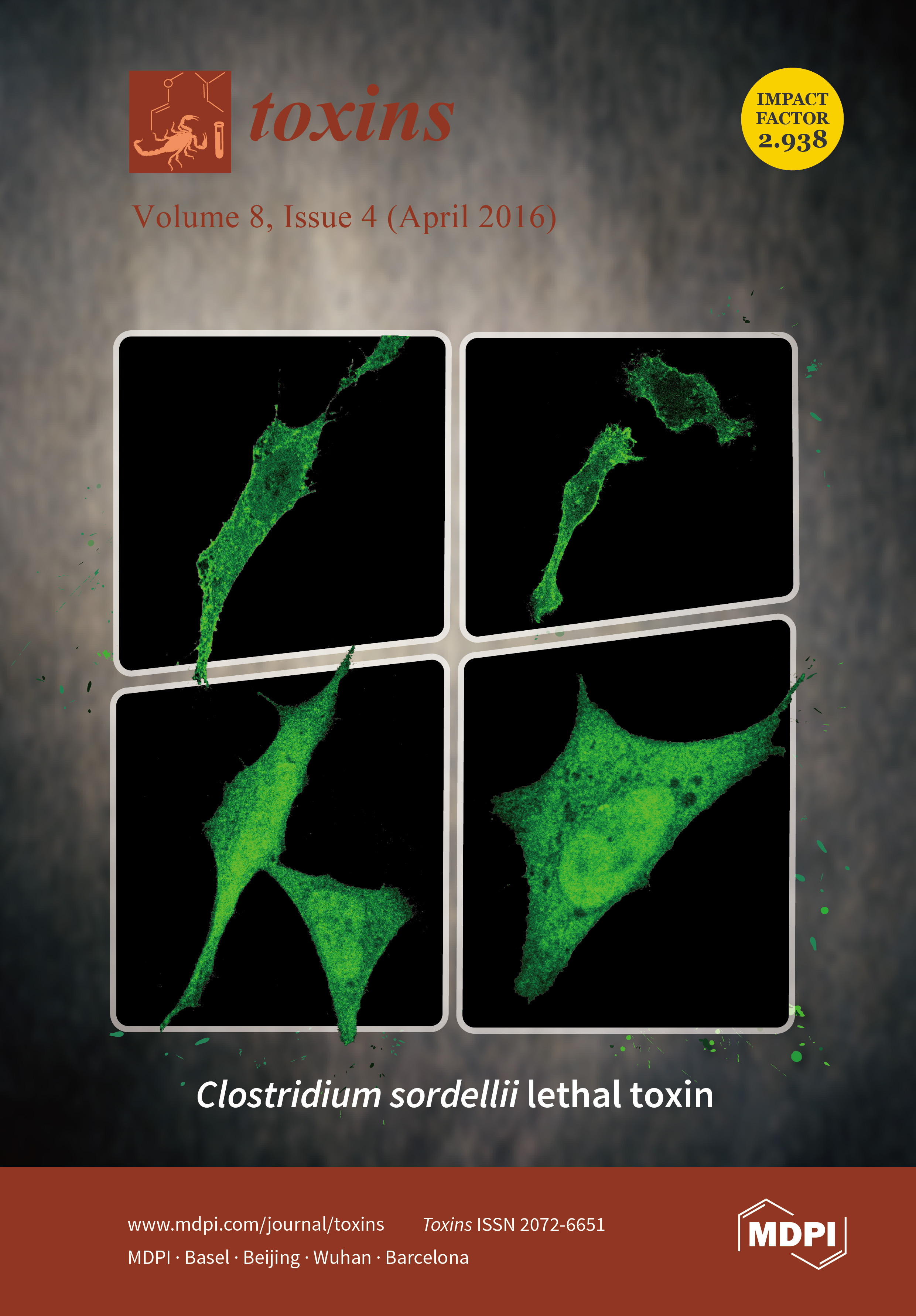
Cover Story: Clostridium sordellii lethal toxin (TcsL) is a powerful virulence factor responsible for severe toxic shock in man and animals. TcsL glucosylates small GTPases lead to cell death. The catalytic domain of TcsL (TcsL-cat) was found to preferentially bind to phosphatidylserine (PS)-containing membranes and to increase the glucosylation of Rac and Ras anchored to lipid membrane. The PS binding site is localized on the tip of the four-helix bundle which is rich in positively charged amino acids. Functional PS-binding site is required for TcsL-cat binding to the plasma membrane and subsequent cytotoxicity. View this article.
  • Issues are regarded as officially published after their release is announced to the table of contents alert mailing list .
  • You may sign up for email alerts to receive table of contents of newly released issues.
  • PDF is the official format for papers published in both, html and pdf forms. To view the papers in pdf format, click on the "PDF Full-text" link, and use the free Adobe Reader to open them.

Articles (34)

  • Review
  • Open Access
141 Citations
14,339 Views
14 Pages

23 April 2016

Since the discovery of the first disintegrin protein from snake venom and the following identification of a mammalian membrane-anchored metalloprotease-disintegrin implicated in fertilization, almost three decades of studies have identified additiona...

  • Review
  • Open Access
37 Citations
6,370 Views
12 Pages

21 April 2016

The use of onabotulinumtoxinA (BoNT-A) for the treatment of lower urinary tract diseases (LUTD) has increased markedly in recent years. The indications for BoNT-A treatment of LUTD now include neurogenic or idiopathic detrusor overactivity, interstit...

  • Article
  • Open Access
41 Citations
9,072 Views
13 Pages

Application of LC-MS/MS MRM to Determine Staphylococcal Enterotoxins (SEB and SEA) in Milk

  • Mirjana Andjelkovic,
  • Varvara Tsilia,
  • Andreja Rajkovic,
  • Koen De Cremer and
  • Joris Van Loco

20 April 2016

Staphylococcus aureus is one of the important aetiological agents of food intoxications in Europe and can cause gastro-enteritis through the production of various staphylococcal enterotoxins (SEs) in foods. Due to their stability and ease of producti...

  • Article
  • Open Access
48 Citations
9,309 Views
12 Pages

Identification and Characterization of the HicAB Toxin-Antitoxin System in the Opportunistic Pathogen Pseudomonas aeruginosa

  • Gang Li,
  • Mengyu Shen,
  • Shuguang Lu,
  • Shuai Le,
  • Yinling Tan,
  • Jing Wang,
  • Xia Zhao,
  • Wei Shen,
  • Keke Guo and
  • Ming Li
  • + 4 authors

19 April 2016

Toxin-antitoxin (TA) systems are small genetic modules that are widely distributed in the genomes of bacteria and archaea and have been proposed to fulfill numerous functions. Here, we describe the identification and characterization of a type II TA...

  • Feature Paper
  • Review
  • Open Access
41 Citations
13,496 Views
30 Pages

From Mollusks to Medicine: A Venomics Approach for the Discovery and Characterization of Therapeutics from Terebridae Peptide Toxins

  • Aida Verdes,
  • Prachi Anand,
  • Juliette Gorson,
  • Stephen Jannetti,
  • Patrick Kelly,
  • Abba Leffler,
  • Danny Simpson,
  • Girish Ramrattan and
  • Mandë Holford

19 April 2016

Animal venoms comprise a diversity of peptide toxins that manipulate molecular targets such as ion channels and receptors, making venom peptides attractive candidates for the development of therapeutics to benefit human health. However, identifying b...

  • Article
  • Open Access
22 Citations
6,198 Views
12 Pages

The Scorpion Toxin Analogue BmKTX-D33H as a Potential Kv1.3 Channel-Selective Immunomodulator for Autoimmune Diseases

  • Fang Ye,
  • Youtian Hu,
  • Weiwei Yu,
  • Zili Xie,
  • Jun Hu,
  • Zhijian Cao,
  • Wenxin Li and
  • Yingliang Wu

19 April 2016

The Kv1.3 channel-acting scorpion toxins usually adopt the conserved anti-parallel β-sheet domain as the binding interface, but it remains challenging to discover some highly selective Kv1.3 channel-acting toxins. In this work, we investigated the ph...

  • Review
  • Open Access
46 Citations
8,912 Views
11 Pages

Peptide Toxins in Solitary Wasp Venoms

  • Katsuhiro Konno,
  • Kohei Kazuma and
  • Ken-ichi Nihei

18 April 2016

Solitary wasps paralyze insects or spiders with stinging venom and feed the paralyzed preys to their larva. Accordingly, the venoms should contain a variety of constituents acting on nervous systems. However, only a few solitary wasp venoms have been...

  • Review
  • Open Access
288 Citations
28,910 Views
25 Pages

15 April 2016

Ochratoxin A (OTA) is a widely-spread mycotoxin all over the world causing major health risks. The focus of the present review is on the molecular and cellular interactions of OTA. In order to get better insight into the mechanism of its toxicity and...

  • Article
  • Open Access
38 Citations
7,293 Views
10 Pages

Detection of Enterotoxigenic Potential and Determination of Clonal Profile in Staphylococcus aureus and Coagulase-Negative Staphylococci Isolated from Bovine Subclinical Mastitis in Different Brazilian States

  • Priscila Luiza Mello,
  • Danilo Flávio Moraes Riboli,
  • Luiza Pinheiro,
  • Lisiane De Almeida Martins,
  • Maria Aparecida Vasconcelos Paiva Brito and
  • Maria De Lourdes Ribeiro de Souza da Cunha

15 April 2016

Epidemiological studies have identified Staphylococcus aureus as the most common agent involved in food poisoning. However, current research highlights the importance of toxigenic coagulase-negative staphylococci (CoNS) isolated from food. The aim of...

  • Article
  • Open Access
14 Citations
5,733 Views
16 Pages

The Response of Selected Triticum spp. Genotypes with Different Ploidy Levels to Head Blight Caused by Fusarium culmorum (W.G.Smith) Sacc.

  • Marian Wiwart,
  • Elżbieta Suchowilska,
  • Wolfang Kandler,
  • Michael Sulyok,
  • Urszula Wachowska and
  • Rudolf Krska

15 April 2016

Several cultivars and pure lines of Triticum monococcum, T. dicoccon, T. polonicum, T. spelta and T. aestivum were inoculated with Fusarium culmorum, the causal agent of Fusarium head blight in wheat. During the three-year study, the infection decrea...

  • Article
  • Open Access
25 Citations
7,042 Views
15 Pages

Review Over a 3-Year Period of European Union Proficiency Tests for Detection of Staphylococcal Enterotoxins in Food Matrices

  • Yacine Nia,
  • Isabelle Mutel,
  • Adrien Assere,
  • Bertrand Lombard,
  • Frederic Auvray and
  • Jacques-Antoine Hennekinne

13 April 2016

Staphylococcal food poisoning outbreaks are a major cause of foodborne illnesses in Europe and their notifications have been mandatory since 2005. Even though the European regulation on microbiological criteria for food defines a criterion on staphyl...

  • Feature Paper
  • Article
  • Open Access
7 Citations
6,410 Views
9 Pages

13 April 2016

Lethal Toxin from Clostridium sordellii (TcsL) and Toxin B from Clostridium difficile (TcdB) belong to the family of the “Large clostridial glycosylating toxins.” These toxins mono-O-glucosylate low molecular weight GTPases of the Rho and Ras familie...

  • Feature Paper
  • Article
  • Open Access
48 Citations
8,241 Views
17 Pages

The Kunitz-Type Protein ShPI-1 Inhibits Serine Proteases and Voltage-Gated Potassium Channels

  • Rossana García-Fernández,
  • Steve Peigneur,
  • Tirso Pons,
  • Carlos Alvarez,
  • Lidice González,
  • María A. Chávez and
  • Jan Tytgat

13 April 2016

The bovine pancreatic trypsin inhibitor (BPTI)-Kunitz-type protein ShPI-1 (UniProt: P31713) is the major protease inhibitor from the sea anemone Stichodactyla helianthus. This molecule is used in biotechnology and has biomedical potential related to...

  • Feature Paper
  • Article
  • Open Access
37 Citations
7,095 Views
22 Pages

Quantitative Proteomic Analysis of Venoms from Russian Vipers of Pelias Group: Phospholipases A2 are the Main Venom Components

  • Sergey I. Kovalchuk,
  • Rustam H. Ziganshin,
  • Vladislav G. Starkov,
  • Victor I. Tsetlin and
  • Yuri N. Utkin

12 April 2016

Venoms of most Russian viper species are poorly characterized. Here, by quantitative chromato-mass-spectrometry, we analyzed protein and peptide compositions of venoms from four Vipera species (V. kaznakovi, V. renardi, V. orlovi and V. nikolskii) in...

  • Article
  • Open Access
12 Citations
7,092 Views
17 Pages

Morphologic, Phylogenetic and Chemical Characterization of a Brackish Colonial Picocyanobacterium (Coelosphaeriaceae) with Bioactive Properties

  • Kerstin Häggqvist,
  • Anna Toruńska-Sitarz,
  • Agata Błaszczyk,
  • Hanna Mazur-Marzec and
  • Jussi Meriluoto

12 April 2016

Despite their cosmopolitan distribution, knowledge on cyanobacteria in the family Coelosphaeriaceae is limited. In this study, a single species culture of a coelosphaeran cyanobacterium isolated from a brackish rock pool in the Baltic Sea was establi...

  • Feature Paper
  • Article
  • Open Access
35 Citations
9,591 Views
13 Pages

δ-Ctenitoxin-Pn1a, a Peptide from Phoneutria nigriventer Spider Venom, Shows Antinociceptive Effect Involving Opioid and Cannabinoid Systems, in Rats

  • Bruna Luiza Emerich,
  • Renata C. M. Ferreira,
  • Marta N. Cordeiro,
  • Márcia Helena Borges,
  • Adriano M. C. Pimenta,
  • Suely G. Figueiredo,
  • Igor Dimitri G. Duarte and
  • Maria Elena De Lima

12 April 2016

PnTx4(6-1), henceforth renamed δ-Ctenitoxin-Pn1a (δ-CNTX-Pn1a), a peptide from Phoneutria nigriventer spider venom, initially described as an insect toxin, binds to site 3 of sodium channels in nerve cord synaptosomes and slows down sodium current in...

  • Feature Paper
  • Article
  • Open Access
25 Citations
6,778 Views
14 Pages

Comparison of Enzyme-Linked Immunosorbent Assay, Surface Plasmon Resonance and Biolayer Interferometry for Screening of Deoxynivalenol in Wheat and Wheat Dust

  • Melanie Sanders,
  • Daniel McPartlin,
  • Kara Moran,
  • Yirong Guo,
  • Mia Eeckhout,
  • Richard O’Kennedy,
  • Sarah De Saeger and
  • Chris Maragos

11 April 2016

A sample preparation method was developed for the screening of deoxynivalenol (DON) in wheat and wheat dust. Extraction was carried out with water and was successful due to the polar character of DON. For detection, an enzyme-linked immunosorbent ass...

  • Article
  • Open Access
78 Citations
14,839 Views
24 Pages

5 April 2016

Jellyfish venoms are rich sources of toxins designed to capture prey or deter predators, but they can also elicit harmful effects in humans. In this study, an integrated transcriptomic and proteomic approach was used to identify putative toxins and t...

  • Article
  • Open Access
14 Citations
6,671 Views
13 Pages

1 April 2016

Previously, the 126-kDa CyaA-hemolysin (CyaA-Hly) fragment cloned from Bordetella pertussis—the causative agent of whooping cough—and functionally expressed in Escherichia coli was revealed as a key determinant for CyaA-mediated hemolysis against tar...

  • Feature Paper
  • Review
  • Open Access
39 Citations
23,990 Views
21 Pages

1 April 2016

Cnidarian envenomations are an important public health problem, responsible for more deaths than shark attacks annually. For this reason, optimization of first-aid care is essential. According to the published literature, cnidarian venoms and toxins...

  • Article
  • Open Access
7 Citations
8,149 Views
14 Pages

EGA Protects Mammalian Cells from Clostridium difficile CDT, Clostridium perfringens Iota Toxin and Clostridium botulinum C2 Toxin

  • Leonie Schnell,
  • Ann-Katrin Mittler,
  • Mirko Sadi,
  • Michel R. Popoff,
  • Carsten Schwan,
  • Klaus Aktories,
  • Andrea Mattarei,
  • Domenico Azarnia Tehran,
  • Cesare Montecucco and
  • Holger Barth

1 April 2016

The pathogenic bacteria Clostridium difficile, Clostridium perfringens and Clostridium botulinum produce the binary actin ADP-ribosylating toxins CDT, iota and C2, respectively. These toxins are composed of a transport component (B) and a separate en...

  • Article
  • Open Access
9 Citations
7,399 Views
17 Pages

Detection and Quantification of ADP-Ribosylated RhoA/B by Monoclonal Antibody

  • Astrid Rohrbeck,
  • Viola Fühner,
  • Anke Schröder,
  • Sandra Hagemann,
  • Xuan-Khang Vu,
  • Sarah Berndt,
  • Michael Hust,
  • Andreas Pich and
  • Ingo Just

1 April 2016

Clostridium botulinum exoenzyme C3 is the prototype of C3-like ADP-ribosyltransferases that modify the GTPases RhoA, B, and C. C3 catalyzes the transfer of an ADP-ribose moiety from the co-substrate nicotinamide adenine dinucleotide (NAD) to asparagi...

  • Feature Paper
  • Article
  • Open Access
16 Citations
7,903 Views
13 Pages

Mechanisms that Determine the Differential Stability of Stx+ and Stx Lysogens

  • Michael P. Colon,
  • Dolonchapa Chakraborty,
  • Yonatan Pevzner and
  • Gerald B. Koudelka

31 March 2016

Phages 933W, BAA2326, 434, and λ are evolutionarily-related temperate lambdoid phages that infect Escherichia coli. Although these are highly-similar phages, BAA2326 and 933W naturally encode Shiga toxin 2 (Stx+), but phage 434 and λ do not (Stx). P...

  • Article
  • Open Access
31 Citations
10,118 Views
14 Pages

30 March 2016

The Staphylococcus aureus toxin, α-hemolysin, is an important and well-studied virulence factor in staphylococcal infection. It is a soluble monomeric protein that, once secreted by the bacterium, forms a heptameric pore in the membrane of a broad ra...

  • Article
  • Open Access
60 Citations
7,779 Views
17 Pages

26 March 2016

Antivenom neutralization against cobra venoms is generally low in potency, presumably due to poor toxin-specific immunoreactivity. This study aimed to investigate the effectiveness of two elapid antivenoms to neutralize the principal toxins purified...

  • Article
  • Open Access
9 Citations
7,705 Views
11 Pages

Biodistribution and Lymphatic Tracking of the Main Neurotoxin of Micrurus fulvius Venom by Molecular Imaging

  • Irene Vergara,
  • Erick Y. Castillo,
  • Mario E. Romero-Piña,
  • Itzel Torres-Viquez,
  • Dayanira Paniagua,
  • Leslie V. Boyer,
  • Alejandro Alagón and
  • Luis Alberto Medina

26 March 2016

The venom of the Eastern coral snake Micrurus fulvius can cause respiratory paralysis in the bitten patient, which is attributable to β-neurotoxins (β-NTx). The aim of this work was to study the biodistribution and lymphatic tracking by molecular ima...

  • Review
  • Open Access
183 Citations
16,162 Views
19 Pages

Hemorrhage Caused by Snake Venom Metalloproteinases: A Journey of Discovery and Understanding

  • José María Gutiérrez,
  • Teresa Escalante,
  • Alexandra Rucavado and
  • Cristina Herrera

26 March 2016

The historical development of discoveries and conceptual frames for understanding the hemorrhagic activity induced by viperid snake venoms and by hemorrhagic metalloproteinases (SVMPs) present in these venoms is reviewed. Histological and ultrastruct...

  • Review
  • Open Access
499 Citations
21,855 Views
36 Pages

Natural Co-Occurrence of Mycotoxins in Foods and Feeds and Their in vitro Combined Toxicological Effects

  • Marie-Caroline Smith,
  • Stéphanie Madec,
  • Emmanuel Coton and
  • Nolwenn Hymery

26 March 2016

Some foods and feeds are often contaminated by numerous mycotoxins, but most studies have focused on the occurrence and toxicology of a single mycotoxin. Regulations throughout the world do not consider the combined effects of mycotoxins. However, se...

  • Review
  • Open Access
15 Citations
5,854 Views
10 Pages

25 March 2016

Overactive bladder (OAB) symptoms increase with age and involve several comorbidities. OnabotulinumtoxinA (BoNT-A) intravesical injection is a treatment choice for patients who are intolerant of or refractory to antimuscarinics. However, the increase...

  • Feature Paper
  • Article
  • Open Access
34 Citations
11,280 Views
10 Pages

Rapid Detection of Escherichia coli O157 and Shiga Toxins by Lateral Flow Immunoassays

  • Jinliang Wang,
  • Robab Katani,
  • Lingling Li,
  • Narasimha Hegde,
  • Elisabeth L. Roberts,
  • Vivek Kapur and
  • Chitrita DebRoy

25 March 2016

Shiga toxin-producing Escherichia coli O157:H7 (STEC) cause food-borne illness that may be fatal. STEC strains enumerate two types of potent Shiga toxins (Stx1 and Stx2) that are responsible for causing diseases. It is important to detect the E. coli...

  • Article
  • Open Access
11 Citations
6,520 Views
17 Pages

The Tip of the Four N-Terminal α-Helices of Clostridium sordellii Lethal Toxin Contains the Interaction Site with Membrane Phosphatidylserine Facilitating Small GTPases Glucosylation

  • Carolina Varela Chavez,
  • Georges Michel Haustant,
  • Bruno Baron,
  • Patrick England,
  • Alexandre Chenal,
  • Serge Pauillac,
  • Arnaud Blondel and
  • Michel-Robert Popoff

25 March 2016

Clostridium sordellii lethal toxin (TcsL) is a powerful virulence factor responsible for severe toxic shock in man and animals. TcsL belongs to the large clostridial glucosylating toxin (LCGT) family which inactivates small GTPases by glucosylation w...

  • Article
  • Open Access
13 Citations
6,454 Views
11 Pages

Fumonisin B1 (FB1) Induces Lamellar Separation and Alters Sphingolipid Metabolism of In Vitro Cultured Hoof Explants

  • Nicole Reisinger,
  • Ilse Dohnal,
  • Veronika Nagl,
  • Simone Schaumberger,
  • Gerd Schatzmayr and
  • Elisabeth Mayer

24 March 2016

One of the most important hoof diseases is laminitis. Yet, the pathology of laminitis is not fully understood. Different bacterial toxins, e.g. endotoxins or exotoxins, seem to play an important role. Additionally, ingestion of mycotoxins, toxic seco...

  • Article
  • Open Access
22 Citations
6,930 Views
16 Pages

23 March 2016

Increasing evidence has demonstrated that in utero exposure to environmental chemicals may interfere with fetal development and increase the risk of disease and cancer development later in life. Ochratoxin A (OTA) has been proven to induce diverse to...

  • Feature Paper
  • Review
  • Open Access
25 Citations
6,402 Views
15 Pages

23 March 2016

Botulinum neurotoxin (BoNT) is used to treat a variety of ailments, and its therapeutic application in lower urinary tract disorders (LUTDs) is well studied. Robust evidence supporting the efficacy and tolerability of BoNT in the treatment of neuroge...

Get Alerted

Add your email address to receive forthcoming issues of this journal.

XFacebookLinkedIn
Toxins - ISSN 2072-6651