


Abstract
This article empirically provides a scientific production trends overview of coffee agronomy at the global level, allowing us to understand the structure of the epistemic community on this topic. The knowledge contributions documented are examined using a bibliometric approach (spatial, productive, and relational) based on data from 1618 records stored in the Web of Science (JCR and ESCI) between 1963 and May 2021, applying traditional bibliometric laws and using VOSviewer for the massive treatment of data and metadata. At the results level, there was an exponential increase in scientific production in the last six decades, with a concentration on only 15 specific journals; the insertion of new investigative peripheral and semiperipheral countries and organizations in worldwide relevance coauthorship networks, an evolution of almost 60 years in relevant thematic issues; and a co-occurring concentration in three large blocks: environmental sustainability of forestry, biological growth variables of coffee, and biotechnology of coffee species; topic blocks that, although in interaction, constitute three specific communities of knowledge production that have been delineated over time.
1. Introduction
This article empirically analyzes the global trends of research in coffee agronomy in terms of its evolution over time, the sources of documentation of scientific production, the geography of knowledge generation (national and organizational), and the topics under study. Research that has been marked by the sustainability agenda in coffee agroforestry has promoted interest in research on organic production systems, the preservation of local cultures and knowledge, biodiversity conservation, and agroecological principles to reconcile sustainable agriculture, considering socioeconomic and cultural contexts that vary at the local level, in order to devise economic development models to further improve the benefits and family budget for family and collective agriculture given its remarketing [1,2,3,4,5,6,7,8,9,10,11,12]. As a result, socioenvironmental standards and certifications have experienced a strong development in the coffee sector during the last decade [13,14,15,16,17].
Due to the Kyoto Protocol in the face of climate change, coffee agroforestry in general and organic farms have gained increased attention as a strategy for carbon sequestration (C), synergistically conserving biodiversity and reducing greenhouse gas (GHG) emissions [18,19,20,21,22,23]. Thus, to mitigate global climate change, researchers have proposed new production mechanisms, including studies of flowering phenology, the measurement of transpiration and water potential in different microclimatic conditions, and the periodic pruning of shade trees to increase the addition of organic matter and the return of nutrients to soil [24,25,26,27,28,29].
In addition, with increasing patterns of climate variability, water resources for agriculture may become more unpredictable and scarcer [30,31,32,33]. For this reason, the presence of shade trees (adequate pruning), the reuse of secondary treated wastewater (with fertilizer management and adequate nutritional conditions), irrigation performance and management (depths and technologies), and groundwater balance seek to reduce soil evaporation and coffee transpiration as measures to preserve water within the agroecosystem [2,34,35,36,37,38,39,40].
On the other hand, irrigation systems have become a common technique to improve coffee yields because they provide a more controlled production environment and avoid production losses due to water deficits, this subject being of interest to several researchers [1,2,41,42,43,44,45,46]. It has been pointed out that soil water deficit is one of the main factors affecting the vegetative development and productivity of coffee, so improving irrigation systems is an important area for researchers to demonstrate its effects [44]. On the other hand, climate change has increased the presence of coffee leaf rust (CLR) (H. vastatrix), which is one of the main diseases that strongly affect production [47,48,49], with an important influence on its costs [50,51]. Given the importance of the management of this disease, it is necessary to have a thorough knowledge of the species and its localities, as the level of incidence and intensity is determined by the microclimates depending on the geographic zones. It is for the same reason that strategies and systems must be designed to predict this disease [52]; however, an important task is to evaluate the pesticide efficiency [53] and determine the tolerance of different coffee genotypes [54]. Thus, drip irrigation techniques can be used to provide nutrients during the growth cycle of the plant based on the plant’s nutrient absorption rate, where fertigation improves nutrient use efficiency by gradually providing nutrients and according to their absorption rate [1].
With respect to contaminants in coffee, the use of organic fertilizers and nonselective herbicides (glyphosate) has been found to have transitory effects that could result in irreversible and prolonged damage to crop growth and drying conditions (in Coffea arabica L.), in addition to Ochratoxin A (OTA), the main mycotoxin found in coffee [55,56,57,58]. In terms of pest treatment, the use of yeasts in dual culture with filamentous fungi, the effect of the citrus mealybug Planococcus citri (Risso, 1813), and the study of 144 microorganisms previously isolated from the fruit of Coffea arabica to evaluate their proteolytic activities have been discussed [59,60,61]. There is also the use of shade trees (leguminous and nonleguminous) and organic inputs, particularly in areas where coffee berry disease is prevalent [62]
Scientific studies on coffee agronomy and the effect of micronutrients refer to the application of foliar spraying of Zn sulfate on crops and their yield in Arabian coffee (“Mundo Novo”), obtaining a positive response to increasing concentrations of ZnSO4 applied in oil to the leaves. On the other hand, the use of zinc (Zn) in treatments of acid clay soils in the southeastern region of Brazil had a positive result on soil attributes (chemical fertility, micronutrients, organic matter, and acidity), causing an improvement in pest management and soil recovery [63,64,65,66].
Harvesting and subsequent drying are two of the most important operations in coffee production systems, for which the drying technology must be adjusted under different parameters such as mathematical evaluations of the drying curves for different coffee species, thermal losses in the coffee dryer, rotation times, and energy efficiency in a fixed-bed coffee dryer for (Coffea arabica L.) [67,68], as well as a continuous rotator and its humidity percentages [69,70,71,72].
Finally, the conservation of biodiversity is an important challenge to maintain the richness of native, productive, and mitigation species in agricultural activity, the habitat being a conservation factor of great relevance for the sustainable development of coffee plantations; therefore, the subject is of great interest for several researchers [73,74,75,76,77]. It has been demonstrated that the rural development of geographic areas with population and production has been adapted to the local environment by following the farming methods and knowledge of the local people, protecting habitats, forestation areas, and the different forms of life in the ecosystem [78]. These landscapes have a relatively high level of agrobiodiversity compared to conventional (monoculture) agriculture [74]. Thus, coffee farms, as habitat fragments, can act as buffer zones and biological corridors between protected forests and other areas [79]. The use of shade trees in agroforestry can also offer an effective coping mechanism to implement in agricultural areas that suffer from extreme climates [25]. This includes crop diversification, coffee marketing activity (e.g., certification of coffee production and postharvest coffee processing), and migrant labor schemes [13,80,81].
2. Materials and Methods
We used a set of articles as a homogeneous basis for citation, counting the main collection of Web of Science (WoS) [82], by selecting articles published in WoS-indexed journals in the Science Citation Index (WoS-SCI), Social Science Citation Index (WoS-SSCI), and Emerging Science Citation Index (WoS-ESCI) based on a search vector [83] about coffee (TS = coffee) restricted to the WoS Agronomy category (WC = agronomy) and with unrestricted time parameters, performing the extraction on 22 May 2021 (See Table S1).
The resulting set of articles was analyzed bibliometrically in terms of their exponential growth to ensure a critical mass of documented scientific production that ensures interest in the international scientific community [84,85], determining the time median and its contemporary and obsolete periods. In terms of concentrations, Bradford’s law of concentrations was applied to the journals, fragmented into thirds of articles, avoiding the exponential decrease in decreasing performance by expanding the search of references in scientific journals peripheral to the topic under study [86,87,88,89,90,91]. Lotka’s law about authors was applied to identify the most prolific group of authors and study them in isolation from the majority of authors with a smaller number of articles based on the unequally distributed scientific production among authors [92]. The Hirsch index or h-index was used for articles based on the set of articles most cited by the scientific community and the citations they have received in other publications of the WoS core collection, established as the “n” documents cited “n” times or more [93,94]. Zipf’s law on words was applied to empirically determine words with the highest frequency of occurrence in the set of articles studied [95]. Information processing and the visualization of spatiality, coauthorship, and cooccurrence [96,97,98,99] were processed with VOSviewer, using fragmentation analysis with thematic and time trend visualization outputs [100,101,102,103,104,105,106,107,108].
3. Results
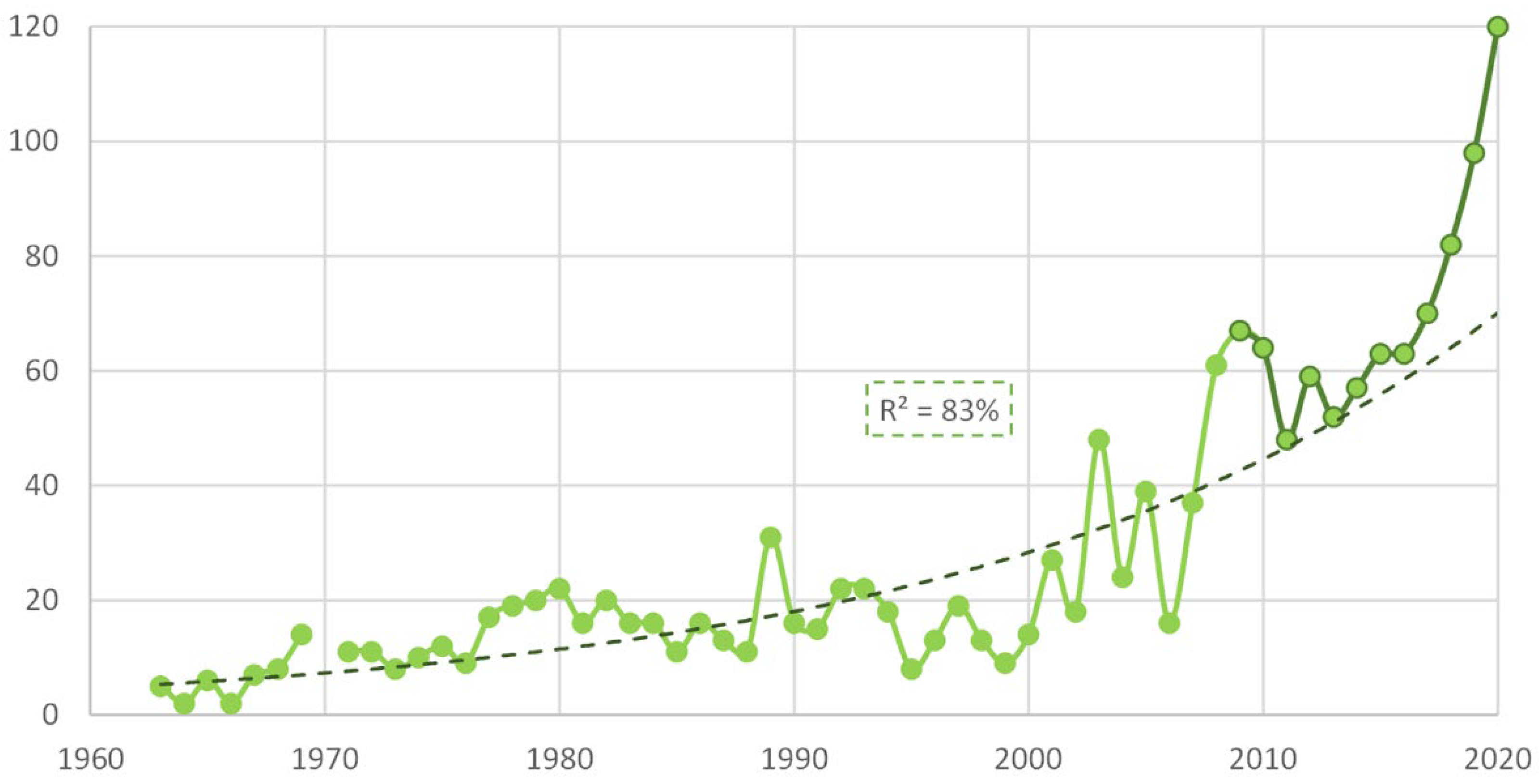
The results show that there is an exponential growth of documented mainstream research in coffee agronomy between the 1960s and the year 2020, with a scientific production that reached 120 articles in the last recorded year and half-periods of production (median years of publication) located in 2009, as shown in Figure 1. This evidence of compliance with Price’s law allows us to consistently give way to other types of bibliometric analysis.
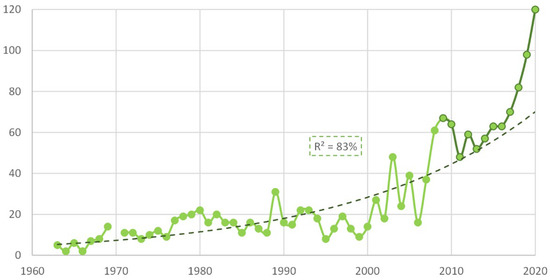
Figure 1.
Temporary trend of publications on coffee agronomy (1960s–2020s).
3.1. Scientific Production Environments
The first trend that we identified shows the places or environments of production, including both the bibliographic space of publication sources and the geographic space where this knowledge is generated.
3.1.1. Bibliographic Environments of Scientific Production
In terms of Bradford’s law, publications on coffee agronomy between 1963 and 2020 are concentrated in a core of 3 journals out of 125 in total that constitute Bradford’s core or main third of article concentration in a small number of journals. In the nucleus zone or first third of articles, 30% are covered, concentrated in three journals; in Zone 2 or the second third of articles, 37% of articles are covered (to complete the 2/3 of articles), concentrated in 12 semiperipheral journals; and finally, Zone 3 or last third covers the remaining articles (34%), dispersed in 110 peripheral journals. As for the Bradford multiplier calculated at 6.6 (average growth rate in the number of journals from one zone to the next), it allows us to calculate the theoretical series of journals that should be found in each zone so that the dispersion of journals is 22.2% lower than the situation we could theoretically have found in Zones 2 and 3, as detailed in Table 1.

Table 1.
Publications on coffee agronomy by Bradford’s zones between 1963 and 2020.
The Bradford zone calculation is reported, as indicated in Table 1. Given a core zone a = 3 and a mean multiplier n = 6.6, Equation (1) for the geometric series summation of Bradford (SSB) is:
with an error percentual margin (εp) in Equation (2):
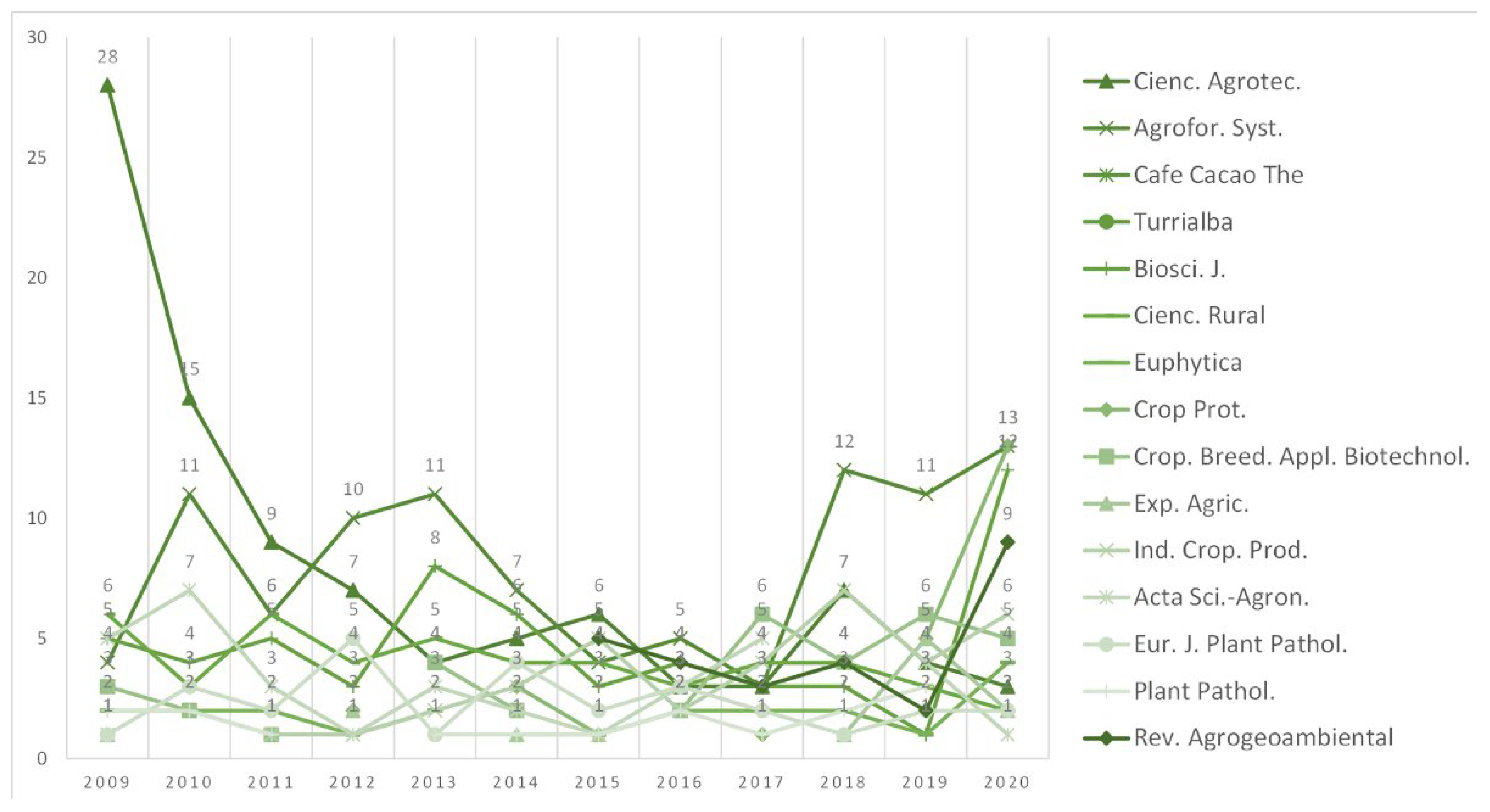
Figure 2 shows the evolution of articles published in the 15 journals of the nucleus and Zone 1, in the contemporary half-period from 2009 to 2020, which are mainly published by major worldwide editor companies or by Brazilian institutions (whose characteristics are detailed in Appendix A). As can be seen, the behavior is not homogeneous among the journals, and not all journals show increasing trends.
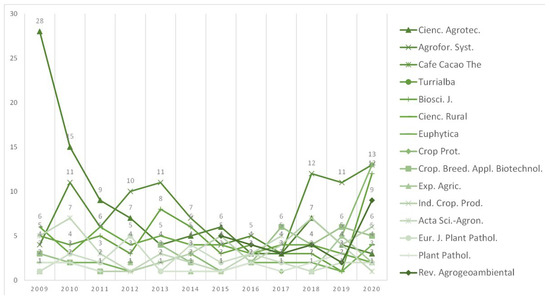
Figure 2.
Publications on coffee agronomy in journals from major Bradford zones (2009–2020).
Table 2 below shows that the journals in the WoS core collection (included in the Journal Citation Reports of Clarivate™ version 2020) with an increasing trend of publications on coffee agronomy are Crop Prot. (Q2), Crop. Breed. Appl. Biotechnol. (Q3), Ind. Crop. Prod. (Q1), and Agrogeoambiental Rev. (Emerging Sources Citation Index (ESCI)).
Table 2.
Journals from major Bradford zones (1960–2020 and 2009–2020).
3.1.2. Geographical Environments of Scientific Production
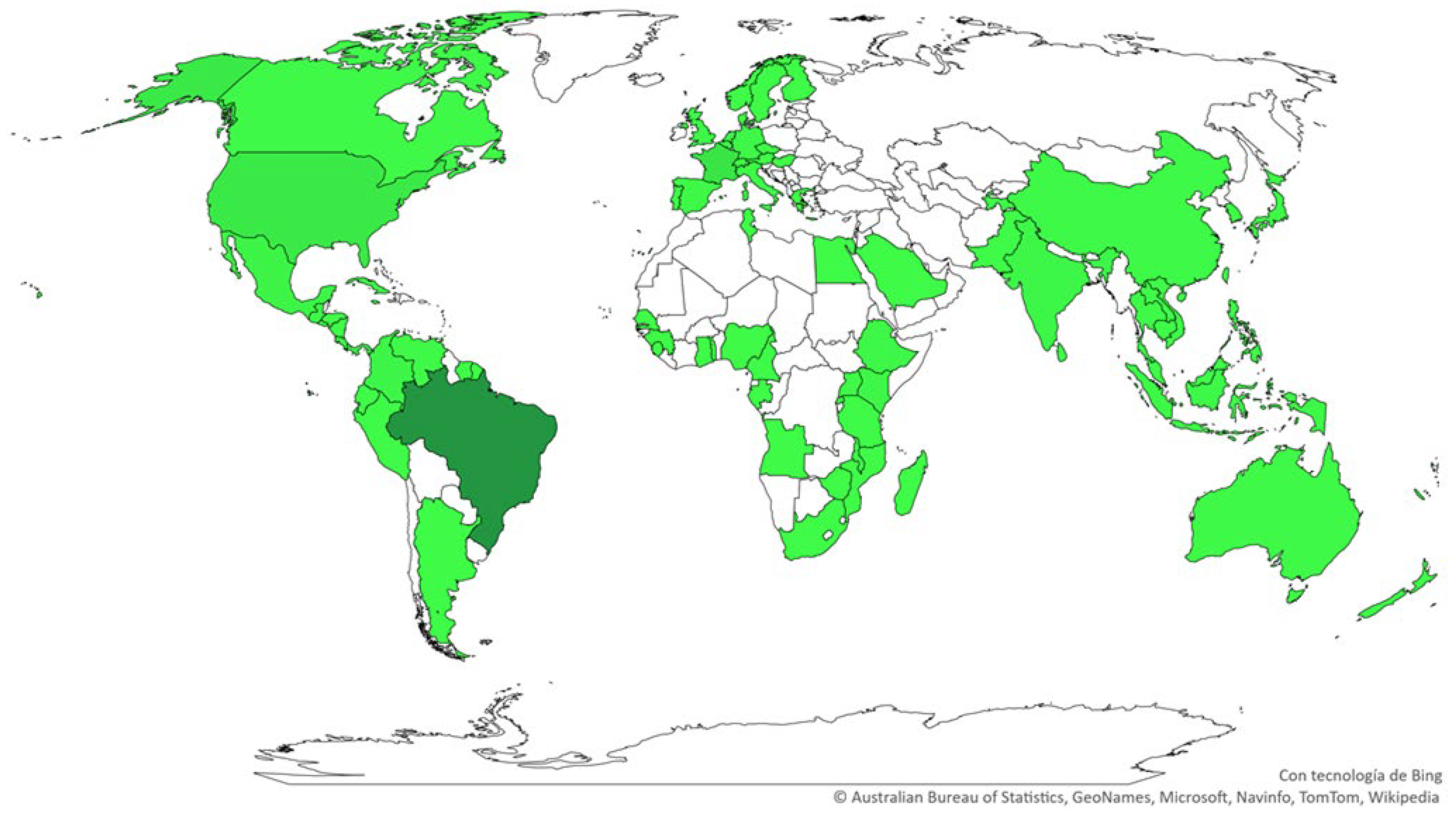
Regarding the geography of knowledge production on coffee agronomy, the set of extracted articles shows 89 countries of authorial affiliation (See Figure 3). Brazil has the largest number of contributions, participating in the coauthorship of 655 articles. Followed at a distance by France (150 articles) and USA (113 articles), all other countries have contributions of less than 100 articles.
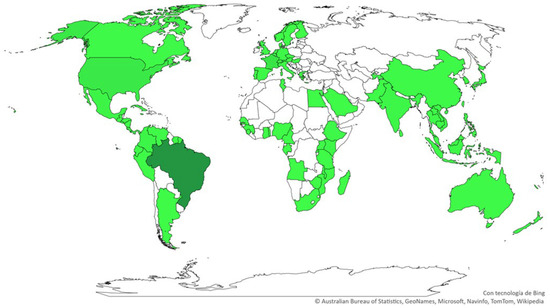
Figure 3.
Geography of documented scientific production.
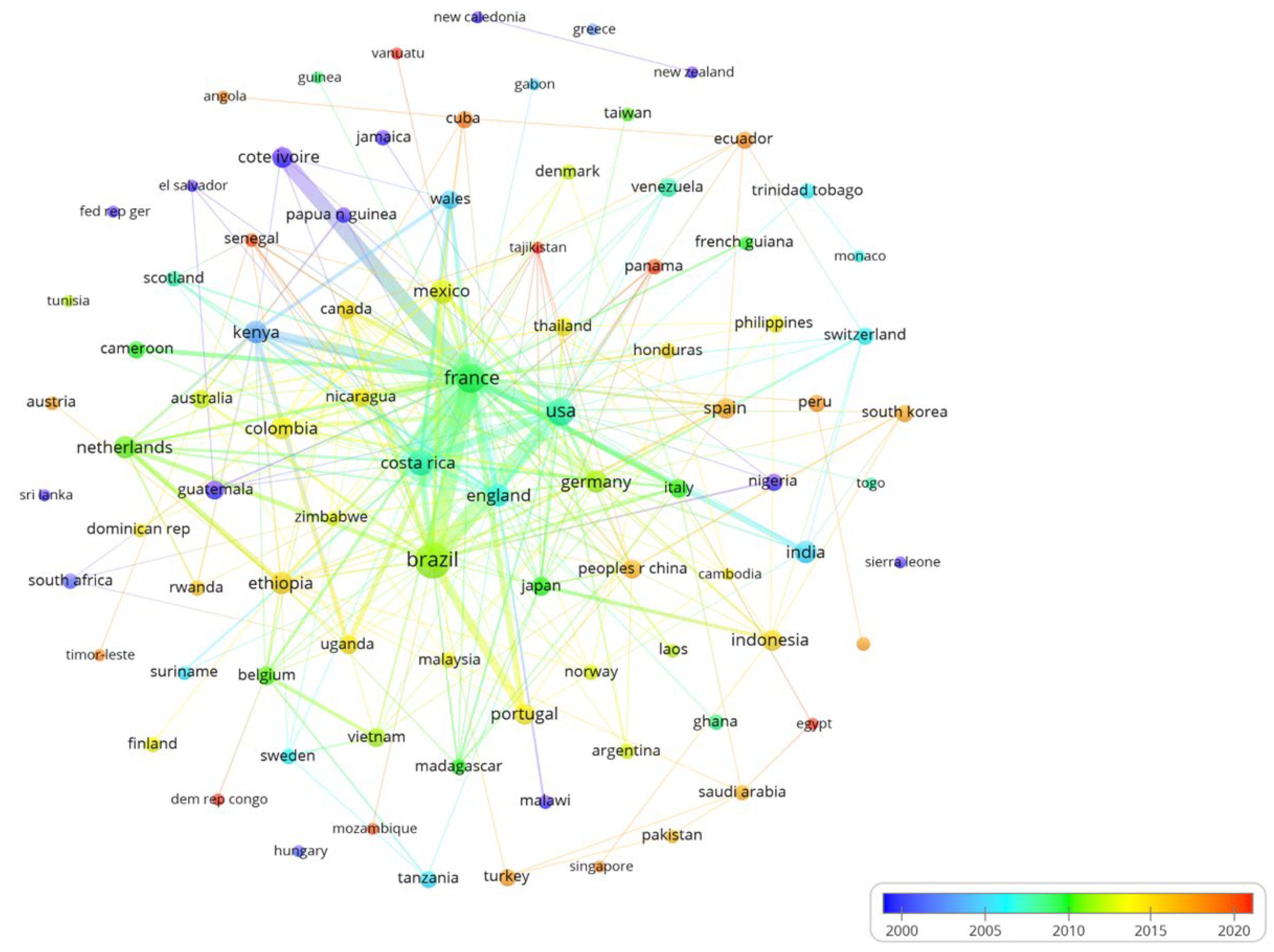
As shown in Figure 4, among these 89 countries, there is a high degree of association between geographically distributed coauthors, although some countries participate in producing knowledge on this topic in isolation: Greece, Hungary, Sierra Leone, Sri Lanka, and Tunisia. The greater width of the lines represents a stronger coauthorship connection between countries and the colors the average number of years of publication; thus, countries with purple nodes have a higher average publication age, and those with a reddish color indicate a lower average publication age.
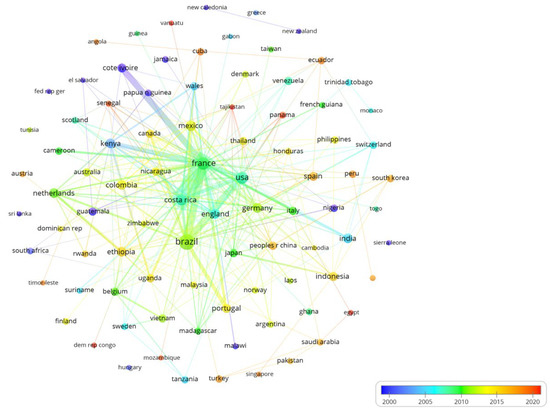
Figure 4.
Coffee agronomy research coauthorship network: countries level.
For the graph of coauthorship in Figure 4, the calculation of the “total link strength” was obtained based on the relationships with other countries and the number of joint collaborations using VOSviewer, from which the 14 highest positions are presented in Table 3 (indicator out of 20) and show the best-connected countries within the group of world knowledge production in coffee agronomy. The high contribution of Brazil to the total number of articles is noteworthy (40%), followed at a distance by France (9%). In addition, the articles with contributions from Brazil exceed 4500 citations from other publications indexed in the WoS core collection and the citations received for articles with contributions from France are close to 3000.
Table 3.
Relevant countries in coffee agronomy research.
Although all the data and metadata analyzed in this article are arranged in English by WoS, this geographical distribution is reflected idiomatically in the articles. In total, 69% of the articles are published in English (contemporary is 77%), followed by articles in Portuguese, French, and Spanish, among others, as shown in Table 4.
Table 4.
Publication languages in coffee agronomy research.
3.2. Actors of Scientific Production in Coffee Agronomy
Among these actors, we identified authors and their affiliation organizations in search of trends in research on coffee agronomy.
3.2.1. Author Affiliation Organizations Network
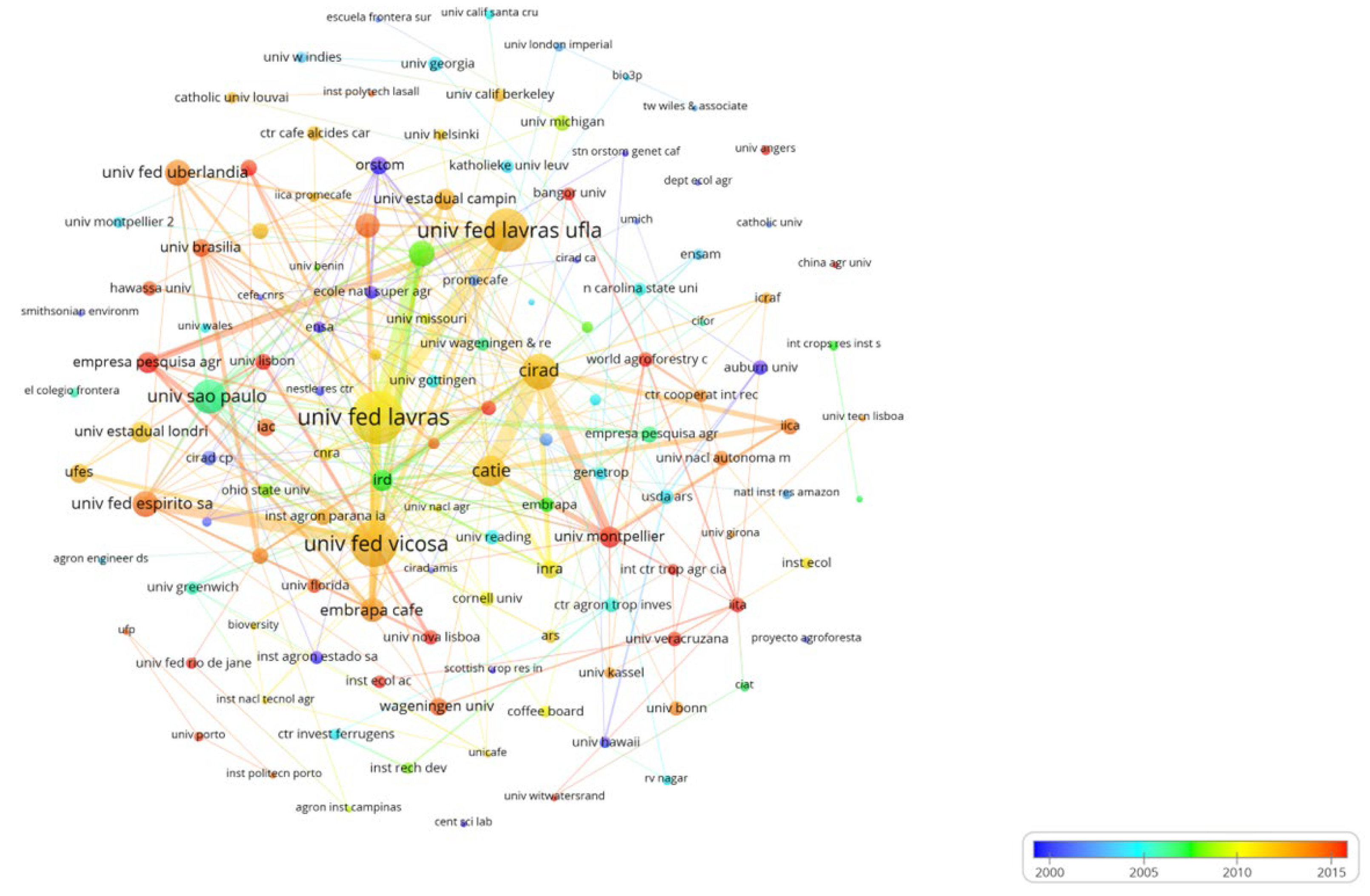
To reduce, in terms of relevance, the number of author-affiliated organizations, the Hirsch index or h-index was used, and therefore, only the 52 documents cited 52 times or more (for a resulting h-index of 54 citations) were considered, all published in English (in contrast, 297 articles did not present citations, and there are 191 with only one citation). Thus, the 1242 author-affiliated organizations present in the 1618 articles under study were reduced to 129 organizations. This set of high citation (impact) articles was published between 1986 and 2015, and among the organizations contributing to this production are the Federal University of Lavras (with two affiliations: “univ fed lavras” and “univ fed lavras ufla”) and the Federal University of Viçosa (“univ fed vicosa”) and most other universities in Brazil. Another highlight is the high average number of citations received by the Tropical Agricultural Research and Teaching Center (CATIE). Table 5 shows the top 10 organizations in terms of coauthorship contributions in published articles and Figure 5 shows the coauthorship network among the 129 organizations.
Table 5.
Relevant author affiliation organizations in coffee agronomy research.
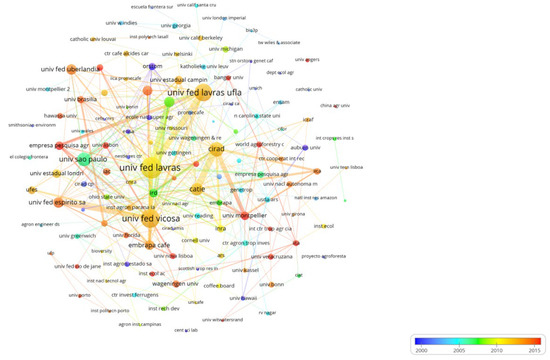
Figure 5.
Coffee agronomy research coauthorship network, organizations level.
3.2.2. Prolific Coauthors Network
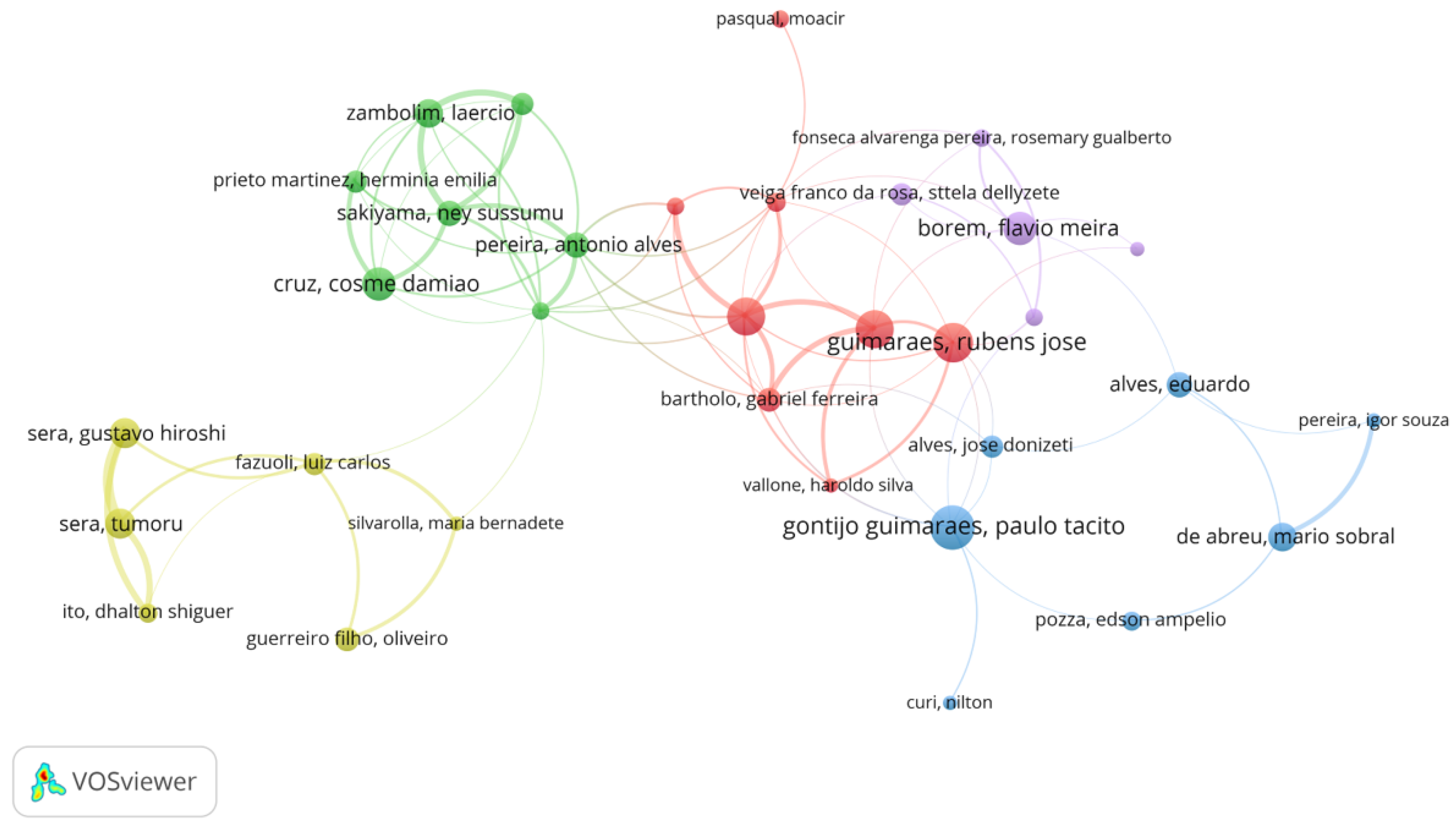
For the total 4670 authors contributing to the 1618 articles, 68 authors were estimated to be prolific (root square = 4670), and 57 authors with at least 7 publications were chosen, which, as shown in Figure 6, constitute 5 clusters, detailed in Appendix B.
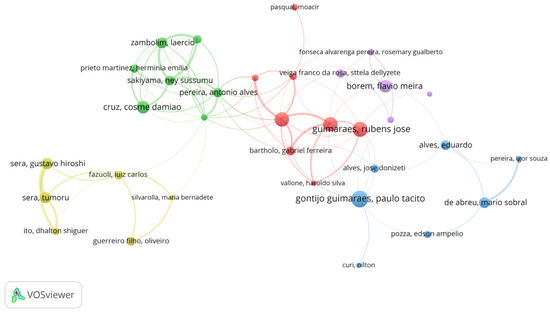
Figure 6.
Coffee agronomy research coauthorship network, authors level.
As for the number of publications, Paulo Tácito Gontijo Guimaraes, PhD in Agronomy, with an emphasis in Fertilization and Soil Fertilization, and Coordinator of the Plant and Soil Nutrition Laboratory of EPAMIG Sul (Lavras, Brazil), has conducted research on topics related to the fertilization, quality, and seedlings of coffee. He is the author with the most publications, with 20 articles being cited 128 times in the WoS core collection. A second relevant author identified in this study is Philippe Lashermes, a researcher at the Institut de Recherche pour le Développement (IRD, France) and codirector of the international initiative that sequenced the coffee genome, who, in the present study, records 18 publications and 897 citations in the WoS core collection. Some other relevant authors on this topic are Rubens José Guimaraes (18 publications), Antonio Nazareno Guimaraes Mendes (17 articles), and Gladyston Rodrigues Carvalho (17 articles) (see Table 6).
Table 6.
Relevant authors in coffee agronomy research.
3.3. Subjects of Scientific Production in Coffee Agronomy
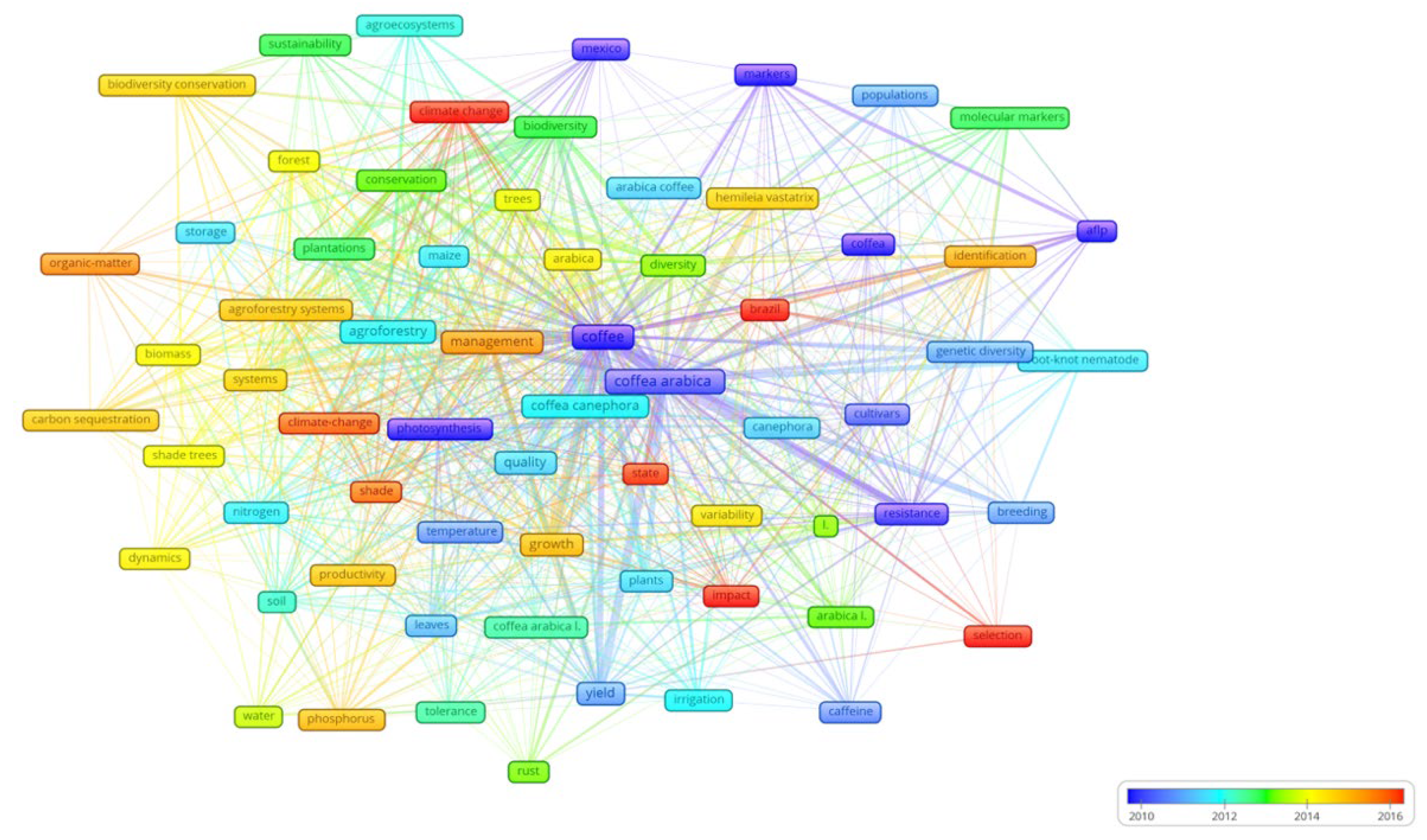
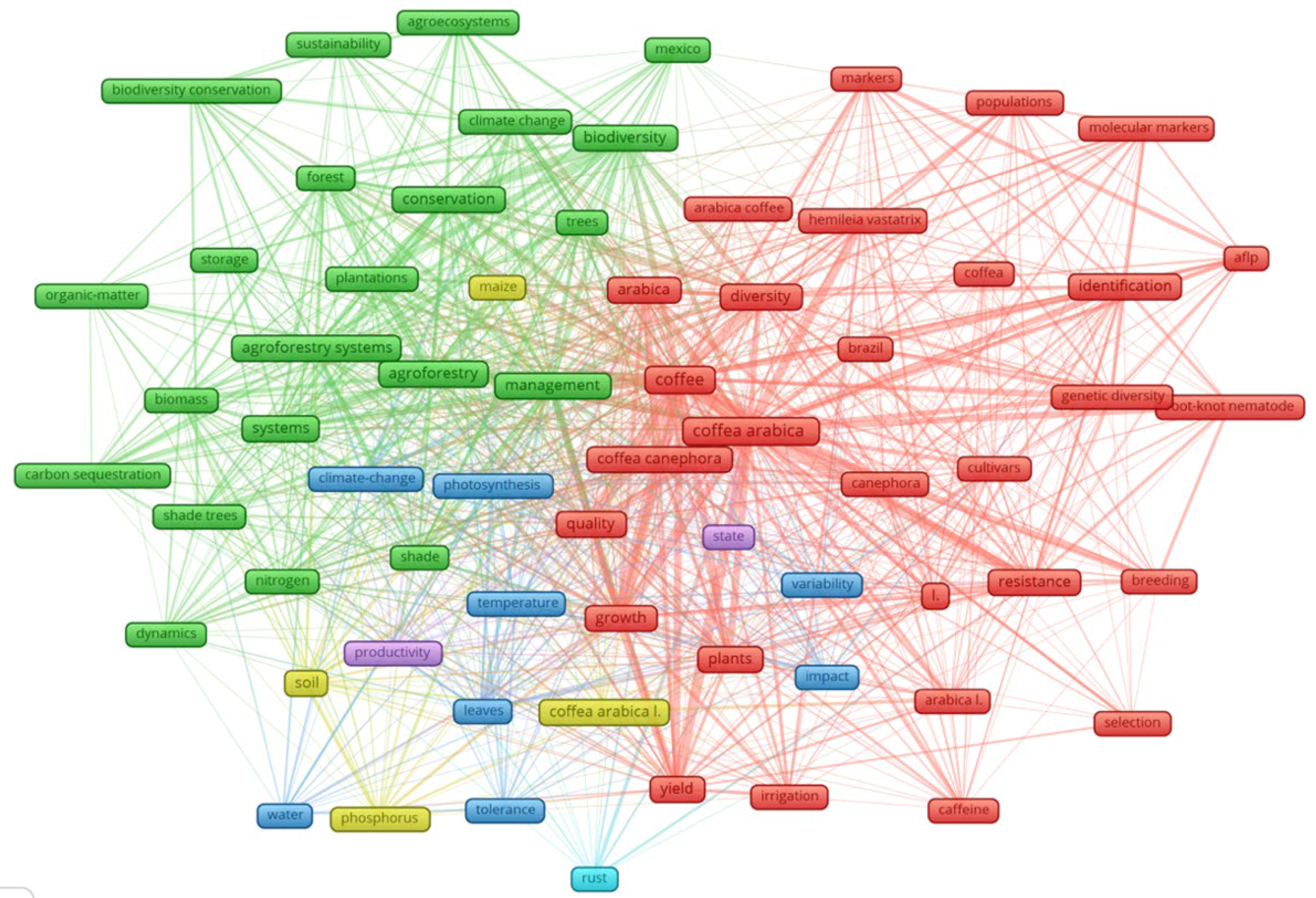
Through text data mining, 5142 keywords were identified (author keywords and keywords plus) and approximately 72 outstanding keywords, 66 being chosen as outstanding keywords with an occurrence of 15 or more times, which present an average age that covers the last decade. Among the outstanding keywords with a more recent average age, in yellow to red colors, the following concepts stand out: climate change, organic matter, growth, shade trees, etc. (see Figure 7). This tendency to the proliferation of new research topics is inserted within three major research areas that are identified in Figure 8 by establishing fragmented clusters with the relevant keywords: the theme of environmental sustainability in forestry (in green), another with respect to the variables of biological growth of coffee (in blue), and finally oriented towards the biotechnology of coffee species (in red).
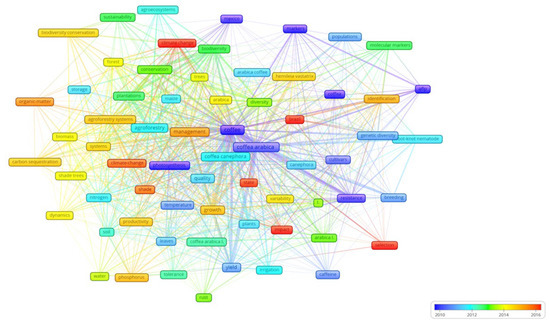
Figure 7.
Coffee agronomy research keywords co-occurrence network, temporary visualization.
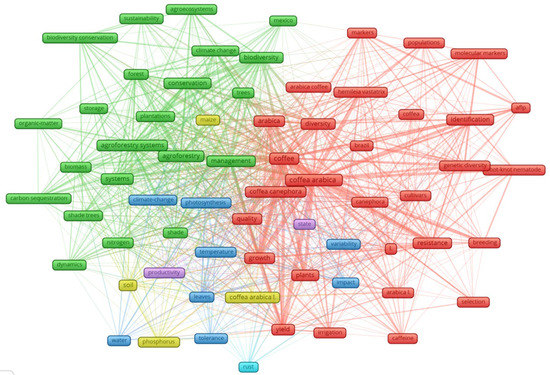
Figure 8.
Coffee agronomy research keywords co-occurrence network, thematic visualization.
4. Discussion
This article empirically contributes to establishing a general overview of the trends in the scientific production of coffee agronomy at the global level, which allows us to understand the structure of the epistemic community on this specific agronomic topic, managing to identify three main thematic areas of research of the coffee, a product of the various research agendas worldwide. Thematic coffee research areas, including the environmental sustainability of forestry, biological growth variables of coffee, and biotechnology of coffee species, display marked differences from a panoramic perspective of analysis. Although there are studies of literature reviews related to the areas of our findings, such as “Reductions in water, soil and nutrient losses and pesticide pollution in agroforestry practices: a review of evidence and processes” [109] and “Effects of shade trees on robusta coffee growth, yield and quality. A meta-analysis” [30]. These stand out for their use of multiple word combinations connected by Boolean operators but not an enveloping search vector [83], and the use of a selection method (e.g., PRISMA), which allowed them to systematize the selection of articles and to gain depth in their analysis, but their tendency to reduce the number of articles analyzed (only 83 and 30 articles, respectively) gives our study an advantage in terms of coverage by using bibliometrics as a meta-analytical method that is not reductive [110].
On the other hand, there is also literature review research such as “Remodeling agro-industrial and food wastes into value-added bioactives and biopolymers” [111] and “Challenges of organic agriculture to produce composts and vermicompost to produce medicinal plants—a socioeconomic demand” [109], which contribute to the topics related to the lines of study but possess less systematic rigorous methodology. In cases such as these, our research proposes a bibliometric methodology, defining a search vector, using homogeneous and structured databases, and incorporating a large sample size (1618 articles). Thus, in the extensive literature reviewed, no other mainstream articles have been identified that can provide a meta-analytical coverage as broad as ours, and no other sources have been identified that, to date, allow us to account for the tendency patterns that the global epistemic community of research on coffee agronomy has adopted over time. In the following conclusions, we will report on the diverse findings that are identified as results and their implications.
5. Conclusions
This article bibliometrically shows the existence of an exponentially growing trend of publications in this research topic, with an adjustment of over 80%, achieving a critical mass of documented scientific production in mainstream articles that show the interest on the part of the international scientific community for research in coffee agronomy. This growth rate of the published knowledge on coffee agronomy allows determining the average time with a period of current technical obsolescence, exceeding 12 years after the publication of a document, except for articles with citations above the historical average and determined as classics in this theme. Thus, in the period of contemporary production (2009 to date), three journals (JCR-WoS) are identified with a growing tendency to publish articles on this topic.
In turn, the article identifies a trend of three main journals that are concentrated in the first third of Bradford or core zone articles, with 30% of the total number of articles (482 of 1618) partly generated by the completion of registration of the journals Café Cacao The and Turrialba in the Journal Citation Report (JCR) of WoS. Thus, it is in the journals Ciencia e Agrotecnologia (published by the Federal University of Lavras), Agroforestry Systems (published by Springer, Kluwer Academic Publishers), and Cafe Cacao The (published by CIRAD—Cultures Perennes, only until 1994), where there is a broad and deep discussion on the topic under study. It should be identified that outside this Bradford core (Zones 1 and 2), there is an exponential diminishing of decreasing performance when trying to expand the search for references on coffee agronomy, as for this specific topic, it would be about peripheral scientific journals.
Geographically, the recent generation of knowledge presents a tendency to a concentration in Brazil as an emerging pole of knowledge production on coffee agronomy, which contributes with 655 articles out of a total of 1618 (40%). On the other hand, the Federal University of Lavras stands out both in the number of documents and citations. Regarding the level of authorship, according to Lotka’s law, the conformation of five research groups stand out, where not only prolific authors (high production) but also prominent authors (high production and high citation) stand out, such as Paulo Tácito Gontijo Guimaraes and Philippe Lashermes. It is of future interest to be able to study them in isolation from the “other” authors with a smaller number of articles and establish in depth the origin of their unequal level of scientific production in comparison with the common authors on this topic. The scientific production that has been generated in languages other than English (23%) is also of interest to analyze in the future, especially the degree of international collaboration, citation, and use as input for other publications that transcend the base language.
As we have pointed out in our study, we also used Zipf’s law to empirically determine the words with the highest frequency of occurrence (keywords and keyterms) in the set of articles studied. Thus, using fragmentation analysis through VOSviewer, thematic and time trend visualization outputs were analyzed. The thematic trends that have evolved in these six decades are identified to strengthen three major research areas: environmental sustainability of forestry, biological growth variables of coffee, and biotechnology of coffee species.
The limitations of this study are due to the wide coverage of articles reviewed (1618), which affects the degree of depth and specificity of the analyzes, and the results should be understood at the level of trends and meta-analytic behaviors. However, this opening of 5142 keywords also generates possibilities for greater segmentation at the level of systematic reviews, such as those mentioned in the discussion, in search of greater depth in specific topics related to coffee agronomy, and the panoramic character of the bibliometric meta-analysis escapes. Another limitation to be considered is related to the way in which both the authors, the journal, and WoS (Clarivate, London, UK) register data and metadata of the articles under study, especially due to the lack of uniformity in the terms used by the authors in the keywords, titles, and abstracts of their manuscripts. In view of this, the requirements of concentration and high occurrence imposed by bibliometric methods make it possible to generate error filters, assuming that errors in data and metadata should occur with low occurrence.
In terms of future research challenges, specific bibliometric and systematic review analyses in the three areas identified should be carried out as lines of future coffee agronomy research (silvicultural environmental sustainability, biological growth variables, and biotechnology of species). The strong relationship between coffee production, contribution in published articles, and local editions of magazines (JCR-WoS) in Brazil make it an interesting national case to study in greater depth and establish explanations of its evolution from coffee agronomic production to the production of knowledge on agronomic coffee.
Supplementary Materials
The following are available online at https://www.mdpi.com/article/10.3390/agronomy11081471/s1, Table S1: Agronomy_Coffee_1618.txt.
Author Contributions
Conceptualization, H.M.-C. and A.V.-M.; methodology, A.V.-M.; software, M.G.-M. and A.V.-M.; validation, G.S.-S.; formal analysis, A.V.-M.; writing—original draft preparation, H.M.-C., N.C.-B. and G.S.-S.; writing—review and editing, N.C.-B., G.S.-S. and A.V.-M.; visualization, A.V.-M.; project administration, A.V.-M.; funding acquisition, N.C.-B., G.S.-S. and A.V.-M. All authors have read and agreed to the published version of the manuscript.
Funding
The article processing charge (APC) was partially funded by Universidad Católica de la Santísima Concepción.
Data Availability Statement
The analyzed dataset has been included as Supplementary Materials.
Conflicts of Interest
The authors declare no conflict of interest.
Appendix A. Relevant Journals in Coffee Agronomy
This appendix details the 15 journals from major Bradford zones (2009–2020) shown in Figure 2 and Table 2. In Table A1, the journals are presented, detailing standardized abbreviated name, full name, International Standard Serial Number (ISSN), publisher, articles published in the Web of Science (WoS) database indexed between 1960–2020 and 2009–2020 (contemporary semiperiod), and the WoS categories to which the journal is attached.
Table A1.
Details of journals from major Bradford zones (2009–2020).
Table A1.
Details of journals from major Bradford zones (2009–2020).
| Journals | Full Name | ISSN | Publisher | 1960–2020 | 2009–2020 | WoS Category |
|---|---|---|---|---|---|---|
| Cienc. Agrotec. | Ciencia e Agrotecnologia | 1413-7054 | Univ Fed Lavras | 197 | 94 | Agriculture, Multidisciplinary; Agronomy |
| Agrofor. Syst. | Agroforestry Systems | 0167-4366 | Springer | 153 | 97 | Agronomy; Forestry |
| Cafe Cacao The | Cafe Cacao The | 0007-9510 | CIRAD- Cultures Perennes | 132 | 0 * | Agronomy |
| Turrialba | Turrialba | 0041-4360 | Inter-Amer Inst Cooperat Agric | 127 | 0 ** | Agronomy |
| Biosci. J. | Bioscience Journal | 1516-3725 | Univ Fed Uberlandia | 61 | 57 | Agriculture, Multidisciplinary; Agronomy; Biology |
| Cienc. Rural | Ciencia Rural | 0103-8478 | Univ Fed Santa Maria | 57 | 48 | Agronomy |
| Euphytica | Euphytica | 0014-2336 | Springer | 52 | 21 | Agronomy; Plant Sciences; Horticulture |
| Crop Prot. | Crop Protection | 0261-2194 | Elsevier | 45 | 28 | Agronomy |
| Crop. Breed. Appl. Biotechnol. | Crop Breeding and Applied Biotechnology | 1984-7033 | Brazilian Soc Plant Breeding | 43 | 35 | Agronomy; Biotechnology & Applied Microbiology |
| Exp. Agric. | Experimental Agriculture | 0014-4797 | Cambridge Univ Press | 41 | 13 | Agronomy |
| Ind. Crop. Prod. | Industrial Crops and Products | 0926-6690 | Elsevier | 37 | 36 | Agricultural Engineering; Agronomy |
| Acta Sci.-Agron. | Acta Scientiarum-Agronomy | 1807-8621 | Univ Estadual Maringa | 36 | 35 | Agronomy |
| Eur. J. Plant Pathol. | European Journal of Plant Pathology | 0929-1873 | Springer | 35 | 28 | Agronomy; Plant Sciences; Horticulture |
| Plant Pathol. | Plant Pathology | 0032-0862 | Wiley | 31 | 16 | Agronomy; Plant Sciences |
| Rev. Agrogeoambiental *** | Revista Agrogeoambiental | 1984-428X | Inst Fed Sul Minas Gerais | 27 | 27 | Agronomy |
* In zero since 1995. ** In zero since 1991. *** Emerging Sources Citation Index, journal without impact factor calculation (IF). N/A: currently not available in the Journal Citation Report.
Appendix B. Prolific Authors by Cluster
This appendix details the five clusters of prolific coauthors network shown in Figure 6 (see Table A2).
Table A2.
Cluster of prolific coauthors network.
Table A2.
Cluster of prolific coauthors network.
| Cluster | Authors |
|---|---|
| Cluster 1 | Bartholo, Gabriel Ferreira |
| Botelho, Cesar Elias | |
| Carvalho, Gladyston Rodrigues | |
| De Rezende, Juliana Costa | |
| Guimaraes Mendes, Antonio Nazareno | |
| Guimaraes, Rubens Jose | |
| Pasqual, Moacir | |
| Vallone, Haroldo Silva | |
| Cluster 2 | Baiao De Oliveira, Antonio Carlos |
| Caixeta, Eveline Teixeira | |
| Cruz, Cosme Damiao | |
| Pereira, Antonio Alves | |
| Prieto Martinez, Herminia Emilia | |
| Sakiyama, Ney Sussumu | |
| Zambolim, Laercio | |
| Cluster 3 | Alves, Eduardo |
| Alves, Jose Donizeti | |
| Curi, Nilton | |
| De Abreu, Mario Sobral | |
| Gontijo Guimaraes, Paulo Tacito | |
| Pereira, Igor Souza | |
| Pozza, Edson Ampelio | |
| Cluster 4 | Fazuoli, Luiz Carlos |
| Guerreiro Filho, Oliveiro | |
| Ito, Dhalton Shiguer | |
| Sera, Gustavo Hiroshi | |
| Sera, Tumoru | |
| Silvarolla, Maria Bernadete | |
| Cluster 5 | Borem, Flavio Meira |
| Da Silva, Fabio Moreira | |
| Fonseca Alvarenga Pereira, Rosemary Gualberto | |
| Malta, Marcelo Ribeiro | |
| Veiga Franco Da Rosa, Sttela Dellyzete |
References
- Byrareddy, V.; Kouadio, L.; Kath, J.; Mushtaq, S.; Rafiei, V.; Scobie, M.; Stone, R. Win-win: Improved irrigation management saves water and increases yield for robusta coffee farms in Vietnam. Agric. Water Manag. 2020, 241, 106350. [Google Scholar] [CrossRef]
- Venturin, A.Z.; Guimarafes, C.M.; de Sousa, E.F.; Machado, F.; Josa, A.; Rodrigues, W.P.; Serrazine Ãcaro, D.; Bressan-Smith, R.; Marciano, C.R.; Campostrini, E. Using a crop water stress index based on a sap flow method to estimate water status in conilon coffee plants. Agric. Water Manag. 2020, 241, 106343. [Google Scholar] [CrossRef]
- Lyngbaek, A.E.; Muschler, R.G.; Sinclair, F.L. Productivity and profitability of multistrata organic versus conventional coffee farms in Costa Rica. Agrofor. Syst. 2001, 53, 205–213. [Google Scholar] [CrossRef]
- De Souza, H.N.; De Graaff, J.; Pulleman, M.M. Strategies and economics of farming systems with coffee in the Atlantic Rainforest Biome. Agrofor. Syst. 2011, 84, 227–242. [Google Scholar] [CrossRef][Green Version]
- Sibelet, N.; Ba, S.N. Strategies of Ugandan farmers facing coffee wilt disease. Cah. Agric. 2012, 21, 258–268. [Google Scholar] [CrossRef]
- Bertrand, B.; Montagnon, C.; Georget, F.; Charmetant, P.; Etienne, H. Creation and dissemination of Arabica coffee varieties: What varietal innovations? Cah. Agric. 2012, 21, 77–88. [Google Scholar] [CrossRef]
- Labouisse, J.P.; Adolphe, C. Preservation and management of the genetic resources of Arabica coffee (Coffea arabica L): A challenge for Ethiopia. Cah. Agric. 2012, 21, 98–105. [Google Scholar] [CrossRef]
- Vagneron, I.; Daviron, B. Coffee in the jungle of environmental and social sustainability standards. Cah. Agric. 2012, 21, 154–161. [Google Scholar] [CrossRef]
- Sibelet, N.; Montzieux, M. Resilience factors in the coffee sector of Kenya: From food security to product removal. Cah. Agric. 2012, 21, 179–191. [Google Scholar] [CrossRef]
- Fournier, S. Geographical Indications: A way to perpetuate collective action processes within Localized Agrifood Systems? Cah. Agric. 2008, 17, 547–551. [Google Scholar] [CrossRef]
- Ellis, E.A.; Baerenklau, K.A.; Marcos-Martínez, R.; Chávez, E. Land use/land cover change dynamics and drivers in a low-grade marginal coffee growing region of Veracruz, Mexico. Agrofor. Syst. 2010, 80, 61–84. [Google Scholar] [CrossRef]
- Ávalos-Sartorio, B.; Blackman, A. Agroforestry price supports as a conservation tool: Mexican shade coffee. Agrofor. Syst. 2009, 78, 169–183. [Google Scholar] [CrossRef]
- Leme, P.; Pinto, C. Sistemas de certificação do café sob a ótica dos Pilares da Qualidade. Rev. Agrogeoambient. 2019, 10, 9–26. [Google Scholar] [CrossRef]
- Faure, G.; Le Coq, J.F.; Vagneron, I.; Hocde, H.; Munoz, G.S.; Kessari, M. Strategies of coffee producers’ organizations in Costa Rica toward environmental and social certification processes. Cah. Agric. 2012, 21, 162–168. [Google Scholar] [CrossRef]
- Aguilar, P.; Ribeyre, F.; Escarraman, A.; Bastide, P.; Berthiot, L. Sensory profiles of coffee in the Dominican Republic are linked to the terroirs. Cah. Agric. 2012, 21, 169–178. [Google Scholar] [CrossRef]
- Galtier, F.; Pedregal, V.D. Can the development of Fair Trade improve justice? Some insights from the coffee case. Cah. Agric. 2010, 19, 50–57. [Google Scholar] [CrossRef]
- Negash, M.; Starr, M.; Kanninen, M.; Berhe, L. Allometric equations for estimating aboveground biomass of Coffea arabica L. grown in the Rift Valley escarpment of Ethiopia. Agrofor. Syst. 2013, 87, 953–966. [Google Scholar] [CrossRef]
- Coltri, P.P.; Zullo, J.J.; Dubreuil, V.; Ramirez, G.M.; Pinto, H.S.; Coral, G.; Lazarim, C.G. Empirical models to predict LAI and aboveground biomass of Coffea arabicaunder full sun and shaded plantation: A case study of South of Minas Gerais, Brazil. Agrofor. Syst. 2015, 89, 621–636. [Google Scholar] [CrossRef]
- Jose, S.; Bardhan, S. Agroforestry for biomass production and carbon sequestration: An overview. Agrofor. Syst. 2012, 86, 105–111. [Google Scholar] [CrossRef]
- Soto-Pinto, L.; Anzueto, M.; Mendoza, J.; Ferrer, G.J.; De Jong, B. Carbon sequestration through agroforestry in indigenous communities of Chiapas, Mexico. Agrofor. Syst. 2009, 78, 39–51. [Google Scholar] [CrossRef]
- Schmitt-Harsh, M.; Evans, T.P.; Castellanos, E.; Randolph, J.C. Carbon stocks in coffee agroforests and mixed dry tropical forests in the western highlands of Guatemala. Agrofor. Syst. 2012, 86, 141–157. [Google Scholar] [CrossRef]
- Häger, A. The effects of management and plant diversity on carbon storage in coffee agroforestry systems in Costa Rica. Agrofor. Syst. 2012, 86, 159–174. [Google Scholar] [CrossRef]
- Pezzopane, J.R.M.; Souza, P.S.; Rolim, G.D.S.; Gallo, P.B. Microclimate in coffee plantation grown under grevillea trees shading. Acta Sci. Agron. 2011, 33. [Google Scholar] [CrossRef]
- Alvarado-Huaman, L.; Borjas-Ventura, R.R.; Castro-Cepero, V.; Garcia-Nieves, L.; Jimenez-Davalos, J.; Julca-Otiniano, A.; Gomez-Pando, L. Dynamics of severity of coffee leaf rust (Hemileia vastatrix) on Coffee, in Chanchamayo (Junin-Peru). Agron. Mesoam. 2020, 31, 517–529. [Google Scholar] [CrossRef]
- Lin, B.B. Agroforestry management as an adaptive strategy against potential microclimate extremes in coffee agriculture. Agric. For. Meteorol. 2007, 144, 85–94. [Google Scholar] [CrossRef]
- Molin, R.; Andreotti, M.; Reis, A.; Furlani Junior, E.; Braga, G.; Scholz, M.B. Physical and sensory characterization of coffee produced in the topoclimatic conditions at Jesuítas, Paraná State (Brazil). Acta Sci. Agron. 2008, 30, 353–358. [Google Scholar] [CrossRef]
- Peters, V.E.; Carroll, C.R. Temporal variation in coffee flowering may influence the effects of bee species richness and abundance on coffee production. Agrofor. Syst. 2012, 85, 95–103. [Google Scholar] [CrossRef]
- Dauzat, J.; Rapidel, B.; Berger, A. Simulation of leaf transpiration and sap flow in virtual plants: Model description and application to a coffee plantation in Costa Rica. Agric. For. Meteorol. 2001, 109, 143–160. [Google Scholar] [CrossRef]
- Dossa, E.L.; Fernandes, E.C.M.; Reid, W.S.; Ezui, K. Above- and belowground biomass, nutrient and carbon stocks contrasting an open-grown and a shaded coffee plantation. Agrofor. Syst. 2007, 72, 103–115. [Google Scholar] [CrossRef]
- Piato, K.; Lefort, F.; Subía, C.; Calderon, D.; Pico, J.; Norgrove, L.; Caicedo, C. Effects of shade trees on robusta coffee growth, yield and quality. A meta-analysis. Agron. Sustain. Dev. 2020. [Google Scholar] [CrossRef]
- Lin, B.B. The role of agroforestry in reducing water loss through soil evaporation and crop transpiration in coffee agroecosystems. Agric. For. Meteorol. 2010, 150, 510–518. [Google Scholar] [CrossRef]
- Flumignan, D.L.; De Faria, R.T.; Prete, C.E. Evapotranspiration components and dual crop coefficients of coffee trees during crop production. Agric. Water Manag. 2011, 98, 791–800. [Google Scholar] [CrossRef]
- Lin, B.B.; Richards, P.L. Soil random roughness and depression storage on coffee farms of varying shade levels. Agric. Water Manag. 2007, 92, 194–204. [Google Scholar] [CrossRef]
- Holwerda, F.; Bruijnzeel, L.A.; Barradas, V.L.; Cervantes, J. The water and energy exchange of a shaded coffee plantation in the lower montane cloud forest zone of central Veracruz, Mexico. Agric. For. Meteorol. 2013, 173, 1–13. [Google Scholar] [CrossRef]
- Pereira, M.W.; Arêdes, A.F.; Santos, M.L. A irrigação do cafezal como alternativa econômica ao produtor. Acta Sci. Agron. 2010, 32. [Google Scholar] [CrossRef]
- Arantes, K.R.; de Faria, M.A.; Rezende, F.C. Recuperação do cafeeiro (Coffea arábica L.) após recepa, submetido a diferentes lâminas de água e parcelamentos da adubação. Acta Sci. Agron. 2009, 31. [Google Scholar] [CrossRef]
- Herpin, U.; Gloaguen, T.V.; Da Fonseca, A.F.; Montes, C.R.; Mendonça, F.C.; Piveli, R.P.; Melfi, A.J. Chemical effects on the soil–plant system in a secondary treated wastewater irrigated coffee plantation—A pilot field study in Brazil. Agric. Water Manag. 2007, 89, 105–115. [Google Scholar] [CrossRef]
- D’haeze, D.; Raes, D.; Deckers, J.; Phong, T.A.; Loi, H.V. Groundwater extraction for irrigation of Coffea canephora in Ea Tul watershed, Vietnam—a risk evaluation. Agric. Water Manag. 2005, 73, 1–19. [Google Scholar] [CrossRef]
- D’haeze, D.; Deckers, J.; Raes, D.; Phong, T.A.; Minh Chanh, N.D. Over-irrigation of Coffea canephora in the Central Highlands of Vietnam revisited. Agric. Water Manage. 2003, 63, 185–202. [Google Scholar] [CrossRef]
- Siles, P.; Harmand, J.M.; Vaast, P. Effects of Inga densiflora on the microclimate of coffee (Coffea arabica L.) and overall biomass under optimal growing conditions in Costa Rica. Agrofor. Syst. 2009, 78, 269–286. [Google Scholar] [CrossRef]
- Liu, X.; Qi, Y.; Li, F.; Yang, Q.; Yu, L. Impacts of regulated deficit irrigation on yield, quality and water use efficiency of Arabica coffee under different shading levels in dry and hot regions of southwest China. Agric. Water Manag. 2018, 204, 292–300. [Google Scholar] [CrossRef]
- Boreux, V.; Vaast, P.; Madappa, L.; Cheppudira, K.G.; Garcia, C.; Ghazoul, J. Agroforestry coffee production increased by native shade trees, irrigation, and liming. Agron. Sustain. Dev. 2016, 36, 1–9. [Google Scholar] [CrossRef]
- Liu, X.; Li, F.; Zhang, Y.; Yang, Q. Effects of deficit irrigation on yield and nutritional quality of Arabica coffee (Coffea arabica) under different N rates in dry and hot region of southwest China. Agric. Water Manag. 2016, 172, 1–8. [Google Scholar] [CrossRef]
- Silva, N.; Assunção, W. Constatação do “efeito sombra” e economia de recursos hídricos e de energia na irrigação do cafeeiro por meio de um pivô central convencional. Rev. Agrogeoambiental. 2016, 8, 23–32. [Google Scholar] [CrossRef][Green Version]
- Marin, F.R.; Angelocci, L.R.; Nassif, D.S.P.; Costa, L.G.; Vianna, M.S.; Carvalho, K.S. Crop coefficient changes with reference evapotranspiration for highly canopy-atmosphere coupled crops. Agric. Water Manag. 2016, 163, 139–145. [Google Scholar] [CrossRef]
- Sakai, E.; Barbosa, E.; Silveira, J.; Pires, R. Coffee productivity and root systems in cultivation schemes with different population arrangements and with and without drip irrigation. Agric. Water Manag. 2015, 148, 16–23. [Google Scholar] [CrossRef]
- Suhartono, D.; Aditya, W.; Lestari, M.; Yasin, M. Expert System in Detecting Coffee Plant Diseases. Int. J. Electr. Energy 2013, 1, 156–162. [Google Scholar] [CrossRef]
- Silva, M.C.; Varzea, V.; Guerra-Guimaraes, L.; Azinheira, H.; Fernandez, D.; Petitot, A.S.; Bertrand, B.; Lashermes, P.; Nicole, M. Coffee resistance to the main diseases: Leaf rust and coffee berry disease. Braz. J. Plant Physiol. 2006, 18, 119–147. [Google Scholar] [CrossRef]
- Talhinhas, P.; Batista, D.; Diniz, I.; Vieira, A.; Silva, D.N.; Loureiro, A.; Tavares, S.; Pereira, A.P.; Azinheira, H.G.; Guerra-Guimarães, L.; et al. The Coffee Leaf Rust pathogen Hemileia vastatrix; One and a half centuries around the tropics. Mol. Plant Pathol. 2016, 18, 1039–1051. [Google Scholar] [CrossRef]
- Zambolim, L. Current status and management of coffee leaf rust in Brazil. Trop. Plant Pathol. 2016, 41, 1–8. [Google Scholar] [CrossRef]
- Capucho, A.S.; Zambolim, L.; Lopes, U.N.; Milagres, N.S. Chemical control of coffee rust in Coffea canephora cv conilon. Australas. Plant Pathol. 2013, 42, 667–673. [Google Scholar] [CrossRef]
- Durand, N.; Gueule, D.; Fourny, G. Contaminants in coffee. Cah. Agric. 2012, 21, 192–196. [Google Scholar] [CrossRef]
- Chemura, A.; Mutanga, O.; Sibanda, M.; Chidoko, P. Machine learning prediction of coffee rust severity on leaves using spectroradiometer data. Trop. Plant Pathol. 2018, 43, 117–127. [Google Scholar] [CrossRef]
- Honorato-Junior, J.; Zambolim, L.; Aucique-Pérez, C.E.; Resende, R.S.; Rodrigues, F.A. Photosynthetic and antioxidative alterations in coffee leaves caused by epoxiconazole and pyraclostrobin sprays and Hemileia vastatrix infection. Pest. Biochem. Physiol. 2015, 123, 31–39. [Google Scholar] [CrossRef]
- Dias, R.A.; Ribeiro, M.R.; Carvalho, A.M.; Botelho, C.E.; Mendes, A.G.; Ferreira, A.D.; Fernandes, F.C. Selection of coffee progenies for resistance to leaf rust and favorable agronomic traits. Coffee Sci. 2019, 14, 173–182. Available online: http://www.coffeescience.ufla.br/index.php/Coffeescience/article/view/1564 (accessed on 17 July 2021). [CrossRef]
- De Carvalho, F.P.; França, A.C.; Lemos, V.T.; Ferreira, E.A.; Santos, J.B.; Dos Silva, A.A. Photosynthetic activity of coffee after application of glyphosate subdoses. Acta Sci. Agron. 2013, 35, 109–115. [Google Scholar] [CrossRef]
- Oliveira, G.H.H.; Corrêa, P.C.; Botelho, F.M.; Goneli, A.L.D.; Afonso Júnior, P.C.; Campos, S.C. Modeling of the shrinkage kinetics of coffee berries during drying. Acta Sci. Agron. 2011, 33, 423–428. [Google Scholar] [CrossRef]
- Tully, K.L.; Wood, S.A.; Lawrence, D. Fertilizer type and species composition affect leachate nutrient concentrations in coffee agroecosystems. Agrofor. Syst. 2013, 87, 1083–1100. [Google Scholar] [CrossRef]
- Silva, C.F.; Ramos, D.M.B.; Batista, L.R.; Schwan, R.F. Inibição in vitro de fungos toxigênicos por Pichia sp. e Debaryomyces sp. isoladas de frutos de café (Coffea arabica). Acta Sci. Agron. 2010, 32, 397–402. [Google Scholar] [CrossRef][Green Version]
- Santa-Cecília, L.V.C.; Correa, L.R.B.; Souza, B.; Prado, E.; Alcantra, E. Desenvolvimento de Planococcus citri (Risso, 1813) (Hemiptera: Pseudococcidae) em cafeeiros. Acta Sci. Agron. 2009, 31, 13–15. [Google Scholar] [CrossRef]
- Rodarte, M.P.; Dias, D.R.; Vilela, D.M.; Schwan, R.F. Proteolytic activities of bacteria, yeasts and filamentous fungi isolated from coffee fruit (Coffea arabica L.). Acta Sci. Agron. 2011, 33, 457–464. [Google Scholar] [CrossRef]
- Bedimo, J.A.; Dufour, B.P.; Cilas, C.; Avelino, J. Effects of shade trees on Coffea Arabica pests and diseases. Cah. Agric. 2012, 21, 89–97. [Google Scholar] [CrossRef]
- Malta, M.R.; Chagas, S.J. Avaliação de compostos não-voláteis em diferentes cultivares de cafeeiro produzidas na região sul de Minas Gerais. Acta Sci. Agron. 2009, 31, 57–61. [Google Scholar] [CrossRef]
- Pedrosa, A.W.; Prieto Martinez, H.E.; Cruz, C.D.; DaMata, F.M.; Clemente, J.M.; Paula Neto, A. Characterizing zinc use efficiency in varieties of Arabica coffee. Acta Sci. Agron. 2013, 35, 57–61. [Google Scholar] [CrossRef]
- Pozza, A.A.; Guimarães, P.T.; Silva, E.D.; Bastos, A.R.; Nogueira, F.D. Adubação foliar de sulfato de zinco na produtividade e teores foliares de zinco e fósforo de cafeeiros arábica. Acta Sci. Agron. 2009, 31, 49–55. [Google Scholar] [CrossRef][Green Version]
- Mora, A.; Beer, J. Geostatistical modeling of the spatial variability of coffee fine roots under Erythrina shade trees and contrasting soil management. Agrofor. Syst. 2012, 87, 365–376. [Google Scholar] [CrossRef]
- Gomes, J.; Ponzo, A.; Oliveira, A. Viability of a terrace covered with porous concrete paving blocks for coffee bean drying. Rev. Agrogeoambient. 2021, 12, 98–109. [Google Scholar] [CrossRef]
- Santos, F.L.; Queiroz, D.M.; Pinto, F.D.; Santos, N.T. Analysis of the coffee harvesting process using an electromagnetic shaker. Acta Sci. Agron. 2010, 32, 373–378. [Google Scholar] [CrossRef]
- Greco, M.; Campos, A.T.; Klosowski, E.S. Variação de diferentes tempos de revolvimento em secador de camada fixa para café. Acta Sci. Agron. 2010, 32, 577–583. [Google Scholar] [CrossRef]
- Resende, O.; Arcanjo, R.V.; Siqueira, V.C.; Rodrigues, S. Modelagem matemática para a secagem de clones de café (Coffea canephora Pierre) em terreiro de concreto. Acta Sci. Agron. 2009, 31, 189–196. [Google Scholar] [CrossRef]
- Greco, M.; Campos, A.T.; Klosowski, E.S. Perdas térmicas em secador de café. Acta Sci. Agron. 2010, 32, 209–212. [Google Scholar] [CrossRef]
- Chalfoun, S.M.; Pereira, M.C.; Carvalho, G.R.; Savian, T.V. Multivariate analysis of sensory characteristics of coffee grains (Coffea arabica L.) in the region of upper Paranaíba. Acta Sci. Agron. 2010, 32, 635–641. [Google Scholar] [CrossRef][Green Version]
- Fujisawa, N.; Roubik, D.W. Inoue, Makoto. Farmer influence on shade tree diversity in rustic plots of Coffea canephora in Panama coffee-agroforestry. Agrofor. Syst. 2020, 94, 2301–2315. [Google Scholar] [CrossRef]
- Chaiyarat, R.; Sripho, S.; Ardsungnoen, S. Small mammal diversity in agroforestry area and other plantations of Doi Tung Development Project, Thailand. Agrofor. Syst. 2020, 94, 2099–2107. [Google Scholar] [CrossRef]
- Mahata, A.; Samal, K.T.; Sharat, K.P. Butterfly diversity in agroforestry plantations of Eastern Ghats of southern Odisha, India. Agrofor. Syst. 2018, 93, 1423–1438. [Google Scholar] [CrossRef]
- McDermott, M.E.; Rodewald, A.D.; Matthews Stephen, N. Managing tropical agroforestry for conservation of flocking migratory birds. Agrofor. Syst. 2015, 89, 383–396. [Google Scholar] [CrossRef]
- Caudill, S.A.; Vaast, P.; Husband, T.P. Assessment of small mammal diversity in coffee agroforestry in the Western Ghats, India. Agrofor. Syst. 2014, 88, 173–186. [Google Scholar] [CrossRef]
- Mukashema, A.; Veldkamp, T.; Amer, S. Sixty percent of small coffee farms have suitable socio-economic and environmental locations in Rwanda. Agron. Sustain. Dev. 2016, 36, 31. [Google Scholar] [CrossRef]
- Valencia, V.; Naeem, S.; Garcıa, B. Conservation of tree species of late succession and conservation concern in coffee. Agric. Ecosyst. Environ. 2016, 219, 32–41. [Google Scholar] [CrossRef]
- Sri, A.; Kemp, R.C. The Impact of Coffee Certification on the Economic Performance of Indonesian Actors. Asian J. Agric. Dev. 2015, 12, 1–16. [Google Scholar] [CrossRef]
- Martins, M.; Mendes, A.N.; Alvarenga, M. Incidência de pragas e doenças em agroecossistemas de café orgânico de agricultores familiares em Poço Fundo-MG. Cienc. Agrotec. 2004, 28, 1306–1313. [Google Scholar] [CrossRef]
- Clarivate Web of Science. Available online: http://www.webofknowledge.com/ (accessed on 22 May 2021).
- Vega-Muñoz, A.; Arjona-Fuentes, J.M. Social networks and graph theory in the search for distant knowledge in the field of industrial engineering. In Handbook of Research on Advanced Applications of Graph Theory in Modern Society; Pal, M., Samanta, S., Pal, A., Eds.; IGI-Global: Hershey, PA, USA, 2020; Volume 17, pp. 397–418. [Google Scholar] [CrossRef]
- Price, D. A general theory of bibliometric and other cumulative advantage processes. J. Assoc. Inf. Sci. 1976, 27, 292–306. [Google Scholar] [CrossRef]
- Dobrov, G.M.; Randolph, R.H.; Rauch, W.D. New options for team research via international computer networks. Scientometrics 1979, 1, 387–404. [Google Scholar] [CrossRef]
- Bulik, S. Book use as a Bradford-Zipf Phenomenon. Coll. Res. Libr. 1978, 39, 215–219. [Google Scholar] [CrossRef]
- Morse, P.M.; Leimkuhler, F.F. Technical note—Exact solution for the Bradford distribution and its use in modeling informational data. Oper. Res. 1979, 27, 187–198. [Google Scholar] [CrossRef]
- Pontigo, J.; Lancaster, F.W. Qualitative aspects of the Bradford distribution. Scientometrics 1986, 9, 59–70. [Google Scholar] [CrossRef]
- Swokowski, E.W. Calculus with Analytic Geometry, 4th ed.; Grupo Editorial Planeta: Mexico City, Mexico, 1988. [Google Scholar]
- Kumar, S. Application of Bradford’s law to human-computer interaction research literature. DESIDOC J. Libr. Inf. Technol. 2014, 34, 223–231. [Google Scholar]
- Shelton, R.D. Scientometric laws connecting publication counts to national research funding. Scientometrics 2020, 123, 181–206. [Google Scholar] [CrossRef]
- Lotka, A.J. The frequency distribution of scientific productivity. J. Wash. Acad. Sci. 1926, 16, 317–321. [Google Scholar]
- Hirsch, J.E. An index to quantify an individual’s scientific research output. Proc. Natl. Acad. Sci. USA 2005, 102, 16569–16572. [Google Scholar] [CrossRef]
- Crespo, N.; Simoes, N. Publication performance through the lens of the h-index: How can we solve the problem of the ties? Soc. Sci. Q. 2019, 100, 2495–2506. [Google Scholar] [CrossRef]
- Zipf, G.K. Selected Studies of the Principle of Relative Frequency in Language; Harvard University Press: Cambridge, MA, USA, 1932. [Google Scholar]
- Moravcsik, M.J. Applied Scientometrics: An Assessment Methodology for Developing Countries. Scientometrics 1985, 7, 165–176. [Google Scholar] [CrossRef]
- Frenken, K.; Hardeman, S.; Hoekman, J. Spatial scientometrics: Towards a cumulative research program. J. Informetr. 2009, 3, 222–232. [Google Scholar] [CrossRef]
- Albort-Morant, G.; Henseler, J.; Leal-Millán, A.; Cepeda-Carrión, G. Mapping the field: A bibliometric analysis of green innovation. Sustainability 2017, 9, 1011. [Google Scholar] [CrossRef]
- Mikhaylov, A.; Mikhaylova, A.; Hvaley, D. Knowledge Hubs of Russia: Bibliometric Mapping of Research Activity. J. Scientometr. Res. 2020, 9, 1–10. [Google Scholar] [CrossRef]
- Acevedo-Duque, Á.; Vega-Muñoz, A.; Salazar-Sepúlveda, G. Analysis of Hospitality, Leisure, and Tourism Studies in Chile. Sustainability 2020, 12, 7238. [Google Scholar] [CrossRef]
- Uribe-Toril, J.; Ruiz-Real, J.L.; Haba-Osca, J.; de Pablo Valenciano, J. Forests’ First Decade: A Bibliometric Analysis Overview. Forests 2019, 10, 72. [Google Scholar] [CrossRef]
- Bondanini, G.; Giorgi, G.; Ariza-Montes, A.; Vega-Muñoz, A.; Andreucci-Annunziata, P. Technostress Dark Side of Technology in the Workplace: A Scientometric Analysis. Int. J. Environ. Res. Public Health 2020, 17, 8013. [Google Scholar] [CrossRef]
- Köseoglu, M.A.; Okumus, F.; Putra, E.D.; Yildiz, M.; Dogan, I.C. Authorship Trends, Collaboration Patterns, and Co-Authorship Networks in Lodging Studies (1990–2016). J. Hosp. Mark. Manag. 2018, 27, 561–582. [Google Scholar] [CrossRef]
- Lojo, A.; Li, M.; Cànoves, G. Co-authorship Networks and Thematic Development in Chinese Outbound Tourism Research. J. Chin. Tour. Res. 2019, 15, 295–319. [Google Scholar] [CrossRef]
- Vega-Muñoz, A.; Arjona-Fuentes, J.M.; Ariza-Montes, A.; Han, H.; Law, R. In search of ‘a research front’ in cruise tourism studies. Int. J. Hosp. Manag. 2020, 85, 102353. [Google Scholar] [CrossRef]
- Gureev, V.N.; Mazov, N.A. Themes of the publications of an organization as a basis for forming an objective and optimal repertoire of scientific periodicals. Sci. Tech. Inf. Proc. 2013, 40, 195–204. [Google Scholar] [CrossRef]
- Vega-Muñoz, A.; Gónzalez-Gómez-del-Miño, P.; Espinosa-Cristia, J.F. Recognizing New Trends in Brain Drain Studies in the Framework of Global Sustainability. Sustainability 2021, 13, 3195. [Google Scholar] [CrossRef]
- Karakose, T.; Demirkol, M. Exploring the emerging COVID-19 research trends and current status in the field of education: A bibliometric analysis and knowledge mapping. Educ. Process Int. J. 2021, 10, 7–27. [Google Scholar] [CrossRef]
- Zhu, X.A.; Liu, W.J.; Chen, J.; Bruijnzeel, L.A.; Mao, Z.; Yang, X.D.; Cardinael, R.; Meng, F.R.; Sidle, R.C.; Seitz, S.; et al. Reductions in water, soil and nutrient losses and pesticide pollution in agroforestry practices: A review of evidence and processes. Plant Soil 2020, 453, 45–86. [Google Scholar] [CrossRef]
- Kullenberg, C.; Kasperowski, D. What is citizen science?—A scientometric meta-analysis. PLoS ONE 2016, 11, e0147152. [Google Scholar] [CrossRef]
- Arun, K.B.; Madhavan, A.; Sindhu, R.; Binod, P.; Pandey, A.; Reshmy, R.; Sirohi, R. Remodeling agro-industrial and food wastes into value-added bioactives and biopolymers. Ind. Crop. Prod. 2020, 154, 112621. [Google Scholar] [CrossRef]
Publisher’s Note: MDPI stays neutral with regard to jurisdictional claims in published maps and institutional affiliations. |
© 2021 by the authors. Licensee MDPI, Basel, Switzerland. This article is an open access article distributed under the terms and conditions of the Creative Commons Attribution (CC BY) license (https://creativecommons.org/licenses/by/4.0/).