


Abstract
Managing stormwater on urban surfaces with blue-green infrastructure (BGI) is being increasingly adopted as an alternative to conventional pipe-based stormwater management in cities. BGI combats water problems and provides multiple benefits for cities, including improved livability and enhanced biodiversity. The paper examines six municipality-led pilot projects from Beijing and Copenhagen, through a review of documents, site observations and interviews with project managers. Beijing’s projects attempt to divert from a pipe-based approach but are dominated by less BGI-based solutions; they could benefit from more integration of multiple benefits with stormwater management. Copenhagen’s projects combine stormwater management with amenity improvement, but lack focus on stormwater utilization. Reviewed municipality-led pilot projects are shown to play an important role in both testing new solutions and upscaling them in the process of developing more sustainable cities. Key lessons are extracted and a simple guideline synthesized. This guideline suggests necessary considerations for a holistic solution that combines stormwater management and urban space improvements. Key lessons for sustainable solutions include defining a clear water technique priority, targeting both small and big rain events, strengthening ‘vertical design’ and providing multiple benefits. An integrated stormwater management and landscape design process is a prerequisite to the meaningful implementation of these solutions. Research and documentation integrated with pilot projects will help upscale the practice at city scale.
1. Introduction
Cities nowadays face great challenges in the management of stormwater from frequent heavy rainfalls exacerbated by climate change, water stress and deterioration of the water environment, all of which impede efforts to improve living conditions. Having learned that pipe-based drainage systems alone are inadequate to these challenges, cities are searching for new ways to manage stormwater and to achieve multiple sustainability goals at the same time [1]. The urban landscape can contribute to these new solutions by harnessing the power of some overlapping concepts and terms such as sustainable drainage system (SUDS), low impact development (LID), water sensitive urban design (WSUD), (blue) green (stormwater) infrastructure (BGI), and sponge city (SC) [2,3]. Techniques related to these concepts have been explored as niche practices, i.e., novel and still-unstable solutions developed and implemented by dedicated but often fringe actors in cities around the world. These practices are mainly driven by each city’s own water stress [1].
The blue-green infrastructure (BGI) approach seeks to mitigate flooding and improve the quality of stormwater discharge by applying decentralized blue-green elements that mimic the natural hydrograph. These elements manage stormwater through processes of infiltration, evapotranspiration, retention, detention and slow transport, while providing such multiple benefits to cities as conserving local water resources, improving livability and supporting biodiversity [2]. Despite the relatively well-known principles, knowledge of cities’ BGI for stormwater management (SWM) practices is lacking. This study has been motivated by a desire to learn practical lessons and to bridge the gap between research and practice.
1.1. Theoretical Background
According to the hydrological processes, water techniques for BGI can be categorized into three types [4,5]. (i) “Onsite control” by small-scale solutions, such as green roofs, raingardens, and permeable pavement, all of which aim to retain as much stormwater locally as possible; The process is mainly retention, i.e., “absorbing” stormwater onsite, through infiltration, evapotranspiration or reuse, generally without discharging runoff further downstream. “Onsite control” contributes positively to flood mitigation, water quality improvement and local water balance [6]. (ii) “Process control” by using swales and ditches to transport stormwater slowly downstream. These processes may reduce floods by increasing the concentration time, but can also improve water quality and local water balance through infiltration [7]. (iii) “Downstream control” or controlled discharge by the use of larger scale facilities like dry basins, ponds and wetlands, for temporary detention and slow discharge to recipients or downstream urban drainage systems. Downstream detention contributes to flood prevention and water quality improvement through sedimentation, but does not improve the local water balance.
To facilitate the processes of retention, detention or transportation, BGI systems need to be able to manage a certain volume of stormwater. This volume is directly related to the size of the effective impervious area (EIA) [8], i.e., the area that generates stormwater runoff to the BGI element, the BGI’s hydrologic function, the earthwork required for landscape construction, and the BGI’s potential benefits to cities. Storage volume is often related to a service level, i.e., the rainfall return period a system is dimensioned to handle. For example, with a service level of three years, the stormwater drainage system is designed to handle a three-year (3-year) rain event, which is the worst rain event that statistically occurs once every three years, that is, a 3-year return period. When managing stormwater volumes on the urban surface, as part of the urban landscape, these systems may provide multiple benefits to the city, such as socio-cultural benefits (recreation, aesthetics of urban landscape, playfull urban space, public education), biodiversity and other ecological benefits, and improved economic performance. Therefore the design of an optimal BGI-based SWM system needs to be integrated with landscape design. When targeting smaller stormwater storage volumes for ‘daily’ rain events that occur frequently (up to 0.2-year), water features are likely to be visible more often (and thus have good potential as landscape assets), the construction investments are relatively low, and the system contributes to managing a large fraction of the annual rainfall [9]. When targeting larger stormwater storage volumes for heavier rain events that occur more rarely (e.g., >1-year), water features are seldom visible or reach the system’s full capacity, the construction investment is relatively high, and the system mainly functions as flood prevention (ibid.). To make a system sufficiently robust to handle rare rain events as well as more common events, BGI with double-profile functions are relevant both for on-site and downstream control. Visible water appears in the lower profile during small rain events, and during heavy rain events detention capacity is available in the higher profile. The higher profile, which is designed to accommodate rare periods of temporary flooding can be integrated with such other urban functions as pedestrian paths, parking lots, streets and playgrounds.
Transition management theory is engaged with ways to facilitate and accelerate sustainable development. As a sub-component of transition management, niche practices incubate innovations and build internal momentum that challenges the cognitive routines in the professional community, thus opening the possibility for developing more sustainable, large-scale practices over time [10]. For niche innovations to lead to a wide breakthrough, their technical and financial performance, learning processes for improving system design, and the involvement of the most influential actors in relevant practices are crucial. Municipality-led pilot projects as niche practices may play important roles in the sustainability transition [11] of the urban SWM system. They provide opportunities to explore new approaches, technologies and products. Pilot projects concerning both SWM functions and multiple benefits to cities are real-life performance tests and provide lessons relevant both for improving the less successful practices and for the upscaling the successful practices. To optimize the process of learning from pilot projects, project documentation and performance monitoring are important. Based on literature relevant to performance evaluation of SWM projects, e.g., [12,13,14] and the identified potential benefits of such approaches [15], eight major foci of BGI projects for sustainable urban SWM projects are summarized in Table 1.

Table 1.
Major focuses of blue-green infrastructure projects for sustainable urban stormwater management. Based on e.g., [12,13,14,15].
1.2. Research Gap and Objective
Both Beijing and Copenhagen have started to explore the potential of BGI as a step towards sustainable urban SWM. In addition to integrating the BGI approach in their flood management and climate change adaptation plans, both cities have been implementing BGI pilot projects. This study is an extension of an earlier investigation on Beijing’s and Copenhagen’s climate resilient strategies and their linkages with sustainability [15], where details about the reasons for studying Beijing and Copenhagen, the general background of the two cities, and their major water management challenges, strategies and activities were provided. In summary, Beijing and Copenhagen were used for the study due to their front-runner status in their countries’ search for resilient solutions to the condition of climate change, thus satisfying the specific funding frame of this research.
A gap exists between the technical aspects of SWM and the planning and design practices applied to achieve multiple benefits, as well as between the final technical solution and the processes intended to generate such a solution. Most studies focus on the hydraulic performance of a specific BGI element, e.g., [12,13,14]. Only a few studies (e.g., [16,17]) actively link SWM and multiple benefits. There are many guidelines and tools related to the application of BGI elements for SWM. However, a systematic approach to planning/designing such projects is lacking: What knowledge and considerations should be available during various stages of the project process, and what steps could lead to a holistic and sustainable project solution? Further, literature introducing BGI pilot projects in a holistic way is scant. A substantial collection of data from a diverse range of sources seems necessary to understand, compare and analyze these initiatives.
This paper aims to address these gaps by systematically presenting and critically reflecting on selected BGI pilot projects. The objective of this paper is to extract key lessons from earlier pilot projects from Beijing and Copenhagen, as stepping stones to indicate ways forward for future practices. The paper highlights how the pilots in Beijing and Copenhagen can inform planners and designers on the process of developing sustainable urban water systems. Thus, based on these new lessons and pre-existing knowledge, the paper provides a simple guideline that visualizes necessary considerations and vital steps towards a holistic solution of BGI for SWM projects. The paper, mainly targeted at urban planners and landscape architects involved in BGI for SWM projects, helps to bridge the gap between the technical side of urban water management—dominated by environmental and civil engineering practices—and the ‘softer’ aspects of landscape architecture and planning, which are relevant to the livability of cities. This will strengthen planners and designers’ capacity to engage in dialogue with engineers and other technical professionals, by making engineering knowledge readily available to them. Simultaneously, this paper provides engineers with arguments on how technical solutions to SWM can serve a city better, at a reasonable cost, when multiple benefits are incorporated.
2. Materials and Methods
The initial purpose of this study was to generate an overview of Beijing’s and Copenhagen’s pilot projects: their goals and strategies, applied SWM elements, documented effects, and perceived challenges. Lessons learned from these analyses were extracted with a view to improving the planning, design and management of BGI-based SWM projects.
2.1. Case Study Design
Six municipality-led pilot projects were studied: three from Beijing and three from Copenhagen (see Table 2). All projects have been implemented and continue to be in operation. Selected case projects fit the following criteria:
Table 2.
Facts of the six municipality-led pilot projects in Beijing and Copenhagen.
- The project is among the early generation pilot projects in the city.
- The project is driven, or partially driven, by city administrations.
- The selected projects represent different types of projects, for example, projects in residential areas, public parks and available urban spaces.
Due to the limited number of implemented pilot projects, the selected pilot projects in the two cities are not directly comparable in terms of size, type and implementation time. However, the selected projects give an overview of the cities’ major early approaches to the exploration of alternative SWM. Further, in line with Flyvberg [18], the limited number of cases enabled in-depth investigation.
2.2. Data Collection and Analyses
Data sources included project plans and documents, site observations and semi-structured interviews with key project managers. Project documents were retrieved from project owners and complemented with data publicly available on websites and in libraries. Each project site was visited at least twice by the authors. Interviews were selected as a method to complement the information provided in the written documents. One or two in-person interviews with key project managers from each project were followed by telephone and email communications for clarification.
Based on the theoretical background (Section 1.1), the collected data was organized and analyzed according to the following framework:
- Project objectives
- Design factors related to hydraulic function, including size of the project, its location within the catchment, priority of water techniques, designed service level and vertical design, i.e., design of various landscape elements and their spatial relations, including elevations of the technical elements (inlet, outlet, overflow) for the hydraulic functions for SWM
- Designed BGI elements, forms and functions as related to SWM
- The performance of the project after implementation, including impact and barriers
Through a reflexive cognitive process, lessons from the six pilot projects, combined with the existing knowledge (Section 1.1), were synthesized into a guideline towards a holistic solution for BGI SWM projects.
3. Results
Overviews of the six municipality-led SWM pilot projects in Beijing and Copenhagen are provided in Table 3. See also the Supplementary Material.
Table 3.
Overview of the six municipal-led stormwater management pilot projects in Beijing and Copenhagen. SWM = stormwater management, perm.pave. = permeable pavement, BWSTI = Beijing Water Science and Technology Institute, TMF = Technical and Environment Administration, Municipality of Copenhagen, HOFOR = Greater Copenhagen Utility.
3.1. Characters of the Case Projects in Beijing
The three Beijing cases were begun many years before the Copenhagen cases, and the two in dense urban areas are dominated by less BGI-based alternative solutions. All three projects prioritize the retention SWM technique, which contributes to both flood control and improves water balance and flood control. Engineering elements (such as underground water storage tanks and permeable pavement) combined with sunken green spaces are applied for on-site flood control (Table 3). Infiltration, stormwater cleansing, stormwater harvesting and groundwater recharge were applied to improve water balance. All three projects have over 80% stormwater utilization rate, i.e., 80% of annual runoff is captured and reused through infiltration and groundwater recharge, or collected in storage tanks (i1 = interviewee 1). Collected stormwater in tanks is intended for non-potable use, including watering nearby green space, street cleaning, fire-fighting and car washing (i1,2).
Compared with the Copenhagen projects, Beijing’s three case projects apply more engineering elements for SWM, and these have mainly technical functions with few added livability or ecological benefits. Only a few visible water elements were designed as part of the urban landscape, and even these are less articulated (or “designed”) for recreational, aesthetic or educational purposes (Table 3). The Olympic Park plan had considered the use of collected stormwater to supply a fountain, but this was either not implemented or is not visible (personal observation). The Gravel Pit project included a circular wet pond, showing some consideration of providing visible water but with little endeavor to enhance its aesthetic value (pers. obse.). Beijing’s pilot projects treat stormwater through first flush separation, sedimentation and filtration through vegetated substrate soil or permeable pavement [19,20]. Biodiversity and ecological performance were considered to a limited extent by including native plants, sunken green space and a vegetated riverbank, and by using stormwater for watering vegetation (ibid.). Research, technical innovation and monitoring of technical performance were emphasized (ibid.). Monitoring was conducted during the initial years, and then stopped due to lack of budget and personnel resources (i2). The documented performance included construction cost, pollutant reduction, annual stormwater utilization volume/rate, runoff co-efficient reduction, annual discharge reduction volume/rate and impact on groundwater level [19].
Beijing’s case projects played an important role during the city’s early stage of SWM practice (i1,2). They locally adapted and demonstrated the feasibility of non-pipe based solutions for SWM projects targeting the city’s water challenges and have been used as models for many other projects in Beijing and other Chinese cities (i1,2). They also produced a rich set of experiences and technical data, which were used to develop local technical guidelines for SWM projects. Both pilot projects and technical guidelines have had a great impact on implementation of city-scale SWM projects in the past 15 years (i1,2; pers. obse.). For example, water storage tanks, permeable pavement and sunken green spaces have been widely implemented in Beijing (ibid.).
3.2. Characteristics of the Copenhagen Case Projects
Copenhagen’s case projects focus more on flood control than stormwater utilization. Landscape elements (raingarden, swale, vegetated or paved recreational area as detention basin) are major components of these relatively new SWM systems (pers. obse.), and these elements are often combined with engineering elements (water storage tanks, soakaways etc.) for flood control, still with minor consideration of stormwater utilization (i4,6,7). Due to stringent considerations on water quality for recreation with human contact, the Lindevang Park project even dropped an early idea to reuse stormwater from roofs and roads that was collected in an underground basin to supply the fountain in the square (i4). Collected water is slowly discharged to the sewer. Taasinge Square and Lindevang Park combined retention with detention, contributing to both water balance improvement and flood control, although the contribution to flood control was minor due to the limited size of the connected EIAs and their relative upstream locations within the catchments (Table 3). With mainly detention but also some consideration for reusing stormwater for watering vegetation (ibid.), Sct. Annae Square contributes mainly to flood control, with a minor contribution to water balance improvement.
In Copenhagen’s case projects, the landscape elements were integrally designed for both SWM and to provide multiple benefits. Projects in Taasinge Square and Lindevang Park included water elements during small rain events, for the purposes of aesthetics, play and environmental education (Table 3). In Sct. Annae Square, early ideas for visible water elements in playgrounds and pedestrian areas were dropped, so the site’s historical architectural features could be better preserved (i4). Copenhagen’s cases ensure that stormwater runoff into the environment is be of acceptable quality, mainly through allowing runoff from roofs, non-motor-traffic and non-de-icing surfaces to be treated before infiltration and discharge into surface waters. Treatments often include bio-filtration with filter soil. UV treatment is sometimes applied, especially for stormwater to be reused for recreational purposes. Stormwater quality is not systematically monitored. Biodiversity and ecological performance were considered to a limited extent, by careful introduction of native plants, water- and drought-resistant plants, and fruit trees and bushes. Research, technical innovation and monitoring of technical performance have not been carried out (i4,6,8), therefore little technical performance documentation exists, although the major elements and the whole project have been observed generally to work (i4,5,6,8). Parameters considered for performance evaluation include area disconnected from sewers, infiltration rate of vegetated or permeable surfaces, appreciation and use of urban space by local citizens and businesses, and construction costs in relation to conventional engineering solutions (Table 3).
Copenhagen’s case projects have been used to showcase integrated solutions that combine SWM with the provision of multiple benefits in urban spaces (pers. obse.). They continue to be used intensively for international communication and city branding, and contribute greatly to Copenhagen’s high reputation for applying BGI solutions to cloudburst management, even though the city’s Cloudburst Management Plan (2012) is mainly based on detention (pers. obse.). The fact that Copenhagen’s case projects have little research and documentation makes it difficult to disseminate solutions, techniques and lessons learned to the city managers and practitioners for the purpose of upscaling.
3.3. Comparison of the Six Pilot Projects
Comparing the outcomes of the projects and the goals stated in the project documents and by interviewees, it is observed that not all project intentions have been implemented (Table 3). The six case projects apply very different SWM techniques, concerning on-site control (retention) versus controlled discharge (detention), EIA size beyond BGI elements, service level and types of selected retention-detention elements (Table 3). On Sct. Annae Square, an existing drainage pipe constrained the intended vertical design of a deeper sunken green space, which led to an adjustment of the dimensions of the sunken green space. Delineation of the EIA of a project seems to be affected by targeted water problems and by other SWM systems in or near the project area. When EIA outside of the BGI elements is smaller, a higher SWM service level can be achieved. Setting up a sustainable service level needs to consider all resulting benefits of an investment. For Taasinge Square, with an upstream location, designing raingardens for on-site retention of up to a 500-year rainfall may be over-dimensioned, considering the limited EIA they serve. A larger EIA could potentially be included if a lower service level is determined to be acceptable.
The landscape expression of Beijing’s cases reveals less integration of SWM design and landscape design. SWM elements are less visible and have fewer functions during small rain events. This seems to relate to the prioritized goals of the city and the separated design processes of landscape and SWM system, each with different actors (Table 3). SWM intervention was led mainly by the water sector and designed by engineers, while landscape design was led mainly by landscape designers in a separate process. It seems that the engineers emphasized utility functions over aesthetics and social-cultural benefits, while the landscape designers’ understandably limited technical competence on hydraulics may have prevented them from integrating SWM functions into the design of landscape forms and functions (pers. obse.). In Copenhagen’s cases, landscape designers played a much larger role in devising plans for the integration of SWM systems into the urban landscape, and engineers provided relevant technical support (i4–8).
Beijing’s projects target the city’s challenges related to water supply and flood control, and are well-aligned with the city’s water management strategies and plans [15]. Combining research with the pilot projects made it possible to include lessons learned in technical guidelines [32] for upscaling the projects in the city (i1). On the other hand, since these first-generation pilot projects included relatively few BGI elements, the city may need to take a more proactive effort in order to integrate multiple benefits with water management, probably by showing the way in a new generation of pilot projects.
Copenhagen’s projects focus mainly on combining flood control with livability, and generally align with Copenhagen’s climate resilience strategy. They showcase more BGI retention solutions than that the city’s Cloudburst Management Plan (2012) indicates, and provide values for upscaling towards a more sustainable direction. Taasinge Square has improved livability and biodiversity through citizen involvement and by integrating landscape design with SWM. Lindevang Park shows how an upstream park, with both on-site control with visible water elements for small rains and potential detention volume for 100-year rain events, can provide multiple benefits. Sct. Annae Square shows an SWM solution in a downstream, historically important urban setting, by targeting flood control of a large catchment area. Water utilization for local water balance played little role in the Copenhagen cases. If a green and sustainable city is the ambition, this issue should be addressed by future pilot projects. Unlike Beijing, Copenhagen had not devised technical guidelines that designers for the three case projects could refer to. Ironically this may have enabled the designers to focus on the unique aspects of their sites, and thus to maximize multiple benefits from their projects.
Both cities have increased their investment in SWM and flood control, and both increasingly realize the socio-cultural benefits that BGI based solutions can contribute to a city. Therefore, more projects with integrated stormwater and landscape design are foreseen in the future. Unveiling potential methods and processes for achieving a good design for SWM projects is thus expected to benefit future practice.
4. Discussion
Key considerations for integrated urban SWM projects are discussed below.
4.1. A Simple Guideline for Planning and Design
Important considerations for reaching a suitable planning and design solution, integrating SWM and multiple potential benefits in urban space, are summarized in Figure 1, which is a key guideline for planners and designers embarking on a sustainable SWM journey.
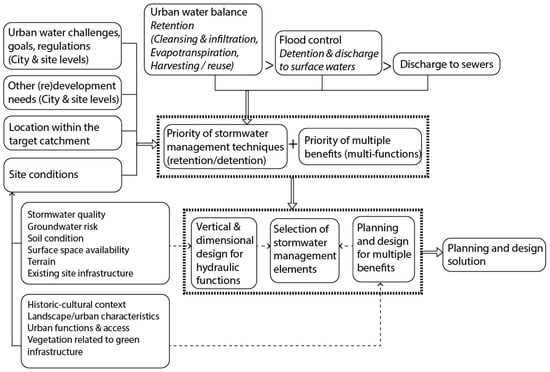
Figure 1.
Key considerations for planning and design of blue-green infrastructure for stormwater management project.
4.2. Key Considerations and Priority of Water Techniques
Site-catchment relation (i.e., location and hydraulic relation), specific site conditions like terrain, construction and soil, and the design objectives targeting the city’s water challenges and other (re)development needs can limit water technique selection and thus are important considerations for finding relevant project solutions. The ability to clearly prioritize water techniques concerning infiltration and ground water recharge, evapotranspiration, reuse, detention and discharge is a prerequisite for the overall project solution. The SWM priority that best contributes to improving the urban water balance is: 1st priority: Retention (cleansing water and infiltration, evapotranspiration, harvesting and reuse); 2nd priority: Detention (cleansing) before throttled discharge to receiving surface water bodies; 3rd priority: Discharge to sewers. A sustainable solution needs to target both frequent small rain events and rare events that generate large runoff volumes. On-site retention for small rains and detention-discharge for heavy rain events appear to be priorities for upstream and downstream locations respectively, although considerations for both small and extreme rains are relevant for all projects that seek to achieve multi-functional success. The right mix and match of options depends on the conditions of the specific site and catchment.
4.3. Site Condition and Urban Context
Of the site conditions, stormwater quality, groundwater risk and soil conditions seem to be decisive for whether retention (infiltration, evapotranspiration, reuse) can be prioritized, in combination with the availability of unpaved surfaces, terrain conditions, existing site infrastructure (i1–8; pers. obse.). In addition, local regulations on water quality influence water management priorities. Due to Copenhagen’s stringent considerations and regulations on stormwater quality for infiltration and recreational use, different SWM priorities are applied to different stormwater sources, and stormwater reuse and infiltration is limited mainly to roof water management [33,34]. In Beijing, regulations associated with stormwater infiltration are less strict, and therefore infiltration is more commonly applied. However, the impact of stormwater infiltration on groundwater quality requires further examination. This difference calls for clearer standards, maybe internationally, for stormwater quality control and environmental impact.
4.4. Vertical Design and Landscape Design for Multiple Benefits
Vertical design plays an important role, especially for the selection and design of SWM elements. Since water flow is based on gravity, the placement of elements and their relations to each other influence how water can run through the designed system and the way it can be treated, detained, retained or reused. The placement of outlets and overflows in BGI elements marks the distinction between detention and retention elements. Vertical design is also an integrated part of landscape planning and design, and thus requires thorough consideration of site conditions and expected socio-cultural functions (aesthetic, recreational etc.). The optimal final planning and design solution seems to emerge through a process intertwined with selection and design of SWM elements, vertical/dimensional design and landscape design for multiple benefits. The planning and design process organizes SWM elements spatially, associates multiple benefits with each element, and adapts the elements into meaningful forms that strengthen the multiple benefits and multiple urban functions. These multiple urban functions often relate to a situation with little or no rain. An integrated SWM and landscape design process seems to be a prerequisite for an integrated solution with multiple benefits, which indicates an interesting area for future research and calls for co-design and interdisciplinary cooperation in the planning and design practice.
5. Conclusions
This study has identified gaps among goals, performance and other potential considerations related to sustainable SWM of six municipality-led pilot projects in Beijing and Copenhagen. Hence, this study serves as a relevant source of knowledge for city administrations, consultancies and researchers engaged with SWM and BGI. The two cities’ practices, each with their strengths and weaknesses, can serve as inspiration in the search for sustainable city solutions. Beijing’s case projects served to test and locally adapt non-pipe-based solutions to SWM and provided inspiration for future projects in Beijing and throughout China. SWM techniques were dominated by engineering and drew less on BGI-based alternatives for both flood control and stormwater harvesting through detention and retention, calling for a more proactive effort to integrate multiple benefits with stormwater management in urban spaces. Copenhagen’s case projects took an integrated approach to combine SWM techniques with amenity improvements, supporting Copenhagen’s brand as a green city. Improving the local water balance played only a marginal role in the Copenhagen cases, calling for future action if a green and sustainable city is the ambition.
A simple guideline for the planning and design of sustainable BGI projects was developed and discussed. This guideline illustrates a range of technical and procedural indications for future BGI projects for SWM. Defining clear priorities among possible SWM techniques, targeting both small and big rain events, strengthening vertical design and providing multiple benefits through landscape design were identified as key steps to achieve a sound project solution. An integrated SWM and landscape design process is seen as a prerequisite for a sustainable solution with multiple benefits. Identifying theoretical and empirical knowledge that can help tackle these key steps, and understanding more precisely how integration between SWM and landscape design process can be accomplished would be interesting areas for future research. The number of cases included in the study was limited, partially because monitoring data and project documentation for pilot projects are generally lacking in both cities. Future investigation of a larger number of pilot projects may provide more information for further refining the findings from the current study. This calls for a future practice that combines research and documentation with pilot projects, thus facilitating empirical learning and guiding the upscaling of BGI practices in a more sustainable direction.
Supplementary Materials
The following are available online at https://www.mdpi.com/2073-4441/11/10/2024/s1, Table S1: Maps and photos of six municipality-led stormwater management pilot projects in Beijing and Copenhagen.
Author Contributions
L.L. conducted the investigation, including document review, site investigation and interviews, carried out formal analysis and conceptualization, and prepared the original draft and figure. O.F. contributed to structuring, reviewing and editing the article, as well as validation of the research methodology and the presented data and results of the Copenhagen cases. S.Z. contributed to selection and investigation of the case projects in Beijing, validated the presented data and results of those cases, and reviewed the article.
Funding
This research was partially funded by Realdania and Sino–Danish Center for Education and Research (SDC).
Acknowledgments
The authors are indebted to the interviewees from the institutes of Beijing and Copenhagen (Table 2), who made the project possible. Thanks to Marina Bergen Jensen, Bjørn Kaare Jensen and Jes Clauson-Kaas for helpful comments in developing the paper. The authors are also grateful for the valuable comments provided by the four reviewers.
Conflicts of Interest
The authors declare no conflict of interest. The funders had no role in the design of the study; in the collection, analyses, or interpretation of data; in the writing of the manuscript, or in the decision to publish the results.
References
- Liu, L.; Jensen, M.B. Green infrastructure for sustainable urban water management: Practices of five forerunner cities. Cities 2018, 74, 126–133. [Google Scholar] [CrossRef]
- Fletcher, T.D.; Shuster, W.; Hunt, W.F.; Ashley, R.; Butler, D.; Arthur, S.; Trowsdale, S.; Barraud, S.; Semadeni-Davies, A.; Bertrand-Krajewski, J.C.; et al. SUDS, LID, BMPs, WSUD and more—The evolution and application of terminology surrounding urban drainage. Urban Water J. 2015, 12, 525–542. [Google Scholar] [CrossRef]
- Jia, H.; Wang, Z.; Zhen, X.; Clar, M.; Yu, S.L. China’s sponge city construction: A discussion on technical approaches. Front. Environ. Sci. Eng. 2017, 11, 18. [Google Scholar] [CrossRef]
- Qiao, X.J.; Liu, L.; Kristoffersson, A.; Randrup, T.B. Governance factors of sustainable stormwater management: A study of case cities in China and Sweden. J. Environ. Manag. 2019, 248. [Google Scholar] [CrossRef]
- Stahre, P. Blue-Green Fingerprints in the City of Malmö, Sweden, Malmö’s Way towards a Sustainable Urban Drainage; VA SYD: Malmö, Sweden, 2008; p. 8. [Google Scholar]
- Burns, M.J.; Fletcher, T.D.; Walsh, C.J.; Ladson, A.R.; Hatt, B.E. Hydrologic shortcomings of conventional urban stormwater management and opportunities for reform. Landsc. Urban Plan. 2012, 105, 230–240. [Google Scholar] [CrossRef]
- Garcia-Serrana, M.; Gulliver, J.S.; Nieber, J. Infiltration capacity of roadside filter strips with nonuniform overland flow. J. Hydrol. 2017, 45, 451–462. [Google Scholar] [CrossRef]
- Alley, W.M.; Veenhuis, J.E. Effective Impervious Area in Urban Runoff Modeling. J. Hydraul. Eng. 1983, 109, 313–319. [Google Scholar] [CrossRef]
- Sørup, H.J.D.; Lerer, S.M.; Arnbjerg-Nielsen, K.; Mikkelsen, P.S.; Rygaard, M. Efficiency of stormwater control measures for combined sewer retrofitting under varying rain conditions: Quantifying the Three Points Approach (3PA). Environ. Sci. Policy 2016, 63, 19–26. [Google Scholar] [CrossRef]
- Geels, F.W.; Schot, J. Typology of sociotechnical transition pathways. Res. Policy 2007, 36, 339–417. [Google Scholar] [CrossRef]
- Markard, J.; Raven, R.; Truffer, B. Sustainability transitions: An emerging field of research and its prospects. Res. Policy 2012, 41, 955–967. [Google Scholar] [CrossRef]
- Martin, C.; Ruperd, Y.; Legret, M. Urban stormwater drainage management: The development of a multicriteria decision aid approach for best management practices. Eur. J. Oper. Res. 2007, 181, 338–349. [Google Scholar] [CrossRef]
- Barbosa, A.E.; Fernandes, J.N.; David, L.M. Key issues for sustainable urban stormwater management. Water Res. 2012, 46, 6787–6798. [Google Scholar] [CrossRef] [PubMed]
- Gogate, N.G.; Kalbar, P.P.; Raval, P.M. Assessment of stormwater management options in urban contexts using Multiple Attribute Decision-Making. J. Clean. Prod. 2017, 142, 2046–2059. [Google Scholar] [CrossRef]
- Liu, L.; Jensen, M.B. Climate resilience strategies of Beijing and Copenhagen and their links to sustainability. Water Policy 2017, 19, 997–1013. [Google Scholar] [CrossRef]
- Backhaus, A.; Fryd, O. The aesthetic performance of urban landscape-based stormwater management systems: A review of twenty projects in Northern Europe. J. Landsc. Archit. 2013, 8, 52–63. [Google Scholar] [CrossRef]
- Echols, S.; Pennypacker, E. From Stormwater Management to Artful Rainwater Design. Landsc. J. 2008, 27, 268–290. [Google Scholar] [CrossRef]
- Flyvbjerg, B. Five Misunderstandings about Case-Study Research. Qual. Inq. 2006, 12, 219–245. [Google Scholar] [CrossRef]
- Guo, Z.B.; Zhang, S.H.; Deng, Z.Z.; Zheng, K.B.; Wang, L.X.; Duan, W.; Bao, W.; Chen, J.G.; Zong, F.P.; Zhao, F.; et al. Research on Stormwater Utilization Technology Olympic Game Area; China Water Conservancy and Hydropower Press: Beijing, China, 2007; pp. 1–274. (In Chinese) [Google Scholar]
- Pan, A.J.; Zhang, S.H.; Chen, J.G.; Ding, Y.Y.; Li, Q.J.; Huang, Y.Z.; Liao, R.H.; Xie, S.C.; Bai, G.Y.; Zhang, S.C.; et al. Research and Application on Urban Stormwater Comprehensive Utilization Technology; China Water Conservancy and Hydropower Press: Beijing, China, 2006; pp. 1–274. (In Chinese) [Google Scholar]
- BWSTI (Beijing Water Science and Technology Institute). Xiangquan Roundabrout Stormwater Utilization Project; Project Poster; BWSTI: Beijing, China, 2014. (In Chinese) [Google Scholar]
- Lindevangsparken—Klar til Oversvømmelse. Available online: https://www.frb-forsyning.dk/forside/kloak/klimatilpasning/lindevangsparken (accessed on 20 May 2016). (In Danish).
- Andersen, S.B.; Westphall, H.R. Lindevangsparken Frederiksberg—Klimatilpasning i den tætte bys parker og pladser. In Proceedings of the VANDPLUS Conference, Copenhagen, Denmark, 8 January 2014; Frederiksberg Municipality and Frederiksberg Water Utility: Frederiksberg, Denmark, 2014. (In Danish). [Google Scholar]
- Westphall, H.R. Climate adaptation Lindevangsparken Frederiksverg. In Proceedings of the Conference of IWA Young Water Professionals Denmark, Copenhagen, Denmark, 9 March 2018; Frederiksberg Water Utility: Frederiksberg, Denmark, 2018. [Google Scholar]
- VANDPLUS Secretory. City’s water—Water plus Frederiksberg (Byens Vand, VANDPLUS, Frederiksberg). In Report for Evaluation and Presentation of VANDPLUS Project—City’s Water; VANDPLUS: Copenhagen, Denmark, 2015; Available online: https://realdania.dk/projekter/byens-vand-frederiksberg (accessed on 20 May 2016). (In Danish)
- Tåsinge Plads. Available online: https://klimakvarter.dk/en/projekt/tasinge-plads/# (accessed on 20 May 2016). (In Danish).
- Tåsinge Plads. Booklet on the Technical Solution and Process of the Project; TMF (Techniques and Environment Administration, Municipality of Copenhagen): Copenhagen, Denmark, 2015. (In Danish)
- Sankt Annæ Projektet. Available online: https://realdania.dk/projekter/sankt-annae-projektet (accessed on 20 May 2016). (In Danish).
- Overdragelsesnotat Sankt Annæ Plads. Report for HOFOR; Rambøll: Copenhagen, Denmark, 2016. (In Danish) [Google Scholar]
- Nielsen, C.N.; Hansen, S.S.; Krak, A.L.; Andersen, S.M.; Clausson-Kaas, J.; Bach, O. Sct Annae Square as Flash Flood Street. In Proceedings of the NOVATECH Conference, Lyon, France, 23–27 June 2013. [Google Scholar]
- Municipality of Copenhagen, HOFOR, and Sankt Annæ Selskabet. Sankt Annæ Project—Dispositionsforslaget fra Offentlig Høring; Municipality of Copenhagen, HOFOR, and Sankt Annæ Selskabet: Copenhagen, Denmark, 2013. (In Danish)
- Beijing Institute of Architectural Design (Group) Co., Ltd.; Beijing General Municipal Engineering Design and Research Institute Co., Ltd.; Beijing Institute for Water Science and Technology. Code for Design of Stormwater Management and Harvesting Engineering—DB11/685-2013); Beijing Municipality Local Standard; Beijing Municipal Planning Commission; Beijing Municipal Bureau of Quality and Technical Supervision: Beijing, China, 2013. (In Chinese)
- The Danish Environmental Protection Act 2019 (Miljøbeskyttelsesloven 2019). Available online: https://www.retsinformation.dk/Forms/R0710.aspx?id=209531#id35df5516-73e2-4268-b993-58d29b40618c (accessed on 10 September 2019). (In Danish).
- Clauson-Kaas, J.; Dalsgaard, A.; Fotel, F.; Thuesen, L.B. Health Aspects of Rain-Based Recreational Water in Major Cities (Sundhedsaspekter ved Regnbaseret Rekreativt Vand i Større Byer); Report; Nature Management Agency, Ministry of Environment: Copenhagen, Denmark, 2011. Available online: https://naturstyrelsen.dk/media/nst/Attachments/rekreativt_vand.pdf (accessed on 10 September 2019). (In Danish)

© 2019 by the authors. Licensee MDPI, Basel, Switzerland. This article is an open access article distributed under the terms and conditions of the Creative Commons Attribution (CC BY) license (http://creativecommons.org/licenses/by/4.0/).