


Abstract
Coccolithophores are unicellular marine algae belonging to the haptophyte group, characterized by the production of intricate calcium carbonate plates that adorn their cells and exhibit species-specific morphology. The Adriatic Sea has historically been the type locality of numerous phytoplankton species, including coccolithophores. However, since the initial description, many species have not been recorded during the frequent phytoplankton surveys in the Adriatic Sea. This was mainly because these surveys did not use electron microscopy, which is necessary for accurate species identification. In this study, we re-evaluate the coccolithophore species lists using historical records and compare them with recent surveys in the coastal and open waters of the Adriatic Sea. In light of changes in nomenclature resulting from clarification of the species’ life cycles, we update the taxonomic list of coccolithophore species occurring in the Adriatic.
1. Introduction
Coccolithophores are single-celled algae characterized by their ability to calcify. They are part of the marine phytoplankton and are among the most important primary producers in the sea. Because of their ability to both calcify and photosynthesize, they fundamentally affect the chemistry of seawater and are one of the most important drivers of the oceanic carbon cycle and thus the Earth’s climate [1]. Coccolithophores occur in both open and coastal marine waters and sometimes form large blooms [2] which are detectable in ocean colour satellite imagery [3].
The characteristic feature of coccolithophores is their intricately shaped calcite plates, coccoliths, which adorn their cells in at least one phase of their life cycle [4]. Coccolithophores have a complex haplo-diplontic life cycle in which both haploid (with a single set of chromosomes) and diploid (with two copies of each chromosome) phases can reproduce vegetatively. Coccolith morphology differs between these two phases. In the diploid phase, coccolithophores produce heterococcoliths, plates consisting of a series of intricately shaped calcite crystals that deviate from the typical rhombohedral geometry [5]. In their haploid phase, their cells are covered with holococcoliths, nannoliths, or they do not calcify at all and have only organic scales covering their cells. Holococcoliths consist of single rhombohedral crystals, while nannoliths are calcareous structures that do not have the characteristic features of either heterococcoliths or holococcoliths.
The taxonomy of coccolithophores is based primarily on the characteristic, species-specific morphology of the coccoliths that cover their cells, the coccospheres [6]. Coccospheres bearing different types of coccoliths have been considered to belong to separate taxa because of their morphological differences, so coccolithophores of the same taxa but at different stages of their life cycle have been incorrectly classified as different species. Although the dimorphic life cycle of coccolithophores was first described by Parke and Adams [7], life cycle associations have only been clarified for ~60 coccolithophore species, representing ~20% of the described diversity, with examples distributed throughout the diversity of coccolithophores [8]. The main tool for clarifying life cycle associations is the detection of “combination cells” (coccospheres, bearing both hetero- and holoccoliths, first defined in Thomsen et al. [9]) in natural samples using scanning electron microscopy (SEM) [8].
The currently known diversity of coccolithophores includes ~280 morphospecies [8], including ~60 holococcolithophores, which should probably be excluded as they likely represent the life cycle stage of heterococcolithophores [10]. Coccolithophores are most diverse in subtropical and tropical waters [11]. In northwestern Mediterranean waters, Cros and Fortuño [12] reported 168 coccolithophores (including various taxonomic and morphotypic units). In the last comprehensive review of phytoplankton species in the Adriatic Sea, Viličić et al. [13] list 95 coccolithophore species in their Table 1. However, the authors note that the species diversity of coccolithophores throughout the Mediterranean is not comparable due to differences in identification methods, suggesting that the use of SEM for coccolithophores was not widespread at the time.

Table 1.
List of morphospecies published by Erwin Kamptner (1941) (Die Coccolithineen der Südwestküste von Istrien. Ann. Naturhist. Mus. Wien. 51: 54–149). HET and HOL indicate the life cycle stage, HET diploid and HOL haploid, and ‘-‘ indicates an unidentifiable life cycle stage. Table lists coccolithophore species along the coast of the Istrian peninsula, northern Adriatic Sea, including 16 new species for science. Accepted names were updated following the recommendations on Young, J.R., Bown P.R., Lees J.A. (2022) Nannotax3 website. International Nannoplankton Association. Accessed 14 December 2022. URL: www.mikrotax.org/Nannotax3. Comments are indicated with *.
In this study, we aimed to investigate and review the taxonomic work on coccolithophores in the Adriatic Sea from the early 1900s to the early 2000s. We intended to update the taxonomy of these old works with new knowledge from the biology of coccolithophores. We also aimed to provide a comprehensive picture of the current diversity of coccolithophores in the Adriatic Sea by summarising published taxonomic surveys using SEM as a gold standard for coccolithophore identification. We anticipate that our efforts to update the checklist of coccolithophore species in the Adriatic Sea will be considered an important source of information for both research and policy.
2. Materials and Methods
In our analysis of historical and modern records of diversity in the Adriatic, we followed the recommendations of the taxonomy of the Nannotax3 website [14]. This online taxonomy project was originally based on the creation of online versions of the well-established syntheses of Bown [15] and Young et al. [6] and was later updated to include data from later publications. It is a useful basis for analysis, both because it is the most up-to-date review and because an attempt has been made to make it comprehensive, including both formally described species and many informally described morphotypes that are very likely to be true species.
For the analysis of the historical record, we used the works of Steuer [16], Brunnthaler [17], Schiller [18,19,20], Kamptner [21,22], Revelante [23], and Viličić et al. [13].
In 1903, Steuer [16] conducted studies in the Gulf of Trieste, while Brunnthaler [17] studied coastal waters near Rovinj, Croatia in 1910. Schiller’s studies [18,19,20] were based on material obtained during the seasonal voyages of the research steamer “Najade”, which investigated transects in the Adriatic Sea: Venice to Rovinj, Ancona to Dugi Otok Island, Bari to Dubrovnik, Otranto to Cap Linquetta in February, May, August, and November 1912. The investigation of coccolithophores by Kamptner [21,22] was mainly related to the coastal waters of the town of Rovinj and various other places on the southwestern coast of Istria, Croatia. The investigations of the coastal waters of the town of Rovinj were carried out quantitatively for a whole year, from the beginning of May 1935 to the end of April 1936. Samples of 2 L were completely sedimented and examined by light microscopy (LM) under high magnifications (1750×, 3750×, and 6000×).
Recent studies on coccolithophores in the northern Adriatic included Cerino et al. [24], Godrijan et al. [25], and Neri et al. [26]. Cerino et al. [24] analyzed data from monthly sampling between May 2011 and February 2013 at the C1-LTER coastal station in the Gulf of Trieste. Coccolithophore composition was determined using a polarized light microscope (PLM) and an SEM. Godrijan et al. [25] analyzed the coccolithophore community on the eastern Adriatic coast from September 2008 to December 2009, sampling fortnightly at 5 m depth. Morphospecies composition was determined using an SEM. Neri et al. [26] presented the entire phytoplankton community in the surface layer using LM (Utermöhl method) for the 1988–2018 data series from offshore station SG05, located 15 nm off the Italian coast, with variable temporal frequency (monthly to quarterly).
For the middle Adriatic, coccolithophores were studied by Šupraha et al. [27,28,29], Skejić et al. [30,31], and Young et al. [32], and in all taxonomic identification was performed by SEM. The works of Šupraha et al. [27,28,29] deal with the coccolithophore community in the coastal region of the Krka estuary in February and July 2013, and quantitative and qualitative analyses were performed for the vertical profile of the coccolithophore community. In their 2018 work, Skejić et al. [30] focused on data collected in December 2015 and April 2016. The study area includes the Jabuka Pit depressions (depth 260 m) and an Italy–Croatia transect (maximum depth 160 m). In their 2021 study, Skejić et al. [31] investigated the sampling site in the highly stratified Krka River estuary on the eastern Adriatic coast. Samples were collected from August to October 2017. Sampling occurred every two weeks at the surface (0 m), in the halocline (mainly 1.5 m), and at 7 m depth. Finally, Young et al. [32] report a single event from a surface water sample collected at an offshore station in March 2018.
Studies on coccolithophores in the southern Adriatic were scarce and, in the last 15 years, have included only the investigation by Balestra et al. [33]. The samples for this study were collected in October 2000 in a grid along four transects in the Gulf of Manfredonia, in the western part of the southern Adriatic. The data presented in this article are from quantitative analyses performed on the vertical water profile using the PLM and SEM.
Images were processed using the Adobe Lightroom 6.1. (Adobe, Mountain View, California, United States). Some of the images in figures have been published elsewhere, e.g., in Godrijan et al. [25], Skejić et al. [30], and Young et al. [32].
3. Results and Discussion
3.1. History of Coccolithophore Research in the Adriatic Sea
In 1903, Steuer [16] conducted the first survey of coccolithophores in the Adriatic Sea, in the Gulf of Trieste and found Syracosphaera pulchra, Rhabdosphaera stylifer, and Syracosphaera robusta. In 1910, Brunnthaler [17] found a much larger number of cocccoltithophores in the coastal waters near Rovinj. Overall, the Adriatic Sea is the type locality of many phytoplankton species, including coccolithophores. New species of coccolithophores in the Adriatic Sea were described by (i) Brunnthaler [17], who listed one new species of coccolithophores, Syracosphaera lohmanni Brunnthaler 1911; (ii) Schiller, who listed 23 new species in 1913 [18] and another 23 new species in 1925 [19]; and (iii) Kamptner, who listed 4 new species in his 1927 article [22] and 16 new species in 1941 [21].
The list of morphospecies in Table 1 was published by Erwin Kamptner in 1941 [21] as an overview of his efforts in the study of coccolithophores along the coast of the Istrian Peninsula in the northern Adriatic. The list includes 45 taxa. However, due to sparse information in the descriptions of some species and limited details in some line drawings of cocospheres, some of the listed species cannot be identified to species level. Moreover, some of the species listed are duplicates resulting from taxonomic revisions [14]. We note, then, that the Kamptner species list contains 35 morphotypes of coccolithophores from the northern Adriatic, for which we trust ourselves to give a currently accepted name. Furthermore, two of the listed species later turned out not to be coccolithophores but calcified dinoflagellate cysts of the species Scrippsiella acuminata (Ehrenberg) Kretschmann, Elbrächter, Zinssmeister, S.Soehner, Kirsch, Kusber, & Gottschling 2015. Kamptner also described Acanthoica rubus, but the line drawing of the coccosphere is rather insufficient to identify the species, and subsequently this morphospecies was never recorded again. Here, we propose that Corisphaera corona shares similarities with Syracosphaera periperforata Kleijne 1991 var. periperforata HOL in the highly arched circum-flagellar coccoliths, while Pontosphaera steueri resembles Hymenomonas globosa (Magne 1954) Gayral & Fresnel 1976, due to the organisation of its coccoliths and elliptical muroliths, and finally that Thalassopapus pellucidus Kampt has similarities to Calciopappus caudatus Gaarder & Ramsfjell, 1954 in the shape of its coccosphere and its circum-flagellar coccoliths modified into elongate spines.
Table 2 consists of a list of morphospecies compiled by Noelia Revelante in 1985 [23]. This work mentions a total of 81 morphospecies that have been recorded in the northern Adriatic. However, this list was compiled from data from the literature and lists species reported for the northern Adriatic by Brunnthaler, Schiller, and Kamptner. Going back to the original descriptions, some of the species cannot be recognized to the species level due to the lack of details in species descriptions and some line drawings of the cocospheres. Additionally, some of the listed species are duplicates as a consequence of taxonomic revisions [14]. We have marked all morphospecies that are not identifiable. We therefore conclude that the Revelante species list contains 41 morphotypes of coccolithophores from the northern Adriatic, for which we can give the currently accepted names.
Table 2.
List of morphospecies compiled by Noelia Revelante (1985) (A catalogue of phytoplankton reported for the Rovinj area of the northern Adriatic. Thalass. Jugoslav. 21/22, 139–169). HET and HOL indicate the life cycle stage, HET diploid and HOL haploid, and ‘-‘ indicates an unidentifiable life cycle stage. This paper reports morphospecies recorded in the northern Adriatic Sea. Accepted names were updated following the recommendations of Young, J.R., Bown P.R., Lees J.A. (2022) Nannotax3 website. International Nannoplankton Association. Accessed 14 December 2022. URL: www.mikrotax.org/Nannotax3. Comments are indicated with *.
Finally, in our historic analysis we present the list of species compiled by Viličić et al. in 2002 [13] (Table 3). The list indicates the distribution of coccolithophore morphospecies for the eastern Adriatic, given as follows: N—Northern, M—Middle, S—Southern. A total of 95 species are listed. Although the text indicates that there are 101 species of prymnesiophytes (Prymnesiophyceae—class of haptophytes, including coccolithophores), we could not identify the 6 additional species in any of the tables in the paper. Going back to the original descriptions, again, some of the listed species cannot be determined to the specific species level due to the lack of information in species descriptions and the lack of features in some line drawings of the cocosphere. Additionally, due to taxonomic revisions, several of the listed species are duplicates. [14]. We have marked all morphospecies that are not identifiable. Thus, we conclude that the Viličić et al. 2002 species list contains 51 morphotypes of coccolithophores from the revised eastern part of the Adriatic for which we are confident to give the currently accepted name.
Table 3.
List of morphospecies compiled by Viličić et al. (2002) (Checklist of phytoplankton in the eastern Adriatic Sea. Acta. Bot. Croat. 61 (1), 57–91). HET and HOL indicate the life cycle stage, HET diploid and HOL haploid, and ‘-‘ indicates an unidentifiable life cycle stage. Only one name per species is listed (additional synonyms are listed in Viličić et al. 2002). This paper lists morphospecies reported for the eastern Adriatic Sea, distribution is noted as: N—Northern, M—Middle, S—Southern, and ˟ registered by Revelante (1985), reportedly not found afterwards. Accepted names were updated following the recommendations of Young, J.R., Bown P.R., Lees J.A. (2022) Nannotax3 website. International Nannoplankton Association. Accessed 14 December 2022. URL: www.mikrotax.org/Nannotax3. Comments are indicated with *.
3.2. Recent Studies on Coccolithophores in the Northern Adriatic
In the last 15 years, the coccolithophore assemblage has been studied in several publications covering the northern, central and southern Adriatic [24,25,26,27,28,29,30,31,32,33]. These publications reveal a great diversity of coccolithophores not only in the open sea, but also in coastal and estuarine waters.
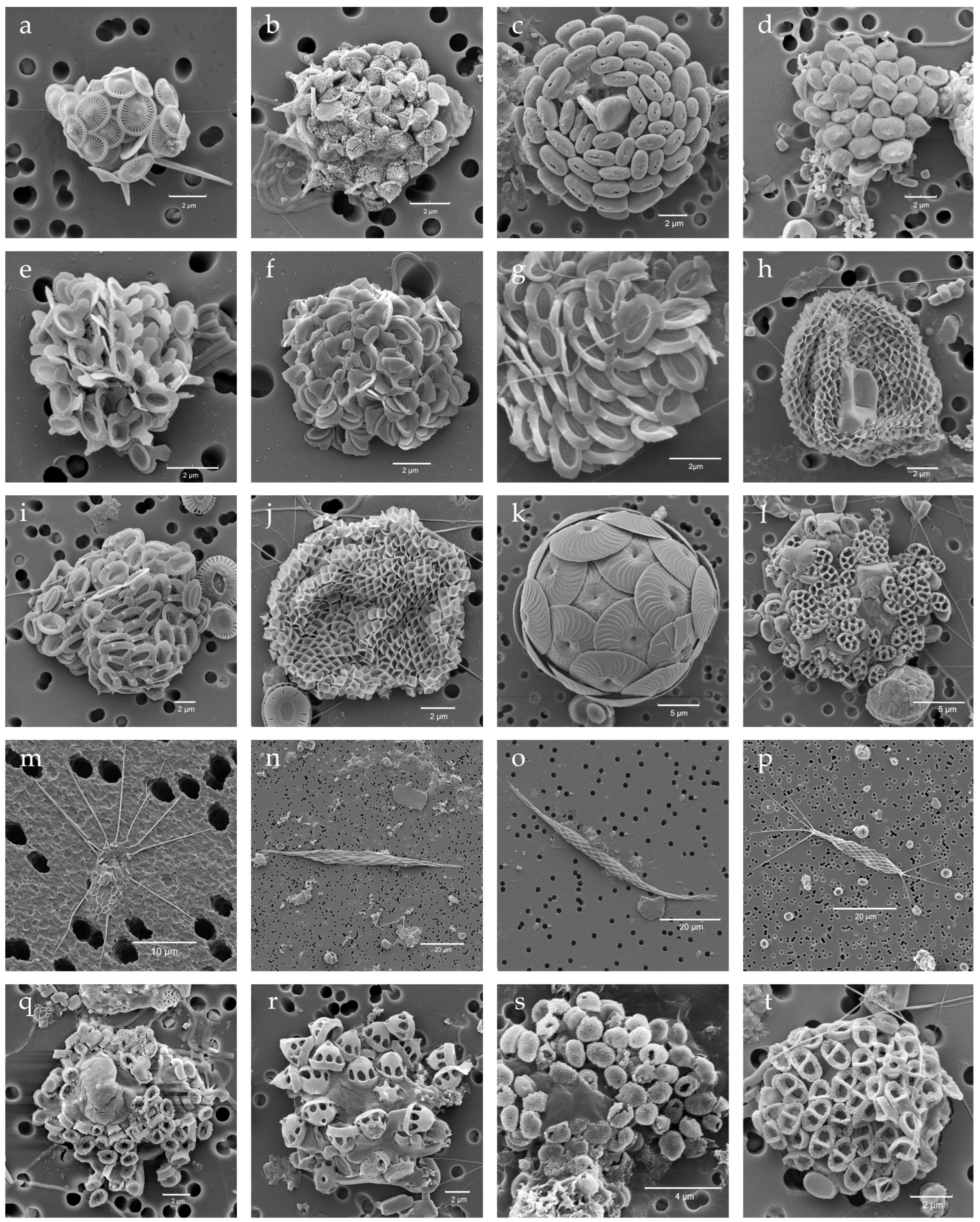
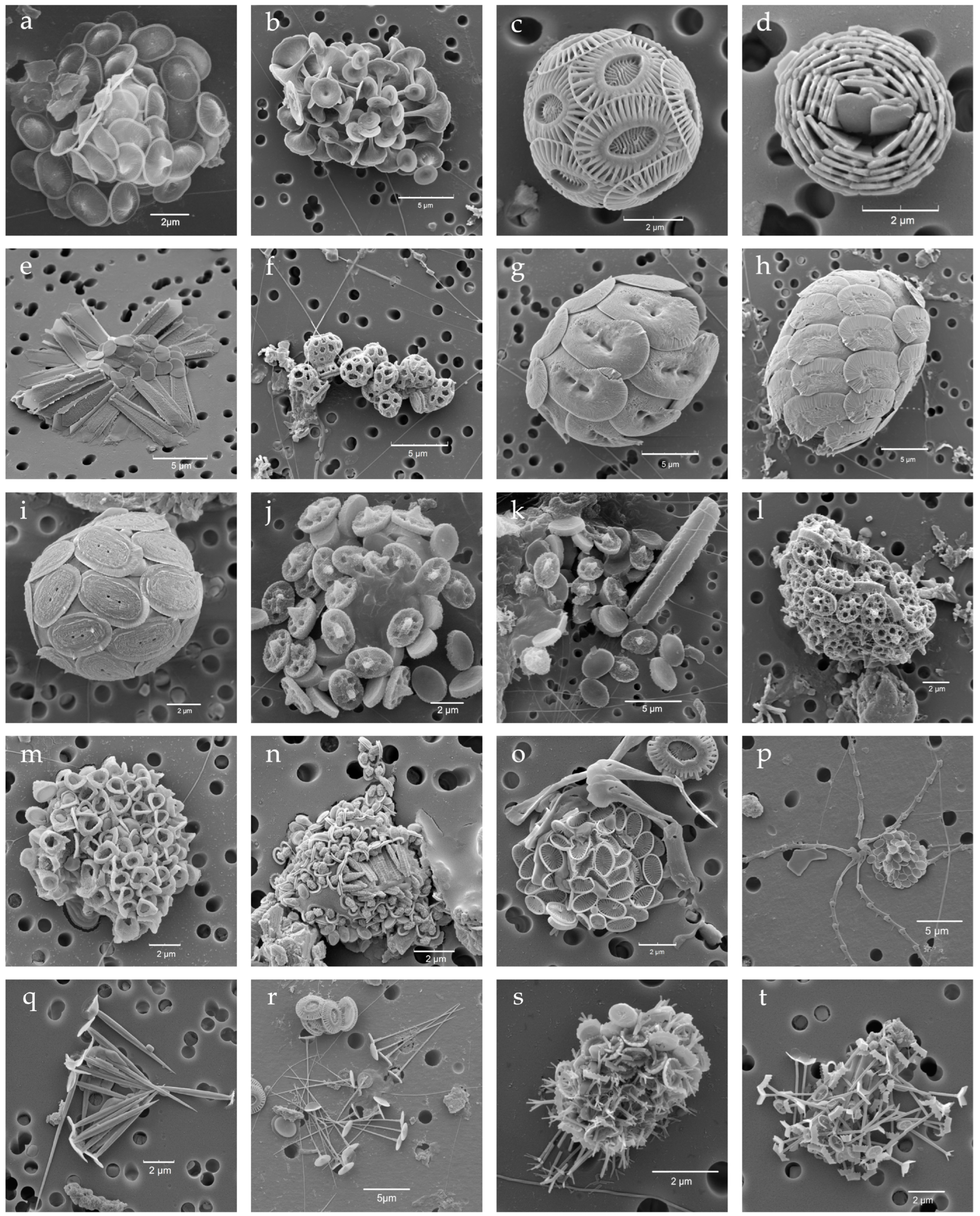
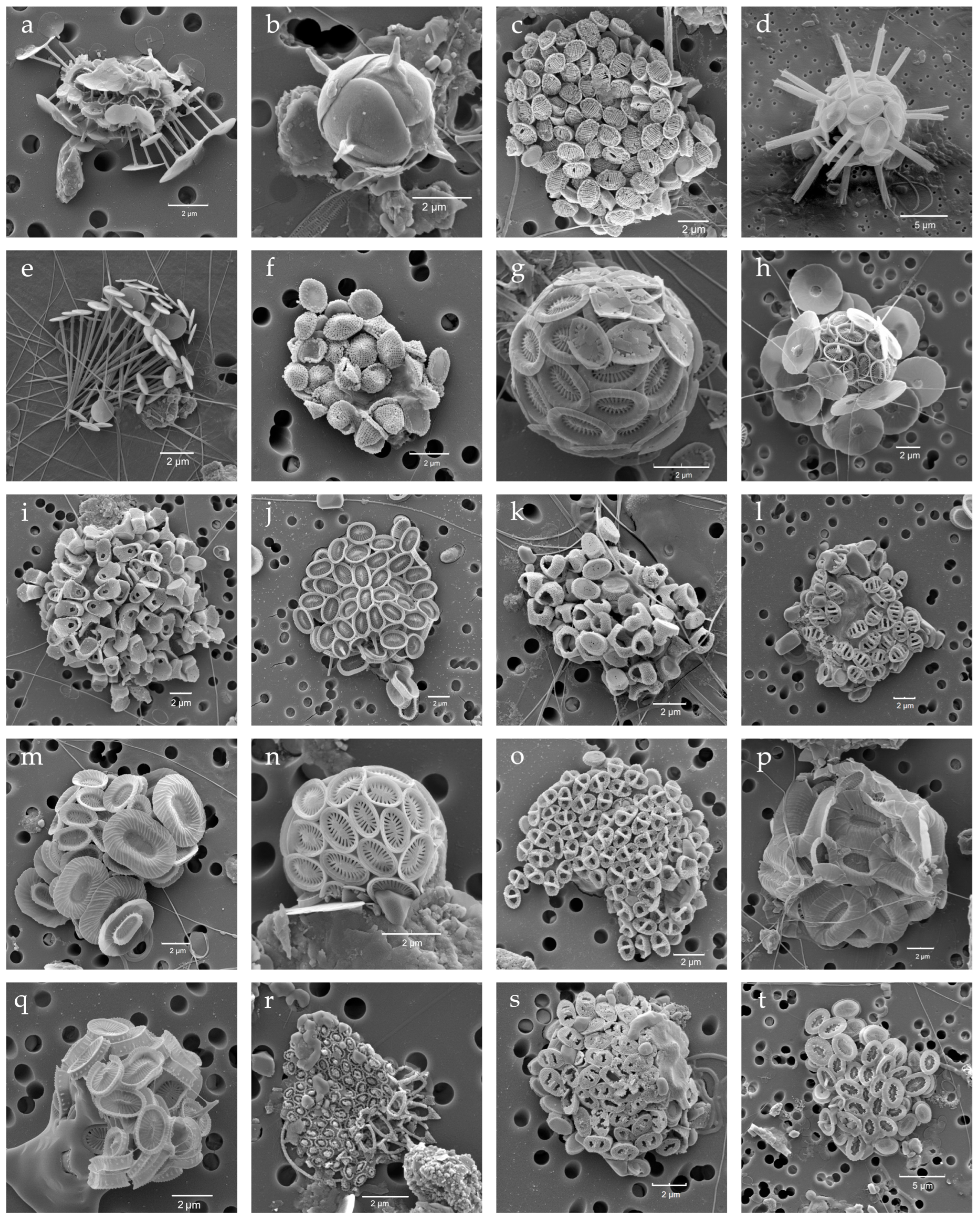
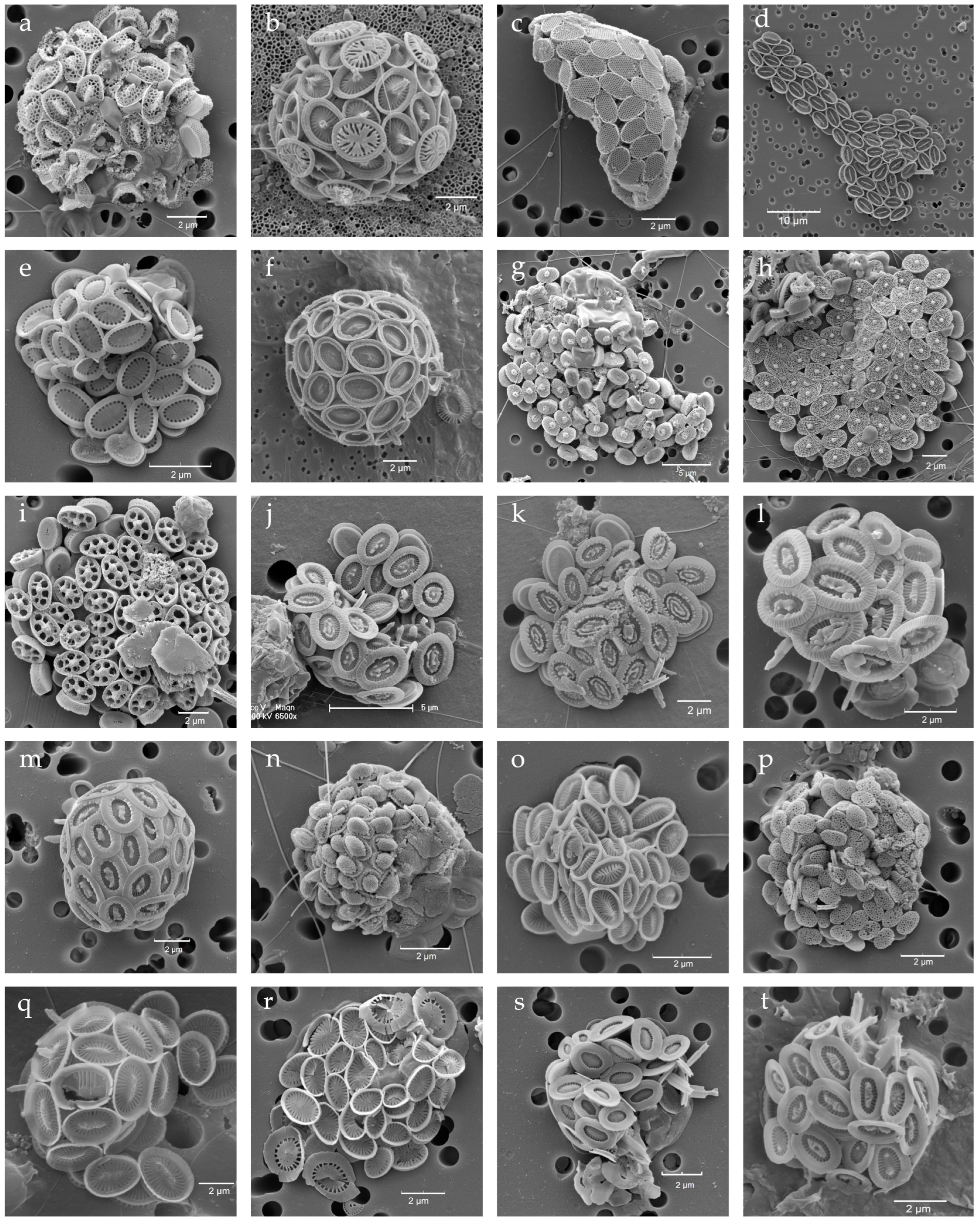
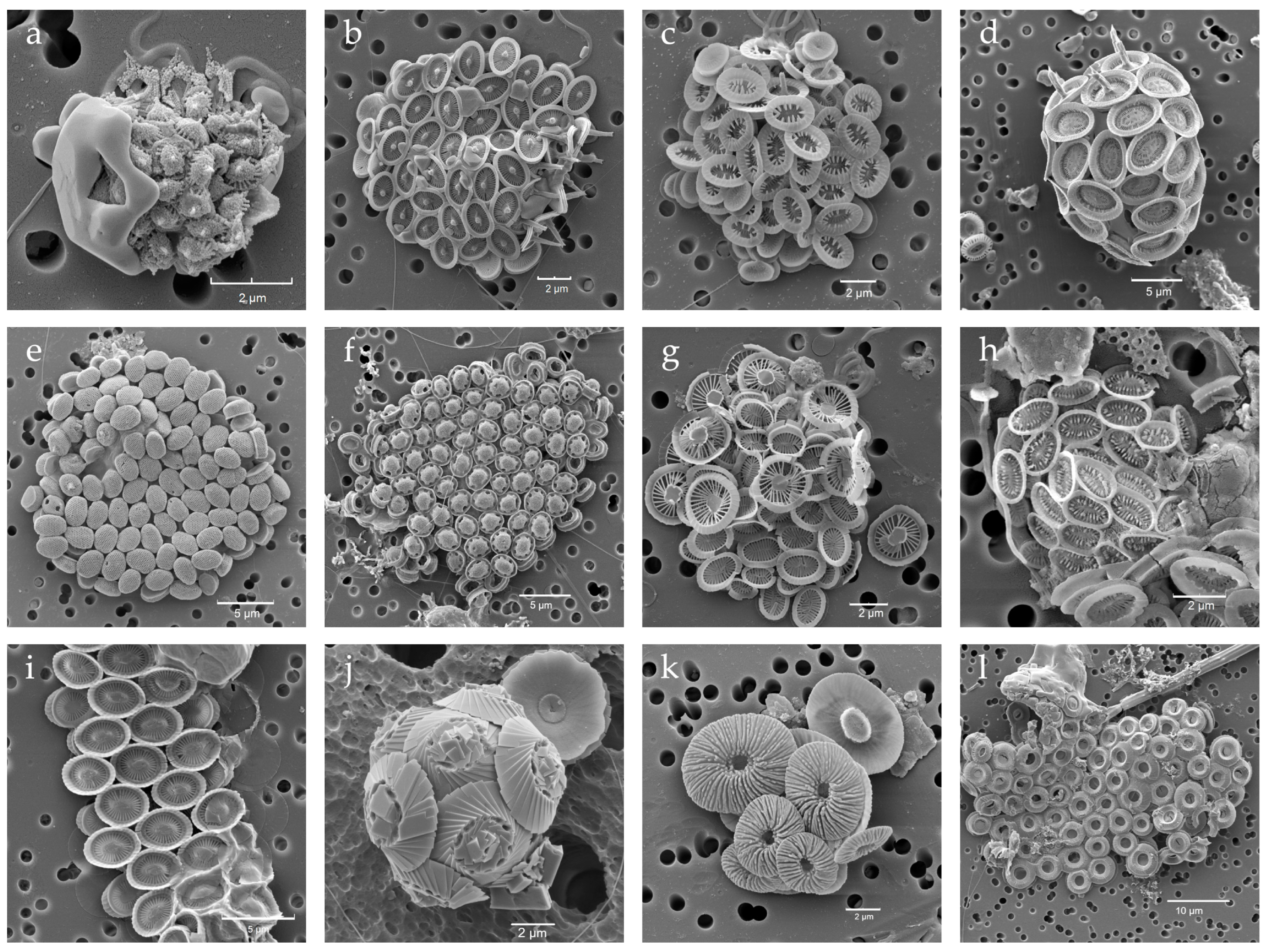
Table 4 contains a list of 141 coccolithophores morphotypes published during last 15 years in the previously mentioned publications (combination coccospheres were not considered). Of these 141 morphotypes, 84 were recorded in the HET—diploid phase and the remaining 58 morphotypes in the haploid phase (including HOL, POL, NAN). Seventeen species were confirmed in both phases (HET-HOL), marked in bold in Table 4. The available images of coccolithophores from the northern and middle Adriatic Sea are listed in Figure 1, Figure 2, Figure 3, Figure 4 and Figure 5.
Table 4.
List of species compiled from recent publications studying coccolithophores diversity assemblage in the Adriatic Sea. HET, HOL, POL and CER indicate life cycle stages. HET-diploid phase; HOL, NAN, POL haploid phase. Species recorded in both phases (HET and HOL) are marked in bold.
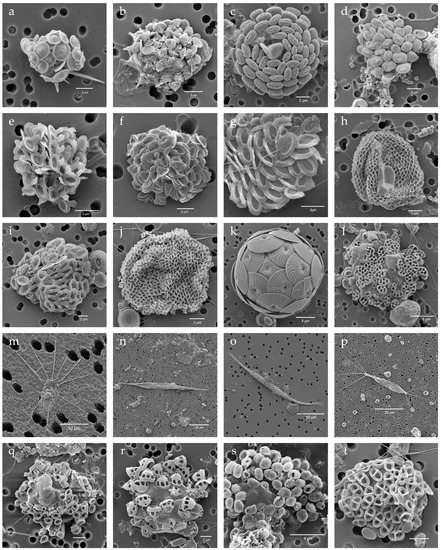
Figure 1.
SEM images of coccolithophore morphotypes: (a) Acanthoica quattrospina; (b) Acanthoica quattrospina HOL; (c) Algirosphaera robusta; (d) Algirosphaera robusta HOL; (e) Alisphaera capulata; (f) Alisphaera extenta; (g) Alisphaera gaudii; (h) Alisphaera gaudii POL; (i) Alisphaera unicornis; (j) Alisphaera unicornis POL; (k) Calcidiscus leptoporus subsp. quadriperforatus; (l) Calcidiscus leptoporus subsp. quadriperforatus HOL; (m) Calciopapus rigidus; (n) Calciosolenia brasiliensis; (o) Calciosolenia corsellii; (p) Calciosolenia murrayi; (q) Calicasphaera blokii; (r) Calyptrosphaera heimdaliae; (s) Calyptrosphaera sphaeroidea; (t) Corisphaera gracilis; (scale bars: a–j,q,r,t = 2 µm; s = 4 µm; k,l = 5 µm; m = 10 µm; n–p = 20 µm).
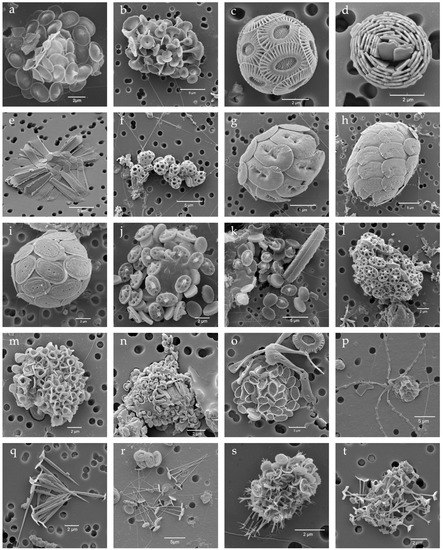
Figure 2.
SEM images of coccolithophore morphotypes: (a) Cyrtosphaera aculeata; (b) Discosphaera tubifera; (c) Emiliania huxleyi; (d) Florisphaera profunda; (e) Gladiolithus flabellatus; (f) Gliscolithus amitakareniae; (g) Helicosphaera carteri; (h) Helicosphaera hyalina; (i) Helicosphaera pavimentum; (j) Helicosphaera pavimentum HOL; (k) Helicosphaera HOL catilliferus type; (l) Helicosphaera HOL confusus type; (m) Homozygosphaera spinosa; (n) Navilithus altivelum; (o) Ophiaster formosus; (p) Ophiaster hydroideus; (q) Palusphaera crosiae; (r) Palusphaera vandelii; (s) Pappomonas sp. type 1; (t) Pappomonas sp. type 3; (scale bars: a,c,d,i,j,l–o,q,s,t = 2 µm; b,e–h,k,p,r = 5 µm).
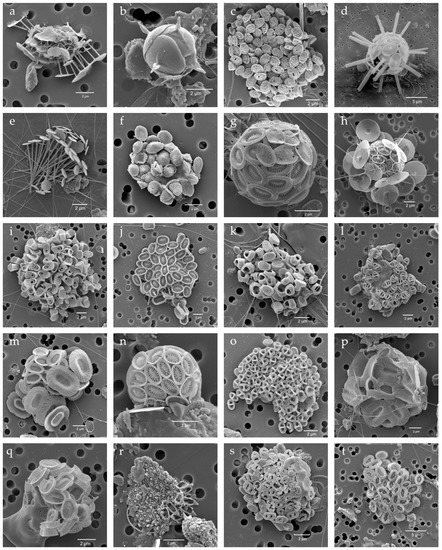
Figure 3.
SEM images of coccolithophore morphotypes: (a) Papposphaera lepida; (b) Pileolosphaera longistirpes; (c) Poritectolithus poritectus; (d) Rhabdosphaera clavigera var. stylifera; (e) Rhabdosphaera xiphos; (f) Sphaerocalyptra sp. 1 HOL; (g) Syracosphaera ampliora; (h) Syracosphaera anthos; (i) Syracosphaera anthos HOL; (j) Syracosphaera arethusae; (k) Syracosphaera arethusae HOL; (l) Syracosphaera aurisinae HOL; (m) Syracosphaera azureaplaneta; (n) Syracosphaera bannockii; (o) Syracosphaera bannockii HOL; (p) Syracosphaera corolla; (q) Syracosphaera dilatata; (r) Syracosphaera elevata HOL; (s) Syracosphaera gaarderae HOL; (t) Syracosphaera halldalii; (scale bars: a–c,e–s = 2 µm; d,t = 5 µm).
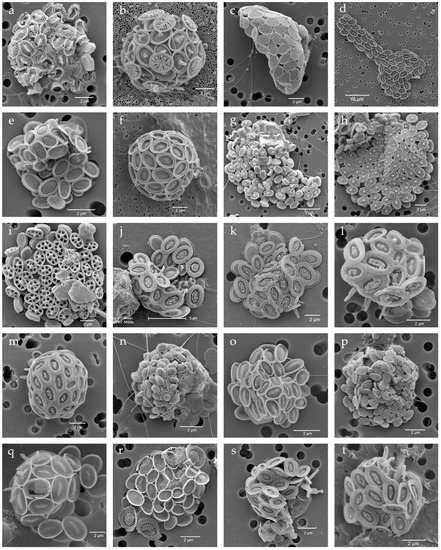
Figure 4.
SEM images of coccolithophore morphotypes: (a) Syracosphaera halldalii HOL; (b) Syracosphaera histrica; (c) Syracosphaera histrica HOL; (d) Syracosphaera lamina; (e) Syracosphaera marginaporata; (f) Syracosphaera mediterranea; (g) Syracosphaera mediterranea HOL gracillima type; (h) Syracosphaera meditteranea HOL hellenica type; (i) Syracosphaera mediterranea HOL wettsteini type; (j) Syracosphaera molischii type 1; (k) Syracosphaera molischii type 2; (l) Syracosphaera mollischi type 3; (m) Syracosphaera mollischi type 4; (n) Syracosphaera mollischi HOL; (o) Syracosphaera nana; (p) Syracosphaera nana HOL; (q) Syracosphaera nodosa; (r) Syracosphaera orbiculus; (s) Syracosphaera ossa type 1; (t) Syracosphaera ossa type 2; (scale bars: a–c,e,f,h,i,k–t = 2 µm; g,j = 5 µm; d = 10 µm).
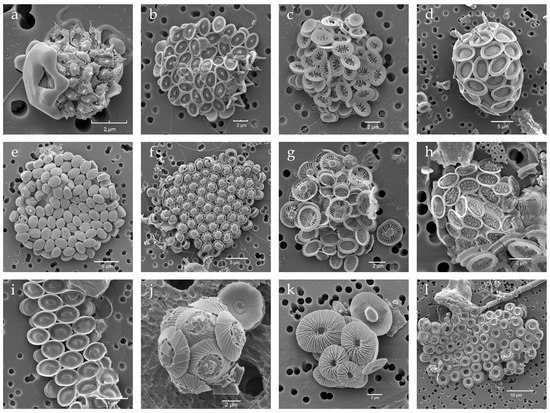
Figure 5.
SEM images of coccolithophore morphotypes: (a) Syracosphaera periperforata var. periperforata; (b) Syracosphaera prolongata; (c) Syracosphaera protrudens; (d) Syracosphaera pulchra; (e) Syracosphaera pulchra HOL oblonga type; (f) Syracosphaera pulchra HOL pirus type; (g) Syracosphaera rotula; (h) Syracosphaera strigilis; (i) Syracosphaera tumularis; (j) Tergestiella adriatica; (k) Umbellosphaera tenuis; (l) Umbilicosphaera sibogae var. sibogae; (scale bars: a–c,g,h,j,k = 2 µm; d–f,i = 5 µm; l = 10 µm).
The most diverse area was the middle Adriatic with 124 morphotypes, but this was probably the result of more intensive research efforts (six publications) compared to the northern (three) and southern parts (one). In addition, 54 morphotypes were found from the northern part and 48 from the southern part of the Adriatic.
The most frequently observed species is E. huxleyi throughout the Adriatic Sea [25,30,33]. However, the highest abundance of coccolithophores was observed for Syracosphaera halldalii, reaching 2.51 × 10⁶ cells L−1 in the middle Adriatic Sea [31].
Records of combination coccospheres (with HET-HOL coccoliths) are important for clarifying taxonomic questions due to the different morphological life cycle stages of coccolithophores. A review of the literature reveals that 11 combination coccospheres were reported in four publications: Acanthoica quattrospina, Alisphaera unicornis, Helicosphaera pavimentum, Syracosphaera arethusae, Syracosphaera bannockii, Syracosphaera histrica, Syracosphaera marginaporata, Syracosphaera mediterranea, Syracosphaera molischii, Syracosphaera pulchra, Syracosphaera strigilis [28,29,30,32].
In summary, we can state that in the past twenty years there has been a notable increase in the number of recorded species in the Adriatic. This increase is most likely due to the use of SEM, which allows a more detailed observation of species characteristics and thus more certain identification. The species lists by Revelante in 1985 [23] and by Viličić et al. in 2002 [13] were largely based on revisions of the older literature, with some species descriptions and associated drawings not being detailed enough to allow unambiguous identification, resulting in duplicate species records. Therefore, we would like to emphasize the importance of including microscopic photographs with species lists, as this allows unambiguous recording of species.
Author Contributions
Conceptualization and writing—original draft preparation: J.G.; formal analysis: J.G., J.A. and S.S.; visualization: M.B.; data curation: J.G., S.S. and J.A.; writing—review and editing, M.B., S.S. and J.A.; funding acquisition, J.G., S.S. and J.A. All authors have read and agreed to the published version of the manuscript.
Funding
This research was funded by the Croatian National Monitoring Program (Project “Jadran”) and by grants from the Croatian Science Foundation under projects UIP-2020-02-3249—Ecology and toxicity of the genus Pseudo-nitzschia in the coastal waters of the central and southern Adriatic Sea (Pseudotox).
Institutional Review Board Statement
Not applicable.
Informed Consent Statement
Not applicable.
Data Availability Statement
Not applicable.
Acknowledgments
We would like to thank everyone who participated in the collection of data sets used in this manuscript. We acknowledge the useful comments of anonymous reviewers.
Conflicts of Interest
The authors declare no conflict of interest.
References
- Rost, B.; Riebesell, U. Coccolithophores and the biological pump: Responses to environmental changes. In Coccolithophores—From Molecular Processes to Global Impact; Springer: Berlin/Heidelberg, Germany, 2004; pp. 76–99. [Google Scholar]
- Okada, H.; Mcintyre, A. Seasonal distribution of modern Coccolithophores in the Western North Atlantic Ocean. Mar. Biol. 1979, 54, 319–328. [Google Scholar] [CrossRef]
- Moore, T.S.; Dowell, M.D.; Franz, B.A. Detection of coccolithophore blooms in ocean color satellite imagery: A generalized approach for use with multiple sensors. Remote Sens. Environ. 2012, 117, 249–263. [Google Scholar] [CrossRef]
- Billard, C.; Inouye, I. What is new in coccolithophore biology? In Coccolithophores: From Molecular Processes to Global Impact; Thierstein, H.R., Young, J.R., Eds.; Springer: Berlin/Heidelberg, Germany, 2004; pp. 1–30. [Google Scholar]
- Young, J.R.; Henriksen, K.; Probert, I. Structure and morphogenesis of the coccoliths of the CODENET species. In Coccolithophores: From Molecular Processes to Global Impact; Thierstein, H.R., Young, J.R., Eds.; Springer: Berlin/Heidelberg, Germany, 2004; pp. 191–216. [Google Scholar]
- Young, J.R.; Geisen, M.; Cros, L.; Kleijne, A.; Probert, I.; Sprengel, C.; Ostergaard, J.B. A guide to extant coccolithophore taxonomy. J. Nannoplankton Res. 2003, 1, 124. [Google Scholar]
- Parke, M.; Adams, I. The motile Crystallolithus hyalinus (Gaarder & Markali) and non-motile phases in the life history of Coccolithus pelagicus (Wallich) Schiller. J. Mar. Biol. Assoc. UK 1960, 39, 263–274. [Google Scholar]
- Frada, M.; Bendif, E.M.; Keuter, S.; Probert, I. The private life of coccolithophores. Perspect. Phycol. 2019, 6, 11–30. [Google Scholar] [CrossRef]
- Thomsen, H.A.; Østergaard, J.B.; Hansen, L.E. Heteromorphic life histories in arctic coccolithophorids (Prymnesiophyceae). J. Phycol. 1991, 27, 634–642. [Google Scholar] [CrossRef]
- Young, J.R.; Geisen, M.; Probert, I. A review of selected aspects of coccolithophore biology with implications for paleobiodiversity estimation. Micropaleontology 2005, 51, 267–288. [Google Scholar] [CrossRef]
- O’Brien, C.J.; Vogt, M.; Gruber, N. Global coccolithophore diversity: Drivers and future change. Prog. Oceanogr. 2016, 140, 27–42. [Google Scholar] [CrossRef]
- Cros, L.; Fortuño, J.M. Atlas of Northwestern Mediterranean Coccolithophores. Sci. Mar. 2002, 66, 7–182. [Google Scholar] [CrossRef]
- Viličić, D.; Marasović, I.; Mioković, D. Checklist of phytoplankton in the eastern Adriatic Sea. Acta Bot. Croat. 2002, 61, 57–91. [Google Scholar]
- Young, J.R.; Lees, P.R.B.J.A. Nannotax3 Website. International Nannoplankton Association. Available online: www.mikrotax.org/Nannotax3 (accessed on 14 December 2022).
- Bown, P.R. Calcareous Nannofossil Biostratigraphy; Chapman and Hall (Kluwer Academic Publishers): London, UK, 1998; p. 315. [Google Scholar]
- Steuer, A. Nr. 7. Über das Vorkommen von Coccolithophoriden im Golf von Triest. Zool. Anz. 1903, 27, 129–131. [Google Scholar]
- Brunnthaler, J. Coccolithophoriden aus der Adria. Internationale Revue der gesamten Hydrobiologie und Hydrographie 1911, 3, 545–547. [Google Scholar] [CrossRef]
- Schiller, J. Vorläufige Ergebnisse der Phytoplankton-Untersuchungen auf den Fahrten S.M.S. Najade in der Adria 1911/12. I. Die Coccolitophoriden. Sitzungberichte der Kaiserlichen Akademie der Wissenschaften, Mathematisch-Naturwissenschaftliche Klasse 1913, 122, 597–617. [Google Scholar]
- Schiller, J. Die planktonischen Vegetationen des adriatischen Meeres. A. Die Coccolithophoriden-Vegetation in den Jahren 1911–14. Arch. Protistenkd. 1925, 51, 1–130. [Google Scholar]
- Schiller, J. Bericht über Ergebnisse der Nannoplanktonuntersuchungen anlässlich der Kreuzungen S.M.S. Najade in der Adria. Int. Rev. Gesamte Hydrobiol. 1914, 6, 1–15. [Google Scholar]
- Kamptner, E. Die Coccolithineen der Südwestküste von Istrien. Ann. Naturhist. Mus. Wien 1941, 51, 54–149. [Google Scholar]
- Kamptner, E. Beitrag zur Kenntnis adriatischer Coccolithophoriden. Arch. Protistenkd. 1927, 58, 173–184. [Google Scholar]
- Revelante, N. A catalogue of phytoplankton reported from the Rovinj area of the Northern Adriatic. Thalass. Jugoslav. 1985, 21/22, 139–169. [Google Scholar]
- Cerino, F.; Malinverno, E.; Fornasaro, D.; Kralj, M.; Cabrini, M. Coccolithophore diversity and dynamics at a coastal site in the Gulf of Trieste (northern Adriatic Sea). Estuar. Coast. Shelf Sci. 2017, 196, 331–345. [Google Scholar] [CrossRef]
- Godrijan, J.; Young, J.R.; Marić Pfannkuchen, D.; Precali, R.; Pfannkuchen, M. Coastal zones as important habitats of coccolithophores: A study of species diversity, succession, and life-cycle phases. Limnol. Oceanogr. 2018, 63, 1692–1710. [Google Scholar] [CrossRef]
- Neri, F.; Romagnoli, T.; Accoroni, S.; Campanelli, A.; Marini, M.; Grilli, F.; Totti, C. Phytoplankton and environmental drivers at a long-term offshore station in the northern Adriatic Sea (1988–2018). Cont. Shelf Res. 2022, 242, 104746. [Google Scholar] [CrossRef]
- Šupraha, L.; Ljubešić, Z.; Mihanović, H.; Henderiks, J. Observations on the life cycle and ecology of Acanthoica quattrospina Lohmann from a Mediterranean estuary. J. Nannoplankton Res. 2014, 34–56, 49. [Google Scholar]
- Šupraha, L.; Ljubešić, Z.; Mihanović, H.; Henderiks, J. Coccolithophore life-cycle dynamics in a coastal Mediterranean ecosystem: Seasonality and species-specific patterns. J. Plankton Res. 2016, 38, 1178–1193. [Google Scholar] [CrossRef]
- Šupraha, L.; Ljubešić, Z.; Henderiks, J. Combination coccospheres from the Eastern Adriatic coast: New, verified and possible life-cycle associations. Mar. Micropaleontol. 2018, 141, 23–30. [Google Scholar] [CrossRef]
- Skejić, S.; Arapov, J.; Kovačević, V.; Bužančić, M.; Bensi, M.; Giani, M.; Bakrač, A.; Mihanović, H.; Gladan, N.; Urbini, L.; et al. Coccolithophore diversity in open waters of the middle Adriatic Sea in pre- and post-winter periods. Mar. Micropaleontol. 2018, 143, 30–45. [Google Scholar] [CrossRef]
- Skejić, S.; Arapov, J.; Bužančić, M.; Ninčević Gladan, Ž.; Bakrač, A.; Straka, M.; Mandić, J. First evidence of an intensive bloom of the coccolithophore Syracosphaera halldalii in a highly variable estuarine environment (Krka River, Adriatic Sea). Mar. Ecol. 2021, 42, e12641. [Google Scholar] [CrossRef]
- Young, J.R.; Arapov, J.; Skejic, S.; Bakrac, A.; Buzancic, M.; Triantaphyllou, M. Verification of the life-cycle of Helicosphaera pavimentum, and discussion of the identity of Syracolithus dalmaticus. J. Nannoplankton Res. 2020, 30, 41–47. [Google Scholar]
- Balestra, B.; Marino, M.; Monechi, S.; Marano, C.; Locaiono, F. Coccolithophore Communities in the Gulf of Manfredonia (Southern Adriatic Sea): Data from Water and Surface Sediments. Micropaleontology 2008, 54, 377–396. [Google Scholar] [CrossRef]
Disclaimer/Publisher’s Note: The statements, opinions and data contained in all publications are solely those of the individual author(s) and contributor(s) and not of MDPI and/or the editor(s). MDPI and/or the editor(s) disclaim responsibility for any injury to people or property resulting from any ideas, methods, instructions or products referred to in the content. |
© 2023 by the authors. Licensee MDPI, Basel, Switzerland. This article is an open access article distributed under the terms and conditions of the Creative Commons Attribution (CC BY) license (https://creativecommons.org/licenses/by/4.0/).