


Abstract
The intrinsic attributes and service functions of community gardens (CGs) are closely related to the stage of national development and social needs. With the gradual implementation of China’s urban micro-renewal policy, many CGs have been gradually developed, but they still face problems such as poor operation and low participation, which urgently require us to carry out site-based research under China’s actual national conditions. Constructing a human’s perception value-oriented evaluation system and summarizing the optimization strategies according to the evaluation results can provide more systematic and targeted practical guidance for the construction of CGs in China. We developed a set of evaluation metrics for CGs based network text analysis, literature analysis, and expert opinions and collected 245 questionnaires from 20 existing CGs in Wuhan as a study sample. Using the Importance-Performance Analysis (IPA) method, we conducted statistical analysis of data for each type of CG. The results show that “Mosquito impact”, “Facility maintenance”, and “Social experience” are essential parts of residential-type community gardens (Resi-CGs) that are easily overlooked; that the users of commercial-type community gardens (Comm-CGs) consider that “Mosquito impact” is a serious deficiency; that campus-type community gardens (Camp-CGs) need to be optimized with regard to the aspects of “Crop stewardship” and “Leisure facilities”; and finally that there is no significant trend in the key improvement indicators of company-type community gardens (Comp-CGs) and the indicators like “Fitness and recreation experience”, “Crop diversity”, and “Aesthetics” need to be improved. According to the above results, we put forward specific optimization strategies to provide development guidelines and practical guidance for the future construction of CGs.
1. Introduction
Since 2019, in response to four years of COVID-19 outbreaks and frequent food safety concerns in China, spontaneous agricultural labor has quietly become an integral part of the daily lives of urban residents. At the same time, urban micro-renewal under the guidance of the 14th “Five-Year Plan” [1] has gradually become a new trend of urban governance and development, with its advantages of “minor demolition and little repair” replacing large demolition and construction, providing fertile soil for the development of micro-urban agriculture in urban construction areas. Community gardens, as “multi-functional” urban micro-renewal space models of co-construction and co-governance, are regarded by numerous scholars as the hope of community rejuvenation [2].
The earliest theoretical studies on CGs can be traced back to the emergence of British allotments. Influenced by the “enclosure movement” in Britain in the late 18th century, a large number of farmers lost the land which they depended on for survival. In order to avoid social unrest, the British government collected some land in the suburbs and leased it to the bottom residents as compensation [3]. The residents began to grow vegetables and fruits for their families on the nearby land allocated by the government. It is this practical need for social development that has driven the development of theories related to CGs, and as a result, relevant theoretical studies of summarizing significance have begun to arise. The reason why the United States can gradually occupy the first place in this research field in the 21st century is that a large number of theoretical evaluations have further contributed to the formation of the local CG system. The Landscape Performance Survey (LPS) guidelines published by the Landscape Campus Foundation (LCF) in 2010 added four new indicators for evaluating the environmental, social, and economic indicators about CGs [4], which further standardize the guidelines for the future construction of CGs. It can be seen that the formation of mature urban CG systems has benefited from the mutual promoting of practical application and theoretical research. This has greatly inspired the starting point of this study.
Throughout this global research progress, CGs, as a product of the contemporary era within national development planning systems, have been significantly influenced by the developmental stages of different countries and societal needs [5]. Consequently, there is currently no universally accepted definition or description of CGs. In general, the CGs under the western political system have a certain scale of practice and social organization system [6,7,8]. The main purpose of their construction is to alleviate the economic pressure of vulnerable groups and solve practical problems such as food and space balance [9,10,11]. However, Chinese CGs are mostly located in empty zones of urban planning. Only Hong Kong and Taiwan have issued targeted policies and plans [12,13] on CGs. Some “hidden policies” put forward by Beijing, Shanghai, Chengdu, Guangzhou, and other places only play a guiding or supporting [14,15,16,17] role in the construction of CGs and cannot provide guiding opinions for future CGs. Therefore, under the framework of top-down urban planning, the construction of CGs still faces the awkward situation of no clear land ownership and no department of planning and management to claim. The bottom-up organization and management model faces difficulties in fund preparation, small-scale promotion, and the low participation of the community. Thus, advanced Western experiences cannot provide effective references and theoretical support for the construction of CGs in China. How to further achieve optimal development under China’s urban planning policy system urgently needs to be summed up from the experience and shortcomings of existing CG construction practices. Therefore, due to varying national development backgrounds and construction objectives, the practical experience of developed countries holds limited relevance for the establishment of CGs in China.
Most of the studies about site-based construction in China have been based on an excellent case study with limited dimensions such as functional effect and management mode [18,19,20,21], and they suggest various experiences and insights. In addition, innovative urban agriculture theories have been used to guide the planning and design of CGs in recent years [22,23,24]. In summary, the guidance and direct effects regarding the “elitist analysis” of existing cases and innovative urban agriculture theories on the practice of CG construction is minimal, even disjointed. Some researchers have even argued that agriculture in built-up areas is still an activity that needs to be “defended” [2]. Nowadays, urban micro-renewal policy provides a good opportunity for Chinese urban planners. Previously, most of the existing CGs were built by social organizations or individuals on their own effort, and the question of land ownership under centralized management was undoubtedly an obstacle to the construction and development of the CG system. The proposed policy of urban micro-renewal is an effective way for the government to enter into stock planning. As a new form of small-scale and micro-involvement in urban renewal, micro-renewal emphasizes more bottom-up mobilization and resident participation. In general, the proposal of urban micro-renewal policy provides a legalized way to reuse grey space and provide us with some samples for research. With the experience of “practice drives theoretical research” in developed countries, we can analyze the results from the evaluation of China’s existing CGs and summarize them into theoretical facts to guide practical application in a feasible way. Therefore, it is necessary to carry out systematic evaluation based on the existing CGs at this stage of development.
As part of urban green infrastructure, the most common evaluation system for urban CGs is the evaluation of ecosystem service (ES). It aims to explore the role and value of the green space to the whole ecosystem. The biggest difference between CGs and other non-edible green infrastructure is that their value to human welfare is overwhelming compared to other biodiversity and regulatory functions. This can even be a decisive factor in determining the sustainability of CGs. This is also confirmed by studies on single dimensions of CGs. For example, CAI Zhizheng et al. investigated urban residents’ preferences for community agricultural landscapes through a questionnaire that combined graphics and text [25]; Wang Zhifang et al. investigated the landscape preference of residential communities in Beijing and then analyzed residents’ acceptance of CGs [26]. These indicate that the ability to provide human well-being plays an important role in the optimization of CGs. By considering the perceptions of users or participants as value-oriented, it becomes possible to more efficiently identify key indicators for the sustainable development of CGs within the context of urban planning.
As an evaluation method based on users’ perception, the IPA method was presented in 1977 with its advantages of simplicity, intuition, and strong operability, and it has been widely used in a variety of scenarios and projects [27]. In recent years, it has also been gradually applied to the fields of tourism, architecture, planning, and the landscape industry. The main research objects are concentrated on aspects of building monomers, scenic areas, city parks, community parks, cultural ecosystem services (CES), and so on [28,29,30,31,32]. The users are mainly tourists and urban residents [33,34], including research on the needs of village residents and elderly groups [27,33]. However, there is no research on its application to the construction projects of CGs. Applying IPA to the existing CG programs and creating a complete evaluation system based on the value of users’ perceptions can effectively guide the construction and long-term development of CGs in future.
We have developed a comprehensive database of evaluation indices for CGs that are applicable to the current planning situation in China. This was achieved through network text analysis, literature analysis, and expert opinions. Using 20 CGs in Wuhan as study samples, the IPA method was used to perform statistical analysis on 245 questionnaires. Our aim is constructing a human’s perception value-oriented evaluation system and summarizing the optimization strategies according to the evaluation results, which can provide more systematic and targeted practical guidance for the construction of CGs in China.
2. Materials and Methods
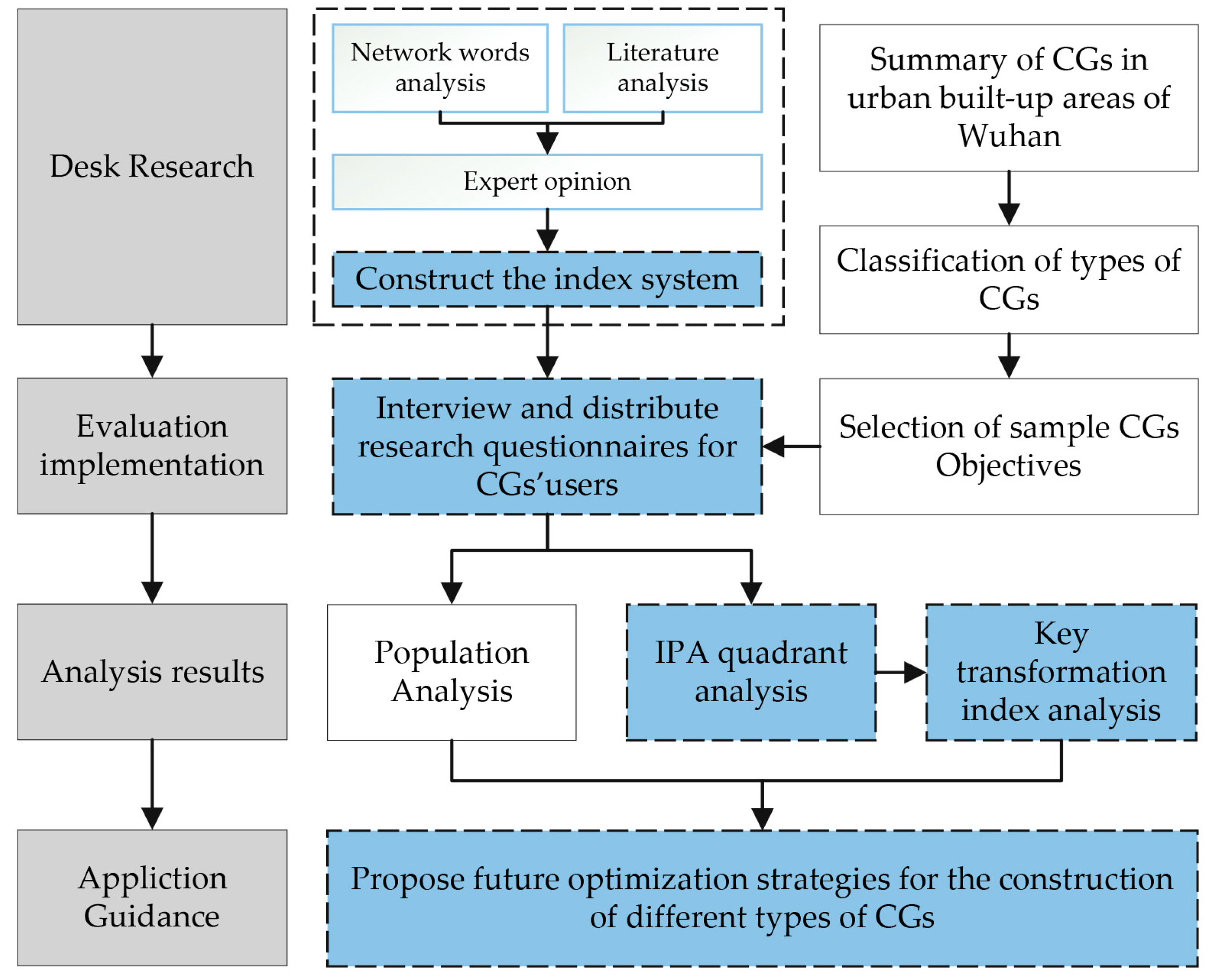
At the stage of determining the IPA evaluation metrics, we mainly performed desk research. We used a combination of network text analysis and the literature analysis method to make preliminary determinations of the indicators, and we integrated expert opinions to further determine the scientific accuracy of the indicators. This is essential for the subsequent analysis of users’ perceptions based on metrics. At the stage of data acquisition, we selected Wuhan as the city for the empirical study of the indicator system and collected data while giving out questionnaires to target populations with activities similar to the 20 different types of sample CGs. After the IPA quadrant analysis, the “key transformation indicators” were extracted and applied to the optimization strategies of the current and future CGs (Figure 1).
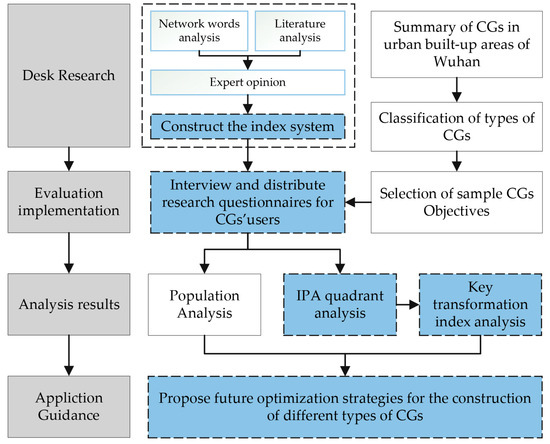
Figure 1.
Framework of methodical approach (the blue boxes are the main processes of evaluation and analysis steps).
2.1. Construction of the Indicator System Based on Network Text Analysis, Literature Analysis, and Expert Opinions
As an important part of urban micro-regeneration, CGs occupy tiny areas and are widely respected by users because of their multifunctional value in construction zones. The identification of evaluation indicators for CGs should not be limited to the dimensions of interest of researchers and scholars. Therefore, expanding the sources of information is necessary for the determination of evaluation indicators for CGs in China. In this study, we combined the network text analysis method with the literature analysis method to determine the original indicator database of CGs.
Network text analysis is a research method for the objective, systematic, and quantitative description of text, images, and other information. Its free, open, and shared characteristics allow users’ feelings and perceptions to be fully expressed [35]. It is widely used in various fields of social science research [30]. We selected the most influential online platforms in China: Blogs, Sina Weibo, and WeChat as search engines, and we searched with the keyword “community gardens”. Then ROST Content Mining 6.0 software was used to classify and mine the selected network text content.
It is worth mentioning that the high-frequency vocabulary from the internet has lexical diversity and colloquial features that cannot be directly used for indicator characterization and needs to be further normalized and related to the results of the literature analysis. We combined the literature analysis method with high-frequency vocabulary to determine the initial indicators. In the literature analysis phase, “community agricultural garden *”, “community garden *”, “IPA analysis”, “evaluation”, “agricultural landscape of residential area”, “transformation and improvement”, and “construction design” were used as key words to search. Then, we determined the descriptive elements considered for practice or evaluation in each piece of literature by eliminating repetitive elements and integrating semantically unclear elements.
In order to summarize two results in a qualitative integration, we organized an indicator team of six people, including CG project staff, community managers, and users. They needed to conduct correspondence matching between descriptive elements and high-frequency vocabulary, and the two checked each other to form the original indicator database.
On the basis of the original indicator database, expert opinions from relevant fields were acquired through expert interviews to refine and adjust the indicators accordingly. The expert members included 5 scholars of landscape architecture, 3 managers of CG project organization, and 2 professional practitioners of urban farm projects. This step was mainly based on the experts’ theoretical academic level and practical experience to optimize the original indicators, facilitating better consideration of the accuracy and scientificity of the indicators from multiple perspectives.
2.2. Research Scope and Sample Delineation
In this study, the urban built-up area of Wuhan was used as the actual research area for the indicator system. We collected all information on all CGs constructed over the last seven years in Wuhan. By 23 March 2023, the distribution information of 60 CGs was obtained through a literature review, an internet search, and field research. Most of these CGs were transformed by original public green spaces, and some of the CGs were recreated and reused by building rooftops, impervious surfaces with planting potential, unused parking lots, and courtyards. Through the field research, planting facilities such as individual flower beds and boxes and vertical crop planting patterns were excluded due to their micro scale. According to different types of urban planning and corresponding user groups, Wuhan CGs were divided into Resi-CGs, Comm-CGs, Camp-CGs, and Comp-CGs (see Table 1). This classification system has been proven to be effective and provide full-coverage by a number of scholars [36,37,38]. The classification of the targeted optimization strategies makes the practical application of this study even more valuable.

Table 1.
Classification criteria and description of CGs.
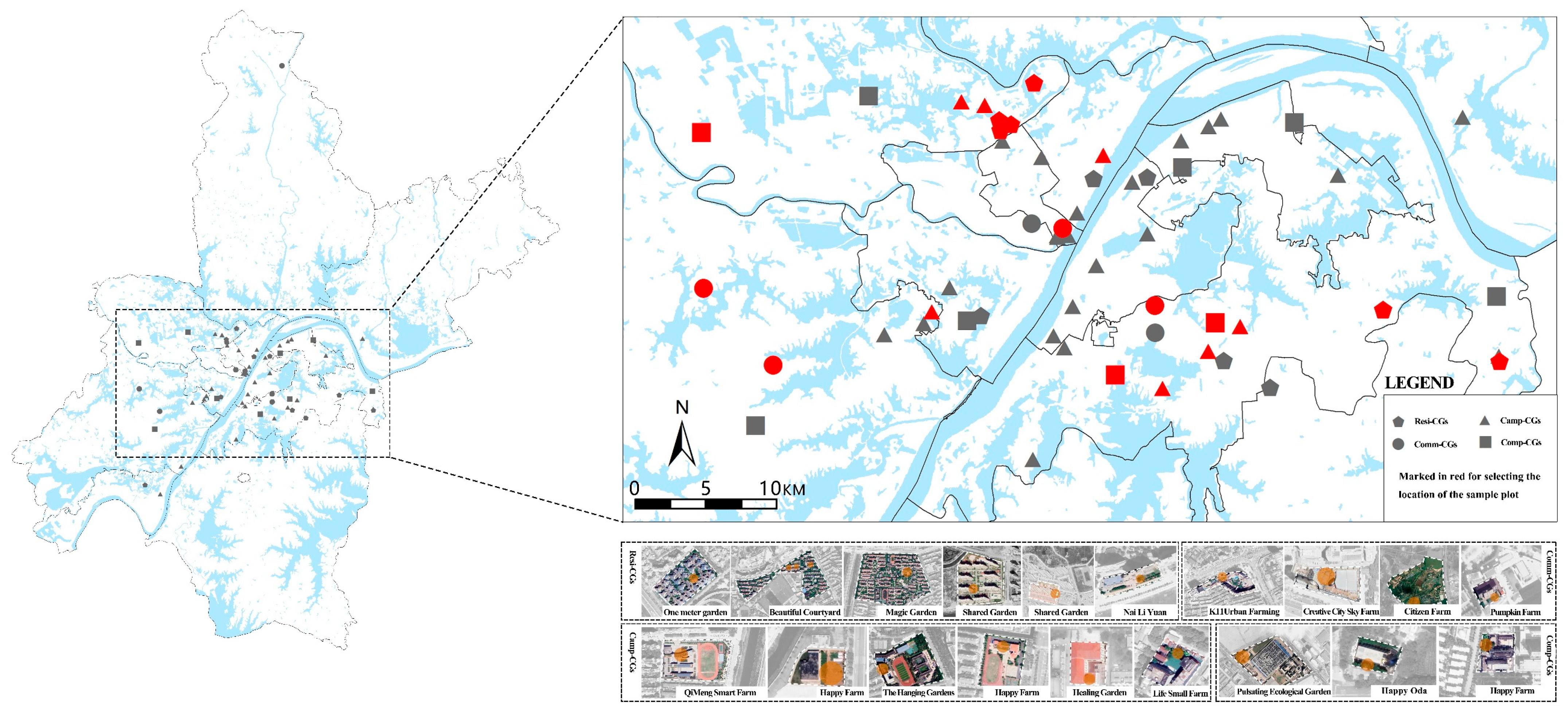
See Appendix A for a detailed summary of CG information. Based on the representativeness of the samples and the integrity of the study, 20 spatial sample points in this study were chosen according to the following rules (Figure 2):
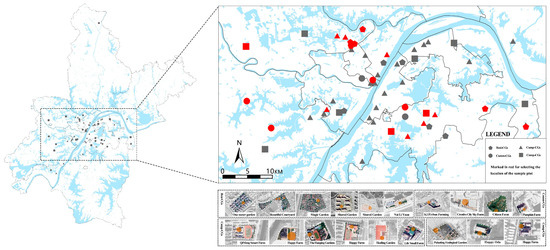
Figure 2.
Spatial distribution map of classified sample CGs.
Ensure the diversity of sample types and the number of single types is not less than 15%;
The project management should be mature, the operation should be stable, and the project should have a certain scale and own some number of users;
The organization and management of the sample is easy to communicate and establish contacts, which is helpful for information acquisition, the conduct of interviews, and the distribution and collection of questionnaires.
2.3. Questionnaire Distribution and Data Processing
The questionnaire consists of two parts. The first part is a basic information survey of the participants, including gender, age, occupation, education level, frequency of agricultural activities, etc. We will use this portion of the data to characterize the participants from different types of CGs as one of the considerations for future CG construction optimization strategies. The second part is the “satisfaction-importance” evaluation of the CG, which is the main content of the questionnaire (see Appendix B for details). We used the questionnaire approach to score the indicators as constructed in the previous section. A five-point Likert scale was used as a measure to assess CG evaluation metrics. Participants rated the two aspects of “satisfaction” and “importance” of the CG projects they participated in according to their own feelings and cognition. “1” means “extremely unsatisfied/important”; “2” means “unsatisfied/important”; “3” means “generally satisfied/important”; “4” means “satisfied/important”; and “5” means “extremely satisfied/important.” A total of 245 questionnaires were distributed, with 212 valid questionnaires. In order to test the reliability and efficiency of single indicator in the questionnaire and judge whether the resulting data were valuable for research, we used SPSS.27 software to calculate the alpha reliability coefficient Cronbach’s α, the KMO value, and the Bartlett spherical value for display. According to the statistics in Table 2, the α of four types of CGs were all greater than 0.8, indicating high reliability. The KMO values ranged from 0.7 to 0.8, indicating the high efficiency of the questionnaire. The results show that 212 questionnaires passed the test, and the data were suitable for follow-up IPA evaluation.
Table 2.
Reliability and validity analysis of different types of CG surveys.
3. Results
3.1. Indicator System of CGs
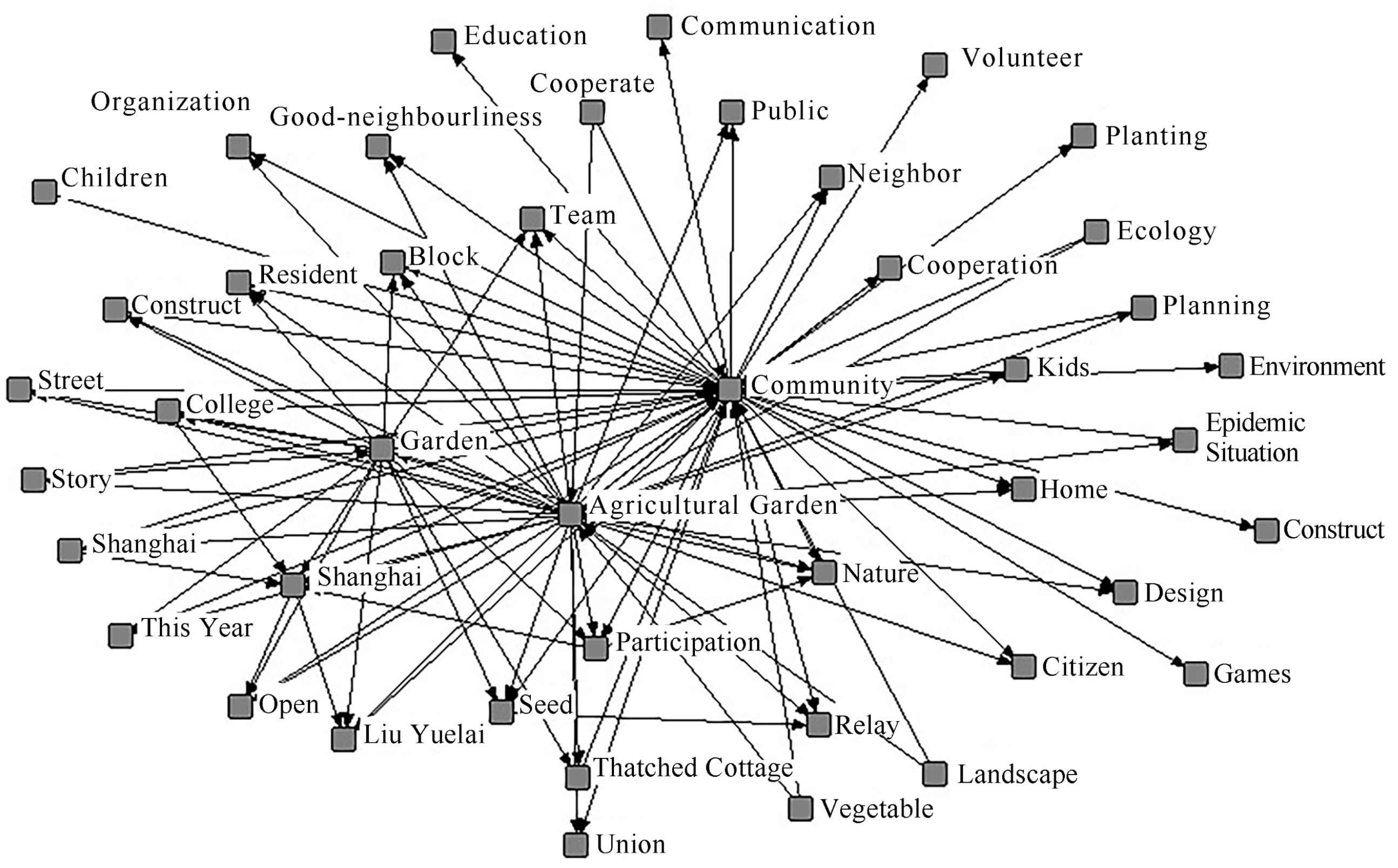
At the stage of network text analysis, we extracted 45 high-frequency vocabulary words from online records and accounts of CGs (Table 3). The high-frequency vocabulary words are mainly nouns, adjectives, and verbs. The nouns mainly reflect the information of place, location, and organizational unit; the verbs mainly reflect the specific activities of the participants; and the adjectives mainly express the participants’ overall feelings about the main image of CGs and the types of activities. In addition, the high-frequency vocabulary words are mainly positive feedback, such as “leisure”, “health”, “nature”, etc., indicating the overall recognition and support attitude of urban residents towards the functions of CGs. Simultaneously, they also reflect the operational and managerial challenges faced by CGs during the ‘epidemic’ period, as well as concerns regarding their impact on the community environment. Following visualization, a prototype of a semantic network analysis diagram was created (Figure 3).
Table 3.
Top 45 high-frequency vocabulary words based on network text analysis.
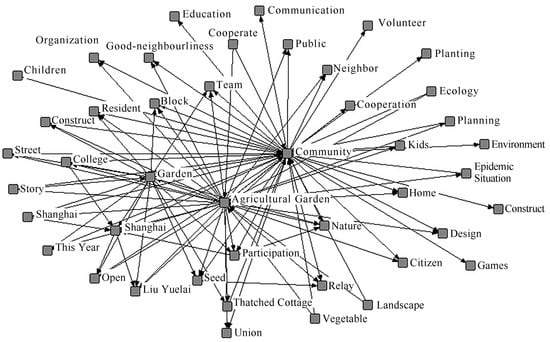
Figure 3.
The diagram of semantic network analysis.
During the literature analysis phase, we selected 27 pieces of strong correlation literature related to the descriptors of CG evaluation. Among them, there are 16 master’s and doctoral theses and 10 journal articles. After summarization, 22 relevant descriptive elements were extracted. Combining the high-frequency vocabulary of the Internet, we summarized the final indicators into four major types, forming the original indicator database with 24 indicators in total (Table 4).
Table 4.
The original indicator database obtained by integrating high-frequency vocabulary and descriptive elements from literature.
After summarizing the expert opinions, the original indicator database was modified as follows (Table 5):
Table 5.
Final indicator database of CG users’ evaluation system.
“Noise effect” has a negative bias, replaced with “Quiet level”;
There is a difference in understanding of “Environmental coordination degree”, replaced with “Farm style and characteristics”;
“Quantity of tools and facilities” is not comprehensive enough, replaced with” Quantity and type of tools and facilities”;
“Landscape quality” is too broad, replaced with “Aesthetics”;
With integration and adjustment, the two levels of indicators in Table 3 are identified as part of the final indicator database of CG users’ evaluation system.
3.2. Characteristics and Needs of Users of Different CG Types
The main participants of Resi-CGs are the retired elderly, aged between 60 and 80 years old, followed by office workers and students. Participants generally claimed that the original intention of designing and building CGs was to improve the community environment, and that most of them hoped to strengthen their health through such convenient, quick, and easily available farming activities. Participants of Comm-CGs are mainly young and middle-aged people aged 18–29, followed by office workers. They often want to get up close and personal with nature and feel the growth of plants after a weekend of relaxation. Parents and children are the main force in the use of this type of CG. In this way, they can help children learn more about nature and provide a natural and healthy outdoor environment. Participants of Camp-CGs are mostly limited to students and a small number of teaching staff. Students generally said that they participated in the activities in CGs on the one hand to respond to the call of the School Volunteer Association and on the other hand due to the fact that farming has the effect of reducing pressure from schoolwork, while at the same time acquiring more knowledge about plants and cultivating a sense of teamwork. The main participants of the Comp-CGs are the employees and their families. Participants can not only obtain fresh vegetables and relax their muscles and bones, but also relieve stress and nurture their body and mind.
3.3. IPA Quadrant Analysis
By statistical analysis and calculation of the data through SPSS, the average satisfaction (p-value), the average importance (I-value), and the mean difference (I-P) of various types of CGs in Wuhan can be obtained (see Table 6). The higher values of I and p values indicate the higher importance/satisfaction of the indicator as perceived by participants. From the statistical data, it can be seen that participants’ satisfaction with the CG is higher on the whole, and users are more satisfied with “Charge situation”, “Decompress experience”, “Accessibility”, and “Fitness and recreation experience”. In terms of importance, participants commonly believe that “Air quality”, “Mosquito impact”, and “Environmental cleaning” are the key points for the construction of CGs.
Table 6.
“Satisfaction–Importance” statistical result.
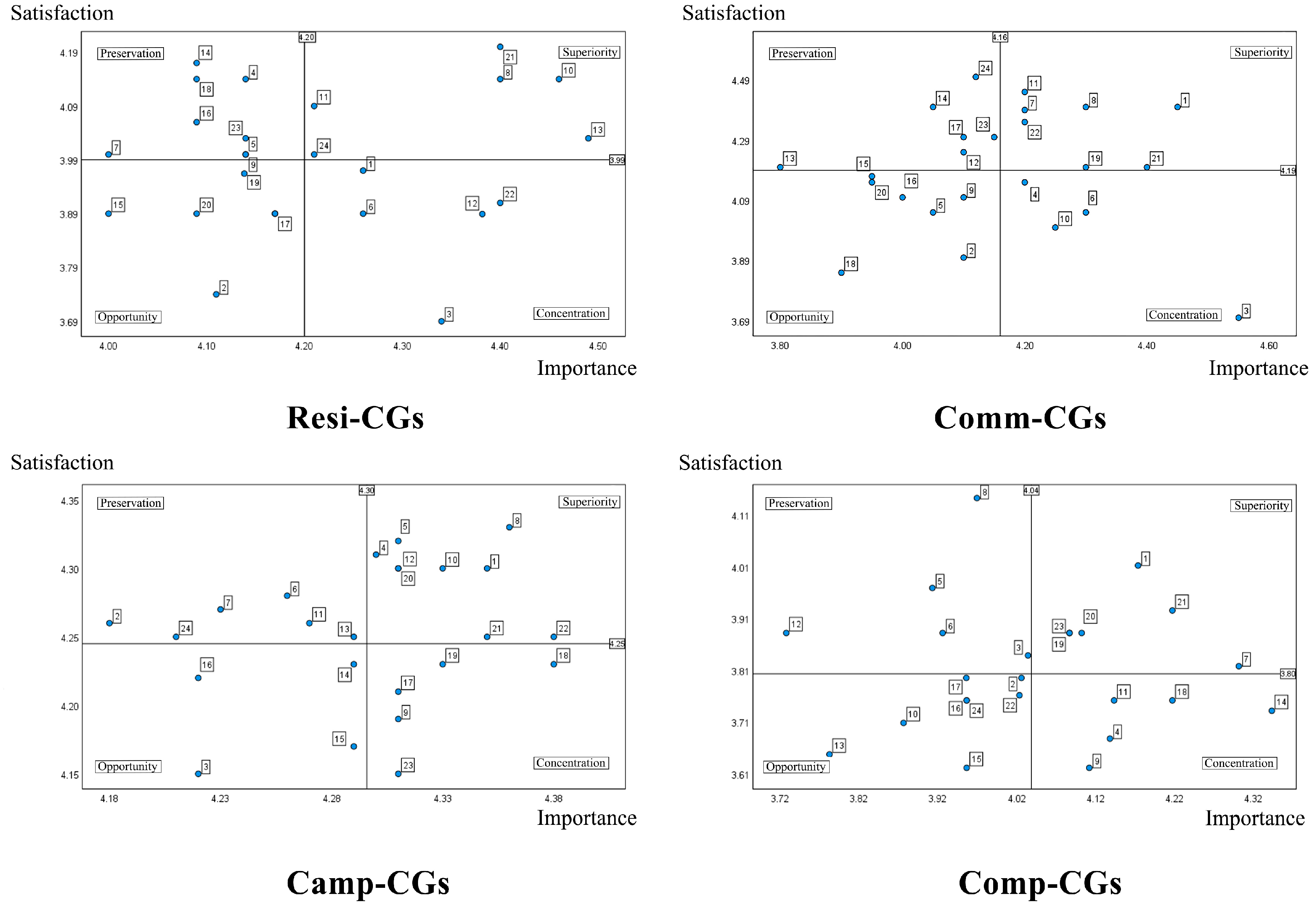
IPA analysis is a method to express users’ evaluations of different indicators in the form of different quadrants. The quadrant diagram is divided into four quadrants using the I-value as the x-axis, the p-value as the y-axis, and the mean value of the indicator as the dividing line. Moreover, I and p values of 24 indicators are marked on the quadrant diagram. It is found in Figure 4 that the distribution of the various indicators in the diagram shows some commonalities. The indicators of “Accessibility”, “Planting skills learn”, and “Environmental cleaning” are located in the dominant areas, and they are both highly important and highly satisfying. In addition, there are differences in the “high importance-low satisfaction” coupling indicators of different types of CGs, which will lead to differentiated priorities for the construction of different types of CGs.
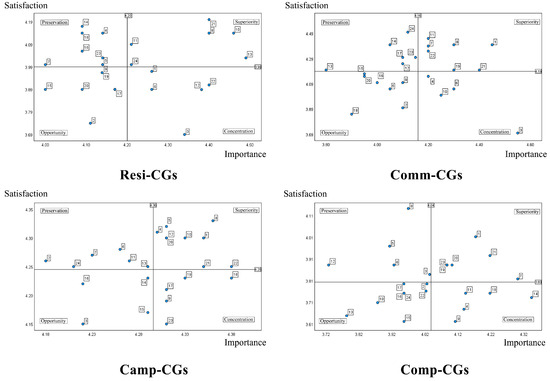
Figure 4.
IPA quadrants of different types of CGs.
3.4. Key Transformation Indexes Analysis
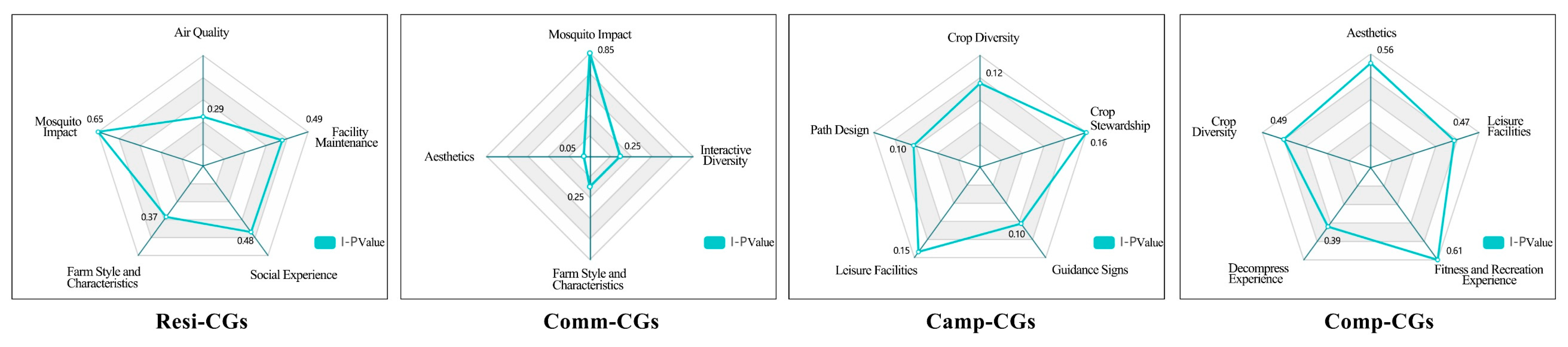
The “key transformation” index is an influential index to put forward the optimization strategy for CGs. This kind of index falls in the fourth quadrant of the IPA quadrant analysis diagram. The I-P mean difference is positive (see Table 5), which represents the statistical meaning of the difference between the degree of importance and satisfaction. Larger values mean that the index is more important in the construction of this type of CG and the current situation does not meet the high expectations of users; smaller values indicate that the index basically meets users’ expectations but still needs to be strengthened. Therefore, we use radar charts of mean difference values (Figure 5) to more intuitively express the importance of the “key transformation” index of different types of CGs.
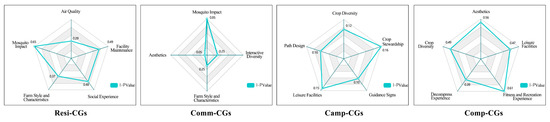
Figure 5.
Analysis of key reconstruction indexes of different types of CGs.
“Mosquito impact”, “Facility maintenance”, and “Social experience” are the indicators of greatest concern of residents and are easily ignored in the construction of Resi-CGs. “Air quality” and “Farm style and characteristics” also need to be optimized and improved. The users of Comm-CGs believe that “Mosquito impact” should be improved in the process of use. Moreover, they put forward higher requirements for the “Aesthetics”, “Farm style and characteristics”, and “Interactive diversity” of CGs. A more distinctive theme and distinctive design of the garden environment is what will make it commercially viable. Camp-CGs need to be optimized in relation to the two aspects of “Crop stewardship” and “Leisure facilities”. In addition, “Path design”, “Guide sign”, and “Crop diversity” also need to be improved so as to enhance students’ awareness of labor and farming practices. There is no significant trend in the key transformation indexes of the Comp-CGs, and the indexes of “Fitness and recreation experience”, “Crop diversity”, “Aesthetics”, “Leisure facilities”, and “Decompress experience” need to be improved. Relaxation of mind and body and the harvesting of different kinds of vegetables have become the chief purposes of cultivation for this group of people.
4. Application and Discussion
We combined the results of the radar charts (Figure 5) and characteristics and needs of users (See Section 3.2) to further explore the application of optimization strategies and pathways for different types of CGs.
- (1)
- Optimization strategy of Resi-CGs
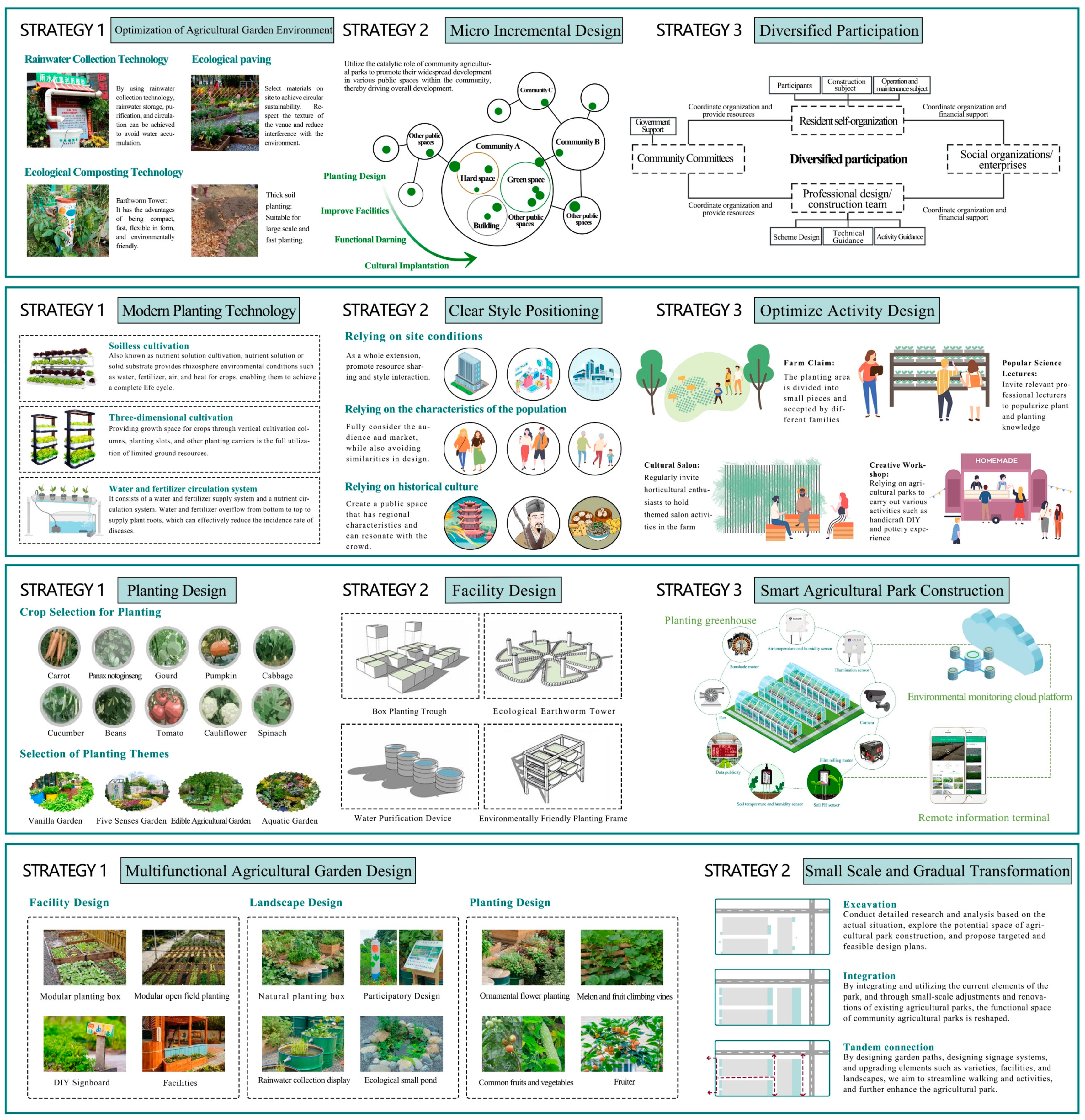
Based on the evaluation results of the key issues that need to be improved, such as “Mosquito impact”, “Social experience”, and “Facility maintenance”, we try to propose corresponding optimization strategies from three aspects of environment, site vitality, and operation mechanism: (a) In terms of the environment of CGs, rainwater collection, ecological composting, ecological paving, and other related ecological technologies are used to solve the harmful effects of mosquito infestation and undesirable odors, so as to improve the overall environmental quality of CGs in the form of low cost, easy maintenance, and environmental friendliness. (b) Improving the vitality of the space is the fundamental way to enhance the social experience of residents. Through functional weaving, cultural implantation, facility improvement, and plant design, we can activate inefficient spaces in communities, trigger regional links, and gradually promote the expansion of CGs in regions and cities. (c) Another strategy is to build a multi-governance participation platform and encourage the government, neighborhood committees, and additional parties to work together to build a long-term operating mechanism for the sustainable development of CGs. Second, we can tap into the talents of the community and play a leading role as a group of residents to promote the regeneration of the community with spontaneous force. In addition, professional design and construction teams are required. Finally, the positive interaction of “preliminary design—consultation—feedback—adjustment design” is formed by combining all forces (Figure 6).
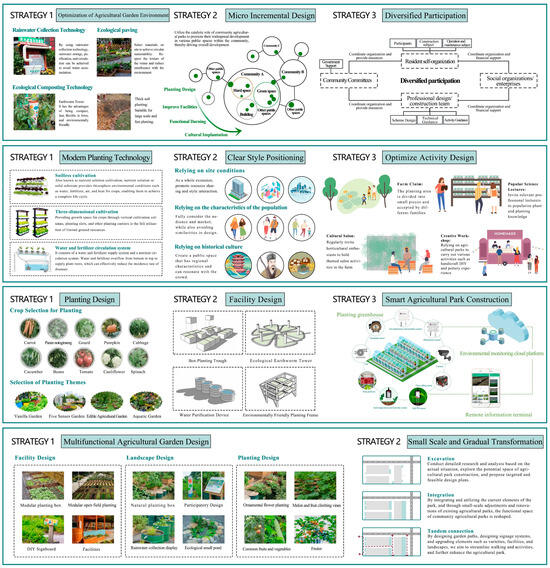
Figure 6.
Optimization strategies of different types of CGs.
- (2)
- Optimization strategy of Comm-CGs
Combined with the key improvement issues of “Mosquito impact”, “Farm style and characteristics”, and “Interactive diversity” in the evaluation results, we proposed an optimization strategy of Comm-CGs based on three aspects: planting technology, style positioning, and activity design: (a) Through the application of modern planting technology, such as soilless cultivation and hydroponics, the negative effects from mosquitoes can be reduced, and the user’s participation experience can be improved. (b) In terms of style positioning, it is necessary to explore the most appropriate design style of CGs based on various factors such as site conditions, population characteristics, history, and culture. First, we can use well-established malls and quality resources for designing style extensions. The other way is that we can rely on local characteristics and culture to create regional character, and the third is to survey and research the main audience groups and finally determine the final design style of CGs. (c) To improve the activity design, it is necessary to provide different services for diverse users. Planting can be taken as an opportunity to carry out activities such as “Farmland Adoption”, “Creative Workshops”, “Science Lectures”, and “Cultural Salon”. These can be combined with the current popular elements of the time to meet the complex needs of people of different ages (Figure 6).
- (3)
- Optimization strategy of Camp-CGs
Combined with the key improvement issues of “Crop diversity”, “Leisure facilities”, and “Crop stewardship” in the evaluation results, we propose three aspects: planting design, facility design, and construction of smart CGs: (a) We must provide a diversified participation experience for students through abundant planting design and make use of limited space and resources on campus to provide more natural education content. Examples include herb gardens, five-sensory gardens, edible gardens, aquatic gardens, and other diversified planting themed designs; diversified planting techniques are displayed using soilless cultivation, glass greenhouses, substrate planting frames, three-dimensional cultivation, advanced water, fertilizer circulation supply systems, and electric control systems. In addition, students can be motivated to participate in various educational and practical activities such as “Insect Class”, “Plant Encyclopedia”, and “Harvest Season”. (b) We should create a safe, pleasant, and approachable environment by optimizing the science signage facilities, recreation facilities, and landscape facilities of the CG. Scientific sign facilities should be combined with nature education content and presented in a lively, fascinating, and easy-to-understand manner; recreation facilities should follow ecological concepts in terms of shape, material, utilization, and natural elements, and they should allow students to gain an attachment and emotional connection to the place through direct perception and experience; landscape facilities are needed to make the CG a demonstration area for campus culture, thus facilitating the development of additional teaching and practice activities on campus. (c) To improve the crop management mechanism, professional and technical personnel can be equipped to take charge of the maintenance of daily crops and the management of facilities. The implantation of automatic planting systems can simplify the management and protection of CGs and reduce manual pressure. Secondly, the online and offline interactive communication platform can provide students with ways to observe the whole cycle growth of crops and build an all-around smart CG on the basis of ensuring the stable operation of the CG (Figure 6).
- (4)
- Optimization strategy of Comp-CGs
In combination with the evaluation results on the key improvement problems of “Fitness and recreation experience”, “Aesthetics”, and “Leisure facilities”, the optimization strategies were proposed from two aspects of multi-functional CGs and progressive design: (a) The one-sided emphasis on production leads to the single function of the CG, which makes it difficult to meet the needs of users. Therefore, it is extremely essential to build a multi-functional CG. With abundant facility design, landscape design, and planting design to create a harvest experience for employees, the CG should have both recreational and leisure functions to activate the space. (b) At present, the popularity of Comp-CGs is low, and scattered and disordered planting areas considerably affect the overall beauty of the CG. The potential space should be explored comprehensively in the overall planning and design of the CG, the construction of the CG should be carried out in stages by a small-scale and gradual method, and the linear green infrastructure should be integrated to complete the series of planting areas so as to improve the overall esthetic sense of the CG (Figure 6).
Observing community gardening in the historical context of urban development, it seems to have become a mirror of different countries and different stages of urban economic development [48,49]. This has led to the fact that it is still impossible to give an accurate description of the intrinsic meaning and form of CGs. On the contrary, those who endeavor to define CGs tend to make their future research and development more narrow [50]. Currently, 93.22% of all studies on CGs are from developed countries. Among them, the United States occupies the leading position [51]. The rapid urbanization of non-high-income developing countries in the future will also provide a broader practical space for the development of CGs [51], and it is necessary and meaningful to strengthen the site-based research in these countries. This would greatly compensate for the current depth of research on CGs around the world. Therefore, we believe that Chinese local CGs must be evaluated in order to provide a practical optimization guideline for the development of urban CGs. Currently, most of the site-based research in China focuses on qualitative topics such as review studies [52,53], theoretical summaries [54,55,56], planning and design of single CGs [57], and public participation [58,59], which are not able to intuitively and scientifically guide the development of CGs in China. These studies are unable to intuitively and scientifically guide the development of urban practices.
In the post-COVID-19 period, the multidimensional functional value of CGs has made them the first choice for urban micro-renewal space transformation in China. The construction of CGs has also been pushed to the climax of the current development stage in China. As part of urban green infrastructure, the ES of CGs has also become a hot topic of evaluation related to urban green space planning [60]. These ES function types are very similar to the indicator database in this study. Most of the current research on the topic of ES only stops at the stage of interviewing users of CGs to determine their ES types. Unfortunately, ESs were identified using a free listing technique [61]. This interview-based identification of indicators is very much limited by the selection bias of the samples, and it is highly likely that the results of the indicator selection will have a large error due to the insufficient coverage of the interviewed population [62]. Secondly, due to the unique features of CGs, this approach to data collection suffers a potential methodological bias towards the appreciation of CES [63,64]. Therefore, we moved beyond the inherent scope of ES indicators and improved the methodology for the construction of the CG indicator database. The finalized 24 indicators were obtained based on the methodology of network text analysis and literature analysis. It is a scientific summary based on the whole scope of CG users and concerned people in China. In addition, we further invited relevant experts to optimize and adjust the indicators. This makes the indicator system more complete and more feasible for subsequent evaluation.
As for the overwhelming “CES function” and “social and cultural benefit value” of CGs [65], we interpret them in relation to the fact that the existence and development of CGs must have a strong correlation with the provision of “human” happiness and well-being. This point is fundamental to differentiate CGs from other non-edible urban green infrastructures. Therefore, we have chosen to use IPA as a tool to link CGs in China to human well-being. What kind of CGs do the Chinese people want now? What is the main contradiction in the construction of CGs? The evaluation results of this study provide a good answer to these two questions.
We finish the discussion by acknowledging the limitation of this study. The importance and satisfaction reflected by the mean difference may only reflect the basic attitudes, feelings, and judgments of the users near CGs in Wuhan, which has certain regional limitations. Therefore, it is necessary to expand the sample size of Chinese cities at different development stages in order to make the results more scientific and instructive so as to match the highest level of urban development strategies and provide a systematic and comprehensive theoretical and practical reference for future CGs.
5. Conclusions
The arrival of the post-COVID-19 period and the implementation of urban micro-renewal policies have pushed Chinese urban community gardening into a golden age. However, there is still a lack of site-based research on the systematic evaluation of CGs. Providing more human well-being experiences is essential for the sustainable development of CGs. Therefore, in order to fill the current theoretical gap in the systematic evaluation of China’s existing CGs, we constructed a human’s perception value-oriented evaluation system and evaluated and analyzed 24 indicators of four different types of CGs through the IPA method. The main findings are as follows:
(1) “Mosquito impact”, “Facility maintenance”, and “Social experience” are the indicators of greatest concern for residents and are easily ignored in the construction of Resi-CGs, which need to be emphasized in the future design and construction process.
(2) “Mosquito impact” should be improved in the process of use. Moreover, they put forward higher requirements for the “Aesthetics”, “Farm style and characteristics”, and “Interactive diversity” of CGs. A more distinctive theme and distinctive design of the garden environment is what will make it commercially viable.
(3) Camp-CGs need to be optimized in the two aspects of “Crop stewardship” and “Leisure facilities” so as to enhance students’ awareness of labor and farming practices.
(4) There is no significant trend in the key transformation indexes of the Comp-CGs, and the indexes of “Fitness and recreation experience”, “Crop diversity”, “Aesthetics”, “Leisure facilities”, and “Decompress experience” need to be improved.
Based on the above conclusions, we further summarize the optimization strategies to give more practical guidance for the construction of CGs in China. In the future, if we have the support of the relevant government departments, we will optimize the construction method of the indicator system and use big data and artificial intelligence to carry out more scientific and systematic research on the evaluation of different cities.
Author Contributions
Conceptualization, Y.S. (Yilan Sun) and Y.S. (Yiyuan Sun); methodology, Y.S. (Yilan Sun); software, Y.S. (Yilan Sun); validation, Y.S. (Yiyuan Sun) and B.Z.; formal analysis, Y.S. (Yilan Sun) and Y.S. (Yiyuan Sun); investigation, Y.S. (Yiyuan Sun); resources, Y.S. (Yilan Sun); data curation, Y.S. (Yiyuan Sun); writing—original draft preparation, Y.S. (Yilan Sun); writing—review and editing, Y.S. (Yiyuan Sun); visualization, Y.S. (Yilan Sun) and Y.S. (Yiyuan Sun); supervision, B.Z.; project administration, B.Z.; funding acquisition, B.Z. All authors have read and agreed to the published version of the manuscript.
Funding
This research was funded by Central Universities Basic Research Business Specific Funds, grant number 2662023FW018, and the Study on Rural Tourism Planning and Landscape Construction under the Goal of Agro-Tourism Integration.
Data Availability Statement
Not applicable.
Acknowledgments
Thanks to Hubei Provincial Department of Natural Resources for providing the Third National Land Survey data, which is of great help to our research work.
Conflicts of Interest
The authors declare no conflict of interest.
Appendix A. The Summary Table of Wuhan Existing CG Projects Information
| Type | Number | Farm Name | Location | City District | Construction Time | Source URL (accessed on 1 March 2023) |
| Resi-CG | 1 | Sky Garden | Third floor, Guomian Community, Yangyuan Street | Wuchang District | July 2018 | http://www.app.dawuhanapp.com/p/31855.html |
| 2 | Jung Wing Farm | Zhengrong Fu residential district, Wuhan | Hanyang District | September 2020 | https://www.sohu.com/a/418776667_120207620 | |
| 3 | Shared Garden | Yisheng Garden Subdistrict, Huanglongshan Community, Fo Zu Ling Street | Jiangxia District | November 2022 | https://baijiahao.baidu.com/s?id=1748347145215709373&wfr=spider&for=pc | |
| 4 | Wuhan Tiandi Urban Farm | Wuhan Tiandi Real Estate by the Second Bridge of the Yangtze River | Jiangan District | - | ||
| 5 | Shared Garden | Chi Yuen Community | Hongshan District | December 2022 | https://gongyi.sohu.com/a/613195880_491282 | |
| 6 | Shared Garden | Apricot Garden community, Huashan Street | Hongshan District | November 2022 | https://rmh.pdnews.cn/Pc/ArtInfoApi/article?id=32558906 | |
| 7 | One Meter Garden | Poly Times residential district, Hsinchu Road, Guanshan Avenue | Hongshan District | January 2018 | http://news.cjn.cn/24hour/wh24/201711/t3111433.htm?from=groupmessage | |
| 8 | Orchard | Evergrande Wuhan Times New City | Hannan District | - | http://www.87380068.com/case.html | |
| 9 | Nei Grain Garden | General Road Street Xiong Jiadun community Yintan Road south side | Dongxihu District | June 2022 | https://mp.weixin.qq.com/s/WA8_czb1UH1x4SlvXQHMrQ | |
| 10 | Magic Garden | Roof of Evergreen Garden No. 1 Community Party and Mass Service Centre | East-west Lakes District | January 2020 | https://mp.weixin.qq.com/s/1TUNnvz0oUcMu-nOxZzu5A | |
| 11 | Beautiful Yard | Evergreen Gardens Fifth Community Community | East West Lakes | November 2022 | https://mp.weixin.qq.com/s/Kf0W6PUQ81VSOrZsOZj5wg | |
| Comm-CG | 12 | K11 Metropolitan Grange | K11 Art Mall, fifth floor roof | Qiaokou District | May 2020 | |
| 13 | Rooftop Vegetable Garden | Cade People’s Paradise | Jianghan District | July 2015 | http://www.360doc.com/content/15/0730/08/11024918_488291889.shtml | |
| 14 | Seven Hills Public Garden | Wuhu Farm | Huangpi District | February 2023 | ||
| 15 | Shared Vegetable Garden | Liuwan Village by the river in Huangpi Fu | Huangpi District | December 2019 | https://m.wuhan.com/travel/35967.html?ivk_sa=1024320u | |
| 16 | Sky Farm | Luojia Creative City | Hongshan District | March 2015 | https://www.sohu.com/a/34233617_117378 | |
| 17 | Huabohui Citizen Farm Garden | Huabohui scenic spot, Daji Street, Caidian | Caidian district | February 2023 | https://baijiahao.baidu.com/s?id=1749672284531883001&wfr=spider&for=pc | |
| 18 | Sweet Pumpkin Farm | Yao Jialin Village | Caidian District | November 2022 | https://www.sohu.com/a/610392717_121118995 | |
| Camp-CG | 19 | Labor Practice Base | Yangluo Campus, Hubei University | Xinzhou District | May 2022 | |
| 20 | Biological Experimental Field | Secondary School No. 14 | Wuchang District | January 2019 | http://hbwh.wenming.cn/rdjj/201812/t20181211_5592064.html | |
| 21 | Vegetable Garden | Simeitang Kindergarten | Wuchang District | January 2021 | http://www.app.dawuhanapp.com/p/227928.html | |
| 22 | Dream Farm | Sand Lake Park | Wuchang District | February 2019 | https://mp.weixin.qq.com/s/Rw2wjFYhmsxnac7fyYVYeQ | |
| 23 | Dream Farm | Yangtze River Zidu Kindergarten | Wuchang District | March 2022 | https://mp.weixin.qq.com/s/hhayFNGtQrRtSlJ0_utBBg | |
| 24 | Dream Farm | Newbridge Kindergarten | Wuchang District | May 2022 | https://mp.weixin.qq.com/s/hhayFNGtQrRtSlJ0_utBBg | |
| 25 | “Mother Orange Tree” | Steel City Sanxiao | Qingshan District | June 2017 | http://mt.sohu.com/20170727/n504285374.shtml | |
| 26 | Trial Jade Farm | Steel City 18th Primary School | Qingshan District | September 2020 | https://baijiahao.baidu.com/s?id=1722440244115117076&wfr=spider&for=pc | |
| 27 | Dream Farm | Experimental Science and Technology Kindergarten Binjiang Garden | Qingshan District | March 2022 | https://mp.weixin.qq.com/s/hhayFNGtQrRtSlJ0_utBBg | |
| 28 | Dream Farm | Red Steel City Elementary School | Qingshan District | March 2022 | https://mp.weixin.qq.com/s/hhayFNGtQrRtSlJ0_utBBg | |
| 29 | Plant Workshop | Daxing No.1 Experimental Primary School | Jianghan District | March 2021 | https://baijiahao.baidu.com/s?id=1693546330217773306&wfr=spider&for=pc | |
| 30 | Grape Farm | Fujian Street Primary | Jianghan District | July 2017 | http://mt.sohu.com/20170727/n504285374.shtml | |
| 31 | Dream Farm | Hankou Hui Min Primary School | Jianghan District | May 2022 | https://mp.weixin.qq.com/s/hhayFNGtQrRtSlJ0_utBBg | |
| 32 | Dream Farm | Tonchi Secondary | Jianghan District | March 2022 | https://mp.weixin.qq.com/s/hhayFNGtQrRtSlJ0_utBBg | |
| 33 | Smart Heart Farm | Huangpi Street Primary School, Jianghan district | Jianghan District | September 2017 | http://mt.sohu.com/20170727/n504285374.shtml | |
| 34 | Sky Garden | Yucai Xingzhi Primary School | Jiangan District | - | http://hbwh.wenming.cn/rdjj/201812/t20181211_5592064.html | |
| 35 | Child Farm | Changchun Street No. 2 Primary School | Jiangan District | March 2023 | ||
| 36 | Dream Farm | Poyang Street Primary School | Jiangan District | June 2022 | https://mp.weixin.qq.com/s/hhayFNGtQrRtSlJ0_utBBg | |
| 37 | Healing Garden | Huazhong Agricultural University | Hongshan District | January 2023 | ||
| 38 | Communal Garden | Optics Valley 29th Primary School | Hongshan District | May 2021 | https://baijiahao.baidu.com/s?id=1699185427575488241&wfr=spider&for=pc | |
| 39 | Cheung Kong Garden “Happy Farm” | Cheung Kong Vocational College | Hongshan District | May 2022 | http://cjxy.ihwrm.com/index/article/articleinfo.html?doc_id=3930050 | |
| 40 | Happy Farm | Wuhan Vocational College of Transportation | Hongshan District | December 2021 | ||
| 41 | Little Farm of Life | Huazhong University of Science and Technology | Hongshan District | November 2022 | ||
| 42 | Star Farm | Zhangjiawan Primary School | Hongshan District | April 2017 | https://baijiahao.baidu.com/s?id=1694041027385592086&wfr=spider&for=pc | |
| 43 | Class Vegetable Patch | Fangcao Campus of Erqiao Middle School | Hanyang District | November 2021 | https://baijiahao.baidu.com/s?id=1716539838273780788&wfr=spider&for=pc | |
| 44 | Pleasant Heart Farm | Yucai Primary School, Hannan District | Hannan District | January 2019 | http://hbwh.wenming.cn/rdjj/201812/t20181211_5592064.html | |
| 45 | Kai Meng Smart Farm | Jinyin Lake No. 2 Primary School | Dongxihu District | February 2023 | ||
| 46 | Rooftop Farm | Love Lake Primary School, Dongxihu District | Dongxihu District | September 2021 | ||
| 47 | Happy Farm | Hongshan Primary | Caidian District | November 2020 | http://hbwh.wenming.cn/wmcj/wmxy/202103/t20210316_7006997.html | |
| 48 | Ilaw Eco-Park | Junshan Primary School, Economic and Technological Development Zone | Caidian District | January 2023 | ||
| 49 | Rooftop Farm | Triangle Lake Primary (Erudite Campus) | Caidian District | July 2021 | https://v.douyin.com/SQAMEk9/ | |
| 50 | Dream Farm | Primary School, Wuhan Foreign Language School | Caidian District | April 2022 | http://news.cjn.cn/bsy/st_20090/202204/t4024881.htm | |
| 51 | Happy Farm | Triangle Lake Primary School (Singapore Campus) | Caidian District | April 2017 | https://mp.weixin.qq.com/s/rkMyN8e4FSVyV16TUR2tXg | |
| Comp-CG | 52 | Oil Depot Small Vegetable Garden | Oil depot after the new fire building | Qingshan District | July 2021 | https://mp.weixin.qq.com/s/3pHEu0r0idVwxYMeKZyyAw |
| 53 | Staff Small Home Vegetable Garden | Qingshan Branch, Postal Savings Bank | Qingshan District | December 2021 | http://news.cjn.cn/24hour/wh24/202112/t3881577.htm | |
| 54 | Worker’s Garden | Wuhan Tianma G6 Company | Hongshan District | December 2021 | ||
| 55 | Happy Garden | Wuhan branch of civil Engineering Company | Hongshan District | July 2022 | https://5bur.cscec.com/oa/dtxw/202207/3553062.html | |
| 56 | Happy Oda | Lion Rock Street Integrated Elderly Care Service Centre | Hongshan District | January 2023 | https://baijiahao.baidu.com/s?id=1760969752955765818&wfr=spider&for=pc | |
| 57 | Worker’s Garden | Jiangcheng Avenue gas station | Hanyang District | July 2021 | ||
| 58 | Worker’s Garden | Danone Co., Zoumaling Street | Dongxihu District | April 2022 | https://baijiahao.baidu.com/s?id=1731080898450526602&wfr=spider&for=pc | |
| 59 | Worker’s Garden | Tokai Minth Group | Dongxihu District | January 2021 | ||
| 60 | Worker’s Garden | Suiyue operation company Yangzi Institute | Caidian District | September 2022 | https://baijiahao.baidu.com/s?id=1744740367397599937&wfr=spider&for=pc |
Appendix B. Questionnaire of “Importance-Satisfaction Analysis” of Community Garden Project in Wuhan
Survey location: Type: Date and time:
- Dear Resident Friends:
Hello! In order to better construct Wuhan Community garden project, understand the community life needs of Wuhan residents, and explore the effective way of old city renewal, we carried out this survey. This survey does not need to fill in the unit and name, it will take about 10 min of your time. Please circle the appropriate answer number or fill it in the blank according to your actual situation.
Thank you for your support and cooperation!
- Part 1: Basic Information article
Your gender: ① Male; ② Female.
Your occupation: ① Student; ② Office worker; ③ freelance worker; ④ Housewife/husband; ⑤ Retiree; ⑥ Unemployment.
Your age: ① under 18; ②18–40; ③ 40–60; ④ 60–80; ⑤ above 80.
Your education level: ① primary school and below; ② junior high school; ③ High school or technical secondary school; ④ Bachelor degree or above.
In what role do you participate in community farm projects: ① user; ② organizer; ③ manager; ④ designer; ⑤ Other.
The frequency of your participation in the farm project is: ① less than 3 times; ② 3–5 times; ③5–10 times; ④ more than 10 times.
Your overall evaluation of the farm project is: ① satisfactory; ② Generally satisfied; ③ not satisfied; ④ very dissatisfied.
- Part 2: Importance—Satisfaction Rating
Next, please think about whether the following indicators are important to you in the process of farming activities and whether you are satisfied with these indicators. Please tick in the box corresponding to each indicator. If you have any doubts in the process of filling in the form, the researcher will also explain the specific meaning of each indicator for you in detail, thank you for your opinion.
Table A1.
Evaluation Indicator Scoring Table.
Table A1.
Evaluation Indicator Scoring Table.
| Indicator Layer | Importance | Satisfaction | ||||||||
|---|---|---|---|---|---|---|---|---|---|---|
| Very Important | Important | Generally Important | Not Important | Very Unimportant | Very Satisfied | Satisfied | Generally Satisfied | Dissatisfied | Very Dissatisfied | |
| 5 | 4 | 3 | 2 | 1 | 5 | 4 | 3 | 2 | 1 | |
| Air Quality | □ | □ | □ | □ | □ | □ | □ | □ | □ | □ |
| Quiet Level | □ | □ | □ | □ | □ | □ | □ | □ | □ | □ |
| Mosquito Impact | □ | □ | □ | □ | □ | □ | □ | □ | □ | □ |
| Aesthetics | □ | □ | □ | □ | □ | □ | □ | □ | □ | □ |
| Reasonable Layout | □ | □ | □ | □ | □ | □ | □ | □ | □ | □ |
| Farm Style and Characteristics | □ | □ | □ | □ | □ | □ | □ | □ | □ | □ |
| Environmentally Friendly | □ | □ | □ | □ | □ | □ | □ | □ | □ | □ |
| Accessibility | □ | □ | □ | □ | □ | □ | □ | □ | □ | □ |
| Crop Diversity | □ | □ | □ | □ | □ | □ | □ | □ | □ | □ |
| Interactive Diversity | □ | □ | □ | □ | □ | □ | □ | □ | □ | □ |
| Decompression Experience | □ | □ | □ | □ | □ | □ | □ | □ | □ | □ |
| Social Experience | □ | □ | □ | □ | □ | □ | □ | □ | □ | □ |
| Planting Skills Learning | □ | □ | □ | □ | □ | □ | □ | □ | □ | □ |
| Fitness and Recreation Experience | □ | □ | □ | □ | □ | □ | □ | □ | □ | □ |
| Tools and Facilities | □ | □ | □ | □ | □ | □ | □ | □ | □ | □ |
| Storage of Items | □ | □ | □ | □ | □ | □ | □ | □ | □ | □ |
| Path Design | □ | □ | □ | □ | □ | □ | □ | □ | □ | □ |
| Leisure Facilities | □ | □ | □ | □ | □ | □ | □ | □ | □ | □ |
| Guidance Signs | □ | □ | □ | □ | □ | □ | □ | □ | □ | □ |
| Planting Explanation | □ | □ | □ | □ | □ | □ | □ | □ | □ | □ |
| Environmental Cleaning | □ | □ | □ | □ | □ | □ | □ | □ | □ | □ |
| Facility Maintenance | □ | □ | □ | □ | □ | □ | □ | □ | □ | □ |
| Crop Care | □ | □ | □ | □ | □ | □ | □ | □ | □ | □ |
| Charge | □ | □ | □ | □ | □ | □ | □ | □ | □ | □ |
References
- Ding, J.; Zhu, H.; Liu, H.; Li, B.; Zhang, K. The Development Trajectory and Trends of Human Settlement Units in the Yangtze River Delta from the People-Oriented Perspective. Urban Plan. Forum 2022, 22–32. [Google Scholar] [CrossRef]
- Gao, N.; Zhang, J.; Hu, X. Defense for Urban Agriculture: Exploration on Urban Agriculture Planning Strategies. Urban Plan. Int. 2021, 36, 84–90. [Google Scholar] [CrossRef]
- Bell, S.; Fox-Kämper, R.; Keshavarz, N.; Benson, M.; Caputo, S.; Noori, S.; Voigt, A. Urban Allotment Gardens in Europe; Routledge: London, UK, 2016. [Google Scholar] [CrossRef]
- Foundation, L.A. Landscape Performance Series. Available online: https://www.landscapeperformance.org/case-study-briefs (accessed on 12 March 2023).
- Ding, X. The Research of Chinese Community Garden. Ph.D. Thesis, Tianjin University, Tianjin, China, 2020. [Google Scholar]
- Gordon, H.R. The Struggle for Eden: Community Gardens in New York City. Community Dev. 2003, 34, 136. Available online: https://www.proquest.com/openview/e9091f75ac0ac1fc19e15a7c990afd52/1?pq-origsite=gscholar&cbl=39686 (accessed on 10 March 2023).
- Milburn, L.-A. Greening Cities, Growing Communities: Learning From Seattle’s Urban Community Gardens by Jeffrey Hou, Julie M. Johnson, and Laura J. Lawson. 2009. Seattle: University of Washington Press and the Landscape Architecture Foundation. 232 pages, 140 illustrations, 130 in color. $40.00, paperback. ISBN-13: 978-0-295989-28-0. Landsc. J. 2010, 29, 238–239. [Google Scholar] [CrossRef]
- Holdsworth, B. Continuous Productive Urban Landscapes: Designing urban agriculture for sustainable cities. Refocus 2005, 6, 13. [Google Scholar] [CrossRef]
- Chitov, D. Cultivating social capital on urban plots: Community gardens in New York City. Humanit. Soc. 2006, 30, 437–462. [Google Scholar] [CrossRef]
- Voicu, I.; Been, V. The effect of community gardens on neighboring property values. Real Estate Econ. 2008, 36, 241–283. [Google Scholar] [CrossRef]
- Algert, S.; Diekmann, L.; Renvall, M.; Gray, L. Community and home gardens increase vegetable intake and food security of residents in San Jose, California. Calif. Agric. 2016, 70, 77–82. [Google Scholar] [CrossRef]
- The Government of Hong Kong Special Administratue Region. Recreation and Community Farming Planning in Hong Kong; Planning Department: Hong Kong, China, 2016. Available online: https://www.pland.gov.hk/pland_en/p_study/comp_s/hk2030plus/TC/document/Planning%20for%20Recreational%20and%20Community%20Farming%20in%20Hong%20Kong_Chi.pdf (accessed on 18 October 2016).
- People.cn. Taipei: Advocating for a “Garden City”. Available online: http://tw.people.com.cn/GB/n1/2017/0602/c14657-29314217.html (accessed on 2 June 2017).
- People.cn. Beijing Demolishes Illegal Buildings, Vacates 50% of the Land to “Keep White and Increase Green”. Available online: http://env.people.com.cn/n1/2019/0116/c1010-30544146.html (accessed on 1 January 2019).
- The People’s Government of Sichuan Province. Promoting the “Two Demolitions and One Increase” to Help Chengdu Build a Beautiful and Livable Park City. Available online: https://www.sc.gov.cn/10462/12771/2019/11/21/e7cfbbd4216d48068793eed564a71211.shtml (accessed on 21 November 2019).
- The State Council The People’s Republic of China. Construction Planning of National Forest City Group in Zhujiang Triangle begins to be Implemented. Available online: http://www.gov.cn/xinwen/2017-06/04/content_5199794.htm (accessed on 4 June 2017).
- Ministry of Natural Resources of the People’s Republic of China. Planning Guidance of 15-Minutes Community-Life Circle 2016. Available online: https://www.mnr.gov.cn/dt/dfdt/201810/t20181030_2310520.html (accessed on 10 August 2016).
- Hou, X. Discussion on Micro-renewal of Urban Small and Micro Public Space Landscape from the Perspective of Social Governance. Landsc. Archit. 2021, 28, 14–18. [Google Scholar] [CrossRef]
- Liu, Y.; Kou, H. Study on the Strategy of Micro-renewal and Micro-governance by Public Participatory of Shanghai Community Garden. Chin. Landscpe Archit. 2019, 35, 5–11. [Google Scholar] [CrossRef]
- Liu, Y.; Yin, K.; Wei, M.; Wang, Y. Approaches to Community Garden Practices in High-density Highrise Urban Areas: A Case Study of Shanghai KIC Garden. Shaunghai Urban Plan. Rev. 2017, 2, 29–33. [Google Scholar]
- Zhou, C.; Huang, Y.; Zhou, Z. Community Garden Construction Based on Natural Education—Taking “The Kids’ Garden” in Hunan Agricultural University as the Example. Chin. Landsc. Archit. 2019, 35, 12–16. [Google Scholar] [CrossRef]
- Fu, J. Urban Roof Vegetable Garden Based on Urban Agriculture Concept Design Exploration. Master’s Thesis, Central South University of Forestry & Technology, Changsha, China, 2019. Available online: https://kns.cnki.net/kcms2/article/abstract?v=f77bZMqd99I5mKt_0sNsSmcusbQhLLRVpqN_yeVK04uDokNTyvCYtoZwpF_EKSyuK6-ihPqbcQLZXmk-uCKHCuhs2flPURR8mTtJeY0tIbBG0BT1s8ZocXFNwwKtaupLCh4gvkVxtNx_nCpIwoyiOw==&uniplatform=NZKPT&language=CHS (accessed on 1 May 2019).
- Geng, H.; He, Y. Development, Operation Mechanism and Experience Reference of European Citizen Farms. World Agric. 2017, 171–175. [Google Scholar] [CrossRef]
- Liu, C. Research on Agro-Integrated Community in Urban Area. Ph.D. Thesis, Tianjin University, Tianjin, China, 2014. Available online: https://kns.cnki.net/kcms2/article/abstract?v=3uoqIhG8C447WN1SO36whLpCgh0R0Z-iv9r0YoQXiId4v9BfOE9rDrn0QP94pSKXfcHamb-Q0UFEfarhx7tQ-zIUd9r6Abts&uniplatform=NZKPT (accessed on 1 December 2014).
- Cai, Z.; Fu, J.; Jia, Y. A Study on Community Agricultural Landscape Preference Based on Green Life Demand—A Case Study of Xianyang City. City House 2021, 28, 164–166+168. Available online: https://kns.cnki.net/kcms2/article/abstract?v=3uoqIhG8C44YLTlOAiTRKibYlV5Vjs7iy_Rpms2pqwbFRRUtoUImHZD6xwFpHoxseJdcku640gm0qGR3CCmMelX88OhmM7FK&uniplatform=NZKPT (accessed on 25 October 2021).
- Wang, Z.; Cai, Y.; Zhang, C.; Kou, M. The Research on Public Acceptance of Community Garden Based on Landscape Preference Analysis—A Case Study of Beijing. Landsc. Archit. 2017, 86–94. [Google Scholar] [CrossRef]
- Xiong, C. Urban Public Park Suitable Renewal Research for Elderly in Nanchang Old Urban Area Based on IPA Method. Master’s Thesis, Jiangxi Agricultural University, Nanchang, China, 2020. [Google Scholar]
- Zhang, C.; Luo, P.; Tang, C.; Zhang, X. An Evaluation of Tourists’ Satisfaction Degree of Folk House World Heritages Based on IPA Analysis: A Case Study of Yongding Hakka Earth Building in Fujian Province, China. Resour. Sci. 2011, 33, 1374–1381. Available online: https://kns.cnki.net/kcms2/article/abstract?v=3uoqIhG8C44YLTlOAiTRKgchrJ08w1e7tvjWANqNvp9sfnv-6ojbT9uChn9JT4DDtEwDfHukF3IN0eRDjIo5-9PR_gX7JEwS&uniplatform=NZKPT (accessed on 15 July 2011).
- Wang, Q.; Peng, J.; Sun, G. Satisfaction Evaluation of Traditional Scenic Area Based on the Theory of IPA:Taking Langya Mountain as An Example. Areal Reserch Dev. 2017, 36, 110–115. [Google Scholar] [CrossRef]
- Yin, H. Research on ShenZhen Urban Park Service Evaluation and Optimization Strategies Combining Web Text Analysis and Im-portance-Performance Analysis. Master’s Thesis, Shenzhen University, Shenzhen, China, 2020. [Google Scholar]
- Yu, B.; Xie, C.; Yang, S.; Che, S. Correspondence Analysis on Residents’ Perceived Recreation Satisfaction and Importance in Shanghai Urban Community Park. Chin. Landsc. Archit. 2014, 30, 75–78. [Google Scholar]
- Zhang, B.; Wu, G.; Ma, J. Strategy of Landscape Ecological Restoration of Xi’an Jiangcungou Landfill Site Based on IPA Analysis. Chin. Landsc. Archit. 2020, 36, 68–72. [Google Scholar] [CrossRef]
- Liu, Y. Research on Consumer Perception of High Star Hotel Brands Based on IPA Analysis. J. Guangdong Ind. Polytech. 2022, 21, 31–34. [Google Scholar] [CrossRef]
- Wang, J. The Study on the Tourism Development Research of Chongqing Anju Ancien Town Based on Community Residents’ Perception. Master’s Thesis, Chongqing Jiaotong University, Chongqing, China, 2016. Available online: https://kns.cnki.net/kcms2/article/abstract?v=f77bZMqd99KZZeeIjF_B2o4kAu71wB5rNkIEdpE4uVU9IwbaoS3V7ijBj2BevZHzjse_nw76wH7DA62sEEg8OOUp4qI3BmThtVv1T8Y-FkrMiNQpu3RSkcJ7iZ42Smi1jJlfAy6dyjNTJjA0uu37WA==&uniplatform=NZKPT&language=CHS (accessed on 15 April 2016).
- Fu, Y.; Wang, X.; Zheng, X. Study on Tourism Image Based on Web Text Analysis: Case of Gulangyu. Tour. Forum 2012, 5, 59–66. [Google Scholar] [CrossRef]
- Gao, N. Cities in Symbiosis with Agriculture: Theory and Practice of Agricultural Urbanism; Beijing Book Co., Inc.: Beijing, China, 2015; Available online: https://books.google.it/books?hl=zh-CN&lr=&id=Qpx8DwAAQBAJ&oi=fnd&pg=PT14&dq=%E9%AB%98%E5%AE%81+%E9%83%BD%E5%B8%82%E5%86%9C%E4%B8%9A&ots=huoCXcO97s&sig=xPUdhUNyDkXTOA3sl8AKWYJ8r64&redir_esc=y#v=onepage&q=%E9%AB%98%E5%AE%81%20%E9%83%BD%E5%B8%82%E5%86%9C%E4%B8%9A&f=false (accessed on 15 April 2016).
- Liu, Y. Building Beautiful Homes Together: A Practical Handbook for Community Gardens; Shanghai Scientific & Technical Publishers: Shanghai, China, 2018. [Google Scholar] [CrossRef]
- Wang, L. Reflections on the development of urban agriculture in the context of urban-rural integration and spatial integration within the urban areas. Proceedings of Spatial Governance for High-Quality Development—Collection of Essays of the Annual Conference on Urban Planning in China, Chengdu, China, 25 September 2021. [Google Scholar]
- Ji, D.; Shen, J.; Liu, Y.; Chen, J. Research on Performance Evaluation System of Community Garden Based on Landscape Performance Series. In Proceedings of the Chinese Society of Landscape Architecture, Guiyang, China, 20 October 2018; pp. 151–158. Available online: https://xueshu.baidu.com/usercenter/paper/show?paperid=1b750xe0ex5x06m0xt450a2035360931&site=xueshu_se&hitarticle=1 (accessed on 1 March 2023).
- Chen, J.; Ji, D.; Wang, Z.; Liu, Y. A Comparative Study on the Evaluation of Community Garden Ecosystem Services in China and Germany: A Case Study of Yangpu District in Shanghai and Essen City in Germany. Huazhong Archit. 2023, 41, 130–135. [Google Scholar] [CrossRef]
- Xing, J. Research on the New Pattern of Residential Landscape Based on the Theory of Sustainable Design of Pomen. Master’s Thesis, Shenyang Agricultural University, Shenyang, China, 2016. Available online: https://xueshu.baidu.com/usercenter/paper/show?paperid=aaef5c765cbe033d5525270b8f03b805&site=xueshu_se&hitarticle=1 (accessed on 1 June 2016).
- Qu, Y. Study on Feasibility of the Open Old Community Farming in Changsha. Master’s Thesis, Hunan Agricultural University, Changsha, China, 2018. [Google Scholar]
- Sun, M. The Application of Participatory Vernacular Landscape Construction Method in Community Garden: Take the Shanghai Project Practice as Examples. Master’s Thesis, Tianjin University, Tianjin, China, 2020. [Google Scholar]
- Chen, H. Research on the Design of Micro-renewal of Unit Community Based on the Health Promotion Theory—Taking Kunchua Community as an Example. Master’s Thesis, Kunming University of Science and Technology, Kunming, China, 2022. [Google Scholar]
- Zhao, J. Research on Micro-Renewal of Public Space in Old Communities Based on PSPL Survey Method: Taking the Main Urban Area of Nanjing as an Example. Master’s Thesis, Nanjing Agricultual Universiy, Nanjing, China, 2020. [Google Scholar]
- Zhu, X.; Huang, Y. Evaluation on Usage Condition of City Community Park Based on POE: Case Study of Changqing Par in Wuhan. Design 2018, 133–135. [Google Scholar] [CrossRef]
- Zhao, Y. Study on the Space Design Strategies of Community Revitalization For Construction Community Identity. Master’s Thesis, Kunming University of Science and Technology, Kunming, China, 2020. [Google Scholar]
- Pudup, M.B. It takes a garden: Cultivating citizen-subjects in organized garden projects. Geoforum 2008, 39, 1228–1240. [Google Scholar] [CrossRef]
- Draper, C.; Freedman, D. Review and analysis of the benefits, purposes, and motivations associated with community gardening in the United States. J. Community Pract. 2010, 18, 458–492. [Google Scholar] [CrossRef]
- Rees, A.; Melix, B. Landscape discourses and community garden design: Creating community gardens in one mid-sized southern US city. Stud. Hist. Gard. Des. Landsc. 2019, 39, 90–104. [Google Scholar] [CrossRef]
- Zheng, H.; Guo, M.; Wang, Q.; Zhang, Q.H.; Akita, N. A Bibliometric Analysis of Current Knowledge Structure and Research Progress Related to Urban Community Garden Systems. Land 2023, 12, 143. [Google Scholar] [CrossRef]
- Ding, X.; Zhang, Y.; Zheng, J.; Yue, X. Design and Social Factors Affecting the Formation of Social Capital in Chinese Community Garden. Sustainability 2020, 12, 10644. [Google Scholar] [CrossRef]
- Ding, X.; Zhao, Z.; Zheng, J.; Yue, X.; Jin, H.; Zhang, Y. Community Gardens in China: Spatial distribution, patterns, perceived benefits and barriers. Sustain. Cities Soc. 2022, 84, 103991. [Google Scholar] [CrossRef]
- Lv, J.Z.Y. An Experience Inspired by the Evolution of Community Gardens in New York City. J. Resour. Ecol. 2022, 13, 299–311. [Google Scholar] [CrossRef]
- Mai, X.; Xu, Y.; Liu, Y. Cultivating an Alternative Subjectivity Beyond Neoliberalism: Community Gardens in Urban China. Ann. Am. Assoc. Geogr. 2023, 113, 1348–1364. [Google Scholar] [CrossRef]
- Shen, Y.; Liao, Y.; Jin, R.; Ye, Q. Study on the Theory and Practice of School-Community Co-construction Community Garden from the Perspective of Children’s Participation. Chin. Landsc. Archit. 2021, 37, 92–97. [Google Scholar] [CrossRef]
- Wu, C.; Li, X.; Tian, Y.; Deng, Z.; Yu, X.; Wu, S.; Shu, D.; Peng, Y.; Sheng, F.; Gan, D. Chinese Residents’ Perceived Ecosystem Services and Disservices Impacts Behavioral Intention for Urban Community Garden: An Extension of the Theory of Planned Behavior. Agronomy 2022, 12, 193. [Google Scholar] [CrossRef]
- He, B.; Zhu, J. Constructing community gardens? Residents’ attitude and behaviour towards edible landscapes in emerging urban communities of China. Urban For. Urban Green. 2018, 34, 154–165. [Google Scholar] [CrossRef]
- Kou, H.; Zhang, S.; Liu, Y. Community-Engaged Research for the Promotion of Healthy Urban Environments: A Case Study of Community Garden Initiative in Shanghai, China. Int. J. Environ. Res. Public Health 2019, 16, 4145. [Google Scholar] [CrossRef]
- Kou, H.; Zhang, S.; Li, W.; Liu, Y. Participatory Action Research on the Impact of Community Gardening in the Context of the COVID-19 Pandemic: Investigating the Seeding Plan in Shanghai, China. Int. J. Environ. Res. Public Health 2021, 18, 6243. [Google Scholar] [CrossRef]
- Bernard, H.R. Social Research Methods: Qualitative and Quantitative Approaches; Sage: Thousand Oaks, CA, USA, 2013; Available online: https://books.google.it/books?hl=zh-CN&lr=&id=7sZHuhyzBNQC&oi=fnd&pg=PR5&dq=Social+research+methods:+Qualitative+and+quantitative+approaches&ots=eeUHU4lDOC&sig=xe4vMCCqQDVdmGPT7Z3x6RIMLt8&redir_esc=y#v=onepage&q=Social%20research%20methods%3A%20Qualitative%20and%20quantitative%20approaches&f=false (accessed on 1 March 2013).
- Camps-Calvet, M.; Langemeyer, J.; Calvet-Mir, L.; Gómez-Baggethun, E. Ecosystem services provided by urban gardens in Barcelona, Spain: Insights for policy and planning. Environ. Sci. Policy 2016, 62, 14–23. [Google Scholar] [CrossRef]
- Chan, K.M.; Guerry, A.D.; Balvanera, P.; Klain, S.; Satterfield, T.; Basurto, X.; Bostrom, A.; Chuenpagdee, R.; Gould, R.; Halpern, B.S. Where are cultural and social in ecosystem services? A framework for constructive engagement. BioScience 2012, 62, 744–756. [Google Scholar] [CrossRef]
- Gómez-Baggethun, E.; Ruiz-Pérez, M. Economic valuation and the commodification of ecosystem services. Prog. Phys. Geogr. 2011, 35, 613–628. [Google Scholar] [CrossRef]
- Ilieva, R.T.; Cohen, N.; Israel, M.; Specht, K.; Fox-Kamper, R.; Fargue-Lelievre, A.; Ponizy, L.; Schoen, V.; Caputo, S.; Kirby, C.K.; et al. The Socio-Cultural Benefits of Urban Agriculture: A Review of the Literature. Land 2022, 11, 622. [Google Scholar] [CrossRef]
Disclaimer/Publisher’s Note: The statements, opinions and data contained in all publications are solely those of the individual author(s) and contributor(s) and not of MDPI and/or the editor(s). MDPI and/or the editor(s) disclaim responsibility for any injury to people or property resulting from any ideas, methods, instructions or products referred to in the content. |
© 2023 by the authors. Licensee MDPI, Basel, Switzerland. This article is an open access article distributed under the terms and conditions of the Creative Commons Attribution (CC BY) license (https://creativecommons.org/licenses/by/4.0/).