


Abstract
The geometry of the image domain plays an important role in the characterization of analytic functions. Therefore, for a comprehensive and detailed study of these functions, a thorough analysis of the geometrical properties of their domains is of prime interest. In this regard, new geometrical structures are introduced and studied as an image domain and then their subsequent analytic functions are defined. Inspired and motivated by ongoing research, Malik et al. introduced a very innovative domain named the cardioid domain, which is symmetric about a real axis. Extending the same work on this symmetric cardioid domain, in this article, we provide a deeper analysis and define and study the convex functions associated with the symmetric cardioid domain, named cardio-convex functions.
1. Introduction
In classical mathematics, the theory of analytic functions is one of the outstanding and elegant parts. In this theory, we study the analytic structure as well as the geometric properties of univalent and multivalent functions. In recent decades, there has been remarkable growth in the research on structural and geometrical properties of analytic functions. We can see the applications of analytic functions in mathematics such as in complex analysis, algebraic geometry, and number theory. Other than mathematical analysis, these functions are extensively used in various fields including fractional calculus, ODEs and PDEs, and operators’ theory, to name a few. There are many other problems in physics and other sciences that use differential equations and benefit from analytic functions. An interesting fact is that the relationship between the theory of analytic function and the logarithmic potential is the same as that between the theory of three-dimensional functions and the Newtonian potential. Moreover, some results of potential theory can be studied in the framework of this theory.
Analytic functions have also been used in image processing to define the mathematical background of analytic signals. In the late 40s, in the framework of communication theory, analytical signals were introduced. From then onward, these signals were used to represent real valued signals. To give an idea of the approach taken to relate the analytic functions and analytic signals, one can notice that the analytic signals represent the boundary values of an analytic function in the upper half plane or that the periodic signals represent the boundary values of a periodic function in the unit disc. An interested reader can find further details in [1] and the references therein.
Let denote the class of functions f of the following form:
which are analytical in the open unit disk . Let represent the class of analytic and univalent functions such that it satisfies (1). A function f is said to be subordinate to a function g if there exists a function with such that for , written as . The class of convex univalent functions, denoted by , contains all those functions such that
where . Additionally, denotes the class of functions that are star-like of order such that
The class is further subdivided into classes depending upon the geometrical interpretation of . The geometrical structures of these image domains appear to be very interesting. Using the concept of differential subordinations, the class can be rephrased as follows:
where the geometry of the image domain of the function is the right half plane. By replacing this function with the following suitable functions, one can obtain several subclasses of the class , which are associated with the indicated symmetric domains.
- (The plane to the right of the vertical line ; see [2])
- (The circular domain centered at and radius ; see [3,4])
- (The right half of the lemniscate of Bernoulli ; see [5])
- (The parabolic domain; see [6,7,8])
- , (The hyperbolic domain; see [6,7])
- , where , and is chosen such that , is Legendre’s complete elliptic integral of the first kind and is the complementary integral of . (The elliptic domain; see [6,7])
- (The oval and petal type domain; see [9,10,11])
- (The leaf-like domain; see [12])
- (The left half of lemniscate of Bernoulli ; see [13])
- (The crescent-shaped region; see [14])
- (The limaçon-shaped region; see [15])
- (The booth lemniscate; see [16])
- (The eight-shaped region; see [17])
- (The nephroid domain; see [18])
- (The Pascal snail regions; see [19])
The abovementioned functions and their associated domains have been studied thoroughly and can be found in the literature; see [20,21,22,23,24,25,26,27]. However, the one most related to our work is a shell-like curve [28,29]. The function generates the shell-like curve, where In a more elaborated manner, the mapping of unit circle through the function gives the conchoid of Maclaurin, which is also called a shell-like curve:
This important function has the following series representation:
where , which generates a Fibonacci series of coefficient constants that makes it closer to Fibonacci numbers. Inspired and motivated by the ongoing research in the area of image domains, especially shell-like and circular domains, Malik et al. [30] defined and discussed a new geometrical structure as the image domain.
Let be the class of functions p that are analytic and , where is given as
with and If we denote and then the image of the unit circle is a cardioid-like curve defined by the parametric form as
where and . In addition, we note that
The cusp defined by (3) of the cardioid-like curve is given by
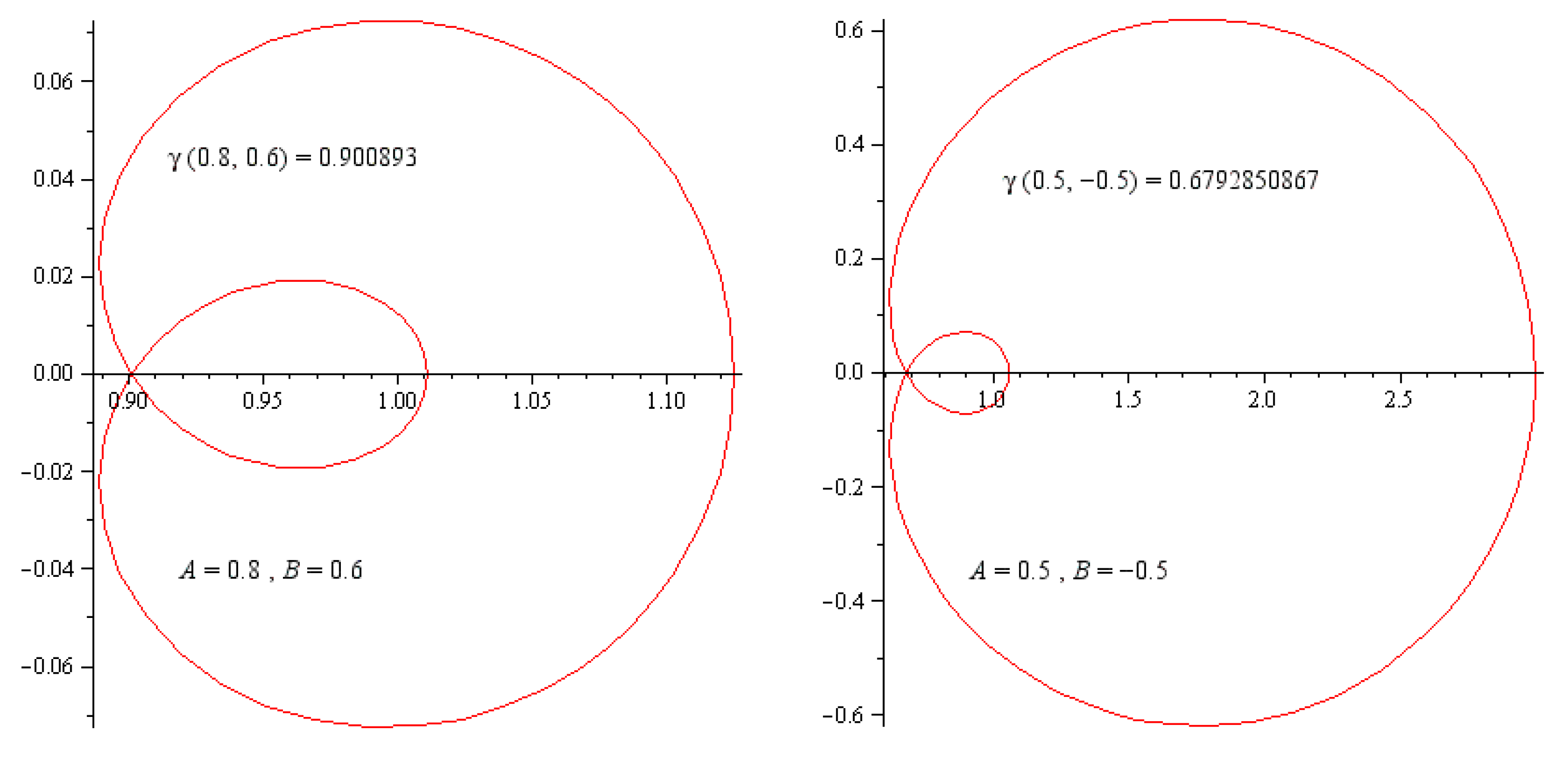
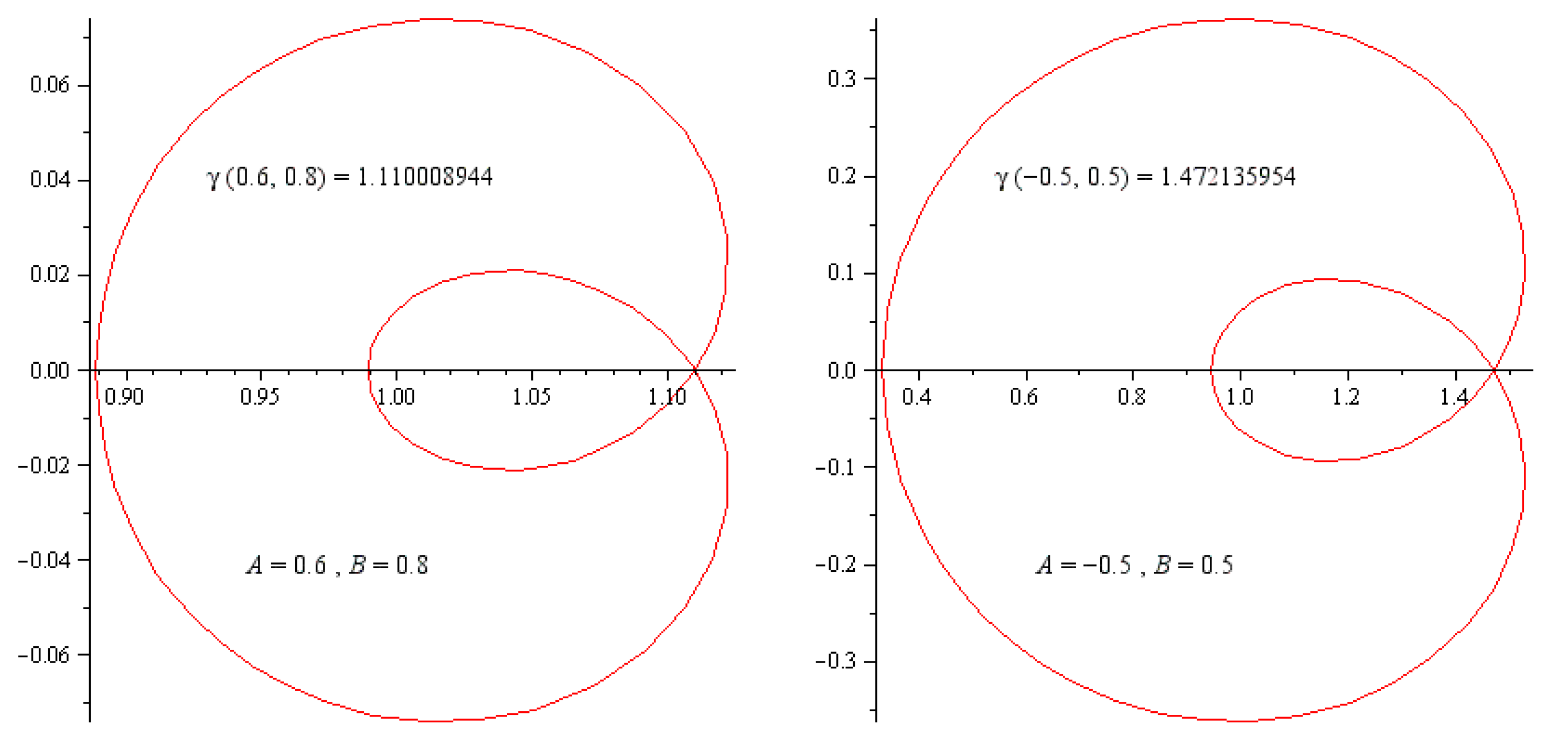
The above discussed symmetric cardioid curve with different values of parameters can be seen in Figure 1. The violation of condition flips over the cardioid curve as shown in Figure 2.
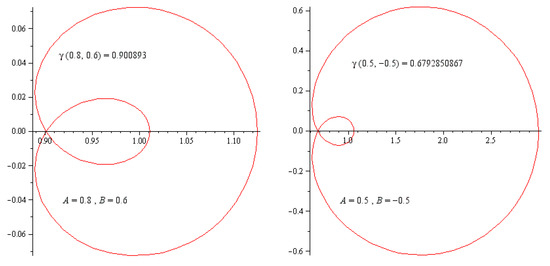
Figure 1.
The curves presented by (3) with certain values of A and B with .
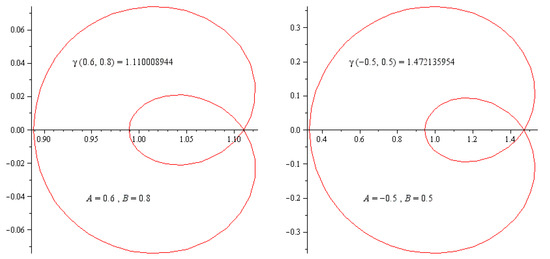
Figure 2.
The curves presented by (3) with certain values of A and B with .
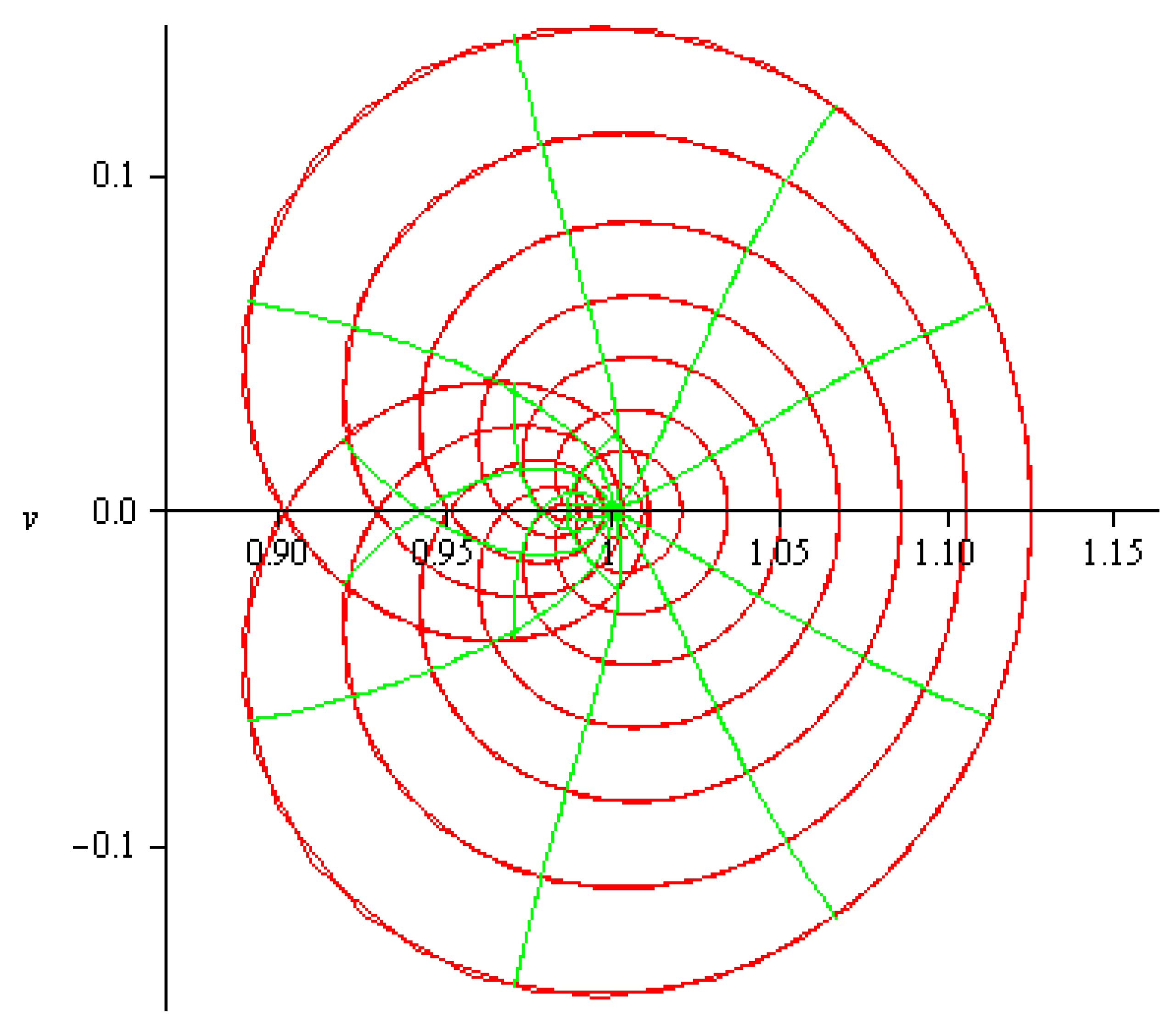
In this regard, it is interesting to observe that, if we consider the open unit disk as the collection of concentric circles in which the center is at the origin, then we notice that the image of each inner circle is a nested symmetric cardioid-like curve. Consequently, the function gives the cardioid region as an image of the open unit disk . That is, is a cardioid domain that is symmetric about the real axis, as shown in the Figure 3.
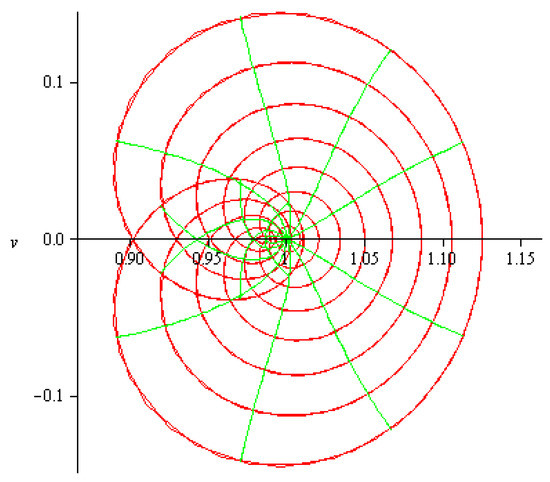
Figure 3.
The image of under .
Here, is univalent in only. Inspired by the idea of a symmetric cardioid domain, we contribute to the literature by introducing convex functions that are associated with symmetric cardioid domain, named cardio-convex functions. The class of such functions is defined below.
Before studying the class, first, we state the following lemma, which is useful in our main results.
Lemma 1.
[31] If is a function with a positive real part in then for v, a complex number
2. Main Results
First, we include the definition of the class of convex functions that are associated with the cardioid domain.
Definition 1.
The class of convex functions associated with the cardioid domain is defined as the set of functions f of the form (1) satisfying the condition
where is given by (2).
Therefore, it is easy to say that takes all of the values in the cardioid . In addition, it is worth mentioning that
- The class of convex functions associated with the cardioid domain with and reduces to the class of those convex functions that are connected with Fibonacci numbers. This class was introduced and studied by Sokół [29]; see also [28].
- , where is given by
Theorem 1.
If and is of the form (1), then for , we have
Proof.
Since therefore from (4), we obtain
where for . It is easy to see that
which, upon simplification, gives
Combining it with (1) takes the form
Upon multiplication by , we obtain
Therefore,
where
Now, from (5), we have
Since , we have
where
Using the formula (see [2]) and then integrating on , we obtain
Since the integral of product with gives 0, as a result, we obtain
Furthermore, we have
Thus, we have
which reduces to
Letting , one may have
and consequently, we obtain the required form. □
Theorem 2.
Let and of the form (1). Then
Proof.
Since we have
where is given by (2). Consider the function
such that for It is clear that . Thus, we have . Using (6), we have , where
Simple calculations lead us to
Additionally, it is easy to see that
Comparing the coefficients from (7) and (8), we obtain
Therefore, by using the well-known result for coefficients of class , we obtain a bound for second coefficients. Now,
where Now, using Lemma 1, we obtain the required result. This result is sharp for the functions and
, where is defined in (2). □
Based upon the Theorem 2, we have the following.
Conjecture If and is of the form (1), then
where and This bound is sharp and sharpness is due to the function
where
Theorem 3.
The function does not belong to the class with if
Proof.
Let
The image domain is a disk with diameter end points and If (11) is satisfied, then one of would satisfy , but this as a consequence gives the negation of inclusion relation Thus, and, hence, it leads to the required result. □
For the above result reduces to the one given below, and it is proved in [28].
Corollary 1.
The function does not belong to the class if
Let . Then, we have
where Using the above given representation, we have
The radius of univalency for the function is . That is, for an r, the curve has no loops; see [30].
Lemma 2.
A function f belongs to the class if and only if there exists an analytic function such that
Proof.
The proof follows the same lines as given in [28]. □
Theorem 4.
Let f belong to the class . Then,
for some and , where
and
Proof.
Let , then using (12) shows that there exists an analytic function with and such that
Now,
where
with , with , and where c and d are defined by (13) and (14) respectively. Therefore,
where and . Thus, we have
with and , . Consequently, this depicts that and . □
3. Conclusions
We introduced and studied the convex functions associated with the symmetric cardioid domain, named cardio-convex functions. These functions have the convex image domain bounded by the cardioid curve on the right half of the complex plane. The extremal function for said convex region was introduced, which gives the convex curve, lying entirely inside the cardioid domain. Moreover, certain geometrical properties related to cardio-convex functions have been discussed. Since this cardioid domain has just been introduced, there is a lot of roam to explore and investigate, and this work can be useful for future work in this direction.
Author Contributions
Conceptualization, S.N.M., R.M., J.S., Q.X. and M.R.; methodology, R.M. and Q.X.; software, S.N.M.; validation, S.N.M., R.M., and M.R.; formal analysis, M.R. and J.S.; investigation, R.M. and J.S.; resources, Q.X.; data curation, M.R.; writing—original draft preparation, S.N.M. and R.M.; writing—review and editing, S.Z.; visualization, S.Z.; supervision, S.N.M.; project administration, S.Z.; funding acquisition, S.N.M. and S.Z. All authors have read and agreed to the published version of the manuscript.
Funding
This research received no external funding.
Institutional Review Board Statement
Not applicable.
Informed Consent Statement
Not applicable.
Data Availability Statement
Not applicable.
Acknowledgments
The authors acknowledge the heads of their institutes for their support and for providing the research facilities.
Conflicts of Interest
The authors declare no conflict of interest.
References
- Bernstein, S.; Bouchot, J.L.; Reinhardt, M.; Heise, B. Generalized Analytic Signals in Image Processing: Comparison, Theory and Applications. In Quaternion and Clifford Fourier Transforms and Wavelets. Trends in Mathematics; Hitzer, E., Sangwine, S., Eds.; Birkhäuser: Basel, Switzerland, 2013. [Google Scholar] [CrossRef]
- Goodman, A.W. Univalent Functions; Polygonal Publishing House: Washington, NJ, USA, 1983; Volume I–II. [Google Scholar]
- Janowski, W. Some extremal problems for certain families of analytic functions. Ann. Polon. Math. 1973, 28, 297–326. [Google Scholar] [CrossRef] [Green Version]
- Wang, B.; Srivastava, R.; Liu, J.-L. A Certain Subclass of Multivalent Analytic Functions Defined by the q-Difference Operator Related to the Janowski Functions. Mathematics 2021, 9, 1706. [Google Scholar] [CrossRef]
- Sokół, J.; Stankiewicz, J. Radius of convexity of some subclasses of strongly starlike functions. Zeszyty Nauk. Politech. Rzeszowskiej Mat. 1996, 19, 101–105. [Google Scholar]
- Kanas, S.; Wiśniowska, A. Conic regions and k-uniform convexity. J. Comput. Appl. Math. 1999, 105, 327–336. [Google Scholar] [CrossRef] [Green Version]
- Kanas, S.; Wiśniowska, A. Conic domains and starlike functions. Rev. Roum. Math. Pures Appl. 2000, 45, 647–657. [Google Scholar]
- Zainab, S.; Raza, M.; Xin, Q.; Jabeen, M.; Malik, S.N.; Riaz, S. On q-Starlike Functions Defined by q-Ruscheweyh Differential Operator in Symmetric Conic Domain. Symmetry 2021, 13, 1947. [Google Scholar] [CrossRef]
- Malik, S.N.; Mahmood, S.; Raza, M.; Farman, S.; Zainab, S. Coefficient Inequalities of Functions Associated with Petal Type Domains. Mathematics 2018, 6, 298. [Google Scholar] [CrossRef] [Green Version]
- Shi, L.; Srivastava, H.M.; Khan, M.G.; Khan, N.; Ahmad, B.; Khan, B.; Mashwani, W.K. Certain Subclasses of Analytic Multivalent Functions Associated with Petal-Shape Domain. Axioms 2021, 10, 291. [Google Scholar] [CrossRef]
- Noor, K.I.; Malik, S.N. On coefficient inequalities of functions associated with conic domains. Comput. Math. Appl. 2011, 62, 2209–2217. [Google Scholar] [CrossRef] [Green Version]
- Paprocki, E.; Sokół, J. The extremal problems in some subclass of strongly starlike functions. Folia Scient. Univ. Technol. Resoviensis 1996, 157, 89–94. [Google Scholar]
- Mendiratta, R.; Nagpal, S.; Ravichandran, V. A subclass of starlike functions associated with left-half of the lemniscate of Bernoulli. Int. J. Math. 2014, 25, 1450090. [Google Scholar] [CrossRef]
- Raina, R.K.; Sokół, J. Some properties related to a certain class of starlike functions. C. R. Math. Acad. Sci. Paris 2015, 353, 973–978. [Google Scholar] [CrossRef]
- Masih, V.S.; Kanas, S. Subclasses of Starlike and Convex Functions Associated with the Limaçon Domain. Symmetry 2020, 12, 942. [Google Scholar] [CrossRef]
- Piejko, K.; Sokół, J. On booth leminiscate and Hadamard product of analytic functions. Math. Slovaca 2015, 65, 1337–1344. [Google Scholar] [CrossRef]
- Cho, N.E.; Kumar, V.; Kumar, S.S.; Ravichandran, V. Radius problems for starlike functions associated with the sine function. Bull. Iran. Math. Soc. 2019, 45, 213–232. [Google Scholar] [CrossRef]
- Wani, L.A.; Swaminathan, A. Starlike and convex functions associated with a nephroid domain. Bull. Malays. Math. Sci. Soc. 2020. [Google Scholar] [CrossRef]
- Kanas, S.; Masih, V.S. On the behaviour of analytic representation of the generalized Pascal snail. Anal. Math. Phys. 2021, 11, 77. [Google Scholar] [CrossRef]
- Kanas, S.; Masih, V.S.; Ebadian, A. Coefficients problems for families of holomorphic functions related to hyperbola. Math. Slovaca 2020, 70, 605–616. [Google Scholar] [CrossRef]
- Kargar, R.; Ebadian, A.; Sokół, J. On Booth lemniscate and starlike functions. Anal. Math. Phys. 2019, 9, 143–154. [Google Scholar] [CrossRef]
- Malik, S.N.; Mahmood, S.; Raza, M.; Farman, S.; Zainab, S.; Muhammad, N. Coefficient Inequalities of Functions Associated with Hyperbolic Domains. Mathematics 2019, 7, 88. [Google Scholar] [CrossRef] [Green Version]
- Murugusundaramoorthy, G.; Bulboacă, T. Hankel Determinants for New Subclasses of Analytic Functions Related to a Shell Shaped Region. Mathematics 2020, 8, 1041. [Google Scholar] [CrossRef]
- Raza, M.; Mushtaq, S.; Malik, S.N.; Sokół, J. Coefficient inequalities for analytic functions associated with cardioid domains. Hacet. J. Math. Stat. 2020, 49, 2017–2027. [Google Scholar] [CrossRef]
- Yunus, Y.; Halim, S.A.; Akbarally, A.B. Subclass of starlike functions associated with a limaçon. In Proceedings of the AIP Conference 2018, Maharashtra, India, 5–6 July 2018; AIP Publishing: New York, NY, USA, 2018. [Google Scholar]
- Bano, K.; Raza, M. Starlikeness Associated with Limaçon. Filomat 2021, accepted. [Google Scholar]
- Liu, L.; Liu, J.-L. Properties of Certain Multivalent Analytic Functions Associated with the Lemniscate of Bernoulli. Axioms 2021, 10, 160. [Google Scholar] [CrossRef]
- Dziok, J.; Raina, R.K.; Sokół, J. Certain results for a class of convex functions related to shell-like curve connected with Fibonacci numbers. Comput. Math. Appl. 2011, 61, 2606–2613. [Google Scholar] [CrossRef] [Green Version]
- Sokół, J. On starlike functions connected with Fibonacci numbers. Folia Scient. Univ. Technol. Resoviensis 1999, 175, 111–116. [Google Scholar]
- Malik, S.N.; Raza, M.; Sokól, J.; Zainab, S. Analytic functions associated with cardioid domain. Turkish J. Math. 2020, 44, 1127–1136. [Google Scholar] [CrossRef]
- Ma, W.; Minda, D.A. Unified treatment of some special classes of univalent functions. In Proceedings of the Conference on Complex Analysis, Tianjin, China, 19–23 June 1992; Li, Z., Ren, F., Yang, L., Zhang, S., Eds.; Int. Press: Cambridge, MA, USA, 1994; pp. 157–169. [Google Scholar]
Publisher’s Note: MDPI stays neutral with regard to jurisdictional claims in published maps and institutional affiliations. |
© 2021 by the authors. Licensee MDPI, Basel, Switzerland. This article is an open access article distributed under the terms and conditions of the Creative Commons Attribution (CC BY) license (https://creativecommons.org/licenses/by/4.0/).