


Abstract
Graph labeling is the mapping of elements of a graph (which can be vertices, edges, faces or a combination) to a set of numbers. The mapping usually produces partial sums (weights) of the labeled elements of the graph, and they often have an asymmetrical distribution. In this paper, we study vertex–face and edge–face labelings of two-connected plane graphs. We introduce two new graph characteristics, namely the vertex–face H-irregularity strength and edge–face H-irregularity strength of plane graphs. Estimations of these characteristics are obtained, and exact values for two families of graphs are determined.
Keywords:
vertex–face (edge–face) labeling; irregularity strength; vertex–face (edge–face) H-irregularity strength MSC:
05C78; 05C70
1. Introduction
All graphs considered in this paper are simple graphs with a vertex set and an edge set . If we consider a plane graph , then is its face set. For the notation and terminology not defined here, see the work presented in [1].
Graph labeling is the mapping of elements of a graph (which can be vertices, edges, faces or a combination) to a set of numbers. The mapping usually produces partial sums (weights) of the labeled elements of the graph, and they often have an asymmetrical distribution.
For a given edge k-labeling , where k is a positive integer, the associated weight of a vertex is . Such a labeling is called irregular if for every pair of vertices of G. The smallest integer k for which an irregular labeling of G exists is known as the irregularity strength of G and is denoted by . The notion of irregularity strength was introduced by Chartrand et al. in [2]. It is known that for graphs with no component with an order of at most two (see [3,4]). This upper bound was gradually improved by Cuckler and Lazebnik in [5], Przybyło in [6], Kalkowski, Karonski and Pfender in [7] and recently by Majerski and Przybylo in [8]. Other interesting results regarding the irregularity strength can be found in [9,10,11,12].
Let be all subgraphs in G isomorphic to a given graph H. If every edge of belongs to at least one of the subgraphs , , we say that graph G admits an H-covering.
Motivated by the irregularity strength of a graph G, Ashraf et al. in [13] introduced two parameters: edge H-irregularity strength and vertex H-irregularity strength , as a natural extension of the parameter . The bounds of the parameters and are estimated in [13], and the exact values of the edge (vertex) H-irregularity strength are determined for several families of graphs, namely paths, ladders and fan graphs.
If we consider a plane graph, it is natural to label not only the vertices and edges of the plane graph but also its faces. Motivated by the edge (vertex) H-irregularity strength and the entire face irregularity strength of plane graphs introduced in [14], we study a vertex–face (edge–face) H-irregularity strength of two-connected plane graphs, which is a natural extension of the edge (vertex) H-irregularity strength of graphs.
A plane graph is a particular drawing of a planar graph on the Euclidean plane. Suppose that is a two-connected plane graph with a vertex set , an edge set and a face set , where denotes the set of internal faces of G. In this paper, we consider only such subgraphs H of a plane graph G that every inner face of H is also an inner face of G.
For a subgraph under vertex–face k-labeling , the associated H-weight is
and under edge–face k-labeling , the associated H-weight is
Vertex–face k-labeling is said to represent the H-irregular vertex–face k-labeling of the plane graph G admitting an H-covering if for every two different subgraphs and isomorphic to H there is . The vertex–face H-irregularity strength of a plane graph G, denoted by , is the smallest integer k such that G has H-irregular vertex–face k-labeling.
Similarly, edge–face k-labeling is said to be an H-irregular edge-face k-labeling of the plane graph G admitting an H-covering if for every two different subgraphs and isomorphic to H there is . The edge–face H-irregularity strength of a plane graph G, denoted by , is the smallest integer k such that G has H-irregular edge-face k-labeling.
The main aim of this paper is to estimate the lower bound and an upper bound for the parameters and . We determine the exact values of the vertex–face (edge–face) H-irregularity strengths for some graphs in order to prove the sharpness of the lower bounds of these graph invariants.
2. Results
2.1. Lower Bounds
The next theorem gives a lower bound for the vertex–face H-irregularity strength for plane graphs.
Theorem 1.
Given a two-connected plane graph admitting an H-covering with t subgraphs isomorphic to H, it holds that
Proof.
Assume that is a two-connected plane graph admitting an H-covering with t subgraphs isomorphic to H and is an H-irregular vertex–face k-labeling of G. Let . The smallest H-weight for every subgraph under vertex–face k-labeling is at least . Since the H-covering of G is given by t subgraphs, then the largest H-weight admits the value at least and at most . Thus,
This implies that
□
By applying a similar reasoning, we get a lower bound for the edge–face H-irregularity strength of plane graphs as follows.
Theorem 2.
Given a two-connected plane graph admitting an H-covering with t subgraphs isomorphic to H, it holds that
The lower bounds in Theorems 1 and 2 are tight. This can be seen from the following two theorems, which determine the exact values of the vertex–face and edge–face ladder-irregularity strengths for ladders. First, we recall the definition and properties of a ladder.
Let , be a ladder with the vertex set , edge set and set of internal faces , where is a four-sided face surrounded by vertices and edges , , , . Thus, the ladder contains vertices, edges, and a number of four-sided face of , and the ladder has one -sided face.
Theorem 3.
Let be positive integers, , . Then
Proof.
For every m, , the ladder admits an -covering with exactly subgraphs , , where is the vertex set, is the edge set and the set of internal faces is It is clearly visible that every edge of belongs to at least one ladder if .
Using Theorem 1, we find that . To prove the equality, it suffices to show the existence of an optimal -irregular vertex–face k-labeling of ladder .
For every we define a vertex–face k-labeling in the following way:
We can see that under the vertex–face labeling , all vertex and face labels are at most k. For the -weight of the ladder , , under the vertex–face labeling , , we get
Consider the difference of weights of subgraphs and , for , as follows:
Since all vertex labels and face labels under the vertex–face labeling form non-decreasing sequences and for every , , it follows that the labeling is an optimal -irregular vertex–face k-labeling of . Thus, we arrive at the desired result. □
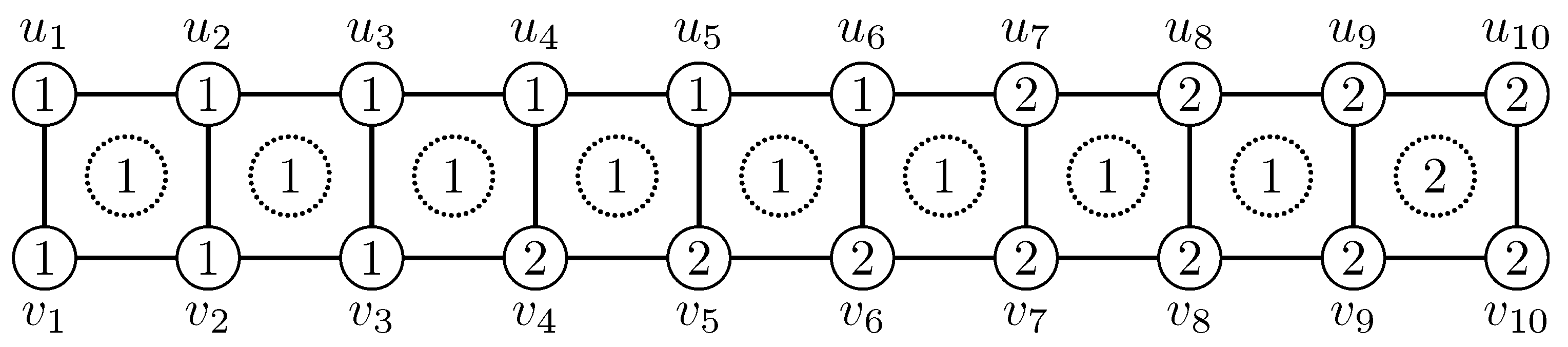
Figure 1 illustrates an -irregular vertex–face 2-labeling of the ladder , where every number in a circle is the face label. The -weights of the ladders are for .
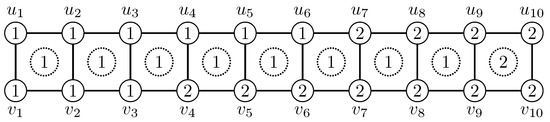
Figure 1.
-irregular vertex–face two-labeling of .
Theorem 4.
Let be positive integers, , . Then
Proof.
Let the -covering of the ladder be defined by subgraphs , and . From Theorem 2, we find that . To show that k is an upper bound for the edge–face -irregularity strength of we define an edge–face k-labeling , , as follows:
Evidently, the labeling is assigned to the edges and faces of the labels less than or equal to k. If the -weight of the ladder under the edge–face labeling is given by the form
then, for the difference of weights of subgraphs and , for , , we get
This proves that for every and . Therefore the labeling is an -irregular edge–face k-labeling of , and thus . This concludes the proof. □
Figure 2 depicts an -irregular edge–face 2-labeling of the ladder , where every number in a circle is the face label. The -weights of the ladders , , successively assume the values .

Figure 2.
-irregular edge–face 2-labeling of .
The lower bounds from Theorems 1 and 2 can be improved in the case when the subgraphs of a plane graph G contain a common subgraph.
Consider a plane graph G with an H-covering. The symbol denotes the set of all subgraphs of G isomorphic to H such that the graph S, is their maximum common subgraph. Thus, , and for every . The following theorem provides another lower bound for the vertex–face H-irregularity strength, where if H and S are graphs, then ( or , respectively) denotes the set of vertices (edges or faces, respectively) of H which do not belong to S.
Theorem 5.
Given a two-connected plane graph admitting an H-covering, let , be all subgraphs of G such that is a maximum common subgraph of , , subgraphs of G isomorphic to H. Then
Proof.
Consider a two-connected plane graph G admitting an H-covering. Let , s, be the set of all subgraphs , where each of them is isomorphic to H, and is their maximum common subgraph. Let be an optimal H-irregular vertex–face labeling of G. Then for the -weights given in the form
are all distinct, and each of them contains the value
The largest among these -weights must be at least
The value does not have any impact on the estimation of the vertex–face irregularity strength. The term , for s is the sum of labels, and therefore, by Theorem 1, at least one label is lower-bounded by . Consequently, we deduce the desired inequality. □
Similarly, we get a lower bound for the edge–face H-irregularity strength for plane graphs as follows.
Theorem 6.
Given a two-connected plane graph admitting an H-covering, let , , be all subgraphs of G such that is a maximum common subgraph of , , subgraphs of G isomorphic to H. Then,
The sharpness of lower bounds from Theorems 5 and 6 results from the following two theorems, which determine the exact values of the vertex–face and edge–face H-irregularity strengths for some graphs.
Let , be a connected graph. Fix a vertex in , say . If we identify the vertices and , the resulting graph can be denoted by the symbol . Let be a fan graph with the center w and let G be an arbitrary two-connected plane graph with a fixed vertex v belonging to the boundary of its external face. Now, we insert the fan graph into the external face of G and identify the vertices w and v. The resulting graph is a two-connected plane graph with vertices, edges, internal faces and one external face. Observe that the graph operation has no impact on the number and also size of internal faces in graph G as the subgraph of .
Denote as the vertex set, as the edge set and as the set of internal faces, where is the three-sided face surrounded by vertices and edges .
Theorem 7.
Let be positive integers, , and let G be a two-connected plane graph, for every . Then,
Proof.
If the graph G is not isomorphic to for every , then the graph , admits an -covering with exactly graphs , . Thus, every graph , has the vertex set , edge set and set of internal faces . Clearly, every edge of belongs to at least one graph if .
Since every graph contains the graph with the vertex set , edge set and face set as the maximum common subgraph, it follows that , , , and from Theorem 5, we have
To show that is an upper bound for the vertex–face -irregularity strength of , it suffices to prove the existence of an optimal vertex–face k-labeling . For , we define the function in the following way:
Indeed, it is readily seen that all vertex and face labels are at most k. Since the -weight of the graph , under the vertex–face labeling , is given by the form
then, for the difference of weights of subgraphs and , for , , we have
In fact, for every and . Thus, the labeling has the required properties of -irregular vertex–face k-labeling of . □
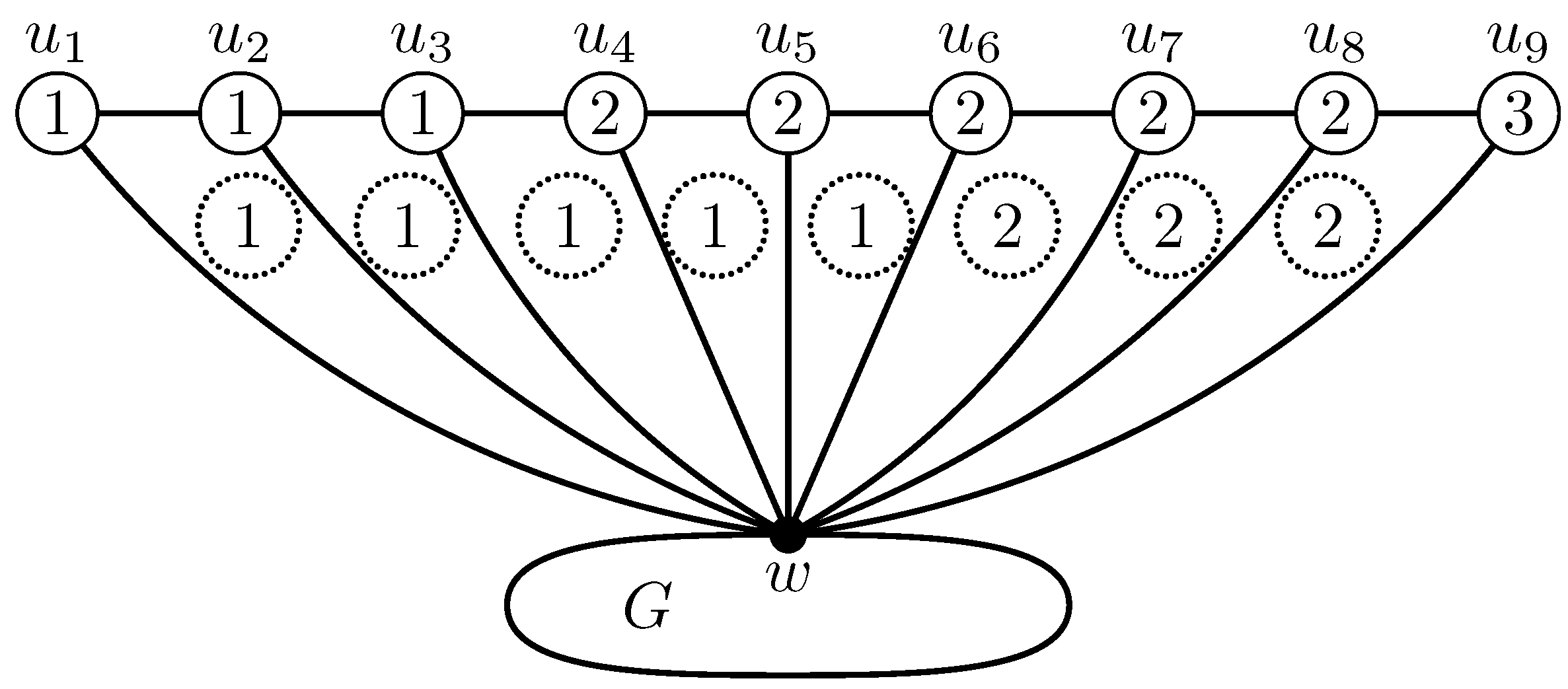
Figure 3 gives an illustration of an -irregular vertex–face 3-labeling of , where G is a two-connected plane graph, for every , and w is the common vertex of the fan and G. The -weights of the subgraphs , , successively obtaining the values .
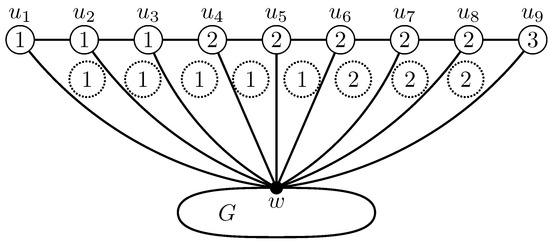
Figure 3.
An -irregular vertex–face 3-labeling of .
Theorem 8.
Let be positive integers, , and let G be a two-connected plane graph, for every . Then,
Proof.
Let G be not isomorphic to for every . Let the -covering of the graph be given by subgraphs , and . Using the fact that every graph contains the graph as the maximum common subgraph, it follows that , and . Thus, according to Theorem 6, we have
To show that is an upper bound for the edge–face -irregularity strength of we describe an edge–face k-labeling . For , we construct the function as follows:
Observe that all vertex and face labels under the labeling are at most k. Denote the -weight of the graph , under the edge–face labeling , by
For the difference of weights of subgraphs and , for , , we get
We can see that for every and . Thus, the labeling is a desired -irregular edge–face k-labeling of . □
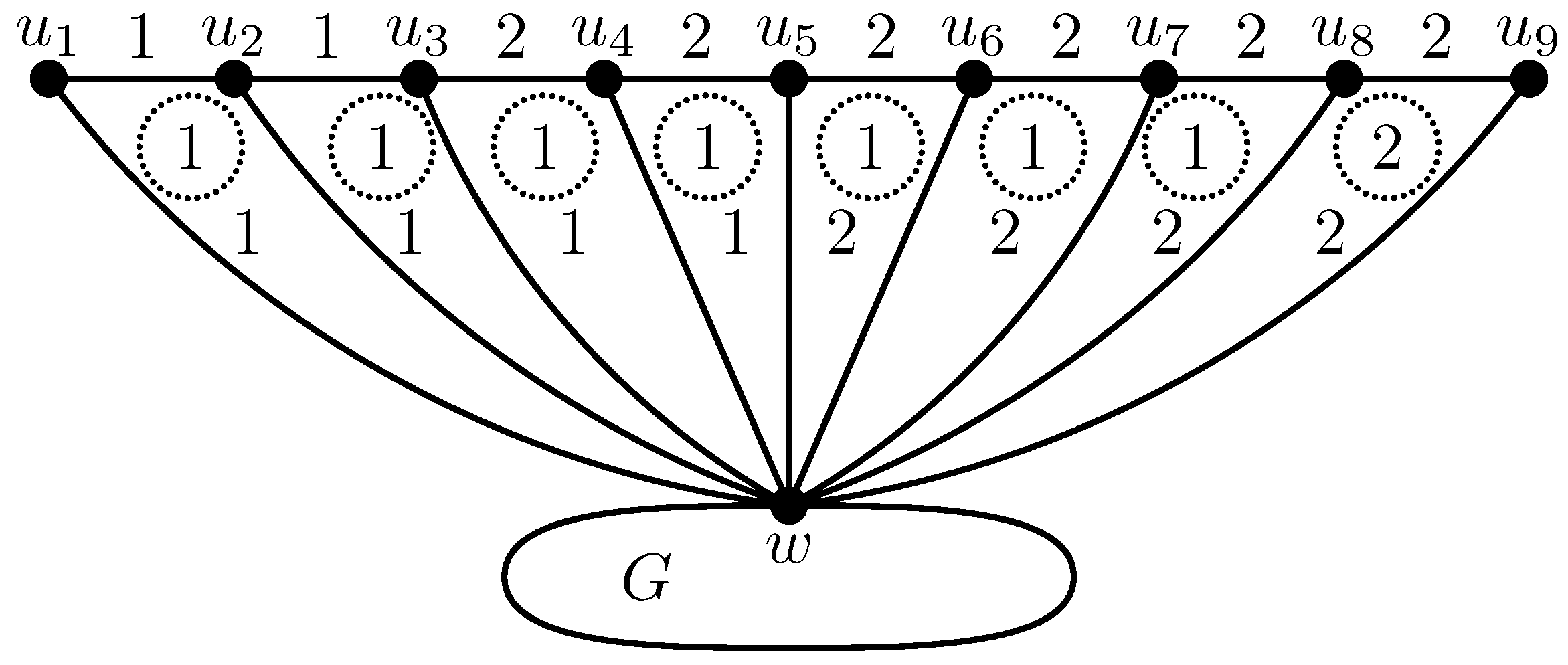
Figure 4 depicts an -irregular edge–face two-labeling of , where G is a two-connected plane graph, for every , and w is the common vertex of the fan and G. The weights of the subgraphs , constitute the set of consecutive integers .
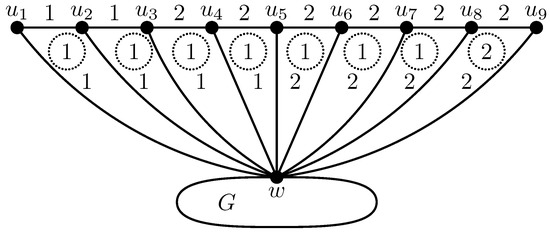
Figure 4.
An -irregular edge-face two-labeling of .
2.2. Upper Bounds
The next theorem gives upper bounds of the parameters and and shows that these graph invariants are always finite.
Theorem 9.
Given a two-connected plane graph admitting an H-covering with t subgraphs isomorphic to H, it holds that
Proof.
Consider a plane graph G admitting the H-covering given by subgraphs . Denote the internal faces of G arbitrarily by the symbols .
First, we define a vertex-face -labeling of G in the following way.
Let us define the labeling such that
where , .
The associated H-weights are the sums of all vertex labels and face labels of vertices and faces in the given subgraph. Thus, for we have
As we have for every , to prove that the H-weights are all distinct, it is enough to show that the sums are distinct for every . However, this is evident if we consider that the ordered -tuple corresponds to binary code representation of the sum (1). As different subgraphs isomorphic to H cannot have the same face sets, we immediately find that the -tuples are different for different subgraphs. Thus, we have
To prove that , it suffices to consider the edge–face -labeling of G defined by
Using similar arguments as in the previous case, we prove that this labeling has desired properties. □
3. Conclusions
In this paper, we have introduced two new graph parameters—the vertex–face H-irregularity strength and the edge–face H-irregularity strength —as a natural extension of the edge (vertex) H-irregularity strength and the entire face irregularity strength of plane graphs.
We have estimated lower and upper bounds for these parameters and determined the exact values of , , and for every , where and for every . These obtained exact values prove the sharpness of the lower bounds of the vertex–face H-irregularity strength and the edge–face H-irregularity strength.
This leads us to suggest the following conjecture.
Conjecture 1.
Let be a two-connected plane graph admitting an H-covering given by t subgraphs isomorphic to H. Let , be all subgraphs of G such that is a maximum common subgraph of , , subgraphs of G isomorphic to H. Then,
Author Contributions
Conceptualization, M.B. and A.S.-F.; methodology, M.B. and A.S.-F.; validation, M.B., N.H., A.J. and A.S.-F.; investigation, M.B., N.H., A.J. and A.S.-F.; resources, M.B., N.H., A.J. and A.S.-F.; writing—original draft preparation, M.B.; writing—review and editing, M.B. and A.S.-F.; supervision, M.B.; project administration, M.B. and A.S.-F.; funding acquisition, M.B. and A.S.-F. All authors have read and agreed to the published version of the manuscript.
Funding
This research was funded by the Slovak Research and Development Agency grant number APVV-19-0153 and by the Ministry of Education, Science, Research and Sport of the Slovak Republic grant number VEGA 1/0233/18.
Institutional Review Board Statement
Not applicable.
Informed Consent Statement
Not applicable.
Data Availability Statement
Not applicable.
Acknowledgments
We thank the anonymous reviewers for their careful reading of our manuscript and their many insightful comments and suggestions.
Conflicts of Interest
The authors declare no conflict of interest.
References
- Chartrand, G.; Lesniak, L.; Zhang, P. Graphs & Digraphs, 6th ed.; Taylor & Francis Group: Boca Raton, FL, USA; New York, NY, USA, 2016. [Google Scholar]
- Chartrand, G.; Jacobson, M.S.; Lehel, J.; Oellermann, O.R.; Ruiz, S.; Saba, F. Irregular networks. Congr. Numer. 1988, 64, 187–192. [Google Scholar]
- Aigner, M.; Triesch, E. Irregular assignments of trees and forests. SIAM J. Discret. Math. 1990, 3, 439–449. [Google Scholar] [CrossRef]
- Nierhoff, T. A tight bound on the irregularity strength of graphs. SIAM J. Discret. Math. 2000, 13, 313–323. [Google Scholar] [CrossRef]
- Cuckler, B.; Lazebnik, F. Irregularity strength of dense graphs. J. Graph Theory 2008, 58, 299–313. [Google Scholar] [CrossRef]
- Przybyło, J. Linear bound on the irregularity strength and the total vertex irregularity strength of graphs. SIAM J. Discret. Math. 2009, 23, 511–516. [Google Scholar] [CrossRef]
- Kalkowski, M.; Karonski, M.; Pfender, F. A new upper bound for the irregularity strength of graphs. SIAM J. Discret. Math. 2011, 25, 1319–1321. [Google Scholar] [CrossRef]
- Majerski, P.; Przybylo, J. On the irregularity strength of dense graphs. SIAM J. Discret. Math. 2014, 28, 197–205. [Google Scholar] [CrossRef]
- Amar, D.; Togni, O. Irregularity strength of trees. Discrete Math. 1998, 190, 15–38. [Google Scholar] [CrossRef]
- Anholcer, M.; Palmer, C. Irregular labellings of Circulant graphs. Discrete Math. 2012, 312, 3461–3466. [Google Scholar] [CrossRef]
- Bohman, T.; Kravitz, D. On the irregularity strength of trees. J. Graph Theory 2004, 45, 241–254. [Google Scholar] [CrossRef]
- Frieze, A.; Gould, R.J.; Karonski, M.; Pfender, F. On graph irregularity strength. J. Graph Theory 2002, 41, 120–137. [Google Scholar] [CrossRef]
- Ashraf, F.; Bača, M.; Kimáková, Z.; Semaničová-Feňovčíková, A. On vertex and edge H-irregularity strengths of graphs. Discrete Math. Algorithms Appl. 2016, 8, 1650070. [Google Scholar] [CrossRef]
- Bača, M.; Jendrol’, S.; Kathiresan, K.; Muthugurupackiam, K. On the face irregularity strength. Appl. Math. Inf. Sci. 2015, 9, 263–267. [Google Scholar] [CrossRef]

Publisher’s Note: MDPI stays neutral with regard to jurisdictional claims in published maps and institutional affiliations. |
© 2021 by the authors. Licensee MDPI, Basel, Switzerland. This article is an open access article distributed under the terms and conditions of the Creative Commons Attribution (CC BY) license (http://creativecommons.org/licenses/by/4.0/).