


Abstract
In this paper, we introduce the notion of neutrosophic rectangular triple-controlled metric space, relaxing the symmetry requirement of neutrosophic metric spaces, by replacing triangular inequalities with rectangular inequalities, and prove fixed point theorems. We have derived several interesting results for contraction mappings supplemented with non-trivial examples. The derived results have been applied to prove the existence of a unique analytical solution as well as a closed form of the unique solution to the integral equation.
Keywords:
neutrosophic metric space; neutrosophic rectangular triple-controlled metric space; fixed point results; integral equation MSC:
47H10; 54H25
1. Introduction
Pursuant upon the reporting of the famous Contraction Mapping Theorem (CMT) by S.Banach [1] in 1922, the study of the existence and uniqueness of fixed points and common fixed points in metric and metric-like spaces and their applications has become a subject of great interest. In 1979, Itoh [2] presented the application of fixed point results to differential equations in Banach spaces. Many authors proved the Banach contraction principle in various generalized metric spaces. In the sequel, the notion of rectangular metric space was introduced by Branciari [3] in 2000. He replaced the right-hand side of the triangular inequality of the metric space with a three-term expression and established an analogous proof of the CMT. Since then, many fixed point theorems for various contractions on rectangular metric spaces have appeared in the literature [4,5,6,7,8,9,10].
In 1965, Zadeh [11] introduced the concept of fuzzy sets, which has varied applications in logical semantics. The concept of the continuous t-norm was introduced by Schweizer et al. [12]. Kramosil and Michlek [13] were the first to introduce the notion of fuzzy metric space, using continuous t-norms as an analog to metric spaces, and analyzed the notions with the probabilistic/statistical extension of metric spaces. The concept of fuzzy sets and fuzzy metric space has varied applications in applied sciences, such as fixed point theorems, signal and image processing including medical imaging, decision making, etc. Garbiec [14] reported the fuzzy extension of the Banach contraction mapping theorem. Since then, many fixed point results have been reported by researchers using different types of contractive conditions in the setting of fuzzy metric space, dislocated fuzzy metric space, intuitionistic fuzzy metric space, etc.; see [15,16,17,18,19,20,21,22,23,24,25,26,27,28,29]. More recently, Ali et al. [30] have presented some applications of the best proximity points of non-self maps in the setting of non-Archimedian fuzzy metric spaces.
In the recent past, many researchers have reported fixed point results in the setting of fuzzy metric spaces and the like. For instance, in 2018, Mlaiki [31] presented fixed point results by defining the concept of controlled metric spaces. Konwar [32], in 2020, defined intutionistic fuzzy b-metric space and established fixed point results under various contractive conditions. Saif Ur Rehman et al. [33] proved some fuzzy cone contraction results with integral-type application.
In the sequel, the concept of neutrosophic metric spaces was introduced by Kirisci and Simsek and various fixed point results were established by them in the setting of these spaces [34,35,36]. Subsequently, Sowndrarajan et al. [37] reported several fixed point results in neutrosophic metric spaces. Sezen [38] presented the concept of controlled fuzzy metric spaces and derived various fixed point results. The concept of fuzzy double-controlled metric space was given by Saleem et al. [39] in 2021. More recently, Uddin et al. [40] established the fixed point theorem on neutrosophic double-controlled metric space and presented an application to the derived result thereon.
Inspired by the above, in the present work, we define the notion of neutrosophic rectangular triple-controlled metric space and establish fixed point theorems. Accordingly, we have organized the rest of the manuscript as follows. Some preliminaries and a monograph are presented in Section 2. In Section 3, we define the neutrosophic metric space and define the Cauchy sequence and its convergence and establish fixed point results. We support the derived results with non-trivial examples. In Section 4, we establish the existence of a unique analytical solution to the Fredholm integral equation. We have also supplemented the derived results by finding the closed form of the unique solution to the intergral equation.
2. Preliminaries
A quick review of the following definitions and monograph will be useful in the sequel.
Definition 1
([19]). A binary operation is called a continuous triangle norm if:
- (1)
- ;
- (2)
- ⋆ is continuous;
- (3)
- ;
- (4)
- , for all ;
- (5)
- If and , with , then .
Definition 2
([19]). A binary operation is called a continuous triangle co-norm if:
- (1)
- , for all ;
- (2)
- ⋄ is continuous;
- (3)
- , for all ;
- (4)
- , for all ;
- (5)
- If and , with , then .
Definition 3
([2]). Given that are non-comparable functions, if satisfies the following conditions
- (a)
- iff ;
- (b)
- ;
- (c)
- ,
for all . Then, is said to be a double-controlled metric space.
Definition 4
([39]). Suppose and are two non-comparable functions, ⋆ is a continuous t-norm and is a fuzzy set on . It is said to be a fuzzy double-controlled metric on ℑ, for all if
- (i)
- ;
- (ii)
- for all , if and only if ;
- (iii)
- ;
- (iv)
- ;
- (v)
- is left continuous.
Then, is said to be a fuzzy double-controlled metric space.
Definition 5
([32]). Take . Let ⋆ be a continuous t-norm, ⋄ be a continuous t-co-norm, and be fuzzy sets on . If fullfils all and ,
- (I)
- ;
- (II)
- ;
- (III)
- ;
- (IV)
- ;
- (V)
- ;
- (VI)
- is a non-decreasing function of and ;
- (VII)
- ;
- (VIII)
- ;
- (IX)
- ;
- (X)
- ;
- (XI)
- is a non-increasing function of and .
Then, is an intuitionistic fuzzy -metric space.
Definition 6
([36]). Let be a continuous t-norm, ⋄ be a continuous t-co-norm, and are neutrosophic sets on . It is said to be a neutosophic metric on ℑ, if, for all , the following conditions are satisfied:
- (1)
- ;
- (2)
- ;
- (3)
- for all , if and only if ;
- (4)
- ;
- (5)
- ;
- (6)
- is continuous and ;
- (7)
- ;
- (8)
- for all , if and only if ;
- (9)
- ;
- (10)
- ;
- (11)
- is continuous and ;
- (12)
- ;
- (13)
- for all , if and only if ;
- (14)
- ;
- (15)
- ;
- (16)
- is continuous and ;
- (17)
- If , then .
Then, is called a neutrosophic metric space.
Now, we present our main results.
3. Main Results
We commence this section by defining neutrosophic rectangular triple-controlled metric space.
Definition 7.
Let and be given non-comparable functions, ⋆ be a continuous t-norm, and ⋄ be a continuous t-co-norm. The neutrosophic set on is said to be a neutrosophic rectangular triple-controlled metric on ℑ, if, for any and all distinct , the following conditions are satisfied:
- (i)
- ;
- (ii)
- ;
- (iii)
- for all , if and only if ;
- (iv)
- ;
- (v)
- ;
- (vi)
- is continuous and ;
- (vii)
- ;
- (viii)
- for all , if and only if ;
- (ix)
- ;
- (x)
- ;
- (xi)
- is continuous and ;
- (xii)
- ;
- (xiii)
- for all , if and only if ;
- (xiv)
- ;
- (xv)
- ;
- (xvi)
- is continuous and ;
- (xvii)
- If , then and .
Then, is called a neutrosophic rectangular triple-controlled metric space.
Example 1.
Let and be three non-comparable functions given by , , and . Define as
Then, is a neutrosophic rectangular triple-controlled metric space with continuous t-norm and continuous t-co-norm, .
Proof.
We need to prove only (v), (x) and (xv).
Let , and . Then
whereas
and
That is,
Then, this satisfies all . Hence,
Now,
whereas
and
That is,
The above expression is true for all .
Hence,
Now,
whereas
and
That is,
Then, it satisfies all . Hence,
Hence, is a neutrosophic rectangular triple-controlled metric space. □
Remark 1.
It can be seen that the preceding example satisfies both the continuous t-norm and continuous t-co-norm .
Example 2.
Let , where and and be given by , and . Define as follows:
Define as
Then, we have
Then, is a neutrosophic rectangular triple-controlled metric space with continuous t-norm and continuous t-co-norm .
Definition 8.
Let be a neutrosophic rectangular triple-controlled metric space, an open ball with center ϑ, radius and on is defined as below:
Definition 9.
Let be a neutrosophic rectangular triple-controlled metric space and be a sequence in ℑ. Then, is said to be
- (a)
- convergent if there exists such that
- (b)
- Cauchy, if and only if, for each , there exists such thatis called a complete neutrosophic rectangular triple-controlled metric space if every Cauchy seqeunce is convergent in ℑ.
Lemma 1.
Let be a neutrosophic rectangular triple-controlled metric space. If, for some and for any ,
Proof.
(1) implies that
Now,
Moreover, from (iii), (viii), (xiii), we have . □
Theorem 1.
Suppose is a complete neutrosophic rectangular triple-controlled metric space in the company of with . Let be a mapping satisfying
for all and . Then, has a unique fixed point.
Proof.
Let ∈ℑ. Define the sequence by .
For all , we have
and
We obtain
Using (v), (x) and (xv), we have the following cases:
Case 1. When , i.e., is odd, then
and
Case 2. When , i.e., is even, then
and
and,
As , we have
and
Therefore, is a Cauchy sequence. Since is a complete neutrosophic rectangular triple-controlled metric space, we have
Now, due to the fact that ϑ is a fixed point of , utilizing e, j, and o, we obtain
and
Hence, .
Now, we examine the uniqueness. Let for some , then
and
by using (iii), (viii) and (xiii), . □
Definition 10.
Let be a neutrosophic rectangular triple-controlled metric space. A map is an NRT(neutrosophic rectangular triple)-controlled contraction if there exists , such that
We now present the fixed point result for an NRT (neutrosophic rectangular triple)-controlled contraction.
Theorem 2.
Let be a complete neutrosophic rectangular triple-controlled metric space with . Let be an ND-controlled contraction. Further, suppose that for an arbitrary , and , where . Then, has a unique fixed point.
Proceeding in this way, we have
We obtain
and
Using (v), (x) and (xv), we have the following cases:
Case 1. When , i.e., is odd, then
and
and
Case 2. When , i.e., is even, then
and
As , we deduce
and
Therefore, is a Cauchy sequence. Since is a complete neutrosophic rectangular triple-controlled metric space, we have
Now, we examine that ϑ is a fixed point of . Utilizing (v), (x) and (xv), we obtain
Using the above inequality, we obtain
and
Hence, . For uniqueness, consider that for some . Then,
and
which are contradictions.
Thus, we have and , and accordingly, . □
Example 3.
Let and be three non-comparable functions given by
Define as
Then, is a complete neutrosophic rectangular triple-controlled metric space with continuous t-norm and continuous t-co-norm .
Define by and take , then
and
Thus, all conditions of Theorem 1 are satisfied with 0 as the unique fixed point for .
Application
Let , the set of real-valued continuous functions defined on .
Consider the integral equation
where is a fuzzy function of and . Define and by means of
and
with the continuous t-norm and continuous t-co-norm defined by and , respectively. Define as
and
Then, is a complete neutrosophic rectangular triple-controlled metric space. Let for and for all. Moreover, let . Then, the integral Equation (10) has a unique solution.
Proof.
Define by
Now, for all , we deduce
and
Thus, all the conditions of Theorem (1) are satisfied and operator has a unique fixed point. This proves that (10) has a unique solution. □
Example 4.
Consider the integral equation
Then, it has a solution in ℑ.
Proof.
Let be defined by
Furthermore, see that , where . It is easy to verify all other conditions of the preceding application and hence a solution exists in ℑ. □
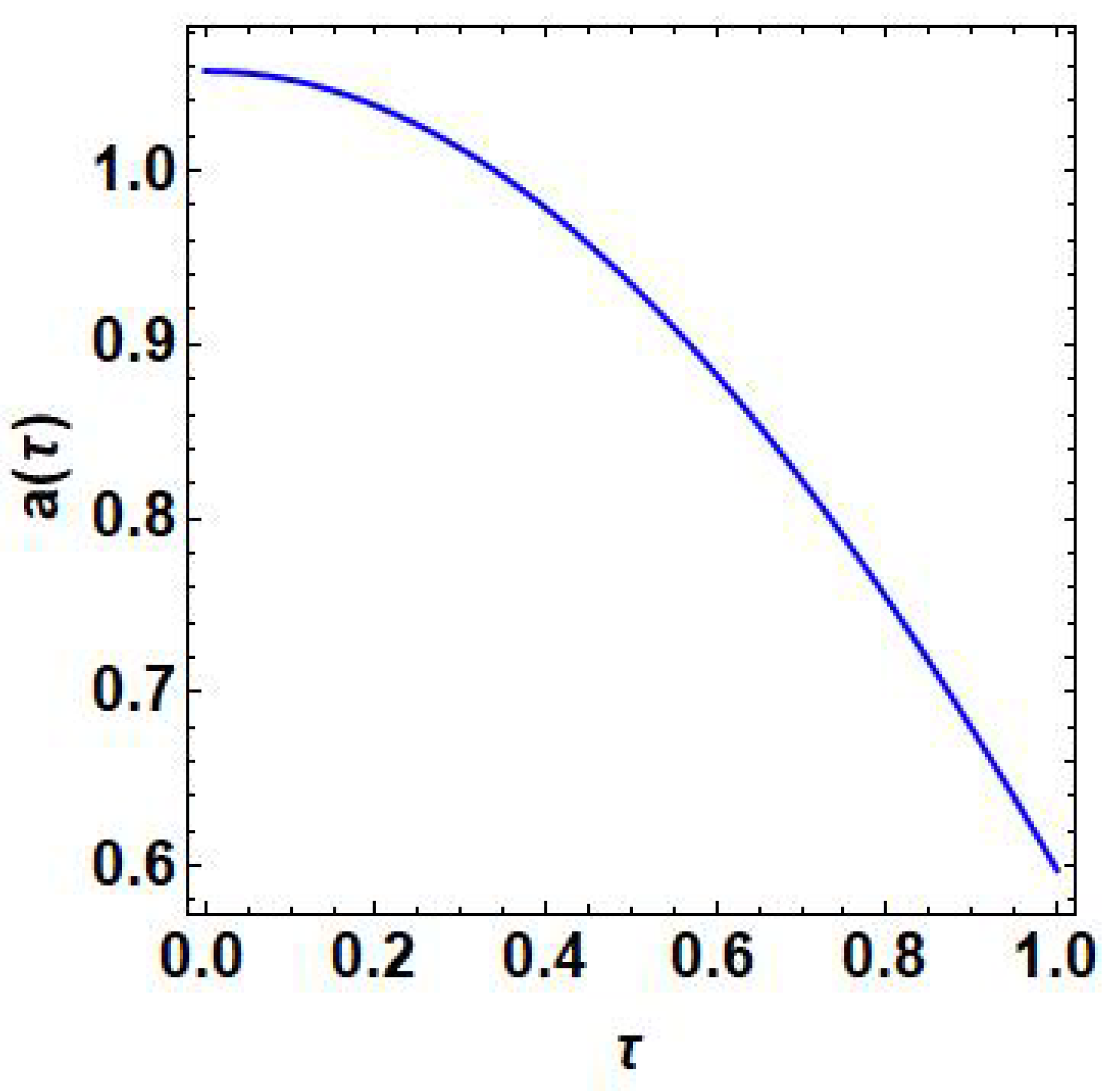
Indeed, the closed form of the unique solution for the integral equation of Example 4 using the software is found to be
and the graph of the solution is shown in Figure 1.
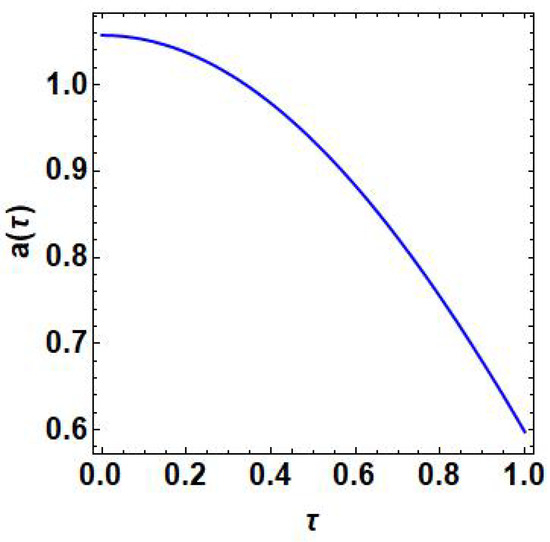
Figure 1.
Solution of Example 4.
4. Conclusions
In the above work, we have defined neutrosophic rectangular triple-controlled metric spaces and defined some topological properties of such spaces. We have proven the existence of a unique fixed point under various contractive conditions in these spaces, supported with non-trivial examples. To substantiate the derived results, we have presented the existence of a unique analytical solution to the Fredholm integral equations, outperforming those present in the literature. We have also presented the closed form of the unique solution to Example 4 to supplement the derived results. It is an open problem to explore the possibility of extending our results thorugh various contractive conditions, such as Meir-Keeler contractions, Ciric-type contractions or by using more generalized verisons of the defined spaces.
Author Contributions
Investigation: G.M., R.R. and A.J.G.; Methodology: R.R. and G.M.; Project administration: R.R. and S.R. (Slobodan Radojevic), S.R. (Stojan Radenović); Software: A.J.G. and O.A.A.A.; Supervision: R.R. and S.R.; Writing—original draft: G.M. and R.R.; Writing—review and editing: R.R., O.A.A.A. and S.R. (Slobodan Radojevic), S.R. (Stojan Radenović). All authors have read and agreed to the published version of the manuscript.
Funding
This research received no external funding.
Data Availability Statement
Not applicable.
Acknowledgments
The research was supported by the Deanship of Scientific Research, Prince Sattam Bin Abulaziz University, Alkharj. The authors are grateful to the external reviewers for their valuable comments, which helped to bring the manuscript to the present form.
Conflicts of Interest
The authors declare no conflict of interest.
References
- Banach, S. Sur les operations dans les ensembles abstraits et leur application aux equations integrales. Fund. Math. 1922, 3, 133–181. [Google Scholar] [CrossRef]
- Itoh, S. Random fixed point theorems to an application to random differential equations in Banach Spaces. J. Math. Anal. Appl. 1979, 97, 261–273. [Google Scholar] [CrossRef]
- Branciari, A. A fixed point theorem of Banach-Caccioppoli type on a class of generalized metric spaces. Publ. Math. 2000, 57, 31–37. [Google Scholar]
- Das, P. A fixed point theorem on a class of generalised metric spaces. Korean J. Math. Sci. 2002, 9, 29–33. [Google Scholar]
- Das, P.; Lahri, B.K. Fixed point of a Ljubomir Ciric’s quasi-contraction mapping in a generalized metric space. Publ. Math. Debr. 2002, 61, 589–594. [Google Scholar]
- Azam, A.; Arshad, M. Kannan Fixed Point Theorems on generalised metric spaces. J. Nonlinear Sci. Appl. 2008, 1, 45–48. [Google Scholar] [CrossRef]
- Azam, A.; Arshad, M.; Beg, I. Banach contraction principle on cone rectangular metric spaces. Appl. Anal. Discret. Math. 2009, 3, 236–241. [Google Scholar] [CrossRef]
- Das, P. A fixed point theorem in generalized metric spaces. Soochow J. Math. 2007, 33, 33–39. [Google Scholar]
- Das, P.; Lahri, B.K. Fixed Point of contractive mappings in generalised metric space. Math. Slovaca 2009, 59, 499–504. [Google Scholar] [CrossRef]
- George, R.; Rajagopalan, R. Common fixed point results for ψ-ϕ contractions in rectangular metric spaces. Bull. Math. Anal. Appl. 2013, 5, 44–52. [Google Scholar]
- Zadeh, L.A. Fuzzy sets. Inf. Control 1965, 8, 338–353. [Google Scholar] [CrossRef]
- Schweizer, B.; Sklar, A. Statistical metric spaces. Pac. J. Math. 1960, 10, 314–334. [Google Scholar] [CrossRef]
- Kramosil, I.; Michlek, J. Fuzzy metric and statistical metric spaces. Kybernetika 1975, 11, 336–344. [Google Scholar]
- Grabiec, M. Fixed points in fuzzy metric spaces. Fuzzy Sets Syst. 1988, 27, 385–389. [Google Scholar] [CrossRef]
- Fang, J.X. On fixed point theorems in fuzzy metric spaces. Fuzzy Sets Syst. 1992, 46, 107–113. [Google Scholar] [CrossRef]
- Mishra, S.N.; Sharma, N.; Singh, S.L. Common fixed points of maps on fuzzy metric spaces. Int. J. Math. Math. Sci. 1994, 17, 253–258. [Google Scholar] [CrossRef]
- Mihet, D. A Banach contraction theorem in fuzzy metric spaces. Fuzzy Sets Syst. 2004, 144, 431–439. [Google Scholar] [CrossRef]
- Gregory, V.; Romuguera, S. Fuzzy quasi metric spaces. Appl. Gen. Topol. 2004, 5, 129–136. [Google Scholar] [CrossRef]
- Park, J.H. Intuitionistic fuzzy metric spaces. Chaos Solitons Fractals 2004, 22, 1039–1046. [Google Scholar] [CrossRef]
- Rafi, M.; Noorani, M.S.M. Fixed theorems on intuitionistic fuzzy metric space. Iran. J. Fuzzy Syst. 2006, 3, 23–29. [Google Scholar]
- Alaca, C.; Turkoglu, D.; Yildiz, C. Fixed points in intuitionistic fuzzy metric spaces. Chaos Solitons Fractals 2006, 29, 1073–1078. [Google Scholar] [CrossRef]
- Romaguera, S.; Sapena, A.; Tirado, P. The Banach fixed point theorem in fuzzy quasi metric spaces with application to the domain of words. Topol. Appl. 2007, 154, 2196–2203. [Google Scholar] [CrossRef]
- Abbas, M.; Altun, I.; Gopal, D. Common Fixed Point Theorems for Non Compatible Mappings in Fuzzy Metric Spaces. Bull. Math. Anal. Appl. 2009, 1, 47–56. [Google Scholar]
- Cho, Y.J.; Sedghi, S.; Shobe, N. Generalised fixed point theorems for compatible mappings with some types in fuzzy metric spaces. Chaos Solitons Fractals 2009, 39, 2233–2244. [Google Scholar] [CrossRef]
- Gopal, D.; Imdad, M.; Vetro, C. Impact of Common Property (EA) on Fixed Point Theorems in Fuzzy Metric Spaces. Fixed Point Theory Appl. 2011, 14, 1–11. [Google Scholar] [CrossRef]
- Sintunavarat, W.; Kumam, P. Fixed Theorems for a Generalized Intuitionistic Fuzzy Contraction in Intuitionistic Fuzzy Metric Spaces. Thai J. Math. 2012, 10, 123–135. [Google Scholar]
- Dey, D.; Saha, M. An extension of Banach fixed point theorem in fuzzy metric space. Bol. Soc. Parana Mat. 2014, 32, 299–304. [Google Scholar] [CrossRef]
- Rajagopalan, R.; George, R.; Khan, M.S.; Reshma, K.P. Common Fixed Point Theorems for Single and Set-valued Horizontally Weakly Compatible Pairs of Mappings in Dislocated Fuzzy Metric Spaces. Int. J. Math. Anal. 2014, 8, 683–697. [Google Scholar] [CrossRef]
- George, R.; Nabwey, H.A.; Reshma, K.P.; Rajagopalan, R. Horizontal Weak Compatibility of Mappings and Common Fixed Points in Dislocated Fuzzy Metric Space. Appl. Math. Sci. 2014, 8, 5641–5652. [Google Scholar] [CrossRef]
- Ali, B.; Ali, M.; Hussain, A.; George, R.; Nazir, T. Best proximity points in non-Archimedean fuzzy metric spaces with application to domain of words. AIMS Math. 2022, 7, 16590–16611. [Google Scholar] [CrossRef]
- Mlaiki, N. Controlled metric type spaces and the related contraction principle. Mathematics 2018, 6, 194. [Google Scholar] [CrossRef]
- Konwar, N. Extension of fixed results in intuitionistic fuzzy b metric spaces. J. Intell. Fuzzy Syst. 2020, 39, 7831–7841. [Google Scholar] [CrossRef]
- Rehman, S.U.; Jabeen, S.; Khan, S.U.; Jaradat, M.M.M. Some α-ϕ Fuzzy Cone Contraction Results with Integral Type Application. J. Math. 2021, 2021, 1566348. [Google Scholar] [CrossRef]
- Simsek, N.; Kirişci, M. Fixed point theorems in Neutrosophic metric spaces. Sigma J. Eng. Nat. Sci. 2019, 10, 221–230. [Google Scholar]
- Kirişci, M.; Şimşek, N.; Akyiit, M. Fixed point results for a new metric space. Math Meth Appl Sci. 2021, 44, 7416–7422. [Google Scholar] [CrossRef]
- Kirişci, M.; Simsek, N. Neutrosophic metric spaces. Math. Sci. 2020, 14, 241–248. [Google Scholar] [CrossRef]
- Sowndrarajan, S.; Jeyarama, M.; Smarandache, F. Fixed point Results for Contraction Theorems in Neutrosophic Metric Spaces. Neutrosophic Sets Syst. 2020, 36, 23. [Google Scholar]
- Sezen, M.S. Controlled fuzzy metric spaces and some related fixed point results. Numer. Methods Partial Differ. Equ. 2020, 37, 583–593. [Google Scholar] [CrossRef]
- Saleem, N.; Isik, H.; Furqan, S.; Park, C. Fuzzy double controlled metric spaces. J. Intell. Fuzzy Syst. 2021, 40, 9977–9985. [Google Scholar] [CrossRef]
- Uddin, F.; Ishtiaq, U.; Hussain, A.; Javed, K.; Al Sulami, H.; Ahmed, K. Neutrosophic Double Controlled Metric Spaces and Related Results with Application. Fractal Fractional. 2022, 6, 318. [Google Scholar] [CrossRef]
Publisher’s Note: MDPI stays neutral with regard to jurisdictional claims in published maps and institutional affiliations. |
© 2022 by the authors. Licensee MDPI, Basel, Switzerland. This article is an open access article distributed under the terms and conditions of the Creative Commons Attribution (CC BY) license (https://creativecommons.org/licenses/by/4.0/).