


Abstract
In this article, we consider an anisotropic viscous cosmological model having LRS Bianchi type I spacetime with gravity. We investigate the modified gravity with form , where Q is the non-metricity scalar and , are the positive constants. From the modified Einstein’s field equation having the viscosity coefficient , the scale factor is derived as . We apply the observational constraints on the apparent magnitude using the test formula with the observational data set such as JLA, Union 2.1 compilation and obtained the best approximate values of the model parameters . We find a transit universe which is accelerating at late times. We also examined the bulk viscosity equation of state (EoS) parameter and derived its current value satisfying , which shows the dark energy dominating universe evolution having a cosmological constant, phantom, and super-phantom evolution stages. It tends to the cold dark matter (CDM) value () at late times. We also estimate the current age of the universe as Gyrs and analyze the statefinder parameters with as .
Keywords:
bulk viscosity; f(Q) gravity; accelerating universe; LRS Bianchi type-I universe; observational constraints PACS:
98.80.-k; 98.80.Jk
1. Introduction
It is well known from the recent astrophysical observations that the present-day universe is undergoing an accelerated expansion phase [1]. There has been a lot of recent research on its potential mechanisms, including extended gravity [2], the decaying cold dark matter (CDM) model [3], and the modification of EoS may account for the observed cosmic accelerated expansion. In other words, the accelerating behavior is due to an unknown mystical component having a large negative pressure termed as the dark energy (DE) [4,5]. Furthermore, the observations of the WMAP satellite [6] and large-scale structure [7] measured the cosmic microwave background (CMB) anisotropies and suggested that approximately of the universe be made up of dark energy (DE), and the rest is made up of relativistic dark matter (DM) and ordinary matter [8]. The nature of DE has previously been classified using the equation of state parameter , which is defined as the ratio of pressure to energy density , that is, . The value of EoS parameter is needed for the acceleration of cosmic expansion. The essential possibilities in this categorization are scalar field models with an EoS value , which articulates as the quintessence field dark energy [9,10], and as the phantom field dark energy [11]. The phantom field has received much interest because of its interesting qualities. In the phantom model, the dark energy grows in an exciting spread leading to a future singularity in the finite time. It also violates the four energy constraints that serve to keep wormholes [12]. In addition, the combined findings of the measurements, WMAP9 [13], SNe-Ia, cosmic microwave background, and BAO demonstrate that for the dark energy. This is despite the fact that the Planck team demonstrated in 2015 that [14]. Cao et al. [15] demonstrated analytically that the integrability of the dynamics of the Kerr–Newman black hole is surrounded by an electromagnetic field, quintessence, and charged particles moving around it for a closed FRW cosmology model with a conformally coupled scalar field. Wu [16] studied a new interpretation of zero Lyapunov exponents in Belinskii–Khalatnikov–Lifshitz time for Mixmaster cosmology. Ma et al. [17] computationally investigated the impact of changing the cosmological constant and self-interacting coefficient on the transition to chaos in complexified space.
Inspired by the studies on black hole thermodynamics [18], Hooft presented the holographic principle (HP) for the first time [19]. Later, the HP was applied to the DE problem, resulting in a new model of DE known as the Holographic Dark Energy (HDE), in which the energy density is based on physical quantities on the universe’s boundary, such as the “reduced Planck mass and the cosmological length scale", which is chosen as the universe’s future event horizon [20]. Many authors have studied the development of different cosmological models that includes viscosity. The viscosity theory of relativistic fluids was first proposed by Eckart [21] and Landau and Lifshitz [22], who considered only the first order of change from equilibrium. Israel [23] came up with the idea for the relativistic second-order theory [24]. Murphy [25] found that a zero-curvature cosmological model is perfectly solvable even in the presence of bulk viscosity. Huang [26] worked on the Bianchi type I cosmological model with bulk viscosity. Many significant problems of the standard Big-Bang cosmology may be resolved by resorting to inflationary cosmology, which may also be related with the bulk viscosity.
Several sources of inspiration for hypotheses go beyond the conventional explanation of gravity. Jimenez et al. [27] have established a new gravity theory known as the symmetric teleparallel gravity or the gravity. The non-metricity term, Q, is what causes the gravitational interaction. The theory has been investigated by Lazkoz et al. [28], along with the observational constraints to test the f(Q) Lagrangian as a polynomial function of the redshift, z. Recently, Mandal et al. [29] examined the energy condition requirements that allowed for the fixation of free parameters, and thus limiting the families of models that are consistent with the accelerated expanding behavior of the universe. The gravity is the simplest modification of STEGR. The energy condition constraints and cosmography in the theory are examined [30,31], using the assumption of a power-law function. Harko et al. [32] examined the coupling matter in modified gravity. For a polynomial model, Dimakis et al. [33] addressed different issues in the quantum cosmology [34]. The above issues have been discussed in the framework of gravity enough to motivate us to work under this new framework.
The first cosmological solutions in gravity may be found in references [35,36]. Several studies have shown the profligacy of viscous fluids which includes the shear and bulk viscosity [32,36,37,38,39]. In references [40,41,42,43,44,45,46,47,48,49,50], the impact of bulk viscous fluids in the late-time accelerating cosmos have been examined. However, in an expanding universe, a feasible process for viscous fluid formation is more difficult to find. In one approach, the bulk viscosity emerges due to the interruption of the local thermodynamic equilibrium [51].
Recent studies have focused on the transit phase universe with gravity [52,53] and gravity [54]. Capozziello and Agostino [55] examined -gravity using a model-independent approach and addressed the variety of cosmological characteristics. Anisotropic gravity with bulk viscosity has been examined by Koussour et al. [56], Maurya [57], and Dixit et al. [58]. In the present analysis, we study different mechanisms for the DE in the gravity model. In Weyl’s geometry, the covariant derivative of the metric tensor is non-null. This characteristic can be displayed mathematically in terms of a novel geometric quantity named non-metricity [59]. Geometrically, the non-metricity may be described as the variation of the length of a vector during parallel transport. To better understand our universe, we are obligated to replace the curvature concept with a more general geometrical concept. We consider gravity in an anisotropic background and solve the field equations for the average scale factor and the metric coefficients, which is different from what other people have accomplished in the past because most people have just assumed it. Using this scale factor, we have discussed the deceleration parameter and the EoS parameter along with other physical quantities.
The paper is organized as follows. An introduction and an overview of the literature have been given in Section 1. We present the gravity formalism in Section 2 along with the corresponding field equation for the LRS Bianchi type-I space-time. In Section 3, we used the bulk-viscosity coefficient = to solve Einstein’s modified field equations. Section 4 has been devoted to the observational constraining of the model. In Section 5, we discussed the results such as how old the universe is now and how the statefinder works. In Section 6, we list our concluding remarks.
2. Field Equations in -Gravity
To find the modified Einstein’s field equations in -gravity, we adopted the action principle [35,36] as
where , is an arbitrary function of Q known as non-metricity scalar and other notations are in their usual meaning such as matter Lagrangian density and metric tensor with determinant g. The non-metricity scalar Q is expressed as below
where is known as the non-metricity tensor and is the deformation tensor, and these may be expressed as
The modified field equations after the variation of action (Equation (1)) with respect to the metric tensor is given by
The non-metricity tensor is defined as
and the trace of the non-metricity tensor is derived as follows [35]:
In addition, we define the non-metricity conjugate tensor
and using this definition, the non-metricity scalar is given as
The stress-energy-momentum tensor is expressed as
The recently constructed dark energy models with bulk viscosity in gravity have a linear form in a flat FLRW universe [54]. In this paper, we derive a viscous dark energy model with a quadratic function = ; and are arbitrary positive constants, in the LRS Bianchi Type-I space-time:
Here, and are known as the metric coefficients. For the line element (6), the non-metricity scalar Q is calculated as
The stress-energy-momentum tensor for the viscous fluid is considered as
with the energy density , anisotropic pressure for bulk viscous fluid , , and along the x, y and z axes, respectively. The EoS parameter for the bulk viscous fluid has been assumed as for . Thus, the diagonal terms of the stress-energy-momentum tensor becomes
where we consider the EoS parameter along the x-axis as and take a deviation in the EoS parameter along the y and z axes from the EoS parameter of the x-axis. is also known as the skewness parameter. The suffix corresponds to the bulk viscous fluid. The EoS parameters and may be constant or functions of cosmic time t.
In the co-moving coordinate system, the field equations from Equations (4), (6) and (8) may be written as
Here, the over dot denotes the derivative with respect to time t. The volume scale-factor of the considered spacetime is defined as
where, denotes the average scale factor and are the metric coefficients. The deceleration parameter (q) in terms of the average scale-factor is given by
The deceleration parameter (DP) reveals the various phases of the expanding evolution of the universe. A positive value of q depicts the decelerating phase and the negative values of q depicts the accelerating phase of the universe.
The mean Hubble parameter H is defined as
where , and are the directional Hubble parameters along the x, y and z axes, respectively. For the line element (6), the directional Hubble parameters are taken as and .
A connection among the above three parameters H, V and a may be obtained as
We define the geometrical parameters called as scalar expansion, shear scalar and the mean anisotropy parameter as
with the directional Hubble parameters .
3. Cosmological Solutions
We have three independent field Equations (10)–(12) in five unknowns . Therefore, to obtain an exact solution, we may require two more constraints on these parameters, and hence, we assume the shear is proportional to the expansion scalar, and this relation leads to [21]
with as an arbitrary constant. With , the model represents an isotropic universe and will give an anisotropic universe. Here is a full explanation of the primary assumptions that caused this circumstance [21]. When is constant, it is possible to achieve isotropy in the Hubble expansion of the universe according to the observations of the velocity redshift relation for extragalactic sources. With reference to Thorne [60], it is further indicated that according to studies of the velocity-redshift relation for extragalactic sources, the Hubble expansion of the universe is currently isotropic to a degree of ≈30% [61,62]. To put it more specifically, red-shift studies set the limit for the shear-to-Hubble constant ratio in the present-day region of our Galaxy at . Collins et al. [63] have noted that the normal congruence to the homogeneous expansion satisfies the requirement that is constant for spatially homogeneous metrics. This circumstance has served as the beginning point for numerous studies.
Now, in the present investigation, we have considered a quadratic function of as
where and are arbitrary constants.
Now, using Equation (20) in (13), the metric coefficients are obtained in terms of the scale factor as:
and the directional Hubble parameters are given by
Viscous fluid pressures are defined in the x, y, and z directions as [22,56]
where p is the normal pressure and is formed when the viscous fluid deviates from local thermal equilibrium. may be a function of the Hubble parameter and its derivative [22,64].
From the expression (21),
Using Equation (24) for the viscous universe in Equations (10)–(12), we deduce that the parameter “bulk viscosity coefficient ” is connected to the matter, the Hubble parameter and its derivative. So, we assume and consider the specific form of as [44,65,66,67,68,69,70,71,72].
where is an arbitrary constant.
Hence, the average scale factor and the average Hubble parameter are given by
and
The and components of the deceleration parameter are computed, respectively, as
The average deceleration parameter is calculated as
4. Observational Constraints
To validate the theoretical model, it is necessary to compare the derived results of the model with the observational universe. The technique of the curve-fitting of some cosmological parameters with various observational data sets is the best way to compare and validate the model. Hence, we will find the best fit curve of the Hubble parameter and apparent magnitude. For performing these curve fittings, we will require a relation between cosmic age and redshift which is taken as the relation between the redshift and average scale-factor as , with . Now, using this relationship, the cosmic age in terms of redshift z may be given as
Hence, the Hubble parameter in terms of redshift z may be derived as
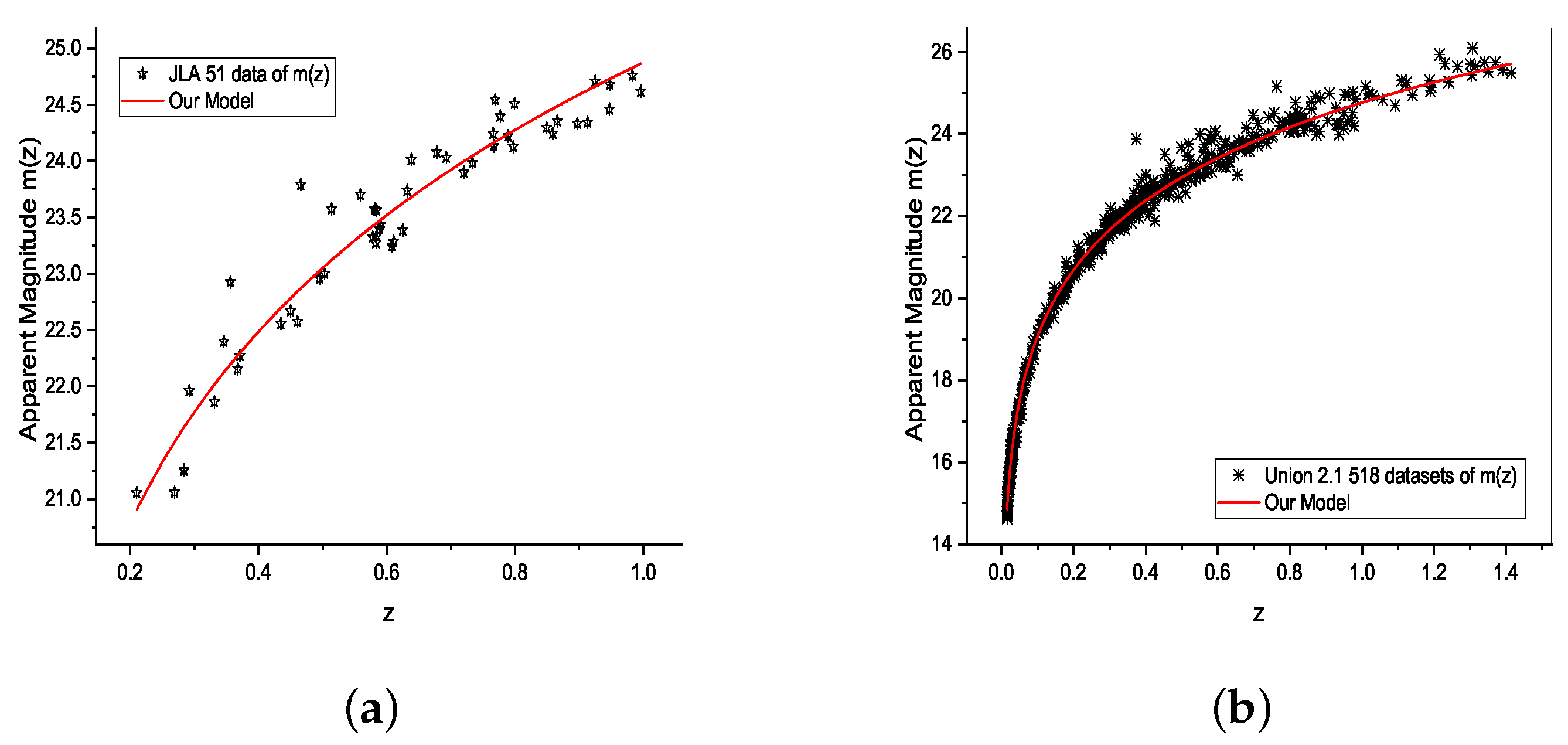
Several observational datasets are presently available in the literature. Here, we use two datasets of the apparent magnitude using redshift z in the derived model. The first is the 51 dataset of apparent magnitude from the Joint Light Curve Analysis (JLA) [73] and the 518 data set of magnitude from the Union 2.1 Compilation of SNe Ia datasets [74].
Apparent Magnitude
Luminous distance is measured by the total luminous flux of a light source and defined as . We take the apparent magnitude with respect to to obtain the best values of the model parameters for the best-fit curve of . Using the 51 observed apparent magnitude dataset from JLA [73] and the 518 observed apparent magnitude dataset Union 2.1 [74] to determine the best-fit curve for the apparent magnitude using the SNe Ia dataset. We use the test formula to achieve the best-fit curve for the theoretical and empirical results.
The Luminosity Distance may be calculated by the formula
where c is the velocity of light and is the Hubble parameter given in Equation (43).
Now, using Equation (43) in (44), the luminosity distance for the above derived model may be given as
Consequently, the apparent magnitude is calculated as
We employ the test to identify the curve as
where summation is taken from 1 to 51 data points for the JLA dataset and it taken from 1 to 518 data points for union 2.1 compilation dataset.
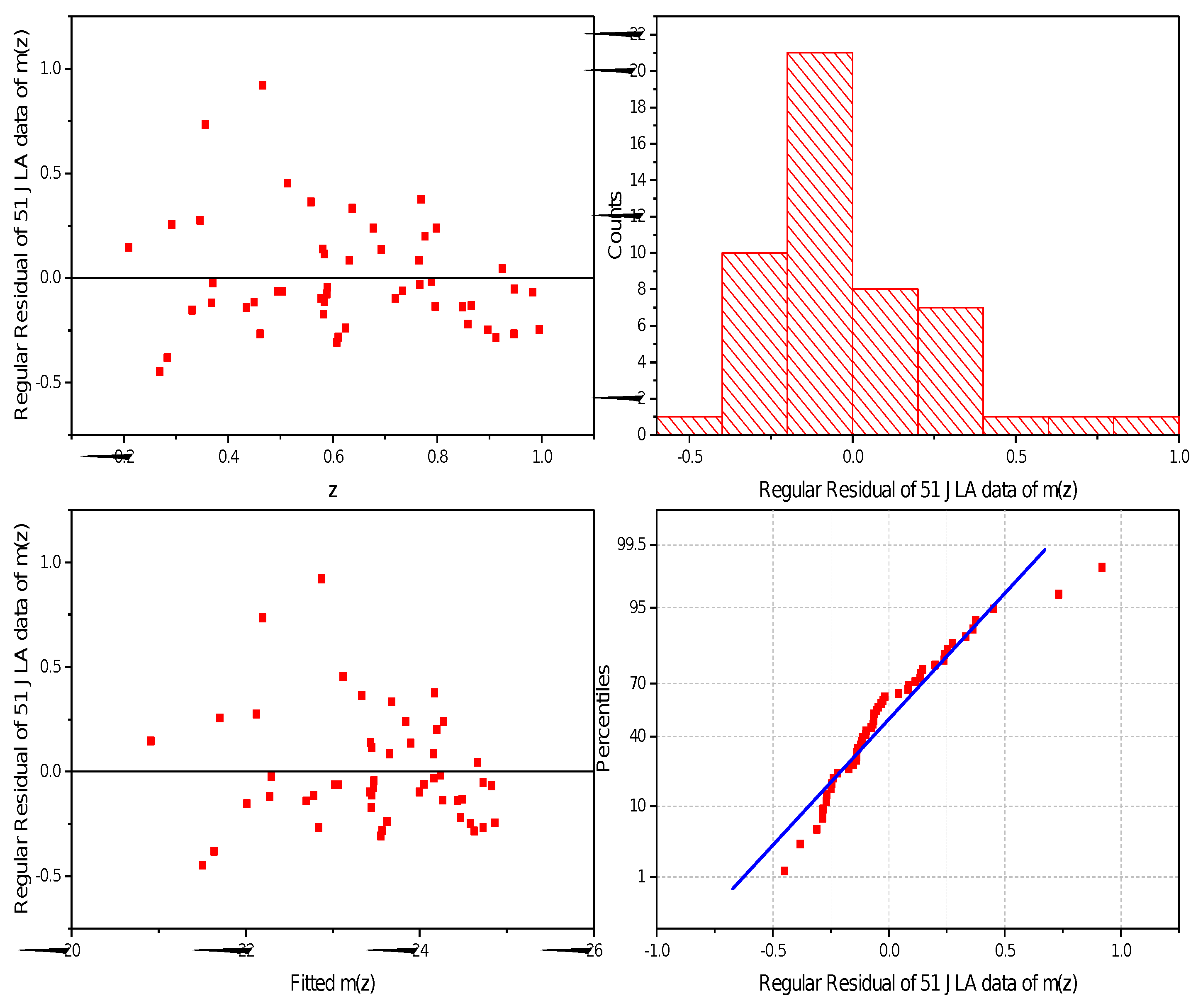
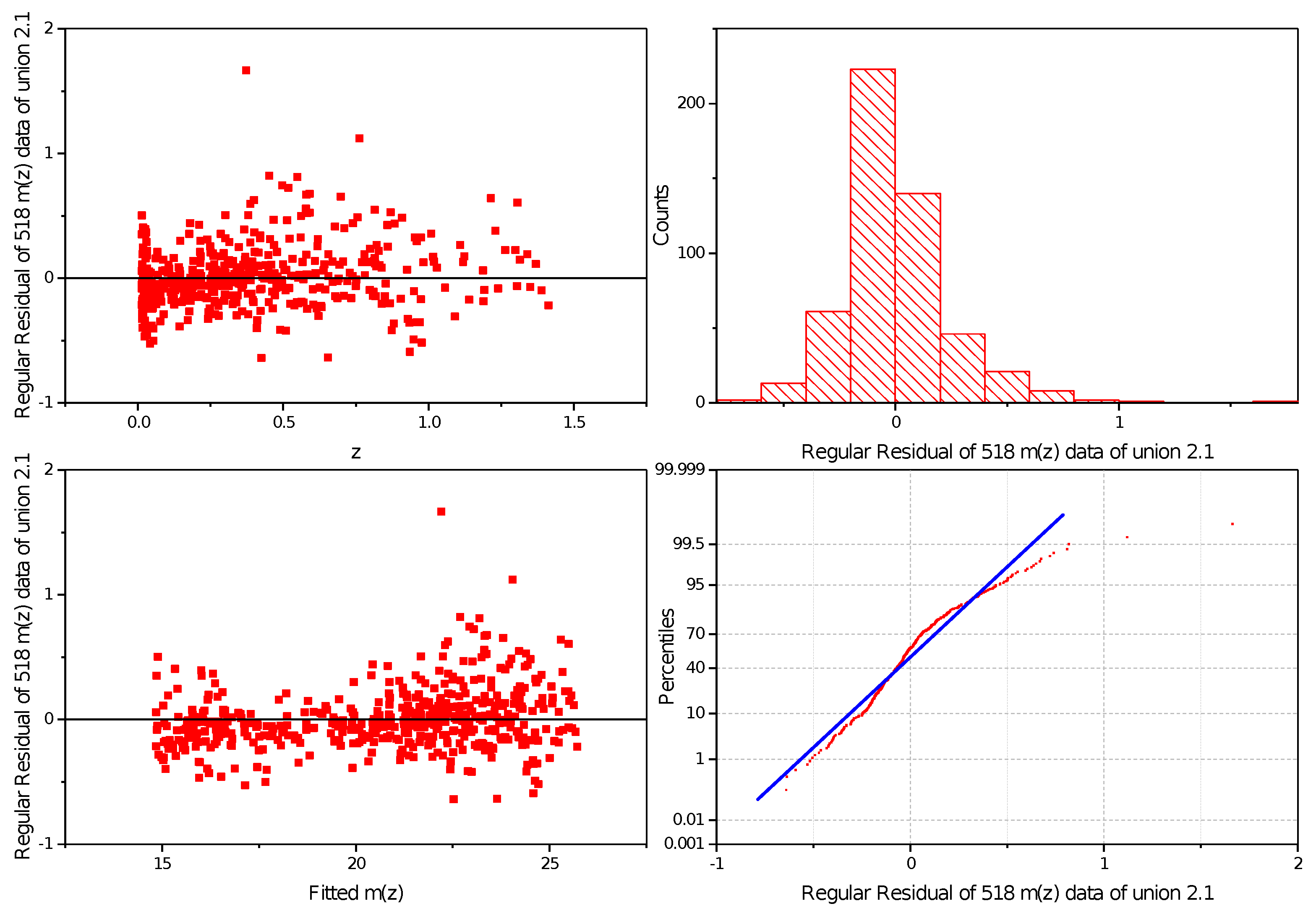
With this understanding of values, we used the -test formula to obtain the best-fit curve of the apparent magnitude with the observational datasets JLA and union 2.1 as well as the best fit values of the model parameters , which are listed in Table 1. The means that observational and theoretical values are exactly the same. Figure 1a,b show the best-fit curves of the apparent magnitude with the observational values of obtained from the JLA and Union 2.1 datasets which are listed in Table 1. We also observe that our theoretical model is in good agreement with these two datasets. Figure 2 and Figure 3 demonstrate, using two different sets of data, the accuracy of our fitted model.

Table 1.
The model parameters that best fit the JLA and Union 2.1 datasets.
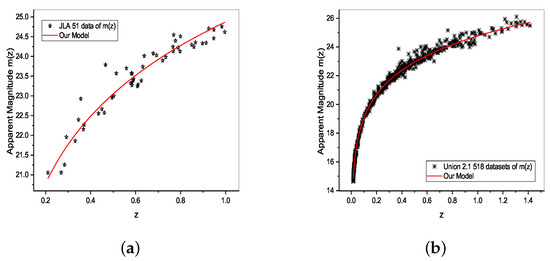
Figure 1.
The Joint Light–Curve Analysis and Union 2.1 datasets, respectively, were used to fit the m (z) curve.
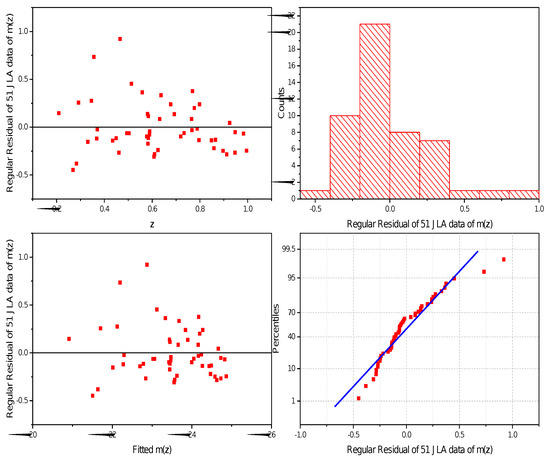
Figure 2.
The residual plot of the best fit model and JLA datasets.
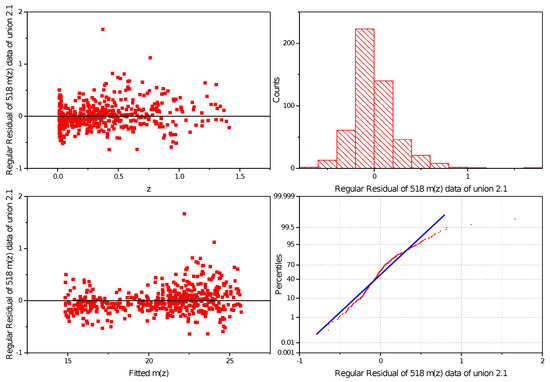
Figure 3.
The residual plot of the best fit model and Union 2.1 datasets.
5. Discussion of the Results
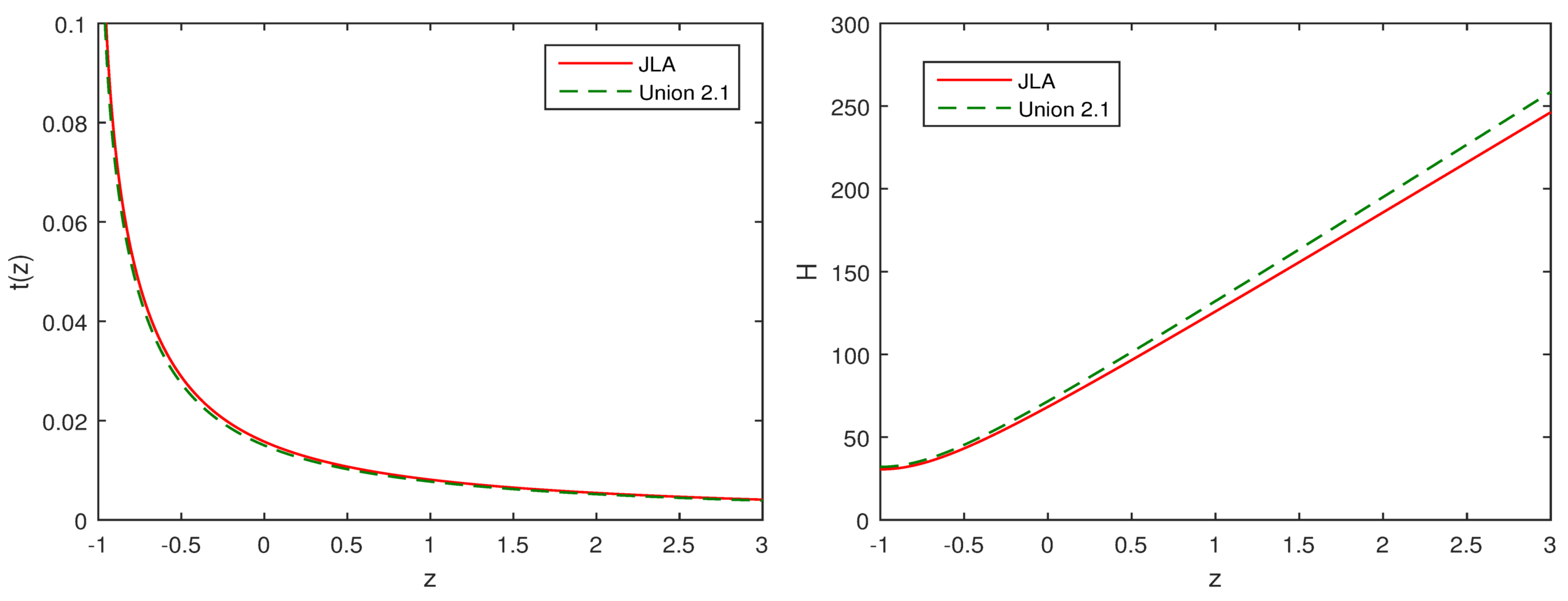
Equation (42) represents a relationship between the cosmic time t and redshift z, and its geometrical interpretation is given by Figure 4a, from which we can say that as , the cosmic time . At , we find the present value of . From Figure 4a, we can see that the cosmic time varies as over the redshift . The expression for the Hubble parameter is given by Equation (42), and Figure 4b shows its geometrical behavior. From Figure 4b, we can see that H is an increasing function of redshift z, and at , the value of H denotes the present value of Hubble parameter . Hence, at , . In addition, as , . From the best-fitting curve, the value of is obtained as ≈70, as mentioned in Table 1. From the Hubble law , i.e., constant , where v is the velocity of the moving object and d is the distance of moving object from the observer, increasing the value of with redshift z shows the acceleration in expansion.
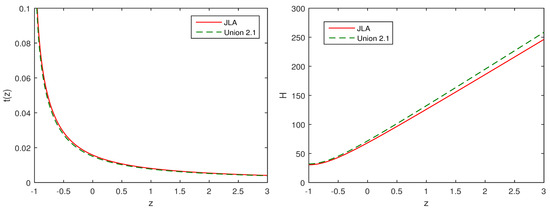
Figure 4.
Cosmic time t and Hubble parameter H with z in the derived model.
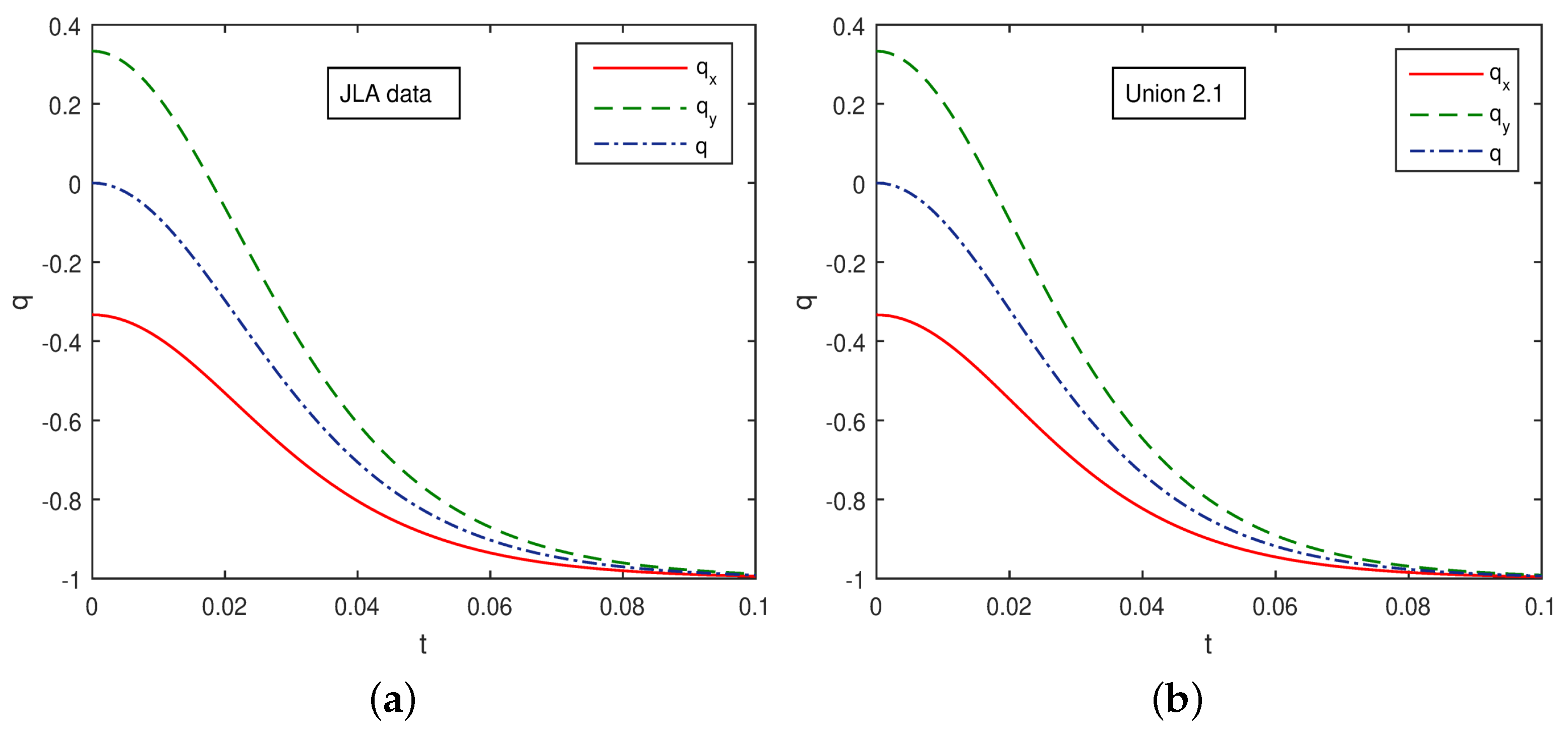
Equations (36) and (37) represent the expressions for the deceleration parameter and along x and y axes, respectively. Equation (38) represents the expression for the average deceleration parameter . The geometrical behavior of these deceleration parameters is shown in Figure 5a,b for JLA and Union 2.1 compilation of SNe Ia observations. Figure 5a,b show that the values of the deceleration parameter decreases with cosmic time and as , . It depicts that the universe’s expansion is accelerating. We observe that the average deceleration parameter q represents a universe from static to an accelerating expanding universe, but the component of q along the x-axis varies over which reveals an ever-accelerating universe and the component depicts a transit phase accelerating universe. The present value of is determined as , and along two datasets, which reveal that the present universe is accelerating. Equation (39) represents the expression for the energy density , and we can observe that as , , i.e., at the time of origin of the universe, the energy density of the universe is very high, and after the Big Bang, it has been diluted with time. For , we may find a constraint on as .
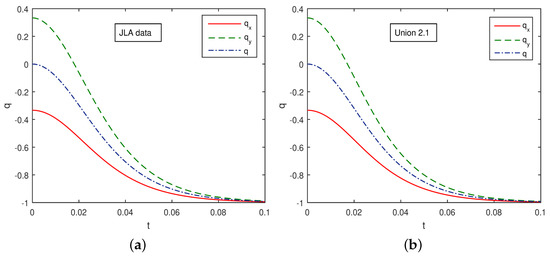
Figure 5.
Behavior of deceleration parameter for two datasets, JLA and Union 2.1 Compilation of SNe Ia observations.
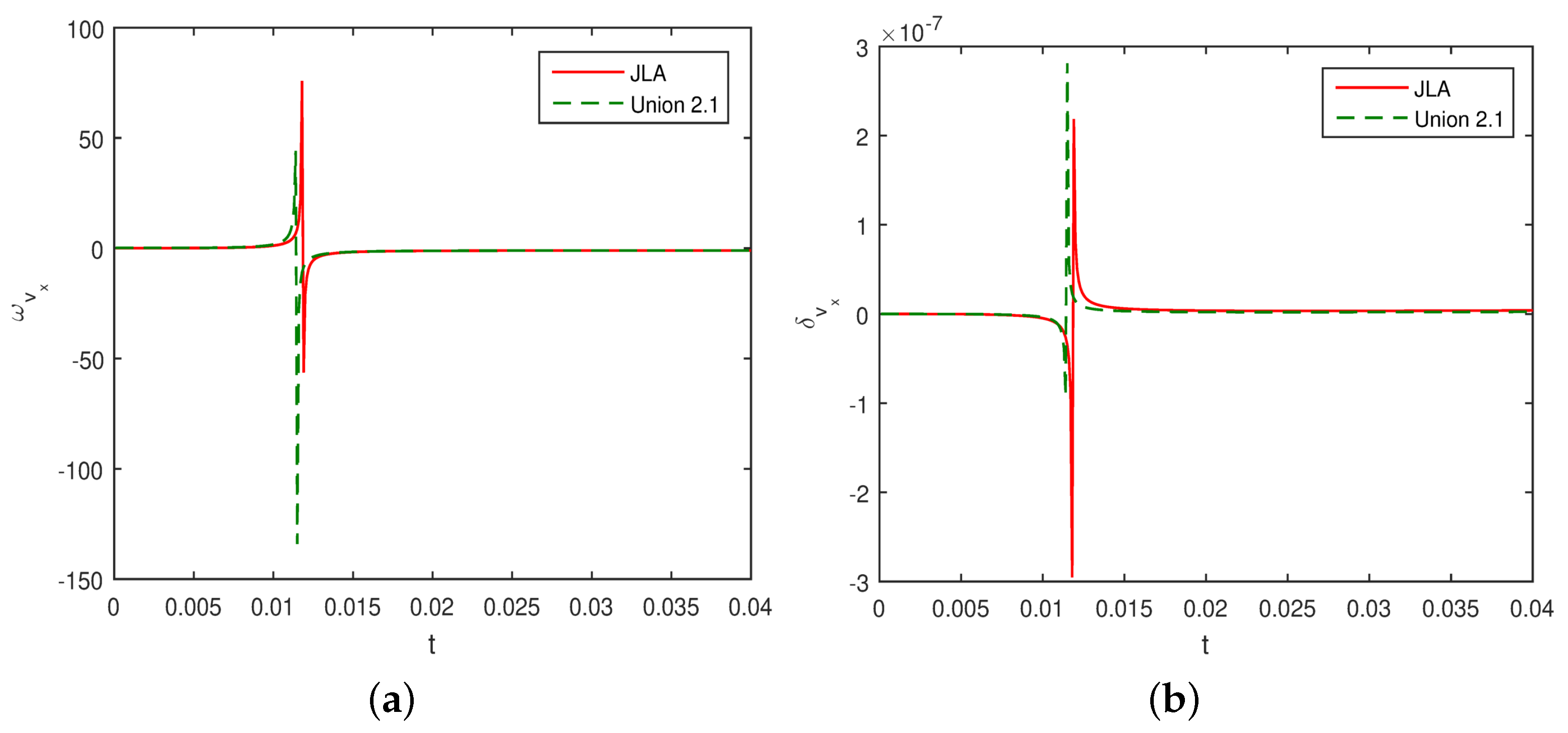
Equations (40) and (41) represent the expressions for the EoS parameter and skewness parameter for the bulk viscous fluid in the anisotropic universe, respectively. Figure 6a,b show their variations over cosmic time t, respectively. Figure 6a shows that the EoS parameter is an increasing function of cosmic time t with . Then, it decreases with time and tends to (CDM model) in the late-time universe, which is an interesting feature of the model. It depicts that the early universe was matter-dominated. As time passes, the dark energy dominates. Due to this, its volume increases, and the universe expands with acceleration. Figure 6b shows that the skewness parameter decreases with cosmic time t, and the present values of tend to zero, which is consistent with the skewness property.
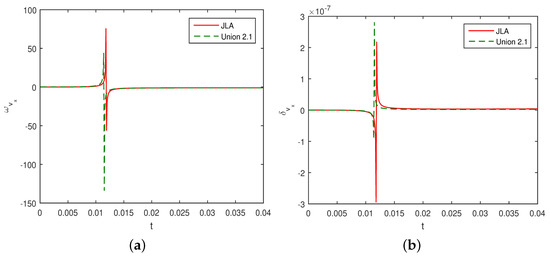
Figure 6.
The EoS and skewness with t for JLA and Union 2.1 Compilation of SNe Ia observations.
Equation (28) with (35) represents the expression for the bulk-viscosity function. We have observed that the Hubble parameter H is a decreasing function of cosmic time t and estimated values of along two datasets. Hence, the bulk-viscosity function is a decreasing function of time t, which may cause the expanding and accelerating expanding universe.
5.1. Age of the Present Universe
The present age of the universe is estimated by
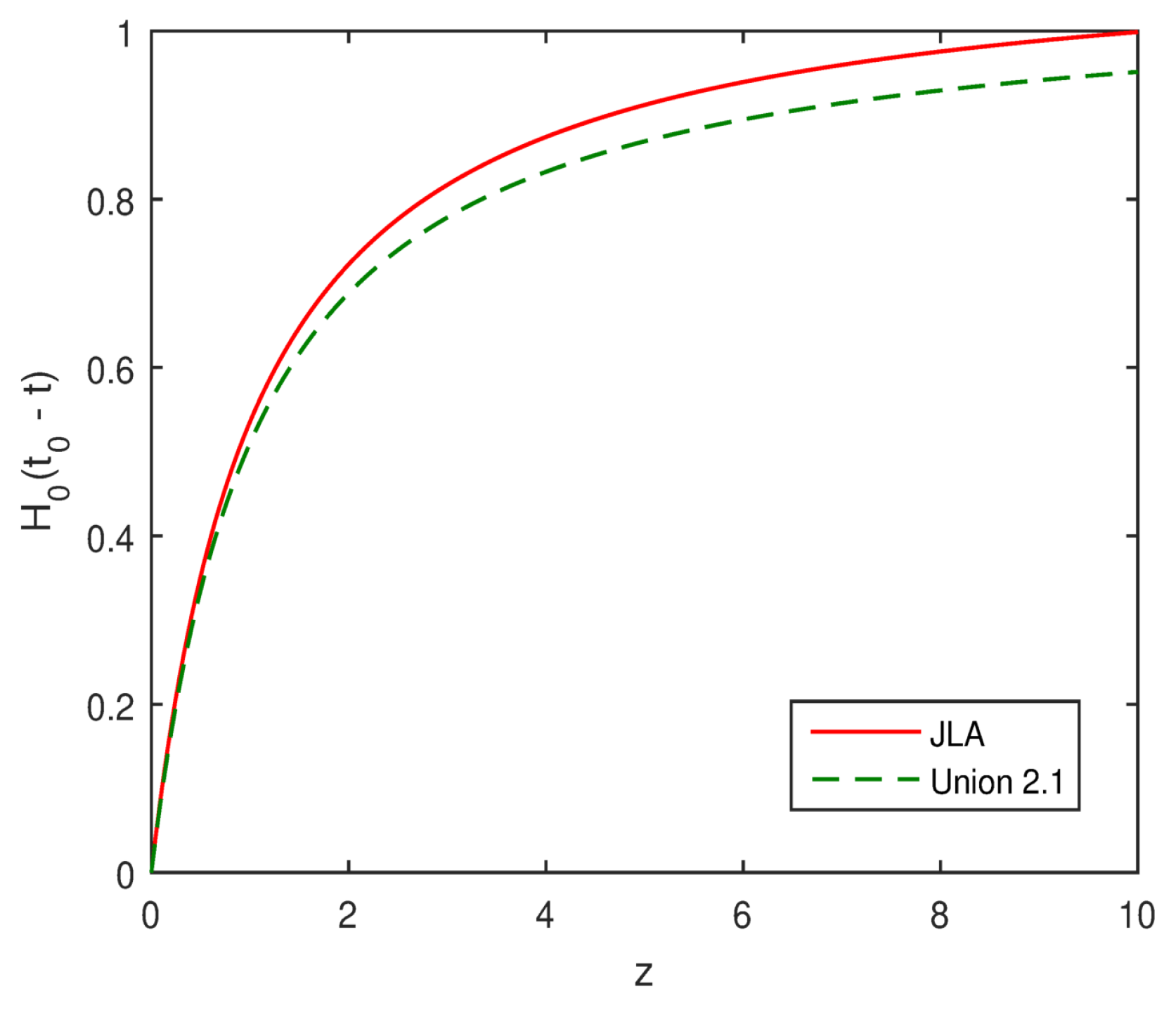
The geometrical behavior of versus redshift is represented in Figure 7. One can see that as , then (i.e., ); here, is the present value of H and shows the age of the present universe. In our derived model, the age of the present universe is calculated as GYrs for two datasets, respectively, the JLA and Union 2.1 compilation of supernovae Ia. These findings are supported by the recent observations [14,73,75].
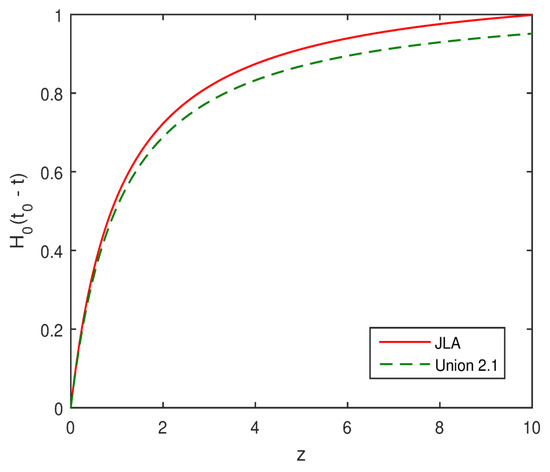
Figure 7.
The cosmic age of the universe in the derived model.
5.2. Statefinder Analysis
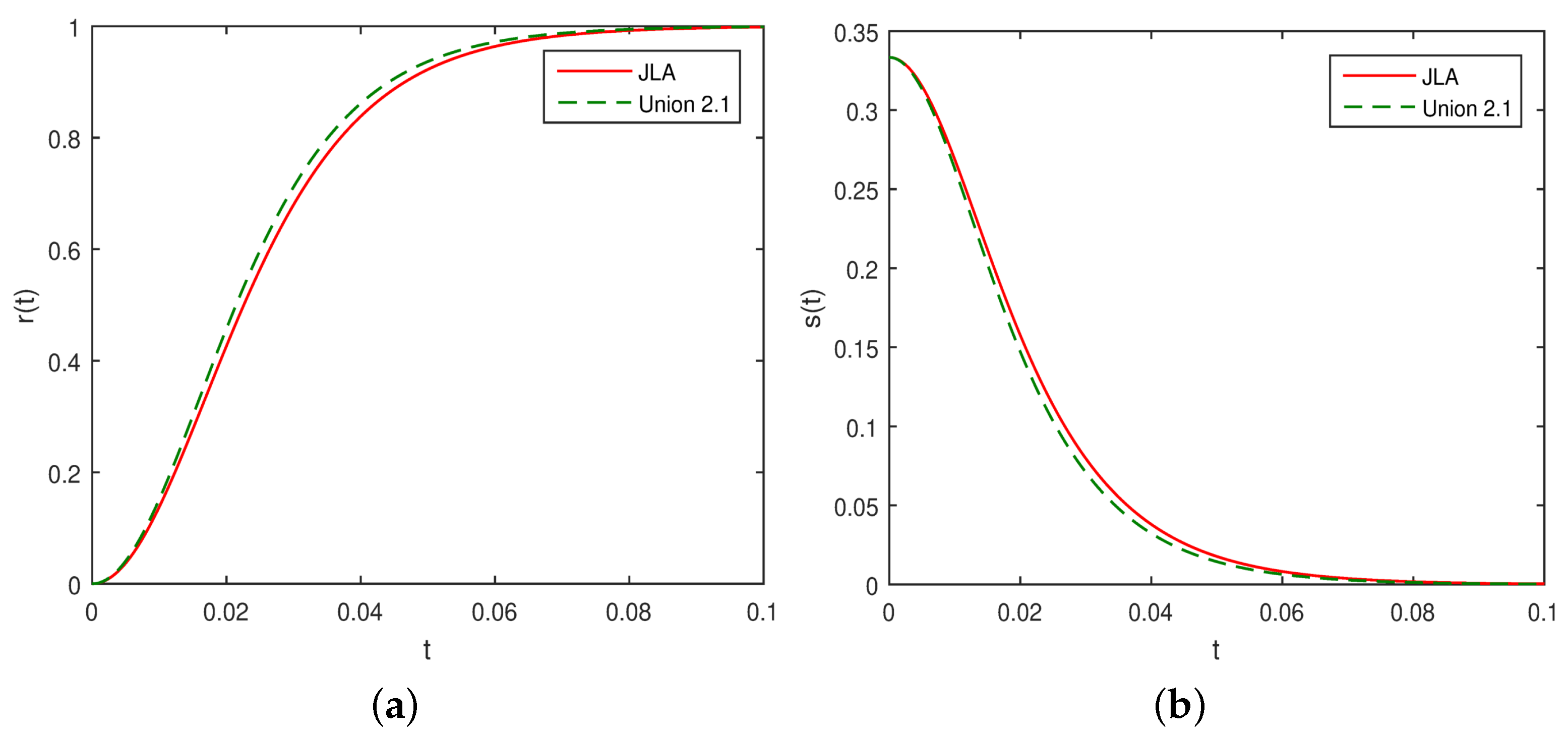
The Hubble parameter and the deceleration parameter are two cosmological parameters that characterize the geometrical evolution of the cosmos. These are also known as geometrical parameters. In addition to these quantities, the statefinder parameters, proposed in reference [14], depict the various phases of the universe evolution in the dark energy models [76,77,78]. The parameters r and s may be expressed in terms of the average scale-factor and its derivative as [14]
The statefinder r may be determined as
Using Equations (34), (42) and (43) in Equations (49) and (50), the expression for the statefinder s may be given as
From Equations (50) and (51), we can find that as , and , this implies that our derived model tends to an isotropic CDM model as .
The geometrical interpretation of the statefinder parameters r, s with the variation of time t are shown in Figure 8a,b, respectively, and we have measured the present values of as , , respectively, for the two datasets. The evolution of reveals different stages of the dark energy models [14,76,77,78]; for instance, the value represents a flat FLRW CDM model. It can be found that at present, , and this indicates that the present universe is a dark energy-dominated universe.
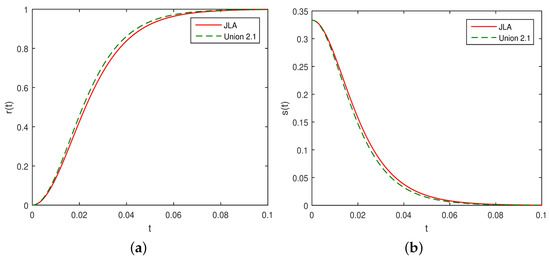
Figure 8.
Behavior of statefinder parameters for two datasets, JLA and Union 2.1 Compilation of SNe Ia observations.
5.3. Om Diagnostics
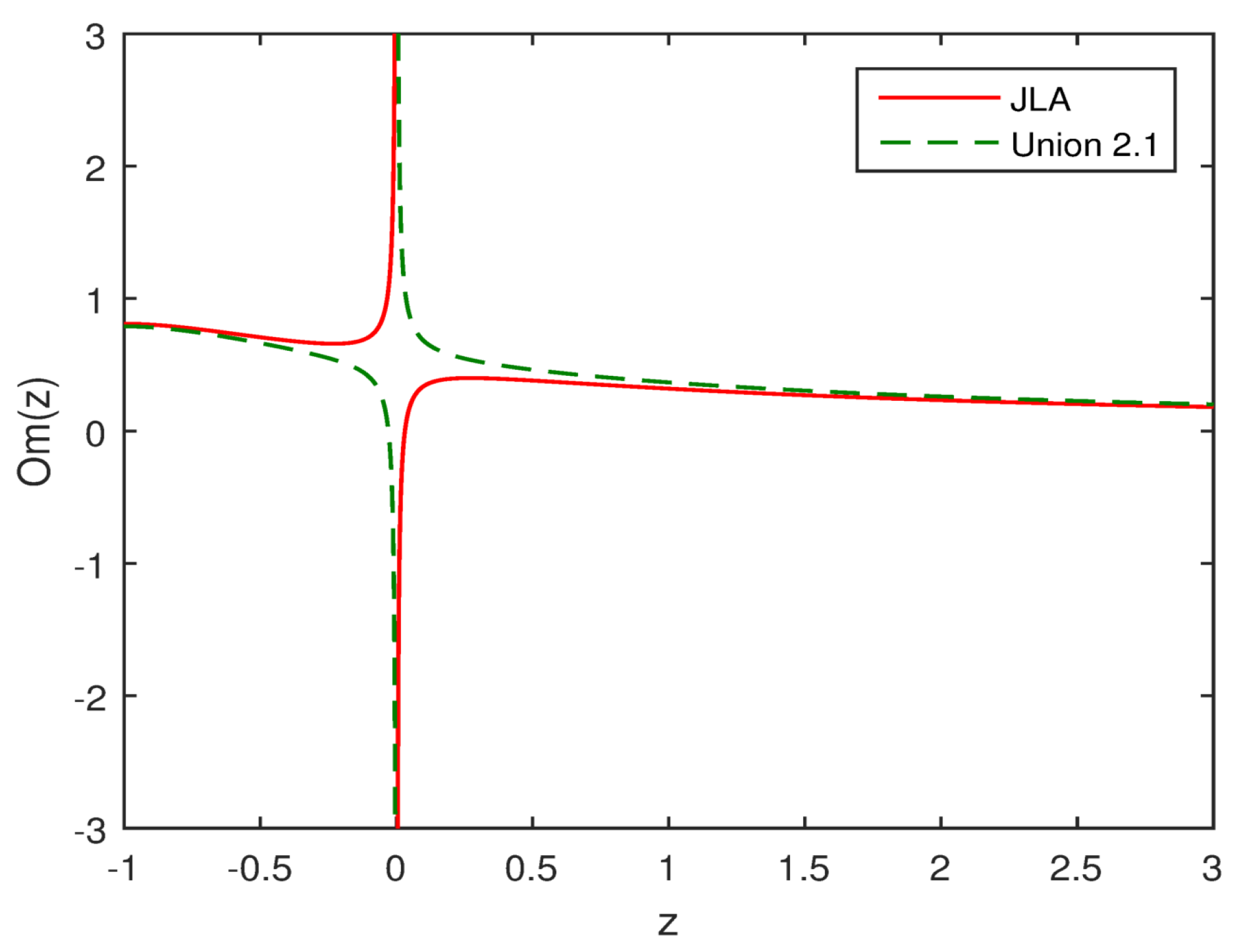
The diagnostic is a useful tool for categorizing different cosmic dark energy models [79]. Given that it only employs the first derivative of the cosmic scale factor, this diagnosis is precise to identify the quintessence and phantom evolution of the universe. For a spatially flat universe, is given by
where the Hubble parameter’s current value is . A positive slope of corresponds to the phantom evolution of dark energy, while a negative slope denotes the quintessence kind of evolution for the dark energy. The CDM model is represented by the constant .
In Figure 9, we found that the diagnostic parameter has a negative slope across a restricted set of values for the model parameter. Therefore, from the diagnostic test, we can conclude that the cosmological model represents quintessential behavior.
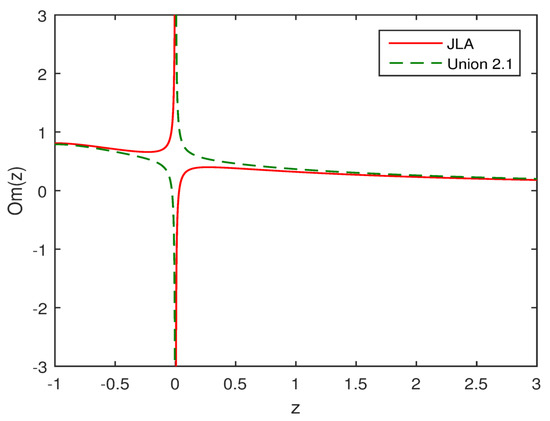
Figure 9.
Behavior of diagnostics in our derived model.
6. Concluding Remarks
In this study, we have found a transit phase (decelerating to accelerating) cosmological model in the modified -gravity theory. We have investigated anisotropic scenarios of the expanding universe with viscous fluid. We solved field equations and found an exact solution for the scale factor. The main features of our model, which we observed, are as follows:
- In the model, the average scale factor is obtained by solving the field equations, and it depends on the values of model parameters .
- We estimated the present values of Hubble parameter as ≈70 Km s/Mpc and deceleration parameter as , which is supported by the recent observations [14,76,77].
- The derived model represents an accelerating universe evolution which has been transited from the decelerating phase.
- We have found the present value of EoS parameter for bulk-viscous fluid and it varies over positive to negative, which indicates the existence of dark energy in the late-time universe of the model.
- The skewness parameter for bulk-viscous fluid tends to zero, which is consistent with skewness property.
- According to our calculations, the universe is currently ≈13.6 Gyrs old, which is supported by recent observations [14,76,77].
- We have found the bulk viscous coefficient as a decreasing function of cosmic time t, which may be a dark energy candidate.
- The model has a singularity at , since it is found that .
- The value of energy density as reveals the Big-Bang singularity in the model.
- The analysis of the statefinder parameters indicate that the derived model tends to the CDM model as .
- In the diagnostic analysis of our model, we have found that the universe in the derived model will have the quintessence-like dark energy at the late times.
The present derived universe model evolves with a natural scale factor and reveals different physical and geometrical quantities compatible with observations. These results may be interesting for the researchers working in this field.
Author Contributions
Conceptualization, A.P. and A.D.; writing-original draft preparation, A.P. and D.C.M.; methodology, A.P. and A.D.; writing—review and editing, A.P. and D.C.M.; Investigation, A.D.; data curation, A.D. and D.C.M.; supervision, A.P.; project administration, D.C.M.; formal analysis, A.P. All authors have read and agreed to the published version of the manuscript.
Funding
This research received no external funding.
Institutional Review Board Statement
Not applicable.
Informed Consent Statement
Not applicable.
Data Availability Statement
Not applicable.
Acknowledgments
A. Pradhan and A. Dixit thank the IUCAA, Pune, India for providing facilities under associateship programs. The reviewers’ and editor’s insightful comments have greatly enhanced our work in terms of the depth of the study and the clarity of its presentation, and the authors are thankful. The authors also thank Ashutosh Singh for his fruitful suggestions.
Conflicts of Interest
The authors declare no conflict of interest.
References
- Totani, T.; Yoshii, Y.; Sato, K. Evolution of the luminosity density in the universe: Implications for the nonzero cosmological constant. Astrophys. J. 1997, 483, L75. [Google Scholar] [CrossRef][Green Version]
- Meng, X.H.; Wang, P. Modified Friedmann equations in R-1-modified gravity. Class. Quant. Grav. 2003, 20, 4949. [Google Scholar] [CrossRef]
- Wang, P.; Meng, X.H. Can vacuum decay in our universe? Class. Quant. Grav. 2005, 22, 283. [Google Scholar] [CrossRef]
- Perlmutter, S.; Gabi, S.; Goldhaber, G.; Goobar, A.; Groom, D.E.; Hook, I.M.; Kim, A.G.; Kim, M.Y.; Lee, J.C.; Pain, R.; et al. Measurements* of the Cosmological Parameters Ω and Λ from the First Seven Supernovae at z ≥ 0.35. Astrophys. J. 1997, 483, 565. [Google Scholar] [CrossRef]
- Perlmutter, S.; Aldering, G.; Valle, M.D.; Deustua, S.; Ellis, R.S.; Fabbro, S.; Fruchter, A.; Goldhaber, G.; Groom, D.E.; Hook, I.M.; et al. Discovery of a supernova explosion at half the age of the Universe. Nature 1998, 391, 51–54. [Google Scholar] [CrossRef]
- Spergel, D.N.; Verde, L.; Peiris, H.V.; Komatsu, E.; Nolta, M.R.; Bennett, C.L.; Halpern, M.; Hinshaw, G.; Jarosik, N.; Kogut, A.; et al. First year Wilkinson Microwave Anisotropy Probe (WMAP) observations: Determination of cosmological parameters. Astrophys. J. Suppl. 2003, 148, 175–194. [Google Scholar] [CrossRef]
- Verde, L.; Heavens, A.F.; Percival, W.J.; Matarrese, S.; Baugh, C.M.; Bland-Hawthorn, J.; Bridges, T.; Cannon, R.; Cole, S.; Colless, M.; et al. The 2dF Galaxy Redshift Survey: The bias of galaxies and the density of the Universe. Mon. Not. R. Astron. Soc. 2002, 335, 432–440. [Google Scholar] [CrossRef]
- Hinshaw, G.; Weiland, J.L.; Hill, R.S.; Odegard, N.; Larson, D.; Bennett, C.L.; Dunkley, J.; Gold, B.; Greason, M.R.; Jarosik, N.; et al. Five-year wilkinson microwave anisotropy probe* observations: Data processing, sky maps, and basic results. Astrophys. J. Suppl. 2009, 180, 225–245. [Google Scholar] [CrossRef]
- Zlatev, I.; Wang, L.; Steinhardt, S. Quintessence, cosmic coincidence, and the cosmological constant. Phys. Rev. Lett. 1999, 82, 896–899. [Google Scholar] [CrossRef]
- Steinhardt, S.; Wang, L.; Zlatev, I. Cosmological tracking solutions. Phys. Rev. D 1999, 59, 123504. [Google Scholar] [CrossRef]
- Caldwell, R.; Kamionkowski, M.; Weinberg, N. Phantom energy: Dark energy with ω<-1 causes a cosmic doomsday. Phys. Rev. Lett. 2003, 91, 071301. [Google Scholar] [PubMed]
- Hassan, Z.; Mandal, S.; Sahoo, P.K. Traversable wormhole geometries in gravity. Fortschr. Phys. 2021, 69, 2100023. [Google Scholar] [CrossRef]
- Hinshaw, G.; Larson, D.; Komatsu, E.; Spergel, D.N.; Bennett, C.; Dunkley, J.; Nolta, M.R.; Halpern, M.; Hill, R.S.; Odegard, N.; et al. Nine-year Wilkinson Microwave Anisotropy Probe (WMAP) observations: Cosmological parameter results. Astrophys. J. Suppl. Ser. 2013, 208, 19. [Google Scholar] [CrossRef]
- Ade, P.A.; Aghanim, N.; Arnaud, M.; Ashdown, M.; Aumont, J.; Baccigalupi, C.; Banday, A.J.; Barreiro, R.B.; Bartlett, J.G.; Bartolo, N.; et al. Planck 2015 results XIII. Cosmological parameters. Astron. Astrophys. 2016, 594, A13. [Google Scholar]
- Cao, W.; Liu, W.; Wu, X. Integrability of Kerr-Newman spacetime with cloud strings, quintessence and electromagnetic field. Phys. Rev. D 2022, 105, 124039. [Google Scholar] [CrossRef]
- Wu, X. A new interpretation of zero Lyapunov exponents in BKL time for Mixmaster cosmology. Res. Astron. Astrophys. 2010, 10, 211. [Google Scholar] [CrossRef]
- Ma, D.Z.; Wu, X.; Zhong, S.Y. Effects of the cosmological constant on chaos in an FRW scalar field universe. Res. Astron. Astrophys. 2009, 9, 1185. [Google Scholar] [CrossRef]
- Hawking, S.W. Particle creation by black holes. Comm. Math. Phys. 1975, 43, 199. [Google Scholar] [CrossRef]
- Hooft, G.T. Dimensional reduction in quantum gravity. arXiv 1993, arXiv:gr-qc/9310026. [Google Scholar]
- Li, M. A model of holographic dark energy. Phys. Lett. B 2004, 603, 1. [Google Scholar] [CrossRef]
- Eckart, C. The thermodynamics of irreversible processes. III. Relativistic theory of the simple fluid. Phys. Rev. 1940, 58, 919. [Google Scholar] [CrossRef]
- Landau, L.D.; Lifshitz, E.M. Fluid Mechanics; Butterworth Heinemann: New York, NY, USA, 1987. [Google Scholar]
- Israel, W. Nonstationary irreversible thermodynamics: A causal relativistic theory. Ann. Phys. 1976, 100, 310. [Google Scholar] [CrossRef]
- Israel, W.; Stewart, J.M. Thermodynamics of nonstationary and transient effects in a relativistic gas. Phys. Lett. 1976, 58, 213. [Google Scholar] [CrossRef]
- Murphy, G.L. Big-bang model without singularities. Phys. Rev. D 1973, 8, 4231. [Google Scholar] [CrossRef]
- Huang, W.H. Bianchi type I cosmological model with bulk viscosity. Phys. Lett. A 1998, 129, 429. [Google Scholar] [CrossRef]
- Jimenez, J.B.; Heisenberg, L.; Koivisto, T. Coincident general relativity. Phys. Rev. D 2018, 98, 044048. [Google Scholar] [CrossRef]
- Lazkoz, R.; Lobo, F.S.; Ortiz-Banos, M.; Salzano, V. Observational constraints of f(Q) gravity. Phys. Rev. D 2019, 100, 104027. [Google Scholar] [CrossRef]
- Mandal, S.; Sahoo, P.K.; Santos, J.R.L. Energy conditions in f(Q) gravity. Phys. Rev. D 2020, 102, 024057. [Google Scholar] [CrossRef]
- Koussour, M.; Shekh, S.H.; Bennai, M. Anisotropic nature of space-time in f(Q) gravity. Phys. Dark Univ. 2022, 36, 101051. [Google Scholar] [CrossRef]
- Mandal, S.; Wang, D.; Sahoo, P.K. Cosmography in f(Q) gravity. Phys. Rev. D 2020, 102, 124029. [Google Scholar] [CrossRef]
- Harko, T.; Koivisto, T.S.; Lobo, F.S.; Olmo, G.J.; Rubiera-Garcia, D. Coupling matter in modified Q gravity. Phys. Rev. D 2018, 98, 084043. [Google Scholar] [CrossRef]
- Dimakis, N.; Paliathanasis, A.; Christodoulakis, T. Quantum cosmology in f(Q) theory. Class. Quantum Grav. 2021, 38, 225003. [Google Scholar] [CrossRef]
- Koussour, M.; Pacif, S.K.J.; Bennai, M.; Sahoo, P.K. Dynamical dark energy models from a new Hubble parameter in f(Q) gravity. J. High Ener. Astrophys. 2022, 35, 43–51. [Google Scholar] [CrossRef]
- Jimenez, J.B.; Heisenberg, L.; Koivisto, T.; Pekar, S. Cosmology in f(Q) geometry. Phys. Rev. D 2020, 101, 103507. [Google Scholar] [CrossRef]
- Khyllep, W.; Paliathanasis, A.; Dutta, J. Cosmological solutions and growth index of matter perturbations in f(Q) gravity. Phys. Rev. D 2021, 103, 103521. [Google Scholar] [CrossRef]
- Barrow, J.D. The deflationary universe: An instability of the de Sitter universe. Phys. Lett. B 1987, 180, 335. [Google Scholar] [CrossRef]
- Brevik, I.; Odintsov, S.D. Cardy-Verlinde entropy formula in viscous cosmology. Phys. Rev. D 2002, 65, 067302. [Google Scholar] [CrossRef]
- Liu, D.J.; Li, X.Z. Dynamics of quintessence with thermal interactions. Phys. Lett. B 2005, 611, 8. [Google Scholar] [CrossRef]
- Fabris, J.C.; Goncalves, S.V.B.; de Sa Ribeiro, R. Bulk viscosity driving the acceleration of the universe. Gen. Relat. Gravit. 2006, 38, 495. [Google Scholar] [CrossRef]
- Li, B.; Barrow, J.D. Does bulk viscosity create a viable unified dark matter model? Phys. Rev. D 2009, 79, 103521. [Google Scholar] [CrossRef]
- Hipolito-Ricaldi, W.S.; Velten, H.E.S.; Zimdahl, W. Viscous dark fluid universe. Phys. Rev. D 2010, 82, 063507. [Google Scholar] [CrossRef]
- Avelino, A.; Nucamendi, U. Can a matter-dominated model with constant bulk viscosity drive the accelerated expansion of the universe? JCAP 2009, 2009, 006. [Google Scholar] [CrossRef]
- Avelino, A.; Nucamendi, U. Exploring a matter-dominated model with bulk viscosity to drive the accelerated expansion of the universe. JCAP 2010, 2010, 009. [Google Scholar] [CrossRef]
- Hassan, Z.; Mustafa, G.; Sahoo, P.K. Wormhole solutions in symmetric teleparallel gravity with noncommutative geometry. Symmetry 2021, 13, 1260. [Google Scholar] [CrossRef]
- Brevik, I.; Normann, B.D. Remarks on cosmological bulk viscosity in different epochs. Symmetry 2020, 12, 1085. [Google Scholar] [CrossRef]
- Cruz, N.; Gonzalez, E.; Jovel, J. Study of a viscous ΛWDM model: Non-equilibrium condition, entropy production, and cosmological constraints. Symmetry 2022, 14, 1866. [Google Scholar] [CrossRef]
- Singh, A.; Chaubey, R. Unified and bouncing cosmologies with inhomogeneous viscous fluid. Astrophys. Space Sci. 2021, 366, 15. [Google Scholar] [CrossRef]
- Raushan, R.; Singh, A.; Chaubey, R.; Singh, T. Universe with quadratic equation of state: A dynamical systems perspective. Int. J. Geom. Methods Mod. Phys. 2020, 17, 2050064. [Google Scholar] [CrossRef]
- Sharma, U.K.; Shweta; Mishra, A.K. Traversable wormhole solutions with non-exotic fluid in framework of f(Q) gravity. Int. J. Geom. Methods Mod. Phys. 2022, 19, 2250019. [Google Scholar] [CrossRef]
- Zimdahl, W.; Schwarz, D.J.; Balakin, A.B.; Pavon, D. Cosmic antifriction and accelerated expansion. Phys. Rev. D 2001, 64, 063501. [Google Scholar] [CrossRef]
- Zia, R.; Maurya, D.C.; Shukla, A.K. Transit cosmological models in modified f(Q,T) gravity. Int. J. Geom. Methods Mod. Phys. 2021, 18, 2150051. [Google Scholar] [CrossRef]
- Godani, N.; Samanta, G.C. FRW cosmology in f(Q,T) gravity. Int. J. Geom. Methods Mod. Phys. 2021, 18, 2150134. [Google Scholar] [CrossRef]
- Pradhan, A.; Maurya, D.C.; Dixit, A. Dark energy nature of viscus universe in f(R)-gravity with observational constraints. Int. J. Geom. Methods Mod. Phys. 2021, 18, 2150124. [Google Scholar] [CrossRef]
- Capozziello, S.; D’Agostino, R. Model-independent reconstruction of f(Q)non-metric gravity. Phys. Lett. B 2022, 832, 137229. [Google Scholar] [CrossRef]
- Koussour, M.; Shekh, S.H.; Bennai, M. Anisotropic f(Q) gravity model with bulk viscosity. arXiv 2022, arXiv:2203.10954. [Google Scholar]
- Maurya, D.C. Accelerating Scenarios of Viscus Fluid Universe in Modified f(T) Gravity. Int. J. Geom. Methods Mod. Phys. 2022, 19, 2250144. [Google Scholar] [CrossRef]
- Dixit, A.; Maurya, D.C.; Pradhan, A. Phantom dark energy nature of bulk-viscosity universe in modified f(Q)-gravity. Int. J. Geom. Methods Mod. Phys. 2022, 19, 2250198. [Google Scholar] [CrossRef]
- Xu, Y.; Li, G.; Harko, T.; Liang, S.D. f(Q,T) gravity. Eur. Phys. J. C 2019, 79, 1–19. [Google Scholar] [CrossRef]
- Thorne, K.S. Primordial element formation, primordial magnetic fields, and the isotropy of the universe. Astrophys. J. 1967, 148, 51. [Google Scholar] [CrossRef]
- Kantowski, R.; Sachs, R.K. Some spatially homogeneous anisotropic relativistic cosmological models. J. Math. Phys. 1966, 7, 433. [Google Scholar] [CrossRef]
- Kristian, J.; Sachs, R.K. Observations in cosmology. Astrophys. J. 1966, 143, 379. [Google Scholar] [CrossRef]
- Collins, C.B.; Glass, E.N.; Wilkinson, D.A. Exact spatially homogeneous cosmologies. Gen. Rel. Grav. 1980, 12, 805. [Google Scholar] [CrossRef]
- Misner, C.W.; Thorne, K.S.; Wheeler, J.A. Gravitation; W.H. Freemann and Company: San Francisco, CA, USA, 1973. [Google Scholar]
- Brevik, I.; Gron, O.; de Haro, J.; Odintsov, S.D.; Saridakis, E.N. Viscous cosmology for early-and late-time universe. Int. J. Mod. Phys. D 2017, 26, 1730024. [Google Scholar] [CrossRef]
- Capozziello, S.; Cardone, V.F.; Elizalde, E.; Nojiri, S.I.; Odintsov, S.D. Observational constraints on dark energy with generalized equations of state. Phys. Rev. D 2006, 73, 043212. [Google Scholar] [CrossRef]
- Nojiri, S.; Odintsov, S.D. Properties of singularities in the (phantom) dark energy universe. Phys. Rev. D 2005, 72, 023003. [Google Scholar] [CrossRef]
- Meng, X.H.; Dou, X. Singularities and entropy in bulk viscosity dark energy model. Commun. Theor. Phys. 2009, 52, 377. [Google Scholar] [CrossRef]
- Meng, X.H.; Ren, J.; Gaung, H.M. Friedmann cosmology with a generalized equation of state and bulk viscosity. Commun. Theor. Phys. 2007, 47, 379. [Google Scholar]
- Kumar, P.; Singh, C.P. New agegraphic dark energy model in Brans-Dicke theory with logarithmic form of scalar field. Astrophys. Space Sci. 2017, 362, 52. [Google Scholar] [CrossRef]
- Normann, B.D.; Brevik, I. Characteristic properties of two different viscous cosmology models for the future universe. Mod. Phys. Lett. A 2017, 32, 1750026. [Google Scholar] [CrossRef]
- Capozziello, S.; D’Agostino, R.; Luongo, O. Extended Gravity Cosmography. Int. J. Mod. Phys. D 2019, 28, 1930016. [Google Scholar] [CrossRef]
- Betoule, M.E.A.; Kessler, R.; Guy, J.; Mosher, J.; Hardin, D.; Biswas, R.; Astier, P.; El-Hage, P.; Konig, M.; Kuhlmann, S.; et al. Improved cosmological constraints from a joint analysis of the SDSS-II and SNLS supernova samples. Astron. Astrophys. 2014, 568, A22. [Google Scholar] [CrossRef]
- Suzuki, N.; Rubin, D.; Lidman, C.; Aldering, G.; Amanullah, R.; Barbary, K.; Barrientos, L.F.; Botyanszki, J.; Brodwin, M.; Connolly, N.; et al. The Hubble space telescope cluster supernova survey. V. Improving the dark-energy constraints above z > 1 and building an early-type-hosted supernova sample. Astrophys. J. 2012, 746, 85. [Google Scholar] [CrossRef]
- Riess, A.G.; Macri, L.M.; Hoffmann, S.L.; Scolnic, D.; Casertano, S.; Filippenko, A.V.; Tucker, B.E.; Reid, M.J.; Jones, D.O.; Silverman, J.M.; et al. A 2.4% determination of the local value of the Hubble constant. Astrophys. J. 2016, 826, 56. [Google Scholar] [CrossRef]
- Sahni, V.; Saini, T.D.; Starobinsky, A.A.; Alam, U. Statefinder-new geometrical diagnostic of dark energy. JETP Lett. 2003, 77, 201. [Google Scholar] [CrossRef]
- Alam, U.; Sahni, V.; Deep Saini, T.; Starobinsky, A.A. Exploring the expanding universe and dark energy using the Statefinder diagnostic. Mon. Not. R. Astron. Soc. 2003, 344, 1057–1074. [Google Scholar] [CrossRef]
- Sami, M.; Shahalam, M.; Skugoreva, M.; Toporensky, A. Cosmological dynamics of a nonminimally coupled scalar field system and its late time cosmic relevance. Phys. Rev. D 2012, 86, 103532. [Google Scholar] [CrossRef]
- Sahni, V.; Shafieloo, A.; Starobinsky, A.A. Two new diagnostics of dark energy. Phys. Rev. D 2008, 78, 103502. [Google Scholar] [CrossRef]
Publisher’s Note: MDPI stays neutral with regard to jurisdictional claims in published maps and institutional affiliations. |
© 2022 by the authors. Licensee MDPI, Basel, Switzerland. This article is an open access article distributed under the terms and conditions of the Creative Commons Attribution (CC BY) license (https://creativecommons.org/licenses/by/4.0/).