


Abstract
The article provides an -cut-based method that solves linear fractional programming problems with fuzzy variables and unrestricted parameters. The parameters and variables are considered as asymmetric triangular fuzzy numbers, which is a generalization of the symmetric case. The problem is solved by using -cut of fuzzy numbers wherein the - and r-cut are applied to the objective function and constraints, respectively. This reduces the problem into an equivalent biobjective model which leads to the upper and lower bounds of the given problem. Afterwards, the membership functions corresponding to various values of are obtained using the optimal values of the biobjective model. The proposed method is illustrated by taking an example from the literature to highlight the fallacy of an existing approach. Finally, a fuzzy linear fractional transportation problem is modelled and solved using the aforementioned technique.
1. Introduction
Linear programming problems (LPPs) are a significant type of optimization problems. These LPPs are used to solve various real-world problems such as production planning, hospital management, transportation problems, diet planning, profit maximization, resource management, etc. Linear fractional programming problems (LFPPs) are LPPs where the objective function is a ratio between two linear functions. Such LFPPs are widely used in economic and commercial models to maximize profit and minimize cost, simultaneously. In the literature, out of several ways to deal with LFPPs, some methods are analytical while some are numerical.
In a significant development, Charnes and Cooper [1] solved LFPPs by using an analytical variable transformation method that reduced the problem into LPPs with some added constraints. Tantawy [2] considered an iterative method to find an optimal solution by sequentially moving from an initial interior point to another feasible solution until the optimal solution is reached. Meanwhile, Chadha and Chadha [3] proved some results regarding the dual of an LFPP and expressed the dual to be an LPP, which was further solved to get a solution to the initial problem. Later, Rizk-Allah et al. [4] provided a new algorithm for linear and nonlinear fractional programming problems, viz., chaotic crow search algorithm. In addition to these, there are various methods based on the simplex approach to find solutions of LFPPs. Sharma and Bansal [5] used the branch-and-bound process along with the simplex technique to solve LFPPs. Next, Pandey and Punnen [6] generalized and extended existing simplex algorithms.
LFPPs can be used to frame many real-world problems, but in most cases, the data provided to the decision-maker are not clearly defined and precise. Generally, there is some form of uncertainty associated with the data. These uncertainties can be overcome by incorporating the fuzzy sense introduced by Zadeh [7] in the parameters, constraints or variables. Nowadays, fuzzy linear fractional programming problems (FLFPPs) are used instead of LFPPs to cater to real-world scenarios. Over time, a number of different techniques have been explored by researchers to solve FLFPPs. Hladík [8] and Borza et al. [9] studied generalized LFPPs with interval uncertainties. Later, Pandian and Jayalakshmi [10] solved LFPPs by a denominator restriction method, which further extended to a decomposition restriction method that solved the FLFPP by converting the problem into three crisp-level LFPPs. Further, Das and Mandal [11] as well as Das et al. [12] converted FLFPPs into crisp multiobjective LFPPs, which were then solved to obtain a solution. In one of their studies, Sharma et al. [13] considered multiobjective fractional programming problems for fixed aspiration levels using symmetric fuzzy parameters. Dutta et al. [14,15] worked on the sensitivity of FLFPPs and also investigated the impact of tolerance on both LFPPs and FLFPPs. Recently, Borza and Rambely [16] solved the FLFPPs with crisp variables and coefficients as TFNs by using a combination of the max-min method and an -cut-based approach.
Veeramani and Sumathi [17] suggested a method that converted the problem into a multiobjective LFPP and then solved it using the fuzzy programming approach. However, Mehra et al. [18] proposed the novel concept of -acceptable optimal solution of an FLFPP having fuzzy coefficients. Further, Das et al. [19] proposed a new ordering for TFNs and used this to reduce an FLFPP into a triobjective problem. Meanwhile, Chinnadurai and Muthukumar [20] considered an FLFPP with all parameters and variables as triangular fuzzy numbers (TFNs) and proposed an -cut-based numerical approach to solve the problem by converting it into an equivalent biobjective model. They erroneously claimed to propose a method for any general FLFPP. Subsequently, Ebrahimnejad et al. [21] worked on a similar numerical approach with non-negative trapezoidal fuzzy numbers. In the present study, a counterexample is cited, which shows that the approach in [20] can be used only when all the parameters are non-negative TFNs. Further, we have established the conditions for the proposed -cut-based method to solve the above-mentioned FLFPPs having unrestricted parameters, which overcomes the shortcoming in [20].
The rest of the paper is structured as follows: Section 2 is dedicated to notations, definitions and arithmetic operations, used throughout this paper. Section 3 describes the formulation of a standard FLFPP having asymmetric TFNs. In Section 4, the approach in [20] is presented along with a counterexample to highlight its shortcoming. The motivation for the new approach and the limitations of existing approaches are indicated in Section 5. Next, Section 6 explains the proposed approach. Later, a numerical illustration and a real-world application are worked out using the proposed method in Section 7. The results are discussed in Section 8. Finally, conclusions and future scope are addressed in Section 9.
2. Notations and Definitions
Some preliminary notations and definitions used in the article are presented in this section.
Definition 1
([20]). If X is a collection of objects denoted generically by x, then a fuzzy set in X is a set of ordered pairs: is called the membership function of which maps X to , and is called the membership degree of x in .
Definition 2
([20]). The (crisp) set of elements that belong to the fuzzy set at least to the degree is called the α-cut of and is defined as:
Definition 3
([22]). A fuzzy set in is said to be a fuzzy number if
- (i)
- such that
- (ii)
- , is a closed interval in , i.e., ;
- (iii)
- the set is a finite subset of
Arithmetic operations on closed intervals of
Let and be two closed intervals of ; we define:
- (i)
- (ii)
- (iii)
- (iv)
- where and
- (v)
- where and, provided .
Remark 1.
In particular, for ; ,
- (vi)
- iff and
Ordering of fuzzy numbers: [20]. The ordering of fuzzy numbers is defined as follows:
- (i)
- iff , i.e., and
- (ii)
- iff
Definition 4
([21]). A triangular fuzzy number (TFN) where is a fuzzy set in if its membership function is given by
For a TFN :
- (i)
- (ii)
- is a non-negative TFN iff , i.e., .
- (iii)
- is a positive TFN iff .Clearly
- (iv)
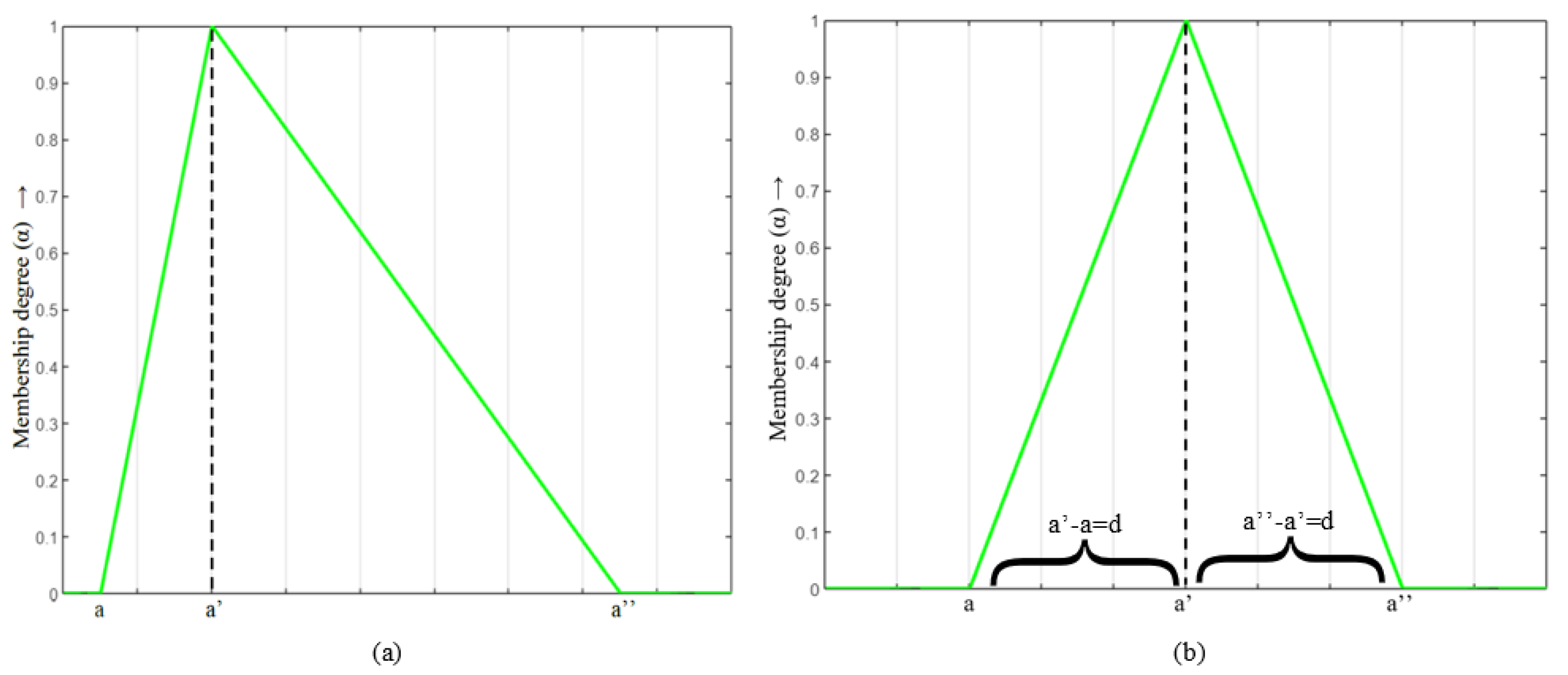
- When , it is said to be symmetric else asymmetric TFN(see Figure 1, [23]).
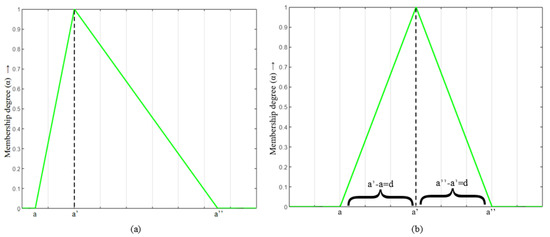 Figure 1. Triangular fuzzy numbers: (a) asymmetric TFN; (b) symmetric TFN.
Definition 5.
A fuzzy number is said to be a negative TFN if is not a non-negative TFN.
Let us denote the set of all TFNs in as . Further, let and be the collection of all non-negative and all positive TFNs, respectively, in . It follows that
Definition 6
([22]). Let be a fuzzy set defined on the universal set X. Then, for some is a fuzzy set defined on X as , where
Theorem 1
(First Decomposition Theorem [22]).
The first decomposition theorem states that any fuzzy set can be represented using its α-cut alone. Hence, to define arithmetic operations on TFNs, only the α-cut of the resulting fuzzy number is sufficient.
Arithmetic operations on α-cut of fuzzy numbers [20]:
Let and with α-cut and , respectively. Then, the fuzzy arithmetic operations between and using the α-cut are defined as follows:
- (i)
- (ii)
- (iii)
- Scalar multiplication:For any
- (iv)
- and
Remark 2.
Let , i.e., then
and
- (v)
- and, provided
Remark 3.
Let , then
3. Formulation of Fuzzy Linear Fractional Programming Problem
A standard FLFPP with asymmetric fuzzy parameters and variables is as follows:
Definition 7.
Let be a feasible solution of an FLFPP, then is said to be an optimal solution if for any other feasible solution
Definition 8.
Let S be the collection of all the feasible solutions of an FLFPP and
, clearly, .
Conventionally, we assume that for a given FLFPP.
Proposition 1.
If is an element of , then .
Proof.
For , consider , where
Given , it implies that
As as well, we have , which is equivalent to saying
Since and , after using interval arithmetic, the above fraction reduces as:
Using , we can conclude that
Hence, using the ordering of fuzzy numbers . □
Proposition 2.
If and an optimal solution of (M1) exists, then .
Proof.
Let, if possible, be an optimal solution of (M1). Further, to prove that , we can equivalently show that any feasible solution cannot be an optimal solution, provided .
Let an arbitrary . From Proposition 1, it follows that .
Then, , this yields
Similarly, .
As , then for some fixed , two cases arise as follows:
Case 1:.
The -cut of becomes
By using interval arithmetic, this further reduces to
From (3) and (4), we obtain,
This further yields
From (5), we obtain that such that does not hold, hence, by Definition 7 such cannot be an optimal solution.
Case 2:.
Observe that
This implies
From (3) and (6), clearly, we have
This implies that such that is invalid. Thus, by Definition 7, is not an optimal solution. Finally, we can see that cannot be an optimal solution, hence the result. □
4. Limitation of Chinnadurai and Muthukumar’s [20] Approach
In this section, the approach used by Chinnadurai and Muthukumar [20] is presented and a counterexample is framed to point out its limitation. The authors tackled the FLFPP by applying an - and r-cut on the objective function and constraints, respectively. Thereafter, the objective function in (M1) reduced into two subproblems as follows:
Lower bound:
subject to
Upper bound:
subject to
Counterexample
Consider the following FLFPP to highlight the error in [20].
subject to
Clearly, . Upon solving this problem for some fixed -cut by using the method in [20], we get the lower- and upper-bound objective functions as:
However, if we use the arithmetic operations as defined in Section 2, the lower- and upper-bound objectives are obtained as:
Observation 1: Model (A) obtained by using the approach in [20] is different from the model (B) which is derived by using the arithmetic operations mentioned in Section 2. The difference is highlighted in bold format. From models (A) and (B), we can observe that the error in the model (A) occurs due to negative coefficients. This shows that the approach in [20] is not in accordance with the fuzzy arithmetic operations and hence, erroneous. Thus, the reduced model will yield misleading results. This can also be seen by solving both models and then comparing the results as in Table 1 for a fixed and various values of .

Table 1.
using the approach in [20] vs. the proposed method.
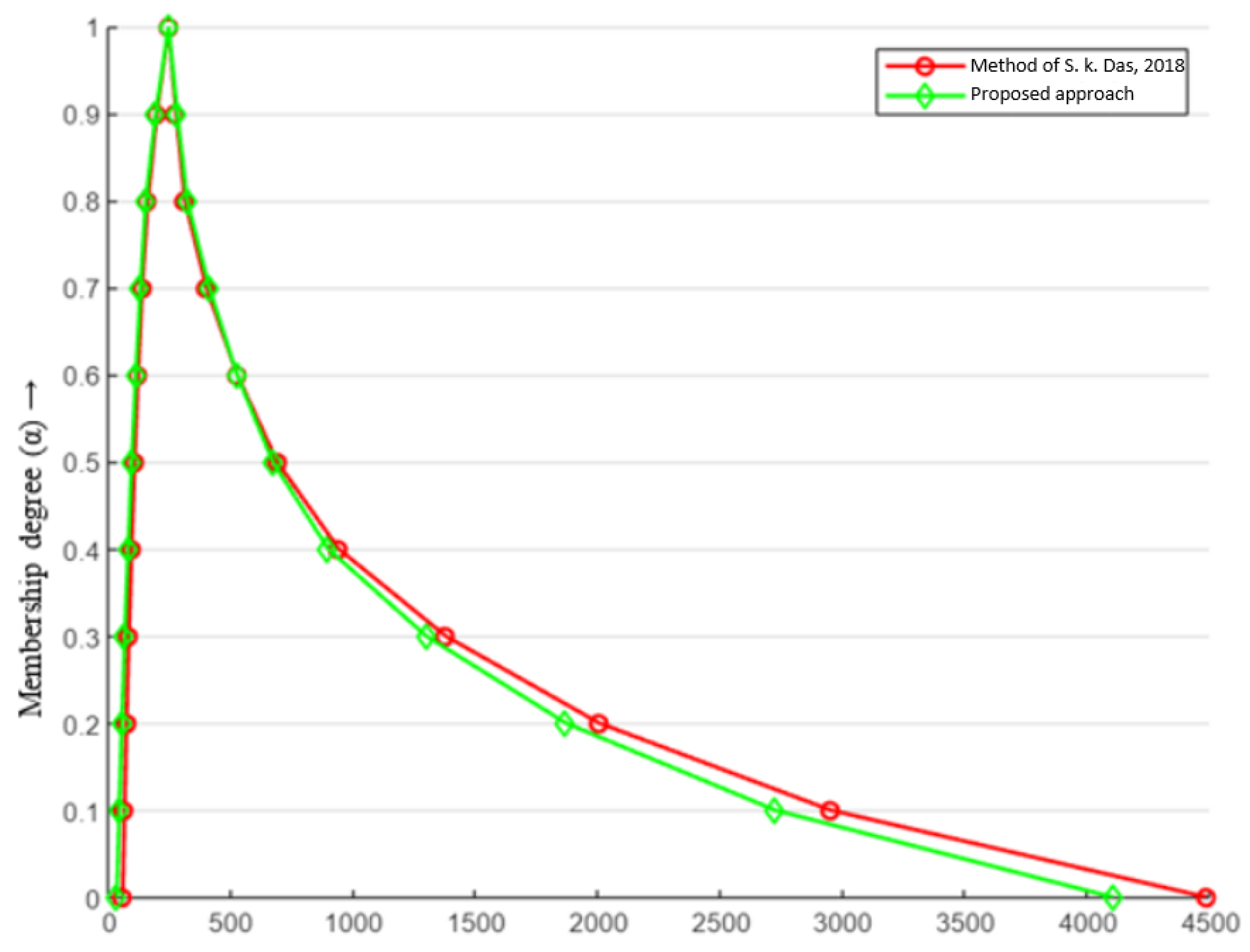
The optimal values of the lower- and upper-bound objectives for obtained using both approaches are shown graphically in Figure 2 for comparison. Hence, the approach used in [20] is not applicable when negative parameters are involved in the problem (M1).
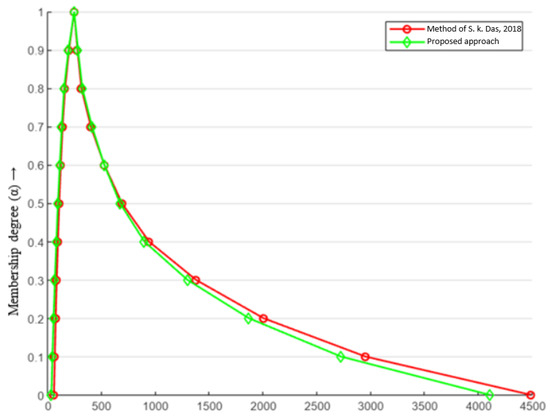
Figure 2.
Comparison of optimal values of (M) for both the approaches. The red line presents the method proposed in [19].
5. Shortcomings of Existing Models and Motivation for the Proposed Approach
In real-world situations, we may come across FLFPPs having negative parameters. Since the approach used in [20] has some inconsistencies, there is a need to obtain an extended method that is applicable to FLFPPs with negative parameters as well. The motivation behind this article was to find a generalized method which provides a solution to an FLFPP with asymmetric fuzzy parameters which are unrestricted in sign.
The shortcomings of existing approaches along with the advantages of the proposed approach are listed below in Table 2.
Table 2.
Comparison of proposed and existing approaches.
6. Proposed -Cut-Based Method
To solve (M1), we use α as the satisfaction level on the objective function but for each constraint, different levels of satisfaction can be applied. For simplicity’s sake, the same satisfaction level r is used for all the constraints, throughout this paper.
For some fixed α and , after applying α-cut on the objective function and r-cut on all the constraints, we get the resulting model as:
Since if an optimal solution exists, then by Proposition 2, . Hence, we need to solve the model for solutions in the set only. Therefore, to solve the model, we use the conditions of , given by and . This further implies that and . Using arithmetic operations for closed intervals, we obtain the following model:
where
subject to
The above problem is then split into two separate problems, viz.,
subject to all the constraints of (FLFPP).
subject to all the constraints of (FLFPP).
The variables are considered to be non-negative TFNs, while there are no restrictions on the parameters Therefore, after using Remark 2, both the bounds and the constraints are further reduced as follows:
Lower-bound objective:
where
subject to
Upper-bound objective:
where
subject to all the constraints of the (LB).
Remark 4.
The membership function of the given objective function for some fixed value of is obtained by plotting a graph between the intervals corresponding to . The proposed method works for any FLFPP irrespective of the nature of the parameters.
7. Illustrative Examples
In this section, an example from the literature and a real-world application in the transportation sector, having unrestricted parameters, are worked out to illustrate the proposed method.
Example 1
([20]). Consider the following FLFPP:
subject to
For some fixed values of , using the algorithm in Section 6, the lower-bound and upper-bound objectives of the problem are as follows:
Lower-bound objective:
subject to
Upper-bound objective:
Substituting values of all -cut, the bounds are rewritten as:
Lower-bound objective:
subject to
Upper-bound objective:
subject to all the constraints of (LB1-1).
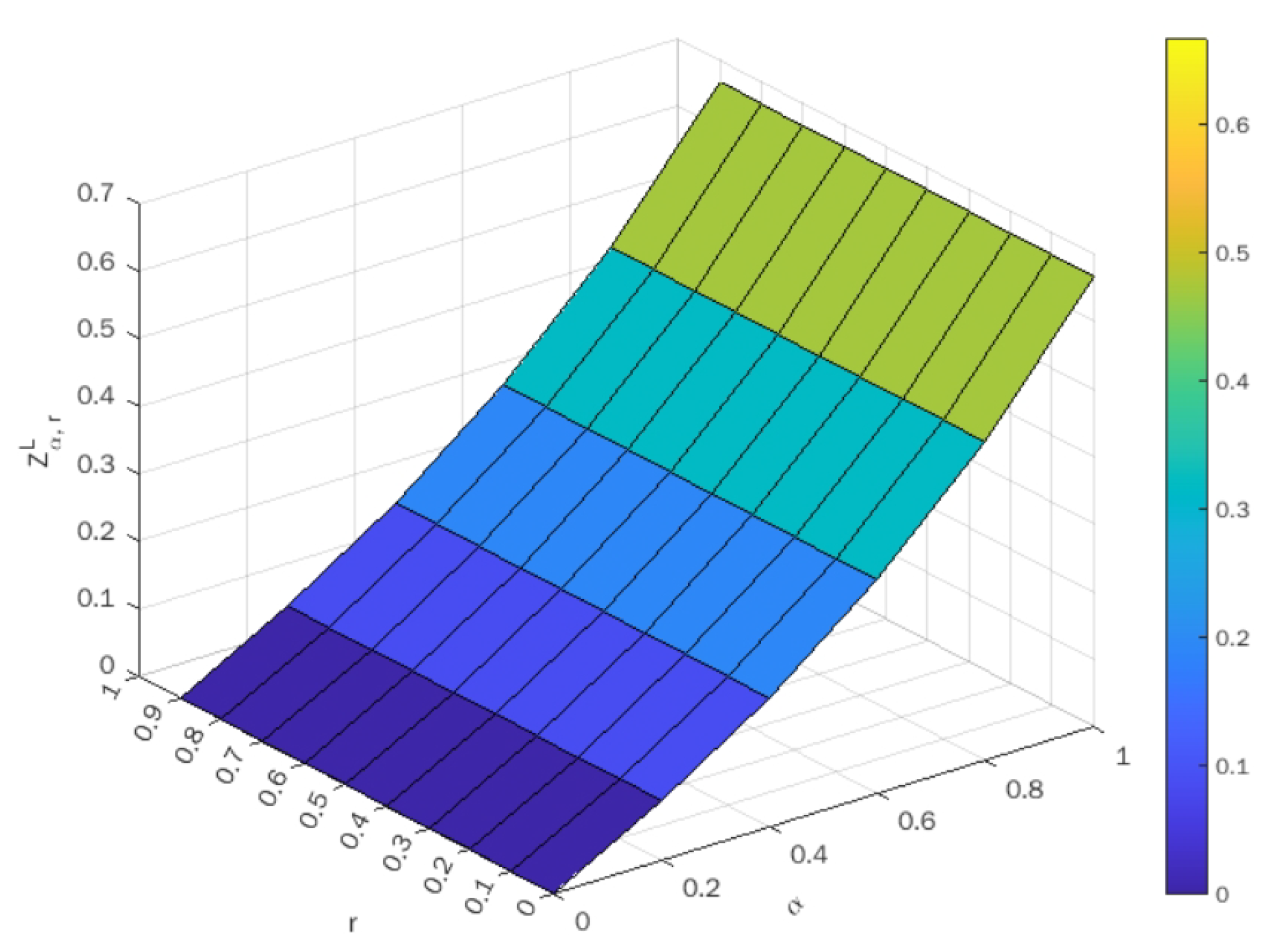
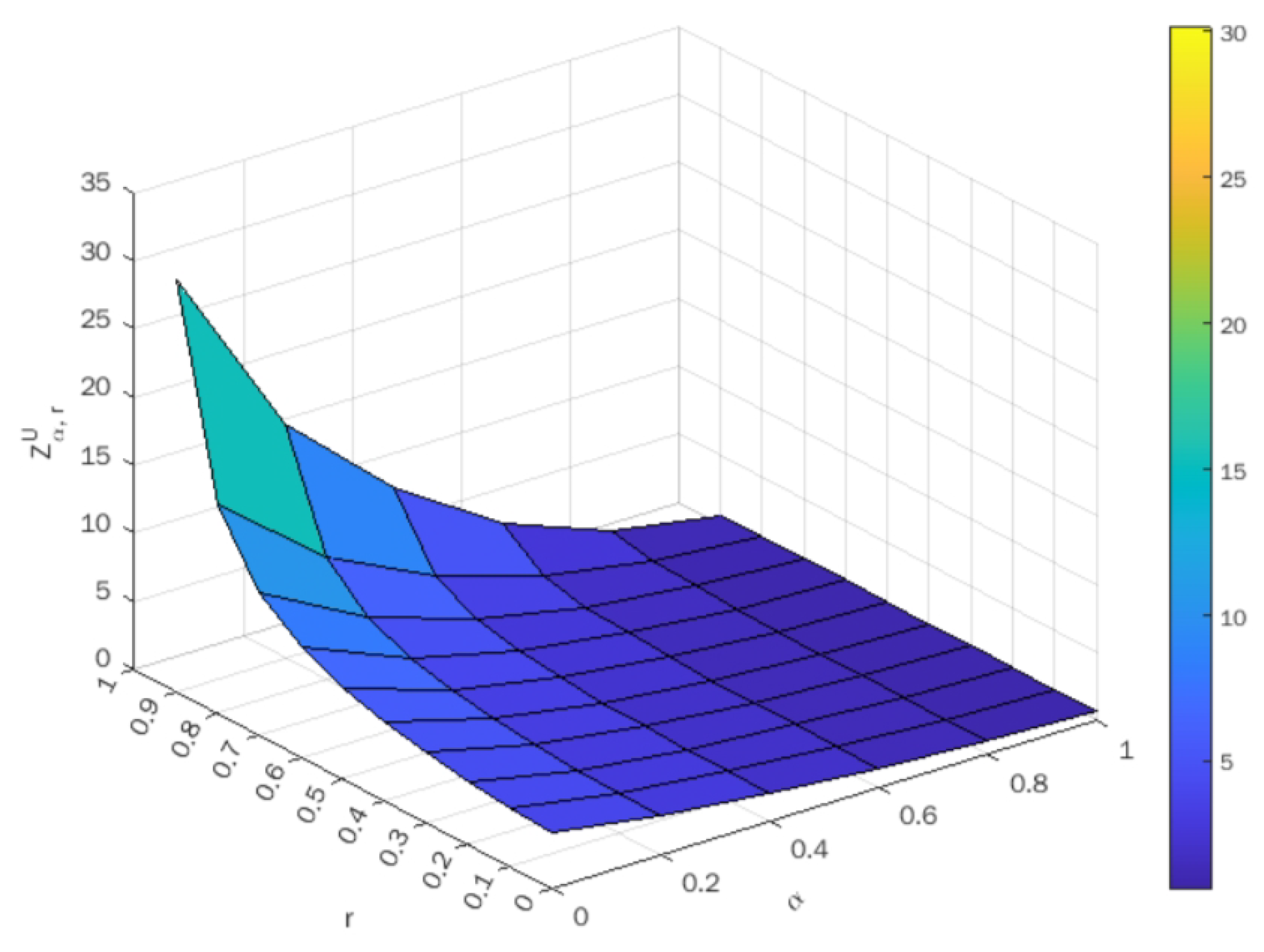
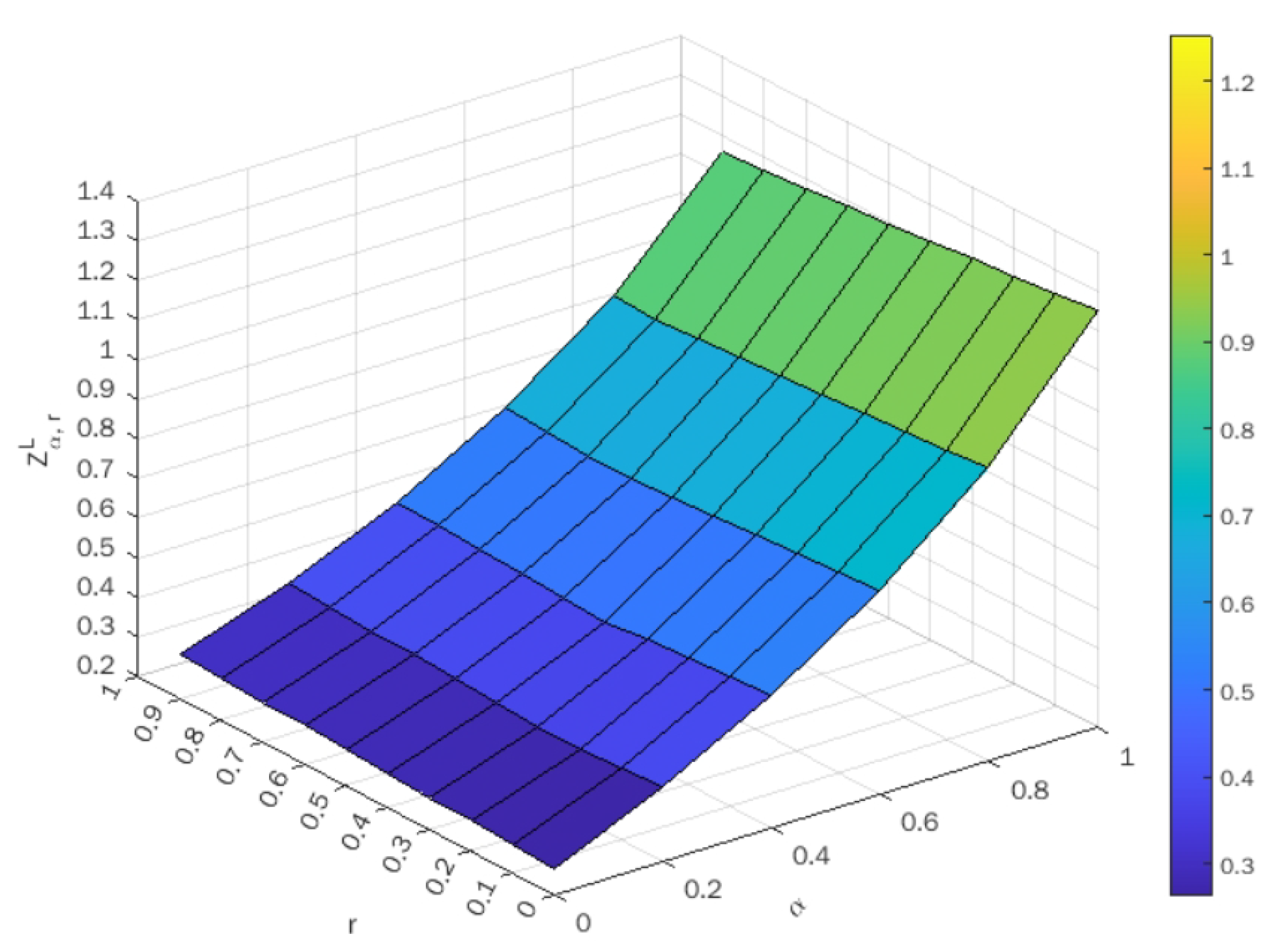
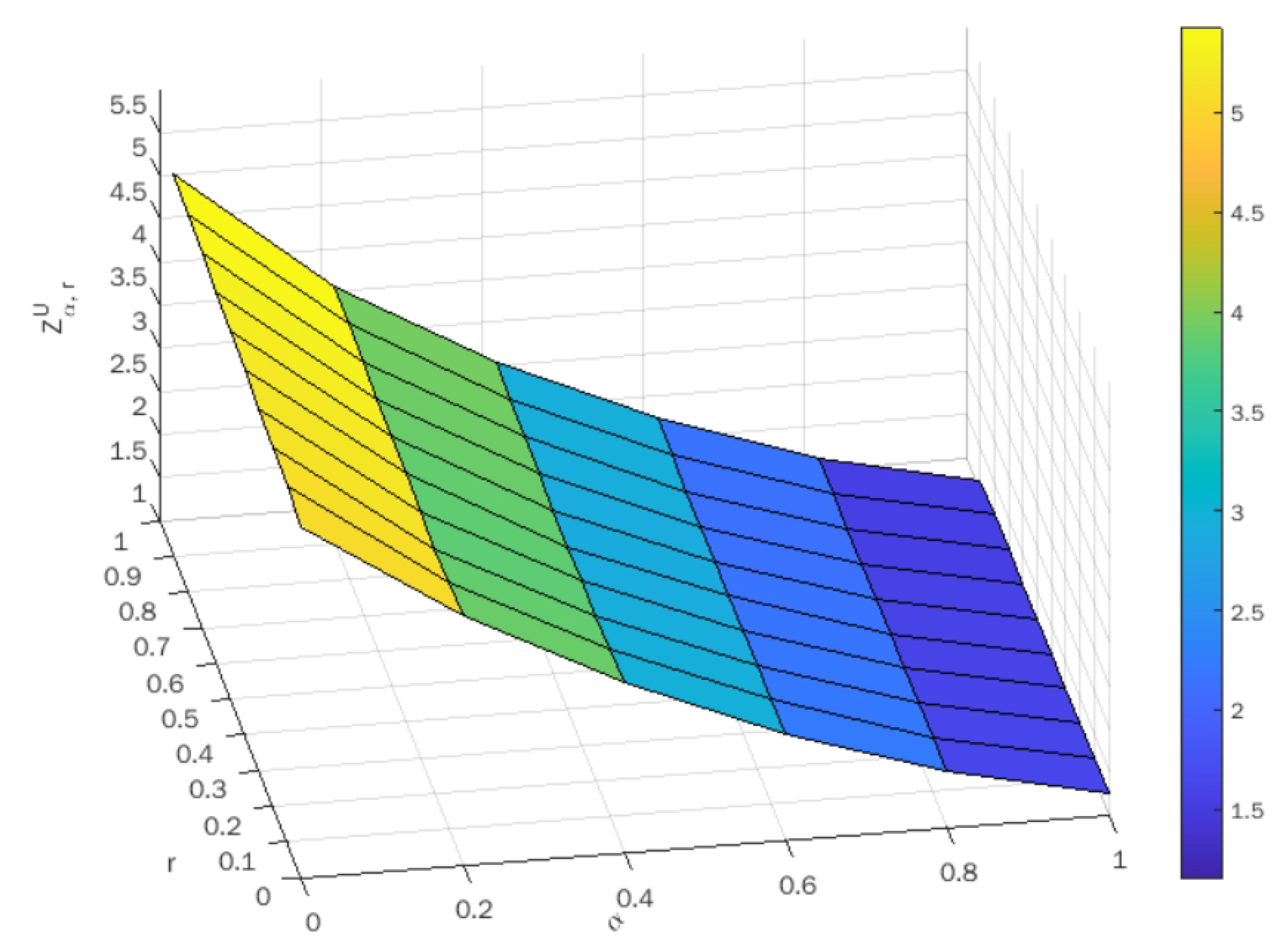
Upon taking different values of , the optimal value of both the lower-bound and upper-bound objectives are indicated in Table 3 and Table 4, respectively. Using these tables, the surface plots of objective values against are shown in Figure 3 and Figure 4 for the lower-bound and upper-bound objectives, respectively.
Table 3.
Optimal values of the objective function .
Table 4.
Optimal values of the objective function .
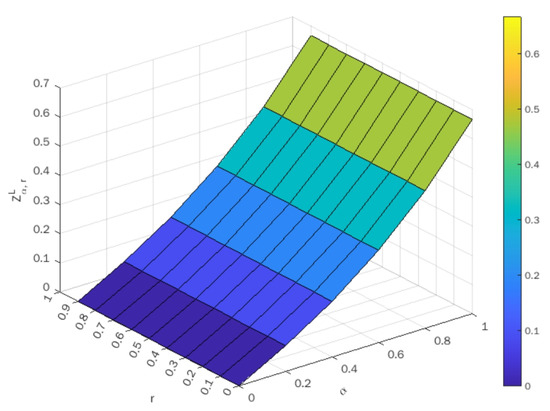
Figure 3.
Surface plot of optimal values corresponding to .
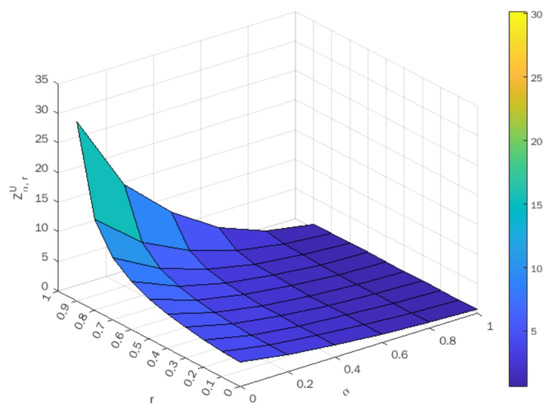
Figure 4.
Surface plot of optimal values corresponding to .
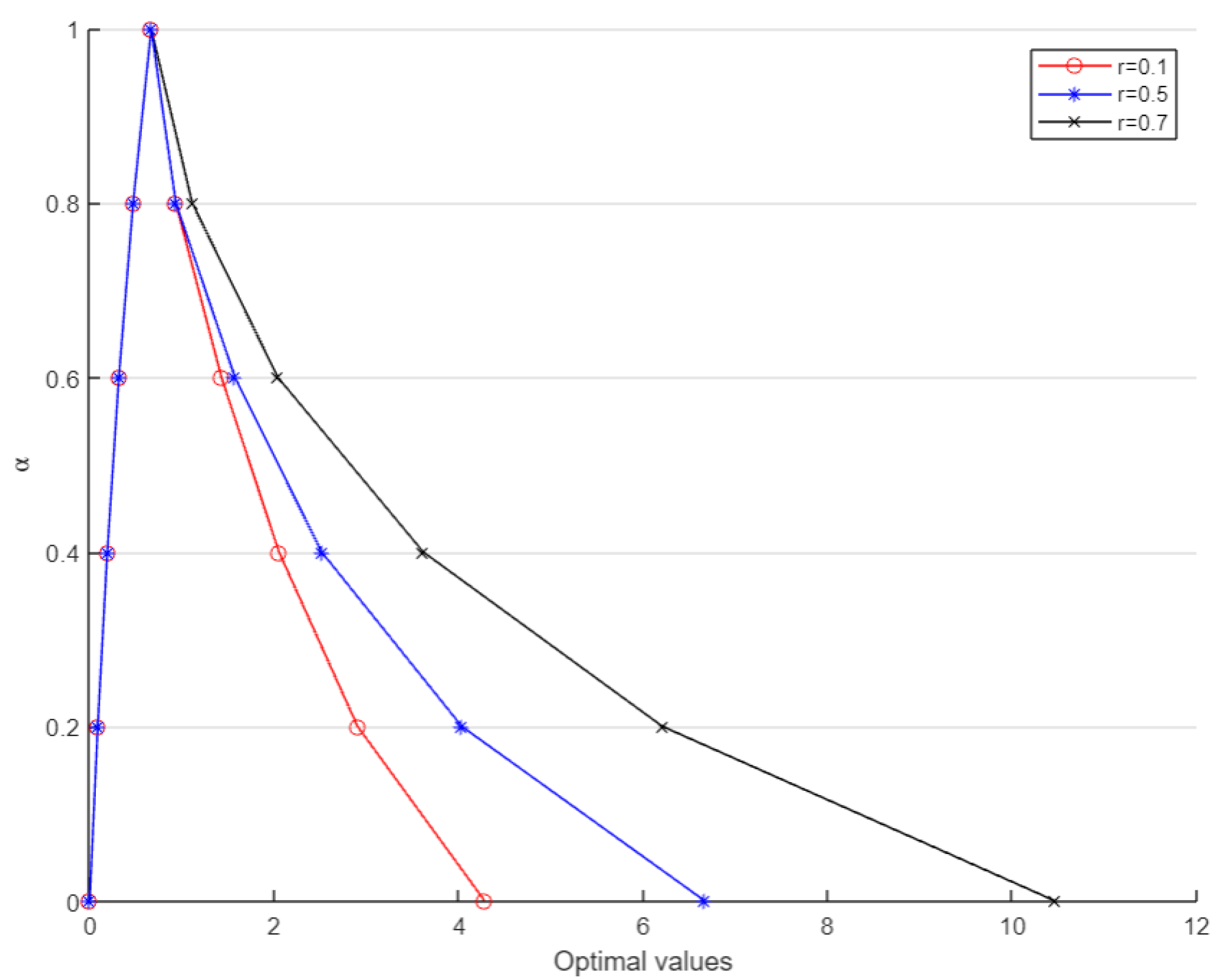
Figure 5 represents the membership function of objective function when particular values are considered for and
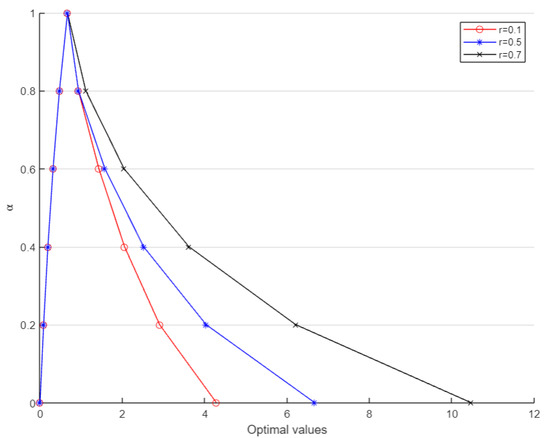
Figure 5.
Membership function of the objective function (Example 1) for .
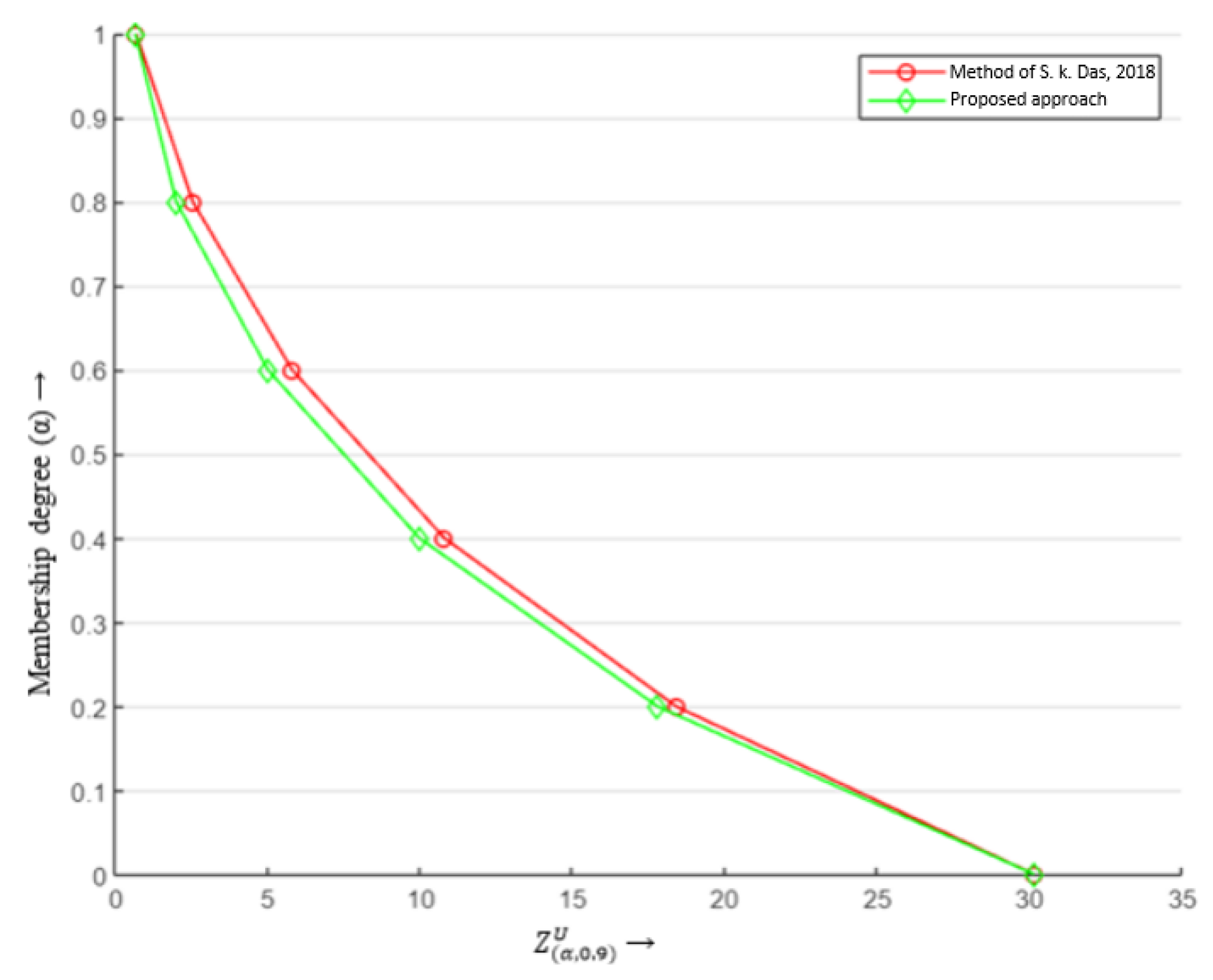
Observation 2: In Table 5, the optimal values of the lower- and upper-bound objectives are compared using and different values of , using the approach in [20] and the proposed approach. The lower-bound objective values are identical for all but the upper-bound objective values exhibit the fallacy in Chinnadurai and Muthukumar’s [20] approach. This shows that the optimal values obtained using the method in [20] are misleading and different from the actual ones.
Table 5.
using the approach in [20] vs. proposed method.
Figure 6 shows the contrast between the optimal values for the upper-bound objective evaluated using both approaches.
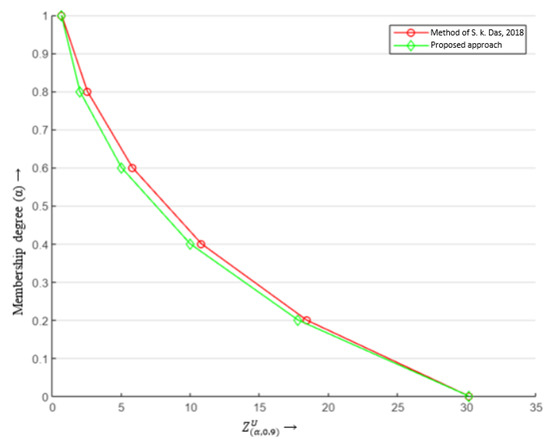
Figure 6.
Comparison of values. The red line presents the method proposed in [19].
Example 2.
Application in transportation sector.
A leading textile company has a well-established network of stores and factory outlets. Due to industrialisation and urbanisation, the demand for their goods at three factory outlets is expected to increase. As the future requirement is imprecise and uncertain, TFNs are used to represent the foreseen requirements at these outlets as given in Table 6. To meet these requirements, the company decides to establish two new storages . The storage capacities are estimated and are indicated in Table 7. Table 8 and Table 9 give the presumed profit and cost of transport per unit of product from the ith store to the jth outlet.
Table 6.
Requirement at the outlets.
Table 7.
Capacity of the stores.
Table 8.
Profit per unit product sold from the outlets (in thousands).
Table 9.
Transportation cost (in thousands).
The company aims to obtain the maximum value of expected profit–cost ratio (PCR) for transporting their goods between these selected storage facilities and the outlets with a view to seek future prospects.
Let be the units of products transported between the ith store and the jth outlet. The proposed technique is applied to forecast the maximum PCR value. The fuzzy linear fractional programming model framed using Table 6, Table 7, Table 8 and Table 9 is as follows:
subject to
where
The decision-maker can fix the satisfaction levels , for the objective function and constraints, respectively. Using the algorithm in Section 6, the lower and upper bounds of the problem are obtained as follows:
Lower-bound objective:
subject to
(As and are negative for some values of .)
Upper-bound objective:
subject to all the constraints of (LB2).
Substituting all -cut values, we get the bounds as:
Lower-bound objective:
subject to
Upper-bound objective:
subject to all the constraints of (LB2-1).
The optimal value of lower-bound and upper-bound objectives corresponding to various values of are indicated in Table 10 and Table 11, respectively. The surface plots of objective values against are shown in Figure 7 and Figure 8 for lower-bound and upper-bound objectives, respectively.
Table 10.
Optimal values of the objective function .
Table 11.
Optimal values of the objective function .
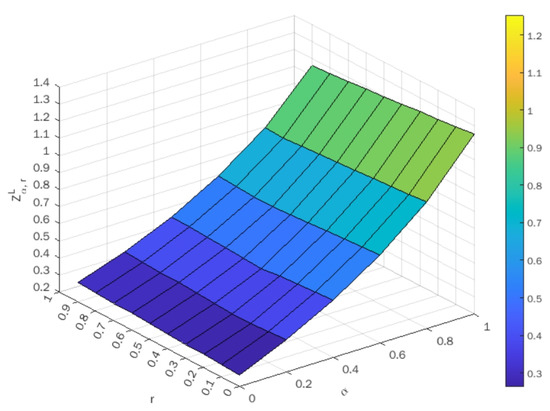
Figure 7.
Surface plot of optimal values corresponding to .
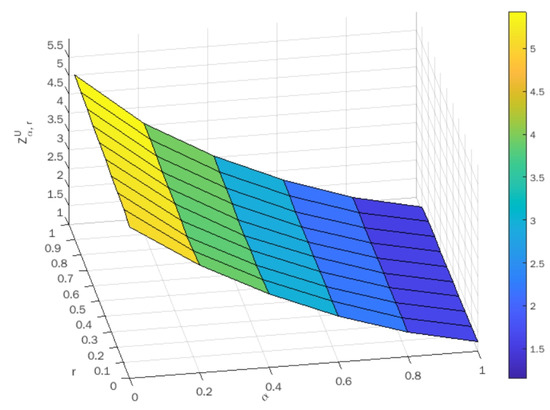
Figure 8.
Surface plot of optimal values corresponding to .
The choice of satisfaction level where corresponds to the crisp case and the maximum PCR is predicted to be 1.149. In realistic scenarios, such crisp values lack much significance as uncertainty is involved. Thus, for some fixed satisfaction levels of the objective and constraints, respectively, a range of PCR values are evaluated and examined. For example, if the decision-maker selects as the satisfaction level of constraints and for the objective function, then the anticipated PCR range is . This gives a better picture to the company for looking into future prospects.
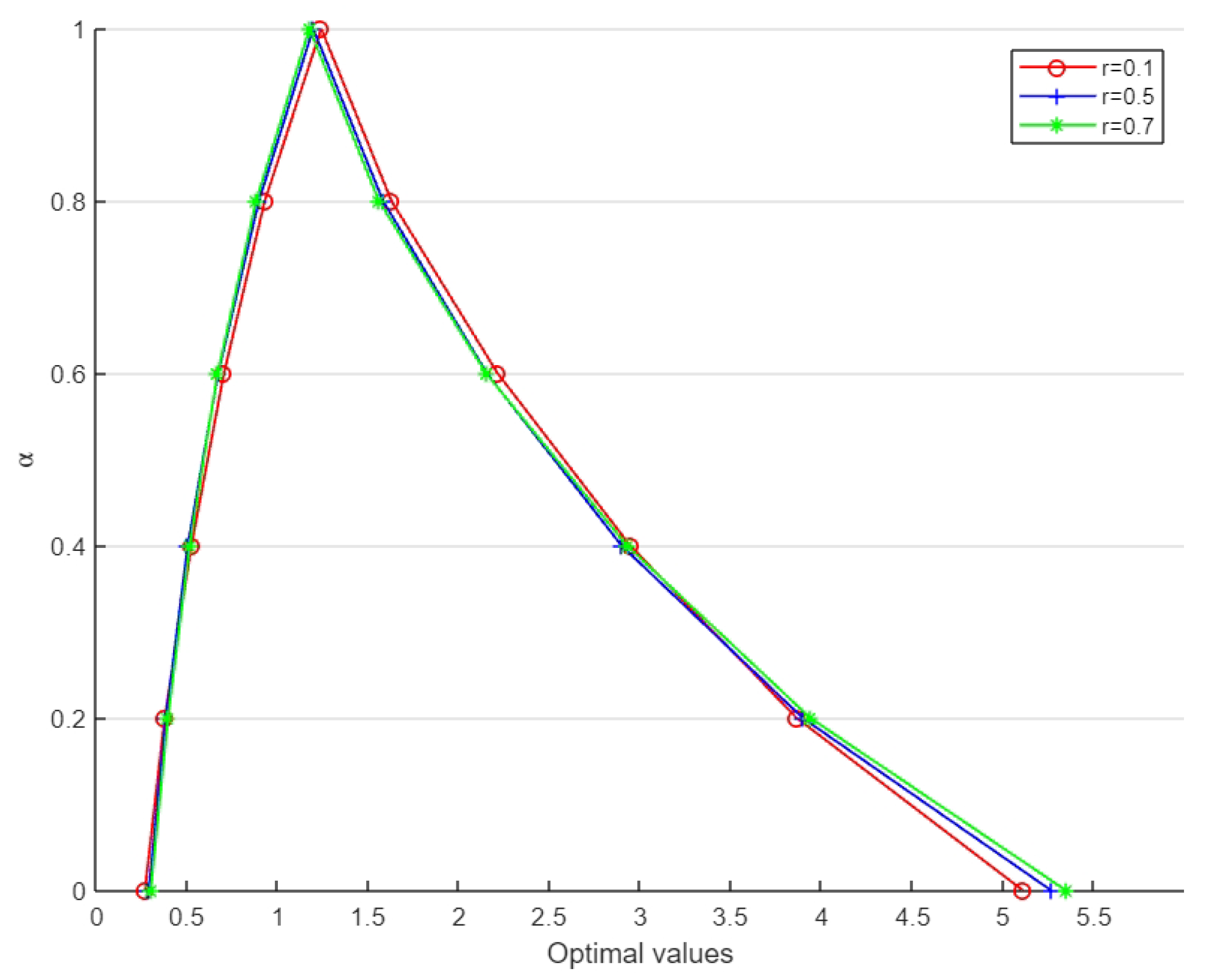
Moreover, for a fixed satisfaction level of the constraints, the membership function of foreseen PCR can be obtained using different values. For some given values of r, i.e., and , the corresponding membership function is shown in Figure 9.
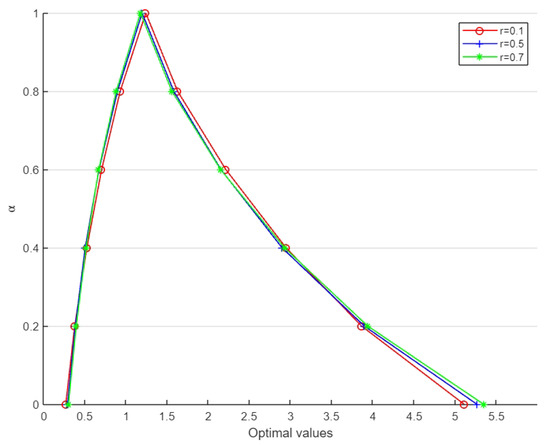
Figure 9.
Membership function of the objective function (Example 2) for .
8. Results and Discussion
In Example 1, we solved an FLFPP with unrestricted parameters and later compared the results with the approach in [20]. For example, when we fixed and , the value obtained using [20]’s approach was [0.191, 10.8052] whereas using the proposed approach, we obtained [0.191, 9.986]. This contrast in values for both approaches could be observed for the rest of values as well, as indicated in Table 5. Thereafter, Example 2 modelled a real-life transportation problem as an FLFPP to forecast the maximum PCR based on the given data. The decision-maker could predict a range of PCR values using Table 10 and Table 11; for instance, when and were selected then the predicted PCR range was [0.5219, 2.9420]. Finally, it could be noticed from Figure 5 and Figure 9 that the membership function corresponding to different and r values gave rise to TFNs. This validated the proposed -cut-based approach.
9. Conclusions and Future Scope
In this article, the limitation of Chinnadurai and Muthukumar’s [20] approach was indicated by a counterexample and then the method was extended and generalized for FLFPPs having parameters that are unrestricted in sign. The method was demonstrated using -cuts by fixing some value of and . The FLFPP was reduced to a crisp biobjective problem that comprised the lower- and upper-bound objectives, which were solved to obtain a numerical solution. Various values of and were fixed and the corresponding solutions were obtained. These solutions were then used to plot the membership function of the initial objective function corresponding to fixed values of r. Examples 1 and 2 were solved to illustrate the proposed approach.
In future work, the same model can be extended for the class of problems where . For simplicity, we considered parameters and variables to be TFNs. For further studies, FLFPPs having parameters as intuitionistic fuzzy or type-2 fuzzy numbers can be investigated. A wide variety of fractional programming problems are nonlinear in nature and may have multiple objective functions or criteria associated with them. The proposed approach can be amalgamated with goal/fuzzy programming or the TOPSIS method to tackle the problem.
Author Contributions
Conceptualization, S.M. and A.C.; Methodology, A.C.; Validation, A.C., S.M. and I.A.; Formal Analysis, A.C.; Writing—Original Draft Preparation, A.C. and S.M.; Writing—Review & Editing, S.M., I.A. and S.A.-H.; Visualization, A.C.; Supervision, S.M. and I.A.; Project Administration, I.A. and S.A.-H.; Funding Acquisition, I.A. and S.A.-H. All authors have read and agreed to the published version of the manuscript. All the authors have read and agreed to the published version of the manuscript.
Funding
This research is supported by the King Fahd University of Petroleum and Minerals, Dhahran, Saudi Arabia, under the Small/Basic Research Grant No. SB191005.
Data Availability Statement
Not applicable.
Acknowledgments
The authors sincerely acknowledge the valuable suggestions and recommendations of the reviewers, which considerably improved the presentation of the paper. The first author would like to acknowledge the support provided by the Council of Scientific & Industrial Research (CSIR), India, to carry out his research work. This research was also supported by the King Fahd University of Petroleum and Minerals, Dhahran, Saudi Arabia, under the Small/Basic Research Grant No. SB191005.
Conflicts of Interest
The authors declare that they have no known competing financial interest or personal relationship that could have appeared to influence the work reported in this paper.
References
- Charnes, A.; Cooper, W.W. Programming with linear fractional functionals. Nav. Res. Logist. Q. 1962, 9, 181–186. [Google Scholar] [CrossRef]
- Tantawy, S.F. A new procedure for solving linear fractional programming problems. Math. Comput. Model. 2009, 48, 969–973. [Google Scholar] [CrossRef]
- Chadha, S.S.; Chadha, V. Linear fractional programming and duality. Cent. Eur. J. Oper. Res. 2007, 15, 119–125. [Google Scholar] [CrossRef]
- Rizk-Allah, R.M.; Hassanien, A.E.; Bhattacharyya, S. Chaotic crow search algorithm for fractional optimization problems. Appl. Soft Comput. 2018, 71, 1161–1175. [Google Scholar] [CrossRef]
- Sharma, S.C.; Bansal, A. A integer solution of fractional programming problem. Gen. Math. Notes 2011, 4, 1–9. [Google Scholar]
- Pandey, P.; Punnen, A.P. A simplex algorithm for piecewise-linear fractional programming problems. Eur. J. Oper. Res. 2007, 178, 343–358. [Google Scholar] [CrossRef]
- Zadeh, L.A. Fuzzy sets. Inform. Control 1965, 8, 338–353. [Google Scholar] [CrossRef]
- Hladík, M. Generalized linear fractional programming under interval uncertainty. Eur. J. Oper. Res. 2010, 205, 42–46. [Google Scholar] [CrossRef]
- Borza, M.; Rambely, A.S.; Saraj, M. Solving linear fractional programming problems with interval coefficients in the objective function. A new approach. Appl. Math. Sci. 2012, 6, 3443–3452. [Google Scholar]
- Pandian, P.; Jayalakshmi, M. On solving linear fractional programming problems. Mod. Appl. Sci. 2013, 7, 90. [Google Scholar]
- Das, S.K.; Mandal, T. A MOLFP method for solving linear fractional programming under fuzzy environment. Int. J. Ind. Eng. 2017, 6, 202–213. [Google Scholar]
- Das, S.K.; Edalatpanah, S.A.; Mandal, T. Application of linear fractional programming problem with fuzzy nature in industry sector. Filomat 2020, 34, 5073–5084. [Google Scholar] [CrossRef]
- Sharma, M.K.; Dhiman, N.; Mishra, V.N.; Rosales, H.G.; Dhaka, A.; Nandal, A.; Mishra, L.N. A fuzzy optimization technique for multi-objective aspirational level fractional transportation problem. Symmetry 2021, 13, 1465. [Google Scholar] [CrossRef]
- Dutta, D.; Rao, J.R.; Tiwari, R.N. Sensitivity analysis in fuzzy linear fractional programming problem. Fuzzy Sets Syst. 1992, 48, 211–216. [Google Scholar] [CrossRef]
- Dutta, D.; Rao, J.R.; Tiwari, R.N. Effect of tolerance in fuzzy linear fractional programming. Fuzzy Sets Syst. 1993, 55, 133–142. [Google Scholar] [CrossRef]
- Borza, M.; Rambely, A.S. An approach based on alpha-cut and max-min technique to linear fractional programming with fuzzy coefficients. Iran. J. Fuzzy Syst. 2022, 19, 153–168. [Google Scholar]
- Veeramani, C.; Sumathi, M. Fuzzy mathematical programming approach for solving fuzzy linear fractional programming problem. RAIRO-Oper. Res. 2014, 48, 109–122. [Google Scholar] [CrossRef]
- Mehra, A.; Chandra, S.; Bector, C.R. Acceptable optimality in linear fractional programming with fuzzy coefficients. Fuzzy Optim. Decis. Mak. 2007, 6, 5–16. [Google Scholar] [CrossRef]
- Das, S.K.; Edalatpanah, S.A.; Mandal, T. A proposed model for solving fuzzy linear fractional programming problem: Numerical Point of View. J. Comput. Sci. 2018, 25, 367–375. [Google Scholar] [CrossRef]
- Chinnadurai, V.; Muthukumar, S. Solving the linear fractional programming problem in a fuzzy environment: Numerical approach. Appl. Math. Model. 2016, 40, 6148–6164. [Google Scholar] [CrossRef]
- Ebrahimnejad, A.; Ghomi, S.J.; Mirhosseini-Alizamini, S.M. A revisit of numerical approach for solving linear fractional programming problem in a fuzzy environment. Appl. Math. Model. 2018, 57, 459–473. [Google Scholar] [CrossRef]
- Klir, G.; Yuan, B. Fuzzy Sets and Fuzzy Logic; Prentice Hall: Hoboken, NJ, USA, 1995; Volume 4, pp. 1–12. [Google Scholar]
- Gomathi, S.V.; Jayalakshmi, M. One’s Fixing Method for a Distinct Symmetric Fuzzy Assignment Model. Symmetry 2022, 14, 2056. [Google Scholar] [CrossRef]
- Das, S.K. An approach to optimize the cost of transportation problem based on triangular fuzzy programming problem. Complex Intell. Syst. 2022, 8, 687–699. [Google Scholar] [CrossRef]
Disclaimer/Publisher’s Note: The statements, opinions and data contained in all publications are solely those of the individual author(s) and contributor(s) and not of MDPI and/or the editor(s). MDPI and/or the editor(s) disclaim responsibility for any injury to people or property resulting from any ideas, methods, instructions or products referred to in the content. |
© 2023 by the authors. Licensee MDPI, Basel, Switzerland. This article is an open access article distributed under the terms and conditions of the Creative Commons Attribution (CC BY) license (https://creativecommons.org/licenses/by/4.0/).