


Abstract
This study is divided into two important axes; for the first one, a new symmetric analytical (approximate) solution to the Duffing–Helmholtz oscillatory equation in terms of elementary functions is derived. The obtained solution is compared with the numerical solution using 4th Range–Kutta (RK4) approach and with the exact analytical solution that is obtained using elliptic functions. As for the second axis, we consider the time-delayed version for the same oscillator taking the impact of both forcing and damping terms into consideration. Some analytical approximations for the time delayed Duffing–Helmholtz oscillator are derived using two different perturbation techniques, known as Krylov–Bogoliubov–Mitropolsky method (KBMM) and the multiple scales method (MSM). Moreover, these perturbed approximations are analyzed numerically and compared with the RK4 approximations.
1. Introduction
In many scientific domains, especially solid-state physics, plasma waves, fluid mechanics, biology, and robotics motion, nonlinear evolution equations (NLEEs) are frequently employed as models to represent engineering and physical processes. Therefore, it is crucial to find the exact (if possible), analytical and numerical solutions to these NLEEs. Generally, the NLEEs are difficult to solve exactly, and only in a small number of exceptional circumstances, can their solutions be unambiguously recorded in writing. However, during the past few decades, significant progress has been made, and numerous potent and successful methods and techniques for getting the exact and approximate solutions of NLEEs have been proposed in the literature. Some important methods and techniques found in the literature that have been used for solving and analyzing different types of NLEEs and oscillatory equations include the family of the homotopy perturbation technique (HPT) [1,2,3,4,5,6,7], Krylov–Bogoliubov–Mitropolsky method (KBMM) [7,8,9,10,11,12,13,14,15], multiple scales method (MSM) [14,15,16,17,18,19], He’s MSM [20], the equivalent linearized method [21], the non-perturbative approach [22], Galerkin method and ansatz method [23], energy balance method (BM) [24,25], harmonic BM [26,27,28,29], Hamiltonian technique [30,31], and many other methods.
In linear oscillators, the presence of friction and an external periodic force can only produce a periodic response, while in a nonlinear oscillator, the response may become chaotic for a certain range of values of some characteristic parameter that we modify. Accordingly, in this investigation and for the first goal, we present the solution to the Duffing–Helmholtz oscillator (D-HO) for a given arbitrary initial conditions using both elliptic (exact solution) and trigonometric functions (approximate solution). The D-HO, sometimes called mixed-parity Duffing oscillator, which is given by the following form
where denotes the displacement of the system, is the natural frequency, and are nonlinear parameters and is a system parameter independent of the time while and denote the initial position and velocity of the oscillator. Equation (1) has a diversity of applications [32,33,34,35]. The standard D-HO (1) can be interpreted as a particle moving in a quadratic potential field, and it has also been studied in a nonlinear circuit theory as well as is related to many nonlinear phenomena that arise in plasma physics. Moreover, the D-HO (1) is a completely integrable equation that contains an abundance of significant properties that occurs in many physical and engineering areas. This equation and some of its extensions have been solved using many different approaches. For instance, the standard D-HO (1) has been solved using the improved harmonic BM [32]. Moreover, some new periodic analytical approximations for the standard D-HO (1) has been derived using the quadrature rules [33]. Some periodic approximations for the D-HO (1) have been obtained via He’s Energy BM and He’s Frequency Amplitude Formulation [34]. Moreover, the exact solutions to the D-HO (1) with frictional force has been obtained in the framework of Jacobi elliptic functions (JEFs) [35]. It is known that evaluating JEFs is a hard task. Thus, the advantage of solving the standard D-HO using elementary functions allows one to evaluate the obtained solutions using only trigonometric functions, which may be performed using a simple calculator. Moreover, the period of the solution is approximated with high accuracy using the period of a trigonometric function. On the other hand, there are perturbative approaches for solving Duffing and many other weakly nonlinear oscillators. However, the obtained solutions are quite complicated. However, our obtained formulas are short and highly accurate.
Moreover, and for the second goal of this investigation, the following time delayed D-HO is considered
where and are non-zero parameters.
Some limited studies have addressed some different Duffing oscillators using several techniques with delayed feedbacks [36,37,38]. For example, the chaotic behavior of both the classical Duffing oscillator system without time delay and the Duffing oscillator system with time delay have been investigated [36]. Moreover, the chaotic dynamics of a delayed Duffing oscillator having harmonic excitation and with delayed displacement and velocity feedbacks have been investigated [37]. The periodic solutions to the time delay autonomous Duffing oscillatory equations have been reported [38]. In this context, both KBMM and MMS [14,15] are introduced for analyzing to provide approximate analytical solutions of the delayed D-HO (2). Moreover, this problem will solve numerically using 4th-order Range–Kutta (RK4) scheme. Both analytical and numerical approximations will numerically compare with each other. It should be noted that the proposed methods (KBMM and MSM) succeeded in analyzing many different nonlinear oscillators. For instance, both unforced and forced Duffing Van-der Pol (VdP) oscillators were solved using KBMM [13]. The authors made a comparison between the obtained approximations using both KBMM, HPM, and RK4 approach [13]. Moreover, both KBMM and MSM succeeded in solving and analyzing a generalized complex Duffing oscillator in the presence of fractional force, and some high-accurate approximations have been derived and compared with the numerical solutions [15]. Both unforced and forced jerk VdP oscillators were analyzed using both KBMM and MSM. Using the KBMM, both first-order approximation and second-order approximation for (un)forced jerk VdP oscillators have been derived [16]. On the contrary, the authors contented themselves with deriving the first-order approximation using MSM, and the obtained results were compared with the numerical approximation and the second-order approximation of KBMM. Furthermore, the KBMM was implemented in analyzing two different formulas for damped forced complex Duffing oscillators [39]. Motivated by these investigations, thus, we will apply these perturbative methods for analyzing the delayed D-HO (2).
This paper is organized as follows: In Section 2, the exact symmetric solutions to the D-HO (1) are derived and discussed based on the concept of a discriminant of the Duffing equation. In Section 3, a symmetric approximation to the D-HO (1) in the framework of a trigonometric function is derived and compared with Jacobi elliptic exact solution and numerical approximation. In Section 4, the delayed D-HO (2) is solved and analyzed using both KBMM and MSM. Note that in the delayed D-HO (2), the impact of time delay, frictional force, and excited periodic force is considered. Thus, this equation is not completely integrable and does not support an exact solution. Consequently, the obtained approximations using both KBMM and MSM will be compared with RK numerical approximations.
2. Exact Solution for D-HO
In the beginning, we should mention that the case for , was discussed in Ref. [40] but in our case, is considered. Accordingly, the solution of the problem (1) can be assumed in the ansatz form
where the function indicates a solution of the following normal Duffing equation
Moreover, we get
with
where are undetermined variables.
Inserting ansatz (3) into the second equation of system (5) and taking into account the first equation in the system (5), we get
with
By solving the algebraic system we obtain
whereas the number A must obey the following equation
Thus, the solution to the normal Duffing Equation (4) can be constructed based on the following discriminant of Equation (4)
Based on this discriminant , three cases can be discussed and investigated as illustrated below.
2.1. First Case: For Positive Discriminant
In this case, the solution of problem (4) reads
with
This solution is periodic for and its main period reads
2.2. Second Case: For Negative Discriminant
To discuss this case, let us define the following new quantity
Since , necessarily , thus, we have
which mean that Accordingly, we try to find a solution to the i.v.p. (4) in the following form
where denotes the solution to the following Duffing equation
By substituting the ansatz (15) into the main problem
Thus, the Duffing Equation (16) has a positive discriminant . The solution to the i.v.p. (4) is then given by
The period of is that of
2.3. Third Case: For Vanishing the Discriminant
For vanishing the discriminant then and the only solution to the i.v.p. (1) with reads
which may be verified by direct computation.
Remark 1.
For we obtain the solution to the following Helmholtz oscillator
Remark 2.
3. Approximate Solution for D-HO in Terms of Elementary Functions
Let us consider the following D-HO
The exact solution to this problem in the form of JEFs is given by
where are undermined parameters. By inserting solution (24) into the problem (23) and after several simple and successive arithmetic operations, we can obtain
and the value of the coefficient A can be calculated by finding the root of the following equation
To give approximate analytic solution to the i.v.p. (23) in terms of elementary functions, we will approximate the Jacobian function “cn” using the trigonometric cosine function as follows:
First let us assume that [40]
where are undermined parameters. Now, by applying an approximation to and until we have
with
On the other hand, if the residual error , it is easy to see that . We will choose the value of to get a small value for the residual . Thus, we have
with
We will choose the value of to fulfill and by using Equation (27), the following quintic algebraic equation is obtained
Using the Padé-approximate technique, then the approximate value of reads
Accordingly, we get
where the values of are evaluated using the Formulas (27)–(30). For more information about the relation between the JEFs and elementary functions, the reader can see Ref. [40]. In the end, the approximate trigonometric solution to the i.v.p. (1) can be written in the following trigonometric form
4. Approximate Solutions for the Time Delayed D-HO
Let us consider the i.v.p.
For anatomy this problem, we first consider as a solution to the i.v.p. (33) for and assuming that
which leads to
After that, the solution of the original problem (33) is considered in the following form
where needs to determine. Inserting solution (36) into the i.v.p. (33) yields
with
Since we will use one of the perturbation methods, the following construction (the homotopy) is considered
with the periodically excited force
where p indicates the perturbation parameter.
Now, problem (37) can be analyzed using many perturbation techniques such as the KBMM and MSM.
4.1. KBMM for Analyzing the Time Delayed D-HO
Based on the KBMM, the solution of the i.v.p. (39) is assumed in the ansatz form
with
Approximation (41) is called the N-th order approximations. For the second-order approximation, i.e., , we get
with
where the functions , , , and will be set later.
Inserting both Equations (43) with (44) into Equation (39) yields
Now, by solving Equations (45) and (46), we obtain
Solving Equations (47)–(50) with the help of values given in Equation (51), we have
and
Inserting Equations (51) and (51) into system (44), and for , we get
and
with
Solving Equation (54) for , we obtain
Solving both system (55) for and , the value of is obtained
The constants and are obtained from the initial conditions.
4.2. MSM for Analyzing the Time Delayed D-HO
We will assume that the delay is not too large, say , accordingly, Taylor series for until the second-order reads
Inserting this approximation in the i.v.p. (2) yields
Inserting solution (36) into problem (60) and rearrange the obtained results, we finally get
with
and the value of d can be calculated by finding a suitable root to the following equation
Applying the MSM, then the solution to the i.v.p. (61) is assumed in the ansatz form
where , , and p denotes the perturbation parameter.
Inserting the perturbed solution (62) into problem (61), we have
with
Equating the coefficient to zero and solved the obtained results, we get
then inserting the solution (64) into the coefficient and rearrange the obtained results, we get
where
To avoid the secular terms, the coefficients of and must be vanished which lead to
Solving these two differential equations, we obtain
and by solving the following other part in Equation (65) with and
we get
For , , and , we finally obtain the MSM first-order approximation to the time delayed D-HO (33)
with
The constants and are obtained from the initial conditions.
5. Numerical Example and Discussion
Let us consider the following numerical example of the time-delayed D-HO
For , the numerical value of the second-order perturbed approximation using the KBMM is obtained as follows
where and , whereas the numerical value to the first-order perturbed approximation using the MSM reads
For , the numerical value of the second-order perturbed approximation using the KBMM is given by
where and , whereas the numerical value to the first-order perturbed approximation using the MSM reads
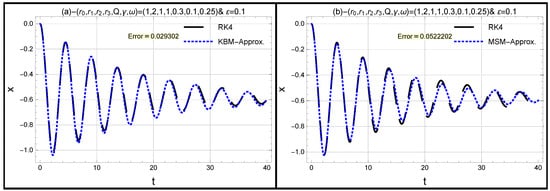
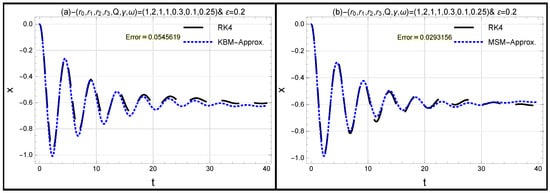
The two perturbed approximations (72) and (73) for and (74) and (75) for , are compared with the RK4 numerical approximations as illustrated in Figure 1 and Figure 2, respectively. Moreover, the global maximum error for the two perturbed approximations as compared to the RK4 numerical approximations are estimated
and
The comparison results are shown that both KBMM and MSM give good results compared the RK4 numerical approximations as illustrated from Figure 1 and Figure 2 as well as from the estimated error.
6. Conclusions
In summary, using MATHEMATICA, the exact symmetric solutions of the standard/undamped Duffing–Helmholtz oscillator (D-HO) have been derived and discussed. Moreover, an approximation to this oscillator in the framework of elementary functions was derived. The trigonometric approximation was compared with both exact solutions and the 4th Range–Kutta (RK4) numerical approximation. It has been noted that the trigonometric approximation is characterized by high accuracy and more stability for long time intervals. On the other hand, both Krylov–Bogoliubov–Mitropolsky method (KBMM) and the multiple scales method (MSM) were applied to derive some approximate solutions to the time-delayed forced damped D-HO. Due to KBMM being less complicated than the other methods, thus, the approximate perturbed solution was derived up to the second order. In addition, it is possible to derive the solutions up to the upper degree in the same way. For the MSM, the first perturbed approximation was derived, but the higher-order approximations cost a lot of time; also in the same way, the higher-order approximations can be obtained. All perturbed approximations were analyzed numerically using suitable numerical values to the related parameters and compared with RK4 numerical approximations. It has been noticed that KBMM gives more accurate perturbed approximations to the current problem than the MSM.
Author Contributions
Conceptualization, W.A. and A.H.S.; methodology, A.H.S. and S.A.E.-T.; software, A.H.S. and S.A.E.-T.; validation, W.A. and A.H.S.; formal analysis, W.A. and S.A.E.-T.; investigation, W.A. and A.H.S.; resources, A.H.S. and S.A.E.-T.; data curation, W.A. and S.A.E.-T.; writing—original draft preparation, A.H.S.; writing—review and editing, W.A. and S.A.E.-T.; visualization, W.A. and A.H.S.; supervision, A.H.S. and S.A.E.-T.; project administration, S.A.E.-T. All authors have read and agreed to the published version of the manuscript.
Funding
This research received no external funding.
Data Availability Statement
All data generated or analyzed during this study are included in this published article (More details can be requested from El-Tantawy).
Acknowledgments
The authors express their gratitude to Princess Nourah bint Abdulrahman University Researchers Supporting Project number (PNURSP2023R229), Princess Nourah bint Abdulrahman University, Riyadh, Saudi Arabia.
Conflicts of Interest
The authors declare no conflict of interest.
References
- He, J.H. Homotopy Perturbation Method with an Auxiliary Term. Abstr. Appl. Anal. 2012, 2012, 857612. [Google Scholar] [CrossRef]
- El-Dib, Y.O. Homotopy perturbation for excited nonlinear equations. Sci. Eng. Appl. 2017, 2, 96–108. [Google Scholar] [CrossRef]
- El-Dib, Y.O. Stability approach for periodic delay Mathieu equation by the Hemultiple-scales method. Alexandria Eng. J. 2018, 57, 4009–4020. [Google Scholar] [CrossRef]
- El-Dib, Y.O. Nonlinear Mathieu equation and coupled resonance mechanism. Chaos Soliton. Fract. 2001, 12, 705. [Google Scholar] [CrossRef]
- El-Dib, Y.O. Multiple scales homotopy perturbation method for nonlinear oscillators. Nonlinear. Sci. Lett. A 2017, 8, 352–364. [Google Scholar]
- El-Dib, Y.O. Nonlinear wave-wave interaction and stability criterion for parametrically coupled nonlinear Schrodinger equations. Nonlinear Dyn. 2001, 24, 399–418. [Google Scholar] [CrossRef]
- Alyousef, H.A.; Alharthi, M.R.; Salas, A.H.; El-Tantawy, S.A. Optimal analytical and numerical approximations to the (un)forced (un)damped parametric pendulum oscillator. Commun. Theor. Phys. 2022, 74, 105002. [Google Scholar] [CrossRef]
- Lenci, S. Exact solutions for coupled Duffing oscillators. Mech. Syst. Signal Process. 2022, 165, 108299. [Google Scholar] [CrossRef]
- Yamgoué, S.B.; Kofané, T.C. Application of the Krylov–Bogoliubov–Mitropolsky method to weakly damped strongly non-linear planar Hamiltonian systems. Int. J. NonLinear Mech. 2007, 42, 1240. [Google Scholar] [CrossRef]
- Salas, A.H.; Abu Hammad, M.; Alotaibi, B.M.; El-Sherif, L.S.; El-Tantawy, S.A. Analytical and Numerical Approximations to Some Coupled Forced Damped Duffing Oscillators. Symmetry 2022, 14, 2286. [Google Scholar] [CrossRef]
- Jothimurugan, R.; Thamilmaran, K.; Rajasekar, S.; Sanjuán, M.A.F. Multiple resonance and anti-resonance in coupled Duffing oscillators. Nonlinear Dyn. 2016, 83, 1803–1814. [Google Scholar] [CrossRef]
- Alhejaili, W.; Salas, A.H.; El-Tantawy, S.A. Novel Approximations to the (Un)forced Pendulum–Cart System: Ansatz and KBM Methods. Mathematics 2022, 10, 2908. [Google Scholar] [CrossRef]
- Salas, A.H.; Albalawi, W.; El-Tantawy, S.A.; El-Sherif, L.S. Some Novel Approaches for Analyzing the Unforced and Forced Duffing–Van der Pol Oscillators. J. Math. 2020, 2022, 2174192. [Google Scholar] [CrossRef]
- Nayfeh, A.H.; Mook, D.T. Nonlinear Oscillations; Wiley: New York, NY, USA, 1979. [Google Scholar]
- Alhejaili, W.; Salas, A.H.; El-Tantawy, S.A. Analytical approximations to a generalized forced damped complex Duffing oscillator: Multiple scales method and KBM approach. Commun. Theor. Phys. 2023, 75, 025002. [Google Scholar] [CrossRef]
- Alhejaili, W.; Salas, A.H.; Tag-Eldin, E.; El-Tantawy, S.A. On Perturbative Methods for Analyzing Third-Order Forced Van-der Pol Oscillators. Symmetry 2023, 15, 89. [Google Scholar] [CrossRef]
- Shoushtari, A.; Khadem, S.E. A Multiple Scale Method Solution for the Nonlinear Vibration of Rectangular Plates. Sci. Iran. 2007, 14, 64. [Google Scholar]
- Ebrahimi, S.; Salahshoor, E.; Maasoomi, M. Application of the method of multiple scales for nonlinear vibration analysis of mechanical systems with dry and lubricated clearance joints. J. Theor. Appl. Vib. Acoust. 2017, 3, 41–60. [Google Scholar]
- Kovacic, I. The method of multiple scales for forced oscillators with some real-power nonlinearities in the stiffness and damping force. Chaos Solitons Fractals 2011, 44, 891–901. [Google Scholar] [CrossRef]
- Ren, Z.F.; Yao, S.W.; He, J.H. He’s multiple scales method for nonlinear vibrations. J. Low Freq. Noise Vib. Act. Control 2019, 38, 1708–1712. [Google Scholar]
- El-Dib, Y.O. Immediate solution for fractional nonlinear oscillators using the equivalent linearized method. J. Low Freq. Noise Vib. Act. Control 2022, 41, 1411–1425. [Google Scholar]
- El-Dib, Y.O. The damping Helmholtz–Rayleigh–Duffing oscillator with the non-perturbative approach. Math. Comput. Simul. 2022, 194, 552–562. [Google Scholar] [CrossRef]
- Alyousef, H.A.; Salas, A.H.; Alharthi, M.R.; El-Tantawy, S.A. Galerkin method, ansatz method, and He’s frequency formulation for modeling the forced damped parametric driven pendulum oscillators. J. Low Freq. Noise Vib. Act. Control 2022, 41, 1426. [Google Scholar] [CrossRef]
- Ozis, T.; Yildirim, A. Determination of the frequency–amplitude relation for a Duffing-harmonic oscillator by the energy balance method. Comput. Math. Appl. 2007, 54, 1184–1187. [Google Scholar] [CrossRef]
- Ganji, D.D.; Esmaeilpour, M.; Soleimani, S. Approximate solutions to Van der Pol damped nonlinear oscillators by means of He’s energy balance method. Int. J. Comput. Math. 2010, 87, 2014–2023. [Google Scholar] [CrossRef]
- Mickens, R.E. Mathematical and numerical study of the Duffing-harmonic oscillator. J. Sound Vib. 2000, 244, 563–567. [Google Scholar] [CrossRef]
- Hu, H.; Tang, J.H. Solution of a Duffing-harmonic oscillator by the method of harmonic balance. J. Sound Vib. 2006, 294, 637–639. [Google Scholar] [CrossRef]
- Lim, C.W.; Wu, B.S. A new analytical approach to the Duffing-harmonic oscillator. Phys. Lett. A 2003, 311, 365–373. [Google Scholar] [CrossRef]
- Leung, A.Y.T.; Guo, Z. Residue harmonic balance approach to limit cycles of non-linear jerk equations. Int. J. Non Linear Mech. 2011, 46, 898–906. [Google Scholar] [CrossRef]
- Khan, Y.; Akbarzade, M. Dynamic analysis of nonlinear oscillator equation arising in double-sided driven clamped microbeam-based electromechanical resonator. Z. Naturforsch. A 2012, 67, 435–440. [Google Scholar] [CrossRef]
- Yildirim, A.; Saadatnia, Z.; Askari, H.; Khan, Y.; KalamiYazdi, M. Higher order approximate periodic solutions for nonlinear oscillators with the Hamiltonian approach. Appl. Math. Lett. 2011, 24, 2042–2051. [Google Scholar] [CrossRef]
- Ju, P. Global residue harmonic balance method for Helmholtz–Duffing oscillator. Appl. Math. Model. 2015, 39, 2172–2179. [Google Scholar] [CrossRef]
- Ghanbari, B. Analytical Approximate Approach to the Helmholtz-Duffing Oscillator. In Advances in Mathematical Modelling, Applied Analysis and Computation; Lecture Notes in Networks and Systems; Singh, J., Anastassiou, G.A., Baleanu, D., Cattani, C., Kumar, D., Eds.; Springer: Singapore, 2023; Volume 415. [Google Scholar] [CrossRef]
- Askari, H.; Saadatnia, Z.; Younesian, D.; Yildirim, A.; Kalami-Yazdi, M. Approximate periodic solutions for the Helmholtz–Duffing equation. Comput. Math. Appl. 2011, 62, 3894–3901. [Google Scholar] [CrossRef]
- Elías-Zúñiga, A. Analytical solution of the damped Helmholtz–Duffing equation. Appl. Math. Lett. 2012, 25, 2349–2353. [Google Scholar] [CrossRef]
- Rusinek, R.; Mitura, A.; Warminski, J. Time delay Duffing systems and chatter control. Meccanica 2014, 49, 1869. [Google Scholar] [CrossRef]
- Shen, Y.J.; Wen, S.F.; Yang, S.P.; Guo, S.Q.; Li, L.R. Analytical threshold for chaos in a Duffing oscillator with delayed feedbacks. Int. J. NonLinear Mech. 2018, 98, 173–179. [Google Scholar] [CrossRef]
- Oishi, S.I. Numerical inclusion of exact periodic solutions for time delay Duffing equation. J. Comput. Appl. Math. 2020, 372, 112620. [Google Scholar] [CrossRef]
- Alhejaili, W.; Salas, A.H.; El-Tantawy, S.A. Analytical and Numerical Study on Forced and Damped Complex Duffing Oscillators. Mathematics 2022, 10, 4475. [Google Scholar] [CrossRef]
- Salas, A.H.; Martinez, L.J.; Ocampo R, D.L. Approximation of Elliptic Functions by Means of Trigonometric Functions with Applications. Math. Probl. Eng. 2021, 2021, 5546666. [Google Scholar] [CrossRef]
Disclaimer/Publisher’s Note: The statements, opinions and data contained in all publications are solely those of the individual author(s) and contributor(s) and not of MDPI and/or the editor(s). MDPI and/or the editor(s) disclaim responsibility for any injury to people or property resulting from any ideas, methods, instructions or products referred to in the content. |
© 2023 by the authors. Licensee MDPI, Basel, Switzerland. This article is an open access article distributed under the terms and conditions of the Creative Commons Attribution (CC BY) license (https://creativecommons.org/licenses/by/4.0/).