


Abstract
For a graph and a function , if then we write . A function is said to be a non-zero vertex signed dominating function (for short, NVSDF) of if holds for every vertex in , and the non-zero vertex signed domination number of is defined as In this paper, the novel concept of the non-zero vertex signed domination for graphs is introduced. There is also a special symmetry concept in graphs. Some upper bounds of the non-zero vertex signed domination number of a graph are given. The exact value of for several special classes of graphs is determined. Finally, we pose some open problems.
MSC:
05C05; 05C69
1. Introduction
We use Bondy and Murty [1] for terminology and notation not defined here and consider finite, undirected, and simple graph only.
Let be a graph with the vertex set and edge set , the order of is the number of its vertices, and its size is . For , the open neighborhood of in is denoted as and for the closed one, is the degree of in , where , , and can be abbreviated to , , and , respectively. Then and denote the minimum degree and maximum degree of . If , then denotes the subgraph of induced by . If , and , then we write . For simplicity, if , then the symbol denotes .
For any two disjoint graphs and , then denotes the join graph of and , where and
For any two disjoint graphs and , then denotes the product graph of and , where and .
The domination of graphs is an important area in graph theory, and the domination parameters and their variations have been widely studied.
In 1995, J.E. Dunbar et al. [2] first proposed the concept of signed domination of a graph, and E.J. Cockayne et al. [3] generalized it and defined many variations on dominating functions of graphs. Thus, many variations on domination concepts were introduced, such as the signed total domination [4], the clique signed domination [5], the signed Roman domination [6], the signed clique domination [7], the signed and minus domination [8], and so on.
For convenience, given a graph and a function , if , then we write .
Let be a graph, a function is said to be a signed dominating function (SDF) of , if for every vertex , and the signed domination number of is defined as:
In the recent past, B. Xu et al. [9] introduced the following concept of the balanced domination of graphs:
Definition 1.
For a graph , a function is said to be a balanced dominating function (BDF) of if holds for every vertex
, and the balanced domination number of is defined as:
Combining the signed domination and balanced domination of graphs, we introduce non-zero vertex signed domination of graphs as following:
Definition 2.
For a graph , if there exists a function such that holds for every vertex , then is said to be a non-zero vertex signed dominating function (NVSDF) of , the graph is called a non-zero vertex signed graph, and the non-zero vertex signed domination number of is defined as
A non-zero vertex signed dominating function of is said to be maximum if . Obviously, if is a non-zero vertex signed dominating function of , then is also a vertex signed dominating function of , then for all non-zero vertex signed graph .
We are interested in the non-zero vertex signed domination in graphs. In this paper, we give some upper bounds of the non-zero vertex signed domination number of a graph and determined the exact value of for several special classes of graphs . Finally, we pose some open problems.
We begin with some basic properties that will be helpful to obtain our results.
Lemma 1.
For any non-zero vertex signed graph , if is a non-zero vertex signed dominating function of , then is also a non-zero vertex dominating function of . Thus, holds for any non-zero vertex signed graph .
Lemma 2.
For any non-zero vertex signed graph of order , then
- (1)
- The degree of each vertex is odd;
- (2)
- is even;
- (3)
- is even.
Proof.
- (1)
- For any non-zero vertex signed dominating function of , since holds for every vertex in , is even. Thus, is odd.
- (2)
- Note that is even and is odd, which implies that is even.
- (3)
- Let , , , we have and . Note that is even, then is even.
This completes the proof. □
Lemma 3.
For any non-zero vertex signed graph of order , if , then .
Proof.
Since , there exists such that . If is a non-zero vertex signed graph; let be a maximum non-zero vertex signed dominating function of , that is, holds for every vertex . Note that , which implies that , that is, .
This completes the proof. □
2. Some Upper Bounds on Non-Zero Vertex Signed Domination Number
In this section, we give some upper bounds on the non-zero vertex signed domination number of graphs.
Theorem 1.
For any non-zero vertex signed graph of order , if , then
Proof.
Let be a maximum non-zero vertex signed dominating function of , that is, . Let , , , we have and .
Let . Since for any , each vertex in must be adjacent to at least one vertex in . If all vertices in are not adjacent to each other, which implies that there is no edge of , then . If one edge is added to , we have two edges that are added to . That is the only way to make for any . Note that and , which implies that . Similarly, if every vertex in removes an edge that is connected to a vertex in , half of the remaining edges in is the number of edges in . Note that . We have
It is easy to see that
which means
Note that the number of edges in does not exceed , which implies that , then
It is easy to see that is an integer and , then
This completes the proof. □
Theorem 2.
For any non-zero vertex signed graph of order , if and denote the minimum degree and maximum degree of the graph, respectively. Then
Proof.
Let be a maximum non-zero vertex signed dominating function of graph , that is, .
Let , , , we have and .
Let . Since holds for any , each vertex in must be adjacent to at least one vertex in . If all vertices in are not adjacent each other, which implies that there is no edge of , then . If one edge is added to , we have two edges are added to , that is the only way to make holds for any . Note that and , which implies that . We have . It is easy to see that
holds for each vertex , which means
Note that , which implies that there is at least one vertex , and is at most adjacent to vertices in . Then is adjacent to vertices in . Thus,
This completes the proof. □
The next results are an immediate consequence of Theorem 2.
Corollary 1.
For any -regular non-zero vertex signed graph , we have .
Corollary 2.
Any complete graph of even order is a non-zero vertex signed graph, and .
By reference [9], we know that . Hence, the following corollary can be obtained.
Corollary 3.
For any non-zero vertex signed graph of order , we have
Theorem 3.
For any non-zero vertex signed graph of order , with degree sequence is , if is the largest positive integer, that makes the following formula true:
Then
Proof.
Let be a maximum non-zero vertex signed dominating function of graph ; we have . Let , , . We have , and . It is easy to see that for every vertex in , which means
and . Note, also, that
Then
It can be known from the definition of , we have , which means
This completes the proof. □
3. Some Special Non-Zero Vertex Signed Graphs
In this section, we determine some classes of non-zero vertex signed graphs.
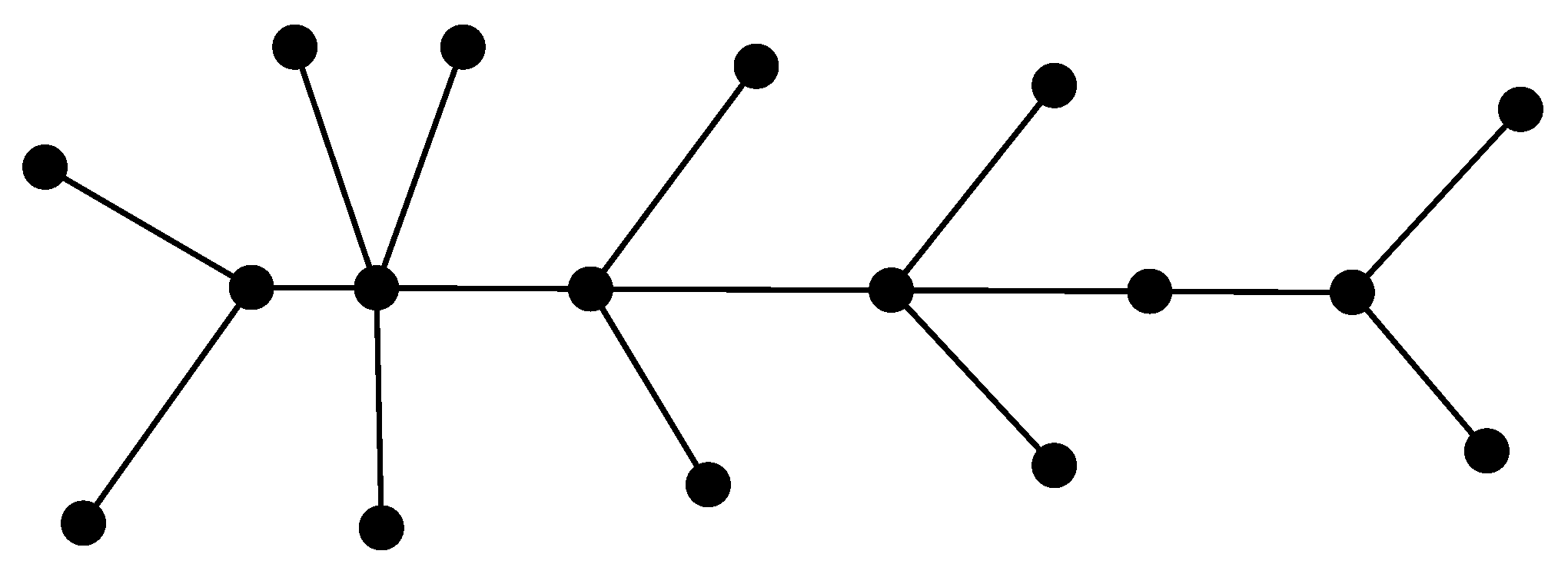
A tree is said to be a caterpillar tree if a path can be obtained by removing all leaf vertices from . The number of leaf vertices adjacent to is . Among them , and . Caterpillar tree is shown in Figure 1.
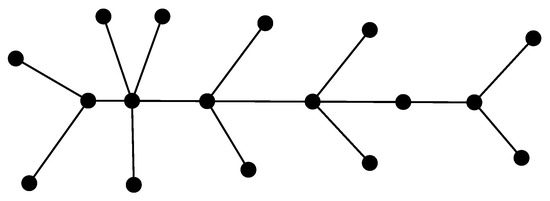
Figure 1.
Caterpillar tree.
Further, we need the following preliminary results.
Lemma 4.
Let be a connected graph, and . Then
The next result is an immediate consequence of Lemma 4.
Corollary 4.
For any non-zero vertex signed graph of order , then
Proof.
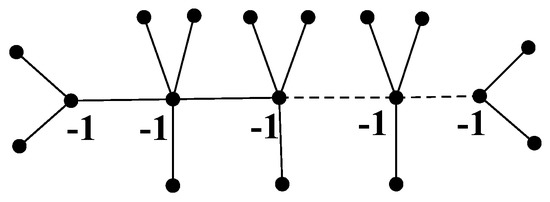
Note that any non-zero vertex signed dominating function of is a balanced dominating function of it, which implies that . Let , then it can be known from lemma 4 and . Thus,
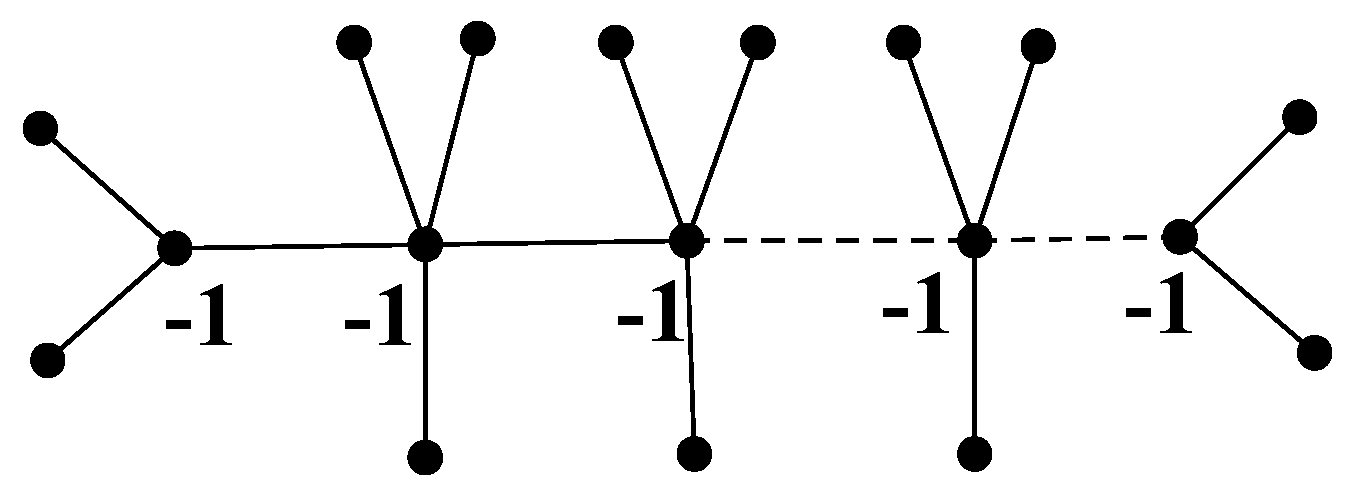
Let caterpillar tree be the given labeling in Figure 2, and . The functional value of these vertices with no labels is equal to “+1”.
Figure 2.
Caterpillar tree.1.
Then , and thus, the existence of an infinite number of caterpillar trees makes the corollary valid.
This completes the proof. □
Theorem 4.
The product graph is a non-zero vertex signed graph if and only if , and is even.
Proof.
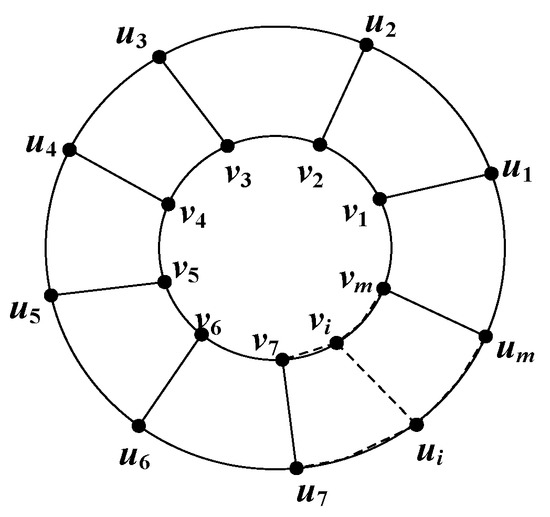
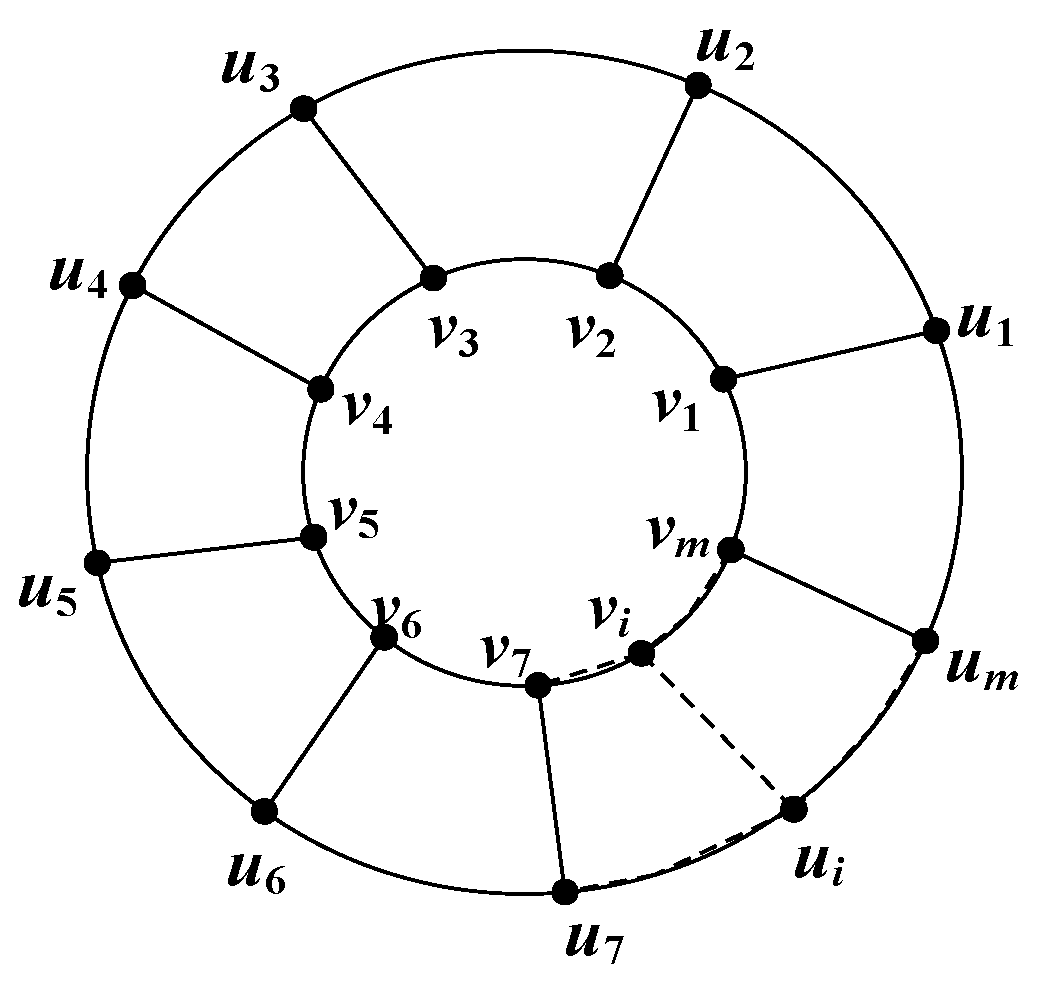
These vertices on the inner ring of the product graph are , and these vertices on the outer ring of the product graph are . The product graph is depicted in Figure 3.
Figure 3.
Product graph.
Case 1. . There exists a vertex in , where is even. Then for every , that is, the product graph is not a non-zero vertex signed graph.
Case 2. . The following is an analysis based on the parity of .
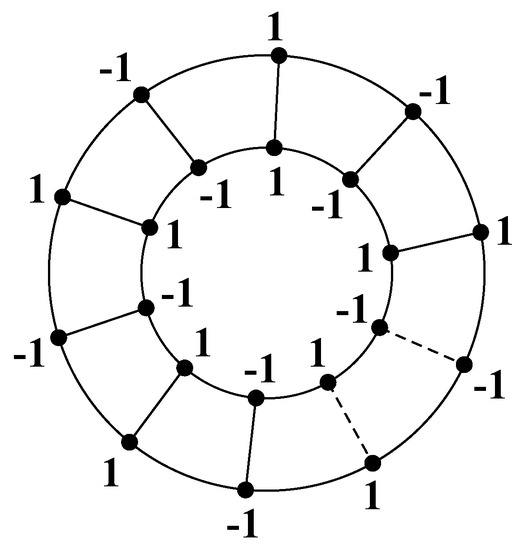
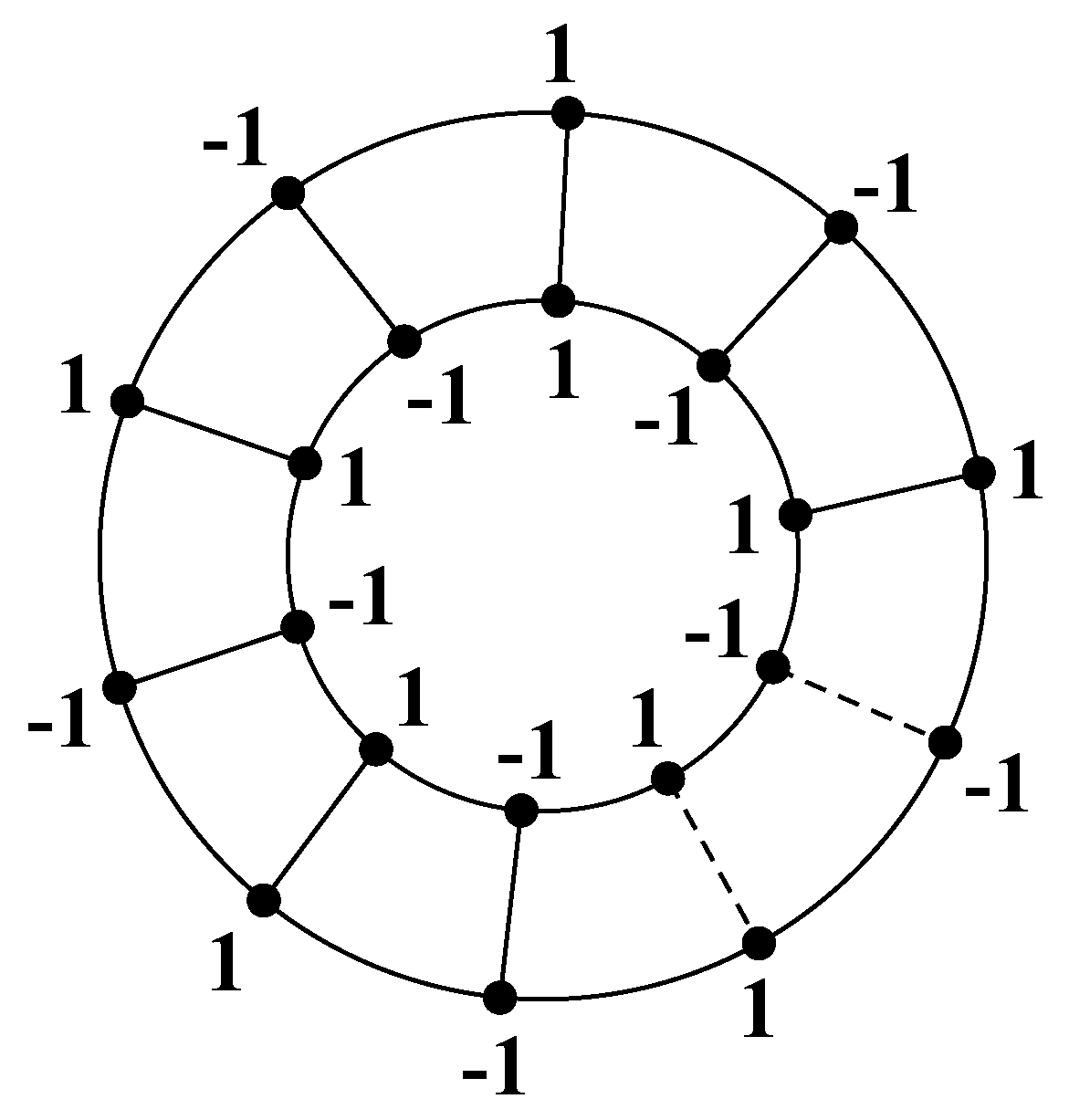
Subcase 2.1. is an even number. The graph is described in Figure 4. It is easy to see that for every vertex in , and hence, if is even, we have is a non-zero vertex signed graph.
Figure 4.
Product graph.1.
Subcase 2.2. is an odd number.
Suppose is a non-zero vertex signed graph. Then, it satisfies holds for every vertex in , we have
Then
In this case, the subscript of takes the minimum positive residue of modulo m. Formulas (6) and (7) can be obtained from Formula (5).
Then
Therefore, there must be an even number of vertices in each circle, a contradiction. Therefore, if is an odd number, and then, the product graph is not a non-zero vertex signed graph.
In summary, the product graph is a non-zero vertex signed graph if and only if , and is an even number.
This completes the proof. □
Theorem 5.
is a caterpillar tree. Then, is a non-zero vertex signed graph, and the necessary and sufficient conditions are as follows:
- (1)
- ;
- (2)
- ;
- (3)
- Let . The number of vertices in each branch of is even.
Proof.
After removing all leaf vertices from the caterpillar tree, the road is obtained. The vertices on are . The number of leaf vertices adjacent to is . Let be the -th leaf vertex adjacent to .
Necessity.
Note that is a non-zero vertex signed graph, let be a non-zero vertex signed dominating function of .
Case 1. . Note that , which implies that , and because of , then . If , that is, . Otherwise, . It is easy to see that and , which means . Similarly, we have .
Case 2. . It can be seen from case 1 and lemma 2, we have and must be an odd number. Note that , which implies that . It is easy to see that , which means . Note that and is a positive integer, then .
Case 3. Assume to the contrary, the number of vertices of a branch of is an odd number. Let , , and is a branch between vertices and , where and . Might as well make . Note that for every vertex in , which implies that . Might as well make , because of , there is . Similarly, it can be obtained , . Note that the functional value of the vertices loop in even multiples, but the branch has an odd number of vertices, which implies that , then . Thus, the caterpillar tree is not a non-zero vertex signed graph, a contradiction.
Sufficiency.
It is easy to see that . Then the number of vertices in each branch of is even, and , where . Let , where . Therefore, when , must be between and . Let , , , , where , , then holds for every in . Therefore, according to the definition 2, is a non-zero vertex signed graph and is a non-zero vertex signed dominating function of .
This completes the proof. □
Theorem 6.
If the join graph of any two regular graphs is a non-zero vertex signed graph, then one of the following conditions must be satisfied:
- (1)
- Both regular graphs are non-zero vertex signed graph,
- (2)
- Join graph is a complete graph of even order.
Proof.
Let be a -regular graph of order , be a -regular graph of order . If is a non-zero vertex signed graph, let be a non-zero vertex signed dominating function of graph . Note that holds for every vertex in , then
And holds for every vertex in , then
Note, also, that , , then
which implies that
Case 1. . It can be known from formula (8), holds for any in , then is a non-zero vertex signed graph. Similarly, is also a non-zero vertex signed graph.
Case 2. . Then . Note that and , if , we have , a contradiction. Hence, and , which implies that is a complete graph of even order.
This completes the proof. □
4. Some Open Problems
In this paper, we give some properties on the non-zero vertex signed graphs and obtain some upper bounds on the non-zero vertex signed domination number, and the non-zero vertex signed domination number of some special graphs are determined. For all these, it is difficult to obtain the conditions to achieve this upper bound. In addition, the general conditions for determining whether a graph is a non-zero vertex signed graph have not been obtained yet. Therefore, we pose some problems as follows:
Problem 1.
Characterize all non-zero vertex signed graphs with
Problem 2.
Characterize all non-zero vertex signed graphs with
Problem 3.
In Theorem 6, we have characterized the non-zero vertex signed caterpillar tree; how to characterize all non-zero vertex signed trees?
Author Contributions
Conceptualization, B.X. and M.Z.; methodology, M.Z.; software, M.Z.; validation, M.Z.; formal analysis, M.Z; resources, M.Z.; writing—original draft preparation, M.Z; writing—review and editing, M.Z. and T.L.; supervision, B.X.; project administration, B.X.; funding acquisition, B.X. All authors have read and agreed to the published version of the manuscript.
Funding
This work is supported by the National Natural Science Foundation of China (Grant Nos. 11961026, 11261019) and the Jiangxi Natural Science Foundation (Grant No. 20181BAB201002).
Conflicts of Interest
The authors declare no conflict of interest.
References
- Bondy, J.A.; Murty, U.S.R. Graph Theory with Application; Elsevier: New York, NY, USA, 1976. [Google Scholar]
- Dunbar, J.E.; Hedetniemi, S.T.; Henning, M.A.; Slater, P.J. Signed domination in graphs. Graph Theory Comb. Appl. 1995, 1, 311–322. [Google Scholar]
- Cockayne, E.J.; Ynhardt, C.M. On a generalization of signed dominating functions of a graphs. Ars. Comb. 1996, 43, 235–245. [Google Scholar] [CrossRef]
- Lu, J.; Liu, L. On the study of total signed domination function of graphs. J. Lanzhou Railw. Univ. Nat. Sc. 2001, 20, 95–97. [Google Scholar]
- Xu, B. On the clique signed domination numbers of Graphs. Sys. Sci. Math 2008, 3, 282–287. [Google Scholar] [CrossRef]
- Dehgardi, N.; Volkmann, L. Nonnegative signed total Roman domination in graphs. Commun. Comb. Optim. 2020, 5, 139–155. [Google Scholar] [CrossRef]
- Baogen, X.; Ting, L.; Mengmeng, Z. A Note on the Signed Clique Domination Numbers of Graphs. J. Math. 2022, 2022, 208164. [Google Scholar] [CrossRef]
- Kang, L.; Shan, E. Signed and Minus Dominating Functions in Graphs. Dev. Math. 2020, 64, 301–348. [Google Scholar] [CrossRef]
- Xu, B.; Wanting, S.; Shuchao, L.; Chunhua, L. On the balanced domination of graphs. Czechoslov. Math. J. 2021, 71, 933–946. [Google Scholar] [CrossRef]
Disclaimer/Publisher’s Note: The statements, opinions and data contained in all publications are solely those of the individual author(s) and contributor(s) and not of MDPI and/or the editor(s). MDPI and/or the editor(s) disclaim responsibility for any injury to people or property resulting from any ideas, methods, instructions or products referred to in the content. |
© 2023 by the authors. Licensee MDPI, Basel, Switzerland. This article is an open access article distributed under the terms and conditions of the Creative Commons Attribution (CC BY) license (https://creativecommons.org/licenses/by/4.0/).