


Abstract
Let be a finite, simple digraph and k a positive integer. A function is called a -Roman dominating function (for short, -RDF) if for any vertex , where and . The weight of a -RDF f is . The minimum weight of any -RDF on is the -Roman domination number, denoted by . For and , we call them the double Roman domination number and the triple Roman domination number, respectively. In this paper, we presented some general bounds and the Nordhaus–Gaddum bound on the -Roman domination number and we also determined the bounds on the -Roman domination number related to other domination parameters, such as domination number and signed domination number. Additionally, we give the exact values of and for the directed path and directed cycle .
1. Introduction and Terminology
Let be a finite and simple digraph. The order of is denoted by . For a vertex w in , its out-neighbourhood (resp. in-neighbourhood) is (resp. ). The closed out-neighbourhood (resp. closed in-neighbourhood) of w is the set (resp. ). For a vertex subset of , its out-neighbourhood (resp. in-neighbourhood) is (resp. ). Its closed out-neighbourhood (resp. closed in-neighbourhood) is (resp. ). For a vertex w in , its out-degree (resp. in-degree) is (resp. ). We usually omit the subscript when the digraph is known from the context. The symbols , , and denote the maximum out-degree, maximum in-degree, minimum out-degree and minimum in-degree of the digraph , respectively [1].
For a set , the subdigraph of induced by is denoted by . Additionally, for two disjoint vertex subsets and of , we define as the arc set satisfying that every arc with , . The distance from u to v, denoted by , is the length of the shortest u-v path.
A digraph is empty if the number of arcs in is 0. We write the path of order n as and the cycle of order n as .
A connected digraph is a rooted tree if there is one vertex r with , called the root, and for any other vertex v distinct from r, . Let be a rooted tree; its height is the maximum distance from the root to any vertex in . If every vertex of has exactly one in-neighbor, we say is contrafunctional. The complement of a digraph is a digraph with vertex set in which if and only if . Please refer to reference [1] for notations and terminology that are not defined here.
A vertex set of a digraph is called a dominating set if . The domination number is is a dominating set of . A -set is a dominating set of with the cardinality . The concept of has been widely studied; see [1,2,3].
Let be a bipartite graph and the bipartition of . If there is a neighbour and for every , then we say is a left dominating set. is a left dominating set of is the left domination number of . A -set is a left dominating set of with the cardinality . For a vertex v in , stands for its minimum degree. For more results about the left dominating set, see [4].
A signed dominating function (for short, SDF) in a digraph is a function such that for every vertex . The signed domination number is is an SDF of , where is the weight of . If the weight of is exactly , then is a -function. This was further studied in [5].
In 2004, Cockayne and others proposed Roman domination based on Stewart’s strategy of defending the Roman Empire. Initially, the study of Roman domination was inspired by the strategies used to defend the Roman Empire during the reign of Emperor Constantine the Great, from 274 to 337 A.D. He decreed that no more than two legions could be stationed in all cities of the Roman Empire. Moreover, if a place was not attacked by legions, then it must be near at least one city where two legions were stationed, so that one of them could be sent to defend the attacked city. The mathematical concept of Roman domination was first defined and discussed by Stewart in 1999 and ReVelle and Rosing in 2000, and was derived from this history of the Roman Empire.
The domination strategy also has many practical applications; for example, it is used in computer science, coding theory, optimal design of connecting networks, etc. Four different types of interconnected components (sink, standby station, power supply substation and power supply station) make up some electrical networks. The sinks need to be connected with the components of a powerful supply station or two less powerful substations. Reserve stations must be connected to the supply element, and because it must be used as electricity storage, at least one reserve station must not be connected to any sink.
Let be a finite, simple digraph and k a positive integer. A function is called a -Roman dominating function (for short, -RDF) if for any vertex , where and . Its weight is the sum of for every vertex . The -Roman domination number is the minimum weight of (for short, -RD-number), denoted by . A -RDF of with the weight is called a -function. In particular, when , the -RDF is exactly the Roman dominating function, which has been studied extensively; see [6,7,8,9]. When and , we call them the double Roman dominating function and the triple Roman dominating function; these denotations were introduced in [10,11,12,13].
In 2019, G. Hao, X. Chen and L. Volkmann presented the Nordhaus–Gaddum bound on the double Roman domination number in [13]. In 2021, in [11], H.A. Ahangar et al. determined the bounds of the triple Roman domination number related to other domination parameters, such as domination number and signed domination number. As we know, the symmetry of a digraph is significant in theoretical and practical problems. A few digraphs with symmetrical structure, for example the Roman domination of the Kautz digraph and de Bruijn digraph, have been thoroughly studied by authors in [14,15]. Due to their many excellent properties such as small diameter and symmetry, the Kautz digraph and de Bruijn digraph are widely used in computer drum design, VLSI structure design and other fields. At the same time, the de Bruijn digraph and hypercube are considered to be the interconnection network of the real large-scale next-generation multi-computer system. In this paper, the above results are extended to -Roman domination numbers of all integers with . The contributions of this paper are summarized as follows.
(a) In Section 2, we investigate the k-RD-number of the connected digraph with .
(b) In Section 3, we provide some general bounds for the k-RD-number.
(c) In Section 4, we present the Nordhaus–Gaddum bound for .
(d) In Section 5, we give the bounds of the -RD-number related to the domination number and the signed domination number.
(e) In Section 6, we obtain the exact values of and for the directed path and the directed cycle .
2. The [k]-RD-Number of a Connected Digraph with δ−(D) ≥ 1
In this section, we give the -RD-number of a connected digraph with . To show the main results, we need a key observation, Proposition 1.
For a -RDF, let for . It is noted that there is a bijective correspondence between and of . Therefore, we use to represent throughout this paper.
Proposition 1.
If is a directed graph, then there is a -function such that can be found.
Proof.
Let be a -function such that the number of vertices assigned 1 by is minimum. Suppose that , that is, there is a vertex v such that . Then, we define a -RDF follows: , for a vertex , and for any vertex . This leads to a -function with fewer vertices assigned to 1, which contradicts the choice of . □
According to Proposition 1, there is a -RDF with no vertex assigned 1. Without loss of generality, we assume that no vertex is assigned to 1 under consideration when determining the -function for any digraph . In this case, arbitrarily -RDF on can be written as .
Proposition 2.
Let be a rooted tree with . Then, .
Proof.
Let r be the root of . Define a function so that and otherwise. Then, is a -RDF on , and so . □
Theorem 1.
Let be a rooted tree of order . Then, .
Proof.
We prove the theorem by induction on n. If , we have in accordance with Proposition 2. For the tree of order m, the theorem is assumed to be true, where and . If the height of is 1, then in accordance with Proposition 2. Hence, assume that . Let r be the root of , and v a vertex for and . Let be the connected component of containing the root r and . Because the distance from r to v is , . From Proposition 2, we find that . If , then by . Let be defined as follows: , and otherwise. Then, is a -RDF on , and so . Now we assume that . If , then we have given the induction hypotheses. Furthermore, . If , then . Hence, . The proof is completed. □
Theorem 2
([16]). Let be a contrafunctional digraph that is connected. Then, has a unique directed cycle.
For a directed graph that is connected and contrafunctional, given Theorem 2 and the definition of the rooted tree , it is clear that . Combined with Theorem 1, these facts will lead to the following conclusion.
Corollary 1.
Let be a directed graph that is connected and contrafunctional. Then, if , and otherwise, where .
Theorem 3.
If is a connected digraph of order with minimum in-degree , then .
Proof.

We prove the theorem by induction on n. If , because and , it is easy to see that . Suppose . For every vertex of , there is an incoming arc that can be chosen by . All such arcs induce a spanning subdigraph of , and consists of some connected components, which are denoted as , , …, . In addition, because the in-degree of each vertex in is 1 for , this implies that is a subdigraph of that is connected and contrafunctional.
Now, we consider that not all are isomorphic to . In general, we may assume that there exist m connected components not isomorphic to and connected components isomorphic to , which are denoted by for and for , respectively. According to Corollary 1, we have for any and for any . Hence,
Next, we consider that all are isomorphic to for . because of . Notice that is connected and is not connected; this implies that there is at least one arc that is in but . If we take the arc in and add it to , then, as shown in Figure 1, it is easy to verify that has a -RD-number which is strictly smaller than by k. Therefore, we find that given Corollary 1. □
Figure 1.
Black circles denote the vertices in , grey circles denote the vertices in , and white circles denote the vertices in .
3. Some Bounds of the [k]-RD-Number
In this section, some general bounds for are presented. We first provide the upper bounds of .
Proposition 3.
If is a directed graph with , then . Furthermore, if and only if there is no arc in .
Proof.
Define a function such that for each vertex of . Then, is a -RDF on and hence . The sufficiency is obvious, so here we only show the necessity. Suppose, to the contrary, that there are two vertices u, v such that . Define a function such that , and for other vertices. Then, g is a -RDF with . Thus, , a contradiction. □
Theorem 4.
Let be a directed graph with and . Then, . Furthermore, iff there is exactly one nontrivial connected component in , where , and when has three vertices, is -path or -cycle.
Proof.
Because is a non-empty digraph, we have according to Proposition 3. Suppose, to the contrary, that . Because , there are two vertices u, v such that . Define a function such that , and for other vertices x. Then, g is a -RDF with . Hence, , a contradiction. Thus, .
To prove the necessity, assume that . First, suppose to the contrary that contains at least two nontrivial connected components. Then, we can choose two arcs, say and , from two distinct connected components. Define a function such that , and for other vertices x. Then, is a -RDF on , and so , a contradiction. Therefore, has exactly one nontrivial connected component, say .
Now we show that the unique nontrivial component is with no more than three vertices. If there are more than three vertices in , we can obtain the contradiction by distinguishing three cases as follows:
Case 1: There are four distinct vertices u, z, s, t such that .
With the same method as above, there is a contradiction.
Case 2: There are three different vertices u, z, t such that .
Define a function such that , and for other vertices x. Then, is a -RDF on , and so , a contradiction.
Case 3: There are three different vertices u, v, s such that .
Define a function such that and otherwise. Thus, is a -RDF on , and so , a contradiction.
Consequently, . Furthermore, following the arguments of Case 2 and Case 3, we find that is -path or -cycle when .
Assume that contains exactly one nontrivial connected component with , and is -path or -cycle when there are three vertices in . If there are two vertices in , . If there are three vertices in and is -path or -cycle, . □
Lemma 1.
Let be a digraph with and maximum out-degree . Then, .
Proof.
Let w be a vertex with the maximum out-degree . Define a function such that , for any vertex and for other vertices u. Then, is a -RDF on . Hence, . □
Theorem 5.
Let be a digraph of order n. Then
Proof.
Let be a vertex set of satisfying the possibility that the vertices in any are independently selected is p, where . Thus, the expected size of , denoted by , is . Let . Then
Hence, . Let be defined as follows: for any vertex , for any vertex , and for any vertex . Then, the expected size of is
Because when , we have . We can further know that the upper bound of is at its minimum when , therefore . This implies that . □
We now establish the lower bound of .
Theorem 6.
Let be a connected digraph with . Then, .
Proof.
Let be a -function and . We consider two cases:
Case 1: .
If , then . If , then . Because is a -function, we have for each vertex . Then, , implying that
Hence, .
Case 2: .
If , then . If , then . Because is a -function, we have for each vertex . Then, , implying that
Hence, . □
4. Nordhaus–Gaddum Bounds on the [k]-RD-Number
In this part, we establish Nordhaus–Gaddum bounds for .
Theorem 7.
Let be a digraph of order for . Then, .
Proof.
Because for each , we see that . According to Lemma 1, we have
Now assume that , then , given the above inequality chain. Let , then . Furthermore, we have that and by . Let be arbitrary.
Claim 1: For every vertex , it must be that .
Proof.
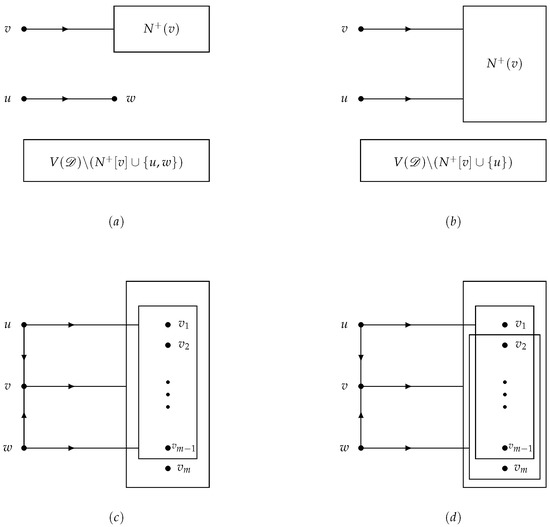
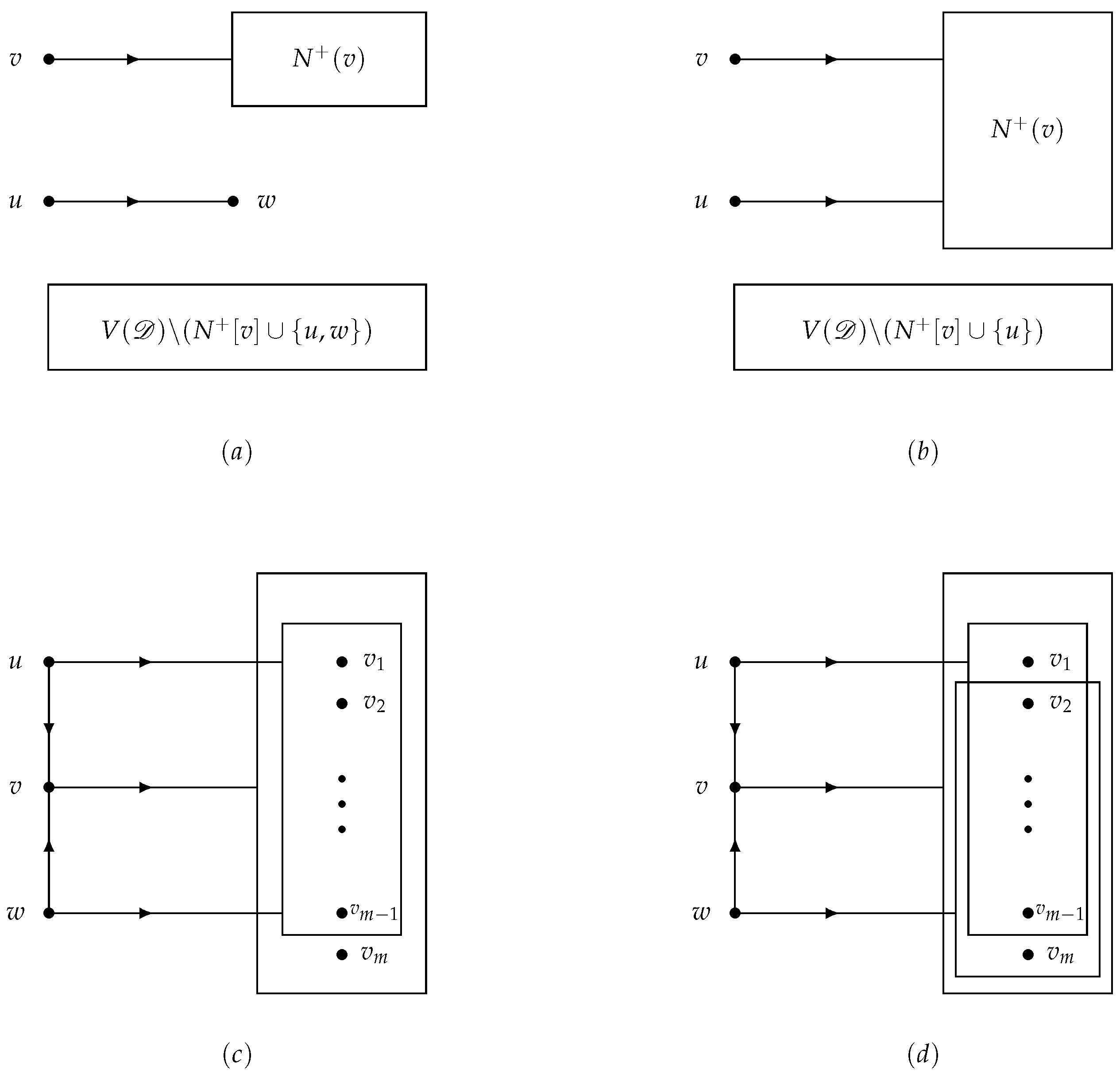
Proving by contradiction, assume that there exists a vertex such that (see Figure 2a). Let be defined as follows: , for any vertex , , and otherwise. Then is a -RDF on . Thus, , a contradiction. □
Figure 2.
The counterexample of Claims 1–4 in Theorem 7.
Claim 2: For any vertex , it must be that .
Proof.
Proving by contradiction, assume that there exists a vertex such that . Because , given Claim 1, (see Figure 2b). Let be defined as follows: for any vertex and otherwise. Then, is a -RDF on , and so , a contradiction. □
Claim 3: .
Proof.
Proving by contradiction, assume that there are two vertices . Given Claim 2, we have . Because , by Claim 1, we find that either or . Let . If , then we may assume (see Figure 2c). Define a function such that for any vertex and otherwise. Then, is a -RDF on and , a contradiction. If , without loss of generality, let and (see Figure 2d). Define a function such that for any vertex and for any vertex and otherwise. Then, is a -RDF on and , a contradiction. □
From Claim 3, we have for any vertex . Notice that the discussion is symmetrical for and . Without loss of generality, we may assume . Thus, , which means that , a contradiction. Consequently, .
5. Relations between the [k]-RD-Number and Other Domination Parameters
In this part, we give relations including with , and . We begin with the relationship between and .
Lemma 2.
Let be a digraph and a -function. Then, .
Proof.
Define a function by for , for , and otherwise. It is easy to verify that g is a -RDF of weight . Hence, . □
Theorem 8.
Let be any digraph. Then, .
Proof.
Firstly, we prove the lower bound of the inequality. Let be a -function. Define a function by for any vertex and otherwise. Then, g is a -RDF, and so . If , then . Clearly, there is at least one non-empty set . Choose a vertex with and let be a function defined by , otherwise. It is not difficult to see that for any vertex . Then, h is a -RDF and , a contradiction. Thus, .
Furthermore, we prove the upper bound of the inequality. Let be a -function. From Lemma 2, we have
□
Next we consider and .
Theorem 9.
Let be a digraph. Then, . Furthermore, if and only if there is a -function such that .
Proof.
Let be a -set. Define a function such that for any vertex and otherwise. Then, g is a -RDF on and .
Below, we prove the necessity and sufficiency.
Suppose that . Let be defined as follows: for any vertex and otherwise. Then, is a -RDF on with weight . Thus, is a -function with .
Let be a -function with . Then, is a dominating set of . This implies that , and so . On the other hand, , hence . □
Theorem 10.
Let be a digraph of order n with maximum out-degree and domination number . Then, .
Proof.

Let be a -function with , where , for . Because the maximum out-degree of is , v has at most out-neighbours in for any vertex . This means that . For any positive integer , we know that given the definition of -RDF, where is the minimum value of for . Clearly, . When , there exist at least two in-neighbours in for any vertex of , . Thus, . Finally, there exist at least k in-neighbours in for any vertex , and thus . Because and , we have that
Let . There exist at least s in-neighbours of the whole vertex of included in . Combined with the inequality (1), we can obtain the results shown in Table 1.
Table 1.
The bound of when the s in-neighbours originate from different sets.
From Table 1, it is not difficult to see that wherever the in-neighbours originate from.
That is, . This means that
It is obvious that, is a dominating set of . Therefore,
□
We are now in a position to relate and , and here is a useful result from [4].
Theorem 11
([4]). Let be a bipartite graph with . If , then .
Theorem 12.
Let be a digraph of order n. Then, .
Proof.
Let be a -function, and represent the vertex sets assigned as and 1 under f, respectively. Then, we have and , which implies that .
If , then . Define a function by for each vertex of . Then, g is a -RDF on and hence .
If , let be the bipartite spanning subdigraph of satisfying that and . Because is a -function, we find that every vertex in has at least two in-neighbours in by the definition of SDF. Thus, , where . Let be the underlying graph of . Then, . Let be a -set. From Theorem 11, we have . According to the definition of the left dominating set, every vertex in has a neighbour in . Hence, every vertex in has an in-neighbour in for and . Let , define a function such that for any vertex , for any vertex and for any vertex . Then g is a -RDF on . Then, we have
The proof is completed. □
6. The [k]-RD-Numbers of the Directed Path and the Directed Cycle
In this section, we determine the exact values for the [k]-RD-numbers of and .
Proposition 4.
Let be a positive integer. Then
Proof.
Let be a directed path with . When , let be defined as follows: and for . Then, is a -RDF on , and so . When , let be defined as follows: , and for . Then, is a -RDF on , and so .
On the other hand, let be a -function. We prove the inverse inequality by induction on n. If , then . If , then . Suppose that the inverse inequality is true for each of order m with . When , then . When , notice that . Hence, .
Consequently,
□
Proposition 5.
Let be a positive integer. Then
where all subscripts are taking module n.
Proof.
Let be a directed cycle with . When , let be defined as follows: and for . Then, is a -RDF on , and so . When , let be defined as follows: and for . Then, is a -RDF on , and so .
On the other hand, let be a -function. When , notice that for . Hence, . When , it is easy to see that there is one vertex such that for , and . Without loss of generality, we assume that for , and . This means that . Hence, .
Consequently,
□
Author Contributions
Conceptualization, X.Z. and X.S.; methodology, X.S.; validation, X.Z., X.S. and R.L.; investigation, X.S.; resources, X.Z.; writing—original draft preparation, X.Z., X.S. and R.L.; writing—review and editing, X.Z. and X.S.; funding acquisition, X.Z. and R.L. All authors have read and agreed to the published version of the manuscript.
Funding
This research was funded by the Fundamental Research Program of Shanxi Province (grant number 20210302123202). This research was funded by the Youth Foundation of Shanxi Province (grant number 201901D211197).
Institutional Review Board Statement
Not applicable.
Informed Consent Statement
Not applicable.
Data Availability Statement
Numerical data is available on demand from Xinhong Zhang.
Acknowledgments
We would like to thank the anonymous referee for a thorough and helpful reading of the paper and Murat Cancan for his help in this paper too.
Conflicts of Interest
The authors declare no conflict of interest.
References
- Haynes, T.W.; Hedetniemi, S.T.; Slater, P.J. Fundamentals of Domination in Graphs; Marcel Dekker, Inc.: New York, NY, USA, 1998. [Google Scholar]
- Haynes, T.W.; Hedetniemi, S.T.; Slater, P.J. Domination in Graphs: Advanced Topics; Marcel Dekker, Inc.: New York, NY, USA, 1998. [Google Scholar]
- Caro, Y.; Henning, M.A. Directed domination in oriented graphs. Discret. Appl. Math. 2012, 160, 1053–1063. [Google Scholar] [CrossRef]
- Ahangar, H.A.; Henning, M.A.; Lowenstein, C.; Zhao, Y.; Samodivkin, V. Signed Roman domination in graphs. J. Comb. Optim. 2014, 27, 241–255. [Google Scholar] [CrossRef]
- Karami, H.; Sheikholeslami, S.M.; Khodkar, A. A lower bounds on the signed domination numbers of directed graphs. Discret. Math. 2009, 309, 2567–2570. [Google Scholar] [CrossRef]
- Chambers, E.W.; Kinnersley, B.; Prince, N.; West, D.B. Extremal problems for Roman domination. SIAM J. Discret. Math. 2009, 23, 1575–1586. [Google Scholar] [CrossRef]
- Favaron, O.; Karami, H.; Khoeilar, R.; Sheikholeslami, S.M. On the Roman domination number of a graph. Discret. Math. 2009, 309, 3447–3451. [Google Scholar] [CrossRef]
- Bermudo, S.; Fernau, H.; Sigarreta, J.M. The differential and the roman domination number of a graph. Appl. Anal. Discret. Math. 2014, 8, 155–171. [Google Scholar] [CrossRef]
- Cockayne, E.J.; Dreyer, P.A., Jr.; Hedetniemi, S.M.; Hedetniemi, S.T. Roman domination in graphs. Discret. Math. 2003, 266, 239–251. [Google Scholar] [CrossRef]
- Poureidi, A.; Rad, N.J. On algorithmic complexity of double Roman domination. Discret. Appl. Math. 2020, 285, 539–551. [Google Scholar] [CrossRef]
- Ahangar, H.A.; Álvarez, M.P.; Chellali, M.; Sheikholeslami, S.M.; Valenzuela-Tripodoro, J.C. Triple Roman domination in graphs. Appl. Math. Comput. 2021, 391, 125444. [Google Scholar]
- Pour, F.N.; Ahangar, H.A.; Chellali, M.; Sheikholeslami, S.M. Global triple Roman dominating function. Discret. Appl. Math. 2022, 314, 228–237. [Google Scholar] [CrossRef]
- Hao, G.; Chen, X.; Volkmann, L. Double Roman Domination in Digraphs. Bull. Malays. Math. Sci. Soc. 2019, 42, 1907–1920. [Google Scholar] [CrossRef]
- Zhang, X.; Guo, Y.; Li, R. The Roman domination of Kautz digraphs and generalized Kautz digraphs. Pure Appl. Func. Anal. 2023; in press. [Google Scholar]
- Zhang, X.; Guo, Y. The Roman domination numbers of the directed de Bruijn and generalized directed de Bruijn graphs. Open Math. 2023; in press. [Google Scholar]
- Harary, F.; Norman, R.Z.; Cartwright, D. Structural Models; Wiley: New York, NY, USA, 1965. [Google Scholar]

Disclaimer/Publisher’s Note: The statements, opinions and data contained in all publications are solely those of the individual author(s) and contributor(s) and not of MDPI and/or the editor(s). MDPI and/or the editor(s) disclaim responsibility for any injury to people or property resulting from any ideas, methods, instructions or products referred to in the content. |
© 2023 by the authors. Licensee MDPI, Basel, Switzerland. This article is an open access article distributed under the terms and conditions of the Creative Commons Attribution (CC BY) license (https://creativecommons.org/licenses/by/4.0/).