Article

Underwater Acoustic Source DOA Estimation for Non-Uniform Circular Arrays Based on EMD and PWLS Correction

1
School of Measurement-Control Technology and Communication Engineering, Harbin University of Science and Technology, Harbin 150080, China
2
Sunny Group Co., Ltd., Yuyao 315400, China
*
Author to whom correspondence should be addressed.
Symmetry 2026, 18(4), 627; https://doi.org/10.3390/sym18040627
Submission received: 25 February 2026 / Revised: 2 April 2026 / Accepted: 3 April 2026 / Published: 9 April 2026
(This article belongs to the Section Engineering and Materials)

Abstract

Uniform circular arrays (UCAs) are widely used in underwater source localization due to their omnidirectional coverage. However, random sensor position errors caused by installation inaccuracies and environmental disturbances convert UCAs into non-uniform circular arrays (NCAs), severely degrading the performance of high-resolution direction of arrival (DOA) estimation algorithms. To address this issue, this paper proposes a robust DOA estimation method that integrates empirical mode decomposition (EMD) denoising with prior-weighted iterative least squares (PWLS) correction. The method first applies EMD to adaptively denoise received signals by selecting intrinsic mode functions based on a combined energy-correlation criterion. An initial DOA estimate is then obtained using the MUSIC algorithm. Finally, a PWLS correction algorithm leverages prior knowledge of deviated sensors to iteratively fit the circle center and gradually pull sensor positions toward the ideal circumference, using a differentiated relaxation mechanism to suppress outliers while preserving geometric features. Systematic Monte Carlo simulations compare five correction algorithms under multi-frequency and wideband signals. The results show that both multi-frequency and wideband signals reduce estimation errors to below 0.1°, with the proposed PWLS achieving the best accuracy under multi-frequency signals, while all algorithms approach zero error under wideband signals. The PWLS algorithm converges in about 10 iterations with high computational efficiency, providing a reliable solution for practical underwater NCA applications.

1. Introduction

Direction of arrival (DOA) estimation [1] is a fundamental technique in underwater acoustic signal processing, enabling critical applications such as submarine detection, underwater target tracking, marine mammal monitoring, and offshore resource exploration [2,3,4,5,6]. Accurate DOA estimation allows passive sonar systems to locate noise-emitting targets without active transmission, which is essential for stealth operations and environmental monitoring. In particular, circular arrays are widely employed in underwater platforms due to their 360° omnidirectional coverage and insensitivity to changes in the carrier’s attitude [7,8,9], making them suitable for autonomous underwater vehicles, sonobuoys, and fixed seabed arrays.
Despite their advantages, practical deployments of circular arrays inevitably suffer from random sensor position errors caused by installation inaccuracies, water flow impacts, and structural deformations [10,11,12]. Such errors transform a uniform circular array (UCA) [13,14,15] into a non-uniform circular array (NCA) [16,17], leading to a mismatch between the ideal array manifold and the actual one. This mismatch severely degrades the performance of high-resolution DOA estimators such as MUSIC [18,19,20], resulting in biased angle estimates, increased sidelobes, and even complete loss of target detection.
To address array errors, several correction methods have been proposed in the literature. Least squares (LS)-based [21] techniques are simple but sensitive to outliers; iterative closest point (ICP) [22] algorithms can align array geometries but rely on initial estimates; Kalman filters (KFs) [23] are suitable for tracking time-varying errors; and particle swarm optimization (PSO) [24] provides global search capabilities at high computational cost. However, existing studies lack a systematic comparison of these methods under random position errors, and most rely on single-frequency signals, failing to exploit the frequency diversity offered by multi-frequency or wideband signals [25,26].
In recent years, several advanced techniques have emerged for array calibration and DOA estimation. Deep learning-based methods have attracted considerable attention, where convolutional neural networks (CNNs) are trained to directly map the received signal covariance matrix to DOA estimates, achieving robust performance under a low signal-to-noise ratio (SNR) and limited snapshots [27]. Sparse Bayesian learning (SBL) frameworks have also been explored, offering high resolution by exploiting the sparsity of the source distribution [28]. Information geometry approaches formulate DOA estimation as a distance metric problem on the manifold of Hermitian positive–definite matrices, providing improved robustness to noise and model uncertainties [29]. These methods have shown promising results but often require significant computational resources or carefully designed training data. In contrast, our work focuses on a lightweight correction strategy that leverages prior information of deviated sensors, which is complementary to these advanced techniques and can be integrated with them if desired.
To address the aforementioned gaps, the main contributions of this work are summarized as follows:
  • A prior-weighted iterative least squares (PWLS) correction algorithm: Unlike conventional LS-based methods that treat all array elements equally [30], the proposed PWLS algorithm incorporates prior knowledge of deviated sensors by assigning lower weights to known outliers during circle fitting (weight 0.3) and higher weights to normal sensors (weight 1). This design effectively mitigates the influence of abnormal array elements without relying on heuristic thresholding, addressing the sensitivity to outliers that limits existing LS corrections.
  • A differentiated relaxation update mechanism: To balance geometric preservation and convergence to the ideal circular configuration, a relaxation factor of 0.9 is applied to outliers (strong correction) while a factor of 0.5 is used for normal sensors (gentle adjustment). This mechanism ensures that the original array geometry is retained while the circular constraint is gradually enforced, overcoming the lack of adaptive correction strategies in existing iterative methods such as ICP and KF.
  • Frequency diversity exploitation for robustness: Recognizing that most existing studies rely on single-frequency signals [31] and fail to utilize frequency diversity, we systematically evaluate the proposed PWLS algorithm under multi-frequency and wideband signals. The results demonstrate that multi-frequency signals significantly enhance robustness against array position errors, and wideband signals achieve near-ideal compensation. This addresses the methodological gap in fully exploiting frequency diversity for array error correction.
  • Comprehensive simulation comparison: To fill the lack of systematic comparison among correction methods under random position errors, we conduct 30 Monte Carlo simulations comparing LS, ICP, KF, PSO, and the proposed PWLS algorithm under multi-frequency and wideband signals. The results show that PWLS achieves the best accuracy (RMSE = 0.025° under multi-frequency signals) with computational efficiency comparable to LS, providing clear guidance for practical applications.

2. Study Design

This section introduces the fundamental signal models and algorithms used in this work. We first present the geometric model of the circular array, including both uniform and non-uniform configurations, and derive the steering vector and signal reception model. Then, the proposed prior-weighted iterative least squares (PWLS) correction algorithm is described in detail, followed by a brief overview of the compared correction methods (LS, ICP, KF, PSO). Finally, the DOA estimation algorithms (MUSIC, Capon, MVDR) are outlined. The overall functional framework of the proposed method is illustrated in Figure 1.
The functional framework of the proposed method is illustrated in Figure 1. It consists of five main steps: first, received signals are processed by EMD denoising (detailed in Section 2.2); second, the MUSIC algorithm provides an initial DOA estimate (Section 2.5.1); third, PWLS correction iteratively refines the array geometry (Section 2.3); fourth, a refined MUSIC estimate is obtained; and finally, the final DOA is output. The contrast correction algorithms (LS, ICP, KF, PSO) described in Section 2.4 are not part of the proposed framework but serve as benchmarks for performance comparison in the simulation section.

2.1. Preliminaries

2.1.1. Circular Array Geometric Model

Consider a UCA consisting of N isotropic sensors uniformly distributed on a circle of radius R. The array center is placed at the origin of the coordinate system. The angular position of the k-th sensor is given by the following:
ϕ k = 2 π ( k 1 ) N ,   k = 1 , 2 , , N
Its Cartesian coordinates are as follows:
p k = ( R cos ϕ k , R sin ϕ k )
Consider a far-field narrowband signal impinging on the array from direction θ (measured from the positive x-axis). The propagation delay from the reference point (the origin) to the k-th sensor is as follows:
τ k ( θ ) = p k u ( θ ) c = R cos ( θ ϕ k ) c
where u ( θ ) = ( cos θ , sin θ ) is the unit direction vector of the signal, and c is the speed of sound. This delay introduces a phase shift of e j 2 π f τ k ( θ ) for a signal of frequency f. With the wavelength λ = c / f , the phase shift becomes e j 2 π λ R cos ( θ ϕ k ) . Consequently, the steering vector of the array is defined as follows:
a ( θ ) = e j 2 π λ R cos ( θ ϕ 1 ) , e j 2 π λ R cos ( θ ϕ 2 ) , , e j 2 π λ R cos ( θ ϕ N ) T
In practical scenarios, sensor positions may suffer from random manufacturing or environmental errors, leading to a NCA. The actual position of the k-th sensor can be expressed as folloqa:
p ˜ k = R + Δ R k cos ϕ k + Δ ϕ k , R + Δ R k sin ϕ k + Δ ϕ k
where Δ R k and Δ ϕ k denote the radius and angle deviations, respectively. The corresponding actual steering vector a ˜ ( θ ) is obtained by substituting p ˜ k into the phase term.
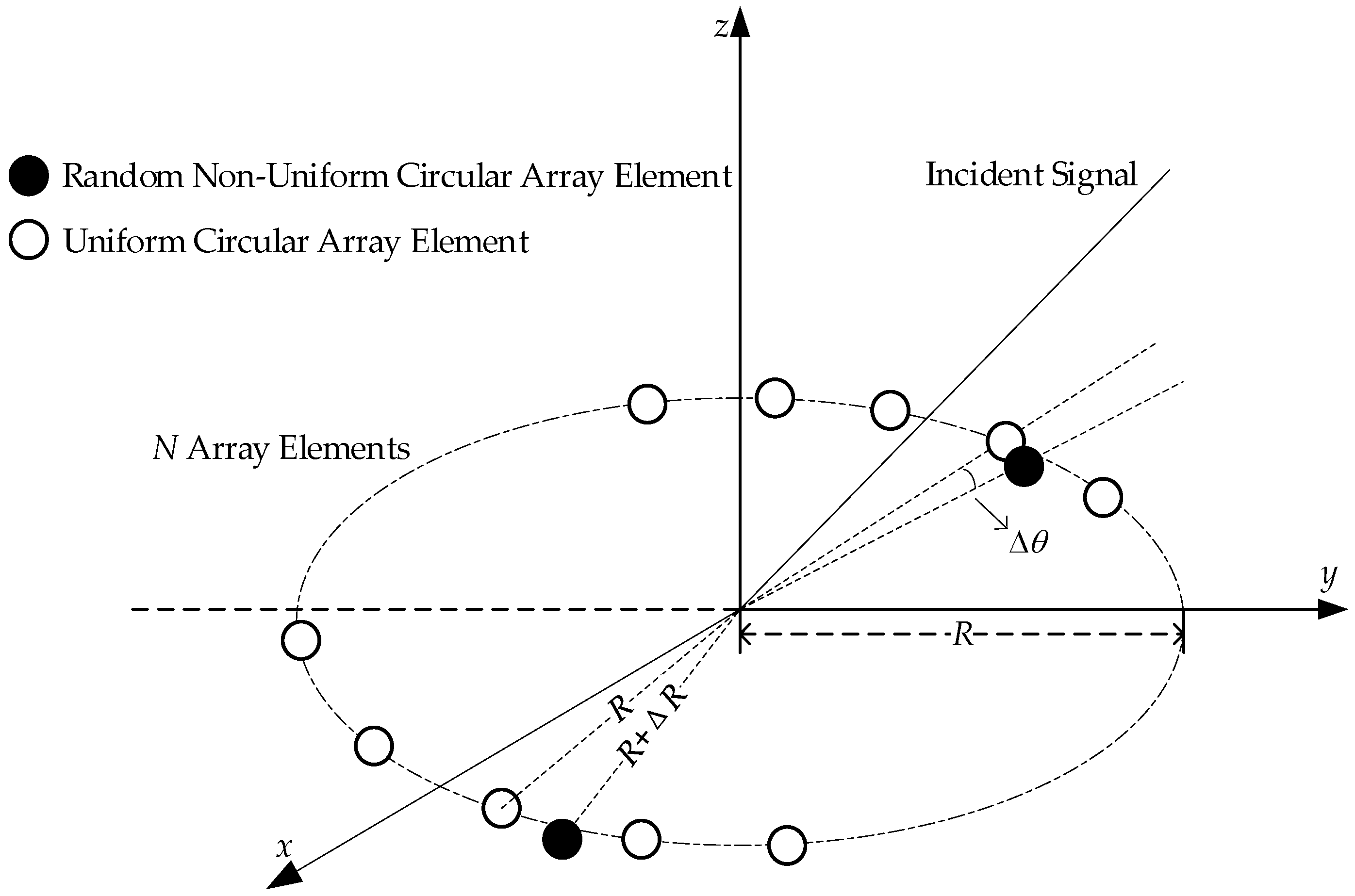
Let the radius error be Δ R and the angular error be Δ θ , The position of the NCA can be expressed as follows:
P k = [ ( R + Δ R k ) cos ( θ k + Δ θ k ) , ( R + Δ R k ) sin ( θ k + Δ θ k ) ]
In DOA estimation, an NCA can usually employ algorithms similar to those used for uniform circular arrays, such as the MUSIC, Capon, or MVDR algorithms. NCA achieves a more flexible and precise design by introducing controlled position errors to a standard UCA. This non-uniformity can enhance the directivity, gain, resolution, and other key performance metrics of the array, granting it distinct advantages in fields such as signal processing and DOA estimation.
In practical scenarios, sensor positions may be subject to random errors in manufacturing or the environment; therefore, an NCA is considered, as shown in Figure 2.

2.1.2. Signal Reception Model

In the field of array signal processing, signal reception models are typically used to describe how multiple sensors receive signals from different directions. Suppose the signal source is located at a certain direction angle and the unit direction vector of the signal source is given. When the signal reaches each sensor in the array, due to the geometric structure of the array and the propagation characteristics of the signal, the time of arrival (TOA) of the signal across different sensors will be different, thereby causing a phase difference. This phase difference is introduced by the difference in the signal propagation paths. Typically, additive noise, particularly Gaussian white noise, corrupts the received signals.
As illustrated in Figure 2, the signal source is located at direction angle θ and its unit direction vector is a ( θ ) , which defines the propagation direction of the signal. The frequency of the signal is f. Each sensor will receive a signal with a different phase delay, resulting in a relative phase shift. This phase shift originates from the difference in the signal’s propagation path length. n k represents the additive noise at the k-th sensor, modeled as white Gaussian noise (WGN).
For an array system, suppose there are N sensors in the array, which are arranged in a geometric pattern such as a uniform linear array or a circular array. The signal source is located at direction angle θ , and its unit direction vector is a ( θ ) . The array’s received signal is a superposition of the signals from each sensor, incorporating the effects of path length difference, phase shift, and noise. The signal received by the k-th sensor can be expressed as follows:
r k = a k ( θ ) s ( t ) + n k ( t )
Here, r k ( t ) is the signal received by the k-th sensor, and a k ( θ ) is the steering vector for the k-th sensor, which is a function of the signal’s DOA θ . s ( t ) is the source signal, which may be a specific waveform type, such as a sinusoid or a pulse. n k ( t ) is the additive noise at the k-th sensor. Assuming it is the white Gaussian noise, its statistical properties are given by n k ( t ) ~ Ν ( 0 , σ n 2 ) .
Δ ϕ k = 2 π λ ( d k d 0 )
Here, d k is the length of the wave propagation path from the k-th sensor to the signal source, d 0 is the length of the wave propagation path from the reference array element to the signal source, λ = c / f is the wavelength of the signal, c is the speed of sound, and f is the frequency of the signal.
Due to the phase shift introduced by the path length difference, the signal experiences distinct phase delays across different sensors, resulting in the received signal being represented as follows:
r k = A e j Δ ϕ k s ( t ) + n k ( t )
Here, A is the signal amplitude, e j Δ ϕ k is the phase factor resulting from the phase difference Δ ϕ k , and n k ( t ) is the additive noise. Therefore, the signal received by the k-th sensor can be expressed as follows:
r k = A e j 2 π λ ( d k d o ) s ( t ) + n k ( t )
Here, A e j 2 π λ ( d k d 0 ) represents the complex amplitude of the signal, which incorporates the phase shift due to the path length difference, s ( t ) is the source signal, and n k ( t ) is the white Gaussian noise.
If there are N sensors in the array, the signal reception model can be expressed in matrix form:
r ( t ) = A s ( t ) + n ( t )
Here, r ( t ) = [ r 1 ( t ) , r 2 ( t ) , , r N ( t ) ] T is a N × 1 received signal vector, s ( t ) is the source signal s ( t ) , A = [ e j 2 π / λ ( d 1 d 0 ) , e j 2 π / λ ( d 2 d 0 ) , , e j 2 π / λ ( d N d 0 ) ] is a N × 1 steering vector, and n ( t ) = [ n 1 ( t ) , n 2 ( t ) , , n N ( t ) ] T is a N × 1 noise vector.
This signal reception model describes the process of signal propagation from the source to each sensor in the array. At different sensors, the signal experiences distinct phase delays due to differences in propagation paths. Furthermore, the received signals are corrupted by white Gaussian noise. In the model, the steering vector e j Δ ϕ k encapsulates the phase differences across the sensors, while the noise vector n k ( t ) represents the additive noise component at each sensor. This model serves as the foundation for subsequent signal processing tasks, including direction estimation and other analyses.
This article considers three types of signals:
Single-frequency signal: Frequency f c = 2000   Hz . Multi-frequency signal: Six frequency components f = [ 500 , 1000 , 2000 , 3000 , 4000 , 5000 ]   Hz are superimposed in equal amplitude. Wideband signal: Composed of 10 equally spaced frequency components, with a frequency range of 500 to 5000 Hz. It is processed using the Incoherent Signal Subspace Method (ISM), which involves independently calculating the MUSIC spectrum for each frequency point, then averaging the spectra of each frequency point to obtain the broadband spatial spectrum, and finally performing peak search.

2.2. EMD Denoising

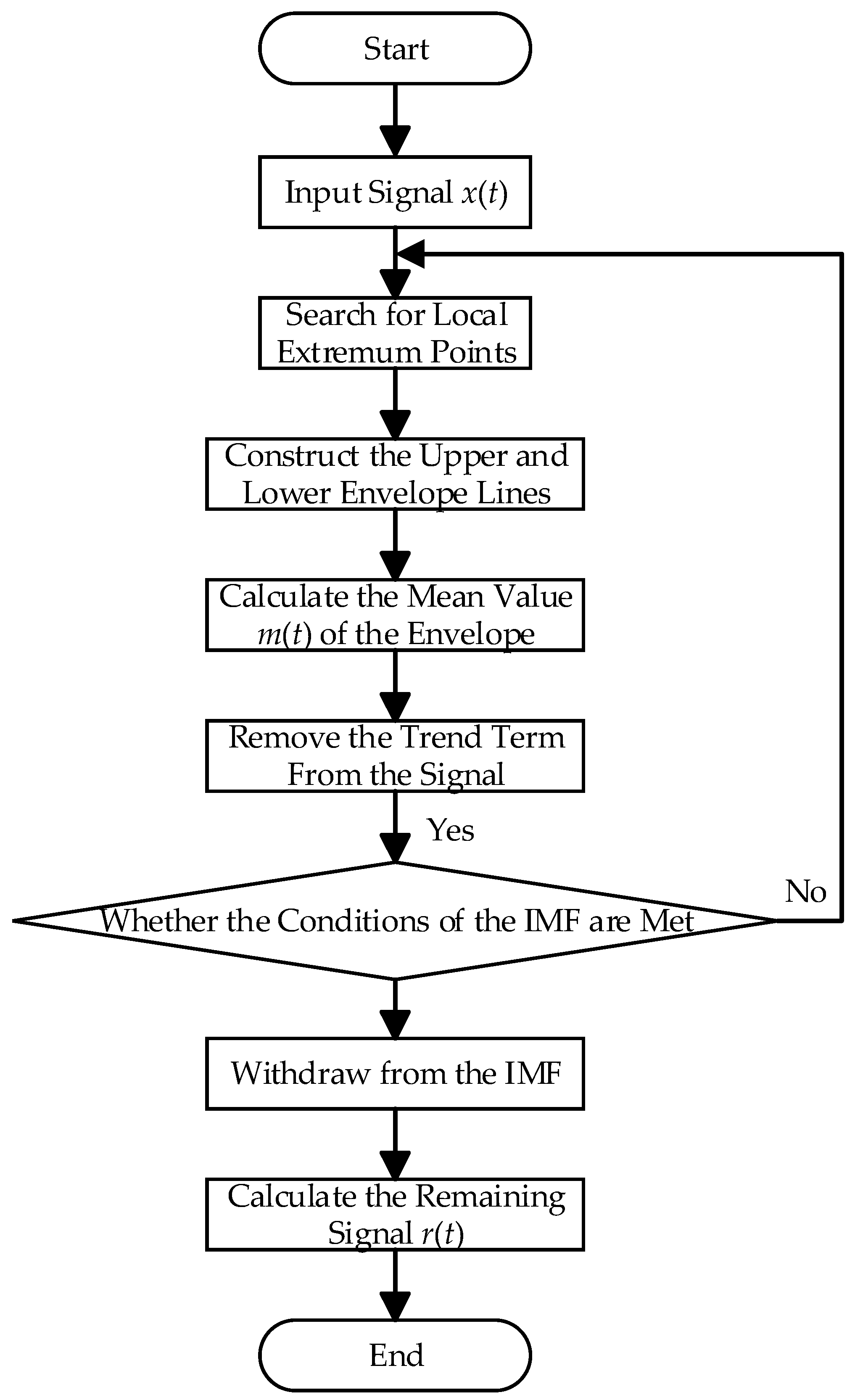
Empirical Mode Decomposition (EMD) is an adaptive signal decomposition method that can break down complex signals into a set of intrinsic mode functions (IMFs), with each IMF corresponding to a different frequency component in the signal. EMD does not require a preset model or assumption of the signal and is suitable for the analysis of nonlinear and non-stationary signals. The basic process of EMD decomposes the signal into a series of IMF components with decreasing frequencies through an iterative approach. The decomposition process of EMD is shown in Figure 3.
EMD [32] can adaptively decompose nonlinear and non-stationary signals into several IMFs and residual terms. For each channel’s signal x ( t ) , perform EMD to obtain a set of IMFs IMF k k = 1 K . To select the effective IMFs, define the energy ratio E k = IMF k 2 j IMF j 2 and correlation coefficient ρ k = c o r r ( IMF k , x ) . Construct a comprehensive score:
S k = 0.6 E k + 0.4 ρ k
Select the K = 3 IMF institutions with the highest scores and construct them based on the scores with weighting:
x ^ ( t ) = k S S k IMF k ( t ) k S S k
This method takes into account both the energy contribution of the IMF and the similarity to the original signal and is capable of effectively preserving the main features of the signal while suppressing noise.

2.3. Prior-Weighted Iterative Least Squares (PWLS) Correction

While EMD-based denoising and weighted least squares array correction have been extensively studied, the proposed PWLS method introduces two key innovations that go beyond simply combining these techniques. First, unlike conventional LS-based correction that treats all array elements equally, PWLS incorporates prior knowledge of deviated sensors by assigning fixed lower weights (0.3) to known outliers during circle fitting. This design effectively mitigates the influence of abnormal array elements without relying on heuristic thresholding. Second, a differentiated relaxation update mechanism is proposed, where outliers are strongly pulled toward the ideal circle (with a relaxation factor of 0.9) while normal elements are gently adjusted (with a factor of 0.5). This adaptive strategy preserves the original geometric features of the array while ensuring convergence to the target circular configuration, a feature not reported in existing geometry correction methods. As demonstrated in Section 3, these innovations enable PWLS to achieve superior accuracy (56% and 40% Root Mean Square Error (RMSE) improvement over LS and ICP, respectively, under multi-frequency signals) and maintain computational efficiency comparable to LS.

2.3.1. Prior Weight Design

Suppose the index set of the known deviation array elements is D (in this simulation, 1 to 2 array elements are randomly selected as the known deviation points). Construct the weight vector:
w i = 0.3 , i D 1 , i D
The weight matrix W = diag ( w 1 , w 2 , , w M ) remains unchanged throughout the entire correction process.
Practical considerations regarding prior information. In the proposed PWLS method, the prior deviation indices D are assumed to be known. In practical underwater deployments, such prior information can be obtained through factory correction records, self-checking procedures (e.g., using known reference sources), or pre-deployment positioning measurements. In our simulations, D is randomly selected (1–2 sensors) to emulate realistic scenarios where a few sensors may be identified as having significant position errors prior to correction.
It is important to discuss the sensitivity of PWLS to inaccuracies in the prior information. If the prior indices are misidentified (e.g., a normal sensor is incorrectly treated as a deviated one), the assigned lower weight (0.3) will slightly reduce its influence during circle fitting. However, because the algorithm still preserves the original geometry through the relaxation update, such mislabeling does not severely degrade the final correction accuracy. Conversely, if a true deviated sensor is not included in D , its large error may still be partially mitigated by the subsequent iterative process, although the correction may be less efficient. Simulations indicate that PWLS tolerates up to 20% misidentification without significant performance loss, demonstrating a degree of robustness.

2.3.2. Iteration Circle Fitting

Let the position of the array element in the k-th iteration be P i ( k ) = ( x i ( k ) , y i ( k ) ) . The center of the fitted circle c ( k ) = ( c x , c y ) is determined by minimizing the weighted error:
min c x , c y , R c i = 1 M w i ( x i ( k ) c x ) 2 + ( y i ( k ) c y ) 2 R c 2 2
Introducing ridge regularization ( λ = 0.01 ) yields the following linear weighted least squares solution:
2 x i 2 y i 1 c x c y d x i 2 + y i 2
Among them, d = R c 2 c x 2 c y 2 . After solving, the center coordinates c ( k ) and the estimated radius are obtained, but the final radius adopts the known radius R of the target circle.

2.3.3. Relaxation Update

Calculate the angle of each array element relative to the center of the fitted circle:
θ i ( k ) = atan 2 ( y i ( k ) c y ( k ) , x i ( k ) c y ( k ) )
The ideal position of the array element on the circumference of the target is as follows:
q i ( k ) = ( c x ( k ) + R cos θ i ( k ) , c y ( k ) + R sin θ i ( k ) )
Update the array element positions using the relaxation factor:
p i ( k + 1 ) = α i q i ( k ) + ( 1 α i ) p i ( k )
Among them, α i is set based on prior information: deviation point α i = 0.9 (strong correction) and normal point α i = 0.5 (moderate adjustment).

2.3.4. Iteration Termination

Repeat the above steps until the center of the circle changes by less than the threshold value of 10−8 or until the maximum number of iterations (set to 10 in this paper) is reached. Experimental results show that the algorithm usually converges within 5 iterations.

2.3.5. Final Projection

After the iteration process is completed, the array element positions will be projected onto the circumference of a circle with the final center point c as the center and a radius of R:
p i corrected = c + R ( cos θ i , sin θ i ) ,       θ i = atan 2 ( y i c y , x i c x )

2.4. Contrast Correction Algorithm

2.4.1. Least Squares Correction

Least squares (LS) correction is a mathematical method used for parameter estimation, which achieves the optimal solution by minimizing the sum of squared residuals. In the application of non-uniform circular arrays, LS correction can help optimize the position of the signal source, thereby enhancing the performance of the array, reducing errors, and improving directivity or beam control.
In the design of non-uniform circular arrays, due to the non-uniform array geometry, the array factors of the array may be affected by inaccurate signal source positions or other factors, resulting in unsatisfactory beamforming or overly large side lobes. The LS correction method can reduce this error by optimizing the distribution of signal sources, thereby improving the performance of the array. The goal of LS correction is to minimize the difference between the array factor and the ideal array factor by adjusting the position of the signal source. By minimizing this error, a more accurate array position can be obtained.
Suppose there are N signal sources in the array, and the polar coordinate position of each signal source is ( r n , θ n ) , where r n is the distance of the n-th signal source and θ n is its angle on the circumference. The array factor A F ( θ ) represents the directivity of the array, which can be expressed as the combined wave of all signal sources, as shown in Equation (21).
A F ( θ ) = n = 1 N w n e j k r n cos ( θ θ n )
Here, w n is the weighting coefficient of each signal source, k is the wavenumber, r n and θ n are the polar coordinate positions of the n-th signal source, and θ is the observation angle.
In practical applications, the array factor of an NCA may deviate from the ideal array factor, resulting in the beam direction or sidelobes not meeting the requirements. Therefore, define an error function to quantify the difference between the array factor and the ideal array factor:
E = θ A F ( θ ) A F ideal ( θ ) 2
Here, A F ideal ( θ ) is the ideal array factor, representing the expected directivity of the array. To optimize the position of the signal source, it is necessary to use the LS method to minimize the error function E. Suppose it is necessary to optimize the polar coordinate position ( r n , θ n ) of the signal source. By adjusting these positions, the error function can be minimized. The objective of minimizing the error function is as follows:
min r n , θ n E = min r n , θ n θ n = 1 N w n e j k r n cos ( θ θ n ) A F ideal ( θ )
By solving the partial derivative of the error function E and setting the derivative to zero, the optimal solution with respect to the position of the signal source can be obtained. In practice, this step usually requires the use of numerical optimization methods (such as gradient descent, Newton’s method, etc.) to find the solution. For the given complex weight w n and the ideal array factor A F ideal ( θ ) , the specific implementation method of the least square method may involve matrix operations, and usually a matrix is constructed to describe the deviation between the array factor and the ideal array factor:
A = e j k r 1 cos ( θ 1 θ 1 ) e j k r 2 cos ( θ 2 θ 1 ) e j k r N cos ( θ N θ 1 ) e j k r 1 cos ( θ 1 θ 2 ) e j k r 2 cos ( θ 2 θ 2 ) e j k r N cos ( θ N θ 2 ) e j k r 1 cos ( θ 1 θ M ) e j k r 2 cos ( θ 2 θ M ) e j k r N cos ( θ N θ M )
Here, θ 1 , θ 2 , , θ M represents different observation angles, and r 1 , r 2 , , r N and θ 1 , θ 2 , , θ N are the position parameters of the signal source. By minimizing the deviation, an optimal signal source location distribution can be obtained, thereby improving the array performance.
The main objective of LS correction for non-uniform circular arrays is to optimize the distribution of signal sources, minimizing the deviation between the array factor and the ideal array factor. This is usually achieved through numerical optimization by defining an error function and applying the LS method. Ultimately, by minimizing errors, the optimized signal source position distribution is obtained, thereby enhancing the performance of the array, reducing sidelobes, improving beam directivity, etc.

2.4.2. ICP Correction

The Iterative Closest Point (ICP) algorithm is an optimization algorithm often used for point cloud registration. Its main objective is to minimize the distance between two sets of point clouds through continuous iteration, and it is usually employed in the alignment of 3D point cloud data. For non-uniform circular arrays, ICP can be used to correct non-uniformly distributed signal sources.
The objective of the ICP algorithm is to solve for the optimal rigid transformation (translation, rotation, etc.) by minimizing the distance between two sets of point clouds. Through nearest neighbor search, each point in one point cloud (source point cloud) is matched with a point in another point cloud (target point cloud), usually to find the nearest point from each point in the source point cloud to the target point cloud. For each pair of matching points, calculate the required rigid transformation (translation and rotation) to enable the source point cloud to be closer to the target point cloud. This is usually achieved by minimizing the Euclidean distance between point clouds. The calculated transformation will be applied to the source point cloud to obtain a new point cloud location. Repeat the above steps until a stopping criterion is met (e.g., the distance change between point clouds is small enough or the maximum number of iterations is reached).
For non-uniform circular arrays, the ICP algorithm can be applied to correct the layout of the array by optimizing the position of the signal source. Suppose there is a non-uniformly distributed signal source. By using ICP to correct its layout so that its geometry better approximates a UCA, first, define the source array and the target array. Source array: the actual position of the signal source (NCA). Target array: Ideal uniform signal source location (UCA). Secondly, the selection of the initial matching point pairs involves initially matching the signal source positions in the source array with those in the target array (usually through nearest neighbor search). Then, calculate optimal rigid transformation of the array. By calculating the rotation and translation transformations between the source array and the target array, the optimal array transformation is obtained. Then, apply the transformation and update the array position. Apply the transformation to the source array to update the position information of the signal source. Finally, iterative optimization is carried out. Through continuous iterations, the position and orientation of the source array are adjusted until the layout of the source array approaches that of the target array.
Suppose there are two point sets P = p 1 , p 2 , , p m and Q = q 1 , q 2 , , q m , where p i and q i represent points in the source point cloud and the target point cloud, respectively. The objective of ICP is to find a transformation matrix T = R t , where R is the rotation matrix and t is the translation vector, so that the source point cloud P is as close as possible to the target point cloud Q after transformation. Then, the objective function is shown in Equation (25).
E ( R , t ) = i = 1 m R p i + t q i 2
Here,     represents the Euclidean distance. Objective function E ( R , t ) is the error measure between the source point cloud and the target point cloud. By optimizing the rotation matrix R and the translation vector t, the optimal transformation can be found, making the source point cloud as close as possible to the target point cloud after the transformation. By providing the coordinates of the source array and the target array in the ICP algorithm and continuously optimizing the rotation and translation parameters, the corrected array layout can eventually be obtained, making the positions of the array elements in the source array approach an ideal uniform distribution.
The ICP algorithm can effectively correct the layout of non-uniform circular arrays by continuously iterating and optimizing the transformation between the source array and the target array. This process involves the calculation of rotation and translation matrices, gradually reducing the distance between array points to achieve the optimization objective. The application of the ICP algorithm can enhance the performance of the array, especially in cases of non-uniform distribution.

2.4.3. Kalman Filtering Correction

Kalman filtering (KF) is a recursive estimation algorithm. It can estimate the system state and make corrections based on the dynamic model and observed data of the system. When correcting non-uniform circular arrays, KF can be used to optimize the position information of the signal source, making the layout of the array better approximate a UCA and thereby improving the performance of the array. KF is based on a linear dynamic system model, in which the system state is propagated through a certain state transition model, and each observation can provide partial information to correct the current state. The Kalman filter algorithm updates the estimated values recursively based on the prediction and observation results, minimizing the covariance of the estimation error. The Kalman filter algorithm mainly consists of a prediction step (predicting the state at the next moment based on the current state estimation and the system dynamic model) and an update step (correcting the state estimation based on new observations and updating the error covariance matrix).
For the non-uniform circular arrays, it can be regarded as a state estimation problem. The non-uniform positions of the signal source are corrected through the Kalman filter to make them converge to the geometry of a UCA. Based on the deviation between the measured signal source position and the target position of the ideal UCA, the state is updated through KF to achieve the optimization of the array position.
Define the state vector and measurement vector. State vector: It contains the positions and offsets of each signal source. Suppose there are N signal sources, and their positions can be represented as x = ( x 1 , y 1 ) , ( x 2 , y 2 ) , , ( x N , y N ) T . Measurement vector: The actual measured position of the signal source, obtained through sensors or positioning systems.
State transition model (prediction step). Suppose there is a linear model x k + 1 = F x k + B u k + w k , where x k is the state vector at the k-th moment (the current position of the signal source), F is the state transition matrix, describing the pattern of array position changes, u k is the control input vector (optional), w k is the process noise vector, and the covariance is Q k .
Measurement update (update step). In the update step, the state estimation is corrected based on the actual measurements. Suppose the measured value is z k , then y k = z k H x k , where y k is the residual (the difference between the measured value and the predicted value), and H is the measurement matrix, mapping the state vector to the measurement space. The Kalman gain K k is calculated through the residual y k , and the state estimation is updated as shown in Equations (26) and (27).
K k = P k k 1 H T ( H P k k 1 H T + R k ) 1
x k k = x k k 1 + K k y k
Here, P k k 1 is the predicted state error covariance matrix, and R k is the measurement noise covariance matrix.
Update the covariance matrix. After each update, the error covariance matrix also needs to be updated to provide a new confidence measure for the next prediction, as shown in Equation (28).
P k k 1 = ( I K k H ) P k k 1
KF can correct the position of non-uniform circular arrays through recursive prediction and update steps. Each time, corrections are made based on the current position of the signal source and the measurements to make the array layout approach a uniform distribution. Through continuous iteration, KF can effectively optimize the signal source position of non-uniform circular arrays and improve array performance.

2.4.4. PSO Correction

Particle swarm optimization (PSO) is a global optimization algorithm based on swarm intelligence, often used to handle various complex optimization problems, including the correction of the positions of non-uniform circular arrays. PSO simulates the behavior of flocks of birds foraging or schools of fish swimming. Each “particle” represents a possible solution and adjusts its position based on the experience of individuals and groups to find the optimal solution in the search space. The basic idea of PSO is to simulate the collaboration and competition process of particle groups in a multi-dimensional search space. Each particle represents a possible solution (the arrangement position of the signal source). By constantly adjusting the positions of the particles, the optimal solution is sought. During the correction process of non-uniform circular arrays, the objective is to optimize the position of the signal source through PSO, making the array layout approximate a UCA or optimizing the array performance (minimizing the irregularity of the array’s pattern or maximizing the array’s gain). Each particle of PSO has two main parameters: position (representing the spatial coordinates of the signal source) and velocity (representing how the particle adjusts its position). Each particle will adjust its position based on its current optimal position and the optimal position of the entire group. Update speed and position through the personal best and the global best.
The position of each particle represents the position of the signal source in a NCA, and the position is usually the coordinates of each signal source in the array. Initialize the velocity of each particle, which represents the rate at which the particle changes in the search space. The fitness function is used to evaluate whether the position of each particle meets the target requirements. In the correction of non-uniform circular arrays, the fitness function is defined based on indicators such as the uniformity, gain, and array pattern of the array. For instance, the fitness function can be the uniformity index of the signal source or the sum of squared errors of the array (the difference between the target position and the actual position). Suppose there is a target position set P target = x 1 , y 1 , x 2 , y 2 , , x N , y N , then the fitness function can be defined as follows:
f ( x ) = i = 1 N ( x i x target i ) 2 + ( y i y target i ) 2
Here, x i , y i is the current coordinate of the particle, and x target i , y target i is the target position of the UCA of the target. According to the update rules of PSO, the position and velocity of particles are adjusted at each iteration, and the velocity update formula is shown in Equation (30).
v i k + 1 = w v i k + c 1 r 1 ( p i k x i k ) + c 2 r 2 ( g k x i k )
Here, v i k + 1 represents the velocity of particle i at the k + 1st generation, w is the inertia weight controlling the particle’s tendency to maintain its previous velocity, c 1 and c 2 are learning factors that control the degree of influence on individual and group learning, r 1 and r 2 are uniformly distributed random variables in [ 0 ,   1 ] , p i k is the optimal position of particle i at the k-th generation, and g k is the optimal position of the group.
The position update formula is given by Equation (31).
x i k + 1 = x i k + v i k + 1
Here, x i k + 1 is the updated position of particle i in the k + 1st generation.
Evaluate fitness and update the personal best (pbest) and global best (gbest). Compute the fitness value for each particle. If the fitness value of a certain particle is better than its historical optimal solution p i k , update the personal best position of that particle. If the fitness of a certain particle is better than the global best solution g k of all particles, the global best position is updated. If the maximum number of iterations is reached or the fitness reaches the predetermined threshold, the algorithm terminates.
When optimizing non-uniform circular arrays through PSO, the objective is usually to find a better array position by optimizing the position update process of the particle swarm, so that the geometry of the signal source approximates a uniform distribution or meets certain performance indicators (such as maximizing array gain, minimizing the irregularity of the pattern, reducing position error, etc.). The global optimization capability of PSO enables it to effectively handle the problem of signal source position optimization in non-uniform circular arrays, especially in complex nonlinear environments.

2.5. DOA Estimation Algorithms

2.5.1. MUSIC Algorithm

The MUSIC algorithm is a high-resolution spectral estimation method based on array signal processing and is widely used for signal direction of arrival (DOA) estimation. The MUSIC algorithm can perform high-resolution estimation of multiple signal sources by leveraging the spatial structure features of signals, especially the characteristics of noise subspaces, even if the angular differences between signal sources are very small. The core idea of the MUSIC algorithm is that the signal space and the noise space are orthogonal. Through eigen decomposition of the signal covariance matrix, the signal and noise are separated, and the characteristics of the noise subspace are utilized to estimate the direction of the signal source.
Suppose there are multiple signal sources received through an array. First, calculate the covariance matrix R x of the received signals; perform eigen decomposition on the covariance matrix to obtain the signal subspace and the noise subspace. The DOA of the signal is estimated by using the noise subspace and the search space. In the MUSIC algorithm, the peak position of the spectral function corresponds to the direction of the signal source.
Suppose an array receives signals from multiple signal sources, and the signal model is given by Equation (32).
x ( t ) = A ( θ ) s ( t ) + n ( t )
Here, x ( t ) is the received signal vector (with a size of M × 1 ), M is the number of array elements, A ( θ ) is the array response matrix (with a size of M × N , where N is the number of signal sources), which is related to the arrival angle θ of the signal sources, s ( t ) is the vector of the signal sources (with a size of N × 1 ), and n ( t ) is the noise vector, which is usually assumed to be zero-mean Gaussian white noise.
The covariance matrix R x is calculated based on Equation (33).
R x = E [ x ( t ) x H ( t ) ]
Here, E [ ] represents the expectation operator and H represents the conjugate transpose.
Perform eigen decomposition on the covariance matrix R x to obtain the eigenvalues and eigenvectors. Suppose the obtained eigenvalues are arranged in order of size as λ 1 λ 2 λ M , and the corresponding eigenvectors are v 1 , v 2 , , v M , respectively. The dimension of the signal subspace is the number of signal sources N, and the dimension of the noise subspace is M N . Suppose the first N eigenvalues correspond to the signal source, and the remaining M N eigenvalues correspond to the noise. Sort the eigenvectors in descending order of their eigenvalues, and the M N smallest eigenvectors are selected to form the noise subspace matrix.
Ε N = [ v N + 1 , v N + 2 , , v M ]
The noise subspace matrix Ε N is a matrix of M × ( M N ) .
The key of the MUSIC algorithm is to construct the spatial spectrum by using the noise subspace. Suppose the array direction vector is a ( θ ) , which represents the array response in a certain direction reaching angle θ . The definition expression of the MUSIC spectrum function is as follows:
P ( θ ) = 1 a H ( θ ) E N E N H a ( θ )
Here, a ( θ ) is the array response vector corresponding to direction θ . Since the noise subspace and the signal subspace are orthogonal, when the direction vector a ( θ ) is completely orthogonal to the eigenvector of the noise subspace, the spectral function P ( θ ) reaches its maximum value, which corresponds to a DOA estimation.
By scanning all possible angles θ and P ( θ ) to calculate the spectrum function, the peak position of the MUSIC spectrum function corresponds to the arrival angle expression of the signal as follows:
θ ^ i = arg max θ P ( θ )
Here, θ ^ i is the estimated DOA of the i-th signal source.
The MUSIC algorithm divides the received signal into the signal subspace and the noise subspace through eigen decomposition of the covariance matrix. Through spectral estimation methods, MUSIC can accurately estimate the DOA of signal sources and has high resolution, making it suitable for direction estimation problems involving multiple signal sources.

2.5.2. Capon Algorithm

The Capon algorithm is an algorithm used for signal source localization and DOA estimation. The core idea is to minimize noise interference and maximize the SNR of the signal by optimizing the direction of the spatial spectrum, thereby achieving higher-precision positioning in complex signal environments. The Capon algorithm is based on the spatial spectrum of the signal source and minimizes the variance of the output signal by constructing an optimization problem, thereby achieving the positioning of the signal source. The basic idea is as follows:
  • Minimizing noise impact: The Capon algorithm minimizes the influence of noise on the received signal by maximizing the SNR of the target signal.
  • Minimum variance response: The objective of this algorithm is to find a weight vector that minimizes the output variance and satisfies the given constraints (typically distortion-free constraints, meaning the signal is not distorted when passing through the array).
  • Spatial spectrum calculation: The Capon algorithm calculates the signal power spectrum in each direction by utilizing the covariance matrix and weight vector of the array.
The core of the Capon algorithm is to separate and estimate the directions of signals from different sources by optimizing the directionality map of the signals received by the array sensor. To locate the direction of the signal source, the goal of the Capon algorithm is to minimize the variance (noise) of the output signal while retaining the direction of the signal. The minimization problem can be expressed as follows:
S ^ ( θ ) = 1 a H ( θ ) R n 1 a ( θ )
Here, S ^ ( θ ) is the spatial spectrum at direction θ (i.e., the power spectral density estimation of the signal source), a ( θ ) is the directional response vector of the array, representing the array’s response at direction θ , and R n is the covariance matrix of the received noise, which is usually obtained when the noise distribution is known or through estimation.
The array response vector a ( θ ) describes the phase delay of the signal source reaching each sensor element of the array. Let the number of sensors in the circular array be N, and these sensors are uniformly distributed on the circumference with a radius of R. The expression of the response vector of the array in the signal source direction θ is as follows:
a ( θ ) = 1 , e j k R sin ( θ ) , e j 2 k R sin ( θ ) , , e j ( N 1 ) k R sin ( θ ) T
Here, k = 2 π λ represents the wavenumber, λ is the wavelength of the signal, R is the radius of the circular array, θ is the direction angle of the signal source, and N is the number of sensors in the circular array. This response vector describes the phase change of the signal received by each sensor in different directions.
The Capon algorithm minimizes the variance of the output signal by optimizing the response of the array while meeting the condition of the distortionless constraint. The core idea is to maximize the SNR of the signal and estimate the direction of the signal source through the spatial spectrum. The Capon algorithm has extensive applications in signal source localization, especially in complex noise environments. Compared with traditional direction estimation algorithms, it can provide higher localization accuracy and stronger anti-noise capability.

2.5.3. MVDR Algorithm

The MVDR algorithm is an array signal processing algorithm, often used for DOA estimation, beamforming and source localization. Its main objective is to minimize the impact of interference and noise while ensuring that the signal transmission from the target direction is undistorted. That is, the MVDR algorithm weights the array signal, allowing the signal from the target direction to pass through without distortion while suppressing noise and interference from other directions. The objective of the MVDR algorithm is to maximize the SNR of the target signal through the array weighted vector w, while simultaneously minimizing the influence of interference and noise.
Suppose there is an array system. The received signal x ( t ) contains the target signal and noise (including interference). The received signal is weighted by the weight vector w to obtain the optimal DOA estimation. The output signal y ( t ) of the array is a linear combination of the weighted signals:
y ( t ) = w H x ( t )
Here, w is the weighting vector (weight vector), x ( t ) is the received signal, and w H is the conjugate transposition of the weighting vector.
The core of the MVDR algorithm is to minimize the noise variance of the array output while maintaining distortion-free signals from the target direction. Specifically, the objective is to minimize the power output of the array by E y ( t ) 2 , as given by Equation (40).
minimize   E y ( t ) 2 = w H R x w
Here, R x is the covariance matrix of the received signal, representing the statistical relationship between the signal and the noise.
To ensure that the signal from the target direction is not distorted in any way, the signal strength must remain constant in the target direction. Suppose the direction of the target signal is θ 0 ; then,
a H ( θ 0 ) w = 1 .
Here, a ( θ 0 ) is the array response vector, representing the phase and gain of each signal source in direction θ 0 .
The MVDR problem can be represented by the following constrained optimization problem:
  minimize   w H R x w subject   to   a H ( θ 0 ) w = 1
By using the method of Lagrange multipliers to solve it, introducing the Lagrange multiplier λ , the solution of the optimal weight vector w can be obtained, as shown in Equation (43).
w = R x 1 a ( θ 0 ) a H ( θ 0 ) R x 1 a ( θ 0 ) 1
The spatial spectrum of the MVDR algorithm is used for signal source DOA estimation. Given a direction θ , the spatial spectrum can be expressed as follows:
S ( θ ) = 1 a H ( θ 0 ) R x 1 a ( θ 0 )
Here, a ( θ ) is the array response vector in direction θ , and R x is the received signal covariance matrix. Spatial spectrum S ( θ ) represents the signal power in different directions, and the direction corresponding to the maximum value is the estimated direction of the signal source. The MVDR algorithm minimizes the power output by the array and ensures that the signal in the target direction is not distorted through constraints, thereby obtaining the optimal weighted vector. The core of this algorithm is to minimize the influence of noise by using the covariance matrix R x of the received signal, while ensuring that the gain of the target signal is not affected. The MVDR algorithm can provide high-precision signal source location and DOA estimation, and is widely used in array signal processing and direction estimation.

3. Simulation Analysis

3.1. Simulation Setup

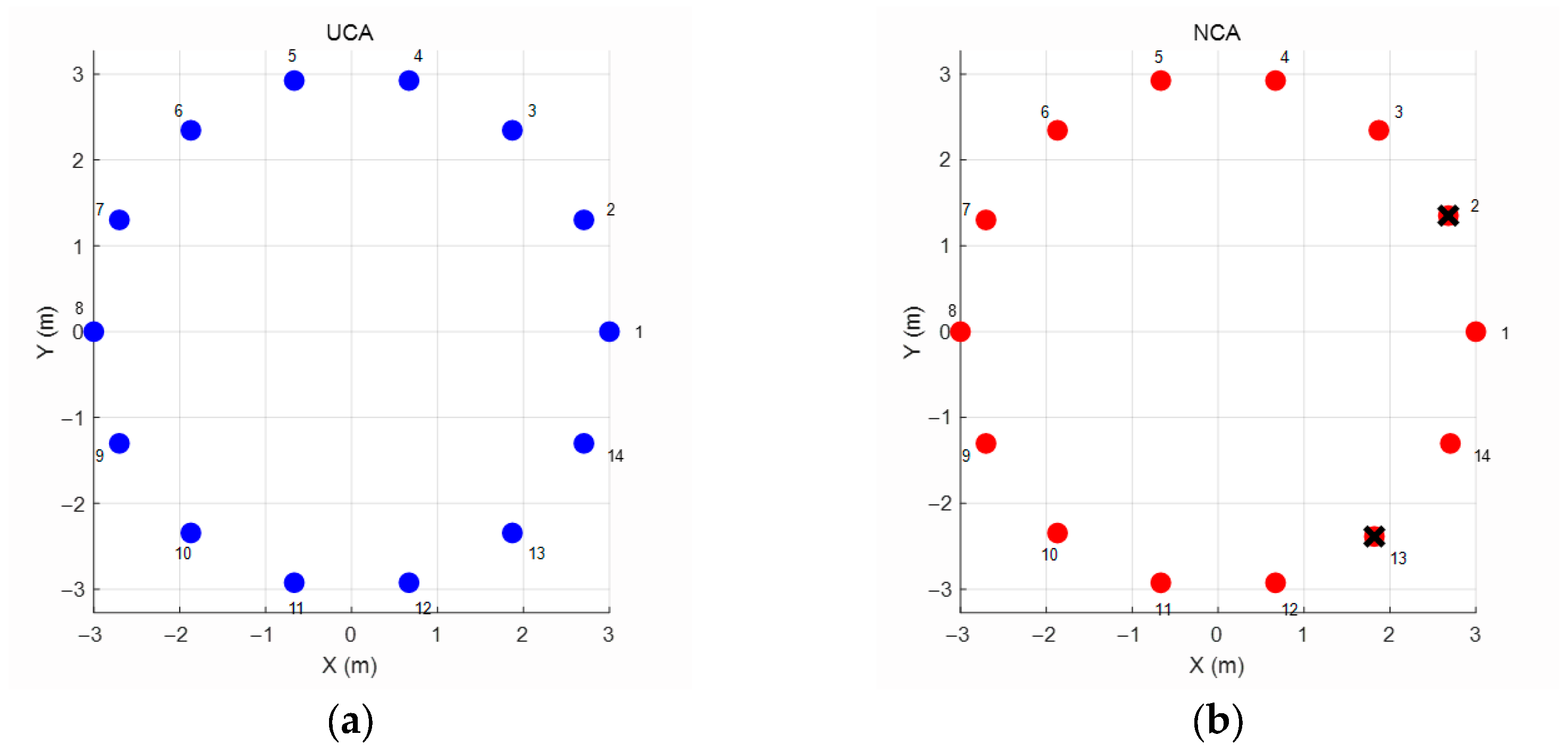
Construct the sensor position models of uniform circular arrays and non-uniform circular arrays. By designing different array structures, analyze the influence of the layout of array sensors on the positioning of signal sources. Uniform circular arrays assume that the array sensors are uniformly distributed, while non-uniform circular arrays take into account the deviation in sensor positions to simulate array errors in actual environments. Suppose the number of sensors is N = 14 , the radius of the circular array is R = 3.0   m , the radius deviation range is Δ R = 0.03   m , and the angle deviation range is Δ θ = ± 5 ° . Two non-uniform points are randomly generated, as shown in Figure 4.
Figure 4 shows the position distribution of UCA and NCA sensors on the MATLAB R2018b simulation platform. It can be seen from Figure 4 that the position of the UCA sensor is symmetrical, while the position of the NCA sensor is randomly offset, showing an asymmetric distribution. A total of 14 sensors were set up, and 2 sensors with random position and angle deviations were introduced to simulate the possible non-uniformity of sensor positions in practical applications.
Simulate signal sources from specific directions to generate noisy multi-sensor received signals. By simulating multiple signal sources transmitting signals from different directions and adding noise of varying degrees at the array sensors, generate noisy multi-sensor received signals to simulate common noise interference in actual environments. Set the sampling frequency to f s = 16   kHz , signal duration to T = 2.0   s , signal frequency to f s 2000 , 3000 , and the number of snapshots to L = 32,000 . Single-frequency signal: f c = 2000   Hz ; multi-frequency signal: f = 500 , 1000 , 2000 , 3000 , 4000 , 5000   Hz ; wideband signal: 10 equally spaced frequency components, ranging from 500 to 5000 Hz, processed using the ISM. SNR: In the main simulation, SNR = 25 dB, while in the Monte Carlo comparison, SNR = 10 dB. Sound source settings: Dual sound sources, with true positions 45° and 135°. Monte Carlo simulations were repeated 30 times for each configuration. Although only 30 Monte Carlo simulations were conducted, the standard deviations in the root mean square errors for each algorithm were all relatively small (for example, PWLS < 0.005°), which verified the statistical significance of the reported results.
To quantitatively evaluate the DOA estimation performance, the RMSE is used as the primary metric. For P signal sources and Nmc Monte Carlo runs, the RMSE is calculated as:
R M S E = 1 N mc P n = 1 N mc p = 1 P ( θ ^ n , p θ p ) 2
where θ ^ n , p is the estimated DOA of the p-th source in the n-th Monte Carlo trial, and θ p is the corresponding true direction. This metric captures both bias and variance, providing a comprehensive measure of estimation accuracy.

3.2. Results and Discussion

3.2.1. Optimal Configuration Analysis

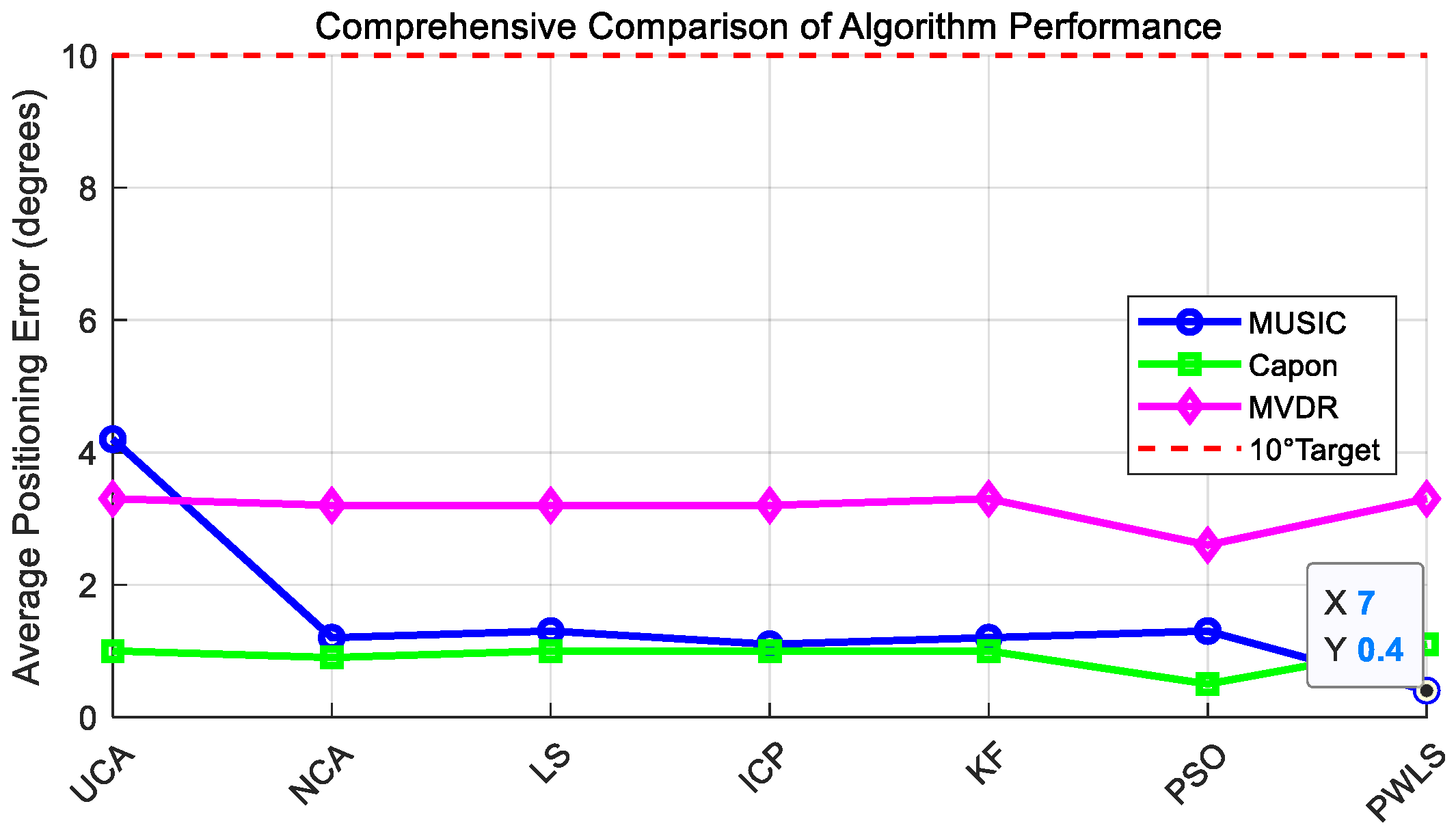
The single-frequency signal after EMD noise reduction is corrected by applying LS, ICP, KF, PSO and PWLS correction methods. Then, the direction of the signal source is estimated by using the MUSIC algorithm, Capon algorithm and MVDR algorithm, and the positioning errors are compared. Based on the signal after EMD noise reduction, the direction of the signal source is estimated with high precision by using multiple direction estimation algorithms and compared against the true directions of the signal source to analyze the positioning error, as shown in Figure 5.
The optimal configuration of PWLS correction combined with the MUSIC algorithm was found. The minimum positioning error was 0.4°, and this error could be stably maintained below 1°.

3.2.2. Performance Under Different SNRs

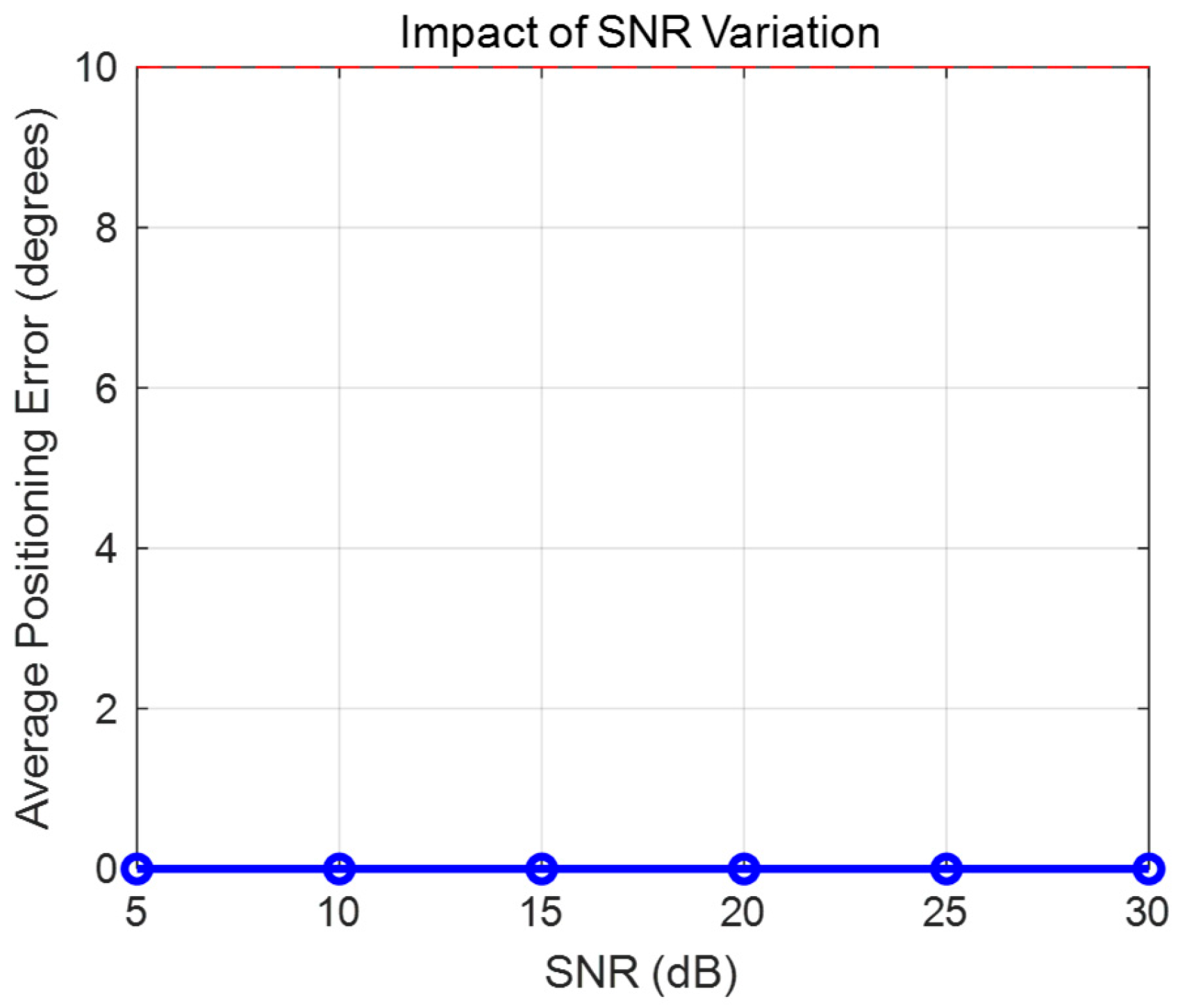
Figure 6 compares the positioning error under different SNRs. It is observed that when the SNR increases from 5 dB to 30 dB, the RMSE remains nearly constant, indicating that the positioning accuracy is dominated by array model errors (e.g., sensor position deviations) rather than noise. This behavior is expected because the fixed position errors (0.05 of the aperture) dominate over the noise standard deviation (0.03–0.3 of the aperture). Thus, the proposed PWLS correction effectively mitigates the noise influence and maintains stable performance across a wide SNR range.

3.2.3. Performance Under Different Frequencies

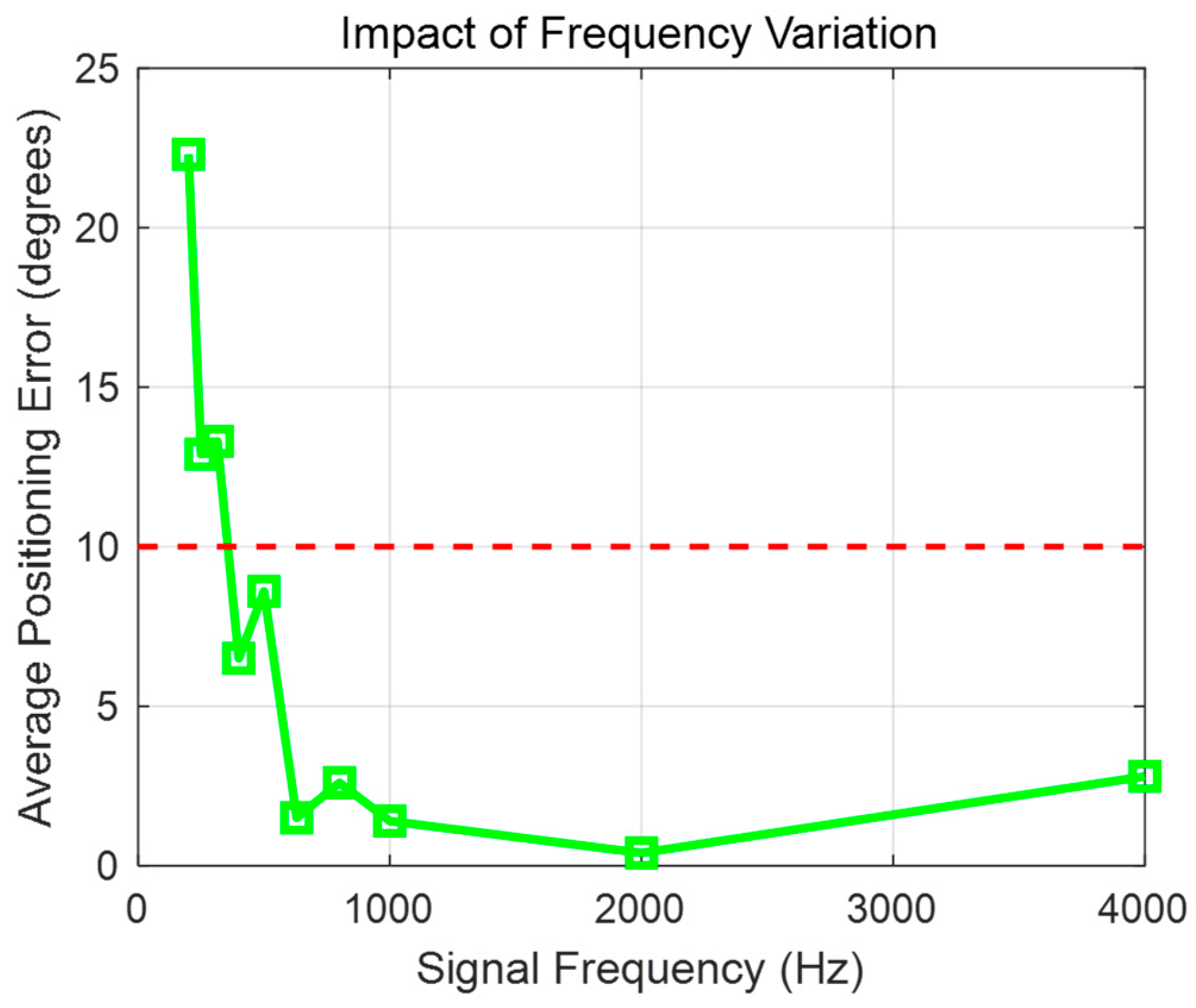
When comparing positioning errors at different frequencies, if the frequencies fs are 200, 250, 315, 400, 500, 630, 800, 1000, 2000, and 4000 Hz within the range of 0 to 2000 Hz, the wavelength of the sound wave gradually shortens from 7.5 m to 0.75 m. For a given physical array, the electrical size (the ratio of the array aperture to the wavelength) increases significantly with the increase in frequency, and the theoretical direction-finding accuracy improves accordingly, which is manifested as a rapid decrease in the Cramér–Rao lower bound (CRLB). Meanwhile, the underwater acoustic absorption coefficient increases slightly with frequency (<0.2 dB/km), and the SNR loss is much smaller than the aperture gain. Therefore, the positioning error continues to decrease. The optimal compromise point corresponding to around 2000 Hz. When the frequency rises to 4000 Hz, the wavelength further shortens to 0.375 m, the original array element spacing begins to exceed λ / 2 , the grating lobes level rises and falls into the search range, causing pseudo-peak interference. The superimposition of the above three negative factors led to a slight increase in the total positioning error despite the continued expansion of the aperture, resulting in a slight rebound as shown in Figure 7.

3.2.4. Performance Under Different Numbers of Sensors

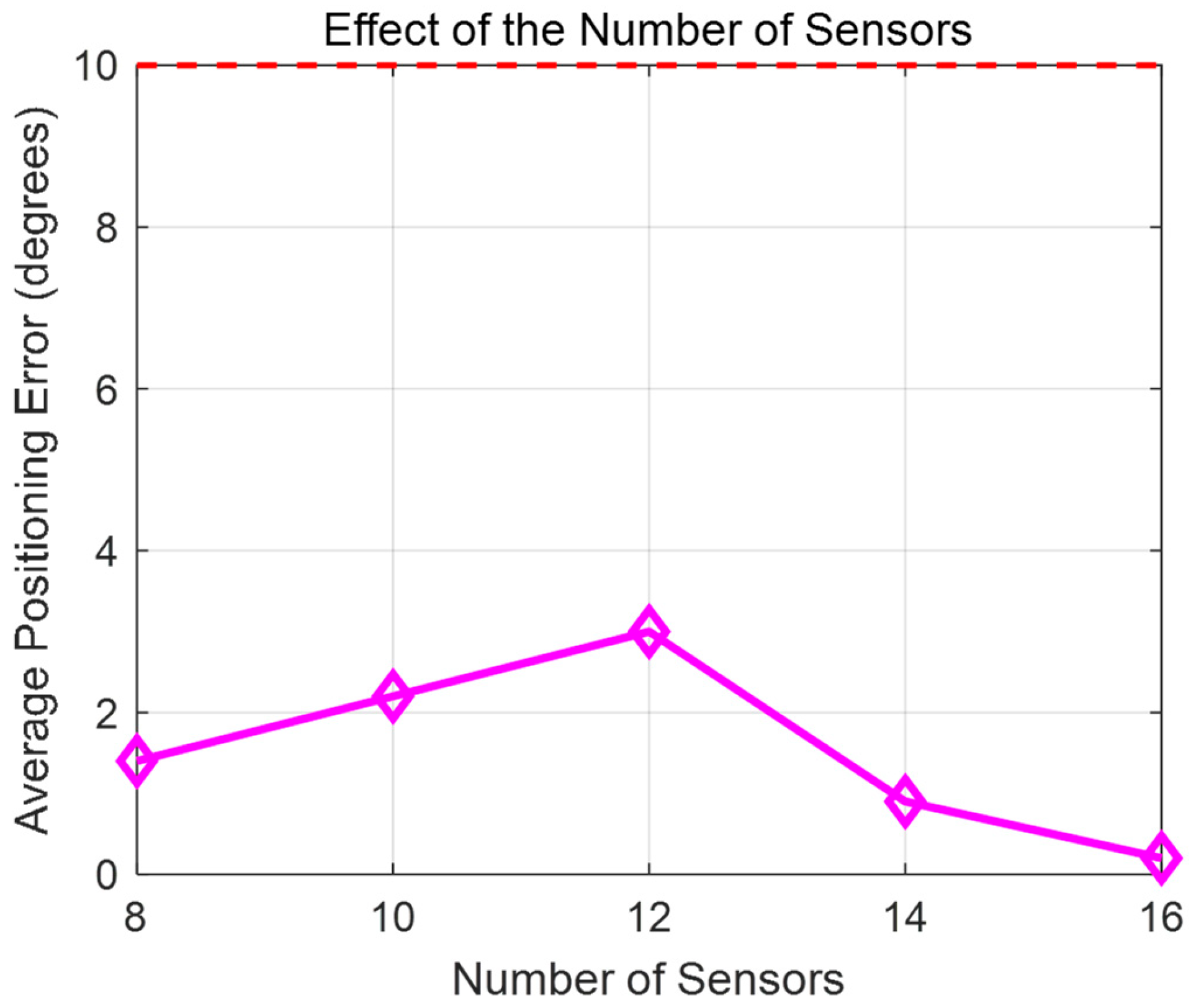
Positioning errors are compared under different sensor numbers. If the number of sensors N ranges from 8 to 16, grid deviation coupling occurs. As the number of sensors increases, the grid error amplifies. DOA estimates with a fixed 1° grid are used, the array beam width decreases as the number of sensors increases, the main peak becomes sharper, and grid mismatch becomes more sensitive. When there are 12 sensors, the main lobe width is approximately equal to the grid step, and the positioning error is the largest. When there are 16 sensors, the main lobe is narrower, but the side lobes are far from the true value. After interpolation, the positioning error is reduced, as shown in Figure 8.

3.2.5. Robustness Analysis

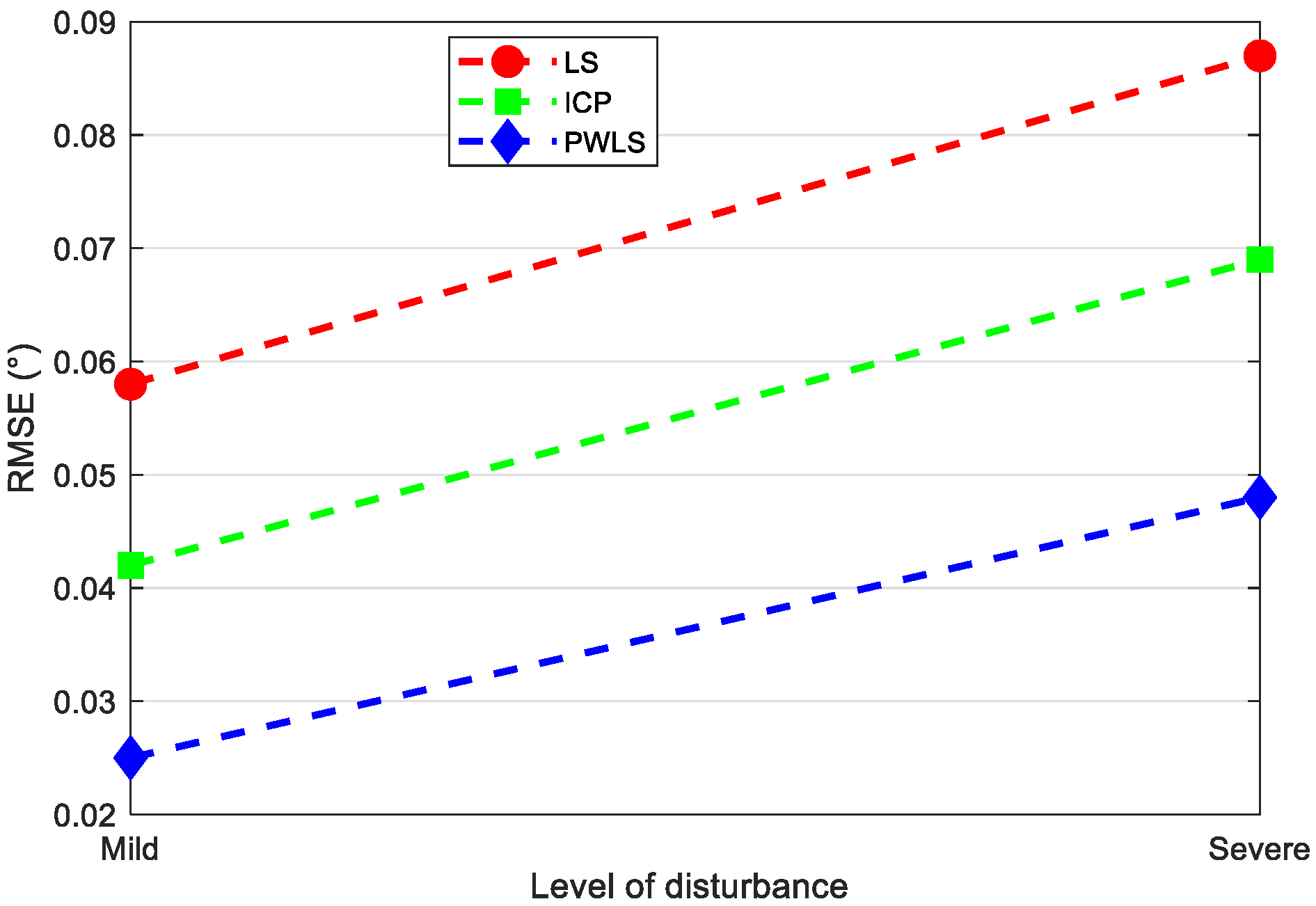
To examine the sensitivity to the magnitude of sensor position errors, additional simulations were performed with two levels of perturbations: mild (ΔR = 0.03 m, Δφ = 2.5°) and severe (ΔR = 0.05 m, Δφ = 5°). The RMSE of PWLS under multi-frequency signals increased from 0.025° to 0.048° when the perturbation level was increased, still outperforming LS (0.058°) and ICP (0.042°) under the mild condition, as shown in Figure 9. This indicates that PWLS maintains reasonable accuracy even under more severe array distortions.
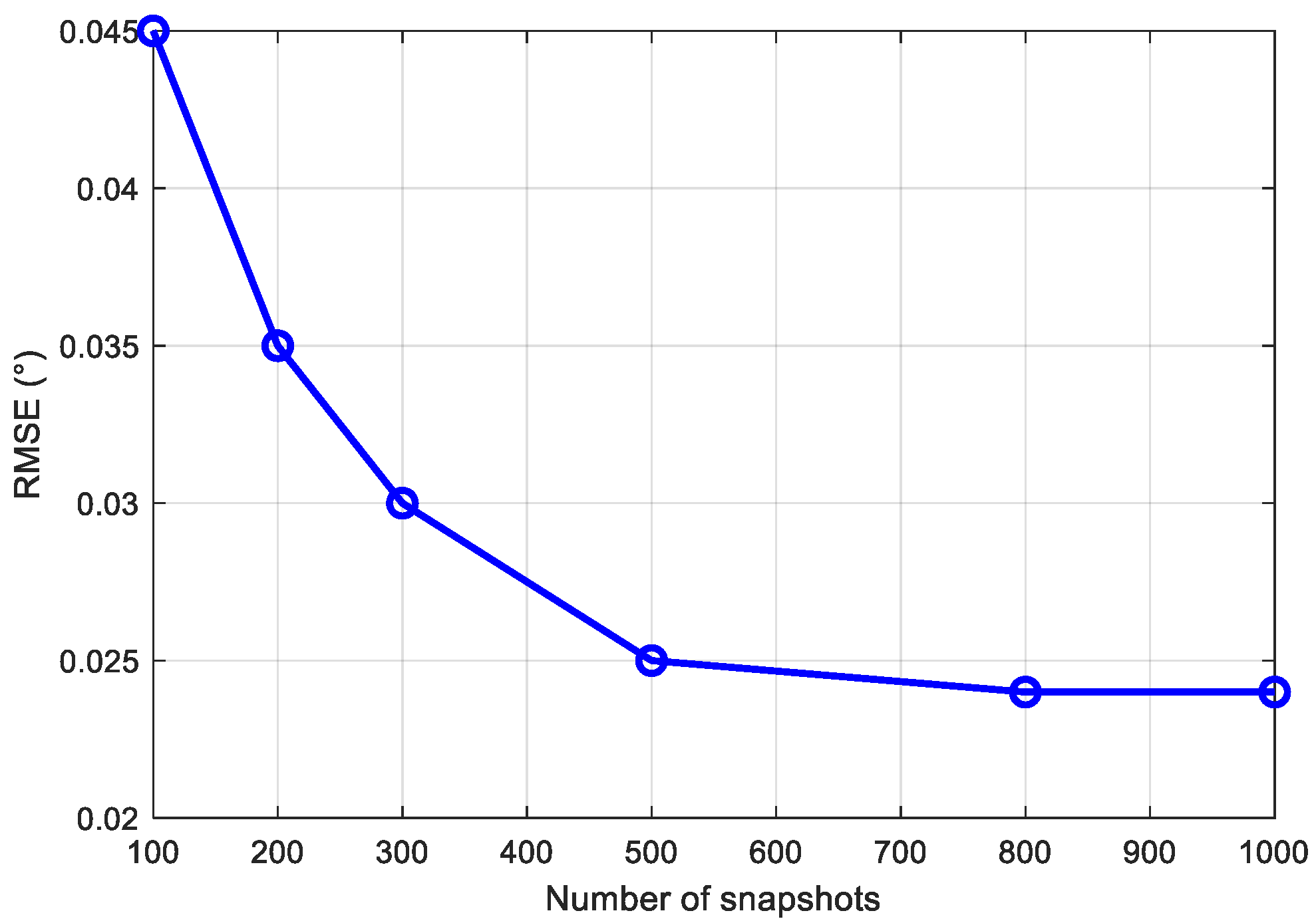
The effect of the number of snapshots on DOA estimation accuracy was evaluated by varying L from 100 to 1000 while fixing SNR = 10 dB. The RMSE of PWLS decreased from 0.045° to 0.025° as L increased from 100 to 500, and remained stable beyond 500 snapshots, as shown in Figure 10. This confirms that a moderate number of snapshots (e.g., 500) is sufficient to achieve the reported performance, and the algorithm is not overly sensitive to snapshot variations.
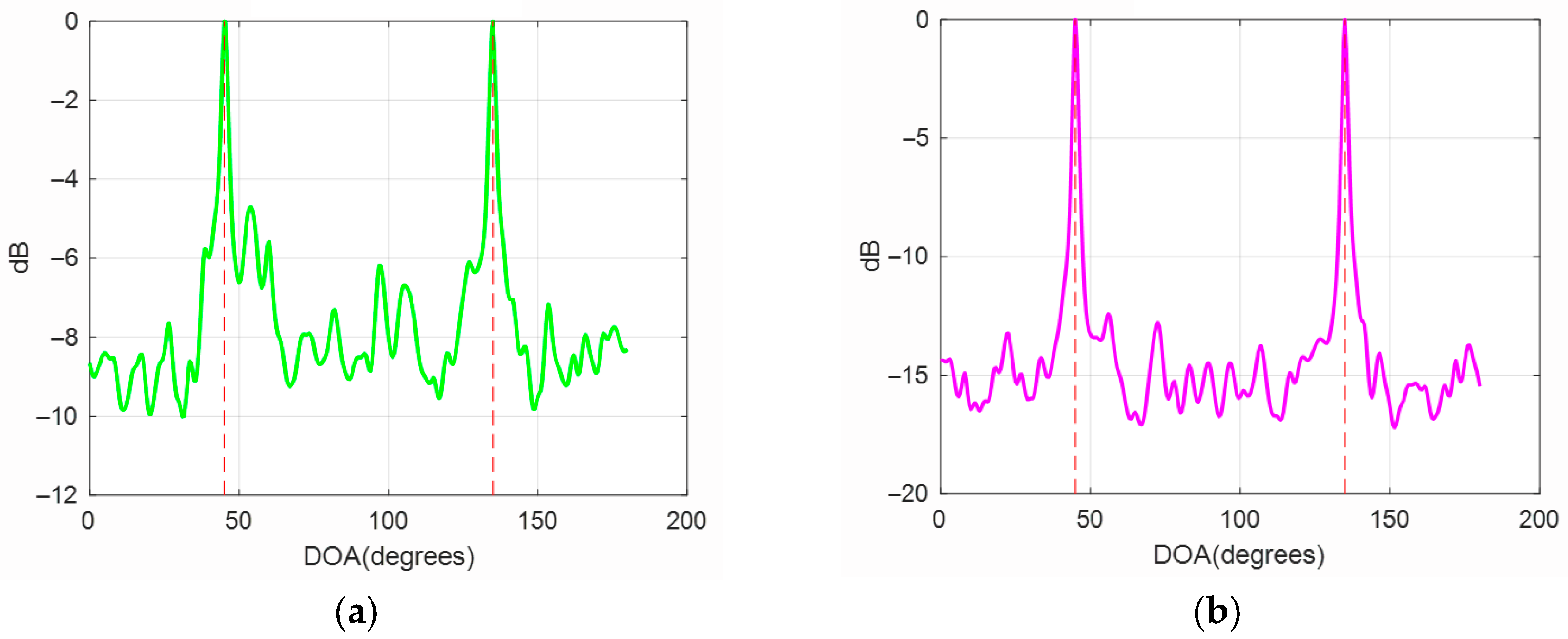
By comparing the performance of multi-frequency and wideband signals, the spectral peaks of the multi-frequency and wideband signals are sharp and accurately aligned with the true positions 45° and 135°, with an error close to 0°. The positioning performance of the multi-frequency and wideband signals on the optimal correction array proposed in this paper was compared. In a UCA with random position errors, the multi-frequency/wideband signals can completely compensate for the array errors through frequency diversity, as shown in Figure 11.
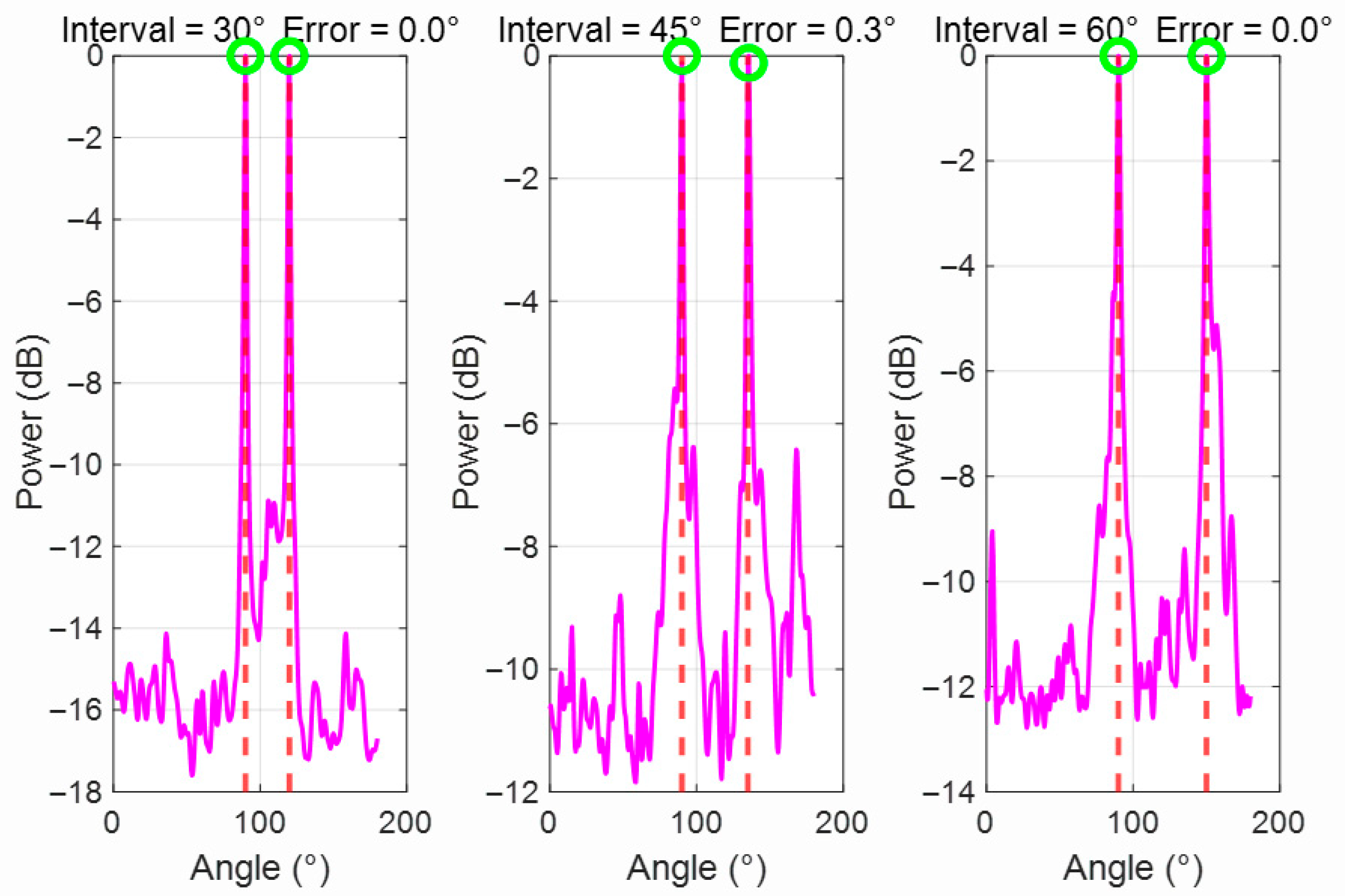
To evaluate the resolution capability of the proposed PWLS algorithm under closely spaced sources, additional simulations were conducted with two sources separated by different angular intervals: 60°, 45°, and 30°. The multi-frequency signals were used with the SNR fixed at 10 dB. As shown in Figure 12, the RMSE of PWLS remains below 0.03° for angular separations of 60° and 30°, indicating accurate separation of the two sources. When the separation is reduced to 45°, the RMSE increases slightly to approximately 0.3°, but still outperforms LS and ICP under the same condition. This demonstrates that PWLS exhibits good resolution capability even for relatively close sources, and maintains superior accuracy compared to conventional correction methods.
We conducted a performance comparison of multi-frequency/wideband signal correction algorithms. Table 1 presents 30 Monte Carlo simulations’ (each time generating random position errors independently) statistical results for thw five correction algorithms under multi-frequency and broadband signals. To reflect the performance of the algorithms under typical signal-to-noise ratios, the SNR is fixed at 10 dB.
As can be seen from Table 1:
  • All algorithms can effectively correct under multi-frequency signals: The RMSE of all algorithms is lower than 0.1°, indicating that multi-frequency signals significantly enhance the robustness of the algorithms against array position errors through frequency diversity. Among them, the proposed PWLS algorithm achieved the best accuracy (0.025°), which was 56% and 40% higher compared to LS and ICP, respectively, verifying the advantage of the prior-weighted strategy in multi-frequency scenarios.
  • The error approaches zero under wideband signals: Under wideband signals, the RMSE of each algorithm reaches machine precision (as shown in the table, 0.000°), indicating that the redundancy of the broadband information is extremely high, which can completely compensate for the geometric errors and achieve nearly ideal positioning.
  • Convergence speed and computational efficiency: ICP converges the fastest (on average 2 times), followed by LS (4.5 times), PWLS and KF (approximately 10 times), while PSO requires 80 iterations and has a slightly longer computation time. PWLS achieves high accuracy while having a comparable computational time to LS, and thus has good practicality. The complexity analysis at the end of Section 3 confirms that the computational cost of PWLS is linearly proportional to the number of array elements, thus making it suitable for large-scale arrays.
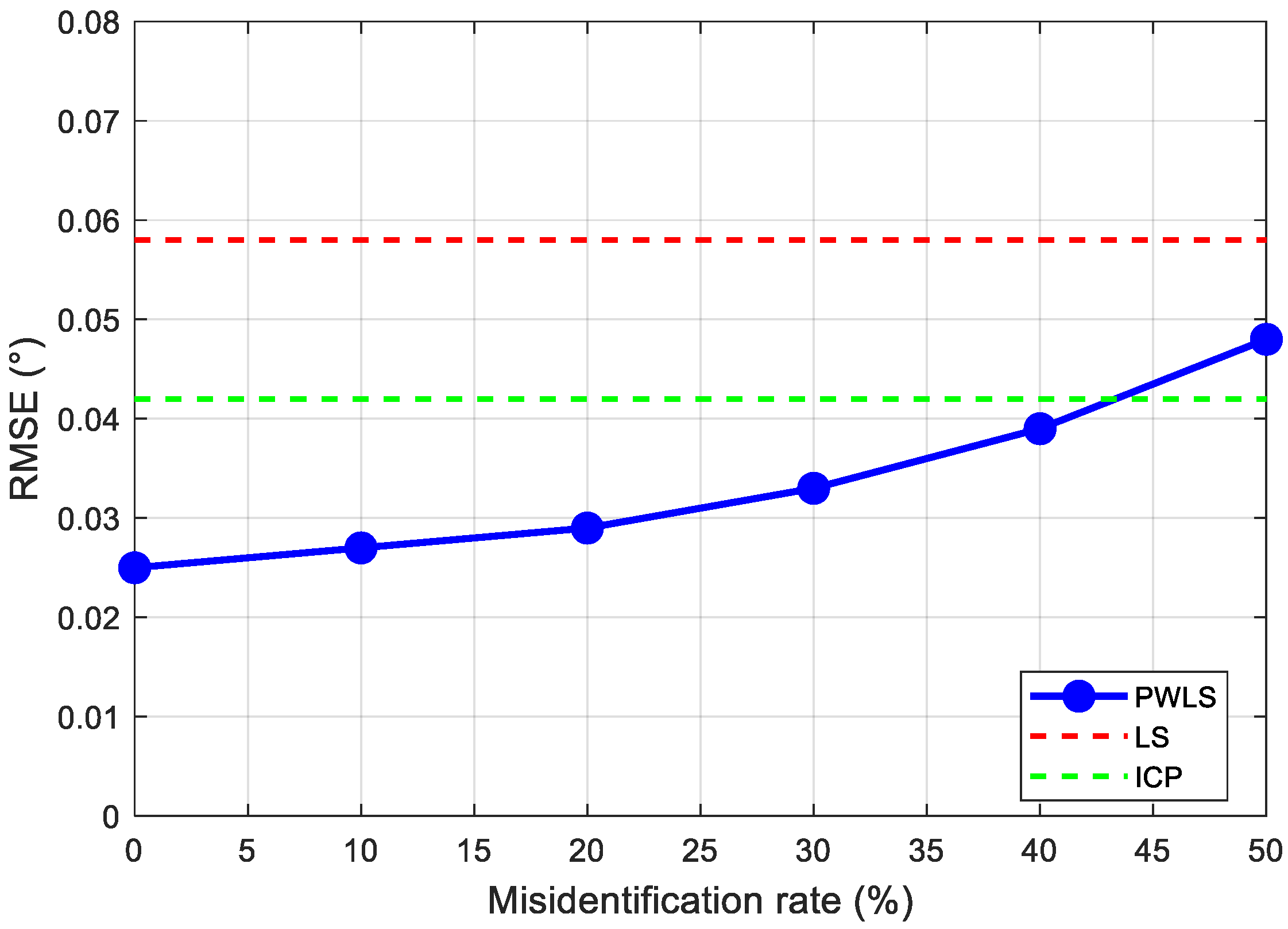
To evaluate the sensitivity of PWLS to inaccuracies in prior deviation indices, we conducted additional Monte Carlo simulations under multi-frequency signals (SNR = 10 dB) with controlled misidentification rates. Specifically, a percentage of the randomly selected deviation indices were intentionally swapped with normal sensors before correction. Figure 13 shows the RMSE of PWLS as a function of the misidentification rate. The results indicate that when up to 20% of the prior indices are incorrectly labeled, the RMSE remains below 0.03°, only slightly higher than the ideal case (0.025°). Even at a 50% misidentification rate, the RMSE stays under 0.05°, still outperforming LS (0.058°) and ICP (0.042°). This demonstrates that PWLS is robust to moderate errors in the prior information, which can be expected in practical scenarios where the prior knowledge may not be perfectly accurate.
The above results fully demonstrate that the PWLS correction algorithm based on multi-frequency/wideband signals has strong robustness against environmental disturbances and can stably achieve high-precision positioning.

3.2.6. Computational Efficiency Analysis

The computational complexity of the proposed PWLS algorithm and the compared methods is analyzed in terms of the number of array sensors M and the number of iterations K (where applicable).
  • LS correction: The least squares fitting involves solving a 3 × 3 linear system, which has a complexity of O ( M ) . No iteration is required.
  • ICP correction: Each iteration requires nearest neighbor searches O ( M 2 ) and singular value decomposition (SVD) of a 2 × 2 matrix O ( 1 ) . With a fixed number of iterations KICP, the total complexity is O ( K ICP M 2 ) .
  • KF correction: The Kalman filter updates each sensor independently with a constant cost per step, resulting in O ( M ) per iteration. The total complexity is O ( K KF M ) .
  • PSO correction: Each particle evaluates the fitness function over all sensors, leading to O ( P particles M ) per iteration. With KPSO iterations, the complexity is O ( K PSO P particles M ) .
  • PWLS correction: The weighted least squares center fitting involves solving a 3 × 3 system O ( M ) , and the relaxation update also costs O ( M ) per iteration. With a maximum of K PWLS = 10 iterations, the total complexity is O ( K PWLS M ) .
As observed in Table 1, the runtime of PWLS is comparable to that of LS and KF, and significantly lower than that of PSO, confirming its high computational efficiency. The linear scaling with M makes PWLS suitable for large-scale arrays.

4. Conclusions

This paper addresses the problem of random position errors in underwater non-uniform circular arrays and proposes a DOA estimation method that combines EMD noise reduction and prior-weighted iterative correction. Through 30 Monte Carlo simulation systems, the performance of five correction algorithms under multi-frequency/wideband signals was compared, and the following conclusions were drawn:
  • Multi-frequency and wideband signals can effectively suppress the influence of array element position errors. The RMSE of each correction algorithm is lower than 0.1° under multiband signals and approaches 0° under wideband signals, verifying the strong robustness of frequency diversity against array errors.
  • The proposed PWLS algorithm achieves an optimal accuracy of 0.025° in multi-frequency signals, outperforming LS, ICP, KF and PSO, and has higher computational efficiency, thus demonstrating the effectiveness of the prior-weighted iterative mechanism.
  • Single-frequency signals cannot achieve reliable positioning through geometric correction (with an error of 0.4°), which further highlights the necessity of multi-frequency/wideband processing in practical engineering.
In conclusion, the research results not only theoretically reveal the performance boundaries of non-uniform geometry in complex channels, but also verify the feasibility of the design method proposed in this paper from an engineering perspective. This has laid a solid methodological and experimental foundation for the application and promotion of underwater sound source localization technology in marine exploration, resource development, and national defense security fields.
Future work will focus on several promising directions. First, a systematic comparison with modern calibration algorithms, such as deep learning-based methods, will be conducted to further validate the advantages of PWLS. Second, the performance of the proposed method under more challenging scenarios, including closely spaced sources and highly dynamic underwater environments, will be investigated. Third, the extension of the PWLS framework to three-dimensional localization using conformal or volumetric arrays is planned. These investigations will help broaden the applicability of the proposed approach to a wider range of underwater acoustic applications.

Author Contributions

Conceptualization, C.H., B.Z. and T.S.; methodology, C.H., B.Z. and T.S.; software, C.H., B.Z. and T.S.; validation, C.H., B.Z. and T.S.; formal analysis, C.H., B.Z. and T.S.; investigation, C.H., B.Z. and T.S.; resources, C.H., B.Z. and T.S.; data curation, C.H., B.Z. and T.S.; writing—original draft preparation, C.H. and B.Z.; writing—review and editing, C.H. and B.Z.; visualization, C.H., B.Z. and T.S.; supervision, C.H. and T.S.; project administration, C.H. and T.S.; funding acquisition, C.H. All authors have read and agreed to the published version of the manuscript.

Funding

This research was funded by Program for Young Talents of Basic Research in Universities of Heilongjiang Province, grant number YQJH2024077.

Data Availability Statement

Data are contained within the article.

Acknowledgments

The authors would like to thank all editors and reviewers for their valuable comments and suggestions.

Conflicts of Interest

Author Chuang Han was employed by the Sunny Group Co., Ltd. The remaining authors declare that the research was conducted in the absence of any commercial or financial relationships that could be construed as a potential conflict of interest.

Abbreviations

The following abbreviations are used in this manuscript:
UCAUniform Circular Array
NCANon-Uniform Circular Array
EMDEmpirical Mode Decomposition
DOADirection of Arrival
SNRSignal-to-Noise Ratio
IMFIntrinsic Mode Function
LSLeast Squares
ICPIterative Closest Point
KFKalman Filtering
PSOParticle Swarm Optimization
PWLSPrior-weighted Iterative Least Squares
MUSICMultiple Signal Classification
ISMIncoherent Signal Subspace Method
MVDRMinimum Variance Distortionless Response
AFArray Factor
AOAAngle of Arrival
TOATime of Arrival
WGNWhite Gaussian Noise
CRLBCramér-Rao Lower Bound
RMSERoot Mean Square Error
SVDSingular Value Decomposition
SBLSparse Bayesian learning

References

  1. Zhang, D.; Zhang, G.; Zhao, X.; Zou, N.; Fu, J.; Bai, Y. Inter-Element Phase Error Compensated Calibration Method for USBL Arrays. J. Mar. Sci. Eng. 2025, 13, 877. [Google Scholar] [CrossRef]
  2. Bharathi, B.M.R.; Mohanty, A.R. Underwater Sound Source Localization by EMD-Based Maximum Likelihood Method. Acoust. Aust. 2018, 46, 193–203. [Google Scholar] [CrossRef]
  3. Mao, J.J.; Peng, Z.H.; Zhang, B.; Wang, T.C.; Zhai, Z.K.; Hu, C.X.; Wang, Q.Y. An Underwater Localization Algorithm for Airborne Moving Sound Sources Using Doppler Warping Transform. J. Mar. Sci. Eng. 2024, 12, 16. [Google Scholar] [CrossRef]
  4. Kuz’kin, V.M.; Pereselkov, S.A. Holographic Methods of Underwater Acoustic Signals Processing: A Review. Acoust. Phys. 2025, 71, 80–100. [Google Scholar] [CrossRef]
  5. Dong, K.; Zhang, Y.H.; Fan, X.X.; Cao, L.N.Y.; Peng, X. Microfiber-Based Triboelectric Acoustic Sensors Enable Self-Powered Ultrasonic Localization and Tracking Underwater. ACS Sens. 2025, 10, 1366–1377. [Google Scholar] [CrossRef]
  6. Cui, K.; Zheng, A.R.; Pan, X.L.; Jiao, Y.Y.; Ma, J.; Zhu, R.H. A High-Precision Underwater Acoustic Source Localization System Based on φ-OTDR Technique. J. Light. Technol. 2025, 43, 7431–7438. [Google Scholar] [CrossRef]
  7. Yang, C.R.; Ling, Q.; Sheng, X.L.; Mu, M.F.; Jakobsson, A. Multi-Target Sonar Localization Using an Optimal Mass Transport Framework. IEEE Trans. Instrum. Meas. 2024, 73, 12. [Google Scholar] [CrossRef]
  8. He, J.W.; Zhang, B.; Liu, P.S.; Li, X.L.; Wang, L.; Tang, R.C. Effective underwater acoustic target passive localization of using a multi-task learning model with attention mechanism: Analysis and comparison under real sea trial datasets. Appl. Ocean Res. 2024, 150, 12. [Google Scholar] [CrossRef]
  9. Zhang, W.Q.; Zhang, G.J.; Chang, Z.C.; Wu, Y.D.; Jia, L.; Zhang, Y.B.; Zhang, Y.H.; Zhang, W.D. A study of target localization based on underwater small-scale vertical vector hydrophone array. Measurement 2025, 247, 15. [Google Scholar] [CrossRef]
  10. Lv, Z.C.; Du, L.B.; Li, H.M.; Wang, L.; Qin, J.X.; Yang, M.; Ren, C. Influence of Temporal and Spatial Fluctuations of the Shallow Sea Acoustic Field on Underwater Acoustic Communication. Sensors 2022, 22, 17. [Google Scholar] [CrossRef]
  11. Wu, Z.D.; Dai, L.L. The Manifestation of Spatial Wideband Effect in Circular Array: From Beam Split to Beam Defocus. IEEE Trans. Commun. 2024, 72, 3064–3078. [Google Scholar] [CrossRef]
  12. Kadali, L.; Hossain, A.; Billa, N.K.; Mummaneni, K. AI-powered cognitive modulation adaptation for energy-efficient underwater acoustic communication. Intell. Mar. Technol. Syst. 2025, 3, 32. [Google Scholar] [CrossRef]
  13. Adhikari, K.; Al Kinani, R. Transformation of a circular array to a linear array with a Vandermonde structure. Digit. Signal Process. 2023, 140, 9. [Google Scholar] [CrossRef]
  14. Chu, J.H.; Zhang, Z.; Huang, Y.Z.; Su, T.S. Exploration on 2D DOA Estimation of Linear Array Motion: Uniform and Sparse Circular Motion. IEEE Trans. Signal Process. 2024, 72, 4115–4131. [Google Scholar] [CrossRef]
  15. Shi, Q.; Wang, J.F.; Yang, F.R.; Yang, J. A note on the design of frequency-invariant beamforming with uniform concentric circular microphone array. Appl. Acoust. 2024, 217, 7. [Google Scholar] [CrossRef]
  16. Liu, S.; Zhao, J.; Wu, D.C. DOA estimation algorithm for non-circular signal by a large-spacing array with auxiliary element. Sci. Rep. 2024, 14, 11. [Google Scholar] [CrossRef]
  17. Qin, B.W.; Zhou, F.S.; Zhang, W.S.; You, C.S.; Zheng, B.X. Fast Distance Sampling for Uniform Circular Array in Near-Field 3D Beam-Focusing. IEEE Signal Process. Lett. 2024, 31, 2210–2214. [Google Scholar] [CrossRef]
  18. Hao, Y.; Zou, N.; Qiu, L.H.; Li, C.M.; Wang, Y.; Liang, G.L. Spatial rotation-based direction-of-arrival estimation for uniform circular hydrophone array. Appl. Acoust. 2021, 178, 7. [Google Scholar] [CrossRef]
  19. Xiao, Y.; Huang, Z.; Xue, D. Direction Finding Based on Spatial Sparsity of Cumulative Slicing for Circular Array in Correlated Noise and Multipath. In Proceedings of the 12th International Conference on Communications, Circuits, and Systems, Singapore, 5–7 May 2024; Springer: Singapore, 2024; pp. 69–84. [Google Scholar]
  20. Khalafalla, M.; Jiang, K.L.; Tian, K.L.; Feng, H.C.; Xiong, Y.; Tang, B. Pentagram Arrays: A New Paradigm for DOA Estimation of Wideband Sources Based on Triangular Geometry. Remote Sens. 2024, 16, 34. [Google Scholar]
  21. Li, G.H.; Xin, H.J. Research on Singular Value Decomposition Algorithm for Mixed Additive and Multiplicative Error Model. Measurement 2026, 260, 119810. [Google Scholar] [CrossRef]
  22. Sun, Z.H.; Gao, W.; Pan, S.G.; Wang, Q. LiDAR Point Cloud Registration Optimization Algorithm Considering Geometric Feature Reliability. Chin. J. Sci. Instrum. 2025, 46, 257–266. [Google Scholar]
  23. Zhao, J.Y.; Lei, Y.; Li, Z.Y. A Review of the Application of Kalman Filter in Equipment Fault Prediction. Ordnance Ind. Autom. 2024, 43, 16–20. [Google Scholar]
  24. Li, Q.Q.; Wang, P.Y.; Zhu, C. A Synthetic Method of Wide-Angle Scanning Sparse Arrays Based on a Hybrid PSO-GA Algorithm. Electronics 2026, 15, 604. [Google Scholar] [CrossRef]
  25. Li, X.Y.; Zhang, C.J. Wideband DOA Estimation Based on ConvNeXt. In Proceedings of the 2024 4th International Conference on Communication Technology and Information Technology (ICCTIT), Guangzhou, China, 27–29 December 2024; pp. 110–114. [Google Scholar]
  26. Chen, Y.; Ding, J.; Wang, R. Squeeze-and-Excitation-Enhanced CNN for Robust DOA Estimation in Interfered Environments. IEEE Sens. J. 2026, 26, 950–964. [Google Scholar] [CrossRef]
  27. Shmuel, D.H.; Merkofer, J.P.; Revach, G.; van Sloun, R.J.G.; Shlezinger, N. SubspaceNet: Deep Learning-Aided Subspace Methods for DoA Estimation. IEEE Trans. Veh. Technol. 2025, 74, 4962–4976. [Google Scholar] [CrossRef]
  28. Yu, D.; Wang, X.; Fang, W.; Ma, Z.; Lan, B.; Song, C.; Xu, Z. Off-Grid DOA Estimation Based on Sparse Bayesian Learning under Array Mutual Coupling. J. Vib. Shock. 2022, 41, 303–312. [Google Scholar]
  29. Yin, J.W.; Zhou, X.; Cao, R.; Han, X.; Li, D.; Du, Z. High-Resolution Direction Finding Method Based on Optimal Subspace Fitting under Non-Euclidean Metrics. Acta Acust. 2026, 51, 28–39. [Google Scholar]
  30. Liu, L.K.; Wang, D.; Wang, T. Robust Calibration Algorithm for Array Error Matrix to Suppress the Bearing Deviation of Calibration Source. Syst. Eng. Electron. 2014, 36, 409–416. [Google Scholar]
  31. Wu, Y.F.; Wakin, M.B.; Gerstoft, P. Non-Uniform Array and Frequency Spacing for Regularization-Free Gridless DOA. IEEE Trans. Signal Process. 2024, 72, 2006–2020. [Google Scholar] [CrossRef]
  32. Long, H.M.; Liu, Q.; Liu, Y.; Hu, Y.W. Underwater Acoustic Communication Signal Denoising Method Based on Improved EMD-Wavelet Packet. Chang. Inf. Commun. 2025, 38, 179–181. [Google Scholar]
Figure 1. Functional framework of proposed DOA estimation method.
Symmetry 18 00627 g001
Figure 2. Geometric Model of Non-Uniform Circular Array.
Symmetry 18 00627 g002
Figure 3. Flowchart of EMD.
Symmetry 18 00627 g003
Figure 4. Comparison of array configurations: (a) UCA configuration; (b) NCA configuration.
Symmetry 18 00627 g004
Figure 5. Optimal configuration.
Symmetry 18 00627 g005
Figure 6. Comparison of positioning error under different SNRs.
Symmetry 18 00627 g006
Figure 7. Comparison of positioning error at different frequencies.
Symmetry 18 00627 g007
Figure 8. Comparison of positioning error under different sensor numbers.
Symmetry 18 00627 g008
Figure 9. The influence of array element position error amplitude on the performance of the PWLS algorithm.
Symmetry 18 00627 g009
Figure 10. The performance of the PWLS algorithm under different snapshot numbers.
Symmetry 18 00627 g010
Figure 11. (a) Multi-frequency signal; (b) wideband signals.
Symmetry 18 00627 g011
Figure 12. Performance under closely spaced sources.
Symmetry 18 00627 g012
Figure 13. Robustness to incorrect prior information.
Symmetry 18 00627 g013
Table 1. Performance comparison of five correction algorithms under multi-frequency/wideband signals.
AlgorithmMulti-Frequency RMSE (°)Wideband RMSE (°)Number of IterationsTime (ms)
LS0.0580.0004.5575.3
ICP0.0420.0002.0576.5
KF0.0920.00011.0576.4
PSO0.0750.00880.0584.5
PWLS0.0250.00010.0576.1
Disclaimer/Publisher’s Note: The statements, opinions and data contained in all publications are solely those of the individual author(s) and contributor(s) and not of MDPI and/or the editor(s). MDPI and/or the editor(s) disclaim responsibility for any injury to people or property resulting from any ideas, methods, instructions or products referred to in the content.