


Abstract
The Taiyuan Formation, located on the northern margin of the Ordos Basin, has an important role in reconstructing tectonic paleogeography and evolutionary process due to its preservation of information about the tectonic evolution of the basin throughout the Late Paleozoic. The provenance, paleogeography, and tectonic activity traits of the Taiyuan Formation were examined using the sedimentary petrology and zircon chronology methods. The Alxa block is consistent with the dating results of the Taiyuan Formation in Shabatai, and the Daqing Shan is consistent with the results of the Taiyuan Formation in Xiachengwan and Adaohai. It is inferred that the provenance of the Taiyuan Formation in the western part of the northern margin of the basin is from the Alxa block, and the provenance in the eastern part is from the Daqing Shan when combined with the study of sandstone detrital components, and paleocurrent. In the late Paleozoic, the Siberian plate collided with the North China Craton, and the Taiyuan Formation was deposited in the northern margin of the Ordos Basin. However, on account of the different ages and types of basement rocks and the central paleo-uplift which has not completely disappeared, the Taiyuan Formation has obvious east-west zonation.
1. Introduction
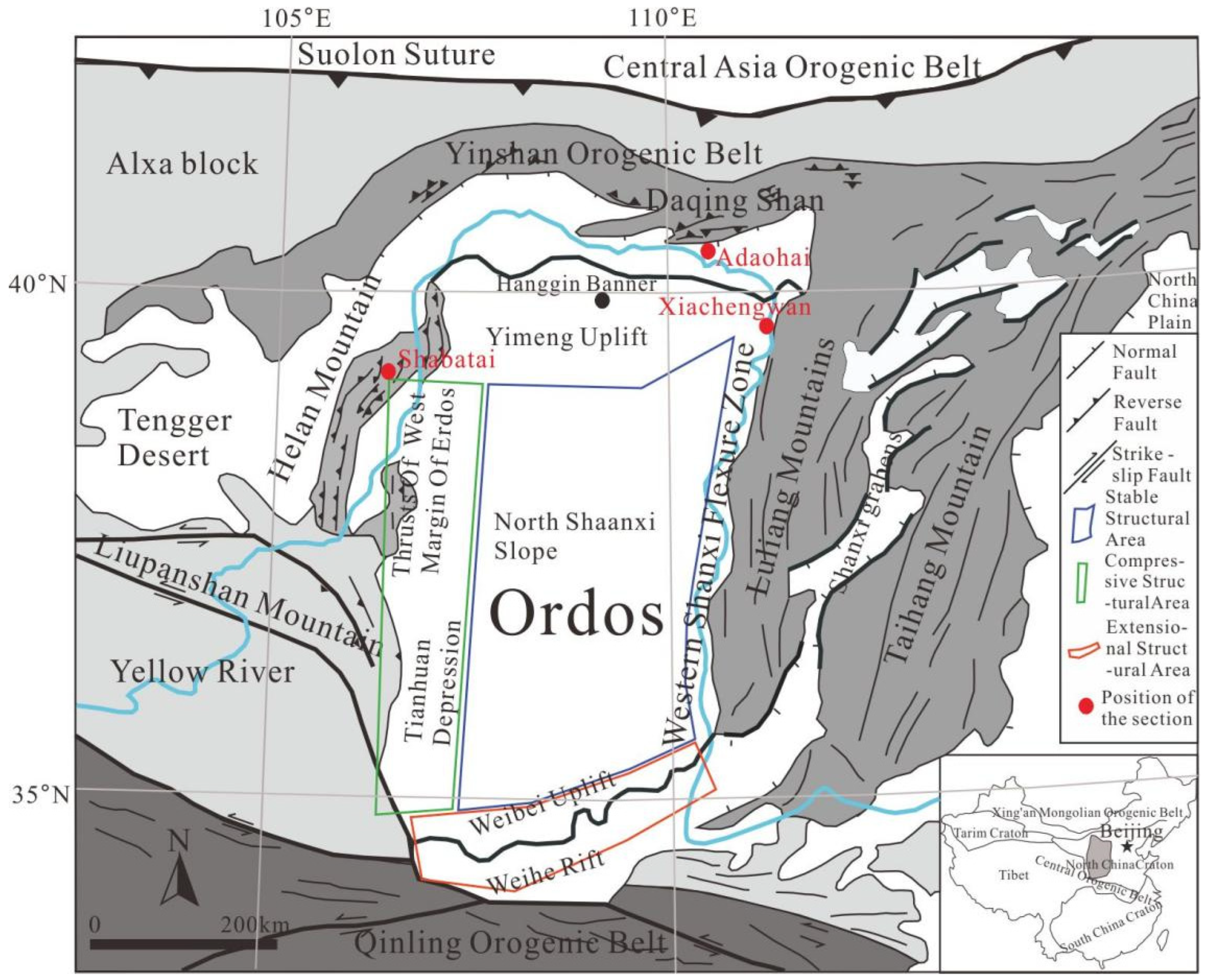
The Ordos Basin is the largest multicycle craton basin in the North China Craton [1,2] (Figure 1), with sustained subsidence and has abundant oil and gas potential. The Sulige, Yulin, Wushen County, and Daniudi regions of the northern margin of the basin have recently seen significant breakthroughs in natural gas and oil development [2,3,4,5]. But as the depth of the exploration level increased, issues with the sedimentary system and ambiguous provenance started to make oil and gas extraction in this area more challenging. Sediments typically do a good job of preserving information on the transition between marine and continental facies [6], the process of structural evolution [7], and the evolution of the paleogeographical environment [8]. Provenance analysis can shed light on the Late Paleozoic sedimentary evolution process at the northern margin of the Ordos basin and give a scientific foundation for oil and gas exploration of this area. The Taiyuan Formation is the Ordos Basin’s primary oil and gas producing stratum [9], hence this formation was chosen as the subject of a thorough sedimentological study. The research on the formation has focused on organic matter characteristics, the shale pore system, the basinal sedimentary environment, and potential of continuous shale gas accumulations [10,11,12,13]. The provenance of this Formation is generally considered to be from the northern margin of the North China Craton, but the difference between the east and west of the provenance has not been clearly understood. Additional research is needed to determine the provenance area’s tectonic background and whether it can develop a corresponding relationship with the tectonic units of the surrounding orogenic belts. It is necessary to conduct a systematic and comprehensive study of Taiyuan Formation in the northern margin of Ordos Basin by using sedimentological methods, combined with zircon chronology.
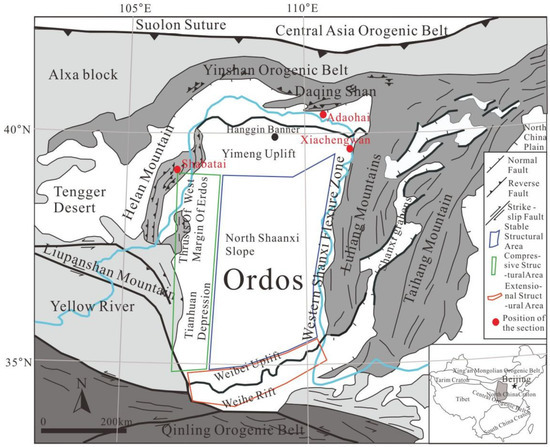
Figure 1.
Geological map of the Ordos Basin (Modified after [13]). Light gray shading represents the North China Craton, medium gray represents areas of known/suspected Late Jurassic–Early Cretaceous contractional intraplate deformation, and dark gray indicates the Qinling Orogen (Permian–Triassic).
2. Geological Setting and Lithostratigraphy
The Ordos Basin is an inland depression basin, located on the west of the North China Craton. It is bounded by Luliang Mountain in the east, Qinling orogenic belt in the south, Helan Mountain and Liupan Mountain in the west, and the Yinshan orogenic belt in the north (Figure 1). The basin is now gently topographic, with asymmetric monoclinic tectonics of gentle east and steep west. Based on the features of stratigraphic development and structure, the basin can be split into six structural units, including the Thrusts of the west margin of Ordos, North Shaanxi slope, Tianhuan depression, Western Shanxi flexural zone, Weibei uplift and Yimeng uplift (Figure 1).
2.1. Characteristics of Sedimentary Facies
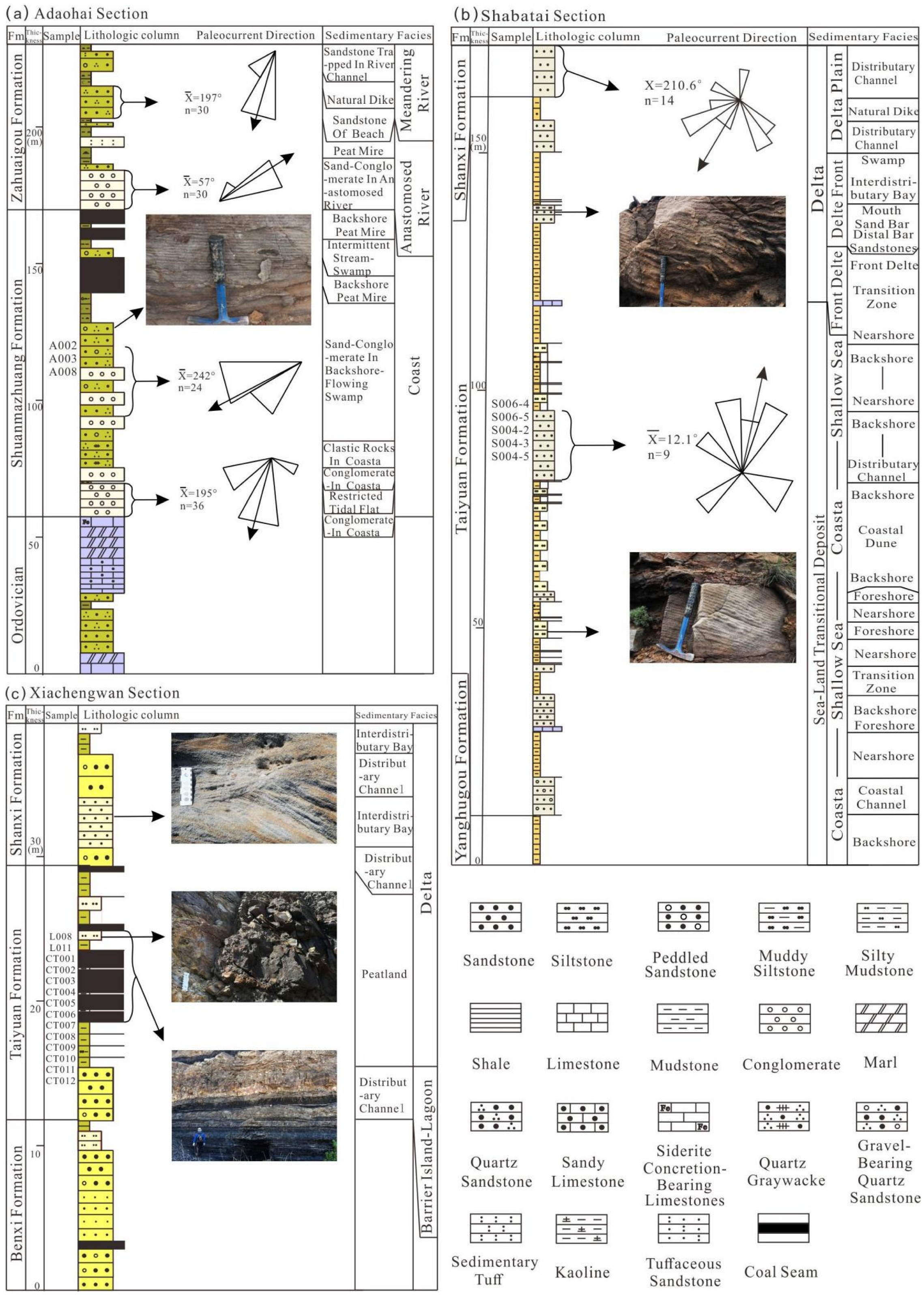
In this study, three sections of Xiachengwan, Adaohai and Shabatai on the northern margin of the basin were selected for analysis (Figure 1 and Figure 2). The Adaohai section (110°27′20.27″ E, 40°24′36.37″ N; 110°29′6.54″ E, 40°38′55.32″ N) is situated 8 km to the northwest of Tumote Right Banner. The bottom of the section is the Ordovician carbonate, the middle is the Upper Carboniferous–Lower Permian Shuanmazhuang group, and the top is the Zahuaigou group (Figure 2a). By comparing the detailed sequence stratigraphic framework of the strata of the two formations and the iconic volcanic event layers, it is found that the upper portion of the Shuanmazhuang Formation in the Daqing Shan Coalfield and the Taiyuan Formation in the Ordos basin are the same sedimentary stratum [14]. This study will conduct a provenance analysis of the Shuanmazhuang Formation in order to provide new evidence for the sedimentary evolution of the northern margin of the basin during the Late Carboniferous–Early Permian. Thin strata of grayish-black siltstone are sandwiched between thick layers of coarse, yellowish-brown conglomerate at the base of the Shuanmazhuang Formation. As one moves upward, interbeds of gray-yellow and gray-brown coarse conglomerate and gray-yellow gravel-bearing coarse-grained sandstone can be seen, together with a thin layer of gray-black muddy siltstone. The top is composed of two giant thick and complex coal seams, and the coal seams are distributed with thin interbeds of gray-black muddy siltstone, carbonaceous mudstone, and interlayers of sedimentary tuff. The Xiachengwan section (111°22′3.31″ E, 39°44′11.35″ N; 111°22′1.82″ E, 39°44′9.61″ N) is located on the east bank of the Yellow River, 30 km southwest of Qingshuihe County, Hohhot. The Lower Permian Shanxi Formation, the Upper Carboniferous–Lower Permian Taiyuan Formation, and Upper Carboniferous Benxi Formation are sequentially exposed from top to bottom (Figure 2c). The Taiyuan Formation in this section is made up of two thin coal seams with a thickness of around 0.5–0.7 m in the upper part, a thick coal seam up to 4.8 m thick in the middle, and yellowish-brown, medium-thick layered coarse sandstone at the bottom. The Shabatai section (106°27′30.46″ E, 39°18′43.64″ N; 106°27′58.76″ E, 39°19′01.82″ N) is located 15 km northwest of Huinong in Shizuishan. From bottom to top, it includes the upper Carboniferous Yanghugou Formation mudstone, the Permian Taiyuan Formation coal-bearing strata, and the Permian Shanxi Formation coarse sandstone (Figure 2b). The section shows that the Taiyuan Formation is mostly interbedded with mudstone, and sandstone, interbedded muddy siltstone and siltstone interbeds, with occasionally containing conglomerate, pebbled sandstone, interbedded coal seam, marine limestone, tuff and so on. On the whole, the Taiyuan Formation is a set of sea–land transition deposit strata.
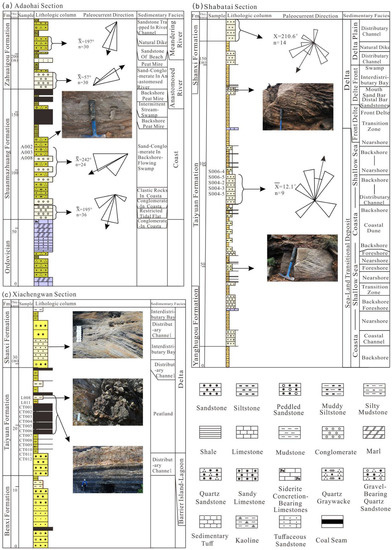
Figure 2.
Stratigraphic column of the Taiyuan Formation in Adaohai section (a), Shabatai section (b) and Xiachengwan section (c) (the direction of paleocurrent according to [14,15]).
2.2. Microscopic Characteristics of Sandstone
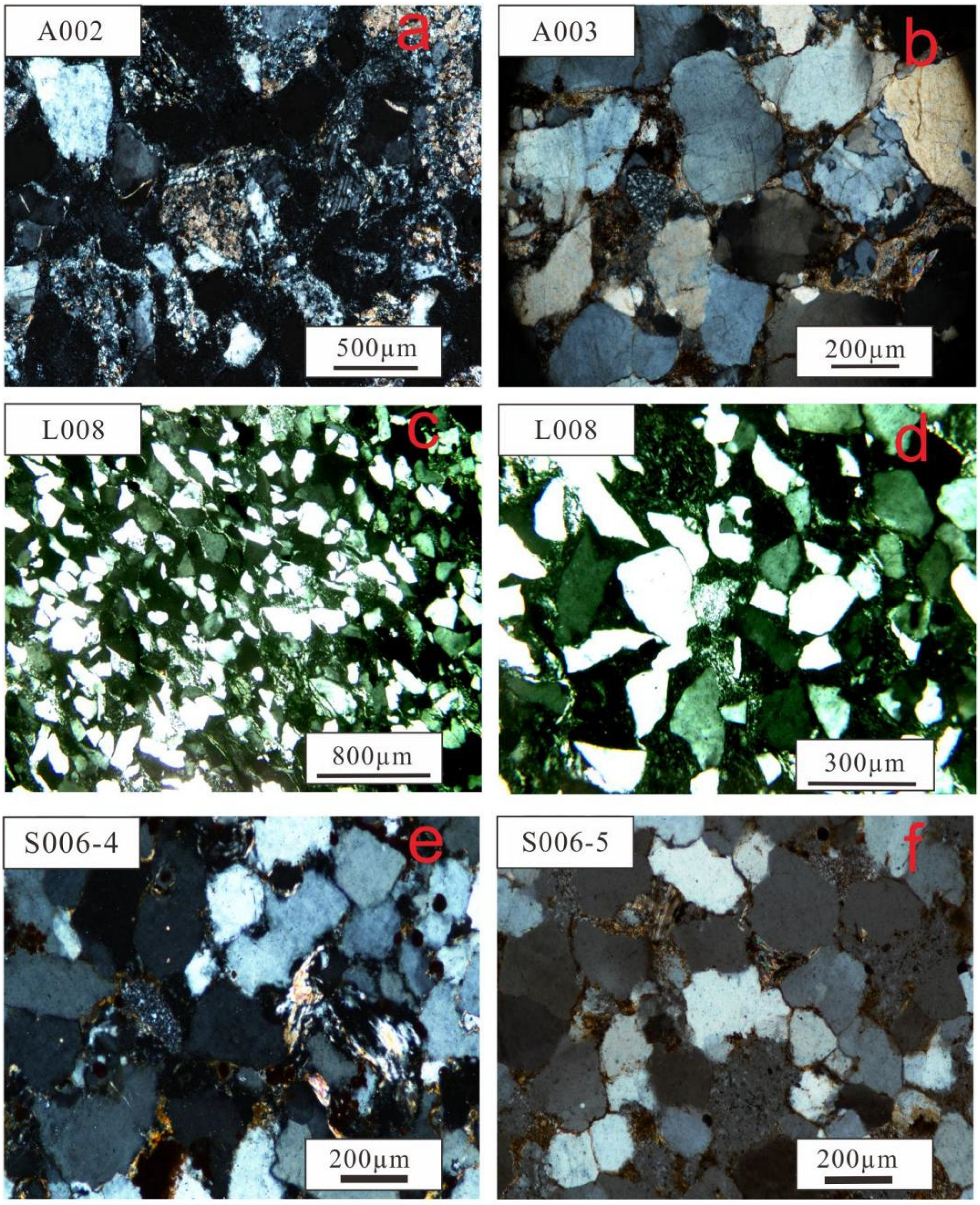
The samples A002 and A003 were selected for lithological microscopic analysis in the Adaohai section (Figure 3a,b). The microscopic features of the two samples are comparable, with blocky and sandy structures and made of terrestrial clastic and gap-filling elements. Quartz (60%) makes up the majority of the clasts, followed by rocks debris (25%), and a tiny quantity of feldspar (5%). The support type is mainly granular support, with linear–convex contact. The cement is calcareous and siliceous. Among them, quartz is mainly sub-rounded, a few sub-angular, mostly single-crystal quartz, occasionally polycrystalline quartz, part of the quartz secondary increase in the edge of the visible, most of the grain size between 0.10–0.65 mm. With a tiny quantity of plagioclase, the feldspar is primarily potassium feldspar. The potassium feldspar typically has a lattice bicrystal and striated structure. The feldspar is also highly clayed, with a dirty surface and a dissolving effect, and its grain size is 0.2 mm–0.35 mm. The rocks debris is composed of phyllite debris and mudstone debris. Cement (6%) and matrix (2%) make up the majority of the interstitial fills, the cement includes iron cement, calcareous cement, and silica cement. The pore space is mainly secondary dissolution pore, with 2% porosity.
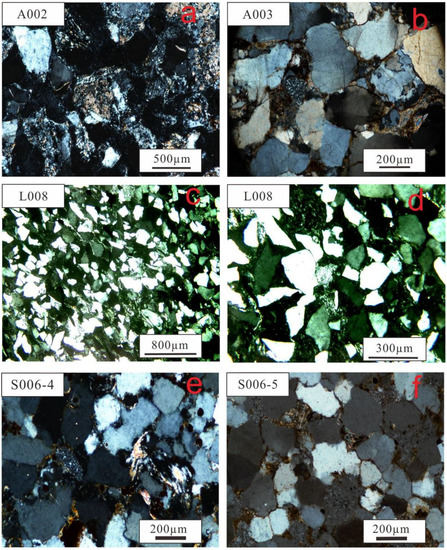
Figure 3.
Microscopic Characteristics of Sandstone samples in Adaohai section (a,b), Xiachengwan section (c,d) and Shabatai section (e,f).
The sample L008 was selected for microscopic analysis of rock thin sections in the Xiachengwan section (Figure 3c,d). The sample microscopically shows a sandy and blocky structure. It is mainly composed of feldspar, quartz and rocks debris. The majority of the feldspar (1%–3%) is potassium feldspar, followed by plagioclase, which is sub-angular and scattered, with fresh and clean surface, about 0.1–0.25 mm in size, and some of them are smaller, about 0.05–0.1 mm in size. Plagioclase is slightly earthy, slightly dirty on the surface. Quartz (80%–85%) is primarily single crystal, seldom polycrystalline, primarily prismatic–sub-prismatic, oriented distribution, clean surface, with a grain size that ranges from 0.05–0.25 mm, a few can reach 0.25–0.5 mm. Rock debris (15%–20%) is mainly metamorphic claystone, metamorphic clay siltstone, metamorphic siltstone, metamorphic siliceous rock, metamorphic clay siliceous rock and a small amount of mud slate, part with metamorphic chlorite aggregate, sericite aggregate. Interstitial fillings (1%–5%) are clay matrix, in the form of fine scale, the diameter of the piece is generally 0.001–0.01 mm, part of 0.01–0.02 mm. Wave-like dentate sutures can be seen, with clayey, opaque mineral distribution within.
Samples S006-4 and S006-5 were selected from the Shabatai section for microscopic analysis (Figure 3e,f). The microscopic properties of the sandstone samples are typically comparable, they are all large in structure and sandy in composition. Mainly composed of feldspar, quartz and rocks debris. Debris is dominated by quartz (80%) and is mainly sub-rounded, with a few sub-angular distributions and occasional wave-like extinction, mostly single-crystal quartz. Part of the quartz has a secondary increased edge structure, the grain size is mostly between 0.15–0.55 mm. Feldspar (3%), mainly potassium feldspar, can be seen with a small amount of plagioclase. Potassium feldspar has a common lattice double crystal and striped structure. Plagioclase can be seen as poly-sheet double crystal or card sodium compound double crystal. Severe sericitization and argillization of feldspar with surface blurring, and grain size of 0.10–0.25 mm. Rock debris (7%) is mainly mudstone debris. Interstitial fillings include cement and matrix. Cement (5%) is calcareous cementation or siliceous cementation. The content of matrix is about 4%. The porosity is about 1%. Occasionally visible strawberry pyrite was observed with a microscope. The support type is granular support, and the contact is mainly linear contact–convex contact.
3. Analytical Procedures
3.1. Sandstone Detritus
The provenance region and the basin’s development process can be revealed to a great extent by the characteristics of the sandstone composition. Standard thin section counting was used to determine the particle number for the siltstone to coarse sandstone samples that were obtained in the sandstone layer for this study. Detailed clastic fraction counts were performed for the sandstones of the Taiyuan Formation in Shabatai, the Shuanmazhuang Formation in Adaohai and the Taiyuan Formation in Xiachengwan (Table 1) using the Gazzi–Dickinson [16] point counting method.

Table 1.
The counting results of detrital sandstone composition in the north depression of the Ordos basin.
3.2. Zircon U–Pb Dating and Minor Element Analysis
Detrital zircon LA-ICP-MS U–Pb dating was tested in four samples. Sample L008 and L011 are from the Xiachengwan section, sample A003 is from the Adaohai section, sample S006-5 is from the Shabatai section.
At the Mineral Laser Microanalysis Laboratory of the China University of Geosciences, Beijing, zircon LA-ICP-MS U–Pb dating, and trace element analysis were carried out. The samples were laser ablated using a NewWave 193UC excimer laser ablation system, and the ablated samples were then carried by the carrier gas to an Agilent 7900 ICP-MS plasma mass spectrometer for examination. Each point analysis process includes 18 s of background analysis to monitor instrument stability, preheating the laser, 50 s of ablation-analysis time, and 10 s of purge–rinse time to remove residues from the previous sample and prepare for the next sample. A total of two 91,500 reference samples were introduced during the experiment at intervals of ten test samples, and the known age monitoring sample GJ-1 (599.2 ± 4.6 Ma, 2SD, n = 4) was inserted concurrently to check the instrument’s stability [17]. Agilent MassHunter software was used to acquire the analytical signals; ICP-MS-DataCal software was used to adjust the background value and integration interval; time drift correction and quantitative calibration were applied to the dating data and trace element data [18,19,20,21]; and ComPbCorr#3.17 was used to correct for common lead [22]. The processed data were plotted using Isoplot for correlation analysis [23]. 206Pb/238U age was applied as young zircon’s forming age (<1000 Ma) and 207Pb/206Pb age was applied as ancient zircon’s forming age (>1000 Ma). Both errors in single data and error in weighted mean of 206Pb/238U or 207Pb/206Pb age of zircon were 1σ.
3.3. Lu-Hf Isotopic Analysis
In situ Lu-Hf isotopic analysis of zircon was also performed at CUGB’s Milma Lab by the MC-ICP-MS method. A multi-receiver inductively coupled plasma mass spectrometer was used to evaluate the samples after they had been ablated by a NewWave 193UC ArF excimer laser (Model: Thermo Fisher Neptune Plus). Each point analysis goes through 50 s background blank, 50 s ablation sampling analysis process, 10 s purging and cleaning process. Software called Iolite was utilized for the final data debugging and processing. A 91500 external standard, and two monitoring standards, Plesovice and GJ-1 [17,24], were added during the experiment at intervals of 6–10 test samples based on the characteristics and amounts of the samples.
3.4. Heavy Mineral Analysis
Detrital heavy minerals have the characteristics of strong stability, reaction parent rock characteristics and little influence by the later period. It serves as an essential tool for provenance analysis. Their mineral assemblage types are very sensitive to provenance [25]. The direction, general location, and transportation process of the provenance region can be limited by examining the heavy mineral assemblage, the heavy mineral index, and the variation of the heavy mineral concentration on the plane. Heavy mineral identification was performed by the Langfang yuheng rock technology service company ltd.
4. Results
4.1. Sandstone Petrography
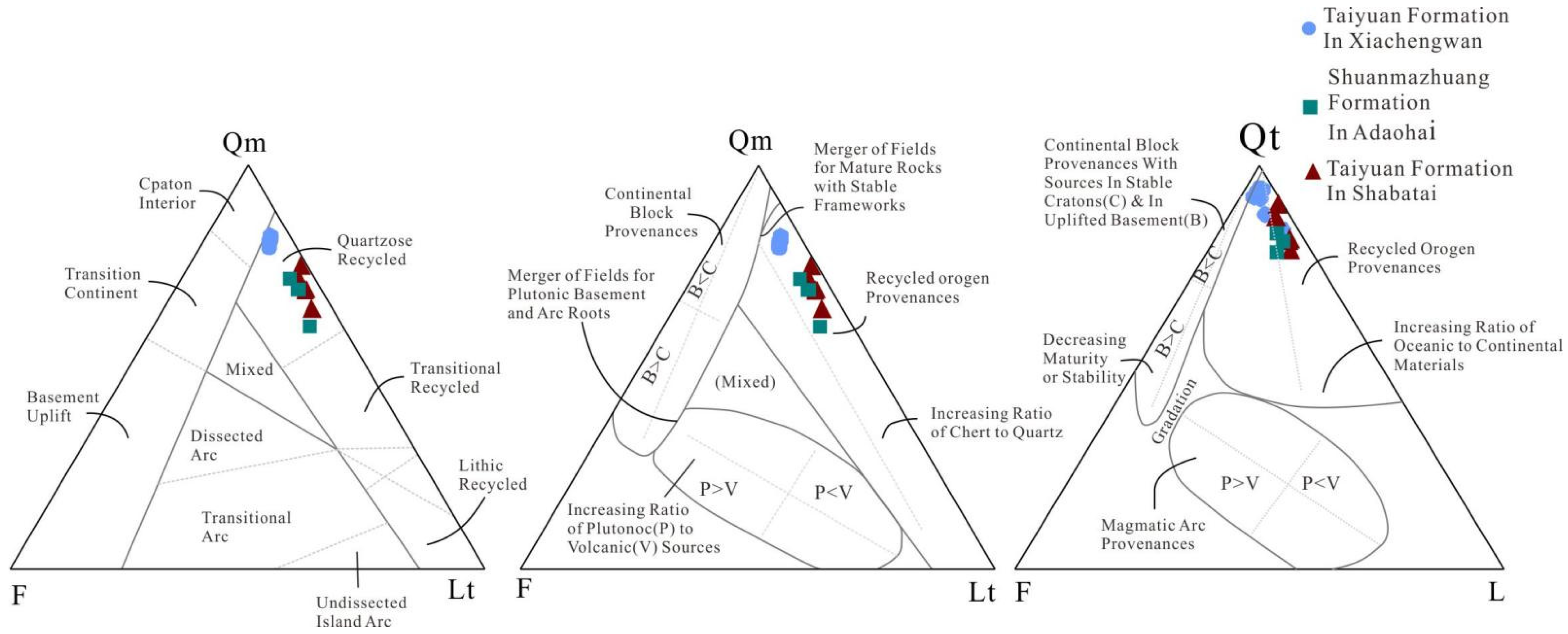
The samples of three sections all fall inside the quartz recycling range and the source area of the recycled orogenic belt, according to the Qm-F-Lt triangle figure (Figure 4). The clastic fractions of Shabatai and Adaohai are close to one another, and the drop points also are; while the drop points of the sandstone samples from Xiahengwan are closer to the inner region of the craton, and the drop points overlap, indicating that the material source is single and stable, and the percentage of single-crystal quartz in the clastic fractions is higher than that in the sandstones of the other two profiles. All three samples are located in the recycled orogenic belt provenance area, which is characterized by continental interior provenance, according to the Qt-F-L diagram. The Taiyuan Formation’s falling point in Xiachengwan is close to a stable craton and uplift basement area, but this is not proof that the provenance area has a stable craton and uplift basement background. It could be the result of the provenance area’s complicated lithology and transportation process. The analytical results of the triangle diagram suggest that the provenance input originates from the intracontinental orogenic belt. Quartz, predominantly single crystal quartz, makes up the majority of the detrital components in the three samples, according to statistics of the detrital results (Table 1). The absence of polycrystalline quartz of the Taiyuan Formation in Xiachengwan is compatible with the recycled orogenic belt’s character in the source region. It also shows how active the tectonic cycle and orogenic activity are in Xiachengwan.
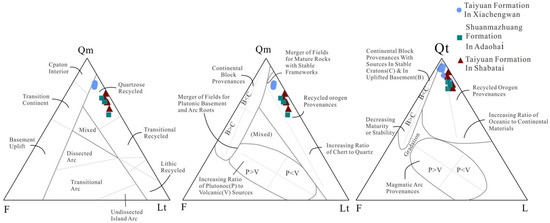
Figure 4.
Modal framework grain compositions of sandstones from sections in the north depression of the Ordos basin (Modified after [26]). Qm, single crystal quartz; Qt, total amount of quartz particles; F, total feldspar; L, all non-siliceous debris; Lt, total debris; B, uplifted basement; C, stable cratons; P, plutonoc; V, volcanic.
Most samples contain very little feldspar, suggesting that terrestrial debris may have been transported over enormous distances and weathered over a long period of time. Only the three samples from the Xiachengwan section had more feldspar debris, which may indicate that the samples were deposited with material input from some of the more recent areas. The Shabatai and Adaohai samples’ features of rock debris are equivalent. There is essentially no volcanic rock debris, but there is an equal amount of sedimentary rock debris and metamorphic rock debris. It shows that both sedimentary rocks and metamorphic rocks may be the source of the provenance. The samples in Xiachengwan hardly contain any rocks debris. Sedimentary rock debris and metamorphic rock debris are only occasionally present in a few samples, whereas volcanic rock debris is almost entirely absent, which is consistent with the long transportation distance and long weathering time of the above debris.
4.2. Zircon Morphology
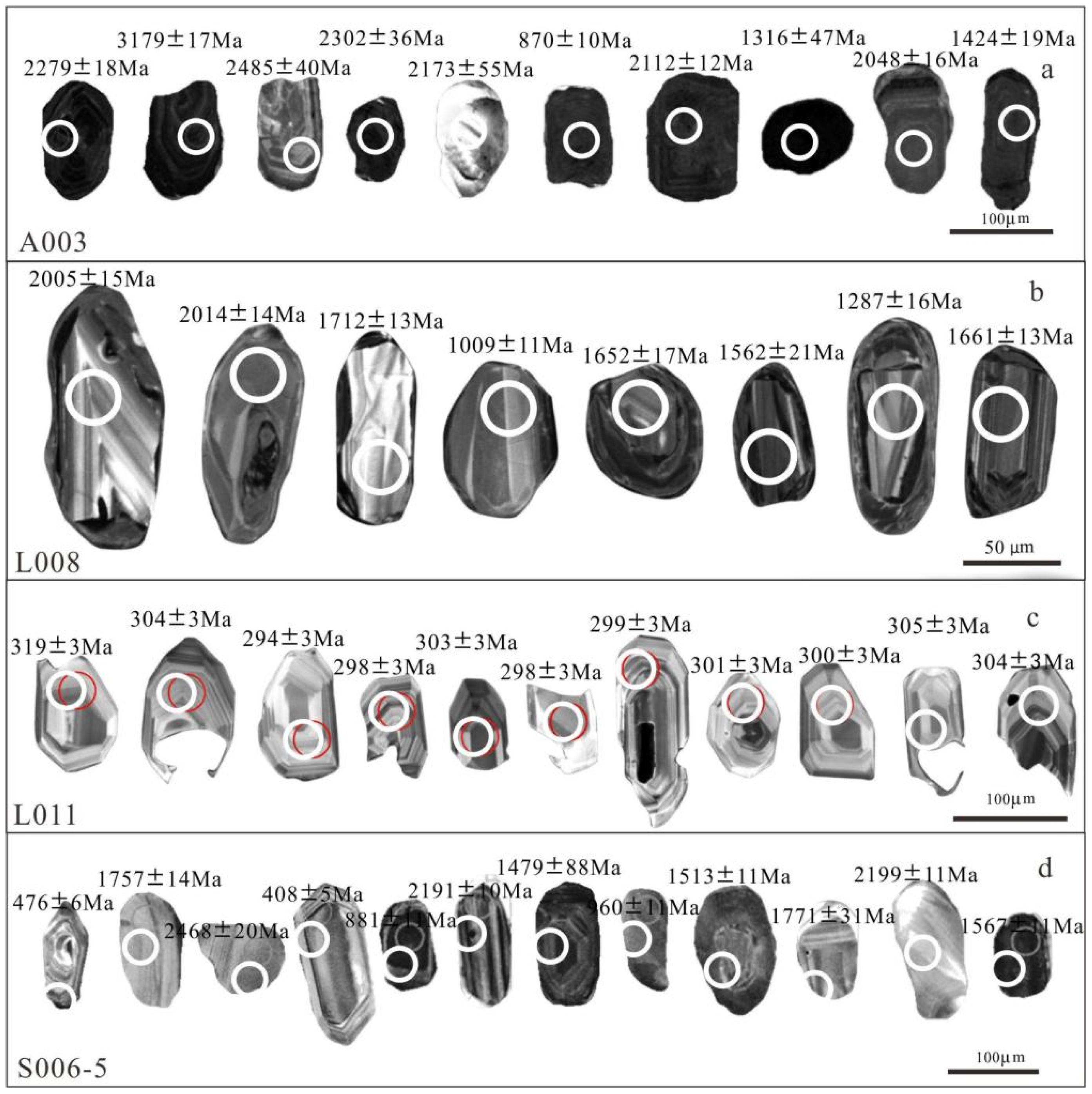
In morphology (Figure 5), L008 shows that zircons are mostly spherical, have short columns, have good roundness, and have complex internal structures. (Figure 5b). The particle size ranges from 60–100 μm, with a tiny portion reaching 150 μm. The majority of the particles are subangular–subcircular, and transmission reflection pictures reveal more developed inclusions, cracks, and evident ablation holes. The core is visible as a fuzzy rhythmic ring, indicating that it has undergone later metamorphism. The structure is complex, the edge is narrow, and the zoning is usually mottled. The majority of the zircons are spherical, have a short column, and have a particle size of about 80–100 μm in L011 (Figure 5c). A few zircons are long columnar, with a particle size of about 180 μm, have a length–width ratio of about 3:1, and are mostly subangular. The transmission reflection images reveal that the zircon contains several long strip inclusions and has surface ablation holes or fissures. A003 show that the particle size is about 50–150 μm, with some up to 200 μm. Zircons are mostly round–oval, with an equal distribution of long columnar and short columnar (Figure 5a). Good roundness indicates a long-distance transmission method that is more intricate. The core structure is complex, showing mottled, fan-shaped zonal, spongy, etc., and clear magmatic rhythmic zoning can be seen on the sides. S006-5 show that most zircon grain sizes are about 80–120 μm, with some up to 150 μm (Figure 5d). Zircons are mostly subangular or rounded, with a limited amount of angular shape, which reflects that the transport process is complex. Th/U ratios are greater than 0.1, and only one value in S006-5 is less than 0.1 (Table 2). Combined with CL images, it is speculated that the zircons measured are magmatic zircons, which have undergone long-distance and long-term transport.
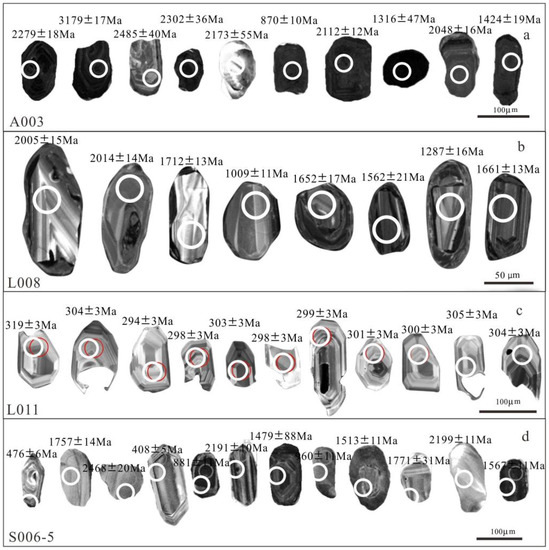
Figure 5.
Cathodoluminescence images of representative zircon grains from the samples of A003 (a), L008 (b), L011 (c), S006-5 (d). In each frame, the top number is the U–Pb age.
Table 2.
LA-ICP-MS U–Pb isotopic results of detrital zircons from the sandstone.
4.3. U–Pb Ages of Detrital Zircons
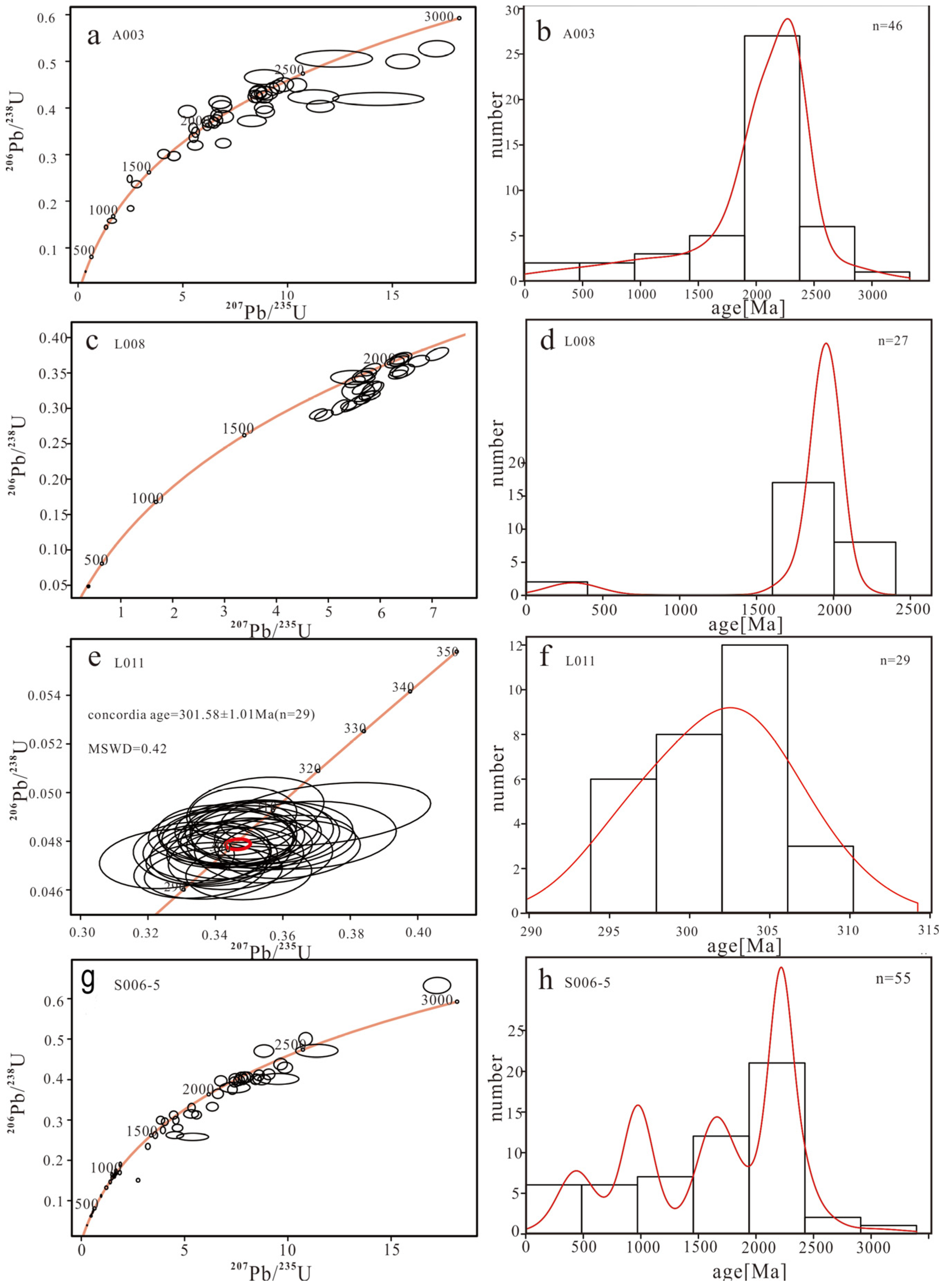
Sample L008 obtained 27 effective zircon U–Pb dating spots (concordance degree of the measured points is between 90%–110%) with age values varying between 301–2182 Ma (Table 2), mainly concentrated in the interval 1888–2182 Ma. Sample L011 obtained 29 effective zircon U–Pb dating spots (concordance degree of the measured points is between 90%–110%) with ages ranging from 294–310 Ma, which are extremely concentrated. The weighted average age is 301 ± 1.5 Ma. Sample A003 obtained 46 effective zircon U–Pb dating spots (concordance degree of the measured points is between 90%–110%) with ages ranging from 309–3089 Ma, mainly in the 1830–2387 Ma interval. Sample S006-5 obtained 55 effective zircon U–Pb dating spots (concordance degree of the measured points is between 90%–110%), with ages ranging from 246–2558 Ma. These ages were mainly distributed into four ranges of 408–476 Ma, 904–993 Ma, 1513–1841 Ma, and 2144–2558 Ma. The dating age values of the sample are close to the concord line (Figure 6) and their concord degree of the measured points is larger than 90%, which confirms the zircon U–Pb age is trustworthy.
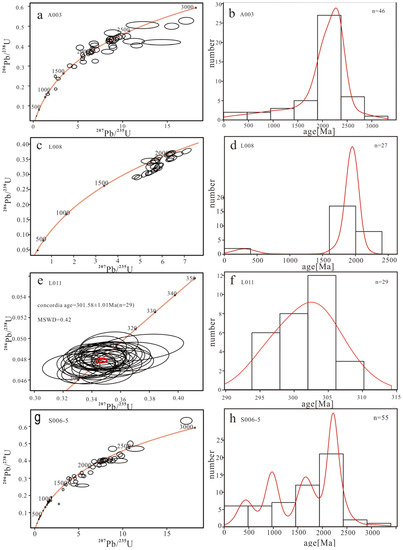
Figure 6.
U–Pb concordia diagrams for samples (a,c,e,g) and Kernel Density Estimation (KDE) plots of the detrital zircon U–Pb data (b,d,f,h) for samples.
4.4. Hf-Isotopes of Detrital Zircons
Zircons, having good U–Pb dating values and a high concordant degree should be used for zircon Hf isotope analysis. The measured zircons in this study have multiple surface fissures and a densely packed interior with inclusions. The CL image reveals that the surface spots are not clear, while the transmission map reveals that the interior is complex. It is difficult to locate a good Hf isotope analysis site near the zircon U–Pb dating point. Therefore, only 13 zircons from the Taiyuan Formation sandstone at Xiachengwan were chosen for analysis. The results of in situ Hf isotope analysis of 13 zircons from the sample L008 (Table 3) show that the 176Lu/177Hf ratio is between 0.0001097–0.002132. Except for points numbered 28, the 176Lu/177Hf of other points is less than 0.002, and the experimentally measured 176Lu/177Hf can represent the initial 176Lu/177Hf. The εHf(t) values of −9.9–−0.3 have two-stage model ages (TDM2) of 2941–1707 Ma, mainly in the range of 2941–2589 Ma; the εHf(t) values of 1.1–−9.3 have two-stage model ages (TDM2) of 2555–2231 Ma, mainly in the range of 2555–2496 Ma. Zircon with an age of 301 Ma, its εHf(t) value is −8.2, two-stage model age (TDM2) is 1985 Ma. Zircon with an age of 308 Ma, its εHf(t) value is −4.5, two-stage model age (TDM2) is 1707 Ma.
Table 3.
Hf-Isotopes results of detrital zircons from the sandstone of the Taiyuan Formation in Xiachengwan.
4.5. Rare Element Compositions of Detrital Zircons
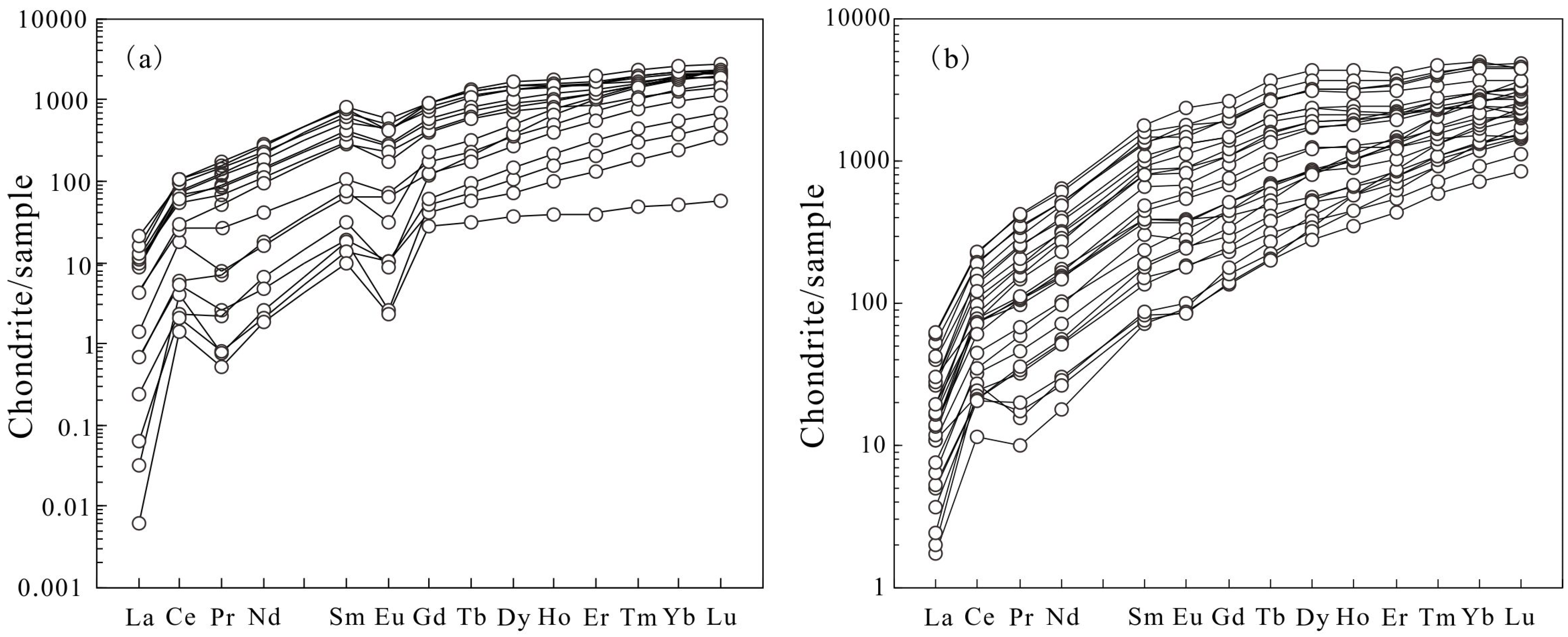
Due to the differences in the rare earth element distribution curves of zircons with various genesis, it was widely used to determine the genesis of zircons [27,28,29]. The internal structure of detrital zircons in measured samples is complex, and the inclusions are well developed. Therefore, the distribution patterns of rare earth elements were exclusively examined in the sandstone of the Taiyuan formation in Xiachengwan. There were two rare earth element distribution curves that were discovered by analyzing the rare earth element concentration and distribution characteristics in detrital zircon with the designation L008. Type 1 is characterized by Ce positive anomalies and Eu negative anomalies (Figure 7a), it is a typical crustal magmatic zircon curve [27,28,29,30]. Type 2 is characterized by Ce positive anomalies (Figure 7b), which show an obvious Eu anomaly, and it may be caused by metamorphism during complex transportation. Both zircon groups show that LREE is more depleted than HREE, LREE/HREE is between 0.01–0.37, and the degree of light and heavy rare earth differentiation is high. The ∑REE content is between 59–7046 ppm, with an average value of 2265 ppm. Type 1 shows the δEu is between 0.08–0.72, with an average of 0.47, δCe is between 1.68–26.02, with an average of 5.64, showing obvious characteristics of Eu enrichment and Ce loss. The δEu of Type 2 is between 0.76–1.13, with an average value of 0.94, showing no obvious Eu anomalies, and the δCe is between 1.3–4.4, with an average value of 1.87, showing weak Ce positive anomalies.
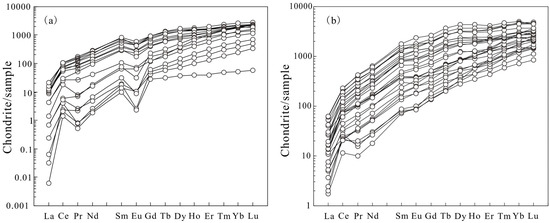
Figure 7.
Chondrite-normalized rare earth element (REE) patterns for detrital zircons from the Taiyuan Formation in the Ordos Basin. (a) Lean to the left Ce positive abnormal Eu negative anomaly, (b) Lean to the left Ce negative anomaly.
4.6. Heavy Mineral Characteristics
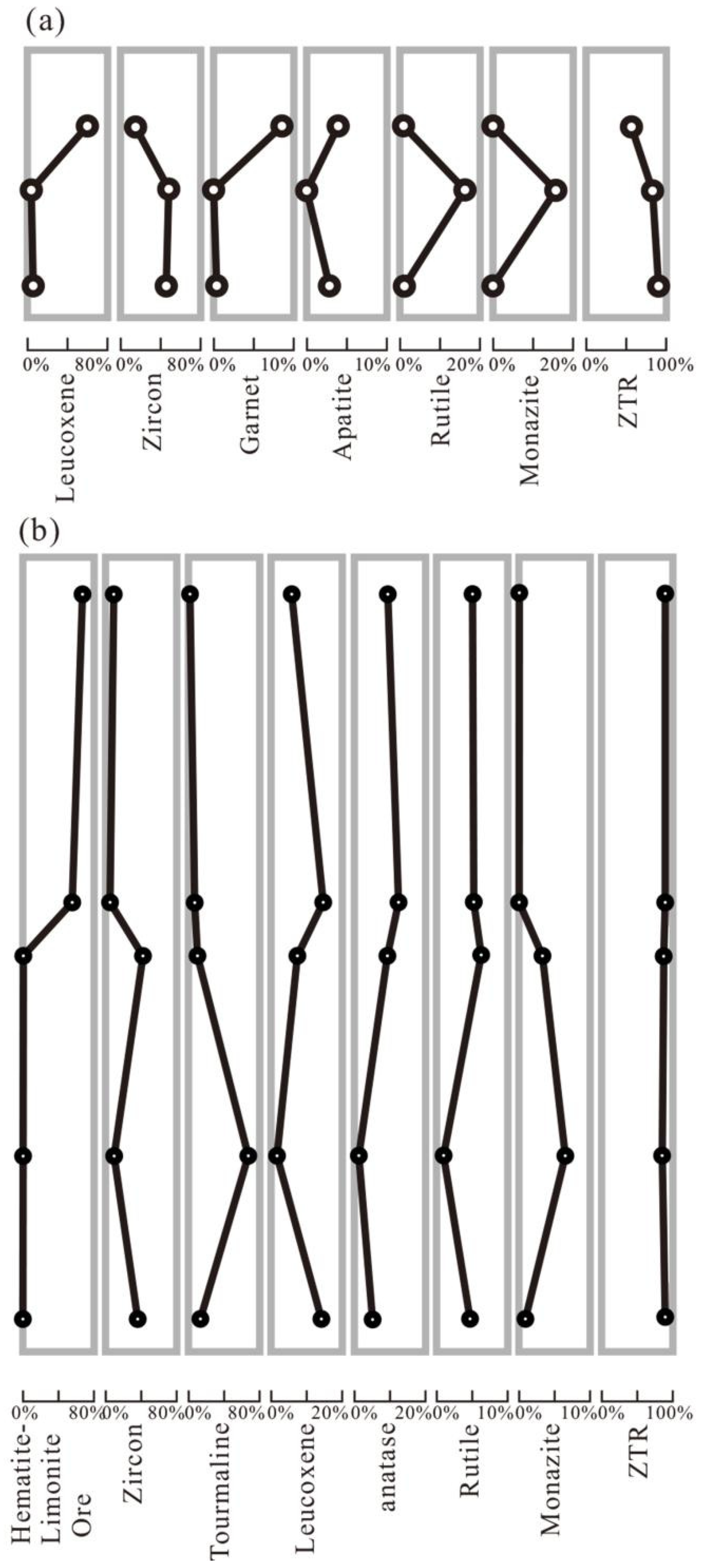
The heavy mineral composition of the five samples of the Taiyuan formation in Shabatai can be divided into two types, namely hematite-limonite + zircon + rutile + monazite + leucoxene and tourmaline (brown) + zircon + rutile (Table 4), indicating that the source rocks are mainly acidic magmatic rocks and metamorphic rocks. Among them, S006-4 and S006-5 heavy mineral identification found more hematite-limonite, which may indicate that a large amount of iron minerals were added when the sample was deposited. There are three types of heavy mineral composition in the sandstone of the Shuanmazhuang formation in Adaohai, namely leucoxene + zircon + garnet + apatite, zircon + rutile + monazite and zircon + ilmenite + leucoxene. The parent rock type corresponding to garnet and apatite is medium–basic extrusive rock, and the parent rock type corresponding to ilmenite is basic and ultra-basic intrusive rock, and the parent rock type corresponding to zircon, rutile and monazite is acidic magmatic rock. Based on this, it is considered that the parent rock of the source area of the Shuanmazhuang formation should be dominated by magmatic rock.
Table 4.
Heavy mineral composition of the Taiyuan Formation in Shabatai and Adaohai (%).
An efficient way to assess the compositional maturity of clastic rocks is to use the ZTR index (the ratio of the combined concentrations of zircon, tourmaline, and rutile to the total content of transparent minerals). With an increase in ZTR value, maturity rises. With the exception of A002 (56%), each of the eight samples has a ZTR index more than 80% (Figure 8). The data are highly concentrated, and the maturity is very high, which indicates that the process is more difficult and that the northern terrigenous debris of the basin is transported far away and the process is more complicated.
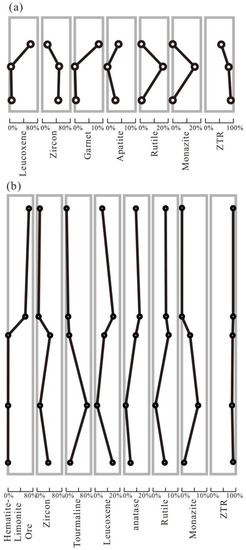
Figure 8.
Variation trend of heavy mineral content and ZTR of the Taiyuan Formation in Shabatai (a) and Adaohai (b).
5. Discussion
5.1. Provenance Analysis of the Eastern Taiyuan Formation
Debris probably underwent a prolonged transport process since single crystal quartz predominates and feldspar concentration is extremely low in the sandstone detrital components of the Taiyuan Formation of the northern margin in the Ordos Basin. The paleocurrent direction indicates that the provenance is from the north, which provides conditions for long-distance transport of provenance. According to the Dickinson triangle diagram, the Taiyuan Formation sand sample belongs to the recycling orogenic belt, which is consistent with the background of the collision between the Xingmeng orogenic belt and the northern margin of the North China Craton. Additionally, the landing points are essentially coincident, demonstrating that the source is single and stable. It is inferred that the provenance is from the orogenic belt in the northern margin of North China Craton (Figure 9).
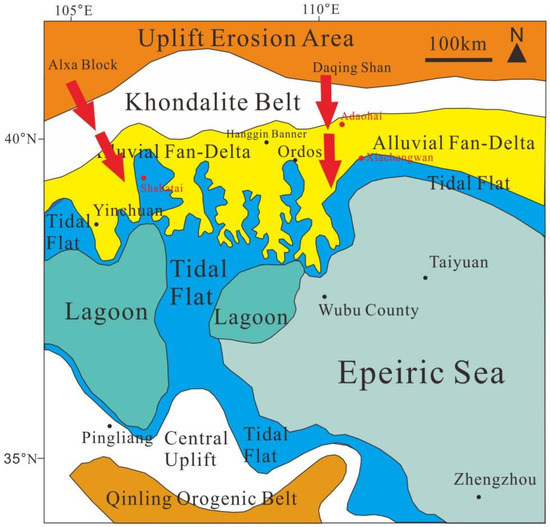
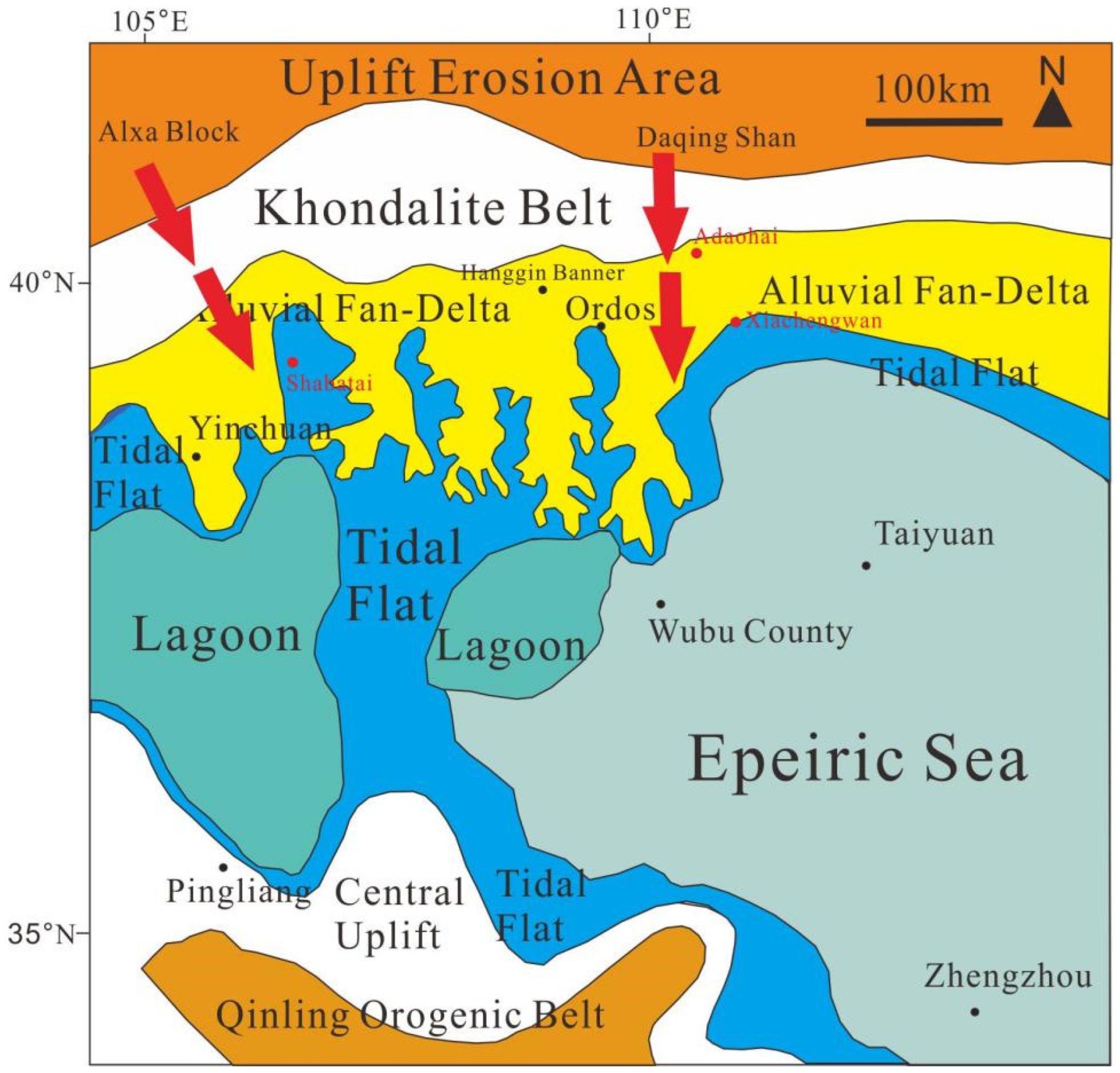
Figure 9.
Structural sedimentary framework of the Taiyuan period in the Ordos Basin (Modified by [33]).
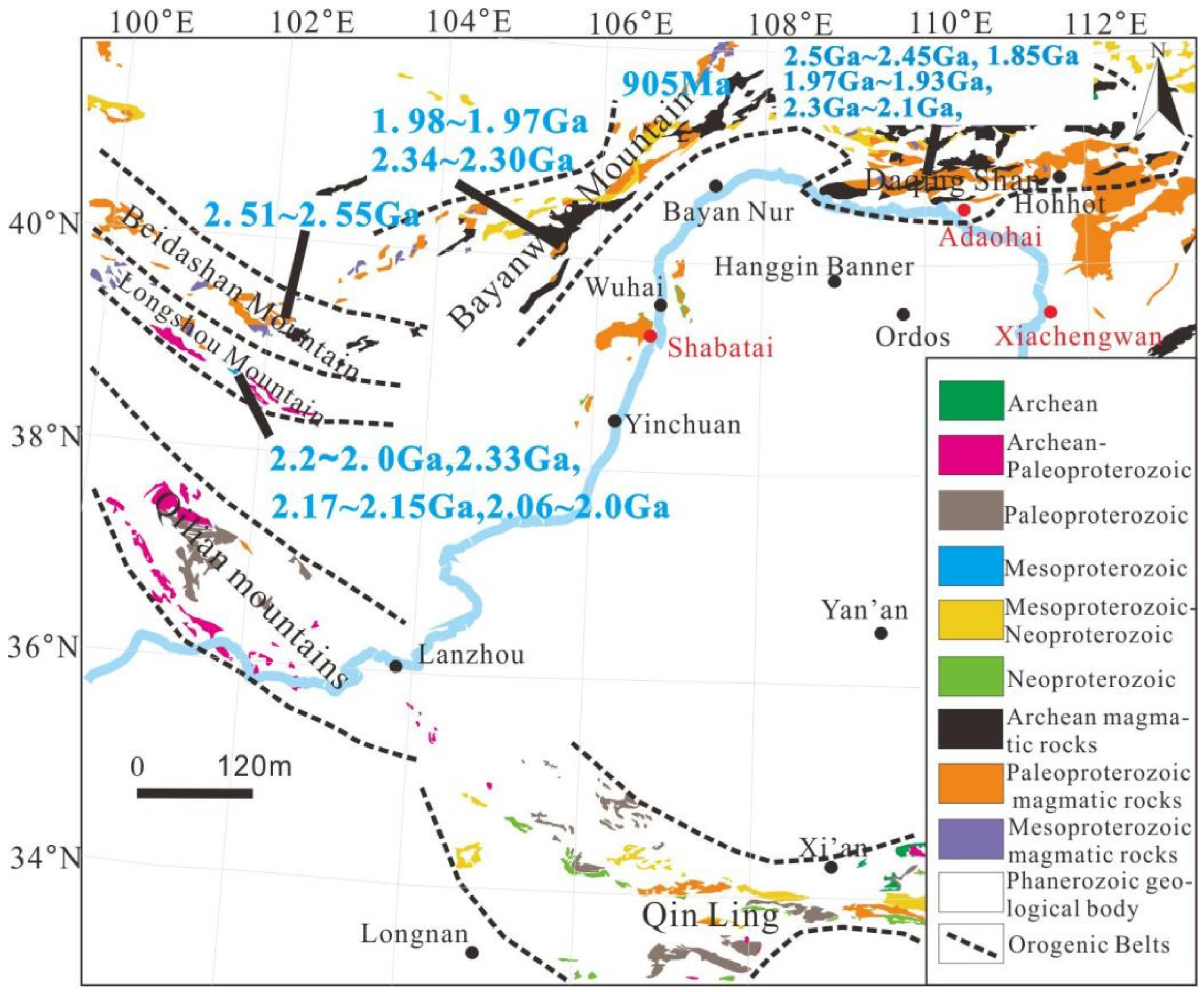
The discovery of tuff in the Taiyuan Formation in Xiachengwan may indicate that the northern margin of the North China Craton was affected by subduction and collision, which caused strong tectonic activity and volcanic activity around 301 Ma. At that time, the northern margin of the North China Craton was in the stage of subduction and collision, and the ancient metamorphic basement was eroded. The debris was likely to be transported to the eastern part of the northern margin of the basin by the paleocurrent relying on the high topography in the north and low topography in the south. Hf isotope analysis of detrital zircon shows that the second stage model age TDM2 of εHf(t) negative age points is mostly between 2777 Ma–2590 Ma, it also includes 1985 Ma and 1707 Ma, indicating that the source area was in the stage of crustal proliferation in the early Archean [31]. A large-scale crustal accretion event occurred in the northern margin of the North China Craton at 2.7 Ga–2.5 Ga and 1.9 Ga–1.8 Ga. A small amount of mantle-derived magma entered the crust during 2.2 Ga–1.8 Ga, most of which was the recycling of existing crustal components [32] (Figure 10). This is the same as the zircon Hf isotope analysis results of the Taiyuan formation sandstone in Xiachengwan, indicating that the source area should be derived from the northern margin of the North China Craton. There are multi-stage tectonic-thermal events in the khondalite series in the northern margin of the North China Craton, with age spans of about 2.6 Ga–2.4 Ga, 2.3 Ga–2.0 Ga and 1.95 Ga–1.85 Ga [33,34,35] (Figure 10). A total of four magmatic events (2.5 Ga–2.45 Ga, 2.3 Ga–2.1 Ga, 1.97 Ga–1.93 Ga and 1.85 Ga) were found in the Daqing mountain complex in the khondalite belt [35,36]. This is consistent with the age of magmatic activity (1888–2182 Ma) of the Taiyuan Formation in Xiachengwan, and the age of magmatic activity (1830–2387 Ma) of the Shuanmazhuang Formation in Adaohai. It is more likely that the Daqing mountain–Wula mountain on the northern margin of the North China Craton is the source area of the Shuanmazhuang Formation and Taiyuan Formation.
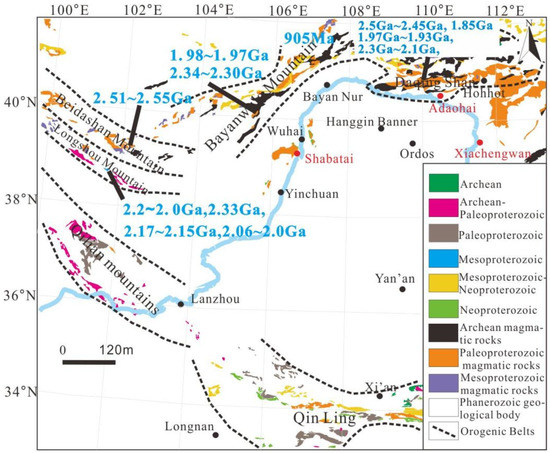
Figure 10.
Distribution of Precambrian igneous rocks in the Orogenic belt around the Ordos basin.
5.2. Provenance Analysis of Western Taiyuan Formation
The rock debris components and paleocurrent characteristics of the Taiyuan Formation in the western part of the northern margin of the basin are the same as those in the eastern part of the northern margin, indicating that it mainly comes from the north and has undergone long-term and long-distance transport. The fact that the ZTR of heavy minerals is greater than 80% indicates that the provenance of the Taiyuan formation has undergone long-distance transport. The Dickinson triangle diagram is also very similar, showing that it comes from the recycled orogenic belt. Combined with the tectonic movement of the peripheral orogenic belt, it is speculated that it also comes from the orogenic belt on the northern margin of the North China Craton.
The Diebusi group rock age in the Alxa block is 1.98–1.97 Ga [37]. According to zircon SIMS U–Pb dating, the magmatic crystallization age of the Bayanwula mountain orthogneiss is 2.34–2.30 Ga [37,38]. The magmatic zircon ages of the orthogneiss in the Longshou mountain are 2.33 Ga, 2.17–2.15 Ga and 2.06–2.0 Ga, respectively [39,40]. The age of the magmatic zircon core in the Beidashan TTG gneiss is 2.51–2.55 Ga [41,42] (Figure 10). In addition, under the influence of the subduction of the Paleo-Asian Ocean, the Alxa region has developed a large Late Paleozoic arcuate tectonic-magmatic belt, in which a large number of Silurian magmatic rocks are developed [43,44,45]. The age of light granite in the Yingba area is 905.2 ± 6.1 Ma [46]. Obviously, the results of detrital zircon dating of sandstone in the Taiyuan Formation of Shabatai (408–476 Ma, 904–993 Ma, 1513–1841 Ma, 2144–2558 Ma) are in good agreement with the time of multiple magmatic activities found in Alxa. There is also a good correspondence between the widespread Silurian magmatic rocks in the Alxa and the 408–476 Ma magmatic activity obtained by detrital zircon dating. Therefore, it is believed that the Alxa block is likely to provide provenance for the Taiyuan formation in the western part of the northern margin of the basin.
In summary, the provenance of the Taiyuan Formation in the northern margin of the Ordos Basin comes from the uplift area of the northern margin of the North China Craton. However, the lithology of the Taiyuan Formation of the northern boundary in the basin also exhibits east–west differentiation as a result of the variations in the age and type of bedrock in the uplift area. Taking Hangjinqi as the margin, the western part of the northern margin of the basin is mainly from the Alxa block, and the eastern part is mainly from the Daqing Shan (Figure 9).
5.3. Tectonic Implications
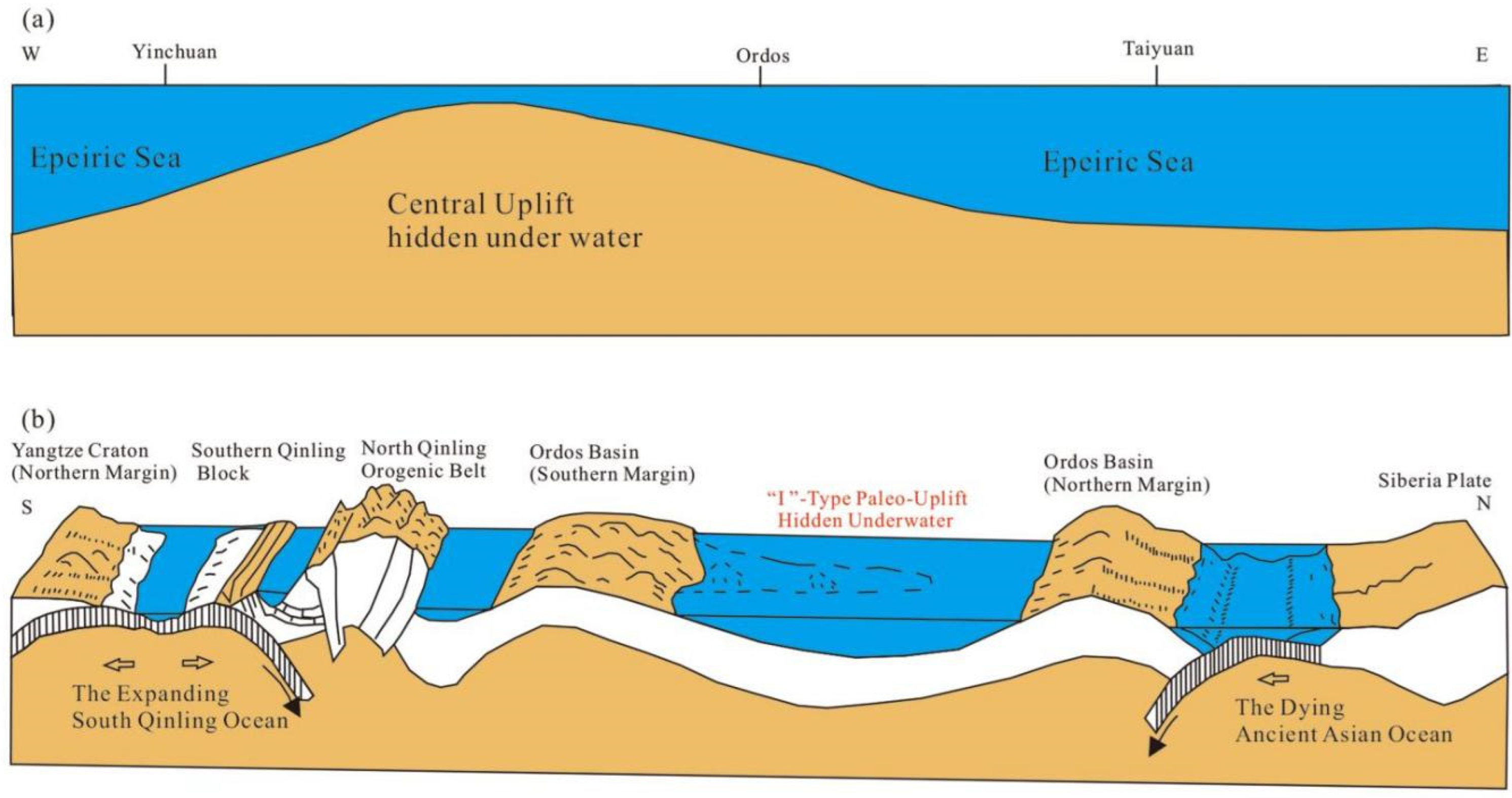
The provenance analysis of the Taiyuan Formation in the northern margin of the Ordos Basin reveals that the provenance area of the Taiyuan Formation in the eastern part is the Daqing Shan in the middle of the northern margin of the North China Craton, and the provenance area of the western part is the Alxa block. It is inferred that during the deposition of the Taiyuan Formation, due to the ancient Asian Ocean gradually closing, the Alxa block and Yinshan orogenic belt in the northern margin uplift belt of North China were uplifted cyclically many times, forming the northern source supply (Figure 11b), and the area north of the Yimeng uplift became the main source area [47,48]. The east–west differentiation of the provenance area is likely because a north–south central paleo-uplift of the Ordos Basin in the late Carboniferous–Early Permian Taiyuan period still exists, making the Taiyuan Formation accept the provenance of different provenance areas.
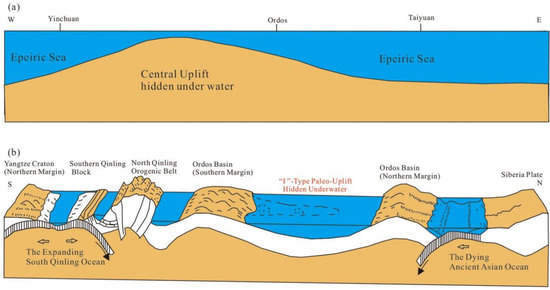
Figure 11.
East-West (a) and North-South (b) tectonic dynamic background of the Taiyuan period in North China and its adjacent areas (Modified by [51]).
In the Early Paleozoic, under the influence of the expansion of the Qinling–Qilian Trough and the Central Asia–Mongolia Trough, the mantle material of the North China Craton moved towards the expansion ridge of the two ocean basins, the North China Craton subsided, and transgression began, forming the North China Epicontinental Basin, which is the Ordos Basin [49]. In the Early Cambrian, the Ordos Basin was controlled by the Qinling–Qilian Trough and the Helan Aulacogen, and successively formed the north–south and east–west ancient uplift, and finally formed the prototype of the central paleolift with an “L” pattern [50,51]. In the Late Cambrian, the central paleo-uplift entered the formation period, and a large central paleo-uplift was formed. During the Majiagou Period of the Early Ordovician, the nature of the continental margin was transformed from a passive continental margin to an active continental margin. Due to the development of the central paleo-uplift, the sea areas on both sides of the basin are separated. West of the paleo-uplift is a carbonate ramp deposit, and to the east is a carbonate deposit in the epicontinental sea [49,52]. In the Late Paleozoic, the basin was gradually transformed from the depression in the cratonic margin to the depression inside the Craton [53]. Affected by continental-arc collisions on both sides of the basin, the Caledonian fold belt was formed, which isolated the connection between the basin and the ocean basin outside the plate [49], and sedimentary facies gradually changed from marine deposit to sea–land transitional deposit and continental deposit. Due to the compression of the bidirectional stress in the Qinling Trough and the Xingmeng Trough in the north and to south of the North China Craton [49], the original “L” type central paleo-uplift evolved into an “I” type from the Late Carboniferous to the early Permian. In the Early Permian, under the strong anti-extrusion action of the Siberian plate and the Yangtze plate and the filling of terrigenous debris [53,54], the seawater on both sides of the central paleo-uplift spread to the middle, according to the central paleo-uplift. The distribution of sedimentary sand bodies on both sides of the paleo-uplift suggests that the central paleo-uplift was submerged in the north–south direction (Figure 11a), and the sea areas on the east and west sides merged, but the depositional patterns on both sides were significantly different, indicating that the evolution of the central paleo-uplift into an underwater paleo-uplift affected the depositional process [55]. During the Shanxi period, the scope of the central paleo-uplift was further reduced, but there are still traces of the control of sedimentary processes on the east and west sides which are still visible. Until the Shihezi period, the central paleo-uplift completely disappeared. The Ordos Basin presents a paleogeographic pattern of low in the middle and high in the north and south [54].
6. Conclusions
- (1)
- The provenance of the Taiyuan Formation in the northern margin of the Ordos Basin is from the recycled orogenic belt, which is the uplift belt in the northern margin of the North China Craton, which underwent a prolonged transport process.
- (2)
- It is considered that the provenance of the Taiyuan Formation in the western part of the northern margin of the basin is the Alxa block, and the provenance in the eastern part is the Daqing Shan in the central and western parts of the Yinshan orogenic belt.
- (3)
- In the late Mesozoic, the central paleo-uplift that developed in the Ordos Basin was submerged, but it still controlled the deposition on the east and west sides of the north margin in the basin.
- (4)
- The Alxa block provided the source for the western part of the northern margin of the Ordos Basin in the Taiyuan period, indicating that there was no ocean barrier between the Alxa block and the North China Craton in this period, and the combination of the two should be before the late Paleozoic.
Author Contributions
Data treatment and writing original draft, W.M.; review and editing, W.M., Y.L., J.X., B.T., X.Y., K.M., F.S. and P.Z.; supervision and funding acquisition, W.M. and Y.L. All authors have read and agreed to the published version of the manuscript.
Funding
This work was financially supported by the Natural Science Foundation of Inner Mongolia (2021MS04010; 2022MS04008), Science and Technology Project of Inner Mongolia (2021GG0251; 2022YFSH0025), Education Science planning project of Inner Mongolia Autonomous Region (NGJGH2020058), Graduate Education Reform Project of Inner Mongolia University of Technology (YJG2020014), Basic Scientific Research Expenses Program of Universities directly under Inner Mongolia Autonomous Region (JY20220243), Postgraduate Education and Teaching Reform Project of Inner Mongolia (JGCG2022080) and Central guidance of local science and technology development fund projects of Inner Mongolia Science and Technology Department (2022ZY0083; 2022ZY0084).
Data Availability Statement
Data is available on request from the corresponding author of the manuscript.
Acknowledgments
Thanks to the evaluation experts and editorial teachers for their rigorous academic guidance and help.
Conflicts of Interest
The authors declare no conflict of interest.
References
- Dai, J.X.; Li, J.; Luo, X.; Zhang, W.; Hu, G.; Ma, C.; Guo, J.; Ge, S. Stable carbon isotope compositions and source rock geochemistry of the giant gas accumulations in the Ordos Basin, China. Org. Geochem. 2005, 36, 1617–1635. [Google Scholar] [CrossRef]
- Zhao, J.Z.; Zhang, W.Z.; Li, J.; Cao, Q.; Fan, Y. Genesis of tight sand gas in the Ordos Basin, China. Org. Geochem. 2014, 74, 76–84. [Google Scholar] [CrossRef]
- Dai, J.X.; Ni, Y.Y.; Wu, X.Q. Tight gas in China and its significance in exploration and exploitation. Pet. Explor. Dev. 2012, 39, 257–264. [Google Scholar] [CrossRef]
- Liu, Q.Y.; Jin, Z.J.; Meng, Q.Q.; Wua, X.; Jia, H. Genetic types of natural gas and filling patterns in Daniudi gas field, Ordos Basin, China. J. Asian Earth Sci. 2015, 107, 1–11. [Google Scholar] [CrossRef]
- Yang, H.; Fu, J.H.; Liu, X.S.; Meng, P. Accumulation conditions and exploration and development of tight gas in the Upper Paleozoic of the Ordos Basin. Pet. Explor. Dev. 2012, 39, 315–324. [Google Scholar] [CrossRef]
- Leier, A.L.; DeCelles, P.G.; Kapp, P.; Ding, L. The Takena Formation of the Lhasa Terrane, Southern Tibet: The Record of a Late Cretaceous Retroarc Foreland Basin. Geol. Soc. Am. Bull. 2007, 119, 31–48. [Google Scholar] [CrossRef]
- Zhu, D.C.; Li, S.M.; Cawood, P.A.; Wang, Q.; Zhao, Z.-D.; Liu, S.-A.; Wang, L.-Q. Assembly of the Lhasa and Qiangtang Terranes in Central Tibet by Divergent Double Subduction. Lithos 2016, 245, 7–17. [Google Scholar] [CrossRef]
- Zhang, K.J.; Xia, B.D.; Wang, G.M.; Li, Y.-T.; Ye, H.-F. Early Cretaceous Stratigraphy, Depositional Environments, Sandstone Provenance, and Tectonic Setting of Central Tibet, Western China. Geol. Soc. Am. Bull. 2004, 116, 1202–1222. [Google Scholar] [CrossRef]
- Huyan, Y.Y.; Pang, X.Q.; Jiang, F.J.; Li, L.; Zheng, D.; Shao, X. Coupling relationship between tight sandstone reservoir and gas charging: An example from lower Permian Taiyuan Formation in Kangning field, northeastern Ordos Basin, China. Mar. Pet. Geol. 2019, 105, 238–250. [Google Scholar] [CrossRef]
- Li, Y.; Wang, Z.; Pan, Z.; Niu, X.; Yu, Y.; Meng, S. Pore structure and its fractal dimensions of transitional shale: A cross-section from east margin of the Ordos Basin, China. Fuel 2019, 241, 417–431. [Google Scholar] [CrossRef]
- Qi, Y.; Ju, Y.W.; Cai, J.C.; Gao, Y.; Zhu, H.; Hunag, C.; Wu, J.; Meng, S.; Chen, W. The effects of solvent extraction on nanoporosity of marine-continental coal and mudstone. Fuel 2019, 235, 72–84. [Google Scholar] [CrossRef]
- Qi, Y.; Ju, Y.W.; Tan, J.Q.; Bowen, L.; Cai, C.; Yu, K.; Zhu, H.; Huang, C.; Zhang, W. Organic matter provenance and depositional environment of marine-to-continental mudstones and coals in eastern Ordos Basin, China-evidence from molecular geochemistry and petrology. Int. J. Coal Geol. 2020, 217, 103345. [Google Scholar] [CrossRef]
- Darby, B.J.; Ritts, B.D. Mesozoic contractional deformation in the middle of the Asian tectonic collage: The intraplate Western Ordos fold-thrust belt, China. Earth Planet. Sci. Lett. 2002, 205, 13–24. [Google Scholar] [CrossRef]
- Zhou, A.C.; Zhao, X.M.; Jia, B.W. Study on Sedimentology Characteristics of the Late Paleozoic Conglomerates from Daqingshan Coalfield, Inner Mongolia. Acta Sedimentol. Sin. 2000, 18, 253–258. (In Chinese) [Google Scholar]
- Wang, L. Study on Sedimentary System of Permian Taiyuan Formation and Shanxi Formation in Western Area of Ordos Basin. Master’s Thesis, Northwest University, Xi’an, China, 2005. (In Chinese with English abstract). [Google Scholar]
- DeCelles, P.G.; Quade, J.; Kapp, P.; Fan, M.; Dettman, D.L.; Ding, L. High and Dry in Central Tibet during the Late Oligocene. Earth Planet. Sci. Lett. 2007, 253, 389–401. [Google Scholar] [CrossRef]
- Jackson, S.E.; Pearson, N.J.; Griffin, W.L.; Belousovaa, E.A. The application of laser ablation-inductively coupled plasma-mass spectrometry to in situ U–Pb zircon geochronology. Chem. Geol. 2004, 211, 47–69. [Google Scholar] [CrossRef]
- Liu, Y.; Gao, S.; Hu, Z.; Gao, C.; Zong, K.; Wang, D. Continental and Oceanic Crust Recycling-Induced Melt-Peridotite Interactions in the Trans-North China Orogen: U-Pb Dating, Hf Isotopes and Trace Elements in Zircons from Mantle Xenoliths. J. Petrol. 2010, 51, 537–571. [Google Scholar] [CrossRef]
- Liu, Y.; Hu, Z.; Gao, S.; Günther, D.; Xu, J.; Gao, C.; Chen, H. In situ analysis of major and trace elements of anhydrous minerals by LA-ICP-MS without applying an internal standard. Chem. Geol. 2008, 257, 34–43. [Google Scholar] [CrossRef]
- Liu, Y.; Hu, Z.; Zong, K.; Gao, C.; Gao, S.; Xu, J.; Chen, H. Reappraisement and refinement of zircon U-Pb isotope and trace element analyses by LA-ICP-MS. Chin. Sci. Bull. 2010, 55, 1535–1546. [Google Scholar] [CrossRef]
- Hu, Z.; Liu, Y.; Gao, S.; Liu, W.; Zhang, W.; Tong, X.; Lin, L.; Zong, K.; Li, M.; Chen, H.; et al. Improved in situ Hf isotope ratio analysis of zircon using newly designed X skimmer cone and jet sample cone in combination with the addition of nitrogen by laser ablation multiple collector ICP-MS. JASS 2012, 27, 1391–1399. [Google Scholar] [CrossRef]
- Andersen, T. Correction of common lead in U-Pb analyses that do not report 204Pb. Chem. Geol. 2002, 192, 59–79. [Google Scholar] [CrossRef]
- Vermeesch, P. IsoplotR: A free and open toolbox for geochronology. Geosci. Front. 2018, 9, 1479–1493. [Google Scholar] [CrossRef]
- Sláma, J.; Košler, J.; Condon, D.J.; Crowley, J.L.; Gerdes, A.; Hanchar, J.M.; Horstwood, M.S.; Morris, G.A.; Nasdala, L.; Norberg, N. Plešovice zircon—A new natural reference material for U-Pb and Hf isotopic microanalysis. Chem. Geol. 2008, 249, 1–35. [Google Scholar] [CrossRef]
- Morton, A.C.; Hallsworth, C.R. Processes of Controlling Composition of Heavy Mineral Assemblages in Sandstones. Sediment. Geol. 1999, 124, 3–29. [Google Scholar] [CrossRef]
- Dickinson, W.R.; Suczek, C. Plate tectonics and sandstone compositions. Am. Assoc. Pet. Geol. Bull. 1979, 63, 2164–2182. [Google Scholar]
- Belousova, E.A.; Griffin, W.L.; Pearson, N.J. Trace element composition and catholuminescence properties of Southern African kimberlitic zircons. Mineral. Mag. 1998, 62, 355–366. [Google Scholar] [CrossRef]
- Belousova, E.A.; Griffin, W.L.; Reilly, S.Y. Igneous zircon: Trace element composition as an indicator of source rock type. Contrib. Mineral. Petrol. 2002, 143, 602–622. [Google Scholar] [CrossRef]
- Hoskin, P.W.O. The composition of zircon and igneous and metamorphic petrogenesis. Rev. Mineral. Geochem. 2003, 53, 27–62. [Google Scholar] [CrossRef]
- Whitehouse, M.J.; Platt, J.P. Dating high-grade metamorphism—Constraints from rare-earth elements in zircon and garnet. Contrib. Mineral. Petrol. 2003, 145, 61–74. [Google Scholar] [CrossRef]
- Yang, J.H.; Wu, F.Y.; Shao, J.A.; Wilde, S.A.; Xie, L.-W.; Liu, X.-M. Constraints on the timing of uplift of the Yanshan Fold and Thrust Belt, North China. Earth Planet. Sci. Lett. 2006, 246, 336–352. [Google Scholar] [CrossRef]
- Chen, Y.L.; Li, D.P.; Wang, Z.; Liu, J.; Chen, C. History of Formation and Evolution on the Crust around the Ordos Basin: Evidences from U-Pb Dating and Hf Isotopic Composition of Zircons. Earth Sci. Front. 2012, 19, 147–166, (In Chinese with English abstract). [Google Scholar]
- Santosh, M.; Wilde, S.A.; Li, J.H. Timing of Paleoproterozoic ultrahigh-temperature metamorphism in the North China Craton: Evidence from SHRIMP U-Pb zircon geochronology. Precambrian Res. 2007, 159, 178–196. [Google Scholar] [CrossRef]
- Wan, Y.S.; Liu, D.Y.; Dong, C.Y.; Xu, Z.; Wang, Z.; Wilde, S.A.; Yang, Y.; Liu, Z.; Zhou, H. The Precambrian Khondalite Belt in the Daqingshan area, North China Craton: Evidence for multiple metamorphic events in the Palaeoproterozoic. Geol. Soc. Lond. Spec. Publ. 2009, 323, 73–97. [Google Scholar] [CrossRef]
- Liu, P.H.; Liu, F.L.; Liu, C.H.; Xu, H.; Wang, Z.; Wilde, S.A.; Yang, Y.; Liu, Z.; Zhou, H. Multiple mafic magmatic and high-grade metamorphic events revealed by zircons from meta-mafic rocks in the Daqingshan-Wulashan Complex of the Khondalite Belt, North China Craton. Precambrian Res. 2014, 246, 334–357. [Google Scholar] [CrossRef]
- Wang, X.; Li, X.P.; Zhang, J.; Zhou, H.; Yin, C. Petrogenesis and tectonic significance of Paleoproterozoic metavolcanic rocks in the Khondalite Belt, North China Craton. Precambrian Res. 2021, 367, 106458. [Google Scholar] [CrossRef]
- Dan, W.; Li, X.H.; Guo, J.H.; Liu, Y.; Wang, X.-C. Paleoproterozoic evolution of the eastern Alxa Block, westernmost North China: Evidence from in situ zircon U-Pb dating and Hf-O isotopes. Gondwana Res. 2012, 21, 838–864. [Google Scholar] [CrossRef]
- Wu, S.; Hu, J.; Ren, M.; Gong, W.; Liu, Y.; Yan, J. Petrography and zircon U-Pb isotopic study of the Bayanwulashan Complex: Constrains on the Paleoproterozoic evolution of the Alxa Block, westernmost North China Craton. J. Asian Earth Sci. 2014, 94, 226–239. [Google Scholar] [CrossRef]
- Gong, J.H.; Zhang, J.X.; Wang, Z.Q.; Yu, S.; Li, H.; Li, Y. Origin of the Alxa Block, western China: New evidence from zircon U-Pb geochronology and Hf isotopes of the Longshoushan Complex. Gondwana Res. 2016, 36, 359–375. [Google Scholar] [CrossRef]
- Zhang, J.X.; Gong, J.H. Revisiting the nature and affinity of the Alxa Block. Acta Petrol. Sin. 2018, 34, 940–962, (In Chinese with English abstract). [Google Scholar]
- Gong, J.H.; Zhang, J.X.; Yu, S.Y.; Li, H.; Hou, K. Ca. 2.5 Ga TTG rocks in the western Alxa Block and their implications. Chin. Sci. Bull. 2012, 57, 2715–2730. (In Chinese) [Google Scholar] [CrossRef]
- Zhang, C.G. Forming Evolution and Sediments Accumulation & Distribution Regularity of Central Paleouplift in Eopaleozoic, Ordos Basin. Ph.D. Thesis, Chengdu University of Technology, Chengdu, China, 2013. (In Chinese). [Google Scholar]
- Duan, J.; Li, C.; Qian, Z.; Jiao, J. Geochronological and geochemical constraints on the petrogenesis and tectonic significance of Paleozoic dolerite dykes in the southern margin of Alxa Block, North China Craton. J. Asian Earth Sci. 2015, 111, 244–253. [Google Scholar] [CrossRef]
- Wang, Z.Z.; Han, B.F.; Feng, L.X.; Liu, B. Geochronology, geochemistry and origins of the Paleozoic-Triassic plutons in the Langshan area, western Inner Mongolia, China. J. Asian Earth Sci. 2015, 97, 337–351. [Google Scholar] [CrossRef]
- Liu, Q.; Zhao, G.; Sun, M.; Liu, B. Early Paleozoic subduction processes of the Paleo-Asian Ocean: Insights from geochronology and geochemistry of Paleozoic plutons in the Alxa Terrane. Lithos 2016, 262, 546–560. [Google Scholar] [CrossRef]
- Zhou, Y.Z.; Han, B.F.; Xu, Z.; Ren, R.; Su, L. Theage of the Proterozoic rocks in Yingba area in western Inner Mongolia:Constraints on the distribution of the South Gobi micro -continent inthe Central Asian orogenic belt. Geol. Bull. China 2013, 32 (Suppl. 1), 318–326, (In Chinese with English abstract). [Google Scholar]
- Chen, B.; Jahn, B.M.; Wilde, S.; Xu, B. Two contrasting Paleozoic magmatic belts in northern Inner Mongolia, China: Petrogenesis and tectonic implications. Tectonophysics 2000, 328, 157–182. [Google Scholar] [CrossRef]
- Dou, W.T.; Hou, M.C.; Dong, G.Y. Provenance analysis of the Upper Paleozoic Shanxi to Lower Shihezi formations in north Ordos basin. Nat. Gas Ind. 2009, 29, 25–28. [Google Scholar]
- Shang, J.W. Structural Evolution of Ordos Basin. Ind. Sci. Trib. 2020, 19, 46–47. (In Chinese) [Google Scholar]
- Deng, K.; Zhang, S.N.; Zhou, L.F.; Liu, Y. Formation and tectonic evolution of the Paleozoic central paleouplift of Ordos Basin and its implications for oil-gas exploration. Geotecton. Et Metallog. 2011, 35, 190–197. (In Chinese) [Google Scholar]
- Zhang, J.X.; Gong, J.H.; Yu, S.Y.; Li, H.; Hou, K. Neoarchean-Paleoproterozoic multiple tectonothermal events in the western Alxa block, North China Craton and their geological implication:Evidence from zircon U-Pb ages and Hf isotopic composition. Precambrian Res. 2013, 235, 36–57. [Google Scholar] [CrossRef]
- Li, J. Regulation of Sediments Distribution and Sedimentation-Sequence Filling Characteristics during Late Paleozoic in Ordos Basin. Ph.D. Thesis, Chengdu University of Technology, Chengdu, China, 2011. (In Chinese with English abstract). [Google Scholar]
- He, F.Q.; Wang, F.B.; Guo, L.G. Evolution of prototype basin and change of tectonic-sedimentary pattern in Paleozoic, Ordos Basin. Pet. Geol. Exp. 2022, 44, 373–384, (In Chinese with English abstract). [Google Scholar]
- Chen, A.Q.; Chen, H.D.; Xu, S.L.; Shi, G.; Zhang, C.G. Provenance and sandy accumulation regularity of Neopaleozoic in North Ordos Basin. J. China Univ. Pet. 2011, 35, 1–7, (In Chinese with English abstract). [Google Scholar]
- Guo, J.; Chen, H.D.; Su, Z.T. Sandboby Development of Taiyuanformation under Central Paleouplift, Ordos basin. Nat. Gas Explor. Dev. 2014, 37, 5–8. (In Chinese) [Google Scholar]
Disclaimer/Publisher’s Note: The statements, opinions and data contained in all publications are solely those of the individual author(s) and contributor(s) and not of MDPI and/or the editor(s). MDPI and/or the editor(s) disclaim responsibility for any injury to people or property resulting from any ideas, methods, instructions or products referred to in the content. |
© 2023 by the authors. Licensee MDPI, Basel, Switzerland. This article is an open access article distributed under the terms and conditions of the Creative Commons Attribution (CC BY) license (https://creativecommons.org/licenses/by/4.0/).