


Abstract
The cut-free single-succedent Gentzen sequent calculus for the minimal tense logic is introduced. This sequent calculus satisfies the displaying property. The proof proceeds in terms of a Kolmogorov translation and three intermediate sequent systems. Finally, we show that tense logics axiomatized by strictly positive implication have cut-free Gentzen sequent calculi uniformly.
MSC:
03F03; 03B44; 03B45
1. Introduction
Basic tense logic is the extension of classical propositional logic with tense operators (cf. e.g., [1]). The minimal tense logic can be formulated as the minimal modal logic with a past modality. Viewed as a kind of bimodal logic, tense logic is investigated mainly by using tools and techniques from modal logic (cf. e.g., [2,3]). As far as the proof theory of modal logic is concerned, some approaches have taken to consider cut-free sequent calculi for modal logics. Since Gentzen sequent calculus for classical logic was developed, it has been extended with rules for modal operators, and such sequent systems are explored in the literature (cf. e.g., [4]). In particular, some aspects of Gentzen sequent calculi for modal logics are explored by Poggiolesi [5]. Belnap’s display logic [6] provides an alternative to Gentzen-type sequent calculi for various non-classical logics (cf. e.g., [7,8]). Labelled sequent calculi are developed in terms of the relational semantics for modal logics (cf. e.g., [9,10,11]). Deep inference (cf. e.g., [12]) calculi are developed where nested sequents are used.
Proof theory for the basic tense logic and its extensions has also been investigated in the literature (cf. [13,14]). However, sequent calculi for tense logics in the sense of Gentzen have not been well-developed. A fundamental problem lies in the elimination of the cut rule. Inspired by the proof-theoretic study of Lambek calculus (cf. [15]), a cut-free Gentzen sequent calculus for intuitionistic modal logic has been provided in [16], and such a sequent calculus is also developed for intuitionistic tense logic in [17]. In these works, structural operators for ∧ (conjunction), ◊ (future possibility) and ⧫ (past possibility) are introduced such that formula structures instead of multisets of formulas are provided for defining sequents. Eventually cut-free Gentzen sequent calculi for intuitionistic modal and tense logics are developed. It is this road we take to provide cut-free sequent calculi for classical tense logics.
Gentzen’s sequent calculus for classical propositional logic is multi-succedent. One way of constructing a single-succedent sequent calculus is that the rule of excluded middle is added to the G3-style sequent calculus for intuitionistic propositional logic (cf. [18], p. 114). In the present paper, we take an alternative approach to this problem. The central point is that we can eliminate cut by considering appropriate rules for negation. Double negation rules and two particular rules for negation are provided. Eventually, the proof of cut elimination for is not a direct induction on the cut height or the complexity of the cut formula but an indirect proof in terms of two additional auxiliary sequent systems. It is this machinery that allows uniform cut elimination for Gentzen sequent calculi for tense logics axiomatized by strictly positive axioms.
The structure of this paper is as follows. Section 2 provides some preliminaries on tense logics. Section 3 introduces a single-succedent sequent calculus for the minimal tense logic . Section 4 provides a proof of the cut elimination for . Section 5 proves that all tense logics axiomatized by strictly positive implications have a single-succedent sequent calculus obtained from by adding structural rules, which are transformed from the strictly positive axioms. Section 6 offers some concluding remarks.
2. Preliminaries on Tense Logics
Let be a denumerable set of propositional variables. Primitive connectives are ⊥ (falsum), ¬ (negation) and ∧ (conjunction). We use four unary operators, which are ◊ (future possibility), ⧫ (past possibility), □ (future necessity) and ■ (past necessity). The formula algebra is defined inductively as follows:
where . We use abbreviations (true), (disjunction), (implication) and , which are defined as usual. The complexity of a formula is defined inductively as follows:
A substitution is a homomorphism . Let be the substitution of under s. For every formula , let be the set of all variables appearing in .
Let and . For every , let . The inverse of Q is defined as . For every , let , and . We use the Boolean operations and (complementation) on the power set .
Definition 1.
A frame is a pair where (the set of possible worlds) and (the accessibility relation). A valuation in is a function . For every formula , the truth set of α under a valuation V in is defined inductively as follows:
Note that , and . A formula α is valid in a frame (notation: ) if for all valuations V in . A formula α is valid in a class of frames (notation: ) if for all . The logic of is defined as the set of formulas . For a set of formulas Σ, we write if for all . The class of all frames for Σ is defined as .
Definition 2.
A tense logic is a set of formulas L such that the following conditions hold:
- (1)
- L contains the following formulas:
- (2)
- L is closed under the following rules:
- (3)
- L is closed under substitution, i.e., if , then for every substitution s.
We write (β is a theorem of L) if .
Fact 1.
For every tense logic L, the following hold:
- (1)
- if , then for every .
- (2)
- ; ; and .
- (3)
- for every , .
- (4)
- for every , and .
- (5)
- and .
Let be a collection of tense logics. It is obvious that is a tense logic. The minimal tense logic is denoted by . Let L be a tense logic and a set of formulas. The tense logic generated by over L is defined as . If , we write for . Let be the set of all tense logics containing L. Clearly, forms a bounded distributive lattice. The set of all tense logics is .
A tense logic L is consistent if . The only inconsistent tense logic is . A tense logic L is Kripke-complete if . Using the standard method of canonical model, we obtain many results on the Kripke completeness (cf. e.g., [2]).
Theorem 1.
is Kripke-complete, i.e., iff .
Proof.
See, e.g., ([2], Corollary 4.36). □
3. A Gentzen Sequent Calculus for
We introduce a single-succedent Gentzen sequent calculus for the minimal tense logic . We follow the formulation of a sequent calculus for intuitionistic tense logic given in [17], and use formula structures to define a sequent.
Definition 3.
Let the comma, ∘ and • be structural operators for ∧, ◊ and ⧫, respectively. The set of all formula structures is defined inductively as follows:
Let , where ϵ stands for the empty. For each , the formula is defined inductively as follows:
In particular, let . By , we denote the degree of a formula structure Γ, i.e., the number of occurrences of structural operators in Δ. A sequent is an expression , where and . We write instead of . We use , etc., with or without subscripts to denote sequents. A sequent rule is a figure
where are premises and is the conclusion of .
Definition 4.
Let − be the given symbol called the position. The set of all contexts is defined recursively as follows:
where . The set of all formula contexts is defined inductively as follows:
where . For every context , we define inductively as follows:
The degree of a context , denoted by , is defined as the number of occurrences of structural operators appearing in . For every context and formula structure , let be the formula structure obtained from by replacing − with Δ.
The degree of a formula context , denoted by , is defined as the number of occurrences of logical operators appearing in . For each and , let be the formula obtained from by replacing − with β.
Obviously, can be considered as a formula structure with a position, and as a formula with a position. For each , we have arising from by replacing − with .
Example 1.
Let us provide examples of context and formula context. The expression is a context. If we replace the formula structure for the position − in , we obtain the formula structure . The expression is a formula context. If we replace the formula for the position − in , we obtain the formula .
Definition 5.
The sequent calculus is defined by the following axiom and inference rules:
- (1)
- Axiom:
- (2)
- Logical rules:The derived formula in the below sequent of a logical rule is called principal.
- (3)
- Structural rules:
- (4)
- Cut rule:
A derivation in is a finite tree of sequents in which each node is either an axiom or derived from child node(s) by a sequent rule. Derivations are denoted by , etc., with or without subscripts. The height of a derivation , denoted by , is defined as the maximal length of branches in . A single node derivation has height 0. A sequent s is derivable in , notation , if there exists a derivation in with root node s. For every , we write if there exists a derivation of s in with height at most k. A sequent rule with premises and conclusion is admissible in if whenever for all . The prefix is omitted if no confusion can arise.
Lemma 1.
The following sequent rules are admissible in :
Proof.
We have the following derivations:
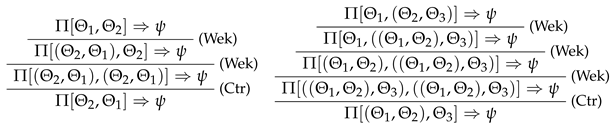
The admissibility of can be shown similarly. □
Note that, in Lemma 1, (Ex) is the the rule of exchange, and and are rules of associativity with respect to the structural operator of comma. Henceforth, applications of these rules are so obvious that we skip them in derivations. A formula is -equivalent to (notation: ) if and .
Lemma 2.
The following hold in :
- .
- and .
- iff .
- iff .
- iff .
- and .
- and .
- and .
- and .
- if , then for every .
Proof.
For (1), it is obtained by (Wek). For (2), from (Id) by and , we obtain . We also have the following derivation:
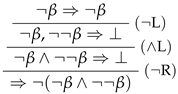
For (3), we have the following derivations:
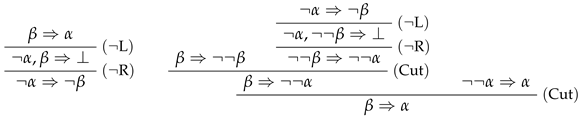
By (3), (2) and (Cut), we obtain (4) and (5). For (6), we have the following derivations:
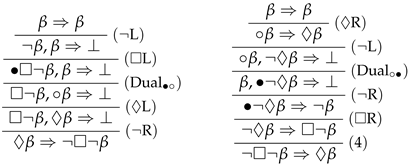
The proof of (7) is similar. For (8) and (9), we have the following derivations:

For (10), assume . By , . By , . By , . By , . The cases of ⧫ and ■ are similar. □
Lemma 3.
If , then , where is obtained from χ by replacing one or more occurrences of α in χ by β.
Proof.
The proof proceeds by induction on the complexity of . The case or is trivial. Let . Suppose . By induction hypothesis, and . It is easy to obtain . Suppose . By induction hypothesis, . By Lemma 2 (3), . Suppose . By induction hypothesis, . By Lemma 2 (10), . The remaining cases for with can be shown similarly. □
Lemma 4.
The following hold in :
- (1)
- if and , then .
- (2)
- if or , then .
- (3)
- .
- (4)
- iff .
- (5)
- iff .
Proof.
For , we have the following derivation:
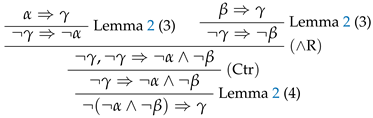
For (2), by , where i = and Lemma 2 (5), . Assume . By (Cut), . For (3), we have the derivation:
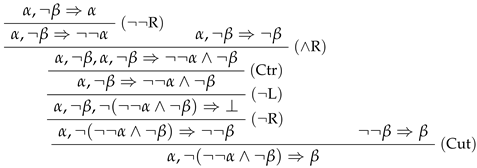
For (4), we have the following derivations:
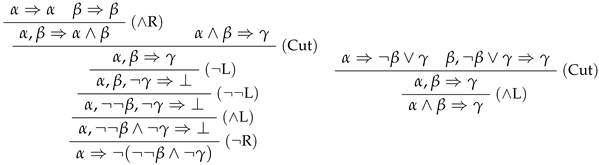
Note that by (3). For (5), by (4), iff . By Lemma 3, . Hence, iff . □
Remark 1.
Every formula structure Θ can be replaced by a corresponding formula . Clearly, iff . Then, by Lemma 4 (4), one obtains iff .
Definition 6.
We define the displaying formula with respect to a formula context and a formula α recursively as follows:
Theorem 2 (Displaying).
iff .
Proof.
We proceed by the induction on . Basic cases for are trivial. We consider the following cases for the induction:
(1) or . We prove only the former one and the other can be treated similarly. Clearly, . By induction hypothesis, iff . It needs only to show that iff . Let . Hence, . Then, . Suppose . Clearly, . Consequently, .
(2) or . We prove only the former one and the other can be treated similarly. Clearly, . According to induction hypothesis, iff . It needs only to show that iff . Let . By , . Let . By , . By Lemma 2 (8), . By (Cut), . □
A sequent is valid in a frame (notation: ) if . A sequent s is valid in a class of frames (notation: ) if for all . An inference rule preserves validity if the validity of premise(s) implies that of the conclusion. Now, we shall prove the soundness and completeness of .
Lemma 5.
For every frame , iff .
Proof.
We proceed by induction on . The basic cases are trivial. Assume or . We prove only the former case. Obviously, . By induction hypothesis, iff . Clearly, iff . Let or . We prove only the former case. Obviously, . By induction hypothesis, iff . Clearly, iff . □
Theorem 3 (Soundness).
If , then .
Proof.
Assume . The case holds obviously. Suppose and is derived by a rule . Right rules for and ■ preserve validity obviously. Other logical rules, (Ctr), (Wek) and (Cut) preserve validity by Lemma 5. For , assume . Then, . Let V be any valuation in . Then, and so . Then, . Then, . The case for is similar. □
Lemma 6.
If , then .
Proof.
Assume . By Lemma 2, Lemma 4 and Remark 1, for every instance of axioms (A1)–(A6), we have . Assume and . By Lemma 4 (3), . By (Cut), . Assume . By Remark 1, . By Lemma 2 (9) and (10), using (Cut), . By Remark 1, . The case for is shown similarly. □
Theorem 4 (Completeness).
If , then .
Proof.
Assume . Then, . By Theorem 1, . By Lemma 6, . Then, and so . □
4. Cut Elimination
In this section, we show the cut elimination of . Let be the sequent calculus obtained from by removing the rule (Cut) and replacing the rules and by the following four rules:
The cut elimination of is obtained by showing that is equivalent to .
Lemma 7.
If , then .
Proof.
Note that and are special cases of and , respectively. Assume . Clearly, . By (Cut), . Hence, is admissible in . Assume . By , . By and (Cut), . Hence, is admissible in . □
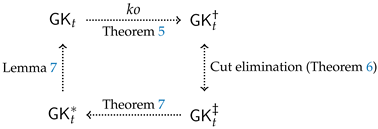
The converse of Lemma 7 shall be shown in three steps. First, is the sequent calculus obtained from by removing the rules and . We shall define a translation such that, for every sequent s, iff . Second, we show the cut elimination of and so obtain a sequent calculus , which is obtained from by removing the rule (Cut). Third, we show that implies .
Lemma 8.
If , then .
Proof.
Let . We prove by induction on . Suppose . Then, . By and , . Suppose or . We prove only the former case. Clearly, . By induction hypothesis, . Suppose or . We prove only the former cases. Clearly, . By (), . By induction hypothesis, . By (), . □
Lemma 9.
For every formula α, and .
Proof.
Apply (¬L) and (¬R) to . □
Lemma 10.
If , then .
Proof.
Assume . By (¬L) and Lemma 8, . By , . By Lemma 9, . By (Cut), . □
Definition 7.
The Kolmogorov translation is recursively defined as follows:
For every formula structure Γ, by , we denote the formula structure obtained from Γ by replacing each formula β in Γ by . For every context , is defined natrually.
Lemma 11.
For every formula α, .
Proof.
Clearly, and for some . By Lemma 9, . Then, . □
Theorem 5.
iff .
Proof.
Let . Then, . Obviously, for any . Due to Lemma 3 and (Cut), . The opposite direction is proved by induction on the derivation of . Let be obtained by rule (R). We provide only details of proof for the case or . Other cases are analogous to the proof of [17], Lemma 5.5. We prove only the former case. Let the premise and the conclusion of (R) be and , respectively. By induction hypothesis, . By and (Cut), . By , . □
Now, we prove the cut elimination holds for . For every , let be the formula structure in which appears at n places. In particular, if , then denotes a formula structure in which does not appear. We introduce the following mix rule:
Clearly, (Mix) is admissible in , and (Cut) is a special case of (Mix). Thus, the cut elimination is equivalent to the mix elimination of .
Theorem 6.
If , then without any application of .
Proof.
Let be a derivation of in . It suffices to show that (Mix) can be eliminated from . Let an application of in be as follows:
We prove the elimination of (Mix) by induction on and . Let or . Then, or is an instance of (Id). Hence, or . Therefore, the conclusion is just the right or left premise of (Mix). Suppose that and . Assume the last rules for deriving the left and right premises of (Mix) are and , respectively. We have the following cases:
(1) At least one of and is a structural rule. We have the following cases:
(1.1) is . Let the derivation end with
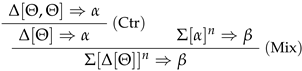
By induction hypothesis, the above subtree can be transformed into
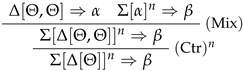 where means n times application of (Ctr).
(1.2) is . Let the derivation end with
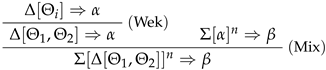
By induction hypothesis, the above subtree can be transformed into
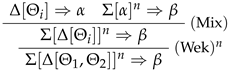 where i = and means n times application of (Wek).
(1.3) is . Let , and the derivation end with
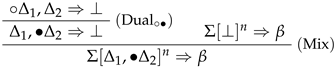
The above subtree can be transformed into
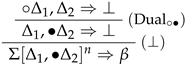
(1.4) is . The proof is quite analogous to (1.3).
(1.5) is (Ctr). Let and the derivation end with
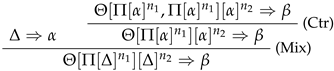
By induction hypothesis, the above subtree can be transformed into
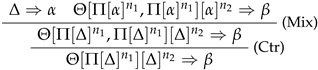
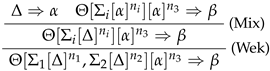
(1.6) is (Wek). Let and the derivation end with
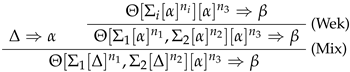
By induction hypothesis, the above subtree can be transformed into
(1.7) is . Let the derivation end with
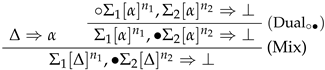
By induction hypothesis, the above subtree can be transformed into
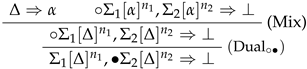
(1.8) is . The proof is quite analogous to (1.7).
(2) Both and are logical rules.
(2.1) is not principal in . We have the following cases.
(2.1.1) is . Let the derivation end with
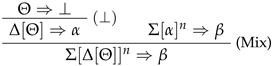
The above subtree can be transformed into
(2.1.2) is a left logical rule. We apply (Mix) to the premise(s) of and , and then apply . Take as an example. Other cases are addressed similarly. Let the derivation end with
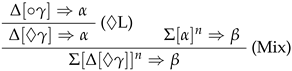
By induction hypothesis, the above subtree can be transformed into
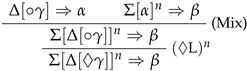 where means n times application of .
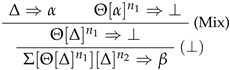
(2.2) is not principal in . We have the following cases:
(2.2.1) is . Let the derivation end with
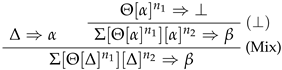
If , then we obtain from by . Let . By induction hypothesis, the above subtree can be transformed into
(2.2.2) is a right logical rule. Apply (Mix) to and the premise(s) of and then apply . Take as an example. Let the derivation end with

By induction hypothesis, the above subtree can be transformed into

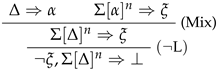
(2.2.3) is a left logical rule. We apply (Mix) to and the premise(s) of , and then apply . Take as an example. Let the derivation end with
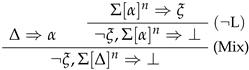
By induction hypothesis, the above subtree can be transformed into
(2.3) is principal in both and . The proof proceeds by induction on the complexity of . We have the following cases:
(2.3.1) . Let the derivation end with

By induction hypothesis, the above subtree can be transformed into

(2.3.2) . Let the derivation end with
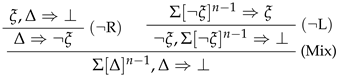
By induction hypothesis, the above subtree can be transformed into

(2.3.3) . Let the derivation end with
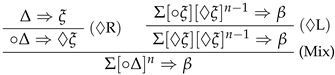
By induction hypothesis, the above subtree can be transformed into

(2.3.4) . The proof is quite analogous to (2.3.3).
(2.3.5) . The derivation ends with
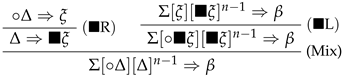
By induction hypothesis, the above subtree can be transformed into
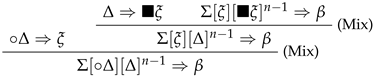
(2.3.6) . The proof is quite analogous to (2.3.5). □
Now, let be , eliminating (Cut). Next, we shall prove that implies .
Remark 2.
We clearly have . Furthermore, iff . The regular proof is omitted.
Lemma 12.
, where is a formula context.
Proof.
Suppose . Then, . Suppose . Assume . By induction hypothesis, . By Remark 2, . Assume or . We prove only the former case. According to induction hypothesis, . By and , . Assume or .We prove only the former case. According to induction hypothesis, . By and , . Assume or . We prove only the former case. According to induction hypothesis, . By and , . □
Lemma 13.
The following hold in :
- (1)
- if , then .
- (2)
- if , then .
Proof.
Assume and . We prove (1) and (2) simultaneously by induction on . Suppose . By Lemma 12, (1) and (2) hold. Suppose . For (1), suppose is derived by a rule . We have the following cases:
(1.1) is a structural rule. We have the following cases:
(1.1.1) . Let and , where . Suppose does not occur in . By (Ctr), . Suppose . By induction hypothesis, . By (Ctr), .
(1.1.2) . Let and , where . Suppose does not occur in . By (Ctr), . Suppose . According to induction hypothesis, . By (Wek), .
(1.1.3) or . We prove only the former. Let and , where . By induction hypothesis and , .
(1.2) is a logical rule. If is one of the rules , , , and , we obtain immediately by induction hypothesis and the rule . We have the following remaining cases:
(1.2.1) . Let and , where . Suppose does not occur in . By , . Suppose . By induction hypothesis, . By , .
(1.2.2) . Let and , where . Suppose , and then or . In each case, by induction hypothesis and , we obtain . If , then we obtain immediately by induction hypothesis and .
(1.2.3) . Let and , where and . Suppose . By and induction hypothesis, . By , . Suppose . By and induction hypothesis, . By , .
(1.2.4) . Let and , where and for any formula . Suppose . Suppose or . Then, or . Then, or , which is impossible. Hence, . By and induction hypothesis, . By , . Suppose . By and induction hypothesis, . By , .
(1.2.5) . Let and , where . Let . Assume or . Then, or . Then, or . Then, or . Assume . By and induction hypothesis, . By , . Let . By induction hypothesis and , .
(1.2.6) or . We prove only the former. Let and , where . Suppose . Then, . According to induction hypothesis, . By , . Suppose . According to induction hypothesis and , .
(1.2.7) or . We prove only the former. Let and , where . Suppose . Then, . According to induction hypothesis, . By , . Suppose . According to induction hypothesis and , .
For (2), suppose is derived by a rule . We have the following cases:
(2.1) is (Ctr) or (Wek). In each case, we obtain by induction hypothesis and .
(2.2) is a logical rule. Note that . Then, cannot be or . If is one of the rules , , , , and , by induction hypothesis and , we obtain . We have the following remaning cases:
(2.2.1) . Let and . From by , we have .
(2.2.2) . Let ; and , where and . Then, or . Then, .
(2.2.3) . Let and . By induction hypothesis, . By , .
(2.2.4) . Let and , where and for any formula . Clearly, and . Then, . By induction hypothesis, . By , .
(2.2.5) is one of the rules , , and . We prove only the case . Let and , where and . Then, . According to induction hypothesis and , . □
Lemma 14.
The following hold in :
- (1)
- if , then .
- (2)
- if , then .
Proof.
(1) Assume . Suppose . By and , . Suppose for any formula . By , .
(2) Assume . Suppose . By and , . Suppose for any formula . By , . □
Lemma 15.
If , then .
Proof.
By Lemma 14, and are admissible in . □
Lemma 16.
If , then .
Proof.
Let . By Lemma 13, the double negation in are eliminable. Hence, . □
Theorem 7.
If , then .
Proof.
Let . By Theorem 5, . By Theorem 6, . By Lemma 15, . By Lemma 16, . □
By Theorem 7, every derivation in can be transformed into a cut-free derivation in . This result provides the cut elimination of .
5. Strictly Positive Formulas
In this section, as in [17], we introduce strictly positive formulas and show that tense logics axiomatized by a set of such formulas have cut-free sequent calculi. The fundamental idea is that each strictly positive formula can be transformed into a structural rule, which is added to without affecting the cut elimination.
Definition 8
(cf. [17]). The strictly positive formulas (‘sp-formulas’ for short) are defined recursivly as follows:
where and are the set of sp-formulas. A sp-axiom is a formula , where .
An expression is called a generalized context if it is built from n positions by only structural operators. For , is the formula structure arised from by replacing each with for .
Definition 9.
For any sp-formula and , let be the generalized context arised from ψ by (i) replacing each with for , and (ii) replacing each occurrence of or ⧫ by the comma, ∘ or •, respectively. If , we obtain only by (ii).
Let be a sp-axiom, where and . We define the structural rule as follows:
where is a context, and .
Many tense logics are axiomatizable by sp-axioms. Table 1 provides some examples of formulas, the corresponding sp-axioms and structural rules.

Table 1.
Some sp-axioms and structural rules.
Let S be a set of sp-axioms and the set of all rules , where . The tense logic is , and the sequent calculus is the extension of with rules in . Every sp-axiom in S is a simple Sahlqvist formula (cf. e.g., [2]), and so is characterized by the frame class .
Theorem 8.
For any set of sp-axioms S, iff .
Proof.
The left-to-right direction is obvious since all rules in preserve validity in . The other direction is shown as the proof of Theorem 4. Note that, if , then by the structural rule . □
Let , and be extensions of , and with rules , respectively. Repeating the cut elimination proof provided in Section 4, it follows that these sequent calculi are equivalent.
Lemma 17.
If , then .
Proof.
The proof is analogous to Lemma 7. □
Theorem 9.
iff .
Proof.
The proof is analogous to Theorem 5. Structural rules in pass the proof. □
Theorem 10.
If , then without any applications of .
Proof.
The proof proceeds as the proof of Theorem 10 by adding cases of rules in . Suppose the derivation ends with

By induction hypothesis, the above subtree can be transformed into
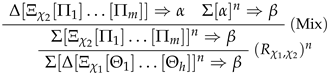 where means n times application of .
Suppose the derivation ends with

By induction hypothesis, the above subtree can be transformed into

This completes the proof. □
Lemma 18.
The following hold in :
- (1)
- if , then .
- (2)
- if , then .
Proof.
The proof is analogous to Lemma 13. Note that rules in pass the proof. □
Lemma 19.
The following hold:
- (1)
- if , then .
- (2)
- if , then .
Proof.
The proofs are quite similar to Lemmas 15 and 16. □
Theorem 11.
If , then .
Proof.
Let . By Theorem 17, . By Theorem 10, . By Lemma 19, , and so . □
It follows that for each sp-axioms set S admits cut elimination. This provides a modular result in the study of proof theory for tense logic.
6. Concluding Remarks
The present work generalizes the Gentzen proof theory for intuitionistic tense logics provided in [17] to classical tense logics. We present a cut-free single-succedent Gentzen sequent calculus for the minimal tense logic . Then, we show that all sp-axioms can be transformed into structural rules, which allow obtaining cut-free sequent calculi uniformly. There are still some questions for further exploration. First, we may consider formulas that are equivalent to sp-axioms, and describe tense logics axiomatized by these sp-axioms. Second, we could consider the proof-theoretic approach to the decidability of these tense logics axiomatized by sp-axioms. Third, the approach provided in the present work can be explored further for the proof of some results on the finite model property in tense logics. Finally, the sequent calculi we have developed can be appropriately extended to multimodal logics.
Author Contributions
Conceptualization, Z.L. and M.M.; investigation, Z.L. and M.M.; writing—original draft preparation, Z.L. and M.M.; writing—review and editing, Z.L. and M.M.; funding acquisition, M.M. All authors have read and agreed to the published version of the manuscript.
Funding
This research was funded by China Funding of Social Sciences grant number 18ZDA033.
Conflicts of Interest
The authors declare no conflict of interest.
References
- Burgess, J. Basic tense logic. In Handbook of Philosophical Logic; Gabbay, D., Guenthner, F., Eds.; Springer: Dordrecht, The Netherlands, 1984; Volume II, pp. 89–133. [Google Scholar]
- Blackburn, P.; de Rijke, M.; Venema, Y. Modal Logic; Cambridge University Press: Cambridge, UK, 2001. [Google Scholar]
- Kracht, M. Tools and Techniques in Modal Logic; Elsevier: Amsterdam, The Netherlands, 1999. [Google Scholar]
- Wansing, H. Sequent systems for modal logics. In Handbook of Philosophical Logic; D’Agostino, M., Gabbay, D.M., Hähnle, R., Posegga, J., Eds.; Springer: Dordrecht, The Netherlands, 1999; Volume 8, pp. 297–396. [Google Scholar]
- Poggiolesi, F. Gentzen Calculi for Modal Propositional Logic; Springer: Dordrecht, The Netherlands, 2011. [Google Scholar]
- Belnap, N. Display logic. J. Philos. Log. 1982, 11, 375–417. [Google Scholar] [CrossRef]
- Kracht, M. Power and weakness of the modal display calculus. In Proof Theory of Modal Logic; Wansing, H., Ed.; Springer: Dordrecht, The Netherlands, 1996; pp. 93–121. [Google Scholar]
- Wansing, H. Displaying Modal Logic; Springer: North Holland, The Netherlands, 1998. [Google Scholar]
- Negri, S. Proof theory of modal logic. J. Philos. Log. 2005, 34, 507–544. [Google Scholar] [CrossRef]
- Stouppa, P. A deep inference system for the modal logic S5. Stud. Log. 2007, 85, 199–214. [Google Scholar] [CrossRef]
- Bonnette, N.; Goré, R. A labelled sequent system for tense logic Kt. In Advanced Topics in Artificial Intelligence, AI 1998, LNCS 1502; Springer: Berlin/Heidelberg, Germany, 2006; pp. 71–82. [Google Scholar]
- Brünnler, K. Deep Inference and Symmetry in Classical Proofs. Ph.D. Thesis, Technischen Universität Dresden, Dresden, Germany, 2003. [Google Scholar]
- Goré, R. Tableau methods for modal and temporal Logics. In Handbook of Tableau Methods; Gabbay, D., Guenthner, F., Eds.; Springer: Dordrecht, The Netherlands, 2002; pp. 61–145. [Google Scholar]
- Kashima, R. Cut-free sequent calculi for some tense logics. Stud. Log. 1994, 53, 119–135. [Google Scholar] [CrossRef]
- Moortgat, M. Multimodal linguistic inference. J. Log. Lang. Inf. 1996, 5, 349–385. [Google Scholar] [CrossRef]
- Lin, Z.; Ma, M. Gentzen sequent calculi for some intuitionistic modal logics. Log. J. IGPL 2019, 4, 596–623. [Google Scholar] [CrossRef]
- Lin, Z.; Ma, M. A proof-theoretic approach to negative translations in intuitionistic tense logics. Stud. Log. 2022, 110, 1225–1289. [Google Scholar] [CrossRef]
- Negri, S.; von Plato, J. Structural Proof Theory; Cambridge University Press: Cambridge, UK, 2001. [Google Scholar]
Disclaimer/Publisher’s Note: The statements, opinions and data contained in all publications are solely those of the individual author(s) and contributor(s) and not of MDPI and/or the editor(s). MDPI and/or the editor(s) disclaim responsibility for any injury to people or property resulting from any ideas, methods, instructions or products referred to in the content. |
© 2023 by the authors. Licensee MDPI, Basel, Switzerland. This article is an open access article distributed under the terms and conditions of the Creative Commons Attribution (CC BY) license (https://creativecommons.org/licenses/by/4.0/).