


Abstract
In this work, analytic solutions of initial value problems for fractional Langevin equations involving Hilfer fractional derivatives and variable coefficients are studied. Firstly, the equivalence of an initial value problem to an integral equation is proved. Secondly, the existence and uniqueness of solutions for the above initial value problem are obtained without a contractive assumption. Finally, a formula of explicit solutions for the proposed problem is derived. By using similar arguments, corresponding conclusions for the case involving Riemann–Liouville fractional derivatives and variable coefficients are obtained. Moreover, the nonlinear case is discussed. Two examples are provided to illustrate theoretical results.
Keywords:
fractional Langevin equation; Hilfer fractional derivative; variable coefficient; weighted space MSC:
26A33; 33E12; 34A08
1. Introduction
In 1908, Langevin introduced an integer-order equation
where m is the mass of a Brownian particle, is the particle’s position, is the viscous force with coefficient and is the fluctuating force. It is regarded as an effective tool to describe the evolution of physical phenomena in fluctuating environments [1].
Fractional differential equations are important tools for investigating many practical problems in physics, chemistry, biology, etc. Many scholars have conducted extensive research on equations involving Riemann–Liouville or Caputo fractional derivatives—for details, see [2,3,4,5].
For more complex physical phenomena, some researchers have generalized Langevin equations from integer order to fractional order. In 1996, the above classical Langevin equation was generalized by Mainardi and Pironi [6] to the fractional Langevin equation (FLE)
where a is the particle’s radius, is the fluid’s viscosity, is the friction coefficient for unit mass, and is a random force.
FLEs have attracted many scholars to study properties of solutions for FLEs—for instance, the existence and uniqueness of solutions for FLEs with Caputo or Riemann–Liouville fractional derivatives [7,8], boundary value problems for FLEs [9,10,11,12], etc. Baghani and Nieto [13] studied the following Langevin differential equation with two different fractional orders:
In 2000, a fractional derivative operator (, ) was introduced by Hilfer, which can be applied to characterize many complicated phenomena in various engineering and scientific disciplines; for instance, it has applications in regular variation in thermodynamics, physics and materials (see, e.g., [14]). More applications can be found in [15,16] and the references therein. When or , reduces to (Riemann–Liouville fractional derivative operator) or (Caputo fractional derivative operator), respectively.
Moreover, we refer to some recent works [17,18] that deal with a qualitative analysis of FLEs with Hilfer fractional derivatives.
In [17], the authors studied a nonlinear fractional Langevin dynamical system with impulse as follows:
In [18], the authors investigated the existence and uniqueness of solutions to the following system of Hilfer FLEs:
Due to the complexity of variable-coefficient functions, it is very hard to obtain representations of solutions of FLEs with variable coefficients. Recently, some methods have been presented to deal with linear fractional differential equations with continuous coefficients, such as power series methods [19,20] and the Banach fixed point theorem [21]. However, to the best of our knowledge, there are very few studies on FLEs with Hilfer derivatives and negative power function coefficients.
Motivated by previous research, in this article, we study the initial value problem (IVP) for FLEs with Hilfer derivatives and variable coefficients:
where , , and is a continuous function. More details about and are given later.
The main contribution in this article is presented as follows:
- Using new techniques, we present an explicit representation of solutions to Problems (1) and (2).
- We obtain the existence and uniqueness of solutions for Problems (1) and (2) without a contractive assumption.
- We present a nonlinear mixed Fredholm–Volterra integral solution for nonlinear initial value Problem (22)–(23).
This paper is split into six sections. Some definitions and properties of fractional derivatives are provided in Section 2. We study the existence and uniqueness of solutions for the linear case and the nonlinear case in Section 3 and Section 4, respectively. In Section 5, we present two examples to illustrate our results and provide an approximate result. Finally, in Section 6, we present the conclusions.
2. Preliminaries
Firstly, we recall the basic definitions and properties of fractional derivatives and weighted spaces.
Definition 1
([5]). Let . The Riemann–Liouville fractional integral and derivative are defined by
where is the Gamma function, provided that the right-hand side of (3) exists.
Definition 2
([14]). The left-sided Hilfer fractional derivative of order and type of is defined by
where , provided that the expression on the right-hand side exists.
A modified Hilfer derivative was presented in [20].
Definition 3
([20]). The left-sided Hilfer fractional derivative of order and type of is defined by
where , provided that the right-hand side exists.
It is not difficult to see that the conditions to guarantee the existence of the Riemann–Liouville derivative in (5) are weaker than those needed for the Hilfer fractional derivative in (4) [20].
Definition 4
([5,22]). Let , and .
- (i)
- is the space of functions x, which are continuous on and .
- (ii)
- The weighted space is defined by
- (iii)
- is the weighted space of functions x, which are continuously differentiable on up to order and have the derivative of order n on such that :with the norm .
- (iv)
- We denote the weighted spacewith the norm . When , is denoted by .
- (v)
- We denote the weighted spacewith the norm . When , is denoted by .
Clearly, . We abbreviate , , , , , and to , , , , , and respectively.
Lemma 1
([5]). If and , then is bounded from into .
Lemma 2
([5]). Let and ; then, .
Lemma 3
([5]). Let , and ; then, .
Lemma 4.
Let and ; then, .
Lemma 5
([5]). Let , . Then, for , the following assertions are valid.
Lemma 6
([5]). Let and . If and , then
Lemma 7
([5]). Let . The space consists of those and only those functions g, which are represented in the form
where and .
Theorem 1.
Let . If and , then
Proof.
Since , from Lemma 7, there exists such that
where . Thus,
then
Moreover, note that
and, combining with (7), we obtain the result. □
Theorem 2.
Let ; then,
Proof.
Since , we can see that and , then
and
From Lemma 6, it follows that
thus,
□
3. Equivalence with an Integral Equation
We consider the following IVP for FLEs with Hilfer derivatives and variable coefficients:
We define the following constants such that
Theorem 3.
Let and ; then, satisfies (9) and (10) if and only if x satisfies the following equation
Proof.
Let satisfy (9) and (10); then, , from Lemma 4,
Thus,
By Theorem 1,
Applying to (9) and in view of (13), one obtains
By Theorem 2, we obtain
Applying to (14), one obtains
which means that satisfies (12).
If satisfies (12), then
Clearly, and
Hence, exists and belongs to . Then,
which implies
Taking into account the fact that and Definition 2, we obtain
this yields (9). The results are proved completely. □
Theorem 4.
Let and . Then, there exists a unique solution to Problems (9) and (10) given by
where
Proof.
We define an operator as follows:
It is easy to see that is a well-defined operator whose fixed point determines the solution of Equation (12). Since
for , we have
where . Furthermore, we find
By induction, we deduce that
We write
and from [23] (5.2.13), it follows that
When k is sufficiently large, the right-hand side of (16) is less than . By the generalized Banach fixed point theorem, has a unique fixed point satisfying (12). Then, the following sequence is convergent in :
Furthermore, we find
Taking the limit as in the last identity, we arrive at
and is the unique solution of (9) and (10). □
Next, we consider the following IVP for FLEs with Riemann–Liouville derivatives.
In this case, the constants satisfy and .
Theorem 5.
Let and ; then, satisfies (22) and (23) if and only if x satisfies the following equation:
Proof.
Let satisfy (17) and (18); then, . From Lemma 4, one has
and
By Theorem 1, we have
Applying to (17) and taking (20) into account, one obtains
Applying to (21) and in view of Lemma 6, one obtains
which means that satisfies (19).
If satisfies (19), then
Obviously, and
which means that exists and belongs to . Hence,
then
which yields (17). The proof is complete. □
Similar to the arguments of Theorem 4, we have the following conclusion.
Theorem 6.
For and , if and , then there exists a unique solution to the following IVP
and this solution has the form
where
4. Nonlinear Case
We consider the following IVP for nonlinear FLEs with Hilfer derivatives and variable coefficients:
where .
We define the constants as (11) and let . Similar to the arguments of Theorem 3, we have the following result.
Theorem 7.
Let for any ; then, satisfies (22) and (23) if and only if x satisfies the following equation:
Set the operator as follows:
clearly, G is a well-defined operator, whose fixed point is the solution of Equation (24).
Theorem 8.
Let for any . If there exists a non-negative function such that
then problem (22)–(23) have a unique solution given by (24).
Proof.
For , note that
We have
where . Combining with (15), we obtain
where . By similar arguments of Theorem 4 and induction, we deduce that
and for sufficiently large k, the right side of the above inequality is smaller than . With the help of the generalized Banach fixed point theorem, satisfying (24) is the unique fixed point of G. □
In particular, we take the following IVP for Hilfer-type fractional Langevin integro-differential equations with variable coefficients into account:
where .
Theorem 9.
Let and . Then, there exists a unique solution to problem (25)–(26) given by
Proof.
It follows from Theorem 8 that (25) and (26) have a unique solution
Similar to the arguments of Theorem 4, one has
□
Similar to the arguments of Theorem 4, we can deduce the corresponding conclusions of the IVP for Riemann–Liouville-type FLEs. We set and .
Theorem 10.
Let for any . If there exists a non-negative function such that
then given by
is the unique solution to the following IVP
In particular, if and , then the explicit solution is given by
5. Applications
Example 1.
Consider the following IVP for a Hilfer-type fractional Langevin differential equation with variable coefficients:
Taking , and from Theorem 4, it follows that in the form
is the unique solution to problem (27)–(28).
Example 2.
Consider the following IVP for a Riemann–Liouville-type fractional Langevin integro-differential equation with variable coefficients:
(I150+x)(0+)=1.
Taking and , from Theorem 10 it follows that in the form
is the unique solution to problem (29)–(30).
Clearly, the approximate solution of problem (27)–(28) can be given by
Approximate solutions of Problems (27) and (28) evaluated at some points with the step using different values of are shown in Figure 1.
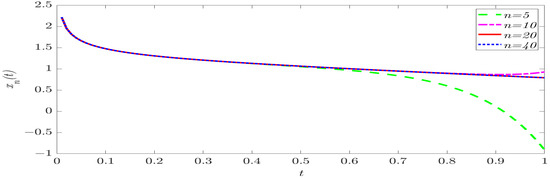
Figure 1.
Approximate solutions for (27) and (28).
6. Conclusions
In this paper, the existence and uniqueness results of solutions of IVPs for FLEs with Hilfer derivatives and variable coefficients are obtained in weighted spaces. The variable-coefficient function is not necessarily continuous on a closed interval. Our technique is also useful to solve more general equations. Moreover, the boundary value problem for corresponding equations can be studied.
Author Contributions
Conceptualization, F.L. and H.W.; methodology, F.L.; software, L.Y.; validation, F.L., L.Y. and H.W.; formal analysis, F.L.; investigation, F.L.; resources, H.W.; writing—original draft preparation, F.L.; writing—review and editing, F.L. and H.W.; supervision, F.L.; project administration, F.L. and H.W.; funding acquisition, F.L. All authors have read and agreed to the published version of the manuscript.
Funding
This research was funded by the Natural Science Foundation of China, grant number: 11971329.
Data Availability Statement
No new data were created or analyzed in this study. Data sharing is not applicable to this article.
Acknowledgments
The authors thank the referees, whose valuable comments have helped improve the original manuscript.
Conflicts of Interest
The authors declare no conflicts of interest.
References
- Coffey, W.T.; Kalmykov, Y.P.; Waldron, J.T. The Langevin Equation: With Applications to Stochastic Problems in Physics, Chemistry and Electrical Engineering, 2nd ed.; World Scientific: Singapore, 2004. [Google Scholar]
- Podlubny, I. Fractional Differential Equations; Mathematics in Science and Engineering; Academic Press: San Diego, CA, USA, 1999; Volume 198. [Google Scholar]
- Miller, K.S.; Ross, B. An Introduction to The Fractional Calculus and Fractional Differential Equations; Wiley: New York, NY, USA, 1993. [Google Scholar]
- Samko, S.G.; Kilbas, A.A.; Marichev, O.I. Fractional Integrals and Derivatives: Theory and Applications; Gordon and Breach Science Publishers: Yverdon, Swizerland, 1993. [Google Scholar]
- Kilbas, A.A.; Srivastava, H.M.; Trujillo, J.J. Theory and Applications of Fractional Differential Equations; North-Holland Mathematics Studies, 204; Elsevier: Amsterdam, The Netherlands, 2006. [Google Scholar]
- Mainradi, F.; Pironi, P. The fractional Langevin equation: Brownian motion revisted. Extracta Math. 1996, 10, 140–154. [Google Scholar]
- Fazli, H.; Nieto, J.J. Fractional Langevin equation with anti-periodic boundary conditions. Chaos Solitons Fractals 2018, 114, 332–337. [Google Scholar] [CrossRef]
- Baghani, H.; Nieto, J.J. Some new properties of the Mittag-Leffler functions and their applications to solvability and stability of a class of fractional Langevin differential equations. Qual. Theor. Dyn. Syst. 2024, 23, 18. [Google Scholar] [CrossRef]
- Almaghamsi, L.; Salem, A. Fractional Langevin equations with infinite-point boundary condition: Application to fractional harmonic oscillator. J. Appl. Anal. Comput. 2023, 13, 3504–3523. [Google Scholar] [CrossRef]
- Salem, A.; Mshary, N. Coupled fixed point theorem for the generalized Langevin equation with four-point and Strip conditions. Adv. Math. Phys. 2022, 2022, 1724221. [Google Scholar] [CrossRef]
- Salem, A. Existence results of solutions for anti-periodic fractional Langevin equation. J. Appl. Anal. Comput. 2020, 10, 2557–2574. [Google Scholar] [CrossRef] [PubMed]
- Ahmad, B.; Alsaedi, A.; Ntouyas, S.K. Nonlinear Langevin equations and inclusions involving mixed fractional order derivatives and variable coefficient with fractional nonlocal-terminal conditions. AIMS Math. 2019, 4, 626–647. [Google Scholar] [CrossRef]
- Baghani, H.; Nieto, J.J. On fractional Langevin equation involving two fractional orders in different intervals. Nonlinear Anal.-Model 2019, 24, 884–897. [Google Scholar] [CrossRef]
- Hilfer, R. Applications of Fractional Calculus in Physics; World Scientific: Singapore, 2000. [Google Scholar]
- Hilfer, R.; Luchko, Y.; Tomovski, Z. Operational method for the solution of fractional differential equations with generalized Riemann-Liouville fractional derivatives. Fract. Calc. Appl. Anal. 2009, 12, 299–318. [Google Scholar]
- Hilfer, R. Experimental evidence for fractional time evolution in glass forming materials. Chem. Phys. 2002, 284, 399–408. [Google Scholar] [CrossRef]
- Radhakrishnan, B.; Sathya, T. Controllability of Hilfer fractional Langevin dynamical system with impulse in an abstract weighted space. J. Optim. Theory Appl. 2022, 195, 265–281. [Google Scholar] [CrossRef]
- Hilal, K.; Kajouni, A.; Lmou, H. Existence and stability results for a coupled system of Hilfer fractional Langevin equation with non local integral boundary value conditions. arXiv 2022, arXiv:2206.07457. [Google Scholar] [CrossRef]
- Rivero, M.; Rodríguez-Germá, L.; Trujillo, J.J. Linear fractional differential equations with variable coefficients. Appl. Math. Lett. 2008, 21, 892–897. [Google Scholar] [CrossRef][Green Version]
- Restrepo, J.E.; Suragan, D. Hilfer-type fractional differential equations with variable coefficients. Chaos Solitons Fractals 2021, 150, 111146. [Google Scholar] [CrossRef]
- Pak, S.; Choi, H.; Sin, K.; Ri, K. Analytical solutions of linear inhomogeneous fractional differential equation with continuous variable coefficients. Adv. Differ. Equ. 2019, 2019, 256. [Google Scholar] [CrossRef]
- Oliveira, D.S.; Capelas de Oliveira, E. Hilfer-Katugampola fractional derivative. Comput. Appl. Math. 2018, 37, 3672–3690. [Google Scholar] [CrossRef]
- Gorenflo, R.; Kilbas, A.A.; Mainardi, F.; Rogosin, S.V. Mittag-Leffler Functions, Related Topics and Applications; Springer: Berlin, Germany, 2020. [Google Scholar]
Disclaimer/Publisher’s Note: The statements, opinions and data contained in all publications are solely those of the individual author(s) and contributor(s) and not of MDPI and/or the editor(s). MDPI and/or the editor(s) disclaim responsibility for any injury to people or property resulting from any ideas, methods, instructions or products referred to in the content. |
© 2024 by the authors. Licensee MDPI, Basel, Switzerland. This article is an open access article distributed under the terms and conditions of the Creative Commons Attribution (CC BY) license (https://creativecommons.org/licenses/by/4.0/).