


Abstract
The crossing number of a graph is a significant measure that indicates the complexity of the graph and the difficulty of visualizing it. In this paper, we examine the crossing numbers of join products involving the complete graph with discrete graphs, paths, and cycles. We analyze optimal drawings of , identify all five non-isomorphic drawings, and address previously hypothesized crossing numbers for , and . Through a simplified approach, we first establish and then extend our method to prove the crossing numbers and . These results also lead to new hypotheses for and involving wheels and stars. Our findings correct previous inaccuracies in the literature and provide a foundation for future research.
Keywords:
crossing number; complete graph K5; discrete graphs; paths; cycles; good drawing; join product; separating cycles; wheels; stars MSC:
05C10
1. Introduction
Graph theory serves as a foundational framework for modeling and analyzing complex systems across various disciplines, ranging from computer science to social networks to biology. One fundamental aspect of graph theory is the concept of crossing numbers, which quantifies the minimum number of crossings required in a drawing of a graph [1]. The understanding and minimization of the crossing number of a graph have significant implications in numerous areas, encompassing both theoretical and practical domains. In computer science, minimizing the crossing number of a graph is essential for optimizing layout algorithms in circuit design, VLSI layout, and graph drawing applications. Moreover, in network design, reducing the crossing number enhances the efficiency and reliability of communication networks by minimizing signal interference and congestion. Furthermore, the crossing number has implications in spatial visualization and cartography, where minimizing crossings leads to clearer and more interpretable representations of geographic networks and transportation systems. In social network analysis, understanding the crossing number sheds light on the underlying structure and dynamics of social interactions, facilitating the identification of cohesive communities and influential nodes. Overall, reducing the number of crossings on graph edges can help in visualizing and understanding complex data, improving system performance, and optimizing graph algorithms [2,3].
In the paper, we will focus on the crossing number of a composite graph G obtained by combining two graphs and , known as their join product . It is constructed by incorporating separate copies of and with no shared vertices and by adding all possible edges between the vertex sets and . In the case where and , the edge set of G is composed of the disjoint sets of edges , and the complete bipartite graph . Therefore, some parts of proofs will be based on Kleitman’s result [4] on the crossing numbers for some . He showed that
The graph terminology used is taken from the book [5].
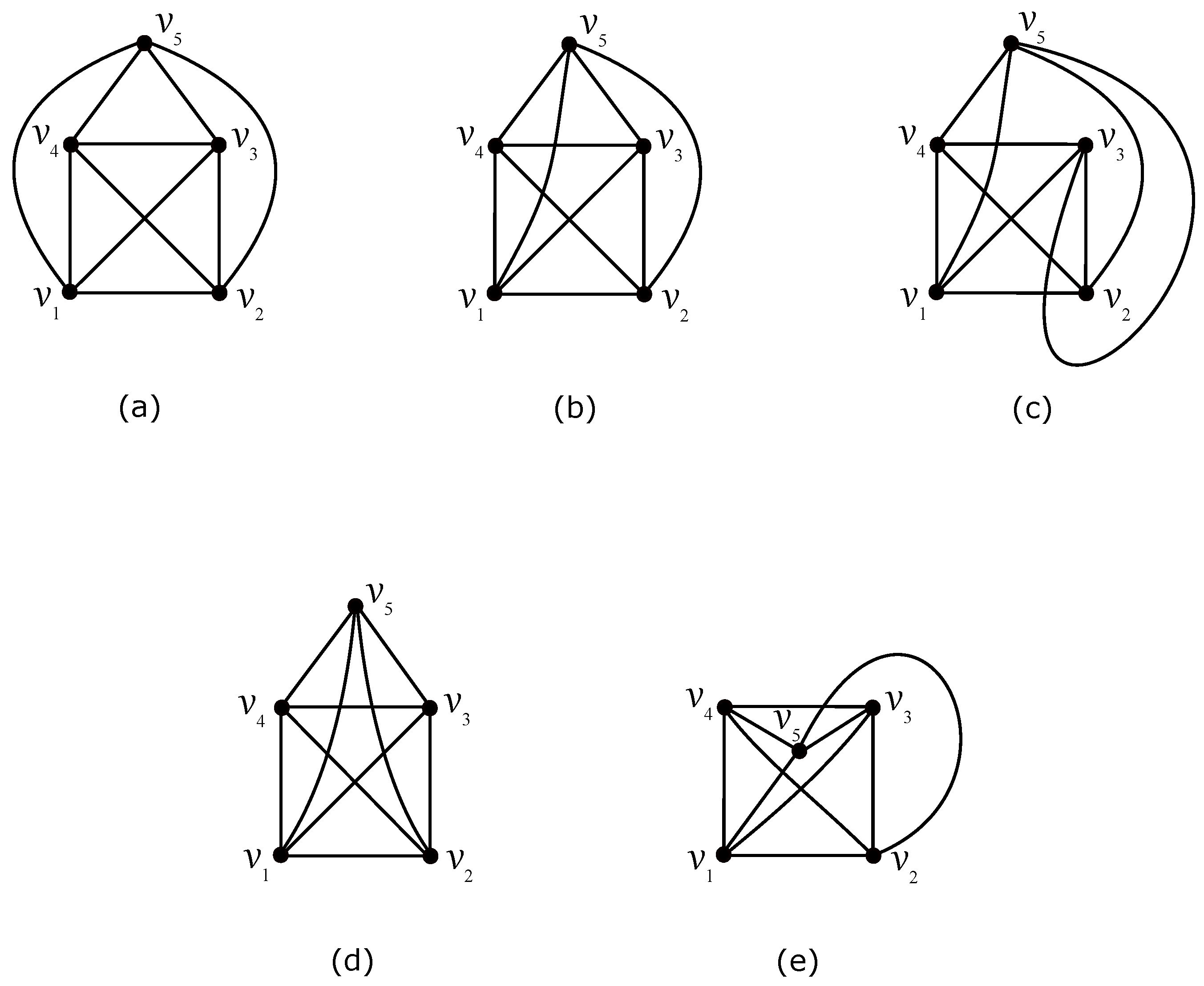
One graph of our considered join product G will be a complete graph with five vertices , which is specific for its symmetries. As the crossing number , there is at least one crossing over all optimal drawings of with the vertex set . In the rest of the paper, let the edges and be crossed. The edges , , , and cannot cross each other because we are only interested in optimal subdrawings. Finally, all considered drawings of can be achieved from the nonplanar drawing of by adding one vertex with the four corresponding edges , , , and . As a result, there are only five mutually non-isomorphic drawings of , which are depicted in Figure 1.
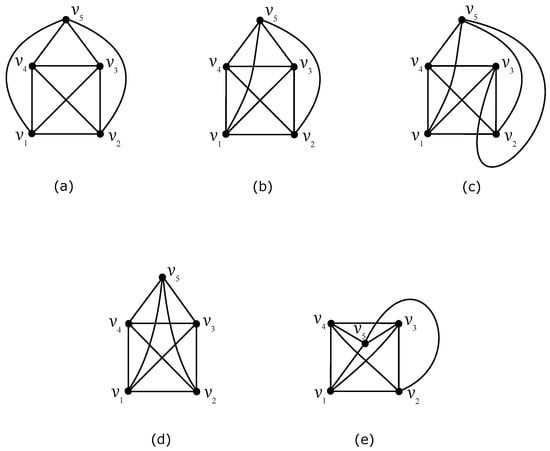
Figure 1.
Five mutually non-isomorphic drawings of : (a) only one crossing; (b) additional crossing on the edge ; (c) additional crossings on the edges and ; (d) additional crossings on the edges and ; (e) additional crossings on the edges and with the vertex located inside the inner region of .
Currently, the crossing numbers of the graphs and , where and are paths and cycles on n vertices, are given only as hypotheses. The crossing number of graphs for was previously investigated in Su’s paper [6], but with several errors in the main proof caused by an inconsistent discussion of possible subcases (e.g., wrong drawings or not considering all the drawings with respect to a given subcase). To prove it correctly, we will first build the necessary mathematical apparatus for the case , where denotes a discrete graph on n vertices. Lü and Huang [7] already proved it, albeit in a rather complicated way. We offer an alternative proof that is simpler, and its same main idea can be used later for determining . The intended idea lies in the use of the existence of different cycles of as subgraphs of that can perform the function of separation concerning the remaining two vertices of . By gradually adding edges, we will also determine the crossing number for the , which was an open problem until now. Additionally, the obtained values and will help us establish completely new hypotheses for and , where and are wheels and stars on vertices, respectively [8].
Regarding the practical importance of the problem, it can be mentioned that some algorithms constructing the graph drawings with a minimal number of crossings have already been created [9,10,11]. For example, the algorithm located on the website [12] can find the crossing numbers of small sparse graphs using an integer linear programming (ILP) formulation based on Kuratowski subgraphs. The system also generates verifiable formal proofs, as described by Chimani and Wiedera [11]. However, for our research, the capacity of the system is insufficient, because the join products considered in this paper belong to dense graphs. This confirms that examining the number of crossings of simple graphs is a classic but still challenging problem. Garey and Johnson [13] even proved that it belongs between NP-complete problems.
2. The Crossing Number of
The considered join product is formed by combining a copy of the graph with n additional vertices labeled as . Each of these newly added vertices is connected to every vertex in the original graph . We define the subgraph as the collection of five edges incident to the fixed vertex . In the drawing D of , it is advantageous to categorize the n subgraphs into three distinct subsets based on the number of times they intersect the edges of . Let represent the set of subgraphs where (indicating zero crossings), and let represent the set of subgraphs where (indicating one crossing). All remaining subgraphs , which cross edges of at least twice in D, fall into the third subset. We note that the same categorization will also be used later in the drawing of and too.
It is evident that a drawing characterized by a minimal number of crossings, known as an optimal drawing, inherently possesses the desirable qualities of a good drawing. In such a drawing, the edges do not intersect themselves, no two edges cross multiple times, and there are no instances where two edges connected to the same vertex intersect [14]. In a good drawing D of some graph G, we say that a cycle C separates two different vertices of the subgraph if they are contained in different components of , where means a two-dimensional space. This considered cycle C is said to be a separating cycle of graph G in D.
To determine the value of the crossing number for the composite graph , we will divide five possible mutually non-isomorphic drawings of into two groups. First, we will look at those in which it is possible to find the separating cycle . In fact, there is such an option in all but one of the drawings in Figure 1. Their crossing numbers will be proved in Lemma 1 using the already known crossing number of the complete tripartite graph in combination with , which is summarized in Theorem 1:
Theorem 1
([15]). for .
Subsequently, in Lemma 2, we will deal with for the two smallest possible n values. After that, we are ready to state the final Theorem 2, and in its proof, we take advantage of the previous two lemmas and discuss in more detail the last case when it is not possible to find a separating cycle in . As part of it, we will also use a concept of the rotation, , of a vertex in D of . It is defined as the cyclic permutation that documents the counterclockwise order, in which the edges departing from appear. This rotation, introduced by Hernández-Vélez et al. [16] or Woodall [17], employs a notation to represent the counter-clockwise order of edges incident to the vertex , such as , , , and . It is important to note that the rotation signifies a cyclic permutation.
Lemma 1.
For , let D be a good drawing of . If there is a separating cycle of in the subdrawing , then there are at least crossings in D.
Proof.
By assumption, let us consider a separating cycle of in the subdrawing . Since the two remaining vertices of lie in different regions of , there is no subgraph for which the edges of are not crossed. Hence, each subgraph crosses the edges of at least once, which yields that . Let G be the graph difference of graphs and ; i.e., G is isomorphic to the complete tripartite graph . The exact value for the crossing number of is given by Theorem 1; that is, . This enforces at least crossings in D because some edge of the cycle is also crossed in . □
Lemma 2.
and .
Proof.
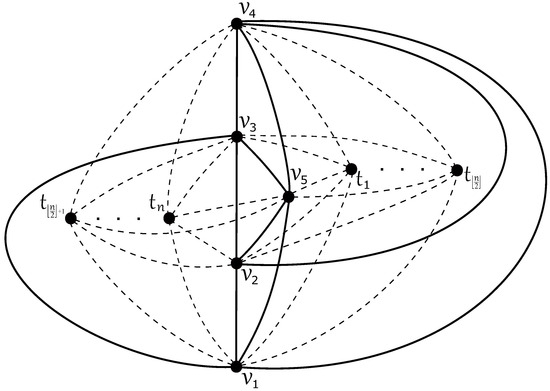
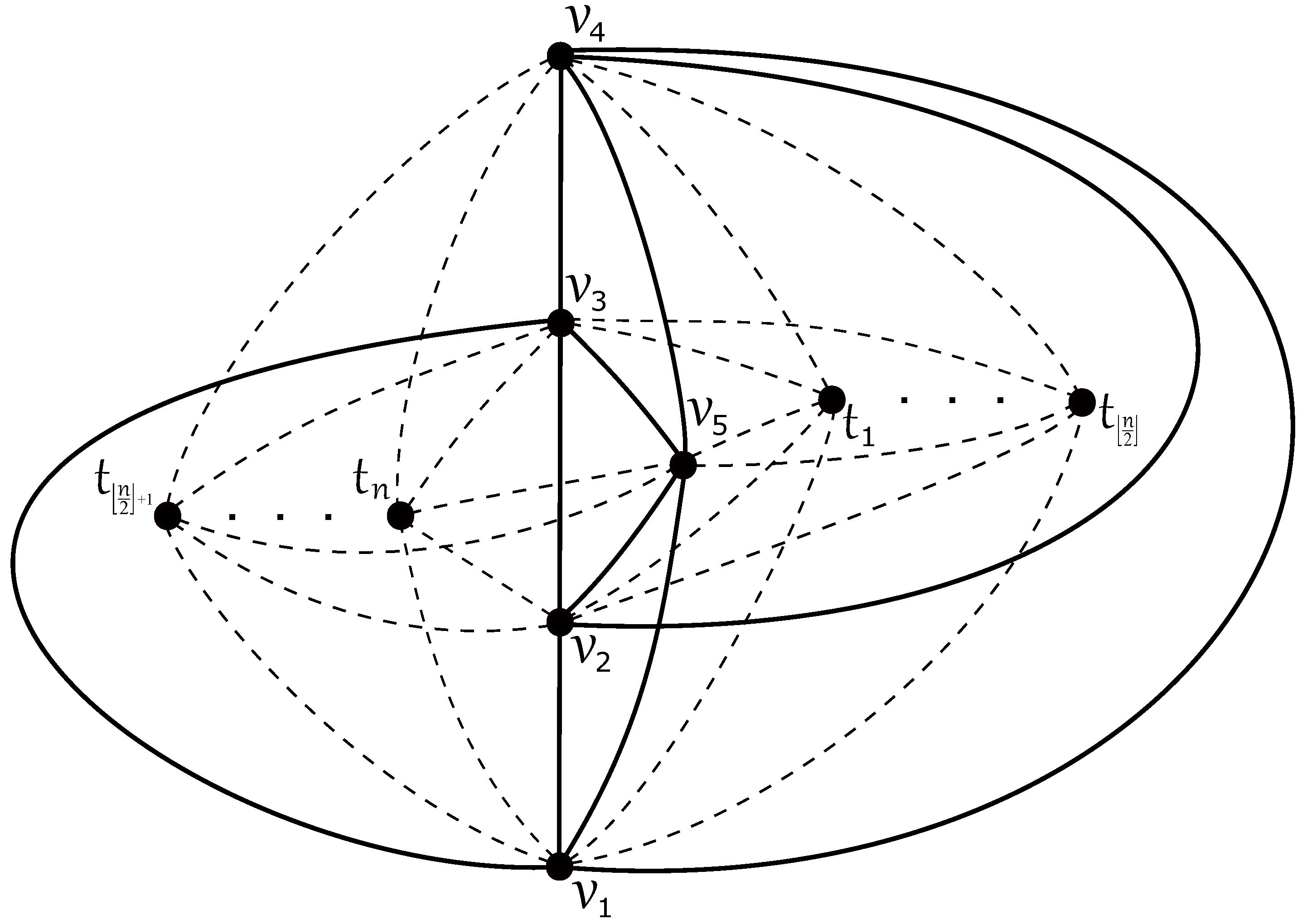
Notice that the graphs and are isomorphic to the join product of the complete graph with the paths and , respectively (Figure 2). Since it was proved in [18] that and , due to isomorphism, we can directly state that and . □
Figure 2.
The good drawing of with crossings.
Theorem 2.
for .
Proof.
By Lemma 2, the result is true for and . In Figure 2, the edges of cross each other times, each subgraph , on the right side crosses edges of the complete graph three times, and each subgraph , on the left side crosses edges of exactly twice. As there is one crossing among edges of , we obtain . To prove the reverse inequality by induction on n, suppose now that there is an optimal drawing D of with
and also let
According to Lemma 1, we can suppose only the drawing of induced by D in such a way as shown in Figure 1d because there is a possibility of obtaining a separating cycle for all four remaining subdrawings . Note that such a single possible induced drawing of does not allow the addition of a subgraph with . Moreover, if , the assumption (2), together with the well-known fact , thanks to (1), implies that in D,
The obtained inequality (4) forces , that is, for n at least 3. For all subgraphs , there is only one subdrawing of represented by the rotation (for our purposes, it does not matter which of the regions is unbounded). If there is a subgraph such that , then the edges of are crossed at least five times by edges of based on the discussion of inserting the vertex with corresponding edges over eleven considered regions of . As a result, the number of crossings in D, we have
where each of subgraphs , , crosses the edges of at least four times due to again by (1). This contradiction with the assumption (2) confirms that the edges of all must be crossed at least once by any other subgraph . For two different subgraphs , holds for any , provided by . Moreover, the edges of are crossed at least seven times by any subgraph , because is fulfilled using the discussion over all possible regions of . As , by fixing the subgraph , we have
We have shown, in all cases, that there are at least crossings in each good drawing D of the graph . The proof of Theorem 2 is complete. □
3. The Crossing Number of
In the drawing of depicted in Figure 2, it is possible to add new edges for forming the path on vertices of with exactly three additional crossings. Thus, . Our goal is to show that the crossing number of is equal to this upper bound. Note that this result was already predicted by Su [6], but we have found several mistakes in his proofs. Our Lemma 3 will confirm this result for and , whereas its proof will be strongly based on isomorphisms. Then, we will focus in Lemma 4 on the case when a separating cycle of exists in the subdrawing . The crossing numbers of the join products of with paths (summarized in Theorem 3), which have already been determined by Staš and Timková in [19], concludes the main idea of the proof.
Theorem 3
([19], Theorem 3.5). for .
Subsequently, Lemma 4 will result in Corollary 1, which discusses the subdrawing of induced by D given in Figure 1a. This drawing of has only one crossing on the edges of in , and therefore, the condition of Lemma 4 is not fulfilled. After that, the statement of the main Theorem 4 about , in the proof of which we take advantage of the pre-prepared Lemma 3, Lemma 4, and Corollary 1, can be established.
Lemma 3.
and .
Proof.
Notice that the graphs and are isomorphic to the complete graph and obtained by removing one edge from , respectively. Guy [20] and Zheng et al. [21] proved that and . Therefore, and , and the proof of Lemma 3 is complete. □
Lemma 4.
For , let D be a good drawing of . If there is a separating cycle of in the subdrawing with at least two crossings on the edges of in , then there are at least crossings in D.
Proof.
Using arguments similar to the proof of Lemma 1, the edges of any separating cycle in are crossed at least n times by . If G is the graph difference of graphs and , then by Theorem 3 enforces at least crossings in D. □
Corollary 1.
For , if D is a good drawing of with the subdrawing of induced by D given in Figure 1a, then there are at least crossings in D.
Proof.
In Figure 1a, there are two separate cycles of , but both have only one crossing on their edges in the subdrawing . If some edge of the path crosses any edge of these separating cycles, we obtain the desired result in D using Lemma 4. Of course, we also obtain at least crossings in D if the edges of some separating cycle are crossed more than once by edges of some subgraph (see the proof of Lemma 1).
Now, we assume that there are exactly n crossings on the edges of each separating 3-cycle; that is, each subgraph crosses the edges of any separating 3-cycle exactly once, and also, the edges of path do not produce any crossing on the edges of both separating 3-cycles. In the rest of the proof, let all vertices of be placed in the outer region of with three vertices , , and or in the inner triangular region with two vertices and of on its boundary. Our assumption enforces no crossing on two edges and in D, which yields the fact that there are exactly crossings on four edges , , , and in D. Let us denote by H the subgraph of with the vertex set and the edge set . By Klešč and Staš [22], it was proved that , and thus, we receive the desired result if there are at least three crossings on the edge in D.
Finally, let us turn to the possibility that there are at most two crossings on the edge in D. For , we obtain at least one subgraph (but there are definitely at least two) whose edges do not cross this edge of the graph . This enforces the fact that no edge of is crossed by the edge and only for with . It is easy to verify over six possible regions of that each of the remaining subgraphs crosses the edges of at least five times. As , by fixing the subgraph , we have
We could add in the previous estimate because the number of crossings on edges of can be increased up to 6 for each subgraph , if both vertices and are placed in the same outer region of . The proof of Corollary 1 is done. □
Theorem 4.
for .
Proof.
The proof proceeds similarly to the graph in Theorem 2. Using Lemma 3, we suppose that there is an optimal drawing D of with
and that
By Lemma 4 and Corollary 1, we consider only the subdrawing of the graph induced by D with presented in Figure 1d. For , the relation with respect to edge crossings of the subgraph in D produces
which again yields for an n of at least four. Since is at least as much as , the proof of Theorem 4 is complete. □
4. The Crossing Number of
To date, the crossing numbers of the join product were not claimed in any hypothesis. The upper bound of can be easily estimated from Figure 2 by the addition of n new edges and , forming the cycle on vertices of with just six additional crossings. In such a way, we obtain
and we will show that the upper bound in (8) holds with equality for all n at least three in the following statements. Lemma 5 will confirm this result for , because is isomorphic to the complete graph and it is shown by Guy [20] that . Similar to the previous two sections, we will focus first on Lemma 6 in the case when there is a separating cycle of in the subdrawing . As the crossing numbers of the join products of with the cycles have been determined by Staš and Timková [19], they can be safely used in the last part of the proof of Lemma 6.
Theorem 5
([19], Theorem 4.9). for .
The condition of Lemma 6 for at least three crossings on edges of in is not fulfilled for the subdrawing of induced by D given in Figure 1a and Figure 1b, respectively. Therefore, these special cases will be discussed separately in Corollary 2 and Corollary 3. After that, we will turn our attention to the subdrawing of induced by D given in Figure 1d. It represents the only subdrawing of without the existence of a separating cycle and is addressed in Lemma 7 for ; i.e., is pre-prepared for the final statement. That will be introduced in Theorem 6 and will establish for arbitrary .
Lemma 5.
.
Lemma 6.
For , let D be a good drawing of . If there is a separating cycle of in the subdrawing with at least three crossings on edges of in , then there are at least crossings in D.
Proof.
Using arguments similar to the proof of Lemma 1, the edges of any separating cycle in are crossed at least n times by . If G is the graph difference of graphs and , then by Theorem 5 enforces at least crossings in D. □
Corollary 2.
For , if D is a good drawing of with the subdrawing of induced by D given in Figure 1a, then there are at least crossings in D.
Proof.
In Figure 1a, there are two separate cycles of , namely 3-cycles and . Both have only one crossing on their edges in the subdrawing . If some edge of the cycle crosses any edge of one separating 3-cycle, we obtain the desired result in D using Lemma 6. Clearly, we also obtain at least crossings in D if there are at least crossings between and one separating cycle (see the proof of Lemma 1). In the following, suppose that a separating cycle can be crossed at most twice by only one subgraph .
Now, we assume that the edges of cycle do not produce any crossing on the edges of separating 3-cycles. In the rest of the paper, let all vertices of be placed in the outer region of with three vertices , , and or in the inner triangular region with two vertices and of on its boundary. We discuss two subcases:
- for each subgraph , . If all vertices of are placed in the outer region of with three vertices , , and of on its boundary, then we obtain at least crossings in D, which is caused by at least crossings on the edges of the 3-cycle and also due to Theorem 5. Below, suppose that they are not placed only in the outer region of . Let us denote by H the subgraph of with the vertex set , and the edge set . Klešč and Staš [22] proved that . It is easy to verify that edges of the subgraph are crossed at least twice by any subgraph and just two crossings can be achieved only for at most two possible different subgraphs given our assumptions. This implies , where is the number of such subgraphs forcing two crossings on edges of . Thus, we obtain at leastcrossings in D. As and , we are done.
- There is a subgraph such that . Without loss of generality, let be a subgraph by which the edges of are crossed just twice, that is, . It is not difficult to verify over six possible regions of that the edges of are crossed at least five times by each other subgraph , and just five crossings can be achieved for several possible different subgraphs given our assumptions. This implies , where is the number of such subgraphs forcing five crossings on the edges of . For , by fixing the subgraph , we have at leastcrossings in D. As and , we are again done.Finally, for , let H be the subgraph of defined in the same way as in the previous subcase. This implies , which yields at leastcrossings in D. As , we achieve the desired result in D.
□
Corollary 3.
For , if D is a good drawing of with the subdrawing of induced by D given in Figure 1b, then there are at least crossings in D.
Proof.
In Figure 1b, there are two separate cycles of but both have only two crossings on their edges in the subdrawing . Let us denote by H the subgraph of with the vertex set and the edge set . If some edge of the cycle crosses any edge of these separating cycles, we obtain the desired result in D using Lemma 6. Now, we assume that no edge of crosses any edge of these separating cycles, that is, all vertices of are placed in some common region of . The crossing numbers of the join product of the graph H with cycles are already known by Staš [23], i.e., . Since the edges of the subgraph (edges of both separating cycles together) are crossed at least times in D, we obtain at least crossings, and this completes the proof of Corollary 3. □
Lemma 7.
If D is a good drawing of with the subdrawing of induced by D given in Figure 1d with the nonempty set , then there are at least 25 crossings in D.
Proof.
For easier reading, let . By the assumption of Lemma 7, and . We remember that there is only one subdrawing of represented by the rotation for all subgraphs . If , we obtain at least crossings in D because every two different subgraphs from with the same rotations produce at least four crossings on their edges. Below, let and let r be at most three. We discuss two possibilities:
- Assume there exists a subgraph , say , by which the edges of are not crossed. The edges of must be crossed at least nine times by the edges of due to the location of the vertex in . For , we obtain at leastcrossings in D. For , we obtain at leastcrossings in D because thanks to (1), and at least one of the subgraphs , crosses the edges of at least three times.
- for any . In the rest of the proof, let in the case of . If for some , the proof can proceed in the same way as in the previous case. Taking into account the assumption that , we obtain at leastcrossings in D because the edges of are crossed at least six times by any subgraph . For , we obtain at leastcrossings in D, where , again thanks to (1).
□
Theorem 6.
for .
Proof.
Using Lemma 5, we suppose that there is an optimal drawing D of with
and that
By Lemma 6 and Corollaries 2, 3, we only consider the drawing of induced by D presented in Figure 1d. For , the relation with respect to edge crossings of the complete graph in D produces
which yields for an n value of at least four. As the set is nonempty, Lemma 7 enforces . Similarly as in the proof of Theorem 2 for a subgraph , if there is a such that , then we can obtain a contradiction with the assumption (12) in D by fixing . In the following, the edges of all must be crossed at least once by each other subgraph , and we will discuss two possibilities:
- Assume . By fixing the subgraph , we have
- Assume . By fixing the subgraph , we have
The obtained contradictions in both subcases complete the proof of Theorem 6. □
5. The Crossing Number of and
Let and denote the wheel and the star on vertices, respectively. In general, the graphs and are isomorphic to and for all integers , respectively. Three conjectures about the crossing numbers of in the join product with , , and have already been established, for more see [24,25,26]. Now, we can postulate that for all ,
where denotes Zarankiewicz’s number [17,27].
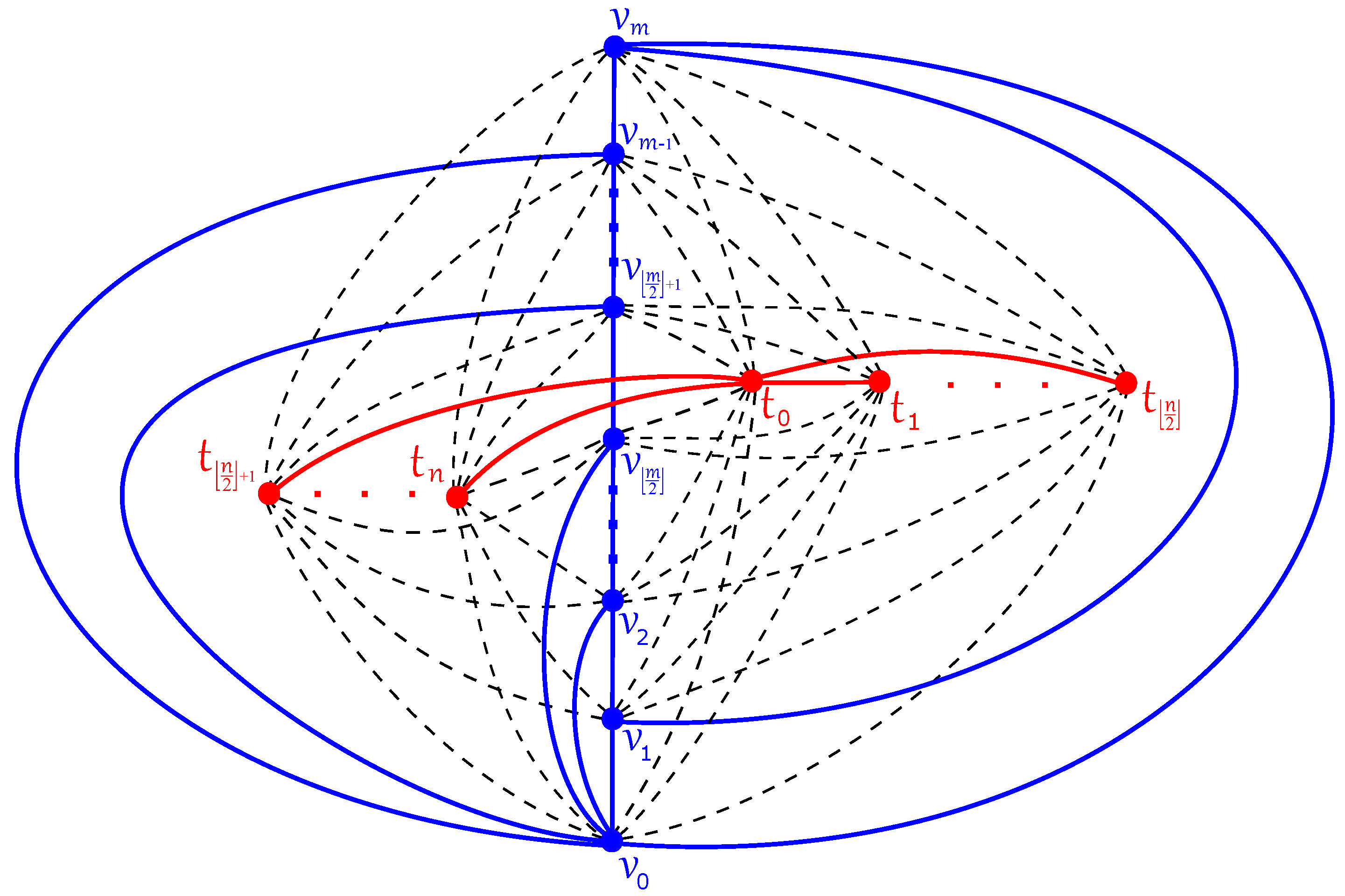
In Figure 3, the edges of cross each other
times, each subgraph , on the right side crosses the edges of exactly once, and each subgraph , on the left side crosses the edges of exactly times. The other crossings are contained on the edges of the subgraph . Thus,
crossings appear among the edges of the graph in this drawing.
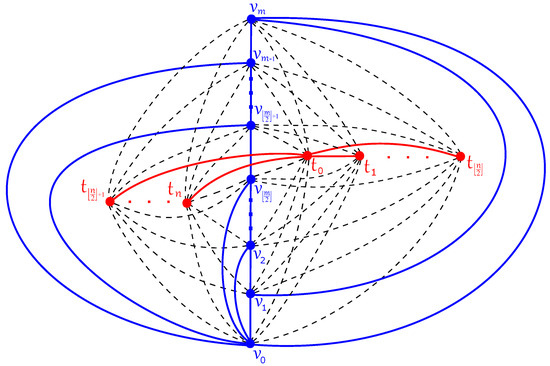
Figure 3.
The good drawing of with crossings.
Usually, the star is defined for an n of at least three, but the conjecture (15) can also be generalized for and . In this case, the stars and are isomorphic to the paths and , respectively. The crossing numbers of the join products of with and were determined by Staš and Valiska [25].
Theorem 7
([25], Theorem 5.1). for .
Theorem 8
([25], Theorem 5.2). for .
Using the aforementioned isomorphisms, our conjecture holds for and thanks to Theorems 7 and 8. As the graph is isomorphic to , Theorem 5 also confirms the validity of this conjecture for . Similarly, the graph is isomorphic to , but only the crossing number of has been shown by Su and Klešč [28]. On the other hand, Theorem 2 again confirms the validity of our conjecture for because the graph is isomorphic to . We add that Wang and Huang [29] also dealt with establishing hypotheses for crossing numbers of connected graphs involving stars, specifically for and . Our conjecture complements this knowledge for .
Now, let us turn to postulate that for all
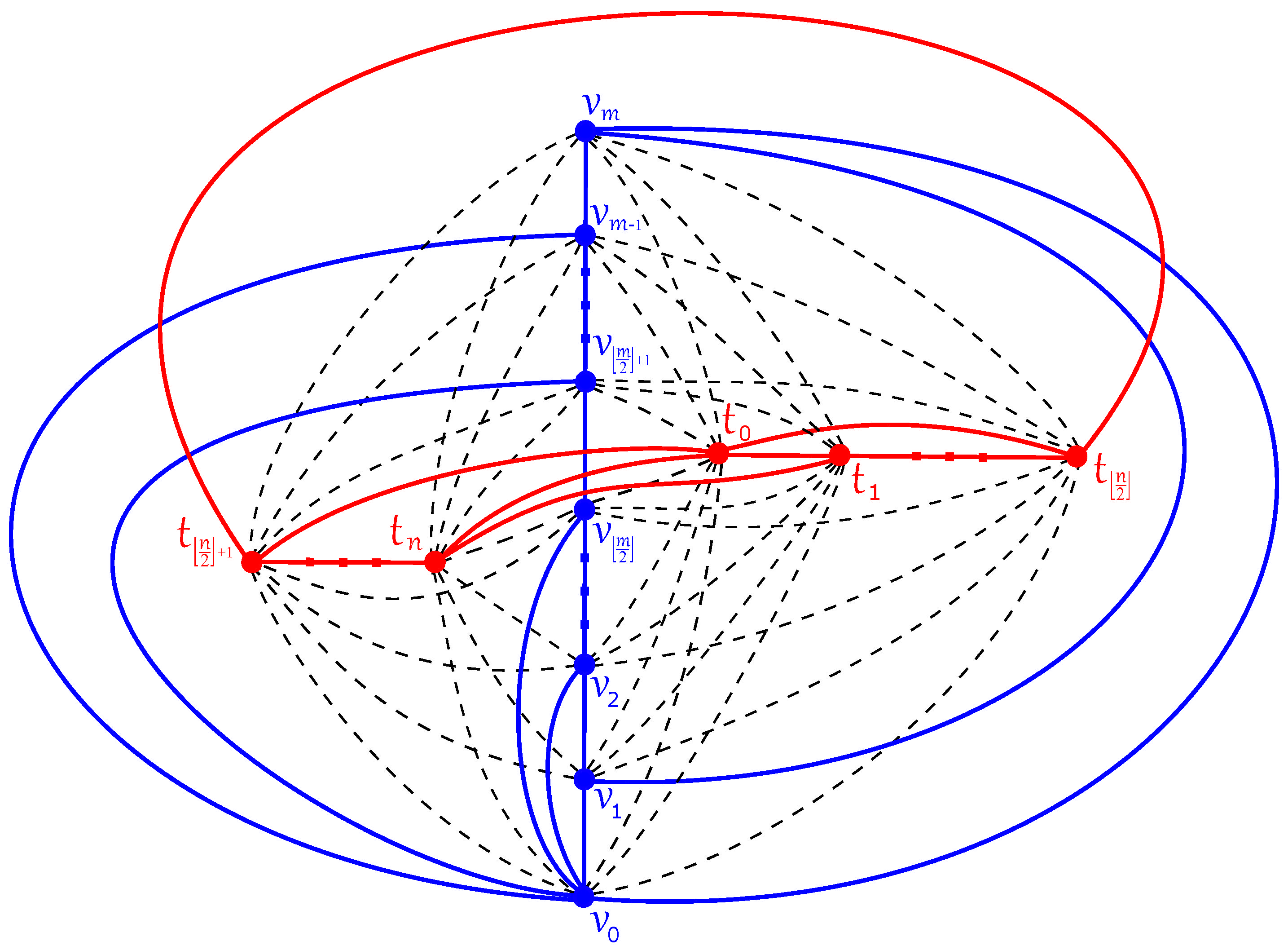
This makes it possible to add n new edges and for into the drawing D of in Figure 3, which form the rim edge set of with additional crossings. In Figure 4, the edges and force and crossings on edges of , respectively. In such a way, we obtain a good drawing of with exactly crossings.
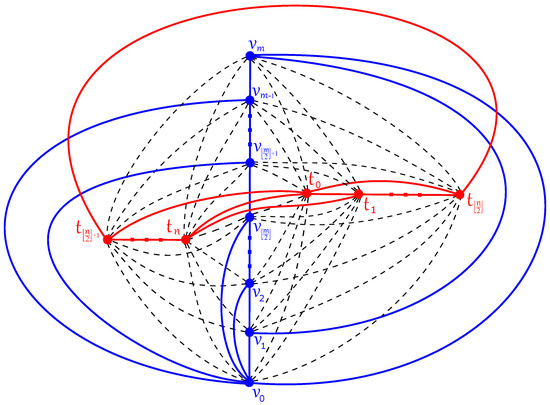
Figure 4.
The good drawing of with crossings.
As the graph is isomorphic to , Theorem 6 confirms the validity of the conjecture (16) for . Due to the symmetry, the same holds for . The graph is isomorphic to , but at the moment we do not even know the crossing number of the join product of with discrete graphs , i.e., whether holds with equality.
6. Conclusions
In this article, we focused on proving the crossing numbers for three connected graphs that include a complete graph on five vertices . We began by explaining why has only five non-isomorphic drawings. Then, we used a similar procedure, involving the existence of different separating cycles , the concept of rotation, and the known crossing numbers of related graphs, to prove the crossing numbers , , and . With these results, we have resolved all open problems concerning connected graphs on five vertices because the last hypotheses regarding and were just recently proven in [30]. Regarding disconnected graphs on five vertices, there is only one graph left for which the crossing numbers in combination with , , and are not exactly proven, namely the graph . Since we obtain this graph by removing one edge from the graph , it is assumed that their crossing numbers in the respective join products will be the same. However, precise proof represents a challenge. If it is mastered, all graphs on five vertices in combination with discrete graphs, paths, and cycles will have exactly known crossing numbers, similar to the case of all graphs on four vertices [31,32].
Additionally, we proposed new hypotheses for and , which we verified for the smallest possible values, and , due to their isomorphisms with and , respectively. Figure 3 and Figure 4 provide upper bounds for these conjectures for all . However, the lower bounds still need to be proven, presenting an interesting topic for future research in this area.
Author Contributions
Conceptualization, M.S., J.F. and M.Š.; methodology, M.S.; validation, M.S., J.F. and M.Š.; formal analysis, M.S.; investigation, M.S., J.F. and M.Š.; writing—original draft preparation, M.S.; writing—review and editing, J.F.; visualization, J.F.; supervision, M.S.; funding acquisition, M.Š. All authors have read and agreed to the published version of the manuscript.
Funding
This work was supported in part by the Slovak Research and Development Agency under Contract APVV-22-0400 and in part by the Scientific Grant Agency (VEGA) under contract No. 1/0413/22.
Data Availability Statement
Data is contained within the article.
Conflicts of Interest
The authors declare no conflicts of interest.
References
- Clancy, K.; Haythorpe, M.; Newcombe, A. A survey of graphs with known or bounded crossing numbers. Australas. J. Combin. 2020, 78, 209–296. [Google Scholar]
- Schaefer, M. The Graph Crossing Number and its Variants: A Survey. Electron. J. Comb. 2024, 20. Available online: https://www.combinatorics.org/ojs/index.php/eljc/article/view/DS21/pdf (accessed on 30 May 2024). [CrossRef] [PubMed]
- Aichholzer, O.; Fabila-Monroy, R.; Fuchs, A.; Hidalgo-Toscano, C.; Parada, I.; Vogtenhuber, B.; Zaragoza, F. On the 2-Colored Crossing Number. In Proceedings of the 27th International Symposium on Graph Drawing and Network Visualization, Lecture Notes in Computer Science, SEP, Prague, Czech Republic, 17–20 September 2019; pp. 87–100. [Google Scholar]
- Kleitman, D.J. The crossing number of K5,n. J. Comb. Theory 1970, 9, 315–323. [Google Scholar] [CrossRef]
- West, D.B. Introduction to Graph Theory; Prentice Hall: Upper Saddle River, NJ, USA, 2011. [Google Scholar]
- Su, Z. The crossing numbers of K5 + Pn. J. Math. Res. App. 2018, 38, 331–340. [Google Scholar]
- Lü, S.; Huang, Y. The crossing number of K5 × Sn. J. Math. Res. Exp. 2008, 28, 445–459. [Google Scholar]
- Yang, X.; Bian, H.; Yu, H.; Liu, D. The Local Antimagic Total Chromatic Number of Some Wheel-Related Graphs. Axioms 2022, 11, 97. [Google Scholar] [CrossRef]
- Buchheim, C.; Chimani, M.; Ebner, D.; Gutwenger, C.; Jünger, M.; Klau, G.W.; Mutzel, P.; Weiskircher, R. A Branch-and-Cut Approach to the Crossing Number Problem. Discret. Optim. 2008, 5, 373–388. [Google Scholar] [CrossRef]
- Chimani, M.; Gutwenger, C.; Mutzel, P. Experiments on Exact Crossing Minimization using Column Generation. ACM J. Exp. Algorithmics 2009, 14, 4.1–4.18. [Google Scholar] [CrossRef]
- Chimani, M.; Wiedera, T. An ILP-based proof system for the crossing number problem. In Proceedings of the 24th Annual European Symposium on Algorithms (ESA 2016), Aarhus, Denmark, 22–24 August 2016; Volume 29, pp. 1–13. [Google Scholar]
- Crossing Number Web Compute. Available online: http://crossings.uos.de/ (accessed on 19 June 2024).
- Garey, M.R.; Johnson, D.S. Crossing number is NP-complete. SIAM J. Algebraic. Discret. Methods 1983, 4, 312–316. [Google Scholar] [CrossRef]
- Klešč, M. The crossing number of join of the special graph on six vertices with path and cycle. Discrete Math. 2010, 310, 1475–1481. [Google Scholar] [CrossRef]
- Ho, P.T. The crossing number of K1,1,3,n. ARS Comb. 2011, 99, 461–471. [Google Scholar]
- Hernández-Vélez, C.; Medina, C.; Salazar, G. The optimal drawing of K5,n. Electron. J. Combin. 2014, 21, P4.1. [Google Scholar] [CrossRef]
- Woodall, D.R. Cyclic-order graphs and Zarankiewicz’s crossing number conjecture. J. Graph Theory 1993, 17, 657–671. [Google Scholar] [CrossRef]
- Klešč, M.; Schrötter, Š. The crossing numbers of join products of paths with graphs of order four. Discuss. Math. Graph Theory 2011, 31, 321–331. [Google Scholar] [CrossRef]
- Staš, M.; Timková, M. The crossing numbers of join products of four graphs of order five with paths and cycles. Opuscula Math. 2023, 43, 865–883. [Google Scholar] [CrossRef]
- Guy, R.K. Crossing numbers of graphs. In Graph Theory and Applications; 303 of Lecture Notes in Mathematics; Springer: Berlin/Heidelberg, Germany, 1972; pp. 111–124. [Google Scholar]
- Zheng, W.; Lin, X.; Yang, Y.; Cui, C.H. On the crossing number of Km□Pn. Graphs Combin. 2007, 23, 327–336. [Google Scholar]
- Klešč, M.; Staš, M. Cyclic permutations in determining crossing numbers. Discuss. Math. Graph Theory 2022, 42, 1163–1183. [Google Scholar] [CrossRef]
- Staš, M. The Crossing Numbers of Join Products of Paths and Cycles with Four Graphs of Order Five. Mathematics 2021, 9, 1277. [Google Scholar] [CrossRef]
- Berežný, Š.; Staš, M. On the crossing number of join of the wheel on six vertices with the discrete graph. Carpathian J. Math. 2020, 36, 381–390. [Google Scholar] [CrossRef]
- Staš, M.; Valiska, J. On the crossing numbers of join products of W4 + Pn and W4 + Cn. Opuscula Math. 2021, 41, 95–112. [Google Scholar] [CrossRef]
- Yue, W.; Huang, Y.; Ouyang, Z. On crossing numbers of join of W4 + Cn. Comp. Eng. Appl. 2014, 50, 79–84. [Google Scholar]
- Zarankiewicz, K. On a problem of P. Turan concerning graphs. Fundam. Math. 1995, 41, 137–145. [Google Scholar] [CrossRef]
- Su, Z.; Klešč, M. Crossing Numbers of K1,1,4,n and K1,1,4□T. ARS Comb. 2020, 148, 137–148. [Google Scholar]
- Wang, J.; Huang, Y. The crossing numbers of Sm + Pn and Sm + Cn. Adv. Math 2011, 40, 631–636. [Google Scholar]
- Staš, M.; Timková, M. The influence of separating cycles in drawings of K5\e in the join product with paths and cycles. Math. Slovaca, accepted for publication.
- Klešč, M. The crossing numbers of join of cycles with graphs of order four. In Proceedings of the APLIMAT 2019: 18th Conference on Applied Mathematics, Bratislava, Czech Republic, 5–7 February 2019; pp. 634–641. [Google Scholar]
- Klešč, M. The join of graphs and crossing numbers. Electron. Notes Discret. Math. 2007, 28, 349–355. [Google Scholar] [CrossRef]
Disclaimer/Publisher’s Note: The statements, opinions and data contained in all publications are solely those of the individual author(s) and contributor(s) and not of MDPI and/or the editor(s). MDPI and/or the editor(s) disclaim responsibility for any injury to people or property resulting from any ideas, methods, instructions or products referred to in the content. |
© 2024 by the authors. Licensee MDPI, Basel, Switzerland. This article is an open access article distributed under the terms and conditions of the Creative Commons Attribution (CC BY) license (https://creativecommons.org/licenses/by/4.0/).