


Abstract
In this study, we introduce a novel local fractional integral identity related to the Gaussian two-point left Radau rule. Based on this identity, we establish some new fractal inequalities for functions whose first-order local fractional derivatives are generalized convex and concave. The obtained results not only represent an extension of certain previously established findings to fractal sets but also a refinement of these when the fractal dimension is equal to one. Finally, to support our findings, we present a practical application to demonstrate the effectiveness of our results.
Keywords:
local fractional integrals; generalized convex functions; Gaussian quadrature; two-point left Radau rule; generalized Hölder inequality; improved generalized power mean inequality MSC:
26D10; 26D15; 26A51
1. Introduction
Convexity, a central concept in mathematical analysis, holds pivotal significance in both pure and applied mathematics. A function defined on an interval I is considered convex if, for any and , the following condition holds [1]:
This geometric and analytical property offers a profound understanding of the behavior of mathematical functions; see [2].
Convex functions play a fundamental role in various mathematical disciplines, with far-reaching implications in optimization, economics, and approximation theory. In the realm of approximation, the study of convexity becomes particularly compelling. It provides a robust framework for understanding the approximation quality of integrals, and one of the key results in this context is the Hermite–Hadamard inequality which can be expressed as follows: for a convex function defined on a closed interval , we have:
This inequality establishes a profound relationship between the average of a real-valued function over an interval and its endpoint values. It serves as a powerful tool in analyzing the behavior of convex functions and has wide-ranging applications in diverse mathematical and scientific fields.
Several results regarding error estimates of Newton–Cotes formulas via convexity have been established; see [3,4,5,6,7] and the references therein. However, the literature suffers from a significant gap concerning error estimates for Gauss quadrature rules, primarily due to their non-symmetric nature, which complicates the task. Among the limited existing results, the authors in [8] have established the following result concerning the two-point left Radau rule.
Theorem 1.
Let be a differentiable function on such that . If is convex on , then
A fractal set is a mathematical construct that exhibits self-similarity at various scales. Unlike traditional geometric shapes with integer dimensions (such as squares or circles), fractals often have non-integer or fractional dimensions. The defining characteristic of a fractal is the repetition of similar patterns at different levels of magnification. This property makes fractals particularly fascinating in the realms of mathematics, art, and nature.
The Mandelbrot set [9], Sierpinski triangle [10], and Koch snowflake [11] are well-known examples of fractal sets. Fractals find applications in diverse fields, including computer graphics, image compression, and the modeling of natural phenomena like coastlines and mountain landscapes.
Local fractional calculus is an extension of classical calculus that deals with derivatives and integrals in the context of functions with a fractal or non-integer dimension. Unlike traditional calculus, which operates on functions with integer dimensions, local fractional calculus allows for the analysis of functions defined on fractal sets [12,13,14].
Yang introduced the concept of generalized convexity applied to fractal sets in [15]. This concept is defined as follows:
Definition 1.
Consider , where is the fractal dimension. If for any and , the inequality
holds, then ð is termed generalized convex on I. If the inequality holds in the reverse direction, then ð is termed generalized concave.
Since the inception of this concept, numerous research efforts have aimed to extend classical findings regarding integral inequalities to the realm of fractals. Notably, Xu et al. made a significant contribution by presenting a series of fractal dual Simpson-like inequalities in [16]. Du and Yuan, in [17], conducted a parameterized study where they established several interesting fractal inequalities related to three-point Newton–Cotes formulas. Li et al. focused on four-point formulas and derived some local fractional inequalities using generalized -convexity in [18]. A more noteworthy study was carried out by Xu et al. in [19], where the authors established a fractal Hermite–Hadamard inequality for generalized -convex functions. They further conducted an extensive investigation, establishing numerous inequalities for different types of one, two, three, and four-point Newton–Cotes rules using the same form of convexity. For additional works on this subject, the readers are referred to [20,21,22,23,24,25,26,27,28,29,30,31,32,33,34].
In this article, we extend the two-point left Radau inequality to the framework of local fractional integrals. To achieve this, we begin by introducing a new local fractional integral identity from which we establish our results. The study is concluded with several applications.
2. Preliminaries
Definition 2
([15]). A non-differentiable function is local fractional continuous at , if
holds for . We denote the set of all local fractional continuous functions on by .
Definition 3
([15]). The local fractional derivative of of order μ at is defined as:
where .
We denote the set of all local fractional differentiable functions on by .
Definition 4
([15]). Let . Then, the local fractional integral is defined by,
with and , where and is a partition of interval .
Here, it follows that if and if . If for any , there exists , then we denote it by .
Lemma 1
([15]).
- 1.
- (Local fractional integration is anti-differentiation) Suppose that ; then, we have
- 2.
- (Local fractional integration by parts) Suppose that and ; then, we have
Lemma 2
([15]). For , the following identities hold
Lemma 3
(Generalized Hölder’s inequality [35]).
Let and where with , be both integrable under the frame of the fractal spaces; then, we have
Lemma 4
(Generalized power mean inequality [35]).
Let and where be both integrable under the frame of the fractal spaces; then, we have
Lemma 5
(Improved generalized power mean inequality [36]).
Let and where be both integrable under the frame of the fractal spaces; then, we have
3. Main Results
The following lemma functions as the crucial and principal instrument for establishing the outcomes of our research.
Lemma 6
Let be a function such that , with , and , then the following equality holds for :
where
Proof.
Theorem 2.
Assume that all the assumptions of Lemma 6 are satisfied. If is generalized convex on , then we have
Proof.
From Lemma 6 and the properties of the modulus, we have
Using the generalized convexity of , we obtain
where we have used
and
Thus, the proof is completed. □
Corollary 1.
In Theorem 2, if , we obtain the following result for the Riemann integral.
Remark 1.
Corollary 1 constitutes a refinement of the result established in Corollary 1 from [8], as the latter can be inferred by leveraging the convexity of with respect to the term , specifically, .
Corollary 2.
In Theorem 2, using the generalized convexity of with respect to the terms and , i.e., , we obtain the following inequality, which involves only the endpoints.
Now, to validate the accuracy of the result obtained in Theorem 2, we provide a numerical example along with a graphical representation to support the results.
Example 1.
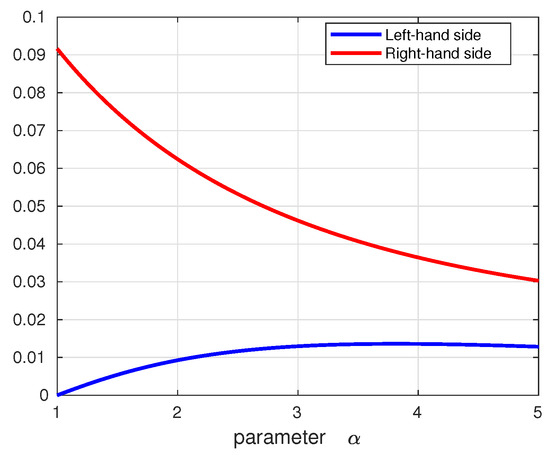
Consider the function defined by with . This function satisfies the conditions of our study, as its local fractional derivative, given by , is convex on the interval .
Let us note that for the function considered, Corollary 1 gives:
The result above is graphically represented in Figure 1, where the red curve corresponds to the left-hand side, and the blue curve represents the right-hand side.
Figure 1.
Graphical representation of Corollary 1.
The representation shown in Figure 1 confirms the accuracy and precision of the result obtained in Theorem 2.
Theorem 3.
Assume that all the assumptions of Lemma 6 are satisfied. If is generalized convex, then we have
where with .
Proof.
From Lemma 6 and the properties of the modulus along with the generalized Hölder inequality, we have
Using the generalized convexity of , we obtain
where we have used
and
The proof is completed. □
Corollary 3.
In Theorem 3, using the generalized convexity of with respect to the terms and , we obtain
Theorem 4.
Assume that all the assumptions of Lemma 6 are satisfied. If is generalized convex for , then we have
Proof.
From Lemma 6 and the properties of the modulus along with the generalized power mean inequality, we have
Using the generalized convexity of , we obtain
where we have used (5)–(13).
This completes the proof. □
Corollary 4.
In Theorem 4, using the generalized convexity of with respect to the terms and , we obtain
In [36], Yu et al. presented an improved version of the power mean inequality given in Lemma 5. In the following theorem, we apply this new inequality to derive a more refined result than the one obtained in Theorem 4.
Theorem 5.
Proof.
From Lemma 6 and the improved generalized power mean inequality along with the generalized convexity of , we have
where we have used
The proof is completed. □
Corollary 5.
In Theorem 5, using the generalized convexity of with respect to the terms and , we obtain
Theorem 6.
Assume that all the assumptions of Lemma 6 are satisfied. If is generalized concave, then we have
where with .
4. Application to Quadrature Formula
Let be the partition of the points of the interval , and consider the quadrature formula
where
and denotes the associated approximation error.
Proposition 1.
Let and be a differentiable function on with and . If is a generalized convex function, we have
Proof.
Applying Corollary 2 on the subintervals of the partition , we obtain
Multiplying both sides of the above inequality by , and then summing the obtained inequalities for all and using the triangular inequality, we obtain the desired result. □
5. Conclusions
In conclusion, our study introduced a novel local fractional integral identity tied to the Gaussian two-point left Radau rule. Using this identity, we established some new fractal inequalities applicable to functions with generalized convex and concave first-order local fractional derivatives. Our practical applications further demonstrated the effectiveness of these results, highlighting their potential impact and relevance in various contexts.
Author Contributions
Conceptualization: B.B.-M., A.L., M.U.A. and A.B.M.; formal analysis: B.B.-M., A.L. and M.U.A.; investigation: B.B.-M., A.L. and A.B.M.; methodology: M.U.A., A.B.M. and B.M.; project administration: B.B.-M., A.L., N.E.I.K., M.U.A. and A.B.M.; software: N.E.I.K.; supervision: B.M. and S.S.D.; validation: M.U.A., B.M. and S.S.D.; visualization: A.B.M., B.M. and S.S.D.; writing—original draft: B.B.-M., A.L., N.E.I.K. and A.B.M.; writing—review and editing: B.B.-M., A.L., M.U.A., A.B.M. and B.M. All authors have read and agreed to the published version of the manuscript.
Funding
This research received no external funding.
Informed Consent Statement
Not applicable.
Data Availability Statement
No new data were created or analyzed in this study. Data sharing is not applicable to this article.
Acknowledgments
This paper is supported by Researchers Supporting Project number (RSP2024R158), King Saud University, Riyadh, Saudi Arabia. The authors are thankful to the editor and anonymous reviewers for their valuable comments and suggestions.
Conflicts of Interest
The authors declare no conflict of interest.
References
- Niculescu, C.P. Convexity according to the geometric mean. Math. Inequal. Appl. 2000, 3, 155–167. [Google Scholar] [CrossRef]
- Pečarić, J.E.; Proschan, F.; Tong, Y.L. Convex Functions, Partial Orderings, and Statistical Applications; Mathematics in Science and Engineering, 187; Academic Press, Inc.: Boston, MA, USA, 1992. [Google Scholar]
- Meftah, B.; Lakhdari, A.; Benchettah, D.C. Some new Hermite-Hadamard type integral inequalities for twice differentiable s-convex functions. Comput. Math. Model. 2022, 33, 330–353. [Google Scholar] [CrossRef]
- Saleh, W.; Lakhdari, A.; Abdeljawad, T.; Meftah, B. On fractional biparameterized Newton-type inequalities. J. Inequal. Appl. 2023, 2023, 122. [Google Scholar] [CrossRef]
- Özdemir, M.E.; Dragomir, S.S.; Yıldız, Ç. The Hadamard inequality for convex function via fractional integrals. Acta Math. Sci. Ser. B (Engl. Ed.) 2013, 33, 1293–1299. [Google Scholar] [CrossRef]
- Saleh, W.; Meftah, B.; Lakhdari, A. Quantum dual Simpson type inequalities for q-differentiable convex functions. Int. J. Nonlinear Anal. Appl. 2023, 14, 63–76. [Google Scholar]
- Zhu, W.S.; Meftah, B.; Xu, H.; Jarad, F.; Lakhdari, A. On parameterized inequalities for fractional multiplicative integrals. Demonstr. Math. 2024, 57, 20230155. [Google Scholar] [CrossRef]
- Meftah, B.; Lakhdari, A. Saleh, W. 2-point left Radau-type inequalities via s-convexity. J. Appl. Anal. 2023, 29, 341–346. [Google Scholar] [CrossRef]
- Mandelbrot, B.B. The Fractal Geometry of Nature; WH Freeman: New York, NY, USA, 1982; Volume 1. [Google Scholar]
- Shang, J.; Wang, Y.; Chen, M.; Dai, J.; Zhou, X.; Kuttner, J.; Hilt, G.; Shao, X.; Gottfried, J.M.; Wu, K. Assembling molecular Sierpiński triangle fractals. Nat. Chem. 2015, 7, 389–393. [Google Scholar] [CrossRef]
- Falconer, K. Fractal Geometry: Mathematical Foundations and Applications; John Wiley & Sons: Hoboken, NJ, USA, 2004. [Google Scholar]
- Gao, F.; Zhong, W.P.; Shen, X.M. Applications of Yang-Fourier transform to local fractional equations with local fractional derivative and local fractional integral. Adv. Mater. Res. 2012, 461, 306–310. [Google Scholar]
- Yang, Y.J.; Baleanu, D.; Yang, X.-J. Analysis of fractal wave equations by local fractional Fourier series method. Adv. Math. Phys. 2013, 2013, 632309. [Google Scholar] [CrossRef]
- Yang, A.M.; Chen, Z.S.; Srivastava, H.M.; Yang, X.J. Application of the local fractional series expansion method and the variational iteration method to the Helmholtz equation involving local fractional derivative operators. Abstr. Appl. Anal. 2013, 2013, 259125. [Google Scholar] [CrossRef]
- Yang, X.J. Advanced Local Fractional Calculus and Its Applications; World Science Publisher: New York, NY, USA, 2012. [Google Scholar]
- Xu, H.; Lakhdari, A.; Saleh, W.; Meftah, B. Some New Parametrized Inequalities on Fractal Set. Fractals 2024, 32, 2450063. [Google Scholar] [CrossRef]
- Du, T.; Yuan, X. On the parameterized fractal integral inequalities and related applications. Chaos Solitons Fractals 2023, 170, 113375. [Google Scholar] [CrossRef]
- Li, H.; Lakhdari, A.; Jarad, F.; Xu, H.; Meftah, B. An expanded analysis of local fractional integral inequalities via generalized (s,P)-convexity. J. Inequal. Appl. 2024, 2024, 78. [Google Scholar] [CrossRef]
- Xu, H.; Lakhdari, A.; Jarad, F.; Abdeljawad, T.; Meftah, T. On multiparametrized integral inequalities via generalized α-convexity on fractal set. Math. Meth. Appl. Sci. 2024. [Google Scholar] [CrossRef]
- Saleh, W.; Meftah, B.; Lakhdari, A.; Kiliçman, A. Exploring the Companion of Ostrowski’s Inequalities via Local Fractional Integrals. Eur. J. Pure Appl. Math. 2023, 16, 1359–1380. [Google Scholar] [CrossRef]
- Lakhdari, A.; Meftah, B.; Saleh, W.; Benchettah, D. Corrected Simpson’s second formula inequalities on fractal set. Fract. Differ. Calc. 2024, 14, 1–19. [Google Scholar] [CrossRef]
- Abdeljawad, T.; Rashid, S.; Hammouch, Z.; Chu, Y.-M. Some new local fractional inequalities associated with generalized (s,m)-convex functions and applications. Adv. Differ. Equ. 2020, 2020, 406. [Google Scholar] [CrossRef]
- Anastassiou, G.; Kashuri, A.; Liko, R. Local fractional integrals involving generalized strongly m-convex mappings. Arab. J. Math. 2019, 8, 95–107. [Google Scholar] [CrossRef]
- Lakhdari, A.; Meftah, B.; Saleh, W. On corrected Simpson-type inequalities via local fractional integrals. Georgian Math. J. 2024. [Google Scholar] [CrossRef]
- Du, T.; Wang, H.; Khan, M.A.; Zhang, Y. Certain integral inequalities considering generalized m-convexity on fractal sets and their applications. Fractals 2019, 27, 1950117. [Google Scholar] [CrossRef]
- Kashuri, A.; Raees, M.; Anwar, M.; Farid, G. On some Ostrowski type inequalities on fractal sets via generalized strongly m-convex mappings. Ann. Oradea Univ.-Math. Fasc. 2020, 27, 81–100. [Google Scholar]
- Khan, Z.A.; Rashid, S.; Ashraf, R.; Baleanu, D.; Chu, Y.-M. Generalized trapezium-type inequalities in the settings of fractal sets for functions having generalized convexity property. Adv. Differ. Equ. 2020, 2020, 657. [Google Scholar] [CrossRef]
- Luo, C.; Wang, H.; Du, T. Fejér-Hermite-Hadamard type inequalities involving generalized h-convexity on fractal sets and their applications. Chaos Solitons Fractals 2020, 131, 109547. [Google Scholar] [CrossRef]
- Noor, M.A.; Noor, K.I.; Iftikhar, S.; Awan, M.U. Fractal integral inequalities for harmonic convex functions. Appl. Math. Inf. Sci. 2018, 12, 831–839. [Google Scholar] [CrossRef]
- Saleh, W.; Lakhdari, A.; Almutairi, O.; Kiliçman, A. Some Remarks on Local Fractional Integral Inequalities Involving Mittag–Leffler Kernel Using Generalized (E,h)-Convexity. Mathematics 2023, 11, 1373. [Google Scholar] [CrossRef]
- Sarikaya, M.Z.; Budak, H.; Erden, S. On new inequalities of Simpson’s type for generalized convex functions. Korean J. Math. 2019, 27, 279–295. [Google Scholar]
- Vivas-Cortez, M.; Awan, M.U.; Asif, U.; Javed, M.Z.; Budak, H. Advances in Ostrowski-Mercer Like Inequalities within Fractal Space. Fractal Fract. 2023, 7, 689. [Google Scholar] [CrossRef]
- Yu, Y.; Du, T. Certain error bounds on the Bullen type integral inequalities in the framework of fractal spaces. J. Nonlinear Funct. Anal. 2022, 2022, 24. [Google Scholar]
- Yu, Y.; Liu, J.; Du, T. Certain error bounds on the parameterized integral inequalities in the sense of fractal sets. Chaos Solitons Fractals 2022, 161, 112328. [Google Scholar] [CrossRef]
- Chen, G.-S. Generalizations of Hölder’s and some related integral inequalities on fractal space. J. Funct. Spaces Appl. 2013, 2013, 198405. [Google Scholar] [CrossRef]
- Yu, S.H.; Mohammed, P.O.; Xu, L.; Du, T. An improvement of the power-mean integral inequality in the frame of fractal space and certain related midpoint-type integral inequalities. Fractals 2022, 30, 2250085. [Google Scholar] [CrossRef]
Disclaimer/Publisher’s Note: The statements, opinions and data contained in all publications are solely those of the individual author(s) and contributor(s) and not of MDPI and/or the editor(s). MDPI and/or the editor(s) disclaim responsibility for any injury to people or property resulting from any ideas, methods, instructions or products referred to in the content. |
© 2024 by the authors. Licensee MDPI, Basel, Switzerland. This article is an open access article distributed under the terms and conditions of the Creative Commons Attribution (CC BY) license (https://creativecommons.org/licenses/by/4.0/).