


Abstract
We describe the case of a 67-year-old male patient with a moderately differentiated hepatocellular carcinoma (HCC) of the right liver lobe who underwent [18F]fluorocholine positron emission tomography/computed tomography (PET/CT) for staging due to a suspicious lung lesion at previous CT scan. [18F]fluorocholine PET/CT showed increased radiopharmaceutical uptake in a liver lesion corresponding to the known HCC. Furthermore, a right pulmonary hilar lesion suspicious for metastatic spread of HCC showed increased radiopharmaceutical uptake. Surprisingly, the histological assessment of the thoracic lesion demonstrated the presence of small cell lung cancer (SCLC). The patient underwent treatment with radiation therapy and chemotherapy for the SCLC and selective internal radiation therapy (SIRT) for the HCC. The patient died after one year due to progressive SCLC. This case demonstrates that coexisting tumors showing increased cell membrane turnover, including SCLC, can be detected by [18F]fluorocholine PET/CT. In our case, [18F]fluorocholine PET/CT findings influenced the patient management in terms of histological verification and different treatment of the detected lesions.
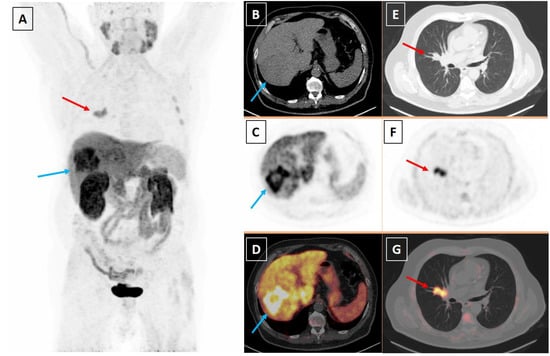
Figure 1.
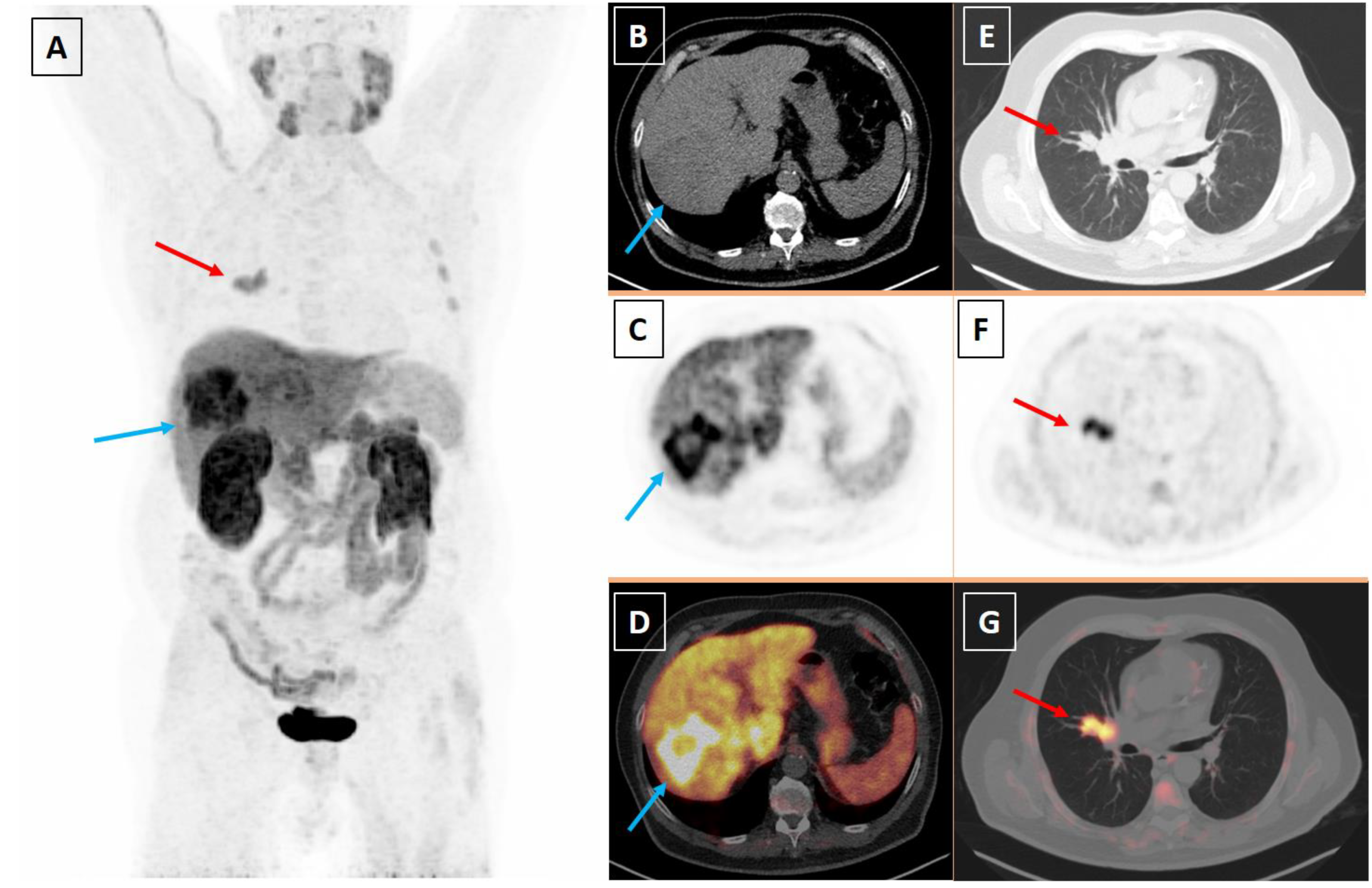
A 67-year-old male patient with a histological diagnosis of moderately differentiated hepatocellular carcinoma (HCC) and a suspicious right pulmonary lesion at computed tomography (CT) underwent [18F]fluorocholine positron emission tomography/computed tomography (PET/CT) for HCC staging. PET/CT was performed 30 min after the injection of 217 MBq of [18F]fluorocholine. Qualitative criteria for PET image analysis were used: areas of increased radiopharmaceutical uptake compared to the background were considered abnormal, excluding the sites of physiological radiopharmaceutical uptake. Furthermore, semi-quantitative PET image assessment using the maximal standardized uptake value (SUVmax) was performed. Maximum intensity projection PET image (A) and axial CT (B,E), PET (C,F) and fused PET/CT images (D,G) showed two areas of abnormal radiopharmaceutical uptake corresponding to the known HCC lesion in the right liver lobe (blue arrows) and to a right pulmonary hilar lesion (red arrows) suspicious for metastatic spread of HCC. SUVmax of liver and pulmonary lesions were 19 and 9, respectively. Surprisingly, the histological assessment of the thoracic lesion performed after [18F]fluorocholine PET/CT showed the presence of small cell lung cancer (SCLC). After multidisciplinary discussion, the patient underwent radiation therapy and chemotherapy for SCLC treatment and selective internal radiation therapy (SIRT) for HCC treatment. Unfortunately, the patient died one year after the [18F]fluorocholine PET/CT scan due to SCLC progression. According to evidence-based data, [18F]fluorocholine PET/CT is a useful imaging method for the staging and restaging of well differentiated and moderately differentiated HCC, which are tumors characterized by increased cell membrane turnover [1,2]. In particular, compared to conventional imaging techniques, [18F]fluorocholine PET/CT is very useful for detecting the metastatic spread of well differentiated and moderately differentiated HCC with several advantages compared to fluorine-18 fluorodeoxyglucose ([18F]FDG) PET/CT in terms of diagnostic performance [1,2]. [18F]fluorocholine PET/CT performed for oncological indications may incidentally detect benign or malignant lesions (second tumors) characterized by increased cell membrane turnover [3,4,5]. In particular, for lung cancers, it has been demonstrated that the uptake of [18F]fluorocholine is correlated with the proliferation of tumor cells; furthermore, the [18F]fluorocholine uptake mechanism is related to the overexpression of choline kinase and phosphorylcholine-cytidyl transferase in lung tumors [6]. A previous case reported the incidental detection of SCLC by [18F]fluorocholine PET/CT performed for a non-oncological indication (primary hyperparathyroidism) [7]. Our case demonstrated that coexisting tumors such as HCC and SCLC showing increased cell membrane turnover can be detected by radiolabeled choline PET/CT. In our case, radiolabeled choline PET/CT findings influenced the patient management in terms of histological verification and different treatment of the detected lesions.
Figure 1.
A 67-year-old male patient with a histological diagnosis of moderately differentiated hepatocellular carcinoma (HCC) and a suspicious right pulmonary lesion at computed tomography (CT) underwent [18F]fluorocholine positron emission tomography/computed tomography (PET/CT) for HCC staging. PET/CT was performed 30 min after the injection of 217 MBq of [18F]fluorocholine. Qualitative criteria for PET image analysis were used: areas of increased radiopharmaceutical uptake compared to the background were considered abnormal, excluding the sites of physiological radiopharmaceutical uptake. Furthermore, semi-quantitative PET image assessment using the maximal standardized uptake value (SUVmax) was performed. Maximum intensity projection PET image (A) and axial CT (B,E), PET (C,F) and fused PET/CT images (D,G) showed two areas of abnormal radiopharmaceutical uptake corresponding to the known HCC lesion in the right liver lobe (blue arrows) and to a right pulmonary hilar lesion (red arrows) suspicious for metastatic spread of HCC. SUVmax of liver and pulmonary lesions were 19 and 9, respectively. Surprisingly, the histological assessment of the thoracic lesion performed after [18F]fluorocholine PET/CT showed the presence of small cell lung cancer (SCLC). After multidisciplinary discussion, the patient underwent radiation therapy and chemotherapy for SCLC treatment and selective internal radiation therapy (SIRT) for HCC treatment. Unfortunately, the patient died one year after the [18F]fluorocholine PET/CT scan due to SCLC progression. According to evidence-based data, [18F]fluorocholine PET/CT is a useful imaging method for the staging and restaging of well differentiated and moderately differentiated HCC, which are tumors characterized by increased cell membrane turnover [1,2]. In particular, compared to conventional imaging techniques, [18F]fluorocholine PET/CT is very useful for detecting the metastatic spread of well differentiated and moderately differentiated HCC with several advantages compared to fluorine-18 fluorodeoxyglucose ([18F]FDG) PET/CT in terms of diagnostic performance [1,2]. [18F]fluorocholine PET/CT performed for oncological indications may incidentally detect benign or malignant lesions (second tumors) characterized by increased cell membrane turnover [3,4,5]. In particular, for lung cancers, it has been demonstrated that the uptake of [18F]fluorocholine is correlated with the proliferation of tumor cells; furthermore, the [18F]fluorocholine uptake mechanism is related to the overexpression of choline kinase and phosphorylcholine-cytidyl transferase in lung tumors [6]. A previous case reported the incidental detection of SCLC by [18F]fluorocholine PET/CT performed for a non-oncological indication (primary hyperparathyroidism) [7]. Our case demonstrated that coexisting tumors such as HCC and SCLC showing increased cell membrane turnover can be detected by radiolabeled choline PET/CT. In our case, radiolabeled choline PET/CT findings influenced the patient management in terms of histological verification and different treatment of the detected lesions.
Author Contributions
Conceptualization, M.C. and G.T.; resources and data curation, M.C.; writing—original draft preparation, G.T.; writing—review and editing, M.C. and G.P. All authors have read and agreed to the published version of the manuscript.
Funding
This research received no external funding.
Institutional Review Board Statement
Not applicable.
Informed Consent Statement
Written informed consent was obtained from the patient.
Data Availability Statement
The data presented in this article are available on request from the corresponding author.
Acknowledgments
We acknowledge the support of the “Maverick Collective” for their assistance in preparing this manuscript and for their help in collecting patient data.
Conflicts of Interest
The authors declare no conflict of interest.
References
- Bertagna, F.; Bertoli, M.; Bosio, G.; Biasiotto, G.; Sadeghi, R.; Giubbini, R.; Treglia, G. Diagnostic role of radiolabelled choline PET or PET/CT in hepatocellular carcinoma: A systematic review and meta-analysis. Hepatol. Int. 2014, 8, 493–500. [Google Scholar] [CrossRef] [PubMed]
- Signore, G.; Nicod-Lalonde, M.; Prior, J.O.; Bertagna, F.; Muoio, B.; Giovanella, L.; Furlan, C.; Treglia, G. Detection rate of radiolabelled choline PET or PET/CT in hepatocellular carcinoma: An updated systematic review and meta-analysis. Clin. Transl. Imaging 2019, 7, 237–253. [Google Scholar] [CrossRef]
- Treglia, G.; Giovannini, E.; Di Franco, D.; Calcagni, M.L.; Rufini, V.; Picchio, M.; Giordano, A. The role of positron emission tomography using carbon-11 and fluorine-18 choline in tumors other than prostate cancer: A systematic review. Ann. Nucl. Med. 2012, 26, 451–461. [Google Scholar] [CrossRef] [PubMed]
- Roland, A.; Drouet, C.; Boulahdour, H.; Cochet, A.; De Bari, B. Unusual uptakes on 18F-fluorocholine positron emission tomography/computed tomography (PET/CT): A retrospective study of 368 prostate cancer patients referred for a biochemical recurrence or an initial staging. Quant. Imaging Med. Surg. 2021, 11, 172–182. [Google Scholar] [CrossRef] [PubMed]
- Sollini, M.; Pasqualetti, F.; Perri, M.; Coraggio, G.; Castellucci, P.; Roncali, M.; Boni, R.; Lazzeri, E.; Galeandro, M.; Paiar, F.; et al. Detection of a second malignancy in prostate cancer patients by using [(18)F]Choline PET/CT: A case series. Cancer Imaging 2016, 16, 27. [Google Scholar] [CrossRef] [PubMed][Green Version]
- Li, M.; Peng, Z.; Liu, Q.; Sun, J.; Yao, S.; Liu, Q. Value of 11C-choline PET/CT for lung cancer diagnosis and the relation between choline metabolism and proliferation of cancer cells. Oncol. Rep. 2013, 29, 205–211. [Google Scholar] [CrossRef] [PubMed]
- Jacquet-Francillon, N.; Granjon, D.; Casteillo, F.; Prévot, N.; Habouzit, V. Incidental Detection of a Small Cell Lung Cancer by 18F-Choline PET/CT Performed for Recurrent Hyperparathyroidism After Parathyroidectomy. Clin. Nucl. Med. 2021, 46, e109–e111. [Google Scholar] [CrossRef] [PubMed]
Disclaimer/Publisher’s Note: The statements, opinions and data contained in all publications are solely those of the individual author(s) and contributor(s) and not of MDPI and/or the editor(s). MDPI and/or the editor(s) disclaim responsibility for any injury to people or property resulting from any ideas, methods, instructions or products referred to in the content. |
© 2023 by the authors. Licensee MDPI, Basel, Switzerland. This article is an open access article distributed under the terms and conditions of the Creative Commons Attribution (CC BY) license (https://creativecommons.org/licenses/by/4.0/).