


Abstract
Social changes have brought educational challenges at all levels of education. One of the most important elements has been adopting the development of competences as a main goal. As regards teacher training, competences have been included in university degrees responding to a traditional concern related to teacher training: the necessary relationship between theory and educational practice. The objective of this work, in the Spanish context, is to define a model for the evaluation of didactic-disciplinary competences (frequently taught in university classrooms, in a theoretical way) within the framework of the school practicums of the degree in early childhood education (the unique practical context where a real application of competences may be assessed before professional performance). For this purpose, we analyzed the legislation (the specific didactic-disciplinary competences of the ECI/3854/2007 Order) and the school practicum plans of Spanish universities, in order to provide a useful tool to know how students apply theoretical learning in their classroom practices. The resulting model, focused on the learning of natural sciences, social sciences and mathematics, enables understanding the level of development of the didactic-disciplinary competences and can be considered as a conceptual framework to design instruments for different contexts.
1. Introduction
The social changes that have been taking place at an unprecedented speed since the end of the last century have had remarkable effects in the educational field at all levels. One of the common commitments to the different educational stages has been competency-based training, focused on the development of abilities and skills associated with the processes that we usually carry out in the multiple aspects of our lives (social, cognitive, work-related, etc.) [1]. Beyond how confusing the term competence [2] may still be today, it is a useful instrument to respond to social realities, making it possible to train citizens for a diverse society, to meet the requirements of the productive process and, as we said, to develop the knowledge, skills and attitudes that enable us to act successfully in different areas of social life [1].
At the core of the competence approach is, then, the connection with the environment—which should serve as a reference for training—as well as the necessary relationship between theory and educational practice. In the Spanish context, from Organic Law 2/2006, of 3 May, of Education (LOE) [3], competences (basic, in the case of LOE, and, later, key competences) are incorporated into primary and secondary education classrooms in Spain. In the same vein, the European Higher Education Area assumes the competence approach, transforming the syllabi and changing the methodologies developed [4].
In the training of future teachers, the two aforementioned realities converge: Teachers are trained in competences, and, in turn, they train students in competences in schools. Their own training by competences must involve the development of a professional profile that also allows them to develop skills in their students [5]. Thus, the delimitation of the so-called teaching competences is a determining factor. Teaching skills has been the subject of numerous studies focused on their conceptualization and delimitation [2,6,7,8], on the perceptions of teachers at different educational levels [9,10,11,12] or on the configuration of models. Among the configuration of models, more in relation to the work we are dealing with, the models developed around the technological and the virtual stand out, such as the well-known Technological Pedagogical Content Knowledge (TPACK) model [13], which establishes three types of knowledge that university teaching staff must possess in order to be able to operate in technological environments (technological, pedagogical and content knowledge); the model of Cabero, Llorente and Morales [14], which also allows the evaluation of teaching performance virtually in four dimensions (disciplinary knowledge of the content, pedagogical, technological and compliance with regulations/standards), which are specified in sub-dimensions; or the Model of Teaching Competences for Online Teaching (MECDL) [15], articulated in three dimensions (anticipation, conduction and assessment of the teaching–learning process). Of a more general nature, and focused on higher education, are Zabalza’s model [16], which proposes ten competences for university staff teachers (planning the teaching–learning process; selecting and preparing disciplinary content; providing comprehensible and well-organized information and explanations; handling new technologies; designing a methodology and organizing activities; communicating and interacting with students; tutoring; evaluating; reflecting and researching on teaching; and identifying with the institution and working as part of a team); and that of Torra et al. [17], which identifies seven competences specific to the teaching function in the European Higher Education Area (interpersonal, methodological, communication, planning, teaching management, group work and innovation).
Certainly, the approach by competences, that authors often like [18] to equate to the traditional paradigms of the profession (positivist, practical, socio-critical), becomes important in professional activity and teacher training. Related to the last one, from a training point of view, we assume that graduates of teaching degrees have the academic and professional competences that will enable them to develop their work as teachers in the most satisfactory way [19].
However, from a researcher’s point of view, whereas research focusing on the development of competences of in-service teachers or on perceptions about competence models is numerous, that focusing its attention on how these competences included in the degrees are put into practice is not [1]. Research along these lines, which is scarce in quantity, is necessary for a variety of reasons of a different nature. First, teacher training must be practice-focused since this is understood as a key to professionalization [2]. While the profile of graduates in other degrees is more diverse, in the case of teacher training students, their work performance goes hand in hand with teaching practice, whether in formal or non-formal contexts. Second, the competences themselves are only defined by action and can only be understood from the particular context where they are put into practice [20,21]. Their development and assessment cannot be separated from the application; in fact, for teachers’ competences to produce real effects in improving teaching, it is necessary to articulate them on teaching tasks in which their practical dimension stands out [22]. Third, and as a determining reason, there are numerous studies [23,24,25,26] that highlight a deficient relationship between theory and practice, some of which have a direct impact on the fact that it cannot be assumed that students will effectively apply some theoretical knowledge in the practical reality of classrooms [27].
Considering all the above, it is necessary to propose research that evaluates competences in the specific contexts of teaching practice, especially that focusing on the practical application of knowledge that may be considered more theoretical. Additionally, this evaluation should be carried out within the framework of initial training, since the aim is not to assess the development of the competences of in-service teachers, but rather the application of the competences of the degree in the reality of the classroom, without being influenced by the experience or the school culture of the schools.
With this aim in mind, and limiting our field of study to the training of early childhood education teachers, we ask ourselves the following: is it possible to configure a model that makes it possible to evaluate the application in teaching–learning situations of the more theoretical competence dealt with as part of the syllabus?
With this as a basis, and with the aim of limiting the research, what we set out to do in this work is to define a model for the evaluation of didactic-disciplinary competences for the learning of natural sciences, social sciences and mathematics, within the framework of the school practices of the bachelor’s degree in early childhood education.
2. Method: Process and Sources for Model Configuration
Within the framework of an interpretative paradigm and qualitative methodology [28], the configuration of the proposed model was carried out using content analysis as a method [29]. We define the resulting model as inductive–deductive, involving in its configuration both the empiricist-inductive epistemological approach and, above all, the rationalist-deductive approach [30].
In Figure 1, we outline the steps to configure the model, which we will describe in the following.
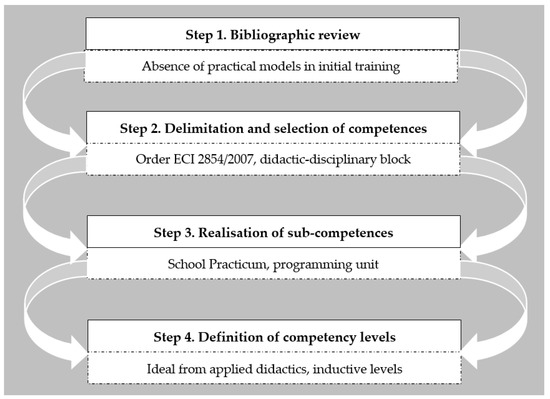
Figure 1.
Method for the configuration of the model.
Step 1. Bibliographic review
The first step for the configuration of the model was the identification of the need for its design, which originates this study and the research problem. In addition, this first bibliographical review allows an initial delimitation of the resources or sources for the configuration of the model. Of particular value is the review of Spanish models and legislation by Zhang [31] and the procedures used for the systematization of the model; in this regard, the proposal by García-Cabrero et al. [15] with their definition of competences, descriptors and indicators is of interest.
Step 2. Delimitation and selection of competences
Given the lack of a model for assessing the teaching competences of trainee teachers—more specifically, for future early childhood education teachers—and the existing diversity in the teaching models proposed for active teachers, the first premise was to delimit the teaching competences that would make up our model.
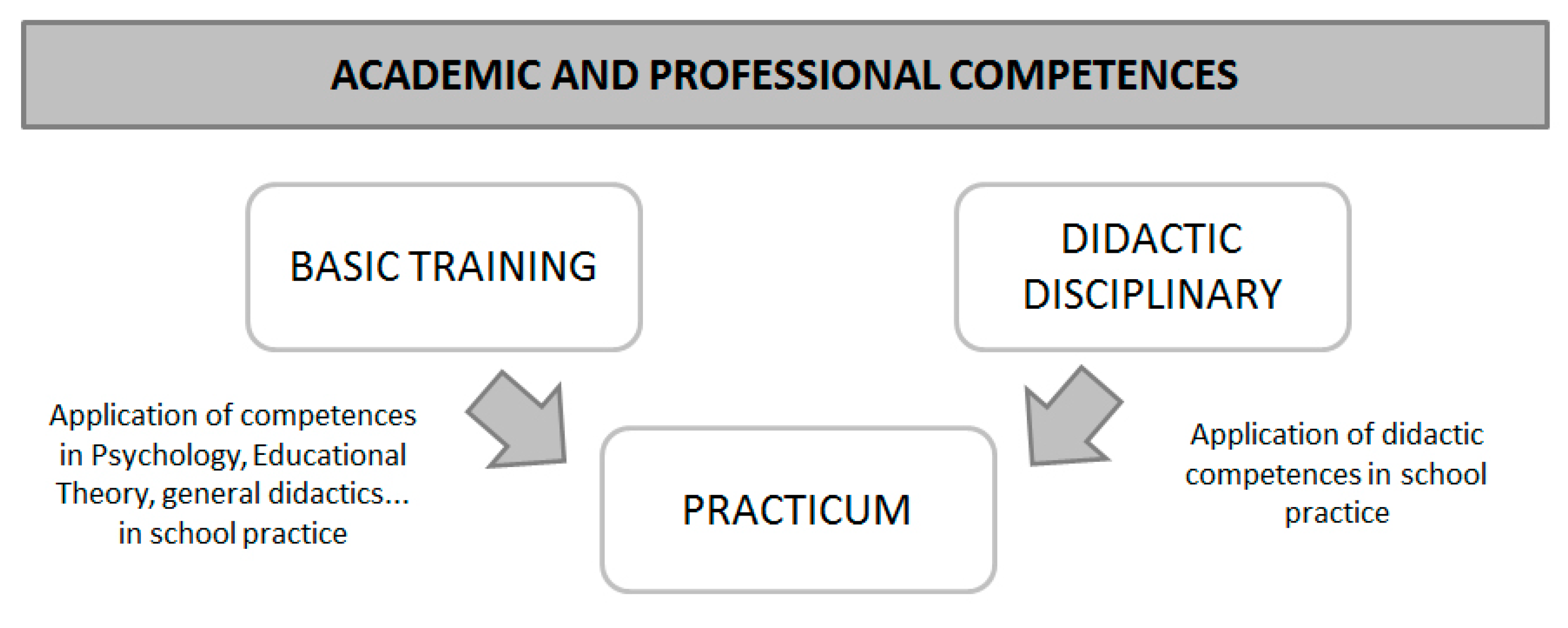
The official university education system in Spain, which is in line with the European Higher Education Area, establishes that official undergraduate curricula must have 240 European ECTS credits (referring to the volume of work conducted by students), which shall contain all the theoretical and practical information that students should acquire in their university studies [32]. This legislative document, in Section 3.2 of Annex I, establishes the basic competences for all undergraduate students, a series of very general requirements established for all students in terms of skills and knowledge specific to their university studies that will enable them to prepare for future professional activities. However, for the degree that concerns us here, that of early childhood education teacher, it is in Order ECI 3854/2007 [33] where the requirements for the verification of the official degree are established, where twelve general competences are specified—in Section 3—in terms of objectives to be achieved by all students on completing the degree and where the specific competences of all the subjects in the syllabus are specified—in Section 5—divided into three blocks: “basic training”, “didactic-disciplinary” and “practicum” (Figure 2).
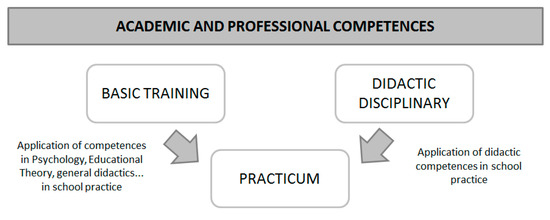
Figure 2.
Relations between competences of the ECI/3854/2007 Order.
Since Order ECI 3854/2007 is the only document that defines the competences to be developed by trainee early childhood education teachers, we took the competences included in this document as the basis for the model. Among them, in order to create a model that would allow us to assess the application of the knowledge acquired theoretically in practice, we articulated the proposal around the “didactic-disciplinary” module, which includes the contents related to applied didactics, collected in the different models analyzed under different names, and worked on in the different subjects of the degree, mostly in a theoretical way, and in any case, without application to the reality of the early childhood classrooms.
Table 1 lists the nine competences of the didactic and disciplinary module “Learning Natural Sciences, Social Sciences and Mathematics”, which we selected to initiate our model, as well as their relationship with the three areas of knowledge involved (NS: natural sciences; SS: social sciences; M: mathematics). The link to the areas of knowledge was based on the curricula of the Spanish universities approved by the National Quality Assessment and Accreditation Agency of Spain (ANECA).

Table 1.
Competences of the didactic and disciplinary module “Learning Natural Sciences, Social Sciences and Mathematics”.
Step 3. Realization of sub-competences
Once the competences that act as the basis of the model were defined, the next step in its configuration was to translate these competences into the teaching practice, taking into account the circumstances in which assessment is to take place.
In this sense, two decisions were made: the consideration of the school practicum as the closest reality, within the framework of the initial training process, to professional teaching performance, and, therefore, its selection as the area around which to articulate and apply the model; and the specification of competences in what we call “sub-competences”, based on the analysis of the design and implementation of a programming unit as a fundamental element of teaching. In relation to the first decision, school practicums of the degree in early childhood education constitute an integrated set of teaching initiation practices in the classroom and are intended to help students acquire both the transversal competences of the university and those specific to the subject, together with the learning outcomes associated with them. In this sense, there are several competences that students put into practice in their periods of school practicums. However, perhaps, the one that is most clearly related to verify how the didactic-disciplinary competences are applied in them is that of “participating in the teaching activity and learning to know how to do, acting and reflecting from practice”.
Considering the practicum program for the configuration of the model means a commitment to a common implementation of all teacher training plans, regardless of the Spanish university where the degree is being studied. Having analyzed the curricula of Spanish universities and the specific requirements of the subjects related to school practices, we can affirm that, despite institutional guidelines, there is no homogeneity in the distribution of subjects in the different national curricula of the degree in early childhood education, neither in terms of credits assigned to departments, number of subjects (compulsory and optional), placement in a certain course or semester, timing with respect to school practicums nor in what is explicitly requested from students. This is the reason behind the second decision, as it is essential to look for common aspects—in terms of tasks to be performed—within the different plans of existing practicums in Spanish universities, with the purpose of articulating a model that is useful for all of them or, at least, easily adaptable.
In this vein, the design and the development of a programming unit is a common element of the practicum program of Spanish universities. This usually carries with it among its learning outcomes knowing “to design a programming unit on the contents of Early Childhood Education foreseen in the classroom programming for the period of practices; put it into practice and evaluate it” [33].
Therefore, we took as a base document Order ECI 3854/2007 and the competences selected and included in Table 1, analyzing, in order to specify them in sub-competences, the practicum plans of Spanish universities and how the competences of the Order are translated into the requirements of the practicums.
Specifically, we selected the practicum plan of the University of Murcia for the delimitation of the sub-competences: concretely, the documents associated with the subject of school practicums in the last year of the degree (school practicum IV) [34]. The reason for the selection is given, mainly, by the concreteness and specificity of this university’s internship plan, which facilitates the delimitation of categories and their subsequent application to other more general plans; in other words, it allows us to create a model, not specific to the context of the University of Murcia, but sufficiently systematized for evaluation in any of the contexts.
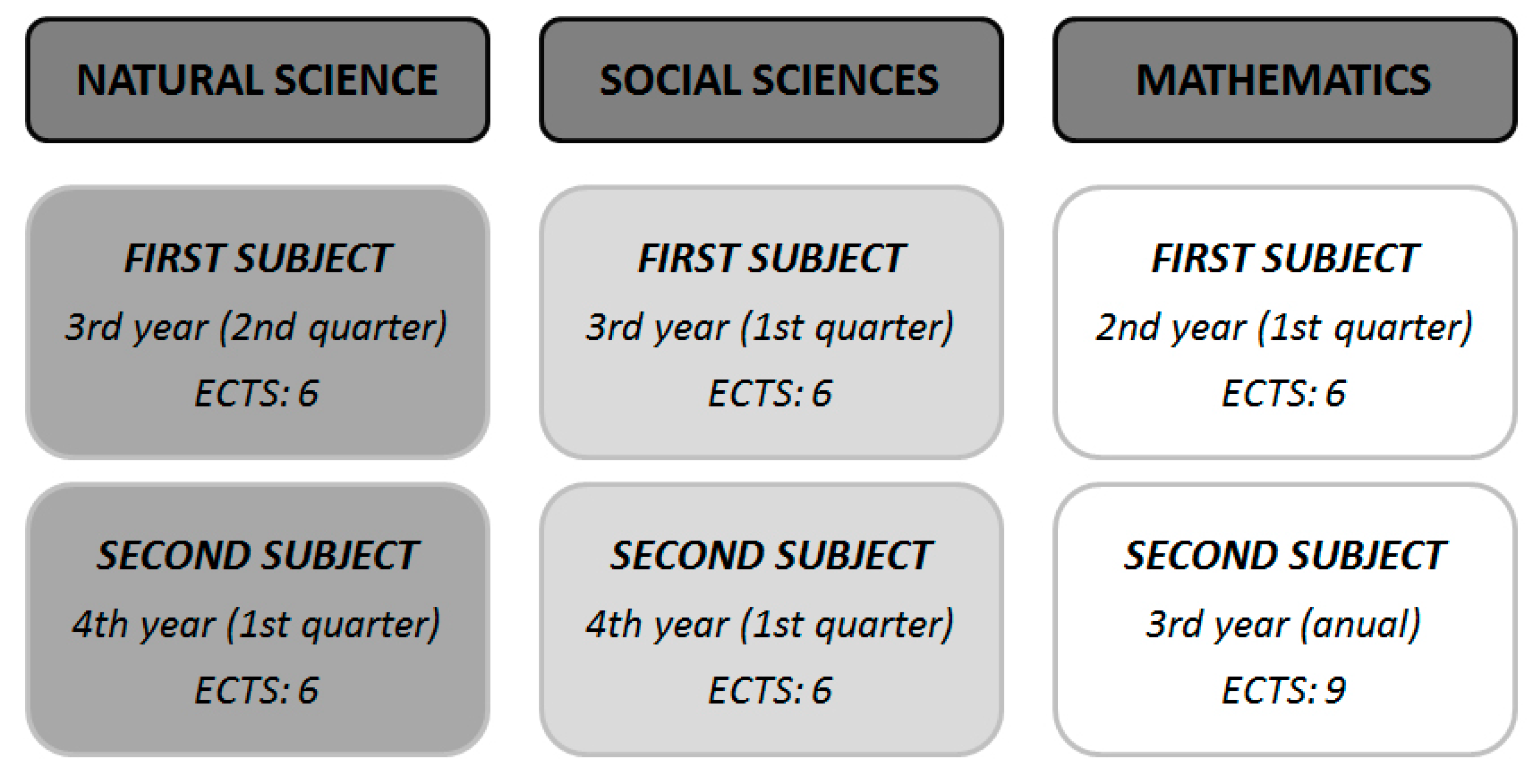
We considered two aspects for the delimitation of the sub-competences. On the one hand, a review of the specific requirements for the development of the program unit in the practicum plan. This question entails the direct specification of some of the sub-competences (C1.1, C1.2, C7.2, C7.3, etc.), which are derived from the list of aspects to be included in the program unit and which, in any case, are prescriptive elements of this unit. On the other hand, the contributions made at the disciplinary and didactic levels of the compulsory subjects corresponding to the didactic-disciplinary module “Learning Natural Sciences, Social Sciences and Mathematics”. Specifically, we considered the theoretical contributions included in the teaching guides of the six subjects, two from each of the areas of the syllabus we considered for the configuration of the model (Figure 3).
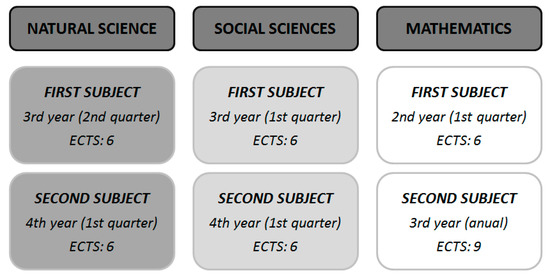
Figure 3.
Compulsory subject related to the module “Learning Natural Science, Social Sciences and Mathematics” (University of Murcia).
Step 4. Definition of competency levels
The last step in the configuration of the model was the definition of competence levels. It is in this phase that the inductive approach of the model is most important. In this sense, in order to establish the levels, two steps were followed: firstly, the description of the ideal for each sub-competence in accordance with the contributions made from applied didactics (L3 = high level); and secondly, the definition of levels 2 (L2 = medium level) and 1 (L1 = low level). For this final process, fifteen student internship reports from the 2019/2020 academic year were analyzed, with different levels of elaboration. The analysis of the students’ contributions to each sub-competence made it possible to establish levels for each of them, based on a scale of a high, medium or low level of development. As the levels of the competences were inductively established, it is not possible to explain all of them individually due to the limitations of the length of the text. Nevertheless, the concretization of the levels for the sub-competence C1.2. can be taken as an example of the process. First of all, we find didactic objectives that are formulated concretely and without errors (“To hypothesize about the observed phenomenon”). These answers correspond to the theoretical ideal for the sub-competence. Therefore, they allow establishing a high level (“L3. Has no mistakes in the formulation of specific elements”). Secondly, we find examples which, while not entirely incorrect, lack concreteness or representativeness in their formulation (“to strengthen the colors of the venous frogs”). On the one hand, the verb which is used by the student is not the most adequate for a didactic objective. On the other hand, the formulation of the objective does not make it clear exactly what the purpose of the proposal is. These answers force the formulation of an intermediate level (“L2. Has some specific mistakes in the formulation of the specific elements”). Finally, we find wrong formulations, for instance, the delimitation of objectives from the perspective of the teacher and not from the perspective of the learner (“To provide artistic knowledge”). This type of answer belongs to the low level (“L1. Has too many mistakes in the formulation of the specific elements”).
3. Model for Evaluation of the Teaching Competences
The full model, the main proposal of our work, can be found in Table 2.
Table 2.
Model for evaluation of teaching competences.
In the following, we shall comment on the aspects most directly involved in the realization of each of the specific competences of the module that make up the model for evaluating competences in school practicums.
If we start with the competences shared by the three areas involved, in relation to the competence “To know the scientific, mathematical and technological foundations of the curriculum of this stage as well as the theories about the acquisition and development of the corresponding learning” (C1), its realization is based on the curricular foundations (selecting, formulating and justifying the objectives, contents and evaluation criteria with the curriculum) and the learning theories (delimiting previous knowledge, establishing levels of deepening, determining and acting in the face of bibliographically justified learning difficulties) of teaching practice, being common to the disciplines. Likewise, the competence “To promote initiation experiences to information and communication technologies” (C9) revolves around the use of ICT as a resource (according to levels of participation) or as a content.
More related to mathematical knowledge, the competence “To know didactic strategies to develop numerical representations and spatial, geometric and logical development notions” (C2) is specified in the application of mathematical processes (problem solving, reasoning and proof, communication, connections and/or representation), at some point within the programming unit, to working on mathematical content (logic, numbers and operations, geometry, measurement and/or statistics-probability) and developing some skills, while “To understand mathematics as sociocultural knowledge” (C3) is formulated in relation to the association of mathematical knowledge with daily activities and to plan the mathematization of the context to teach mathematics.
The competences of social sciences are specified by including some activity around change and continuity in the proposal, showing some knowledge of first-order content (thought, customs, beliefs, etc.) for the competence “To acquire knowledge about the evolution of thought, customs, beliefs and social and political movements throughout history” (C5), as well as incorporating events or figures with historical relevance in the teaching activity and establishing relationships between social phenomena and human activities in the environment for the C6 competence (“To know the most outstanding moments in the history of science and technology and their significance”).
Finally, with more connection with the natural and experimental sciences, although not exclusively, we mainly focus on the globalization of the didactic proposal, correct sequencing and evaluation, as well as the consideration of the CTS interaction and sustainable development for the competence “To elaborate didactic proposals in relation to the interaction between science, technology, society and sustainable development” (C7); the promotion of attitudes of respect and care for the natural environment, for coexistence and respect for others, of interest for cultural manifestations and recognition of identity, in relation to the competence “To promote interest and respect for the natural, social and cultural environment through appropriate educational projects” (C8); and, finally, the inclusion of some activity that requires the use of scientific procedures and attitudes associated with experimental activities, as well as the creation of mental representations and language development, in the case of the competence “To know the scientific methodology and promote scientific thinking and experimentation” (C4).
In all cases, three levels of development have been delimited. This allows a progressive assessment of the competences specifically related to the context where they are applied.
4. Conclusions and Prospective
We started, in this work, from the intention of delimiting a model of evaluation of the didactic-disciplinary competences for the learning of natural sciences, social sciences and mathematics, within the framework of the school practicums of the degree in early childhood education. This intention was forged bearing in mind the theoretical–practical relationship of knowledge, particularly the possibility of assessing the application of competences, worked on in a more theoretical way, to the reality of teaching but within the framework of initial training.
With the previous basic idea as a basis, the aim was the configuration of a model with categories that can be measured and, therefore, to convert the intuitions that we have around the relationship between theory and practice, in training, into specific results, facilitators of possible changes and improvements.
Thus, in the configuration of the model that we have elaborated, we can recognize the influence of the main realities involved in the training that we offer a teacher: what the regulations say, what we teach in university classrooms and what they learn and apply in school practicums. In this sense, we advocate the interrelation of the different modules that make up the ECI/3854/2007 (Spanish) Order, specifying the didactic-disciplinary competences (taught in university classrooms, in a more theoretical way than we would surely like) in the way in which they would be applied in school practices (within the framework of educational centers and, perhaps, with less basic theory than we would like). In other words, we attempt to build the intermediate bridges between what, from another perspective, could be differentiated as knowledge and action [23].
Regarding the configuration of this model, we can make some observations by way of limitations and possible improvements. Firstly, the model that we propose here is conformed under general principles that allow its application to different university realities. Thus, the benchmark for the realization of competences (the design and application of a programming unit) is a shared element in the practicum plans and the delimited competences common to what could be expected from their design, implementation and evaluation. Nevertheless, and particularly in the national context, we consider the model would have to be adapted to the specificities that other curricula may include. Secondly, and in the same line, the model is designed for the degree in early childhood education. This implies that, although easy for primary education, it would have to receive modifications considering the differentiations that, at the curricular and methodological levels, occur between the stages. Thirdly, as the study is limited to the theoretical construction of a model, on the basis of which specific instruments adapted to the particularities of each context can be designed, the analysis of the characteristics of validity and reliability [34] must be carried out at a later date. However, a thorough reflection on the definition of the theoretical construct we are dealing with, as well as the delimitation of its variables, would allow us to start from an internal validity and a theoretical construct validity for the design of any instrument [35,36].
Although the aforementioned testing of that model is needed in a next step to ensure future potentialities, it is possible to point out some benefits inherent to the formulation of the model itself. From the perspective of the teaching staff and students, we are dealing with a model that allows the construction of instruments for the evaluation of student performance during their internship period. Having a systematized model allows for a formative evaluation, throughout the period of the internship, or in the different units that make up the subject in the curricula. This involves identifying the less developed aspects in order to allow for improvement, so that the model can be used as part of self-evaluation. In addition, and ultimately, we consider it to be a useful basis for the construction of progressively more objective assessment instruments. From this point of view, the model does not have to be of a finalist nature, but its usefulness is understood as an instrument progressively applied within the framework of action research. From the perspective of university education, and in accordance with the accreditation and quality assessment requirements to which Spanish universities are subject, the model proposed can be taken as a basis for providing evidence on the assessment of the teaching given in the Higher Education Areas, as well as for reporting improvements in the syllabi in terms of what future professionals are able or not able to improve in practice. Moreover, this assessment would be contextualized, without additional practice, but in the framework of a core subject of the curriculum with specific competences in its application. Finally, from the perspective of society, it is not a question of evaluating the students but of having the assurance that we are training the professionals we want. At the end of the day, what we offer students in training will be what society will receive tomorrow.
Author Contributions
All authors contributed equally to this work. All authors have read and agreed to the published version of the manuscript.
Funding
This research received no external funding.
Institutional Review Board Statement
This study was conducted according to the guidelines of the Declaration of Helsinki.
Informed Consent Statement
Informed consent is not necessary.
Data Availability Statement
Authors can confirm that all relevant data are included in the article.
Conflicts of Interest
The authors declare no conflict of interest.
References
- Torres, A.D.; Badillo, M.; Valentín, N.A.; Ramírez, E.T. Las competencias docentes: El desafío de la educación superior. Innov. Educ. 2014, 14, 130–145. [Google Scholar]
- Tejada, J. Competencias docentes. Profr. Rev. Currículum y Form. Profr. 2009, 13, 1–15. [Google Scholar]
- Ministry of Education and Science. Ley Orgánica 2/2006, de 3 mayo, de Educación. Boletín Of. Estado 2006, 106, 17158–17207. Available online: https://www.boe.es/boe/dias/2006/05/04/pdfs/A17158-17207.pdf (accessed on 24 April 2021).
- Oriola, S.; Montoya, A.; Faure, A. Adquisición de Competencias Básicas en la Formación de Futuros Docentes. In Proceedings of the Congreso In-Red, Valencia, Spain, 19–20 July 2018; Universidad Politécnica de Valencia: Valencia, Spain, 2018. [Google Scholar]
- Sonnleitner, P.; Kovacs, C. Differences Between Students’ and Teachers’ Fairness Perceptions: Exploring the Potencial of a Self-Administered Questionnaire to Improve Teachers’ Assessment Practices. Front. Educ. 2020, 5, 17. [Google Scholar] [CrossRef]
- Perrenoud, P. Cuando la Escuela Pretende Preparar para la vida. ¿Desarrollar Competencias o Enseñar Otros Saberes? Graó: Barcelona, Spain, 2012. [Google Scholar]
- Pimienta, J.A. Las Competencias en la Docencia Universitaria. Preguntas Frecuentes; Pearson Educación: Madrid, Spain, 2012. [Google Scholar]
- Zabalza, M.A. Ser profesor universitario hoy. Cuest. Univ. 2009, 5, 68–80. [Google Scholar]
- Cañadas, L.; Santos-Pastor, M.L.; Castejón, F.J. Competencias docentes en la formación inicial del profesorado de educación física. Retos 2019, 35, 284–288. [Google Scholar] [CrossRef]
- Del Pozo, R.; De Juanas, A. La formación inicial en competencias valorada por los maestros en activo. REIFOP 2009, 12, 59–69. [Google Scholar]
- Iranzo-García, P.; Camarero-Figuerola, M.; Barrios-Arós, C.; Tierno-García, J.M.; Gilabert-Medina, S. ¿Qué opinan los Maestros sobre las Competencias de Liderazgo Escolar y sobre su Formación Inicial? Rev. Iberoam. Calid., Efic. Cambio Educ. 2018, 16, 29–48. [Google Scholar] [CrossRef]
- Osorio-Romero, J.A.; Herrero-Torres, L.; Lorenzo-Quiles, O. Competencias docentes de los profesores en formación según opinión de los docentes formadores. Diálogos 2016, 17, 35–51. [Google Scholar] [CrossRef]
- Mishra, P.; Koehler, M.J. Technological Pedagogical Content Knowledge: A Framework for Teacher Knowledge. Teach. Colleg. Rec. 2006, 108, 1017–1054. [Google Scholar] [CrossRef]
- Cabero, J.; Llorente, M.C.; Morales, J.A. Evaluación del desempeño docente en la formación virtual: Ideas para la configuración de un modelo. RIED 2018, 21, 261–279. [Google Scholar] [CrossRef]
- García-Cabrero, B.; Luna, E.; Cisneros-Cohernour, E.J.; Cordero, G.; García, M.H. Las competencias docentes en entornos virtuales: Un modelo para su evaluación. RIED 2018, 21, 343–365. [Google Scholar] [CrossRef]
- Zabalza, M. Competencias Docentes del Profesorado Universitario. Calidad y Desarrollo Profesional; Narcea: Madrid, Spain, 2003. [Google Scholar]
- Torra, I.; De Corral, I.; Pérez, M.J.; Triadó, X.; Pagès, T.; Valderrama, E.; Màrquez, M.D.; Sabaté, S.; Solà, P.; Hernàndez, C.; et al. Identificación de competencias docentes que orienten el desarrollo de planes de formación dirigidos a profesorado universitario. REDU 2012, 10, 21–56. [Google Scholar] [CrossRef]
- Baelo, R.; Arias, A.R. La formación de maestros en España, de la teoría a la práctica. Tend. Pedag. 2011, 18, 105–130. [Google Scholar]
- National Quality Assessment and Accreditation Agency of Spain (ANECA) Libro Blanco Título de Grado en Magisterio (volúmenes 1 y 2). Available online: http://www.aneca.es/var/media/150404/libroblanco_jun05_magisterio1.pdf (accessed on 3 April 2021).
- Martínez, A. Análisis de las competencias en las prácticas escolares de Grado en Educación Infantil. Rev. Educ. Incl. 2013, 6, 21–39. [Google Scholar]
- Von Treuer, K.M.; Reynolds, N. A Competency Model of Psychology Practice: Articulating Complex Skills and Practices. Front. Educ. 2017, 2, 54. [Google Scholar] [CrossRef]
- Ministry of Education and Science. El Profesorado del Siglo XXI. XXI Encuentro de Consejos Escolares Autonómicos y del Estado; Secretaría Técnica General: Madrid, Spain, 2015. [Google Scholar]
- Álvarez, C. La relación teoría-práctica en los procesos de enseñanza-aprendizaje. Educ. Siglo XXI 2012, 30, 383–402. [Google Scholar]
- Carr, W. El Docente Investigador en Educación; Colección Selva Negra; Universidad de Ciencias y Artes de Chiapas: Tuxtla Gutiérrez, Chiapas, México, 2007. [Google Scholar]
- Colén, M.T.; Castro, L. El desarrollo de la relación teoría y práctica en el grado de Maestro en Educación Primaria. Rev. Curric. Form. Profr. 2017, 21, 59–79. [Google Scholar]
- Coll, C. La centralidad de la práctica y la dualidad de conocimiento teórico/conocimiento práctico. J. Study Educ. Dev. Infanc. Aprendiz. 2010, 33, 151–159. [Google Scholar] [CrossRef]
- Snoek, M. Scenarios for Dutch teacher education. A trip to Rome: Coach bus company or travel agency? Europ. J. Teach. Educ. 2003, 26, 123–136. [Google Scholar] [CrossRef]
- Martínez, R.; Castellanos, M.A.; Chacón, J.C. Métodos de Investigación en Psicología; EOS Universitaria: Madrid, Spain, 2014. [Google Scholar]
- López-Noguero, F. El análisis de contenido como método de investigación. Rev. Educ. 2002, 4, 167–179. [Google Scholar]
- Sáez, R.; Padrón, J. Consideración Teóricas en el Diseño de Modelos. Interacción Perspect. 2013, 3, 37–61. [Google Scholar]
- Zhang, H. La Formación Inicial del Profesorado de Educación Primaria Desde la Perspectiva de Las Competencias Profesionales Docentes: Visión Supranacional y Estudio Comparado Entre España y China. Ph.D. Thesis, Autonomous University of Madrid, Madrid, Spain, 2018. [Google Scholar]
- Ministry of Education and Science. Real Decreto 1393/2007, de 29 de Octubre, Por el que se EsTABLEce la Ordenación de las Enseñanzas Universitarias Oficiales. Boletín Of. Estado 2007, 260, 44037–44048. Available online: https://www.boe.es/buscar/act.php?id=BOE-A-2007-18770 (accessed on 24 April 2021).
- Ministry of Education and Science. Orden ECI/385472007, de 27 de Diciembre, Por la Que se Establecen los Requisitos Para la Verificación de Los Títulos Universitarios Oficiales que Habiliten Para el Ejercicio de la Profesión de Maestro en Educación Infantil. Boletín Of. Estado 2007, 312, 53735–53738. Available online: https://www.boe.es/diario_boe/txt.php?id=BOE-A-2007-22446 (accessed on 24 April 2021).
- University of Murcia. Ficha de la Materia del Módulo de Prácticas Externas del Título de Grado en Educación Infantil (Fac. de Educación de la Universidad de Murcia). Available online: https://www.um.es/c/document_library/get_file?uuid=5f26be14-ce4f-42ce-a03f-9e511bc8fc88&groupId=299436 (accessed on 24 April 2021).
- Mateo, J.; Martínez, F. Medición y Evaluación Educativa; La Muralla: Madrid, Spain, 2008. [Google Scholar]
- Cubo, S. Validez y Técnicas de Control de las Fuentes de Variación. In Métodos de Investigación y Análisis de Datos en Ciencias Sociales y de la Salud; Cubo, S., Martín, B., Ramos, J.L., Eds.; Pirámide: Madrid, Spain, 2011; pp. 137–172. [Google Scholar]
Publisher’s Note: MDPI stays neutral with regard to jurisdictional claims in published maps and institutional affiliations. |
© 2021 by the authors. Licensee MDPI, Basel, Switzerland. This article is an open access article distributed under the terms and conditions of the Creative Commons Attribution (CC BY) license (https://creativecommons.org/licenses/by/4.0/).