


Abstract
Contracting parties in construction projects confront significant challenges due to changes. This is an inherent industry characteristic. Managing changes properly with the help of a taxonomy encompassing many of the causes of changes can have a longitudinal and positive effect on project performance, knowledge management, and stakeholder management. However, studies to date have failed to propose an in-depth taxonomy for change causes in construction projects. Therefore, a taxonomy for change causes that can be applied to different construction projects has been developed. First, a systematic literature review and desk study sessions were conducted to identify the initial list of the taxonomy components. Six case studies were then analyzed to reveal the change causes of these cases. Based on the extracted change causes from the literature review and case studies, a taxonomy was developed by conducting focus group discussions with six experts. In the next step, the applicability and validity of the refined taxonomy were evaluated through face-to-face interviews. As a result, a taxonomy with a three-level hierarchy was proposed. This taxonomy is divided into three levels with 13 main categories, 50 subcategories, and 52 change causes. The proposed taxonomy is expected to contribute to practice by reducing the frequency of changes through proactive management of potential changes and standardizing knowledge management practices for managing change.
1. Introduction
Construction projects are inherently dynamic, involving multiple stakeholders with diverse objectives and subject to frequent changes during their lifecycles. Any modifications to project goals, scope, or requirements—including additions and deletions—are considered changes [1]. These changes can result in significant challenges such as delays, cost overruns, and quality failures. This highlights the importance of effective change management as a critical success factor [2]. Successful change management requires a proactive approach and a knowledge-intensive process that incorporates lessons learned from previous projects in the early stages of a project [3]. Taxonomies play a crucial role in knowledge management systems by facilitating the systematic classification of knowledge. While some efforts have been made to classify change causes in construction projects, a lack of systematic classification, uniform vocabulary, and a comprehensive structure impedes effective change management for industry practitioners [4].
To fill this gap, this study aims to develop a taxonomy classifying change causes in construction projects, following five main steps: (1) A systematic literature review was conducted to extract change causes and main categories. (2) The preliminary taxonomy for change causes was developed according to the literature review and brainstorming sessions. (3) A questionnaire survey was conducted with professionals working in one of six construction projects to determine the change causes in these projects. Hence, a list of change causes was prepared and refined in a way that combines the findings of the literature survey and questionnaire survey. (4) The subcategories were specified, and the change causes were assigned to these subcategories by conducting focus group discussion (FGD) sessions. The most appropriate structure was determined by examining existing taxonomies and a three-level hierarchical taxonomy was proposed accordingly. (5) Finally, a taxonomy for causes of changes that was proposed by integrating all the findings obtained from the literature review, questionnaire survey, and case studies was validated by conducting interviews with the experts. Overall, the practical contributions of the current study can be summarized as follows:
- Practitioners can use the proposed taxonomy to differentiate change causes, handle the related change causes together, and minimize the changes at the outset of project initiation, enhancing the overall productivity of projects.
- A taxonomy encompassing all possible change causes can enhance the effectiveness of the decision-making process in case of a change by assisting project parties to identify potential underlying causes of changes.
- A standardized taxonomy on knowledge about causes of changes can improve knowledge sharing among project parties regarding the causes and effects of changes. Such a knowledge management framework not only reduces the occurrence of changes, but also minimizes the adverse consequences of them.
- The proposed taxonomy can also enhance the monitoring capability of project teams on changes as well as aiding the reporting of changes and/or causes associated with them in more detail and more reliably; this is expected to construct a trust bridge among parties that can be disrupted due to changes and/or change requests.
2. Critical Review of the Studies on Causes of Changes
The causes of changes in construction projects have widely been investigated in the literature to mitigate the impacts of changes. The primary aim of many existing studies is to identify the most critical causes of changes. For instance, Mohammad et al. [4] identified 17 change causes for building projects and ranked them based on a questionnaire survey. According to the findings of the study, the most critical change causes were identified as plan changes made by the owner, replacement of the materials, and design changes made by the consultants. For a different project setting, Mahamid [5] explored the change order causes of highway projects. The researcher separately ranked 16 causes, extracted from the literature, for contractors and consultants. This revealed that two parties have different opinions on the importance of change causes. By criticizing this approach, Rahman et al. [6] stated that the structural relationships between the causes and effects of changes should be examined to underline the most critical changes, i.e., the underlying causes. They identified 53 causes and 43 effects of changes and examined them using structural equation modeling.
Another commonly focused sub-topic was the investigation of design changes and the identification of the most critical causes of design changes. For instance, Wu et al. [7] considered a highway project for identifying the causes of design changes. They concluded that to prevent design changes in the construction of embankment roads, viaducts, and tunnels, companies should elaborate and manage geological risks. Similarly, Yap and Skitmore [8] identified 39 design change causes based on a literature survey and semi-structured interviews. They asserted the most important causes as being (1) lack of coordination among various professional consultants, (2) change of requirements/specifications, (3) addition/omission of scope, (4) erroneous/discrepancies in design documents, and (5) unforeseen ground conditions. For three different power project types performed in Ghana, Afelete and Jung [9] identified 30 causes of design changes specific to power projects, according to the literature review and expert reviews.
Causes of changes or change orders have also been investigated regarding the economic condition of countries. For instance, Mahamid [5] investigated the major causes of change orders in a developing economy (i.e., Palestine) for highway construction projects and developed a regression model in this regard. The researchers suggested that the proposed model is applicable to developing countries and found that scope change, coordination issues between parties, owner’s financial problems, material changes, and errors in design were the most frequent causes of change orders. Ismail et al. [10] identified critical change causes in roadway projects in Iran, as a representative example of developing economies. Similar to the findings of Mahamid [5], Ismail et al. [10] also found that scope changes, errors in design, financial difficulties, and unforeseen site conditions were the most critical causes that are expected to be common in developing countries. Similar research was conducted in other developing regions such as Saudi Arabia [11], Republic of the Congo [12], UAE [6,13], and Egypt [14]. However, only limited research specifically addressed the causes of changes in developed countries. Among them, Lavikka et al. [15] examined five case projects conducted in the USA, Sweden, and Finland to examine the underlying change causes in hospital construction projects. They found that technological uncertainty, structural complexity (i.e., between medical devices and building components), slow decision-making processes, errors in design, lack of coordination, and uncertain site conditions were among the most commonly addressed change causes. Taylor et al. [16] investigated changes and lessons learned in highway projects in Kentucky state. The researchers examined 610 road projects to underline how the causes of changes differ according to project status or project types. The most common change orders in the state included omissions in contract documents, owner-induced scope changes, and increases in the volume of contract items. Arrain [17] examined the change causes in oil and gas construction projects in Alberta, Canada. They found that scope changes, errors in design, inadequate design, unforeseen conditions, and changes in specifications were the most significant change causes. Overall, according to the literature review, many of the change causes are common in developed and developing regions (e.g., design errors, unforeseen conditions, and scope changes). Still, financial problems seem to be more critical for developing economies than for developed economies. On the other hand, it was observed that many of the studies conducted in developing countries try to solve change issues in a broader context, i.e., with a country-wide perspective, while studies in developed countries usually addressed a solution for a specific state, region, or project.
Many of the studies to date classified the causes of changes while investigating the changes in construction projects. One of the widely used approaches in the classification of causes of changes is origin agents, which are mainly related to the construction stakeholders causing changes. Based on the origin agents, several researchers identified the main categories for causes of changes. For instance, Mohammad et al. [4] proposed that there are four origin agents; namely, client, consultant, contractor, and other. Rahman et al. [6] ignored the other change categories and grouped the causes of changes into the remaining three categories (i.e., client, consultant, contractor) to develop their structural equation model. On the other hand, despite Jarkas and Mubarak [18] using origin agents to group the causes of change orders, they only considered external or exogenous categories instead of stakeholders. Although in most studies the researchers considered the classification categories derived from origin agents, some of the researchers added new categories to represent the change causes more elaborately. For instance, Yap and Skitmore [8] added a site category and used five categories in the investigation of design changes. Likewise, Bitamba and An [12] explored change causes in the Democratic Republic of the Congo that encompassed eight categories. They added five new categories to the traditional classification; namely (1) organizational and management, (2) project, (3) environment, and site conditions, (4) other resources, and (5) economy and governmental regulations, along with design, contractor, and owner. In all these studies, the classifications were formed based on two hierarchical levels. However, an in-depth exploration of the causes of changes with more detailed taxonomies should be performed to fully exploit the benefits of taxonomy.
Some of the researchers added another level to their framework as the first level of the classification addressing the controllability of the causes. Generally, the causes are classified into two groups at this level. These are: internal (controllable), which are generated by the included parties; and external (uncontrollable), which are beyond the control of the parties. For instance, Wu et al. [7] proposed a three-level hierarchical classification for the causes of design changes in highway projects. While the first level covered external and internal factors; at the second level of the classification, they considered (1) origin agents (i.e., owner, contractor, design consultant-related, other) as the internal causes and (2) political and economic factors, natural environmental factors, and third-party factors as the external causes. Afelete and Jung [9] also used a similar hierarchical structure for classifying change causes. They named the first level categories controllable and uncontrollable and followed the origin agent approach (instead using a design-related category instead of a consultant-related category) for identifying the subcategories of controllable factors. However, they did not use any subcategories for uncontrollable factors. Arefazar et al. [19] also used a similar scheme for the classification of change causes to prioritize agile project management strategies as a change management tool. At the first level, they designated each second category internal or external categories. The researchers recommended the following agility-based solutions for effective change management: (1) continuous monitoring of resources, (2) adopting flexible workflow, (3) participation of the client, (4) facilitated communication among project stakeholders, and (5) receiving requirements to respond to the changes. Another change classification was proposed by Chan and Kumaraswamy [20] who, despite adopting the origin of agents for the first-level categories, did not limit themselves to these categories by integrating origin agents (i.e., client, design team, contractor, and external) with the critical resources used in the project as new categories; namely, material, labor, and plant/equipment.
As a generic classification scheme, some researchers attempted to propose taxonomies for classifying change causes. One of the preliminary studies on the taxonomy of change causes was performed by Sun and Meng [21]. The researchers proposed a hierarchical taxonomy including three levels. The first level consisted of three categories; namely, internal, external, and organizational causes. For identifying second-level categories of internal causes, they also used the origin agent approach and proposed the same subcategories used by Wu et al. [7]. However, they adopted a different structure for external causes with five subcategories, i.e., environmental, political, social, economic, and technological factors. Similarly, they incorporated three subcategories into organizational factors, namely, process-related, people-related, and technology-related. The most important difference between the study of Sun and Meng [21] and other studies was that they proposed detailed third-level causes based on a literature survey. Another study aiming to develop a taxonomy for change causes was performed by Padala et al. [3]. At the end of their study, the researchers identified 85 causes of changes and placed them at the third level of the taxonomy by employing a literature review, semi-structured interviews, and focus group discussion. According to their taxonomy, the first level included six categories; namely, client-related, design, interface, construction, external, and performance. It can be inferred that the approaches used in the literature were combined by Padala et al. [3], while some of the categories were eliminated and some new categories were included (such as the stages of construction projects). Despite the above-mentioned studies proposing practical contributions to minimize the causes of changes, there exist some limitations in the existing taxonomies. The following section covers the deficiencies of the existing studies and addresses the need for performing this study.
3. Examining the Current Categories of Change Causes
As seen in the literature, there are many efforts to classify the causes of changes, all posing some pros and cons. The deficiencies of the existing frameworks can be listed as follows.
- First, many of the existing studies revealed the change causes classification based on case studies. That is to say, existing accounts only reviewed specific project records and documents to identify the change causes. Therefore, the findings of these studies cannot be generalized for all construction projects, rather they can be used only for specific projects and/or in specific locations while being applicable only for the investigated time horizons. Briefly, the majority of recent studies on change causes are project-specific, project type-specific, and/or country-specific.
- Secondly, in many of the existing research, the methodology used to identify change cause classification is in the form of questionnaire surveys with experts working in the construction industry. However, since these questionnaires were prepared based on previous studies and were finalized without discussion with the experts from a wide range of projects, the questionnaires can provide limited insights into the evolving causes of changes. The researchers chiefly ranked the existing change causes based on the collected questionnaires causing subjective insights, which led to different ranks in the previous studies.
- Another limitation of the current taxonomies is that the majority of the existing classifications were based upon the origin agent approach, in which the responsible parties were identified instead of proposing a generic model of the taxonomy for change causes. The present approaches can only be beneficial for those conducted with the same project and/or contract type as the case studies used for developing these classification schemes. However, they are not suitable for use as a general model to determine the cause of changes in all types of building projects.
- Although there exist studies that used change cause classifications, the main purpose of most of them was not to develop a comprehensive taxonomy for the causes of changes. The classifications were primarily used by researchers for various purposes, such as establishing a relationship between change causes and impacts or ranking the causes of changes. Therefore, there is a need for a comprehensive classification of change causes that can be used by all parties to monitor and control the changes in any type of project and any location. Overall, the current research aims to extend the scope of change management for practitioners, who have usually used an incomplete list of “Change Causes”, resulting in unexpected outcomes.
4. Research Methodology
The flow of the research is visualized in Figure 1 and described in the following sections.
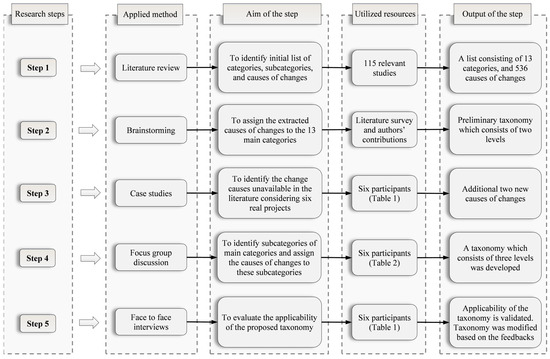
Figure 1.
Flowchart of the research.
4.1. Developing Preliminary Taxonomy (Step 1 and Step 2)
To identify relevant research articles, Scopus was selected for its popularity, scope, performance, and reliability (Graham et al., 2020). The search was performed with the following query string, and 395 documents were retrieved. TITLE-ABS-KEY ((change OR variation OR causes OR orders AND construction)) AND (“causes of change”) OR (“change causes”) OR (“causes for changes”) OR (“change causation”). However, not all of the identified studies were directly related to the subject matter. Hence, by reading the titles, abstracts, and keywords of the captured studies, 157 relevant studies were determined. These studies were further reinvestigated by considering whether they provided any insights about the emergence of changes in construction projects. A total of 82 studies that did not satisfy this criterion were eliminated, which reduced the number of studies to 75. In the next step, the snowballing technique was conducted, and the relevant references in the remaining studies (i.e., 75 studies) were included. As a result, a total of 115 studies were considered suitable to review in this study. Figure 2 shows the distribution of the studies by year. At the end of the initial review, a total of 1578 change causes were extracted. However, in the next step, to simplify the classification process, avoid repetition, and reduce the number of similar causes, some of the identified change causes were combined, leading to 536 distinct change causes.
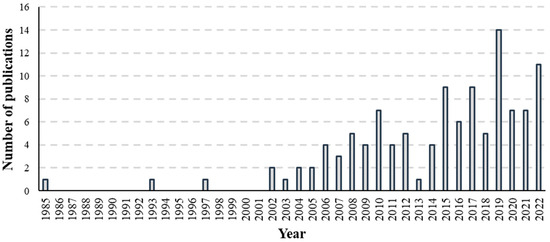
Figure 2.
Distribution of the studies by year.
The distribution of the studies by country is provided in Figure 3. According to this figure, the studies related to change causes were conducted for both developing and developed countries.
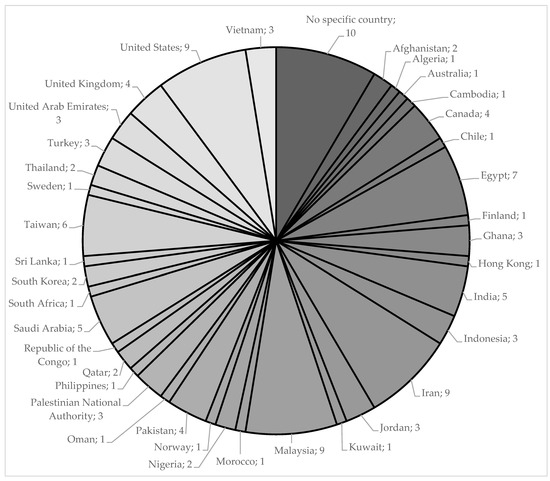
Figure 3.
Distribution of the studies by country.
In the following step, the first level of the taxonomy was determined by considering the classifications proposed by Mansfield et al. [22], Chan and Kumaraswamy [20], Assaf and Al-Hejji [23], Sun and Meng [21], Wu et al. [7], Bitamba and An [12], Padala et al. [3], Afelete and Jung [9], and Arefazar et al. [19]. According to the first-level categories proposed in these studies, thirteen main categories were identified. After the identification of the main categories, the change causes identified from the literature were assigned to each category one by one through brainstorming sessions. These brainstorming sessions were conducted by the authors of this study only. In this step, existing classifications in the literature were considered and discussed to develop the preliminary taxonomy. The main categories and the number of causes of changes assigned to each category are given in Figure 4.
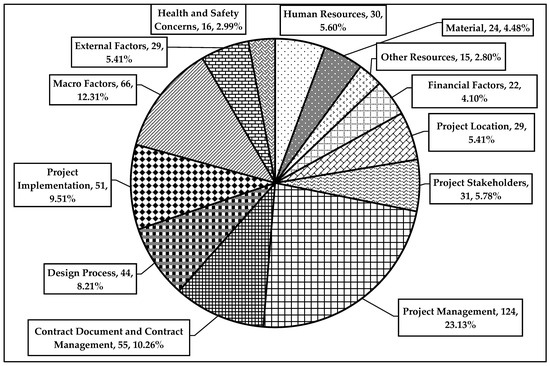
Figure 4.
Main categories and the number of change causes assigned to these categories.
4.2. Case Studies (Step 3)
The present study examined six projects in Iran by conducting questionnaire surveys to capture the causes of changes experienced in these projects. A total of 10 participants were invited from different organizations, including five contracting companies, two client organizations, and three consultants in the first stage. After first contact with the representatives of the organizations, six of them (i.e., four from contractors, one from the consultant, and one from the client) agreed to participate in the survey (Table 1). Hence, the heterogeneity in the sample encompassing at least one participant from the major stakeholders was ensured, which helped to capture diverging perspectives in the market. Despite additional projects aiming to increase the number of case projects to 10 by contacting more project representative, none of them replied to the invitations. Besides, all participants are well experienced in the sector, such that two, one, and three of them had 6 to 10 years, 16 to 20 years, and more than 20 years of experience in the construction industry, respectively. Since case studies were examined qualitatively and collected materials from all the projects were engaged in the study, the bias due to the heterogeneity of participants was minimized.

Table 1.
Profile of the participants who attended case study—validation.
The survey used in this study had two parts. The first part included questions about the respondents’ general situations, such as the type of organization they belong to, their experience in the construction industry, and their current position. In the second part, general information about the projects, namely realized project duration, estimated project duration, realized project cost, estimated project cost, project type, project owner, and reports prepared throughout these projects were required from the participants. Three of these projects were building projects, two of them were infrastructure projects, and the last one was an industrial project. Five projects were public projects and one project was a private project. None of the projects were completed within the budget and scheduled timeline. Based on the provided inputs, the respondents were asked to prepare two lists: (1) the most important five changes that occurred in the corresponding project, and (2) the most important 10 change causes observed in the corresponding project. Based on the provided lists, two new causes of changes, namely “High material cost” and “Wide variety of equipment and machinery costs”, were added to the taxonomy and designated to the financial category. Furthermore, other change causes stated by the experts had already been extracted from the literature, and only minor linguistic changes were performed to explain them more clearly. At the end of this process, the total number of change causes increased to 538.
4.3. Focus Group Discussion (Step 4)
This study performed an FGD session to identify, refine, and finalize the subcategories of the main categories attained. The focus group method was preferred instead of individual interviews since this method enables participants to interact with each other by exchanging their ideas, points of view, and experiences during the discussions to create new, creative, and augmented ideas [24]. Before conducting the FGDs, the size of the focus group should be determined as it plays a critical role in knowledge acquisition. On the one hand, if a high number of experts participate in FGDs, the sessions can be time-consuming and hard to control, but on the other, having few participants may cause low-reliability issues [25]. There are several sample-size suggestions for performing effective discussions. For instance, Krueger and Casey [26] proposed that the ideal size for noncommercial topics is five to eight. Groves et al. [27] suggested that the researchers should use six to twelve participants to reach reliable findings. Based on these suggestions, a minimum of six participants criterion was applied in this study.
The other important issue related to FGDs is the selection of the participants [26]. The participants should have the required knowledge and experience of the selected topic as well as the ability to contribute to the development of the topic. Based on the suggestions of past research, six experts (Table 2) were invited to FGDs and all of them agreed to participate in this study. Two experts are from consultant companies, one expert is from a client organization, and the other experts are from contracting companies. As a result, the sample’s heterogeneity, which can aid in capturing various viewpoints on the subject matter, was attained. Additionally, each member has adequate experience, such that two, one, and three of them had between 10 and 15 years, between 16 and 20 years, and more than 20 years of experience in the industry, respectively.
Table 2.
Profile of the participants who attended FGD.
In the FGDs, the experts examined and categorized the change causes of each main category one by one. Firstly, they started with the first main category and grouped the subcategories by considering their common points in alignment with the context of the main category. The experts discussed the subcategories of the causes of changes in terms of the categories that they should belong to. The majority voting approach was adopted in case of disagreement among focus group participants. The majority voting approach was chosen due to the high number of change causes, which could have made reaching a consensus during discussions a lengthy process. This approach helped prevent participants from leaving focus group discussions prematurely. Despite the allocation of almost all change causes to subcategories with consensus, some disagreements also did arise. In such cases, the authors allowed further discussion until a consensus was reached. If consensus seemed unlikely, the authors would intervene and allocate the cause of changes to the relevant subcategory based on the majority votes. The categorization of the causes of changes was also conducted in a similar vein, i.e., by discussing the context of change causes and subcategories. This process was repeated for each main category to classify subcategories, as well as for each subcategory to classify change causes. Furthermore, with the recommendations of the participants, some change causes were decomposed into elaborated causes. For instance, “change in specifications” was decomposed to form three new causes, namely “specifications changes by the owner”, “specifications changes by the designer” and “specifications changes by the consultant”. Therefore, the total number of change causes increased to 552 (Appendix A).
4.4. Validation of the Taxonomy (Step 5)
The proposed taxonomy was also evaluated by the experts through face-to-face interview sessions. The interviews aimed to estimate the efficiency, assess the applicability, identify the deficiencies, and evaluate the appropriateness of the taxonomy for different parties, project types, and countries. The interviews were conducted with the same experts who participated in the questionnaire survey (i.e., case study). The interviews lasted on average 2 h and 10 min. In the interviews, reports of the projects and developed framework were provided to the experts to help them examine the taxonomy in terms of its validity. The experts prepared two lists to identify the most important changes experienced as well as the main change causes identified in these projects. In addition, the experts evaluated the applicability and efficiency of the taxonomy for three parties, (contractor, owner, consultant), different project types (such as residential building, manufacturing, commercial, highway, etc.), different countries, and three stages of the project; namely, design, planning, and construction. The lists obtained at the end of interviews were compared with the lists prepared initially, i.e., without a developed taxonomy. The second list appeared to be more elaborate, and the same experts identified more change causes for each project. Additionally, there was a clear decrease in the differences between the opinions of the experts, such that the experts proposed nearly the same change causes for the same project settings. The systematic framework provided by the change cause taxonomy can help in reviewing change events and their underlying causes more efficiently and reliably. Therefore, the proposed taxonomy can serve as an elaborate basis for identifying the root causes of changes and reviewing the change management process, leading to more efficient and reliable outcomes.
Finally, the experts stated that the proposed taxonomy is applicable and efficient for all parties, project stages, project types, and in many countries. However, they provided some feedback about the structure of the taxonomy. Four experts suggested that new subcategories should be created for financial factors since they could not find proper categories for a wide variety of labor costs, a wide variety of equipment and machinery costs, high material costs, changes in material costs by a supplier, and a wide variety of overhead costs. Therefore, two subcategories were proposed for the financial factors category, namely, (1) resource costs, and (2) contract and overhead costs. One expert recommended the modification of the “contract management” category to “contractual document and contract management” to clarify the causes related to contractual documents and project scope. Table 3 shows the final version of the subcategories. The final list of the causes of changes and associated subcategories and categories (i.e., the proposed taxonomy) are provided in Appendix A.
Table 3.
Proposed change causes taxonomy.
5. Discussion of Findings
5.1. Implications of Findings for Project Management
In the proposed taxonomy, the “project management” category is notably associated with many causes of changes (namely 134 change causes) in diverging contexts addressed as subcategories. These subcategories are: (1) construction site management, (2) project quality management, (3) project time management, (4) project communication management, and (5) project organization. Causes of changes can irreversibly affect project objectives, as noted by Chan and Kumaraswamy [20]. They identified poor site management/layout, unsuitable management structure, and improper control over resource allocation as among the significant causes of project delays related to project and site management. Similarly, Kumar [28] highlighted the impact of several change causes identified in this study (e.g., slow site clearance due to restrictions and unavailability of professional construction management) as important contributors to project delays. On the other hand, inspection-induced causes included in this study with the “supervision and quality management” subcategory were also underlined by several researchers. For instance, Alshihri et al. [29] investigated factors affecting cost and time overruns and underlined several associated factors such as delays in inspection/testing, delays in approval, and poor inspection. Alameri et al. [13] explored the causes of changes in mega-construction projects and found “poor inspection and supervision” as the most critical change cause that is associated with contractors.
Another subcategory that received considerable attention from the research society is “scheduling, planning, and control”. This subcategory encompasses similar change causes in terms of their effects such as a change in the project schedule, unrealistic scheduling, underestimation of quantities and complexities, unfeasible design period, overestimation of productivity, etc., all associated with reducing the total duration of the projects without proper analysis of its feasibility. There is a habit of unrealistic project planning in construction projects, and it is hard for project teams to manage difficulties due to improper planning [30]. This not only causes project delays but also incurs significant changes in the execution stage to adjust project processes to the existing and unfeasible plans. Here, “communication and coordination” between project parties plays a critical role in developing appropriate project plans. Still, this subcategory also includes many causes of changes; these are mainly related to lack of collaboration, coordination, communication, and involvement in the design. This leads to conflicts among included parties. This corroborates the ideas presented in the literature. For instance, Yap et al. [31] identified a lack of coordination among consultants as being one of the most critical factors causing design changes. Similarly, in a different project setting, i.e., road construction, Waty, and Sulistio [32] found that coordination among contracting stakeholders is among the top causes of change orders. The lack of communication can arise because of organizational and/or bureaucracy-based issues, which is another subcategory of project management. Most of the identified change causes in this subcategory can be related to slow decision-making, delays in approvals, interim valuations, contractor submissions, responding to consultant inquiries, etc. In a similar vein, Alraie [33] also found delays in responses and/or approvals as being among the most causative factors in terms of change orders.
Participants from six case projects added two new change causes to the taxonomy: (1) wide variety of equipment and machinery cost, and (2) high material costs. As mentioned before, financial and cost-related causes were more critically addressed in studies conducted in developing economies. Cost overrun is one of the most critical problems in the Iranian construction industry and nearly one-fourth of the projects in Iran encountered more than 25% of cost overrun [33]. This may be the reason why participants focused more on missing cost-related causes of changes compared to other categories. Particularly in developing countries, changes induced due to cost-related issues can be more critical as they may threaten the completion of the projects. In addition, poor cost and quantity estimations are one of the critical and consultant-induced change causes, as addressed by Rahmani et al. [6], but participants only from client and contractor organizations who attended to this study underlined cost-related change causes. It can be concluded that consultant-induced change causes have significant impacts on the performance of clients and contractors. Therefore, working with a competent consultant is a must for minimizing changes and related issues in construction projects.
5.2. Benefits and Challenges of Utilizing the Proposed Taxonomy
This study proposes the most comprehensive taxonomy of change causes for construction projects. Despite different taxonomies having been proposed in the literature, none of the existing taxonomies is as comprehensive as the one presented in this study. The first and most crucial step in effective construction change management is identifying all possible change causes since the accuracy and efficiency of subsequent decisions depend heavily on the precision and reliability of this initial step. However, in most of the projects, some of the change causes are identified after the change event as a reactive approach. However, companies must overcome the consequences of these changes by identifying the potential change causes before the occurrence of changes as a proactive approach. Hence, with the help of the taxonomy, the companies can oversee these unidentified, unforeseen, and unstructured change causes. In this way, they can develop strategies to manage the causes of changes proactively leading to the elimination of changes, which is a better strategy than adjusting them to the current conditions for effective change management. In addition, the proposed taxonomy can be used to record the changes more systematically, and these records can be used subsequently due to the existence of the same understanding [3]. This study identified 552 change causes in the third level, which can provide a framework for the managers to identify the root causes of the changes, either to eliminate them or to decrease the possibility of their reoccurrence. In other words, construction firms should identify the change causes accurately, systematically, and completely; otherwise, they may use their limited resources ineffectively. The validation process shows that the presented taxonomy can be used to identify the unseen change causes in any project type, in any country, and by any project stakeholders. These mirror the views of Sun and Meng [21], who mentioned the criticality of systematic review in the early change cause identification process. Overall, the proposed change causes taxonomy can be beneficial for the construction companies to complete the projects successfully, to monitor changes more systematically, and to enhance knowledge sharing and completeness comprehensively.
Sun and Meng [21] asserted that many other change causes are not stated in their taxonomy, and it is nearly impossible to produce a list that shows all change causes. Similarly, the proposed taxonomy in this study also does not show all change causes. Still, since it is much more comprehensive than other studies, the companies will be able to use this taxonomy without making many modifications. Besides, the limitations of the previous taxonomies may lead to impractical applications due to the lack of a detailed description of changes. Finally, the hierarchical structure used in this study can be modified for the newly emerged change causes.
It is essential to note that due to the size of the proposed taxonomy, the users can struggle to identify the change causes. Although reducing the number of categories, subcategories, and change causes was an alternative to the proposed comprehensive taxonomy, the experts who participated in the validation step gave positive feedback about the applicability of the taxonomy. They stated that due to the hierarchical structure of the taxonomy, companies can review the change causes more easily. In addition, they further stated that the number of main categories is appropriate, and they seem to be identified following the same conceptual approach of the project management teams. Finally, the respondents also addressed that the taxonomy can also be beneficial for resolving emerging claims and disputes (since changes are the main causes of claims and disputes [34]) to reveal the root causes of changes and parties responsible for the changes.
5.3. Suggestions for Effective Change Management
This study found that frequent changes during construction projects are often caused by improper feasibility assessment, design, and planning. To avoid changes, companies should allocate sufficient time [35,36] and resources, including hiring experienced consultants and planners [37], aiding to develop more realistic and applicable plans. Additionally, these plans should be highly elaborated, which can lead to uncertainties in the plans. To achieve this, a standard manual with a checklist can be used [37].
Another critical issue is identified as appropriate communication and coordination between the parties. However, due to high fragmentation among the parties, communication and coordination are problematic in construction projects [8]. Knowledge management tools can facilitate capturing and sharing knowledge, especially tacit knowledge, which is critical for change management compared to explicit knowledge [2]. These tools can also improve trust between parties and change attitudes. Additionally, these tools play a critical role in changing the attitudes of the parties since trust between parties can improve with the usage of these tools. Additionally, companies can use these tools to capture lessons learned from previous changes, helping maintain continuous improvement goals. Hence, the proposed taxonomy can be used in the development of these knowledge management tools.
The other useful tool that companies can use to manage the changes effectively is building information modelling (BIM). By using BIM appropriately, companies can identify the most likely changes in time and avoid clashes [38]. BIM can be used to identify possible changes in advance, avoid clashes, identify change history, analyze deficiencies, and take-off quantities. BIM-based tools have been developed for change management, such as a BIM-based change management process proposed by Mejlænder-Larsen [38] to handle design changes resulting from owner and contractor demands. Some authors have even developed BIM-based tools which can be used for change management. Mejlænder-Larsen [38] proposed a BIM-based change management process to handle the design changes resulting from owner and contractor demands. In their system, a web-based system manages design changes. In another study, Likhitruangsilp et al. [39] presented a decision support system based on BIM that enables project stakeholders to anticipate the effects of change orders on different project success criteria, such as schedule, budget, and physical conditions.
6. Conclusions
The objective of this study is to create a reliable and all-encompassing classification for change causes. The proposed classification is structured hierarchically and has three levels, with the lowest being the change causes. To identify the causes of changes, a thorough literature review was conducted, and the preliminary list was further refined by adding the change causes observed in six construction projects that performed poorly regarding cost and time criteria. The findings from the literature review and the actual projects combined led to the identification of 552 change causes. The study reveals that 13 types of changes can be observed in any construction project.
Among the main categories of the taxonomy, the project management category involves the highest number of change causes. This shows that if project management is not performed carefully, the possibility of confronting a diversity of changes in the project is high. Therefore, construction companies should allocate appropriate resources and skills for project management. In other words, this category requires critical attention since the parties can minimize the occurrence of changes related to project management with a systematic and elaborative governance approach. In particular, poor communication and coordination between parties may cause many types of changes. In addition, some change causes such as changes due to external factors are not under the control of the construction companies, and as such cannot be avoided by the efforts of the construction companies. Therefore, by improving communication and collaboration with other parties such as governmental agencies, non-profit organizations, and trade unions, which can manage and/or control such externally driven changes, construction companies can mitigate their adverse impacts.
This study is not free of limitations. First, the current study used several qualitative techniques to identify and elaborate on the causes of changes. Therefore, a quantitative assessment of the change causes per category/subcategory can further illustrate the most critical ones since resource limitation is the case for real-life conditions and many companies cannot afford the required measures for all the change causes. Second, despite the case studies covering a wide range of projects and stakeholders, experts from some project types (such as energy) and stakeholder groups (such as suppliers and subcontractors) did not participate in the present research, restricting the penetration of certain change causes associated with these project types and stakeholders into the taxonomy. Therefore, covering all project types and stakeholders, and even comparing the change causes observed in diverging project types and perception differences would be an intriguing research direction. Besides, this study used six case projects conducted in Iran to extract the change causes with a limited heterogeneity of the projects (i.e., only one client, consultant, and private entities were involved). The main reason for this limitation was that many of the other contacted project representatives decided not to participate in the study. Hence, increasing the number of participants from the client, consultant, and private sides can further increase the generalizability of the research findings. Enhancing the quality of this study can be achieved by developing a new taxonomy that specifically delineates the impact of changes on project outcomes. Additionally, the taxonomy can be further refined by incorporating an additional layer that clarifies the responsible party of the change causes. This can enable construction companies to more effectively assign management of a change cause to the relevant party if it arises. Overall, the output of this study can be used by construction companies to capture the knowledge about change causes more systematically, thus increasing its volume, variety, veracity, and useability, only with which effective change management can be realized. Construction companies can further utilize the proposed taxonomy to develop procedures to eliminate causes of changes due to errors, as well as improve their change management strategies. The taxonomy might also be used to develop robust knowledge management software for change management.
Author Contributions
Conceptualization, Z.B. and C.B.; methodology, Z.B. and C.B.; validation, Z.B., C.B. and K.K.; formal analysis, C.B.; investigation, Z.B.; writing—original draft preparation, C.B. and K.K.; writing—review and editing, C.B. and K.K.; visualization, K.K.; supervision, Z.B.; project administration, Z.B. All authors have read and agreed to the published version of the manuscript.
Funding
This research received no external funding.
Data Availability Statement
The corresponding author can provide the data from this study upon request. The data are not publicly available due to the disallowance of the participants.
Conflicts of Interest
The authors declare no conflicts of interest.
Appendix A
Table A1.
The full view of the proposed taxonomy.
Table A1.
The full view of the proposed taxonomy.
| Level 1: Human resources | ||
| Level 2: Organizing and Managing | ||
| 1 | Inequitable labor distribution | Rahman et al. [6] |
| 2 | Replacement of key personnel | Zadeh et al. [40] |
| 3 | Turnover of contractor’s employee | Sun and Meng [21], Safapour et al. [41], and Yap et al. [42] |
| 4 | Overstaffing or understaffing | Okada et al. [43] |
| 5 | Extensive overtime for labor | Hanna et al. [44], Safapour et al. [41], Arditi et al. [45] |
| 6 | Additional shifts | Waney et al. [46] |
| 7 | Replacement of key personnel by owner | Rahman et al. [6], Al-Kharashi and Skitmore [47] |
| 8 | Excessive turnover of owner’s technical personnel | Sun and Meng [21], Safapour et al. [41], Yap et al. [42] |
| 9 | Absenteeism of labor | Safapour et al. [41], Hanna et al. [44], Ajayi and Chinda [48], Arditi et al. [45] |
| 10 | Absenteeism of consultant’s supervisors | Assaf and Al-Hejji [23], Alaghbari et al. [49] |
| 11 | Low motivation and morale of labors | Yap and Tan [50], Shoar et al. [51], Kumar [28], Niazi and Painting [52] |
| 12 | Nationality of labors | Assaf and Al-Hejji [23], Al-Kharashi and Skitmore [47], Niazi and Painting [52] |
| 13 | Conflict among workers due to different personality | Safapour et al. [41] |
| Level 2: Availability | ||
| 1 | Unavailability/shortage of labor | Altaf et al. [53], Staiti et al. [54], Kumar [28], Yates [55], Al-Kharashi and Skitmore [47], Marzouk and El-Rasas [56] |
| 2 | Shortage of contractor’s technical professionals | Rahman et al. [6], Al-Kharashi and Skitmore [47] |
| 3 | Shortage of qualified/skilled labor/craft | Altaf et al. [53], Enshassi et al. [35], Rashid et al. [57], Project 5 |
| 4 | Shortage of qualified local labor | Hilali et al. [58], Toor and Ogunlana [59], Arditi et al. [45] |
| 5 | Shortage of qualified owner’s engineers | Alnuaimi et al. [37] |
| 6 | Shortage of management support and staff training to simulate the construction process | Kumar [28], Lee et al. [60] |
| 7 | Shortage of qualified managers | Yap et al. [42] |
| 8 | Shortage of qualified owner’s representative | Jarkas and Mubarak [18], Toor and Ogunlana [59], Arditi et al. [45] |
| 9 | Shortage of contractor’s administrative personnel | Rahman et al. [6], Al-Kharashi and Skitmore [47], Sweis et al. [61] |
| 10 | Shortage of contractor’s site staff | Alaghbari et al. [49] |
| Level 2: Capabilities | ||
| 1 | Unqualified/Inexperienced labor | Maqbool and Rashid [62], Staiti et al. [54], Chan and Kumaraswamy [20], Marzouk and El-Rasas [56] |
| 2 | Unskillful labor | Safapour et al. [41], Yap et al. [42], Lee et al. [60], Al-Kharashi and Skitmore [47] |
| 3 | Skill shortage in certain trades | Sun and Meng [21], Rahman et al. [6], Yap et al. [42] |
| 4 | Low level of labors efficiency/Productivity | Rahman et al. [6], Kumar [28], Yates [55], Al-Kharashi and Skitmore [47], Prasad et al. [63] |
| 5 | Inadequate skill of equipment-operator | Rahman et al. [6], Al-Kharashi and Skitmore [47] |
| 6 | Inexperienced consultant’s site staff | Alshihri et al. [29], Alaghbari et al. [49] |
| 7 | Incompetent technical staff | Maqbool and Rashid [62] |
| Level 1: Material | ||
| Level 2: Procurement Process of Materials | ||
| 1 | Delay in material delivery | Staiti et al. [54], Kumar [28], Alshihri et al. [29], Rashid et al. [57], Yates [55] |
| 2 | Poor programming of material procurement | Rahman et al. [6], Chan and Kumaraswamy [20] |
| 3 | Poorly scheduled supply of material to the site | Arefazar et al. [19] |
| 4 | Delay in manufacturing special building materials | Kumar [28], Alshihri et al. [29] |
| 5 | Problems arising from imported materials and plant items | Hilali et al. [58], Hansen et al. [36], Prasad et al. [63] |
| 6 | Late procurement of materials | Jarkas and Mubarak [18], Alshihri et al. [29], Keane et al. [64] |
| 7 | Inappropriate/Poor procurement method | Maluleke et al. [65], Dosumu and Aigbavboa [66], Enshassi et al. [35] |
| 8 | Fluctuation of material prices | Bitamba and An [12] |
| 9 | Substituting material price | Bitamba and An [12] |
| 10 | Poor handling of material on-site | Yap and Tan [50] |
| 11 | Delays/Problems in delivery of materials or goods due to faults of the owner | Wu et al. [7] |
| Level 2: Availability and Variety of Materials | ||
| 1 | Unavailability of necessary materials on-site | Jarkas and Mubarak [18], Alaghbari et al. [49], Project 3 |
| 2 | Delay in the selection of materials due to the existence of many choices | Kumar [28], Assaf and Al-Hejji [23] |
| 3 | Shortage of construction materials in the market | Kumar [28], Enshassi et al. [35], Alshihri et al. [29], Alaghbari et al. [49], Prasad et al. [63] |
| Level 2: Storage of Materials in the Construction Site | ||
| 1 | Problems in material storage | Lee et al. [60], Alshihri et al. [29] |
| 2 | Damage to materials during storage | Kumar [28], Alshihri et al. [29], Yates [55] |
| 3 | Unforeseen material damages | Lee et al. [60], Lerche et al. [67] |
| 4 | Lack of information about available materials | Enshassi et al. [35], Perera et al. [68], Keane et al. [64], Badawy [14] |
| Level 2: Quality of Procured Materials | ||
| 1 | Materials in incompliant with specifications | Bitamba and An [12], Lee et al. [60], Mahamid [5] |
| 2 | Rejected material | Rahman et al. [6] |
| 3 | Poor quality of materials | Lerche et al. [67], Rahman et al. [6], Ajayi and Chinda [48], Yates [55] |
| 4 | Changes in material specifications during construction | Rahman et al. [6], Yap et al. [31] |
| 5 | Problems with new materials | Rahman et al. [6], Padala et al. [3], Sun and Meng [21], Project 2, Project 4 |
| 6 | Changes in material types during construction | Rahman et al. [6], Ajayi and Chinda [48], Kumar [28] |
| 7 | Replacement/Substitution of materials | Rahman et al. [6], Mohammad et al. [4], Keane et al. [64] |
| 8 | Material changes due to shortage of particular material in the market | Choudhry et al. [69] |
| Level 1: Other resources | ||
| Level 2: Procurement and Delivery of Equipment and Machines | ||
| 1 | Equipment delivery problem | Ajayi and Chinda [48], Yates [55] |
| 2 | Improper handling of machinery and equipment | Yap and Tan [50], Yap et al. [42] |
| 3 | Wrong selection | Chan and Kumaraswamy [20], Padala et al. [3] |
| 4 | Delay in manufacturing special building equipment | Alshihri et al. [29], Rashid et al. [57] |
| 5 | Procurement of poor qualified equipment | Yates [55] |
| Level 2: Availability of Equipment and Machines in the Market | ||
| 1 | Lack of appropriate equipment/tools | Bitamba and An [12], Yates [55] |
| 2 | Lack of equipment/tools | Mohammad et al. [4], Bitamba and An [12], Gunduz et al. [70] |
| 3 | Lack of specified products | Rashid et al. [57] |
| 4 | Lack of new and high-technology mechanical equipment | Altaf et al. [53], Almasi et al. [71] |
| 5 | Lack of knowledge about available equipment | Perera et al. [68], Badawy [14], Enshassi et al. [35] |
| 6 | Lack of spare parts | Enshassi et al. [35] |
| Level 2: Repair and Maintenance Capabilities | ||
| 1 | Lack of repair facilities for equipment and tools | Ajayi and Chinda [48], Chan and Kumaraswamy [20], Yates [55] |
| 2 | Lack of maintenance facilities for equipment and tools | Yap et al. [42] |
| Level 2: Productivity of Machines and Equipment | ||
| 1 | Insufficient productivity of equipment | Mahamid [5], Chan and Kumaraswamy [20], Gunduz et al. [70] |
| 2 | Poor qualified equipment used for the works | Waty and Sulistio [32], Alshihri et al. [29], Gunduz et al. [70] |
| 3 | Inadequate modern equipment | Gunduz et al. [70] |
| Level 2: Quality of Machines and Equipment | ||
| 1 | Poor standard of machinery and equipment | Yap et al. [42], Yates [55] |
| 2 | Improper/Wrong tools for materials | Yates [55] |
| 3 | Frequent equipment breakdowns | Gunduz et al. [70] |
| Level 1: Financial Factors | ||
| Level 2: Cashflows | ||
| 1 | Delays in contractor’s progress payments | Alshihri et al. [29], Yap and Tan [50], Maqbool and Rashid [62], Ajayi and Chinda [48], Marzouk and El-Rasas [56], Project 4, Project 5, Project 6 |
| 2 | Additional payments to the contractor | Famadico and Baccay [72], Perera et al. [68] |
| 3 | Late payment to the subcontractor by the main contractor | Almasi et al. [71], Prasad et al. [63] |
| 4 | Delay of retention payment | Gunduz and Mohammad [73], Ajayi and Chinda [48] |
| Level 2: Financing Conditions | ||
| 1 | Poor project financing | Chan and Kumaraswamy [20] |
| 2 | Failure to finance the project on time/financing difficulties | Faten Albtoush et al. [74] |
| 3 | Funding changes | Faten Albtoush et al. [74] |
| 4 | Lack of owner’s finance | Afelete and Jung [9] |
| 5 | Financial constraints faced by the owner | Yap et al. [31], Aljassmi et al. [75] |
| 6 | Contractor’s financial difficulties | Alshihri et al. [29], Mohammad et al. [4], Hanif et al. [76], Enshassi et al. [35], Rashid et al. [57], Keane et al. [64] |
| 7 | Owner’s financial difficulties | Faten Albtoush et al. [74], Ismail et al. [10], Mahamid [5], Rashid et al. [57], Keane et al. [64], Project 1, Project 2, Project 4, Project 5, Project 6 |
| 8 | Problems in cash flow management | Rahman et al. [6], Maqbool and Rashid [62], Alshihri et al. [29] |
| 9 | Contractor’s financial obligations | Balbaa et al. [77], Faten Albtoush et al. [74] |
| 10 | Bankruptcy by contractor/subcontractor or supplier | Yang and Chen [78], Sun and Meng [21], Afelete and Jung [9], Yates [55] |
| 11 | Subcontractor’s financial difficulties | Rahman et al. [6], Project 6 |
| 12 | Owner’s/contractor’s cash flow problem | Rahman et al. [6], Aljohani et al. [79] |
| Level 2: Resource Costs | ||
| 1 | Change in material costs applied by a supplier | Peansupap and Cheang [80], Aljohani et al. [79] |
| 2 | A wide variety of labor costs | Rahman et al. [6], Aljohani et al. [79], Project 5 |
| 3 | Wide variety of equipment and machinery costs (e.g., first cost, rent) | Project 1, Project 4 |
| 4 | High material costs | Project 3, Project 4 |
| Level 2: Contract and Overhead Costs | ||
| 1 | Wide variety of overhead costs | Maqbool and Rashid [62], Rahman et al. [6], Project 2 |
| Level 1: External factors | ||
| Level 2: Weather | ||
| 1 | Extreme hot weather | Ezenta [81] |
| 2 | Weather changes | Bakr [82], Mohammad et al. [4] |
| 3 | Humidity effect on construction activities | Jarkas and Mubarak [18], Ballesteros-Pérez et al. [83], Yates [55] |
| 4 | Inclement weather effect on construction activities | Hao et al. [84], Jarkas and Mubarak [18] |
| 5 | Wind effect on construction activities | Lerche et al. [67], Dosumu and Aigbavboa [66] |
| 6 | Rain/snow effect on construction activities | Wu et al. [7], Dosumu and Aigbavboa [66], Yates [55], Project 2 |
| 7 | Extreme cold weather effect on construction activities | Ezenta [81], Yates [55] |
| 8 | Blizzards | Wu et al. [7], Sun and Meng [21] |
| 9 | Storms | Ballesteros-Pérez et al. [83] |
| 10 | Hurricanes/Cyclones/Tornadoes | Okada et al. [43] |
| Level 2: Catastrophes | ||
| 1 | Artificial/Manmade disasters | Wu et al. [7] |
| 2 | Earthquakes | Sun and Meng [21], Okada et al. [43], Almasi et al. [71], Marzouk and El-Rasas [56] |
| 3 | Landslides | Waty and Sulistio [32], Hsieh et al. [85] |
| 4 | Volcanic eruptions | Wu et al. [7], Sun and Meng [21] |
| 5 | Floods | Hsieh et al. [85], Waty and Sulistio [32], Sun and Meng [21] |
| 6 | Limnic eruptions | Sun and Meng [21], Wu et al. [7] |
| 7 | Tsunamis | Sun and Meng [21], Wu et al. [7] |
| 8 | Droughts | Sun and Meng [21], Wu et al. [7] |
| 9 | Wildfires | Sun and Meng [21], Wu et al. [7] |
| 10 | Avalanches | Sun and Meng [21], Wu et al. [7] |
| 11 | Soil settlement | Hsieh et al. [85], Waty and Sulistio [32] |
| Level 2: Environmental Problems | ||
| 1 | Environmental protection and mitigation costs | Sun and Meng [21], Waty and Sulistio [32] |
| 2 | Problems due to site pollution and noise | Padala et al. [3], Arditi et al. [45] |
| 3 | Environmental concerns and restrictions | Chan and Kumaraswamy [20], Yates [55] |
| 4 | Conservation restrictions | Sun and Meng [21], Marzouk and El-Rasas [56] |
| Level 2: Security Problems | ||
| 1 | Poor site security | Hsieh et al. [85] |
| 2 | Theft/Vandalism inside the site | Waty and Sulistio [32] |
| Level 1: Health and Safety Concerns | ||
| Level 2: Safety Concerns | ||
| 1 | Poor safety conditions | Sun and Meng [21], Arditi et al. [45] |
| 2 | Accidents during construction | Kumar [28], Abd El-Razek et al. [86], Mpofu et al. [87] |
| 3 | Unsafe practices during construction | Rahman et al. [6] |
| 4 | Damage to structure | Abd El-Razek et al. [86] |
| 5 | Lateness in safety facilities reinforcement | Hsieh et al. [85] |
| 6 | Failure to meet safety rules and regulations | Balbaa et al. [77], Sweis et al. [61] |
| 7 | Lack of safety rules and regulations | Balbaa et al. [77] |
| 8 | Residential safety | Wu et al. [7] |
| 9 | Work incidents | Wu et al. [7], Chang [88] |
| Level 2: Health Concerns | ||
| 1 | Epidemics | Alshihri et al. [29], Trauner et al. [89] |
| 2 | Pandemics | Alshihri et al. [29], Nguyen and Do [90] |
| 3 | Endemics | Yap and Tan [50] |
| 4 | High noise level | Padala et al. [3] |
| 5 | Labor injuries | Safapour et al. [41] |
| Level 1: Project Location | ||
| Level 2: Ground Conditions | ||
| 1 | Unexpected foundation conditions | Wu et al. [7] |
| 2 | Incomplete geological survey/information | Wu et al. [7] |
| 3 | Groundwater location | Wu et al. [7] |
| 4 | Unexpected underground conditions (geological issues/groundwater level issues, etc.) | Wu et al. [7], Marzouk and El-Rasas [56] |
| 5 | Changes in geological conditions | Wu et al. [7], Abad et al. [91] |
| 6 | Uncertainty in locating pipe positions underground | Wu et al. [7] |
| 7 | Archaeology findings (unexpected archaeological finds) | Lee et al. [60], Lee [92] |
| 8 | Conflict with existing underground utilities | Shrestha et al. [93], Prasad et al. [63] |
| 9 | Unanticipated underground utilities | Okada et al. [43], Yap et al. [31] |
| 10 | Insufficient soil investigation | Yap et al. [31] |
| 11 | Unforeseen ground conditions (rock, acid, sediment basin) | Yap et al. [31], Sun and Meng [21], Annamalaisami and Kuppuswamy [94] |
| 12 | Unexpected ground elevation and landform | Wu et al. [7] |
| 13 | Changes in site location | Padala et al. [3] |
| Level 2: Site Condition and Restrictions | ||
| 1 | Poor investigation of project location | Rahman et al. [6], Altaf et al. [53], Abad et al. [91], Project 5 |
| 2 | Changes in site conditions due to the contractor | Wu et al. [7] |
| 3 | Differing site conditions | Enshassi et al. [35], Hilali et al. [58], Rashid et al. [57] |
| 4 | Discrepancies between the survey and existing on-site conditions | Wu et al. [7] |
| 5 | Unforeseen site conditions | Afelete and Jung [9], Motawa et al. [95], Arditi et al. [45] |
| 6 | Poor traffic control regulation and inadequate restriction | Assaf and Al-Hejji [23], Marzouk and El-Rasas [56] |
| 7 | Poor site storage capacity | Lee et al. [60], Arditi et al. [45] |
| 8 | Overcrowded work area/Congestion | Padala et al. [3], Sun and Meng [21] |
| 9 | Poor site layout | Padala et al. [3], Arditi et al. [45] |
| 10 | Problems due to site restrictions | Rahman et al. [6], Wu et al. [7] |
| 11 | Inconsistency between drawings and site conditions | Hsieh et al. [85], Abad et al. [91] |
| Level 2: Accessibility and Possession | ||
| 1 | Late delivery of the construction site to the contractor | Wu et al. [7], Marzouk and El-Rasas [56], Project 5 |
| 2 | Difficulty in site acquisition | Sun and Meng [21] |
| 3 | Expropriation costs (underestimated expropriation costs) | Wu et al. [7], Lee [92] |
| 4 | Restricted access to the site | Rashid et al. [57] |
| 5 | Negligence of Employer regarding egress and entrance | Sun and Meng [21] |
| 6 | Failure of the employer to provide right of way | Wu et al. [7] |
| Level 1: Project Stakeholders | ||
| Level 2: Project Stakeholders’ Competence and Experience | ||
| 1 | Lack of owner’s technical knowledge | Afelete and Jung [9], Alaghbari et al. [49] |
| 2 | Lack of experience of the owner in construction projects | Afelete and Jung [9], Heravi and Charkhakan [96], Ameyaw et al. [97] |
| 3 | Lack of technical knowledge of the consultant | Afelete and Jung [9], Keane et al. [64] |
| 4 | Consultant’s inability | Yap et al. [98], Chang [88] |
| 5 | Inexperienced consultant | Rahman et al. [6], Yap et al. [31], Marzouk and El-Rasas [56] |
| 6 | Inadequate contractor experience | Chan and Kumaraswamy [20], Yap et al. [99] |
| 7 | Lack of experience with the type of project | Yap et al. [99], Annamalaisami and Kuppuswamy [94] |
| 8 | Lack of experience in the project location | Annamalaisami and Kuppuswamy [94] |
| 9 | Unfamiliarity of contractor with local regulations | Rahman et al. [6], Yap et al. [99], Annamalaisami and Kuppuswamy [94] |
| 10 | Incompetent project team | Rahman et al. [6] |
| 11 | Lack of experience in the contract | Annamalaisami and Kuppuswamy [94] |
| 12 | Inadequate design-team experience | Heravi and Charkhakan [96], Chan and Kumaraswamy [20], Lopez et al. [100] |
| 13 | Lack of training programs offered to the design team | Assaf and Al-Hejji [23] |
| 14 | Inexperienced subcontractors | Rahman et al. [6], Jarkas and Mubarak [18], Project 3, Project 6 |
| 15 | Unfamiliarity with local conditions | Badawy [14], Keane et al. [64] |
| 16 | Insufficient training of designers | Yang and Wei [101] |
| Level 2: Project Stakeholders’ Expectations | ||
| 1 | Unrealistic time/cost/quality targets of owner | Do et al. [102], Jarkas and Mubarak [18] |
| 2 | Unrealistic owner expectations | Shoar et al. [51] |
| 3 | Contractor’s desire to improve his financial situation | Mohammad et al. [4], Pourrostam et al. [103] |
| 4 | Unrealistic information expectations by the contractor | Do et al. [102] |
| 5 | Special owner requirements | Wu et al. [104] |
| 6 | Unclear owner’s needs during the design stage | Alnuaimi et al. [37], Project 1 |
| 7 | Owner’s unclear requirements | Mpofu et al. [87], Arditi et al. [45] |
| 8 | Growing needs of parties | Chang et al. [105], Chang [88] |
| 9 | Major changes in requirements | Yap et al. [31] |
| 10 | Changes in owner’s requirements | Enshassi et al. [35], Yang and Wei [101] |
| 11 | The design engineer’s misunderstanding of the owner’s requirements | Kumar [28], Assaf and Al-Hejji [23], Arefazar et al. [19] |
| Level 2: Culture and Ethics | ||
| 1 | Owner or contractor’s disregard for the terms of the contract | Abd El-Razek et al. [86], Aljohani et al. [79], Prasad et al. [63] |
| 2 | Misuses of variations instructions by the contractor | Alnuaimi et al. [37] |
| 3 | Personality clashes between the parties | Do et al. [102], Lavikka et al. [15] |
| 4 | Uncooperative owner | Mpofu et al. [87] |
| 5 | Fraudulent behavior of the contractor and consultant | Alshihri et al. [29], Shoar et al. [51], Arditi et al. [45] |
| 6 | Existence of opportunistic behavior among project parties | Charkhakan and Heravi [106], Shoar et al. [51] |
| 7 | Inflexibility (rigidity) of consultant/client | Assaf and Al-Hejji [23], Alshihri et al. [29] |
| 8 | Issues regarding personality type | Safapour et al. [41] |
| 9 | Obstinate nature of employer | Badawy [14], Arefazar et al. [19], Keane et al. [64] |
| Level 1: Project Management | ||
| Level 2: Construction Site Management | ||
| 1 | Inadequate of contractor’s site management capability | Chan and Kumaraswamy [20] |
| 2 | Poor project management by contractor | Varghese et al. [107], Bitamba and An [12], Alnuaimi et al. [37] |
| 3 | Inadequate/poor project management assistance by consultant | Jarkas and Mubarak [18] |
| 4 | Untrained and inexperienced project management team | Safapour and Kermanshachi [108], Olawale and Sun [109] |
| 5 | The project manager’s inappropriate leadership style | Chan and Kumaraswamy [20], Almasi et al. [71], Arditi et al. [45] |
| 6 | Contractor’s inappropriate management style | Chan and Kumaraswamy [20], Maqbool and Rashid [62] |
| 7 | Unavailability of professional construction management | Kumar [28], Ramanathan et al. [110] |
| 8 | Poor site/project management skills | Sun and Meng [21] |
| 9 | Slow site clearance due to restrictions | Kumar [28], Ramanathan et al. [110] |
| 10 | Contractor’s poor site management | Alshihri et al. [29], Jarkas and Mubarak [18], Assaf and Al-Hejji [23] |
| 11 | Failure of the contractor/project manager to use the tools to manage the project symmetrically | Toor and Ogunlana [59], Arditi et al. [45] |
| 12 | Inaccurate site investigation by consultant | Ilter and Celik [111], Annamalaisami and Kuppuswamy [94] |
| 13 | Poor quality of site documentation | Lavikka et al. [15] |
| 14 | Improper control over site resource allocation | Chan and Kumaraswamy [20], Maqbool and Rashid [62], Faridi and El-Sayegh [112] |
| 15 | Lack of project management group | Faridi and El-Sayegh [112] |
| 16 | The contractor and his staff focus on other projects | Choudhry et al. [69] |
| 17 | Failure to provide adequate protection for materials and completed works | Yap et al. [42] |
| 18 | Labors re-allocation to other projects | Mahamid [5] |
| Level 2: Project Quality Management | ||
| 1 | Delays in consultant’s site inspection | Alshihri et al. [29], Mpofu et al. [87], Prasad et al. [63] |
| 2 | Long waiting time for sample materials approval | Alshihri et al. [29], Mpofu et al. [87], Faridi and El-Sayegh [112] |
| 3 | Weak quality control and supervision consulting company | Charkhakan and Heravi [106] |
| 4 | Poor inspection and supervision by the contractor | Alshihri et al. [29], Jarkas and Mubarak [18], Assaf and Al-Hejji [23] |
| 5 | Long waiting time for approval of quality control tests or results due to the consultant | Faridi and El-Sayegh [112] |
| 6 | The consultant’s poor inspection and testing procedure | Rahman et al. [6], Faridi and El-Sayegh [112] |
| 7 | Consultant’s slow response to quality procedures | Rahman et al. [6], Sweis et al. [61] |
| 8 | Inefficient quality assurance and quality control | Lopez et al. [100], Safapour et al. [41], Alshihri et al. [29], Yates [55] |
| 9 | Lack of quality assurance of materials | Varghese et al. [107] |
| 10 | Long waiting time for confirmation of test samples and delivered materials due to consultant | Chan and Kumaraswamy [20] |
| 11 | Delay in performing the final audit and issuing certification by a third party | Assaf and Al-Hejji [23], Kumar [28], Marzouk and El-Rasas [56], Bramble and Callahan [113] |
| 12 | Poor consultant’s supervision | Alnuaimi et al. [37], Jadhav and Bhirud [114] |
| 13 | Inadequate value engineering | Keane et al. [64], Yap et al. [31], Shoar et al. [51], Balbaa et al. [77] |
| Level 2: Project Time Management | ||
| 1 | Changes in project schedule | Mohammad et al. [4], Hanif et al. [76] |
| 2 | Inexperienced contractor in planning and controlling the project schedule | Chan and Kumaraswamy [20] |
| 3 | Underestimation of the complexity of the project | Bajjou and Chafi [115] |
| 4 | Non-availability of overall project planning | Alnuaimi et al. [37], Waty and Sulistio [32] |
| 5 | Overestimation of the labor productivity | Chanmeka et al. [116], Faridi and El-Sayegh [112] |
| 6 | Underestimation of quantities | Ameyaw et al. [97], Yates [55] |
| 7 | Failure to plan and schedule projects effectively by the contractor | Alshihri et al. [29], Assaf and Al-Hejji [23] |
| 8 | Nonavailability of records of similar projects | Kumar [28], Alnuaimi et al. [37] |
| 9 | Inexperienced experts in estimating time and resources | Ramanathan et al. [110] |
| 10 | Unrealistic design periods | Alnuaimi et al. [37], Jadhav and Bhirud [114] |
| 11 | Unrealistic or insufficient construction schedule | Alnuaimi et al. [37], Padala et al. [3], Yates [55] |
| 12 | Contractors’ planning and scheduling problems | Bajjou and Chafi [115] |
| 13 | Inaccurate evaluation of project time/duration | Frimpong et al. [117], Olawale and Sun [109], Yang and Wei [101] |
| 14 | Inaccurate estimate quantity | Yang and Chen [78], Prasad et al. [63] |
| 15 | Inadequate early planning of the project | Kumar [28], Jarkas and Mubarak [18], Ramanathan et al. [110], Al-Kharashi and Skitmore [47], Prasad et al. [63] |
| 16 | Unreasonable/unpractical initial schedule | Arefazar et al. [19] |
| 17 | Failure to effectively control project progress by the owner | Alshihri et al. [29] |
| 18 | Contractor’s poor project planning and scheduling process | Gunduz and Khan [118], Mpofu et al. [87], Prasad et al. [63] |
| 19 | Inefficient/poor work breakdown structure | Al-Kharashi and Skitmore [47] |
| 20 | Long waiting for information from other parties | Ramanathan et al. [110], Frimpong et al. [117] |
| 21 | Lack of contractor’s knowledge about planning and scheduling | Chan and Kumaraswamy [20], Maqbool and Rashid [62] |
| 22 | Conflicts between subcontractors’ and contractor’s schedules | Assaf and Al-Hejji [23] |
| 23 | Failure to effectively control project progress by the contractor/Inadequate progress review | Al-Kharashi and Skitmore [47], Alshihri et al. [29], Faridi and El-Sayegh [112] |
| 24 | Inadequate foresight about the nature of the project at the design stage | Alnuaimi et al. [37] |
| 25 | Unrealistic project schedule/design period | Arditi et al. [45] |
| 26 | Inappropriate software usage for time management | Olawale and Sun [109] |
| 27 | Lack of data related to activity duration and resources | Yang and Wei [101], Faridi and El-Sayegh [112], Abd El-Razek et al. [86] |
| 28 | Unreasonable/unpractical initial plan | Yang and Wei [101] |
| Level 2: Project Communication management | ||
| 1 | Poor communication and coordination between designers | Yap et al. [42], Assaf et al. [119], Yap et al. [31], Jarkas and Mubarak [18], Yang and Wei [101] |
| 2 | Lack of coordination between international and local designers | Enshassi et al. [35] |
| 3 | Lack of coordination between contractor and consultant | Mohammad et al. [4] |
| 4 | Poor communication among the various parties | Do et al. [102], Nguyen and Do [90] |
| 5 | Lack of coordination and communication with related organizations outside of the project by the client | Charkhakan and Heravi [106] |
| 6 | Insufficient communication between the owner and designer | Keane et al. [64] |
| 7 | Poor communication between the designer and other construction parties | Hwang et al. [120] |
| 8 | Lack of design team involvement in the construction stage | Badawy [14], Arditi et al. [45] |
| 9 | Lack of contractor’s involvement in design | Keane et al. [64] |
| 10 | Conflicts between contractors and designers | Grau et al. [121] |
| 11 | Conflicts amongst consultants with other parties | Niazi and Painting [52] |
| 12 | Poor communication and coordination between consultants | Yap et al. [31], Padala et al. [3] |
| 13 | Poor communication and coordination among variousprofessional disciplines | Yap et al. [122] |
| 14 | Incapability of the owner in coordinating multiple contractors | Yates [55], Bramble and Callahan [113] |
| 15 | Inadequate pre-design communication | Wu et al. [7] |
| 16 | Conflicts between co-ownership of the project | Safapour and Kermanshachi [108] |
| 17 | Conflicts between the owner and other parties | Peansupap and Cheang [80], Olawale and Sun [109] |
| 18 | Poor communication and coordination between the owner and the consultant | Yap et al. [31] |
| 19 | Poor communication and coordination between the owner and end users | Yap et al. [31] |
| 20 | Poor communication and coordination among the project parties | Enshassi et al. [35], Balbaa et al. [77], Faridi and El-Sayegh [112], Marzouk and El-Rasas [56] |
| 21 | Poor communication and coordination between relevant governmental units and the owner | Alnuaimi et al. [37], Al-Kharashi and Skitmore [47] |
| 22 | Conflict of perspective between contractor and consultant | Abd El-Razek et al. [86], Alshihri et al. [29] |
| 23 | Poor communication and coordination between the contractor and other parties | Assaf and Al-Hejji [23] |
| 24 | Poor communication and coordination between the owner and other parties | Assaf and Al-Hejji [23], Rachid [123] |
| 25 | Problems in trade coordination | Yates [55] |
| 26 | Owner’s incomplete/incorrect information | Chang [88] |
| 27 | Failure of the owner to provide information | Chang [88] |
| 28 | Inadequate information and supervision by the owner | Yates [55], Mahamid [5] |
| 29 | Insufficient or poorly integrated baseline project data provided by the owner | Yang and Wei [101] |
| 30 | Poor collaboration among project team members | Ramanathan et al. [110] |
| 31 | Insufficient or poorly integrated baseline project data provided by the contractor | Yang and Wei [101] |
| 32 | Ineffective involvement of the contractor’s head office | Al-Kharashi and Skitmore [47] |
| 33 | Personal conflicts among labors | Assaf and Al-Hejji [23] |
| 34 | Labor and management relations | Abd El-Razek et al. [86] |
| 35 | Unnecessary interference by the owner | Marzouk and El-Rasas [56], Niazi and Painting [52], Bramble and Callahan [113] |
| 36 | Slow information delivery between designers | Yang and Wei [101] |
| 37 | Poor information dissemination/provision by consultant | Aibinu and Odeyinka [124] |
| 38 | Subcontractor interference | Yates [55] |
| 39 | Insufficient coordination between various departments in utility shifting and placing | Varghese et al. [107] |
| 40 | Poor communication between site management and the labor force | Jarkas and Mubarak [18] |
| Level 2: Project Organization | ||
| 1 | Delay in issuing the owner’s change orders | Niazi and Painting [52], Project 6 |
| 2 | Changes in decision-making authority | Chang [88], Project 3 |
| 3 | Slow decision-making by designers | Yang and Wei [101] |
| 4 | Delay in revisions made by consultant while construction is in progress | Abd El-Razek et al. [86], Assaf and Al-Hejji [23] |
| 5 | Delay in the consultant’s interim valuation | Aibinu and Odeyinka [124] |
| 6 | Owner’s protracted refusal to settle contractor claims | Al-Kharashi and Skitmore [47], Sweis et al. [61] |
| 7 | Delay in consultant’s valuation of variation works | Aibinu and Odeyinka [124] |
| 8 | Delayed and slow supervision in making decisions | Alaghbari et al. [49], Frimpong et al. [117] |
| 9 | Delay in the consultant engineer’s approval of the contractor’s submissions | Sweis et al. [61], Frimpong et al. [117], Aibinu and Odeyinka [124] |
| 10 | Delay in issuance of the consultant engineer’s instructions | Niazi and Painting [52] |
| 11 | Slow consultant engineer’s response to contractor inquiries | Sweis et al. [61] |
| 12 | Problems due to the consultant’s organization | Al-Kharashi and Skitmore [47] |
| 13 | Slow owner’s responses | Arditi et al. [45] |
| 14 | Failure of the owner to give timely orders/instructions | Yates [55] |
| 15 | Excessive bureaucracy arising from owner management | Faridi and El-Sayegh [112], Ramanathan et al. [110], Mpofu et al. [87], Alshihri et al. [29], Yang and Wei [101] |
| 16 | Slow decision-making process by the owner | Keane et al. [64], Marzouk and El-Rasas [56] |
| 17 | Insufficient structure linking all parties in the project | Maqbool and Rashid [62], Al-Kharashi and Skitmore [47], Chan and Kumaraswamy [20] |
| 18 | Slow decision-making process by all project teams | Chan and Kumaraswamy [20], Frimpong et al. [117] |
| 19 | Slow decision-making within each project team | Chan and Kumaraswamy [20], Frimpong et al. [117] |
| 20 | Lack of responsibility of project manager/contractor | Arditi et al. [45] |
| 21 | Lack of contractor’s authority | Arditi et al. [45] |
| 22 | Lack of timely corrective decisions by contractor/project manager | Arditi et al. [45] |
| 23 | Slow response from contractor/project manager | Arditi et al. [45] |
| 24 | Delay in preparation of contractor deliverables | Sweis et al. [61], Al-Kharashi and Skitmore [47] |
| 25 | Problems arising from the contractor’s company organization | Al-Kharashi and Skitmore [47] |
| 26 | Unilateral decisions taken by the owner without contractual considerations | Alnuaimi et al. [37], Jadhav and Bhirud [114] |
| 27 | Contractor’s internal problems | Al-Kharashi and Skitmore [47] |
| 28 | Consultant’s internal problems | Al-Kharashi and Skitmore [47], Alshihri et al. [29] |
| 29 | Ill-defined duties and responsibilities by the contractor | Arditi et al. [45] |
| 30 | Contractor’s inadequate decision-making mechanism | Arditi et al. [45] |
| 31 | Delay in consultant’s approval of major changes in the scope of work | Al-Kharashi and Skitmore [47], Assaf and Al-Hejji [23], Gunduz et al. [70] |
| 32 | A large number of participants in the project | Arditi et al. [45] |
| 33 | Involvement of several contractors/foreign contractors | Arditi et al. [45] |
| 34 | Project commissioning and ownership transfer | Chang [88] |
| 35 | Lack of strategic planning | Keane et al. [64], Balbaa et al. [77], Staiti et al. [54], Badawy [14] |
| Level 1: Contractual Document and Contract Management | ||
| Level 2: Project Scope Management | ||
| 1 | Technology complexity | Sun and Meng [21], Keane et al. [64] |
| 2 | Technical challenges | Charles et al. [125] |
| 3 | Complexity of project | Zadeh et al. [40], Olawale and Sun [109] |
| 4 | Project characteristics | Chanmeka et al. [116] |
| 5 | Project size | Khalafallah and Shalaby [126], Chanmeka et al. [116] |
| 6 | Inadequate project objectives | Badawy [14], Ali Kamal Balbaa et al. [77], Keane et al. [64] |
| 7 | Inadequate scope of work for contractor | Bakr [82], Mohammad et al. [4] |
| 8 | Ambiguous scope of work | Safapour and Kermanshachi [108], Tran et al. [127], Nguyen and Do [90] |
| 9 | Risk and uncertainty associated with projects | Olawale and Sun [109] |
| 10 | Poor scope definition | Yang and Wei [101], Prasad et al. [63] |
| Level 2: Tendering and Project Delivery | ||
| 1 | Type of project tendering | Assaf and Al-Hejji [23], Bajjou and Chafi [115], Marzouk and El-Rasas [56] |
| 2 | Type of construction contract | Assaf and Al-Hejji [23] |
| 3 | Inappropriate choice of project delivery system | Ilter and Çelik [111] |
| 4 | Inappropriate choice of contract type | Ilter and Çelik [111] |
| 5 | Lack of contractor’s field visit to the site during the bidding | Alshihri et al. [29] |
| 6 | Exceptionally low bids | Yap et al. [99], Ilter and Çelik [111], Ramanathan et al. [110], Prasad et al. [63] |
| 7 | Insufficient time for bid preparation | Enshassi et al. [35] |
| 8 | Type of construction contract/project delivery system | Choudhry et al. [69], Assaf and Al-Hejji [23] |
| 9 | Selection of inappropriate type of main construction | Chan and Kumaraswamy [20] |
| 10 | Inappropriate contractor or consultant selection | İlter and Çelik [111], Arditi et al. [45] |
| 11 | Non-feasibility of construction methodology | Padala et al. [3] |
| 12 | Improper project feasibility study | Arditi et al. [45] |
| 13 | Unclear contract language and translation | Bakr [82] |
| 14 | Ambiguous contract terms | Ameyaw et al. [97] |
| 15 | Faulty negotiations and obtaining of contracts | Abd El-Razek et al. [86], Ramanathan et al. [110] |
| 16 | Improper subcontractor selection | Mahamid [5] |
| 17 | Low consultancy fee | Alnuaimi et al. [37] |
| 18 | Client’s late contract award | Aljohani et al. [79], Bramble and Callahan [113] |
| 19 | Inadequate and unclear information provided by the consultant in the tender documents | Jadhav and Bhirud [114], Alnuaimi et al. [37] |
| 20 | Contract awarded to the lowest bidder | Alshihri et al. [29], Prasad et al. [63] |
| Level 2: Contract Document Management | ||
| 1 | Unfair risk allocation in contracts | Do et al. [102], Arditi et al. [45] |
| 2 | Conflicts among contract documents | Bakr [82], Ameyaw et al. [97], Mohammad et al. [4], Enshassi et al. [35] |
| 3 | The existence of errors and incomplete information in the pricing document | Wu et al. [7] |
| 4 | Improper or wrong cost estimation | Almasi et al. [71], Prasad et al. [63] |
| 5 | Errors in contract documents due to the owner | Rashid et al. [57], Günhan et al. [128], Arditi et al. [45] |
| 6 | Errors in contract documents due to contractor | Rashid et al. [57], Arditi et al. [45] |
| 7 | Owner’s contract modifications | Günhan et al. [128] |
| 8 | Unrealistic contract duration imposed in contract | Alshihri et al. [29], Mpofu et al. [87], Marzouk and El-Rasas [56], Prasad et al. [63] |
| 9 | Existence of gray areas in general conditions and request variations to the contract | Alnuaimi et al. [37] |
| 10 | Incomplete/erroneous contract documentation | Safapour et al. [41], Yap and Tan [50] |
| 11 | Misinterpretation of contract documents | Perera et al. [68], Padala et al. [3] |
| 12 | Poor contract familiarity | Hassanein and El Nemr [129], Hilali et al. [58] |
| 13 | Difference in contract interpretation | Rashid et al. [57] |
| 14 | Absence of financial rewards for completing the project earlier | Alshihri et al. [29], Assaf and Al-Hejji [23] |
| 15 | Ineffective delay penalties in contract | Alshihri et al. [29], Assaf and Al-Hejji [23], Marzouk and El-Rasas [56] |
| 16 | Inappropriate contact form | Hsieh et al. [85], Toor and Ogunlana [59] |
| 17 | Ambiguities in contract clauses | Gunduz et al. [70] |
| 18 | Poor contract administration | Tran et al. [127], Hansen et al. [36] |
| 19 | Poor contract management by consultant/contractor | Shoar et al. [51], Ilter and Celik [111], Frimpong et al. [117] |
| 20 | Non-use of professional contract management | Abd El-Razek et al. [86] |
| 21 | Legal disputes between various parties | Alshihri et al. [29], Assaf and Al-Hejji [23] |
| 22 | Inaccurate estimates—errors or omissions in quantity estimating/inaccurate bills of quantities | Yap et al. [99] |
| 23 | Unreasonable estimation and adjustment of the project cost | Maqbool and Rashid [62], Ilter and Celik [111], Lee [92] |
| 24 | Underestimates or omissions by the consultant | Chang [88] |
| 25 | Erroneous, incomplete, or inaccurate pricing documents | Wu et al. [104] |
| 26 | Contract and specification interpretation disagreement | Olawale and Sun [109] |
| Level 1: Design Process | ||
| Level 2: Problems in Design | ||
| 1 | Errors and omissions in design | Ismail et al. [10], Jarkas and Mubarak [18], Nguyen and Do [90], Project 1, Project 4 |
| 2 | Inadequate shop drawing details | Mohammad et al. [4], Staiti et al. [54], Hanif et al. [76], Keane et al. [64] |
| 3 | Unclear and inadequate details in the drawing | Kumar [28], Assaf and Al-Hejji [23], Keane et al. [64] |
| 4 | Incomplete/Defective/Poor design drawings, specifications, or documents | Wu et al. [104], Yap et al. [99], Prasad et al. [63], Project 1, Project 2, Project 6 |
| 5 | Errors and omissions in design documents and specifications | Yap et al. [99], Ilter and Celik [111], Keane et al. [64] |
| 6 | Citation of inadequate specification | Hsieh et al. [85] |
| 7 | Poor design quality—improper/wrong/impractical design | Chang et al. [105], Keane et al. [64], Project 6 |
| 8 | Inconsistency between drawings and site conditions | Hsieh et al. [85], Ilter and Celik [111] |
| 9 | Errors and discrepancies in design documents | Chan and Kumaraswamy [20], Assaf and Al-Hejji [23], Marzouk and El-Rasas [56] |
| 10 | Outdated designs and specifications | Yap and Skitmore [8] |
| 11 | Ineffective design by the consultant | Alnuaimi et al. [37], Jadhav and Bhirud [114] |
| 12 | Lack of design information | Motawa et al. [95], Peansupap and Cheang [80] |
| 13 | Poor quality design documentation | Lopez et al. [100] |
| 14 | Errors/changes in the design criteria provided by the employer | Prasad et al. [63] |
| Level 2: Changes in Design | ||
| 1 | Design function change due to the client’s requirement | Peansupap and Cheang [80], Prasad et al. [63] |
| 2 | Design changes by consultant | Enshassi et al. [35], Mohammad et al. [4], Keane et al. [64] |
| 3 | Plan changes by owner/client | Mohammad et al. [4] |
| 4 | Specification changes by the owner | Gunduz and Khan [118], Enshassi et al. [35], Keane et al. [64] |
| 5 | Specification changes by the designer | Peansupap and Cheang [80] |
| 6 | Specification changes by the consultant | Keane et al. [64] |
| 7 | Change due to poor and incomplete design | Peansupap and Cheang [80] |
| 8 | Design changes due to inconsistent site conditions | Peansupap and Cheang [80] |
| 9 | Design changes due to poor brief, errors, and omissions | Peansupap and Cheang [80], Sun and Meng [21], Yang and Chen [78] |
| 10 | Design changes due to design deficiency | Rashid et al. [57] |
| Level 2: Design Procedure | ||
| 1 | Inadequate data collection before design | Assaf and Al-Hejji [23], Shoar et al. [51] |
| 2 | Inadequate site investigation before design | Abad et al. [91], Wu et al. [7] |
| 3 | Poor material/equipment investigation before design | Wu et al. [7], Project 3 |
| 4 | Problems in the preparation and approval of shop drawings | Assaf and Al-Hejji [23], Jarkas and Mubarak [18], Mpofu et al. [87] |
| 5 | Conflicts between the designers and foreign designers | Toor and Ogunlana [59], Safapour and Kermanshachi [108], Arditi et al. [45] |
| 6 | Discrepancy in original design specifications | Dosumu and Aigbavboa [66] |
| 7 | Non-use of the earned value management method | Lee [92] |
| 8 | Poor application of standardization in design | Toor and Ogunlana [59], Arditi et al. [45] |
| 9 | Non-use of advanced engineering design software | Assaf and Al-Hejji [23] |
| 10 | Delays in the delivery of design information | Chan and Kumaraswamy [20] |
| 11 | Late revision and approval of design documents by the owner | Bajjou and Chafi [115], Assaf and Al-Hejji [23], Mpofu et al. [87], Marzouk and El-Rasas [56] |
| 12 | Delays in drawing revision and distribution | Bramble and Callahan [113] |
| 13 | Delays in approval of drawings | Chan and Kumaraswamy [20], Maqbool and Rashid [62], Ramanathan et al. [110] |
| 14 | Delays in design document preparation | Chan and Kumaraswamy [20], Assaf and Al-Hejji [23], Mpofu et al. [87], Prasad et al. [63] |
| 15 | Delays in design error correction | Bramble and Callahan [113] |
| 16 | Slow consultant’s responses to review and approval of design documents | Assaf and Al-Hejji [23] |
| 17 | Slow consultant’s responses to preparation and approval of shop drawings | Chan and Kumaraswamy [20], Marzouk and El-Rasas [56] |
| 18 | Slow owner’s responses to review and approval of design documents, schedules, and materials | Gunduz et al. [70], Al-Kharashi and Skitmore [47] |
| 19 | Discrepancy between design specification and building code | Mpofu et al. [87] |
| 20 | Over-design increasing the overall cost | Arditi et al. [45] |
| Level 2: Design Properties | ||
| 1 | Complex interfaces | Lee [92], Prasad et al. [63] |
| 2 | Complexity of project design | Assaf and Al-Hejji [23], Keane et al. [64] |
| 3 | Low constructability of design | Choudhry et al. [69], Arditi et al. [45], Prasad et al. [63] |
| Level 1: Project Implementation | ||
| Level 2: Mobilization of Construction Site | ||
| 1 | Delay in providing utilities (such as water, and electricity) | Assaf and Al-Hejji [23], Alshihri et al. [29], Marzouk and El-Rasas [56] |
| 2 | Lack of utilities (such as water, electricity, phone, etc.) on site | Marzouk and El-Rasas [56] |
| 3 | Lack of temporary facilities (such as office buildings etc.) | Mpofu et al. [87], Arditi et al. [45] |
| 4 | External work (such as roads, utilities, and public services) due to public obligations | Alaghbari et al. [49] |
| 5 | Difficulties in obtaining energy (electricity, fuel) | Arditi et al. [45] |
| 6 | Delay in site mobilization | Assaf and Al-Hejji [23], Alshihri et al. [29], Marzouk and El-Rasas [56] |
| 7 | Slow mobilization of equipment | Gunduz et al. [70], Project 3 |
| 8 | Slow mobilization and demobilization of labor | Kumar [28] |
| 9 | Subcontractor’s slow mobilization | Bajjou and Chafi [115], Ramanathan et al. [110] |
| Level 2: Logistics | ||
| 1 | Transportation delays beyond the control | Alaghbari et al. [49] |
| 2 | Poor logistic control | Yang and Chen [78], Sun and Meng [21] |
| Level 2: Construction Methodology | ||
| 1 | Problems in the introduction of new construction methodology | Shoar et al. [51], Wu et al. [104], Padala et al. [3], Sun and Meng [21] |
| 2 | Technology changes | Erdogan et al. [130], Keane et al. [64] |
| 3 | Changes in construction methodology due to newly emerging site conditions | Wu et al. [7] |
| 4 | Using outdated construction methodology and technologies | Arditi et al. [45], Alnuaimi et al. [37] |
| 5 | Improper construction methods/techniques implemented by the contractor | Ajayi and Chinda [48] |
| 6 | Problems in off-site prefabrication | Chan and Kumaraswamy [20] |
| Level 2: Subcontract Management | ||
| 1 | Unavailability of the construction group | Faridi and El-Sayegh [112] |
| 2 | Frequent change of subcontractors due to their poor performance | Assaf and Al-Hejji [23], Kumar [28], Niazi and Painting [52] |
| 3 | Poor subcontract management | Yap et al. [42] |
| 4 | Poor subcontracting (system) | Chan and Kumaraswamy [20] |
| 5 | Incapable subcontractor | Alaghbari et al. [49] |
| 6 | Inexperienced subcontractor | Alaghbari et al. [49] |
| 7 | Untrustful subcontractors | Gunduz et al. [70] |
| 8 | Long required time for finding appropriate subcontractors | Abd El-Razek et al. [86] |
| 9 | Delays in appointing a subcontractor | Sun and Meng [21] |
| 10 | Degree of subcontracting | Chan and Kumaraswamy [20] |
| Level 2: Productivity Issues | ||
| 1 | Defective workmanship | Mahamid [5], Jarkas and Mubarak [18], Badawy [14] |
| 2 | Workmanship not meeting the specification | Ismail et al. [10], Mohammad et al. [4] |
| 3 | Delays in contractor’s field survey | Al-Kharashi and Skitmore [47] |
| 4 | Delays caused by subcontractor | Faten Albtoush et al. [74] |
| 5 | Accelerating works | Wu et al. [104] |
| 6 | Inadequate contractor’s work | Kumar [28] |
| 7 | Construction errors and defective work | Yap et al. [99] |
| 8 | Delays in construction activities | Lee [92] |
| 9 | Excessive scope changes and constructive change orders | Sweis et al. [61], Marzouk and El-Rasas [56], Arditi et al. [45] |
| 10 | Inappropriate technical work by the contractor during the tender phase | Sweis et al. [61], Prasad et al. [63] |
| 11 | Errors committed during field construction on site | Ramanathan et al. [110] |
| 12 | Rework due to errors during construction | Kumar [28], Assaf and Al-Hejji [23], Rachid et al. [123] |
| 13 | Poor performance of the owner’s workforce | Turner and Turner [131], Yates [55] |
| 14 | Work suspension by the owner | Assaf and Al-Hejji [23], Maqbool and Rashid [62], Mpofu et al. [87], Sweis et al. [61], Marzouk and El-Rasas [56] |
| 15 | Low contractor productivity | Sun and Meng [21] |
| 16 | Poor workmanship | Chan and Kumaraswamy [20], Sun and Meng [21], Ali Kamal Balbaa et al. [77] |
| 17 | Low subcontractors’ productivity | Bajjou and Chafi [115] |
| 18 | Interference with other trades (trade stacking) | Hanna et al. [44] |
| 19 | Inappropriate/Inadequate use (misuse) of material | Niazi and Painting [52] |
| 20 | Addition/omission of scope | Yap and Skitmore [8] |
| 21 | Extra works imposed by the owner | Turner and Turner [131] |
| 22 | Change orders during construction | Alshihri et al. [29] |
| 23 | Change in scope of work | Ameyaw et al. [97], Keane et al. [64] |
| 24 | Poorly executed design drawings | Wu et al. [104] |
| Level 1: Macro Factors | ||
| Level 2: Societal Factors | ||
| 1 | Nationalization | Kumar [28] |
| 2 | Residents’ protests may result in modifications or halts to the peripheral details’ construction. | Wu et al. [104] |
| 3 | Effects of social and cultural factors | Assaf and Al-Hejji [23], Perera et al. [68] |
| 4 | Labor dispute | Waty and Sulistio [32] |
| 5 | Civil unrest | Kumar [28] |
| 6 | Fraudulent practices and kickbacks | Mpofu et al. [87], Prasad et al. [63] |
| 7 | Public strikes | Almasi et al. [71], Marzouk and El-Rasas [56] |
| 8 | The effects of changing demographics on labor supply and demand | Sun and Meng [21], Erdogan et al. [130] |
| 9 | Change in demand | Almasi et al. [71] |
| Level 2: Political Factors | ||
| 1 | Internal political problems | Perera et al. [68], Enshassi et al. [35] |
| 2 | Political instability | Alshihri et al. [29] |
| 3 | Political pressure to complete the project ahead of the schedule | Alshihri et al. [29] |
| 4 | Government intervention | Do et al. [102] |
| 5 | Government policies | Mpofu et al. [87] |
| 6 | Wars in region | Alshihri et al. [29], Almasi et al. [71] |
| Level 2: Economic Factors | ||
| 1 | Cycle of economic development and how it affects demand | Sun and Meng [21] |
| 2 | Economic instability | Alshihri et al. [29], Perera et al. [68] |
| 3 | Freight/Economic embargoes | Almasi et al. [71] |
| 4 | Labor, material, and plant price inflation | Padala et al. [3], Sun and Meng [21] |
| 5 | Market competition | Sun and Meng [21] |
| 6 | Inflation/Escalation of prices | Alshihri et al. [29], Rahman et al. [6], Arditi et al. [45] |
| 7 | Import/Export Restrictions | Alshihri et al. [29] |
| 8 | Price adjustments for commodities in contracts with fixed or unit prices | Alshihri et al. [29], Sweis et al. [61] |
| 9 | Unforeseeable financial and economic crises | Mpofu et al. [87], Arditi et al. [45] |
| 10 | Price/Financial fluctuations | Sun and Meng [21] |
| 11 | Fluctuation of exchange rate/currency | Yap et al. [31], Alshihri et al. [29], Olawale and Sun [109] |
| 12 | Changes in interest rates | Yap et al. [31], Aljohani et al. [79], Arditi et al. [45] |
| 13 | Changes in tax rates | Yap et al. [31], Alshihri et al. [29], Annamalaisami and Kuppuswamy [94] |
| Level 2: Influence of external stakeholders | ||
| 1 | Issues brought on by hold-up work | Al-Kharashi and Skitmore [47] |
| 2 | Difficulties in obtaining work permits from the authorities | Alshihri et al. [29], Varghese et al. [107] |
| 3 | Previous construction delays by other contractors | Wu et al. [104] |
| 4 | Problem with adjacent properties | Yap and Skitmore [8], Ramanathan et al. [110] |
| 5 | Work damaged by others | Lerche et al. [67] |
| 6 | Associated causes | Wu et al. [7] |
| 7 | Opposition of neighboring community | Sun and Meng [21], Padala et al. [3], Arefazar et al. [19] |
| 8 | Residential requirements | Padala et al. [3] |
| 9 | Changes made due to modifications by other organizations | Wu et al. [104], Sun and Meng [21] |
| 10 | Non-cooperation from labor unions | Arditi et al. [45] |
| 11 | Routine of government authorities | Mpofu et al. [87] |
| 12 | Lack of cooperation from local authorities | Arditi et al. [45] |
| Level 2: Rules and Regulations | ||
| 1 | Acquiring required permits/approvals from the municipality/different government authorities | Sun and Meng [21], Alshihri et al. [29], Mpofu et al. [87], Marzouk and El-Rasas [56] |
| 2 | New government regulations | Ismail et al. [10], Mahamid [5] |
| 3 | Obtaining (working) permits for laborers | Sweis et al. [61], Ramanathan et al. [110] |
| 4 | Legislative or policy changes | Erdogan et al. [130], Padala et al. [3] |
| 5 | Lack of engineering licenses to protect the quality of consulting services | Alnuaimi et al. [37] |
| 6 | Lack of construction guidelines and procedures | Alnuaimi et al. [37] |
| 7 | Changes owing to policy or regulations changes | Wu et al. [7] |
| 8 | Changes in legislation on employment, and working conditions | Sun and Meng [21] |
| 9 | Changes in government policies (environmental protection, sustainability, waste recycling, brownfield use, etc.) | Sun and Meng [21], Yap and Skitmore [8] |
| 10 | Weak regulation and control | Olawale and Sun [109] |
| 11 | Change in Laws | Annamalaisami and Kuppuswamy [94], Perera et al. [68], Yap and Skitmore [8] |
| 12 | Quarantine restrictions | Trauner et al. [89] |
| 13 | Changes in government regulations | Perera et al. [68], Do et al. [102], Yap and Skitmore [8], Sweis et al. [61] |
| 14 | Obtaining transportation permit | Faridi and El-Sayegh [112] |
| 15 | Building permit approval process | Abd El-Razek et al. [86] |
| 16 | Prevention of contractor’s resource | Turner and Turner [131] |
| 17 | Procurement problems due to statutory actions | Turner and Turner [131] |
| 18 | A body’s statutory obligations | Turner and Turner [131] |
| 19 | Legal issues because of existing rules and regulations | Toor and Ogunlana [59] |
| 20 | Challenges in acquiring construction licenses | Arditi et al. [45] |
| 21 | Changes in standards/norms | Lee [92] |
References
- Ibbs, C.W.; Wong, C.K.; Kwak, Y.H. Project Change Management System. J. Manag. Eng. 2001, 17, 159–165. [Google Scholar] [CrossRef]
- Senaratne, S.; Sexton, M.G. Role of Knowledge in Managing Construction Project Change. Eng. Constr. Archit. Manag. 2009, 16, 186–200. [Google Scholar] [CrossRef]
- Padala, S.P.S.; Maheswari, J.U.; Hirani, H. Identification and Classification of Change Causes and Effects in Construction Projects. Int. J. Constr. Manag. 2020, 14, 2788–2807. [Google Scholar] [CrossRef]
- Mohammad, N.; Ani, A.I.C.; Rakmat, R.; Yusof, M.A. Investigation on the Causes of Variation Orders in the Construction of Building Project–a Study in the State of Selangor, Malaysia. J. Build. Perform. 2010, 1, 12010. [Google Scholar]
- Mahamid, I. Effect of Change Orders on Rework in Highway Projects in Palestine. J. Financ. Manag. Prop. Constr. 2017, 22, 62–76. [Google Scholar] [CrossRef]
- Rahman, I.A.; Al Ameri, A.E.S.; Memon, A.H.; Al-Emad, N.; Alhammadi, A.S.A.M. Structural Relationship of Causes and Effects of Construction Changes: Case of UAE Construction. Sustainability 2022, 14, 596. [Google Scholar] [CrossRef]
- Wu, C.; Hsieh, T.; Cheng, W. Statistical Analysis of Causes for Design Change in Highway Construction on Taiwan. Int. J. Proj. Manag. 2005, 23, 554–563. [Google Scholar] [CrossRef]
- Yap, J.B.H.; Skitmore, M. Investigating Design Changes in Malaysian Building Projects. Archit. Eng. Des. Manag. 2018, 14, 218–238. [Google Scholar] [CrossRef]
- Afelete, E.; Jung, W. Causes of Design Change Depending on Power Project-Types in Ghana. Energies 2021, 14, 6871. [Google Scholar] [CrossRef]
- Ismail, A.; Pourrostam, T.; Soleymanzadeh, A.; Ghouyounchizad, M. Factors Causing Variation Orders and Their Effects in Roadway Construction Projects. Res. J. Appl. Sci. Eng. Technol. 2012, 4, 4969–4972. [Google Scholar]
- Khalifa, W.M.A.; Mahamid, I. Causes of Change Orders in Construction Projects. Technol. Appl. Sci. Res. 2019, 9, 4956–4961. [Google Scholar] [CrossRef]
- Bitamba, B.F.; An, S.H. Construction Project Change Management in the Democratic Republic of the Congo: Status, Causes, and Impacts. Sustainability 2020, 12, 9766. [Google Scholar] [CrossRef]
- Alameri, A.; Rahman, I.A.; Nasaruddin, N.A.N. Ranking of Factors Causing Construction Project Changes in Uae Mega Construction Projects. Int. J. Sustain. Constr. Eng. Technol. 2020, 11, 1–6. [Google Scholar]
- Badawy, M. Second-Order Confirmatory Factor Analysis Model for Estimating the Overall Risk of Change Orders in Road Projects. J. Eng. Des. Technol. 2022, 20, 1217–1235. [Google Scholar] [CrossRef]
- Lavikka, R.H.; Kyrö, R.; Peltokorpi, A.; Särkilahti, A. Revealing Change Dynamics in Hospital Construction Projects. Eng. Constr. Archit. Manag. 2019, 26, 1946–1961. [Google Scholar] [CrossRef]
- Taylor, T.R.B.; Uddin, M.; Goodrum, P.M.; McCoy, A.; Shan, Y. Change Orders and Lessons Learned: Knowledge from Statistical Analyses of Engineering Change Orders on Kentucky Highway Projects. J. Constr. Eng. Manag. 2012, 138, 1360–1369. [Google Scholar] [CrossRef]
- Arrain, F.M. Critical Causes of Changes in Oil and Gas Construction Projects in Alberta, Canada. Proc. Annu. Conf. Can. Soc. Civ. Eng. 2011, 3, 1836–1845. [Google Scholar]
- Jarkas, A.M.; Mubarak, S.A. Causes of Construction Change Orders in Qatar: Contractors’ Perspective. Int. J. Proj. Organ. Manag. 2016, 8, 275–299. [Google Scholar] [CrossRef]
- Arefazar, Y.; Nazari, A.; Hafezi, M.R.; Maghool, S.A.H. Prioritizing Agile Project Management Strategies as a Change Management Tool in Construction Projects. Int. J. Constr. Manag. 2022, 22, 678–689. [Google Scholar] [CrossRef]
- Chan, D.W.M.; Kumaraswamy, M.M. A Comparative Study of Causes of Time Overruns in Hong Kong Construction Projects. Int. J. Proj. Manag. 1997, 15, 55–63. [Google Scholar] [CrossRef]
- Sun, M.; Meng, X. Taxonomy for Change Causes and Effects in Construction Projects. Int. J. Proj. Manag. 2009, 27, 560–572. [Google Scholar] [CrossRef]
- Mansfield, N.R.; Ugwu, O.O.; Doran, T. Causes of Delay and Cost Overruns in Nigerian Construction Projects. Int. J. Proj. Manag. 1994, 12, 254–260. [Google Scholar] [CrossRef]
- Assaf, S.A.; Al-Hejji, S. Causes of Delay in Large Construction Projects. Int. J. Proj. Manag. 2006, 24, 349–357. [Google Scholar] [CrossRef]
- Nyumba, T.O.; Wilson, K.; Derrick, C.J.; Mukherjee, N. The Use of Focus Group Discussion Methodology: Insights from Two Decades of Application in Conservation. Methods Ecol. Evol. 2018, 9, 20–32. [Google Scholar] [CrossRef]
- Budayan, C.; Okudan, O.; Dikmen, I. Identification and Prioritization of Stage-Level KPIs for BOT Projects—Evidence from Turkey. Int. J. Manag. Proj. Bus. 2020, 13, 1311–1337. [Google Scholar] [CrossRef]
- Krueger, R.A.; Casey, M.A. Focus Groups: A Practical Guide for Applied Research; Sage Publications: Thousand Oaks, CA, USA, 2014; ISBN 1483365239. [Google Scholar]
- Groves, R.M.; Fowler, F.J., Jr.; Couper, M.P.; Lepkowski, J.M.; Singer, E.; Tourangeau, R. Survey Methodology; John Wiley & Sons: Hoboken, NJ, USA, 2011; ISBN 1118211340. [Google Scholar]
- Kumar, D. Causes and Effects of Delays in Indian Construction Projects. Int. Res. J. Eng. Technol. 2016, 3, 1831–1837. [Google Scholar]
- Alshihri, S.; Al-Gahtani, K.; Almohsen, A. Risk Factors That Lead to Time and Cost Overruns of Building Projects in Saudi Arabia. Buildings 2022, 12, 902. [Google Scholar] [CrossRef]
- Gurgun, A.P.; Koc, K.; Kunkcu, H. Exploring the Adoption of Technology against Delays in Construction Projects. Eng. Constr. Archit. Manag. 2023. ahead-of-print. [Google Scholar] [CrossRef]
- Yap, J.B.H.; Abdul-Rahman, H.; Wang, C.; Skitmore, M. Exploring the Underlying Factors Inducing Design Changes during Building Production. Prod. Plan. Control 2018, 29, 586–601. [Google Scholar] [CrossRef]
- Waty, M.; Sulistio, H. Causes for the Change Orders in Road Construction: Reviewed from Owner. Commun. Sci. Lett. Univ. Zilina 2022, 24, D72–D84. [Google Scholar] [CrossRef]
- Alraie, A.A.; Ali Kadhum, A.M.; Shabbar, R. Causes of Change Orders in the Cycle of Construction Project: A Case Study in Al-Najaf Province. Open Eng. 2022, 12, 799–807. [Google Scholar] [CrossRef]
- Assaf, S.; Hassanain, M.A.; Abdallah, A.; Sayed, A.M.Z.; Alshahrani, A. Significant Causes of Claims and Disputes in Construction Projects in Saudi Arabia. Built Environ. Proj. Asset Manag. 2019, 9, 597–615. [Google Scholar] [CrossRef]
- Enshassi, A.; Arain, F.; Al-Raee, S. Causes of Variation Orders in Construction Projects in the Gaza Strip. J. Civ. Eng. Manag. 2010, 16, 540–551. [Google Scholar] [CrossRef]
- Hansen, S.; Rostiyanti, S.F.; Rif’at, A. Causes, Effects, and Mitigations Framework of Contract Change Orders: Lessons Learned from GBK Aquatic Stadium Project. J. Leg. Aff. Disput. Resolut. Eng. Constr. 2020, 12, 05019008. [Google Scholar] [CrossRef]
- Alnuaimi, A.S.; Taha, R.A.; Al Mohsin, M.; Al-Harthi, A.S. Causes, Effects, Benefits, and Remedies of Change Orders on Public Construction Projects in Oman. J. Constr. Eng. Manag. 2010, 136, 615–622. [Google Scholar] [CrossRef]
- Mejlænder-Larsen, Ø. Using a Change Control System and Building Information Modelling to Manage Change in Design. Archit. Eng. Des. Manag. 2017, 13, 39–51. [Google Scholar] [CrossRef]
- Likhitruangsilp, V.; Handayani, T.N.; Ioannou, P.G.; Yabuki, N. A BIM-Enabled System for Evaluating Impacts of Construction Change Orders. In Proceedings of the Construction Research Congress 2018, New Orleans, LA, USA, 2–4 April 2018; pp. 622–631. [Google Scholar]
- Zadeh, M.T.; Dehghan, R.; Ruwanpura, J.Y.; Jergeas, G. Factors Influencing Design Changes in Oil and Gas Projects. Int. J. Constr. Eng. Manag. 2014, 3, 117–133. [Google Scholar]
- Safapour, E.; Kermanshachi, S.; Taneja, P.; Pamidimukkala, A. Exploratory Analysis of Human-, Organizational-, and Project-Based Reworks: Challenges and Strategies. J. Leg. Aff. Disput. Resolut. Eng. Constr. 2022, 14, 04521045. [Google Scholar] [CrossRef]
- Yap, J.B.H.; Rou Chong, J.; Skitmore, M.; Lee, W.P. Rework Causation That Undermines Safety Performance during Production in Construction. J. Constr. Eng. Manag. 2020, 146, 04020106. [Google Scholar] [CrossRef]
- Okada, R.C.; Simons, A.E.; Sattineni, A. Owner-Requested Changes in the Design and Construction of Government Healthcare Facilities. Procedia Eng. 2017, 196, 592–606. [Google Scholar] [CrossRef]
- Hanna, A.S.; Camlic, R.; Peterson, P.A.; Nordheim, E.V. Quantitative Definition of Projects Impacted by Change Orders. J. Constr. Eng. Manag. 2002, 128, 57–64. [Google Scholar] [CrossRef]
- Arditi, D.; Akan, G.T.; Gurdamar, S. Reasons for Delays in Public Projects in Turkey. Constr. Manag. Econ. 1985, 3, 171–181. [Google Scholar] [CrossRef]
- Waney, E.Y.V.; Wala, M.M.; Kapoh, H. Development of Model for Controlling Contract Change Order in Pier Project (Case Study in North Sulawesi, Indonesia). ARPN J. Eng. Appl. Sci. 2017, 12, 1359–1368. [Google Scholar]
- Al-Kharashi, A.; Skitmore, M. Causes of Delays in Saudi Arabian Public Sector Construction Projects. Constr. Manag. Econ. 2009, 27, 3–23. [Google Scholar] [CrossRef]
- Ajayi, B.O.; Chinda, T. Impact of Construction Delay-Controlling Parameters on Project Schedule: DEMATEL-System Dynamics Modeling Approach. Front. Built Environ. 2022, 8, 799314. [Google Scholar] [CrossRef]
- Alaghbari, W.; Razali, M.A.K.; Salim, A. Ernawati The Significant Factors Causing Delay of Building Construction Projects in Malaysia. Eng. Constr. Archit. Manag. 2007, 14, 192–206. [Google Scholar] [CrossRef]
- Yap, J.B.H.; Tan, S.M. Investigating Rework: Insights from the Malaysian Construction Industry. ASM Sci. J. 2021, 14, 1–9. [Google Scholar] [CrossRef]
- Shoar, S.; Chileshe, N.; Payan, S. Assessment of the Causes and Effects of Design Deficiencies for Large Construction Projects Using Social Network Analysis. Int. J. Manag. Proj. Bus. 2022, 15, 371–395. [Google Scholar] [CrossRef]
- Niazi, G.A.; Painting, N. Significant Factors Causing Cost Overruns in the Construction Industry in Afghanistan. Procedia Eng. 2017, 182, 510–517. [Google Scholar] [CrossRef]
- Altaf, M.; Musarat, M.A.; Khan, A.; Shoukat, Z.; Salahuddin, U. Change Order Impact on Construction Industry of Pakistan. In Lecture Notes in Civil Engineering; Springer International Publishing: Cham, Switzerland, 2020; Volume 53, pp. 391–402. ISBN 9783030328160. [Google Scholar]
- Staiti, M.; Othman, M.; Jaaron, A.A.M. Impact of Change Orders in Construction Sector in the West Bank. In Proceedings of the International Conference on Industrial Engineering and Operations Management, Kuala Lumpur, Malaysia, 8–10 March 2016; pp. 1690–1698. [Google Scholar]
- Yates, J.K. Construction Decision Support System for Delay Analysis. J. Constr. Eng. Manag. 1993, 119, 226–244. [Google Scholar] [CrossRef]
- Marzouk, M.M.; El-Rasas, T.I. Analyzing Delay Causes in Egyptian Construction Projects. J. Adv. Res. 2014, 5, 49–55. [Google Scholar] [CrossRef] [PubMed]
- Rashid, I.A.; El-mikawi, M.a; Saleh, M.E.A. The Impact of Change Orders on Construction Projects Sports Facilities Case Study. J. Am. Sci. 2012, 8, 628–631. [Google Scholar]
- Hilali, A.; Charoenngam, C.; Barman, A. Barriers in Contractual Scope Management of International Development Projects in Afghanistan. Eng. Constr. Archit. Manag. 2019, 26, 1574–1592. [Google Scholar] [CrossRef]
- Toor, S.; Ogunlana, S. Problems Causing Delays in Major Construction Projects in Thailand. Constr. Manag. Econ. 2008, 26, 395–408. [Google Scholar] [CrossRef]
- Lee, S.; Cha, Y.; Han, S.; Hyun, C. Application of Association Rule Mining and Social Network Analysis for Understanding Causality of Construction Defects. Sustainability 2019, 11, 618. [Google Scholar] [CrossRef]
- Sweis, G.; Sweis, R.; Abu Hammad, A.; Shboul, A. Delays in Construction Projects: The Case of Jordan. Int. J. Proj. Manag. 2008, 26, 665–674. [Google Scholar] [CrossRef]
- Maqbool, R.; Rashid, Y. Detrimental Changes and Construction Projects: Need for Comprehensive Controls. Int. J. Proj. Organ. Manag. 2017, 9, 154. [Google Scholar] [CrossRef]
- Prasad, K.V.; Vasugi, V.; Venkatesan, R.; Bhat, N.S. Critical Causes of Time Overrun in Indian Construction Projects and Mitigation Measures. Int. J. Constr. Educ. Res. 2019, 15, 216–238. [Google Scholar] [CrossRef]
- Keane, P.; Sertyesilisik, B.; Ross, A.D. Variations and Change Orders on Construction Projects. J. Leg. Aff. Disput. Resolut. Eng. Constr. 2010, 2, 89–96. [Google Scholar] [CrossRef]
- Maluleke, P.; Aigbavboa, C.; Thwala, W.D. Causes of Variation Orders in Construction: A Case Study of Polokwane, Limpopo Province. In Advances in Intelligent Systems and Computing; Springer International Publishing: Cham, Switzerland, 2019; Volume 903, pp. 914–920. ISBN 9783030110505. [Google Scholar]
- Dosumu, O.S.; Aigbavboa, C.O. Effects of Variation on Project Cost of Selected Building Projects in Lagos State. In Proceedings of the International Conference on Construction and Real Estate Management, Guangzhou, China, 10 November 2017; American Society of Civil Engineers: Reston, VA, USA, 2017; pp. 42–52. [Google Scholar]
- Lerche, J.; Lindhard, S.; Enevoldsen, P.; Neve, H.H.; Møller, D.E.; Jacobsen, E.L.; Teizer, J.; Wandahl, S. Causes of Delay in Offshore Wind Turbine Construction Projects. Prod. Plan. Control 2022, 34, 1513–1526. [Google Scholar] [CrossRef]
- Perera, B.A.K.S.; Sirimewan, D.C.; Senadeera, A.D. Management of Variations in the Public-Sector Building Construction Projects in Sri Lanka. J. Eng. Des. Technol. 2021, 19, 1601–1619. [Google Scholar] [CrossRef]
- Choudhry, R.M.; Gabriel, H.F.; Khan, M.K.; Azhar, S. Causes of Discrepancies between Design and Construction in the Pakistan Construction Industry. J. Constr. Dev. Ctries. 2017, 22, 1–18. [Google Scholar] [CrossRef]
- Gunduz, M.; Nielsen, Y.; Ozdemir, M. Fuzzy Assessment Model to Estimate the Probability of Delay in Turkish Construction Projects. J. Manag. Eng. 2013, 31, 04014055. [Google Scholar] [CrossRef]
- Almasi, G.; Moradianmina, R.; Zavari, S. Changes and Their Main Causes and Effects in Iranian Projects. In Proceedings of the 2011 International Conference on Management and Service Science, Wuhan, China, 12–14 August 2011; IEEE: Toulouse, France, 2011; pp. 1–6. [Google Scholar]
- Famadico, J.J.F.; Baccay, M.A. Comparative Study on Change Orders in Building Projects. In Lecture Notes in Civil Engineering; Pradhan, B., Ed.; Springer: Singapore, 2019; Volume 9, pp. 79–110. ISBN 9789811080166. [Google Scholar]
- Gunduz, M.; Mohammad, K.O. Assessment Of Change Order Impact Factors On Construction Project Performance Using Analytic Hierarchy Process (AHP). Technol. Econ. Dev. Econ. 2019, 26, 71–85. [Google Scholar] [CrossRef]
- Faten Albtoush, A.M.; Doh, S.I.; Rahman, R.A. Underlying Factors of Cost Overruns in Developing Countries: Multivariate Analysis of Jordanian Projects. IOP Conf. Ser. Earth Environ. Sci. 2021, 682, 012019. [Google Scholar] [CrossRef]
- Aljassmi, H.; Han, S.; Davis, S. Analysis of the Complex Mechanisms of Defect Generation in Construction Projects. J. Constr. Eng. Manag. 2016, 142, 04015063. [Google Scholar] [CrossRef]
- Hanif, H.; Khurshid, M.B.; Lindhard, S.M.; Aslam, Z. Impact of Variation Orders on Time and Cost in Mega Hydropower Projects of Pakistan. J. Constr. Dev. Ctries. 2016, 21, 37–53. [Google Scholar] [CrossRef]
- Ali Kamal Balbaa, A.; Aly Mousa El-Nawawy, O.; Mohamed El-Dash, K.; Badawy Abd El-Megeed Badawy, M. Risk Assessment for Causes of Variation Orders for Residential Projects. J. Eng. Appl. Sci. 2019, 14, 701–708. [Google Scholar] [CrossRef]
- Yang, J.-B.; Chen, C.-C. Causes of Budget Changes in Building Construction Projects: An Empirical Study in Taiwan. Eng. Econ. 2015, 60, 1–21. [Google Scholar] [CrossRef]
- Aljohani, A.; Ahiaga-Dagbui, D.; Moore, D. Construction Projects Cost Overrun: What Does the Literature Tell Us? Int. J. Innov. Manag. Technol. 2017, 8, 137–143. [Google Scholar] [CrossRef]
- Peansupap, V.; Cheang, L. Identifying Issues of Change Leading to Cost Conflicts: Case Study in Cambodia. Procedia Eng. 2015, 123, 379–387. [Google Scholar] [CrossRef][Green Version]
- Ezenta, B. Project Change Management for Oil and Gas Projects in Alberta: Towards a Predictive Approach. Master’s Thesis, University of Calgary, Calgary, Canada, 2015. [Google Scholar] [CrossRef]
- Bakr, G.A. Studying the Status of Variations in Construction Contracts in Jordan. In Proceedings of the 2014 International Conference on Computing in Civil and Building Engineering, Orlando, FL, USA, 23–25 June 2014; American Society of Civil Engineers: Reston, VA, USA, 2014; pp. 187–194. [Google Scholar]
- Ballesteros-Pérez, P.; del Campo-Hitschfeld, M.L.; González-Naranjo, M.A.; González-Cruz, M.C. Climate and Construction Delays: Case Study in Chile. Eng. Constr. Archit. Manag. 2015, 22, 596–621. [Google Scholar] [CrossRef]
- Hao, Q.; Neelamkavil, J.; Shen, W. Managing Changes in Construction; Institute for Research in Construction, National Research Council Canada: Ottawa, ON, Canada, 2008. [Google Scholar]
- Hsieh, T.Y.; Lu, S.T.; Wu, C.H. Statistical Analysis of Causes for Change Orders in Metropolitan Public Works. Int. J. Proj. Manag. 2004, 22, 679–686. [Google Scholar] [CrossRef]
- Abd El-Razek, M.E.; Bassioni, H.A.; Mobarak, A.M. Causes of Delay in Building Construction Projects in Egypt. J. Constr. Eng. Manag. 2008, 134, 831–841. [Google Scholar] [CrossRef]
- Mpofu, B.; Ochieng, E.G.; Moobela, C.; Pretorius, A. Profiling Causative Factors Leading to Construction Project Delays in the United Arab Emirates. Eng. Constr. Archit. Manag. 2017, 24, 346–376. [Google Scholar] [CrossRef]
- Chang, A.S.-T. Reasons for Cost and Schedule Increase for Engineering Design Projects. J. Manag. Eng. 2002, 18, 29–36. [Google Scholar] [CrossRef]
- Trauner, T.J.; Manginelli, W.A.; Lowe, J.S.; Nagata, M.F.; Furniss, B.J. Construction Delays: Understanding Them Clearly, Analyzing Them Correctly, 2nd ed.; Butterworth-Heinemann: London, UK, 2009; ISBN 0080957145. [Google Scholar]
- Nguyen, V.T.; Do, S.T. Assessing the Relationship Chain among Causes of Variation Orders, Project Performance, and Stakeholder Performance in Construction Projects. Int. J. Constr. Manag. 2021, 23, 1592–1602. [Google Scholar] [CrossRef]
- Abad, F.; Eshtehardian, E.; Taghizade, K. Framework for Proactive Change Management: Assessing the Risk of Change in Construction Projects Using Fuzzy Fault Tree Analysis. J. Archit. Eng. 2019, 25, 04019010. [Google Scholar] [CrossRef]
- Lee, J.-K. Cost Overrun and Cause in Korean Social Overhead Capital Projects: Roads, Rails, Airports, and Ports. J. Urban Plan. Dev. 2008, 134, 59–62. [Google Scholar] [CrossRef]
- Shrestha, P.P.; Zeleke, H.B.; Shrestha, K.K. An Analysis of Change Orders in Public School Projects. Proc. Annu. Conf. Can. Soc. Civ. Eng. 2013, 1, 700–709. [Google Scholar]
- Annamalaisami, C.D.; Kuppuswamy, A. Managing Cost Risks: Toward a Taxonomy of Cost Overrun Factors in Building Construction Projects. ASCE-ASME J. Risk Uncertain. Eng. Syst. Part. A Civ. Eng. 2021, 7, 04021021. [Google Scholar] [CrossRef]
- Motawa, I.A.; Anumba, C.J.; El-Hamalawi, A. A Fuzzy System for Evaluating the Risk of Change in Construction Projects. Adv. Eng. Softw. 2006, 37, 583–591. [Google Scholar] [CrossRef]
- Heravi, G.; Charkhakan, M.H. Predicting Change by Evaluating the Change Implementation Process in Construction Projects Using Event Tree Analysis. J. Manag. Eng. 2015, 31, 04014081. [Google Scholar] [CrossRef]
- Ameyaw, E.E.; Chan, A.P.C.; Owusu-Manu, D.G.; Coleman, E. A Fuzzy Model for Evaluating Risk Impacts on Variability between Contract Sum and Final Account in Government-Funded Construction Projects. J. Facil. Manag. 2015, 13, 45–69. [Google Scholar] [CrossRef]
- Yap, J.B.H.; Abdul-Rahman, H.; Wang, C. A Conceptual Framework for Managing Design Changes in Building Construction. MATEC Web Conf. 2016, 66, 00021. [Google Scholar] [CrossRef]
- Yap, J.B.H.; Lim, B.L.; Skitmore, M.; Gray, J. Criticality of Project Knowledge and Experience in the Delivery of Construction Projects. J. Eng. Des. Technol. 2022, 20, 800–822. [Google Scholar] [CrossRef]
- Lopez, R.; Love, P.E.D.; Edwards, D.J.; Davis, P.R. Design Error Classification, Causation, and Prevention in Construction Engineering. J. Perform. Constr. Facil. 2010, 24, 399–408. [Google Scholar] [CrossRef]
- Yang, J.-B.; Wei, P.-R. Causes of Delay in the Planning and Design Phases for Construction Projects. J. Archit. Eng. 2010, 16, 80–83. [Google Scholar] [CrossRef]
- Do, S.T.; Nguyen, V.T.; Nguyen, N.H. Relationship Networks between Variation Orders and Claims/Disputes Causes on Construction Project Performance and Stakeholder Performance. Eng. Constr. Archit. Manag. 2022. ahead of printing. [Google Scholar] [CrossRef]
- Pourrostam, T.; Ismail, A.; Mansournejad, M. Identification and Evaluation of Causes and Effects of Change Orders in Building Construction Projects. Appl. Mech. Mater. 2011, 94–96, 2261–2264. [Google Scholar] [CrossRef]
- Wu, C.H.; Hsieh, T.Y.; Cheng, W.L.; Lu, S.T. Grey Relation Analysis of Causes for Change Orders in Highway Construction. Constr. Manag. Econ. 2004, 22, 509–520. [Google Scholar] [CrossRef]
- Chang, A.S.T.; Shih, J.S.; Choo, Y.S. Reasons and Costs for Design Change during Production. J. Eng. Des. 2011, 22, 275–289. [Google Scholar] [CrossRef]
- Charkhakan, M.H.; Heravi, G. Evaluating the Preventability of Conflicts Arising from Change Occurrence in Construction Projects. Eng. Constr. Archit. Manag. 2019, 26, 1777–1800. [Google Scholar] [CrossRef]
- Varghese, P.S.; Parakkal, R.; KK, S.; Babu, S.T.; Anilkumar, S. Analysis of Change Order in Road Construction Projects. Int. Res. J. Eng. Technol. 2018, 5, 2671–2674. [Google Scholar]
- Safapour, E.; Kermanshachi, S. Identifying Manageable Scope Creep Indicators and Selecting Best Practice Strategies for Construction Projects. In Proceedings of the Canadian Society of Civil Engineering Annual Conference 2019, Montreal, QC, Canada, 12–15 June 2019; pp. 1–10. [Google Scholar]
- Olawale, Y.A.; Sun, M. Cost and Time Control of Construction Projects: Inhibiting Factors and Mitigating Measures in Practice. Constr. Manag. Econ. 2010, 28, 509–526. [Google Scholar] [CrossRef]
- Ramanathan, C.; Narayanan, S.P.; Idrus, A.B. Construction Delays Causing Risks on Time and Cost—A Critical Review. Constr. Econ. Build. 2012, 12, 37–57. [Google Scholar] [CrossRef]
- İlter, O.; Çelik, T. Investigation of Organizational and Regional Perceptions on the Changes in Construction Projects. Tek. Dergi 2021, 32, 11257–11286. [Google Scholar] [CrossRef]
- Faridi, A.S.; El-Sayegh, S.M. Significant Factors Causing Delay in the UAE Construction Industry. Constr. Manag. Econ. 2006, 24, 1167–1176. [Google Scholar] [CrossRef]
- Bramble, B.B.; Callahan, M.T. Construction Delay Claims, 4th ed.; Aspen Publishers: Gainthersburg, MD, USA, 2011. [Google Scholar]
- Jadhav, O.U.; Bhirud, A.N. An Analysis of Causes and Effects of Change Orders on Construction Projects in Pune. J. Eng. Res. Appl. 2015, 4, 2248–962201. [Google Scholar]
- Bajjou, M.S.; Chafi, A. Empirical Study of Schedule Delay in Moroccan Construction Projects. Int. J. Constr. Manag. 2020, 20, 783–800. [Google Scholar] [CrossRef]
- Chanmeka, A.; Thomas, S.R.; Caldas, C.H.; Mulva, S.P. Assessing Key Factors Impacting the Performance and Productivity of Oil and Gas Projects in Alberta. Can. J. Civ. Eng. 2012, 39, 259–270. [Google Scholar] [CrossRef]
- Frimpong, Y.; Oluwoye, J.; Crawford, L. Causes of Delay and Cost Overruns in Construction of Groundwater Projects in a Developing Countries; Ghana as a Case Study. Int. J. Proj. Manag. 2003, 21, 321–326. [Google Scholar] [CrossRef]
- Gunduz, M.; Khan, O.H. Effective Framework for Change Order Management Using Analytical Hierarchy Process (AHP). Gazi Univ. J. Sci. 2018, 31, 1079–1091. [Google Scholar]
- Assaf, S.; Hassanain, M.A.; Abdallah, A. Review and Assessment of the Causes of Deficiencies in Design Documents for Large Construction Projects. Int. J. Build. Pathol. Adapt. 2018, 36, 300–317. [Google Scholar] [CrossRef]
- Hwang, B.-G.; Thomas, S.R.; Haas, C.T.; Caldas, C.H. Measuring the Impact of Rework on Construction Cost Performance. J. Constr. Eng. Manag. 2009, 135, 187–198. [Google Scholar] [CrossRef]
- Grau, D.; Back, W.E.; Prince, J.R. Benefits of On-Site Design to Project Performance Measures. J. Manag. Eng. 2012, 28, 232–242. [Google Scholar] [CrossRef]
- Yap, J.B.H.; Skitmore, M.; Gray, J.; Shavarebi, K. Systemic View to Understanding Design Change Causation and Exploitation of Communications and Knowledge. Proj. Manag. J. 2019, 50, 288–305. [Google Scholar] [CrossRef]
- Rachid, Z.; Toufik, B.; Mohammed, B. Causes of Schedule Delays in Construction Projects in Algeria. Int. J. Constr. Manag. 2019, 19, 371–381. [Google Scholar] [CrossRef]
- Aibinu, A.A.; Odeyinka, H.A. Construction Delays and Their Causative Factors in Nigeria. J. Constr. Eng. Manag. 2006, 132, 667–677. [Google Scholar] [CrossRef]
- Charles, S.P.R.; Wanigarathna, N.; Sherratt, F. Construction Project Change: Investigating Cost and Benefits. In Proceedings of the 31st Annual ARCOM Conference, Lincoln, UK, 7–9 September 2015; pp. 833–842. [Google Scholar]
- Khalafallah, A.; Shalaby, Y. Change Orders: Automating Comparative Data Analysis and Controlling Impacts in Public Projects. J. Constr. Eng. Manag. 2019, 145, 04019064. [Google Scholar] [CrossRef]
- Tran, N.N.N.; Do, S.T.; Nguyen, T.A.; Le, L.H. Variation Order Management in Vietnam Construction Projects. In Proceedings of the ICSCEA 2019, Lecture Notes in Civil Engineering 80; Reddy, J.N., Wang, C.M., Luong, V.H., Le, A.T., Eds.; Springer Singapore: Singapore, 2020; Volume 80, pp. 1007–1014. [Google Scholar]
- Günhan, S.; Arditi, D.; Doyle, J. Avoiding Change Orders in Public School Construction. J. Prof. Issues Eng. Educ. Pract. 2007, 133, 67–73. [Google Scholar] [CrossRef]
- Hassanein, A.A.G.; El Nemr, W. Management of Change Order Claims in the Egyptian Industrial Construction Sector. J. Financ. Manag. Prop. Constr. 2007, 12, 45–60. [Google Scholar] [CrossRef]
- Erdogan, B.; Anumba, C.; Bouchlaghem, D.; Nielsen, Y. Change Management in Construction: The Current Context. In Association of Researchers in Construction Management ARCOM 2005—Proceedings of the 21st Annual Conference, London, UK, 7–9 September 2005; Association of Researchers in Construction Management: London, UK, 2005; Volume 2, pp. 1085–1095. [Google Scholar]
- Turner, D.F.; Turner, A. Building Contract Claims and Disputes; Routledge: London, UK, 2014; ISBN 1317888952. [Google Scholar]
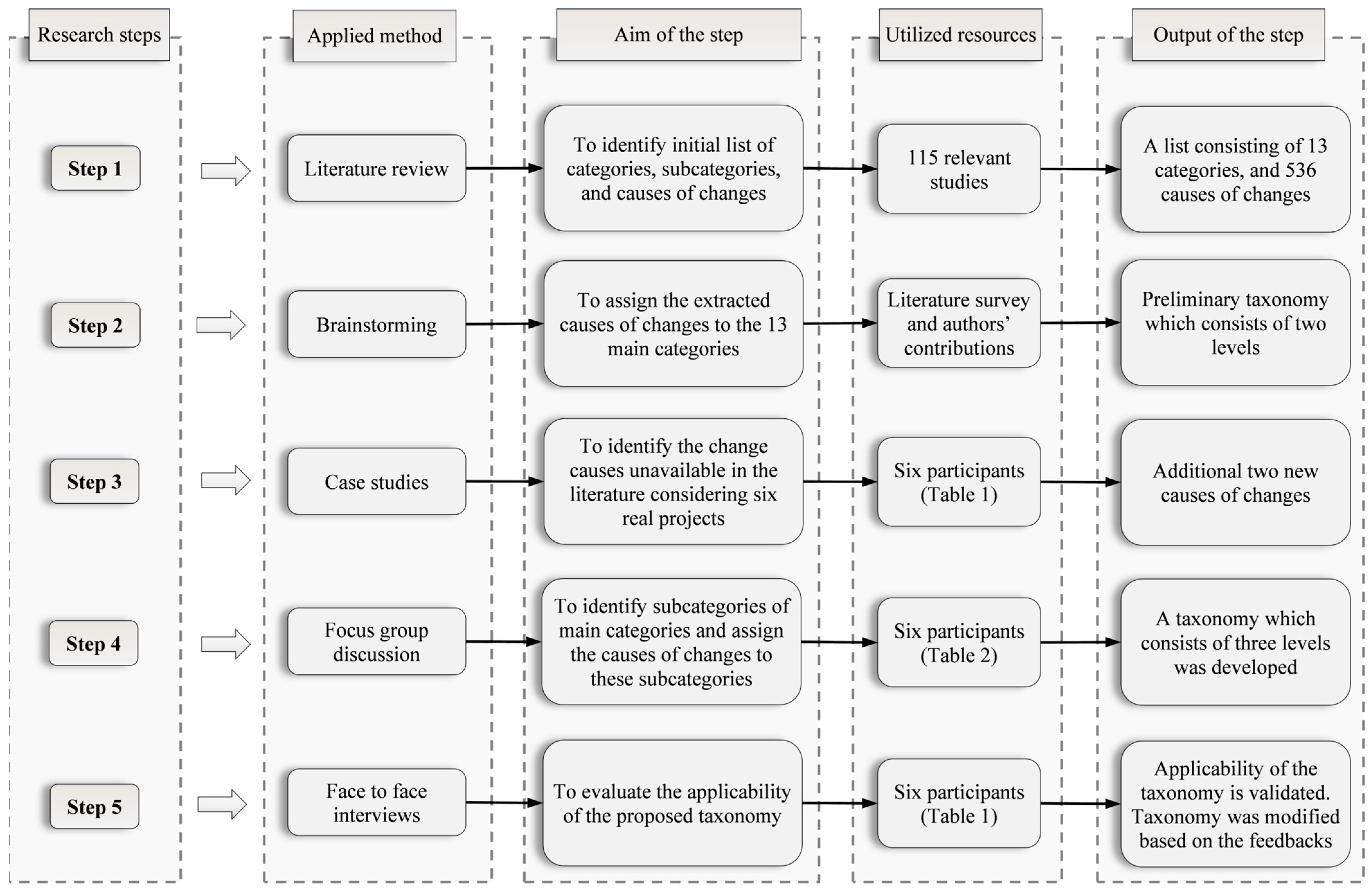
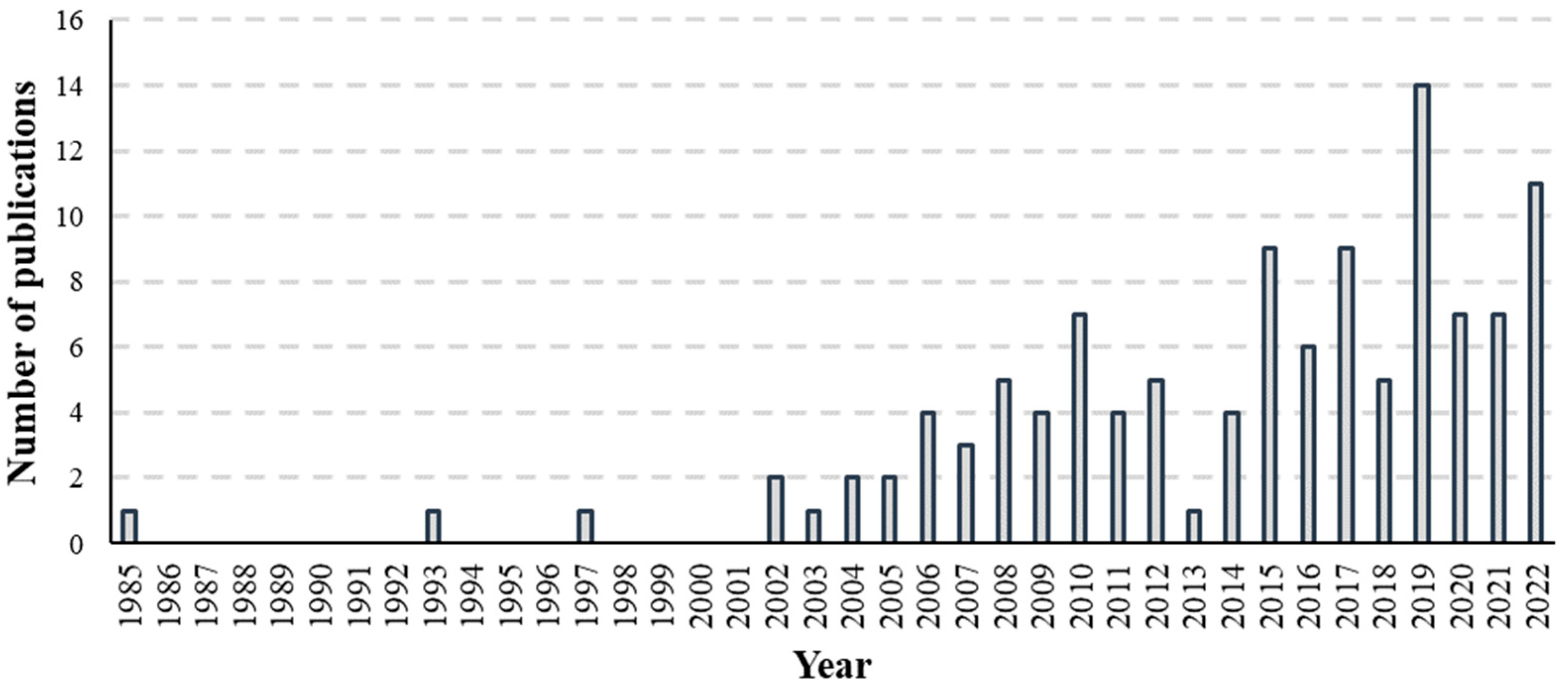
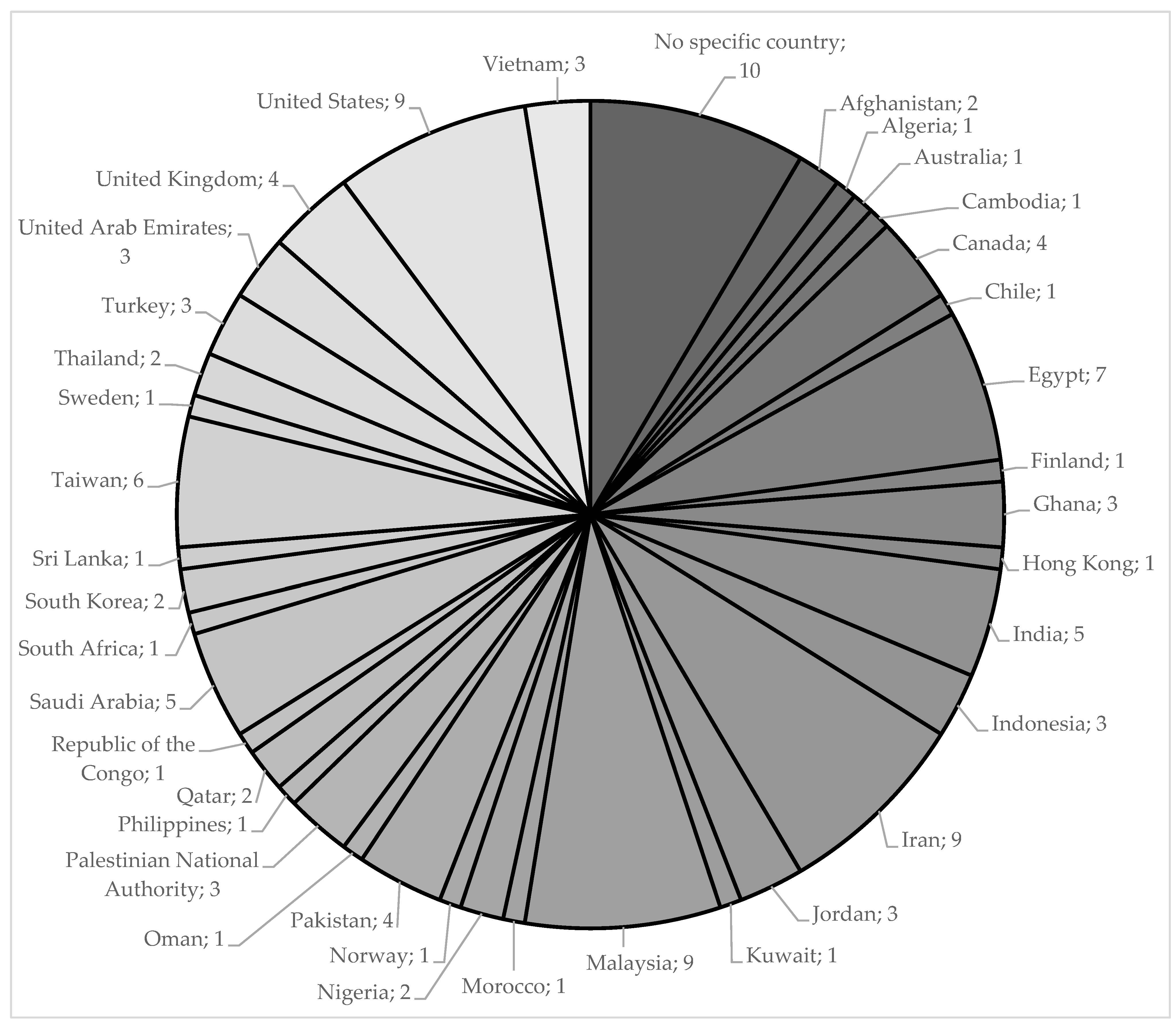
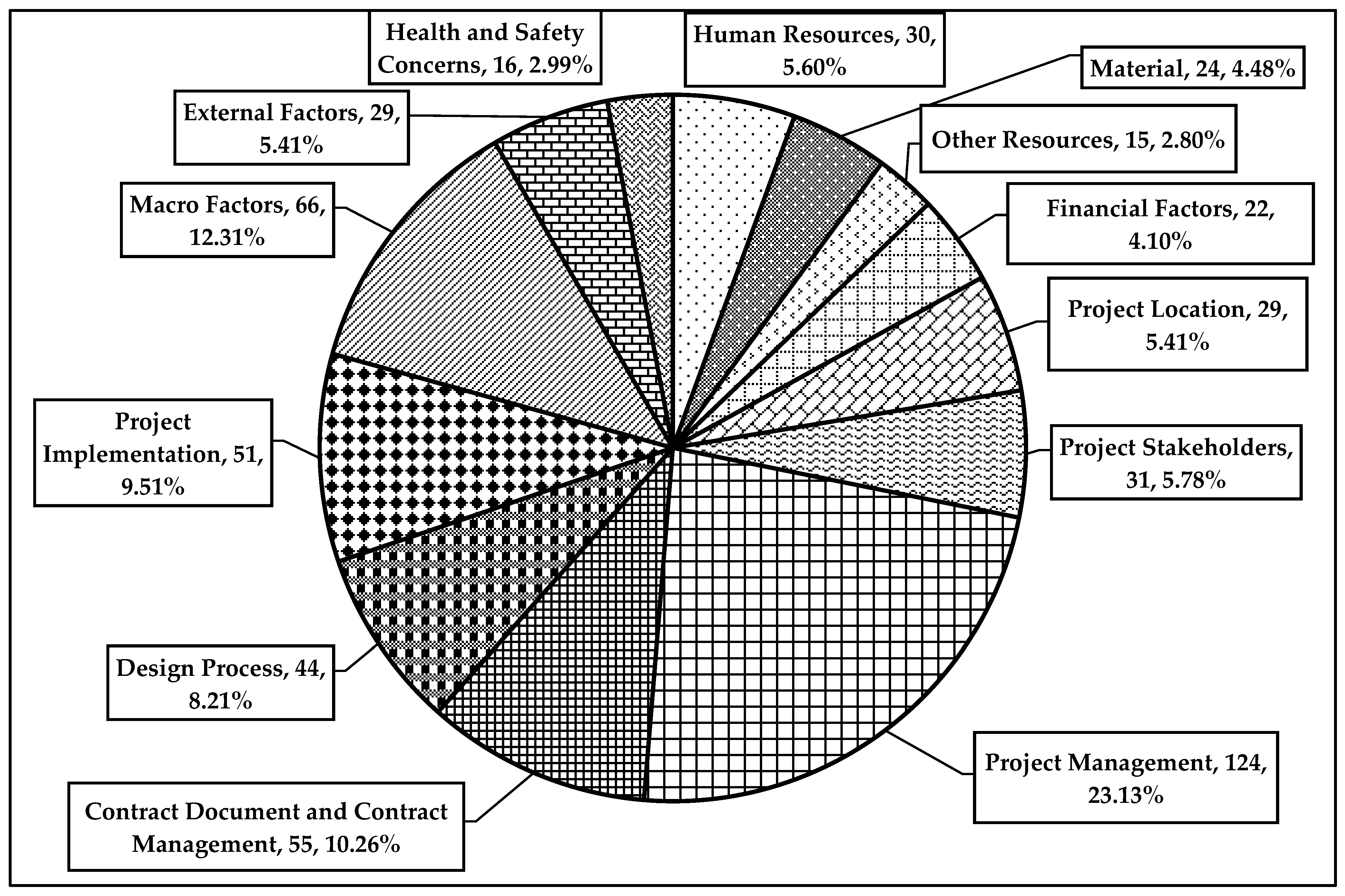
Disclaimer/Publisher’s Note: The statements, opinions and data contained in all publications are solely those of the individual author(s) and contributor(s) and not of MDPI and/or the editor(s). MDPI and/or the editor(s) disclaim responsibility for any injury to people or property resulting from any ideas, methods, instructions or products referred to in the content. |
© 2024 by the authors. Licensee MDPI, Basel, Switzerland. This article is an open access article distributed under the terms and conditions of the Creative Commons Attribution (CC BY) license (https://creativecommons.org/licenses/by/4.0/).