
Article

Journalistic Values and GenAI: A Transnational Study of Editorial Policies

by
Rubén Rivas-de-Roca
*,
Tania Forja-Pena
,
Artai Bringas-Gómez
and
Berta García-Orosa
Department of Communication Sciences, Universidade de Santiago de Compostela, 15782 Santiago de Compostela, Spain
*
Author to whom correspondence should be addressed.
Soc. Sci. 2026, 15(3), 198; https://doi.org/10.3390/socsci15030198
Submission received: 22 December 2025 / Revised: 13 February 2026 / Accepted: 17 March 2026 / Published: 18 March 2026
(This article belongs to the Special Issue Big Data and Political Communication)

Abstract

The consolidation of artificial intelligence (AI) is transforming the journalistic sector, to the point that its ethical dimension is being altered. However, the mission and values of the media in the face of the current emergence of generative artificial intelligence (GenAI) have barely been explored. Bearing this in mind, it is important to understand not only how journalists perceive AI, but also to examine the role that the media assign to themselves and the audience’s participation in this context. This research explores the roles defined by a sample of leading media outlets (n = 21) in seven countries in Western Europe and North America: France, Germany, Italy, Spain, the United Kingdom, Canada, and the United States. To this end, a discursive content analysis is applied to three newspapers (printed or digital) per country. The findings reflect differences between countries and media outlets, within a common trend of prioritizing responsibility as the primary editorial value, followed by truthfulness. We also found scant direct references to AI regulation, alongside the development of participatory interactivity within readership established by the media outlet. Furthermore, greater participation of audiences was observed in publicly funded publications, granting audiences a deliberative role.

1. Introduction

The rise and consolidation of artificial intelligence (AI) is modifying the journalistic sector to such an extent that basic principles of its own functioning and its ethical dimension are being altered (Cools and Diakopoulos 2024; Molina Bailon 2024). AI involves the application of machine learning strategies, based on large amounts of data, to generate outputs, including journalistic content (Schapals and Porlezza 2020). Big data and its subsequent management to produce information have become a media trend over the last decade (Coddington 2015), to the point that the growing use of AI in news is placed by some authors within the framework of a shift in journalism towards quantitative parameters (Anderson 2018).
The datafication of the media (Mejias and Couldry 2019) is accompanied by the integration of AI into many phases of the news process, from data collection to the production and distribution of journalistic pieces. This leads to the development of a kind of automated newsroom, which massively employs data-driven technologies (Cools and Diakopoulos 2024). The widespread use of AI increases resource efficiency, but it can affect editorial autonomy (Simon 2022; Cools and de Vreese 2025) by reducing control over the correct application of journalistic standards.
Since the emergence of generative AI tools like ChatGPT, the synthetic production of texts and images has been simplified. These chatbots have potential in journalism, although they also pose a threat to the profession in the context of abundant disinformation (Pavlik 2023). The automation of certain processes brings certain risks perceived by journalists, stemming from the weak consideration of algorithms regarding ethical or unethical aspects of the texts and video they produce (Gutiérrez-Caneda et al. 2023). In this regard, some surveys show that journalists have a cautious stance towards AI, with a critical view of its biases and its capacity to fuel disinformation (Peña-Fernández et al. 2023). Furthermore, the use of these technologies is not uniform, but rather depends on the journalistic roles that professionals attribute to them (Møller et al. 2025).
In liberal democracies such as those of Western countries, journalism is a sector usually associated with strong values that constitute a professional ideology, in which the public service mission of informing citizens prevails (Deuze 2005). Although the elements of journalism have remained unchanged for decades (Kovach and Rosenstiel 2001), the fact that AI can produce content sometimes considered to be of higher quality than that generated by journalists themselves (Baptista et al. 2025) challenges the role of journalistic professionals.
Literature attempts to shed light on journalists’ perceptions of these changes, with a prevailing defense of values such as transparency and diversity, which are seen, within algorithmic context, as the essence of journalistic activity, in algorithmic formulas such as news recommendation engines (Bastian et al. 2021). Nevertheless, studies are limited and restricted to specific geographic areas (Kuai 2026).
There is also longitudinal research on how the media reports on AI (Moran and Shaikh 2022; Rivas-de-Roca et al. 2025) and the journalists’ metadiscourse regarding AI-generated disinformation such as deepfakes (Wahl-Jorgensen and Carlson 2021). However, the broader relationship between the media and the big data upon which AI is based has scarcely been explored. Therefore, this research seeks to characterize the discourse on journalism and generative artificial intelligence (GenAI) constructed by the media.
In order to define the collective discourse on media, journalists, and AI, a discursive content analysis is applied. The collective imaginary surrounding AI and journalism can modify its legitimacy, effectiveness, and influence in society. This includes an analysis of the predominant voices in the debate on the ethical, political, and social implications of AI, as well as the role of conversational agents in constructing these narratives. Specifically, this study analyzes the role that the media and journalists assign themselves with the rise of AI, synthetic products, and the inclusion of AI in phases of news production.

2. Ethics and Metajournalistic Discourses in the Age of AI

The integration of AI represents a high-tech approach that entails a shift in the social and cultural relationships of journalism, now marked by algorithms that reproduce pre-existing inequalities through journalistic coverage (Gutsche 2024). The governance of these technologies is still in its early stages, but it is possible that similar patterns to those experienced in social media will be repeated, characterized by limited self-regulation and the centrality of the concept of innovation as the driving force behind management (Napoli and Adi 2025). However, in the EU there is much emphasis on regulation of both media (Kerševan 2024) and AI (Gstrein et al. 2024). In this regard, some authors call for the development of regulatory frameworks that facilitate the introduction of AI in journalism (Lin and Lewis 2022).
Journalists show some resistance to the widespread adoption of AI, fueled by the perception that its use will lead to job losses and weaken editorial control (Petruccio et al. 2025). This explains the advocacy for combining machines and humans to ensure the quality of information (Sjøvaag 2013). Nevertheless, the literature also points to journalists’ acceptance of AI, and its interpretation depends largely on the organizational context in which it is implemented (Hermida and Simon 2025). Hence, the media outlet is key to understanding the meta-journalistic discourses generated by this type of technology.
In academic research, interviews are emerging as the preferred method for exploring how journalists and editors value collaboration with AI (Grimme and Zabel 2024; Palla and Kostarella 2025; Pitluk et al. 2025). Interviews reconstructing professional practice (de Haan et al. 2022) also reveal a certain negativity on the influence of AI in journalism, even though journalists attribute to themselves a strong professional authority over algorithms.
These types of qualitative approaches show that journalists believe in a set of ethical principles that guide their actions with AI, but the complexity of this technology means there is no consensus on whether these standards are sufficient to encompass all the consequences of its application (Misri et al. 2025). There does seem to be agreement, however, that both external factors and internal dynamics influence the integration of AI in newsrooms (Helberger et al. 2022).
Previous theoretical studies suggest that the use of AI in information is fundamentally a problem linked to aligning AI with journalistic values and principles, which has been extensively studied in fields such as visual journalism (Matich et al. 2025). In this regard, there has also been an uncritical adoption of digital tools by journalists in many Western countries, and particularly AI since 2022, meaning that its potential risks to journalistic practice are not being addressed (Kiesow 2024).
As of 2024, media ethics codes in regions like Europe have not adapted to the emergence of AI but rather remain focused on issues such as disinformation and audience engagement (Forja-Pena et al. 2024). Based on content analysis and the Delphi method, they show that professionals and academics in much of Europe agree on the need to strengthen journalism so that it keeps its social function. Furthermore, media professionals are calling for collaboration among themselves to address the shared challenges of AI. They also show a commitment to publishing style guides that clarify how each news organization uses this technology (Gutiérrez-Caneda et al. 2024).
Beyond the high expectations generated by AI, the relationship with these technologies is complex, as illustrated by some recent ethnographic studies on their integration into newsrooms (Schaetz and Schjøtt 2026). Many professionals begin to use AI intensively, and ambivalent approaches are noticed. On the one hand, this technology is perceived as an opportunity to increase productivity and better reach the audience; on the other hand, its inclusion may affect journalistic practices and norms (Aitamurto and Boyles 2025). Indeed, the ethical dimension of automation has caused ethical concern since its inception, with special attention to its impact on objectivity and informational authority (Dörr and Hollnbuchner 2017).
In light of the above, it is interesting to know not only how journalists perceive AI as some studies found the persistence of a strong professional sentiment (Carlson 2018), but also to examine the role that the media assign themselves in relation to AI. As previously mentioned, the media company is essential for understanding the shaping of this technology and the discourses surrounding it (Hermida and Simon 2025), which can alter its legitimacy and social influence, as well as its presence at different stages of the news-making process.
To this end, a range of research questions are posed that analyze the voices of the journalistic sector in the framework of the rise of AI and synthetic products:
  • RQ1. How do news organizations articulate and renegotiate journalism’s professional norms in the context of developing AI technologies?
  • RQ2. How (and whether) GenAI is publicly incorporated into mission statements, ethical codes, and audience-facing policies?
  • RQ3. What forms of audience participation are enabled in these news organizations?

3. Methods

This study explores media discourses at the time of emerging AI. A comparative content analysis with descriptive comparisons across cases in Europe and North America is applied, together with selective qualitative interpretation. We selected the five most populous European countries (United Kingdom, France, Germany, Italy, and Spain), as well as the United States and Canada. This allows for a comparative perspective on Western media discourse.
Specifically, 21 media outlets are considered, three per country, which are among the leaders in their respective countries according to the Digital News Report (Newman et al. 2025). We select the most widely read newspaper, excluding sensationalist ones because they are generally scarcely aligned with journalistic standards and practices (Bravo Araujo et al. 2021).
In cases of a tie in the percentage of readers, digital newspapers were chosen over print media because they offer greater accessibility and a broader range of updated materials. Additionally, digital formats may better reflect current journalistic practices and audience consumption habits, making them more appropriate for analyzing contemporary media dynamics. The sample is as follows:
Europe
  • United Kingdom: The Guardian, Daily Mail, and Daily Telegraph.
  • France: Le Monde, Brut, and Le Figaro.
  • Germany: Focus, Der Spiegel, and Die Welt.
  • Italy: Fanpage, La Repubblica, and Corriere della Sera.
  • Spain: El País, 20 Minutos, and elDiario.es.
America
  • United States: The New York Times, USA Today, and The Washington Post.
  • Canada: The Globe and Mail, Toronto Star, and National Post.
To answer the research questions, a content analysis was conducted on the information available on the websites of the news organizations, along with other open-access materials such as interviews with editors and advertising. This study is organized into a table with four main blocks of variables (Table 1): definition and values of the media outlet; relationship with the audience and innovation in the media; presence and explicit definition of the audience on the media outlet’s website; and audience participation.
The media outlet’s values, as expressed in its editorial, are rooted in the classic elements of journalism (Kovach and Rosenstiel 2001), while the relationship with its audience is a widely studied category based on business models that involve varying degrees of payment (Goyanes 2014). The variables for both this dimension and the audience’s presence and definition are triggered from the work of Pérez-Seijo et al. (2020). The items created for the editorial letter and audience engagement analysis are an adaptation of several previous studies: Groenhart and Bardoel (2012); García-Orosa (2018); García-Orosa et al. (2020); Renedo-Farpón et al. (2023); and Caro-González et al. (2024). Indeed, as for the editorial letter they are core principles of high-quality journalism.
The variable 1 “news organization’s self-definition and values”, related to RQ1 (journalism’s norms in the context of AI), was operationalized by identifying implicit references to a professional code of ethics, norms, standards, and roles. On this matter, direct mentions in the editorial letter to each core journalistic value were collected. Regarding RQ2 (incorporation of GenAI in public-facing documents and site features), it is answered through variables 2, 3 and 4. We analyze public-facing communication such as references to audience, transparency in terms of funding or role attributed to the citizen according to the published information.
As for variables 4 and 5, they were both used to answer RQ3 (mechanisms of participation). This was operationalized by mapping participation tools across selected news outlets and coding the community and communication flow built. We count on three coders for the fieldwork. Inter-coder reliability was calculated using Krippendorff’s alpha, based on a pretest of 10% of the sample in which all three coders participated. Acceptable values were obtained (Krippendorff 2011) between 0.65 and 1 for each of the variables. The average was 0.81, although the items with the lowest scores were given additional instructions in the codebook to ensure consistency in coding.

4. Results

4.1. Self-Assigned Values of the Media

First, the presence of the potential media values collected in the analysis sheet is determined by the fulfillment of each of these items. This allows us to understand the main concepts used in media self-definition. Table 2 shows that the most common value is responsibility, present in 19 media outlets in the sample, followed by truthfulness and accuracy (18). Despite its centrality, this idea involves different approaches. Many media outlets refer to responsibility for the work carried out and the content provided, as can be seen in the mission statements of La Repubblica (Italy), The Washington Post (United States), and the German publications Focus and Der Spiegel. In Germany (Die Welt) environmental responsibility is also mentioned.
It is also noteworthy that Corriere della Sera (Italy) presents a list of specific responsibilities, such as listening to the voiceless, avoiding arrogant positions, and applying editorial transparency. This news organization incorporates statements extracted from the statutes of other internationally recognized media outlets for their own ethical codes.
On the other hand, the value of truthfulness and accuracy is generally found in the sample with less detail. The media are likely to emphasize the importance of truthful information, although in Canada the focus of the three selected outlets is on the need to offer accurate journalism, based on integrity and proper contextualization. At this point error correction is mentioned.
Regarding independence (found 16 times), it is defined by media outlets such as 20 Minutos (Spain), Le Monde (France), and Corriere della Sera as separation from any political, economic, or religious power. In this context, it is significant that some news organizations associate independence on their websites with their reputation (The Guardian, UK) or even with the existence of a partner-based business model, as elDiario.es in Spain.
Following in terms of presence is the value related to humanity and human rights, which in some cases is linked to the institutional norms of each country. Fairness/impartiality also appears with some frequency in the sample, along with pluralism. However, the greatest differences between media outlets emerge in the “other” category, as well as in references to technological issues, including AI.
La Repubblica and The Washington Post establish protocols for social media, whereas in the UK Daily Mail and The Guardian have clear guidelines for handling sensitive issues such as minors or suicide. The latter also has a section on the use of AI, which is only found in Le Monde, The New York Times, USA Today (US), The Globe and Mail (Canada), and elDiario.es (Spain).
While The Guardian’s approach seems more general, Le Monde defines a clear protocol on its website for the use of AI, stipulating that this technology cannot be used to produce original editorial content. Generative AI is only permitted as a production assistance tool, under strict conditions. Furthermore, it states that readers should be systematically informed of the uses of generative AI by the newsroom.
As for USA Today, it places information about AI within the framework of truthfulness and accuracy. Specifically, its editorial code states that “AI-generated content must be verified for accuracy and factuality before being used in news products.” The responsibility falls on journalists, who assume responsibility for any errors caused by AI and should be aware of the biases of this technology in order “not to discriminate against any individual or group on the basis of race, ethnicity, religion, gender, sexual orientation, or any other characteristic.”
This individualistic view of news reporting with AI contrasts with The New York Times, which highlights that automation tools do not replace journalistic judgment. Therefore, it states that any use of AI “must have human oversight and adhere to established journalistic standards and editing processes.” This is complemented by adequate transparency, reporting when this technology is employed. In the whole sample, 17 media outlets have ethical codes, but only six include direct references to AI.
In Canada, The Globe and Mail has articulated guidelines that position AI as a supportive tool rather than a replacement for journalistic judgment. Its approach emphasizes that responsibility for published content always rests with human editors and reporters. The guidelines underscore the importance of accuracy, fairness, and independence, requiring journalists to verify AI-assisted outputs in the same way they would any other source. Transparency is also central: when AI plays a significant role in producing content, the newsroom aims to be open to readers about how technology was used. Ethical considerations form another core pillar of The Globe and Mail’s AI guidance. The organization cautions against using AI to generate fabricated quotes, sources, or events, and it places strict limits on the use of synthetic media that could mislead audiences.
Lastly, elDiario.es has publicly shared in 2025 a declaration of principles on the use of AI in journalism, emphasizing that “journalism is an exclusively human capacity” and that no AI should replace the editorial judgment or core reporting functions of its journalists. The guidelines state that the newspaper will not publish major journalistic formats like investigations, reports, interviews, or podcasts generated entirely by AI, and any content generated by AI must be clearly identified and transparent to readers. The document also allows AI tools to be used as technical assistants for supportive tasks, but always under human supervision and with an understanding of potential bias or reliability issues. Therefore, all the analyzed media outlets are committed to keep the key role of human journalists in the management of AI within newsrooms.

4.2. Relationship with the Audience and Its Functions

The relationship with the audience is most often (14) developed through a partial paywall system (mostly paywall with some limited content for free). Only 20 Minutos, Corriere della Sera, Fanpage (Italy), and Brut (France) have all their news items available free of charge; thus, only four are totally free. Conversely, the most limited models for non-subscribers are found in North America with The New York Times and The Globe and Mail (Canada), as well as in Italy with La Repubblica, a country where both the most open and closed content models coexist in our sample.
This connection with the audience materialized through a mixed funding system (members and advertising) in all the selected media outlets, except for the free publications Brut and 20 Minutos, which rely solely on advertising. The existence of mixed business models means that there is a significant dependence on the public, who are offered different incentives for their participation. Following the proposal of Pérez-Seijo et al. (2020), the main value observed in our research is exclusivity (Figure 1), which refers specifically to the unlimited access enjoyed by subscribers, including posting, receiving offers, etc.
Exclusivity is the primary reward in the seven countries included in this study, but French, German, and Canadian media also show a certain distinction for the audience based on their level of participation. The distinction category refers to the possibility of being recognized within the media community, for example, by leaving comments on news articles as a member.
On a smaller scale, other incentives are offered, such as accountability as seen in Le Monde, Fanpage, and elDiario.es. This situates the public as a guarantor of the media outlet’s independence through their payments or even their potential vote in decision-making. Similarly, two news organizations (Der Spiegel and The New York Times) offer the reward of having a “voice.” With this option, subscribers can publish opinion pieces in the publication or participate in internal meetings.
On the other hand, several media outlets assign functions to the public. This is particularly remarkable in Italy, where Corriere della Sera devotes to “listening to the voiceless” and La Repubblica seeks to “encourage participation in public life through a deeper understanding of events, ideas, and culture in Italy and around the world.” Similarly, 20 Minutos “encourages readers to engage with its reporting.” In contrast, The Washington Post does not directly appeal to reader participation but rather emphasizes that its obligation “is to serve readers, not sources.”

4.3. Audience Interaction and Participation

The possibility of participating in the media leads to a debate about the extent to which audiences are part of journalistic activity. Regarding existing avenues for participation, the most common are participatory interaction, present in 19 media outlets, and selective interaction, present in 18. The participatory modality involves contact between users and journalists or other readers, within the parameters established by the media outlet such as comments or games. In fact, these latter playful initiatives are found in The Washington Post, elDiario.es and Corriere della Sera (Figure 2).
For its part, selective interactivity reaches a very similar number of media outlets and refers to mechanisms that allow for some interaction between the audience and the media, as well as adaptation to user preferences, such as email alerts or ways to contact journalists. Participation can contribute to fostering the idea of community, understood as a feeling of belonging among readers (Manfredi-Sánchez et al. 2015). On this matter, Table 3 illustrates that there are 11 media outlets that meet some of the community variables. Apart from the UK, all the selected countries have at least one news organization that adopts methods to generate community. Besides that, they correspond to publicly funded organizations, apart from Fanpage.
Following the above, Fanpage along with elDiario.es are the only media outlets that accomplish all three established categories (both with an incentive system): promoting membership, creating a member-only community, and organizing meetings or events. The remaining news organizations employ some of these variables, with none being more frequent than another. They use a two-way flow, involving interaction between sender and receiver, for example, through the aforementioned meetings or by providing feedback on publications.
This finding does not preclude the primary communication flow from being unidirectional, from the media outlet to the audience, which includes traditional content such as text-based news articles or videos. These news products are accompanied by audience participation, with a high level of compliance with the identified criteria (Table 4). Specifically, both the availability of an accessible contact method and the presence of buttons to share the news items are found in all media outlets.
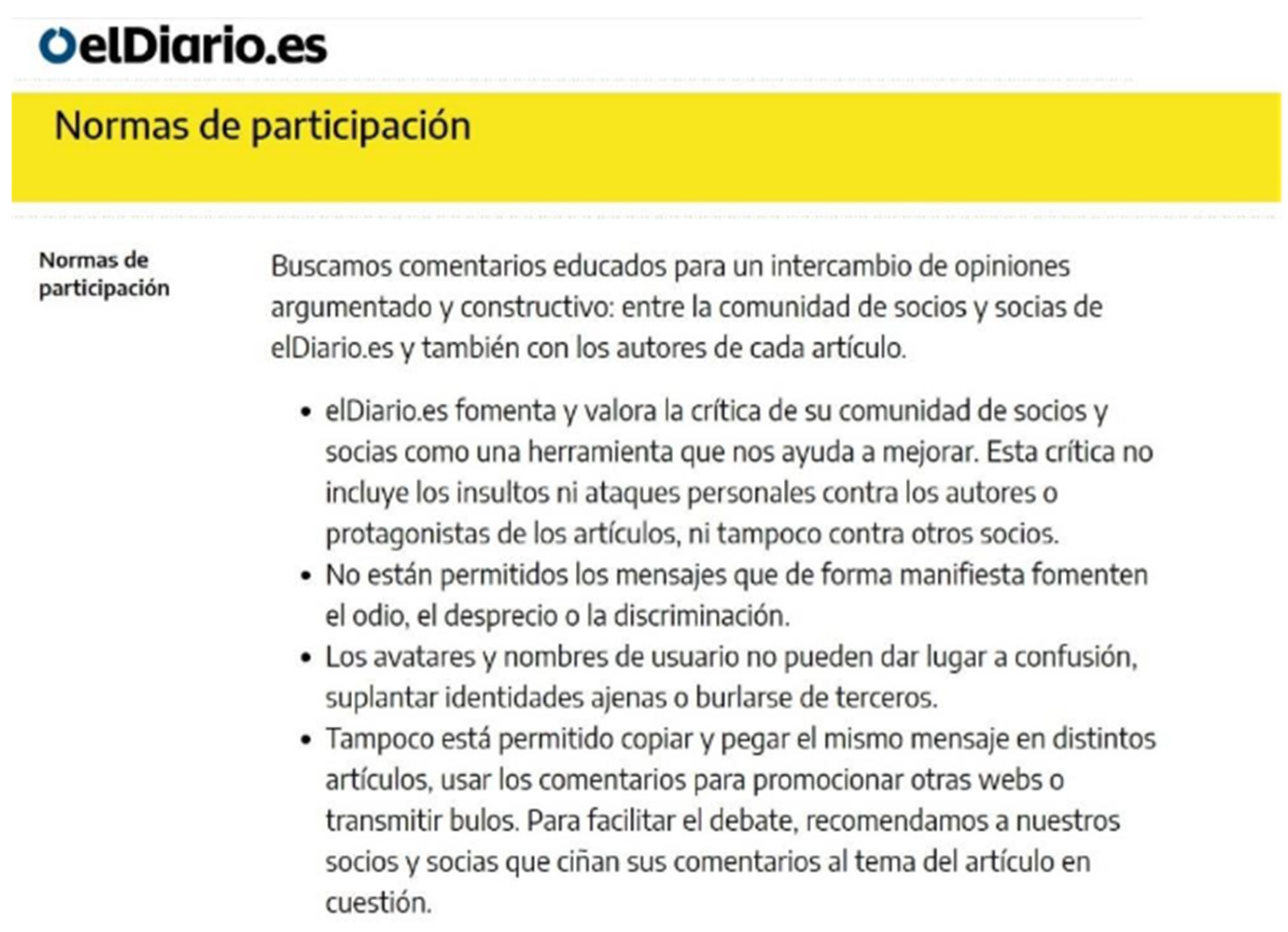
Although most of the companies analyzed (17) allow reader comments, fewer (12) publish information about their comment policy. For example, elDiario.es (Figure 3) provides a series of guidelines to prevent hate speech and boost critical discussion. This is relevant because the literature highlights that civility and the level of reasoning in these messages contribute to a higher perceived quality of the publication, compared to situations where participatory section becomes a space of toxicity (Prochazka et al. 2018).
Beyond comments, subscriber and partner benefits represent another form of participation, even though they exhibit a certain passivity since sometimes the benefits are limited to mere access. Classic sections such as letters to the editor are also present, and to a lesser extent, the option to submit content, the latter of which could open the door to co-creation. Nevertheless, this type of approach is limited in comparison to more unidirectional participation mechanisms.

5. Conclusions and Discussion

At a time of technological transformation and the proliferation of AI, our study seeks to shed light on the self-assigned roles of leading media outlets in key markets in Western Europe and North America. The massive incorporation of AI into this sector brings with it an epistemic crisis, which some authors conceptualize as an opportunity to strengthen the professionalization of journalism (Perreault et al. 2025). Therefore, this research addresses research questions that place the current moment as a possibility for change.
First, the results reveal divergences between countries and media outlets, within a common trend of positioning responsibility as the main editorial value, followed by truthfulness (RQ1). These are classic values that highlight the degree of influence of journalism, which requires practicing the profession responsibly and with high standards of accuracy in terms of truthfulness. The scant direct references to AI guidelines are noteworthy. In fact, only The Guardian, Le Monde, The Globe and Mail, elDiario.es, and two US newspapers (The New York Times and USA Today) include specific sections on the use of this technology. Hence, only a few newspapers (6 of 21) have sections about internal AI regulation.
In the media outlets that mention AI, the negativity that some previous studies described toward its journalistic use (de Haan et al. 2022) is not evident, but a critical perspective appears. It is argued that AI cannot replace journalistic judgment, while its management is located within the framework of truthfulness and accuracy. This shows an awareness of the extent to which these automation tools require special care to avoid inaccuracies. Besides that, the formal indifference of most of the selected media outlets towards AI aligns with key findings in the literature, which report that the ethical codes of news organizations have not added guidelines for the use of this technology (Forja-Pena et al. 2024).
Regarding the role attributed to the audience (RQ2), the relationship with the audience is usually maintained through a system that combines open access pieces and exclusive content, based on a mixed funding model of memberships and advertising. Members or subscribers receive exclusivity as their main reward in the seven countries considered, although in media outlets in France, Germany, and Canada some degree of distinction is also awarded to the most engaged users.
Likewise, some media outlets assign specific functions to the audience, such as serving as a source or participating in the creation of news stories, but there are few cases (the prestigious Der Spiegel and The New York Times) where this possibility materializes. It should be noted that price remains the primary factor influencing subscriptions to a media outlet and, thus, the decision to consume news online (O’Brien et al. 2025). This means the scope of the rewards model needs to be assessed with caution.
The available participation mechanisms foster the development of participatory interactivity, primarily through comments and games, which occurs within the framework created by the media outlet itself, but is closely followed by selective interactivity (RQ3). Moreover, media outlets tend to build community among users, adhering to relevant parameters in almost all countries. Fanpage and elDiario.es fit all three categories, emerging as the most community-oriented media outlets in the sample.
On the other hand, media outlets primarily engage in unidirectional communication, with some bidirectional elements such as contact methods with the newsroom or mechanisms for sharing news, which are present in all selected media outlets. Conversely, there is little transparency regarding participation guidelines in several news organizations, while the option for co-creation is very limited.
In summary, our analysis reflects a lack of clarity surrounding GenAI, which is managed within the framework of the core journalistic values attributed to these leading media outlets. Only somemedia outlets have defined any kind of protocol for using this technology at the timeframe when the research was carried out. Furthermore, a slightly higher level of participation is observed in publicly funded publications, granting audiences a more deliberative role, especially when it comes to building community. In this context, exclusivity is identified as the most important reward.
Almost all share the same participation mechanisms, with original formulas such as games, carried out within a logic of participatory interactivity. Nevertheless, no adaptation for the public is observed in response to the rise of AI. Hence, the comparative analysis performed indicates that media organizations are not fully conscious of AI’s role in shaping audience news consumption habits, particularly in how information is accessed, filtered, and interpreted. As a result, these influences are largely absent from their mission statements and other documents through which media outlets define their roles and practices.
This research is limited by its focus on the public information of each media outlet, despite the fact that the adoption of automated algorithms is a phenomenon that permeates all newsrooms. The study could be expanded by applying qualitative approaches that explore the perceptions and uses of these technologies, in line with recent articles that reveal a lack of clarity in newsrooms on who is responsible for the use of AI (Cools 2025). It would also be useful to analyze other media contexts and newspapers to obtain a broader overview of the associated roles.
The leading media outlets show some divergences in their relationship with the public, while keeping responsibility as a key value for their overall work, within which AI is framed. Although some cases have developed protocols in this regard, there is no concrete information surrounding AI and the associated rise of big data. It seems that technological innovation is taking precedence over the roles self-assigned by the media themselves.

Author Contributions

Conceptualization, R.R.-d.-R. and B.G.-O.; methodology, R.R.-d.-R., T.F.-P. and A.B.-G.; software, T.F.-P. and A.B.-G.; validation, T.F.-P. and A.B.-G.; formal analysis, R.R.-d.-R.; investigation, R.R.-d.-R., T.F.-P. and A.B.-G.; resources, T.F.-P. and A.B.-G.; data curation, R.R.-d.-R., T.F.-P. and A.B.-G.; writing—original draft preparation, R.R.-d.-R.; writing—review and editing, R.R.-d.-R., T.F.-P., A.B.-G. and B.G.-O.; visualization, R.R.-d.-R.; supervision, B.G.-O.; project administration, R.R.-d.-R.; funding acquisition, B.G.-O. All authors have read and agreed to the published version of the manuscript.

Funding

This article is part of the R&D project Artificial Intelligence in Digital Media in Spain: Effects and Roles (PID2024-156034OB-C22), funded by MICIU/AEI/10.13039/501100011033 and by “ERDF/EU”. The author Tania Forja-Pena holds a predoctoral contract from the Xunta de Galicia with reference ED481A-2023-043.

Institutional Review Board Statement

Not applicable.

Informed Consent Statement

Not applicable.

Data Availability Statement

The datasets presented in this article are not readily available because the data are part of an ongoing project (Artificial Intelligence in Digital Media in Spain: Effects and Roles-NEXTDIGIMEDIA). Requests to access the datasets should be directed to the corresponding author.

Conflicts of Interest

The authors declare no conflicts of interest.

References

  1. Aitamurto, Tanja, and Jan Lauren Boyles. 2025. Next Generation Journalistic Norms: Journalism Students’ Social Imaginary of AI-Infused Journalism. Journalism Practice 19: 2230–48. [Google Scholar] [CrossRef]
  2. Anderson, Christopher W. 2018. Apostles of Certainty: Data Journalism and the Politics of Doubt. Oxford: Oxford University Press. [Google Scholar] [CrossRef]
  3. Baptista, João Pedro, Rubén Rivas-de-Roca, Anabela Gradim, and Concha Pérez-Curiel. 2025. Human-made news vs. AI-generated news: A comparison of Portuguese and Spanish journalism students’ evaluations. Humanities and Social Sciences Communication 12: 567. [Google Scholar] [CrossRef]
  4. Bastian, Mariella, Natali Helberger, and Mykola Makhortykh. 2021. Safeguarding the Journalistic DNA: Attitudes towards the Role of Professional Values in Algorithmic News Recommender Designs. Digital Journalism 9: 835–63. [Google Scholar] [CrossRef]
  5. Bravo Araujo, Andrea, Javier Serrano-Puche, and María Fernanda Novoa Jaso. 2021. Uso del clickbait en los medios nativos digitales españoles. Un análisis de El Confidencial, El Español, Eldiario.es y Ok Diario. Dígitos 7: 185. [Google Scholar] [CrossRef]
  6. Carlson, Matt. 2018. Automating judgment? Algorithmic judgment, news knowledge, and journalistic professionalism. New Media & Society 20: 1755–72. [Google Scholar] [CrossRef]
  7. Caro-González, Francisco J., Rubén Rivas-de-Roca, Manuel Garrido-Lora, and Mar García-Gordillo. 2024. Indicador de Compromiso Social (ICS) en el Periodismo de Proximidad: Hacia un Modelo de Calidad en los Medios Locales. Profesional de la información 33: e330219. [Google Scholar] [CrossRef]
  8. Coddington, Mark. 2015. Clarifying Journalism’s Quantitative Turn: A Typology for Evaluating Data Journalism, Computational Journalism, and Computer-Assisted Reporting. Digital Journalism 3: 331–48. [Google Scholar] [CrossRef]
  9. Cools, Hannes. 2025. Navigating the responsible AI landscape: Unraveling the principles-to-practices gap of transparency and explainability at the BBC. Information, Communication & Society, 1–21. [Google Scholar] [CrossRef]
  10. Cools, Hannes, and Claes H. de Vreese. 2025. From Automation to Transformation with AI-Tools: Exploring the Professional Norms and the Perceptions of Responsible AI in a News Organization. Digital Journalism. [Google Scholar] [CrossRef]
  11. Cools, Hannes, and Nicholas Diakopoulos. 2024. Uses of Generative AI in the Newsroom: Mapping Journalists’ Perceptions of Perils and Possibilities. Journalism Practice 1: 1–19. [Google Scholar] [CrossRef]
  12. de Haan, Yael, Eric van den Berg, Nele Goutier, Sanne Kruikemeier, and Sophie Lecheler. 2022. Invisible Friend or Foe? How Journalists Use and Perceive Algorithmic-Driven Tools in Their Research Process. Digital Journalism 10: 1775–93. [Google Scholar] [CrossRef]
  13. Deuze, Mark. 2005. What is journalism? Professional identity and ideology of journalists reconsidered. Journalism 6: 442–64. [Google Scholar] [CrossRef]
  14. Dörr, Konstantin Nicholas, and Katharina Hollnbuchner. 2017. Ethical Challenges of Algorithmic Journalism. Digital Journalism 5: 404–19. [Google Scholar] [CrossRef]
  15. Forja-Pena, Tania, Berta García-Orosa, and Xosé López-García. 2024. A Shift Amid the Transition: Towards Smarter, More Resilient Digital Journalism in the Age of AI and Disinformation. Social Sciences 13: 403. [Google Scholar] [CrossRef]
  16. García-Orosa, Berta. 2018. Perfil de la audiencia de cibermedios: Representación discursiva y praxis del receptor 2.0. Palabra Clave 21: 111–33. [Google Scholar] [CrossRef]
  17. García-Orosa, Berta, Xosé López-García, and Jorge Vázquez-Herrero. 2020. Journalism in digital native media: Beyond technological determinism. Media and Communication 8: 5–15. [Google Scholar] [CrossRef]
  18. Goyanes, Manuel. 2014. An Empirical Study of Factors that Influence the Willingness to Pay for Online News. Journalism Practice 8: 742–57. [Google Scholar] [CrossRef]
  19. Grimme, Meike, and Christian Zabel. 2024. AI in the newsroom: A collective case study about newsworker-AI collaboration in the German newspaper industry. Journal of Media Business Studies 22: 118–42. [Google Scholar] [CrossRef]
  20. Groenhart, Harmen, and Jo Bardoel. 2012. Conceiving the transparency of journalism: Moving towards a new media accountability currency. Studies in Communication Sciences 12: 6–11. [Google Scholar] [CrossRef]
  21. Gstrein, Oskar J., Noman Haleem, and Andrej Zwitter. 2024. General-purpose AI regulation and the European Union AI Act. Internet Policy Review 13: 1–26. [Google Scholar] [CrossRef]
  22. Gutiérrez-Caneda, Beatriz, Carl-Gustav Lindén, and Jorge Vázquez-Herrero. 2024. Ethics and journalistic challenges in the age of artificial intelligence: Talking with professionals and experts. Frontiers in Communication 9: 1465178. [Google Scholar] [CrossRef]
  23. Gutiérrez-Caneda, Beatriz, Jorge Vázquez-Herrero, and Xosé López-García. 2023. AI Application in Journalism: ChatGPT and the Uses and Risks of an Emergent Technology. Profesional de la Información 32: e320514. [Google Scholar] [CrossRef]
  24. Gutsche, Robert E. 2024. Cultures of Digital Architectures: Power and Positionalities in the Backend of Online Journalism Production. Journal of Communication Inquiry 48: 392–410. [Google Scholar] [CrossRef]
  25. Helberger, Natali, Max van Drunen, Judith Moeller, Sanne Vrijenhoek, and Sarah Eskens. 2022. Towards a Normative Perspective on Journalistic AI: Embracing the Messy Reality of Normative Ideals. Digital Journalism 10: 1605–26. [Google Scholar] [CrossRef]
  26. Hermida, Alfred, and Felix M. Simon. 2025. AI in the Newsroom: Lessons from the Adoption of The Globe and Mail’s Sophi. Journalism Practice 19: 2323–40. [Google Scholar] [CrossRef]
  27. Kerševan, Tanja. 2024. Dalla retorica alla regolamentazione: EMFA e la concentrazione dei media nell’era digitale. Rivista Italiana di Informatica e Diritto 6: 173–86. [Google Scholar] [CrossRef]
  28. Kiesow, Damon. 2024. Journalism (Ethics) in the Loop: Software Development as a Cultural Competency for News Organizations. Digital Journalism 12: 1059–67. [Google Scholar] [CrossRef]
  29. Kovach, Bill, and Tom Rosenstiel. 2001. The Elements of Journalism: What News People Should Know and the Public Should Expect. New York: Crown Publishers. [Google Scholar]
  30. Krippendorff, Klaus. 2011. Agreement and information in the reliability of coding. Communication Methods and Measures 5: 93–112. [Google Scholar] [CrossRef]
  31. Kuai, Joanne. 2026. Navigating the AI Hype: Chinese Journalists’ Algorithmic Imaginaries and Role Perceptions in Reporting Emerging Technologies. Digital Journalism 14: 360–79. [Google Scholar] [CrossRef]
  32. Lin, Bibo, and Seth C. Lewis. 2022. The One Thing Journalistic AI Just Might Do for Democracy. Digital Journalism 10: 1627–49. [Google Scholar] [CrossRef]
  33. Manfredi-Sánchez, Juan-Luis, José-Luis Rojas-Torrijos, and José-María Herranz-de-la-Casa. 2015. Innovación en el periodismo emprendedor deportivo. Modelo de negocio y narrativas. El Profesional de la Información 24: 265–73. [Google Scholar] [CrossRef]
  34. Matich, Phoebe, T. J. Thomson, and Ryan J. Thomas. 2025. Old Threats, New Name? Generative AI and Visual Journalism. Journalism Practice 19: 2402–21. [Google Scholar] [CrossRef]
  35. Mejias, Ulises A., and Nick Couldry. 2019. Datafication. Internet Policy Review 8: 1–10. [Google Scholar] [CrossRef]
  36. Misri, Angela, Nicole Blanchett, and April Lindgren. 2025. “There’s a Rule Book in my Head”: Journalism Ethics Meet A.I. in the Newsroom. Digital Journalism, 1–19. [Google Scholar] [CrossRef]
  37. Molina Bailon, Óscar. 2024. Disonancia entre la transformación tecnológica y ética periodística: Una reflexión crítica del impacto de la inteligencia artificial en los medios de comunicación. adComunica. Revista Científica de Estrategias, Tendencias e Innovación en Comunicación 28: 91–114. [Google Scholar] [CrossRef]
  38. Moran, Rachel E., and Sonia Jawaid Shaikh. 2022. Robots in the News and Newsrooms: Unpacking Meta-Journalistic Discourse on the Use of Artificial Intelligence in Journalism. Digital Journalism 10: 1756–74. [Google Scholar] [CrossRef]
  39. Møller, Lynge Asbjørn, Hannes Cools, and Morten Skovsgaard. 2025. One Size Fits Some: How Journalistic Roles Shape the Adoption of Generative AI. Journalism Practice, 1–22. [Google Scholar] [CrossRef]
  40. Napoli, Philip M., and Suher Adi. 2025. On moving fast and breaking things … again: Social media’s lessons for generative AI governance. Information, Communication & Society, 1–17. [Google Scholar] [CrossRef]
  41. Newman, Nic, Amy Ross Arguedas, Craig T. Robertson, Rasmus Kleis Nielsen, and Richard Fletcher. 2025. Reuters Institute Digital News Report 2025. Oxford: University of Oxford. [Google Scholar] [CrossRef]
  42. O’Brien, Daniel, Christian Zabel, and Frank Lobigs. 2025. Consumer Preferences and Willingness to Pay for Digital Journalism in Intermedia Competition: A Conjoint Analysis of Online News Users in the Austrian Market. Digital Journalism, 1–28. [Google Scholar] [CrossRef]
  43. Palla, Zoi, and Ionna Kostarella. 2025. Journalists’ Perspectives on the Role of Artificial Intelligence in Enhancing Quality Journalism in Greek Local Media. Societies 15: 89. [Google Scholar] [CrossRef]
  44. Pavlik, John V. 2023. Collaborating with ChatGPT: Considering the Implications of Generative Artificial Intelligence for Journalism and Media Education. Journalism & Mass Communication Educator 78: 84–93. [Google Scholar] [CrossRef]
  45. Peña-Fernández, Simón, Urko Peña-Alonso, and Maider Eizmendi-Iraola. 2023. El discurso de los periodistas sobre el impacto de la inteligencia artificial generativa en la desinformación. Estudios sobre el Mensaje Periodístico 29: 833–41. [Google Scholar] [CrossRef]
  46. Perreault, Gregory P., Seth C. Lewis, and Maxwell Ely. 2025. ChatGPT, Generative AI, and an Epistemic Opportunity for Journalistic Authority. Digital Journalism, 1–21. [Google Scholar] [CrossRef]
  47. Petruccio, Petra, Tai Neilson, and Christian Stöcker. 2025. ‘A Part of Our Work Disappeared’: AI Automated Publishing in Social Media Journalism. Journalism and Media 6: 30. [Google Scholar] [CrossRef]
  48. Pérez-Seijo, Sara, Ángel Vizoso, and Xosé López-García. 2020. Accepting the Digital Challenge: Business Models and Audience Participation in Online Native Media. Journalism and Media 1: 78–91. [Google Scholar] [CrossRef]
  49. Pitluk, Adam, Jennifer Wilson, and Jeffrey Inman. 2025. Helpful or Hurtful: Legacy Magazine Journalism Wrestles with the Advent of AI Technology in Newsrooms. Journalism Practice, 1–16. [Google Scholar] [CrossRef]
  50. Prochazka, Fabian, Patrick Weber, and Wolfgang Schweiger. 2018. Effects of Civility and Reasoning in User Comments on Perceived Journalistic Quality. Journalism Studies 19: 62–78. [Google Scholar] [CrossRef]
  51. Renedo-Farpón, Cristina, João Canavilhas, and María Díez-Garrido. 2023. Transparency mechanisms in the media: Analysis of Spain and Portugal. Profesional de la información 32: e320105. [Google Scholar] [CrossRef]
  52. Rivas-de-Roca, Rubén, Concha Pérez-Curiel, and Andreu Casero-Ripollés. 2025. Reporting AI in Political Disinformation: Journalistic Discourses in European Quality Newspapers. Journalism Practice, 1–18. [Google Scholar] [CrossRef]
  53. Schaetz, Nadja, and Anna Schjøtt. 2026. AI Hype and its Function: An Ethnographic Study of the Local News AI Initiative of the Associated Press. Digital Journalism 14: 220–37. [Google Scholar] [CrossRef]
  54. Schapals, Aljosha Karim, and Colin Porlezza. 2020. Assistance or Resistance? Evaluating the Intersection of Automated Journalism and Journalistic Role Conceptions. Media and Communication 8: 16–26. [Google Scholar] [CrossRef]
  55. Simon, Felix M. 2022. Uneasy Bedfellows: AI in the News, Platform Companies and the Issue of Journalistic Autonomy. Digital Journalism 10: 1832–54. [Google Scholar] [CrossRef]
  56. Sjøvaag, Helle. 2013. Journalistic Autonomy: Between Structure, Agency and Institution. Nordicom Review 34: 155–66. [Google Scholar] [CrossRef]
  57. Wahl-Jorgensen, Karin, and Matt Carlson. 2021. Conjecturing Fearful Futures: Journalistic Discourses on Deepfakes. Journalism Practice 15: 803–20. [Google Scholar] [CrossRef]
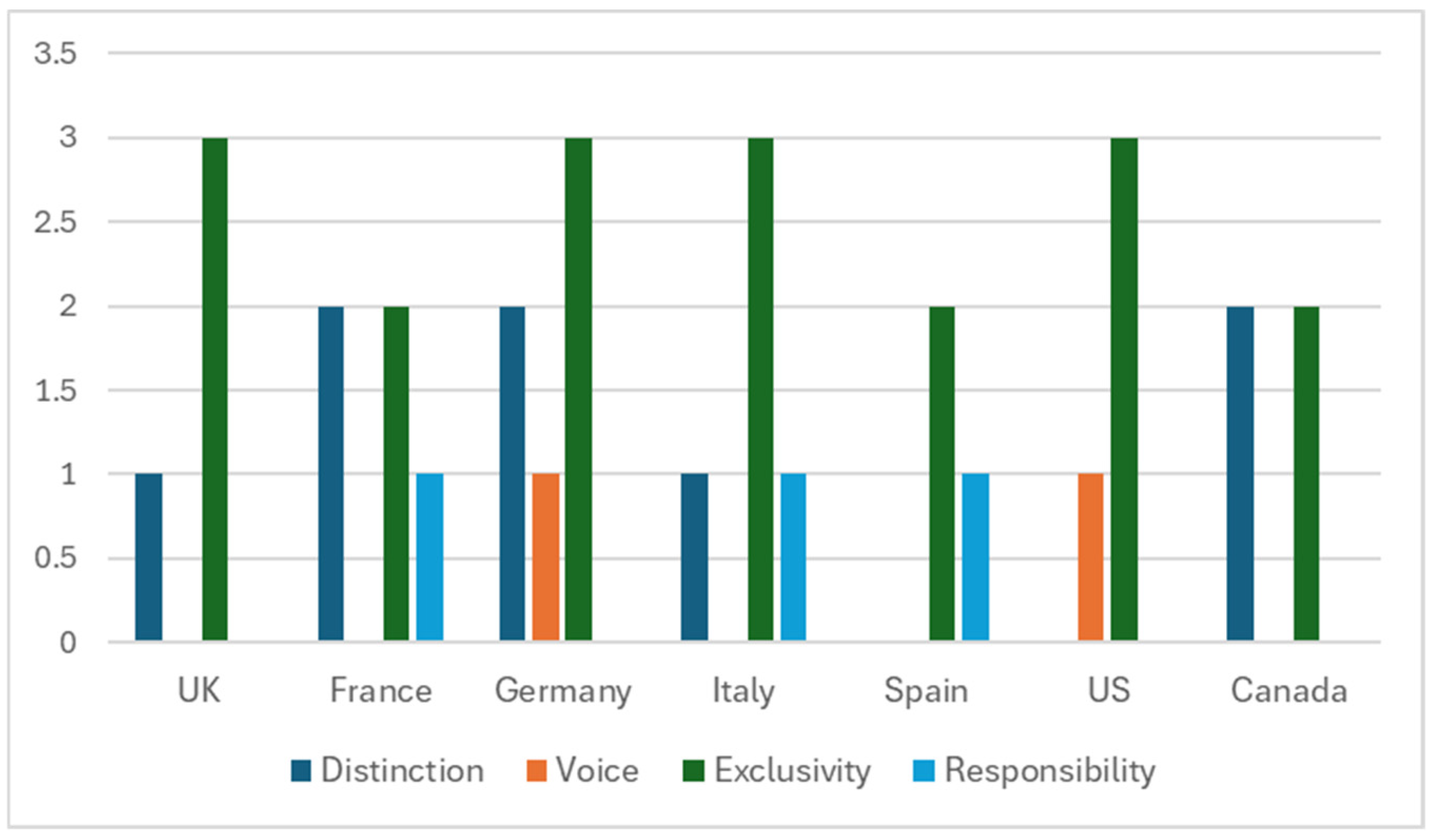
Figure 1. Distribution of community gratifications by country.
Socsci 15 00198 g001
Figure 2. Games (pastimes) section of Corriere della Sera.
Socsci 15 00198 g002
Figure 3. elDiario.es comments policy.
Socsci 15 00198 g003
Table 1. Analysis sheet.
CategoryVariables
0. IdentificationMedia outlet
Website URL
Data collection date
1. News organization’s self-definition and valuesProfessional code of ethics specific for the medium
Editorial letterIndependence
Plurality
Truthfulness and accuracy
Fairness and impartiality
Responsibility
Other
2. Relationship with the public and innovation in the mediaNews-reading
public
Open (free of charge)
Open with exclusive content for members/subscribers (partial paywall)
Mostly limited (only news previews, monthly content limit, or similar)
Audience-based
funding
Restricted to members
Hybrid model
Cookie system
3. Presence and explicit definition of the audience on the media websiteAudience definitions by the media
Audience roles proposed by the media
Rewards identified in the communityDistinction
Voice
Exclusivity
Responsibility
4. Media’s relationship with deliberative audiencesTypes and intensity of participation/interactivityThe media outlet explicitly encourages participation
Selective interactivity
Participatory interactivity
Productive interactivity
CommunityEmphasizes belonging to a community
Community restricted to members
Meetings/events or similar
Term/name used to refer to the community
Types of communication flowUnidirectional
Bidirectional
5. Audience participation channelsAccessible form of contact
Allow comments
Information about comment policy
Option to submit content
Ways to share the news item
Letters to the editor section
Advantages for subscribers/members
Others
Table 2. Distribution of editorial values in the sample (n = 21).
Editorial ValuePresence Among All Media Analyzed
Responsibility19/21
Truthfulness and Accuracy18/21
Independence16/21
Humanity/Human Rights14/21
Fairness and Impartiality13/21
Plurality12/21
Other9/21
Table 3. Variables met (X) by the media outlets that generate community.
Media OutletPromotes
Membership
Member-Only
Community
Meetings/Events
Le MondeX
National PostXX
The Globe and Mail X
Der SpiegelXX
Die WeltXX
FanpageXXX
La Repubblica X
The New York Times X
The Washington Post X
elDiario.esXXX
El País X
Table 4. Audience participation items in the sample (n = 21).
Editorial ValuePresence Among All Media Analyzed
Accessible form of contact21/21
Ways to share the news article21/21
Advantages for
subscribers/partners
19/21
Comments allowed17/21
Letters to the editor section15/21
Information published about their comment policy12/21
Content submission option12/21
Disclaimer/Publisher’s Note: The statements, opinions and data contained in all publications are solely those of the individual author(s) and contributor(s) and not of MDPI and/or the editor(s). MDPI and/or the editor(s) disclaim responsibility for any injury to people or property resulting from any ideas, methods, instructions or products referred to in the content.