


Abstract
Background: Protozoal infection is a lingering public health issue of great concern, despite efforts to produce drugs and vaccines against it. Recent breakthrough research has discovered alternative antiprotozoal agents encompassing the use of snake venoms and their components to cure these infections. This study collated the existing literature to examine the antiprotozoal effect of snake venoms and their fractions. Methods: We conducted a systematic review following the PRISMA guidelines. The PubMed and Embase databases were searched from their inception until 13 October 2021. Articles were screened at the title, abstract and full-text phases. Some additional studies were obtained through the manual search process. Results: We identified 331 studies via the electronic database and manual searches, of which 55 reporting the antiprotozoal effect of snake venoms and their components were included in the review. Around 38% of studies examined the effect of whole crude venoms, and a similar percentage evaluated the effect of a proportion of enzymatic phospholipase A2 (PLA2). In particular, this review reports around 36 PLA2 activities and 29 snake crude venom activities. We also report the notable phenomenon of synergism with PLA2 isoforms of Bothrops asper. Importantly, limited attention has been given so far to the antiprotozoal efficacies of metalloproteinase, serine protease and three-finger toxins, although these venom components have been identified as significant components of the dominant venom families. Conclusion: This study highlights the impact of snake venoms and their fractions on controlling protozoal infections and suggests the need to examine further the effectiveness of other venom components, such as metalloproteinase, serine protease and three-finger toxins. Future research questions in this field must be redirected toward synergism in snake venom components, based on pharmacological usage and in the context of toxicology. Ascertaining the effects of snake venoms and their components on other protozoal species that have not yet been studied is imperative.
1. Introduction
The evolutionary origin of snake venom has been traced back to the Cenozoic era [1]. Snake venoms have been identified as one of the most well-characterized animal venoms, with complex compositions of toxic, pharmacologically active proteins and peptides [2]. When compared with the venoms of other animals such as scorpions, spiders and cone snails, snake venoms are considered advanced due to their vast array of larger proteins and peptides that possess medicinal and toxicological effects [3]. About 50–100 components in snake venoms are distributed in dominant and secondary families, presenting multiple proteins and peptide isoforms [4]. The dominant families include secreted phospholipases A2 (PLA2s), snake venom metalloproteases (SVMPs), snake venom serine proteases (SVSPs) and three-finger toxins (3FTXs) [4]. The secondary families comprise cysteine-rich secretory proteins, L-amino acid oxidases (LAAOs), Kunitz peptides, C-type lectins, disintegrins and natriuretic peptides [5].
The compositions of snake venom vary interspecifically and intraspecifically [4], with various influencing factors including age, gender, location, diet and season [1]. These factors influence the diversity of toxins and their multifunctionality, and they greatly impact anti-venom production and envenomation treatment [6]. The pharmacological potentials of snake venoms have been grouped into hemotoxic, neurotoxic and cytotoxic effects [7]. The major toxins involved have been identified as PLA2s, SVMPs, SVSPs and 3FTXs, either singly or in combination. They are equally responsible for the pharmacological effects in snakebite victims [8].
Protozoan diseases are also a significant public health issue of great concern worldwide, especially in developing countries, with children being the most vulnerable population [9]. Millions of individuals globally experience one or more parasitic infections annually, and most of the morbidity and mortality due to protozoan infections are attributed to trypanosomatid and other Apicomplexan parasites [10,11]. However, Toxoplasma gondii and Trichomonas vaginalis are medically important intestinal protozoa [12]. Some of these are considered to be neglected tropical diseases, a term used to describe a group of chronic, debilitating and usually stigmatized conditions that mostly affect poor communities in tropical and subtropical regions [13].
The epidemiological control of protozoan diseases is still not satisfactory, due to the difficulties in achieving vector and reservoir control [1,12]. Equally, efforts toward developing vaccines against these persistent diseases are slow and not yet fruitful. Currently, chemotherapy remains the best choice for clinical management and disease control programs in endemic regions [12]. The chemotherapy agents in use are outdated and not fully cost-effective. In recent decades, efforts have been diverted towards developing novel chemotherapy agents to treat infectious diseases, due to increased drug resistance and the recognition of novel and previously unnoticed infectious agents [14]. The use of snake venoms and their components is an interesting and important concept, due to their potential as therapeutic molecules with antimicrobial features that could be used against shielded bacteria, fungi, parasites, protozoa and viruses [1,15].
We present a comprehensive systematic review of the existing literature on the antiprotozoal effect of snake venoms and their components. Notably, the review is intended to highlight the unconfirmed potentials of various snake venoms and their fractions as alternative treatments for protozoal diseases.
2. Methods
2.1. Search Strategy and Study Screening Processes
The methodology and reporting of the systematic review were conducted following the preferred reporting items for systematic reviews and meta-analyses (PRISMA) guidelines [16]. Pertinent databases (PubMed and Embase) were searched from inception until 13 October 2021, without restricting the year of publication. Studies reporting the antiprotozoal effect of snake venoms or their components were searched and included in the review. A comprehensive literature search was conducted for papers published in English, and the search terms across the two databases were “antiprotozoal OR antiprotozoal activity OR antiprotozoal drugs OR antiprotozoal agents” and “agents OR contrast agent” and “snake venom OR snake venoms OR snake venom metalloproteinase OR phospholipase PLA2 OR snake venom phospholipase A2 OR snake venom three-finger toxin OR snake venom serine proteinases”. The detailed search strategy adopted in this study is presented in Supplementary Table S1. Furthermore, the reference lists of the studies included in the review via the electronic database search were manually searched to ensure wider literature coverage. Citations were managed using EndNote version X9.0 (Clarivate Analytics, Philadelphia, PA, USA), and duplicates were removed using the built-in “find duplicates” feature. Two authors (Z.U.A. and S.S.M.) compiled the citations separately and later discussed them with the other authors to ensure an accurate literature report. Subsequently, the two authors independently and sequentially assessed the titles, abstracts and full text of the non-duplicated generated citations against the eligibility criteria of the study. Discrepancies in the outcomes of the screening processes between the two authors were resolved by further discussions and consultations with the other authors.
2.2. Study Selection and Eligibility Criteria
Articles were included in this review if they assessed the antiprotozoal effect of whole snake venoms or their fractions were published with at least an abstract in English. Restrictions were not placed on the study design; hence, studies of various designs (experimental, quasi-experimental, observational, case-control and case series, among others) were included. We excluded published reviews, review protocols, and conference abstracts.
2.3. Data Extraction and Synthesis
To satisfy the set criteria of the review, two authors (Z.U.A. and S.S.M.) independently extracted all the relevant data using a pre-designed Excel sheet. The data extracted included the author details, date of publication, snake species under study, snake venom components or fractions, concentration of snake venom and components used, specificity of venoms and fractions to protozoan species, and snake venom and component-induced activity on protozoa. The extracted data were then compared, and cases of inconsistent outcomes were rectified via further deliberations among the authors. The data analysis followed the synthesis without meta-analysis (SWiM) guidelines [17].
3. Results
3.1. Literature Search Findings and Study Characteristics
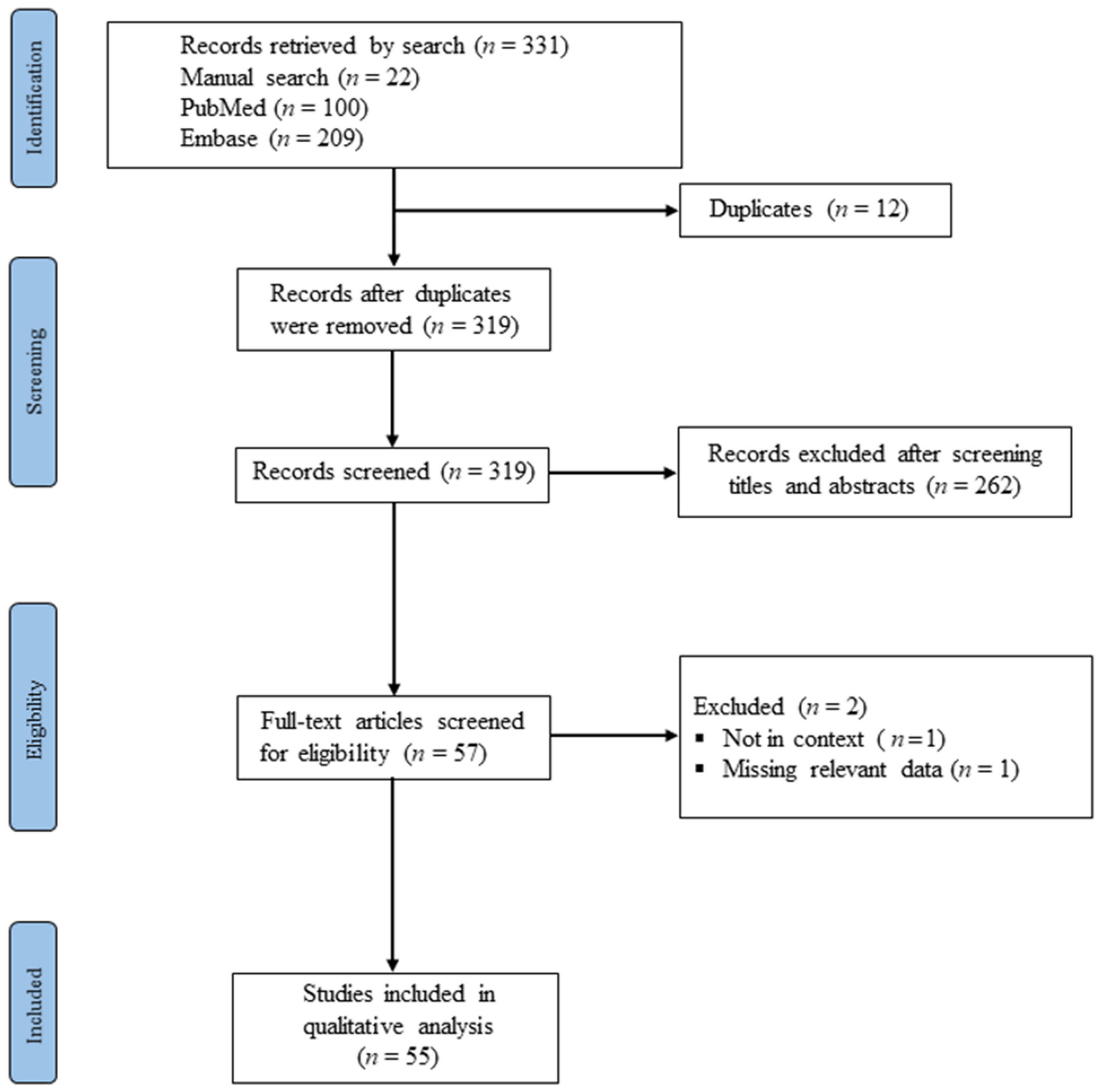
The first search identified 309 articles through the electronic databases (100 in PubMed, and 209 in Embase). Additionally, 22 articles were added via the manual search of the reference lists of the included citations, totaling 331 papers (see Figure 1 for the outcomes of the search processes). After duplicates were removed, 319 studies remained. We screened the titles and abstracts of the 319 records against the stated eligibility criteria of the study. Finally, 55 studies were included for further synthesis and analysis. Figure 1 illustrates the flowchart of the study search and screening processes, and Table 1 presents the characteristics of the included studies.
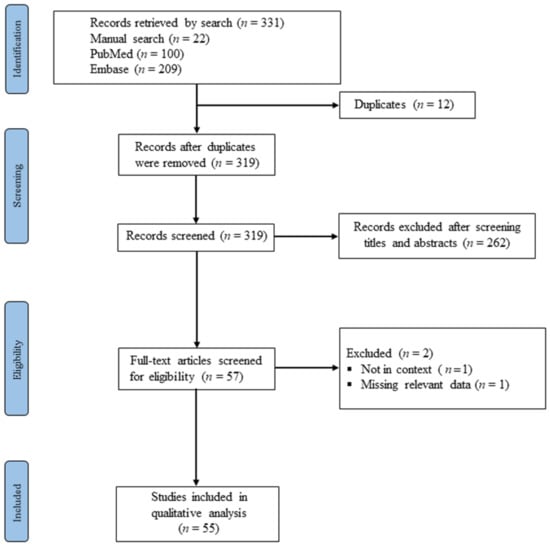
Figure 1.
PRISMA diagram for the study search and selection processes.

Table 1.
Features of the included studies.
3.2. Antiprotozoal Effect of Snake Crude Venoms
We identified 55 studies that met our inclusion criteria, of which 20 were conducted to evaluate the antiprotozoal efficacy of snake crude venoms [18,21,28,34,35,36,38,40,43,45,46,47,49,50,58,61,62,63,65,69]. We identified a previous study that reported the antiprotozoal effect of snake crude venoms, with some hypotheses about the specific snake venom fractions responsible for antiprotozoal activity without proof from laboratory trials [10]. Three reports [35,50,61] hypothesized that several proteins identified from the crude venom of Bitis arietans (B. arietans) could be responsible for its trypanocidal activity. Alape-Giron et al. [73] described snake venoms as a mixture of structured peptides, including enzymes and toxins, that comprise metalloproteases (41–44%), PLA2s (29–45%), serine proteases (4–18%), LAAOs (5–59%), disintegrins (1–2%), C-type lectin-like proteins (0.5%) and cysteine-rich secretory proteins (CRISPs; 0.1%). Similarly, Imam et al. [50] reported that the venom of B. arietans is composed of several catalytically active enzymes, including PLA2, LAAOs and CRISPs. Adade et al. [18] also reported that crovirin, a CRISP contained in the snake venom of Crolatus viridis viridis, showed promising activity against T. cruzi. PLA2s have equally been reported to have antitrypanosomal activity [34].
Furthermore, previous studies [28,69] showed the impact of the trypanocidal activity of LAAOs. However, this may exclude the possibility that the other proteins reported by Chechet et al. [35], which corresponded to those reported by Guidlolin et al. [74], were responsible for the antitrypanosomal activity, either singly or synergistically. According to Peichoto et al. [62], the activity of the crude venom on the protozoal species was due to trimorphin. However, several works [18,40,45,46] suggested the need for further research to ascertain which components possess antiprotozoal efficacy, though crucial information has been reported on them, including their molecular weight and thermal stability [45,46]. Similarly, a need was reported to further investigate the fractions of B. jararaca and C.d. terrificus with antigiardial potential, suggesting that more research will provide details on the mechanisms of action [75].
3.3. Antiprotozoal Effect of Snake Venom Components or Fractions
LAAOs are oxidoreductase flavoenzymes that catalyze the stereospecific oxidative deamination of L-amino acids to produce the α-keto acids, NH3 and H2O2 [25]. They form part of several proteins in ophidians, particularly hemorrhagic venoms. LAAOs have been reported to possess the ability to induce apoptosis in several types of cells [25], including vascular endothelial cells, but the mechanism of action remains unclear. The LAAO activity has been proven to be due to H2O2 production, which, in turn, has been linked with the oxidation of several proteins in the plasma membrane [1]. Our systematic review found different documented antiprotozoal activities of LAAOs. Several researchers reported antileishmanial activity in the respective species [31,32,36,67,70]. Other [25,37,38,42,60] showed their influence on growth inhibition, cytotoxic activity, inhibitory effect, programmed cell death and parasite killing on trypanosomatids. Furthermore, the LAAOs of Bothrops pirajai resulted in maximal inhibition of infection with T. gondii [51].
PLA2s are enzymatic proteins with a low molecular weight. They are responsible for promoting hydrolysis of the 3-sn-phosphoglyceride-dependent calcium 2-acyl ester bond, resulting in lysophospholipids and fatty acid products [1]. The PLA2s of snake venoms may appear to be the same but could have different toxicological efficacies in their myotoxicity, neurotoxicity, anticoagulant activity, hemolysis, hyperalgesia, inflammation, edema, cytotoxicity, hypotension, and parasitic activity [10]. The activity of PLA2s on protozoal species varies across species of snakes and the protozoal organisms involved, as described in Table 1. Previous reports [34,47,71] indicated the inhibitory effects of PLA2s of the respective snake venoms on P. falciparum. According to many other studies [21,58,59,68], various PLA2s inhibited the cellular viability of Leishmania species. In addition, Borges et al. [29] and Borges et al. [30] reported that PLA2s of B. pauloensis inhibited parasite adhesion, intracellular proliferation, parasite viability, intracellular proliferation and pro-inflammatory cytokine production in T. gondii. Furthermore, the PLA2s of B. pauloensis induced in vitro cell death in L. mexicana [52], and Zieler et al. [72] reported that the PLA2s of C. adamanteus blocked the ookinete adhesion and oocyst formation of both P. gallinaceum and P. falciparum. According to a previous study [63], crotoxin B and its complex from C. durissus cumanensis exerted a cytotoxic effect against the mononuclear cells of P. falciparum, and another [19] reported that the crovirin from C. viridis could inhibit and lyse human-infective trypanosome species, including the intracellular amastigotes. However, despite the successful antiprotozoal activities of PLA2s on protozoal species, Costa-Torres et al. [38] reported that the PLA2s of B. marajoensis did not promote any inhibition of L. amazonensis or L. chagasi growth. Similarly, Grabner et al. [47] reported that the PLA2s of B. marajoensis did not promote the in vitro inhibition of cellular viability in T. cruzi epimastigote, even at 100 μg/mL.
Snake venom metalloproteases (SVMPs) are zinc-dependent proteinases of around 20–110 kDa [76]. They are grouped into P-I, P-II and P-III classes according to their structural domains. These toxins are significant in viper venom compositions and have a substantial role in the toxicity of these venoms. The origin of SVMPs is linked to disintegrin and metalloproteinase (ADAM) proteins, particularly ADAM28 [77], with the P-III class being the most basal structural variant, comprising metalloproteinase, disintegrin-like, and cysteine-rich domains. Subsequently, P-II SVMPs came from P-IIIs and consisted of a metalloprotease and disintegrin domain, with the latter particularly found in venom as a proteolytically processed product [1]. The final class, PI SVMPs, which have only the metalloproteinase domain, evolved on multiple independent occasions in specific lineages due to the loss of the P-II disintegrin coding domain. SVMPs contribute extensively to the hemorrhagic and coagulopathy venom activities following bites by viperid snakes. Their isoform diversity often presents in their venom, likely facilitating synergistic effects such as a simultaneous action on multiple steps of the blood-clotting cascade [1]. Reports [27,52,54] showed the antiprotozoal activities of a metalloproteinase from the Bothrops species on T. gondii, and P. falciparum, which is one of the most threatening and widespread species.
4. Discussion
A total of 55 articles on the antiprotozoal effect of snake venoms and their components were identified through our systematic search of the existing literature. The majority were on the antiprotozoal efficacy of PLA2s. Over 70% of the snake species reported were vipers, with very few reports on the Colubridae species [78]. A significant proportion (around 20%) constituted species of the Elapidae family. PLA2s form a considerable component in the venoms of vipers and elapids [78], due to their biomedical importance over others [79]. PLA2s have catalytically active and inactive components. Asp49-PLA2s are the catalytically active component, and Lys49-PLA2s are the catalytically inactive component, which can facilitate pharmacological effects regardless of catalytic activity [80,81]. Findings on both the catalytically active and catalytically inactive PLA2s were reported in our study. The mediation of antiprotozoal effects by PLA2s could occur through the interaction of either PLA2 phospholipids or PLA2 proteins. Interestingly, the commonly described receptors in the cell membranes are the vascular endothelial growth factor receptor-2 (VEGFR-2), M-type receptors, and nucleolin [82,83]. Bregge-Silva et al. [31] reported synergism involving the PLA2 isoforms of B. asper, which resulted in around a 10-fold increase in antiplasmodial activity during the association of AS49-PLA2 and LYS49-PLA2.
Synergism is an important phenomenon that occurs in snake venoms, leading to evolving strategies to potentiate toxicities. Synergism exists between toxins or toxin complexes in various snake venoms, with PLA2s (toxins or subunits) the primary enablers [84]. Snake venoms can induce considerable toxicity, which may be due to many toxins’ cumulative or synergistic roles. Their compositions function together, directly or indirectly, and result in improved toxicity and pharmacological efficacy. Most synergisms of toxins have been noticed where SVSPs, PLA2s, 3FTxs and SVMPs were co-administered [84]. Synergism involving two PLA2s in B. asper has also been reported [85]. The ASP49-PLA2 and LYS49-PLA2 homologs were reported to have acted synergistically, leading to an increase in Ca2+ ions in the plasma membrane, in turn resulting in the rapid death of myotubes. Another study reported a synergistic phenomenon between the myotoxins of ASP49-PLA2 and LYS49-PLA2, which resulted in irreversible membrane and overall cell damage [86].
Concerning the antiprotozoal activity of whole crude venoms, variations in their activity and composition are not uncommon, leading to their unique potentials in biomedical research [79]. The past literature has noted that variations in snake venoms’ biochemical makeup occur even among closely related species and within species [87,88,89]. For instance, in pit vipers and adders, intra-genus or intra-specific variation in venoms has been documented [87,90]. These diversities are attributed to diet [87,91,92,93] or topography [94,95]. Other attributable factors include repetitions in toxin-encoding genes, production processes [96,97,98,99,100], and functional and structural diversifications [75,88,101,102]. For example, venom from Laticauda semifasciata (a sea snake) does not have a complex composition, and it has just two prominent families of proteins, 3FTxs and PLA2s. However, the venoms of rattlesnakes and mambas can have 50–100 peptides or proteins, representing around 10–20 protein families [84]. Generally, the predominant protein families in snake venoms significantly comprise phylogenetic trends. The venoms of cobras, kraits, mambas and hydrophids in particular have more negligible toxins, such as 3FTxs and PLA2s. In contrast, viperid venoms are made up of more significant fractions with enzymatic activities such as snake venom metalloproteinase and snake venom serine protease [84]. For instance, the venom of C. durissus terrificus is composed of amino acids, small peptides, carbohydrates, lipids, biogenic amines, and enzymes, whereas that of B. jararaca has peptides, serine, and metalloproteases as its constituents [75]. Hence, the activity of venoms varies with the difference in concentrations and compositions.
Aside from the role of snake species in the antiprotozoal effect, parasites also present contributing factors. Promastigotes and amastigotes are physiologically different in their sensitivity to drugs, with amastigotes having the greater capability to accumulate drugs [75]. Furthermore, Podešvová et al. [52] reported that variations in the compositions of parasite membranes could also be responsible for the differences in the activities of snake venoms and their fractions. Additionally, mechanisms including post-translational modifications, protein stability, and folding may likely influence toxin activity on parasites [52].
4.1. Strengths
This systematic review was conducted following an extensive literature search of the pertinent PubMed and Embase databases. Relevant citations were extracted using the reference lists of the included studies to ensure robust coverage of the existing literature. The systematic review covered studies on the antiprotozoal effect of crude venoms and their components from clinical studies and scientific reports. No restrictions were placed on the year of publication to ensure the thorough collation of relevant information. Equally, the study inclusion criteria were not restricted to snake species or components, to provide detailed information to the research community on the research question and the gaps in the literature.
4.2. Limitations
Despite the strengths of our systematic review, it has some limitations. First, we restricted inclusion to studies published in English, thereby limiting the ability to incorporate relevant data from studies in languages other than English. Additionally, incorporating a meta-analysis on the antiprotozoal efficacy of venoms and their fractions would have improved the quality of our work, which could be considered in future studies.
5. Conclusions
This systematic review provides a general overview of the antiprotozoal effect of snake venoms and their components. We found varying antiprotozoal activities, presenting outstanding breakthroughs in the quest for alternative therapies for lingering protozoal infections. However, several variations were documented, including the concentrations of the crude venoms and fractions used, IC50 dosages, protozoan species, and antiprotozoal activities. These findings present challenges as to how the reviewed snake venoms and their fractions could serve as alternative antiprotozoal agents for many protozoal species, if not all. An excellent approach to this dilemma could be gearing research efforts toward understanding the relationships between venom components in the context of synergism, rather than toward studies on individual units, mainly because venomous snake species are numerous. Future studies also need to focus on other snake venom components that have received little attention. We recommend that other protozoan species should be subjected to trials with crude snake venoms and their fractions.
Supplementary Materials
The following are available online at https://www.mdpi.com/article/10.3390/pathogens10121632/s1, Table S1: Search strategy.
Author Contributions
Conceptualization, data curation, formal analysis, formal analysis, investigation, methodology, project administration, resources, validation, visualization, writing—original draft, writing—review and editing: Z.U.A.; conceptualization, data curation, formal analysis, funding acquisition, investigation, methodology, project administration, resources, supervision, validation, visualization, writing—original draft, writing—review and editing: S.S.M.; Conceptualization, data curation, formal analysis, formal analysis, investigation, methodology, project administration, resources, validation, visualization, writing—original draft, writing—review and editing: D.H.; conceptualization, data curation, formal analysis, funding acquisition, investigation, methodology, project administration, resources, supervision, validation, visualization, writing—original draft, writing—review and editing: U.M.B. All authors have read and agreed to the published version of the manuscript.
Funding
This research received no external funding.
Institutional Review Board Statement
Not applicable.
Informed Consent Statement
Not applicable.
Data Availability Statement
All data used in this study can be obtained from the public domain.
Acknowledgments
The authors are grateful to the editor and anonymous reviewers for their insightful comments, which were used to improve the manuscript from its initial version. UMB would like to acknowledge the support of the Government of Hong Kong Special Administrative Region & Innovation and Technology Fund.ss.
Conflicts of Interest
The authors declare no conflict of interest.
References
- Ferraz, C.R.; Arrahman, A.; Xie, C.; Casewell, N.R.; Lewis, R.J.; Kool, J.; Cardoso, F.C. Multifunctional toxins in snake venoms and therapeutic implications: From pain to hemorrhage and necrosis. Front. Ecol. Evol. 2019, 7, 218. [Google Scholar] [CrossRef]
- Chan, Y.S.; Cheung, R.C.F.; Xia, L.; Wong, J.H.; Ng, T.B.; Chan, W.Y. Snake venom toxins: Toxicity and medicinal applications. Appl. Microbiol. Biotechnol. 2016, 100, 6165–6181. [Google Scholar] [CrossRef] [PubMed]
- Zhang, Y. Why do we study animal toxins? Zool. Res. 2015, 36, 183–222. [Google Scholar] [CrossRef]
- Tasoulis, T.; Isbister, G.K. A review and database of snake venom proteomes. Toxins 2017, 9, 290. [Google Scholar] [CrossRef] [PubMed]
- Munawar, A.; Ali, S.A.; Akrem, A.; Betzel, C. Snake venom peptides: Tools of biodiscovery. Toxins 2018, 10, 474. [Google Scholar] [CrossRef]
- Gutiérrez, J.M.; Calvete, J.J.; Habib, A.G.; Harrison, R.A.; Williams, D.J.; Warrell, D.A. Snakebite envenoming. Nat. Rev. Dis. Prim. 2017, 3, 17063. [Google Scholar] [CrossRef] [PubMed]
- WHO Africa. Guidelines for the Prevention and Clinical Management of Snake Bite in Africa. 2010. Available online: http://www.afro.who.int/index.php?option=com_docman&task=doc_download&gid=5529 (accessed on 6 October 2021).
- Tsetlin, V.I. Three-finger snake neurotoxins and Ly6 proteins targeting nicotinic acetylcholine receptors: Pharmacological tools and endogenous modulators. Trends Pharmacol. Sci. 2015, 36, 109–123. [Google Scholar] [CrossRef]
- Harhay, M.O.; Horton, J.; Olliaro, P.L. Epidemiology and control of human gastrointestinal parasites in children. Expert Rev. Anti-Infect. Ther. 2010, 8, 219–234. [Google Scholar] [CrossRef] [PubMed]
- Adade, C.M.; Souto-Padrón, T. Venoms as sources of novel anti-parasitic agents. In Toxins and Drug Discovery; Springer: Dordrecht, The Netherlands, 2015. [Google Scholar]
- Menna-Barreto, R.F.S. Cell death pathways in pathogenic trypanosomatids: Lessons of (over) kill. Cell Death Dis. 2019, 10, 93. [Google Scholar] [CrossRef]
- Monzote, L.; Siddiq, A. Drug development to protozoan diseases. Open Med. Chem. J. 2011, 5, 1–3. [Google Scholar] [CrossRef]
- Utzinger, J.; Becker, S.L.; Knopp, S.; Blum, J.; Neumayr, A.L.; Keiser, J.; Hatz, C.F. Neglected tropical diseases: Diagnosis, clinical management, treatment and control. Swiss Med. Wkly. 2012, 142, w13727. [Google Scholar] [CrossRef] [PubMed]
- Müller, J.; Hemphill, A. New approaches for the identification of drug targets in protozoan parasites. Int. Rev. Cell Mol. Biol. 2013, 301, 359–401. [Google Scholar] [CrossRef] [PubMed]
- Bocian, A.; Hus, K.K. Antibacterial properties of snake venom components. Chem. Pap. 2020, 74, 407–419. [Google Scholar] [CrossRef]
- Page, M.J.; McKenzie, J.E.; Bossuyt, P.M.; Boutron, I.; Hoffmann, T.C.; Mulrow, C.D.; Shamseer, L.; Tetzlaff, J.M.; Moher, D. Updating guidance for reporting systematic reviews: Development of the PRISMA 2020 statement. J. Clin. Epidemiol. 2021, 134, 103–112. [Google Scholar] [CrossRef]
- Campbell, M.; McKenzie, J.E.; Sowden, A.; Katikireddi, S.V.; Brennan, S.E.; Ellis, S.; Hartmann-Boyce, J.; Ryan, R.; Shepperd, S.; Thomas, J.; et al. Synthesis without meta-analysis (SWiM) in systematic reviews: Reporting guideline. BMJ 2020, 368, l6890. [Google Scholar] [CrossRef]
- Adade, C.M.; Cons, B.L.; Melo, P.A.; Souto-Padrón, T. Effect of Crotalus viridis viridissnake venom on the ultrastructure and intracellular survival of Trypanosoma cruzi. Parasitology 2011, 138, 46–58. [Google Scholar] [CrossRef] [PubMed]
- Adade, C.M.; Carvalho, A.L.; Tomaz, M.A.; Costa, T.F.; Godinho, J.L.; Melo, P.A.; Lima, A.P.C.A.; Rodrigues, J.C.F.; Zingali, R.B.; Souto-Padrón, T. Crovirin, a snake venom cysteine-rich secretory protein (CRISP) with promising activity against Trypanosomes and Leishmania. PLoS Negl. Trop. Dis. 2014, 8, e3252. [Google Scholar] [CrossRef]
- Adade, C.M.; Cristine, S.F.A.; Lúcia, O.C.A.; Zingali, R.B.; Souto-Padrón, T. Leishmanicidal effects of a phospholipase A2 isolated from Crotalus viridis viridis snake venom. Toxicon 2012, 60, 117. [Google Scholar] [CrossRef]
- Alfonso, J.J.; Kayano, A.M.; Garay, A.F.G.; Simões-Silva, R.; Sobrinho, J.C.; Vourliotis, S.; Soares, A.; Calderon, L.; Gómez, M.C.V. Isolation, biochemical characterization and antiparasitic activity of BmatTX-IV, a basic Lys49-phospholipase A2 from the venom of bothrops mattogrossensis from Paraguay. Curr. Top. Med. Chem. 2019, 19, 2041–2048. [Google Scholar] [CrossRef] [PubMed]
- Allane, D.; Oussedik-Oumehdi, H.; Harrat, Z.; Seve, M.; Laraba-Djebari, F. Isolation and characterization of an anti-leishmanial disintegrin from Cerastes cerastes venom. J. Biochem. Mol. Toxicol. 2018, 32, e22018. [Google Scholar] [CrossRef]
- Aranda-Souza, M.Â.; de Lorena, V.M.B.; dos Santos Correia, M.T.; de Figueiredo, R.C.B.Q. In vitro effect of Bothrops leucurus lectin (BLL) against Leishmania amazonensis and Leishmania braziliensis infection. Int. J. Biol. Macromol. 2018, 120, 431–439. [Google Scholar] [CrossRef] [PubMed]
- Bandeira, I.C.J.; Bandeira-Lima, D.; Mello, C.P.; Pereira, T.P.; Menezes, R.; Sampaio, T.L.; Falcao, C.; Rádis-Baptista, G.; Martins, A.M.C. Antichagasic effect of crotalicidin, a cathelicidin-like vipericidin, found in Crotalus durissus terrificus rattlesnake’s venom gland. Parasitology 2018, 145, 1059–1064. [Google Scholar] [CrossRef]
- Barbosa, L.G.; Costa, T.R.; Borges, I.P.; Costa, M.S.; Carneiro, A.C.; Borges, B.C.; Silva, M.J.B.; Amorim, F.G.; Quinton, L.; Yoneyama, K.A.G.; et al. A comparative study on the leishmanicidal activity of the L-amino acid oxidases BjussuLAAO-II and BmooLAAO-II isolated from Brazilian Bothrops snake venoms. Int. J. Biol. Macromol. 2021, 167, 267–278. [Google Scholar] [CrossRef] [PubMed]
- Barros, G.A.; Pereira, A.V.; Barros, L.C.; Lourenço, A.; Calvi, S.A.; Santos, L.D.; Barraviera, B.; Jr, R.S.F.; Jr, A.L. In vitro activity of phospholipase A2 and of peptides from Crotalus durissus terrificus venom against amastigote and promastigote forms of Leishmania (L.) infantum chagasi. J. Venom. Anim. Toxins Incl. Trop. Dis. 2015, 21, 48. [Google Scholar] [CrossRef] [PubMed]
- Bastos, L.M.; Júnior, R.J.O.; Silva, D.A.O.; Mineo, J.R.; Vieira, C.U.; Teixeira, D.N.S.; Homsi-Brandeburgo, M.I.; Rodrigues, V.D.M.; Hamaguchi, A. Toxoplasma gondii: Effects of neuwiedase, a metalloproteinase from Bothrops neuwiedi snake venom, on the invasion and replication of human fibroblasts in vitro. Exp. Parasitol. 2008, 120, 391–396. [Google Scholar] [CrossRef] [PubMed]
- Bhattacharya, S.; Ghosh, P.; De, T.; Gomes, A.; Gomes, A.; Dungdung, S.R. In vivo and in vitro antileishmanial activity of Bungarus caeruleus snake venom through alteration of immunomodulatory activity. Exp. Parasitol. 2013, 135, 126–133. [Google Scholar] [CrossRef]
- Borges, I.P.; Castanheira, L.E.; Barbosa, B.F.; de Souza, D.L.N.; da Silva, R.J.; Mineo, J.R.; Tudini, K.A.Y.; Rodrigues, R.S.; Ferro, E.A.V.; Rodrigues, V.D.M. Anti-parasitic effect on Toxoplasma gondii induced by BnSP-7, a Lys49-phospholipase A2 homologue from Bothrops pauloensis venom. Toxicon 2016, 119, 84–91. [Google Scholar] [CrossRef]
- Borges, I.P.; Silva, M.F.; Santiago, F.M.; de Faria, L.S.; Júnior, Á.F.; da Silva, R.J.; Costa, M.S.; de Freitas, V.; Yoneyama, K.A.G.; Ferro, E.A.V.; et al. Antiparasitic effects induced by polyclonal IgY antibodies anti-phospholipase A2 from Bothrops pauloensis venom. Int. J. Biol. Macromol. 2018, 112, 333–342. [Google Scholar] [CrossRef]
- Bregge-Silva, C.; Nonato, M.C.; de Albuquerque, S.; Ho, P.L.; de Azevedo, I.L.J.; Diniz, M.R.V.; Lomonte, B.; Rucavado, A.; Díaz, C.; Gutiérrez, J.M.; et al. Isolation and biochemical, functional and structural characterization of a novel l-amino acid oxidase from Lachesis muta snake venom. Toxicon 2012, 60, 1263–1276. [Google Scholar] [CrossRef]
- Carone, S.E.I.; Costa, T.R.; Burin, S.M.; Cintra, A.C.O.; Zoccal, K.F.; Bianchini, F.J.; Tucci, L.F.; Franco, J.J.; Torqueti, M.R.; Faccioli, L.H.; et al. A new l-amino acid oxidase from Bothrops jararacussu snake venom: Isolation, partial characterization, and assessment of pro-apoptotic and antiprotozoal activities. Int. J. Biol. Macromol. 2017, 103, 25–35. [Google Scholar] [CrossRef] [PubMed]
- Bregge-Silva, C.; Nonato, M.C.; de Albuquerque, S.; Ho, P.L.; de Azevedo, I.L.J.; Diniz, M.R.V.; Lomonte, B.; Rucavado, A.; Díaz, C.; Gutiérrez, J.M.; et al. Insights into anti-parasitism induced by a C-type lectin from Bothrops pauloensis venom on Toxoplasma gondii. Int. J. Biol. Macromol. 2015, 74, 568–574. [Google Scholar]
- Castillo, J.C.; Vargas, L.J.; Segura, C.; Gutiérrez, J.M.; Pérez, J.C. In vitro antiplasmodial activity of phospholipases A2 and a phospholipase homologue isolated from the venom of the snake Bothrops asper. Toxins 2012, 4, 1500–1516. [Google Scholar] [CrossRef]
- Chechet, G.; Peter, G. In vitro anti-trypanosomal activity of Bitis arietans crude venom against Trypanosoma brucei brucei. Niger. Vet. J. 2018, 39, 308. [Google Scholar] [CrossRef]
- Ciscotto, P.; De Avila, R.M.; Coelho, E.; Oliveira, J.; Diniz, C.; Farías, L.; de Carvalho, M.; Maria, W.; Sanchez, E.; Borges, A.; et al. Antigenic, microbicidal and antiparasitic properties of an l-amino acid oxidase isolated from Bothrops jararaca snake venom. Toxicon 2009, 53, 330–341. [Google Scholar] [CrossRef] [PubMed]
- Costa, T.R.; Menaldo, D.L.; Prinholato da Silva, C.; Sorrechia, R.; de Albuquerque, S.; Pietro, R.C.L.R.; Ghisla, S.; Antunes, L.M.G.; Sampaio, S.V. Evaluating the microbicidal, antiparasitic and antitumor effects of CR-LAAO from Calloselasma rhodostoma venom. Int. J. Biol. Macromol. 2015, 80, 489–497. [Google Scholar] [CrossRef] [PubMed]
- Costa Torres, A.F.; Dantas, R.T.; Toyama, M.H.; Diz Filho, E.; Zara, F.J.; Rodrigues de Queiroz, M.G.; Nogueira, N.A.P.; Oliveira, M.; Toyama, D.D.O.; Monteiro, H.S.; et al. Antibacterial and antiparasitic effects of Bothrops marajoensis venom and its fractions: Phospholipase A2 and l-amino acid oxidase. Toxicon 2010, 55, 795–804. [Google Scholar] [CrossRef] [PubMed]
- De Barros, N.B.; Macedo, S.R.A.; Ferreira, A.S.; Tagliari, M.P.; Zanchi, F.B.; Kayano, A.M.; Soares, A.; Nicolete, R. Liposomes containing an ASP49-phospholipase A 2 from Bothrops jararacussu snake venom as experimental therapy against cutaneous leishmaniasis. Int. Immunopharmacol. 2016, 36, 225–231. [Google Scholar] [CrossRef] [PubMed]
- de Menezes, R.R.; Torres, A.F.; da Silva, T.S.; de Sousa, D.F.; Lima, D.B.; Norjosa, D.B.; Nogueira, N.A.; Oliveira, M.F.; de Oliveira, M.R.; Monteiro, H.S.; et al. Antibacterial and antiparasitic effects of Bothropoides lutzi venom. Nat. Prod. Commun. 2012, 7, 71–74. [Google Scholar] [CrossRef] [PubMed]
- Dematei, A.; Nunes, J.B.; Moreira, D.C.; Jesus, J.A.; Laurenti, M.D.; Mengarda, A.C.; Vieira, M.S.; Amaral, C.P.D.; Domingues, M.M.; de Moraes, J.; et al. Mechanistic insights into the leishmanicidal and bactericidal activities of batroxicidin, a cathelicidin-related peptide from a South American viper (Bothrops atrox). J. Nat. Prod. 2021, 84, 1787–1798. [Google Scholar] [CrossRef] [PubMed]
- Deolindo, P.; Teixeira-Ferreira, A.S.; DaMatta, R.A.; Alves, E.W. L-amino acid oxidase activity present in fractions of Bothrops jararaca venom is responsible for the induction of programmed cell death in Trypanosoma cruzi. Toxicon 2010, 56, 944–955. [Google Scholar] [CrossRef] [PubMed]
- Deolindo, P.; Teixeira-Ferreira, A.S.; Melo, E.J.T.; Arnholdt, A.C.; De Souza, W.; Alves, E.W.; DaMatta, R.A. Programmed cell death in Trypanosoma cruzi induced by Bothrops jararaca venom. Mem. Inst. Oswaldo Cruz 2005, 100, 33–38. [Google Scholar] [CrossRef]
- El Chamy Maluf, S.; Dal Mas, C.; Oliveira, E.B.; Melo, P.M.; Carmona, A.K.; Gazarini, M.L.; Hayashi, M. Inhibition of malaria parasite Plasmodium falciparum development by crotamine, a cell penetrating peptide from the snake venom. Peptides 2016, 78, 11–16. [Google Scholar] [CrossRef] [PubMed]
- Fernandez-Gomez, R.; Zerrouk, H.; Sebti, F.; Loyens, M.; Benslimane, A.; Ouaissi, M.A. Growth inhibition of Trypanosoma cruzi and Leishmania donovani infantum by different snake venoms: Preliminary identification of proteins from Cerastes cerastes venom which interact with the parasites. Toxicon 1994, 32, 875–882. [Google Scholar] [CrossRef]
- Gonçalves, A.R.; Soares, M.J.; de Souza, W.; DaMatta, R.A.; Alves, E.W. Ultrastructural alterations and growth inhibition of Trypanosoma cruzi and Leishmania major induced by Bothrops jararaca venom. Parasitol. Res. 2002, 88, 598–602. [Google Scholar] [CrossRef] [PubMed]
- Grabner, A.N.; Alfonso, J.; Kayano, A.M.; Moreira-Dill, L.S.; Dos Santos, A.P.A.; Caldeira, C.A.S.; Sobrinho, J.C.; Gómez, A.; Grabner, F.P.; Cardoso, F.F.; et al. BmajPLA(2)-II, a basic Lys49-phospholipase A(2) homologue from Bothrops marajoensis snake venom with parasiticidal potential. Int. J. Biol. Macromol. 2017, 102, 571–581. [Google Scholar] [CrossRef] [PubMed]
- Guillaume, C.; Deregnaucourt, C.; Clavey, V.; Schrével, J. Anti-plasmodium properties of group IA, IB, IIA and III secreted phospholipases A2 are serum-dependent. Toxicon 2004, 43, 311–318. [Google Scholar] [CrossRef] [PubMed]
- Hajialiani, F.; Elmi, T.; Mohamadi, M.; Sadeghi, S.; Shahbazzadeh, D.; Ghaffarifar, F.; Dalimi, A.; Arjmand, M.; Tabatabaie, F.; Zamani, Z. Analysis of the active fraction of Iranian Naja naja oxiana snake venom on the metabolite profiles of the malaria parasite by 1HNMR in vitro. Iran. J. Basic Med. Sci. 2020, 23, 534. [Google Scholar] [PubMed]
- Imam, T.S.; Tukur, Z.; Bala, A.A.; Ahmad, N.B.; Ugya, A.Y. In vitro trichomonocidal potency of Naja nigricollis and Bitis arietans snake venom. Int. J. One Health 2021, 7, 6–12. [Google Scholar] [CrossRef]
- Izidoro, L.F.; Alves, L.M.; Rodrigues, V.M.; Silva, D.A.; Mineo, J.R. Bothrops pirajai snake venom L-amino acid oxidase: In vitro effects on infection of Toxoplasma gondii in human foreskin fibroblasts. Rev. Bras. Farmacogn. 2011, 21, 477–485. [Google Scholar] [CrossRef]
- Podešvová, L.; Leštinová, T.; Horáková, E.; Lukeš, J.; Volf, P.; Yurchenko, V. Suicidal Leishmania. Pathogens 2020, 9, 79. [Google Scholar] [CrossRef] [PubMed]
- Macedo, S.R.; de Barros, N.B.; Ferreira, A.S.; Moreira-Dill, L.S.; Calderon, L.A.; Soares, A.M.; Nicolete, R. Biodegradable microparticles containing crotamine isolated from Crotalus durissus terrificus display antileishmanial activity in vitro. Pharmacology 2015, 95, 78–86. [Google Scholar] [CrossRef]
- Martins, G.G.; de Jesus Holanda, R.; Alfonso, J.; Gómez Garay, A.F.; Dos Santos, A.P.A.; de Lima, A.M.; Francisco, A.F.; Teles, C.B.G.; Zanchi, F.B.; Soares, A. Identification of a peptide derived from a Bothrops moojeni metalloprotease with in vitro inhibitory action on the Plasmodium falciparum purine nucleoside phosphorylase enzyme (PfPNP). Biochimie 2019, 162, 97–106. [Google Scholar] [CrossRef] [PubMed]
- Mello, C.P.; Lima, D.B.; Bandeira, I.C.J.; Tessarolo, L.D.; Sampaio, T.L.; Falcão, C.B.; Rádis-Baptista, G.; Martins, A.M.C. Evaluation of the antichagasic activity of batroxicidin, a cathelicidin-related antimicrobial peptide found in Bothrops atrox venom gland. Toxicon 2017, 130, 56–62. [Google Scholar] [CrossRef] [PubMed]
- Mendes, B.; Almeida, J.R.; Vale, N.; Gomes, P.; Gadelha, F.R.; Da Silva, S.L.; Miguel, D.C. Potential use of 13-mer peptides based on phospholipase and oligoarginine as leishmanicidal agents. Comp. Biochem. Physiol. Part C Toxicol. Pharmacol. 2019, 226, 108612. [Google Scholar] [CrossRef]
- Merkel, P.; Beck, A.; Muhammad, K.; Ali, S.A.; Schönfeld, C.; Voelter, W.; Duszenko, M. Spermine isolated and identified as the major trypanocidal compound from the snake venom of Eristocophis macmahoni causes autophagy in Trypanosoma brucei. Toxicon 2007, 50, 457–469. [Google Scholar] [CrossRef]
- Moura, A.A.D.; Kayano, A.M.; Oliveira, G.A.; Setúbal, S.S.; Ribeiro, J.G.; Barros, N.B.; Nicolete, R.; Moura, L.A.; Fuly, A.L.; Nomizo, A.; et al. Purification and biochemical characterization of three myotoxins from Bothrops mattogrossensis snake venom with toxicity against Leishmania and tumor cells. BioMed Res. Int. 2014, 2014, 195356. [Google Scholar] [CrossRef] [PubMed]
- Nunes, D.C.; Figueira, M.M.; Lopes, D.S.; De Souza, D.L.N.; Izidoro, L.F.M.; Ferro, E.A.; Souza, M.A.; Rodrigues, R.S.; Rodrigues, V.M.; Yoneyama, K.A.G. BnSP-7 toxin, a basic phospholipase A2 from Bothrops pauloensis snake venom, interferes with proliferation, ultrastructure and infectivity of Leishmania (Leishmania) amazonensis. Parasitology 2013, 140, 844–854. [Google Scholar] [CrossRef]
- Paiva, R.D.M.A.; de Freitas Figueiredo, R.; Antonucci, G.A.; Paiva, H.H.; Bianchi, M.D.L.P.; Rodrigues, K.C.; Lucarini, R.; Caetano, R.C.; Pietro, R.C.L.R.; Martins, C.H.G.; et al. Cell cycle arrest evidence, parasiticidal and bactericidal properties induced by L-amino acid oxidase from Bothrops atrox snake venom. Biochimie 2011, 93, 941–947. [Google Scholar] [CrossRef]
- Passero, L.F.; Tomokane, T.Y.; Corbett, C.E.; Laurenti, M.D.; Toyama, M.H. Comparative studies of the anti-leishmanial activity of three Crotalus durissus ssp. venoms. Parasitol. Res. 2007, 101, 1365–1371. [Google Scholar] [CrossRef] [PubMed]
- Peichoto, M.E.; Tavares, F.L.; DeKrey, G.; Mackessy, S.P. A comparative study of the effects of venoms from five rear-fanged snake species on the growth of Leishmania major: Identification of a protein with inhibitory activity against the parasite. Toxicon 2011, 58, 28–34. [Google Scholar] [CrossRef] [PubMed]
- Quintana, J.C.; Chacón, A.; Vargas, L.; Segura, C.; Gutiérrez, J.M.; Alarcón, J.C. Antiplasmodial effect of the venom of Crotalus durissus cumanensis, crotoxin complex and Crotoxin B. Acta Trop. 2012, 124, 126–132. [Google Scholar] [CrossRef]
- Sharifi, I.; Tabatabaie, F.; Nikpour, S.; Mostafavi, M.; Oliaee, R.T.; Sharifi, F.; Babaei, Z.; Jafari, E.; Salarkia, E.; Shahbazzadeh, D. The effect of Naja naja oxiana snake venom against Leishmania tropica confirmed by advanced assays. Acta Parasitol. 2021, 66, 475–486. [Google Scholar] [CrossRef] [PubMed]
- Shinohara, L.; de Freitas, S.F.; da Silva, R.J.; Guimarães, S. In vitro effects of Crotalus durissus terrificus and Bothrops jararaca venoms on Giardia duodenalis trophozoites. Parasitol. Res. 2006, 98, 339–344. [Google Scholar] [CrossRef] [PubMed]
- Simões-Silva, R.; Alfonso, J.J.; Gómez, A.F.; Sobrinho, J.C.; Kayano, A.M.; de Medeiros, D.S.S.; Teles, C.B.G.; Quintero, A.; Fuly, A.L.; Gómez, C.V.; et al. Synergism of in vitro plasmodicidal activity of phospholipase A2 isoforms isolated from panamanian Bothrops asper venom. Chem.-Biol. Interact. 2021, 346, 109581. [Google Scholar] [CrossRef]
- Soares, T.G.; Santos, J.L.D.; Alvarenga, V.G.; Santos, J.S.C.; Leclercq, S.Y.; Faria, C.D.; Oliveira, M.A.A.; Bemquerer, M.P.; Sanchez, E.O.F.; De Lima, M.E.; et al. Biochemical and functional properties of a new l-amino acid oxidase (LAAO) from Micrurus lemniscatus snake venom. Int. J. Biol. Macromol. 2020, 154, 1517–1527. [Google Scholar] [CrossRef] [PubMed]
- Stabeli, R.G.; Amui, S.F.; Sant’Ana, C.D.; Pires, M.G.; Nomizo, A.; Monteiro, M.C.; Romão, P.R.; Guerra-Sá, R.; Vieira, C.A.; Giglio, J.R.; et al. Bothrops moojeni myotoxin-II, a Lys49-phospholipase A2 homologue: An example of function versatility of snake venom proteins. Comp. Biochem. Physiol. Part C Toxicol. Pharmacol. 2006, 142, 371–381. [Google Scholar] [CrossRef] [PubMed]
- Tempone, A.G.; Andrade, H.F.; Spencer, P.J.; Lourenço, C.O.; Rogero, J.R.; Nascimento, N. Bothrops moojeni venom kills Leishmania spp. with hydrogen peroxide generated by its l-amino acid oxidase. Biochem. Biophys. Res. Commun. 2001, 280, 620–624. [Google Scholar] [CrossRef]
- Toyama, M.H.; Toyama, D.D.O.; Passero, L.F.; Laurenti, M.D.; Corbett, C.E.; Tomokane, T.Y.; Fonseca, F.V.; Antunes, E.; Joazeiro, P.P.; Beriam, L.O.; et al. Isolation of a new L-amino acid oxidase from Crotalus durissus cascavella venom. Toxicon 2006, 47, 47–57. [Google Scholar] [CrossRef] [PubMed]
- Vitorino, K.A.; Alfonso, J.J.; Gómez, A.F.; Santos, A.P.A.; Antunes, Y.R.; Caldeira, C.A.D.S.; Gómez, C.V.; Teles, C.B.; Soares, A.M.; Calderon, L.A. Antimalarial activity of basic phospho-lipases A2 isolated from Paraguayan Bothrops diporus venom against Plasmodium falciparum. Toxicon X 2020, 8, 100056. [Google Scholar] [CrossRef] [PubMed]
- Zieler, H.; Keister, D.B.; Dvorak, J.A.; Ribeiro, J.M. A snake venom phospholipase A2 blocks malaria parasite development in the mosquito midgut by inhibiting ookinete association with the midgut surface. J. Exp. Biol. 2001, 204, 4157–4167. [Google Scholar] [CrossRef]
- Alape-Giroón, A.; Sanz, L.; Escolano, J.; Flores-Diaz, M.; Madrigal, M.; Sasa, M.; Calvete, J.J. Snake venomics of the lancehead pitviper Bothrops asper: Geographic, individual, and ontogenetic variations. J. Proteome Res. 2008, 7, 3556–3571. [Google Scholar] [CrossRef] [PubMed]
- Guidlolin, R.G.; Marcelino, R.M.; Gondo, H.H.; Morais, J.F.; Ferreira, R.A.; Silva, C.L.; Kipnis, T.L.; Silva, J.A.; Fafetine, J.; da Silva, W.D. Polyvalent horse F (Ab) 2 snake antivenom: Development of process to produce polyvalent horse F (Ab) 2 antibodies anti-african snake venom. Afr. J. Biotechnol. 2010, 9, 2446–2455. [Google Scholar]
- Nikpour, S.; Tabatabaie, F.; Sharifi, I.; Mostafavi, M.; Oliaee, R.T.; Sharifi, F.; Babaei, Z.; Jafari, E.; Salarkia, E.; Shahbazzadeh, D. The fraction of the snake venom, its leishmani-cidal effect, and the stimulation of an anti-leishmania response in infected macrophages. Endocr. Metab. Immune Disord.-Drug Targets 2021, 21, 1115–1124. [Google Scholar] [CrossRef] [PubMed]
- Markland, F.S., Jr.; Swenson, S. Snake venom metalloproteinases. Toxicon 2013, 62, 3–18. [Google Scholar] [CrossRef] [PubMed]
- Casewell, N.R. On the ancestral recruitment of metalloproteinases into the venom of snakes. Toxicon 2012, 60, 449–454. [Google Scholar] [CrossRef]
- Harris, J.B.; Scott-Davey, T. Secreted phospholipases A2 of snake venoms: Effects on the Peripheral neuromuscular system with comments on the role of phospholipases A2 in disorders of the CNS and their uses in industry. Toxins 2013, 5, 2533–2571. [Google Scholar] [CrossRef]
- Deshwal, A.; Phan, P.; Kannan, R.; Thallapuranam, S.K. Patterns in protein components present in rattlesnake venom: A Meta-Analysis. Preprints 2020, 1, 2020090012. [Google Scholar] [CrossRef]
- Fernandez, S.; Hodgson, W.; Chaisakul, J.; Kornhauser, R.; Konstantakopoulos, N.; Smith, A.I.; Kuruppu, S. In Vitro toxic effects of puff adder (Bitis arietans) venom, and their neutralization by antivenom. Toxins 2014, 6, 1586–1597. [Google Scholar] [CrossRef] [PubMed]
- Lomonte, B.; Rangel, J. Snake venom Lys49 myotoxins: From phospholipases A2 to non-enzymatic membrane disruptors. Toxicon 2012, 60, 520–530. [Google Scholar] [CrossRef] [PubMed]
- Lambeau, G.; Ancian, P.; Nicolas, J.P.; Beiboer, S.H.; Moinier, D.; Verheij, H.; Lazdunski, M. Structural elements of secretory phospho-lipases A2 involved in the binding to M-type receptors (∗). J. Biol. Chem. 1995, 270, 5534–5540. [Google Scholar] [CrossRef] [PubMed]
- Massimino, M.L.; Simonato, M.; Spolaore, B.; Franchin, C.; Arrigoni, G.; Marin, O.; Monturiol-Gross, L.; Fernández, J.; Lomonte, B.; Tonello, F. Cell surface nucleolin interacts with and internalizes Bothrops asper Lys49 phospholipase A2 and mediates its toxic activity. Sci. Rep. 2018, 8, 10619. [Google Scholar] [CrossRef]
- Xiong, S.; Huang, C. Synergistic strategies of predominant toxins in snake venoms. Toxicol. Lett. 2018, 287, 142–154. [Google Scholar] [CrossRef] [PubMed]
- Cintra-Francischinelli, M.; Pizzo, P.; Rodrigues-Simioni, L.; Ponce-Soto, L.A.; Rossetto, O.; Lomonte, B.; Gutiérrez, J.M.; Pozzan, T.; Montecucco, C. Calcium imaging of muscle cells treated with snake myotoxins reveals toxin synergism and presence of acceptors. Cell. Mol. Life Sci. 2009, 66, 1718–1728. [Google Scholar] [CrossRef]
- Mora-Obando, D.; Fernandez, J.; Montecucco, C.; Gutiérrez, J.M.; Lomonte, B. Synergism between basic Asp49 and Lys49 phos-pholipase A2 myotoxins of viperid snake venom in vitro and in vivo. PLoS ONE 2014, 9, e109846. [Google Scholar]
- Daltry, J.C.; Wüster, W.; Thorpe, R.S. Diet and snake venom evolution. Nature 1996, 379, 537–540. [Google Scholar] [CrossRef]
- Fry, B.G.; Wüster, W.; Kini, R.M.; Brusic, V.; Khan, A.; Venkataraman, D.; Rooney, A.P. Molecular evolution and phylogeny of elapid snake venom three-finger toxins. J. Mol. Evol. 2003, 57, 110–129. [Google Scholar] [CrossRef] [PubMed]
- Yang, C.; Chang, L.; Wu, F. Venom constituents of Notechis scutatus scutatus (Australian tiger snake) from differing geographic regions. Toxicon 1991, 29, 1337–1344. [Google Scholar] [CrossRef]
- Barlow, A.; Pook, C.E.; Harrison, R.A.; Wüster, W. Coevolution of diet and prey-specific venom activity supports the role of selection in snake venom evolution. Proc. Royal Soc. B Biol. Sci. 2009, 276, 2443–2449. [Google Scholar] [CrossRef] [PubMed]
- Fry, B.G.; Wickramaratna, J.C.; Hodgson, W.C.; Alewood, P.F.; Kini, R.M.; Ho, H.; Wüster, W. Electrospray liquid chromatography/mass spectrometry fingerprinting of Acanthophis (death adder) venoms: Taxonomic and toxinological implications. Rapid Commun. Mass Spectrom. 2002, 16, 600–608. [Google Scholar] [CrossRef]
- Saravia, N.G.; Weigle, K.; Navas, C.; Segura, I.; Valderrama, L.; Valencia, A.Z.; Escorcia, B.; McMahon-Pratt, D. Heterogeneity, geographic distribution, and pathogenicity of serodemes of Leishmania viannia in Colombia. Am. J. Trop. Med. Hyg. 2002, 66, 738–744. [Google Scholar] [CrossRef]
- Creer, S.; Malhotra, A.; Thorpe, R.S.; Stöcklin, R.S.; Favreau, P.S.; Chou, W.S.H. Genetic and ecological correlates of intraspecific vari-ation in pitviper venom composition detected using matrix-assisted laser desorption time-of-flight mass spectrometry (MALDI-TOF-MS) and isoelectric focusing. J. Mol. Evol. 2003, 56, 317–329. [Google Scholar] [CrossRef]
- Fry, B. Venomous Reptiles and Their Toxins: Evolution, Pathophysiology and Biodiscovery; Oxford University Press: Oxford, UK, 2015. [Google Scholar]
- Tonello, F.; Simonato, M.; Aita, A.; Pizzo, P.; Fernández, J.; Lomonte, B.; Gutiérrez, J.M.; Montecucco, C. A Lys49-PLA2 myotoxin of Bothrops asper triggers a rapid death of macrophages that involves autocrine purinergic receptor signaling. Cell Death Dis. 2012, 3, e343. [Google Scholar] [CrossRef] [PubMed]
- Mackessy, S.P.; Sixberry, N.M.; Heyborne, W.H.; Fritts, T. Venom of the brown treesnake, Boiga irregularis: Ontogenetic shifts and taxa-specific toxicity. Toxicon 2006, 47, 537–548. [Google Scholar] [CrossRef]
- Rokyta, D.R.; Margres, M.J.; Calvin, K. Post-transcriptional mechanisms contribute little to phenotypic variation in snake venoms. G3 Genes Genomes Genet. 2015, 5, 2375–2382. [Google Scholar] [CrossRef]
- Calvete, J.J.; Juárez, P.; Sanz, L. Snake venomics. Strategy and applications. J. Mass Spectrom. 2007, 42, 1405–1414. [Google Scholar] [CrossRef]
- Cintra, A.; De Toni, L.; Sartim, M.; Franco, J.; Caetano, R.; Murakami, M.; Sampaio, S. Batroxase, a new metalloproteinase from B. atrox snake venom with strong fibrinolytic activity. Toxicon 2012, 60, 70–82. [Google Scholar] [CrossRef] [PubMed]
- Fox, J.W. A brief review of the scientific history of several lesser-known snake venom proteins: L-amino acid oxidases, hyaluronidases and phosphodiesterases. Toxicon 2013, 62, 75–82. [Google Scholar] [CrossRef] [PubMed]
- Kordiš, D.; Gubenšek, F. Adaptive evolution of animal toxin multigene families. Gene 2000, 261, 43–52. [Google Scholar] [CrossRef]
- Chang, L.-S.; Lin, S.-K.; Huang, H.-B.; Hsiao, M. Genetic organization of α-bungarotoxins from Bungarus multicinctus (Taiwan banded krait): Evidence showing that the production of α-bungarotoxin isotoxins is not derived from edited mRNAs. Nucleic Acids Res. 1999, 27, 3970–3975. [Google Scholar] [CrossRef] [PubMed]
Publisher’s Note: MDPI stays neutral with regard to jurisdictional claims in published maps and institutional affiliations. |
© 2021 by the authors. Licensee MDPI, Basel, Switzerland. This article is an open access article distributed under the terms and conditions of the Creative Commons Attribution (CC BY) license (https://creativecommons.org/licenses/by/4.0/).