


Abstract
The main purpose of the study was to determine whether a pistol shooting efficiency score could be predicted by plantar force distribution patterns. In this cross-sectional study, participants were special police male officers (N = 30), members of the Anti-Terrorist Unit ‘Lučko’ (agemean±SD = 40 ± 6 years, heightmean±SD = 180 ± 5 cm, weightmean±SD = 89 ± 8 kg). Shooting efficiency at a target 10 m away was tested on a scale from 0 to 5, while standing on a Zebris pedobarographic platform. Higher absolute (N; β = −0.19, p = 0.002) and relative (%; β = −0.12, p = 0.043) forces beneath the hindfoot were associated with poorer shooting efficiency. A significant positive association between the relative force beneath the forefoot and shooting efficiency was found, i.e., higher relative forces beneath the forefoot region exhibited better shooting values (β = 0.12, p = 0.043). When the force was normalized by weight (N/kg), similar associations remained. This study shows that higher force values under the hindfoot region may lead to a lower shooting performance, while higher force values under the forefoot region can increase shooting performance.
1. Introduction
Shooting performance from a standing position is one of the most complex activities, requiring accuracy, precision, and consistency [1]. The shooter aims at a target and the efficiency is mainly based on shooting score [2]. However, previous evidence has shown that shooting performance must be analysed at a more specific level, describing the movement and the interaction between the feet and the ground [1,2]. A biomechanical approach often includes kinematical, kinetical, and electromyography behavioural parameters responsible for a more efficient performance [3].
Most of the previous research aiming to describe the associations between shooting performance and biomechanics has been carried out in Olympic sports [1,3,4,5,6,7,8,9]. Specifically, elite shooters have been found to produce smaller body-sway amplitudes indicated by the centre of pressure movements during standing [4,6] and shooting activities [5,7]. Furthermore, postural balance has been shown to discriminate between successful and unsuccessful shooters, i.e., unsuccessful shooters have worse postural balance during shooting activity [5]. In general, a recent systematic review has shown that the most important factor affecting shooting performance is rifle stability, while some physiological or psychological factors, such as heart-rate stability and anxiety/stress, seem to have small influence on shot score [9].
Although a great effort has been made in order to investigate the most important determinants for better shooting efficiency in sports, less evidence has been provided for ground reaction forces during shooting performance in special police. Special police officers are trained to perform specific shooting tasks and demands at maximal level [10]. While shooting training is part of the everyday activities among special police officers, the associations between shot score and produced forces beneath different foot regions remain unclear. A quality shooting position should ensure the highest level of stabilization of the abdomen, leg, and feet muscles and generate a significant amount of ground reaction forces through the feet. Recently, a study by Kim [1] showed that plantar forces during shooting performance might be associated with the shot score. However, the study was conducted among four rifle shooters and the possibility of low statistical power cannot be excluded. By examining how ground reaction forces may be associated with shooting performance, the new biomechanical approach to training protocols and better shooting efficiency may be incorporated within the police system.
Therefore, the main purpose of the study was to examine the associations between plantar pressure distribution patterns and shooting performance among special police officers. We hypothesized that lower peak ground reaction forces beneath the feet would be associated with better shooting performance.
2. Methods
2.1. Study Participants
In this cross-sectional study, participants were 30 randomly selected full-time special police officers from the Anti-Terrorist Special Police Unit ‘Lučko’ with more than 5 years of service. Before entering and during the study, none of the participants had any health or injury conditions. All subjects were male between 28 and 51 years of age (agemean±SD = 40.0 ± 6.0 years, heightmean±SD = 180.0 ± 5.0 cm, weightmean±SD = 89.0 ± 8.0 kg). All procedures conducted in this study were anonymous and in accordance with the Declaration of Helsinki [11]. The Ethical Committee of the Faculty of Kinesiology and the Anti-Terrorist Special Police Unit ‘Lučko’ approved the study.
2.2. Testing Protocol and Measurements
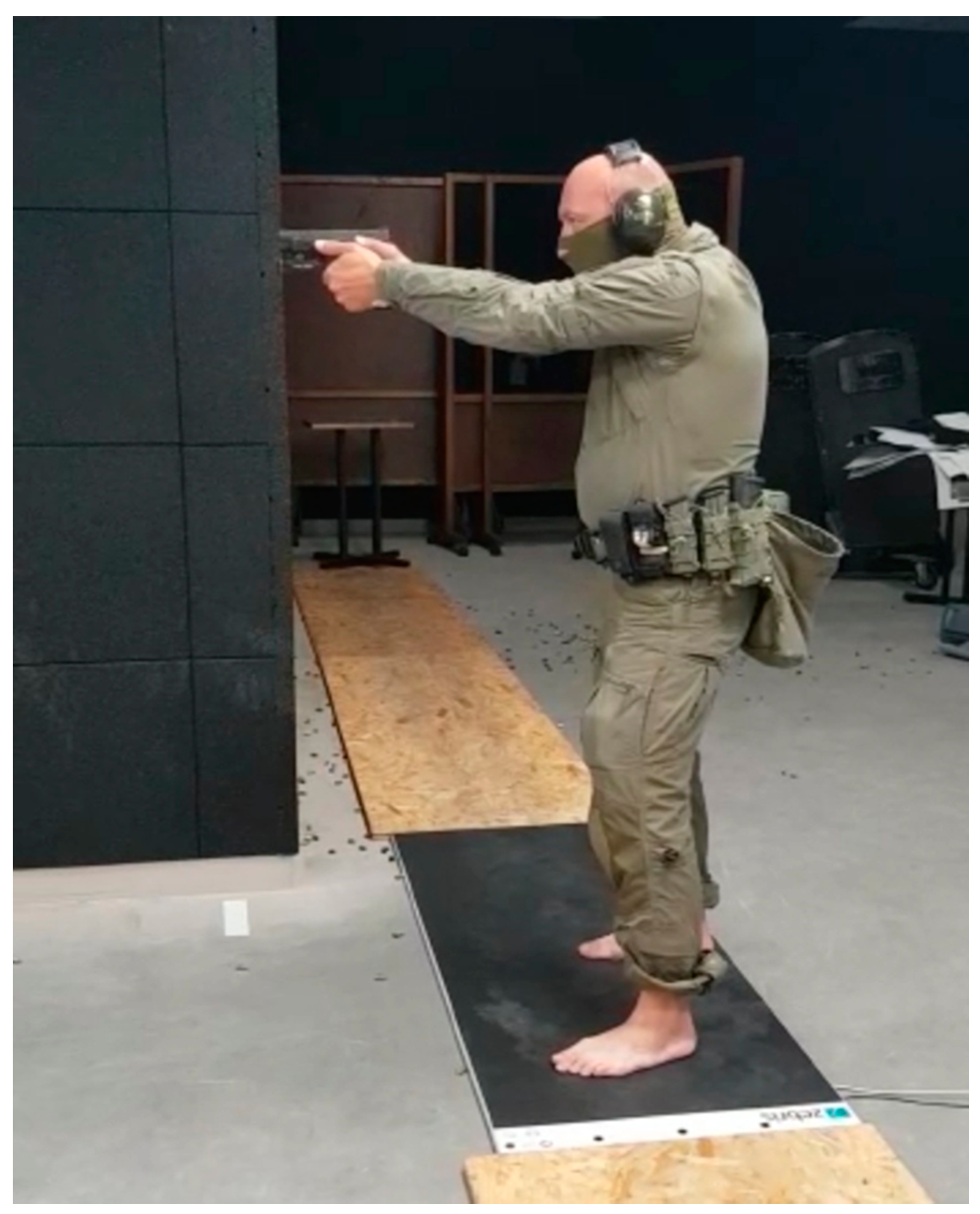
The study was conducted in 2021 in the closed shooting range of the Anti-Terrorist Unit ‘Lučko’ in the city of Zagreb with consent from the Special Police Command and their shooting instructor. Participants were required to wear only the basic equipment, which included a special police uniform, a belt containing fastening devices with a holster, a telescopic pole with a holster, a holster with a short HS XDM-9 firearm, 4.5″-barrel length with tank, a tactical lamp TLR-1 Stream light, as well as a holster with a spare tank and associated ammunition (both tanks contained a total of 20 pieces of ammunition calibre 9 × 19 mm2 124 Luger FMJ). The basic equipment and shooting position are presented in Figure 1.
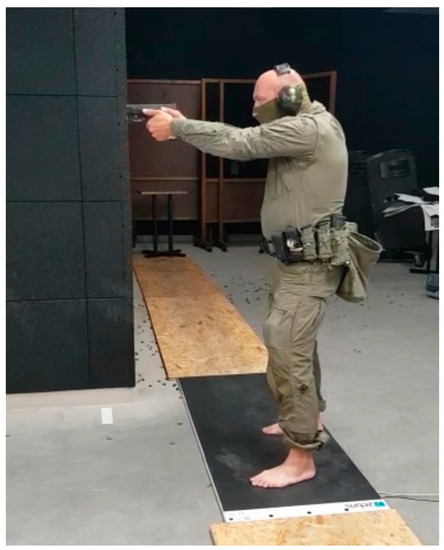
Figure 1.
Basic equipment and shooting position.
Measurements of all participants were conducted at the same time in the evening hours and at the same place. All respondents were familiar with the measurement protocol before the measurements. First, the anthropometric characteristics of the examinees were measured, including body height and weight. Ground reaction forces (absolute in N and relative in %) were measured during ammunition shooting at the shooting range. The measurements were performed in small groups (N = 5). Each participant stepped on the Zebris medical platform for the measuring of pedobarographic plantar characteristics (type FDM 1.5), 10 m away from the static target. The Zebris platform uses 11.264 micro sensors, arranged across the walking area, with the frequency of 300 Hz. It has been a highly universal diagnostic device for supporting a few modes of operation [12], including static analysis while a participant is standing still. The Zebris platform was connected via USB cable with an external unit (laptop). The data were gathered in real time using WinFDM software for extraction and calculation. Measurement values could be additionally exported in the form of text, picture, and video, while simultaneously comparing the data from both feet. The capacity sensor technology is based on the calibration of every single sensor automatically integrated into a platform. The Zebris platform has been extensively used in previous research for measuring and understanding plantar pressure distribution in various populations [13,14,15,16,17]. The task was to stand on the platform in the direction of the target and, on the shooting instructor’s command, take the pistol out of its holster and load it (put a charge into the barrel). The standing shooting position was done by their choice (left or right foot forward or parallel stance), while allowing maximum stability. After an audible signal, participants were asked to fire a total of ten two-handed shots from an HS XDM-9 pistol in the target within 20 s, to score as many points as possible. When shooting, each hit within the target was scored, with points from a minimum of one to a maximum of five, and zero denoted hits outside the marked area. In order to measure repeatability properties, 10 special police officers were randomly chosen and were instructed to return for a second day of testing. Notably, the repeatability for all variables was high (Cronbach’s α > 0.90).
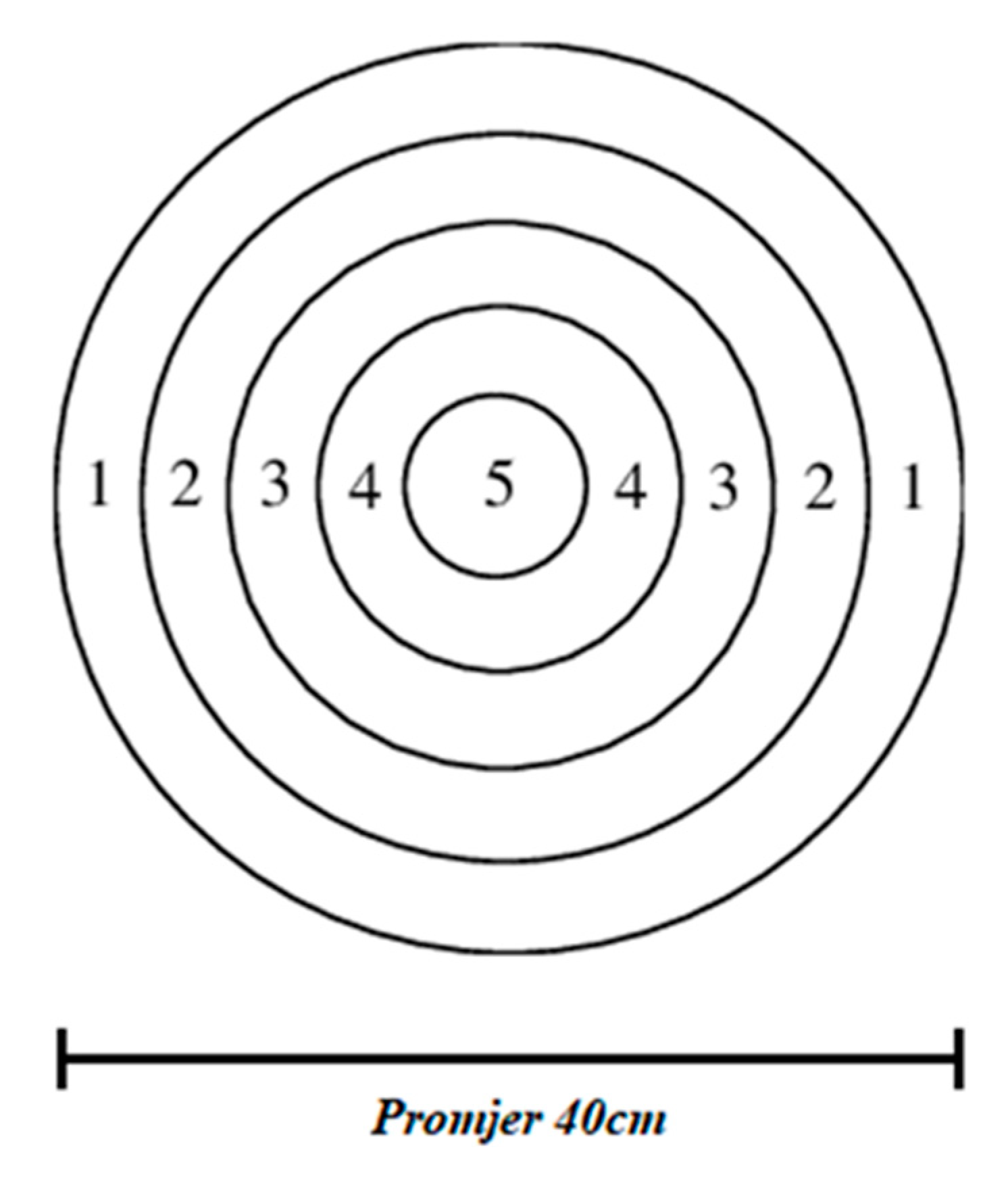
The target used in the study was static, circular-shaped, 40 cm in diameter, and consisted of five circles of an equal distance and numbered from one to five, representing the number of points (Figure 2). The number five was the maximum number of points that a shooter could achieve, while the number one was the lowest achievable number of points. All hits outside the marked outer edge of the target were not scored and numbered as zero.
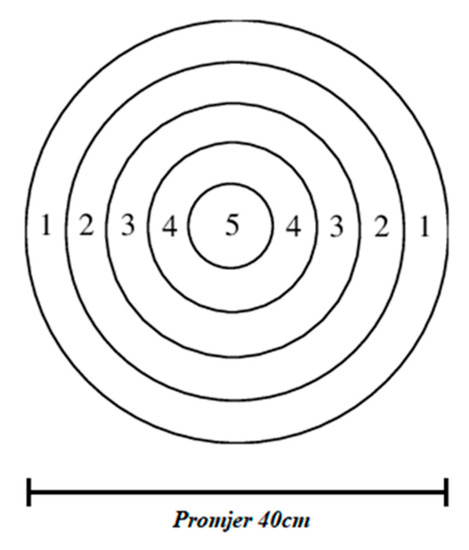
Figure 2.
View of the circular target (40 cm in width with points).
2.3. Data Analysis
Basic descriptive statistics are presented as mean and standard deviations for normally and median (25th–75th interquartile range) for not normally distributed variables. Categorical variables are displayed in percentages. The associations between the absolute (N) and relative (%) forces generated beneath the forefoot and hindfoot regions of both feet with the shot score were examined by Spearman’s and beta regression coefficients with 95% CI. Two-sided p-values were used, and significance was set at α < 0.05. All the analyses were calculated in Statistical Packages for Social Sciences v.23 (SPSS, Chicago, IL, USA).
3. Results and Discussion
Basic descriptive statistics are presented in Table 1. Peak plantar forces beneath the left forefoot were 36% lower compared with the peak plantar force beneath the left hindfoot region (p < 0.001). On the other hand, peak plantar forces beneath the right forefoot were higher, compared with the hindfoot region, by 42% (p < 0.001). Relative forces are predominantly observed beneath the hindfoot region of the left foot and the forefoot region of the right foot, but no significant differences in total relative plantar force percentage are observed (p = 0.878).

Table 1.
Basic descriptive statistics of the study participants (N = 30).
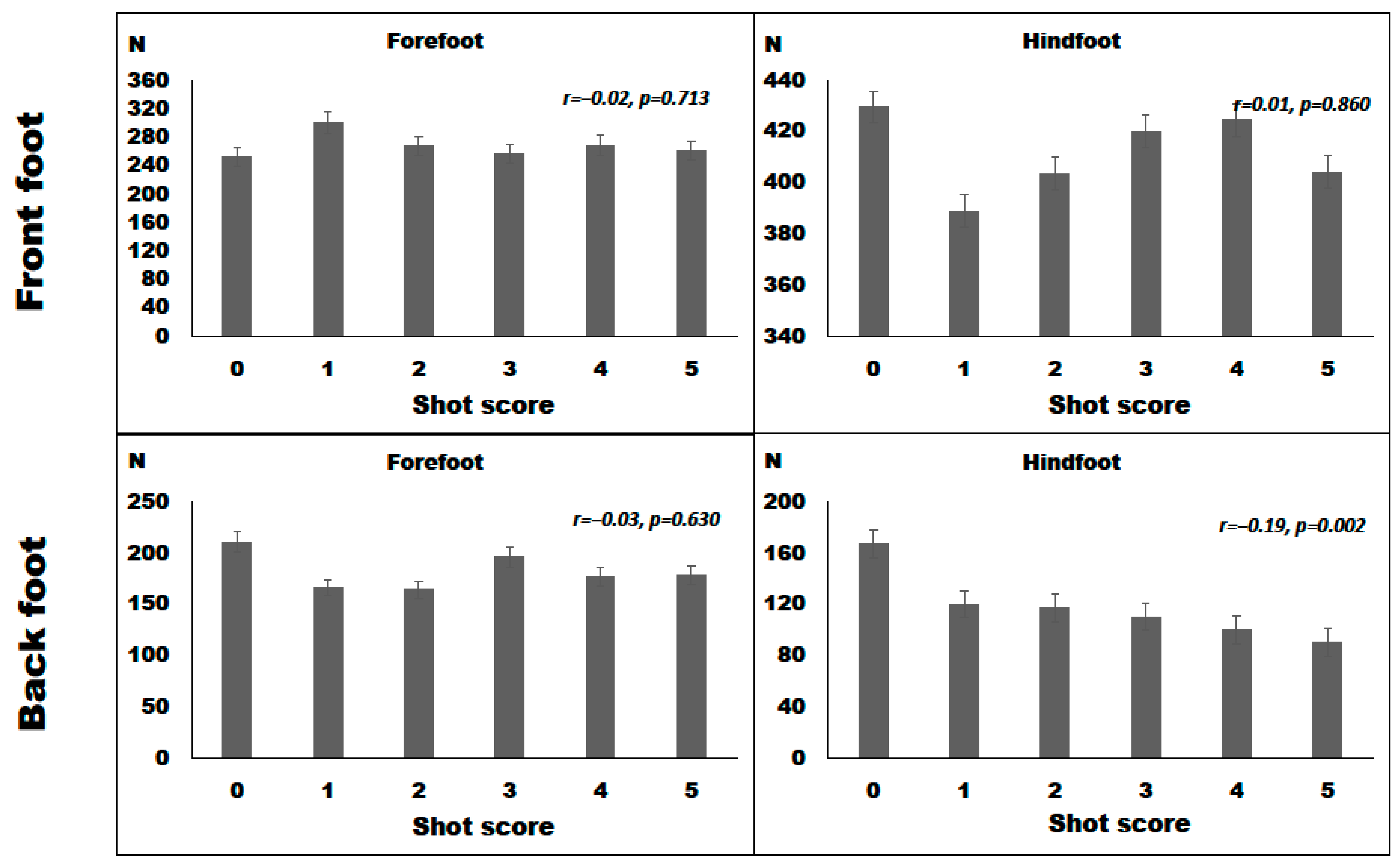
Higher peak plantar pressure values beneath the hindfoot region were significantly correlated with worse shooting performance (β = −0.19, 95% CI −0.39 to −0.09, p = 0.002). No significant associations in other peak plantar forces with shooting performance were observed (p > 0.05). When the model was adjusted by weight, similar associations remained (β = −0.20, 95% CI −0.41 to −0.11, p < 0.001) (Figure 3).
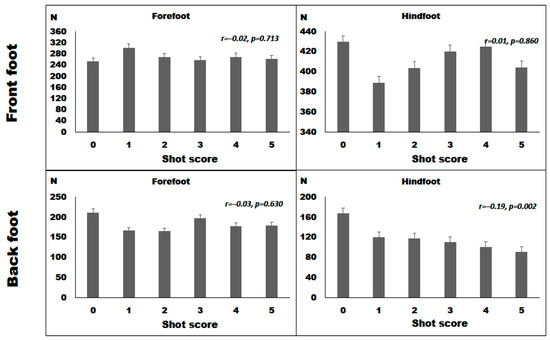
Figure 3.
The associations between absolute ground reaction forces beneath the forefoot and hindfoot region of both feet with shot score in the study participants.
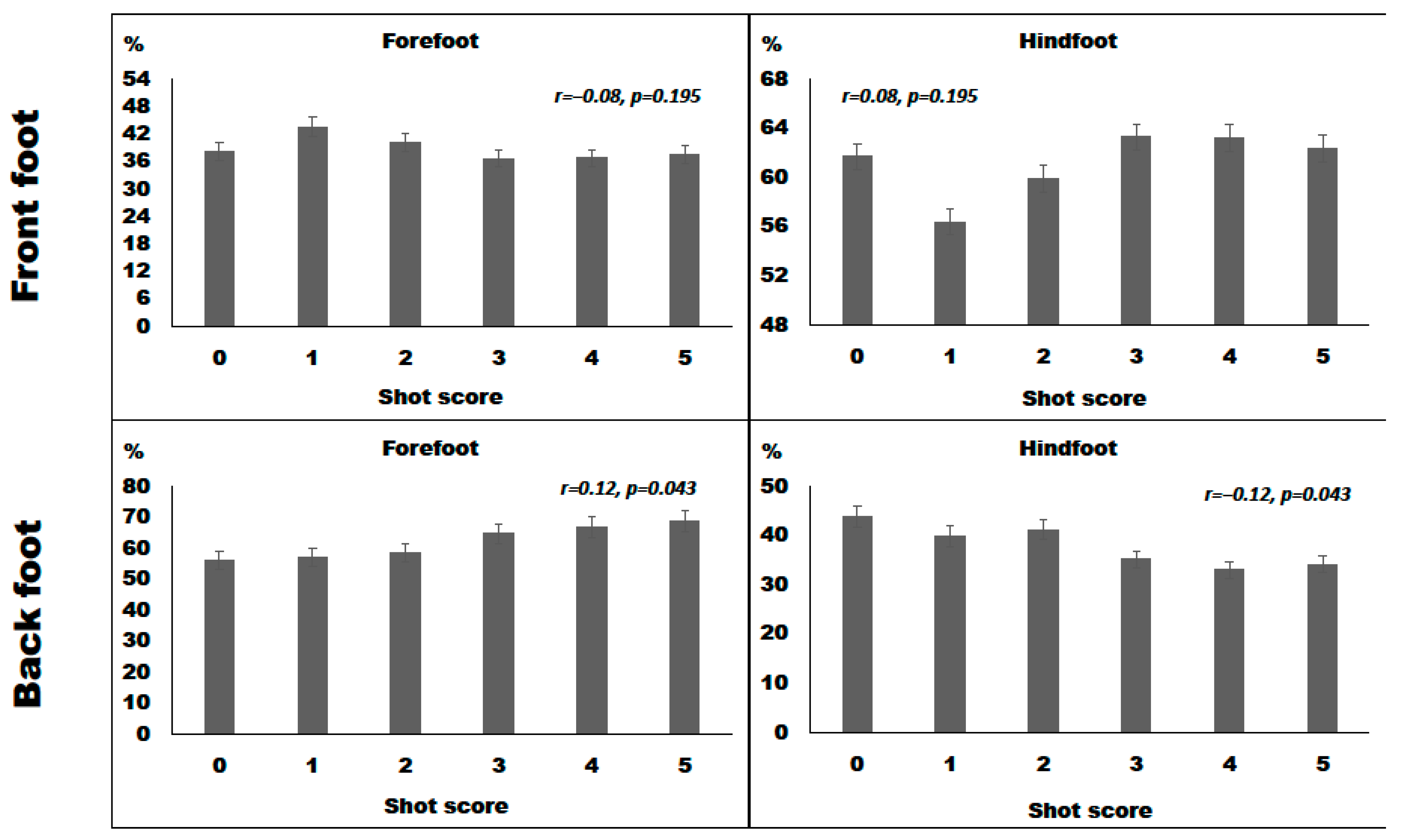
Relative forces generated beneath the forefoot and hindfoot of both feet associated with shot score are presented in Figure 4. Higher levels of force beneath the forefoot region of the foot were significantly associated with better shooting performance (β = 0.12, 95% CI 0.01 to 0.31, p = 0.043). The same magnitude of the association between the level of force beneath the hindfoot region and shot score was observed, only in a different direction (β = −0.12, 95% CI −0.31 to −0.01, p = 0.043).
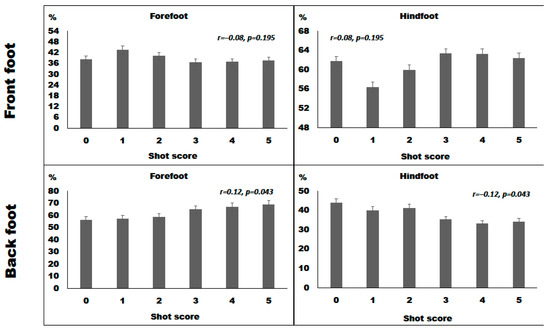
Figure 4.
The associations between relative ground reaction forces beneath the forefoot and hindfoot region of both feet with shot score in the study participants.
The main purpose of the study was to examine the associations between plantar pressure distribution patterns and shooting performance among special police officers. The main findings of the study are: (i) higher absolute peak plantar pressure values beneath the hindfoot region are associated with poorer shooting performance; (ii) higher levels of relative force beneath the forefoot region are associated with better shooting performance; and (iii) higher levels of relative force beneath the hindfoot region are associated with poorer shooting performance.
The finding that the shooter’s performance was associated with absolute and relative peak plantar forces is supported by previous empirical findings [1]. Being able to generate foot forces more adequately without additional movements may lead to better postural sway during walking [4,6] and shooting activities [5,7]. For example, a study by Ball et al. [3] showed that an increase in body sway, indicated by centre of pressure, was associated with an increase in aim-point fluctuation and a decrease in performance. Earlier research has also illustrated that postural stability and stance characteristics play an important role in determining shooting performance [2]. However, standing position often leads to instability, because of the high position of the body’s centre of gravity and relatively small body support area with the ground [18]. To be able to perform a correct shot at maximal level, previous evidence has highlighted the importance of physical effort being associated with body stability [19]. A more stable body and rifle stability have been associated with the static and dynamic balancing of the destabilizing forces of gravity and inertia by stimulating the appropriate muscle groups [20]. In that way, the forces generated by muscles compensate for disturbing the stability. Moreover, it has been well documented that the efficiency in shooting strongly relies on the motor ability to ‘freeze’ during shooting, creating the smallest possible amplitudes and generating lower ground reaction forces, while maintaining the standing [5,21]. Our findings showed that higher absolute and relative ground reaction forces beneath the hindfoot region of the foot were associated with poorer shooting performance. During shooting, the vertical projection of the rifle falls out of this area, causing additional movement corrections of the shooter’s body posture. In addition, the posture of top-class shooters is often modified by twisting, including maximal support of the body by bones and ligaments and the minimal activation of postural muscle groups [18]. This was supported by our results, since the position of standing by maintaining a stable posture using the hindfoot region could not efficiently amortize the external forces produced by the shoot. It has been highlighted that postural stability during shooting is inversely associated to the distance between the vertical projection of the position of the centre of gravity of the shooter–rifle system and the point of action of ground reaction force vector [18]. Leg muscle activity [22] and foot pressure distribution [23] change somatosensory information and may provide different standing-position perception in the anteroposterior position. When leaning backwards and producing higher ground reaction forces beneath the hindfoot region, a large increase in muscle activity has been observed at about 25% of the foot length from the standing position [24], and upward patellar movement has been detected more frequently while gradually leaning backwards [25]. Thus, higher ground reaction forces under the heel may significantly impact postural stability and shooting efficiency. Our findings also showed that higher absolute and relative forces beneath the forefoot region were associated with better shooting efficiency, even after adjusting for weight and body-mass index. Previous evidence suggests that a challenge for performing a coordination task, such as shooting, is to determine the distribution of the applied forces [26].
This study has a few limitations. First, by using a cross-sectional design, we cannot determine the causality of the associations. Second, a relatively small sample size (N = 30) may have led to insufficient statistical power. Third, no biological and physiological measurements were collected, including blood samples, heart-rate monitoring, fatigue level and sleep deprivation. Fourth, we did not collect, nor include, another variable, which might moderate the associations between forces and shooting performance, such as officer’s experience, type of weapon usually used in combat situations, and mental health.
4. Conclusions
In conclusion, this study shows that higher absolute and relative ground reaction forces beneath the hindfoot region of the back foot are associated with lower shooting performance, while higher relative forces beneath the forefoot region of the same foot are associated with a better shot score. Our findings imply that leaning forward on the stance leg during shooting may impact shooting efficiency and improve force amortization during rifle shooting. On the other hand, higher ground reaction forces beneath the hindfoot region should be unburdened, and the mechanical load shifted slightly forwards, in order to achieve better shooting performance. Future research should focus on examining the associations between kinematic parameters, such as postural sway, a pistol snatch during shooting, and mental health (sleep deprivation, psychological distress) and shooting performance. In this way, professionals who plan shooting protocols may adequately create special training interventions and policies, which can enhance shooting ability and precision. Therefore, training protocols which include biomechanical approaches to improve shooting should be of a great interest for special police officers.
Author Contributions
Conceptualization, M.K. and L.Š.; methodology, L.Š.; software, L.Š.; validation, M.K., L.Š. and A.Š.; formal analysis, L.Š.; investigation, M.K., L.Š., M.B. and D.S.; resources, M.B. and D.S.; data curation, L.Š.; writing—original draft preparation, M.K., L.Š., M.B., D.S., A.Š., I.Š. and K.J.; writing—review and editing, M.K., L.Š., M.B., D.S., A.Š., I.Š. and K.J.; visualization, L.Š.; supervision, M.K., M.B. and D.S.; project administration, M.K.; funding acquisition, M.B. and D.S. All authors have read and agreed to the published version of the manuscript.
Funding
This research received no external funding.
Institutional Review Board Statement
The Ethical Committee of the Faculty of Kinesiology and the Institutional Review Board of the Anti-Terrorist Special Police Unit ‘Lučko’ approved the study.
Informed Consent Statement
Informed consent was obtained from all subjects involved in the study.
Data Availability Statement
The data presented in this study are available on request from the corresponding author. The data are not publicly available due to the third party restrictions.
Acknowledgments
We would like to thank all the participants and the Special Anti-Terrorist Unit ‘Lučko’ for their enthusiastic support and participation in the study.
Conflicts of Interest
The authors declare no conflict of interest.
References
- Kim, S.E. The influence of shoe on posture and performance of rifle shooters-a comparative study. Int. J. Eng. Res. Technol. 2019, 12, 1205–1209. [Google Scholar]
- Mononen, K.; Konttinen, N.; Viitasalo, J.; Era, P. Relationships between postural balance, rifle stability and shooting accuracy among novice rifle shooters. Scand. J. Med. Sci. Sports 2007, 17, 180–185. [Google Scholar] [CrossRef] [PubMed]
- Ball, K.A.; Best, R.J.; Wrigley, T.V. Body sway, aim point fluctuation and performance in rifle shooters: Inter- and intra-individual analysis. J. Sports Sci. 2003, 21, 559–566. [Google Scholar] [CrossRef] [PubMed]
- Aalto, H.; Pyykkö, I.; Ilmarinen, R.; Kähkönen, E.; Starck, J. Postural stability in shooters. ORL J. Otorhinolaryngol. Its Relat. Spec. 1990, 52, 232–238. [Google Scholar] [CrossRef] [PubMed]
- Era, P.; Konttinen, N.; Mehto, P.; Saarela, P.; Lyytinen, H. Postural stability and skilled performance-a study on top-level and naive rifle shooters. J. Biomech. 1996, 29, 301–306. [Google Scholar] [CrossRef]
- Niinimaa, V.; McAvoy, T. Influence of exercise on body sway in standing rifle shooting. Can. J. Appl. Sports Sci. 1983, 8, 30–33. [Google Scholar]
- Konttinen, N.; Lyytinen, H.; Era, P. Brain slow potentials and postural sway behavior during sharpshooting performance. J. Mot. Behav. 1999, 31, 11–20. [Google Scholar] [CrossRef]
- Viitasalo, J.T.; Era, P.; Konttinen, N.; Mononen, H.; Mononen, K.; Norvapalo, K. Effects of 12-week shooting training and mode of feedback on shooting scores among novice shooters. Scand. J. Med. Sci. Sports 2001, 11, 362–368. [Google Scholar] [CrossRef]
- Spancken, S.; Steingrebe, H.; Stein, T. Factors that influence performance in Olympic air-rifle and small-bore shooting: A systematic review. PLoS ONE 2021, 16, e0247353. [Google Scholar] [CrossRef]
- Ridgeway, G. The role of individual officer characteristics in police shootings. ANNALS Am. Acad. Political Soc. Sci. 2020, 687, 58–66. [Google Scholar] [CrossRef]
- World Medical Association. World Medical Association Declaration of Helsinki: Ethical principles for medical research involving human subjects. JAMA 2013, 310, 2191–2194. [Google Scholar] [CrossRef] [PubMed] [Green Version]
- Bedla, M.; Pięta, P.; Kaczmarski, D.; Deniziak, S. Estimation of gross motor functions in children with cerebral palsy using Zebris FDM-T treadmill. J. Clin. Med. 2022, 11, 954. [Google Scholar] [CrossRef] [PubMed]
- Donath, L.; Faude, O.; Lichtenstein, E.; Nüesch, C.; Mündermann, A. Validity and reliability of a portable gait analysis system for measuring spatiotemporal gait characteristics: Comparison to an instrumented treadmill. J. Neuroeng. Rehabil. 2016, 13, 6. [Google Scholar] [CrossRef] [PubMed] [Green Version]
- Braun, B.J.; Veith, N.T.; Hell, R.; Döbele, S.; Roland, M.; Rollmann, M.; Holstein, J.; Pohlemann, T. Validation and reliability testing of a new, fully integrated gait analysis insole. J. Foot Ankle Res. 2015, 8, 54. [Google Scholar] [CrossRef] [PubMed] [Green Version]
- Gruić, I.; Cebović, K.; Radaš, J.; Bolčević, F.; Medved, V. Pedobarographic features of gait measured by FDM1.5 PMD. In Proceedings of the 3rd International Congress on Sport Sciences Research and Technology Support (icSPORTS 2015), Lisbon, Portugal, 15–17 November 2015. [Google Scholar]
- Giacomozzi, C.; Keijsers, N.; Pataky, T.; Rosenbaum, D. International scientific consensus on medical plantar pressure measurement devices: Technical requirements and performance. Ann. Dell’istituto Super. Sanita 2012, 48, 259–271. [Google Scholar] [CrossRef]
- Giacomozzi, C. Appropriateness of plantar pressure measurement devices: A comparative technical assessment. Gait Posture 2010, 32, 141–144. [Google Scholar] [CrossRef]
- Heimer, S.; Medved, V.; Špirelja, A. Influence of postural stability on sport shooting performance. Kinesiology 1985, 17, 119–122. [Google Scholar]
- Krawczyk-Suszek, M.; Martowska, B.; Sapuła, R. Analysis of the stability of the body in a standing position when shooting at a stationary target-a randomized controlled trial. Sensors 2022, 22, 368. [Google Scholar] [CrossRef]
- Błaszczyk, J.W.; Czerwosz, L. Stabilność posturalna w procesie starzenia. Gerontolol. Pol. 2005, 13, 25–36. [Google Scholar]
- Andreeva, A.; Melnikov, A.; Skvortsov, D.; Akhmerova, K.; Vavaev, A.; Golov, A.; Draugelite, V.; Nikolaev, R.; Chechelnickaia, S.; Zhuk, D.; et al. Postural stability in athletes: The role of age, sex, performance level, and athlete shoe features. Sports 2020, 8, 89. [Google Scholar] [CrossRef]
- Okada, M.; Fujiwara, K. Relation between sagittal distribution of the foot pressure in upright stance and relative EMG magnitude in some leg and foot muscles. J. Hum. Ergol. 1984, 13, 97–105. [Google Scholar]
- Fujiwara, K.; Asai, H.; Koshida, K.; Maeda, K.; Toyama, H. Perception of large change in distribution of heel pressure during backward leaning. Percept. Mot. Ski. 2005, 100, 432–442. [Google Scholar] [CrossRef] [PubMed]
- Asai, H.; Fujiwara, K. Perceptibility of large and sequential changes in somatosensory information during leaning forward and backward when standing. Percept. Mot. Ski. 2003, 96, 549–577. [Google Scholar] [CrossRef] [PubMed]
- Asai, H.; Odashiro, Y.; Inaoka, P.T. Patellar movement perception related to a backward-leaning standing position. J. Phys. Ther. Sci. 2017, 29, 1372–1376. [Google Scholar] [CrossRef] [Green Version]
- Sporns, O.; Edelman, G.M. Solving Bernstein’s problem: A proposal for the development of coordinated movement by selection. Child Dev. 1993, 64, 960–981. [Google Scholar] [CrossRef]
Publisher’s Note: MDPI stays neutral with regard to jurisdictional claims in published maps and institutional affiliations. |
© 2022 by the authors. Licensee MDPI, Basel, Switzerland. This article is an open access article distributed under the terms and conditions of the Creative Commons Attribution (CC BY) license (https://creativecommons.org/licenses/by/4.0/).