Analysis of the Genetic Mechanism of Thermal Anomaly in the A’nan Sag, Erlian Basin Based on 3D Magnetotelluric Imaging

Abstract
1. Introduction
2. Overview of Regional Geology
3. Data Acquisition and Processing
3.1. MT Data Acquisition
3.2. Preprocessing of MT Data
4. Electrical Structure Characteristics of the Southwestern A’nan Sag
4.1. 3D Inversion Methods
4.2. 3D Electrical Structure Characteristics Analysis
5. Genetic Mechanism Analysis of Thermal Anomalies in the Southwestern A’nan Sag Structure Characteristics of the Southwestern A’nan Sag
5.1. Analysis of the Geothermal System in the Study Area
5.1.1. Geoelectrical Model Analysis of the Study Area
5.1.2. Analysis of Heat Source in the Geothermal System
5.1.3. Thermal Conduits of the Geothermal System
5.1.4. Reservoir and Caprock of the Geothermal System
5.2. Analysis of Geothermal Anomaly Formation Mechanism
6. Conclusions
- (1)
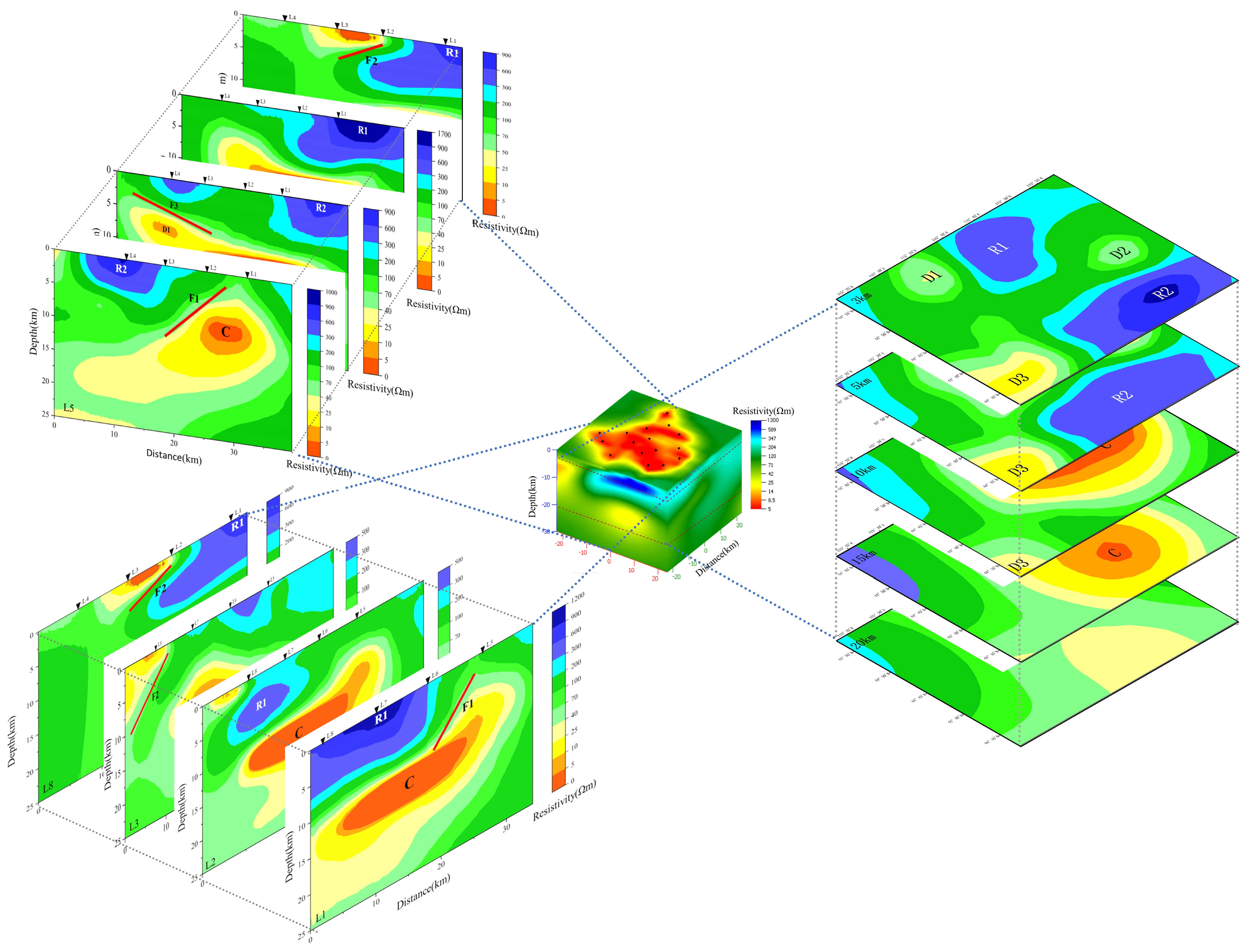
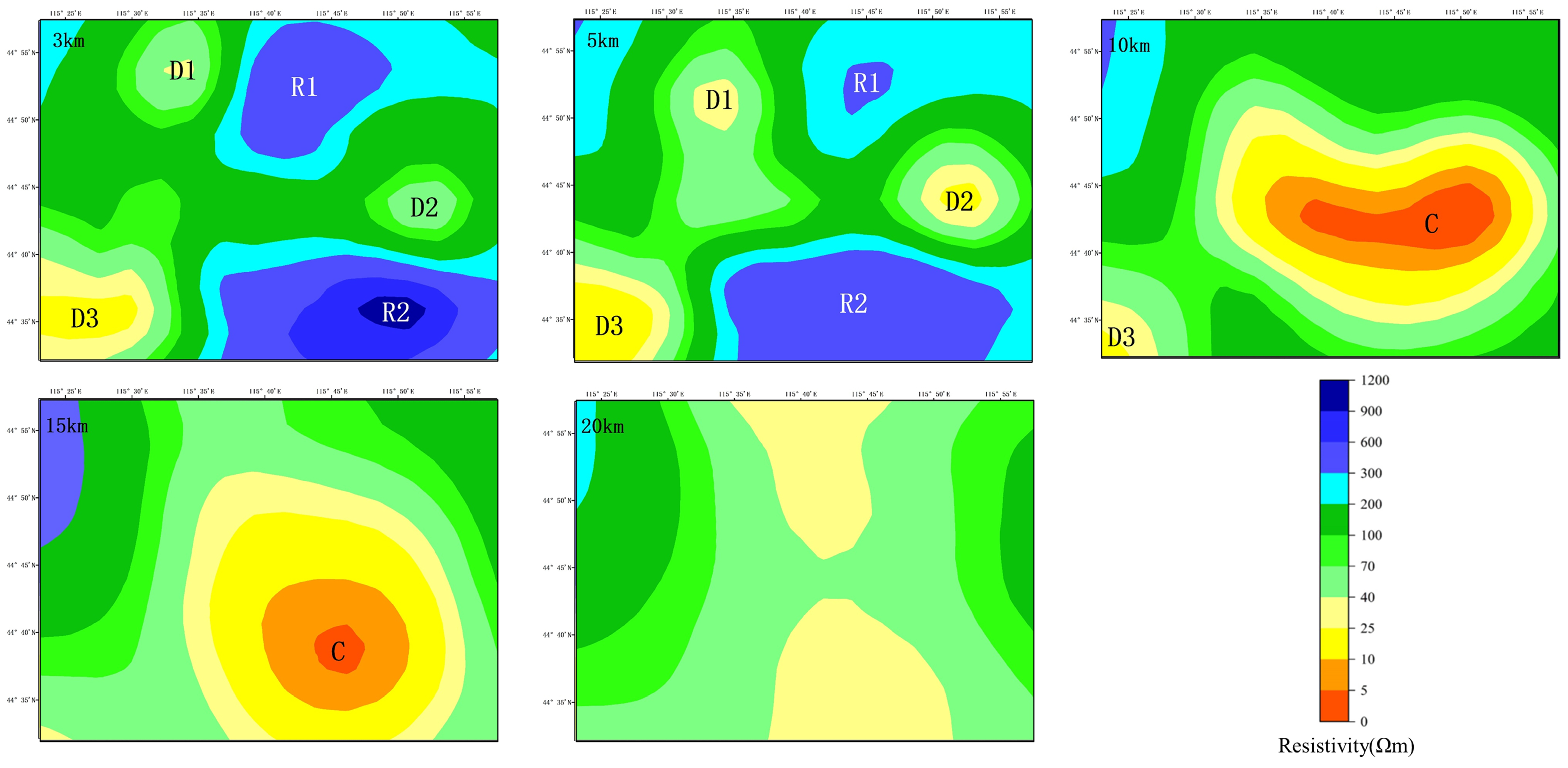
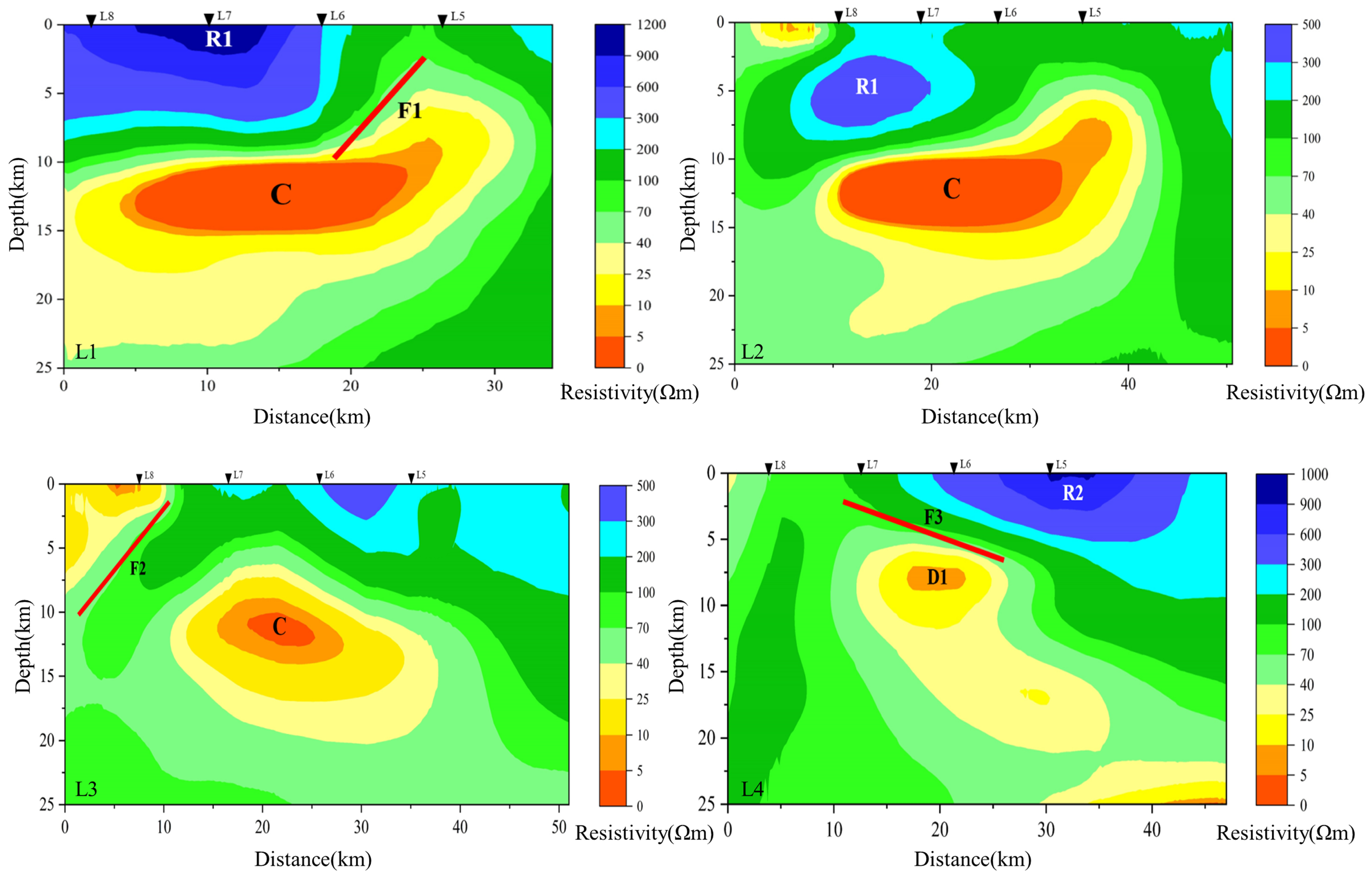
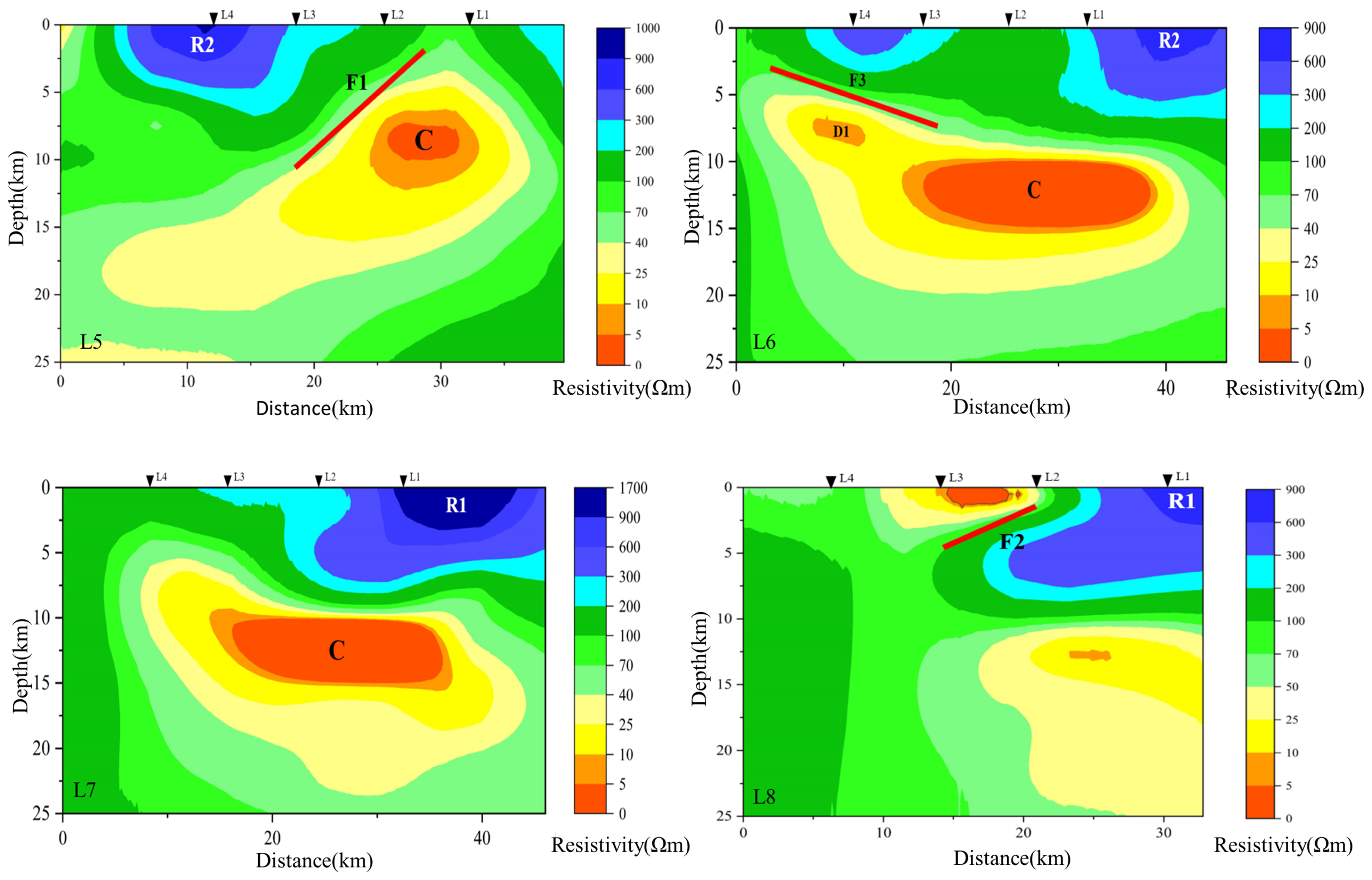
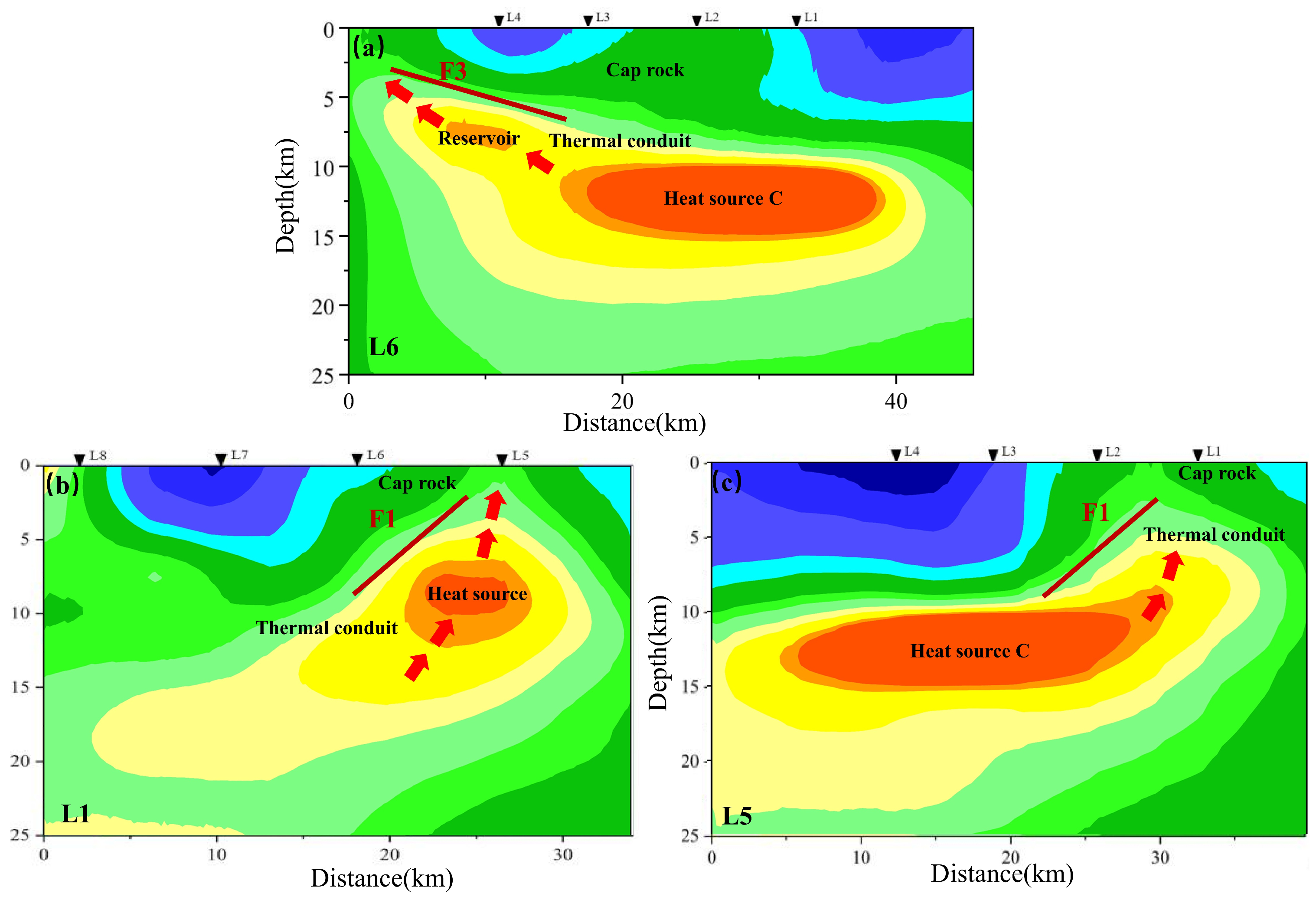
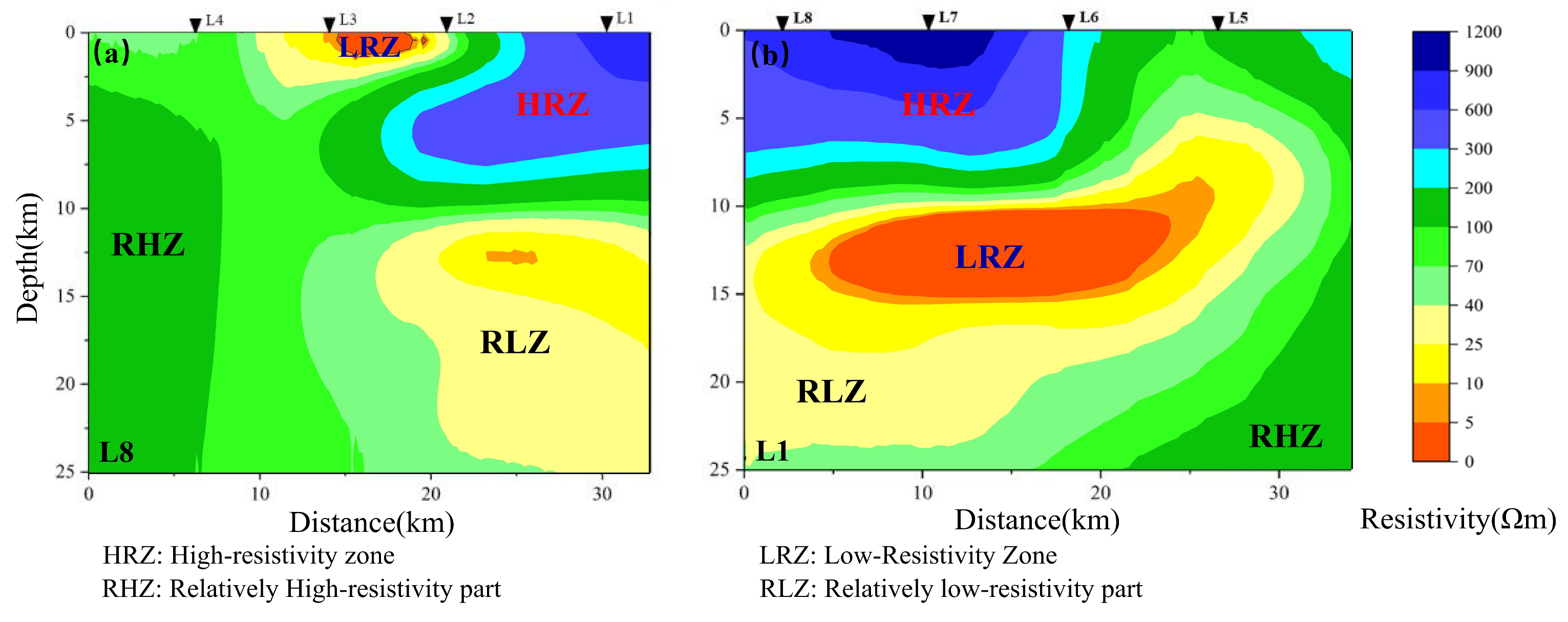
- MT 3D inversion reveals an elliptical low-resistivity Anomaly C at depths of 10–15 km depth, with dimensions of ~20 km (long axis) × 16 km (short axis) × 5 km (thickness). Among the major faults (F1, F2, F3), Anomaly C extends upward along F1 and F3 faults, forming medium-low resistivity conduits (10–40 Ωm) that culminate in shallow relatively low-resistivity layers D1/D2 at ~5 km depth (5–10 Ωm). These interconnected features establish a vertically continuous hydrothermal migration pathway extending to 0–3 km depth.
- (2)
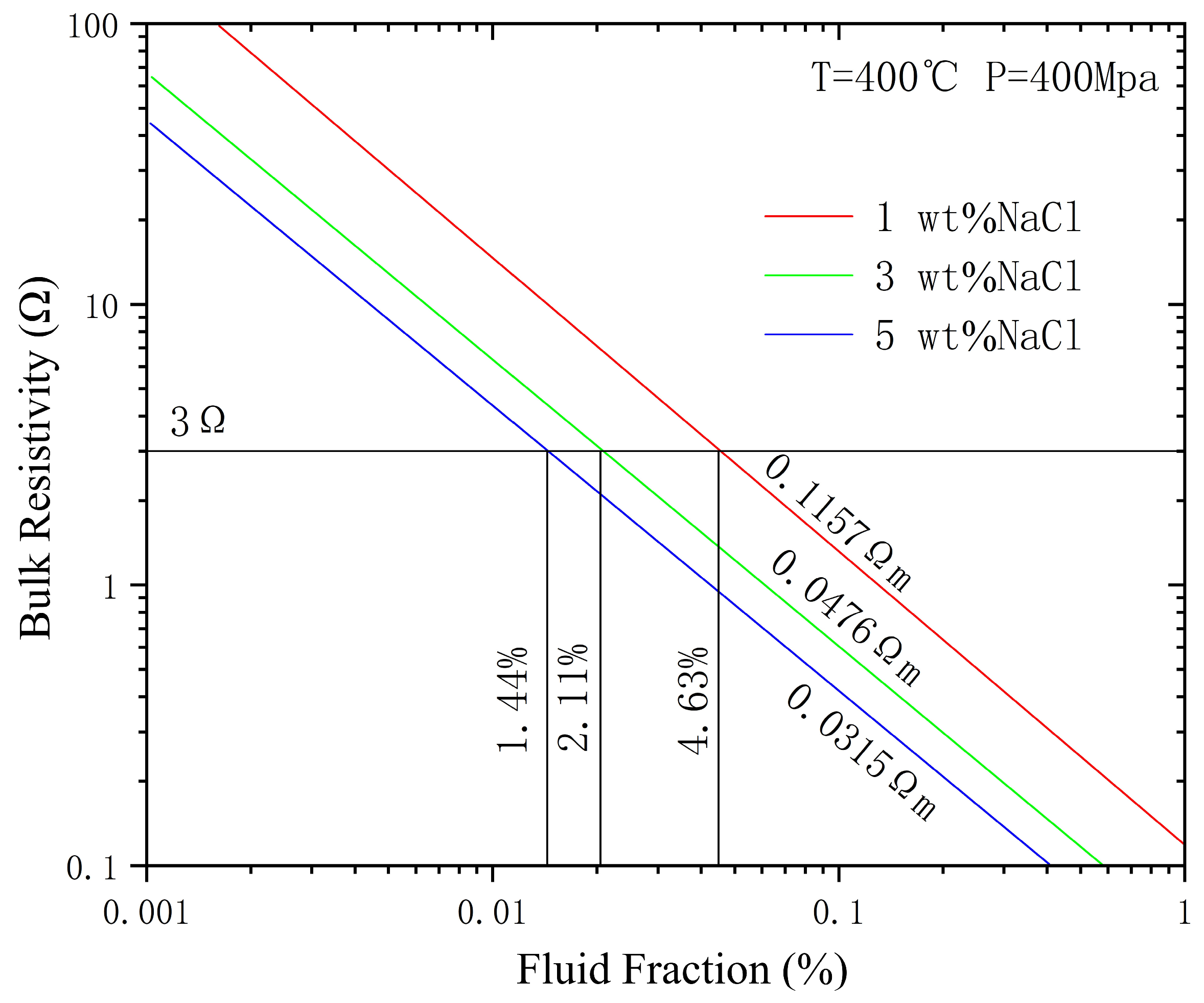
- The deep-seated low-resistivity Anomaly C is primarily attributed to hypersaline fluids (1.50 vol%, 3–5 wt% NaCl) at ~400 °C, with an estimated temperature of ~400 °C, constituting the system’s core heat source. The mid-depth low-resistivity layers D1 and D2 function as the thermal reservoirs, characterized by fracture networks saturated with geothermal fluids. Overlying these, a relatively high-resistivity layer (40–100 Ωm) forms an effective caprock through low-permeability tight sandstones that suppress vertical heat dissipation. Faults F1/F3 dominate thermal energy transport, establishing a coherent “heat source–conduit–reservoir–cap” architecture that aligns with the defining characteristics of a typical convective-type geothermal system.
- (3)
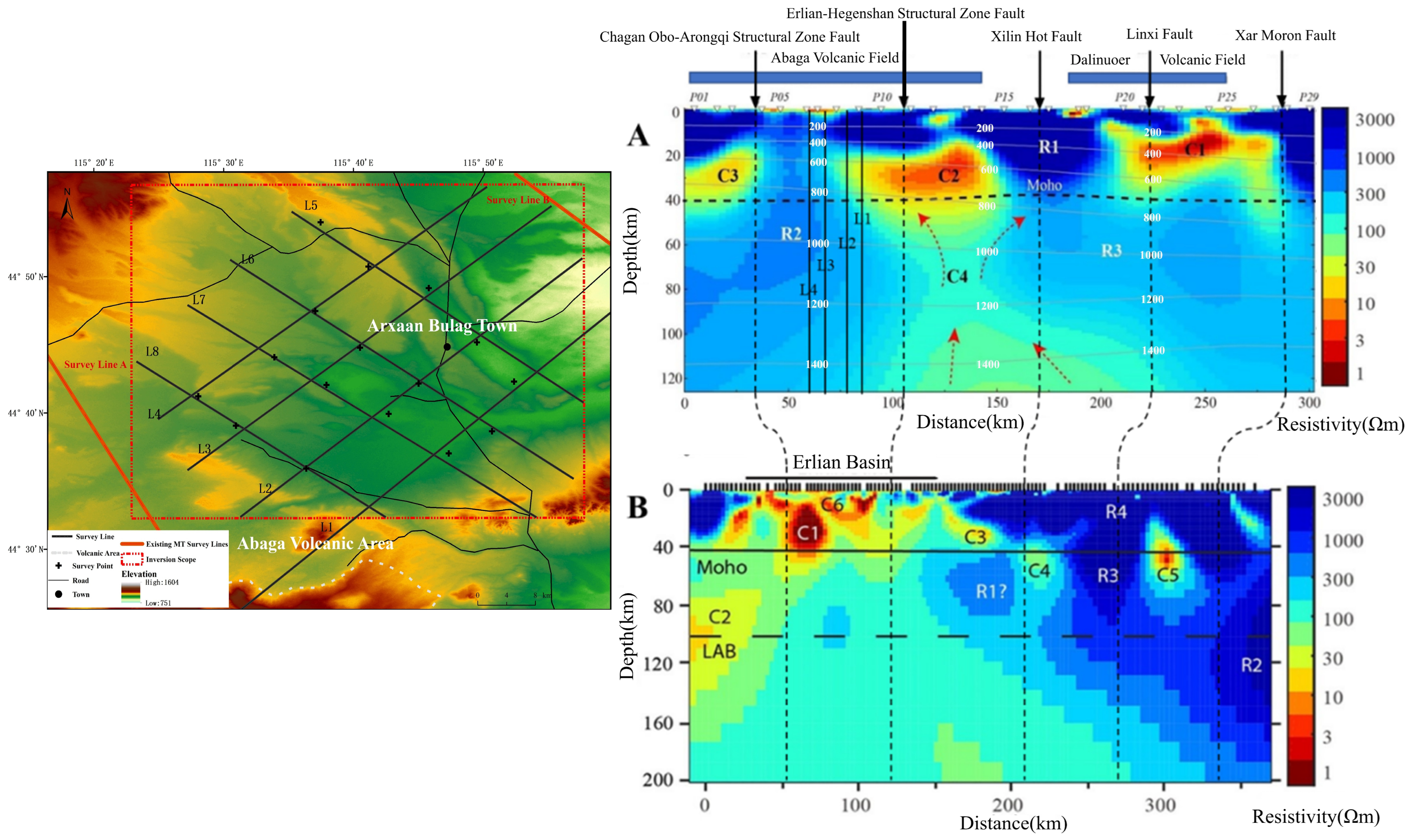
- Integrated seismic S-wave velocity analysis reveals that the thermal energy derived from partial melt beneath the Abaga volcanic zone is supplied to Anomaly C via medium-low resistivity conduits (10–40 Ωm) primarily through thermal conduction. Superimposed with deep mantle conductive heat, forms a stable composite heat source. Driven by the fault systems, thermal energy is transported to shallow crustal levels through a coupled conduction-convection mode, generating and sustaining regional thermal anomalies.
Author Contributions
Funding
Informed Consent Statement
Data Availability Statement
Acknowledgments
Conflicts of Interest
References
- Krieger, M.; Kurek, K.A.; Brommer, M. Global geothermal industry data collection: A systematic review. Geothermics 2022, 104, 102457. [Google Scholar] [CrossRef]
- Van der Zwaan, B.; Dalla Longa, F. Integrated assessment projections for global geothermal energy use. Geothermics 2019, 82, 203–211. [Google Scholar] [CrossRef]
- Bharathi N, K.; Abirami, M.; Vighneshwari, D.; Hariprasath, M. Techno-economic optimization of hybrid renewable systems for sustainable energy solutions. Sci. Rep. 2025, 15, 21114. [Google Scholar] [CrossRef]
- Kaczmarczyk, M.; Sowiżdżał, A. Environmental and Social Dimensions of Energy Transformation Using Geothermal Energy. Energies 2025, 18, 3565. [Google Scholar] [CrossRef]
- Ellabban, O.; Abu-Rub, H.; Blaabjerg, F. Renewable energy resources: Current status, future prospects and their enabling technology. Renew. Sustain. Energy Rev. 2014, 39, 748–764. [Google Scholar] [CrossRef]
- Zhang, J.; Chen, L.; Sun, Y.; Xu, L.; Zhao, X.; Li, Q.; Zhang, D. Geothermal resource distribution and prospects for development and utilization in China. Nat. Gas Ind. B 2024, 11, 6–18. [Google Scholar] [CrossRef]
- Poh, J.; Tjiawi, H.; Chidire, A.; Veerasamy, B.B.; Massier, T.; Romagnoli, A.; Wu, W.; Lu, D.; Lim, J.W.M.; Yang, L.; et al. Geothermal development in South, Southeast and East Asia: A review. Renew. Sustain. Energy Rev. 2025, 209, 115043. [Google Scholar] [CrossRef]
- Wang, Y.; Liu, Y.; Dou, J.; Li, M.; Zeng, M. Geothermal energy in China: Status, challenges, and policy recommendations. Util. Policy 2020, 64, 101020. [Google Scholar] [CrossRef]
- Zhu, J.L.; Hu, K.Y.; Lu, X.L.; Huang, X.X.; Liu, K.T.; Wu, X.J. A review of geothermal energy resources, development, and applications in China: Current status and prospects. Energy 2015, 93, 466–483. [Google Scholar] [CrossRef]
- Xu, W.; Huang, S.; Zhang, J.; Zuo, Y.; Zhou, Y.; Ke, T.; Yu, R.; Li, Y. Geothermal gradient and heat flow of the Erlian Basin and adjacent areas, Northern China: Geodynamic implication. Geothermics 2021, 92, 102049. [Google Scholar] [CrossRef]
- Xu, W.; Zhou, Y.; Zhang, J.; Li, Y. Thermo-tectonic evolution of the northern Erlian Basin (NE China): Evidence from fission track and (U–Th)/He thermochronology. J. Asian Earth Sci. 2023, 248, 105620. [Google Scholar] [CrossRef]
- Zuo, Y.; Wang, C.; Tang, S.; Hao, Q. Mesozoic and Cenozoic thermal history and source rock thermal evolution of the Baiyinchagan sag, Erlian Basin, Northern China. J. Pet. Sci. Eng. 2016, 139, 171–184. [Google Scholar] [CrossRef]
- Fu, S.; Liu, Z.; Song, L.; Ge, J.; Tian, N.; Yin, K.; Wang, X. A new division of late Cretaceous Erlian Basin tectonic units based on differential basement characteristics. Geoenergy Sci. Eng. 2025, 245, 213536. [Google Scholar] [CrossRef]
- Dong, Z.; Zhan, Y.; Xiao, Q.; Li, N.; Han, B.; Sun, X.; Liu, X.; Tang, J. Electrical resistivity structure across the Late Cenozoic Abaga-Dalinor volcanic field, eastern China, from 3-D magnetotelluric imaging and its tectonic implications. J. Asian Earth Sci. 2023, 258, 105574. [Google Scholar] [CrossRef]
- Ye, G.; Fu, H.; Jin, S.; Wei, W. Magnetotelluric study of the mechanism of the Abaga and Dalinor volcanic groups in Central Inner Mongolia, China. Phys. Earth Planet. Inter. 2020, 308, 106570. [Google Scholar] [CrossRef]
- Zhang, J.; Huang, S.; Zuo, Y.; Zhou, Y.; Liu, Z.; Duan, W.; Wei, X. Terrestrial heat flow in the baiyinchagan sag, erlian Basin, northern China. Geothermics 2020, 86, 101799. [Google Scholar] [CrossRef]
- Muñoz, G. Exploring for Geothermal Resources with Electromagnetic Methods. Surv. Geophys. 2014, 35, 101–122. [Google Scholar] [CrossRef]
- Liu, Y.H.; Yin, C.C.; Cai, J.; Huang, W.; Ben, F.; Zhang, B.; Qi, Y.F.; Qiu, C.K.; Ren, X.Y.; Huang, X.; et al. Review on research of electrical anisotropy in electromagnetic prospecting. Chin. J. Geophys.-Chin. Ed. 2018, 61, 3468–3487. [Google Scholar] [CrossRef]
- Tang, J.T.; Ren, Z.Y.; Zhou, C.; Zhang, L.C.; Yuan, Y.; Xiao, X. Frequency-domain electromagnetic methods for exploration of the shallow subsurface: A review. Chin. J. Geophys.-Chin. Ed. 2015, 58, 2681–2705. [Google Scholar] [CrossRef]
- Thanassoulas, C. Geothermal-Exploration Using Electrical Methods. Geoexploration 1991, 27, 321–350. [Google Scholar] [CrossRef]
- Árnason, K.; Eysteinsson, H.; Hersir, G.P. Joint 1D inversion of TEM and MT data and 3D inversion of MT data in the Hengill area, SW Iceland. Geothermics 2010, 39, 13–34. [Google Scholar] [CrossRef]
- Araya Vargas, J.; Meqbel, N.M.; Ritter, O.; Brasse, H.; Weckmann, U.; Yáñez, G.; Godoy, B. Fluid Distribution in the Central Andes Subduction Zone Imaged with Magnetotellurics. J. Geophys. Res. Solid Earth 2019, 124, 4017–4034. [Google Scholar] [CrossRef]
- Gao, J.; Zhang, H.; Zhang, S.; Chen, X.; Cheng, Z.; Jia, X.; Li, S.; Fu, L.; Gao, L.; Xin, H. Three-dimensional magnetotelluric imaging of the geothermal system beneath the Gonghe Basin, Northeast Tibetan Plateau. Geothermics 2018, 76, 15–25. [Google Scholar] [CrossRef]
- He, L.; Chen, L.; Dorji; Xi, X.; Zhao, X.; Chen, R.; Yao, H. Mapping the Geothermal System Using AMT and MT in the Mapamyum (QP) Field, Lake Manasarovar, Southwestern Tibet. Energies 2016, 9, 855. [Google Scholar] [CrossRef]
- Wu, C.; Hu, X.; Wang, G.; Xi, Y.; Lin, W.; Liu, S.; Yang, B.; Cai, J. Magnetotelluric Imaging of the Zhangzhou Basin Geothermal Zone, Southeastern China. Energies 2018, 11, 2170. [Google Scholar] [CrossRef]
- Hata, M.; Uyeshima, M. Temperature and melt fraction distributions in a mantle wedge determined from the electrical conductivity structure: Application to one nonvolcanic and two volcanic regions in the Kyushu subduction zone, Japan. Geophys. Res. Lett. 2015, 42, 2709–2717. [Google Scholar] [CrossRef]
- Sheng, Y.; Jin, S.; Lei, L.; Dong, H.; Zhang, L.; Wei, W.; Ye, G.; Li, B.; Lu, Z. Deep thermal state on the eastern margin of the Lhasa-Gangdese belt and its constraints on tectonic dynamics based on the 3-D electrical model. Tectonophysics 2020, 793, 228606. [Google Scholar] [CrossRef]
- Bonnetti, C.; Malartre, F.; Huault, V.; Cuney, M.; Bourlange, S.; Liu, X.D.; Peng, Y.B. Sedimentology, stratigraphy and palynological occurrences of the late Cretaceous Erlian Formation, Erlian Basin, Inner Mongolia, People’s Republic of China. Cretac. Res. 2014, 48, 177–192. [Google Scholar] [CrossRef]
- Zhang, Y.; Liu, Z.; Fu, S.; Jiang, S.; Yao, N.; Wang, X. New understandings of the basement characteristics and evolution process of Erlian Basin. Oil Geophys. Prospect. 2019, 54, 404–416. [Google Scholar]
- Yongqian, C.U.I.; Hengmao, T.; Xianping, L.I.; Zhen, L.I.U.; Hongbo, Z.; Changjiang, D.U. Tectonic Mechanism of the Erlian Basin during Early Yanshanian and Speculation on the Basin Prototype. Acta Geol. Sin. 2011, 85, 1265–1273. [Google Scholar]
- Wang, Y. Coupling relationship of Mesozoic-Cenozoic Basin and Mountains in the Erlian Basin. Spec. Oil Gas Reserv. 2011, 18, 60–63,138. [Google Scholar]
- Lu, W.; Song, T.; Li, X.; Yan, W.; Wang, J.; Zhong, X. Accumulation features and formation conditions of tight oil reservoir in A’nan Sag, Erlian Basin, China. Nat. Gas Geosci. 2016, 27, 1699–1708. [Google Scholar]
- Dong, Y.; Ma, L.; Sun, F. Exploration prospects of low-mature oil/gas in the shallow layers of the A’nan Sag, the Erlian Basin. Oil Gas Geol. 2007, 28, 610–614,633. [Google Scholar]
- Fu, X.; Zhang, T.; Wu, J.; Wang, X.; Zhou, J.; Jiang, T.; Li, B.; Li, C. Characteristics and main controlling factors of tight oil reservoirs in Cretaceous Tengger Formation, A’nan Sag, Erlian Basin. Pet. Geol. Exp. 2021, 43, 64–76. [Google Scholar]
- Weiliang, D.U.; Xianping, L.I.; Yang, X.; Jiuqiang, Z.; Yahui, L.U.; Shunping, Y.U. Reverse Structures in Erlian Basin and Their Relations with Hydrocarbon. Sci. Technol. Rev. 2007, 25, 45–47. [Google Scholar]
- Zhang, Y.; Guo, Y.; Guo, Y.; Shou, J.; Zhou, J.; Li, B.; Zhang, T.; Lan, B. Petrophysical property limits of effective tight oil reservoirs in the lower part of the first member of Cretaceous Tengger Formation, A’nan Sag, Erlian Basin, North China. Pet. Geol. Exp. 2016, 38, 551–558. [Google Scholar]
- Xiang, X.; Dan, W.N.; Lu, S.F.; Zhang, P.F.; Li, B.; Cao, L.Z.; Wei, Y.; Li, X.W.; Fan, J.; Wang, J.J.; et al. Insight into Fluid Occurrence and Pore Structure of Lacustrine Shale from the Cretaceous Tengger Formation, A’nan Sag, Erlian Basin, China. Energy Fuels 2024, 38, 12960–12977. [Google Scholar] [CrossRef]
- Dong, Y.; Chang, F.; Jiang, B.Y.; Li, C.; Dai, X.D.; Li, C.H. Study on Hydrocarbon Accumulation Law in Erlian Basin China. Fresenius Environ. Bull. 2021, 30, 6277–6284. [Google Scholar]
- Wang, S.; Shao, L.Y.; Wang, D.D.; Sun, Q.P.; Sun, B.; Lu, J. Sequence stratigraphy and coal accumulation of Lower Cretaceous coal-bearing series in Erlian Basin, northeastern China. AAPG Bull. 2019, 103, 1653–1690. [Google Scholar] [CrossRef]
- Guo, Z.X.; Zhao, X.Z.; Yang, Y.T.; Zhang, R.F.; Han, C.Y.; Shi, Y.P.; Jiang, S.Q.; Tao, M.H. Jurassic-earliest Cretaceous tectonostratigraphic evolution of the Erlian Basin, Northeast China: Records of polyphase intracontinental deformation in Northeast Asia. Mar. Pet. Geol. 2018, 96, 405–428. [Google Scholar] [CrossRef]
- Sun, M.; Guo, Z.; Yang, Y.; Jiang, S.; Wang, H.; Wang, M. Upper Jurassic-Lower Cretaceous Stratigraphy in the Middle Wuliyasitai Depression, Erlian Basin: Evidence from Zircon U-Pb Dating. J. Stratigr. 2017, 41, 48–64. [Google Scholar]
- Zhu, S.F.; Yue, H.; Zhu, X.M.; Sun, S.Y.; Wei, W.; Liu, X.; Jia, Y. Dolomitization of felsic volcaniclastic rocks in continental strata: A study from the Lower Cretaceous of the A’nan Sag in Er’lian Basin, China. Sediment. Geol. 2017, 353, 13–27. [Google Scholar] [CrossRef]
- Shi, Z.W.; Cui, F.R.; Zhao, Z.D.; Bai, Z.D.; Chang, Z.G.; Zhao, J.X. First Optically Stimulated Luminescence and Radiocarbon Dating of the Late Quaternary Eruptions in the Xilinhot Volcanic Field, China. Minerals 2024, 14, 1181. [Google Scholar] [CrossRef]
- Zhang, P.; Wang, J.; Lu, S.; Wu, H.; Liu, C.; Gao, W.; Li, W.; Zhou, N.; Chen, G.; Wu, C.; et al. Geochemical characteristics and paleo-environment of Lower Cretaceous lacustrine shale in the A’nan Sag, Erlian Basin, Northern China. Mar. Pet. Geol. 2025, 178, 107420. [Google Scholar] [CrossRef]
- Sun, Z.; Qian, Z.; Lu, X.; Guo, Q.; Xu, J.; Shi, Y.; Hu, W. Reservoir property of the special lithologic section in the lower Tengger Formation of Anan depression, ErIian basin. Geol. Bull. China 2017, 36, 644–653. [Google Scholar]
- Sun, Z.; Hong, Y.; Wu, Q.; Gan, C. Seismic characteristics of the gas reservoir in A’nan Sag of Erlian Basin. Tianranqi Gongye Nat. Gas Ind. 2001, 21, 26–29. [Google Scholar]
- Xiao, B. Characteristics and favorable zone distribution of tuff reservoirt of Cretaceous in A’nan sag, Erlian Basin. Lithol. Reserv. 2024, 36, 135–148. [Google Scholar]
- Xiong, H.Z.; Chen, K.Y.; Qi, Z.Y.; Chen, D.; Chen, W.L. Geochemical characteristics and genetic mechanism of dolomitic rocks in tengger formation in A’nan sag, China. Chim. Oggi-Chem. TODAY 2016, 34, 39–45. [Google Scholar]
- Liu, Z.; Chen, X.; Cai, J.; Cui, T.; Zhao, G.; Tang, J.; Ouyang, B. The Design and Application of Topeak: A Threedimensional Magnetotelluric Inversion Cloud Computing System. Seismol. Geol. 2022, 44, 802–820. [Google Scholar]
- Zhang, Y.; Feng, J.; He, Z.; Li, P. Classification of geothermal systems and their formation key factors. Earth Sci. Front. 2017, 24, 190–198. [Google Scholar]
- Wang, G.; Lin, W. Main hydro-geothermal systems and their genetic models in China. Acta Geol. Sin. 2020, 94, 1923–1937. [Google Scholar]
- Zhang, L.; Huang, S.P.; Fu, R.; Tang, X.Y. Application of magnetotellurics in geothermal exploration and research in volcano areas. Acta Petrol. Sin. 2017, 33, 279–290. [Google Scholar] [CrossRef]
- Niu, Y.L. Lithosphere thickness controls the extent of mantle melting, depth of melt extraction and basalt compositions in all tectonic settings on Earth—A review and new perspectives. Earth-Sci. Rev. 2021, 217, 103614. [Google Scholar] [CrossRef]
- Liu, S.Y.; Xu, Y.X.; Yang, B.; Guo, Z.Q.; Shi, Y.; Liu, Y. Deciphering Fine Electrical Conductivity Structures in the Crust from MT Data Using the Equivalent Conductivity Formula. J. Geophys. Res.-Solid Earth 2021, 126, e2021JB022519. [Google Scholar] [CrossRef]
- Comeau, M.J.; Unsworth, M.J.; Cordell, D. New constraints on the magma distribution and composition beneath Volcan Uturuncu and the southern Bolivian Altiplano from magnetotelluric data. Geosphere 2016, 12, 1391–1421. [Google Scholar] [CrossRef]
- Gao, J.; Zhang, H.J.; Zhang, S.Q.; Xin, H.L.; Li, Z.W.; Tian, W.; Bao, F.; Cheng, Z.P.; Jia, X.F.; Fu, L. Magma recharging beneath the Weishan volcano of the intraplate Wudalianchi volcanic field, northeast China, implied from 3-D magnetotelluric imaging. Geology 2020, 48, 913–918. [Google Scholar] [CrossRef]
- Wen, L.M.; Kang, G.F.; Bai, C.H.; Gao, G.M. Studies on the relationships of the Curie surface with heat flow and crustal structures in Yunnan Province, China, and its adjacent areas. Earth Planets Space 2019, 71, 85. [Google Scholar] [CrossRef]
- Sun, Y.J.; Dong, S.W.; Wang, X.Q.; Liu, M.A.; Zhang, H.; Shi, Y.L. Three-Dimensional Thermal Structure of East Asian Continental Lithosphere. J. Geophys. Res.-Solid Earth 2022, 127, e2021JB023432. [Google Scholar] [CrossRef]
- Feucht, D.W.; Sheehan, A.F.; Bedrosian, P.A. Magnetotelluric Imaging of Lower Crustal Melt and Lithospheric Hydration in the Rocky Mountain Front Transition Zone, Colorado, USA. J. Geophys. Res.-Solid Earth 2017, 122, 9489–9510. [Google Scholar] [CrossRef]
- Sun, Y.J.; Dong, S.W.; Liu, M.; Zhang, H.; Shi, Y.L. The rheological structure of East Asian continental lithosphere. Tectonophysics 2025, 895, 230575. [Google Scholar] [CrossRef]
- Sinmyo, R.; Keppler, H. Electrical conductivity of NaCl-bearing aqueous fluids to 600 °C and 1 GPa. Contrib. Mineral. Petrol. 2017, 172, 4. [Google Scholar] [CrossRef]
- Guo, H.H.; Keppler, H. Electrical Conductivity of NaCl-Bearing Aqueous Fluids to 900°C and 5GPa. J. Geophys. Res.-Solid Earth 2019, 124, 1397–1411. [Google Scholar] [CrossRef]
- Heinrich, C. The physical and chemical evolution of low-salinity magmatic fluids at the porphyry to epithermal transition: A thermodynamic study. Miner. Depos. 2005, 39, 864–889. [Google Scholar] [CrossRef]
- Sakuma, H.; Ichiki, M. Electrical conductivity of NaCl-H2O fluid in the crust. J. Geophys. Res.-Solid Earth 2016, 121, 577–594. [Google Scholar] [CrossRef]
- Ucok, H.; Ershaghi, I.; Olhoeft, G.R. Electrical-Resistivity of Geothermal Brines. J. Pet. Technol. 1980, 32, 717–727. [Google Scholar] [CrossRef]
- Wang, G.; Lin, W.; Liu, F.; Gan, H.; Wang, S.; Yue, G.; Long, X.; Liu, Y. Theory and survey practice of deep heat accumulation in geothermal system and exploration practice. Acta Geol. Sin. 2023, 97, 639–660. [Google Scholar]
- Jiang, G.; Wang, Y.; Hu, J.; Zhang, C.; Wang, Y.; Zuo, Y.; Tang, X.; Ma, F.; Hu, S. Medium-high temperature geothermal resources in China: Exploration directions and optimizing prospecting targets. Sci. Technol. Rev. 2022, 40, 76–82. [Google Scholar]
- Wang, G.; Lin, W. The thermal status of Chinas land areas and heat-control factors. Earth Sci. Front. 2024, 31, 1–18. [Google Scholar]
- Qiu, N.; Tang, B.; Zhu, C. Deep thermal background of hot spring distribution in the Chinese continent. Acta Geol. Sin. 2022, 96, 195–207. [Google Scholar]
- Liu, X.H.; Liu, J.X.; Ma, Z.Q.; Wang, Y.X.; Zhang, H. Development simulation in Gucheng County, Hebei Province: Comparative study of the thermal storage development of clastic and carbonate rocks. Nat. Gas Ind. B 2024, 11, 95–105. [Google Scholar] [CrossRef]
- Zhou, Z.K.; Wang, D.L.; Wang, T.Q.; Weng, A.H.; Li, Y.B.; Guo, J.H.; Wang, X.Q. Undulating electrical lithosphere-asthenosphere boundary beneath Northeast China; as revealed by long-period magnetotelluric data. Tectonophysics 2023, 851, 229770. [Google Scholar] [CrossRef]
- Mu, Q.; Han, J.T.; Liu, L.J.; Hou, H.S.; Liu, W.Y.; Liu, G.X.; Liang, H.D.; Wu, Y.H.; Xin, Z.H. The deep section cutting through the Xing’an Mongolia Orogenic Belt: Lithospheric resistivity structure and modification model. Chin. J. Geophys.-Chin. Ed. 2023, 66, 1603–1617. [Google Scholar] [CrossRef]
- Hanneson, C.; Unsworth, M.J.; Currie, C.A. Lithospheric thickness and the backarc-craton lithosphere step in southwestern Canada imaged by a 3D magnetotelluric study. Can. J. Earth Sci. 2025, 62, 843–864. [Google Scholar] [CrossRef]
- Ye, G.F.; Xia, Z.H.; Unsworth, M.; Wei, W.B.; Jin, S.; Liu, Z.L. Ongoing Asthenospheric Upwelling and Delamination-Style Down-Welling Beneath Northeast China: Evidence from High-Resolution Magnetotelluric Profiles. J. Geophys. Res.-Solid Earth 2022, 127, e2021JB022100. [Google Scholar] [CrossRef]
- Qiang, Z.Y.; Wu, Q.J. Upper mantle anisotropy beneath Abag area in Inner Mongolia from shear wave splitting. Chin. J. Geophys.-Chin. Ed. 2019, 62, 2510–2526. [Google Scholar] [CrossRef]
- He, J.; Wu, Q.J.; Zhang, R.Q.; Lei, J.S. Crustal structure beneath the Abaga area of Xing’an-Mongolia Orogenic Belt using teleseismic receiver functions. Chin. J. Geophys.-Chin. Ed. 2018, 61, 3676–3688. [Google Scholar] [CrossRef]
- Xu, H.; Wu, Q. Crustal S-wave velocity structure of the Abaga area of Xing’an-Mongolia Orogenic Belt from ambient noise. Acta Seismol. Sin. 2025, 47, 54–72. [Google Scholar]
- Hou, J.; Wu, Q.J.; Yu, D.X.; Ye, Q.D.; Zhang, R.Q. Study on surface-wave tomography in Abaga volcanic area, Inner Mongolia. Front. Earth Sci. 2023, 11, 1131393. [Google Scholar] [CrossRef]
- Liu, Y.N.; Niu, F.L.; Chen, M.; Yang, W.C. 3-D crustal and uppermost mantle structure beneath NE China revealed by ambient noise adjoint tomography. Earth Planet. Sci. Lett. 2017, 461, 20–29. [Google Scholar] [CrossRef]



Disclaimer/Publisher’s Note: The statements, opinions and data contained in all publications are solely those of the individual author(s) and contributor(s) and not of MDPI and/or the editor(s). MDPI and/or the editor(s) disclaim responsibility for any injury to people or property resulting from any ideas, methods, instructions or products referred to in the content. |
© 2025 by the authors. Licensee MDPI, Basel, Switzerland. This article is an open access article distributed under the terms and conditions of the Creative Commons Attribution (CC BY) license (https://creativecommons.org/licenses/by/4.0/).
Share and Cite
Wang, S.; Xu, W.; Guo, T.; Duan, W.; Wang, Z. Analysis of the Genetic Mechanism of Thermal Anomaly in the A’nan Sag, Erlian Basin Based on 3D Magnetotelluric Imaging. Appl. Sci. 2025, 15, 9085. https://doi.org/10.3390/app15169085
Wang S, Xu W, Guo T, Duan W, Wang Z. Analysis of the Genetic Mechanism of Thermal Anomaly in the A’nan Sag, Erlian Basin Based on 3D Magnetotelluric Imaging. Applied Sciences. 2025; 15(16):9085. https://doi.org/10.3390/app15169085
Chicago/Turabian StyleWang, Sen, Wei Xu, Tianqi Guo, Wentao Duan, and Zhaoyun Wang. 2025. "Analysis of the Genetic Mechanism of Thermal Anomaly in the A’nan Sag, Erlian Basin Based on 3D Magnetotelluric Imaging" Applied Sciences 15, no. 16: 9085. https://doi.org/10.3390/app15169085
APA StyleWang, S., Xu, W., Guo, T., Duan, W., & Wang, Z. (2025). Analysis of the Genetic Mechanism of Thermal Anomaly in the A’nan Sag, Erlian Basin Based on 3D Magnetotelluric Imaging. Applied Sciences, 15(16), 9085. https://doi.org/10.3390/app15169085