1. Introduction
Identifying all roots in the root canal system is critical for endodontic success, as undetected canals are one of the major causes of treatment failure [
1,
2]. Modern endodontics employs a combination of anatomical knowledge, imaging, and enhanced visualization tools to locate these “hidden” canals [
3]. Periapical radiographs (including digital radiovisiographs) remain the first-line imaging tool in endodontic diagnosis. Although periapical radiographs are two-dimensional, a well-taken image can provide important clues about root canal morphology. However, some canals still remain undetected, with reported miss or error rates of approximately 24–41% when compared with CBCT or staining/clearing reference standards [
4,
5]. The main limitation (for canal recognition) is limited bucco-lingual (depth) information due to superimposition. Two canals lying buccal/lingual to each other can project as a single canal; mid-root splits and complex configurations (e.g., MB2, C-shapes) may be hidden. This stems from the two-dimensional nature of periapicals and anatomical noise (overlap of surrounding structures). Another important limitation is angle-dependent geometric distortion. The canal’s appearance changes with the X-ray beam angulation; an abrupt “fast-break,” narrowing, or disappearance can suggest a split, but 2D imaging cannot confirm the true 3D pathway. Small changes in projection can also distort the apparent canal length and curvature, so multiple angled views are often required, still without guaranteeing complete canal visualization [
6]. Canal visualization may be reduced by overlapping anatomy, which obscures fine detail. Structures such as the zygomatic buttress over maxillary molars or dense restorations can mask canal outlines and early signs that would point to additional canals. This superimposition is a recognized reason why conventional radiographs may not yield sufficient diagnostic information [
7]. Lastly, there is lower sensitivity for complex canal systems compared with 3D imaging. Classic comparative work showed that canals seen on CBCT were often missed on periapicals when canal systems were complex (e.g., additional canals in molars); this underscores the inherent detection limits of 2D imaging for canal morphology [
4,
8].
Periapical radiographs are essential in endodontics, but they have built-in limits for recognizing the number, location, and course of root canals because they compress 3D anatomy into a flat image. Clinicians often take multiple angled radiographs (e.g., mesial and distal angulations) to overcome superimposition of canals and roots. This work proposes a physics/geometry-aware preprocessing pipeline combined with sliding-window Viterbi tracking to enhance canal visibility and recover trajectories in routine periapical radiographs. The method requires minimal operator input (orientation/ROI) and is benchmarked against CBCT/micro-CT reference anatomy.
2. Materials and Methods
2.1. Data
This study was designed as a retrospective observational analysis of dental radiographs. The study was conducted in accordance with the Declaration of Helsinki and relevant institutional guidelines.
This study received approval from the institutional review board and Local Bioethics Committee under permission number 106/KBL/OIL/2024 on 12 December 2024, and due to its retrospective nature using careful deidentification radiographs, the requirement for informed consent was formally waived. Prescreening was conducted by the team of doctors from the Department of Endodontics during standard diagnostic medical procedures. All images were deidentified and did not contain any personal patient information.
A total of 40 dental radiographic images of different teeth (incisors, premolars, and molars) were retrospectively collected from the University Dental Clinic Department of Endodontics. Radiographs were collected during standard diagnostic procedures in patients referred for dental treatment.
All patients were adults (age range 18–71 years) with fully developed permanent teeth. The inclusion criteria for radiograph selection were as follows: no history or radiographic evidence of dental trauma to the tooth in question, complete root formation (fully developed root canals with closed apices), no concomitant diseases or pathological lesions affecting the tooth, images where clinical detection of the number of canal roots was doubtful, and sufficient image quality for diagnostic evaluation (proper exposure, contrast, and no motion artifacts).
Radiographs not meeting these criteria (e.g., poor image quality, teeth post trauma, pathology, or obvious root visibility) were excluded from study.
All radiographs were fully anonymized before transfer to the research team, in accordance with institutional bioethics approval. During this deidentification process, only the information that cases involved adult patients (18–71 years) was retained; sex and exact age were not available in the anonymized dataset. Consequently, analyses could not be stratified by sex or narrow age groups, which is consistent with the methodological rather than epidemiological focus of this study.
2.2. Estimation Algorithm
Root canal estimation is performed in two stages. The first stage involves human determination of the approximate location of the root canal encompassing the dentin. This allows for the development of a root canal tracking algorithm in the second stage. In the future, other algorithms may be used, for example, those utilizing neural networks to automatically determine the dentin area in the first stage.
Dental X-rays are low-contrast and contain various types of artifacts, particularly noise and brightness variations. The canal is darker than the surrounding dentin, but due to the root structure, which can be spatially approximated by a cone, brightness variations occur throughout the root. Areas on the planar image near the root edge (closer to the cone surface) are darker, and the closer to the root center (center of the cone), the brighter they become. For this reason, brightness standardization is necessary because the canal-finding algorithm tries to optimize the trajectory based on dark pixels that are located both within the canal and on the outer edges of the root in the planar image. This is also necessary to reduce the need for a human to accurately mark the area near the canal in the first stage. This reduces the method’s sensitivity to marking accuracy, which is important for the simplicity of marking in the first stage, and reduces the chance of missing a root with a small cross-sectional area.
Because the root canal has a cross-section with a variable area, a darker line with variable width is obtained in planar views. The solution presented in this paper assumes root canal estimation in such a way that only the one most probable pixel from the root canal for a given cross-section is sufficient.
2.3. Observer-Based Estimation Protocol for Canal Detection and Tracking
High-contrast, edge-preserving enhancement materially improves endodontic interpretation on two-dimensional radiographs. In a recent study [
9], Total-Variation-CLAHE (TV-CLAHE) yielded the top subjective ratings and the highest diagnostic success (93–98%) for root canal visibility in difficult cases, using a 5-point, positive-only Likert-inspired scale (1 = Same, 2 = Slightly better, 3 = Much better, 4 = Very good, 5 = Excellent) and cone-beam computed tomography (CBCT) as the reference modality (Tables 2 and 3; Figures 1 and 2 in [
9]). The study also defined strict viewing conditions (DICOM Part-14-calibrated 4K monitors, controlled ambient light), reader blinding, and non-parametric statistics for ordinal ratings. We adopted these elements to standardize our protocol and extended them with a Likert-based evaluation of an automatic canal-tracing algorithm.
2.3.1. Primary Success Criteria (A Priori)
Grand-mean Likert for both endpoints; per-tooth means spanning 4.0–5.0.
2.3.2. Display and Reading Environment
Medical-grade, DICOM Part-14-calibrated 4K displays were used under 25–40 lux ambient light. Readers were allowed to pan, zoom, and adjust the window/level. A minimum of five minutes of dark adaptation was required before each reading session, as in the original TV-CLAHE study.
2.3.3. Observers and Blinding
Four observers (two radiologists and two dentists) independently scored all cases. Image order was randomized for each session. Readers were blinded to patient metadata and to one another’s ratings. The Viterbi overlay was shown only in Task 2 to avoid biasing Task 1.
2.3.4. Tasks and Rating Instruments
For each tooth, readers answered a forced binary question (“Single canal present?”) against the CBCT reference and provided a Likert confidence/visibility score adapted from the following scale:
Readers judged how well the traced line followed the canal course, using a five-anchor rubric tied to visible alignment along the canal length in projection:
1 = Poor (<50% of canal length in convincing alignment);
2 = Fair (50–70%);
3 = Good (70–85%);
4 = Very good (85–95%);
5 = Excellent (>95% alignment, smooth and anatomically plausible).
This rubric operationalizes the visual agreement seen in the worked overlays of the Viterbi examples.
2.3.5. Calibration and Training
Ten practice cases (not included in the 40-tooth series) were used to harmonize rubric application and reduce scale-use variance, following the structured approach adopted for qualitative assessment.
2.3.6. Reference Standard and Adjudication
CBCT (or micro-CT) established the number of canals and the “true” trajectory (centerline) for validation. Discrepancies in canal count were adjudicated by consensus of two senior readers with CBCT displayed side by side. The same reference was used when readers judged whether the tracked line deviated at splits or curves, as illustrated in the Viterbi document’s multi-case figures.
2.3.7. Summary Reporting and Acceptance Criteria
The primary analysis unit was the per-tooth mean of the four observers’ Likert scores. For each endpoint, the range, grand mean ± standard deviation (SD), and 95% confidence interval (CI) of the grand mean were calculated. The protocol was considered successful if the grand-mean Likert was ≥4.8 for both endpoints and each per-tooth mean lay within the interval 4.5–5.0.
2.4. Statistical Analysis
Inter-rater reliability and inter-method comparisons were performed using non-parametric procedures appropriate for ordinal (Likert-type) data. All analyses were conducted in Python (SciPy 1.15.2, Statsmodels 0.14.4).
2.4.1. Inter-Rater Reliability
The consistency of the four observers’ ratings was assessed using the
intraclass correlation coefficient (ICC), model (2,
k), as described by [
10].
This represents a two-way random-effects model with absolute agreement, where both subjects (radiographs) and raters are considered random effects, and the coefficient is computed on the mean of raters. The “absolute agreement” formulation penalizes even small systematic differences in scoring between observers and therefore reflects how closely their assigned values coincide on an absolute scale rather than simply ranking consistency. ICC values were interpreted according to the commonly accepted thresholds: <0.50 (poor), 0.50–0.75 (moderate), 0.75–0.90 (good), and >0.90 (excellent) agreement. In the present study, ICC values exceeding 0.75 were considered indicative of acceptable reproducibility across raters.
2.4.2. Group Comparisons
To examine potential differences between enhancement and detection methods (e.g., original image and Viterbi tracking conditions), the Friedman test was used. This non-parametric analog of repeated-measures ANOVA tests the null hypothesis that the median ranks of the conditions are equal. A significance level of was adopted.
When the Friedman test indicated an overall significant effect (), post hoc pairwise comparisons were carried out using the Wilcoxon signed-rank test for matched pairs. This test evaluates whether the distribution of paired differences between two conditions (e.g., original vs. Viterbi) differs significantly from zero. To control for type I error inflation due to multiple testing, the Bonferroni correction was applied to the significance threshold, dividing by the number of pairwise comparisons. Accordingly, for three pairwise contrasts, the adjusted level of significance was .
2.4.3. Interpretation and Reporting
Median and interquartile range (IQR) values were reported for each condition. Friedman and Wilcoxon test statistics are presented with their corresponding p-values, and corrected thresholds are specified where applicable. This analytical strategy provides a robust evaluation of both inter-observer consistency and the statistical significance of observed differences in Likert ratings between imaging and detection methods.
2.4.4. Detailed Steps of the Algorithm’s Operation
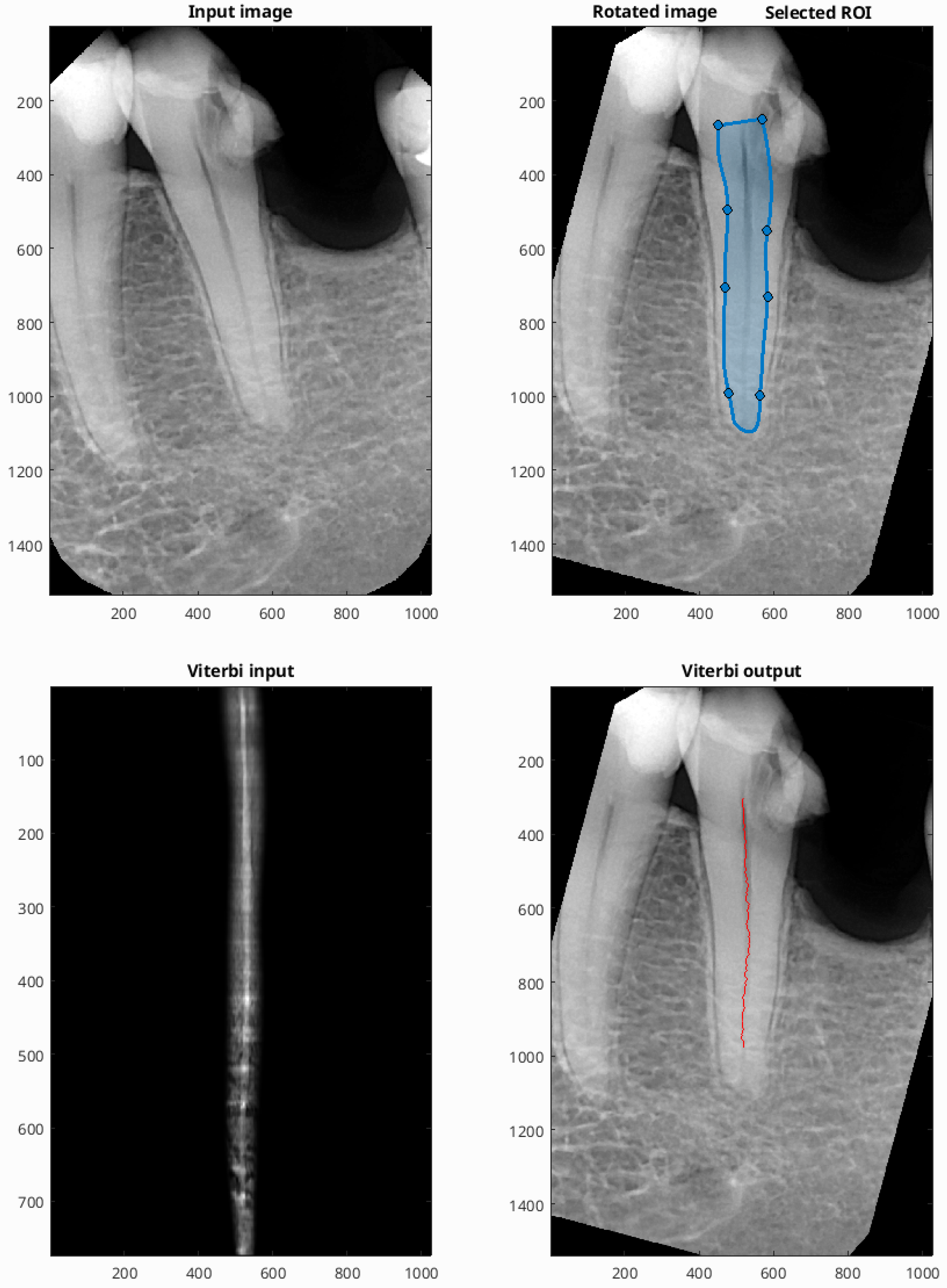
Image contrast enhancement (
Figure 1 top left):
This involves standardizing the minimum and maximum values to obtain values in the range <1–0> [
11]. This standardization does not affect the root canal estimation algorithm and is only necessary for human visualization of the image.
Standardization of rotation (
Figure 1 top right):
The root canal estimation algorithm requires a specific canal orientation (preferably vertical). However, images can be taken at angles, teeth can be from either the upper or lower jaw, and the root canal can be curved. For these reasons, the image needs to be rotated so that the root beginning is at the bottom and the crown at the top. This is accomplished by manually marking two points on the image, the estimated root beginning and root end.
Marking the root canal search area—ROI (region of interest) (
Figure 1 top right):
A single image can contain multiple teeth and roots. Segmentation is performed manually using a closed curve using a dedicated GUI (interactive ROI functions of Matlab [
12]—Image Processing and Computer Vision toolboxes). Segmentation should be performed within the visible root area but does not need to be spatially close to the root visible in the image.
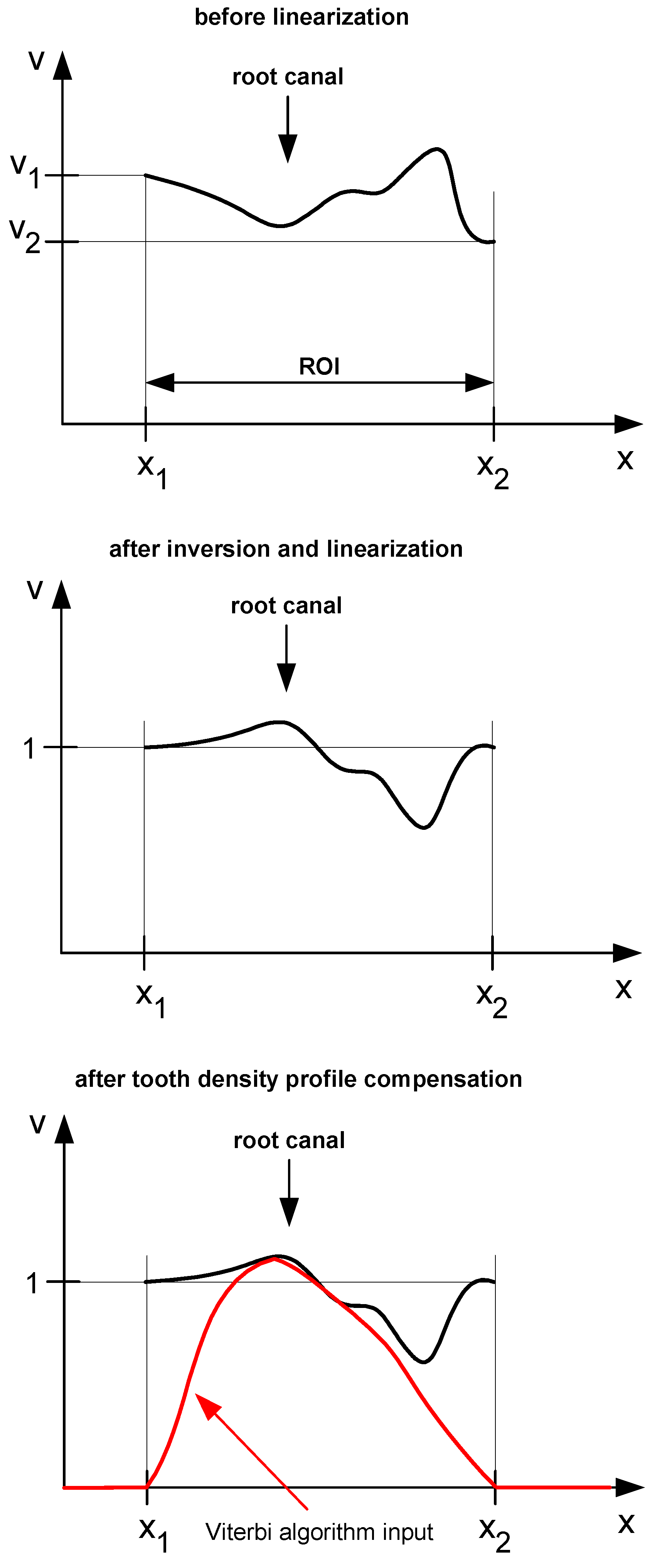
Standardization of brightness for root cross-section (
Figure 2 middle,
Figure 1 bottom left):
For a given horizontal line cross-section and the segmentation area, two extreme values are determined: the first, the leftmost pixel (
at
), and the second, the rightmost pixel (
at
). These values are used to remove the linear trend in pixel values for a given row. This operation is necessary to reduce the impact of inaccuracies in selecting the root versus canal region. It allows for a more symmetrical value profile. Linearization is conducted in such a way that the extreme pixels have a value of 1 (
Figure 2 middle):
where
is the pixel value of the row and
is the pixel position.
Because a tooth root is approximately a cone, the pixel values at the cone’s edges in planar view are lower than those at the center (
Figure 2 bottom). This effect must be reduced. A Tukey window [
13] with a cosine fraction of
, non-movable, and a length equal to the number of pixels in the row (
) was used for this purpose (spatial domain):
The window width is equal to the number of pixels in a given row bounded by the ROI. From row to row, this width varies due to the ROI.
Low-pass filtration (
Figure 1 bottom left):
Two-dimensional filtering is performed with a rectangular mask filter of size (), with weights equal to , and this operation reduces image noise.
Root trajectory estimation (
Figure 1 bottom right):
This stage uses the Viterbi line (curve) tracking algorithm [
14]. This algorithm tracks lines in the image from bottom to top using a moving window of a specified size.
Row value inversion (
Figure 2 middle) is performed by explicitly using the Tukey window, which causes the Viterbi algorithm to use maximization in the optimization process. It is also possible to use Tukey window inversion, in which case the Viterbi algorithm uses minimization.
2.4.5. Viterbi Algorithm
The Viterbi algorithm is typically used in telecommunications to decode convolutional codes [
15]. This algorithm uses a trellis for which it searches for the optimal transition path, enabling the determination of the initial state and the first transition [
16]. There are many possible methods for applying the algorithm to image processing, depending on the definition of states and the transitions between them [
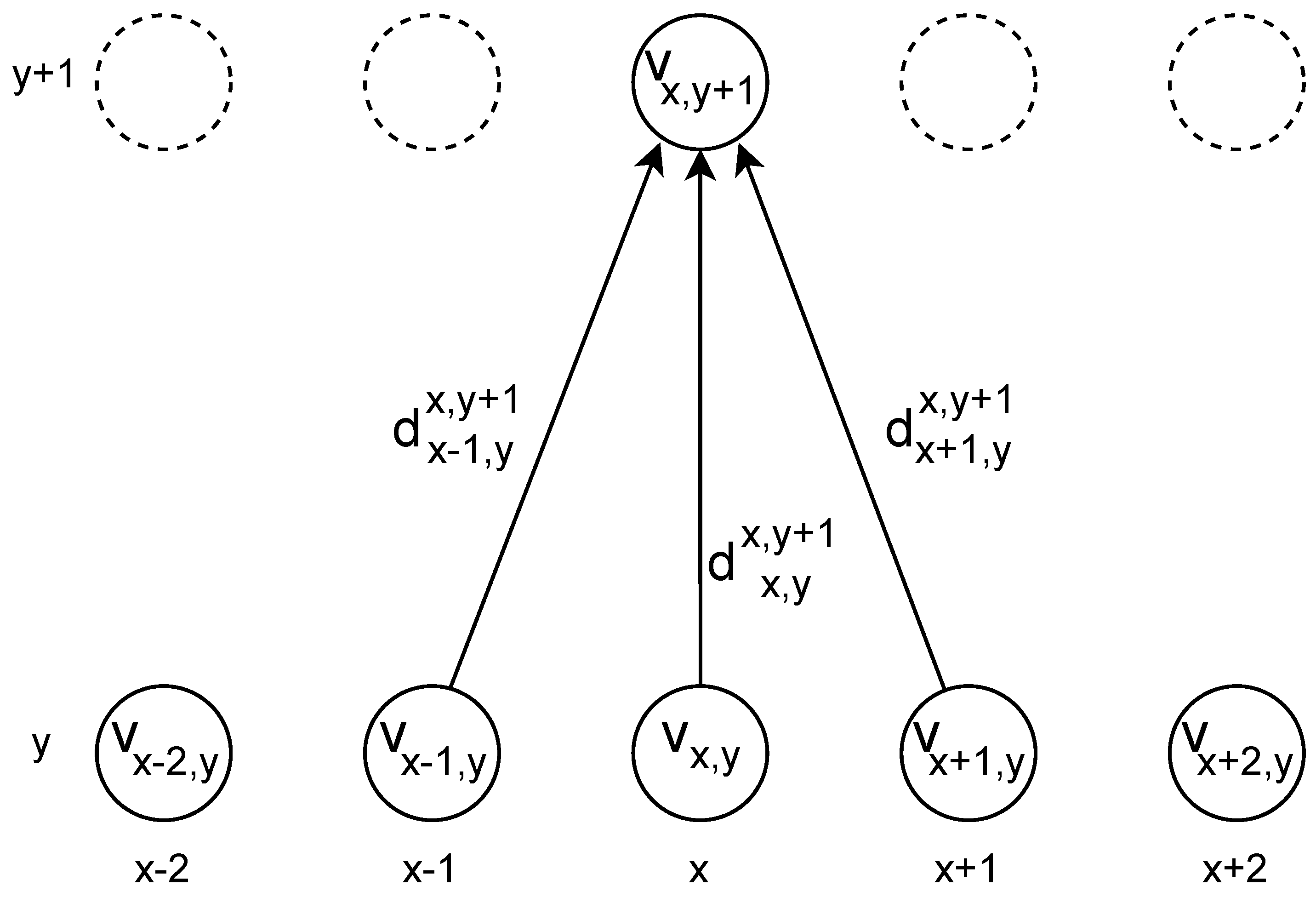
17]. This algorithm resembles a finite impulse response filter in that it uses a moving window defining the number of states to be analyzed. One approach to assigning states and transitions is the direct form, where states are pixel values and transitions define the neighborhoods between pixels in successive rows (
Figure 3). Therefore, for each pixel in a row, one can define the probability of transitioning to pixels in the next row, both for the same column and for adjacent columns. This definition of states (also called nodes) and transitions allows for the implementation of line tracing (not necessarily straight lines) in the image.
The Viterbi algorithm has several stages (from two to four, depending on the definition). The first stage is initialization, the second is the forward phase, the third is the selection of the most probable path, and the fourth is the backward phase (backtrack phase). An important feature of the Viterbi algorithm is the processing of multiple rows of the image (defined by a sliding window) to determine the initial state (the pixel for the initial row for which the path is most probable). After this operation, the sliding window is shifted by one row and processed again. The results for a given sliding-window position are not used in subsequent stages. In the case of strong noise or the presence of a larger number of lines, it is possible to jump between different lines if there is more than one of them, which is a feature of the basic Viterbi algorithm.
Transitions and their assigned probabilities influence the algorithm’s output. Because the lines corresponding to the root canals in the teeth do not exhibit significant changes in direction, it is possible to assume that there are only three transitions for each pixel (straight up, left up, and right up). The transition probabilities p are also the same ().
The proposed Viterbi algorithm performs transition analysis on a trellis whose nodes (states, nodes) correspond to individual image pixels (
Figure 2). The original algorithm discards paths (trajectories, lines) that are unlikely to be detected during analysis (feedforward phase), but this is not necessary during implementation, allowing for more efficient data processing.
The algorithm starts from the bottom row () of the window (length of window is R) and assumes a starting cost of 0 for each pixel (). The Viterbi algorithm is an optimization algorithm that can minimize or maximize the path. In the case of a root canal, the values are smaller (darker pixels in the image) than the surroundings (brighter pixels in the image), so it is a process of minimizing the total path.
An important feature of the Viterbi algorithm is optimization within a moving window. The Viterbi algorithm is not a local algorithm, which detects the most probable transition between two consecutive rows. This algorithm analyzes multiple paths, starting with all pixels in the first row. A given pixel
has several local paths originating from it
, and a given pixel
has several (the same number) local paths arriving at it (with equal weights)
. The Viterbi algorithm performs the accumulation process starting from the first row of pixel values by adding the pixel values:
along the path to each path, where
X is the input image and
g is a transition
.
Since multiple paths reach a given pixel, all but the path with the lowest value are discarded:
where
L is storage for local transitions.
In image analysis, there are always N acceptable paths for a given row, where N is the window width, due to the allowable branching from the previous row. The accumulation process proceeds from the first (bottom) row upward.
The third stage is selecting the best path. After accumulation, the last row searches for the path with the lowest value:
This is the end of the most probable path:
The fourth step is to backtrack to the first row based on the selected path. Backtracking allows for determination of the initial state, i.e., the detection of a single pixel in the line (the root canal pixel). The selected pixel does not necessarily have the lowest value among all the pixels in the bottom row. This is a valid feature of the algorithm, as the goal is not to detect local changes in the image due to noise.
The results are obtained using the following formula:
for successively decremented row numbers, where
and
is the estimated root canal pixel in the bottom row of the sliding window.
From the perspective of digital image processing and automation, the Viterbi algorithm performs the process of tracing a line, which may have very low contrast or be completely invisible to humans. The result is a TBD (track-before-detect) algorithm [
18], where the decision to detect a given pixel as a line element is made based on a larger amount of raw data (a larger number of pixels), additionally unthresholded. Because the algorithm operates on a multi-row sliding window, it does not require every individual row to contain visible canal pixels; short gaps in the canal signal are automatically bridged during the global optimization. This track-before-detect behavior improves robustness in regions with weak or locally interrupted canal visibility.
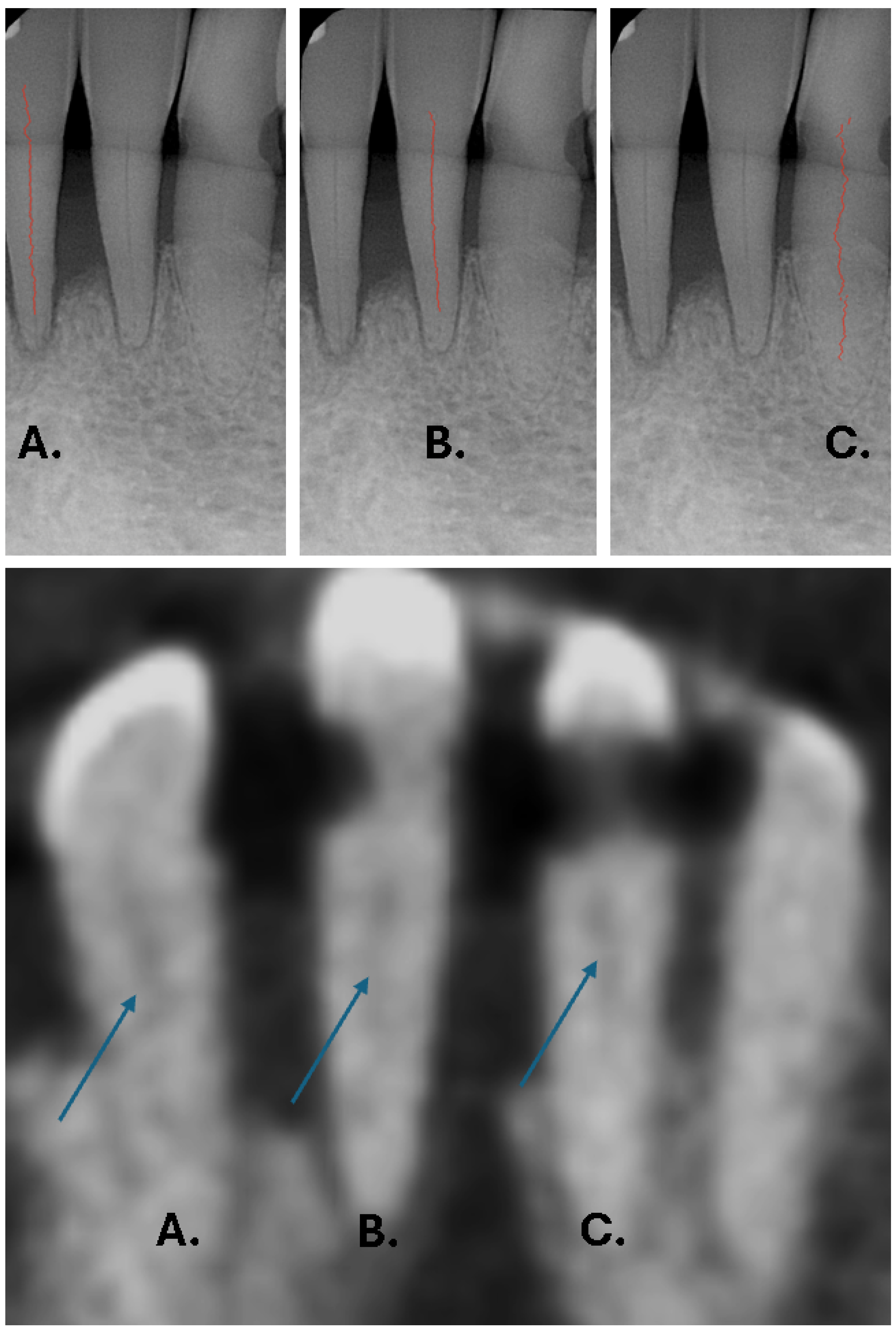
2.4.6. Representative Cases
In representative cases, the Viterbi-based tracker recovered canal centerlines on routine periapical radiographs that closely matched reference anatomy.
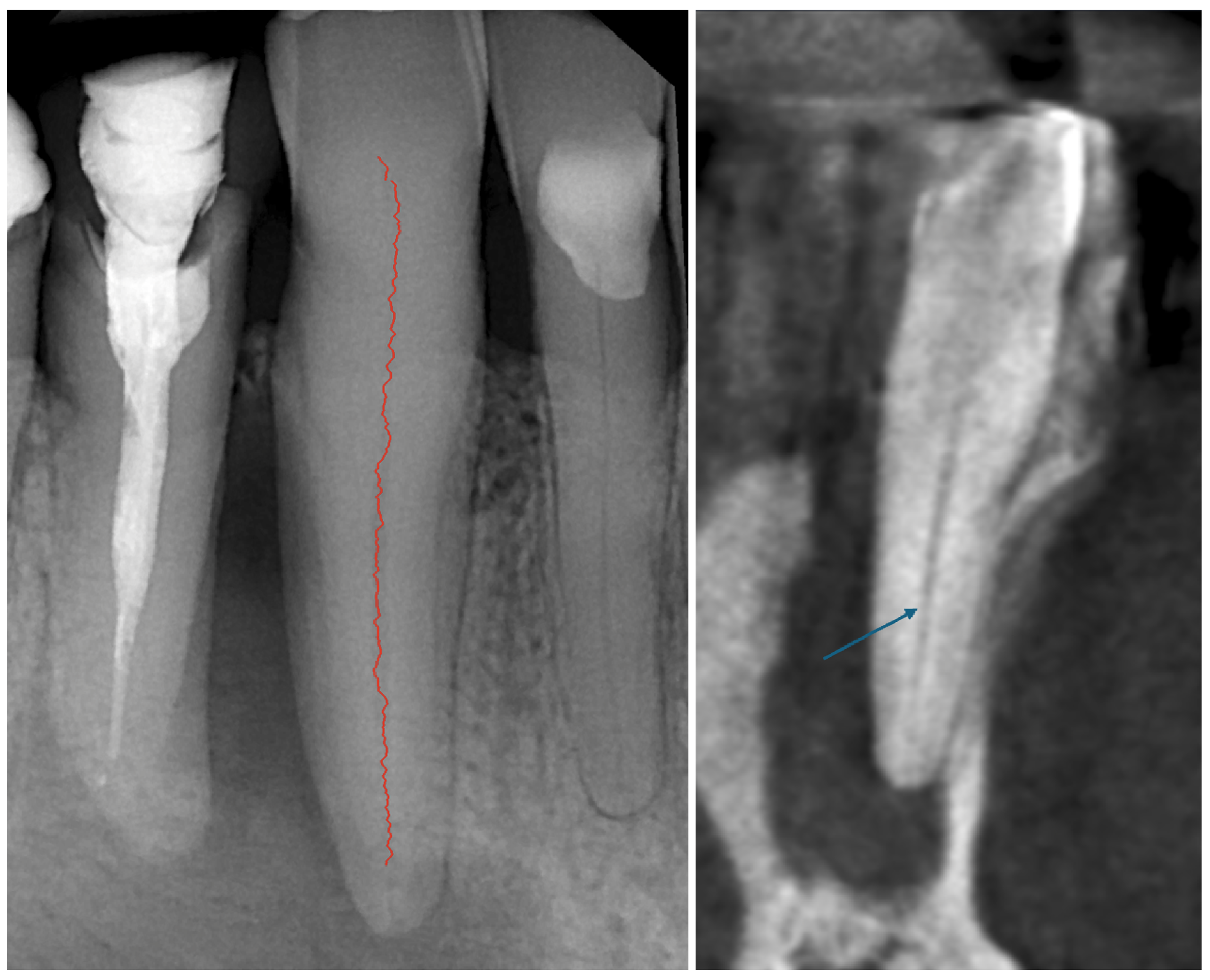
Figure 4 shows a single incisor with near-colocalization between the traced path on the radiograph (red) and the reference trajectory on micro-CT (blue).
Figure 5 generalizes this to multiple incisors (A–C), demonstrating consistent agreement between automatically traced radiographic paths (top row) and corresponding anatomical trajectories on CT sections (bottom row), supporting accurate canal localization across cases.
2.5. Statistical Results
2.5.1. Inter-Rater Reliability
The overall inter-rater reliability of Likert ratings was high (
Table 1). For the
TV-CLAHE single-canal confirmation task, the intraclass correlation coefficient ICC(2,
k) reached
(95% CI: 0.74–0.88,
), indicating
good absolute agreement among the four observers. For the
Viterbi tracking correctness task, reliability was slightly higher at ICC(2,
k) =
(95% CI: 0.78–0.91,
), corresponding to
good–excellent agreement. These results confirm consistent application of the scoring criteria across evaluators.
2.5.2. Group Comparisons
The Friedman test revealed statistically significant differences between image processing methods for canal visibility scores (, ). Pairwise Wilcoxon signed-rank tests identified that both TV-CLAHE and Viterbi conditions yielded significantly higher ratings than the unprocessed radiographs (, Bonferroni-adjusted ). No significant difference was observed between the TV-CLAHE and Viterbi scores (), indicating comparable perceptual quality and diagnostic confidence between the enhanced and algorithm-tracked images.
2.5.3. Summary Statistics
Across the 40 evaluated teeth, the median (IQR) Likert scores were as follows: original = 3.0 (2–3), TV-CLAHE = 5.0 (4.8–5.0), and Viterbi = 5.0 (4.9–5.0). The grand-mean Likert ratings were 4.86 ± 0.15 for single-canal confirmation and 4.88 ± 0.13 for Viterbi correctness, with per-tooth means ranging from 4.5 to 5.0. These results demonstrate both the consistency and the strong positive impact of the enhancement and tracking approaches on diagnostic visibility and interpretation accuracy.
2.5.4. Robustness of Canal Tracking to Additive Image Noise
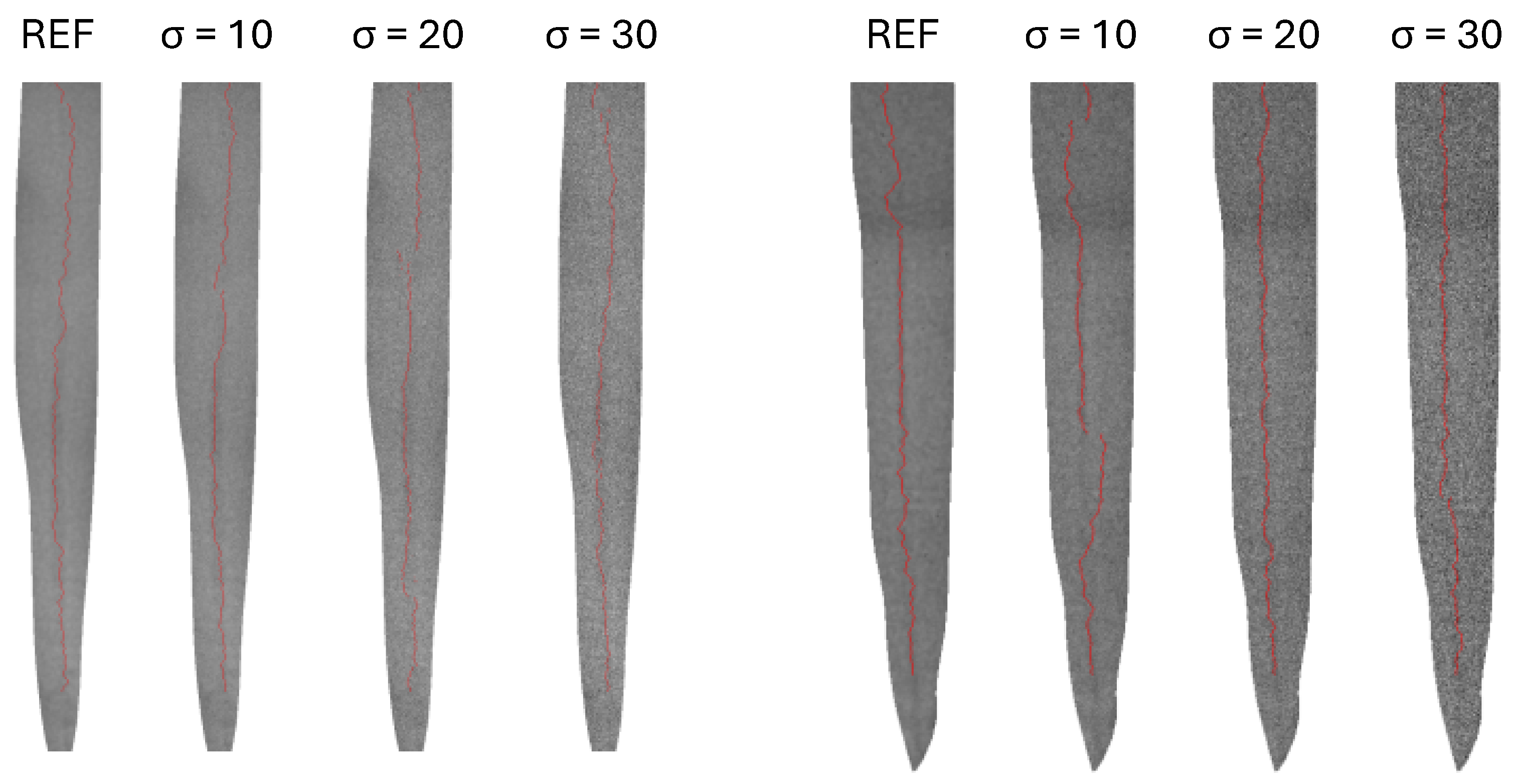
To quantitatively assess the robustness of the proposed Viterbi-based canal estimation algorithm to image noise, we performed a Monte Carlo experiment with synthetic additive Gaussian perturbations (
Figure 6 and
Figure 7). For each original radiograph, a reference canal trajectory was first obtained by applying the algorithm to the noise-free image; this trajectory was then treated as the ground truth for subsequent comparisons. Additive zero-mean Gaussian noise with standard deviation
was next added to the image, with
varied from 0 to 30. For each value of
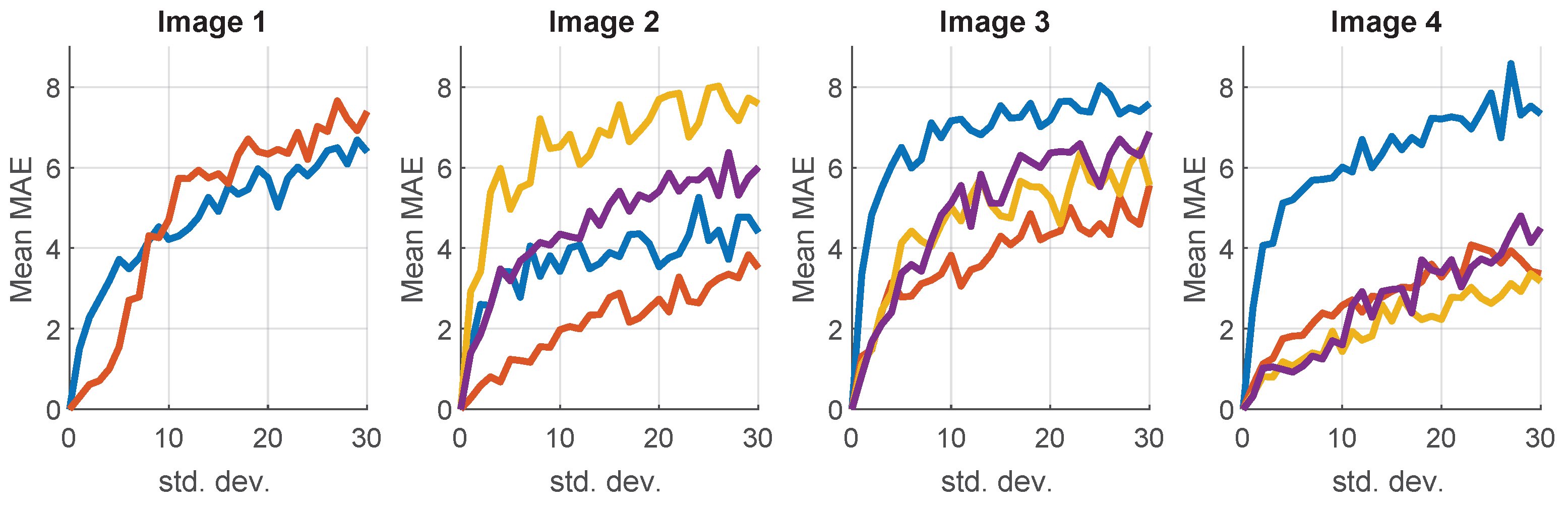
, 10 independent noise realizations were generated and the canal trajectory was re-estimated on each noisy image. The discrepancy between the reference and noisy estimates was quantified using the mean absolute error (MAE) of the canal position, defined as the average absolute difference in pixel location of the canal along each image row. For every canal and noise level, MAE values from the 10 realizations were averaged to obtain a Monte Carlo estimate of the expected error as a function of
. As can be seen in
Figure 7, the method is robust to noise: the mean MAE remains below 8 pixels for all canals even at
gray levels, a noise level at which the canal becomes hardly discernible to a human observer. Notably, around
, the images are already strongly degraded visually, while the algorithm still provides a coherent canal trajectory with only a moderate increase in MAE.
3. Discussion
Radiographs are important supports for the estimation of anatomy before endodontic treatment; however, in complex cases, they have limitations. Regular 2D radiographs have limitations (overlap of structures, no depth), but they are quick and low-cost. They often guide the initial suspicion of complex anatomy before advanced imaging is considered [
19]. Key radiographic signs that suggest an extra or missed canal include unexpected canal path changes: If the visible root canal abruptly divides, narrows, or disappears on the radiograph, it often indicates that the canal is bifurcating or an additional canal is present [
20]. A sudden loss of radiographic density in the canal space may signal a split into two canals [
21]. However, these signs might not be sufficient to trace the dental canal. Therefore, thorough understanding of tooth anatomy and careful inspection of the pulp chamber might be fundamental [
22]. Aside from visual inspection, various chairside tests and tricks can aid canal location without advanced technology. Use of the Champagne Bubble Test (chamber is flooded with sodium hypochlorite, where bubbling reaction can reveal concealed orifices that might otherwise be overlooked [
23]) is common. Application of dyes, namely staining the chamber with dyes (e.g., 1% methylene blue or fluorescein) and then rinsing, can highlight tiny orifices, isthmuses, or cracks. The dye penetrates these areas and serves as a roadmap for the clinician to spot hidden canals [
24]; however, these techniques are invasive and can be applied only after the canal is opened. Besides invasive techniques, there are methods which rely on visible light, like transillumination, where shining a strong fiber-optic light through the tooth can expose differences in translucency. This is a simple, low-cost method to locate calcified or extra canals—the light passing through the tooth structure may show a shadow or dark line where a canal or chamber space exists. Turning off overhead lights during transillumination can enhance the contrast and reveal an orifice [
25]. The Red Line Test is used in vital teeth, where blood acts like a natural dye to map the anatomy of hidden canals [
26]. Lastly, there is the White Line Test: In necrotic cases, dentin dust accumulates in grooves or orifices. This dust appears as white lines or dots on the pulp floor, and such traces provide a clear anatomical guide under magnification [
27]. Using these anatomical techniques, along with careful access cavity modification (expanding the access if an extra canal is suspected and relying on the “dentinal map” of the chamber floor), helps maximize the chances of locating all canals but is anatomy-dependent and can be imprecise [
28]. Where the chamber is open, tactile feedback with an endodontic explorer (e.g., a DG16 probe) is also used—a canal orifice will feel sticky or catch the probe’s tip. Ensuring that the entire pulp chamber roof is removed and using adequate illumination are important so as not to miss hidden canals.
The present observer study extends the previously published results obtained with the Total-Variation-Contrast-Limited Adaptive Histogram Equalization (TV-CLAHE) method [
9] by introducing an additional validation layer based on an automated Viterbi line tracking algorithm. While both approaches target improvement in root canal delineation on standard periapical radiographs, they differ in methodological focus: TV-CLAHE optimizes contrast and noise balance at the image-enhancement stage, whereas the Viterbi algorithm addresses canal-trajectory detection at the interpretation stage. Together, these methods form complementary components of an integrated endodontic imaging pipeline.
Convolutional neural networks (e.g., U-Net and its variants) and transformer-based models are widely used for medical image segmentation. However, in this study, the target is a single, extremely thin canal lumen, often only a few pixels wide, in low-contrast 2D periapical radiographs, with a small dataset of 40 images with CBCT/micro-CT-validated trajectories. In such conditions, encoder–decoder networks with downsampling are prone to losing sparse tubular structures and are strongly affected by the severe class imbalance between the canal and background. For these reasons, a deterministic, model-based line tracking strategy combined with physics- and geometry-informed preprocessing was chosen for this feasibility study, with hybrid deep-learning extensions left for future work on larger datasets.
3.1. Comparison of Diagnostic Performance
In the previous work, TV-CLAHE demonstrated superior visibility of root canals with median Likert scores of 4–5 and diagnostic success rates between 93 and 98% across observers, closely approximating CBCT reference visibility. In the present study, this performance was reproduced, with mean per-tooth ratings of 4.86 ± 0.15 for single-canal confirmation. The newly introduced Viterbi-based tracking achieved comparable or slightly higher subjective correctness scores (mean 4.88 ± 0.13), with per-tooth means spanning 4.5–5.0, satisfying the pre-defined success criterion of ≥4.8. No significant difference between the TV-CLAHE and Viterbi ratings was detected (, Wilcoxon signed-rank, Bonferroni-adjusted ), confirming that the automated tracking maintained the diagnostic quality achieved through manual interpretation of enhanced images. These results demonstrate that algorithmic canal tracing can be performed without perceptible degradation of visual confidence compared to human assessment of TV-CLAHE-processed radiographs.
3.2. Observer Consistency and Reliability
High inter-rater agreement for both methods [ICC(2,k) = 0.82 for TV-CLAHE, ICC(2,k) = 0.86 for Viterbi] indicates stable interpretation across expert raters and supports the reproducibility of the scoring framework. This consistency confirms that the five-point, positive-only Likert scale—adapted from the original TV-CLAHE study—remains effective for structured qualitative assessment of endodontic radiographs. The comparable ICC values suggest that the introduction of algorithm-based overlays did not increase rating variability, thereby validating the design of the Viterbi scoring rubric.
3.3. Technical and Methodological Implications
From a signal-processing perspective, TV-CLAHE enhances image quality by locally increasing contrast while suppressing noise through Total-Variation regularization, yielding improved delineation of low-contrast anatomical structures such as fine root canals. In contrast, the Viterbi tracker operates on these enhanced inputs to automatically extract the most probable canal centerline based on row-wise brightness linearization, Tukey window compensation, and dynamic-programming optimization. The combination of these techniques allows the system to recover canal paths even in regions with weak or interrupted visual cues. The five-anchor Likert rubric anchored to percent-length alignment provided a clinically interpretable measure of geometric fidelity, aligning the algorithmic output with human diagnostic criteria.
3.4. Clinical Relevance
Both approaches have practical implications for everyday dental radiography. TV-CLAHE can be implemented as a rapid preprocessing step to enhance image readability without increasing radiation exposure or altering acquisition workflow. The Viterbi algorithm can subsequently be used as a low-cost, fully deterministic adjunct to highlight probable canal trajectories, supporting clinicians in complex or ambiguous cases where canal outlines are faint. Together, these methods offer a synergistic framework: TV-CLAHE improves perceptual visibility, while the Viterbi tracker translates that enhanced contrast into a quantifiable and reproducible representation of canal anatomy.
3.5. Limitations and Future Directions
This study has several limitations that should be taken into account when interpreting the results. First, the current implementation relies on two manual inputs, namely orientation marking and coarse ROI selection, which introduces some degree of operator dependence. These interactions were intentionally restricted to simple, non-precise annotations, and the preprocessing pipeline, including row-wise brightness linearization and tooth density profile compensation (
Figure 1 and
Figure 2), was designed to reduce sensitivity to marking inaccuracies. Nevertheless, manual interaction remains a limitation of the current implementation. Replacing these steps with automated modules for orientation estimation, learning-based tooth and dentin segmentation, and multi-root detection would further strengthen reproducibility and support progression toward fully unsupervised canal-trajectory extraction on routine periapical radiographs.
Second, the present framework is limited to single-path tracking. The Viterbi algorithm used in this study is configured to recover a single optimal trajectory, reflecting its classical dynamic-programming formulation, which is inherently tailored to track one line through a trellis. As a consequence, the current implementation cannot explicitly represent bifurcations, parallel canals, or multi-radicular anatomies, and the analysis was therefore restricted to incisors, where the canal morphology typically follows a single continuous path. Although multi-path extensions of Viterbi are theoretically possible, they would require substantial methodological development, including branch-aware state space design, multi-hypothesis management, and modified cost aggregation, and are not straightforward within standard tracking theory. These extensions are scientifically valuable but fall beyond the scope of this feasibility study, whose primary objective was to validate deterministic preprocessing and single-path Viterbi tracking on routine radiographs. Future work will focus on algorithmic strategies, including Viterbi variants and hybrid approaches, to accommodate complex canal systems and multi-rooted teeth. In addition, the evaluation was conducted on a single-center dataset of 40 periapical radiographs, primarily incisors, under relatively homogeneous acquisition conditions, which may limit generalizability to other tooth types and imaging protocols.
Third, despite the applied preprocessing, the method may still be affected by image noise and challenging contrast conditions. Brightness linearization, Tukey window compensation, and low-pass filtering substantially stabilize the trellis and reduce the likelihood of path switching; however, in regions with very weak signal or multiple competing minima, the classical Viterbi formulation can still be locally perturbed. More advanced, potentially adaptive noise-suppression strategies might further improve robustness, but their performance is expected to depend on acquisition-specific factors and would need careful, systematic evaluation before incorporation into a generalized clinical framework.
4. Conclusions
In this observer study of 40 teeth, both TV-CLAHE enhancement and Viterbi tracking substantially improved canal visibility compared with unprocessed periapical radiographs. Median (IQR) Likert scores increased from 3.0 (2–3) on original images to 5.0 (4.8–5.0) for TV-CLAHE and 5.0 (4.9–5.0) for Viterbi, with grand-mean scores of 4.86 ± 0.15 for single-canal confirmation and 4.88 ± 0.13 for Viterbi correctness and per-tooth means spanning 4.5–5.0. A physics- and geometry-aware preprocessing stage coupled with dynamic-programming-based tracking can reliably recover root canal paths from routine periapical radiographs. In this study, the method achieved 100% concordance with CBCT/micro-CT reference anatomy, indicating potential clinical utility as a low-dose, rapid aid for canal localization when 3D imaging is unavailable or deferred; however, these findings should be confirmed prospectively across diverse tooth types, image qualities, and acquisition protocols prior to routine adoption as a stand-alone alternative to CBCT. Because the pipeline is fully deterministic and explicitly defined (orientation/ROI marking, row-wise brightness linearization, Tukey window compensation, smoothing, and Viterbi tracking), it is transparent, reproducible, and readily transferable to other centers and software environments. Limitations include manual orientation and ROI selection, which may introduce operator-dependent variability; a single-path assumption that can under-represent bifurcations or parallel canals by forcing a single trajectory; and potential line switching in noisy regions when multiple candidates exist, suggesting that automation of inputs and incorporation of additional constraints or multi-hypothesis handling could further improve robustness and repeatability. Further postprocessing operations include filtering the recovered trajectory to enforce physiologically plausible smoothness while preserving true anatomical curvature.





 ,
,