Systematic Review

Plant Species for Sustainable Bioretention Systems’ Implementation in Mediterranean Italian Regions: A Review

Department of Civil and Environmental Engineering, University of Perugia, Borgo XX Giugno 74, 06121 Perugia, Italy
*
Author to whom correspondence should be addressed.
Appl. Sci. 2026, 16(11), 5315; https://doi.org/10.3390/app16115315
Submission received: 28 April 2026 / Revised: 20 May 2026 / Accepted: 21 May 2026 / Published: 26 May 2026
(This article belongs to the Special Issue Resilient Cities in the Context of Climate Change)

Abstract

Vegetation is a key component of bioretention systems, significantly influencing their functionality and overall performance. The sustainability of these systems largely depends on the plant species’ ability to withstand the primary hydrological stresses induced by the infrastructure’s design, in combination with local climatic conditions. This study focuses on plant selection for bioretention applications in Sub-Mediterranean and Mediterranean regions of Italy, which are increasingly affected by extreme weather events, including intense rainfall, heat waves, and prolonged droughts. A review of scientific literature and stormwater management manuals developed for Mediterranean climates was conducted to evaluate both non-native species and Italian native species already used in international applications. The findings reveal a limited range of drought-tolerant non-native species in scientific literature, whereas such species are more prominently featured in California-based manuals. Moreover, among the relatively few native species identified, only a small number are truly suited to fully Mediterranean conditions, based on evaluations of Ellenberg index values. These results highlight a significant research gap, emphasizing the need for further studies, particularly focused on the target ecosystems of native flora in central and southern Italian regions.

1. Introduction

Driven by increasingly intense rainfall linked to climate change, together with widespread soil sealing in rapidly urbanizing areas, sustainable stormwater management has become a priority for municipalities worldwide [1,2]. In this context, Green Stormwater Infrastructures (GSI)—referred to by different terms depending on the region, such as Sustainable Urban Drainage Systems (SuDS) or Low Impact Development (LID)—have gained growing attention over the past three decades [3], emerging as priority Nature Based Solutions (NbS) for stormwater management [4]. Among GSI practices, bioretention systems, commonly known as rain gardens (RGs) and often implemented as bioswales [5], represent one of the most widely adopted approaches. These systems not only promote the infiltration and filtration of stormwater but also deliver a range of ecosystem services [6,7], including support for biodiversity, enhancement of urban aesthetics, and various social benefits [8,9].
Climate change makes stormwater management infrastructures particularly relevant for the Italian peninsula, not only in Northern Italy but also in its Central and Southern regions. While mostly Northern Mediterranean areas—such as South France, North Italy, and the Balkans—are projected to experience increasingly extreme precipitation events [10,11,12], Central Italy is also showing an increase in the frequency and intensity of such events, particularly during the summer, with a shift towards shorter and more intense convective rainfall [13,14,15]. Furthermore, although the southern Mediterranean is generally expected to experience a decrease in both average and extreme precipitation [10,11,12], local studies nevertheless highlight a trend toward more intense short-duration rainfall events [16,17,18].
Consequently, GSI are increasingly recognized as a crucial strategy for climate change adaptation within Italian urban areas [19,20]. The broader ongoing SuDS implementation initiative is represented by the Milan Sponge City Project [21], while several pilot RG projects have been developed across the country [19], although they remain largely undocumented in the scientific literature. To date, the only experimental RG described in the literature was established in Padova in 2011 [22,23,24]. In Central and Southern Italy, the municipality of Rome is currently promoting the implementation of stormwater management measures such as RGs [25], while in Sicily, the intention to adapt coastal areas to extreme climatic events through the use of NbS is reflected by the completed Gifluid project [26] and participation in the ongoing Horizon project Cardimed [27]. A first RG was recently implemented in the city of Catania [28].
Mediterranean climates occupy a large portion of the Italian peninsula across its Central and Southern regions, according to both the Köppen climate classification [29] and, more importantly for vegetation analysis, the Rivas-Martinez bioclimatic classification [29,30]. Furthermore, a large portion of northern Central Italy, currently classified as Sub-Mediterranean macrobioclimate according to Rivas-Martínez [29], is projected to shift toward Mediterranean climatic conditions from the 2040s onward [31]. The magnitude of this climate-driven southward shift toward warmer climatic conditions is also well documented by Bastin et al. [32]. E.g., in fifty years, Madrid is projected to experience the climate of Marrakesh, and London that of Istanbul.
Since the overall performance and long-term functionality of RGs strongly depend on vegetation, which plays a central role in regulating hydrological processes, supporting microbial activity, and ensuring system resilience over time [33,34,35], selecting climate-adapted species is crucial to the infrastructure’s sustainability. Under Mediterranean conditions, plants in RGs are not only required to tolerate a more or less prolonged and pronounced temporary waterlogging [8,36], depending on the infrastructure’s design and their positioning within the RG [37], but also severe heat and drought stress [38]. Although a limited number of studies have addressed bioretention design in xeric climates [39,40,41], applications in Mediterranean-climate regions remain comparatively underrepresented in the literature [5], highlighting a significant research gap regarding the identification of suitable plant species.
Therefore, this review aims to address the current knowledge gap regarding vegetation selection for bioretention systems in Mediterranean environments in Italy. Specifically, the objectives of the study are:
  • to identify the botanical families, genera, and growth forms most frequently associated with bioretention systems in scientific literature and Mediterranean stormwater manuals;
  • to evaluate the ecological compatibility of recurrent non-native taxa with Sub-Mediterranean and Mediterranean Italian conditions, with particular reference to tolerance to alternating flooding and drought stress;
  • to identify Italian native taxa potentially suitable for bioretention applications through the integration of ecological indicators, habitat affinity, and flooding-tolerance information;
  • to develop a structured preliminary reference framework for future experimental testing and plant selection in Mediterranean bioretention systems.

2. Materials and Methods

2.1. Studies’ Research

First, two of the most comprehensive books on bioretention (rain gardens) were selected as primary sources to identify potentially suitable taxa in both British [37] and North American [9] literature. Subsequently, the research conducted in April 2025 focused on identifying the most recent and comprehensive review papers in the scientific literature on bioretention, with particular emphasis on vegetation, or, at a minimum, on including the names of the plant species reported in the analyzed studies [2,5,42]. The construction of the main database was based on expanding the taxa list proposed by Corduan and Kühn [5]. Within the bibliographies of the selected reviews, only studies directly associated with cited plant species were considered, while duplicate articles were counted only once. Consequently, only species explicitly mentioned within the databases and texts of the selected review papers were included in the initial species list.
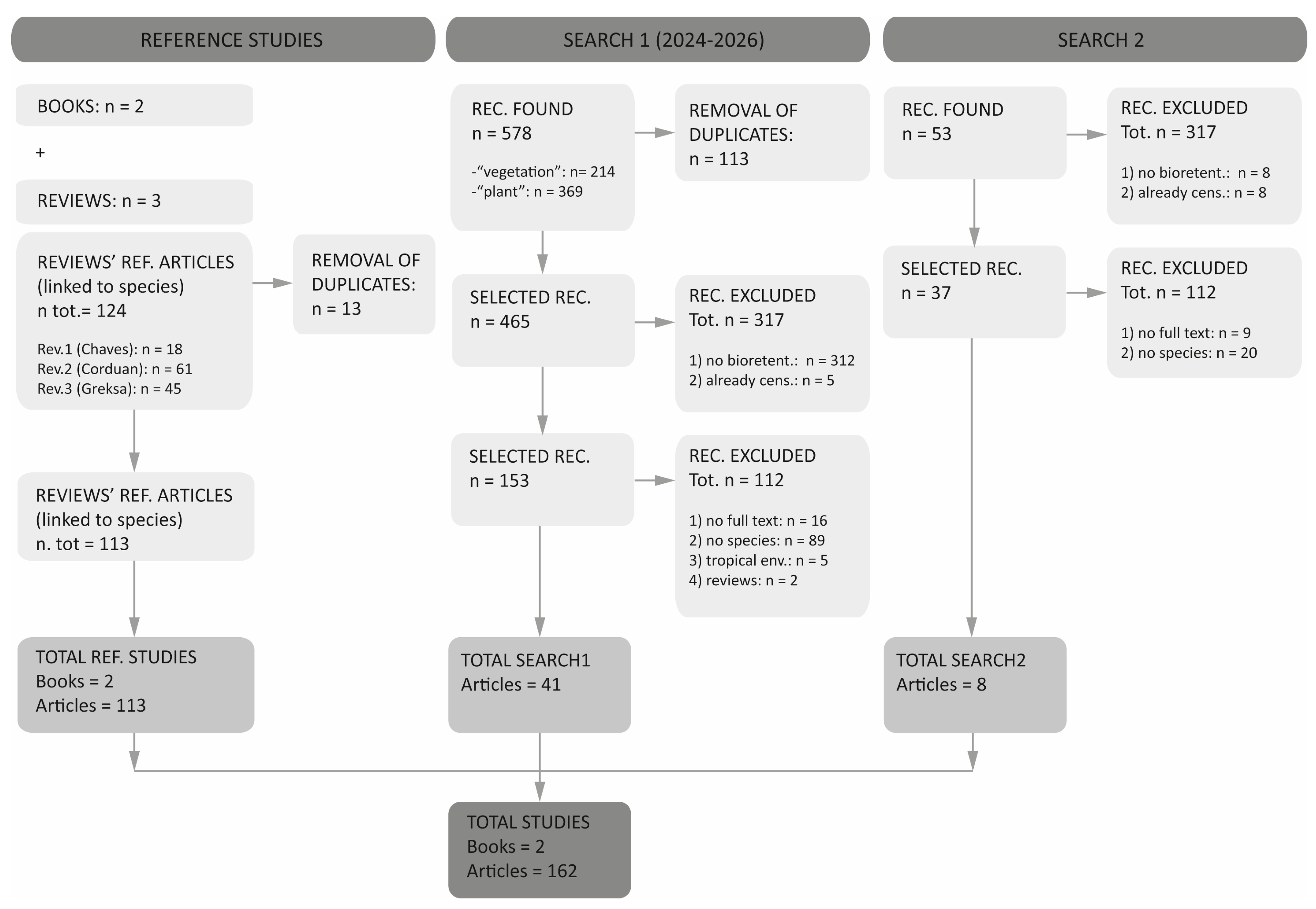
The database was subsequently expanded to include both the most recent studies on bioretention (2024–2026) and the species experimentally tested under cyclic flooding conditions. To achieve this, two additional searches were conducted in March 2026, referred to as “search 1” (S1) and “search 2” (S2), respectively (Figure 1). Both searches were performed in Web of Science across all available databases, including only English-language publications.
For S1, the following search criteria were applied: Topic = “bioretention” OR “bioswale” OR “rain garden” OR “rain garden” OR “stormwater biofilter”. The results were first filtered by publication year (2024, 2025, and 2026), after which two additional filters—“vegetation” and “plant”—were applied separately, generating two result sets. Duplicate records between the two sets were subsequently removed. An initial screening based on titles and abstracts excluded studies unrelated to bioretention, and articles already included in the review papers were considered as primary references. A second screening, based on abstracts and full texts, applied the following exclusion criteria: unavailable full texts, absence of scientific plant names, studies specifically focused on tropical environments, and review papers to avoid duplication of sources.
For S2, the following search criteria were applied: Topic = (“bioretention” OR “bioswale” OR “rain garden”) AND (“plant selection” OR “cyclic flooding” OR “cyclical flooding”). Results were refined using the combined filters “vegetation” and “plant”. Articles unrelated to bioretention or already identified in the previous search were first excluded, followed by records lacking full-text availability or species names. Overall, the final database included 169 scientific publications: 2 books and 167 articles.
Grey literature on stormwater management was also surveyed, with a specific focus on the Mediterranean climate. An initial online search was performed in Google Chrome using the keywords “stormwater management manual plant list” and “stormwater management LID manual plant list”, yielding 29 results from various North American locations. Based on the Köppen climate classification of the corresponding cities or regions, three manuals from Csa climate regions (Mediterranean climate with dry, hot summers) were selected [43,44,45], along with three additional manuals representative of Csb climates (Mediterranean climate with dry, warm summers) [46,47,48]. A secondary practice-oriented database was compiled from plant species lists reported in the selected stormwater management manuals representative of Mediterranean-type climates. These manuals were considered as technical grey literature intended to complement, rather than replace, peer-reviewed scientific evidence.

2.2. Species’ Analysis

All the species found in the aforementioned scientific literature and stormwater manuals were listed in a first Excel database, available as Table S1a,b in Supplementary Materials S1. The database was designed as a structured reference tool for preliminary species screening, rather than as a definitive plant-selection algorithm. Taxa were included according to a transparent source hierarchy: first, scientific literature on bioretention and cyclic flooding experiments; second, stormwater management manuals from Mediterranean-type climates; and third, botanical and ecological databases to standardize each taxon’s attributes. For each record, accepted taxonomic name, botanical family, growth form, native range, and Italian native/non-native status were compiled, based on the information in the Kew Gardens’ Plants of the World online database [49].
Species were then separated into herbaceous dicotyledons, herbaceous monocotyledons, shrubs, and trees/shrub-trees, because these groups differ in ecological function, available information, and potential use within bioretention systems. For each of these groups, the most recurring families and genera were assessed. For further analysis of the single species, Italian native and non-native taxa were considered separately. For non-native taxa, drought tolerance, moisture use, anaerobic tolerance, minimum precipitation, and wetland status were extracted when available. For Italian native taxa, Ellenberg temperature and humidity values were combined to derive an environmental compatibility class, while tolerance to temporary waterlogging was classified using evidence from cyclic flooding studies, wetland status, or habitat affinity.
The screening procedure did not apply numerical weights, as the available sources provide heterogeneous information and rarely report comparable quantitative performance metrics. Instead, the database applies a reproducible qualitative classification based on explicitly defined criteria. Therefore, the database should be interpreted as a preliminary decision-support framework for identifying promising candidate species, not as a substitute for local experimental validation.

2.2.1. Non-Native Taxa: Scientific Literature

For non-native taxa identified through the scientific literature survey, only species with at least two citations were considered in order to narrow down the pool of candidate taxa. Given the predominance of North American species, the following attributes, available in the USDA Plants Database [50], were primarily assessed: anaerobic tolerance, drought tolerance, moisture use, minimum precipitation, and wetland status. When drought-tolerance information was unavailable, and especially for particularly promising taxa, the USDA data were integrated and cross-checked with information from the Missouri Botanical Garden online database [51] and the University of Texas database [52]. Table 1 summarizes the conversion of textual information into the drought-tolerance ranges derived from the USDA Plant Database.
Additional information from species descriptions was also used to assign drought-tolerance ranges when not available in the aforementioned literature and to list the species’ preferred habitats. Multiple databases, floras, and nursery sources were consulted for species native to North America [53,54,55,56,57,58], Oceania [59,60,61,62], and other geographical regions [63,64,65]. Whenever available, this information was further compared with Ellenberg indicator values [66,67], which were interpreted according to the criteria described in Section 2.2.2. The aim of the analysis was to identify the most suitable species for a potential use in the drought-prone Mediterranean environments. The resulting candidate taxa are reported in Section 3, along with information on their current occurrence within the Italian territory, to provide a preliminary assessment of potential invasiveness risk.

2.2.2. Non-Native Taxa: Stormwater Management Manuals

Besides performing the same analysis described in Section 2.2.1 for the recurrent taxa, all species reported in the Csa-climate manuals were additionally considered in order to further characterize the non-native taxa. Cultivars and subspecies were reported to species rank and therefore counted only once. Due to the availability of additional ecological information within the manuals, tolerance to submersion, water regime, and shading were also assessed. Csb-climate manuals were likewise consulted when the same species were included in those sources. Regarding submersion tolerance, species were classified as “Y” (tolerant) when indicated for the bottom zone of the basin or described as having broad ecological tolerance to submersion, whereas “(Y)” indicated limited or uncertain tolerance, corresponding to species recommended for the slope zone of the basin or more generally classified as flood-tolerant. Water-regime values ranged from L (Low) to M+ (High). Values reported as “VL” (Very Low) in the manuals were conservatively reclassified as L. Water-regime classifications were subsequently verified by comparison with the WUCOLS database, when available for the species considered [68].
For the analysis of plant communities, habitats, and environmental conditions, the Calflora database was used as the reference source [57], given the predominance of California-native taxa. Information regarding maximum temperatures during the hottest month (“July High”), minimum annual precipitation, plant communities, and habitat types—including wetland occurrence—was extracted. The complete analysis is provided in Supplementary Materials S6.

2.2.3. Italian Native Taxa

For the analysis of Italian native species, the following attributes were considered: Raunkiaer life-forms, chorotype, Ellenberg indicator values, USDA wetland status, distribution within the Italian peninsula, and main habitats. The first three categories were primarily derived from Pignatti [69]. For Monocotyledon indicator values, Guarino et al. [66] were additionally consulted, while species assigned an “X” value were further integrated using the corresponding values reported by Tichy et al. [70], which were included in brackets. Whenever available, USDA wetland status classifications were also extracted from the USDA Plants Database [50]. Species’ distribution within Italy was assessed in terms of both geographical and altitudinal range using online floristic databases [71,72] and Pignatti [73]. The same sources were used to identify and synthesize the preferred habitats of the most promising taxa, which were compiled into a final summary table for each plant group (herbaceous Dicotyledons, Monocotyledons, shrubs, and trees).
To synthesize the ecological information most relevant to environmental compatibility under Sub-Mediterranean and Mediterranean conditions, namely temperature (T) and humidity (H), a qualitative index based on these two Ellenberg indicators was developed. The index was intended as a preliminary screening and classification tool and is reported in Table 2.
Based on the ecological significance attributed to Ellenberg temperature and humidity values in Pignatti’s interpretation, the index might indicate the following gradient of environmental compatibility:
  • the value “+/−” may correspond to conditions requiring average irrigation in Sub-Mediterranean contexts or frequent irrigation under Mediterranean conditions;
  • the value “+” may correspond to moderately irrigated Sub-Mediterranean conditions or average irrigation under Mediterranean conditions;
  • the value “++” may correspond to moderately irrigated Mediterranean conditions;
  • the value “+++” may correspond to Mediterranean conditions requiring only infrequent or no irrigation, apart from establishment and emergency interventions.
The category “t.b.e.” (“to be evaluated”) was assigned both to species with incomplete ecological information (e.g., “X” values for T and/or H) and to more or less thermophilous taxa associated with elevated moisture requirements. This category was intended to highlight the need for additional ecological or technical evaluation of drought and heat tolerance, or for further inference based on habitat affinity [71,73,74,75], particularly in cases where species also exhibited high flooding tolerance associated with elevated humidity values.
A second index was developed to assess the species’ tolerance to waterlogging. Due to the frequent occurrence of taxa derived from cyclic flooding studies, the most recurrent limit flooding duration—72 h—was adopted as a reference threshold. The classification system was primarily based on the study of Eben et al. [76] concerning experimentally tested herbaceous species, and is reported in Table 3.
The results of comparable cyclic flooding studies [77,78,79] were subsequently standardized using this reference framework, incorporating mortality and visual and/or growth assessments. In other cases, flooding tolerance was inferred from the experimental conditions described in the corresponding studies. When direct information was unavailable, species associated with highly moist or flood-prone ecological niches [71,73,74,75] were assumed to have elevated tolerance to flooding. For woody taxa, the “Try Plant Trait Database” was also consulted [80], particularly regarding the trait “Species tolerance to waterlogging”, mainly derived from the study of Niinemets and Valladares [81]. In ambiguous cases, or when flooding tolerance could not be inferred from the available literature, the value was reported as “?”.

3. Results

3.1. Overall Results

Scientific literature. The scientific literature survey identified a total of 37 taxa reported at the genus level, 704 distinct species, 67 cultivars, and 9 botanical varieties or subspecies. Of the recorded taxa, 67% were herbaceous, whereas 33% were woody (see Table S1a in Supplementary Materials S1).
Among herbaceous dicotyledon species, classified primarily as forbs (296 taxa), the vast majority were Hemicryptophytes, while only a limited number of species were Therophytes or Biennials. Monocotyledons were also predominantly represented by Hemicryptophytes, mainly consisting of grasses (94 taxa) and graminoid species, including sedges (44 taxa) and rushes (12 taxa). The remaining taxa are Geophytes, mostly rhizomatous, whereas bulbous species were comparatively rare. The few Chamaephytes were identified as “small shrubs” and partially included within the herbaceous Dicotyledons due to their reduced dimensions and predominantly herbaceous habit. Among Phanerophytes (260 taxa), shrubs represented the dominant life form (126 taxa), followed by trees (73 taxa) and taxa exhibiting both shrub and tree habits (53 taxa), while only a few species were woody climbers.
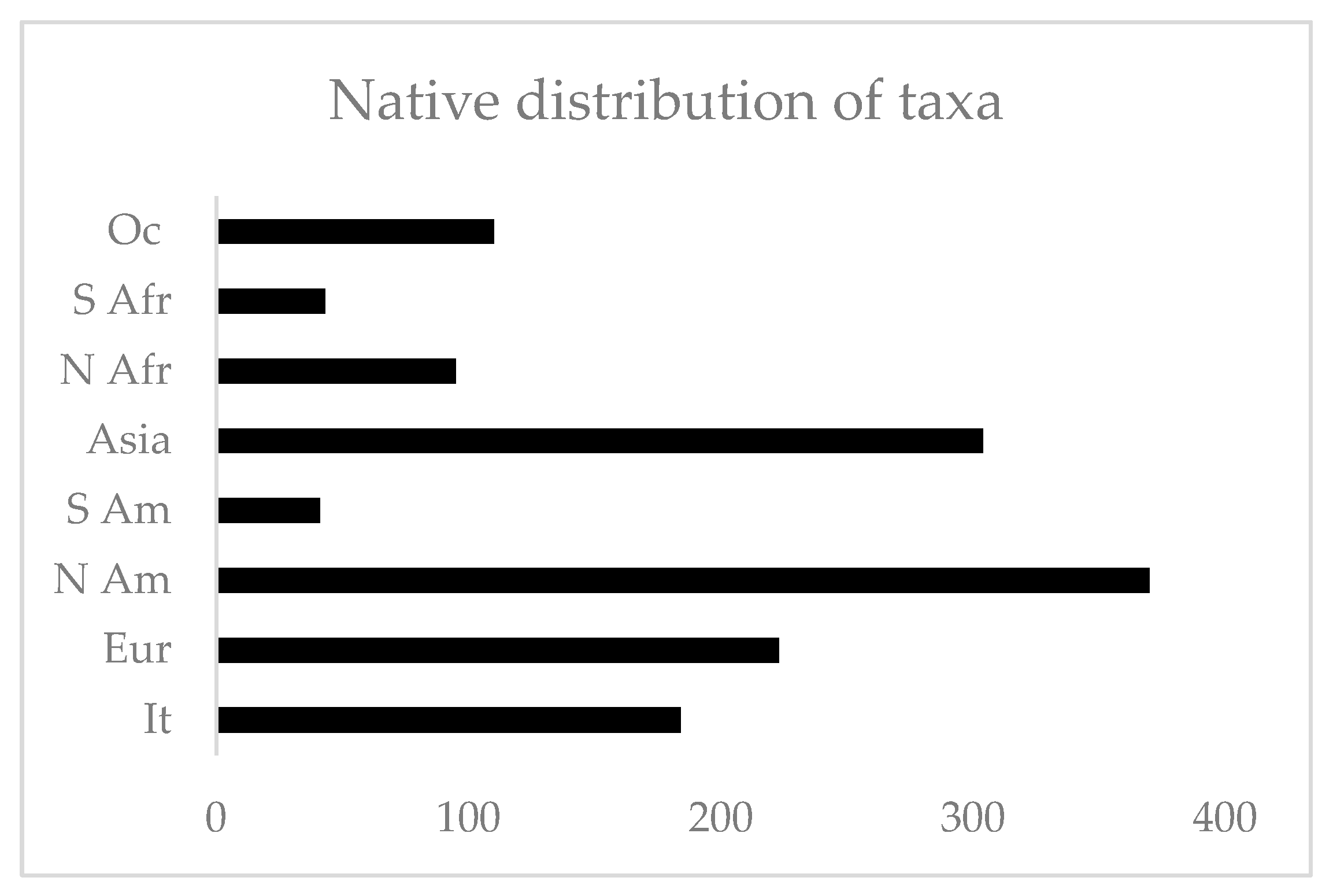
Figure 2 illustrates the distribution of the taxa across the different native geographical ranges. Most taxa were native to North America (370 taxa), of which 84% were exclusively North American. Only 184 taxa, being 23% of the censused total, were native to Italy.
Stormwater management manuals. The total number of records identified in manuals from both Csa and Csb climates amounted to 533 taxa, including 15 genera, 450 species, and 117 cultivars or subspecies. Of these, 172 taxa had already been identified in the scientific literature survey (see Table S1b in Supplementary Materials S1). Compared with the scientific literature survey, stormwater manuals showed a greater prevalence of woody taxa (58%), whereas herbaceous taxa accounted for 42% of the total records (37% considering only Csa manuals). However, the distribution of growth forms generally reflected the same ecological patterns observed in the scientific literature. Among herbaceous dicotyledons (130 taxa), most species were Hemicryptophytes, while only a few taxa (6 species) were Therophytes. Monocotyledons were also predominantly Hemicryptophytes, mainly including grasses (38 taxa), sedges (20 taxa), and rushes (7 taxa), whereas the remaining taxa were mostly rhizomatous Geophytes. Among woody taxa, 45 species were classified as “small shrubs” (Chamaephytes or Nano-Phanerophytes), while Phanerophytes constituted the dominant group, including 128 shrubs, 94 trees, 33 taxa exhibiting both shrub and tree habits, and 5 woody climbers.
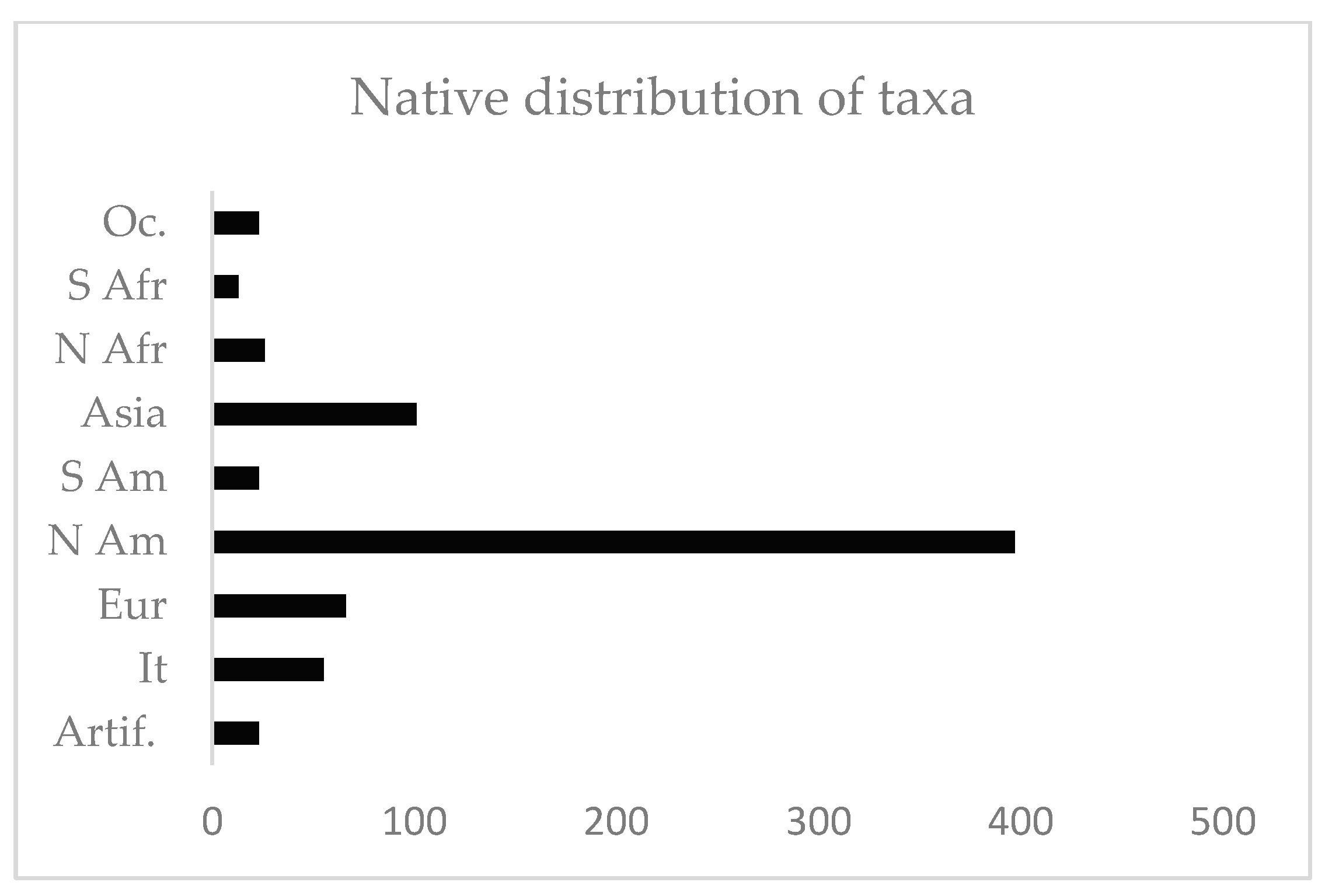
Across all vegetation groups, the surveyed literature revealed a strong predominance of North American taxa associated with temperate-climate bioretention systems (Figure 3). Conversely, Mediterranean-native species were comparatively underrepresented, particularly among taxa experimentally validated as tolerant of combined drought and flooding. This imbalance highlights the need for future region-specific testing focused on Mediterranean ecological conditions and native plant communities.

3.2. Herbaceous Dicotyledons

Herbaceous dicotyledons represented the most taxonomically diverse component of the surveyed vegetation, with a strong predominance of perennial forbs associated with wetland environments, temperate grasslands, wet to dry meadows, and disturbance-adapted habitats. The results reveal a marked prevalence of North American taxa recurrently used in bioretention systems, while Mediterranean and Italian native species remain comparatively underrepresented. This pattern reflects both the historical development of bioretention research in temperate North American regions and the limited availability of experimental studies specifically focused on Mediterranean environments.
In the survey of the scientific literature, a total of 312 records (including genera, species, cultivars, and subspecies) across 46 botanical families were identified. The most represented families are Asteraceae (31.4% of the taxa), followed by Lamiaceae (7.4%), Plantaginaceae (5.1%), Fabaceae (5.8%), and Rosaceae (4.2%). Overall, the recorded taxa belong to 168 genera, of which 61% are represented in Italy by native species. The most recurrent genera were all members of the family Asteraceae, namely Rudbeckia, Solidago, Symphyotrichum, Echinacea, and Eutrochium. Among genera including Italian native species, the most frequently cited were Solidago, Filipendula, Achillea, Lythrum, and Geranium. Complete lists of botanical families and genera are provided in Tables S2 and S3 (Supplementary Materials S2).
The predominance of Asteraceae taxa, particularly perennial prairie-associated genera such as Rudbeckia, Solidago, and Echinacea, likely reflects their broad ecological plasticity and tolerance to alternating wet and dry conditions. Similarly, the recurrent occurrence of genera such as Achillea, Lythrum, and Geranium among Italian native taxa suggests that ecotonal meadow and semi-ruderal communities may be relevant reference ecosystems for designing Mediterranean bioretention plantings.
Within stormwater manuals, in addition to Asteraceae (25.4% of the taxa), Lamiaceae, and Rosaceae, the most represented families are Onagraceae and Phrymaceae. The most frequently cited genera were Achillea, Epilobium, and Erigeron, all of which are also present in Italy with native species.

3.2.1. Non-Native Taxa

Scientific literature. Although drought-tolerant taxa were identified (36%), most recurrent species still belonged to intermediate moisture-use categories, suggesting that many currently adopted bioretention species may remain more suitable for temperate or Sub-Mediterranean conditions than for fully Mediterranean climates characterized by prolonged summer drought. This finding further highlights the limited availability of experimentally validated taxa specifically adapted to combined flooding and severe drought stress. These taxa are reported in Table 4, while the complete list of species and their characteristics is reported in Table S10a (Supplementary Materials S3).
Manuals. The analysis of the most recurrent non-native species showed that 61% of the taxa have a medium to high drought tolerance, although most fell within the “medium” tolerance range. The drought-tolerance assessment is reported in Table S10b (Supplementary Materials S3).

3.2.2. Italian Native Taxa

Scientific literature. Among the surveyed taxa, 90 herbaceous dicotyledon species were native to the Italian peninsula. Of these, 86 occur in Northern Italy, 77 in Central Italy, and 67 in Southern Italy, with 71, 77, 64, and 33 taxa, respectively, distributed within the lowland, hilly, montane, and subalpine belts. The complete species list is provided in Table S11a (Supplementary Materials S3).
The predominant chorotype was Eurasian (16 taxa), followed by Paleotemperate and South European–South Siberian chorotypes (10 taxa each). In contrast, only 9 taxa exhibited a Eurimediterranean distribution, while only 2 taxa belonged to the Mediterranean montane chorotype. The limited representation of Mediterranean chorotypes among recurrent taxa further emphasizes the current mismatch between the climatic contexts in which bioretention systems have been most extensively investigated and the Mediterranean environments where climate-adapted vegetation selection is increasingly needed.
This pattern is partially reflected in the Ellenberg indicator values analysis, although the trend is more pronounced for the other plant groups (Monocotyledons, shrubs, and trees). In this case, average Ellenberg values were 7 for light, 5.7 for temperature, 4.7 for humidity, 6.6 for reaction, and 3.9 for nutrients. Despite their broad occurrence in Southern Italy, most taxa (46%) fell within the temperate to Mediterranean-montane temperature range (6 ≤ T < 8), predominantly with the value 6, while a comparable proportion of species was associated with cooler montane environments (4 ≤ T < 6). Regarding humidity, most taxa (54%) were characteristic of habitats ranging from relatively dry to fluctuating moisture conditions (2 < H ≤ 4), followed by species associated with humid to infrequently submerged environments (6 < H ≤ 8). Overall, these findings suggest that many of the drought-tolerant taxa identified are nevertheless primarily associated with relatively cool temperate, montane, or Mediterranean-montane environments.
Table 5a reports all the species selected for environmental compatibility, based on the compatibility classes (from + to +++) assigned according to the criteria described in Section 2.2.2. Species showing unsuccessful waterlogging tolerance (−−) were excluded from the table. Most taxa included in Table 5a were identified exclusively through cyclic flooding studies, particularly those conducted by Eben et al. [76], which specifically targeted species characterized by drought tolerance or ecological adaptability.
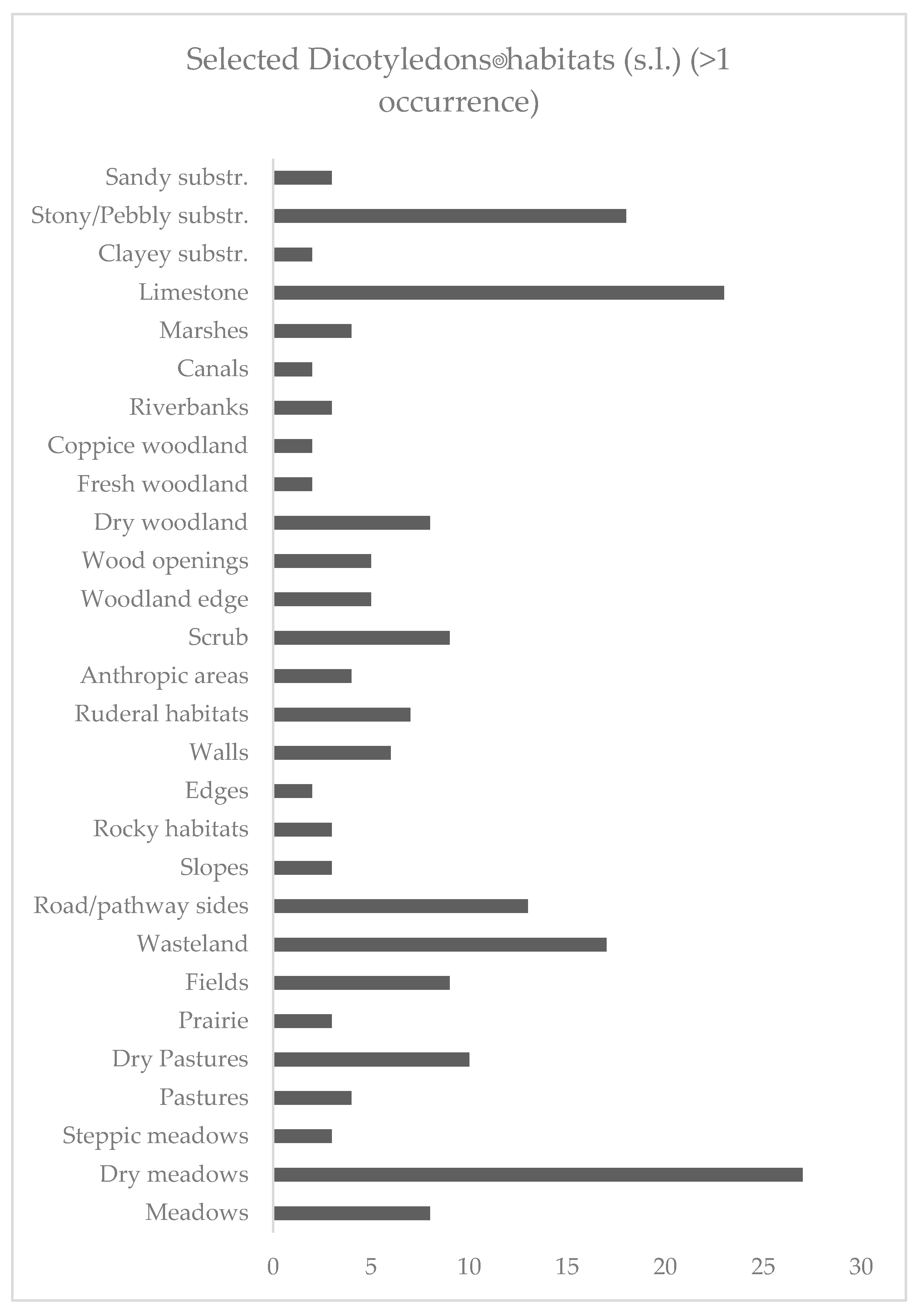
Table S12 (Supplementary Materials S3) also reports, for the species with adequate environmental compatibility (from +/− to ++), the habitats of occurrence (Figure 4). The prevalence of dry meadows, steppic grasslands, rocky slopes, roadside margins, and other disturbance-prone habitats suggests that species adapted to fluctuating resource availability and shallow or skeletal soils may represent promising candidates for Mediterranean bioretention systems. These habitats are characterized by periodic water limitation, high solar exposure, recurrent disturbance regimes, and often compacted, occasionally saturated soils, conditions partially analogous to those experienced in engineered stormwater infrastructures.
Manuals. An additional six Italian native taxa were identified; the complete list is provided in Table S11b (Supplementary Materials S3). The average Ellenberg indicator values were 7.0 for light, 6.0 for temperature, 4.3 for humidity, 6.3 for reaction, and 3.8 for nutrients. No Mediterranean chorotypes were recorded among these taxa. Table 5b reports the species selected for environmental compatibility.
Overall, the results suggest that herbaceous Dicotyledons potentially suitable for Mediterranean bioretention systems are primarily associated with stress-tolerant grassland and ecotonal communities rather than wetland-specialist vegetation. However, the relatively limited number of Mediterranean native taxa identified in the literature indicates the need for future experimental validation specifically targeting southern European climates.

3.3. Herbaceous Monocotyledons

Herbaceous monocotyledons were primarily represented by graminoid species associated with wetlands, meadows, and disturbance-adapted grassland ecosystems. Compared with Dicotyledons, this group showed a stronger prevalence of taxa functionally associated with hydrological regulation, soil stabilization, and tolerance to fluctuating moisture conditions, particularly among Poaceae, Cyperaceae, and Juncaceae. However, Mediterranean-native monocotyledons remained poorly represented, further highlighting the limited availability of experimentally tested taxa adapted to hot, dry Mediterranean climates.
In the scientific literature survey, a total of 212 records (genera, species, and cultivars/subspecies) belonging to 16 botanical families were identified. The most represented families were Poaceae (45.3% of the taxa), Cyperaceae (20.8%), Iridaceae (4.7%), Juncaceae (6.1%), and Asphodelaceae (5.2%). Overall, the recorded taxa belonged to 85 genera, of which 58% are represented in Italy by native species. The most recurrent genera were Carex, Juncus, Iris, Panicum, and Dianella; among genera represented in Italy by native taxa, the most frequently cited were Poa, Festuca, and Calamagrostis, in addition to the first four genera mentioned above. Complete lists of botanical families and genera are reported in Tables S4 and S5 (Supplementary Materials S2). The predominance of graminoid genera such as Carex, Juncus, Panicum, and Poa reflects the functional importance of Monocotyledons in bioretention systems, particularly regarding erosion control, root-mediated soil stabilization, and tolerance to hydrological fluctuations. At the same time, the recurrent use of North American prairie and wetland-associated taxa suggests that most experimentally validated Monocotyledons remain linked to temperate climatic conditions rather than fully Mediterranean environments.
The analysis of stormwater manuals revealed a similar distribution among the dominant families, whereas the most recurrent genera were Festuca and, to a lesser extent, Nassella. Deschampsia and Melica were the other most frequently cited genera represented in Italy by native species.

3.3.1. Non-Native Taxa

Compared with herbaceous Dicotyledons, Monocotyledons showed a generally higher representation of drought-tolerant taxa, particularly among warm-season grasses, often characterized by C4 metabolism, and rhizomatous species. Taxa sharing these morphophysiological traits may offer functional advantages under Mediterranean conditions due to their efficient water use and extensive underground organs, which contribute to resilience under alternating dry and temporarily flooded conditions.
Scientific literature. The analysis of the non-native species with at least two citations showed that 54% of the taxa exhibited medium to high drought tolerance. These taxa are reported in Table 6 (for the complete list of species, see Table S13a in Supplementary Materials S4).
Manuals. The analysis showed that 67% of the newly most-cited taxa have medium to high drought tolerance. The drought-tolerance assessment of the species is reported in Table S13b (Supplementary Materials S4).

3.3.2. Italian Native Monocotyledons

Scientific literature. Among the surveyed taxa, 40 monocotyledon species were native to the Italian peninsula, while one species (Iris germanica) was identified as a naturalized Archaeophyte. Of these taxa, 40 occur in Northern Italy, 34 in Central Italy, and 29 in Southern Italy, while 33, 29, 30, and 22 taxa are, respectively, distributed within the lowland, hilly, montane, and subalpine belts. The complete list is provided in Table S14a (Supplementary Materials S4).
The predominant chorotype was Circumboreal (9 taxa), followed by the Eurasian and Eurosiberian chorotypes (6 taxa each), and 7 taxa classified as Cosmopolitan or Subcosmopolitan. Only one taxon exhibited a Eurimediterranean distribution. Compared with Dicotyledons, this pattern indicates an even more pronounced underrepresentation of Mediterranean taxa, likely reflecting both the predominance of European applications in cooler and moister environments and the availability of drought-tolerant North American taxa better adapted to harsher climatic conditions. Average Ellenberg indicator values further reflect this trend, being 7.1 for light, 5.9 for temperature, 6.4 for humidity, 6.1 for reaction, and 4.6 for nutrients. Similar to Dicotyledons, most taxa (39%) fell within the temperate to Mediterranean-montane temperature range, predominantly with the value 6. The second largest group was associated with cooler montane environments, while the third corresponded to species characterized by a variable temperature range (“X”). Only one species was associated with not-too-hot Mediterranean environments (8 ≤ T< 10), and another with hot Mediterranean conditions (10 ≤ T). Regarding humidity, most taxa (27%) were characteristic of habitats ranging from fluctuating to moist soil (4 < H ≤ 6), followed by species associated with consistently moist to infrequently inundated soils (6 < H ≤ 8), and, finally, taxa typical of frequently or permanently submerged conditions (8 < H).
Table 7 reports all species selected for environmental compatibility, based on compatibility classes (from +/− to ++; due to the limited number of species in the higher compatibility ranges), assigned according to the criteria described in Section 2.2.2.
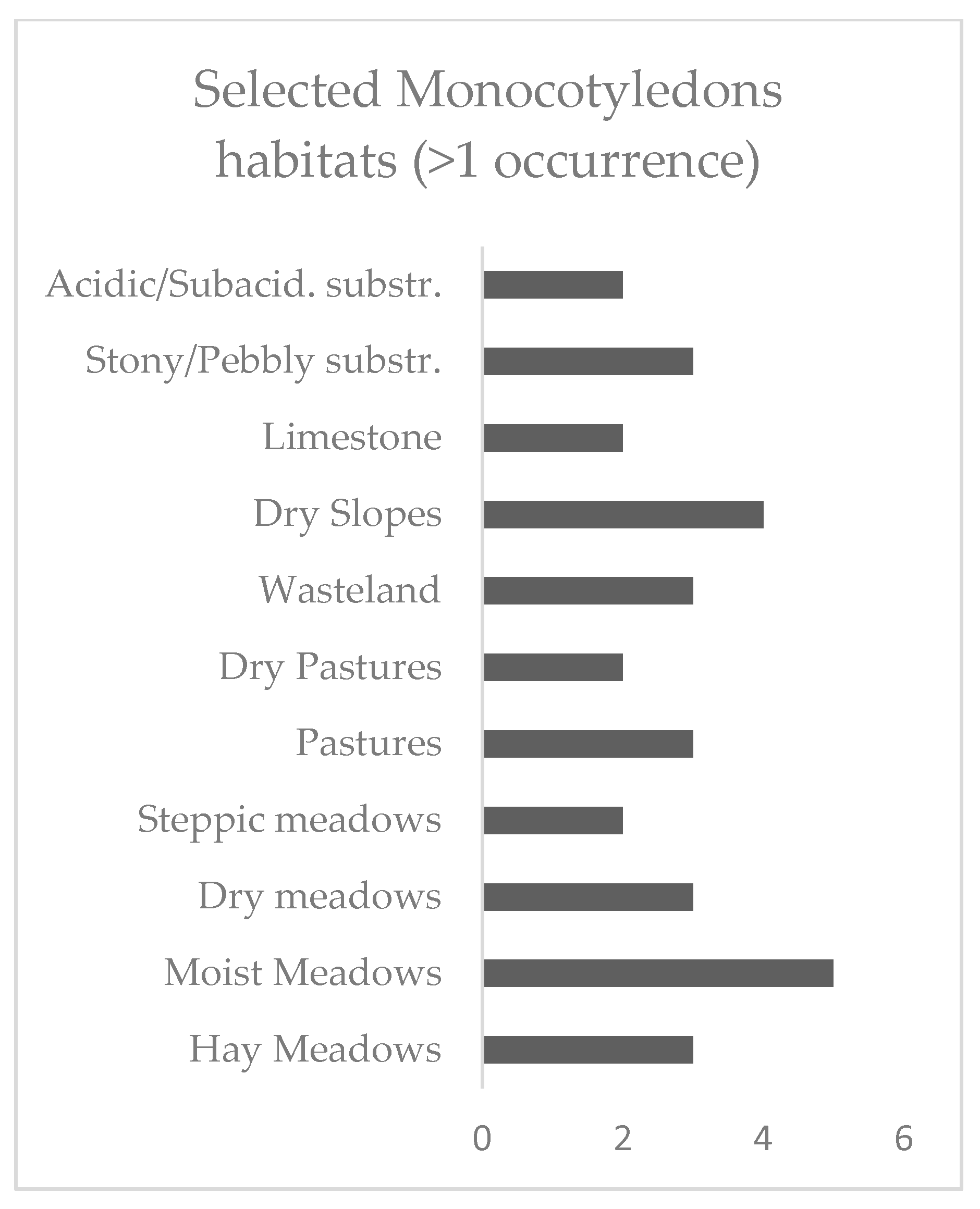
Table S15a (Supplementary Materials S4) also reports the habitats of occurrence for the species with adequate environmental compatibility (from +/− to ++). The analysis revealed a broad distribution across various meadow and pasture types, along with a notable occurrence on dry-slope habitats, often characterized by rocky or gravelly substrates, as shown in Figure 5.
Overall, the results suggest that Monocotyledons may be among the most functionally suitable vegetation groups for Mediterranean bioretention systems, particularly with respect to hydrological resilience and soil stabilization. However, as with Dicotyledons, the limited representation of Mediterranean-native taxa highlights the need for future experimental studies focused on southern European climates and native grassland communities.
Manuals. An additional four Italian native taxa were identified; the complete list is provided in Table S14b (Supplementary Materials S4). The average Ellenberg indicator values were 7.8 for light, 6.0 for temperature, 8.3 for humidity, 5.0 for reaction, and 3.8 for nutrients. No Mediterranean chorotypes were recorded among these taxa, although Iris pallida exhibited a SE-European distribution. Notably, I. pallida was also the only species classified as environmentally compatible (+) with Mediterranean stress conditions.

3.4. Woody Species

Woody species were an important component of both the scientific literature and stormwater manuals, particularly in practice-oriented applications in Mediterranean-climate regions. Compared with herbaceous taxa, woody vegetation shows a stronger association with long-term structural functions, including shading, evapotranspiration enhancement, slope stabilization, and resilience under low-irrigation conditions.
In the scientific literature survey, a total of 121 shrub records from 39 botanical families were identified. The most represented families were Rosaceae (17.6% of the taxa), Viburnaceae (6.4%), Aquifoliaceae (5.6%), Cornaceae (5.6%), Cyrillaceae (1.8%), and Myrtaceae (5.6%). For trees and species capable of developing as either shrubs or trees, 136 records from 39 botanical families were identified. The most represented families were Myrtaceae (15.6% of the taxa), Betulaceae (8.9%), Sapindaceae (7.4%), Fagaceae (5.9%), and Rosaceae (8.9%).
The shrub taxa belonged to 76 genera, of which 38% are represented in Italy by native species. The most recurrent genera were Viburnum, Ilex, Cornus, Itea, and Salix; among genera represented in Italy by native taxa, the most frequently cited were Spiraea, Betula, and Vaccinium, in addition to Viburnum, Ilex, and Salix. Tree and shrub/tree taxa belonged to 72 genera, of which 39% are represented in Italy by native species. The most recurrent genera were Melaleuca, Acer, Quercus, Betula, and Magnolia; among genera represented in Italy by native taxa, the most frequently cited were Ligustrum, Salix, and Alnus, in addition to Acer, Quercus, and Betula. Complete lists of botanical families and genera are reported in Tables S6–S9 (Supplementary Materials S2). Overall, the recurrent occurrence of genera such as Quercus, Acer, Melaleuca, and Salix reflects the coexistence of two main ecological strategies in bioretention design: species adapted to periodically flooded environments and drought-tolerant woody taxa capable of persisting under prolonged summer water deficit.
In the stormwater manuals survey, the most represented families for shrubs and subshrubs, besides Rosaceae (14.8% of taxa), were Asteraceae, Ericaceae, Rhamnaceae, and Lamiaceae. The most recurring genera were Arctostaphylos, Berberis, and Ribes, followed, among genera represented in Italy by native species, by Salvia, Artemisia, and Frangula. Among shrubs/trees, aside from Fagaceae, Sapindaceae, and Myrtaceae, the most represented families were Cupressaceae and Fabaceae, while the most common genera were Quercus, Acer, and Platanus.

3.4.1. Non-Native Taxa

The analysis of the non-native shrub species showed that 50% of the recurring taxa exhibited medium to high drought tolerance, although most fell within the medium tolerance range. At the same time, an equivalent proportion of species was classified as obligate or facultative wetland taxa. Drought-tolerant species are reported in Table 8 (see Table S16a in Supplementary Materials S5 for the complete species list).
The analysis of non-native shrubs/trees and tree species showed that 62% of the recurrent taxa exhibited medium to high drought tolerance, with most falling within the medium/high tolerance range. These drought-tolerant taxa are reported in Table 9 (see Table S17a in Supplementary Materials S5 for the complete species list).
Manuals. Compared with the scientific literature, Mediterranean-climate stormwater manuals showed a stronger representation of drought-tolerant woody species and xeric-adapted taxa, particularly from California floras. This likely reflects the practical need, in operational design guidelines, to prioritize long-term survivability under low-irrigation conditions. The analysis of the non-native shrub species showed that 87% of the recurrent taxa exhibited medium to high drought tolerance, although most fell within the medium tolerance range. The drought-tolerance assessment is reported in Table S16b (Supplementary Materials S5). In the case of non-native shrub/tree and tree species, 62% of the recurring taxa exhibited medium to high drought tolerance, although, also in this case, most fell within the “medium” tolerance range. The drought-tolerance assessment is reported in Table S17b (Supplementary Materials S5).

3.4.2. Italian Native Taxa

Scientific literature. Among the surveyed taxa, 26 woody species were native to the Italian peninsula, while 2 species were identified as naturalized Archaeophytes. Of these 28 taxa, 22 occur in Northern Italy, 21 in Central Italy, and 20 in Southern Italy, with 21, 22, 17, and 10 taxa, respectively, distributed within the lowland, hilly, montane, and subalpine belts. The complete species list is provided in Table S18a (Supplementary Materials S5).
The predominant chorotypes were European-Caucasian, Eurasian, and Eurosiberian (5 taxa each), while only one taxon exhibited a North-Mediterranean montane distribution. Average Ellenberg indicator values were 6.9 for light, 5.5 for temperature, 6.0 for humidity, 6.2 for reaction, and 4.6 for nutrients. Regarding temperature, most species (50%) were primarily associated with cooler montane environments, followed by taxa belonging to the temperate to Mediterranean-montane range, while two species were characteristic of upper-montane or subalpine conditions. In terms of humidity, most taxa (36%) were associated with consistently moist to infrequently inundated soils, followed by species characteristic of habitats ranging from fluctuating to moist soil conditions.
Table 10a reports all the native species selected for environmental compatibility, based on the compatibility classes (from +/− to ++) assigned according to the criteria described in Section 2.2.2.
Table S19a (Supplementary Materials S5) also reports the habitats of occurrence for the species included in Table 10a. The analysis revealed a predominance of mesophilous or meso-thermophilous woodlands and riparian habitats.
Manuals. An additional 19 Italian native woody species were identified through the manual survey. Of these, 16 occur in Northern Italy, 18 in Central Italy, and 16 in Southern Italy, while 17, 9, 7, and 4 taxa are, respectively, distributed within the lowland, hilly, montane, and subalpine belts. The complete species list is available as Table S18b (Supplementary Materials S5). Besides the European-Caucasian chorotype (6 taxa), the second most represented group consisted of Mediterranean chorotipes (5 taxa). Average Ellenberg indicator values were 6.6 for light, 6.8 for temperature, 4.7 for humidity, 5.5 for reaction, and 4.3 for nutrients. Regarding temperature, most taxa (40%) belonged to the temperate to Mediterranean-montane range, while the second-largest group included species associated with climates ranging from Mediterranean-montane to warm Mediterranean conditions (8 ≤ T < 10). One species was characteristic of hot Mediterranean environments (10 ≤ T). In terms of humidity, most species (40%) were associated with habitats ranging from dry to fluctuating moisture conditions, followed by taxa characteristic of fluctuating to moist environments. Table 10b reports all native species selected for environmental compatibility.
Table S19b (Supplementary Materials S5) also reports the habitats of occurrence for the species included in Table 10b. The analysis revealed a predominance of scrublands, rocky habitats, and dry thermophilous woodlands.
Overall, woody taxa appeared particularly relevant for Mediterranean bioretention applications due to their structural and ecological resilience under stressful urban conditions. Nevertheless, most recurrent taxa originated from North American or Australian floras, whereas experimentally validated Mediterranean-native woody species remained comparatively scarce. In particular, most native species identified through the scientific literature survey were associated with cooler and moister environments, potentially limiting their sustainable applicability under hotter and drier Mediterranean conditions. In this respect, stormwater manuals offered a broader palette of environmentally compatible species, including properly Mediterranean taxa.

3.5. Csa-Climate Stormwater Management Manuals Analysis: Non Native Taxa

The complete list of non-native taxa from the Csa manuals is reported in Table S20 (Supplementary Materials S6). A total of 85 herbaceous species were recorded, including 50 Dicotyledons and 35 Monocotyledons, of which 64 were native to California. Overall, most species exhibited either “Low” (31%) or “Low to medium” (18%) water requirements. For California native taxa (including two non-native species in the Calflora database), the predominant maximum temperature range was 30–35 °C (43%), followed by 35–40 °C (35%). The most represented minimum precipitation range was 200–400 mm/year (52%), followed by 400–600 mm/year (25%). The most recurrent plant communities were the Yellow Pine Forest (54%) and chaparral (51%), followed by wetland-riparian, Foothill Woodland, and Red Fir Forest communities. 31 California native taxa (48%) were reported to occur in wetlands.
A total of 164 woody species were recorded, including 116 shrubs, 18 shrub/tree taxa, and 30 trees, of which 133 were native to California. Most species exhibited either “Low” (32%) or “Very Low” (31%) water requirements. Among California native taxa (together with six non-native species included in the Calflora database), the predominant maximum temperature range is 30–35 °C (41%), followed by 35–40 °C (39%). The most represented minimum precipitation range was 200–400 mm/year (59%), followed by 400–600 mm/year (21%). The most recurrent plant communities were Chaparral (55%), Foothill Woodlands (34%), Yellow Pine Forest (28%), Coastal Sage Scrub (27%), and wetland-riparian (21%). Furthermore, 34 California native taxa (26%) were reported to occur in wetlands.

4. Discussion

The present review integrates worldwide peer-reviewed literature and Mediterranean-climate technical manuals to assess the potential suitability of plant taxa proposed for bioretention systems in Mediterranean-climate regions of Italy. Both the recurrent non-native species and the Italian native taxa were assessed, with particular attention to the combined effects of drought, heat, and temporary flooding. Flood tolerance, especially for native species, was also considered to evaluate the potential applicability of taxa across the full moisture gradient typically present within bioretention facilities.
The main survey featured horticultural books and peer-reviewed studies, while Mediterranean-climate stormwater manuals were included to broaden the range of taxa currently adopted in operational practice, and to identify Mediterranean species already used in stormwater infrastructures. Although technical manuals do not constitute peer-reviewed scientific evidence, they provide relevant insight into species currently employed by practitioners, particularly in Mediterranean-climate regions where experimental studies remain scarce. Nevertheless, the criteria underlying plant selection in these manuals often remain unclear, and the transferability of horticultural recommendations to different environmental contexts may be uncertain, as already highlighted by several authors [8,82,83,84]. This is particularly true for stormwater manuals, which, on the other hand, are supposed to rely on empirical evidence and horticultural knowledge.
The reference scales developed for drought tolerance, environmental compatibility (i.e., the combination of heat and drought), and flooding tolerance should therefore be interpreted as pragmatic tools for a preliminary screening and comparisons within and across plant groups, rather than as definitive predictive models. Indeed, the review revealed both a lack of scientifically grounded information and multiple, often divergent, and scarcely comparable sources. Guzzon et al. [83] reported similar difficulties in selecting ornamental shrubs, highlighting the contrast between qualitative, experience-based horticultural information—which is often inconsistent—and highly specialized technical literature that focuses only on specific morphophysiological responses.
The predominance of North American taxa in the surveyed literature is likely a consequence not only of ecological suitability but also of the historical development of bioretention research itself. Since modern bioretention systems were primarily developed and experimentally tested in North American urban contexts [5,85], especially in temperate regions, the species most frequently investigated tend to reflect locally available flora and prairie-associated vegetation models. E.g., within the first survey of herbaceous Dicotyledons, all the main genera have a North American distribution. This is also reflected in North American stormwater manuals, which generally encourage the use of native species due to their environmental adaptations and ecological value, as shown in the plant lists proposed for bioretention [84]. This geographical research bias has probably contributed to the limited experimental evaluation of Mediterranean-native species, despite their potential relevance under increasingly drought-prone climatic conditions.
The limited representation of Mediterranean-native taxa may also derive from intrinsic ecological and operational constraints. Many Mediterranean plant communities are adapted to prolonged summer drought but not necessarily to repeated short-term waterlogging, which represents a key functional requirement in bioretention systems. Furthermore, Mediterranean grasslands and xeric communities remain comparatively understudied in stormwater infrastructure research, while commercially available plant palettes used by practitioners are often derived from established North American or ornamental horticultural selections.
Growth-form analysis revealed contrasting patterns between the worldwide literature and Mediterranean-climate manuals. Herbaceous taxa dominate the scientific literature, whereas woody species—particularly shrubs—prevail in Mediterranean manuals, especially those from Csa-climate regions. This pattern is consistent with Mediterranean landscaping literature [86], which extensively relies on drought-tolerant shrubs and sub-shrubs, capable of coping with aridity through morphophysiological adaptations such as deep rooting, sclerophylly, and woody tissues. Similarly, Houdeshel et al. [39] recommend using shrubs and bunchgrasses in bioretention design for xeric climates.
Among the dominant herbaceous genera, many taxa are associated with medium to high moisture availability (e.g., Eutrochium, Symphorythricum, Epilobium, Lythrum, Carex, Juncus, and Calamagrostis), whereas a limited part has a broader ecological variability (e.g., Solidago, Geranium, Poa), and only a few are also characteristic of drought-prone habitats (e.g., Achillea, Festuca) [50,53,70,73]. Although this partially reflects the family’s amplitude and distribution, the strong predominance of Asteraceae among herbaceous Dicotyledons remains particularly remarkable, and suggests considering this taxon for further research within the native flora. For shrubs, besides the variability of the family Rosaceae, the main taxa identified in the scientific literature are associated with moist or riparian environments (Ilex, Viburnum, Cornus, and particularly Salix, Betula, and Vaccinium), whereas the trees’ genera are more variable (e.g., Quercus, Melaleuca), but still encompass high moisture-loving taxa (e.g., Betula, Salix, Alnus) [50,53,59,70,73]. Overall, only a relatively limited number of taxa appear potentially suitable for prolonged drought-prone Mediterranean urban environments.
The results also suggest a frequent functional trade-off between drought tolerance and flooding tolerance. Species associated with wetlands or permanently moist environments often exhibit high waterlogging resistance but limited drought resilience, whereas most Mediterranean xerophytic taxa may tolerate prolonged summer drought while remaining poorly adapted to repeated inundation. This dual hydrological stress likely represents one of the major challenges for vegetation selection in Mediterranean bioretention systems. For this reason, the numerous taxa reported in the literature from wetland or riparian habitats—often strictly hygrophilous species associated with cooler environments—are unlikely to represent a sustainable choice under Mediterranean conditions. Only a limited number of specialized ecological niches within southern Italian wetland systems may undergo a seasonal transition from winter waterlogging to complete summer desiccation, potentially providing valuable ecological models for Mediterranean bioretention design. Nevertheless, none of the species reported in the literature occur in such habitats, and only a few species (e.g., E. cannabinum, E. hirsutum) might be considered for use if provided adequate irrigation.
Among herbaceous taxa, Monocotyledons—particularly graminoids—generally showed greater adaptability to drought stress than Dicotyledons, both in terms species richness and of tolerance intensity. Several North American grasses, including S. scoparium, A. gerardii, B. gracilis, S. viriginicus, S. heterolepis, and M. rigens, stand out for their combined tolerance to drought and temporary flooding [45,50,53]. Interestingly, the largely used P. virgatum is absent from the Mediterranean-climate manuals, suggesting, as a tallgrass prairie species, a limited suitability under fully Mediterranean conditions. Nevertheless, the adoption of the above-mentioned species for Italy—even if convenient in terms of plant resilience—may involve ecological risks, particularly considering the high invasive potential of Poaceae [87]. Although species from more arid habitats and from North America currently appear less problematic at the global scale [87], Poaceae already represent the second most abundant family among naturalized species in Italy, and some Sporobolus species are considered already invasive [88].
Among woody species, Mediterranean manuals include a broader range of drought-tolerant species than the scientific literature, although this may partly reflect the inclusion of taxa suitable for general LID applications rather than specifically for bioretention systems. Nevertheless, several drought-tolerant woody taxa are also indicated for flood tolerance [45], suggesting the need for further experimental investigation of their compatibility—and that of similar species—with temporary waterlogging. Within the scientific literature survey, trees generally exhibited greater adaptability than shrubs, largely due to the occurrence of drought-tolerant Australian Myrtaceae species [59,60,61].
Several Italian native herbaceous Dicotyledons were identified as potentially compatible with Sub-Mediterranean or Mediterranean conditions. However, most taxa fell within the moderate compatibility range (+), suggesting limited tolerance to harsher urban Mediterranean conditions without irrigation support. This interpretation is further supported by the absence of the Stenomediterranean chorotype, and by the fact that the most promising species (e.g., P. saxifraga, H. perforatum, M. vulgare) appear to be more strongly adapted to aridity only, rather than to the combination of drought and high temperatures [69]. Furthermore, most of the species come from waterlogging [78] or cyclic flooding experiments [76,77] and not from bioretention field implementations. Of these, the main experiment was conducted in a temperate climate, despite the focus on drought-tolerant species [76]. Indeed, for this reason, most species come from dry meadows or pastures [71,72,73], yet not from the hotter Mediterranean stations, even when present in Southern Italy [69].
Selected Monocotyledons appeared even less adapted to heat and drought stress, with most taxa showing only limited environmental compatibility (+/−). This pattern is reflected in the prevalence of moist meadow habitats among recurrent species. Remarkable exceptions are M. ciliata and Stipa spp., which were again tested only for cyclic flooding, with contrasting [76,77] and promising results [76], respectively. These findings may indicate, unexpectedly, the potential relevance of the respective plant communities of these taxa, i.e., dry slopes (M. ciliata, S. capillata) and steppic meadows (S. pennata) [73], and of other Southern Stipa species and communities. It is uncertain to what extent species such as A. flexuosa, D. caespitosa, and M. coerulea can tolerate heat and drought, even though they are included in the WUCOLS species list and have moderate water requirements for non-desertic regions [68]. This suggests a certain compatibility with Sub-Mediterranean conditions.
Among the woody species derived from the first survey, only a few show minimum environmental compatibility, and most belong to the “limited” range (+/−). Conversely, nearly all species appeared capable of tolerating short-term flooding and, in some cases, longer inundation periods [81], consistently with their generally high moisture affinity and frequent occurrence in riparian habitats [71,73]. In this respect, stormwater manuals provide a broader selection of drought-adapted taxa, including a significant proportion of Mediterranean species; however, their tolerance to temporary flooding often remains insufficiently documented or uncertain. In scientific literature, only a few garigue species, including Salvia officinalis, have been experimentally evaluated for waterlogging tolerance, with promising results [89].
Although the scientific literature survey was conducted globally, the technical manuals considered in this study were primarily derived from North American Mediterranean-climate regions, particularly California. Future research should extend the comparative analysis to additional Mediterranean-climate regions, primarily Australia, and potentially other regions such as South Africa or Chile, to further assess the transferability of plant-selection strategies across different ecological and urban contexts.
California stormwater manuals provide a particularly broad range of drought- and heat-adapted taxa, a significant portion of which is reportedly also flood-tolerant [45]. Many of these species occur under minimum-precipitation regimes, comparable to the driest Mediterranean regions of Italy, and tolerate high summer temperatures. However, the transferability of ecological information derived from natural habitats [57] to highly altered urban environments should be evaluated cautiously [83]. The recurrent occurrence of “chaparral”—sensu lato as part of the division “Californian Chaparral, Coastal Scrub & Grassland”, or sensu stricto as a macro-group of more or less xeric shrubland communities [90]—within California manuals may provide a useful ecological parallel for the identification of Mediterranean-compatible species. In particular, the coexistence of taxa adapted to both dry shrublands and periodically moist habitats suggests potentially valuable adaptive strategies for bioretention systems. Nevertheless, these ecological combinations may also characterize aggressive species with invasive potential, as demonstrated by Amorpha fruticosa, which is invasive across several European regions [91].
The use of non-native species in NbS remains controversial, particularly in biodiversity-oriented urban ecological planning [92]. On the one hand, some non-native taxa recurrently identified in the bioretention literature exhibit functional traits potentially advantageous under Mediterranean urban conditions, including tolerance to alternating flooding and drought stress, rapid establishment, and resilience in compacted or nutrient-poor soils (e.g., Panicum virgatum). These characteristics may partially explain their frequent adoption in operational stormwater infrastructures. On the other hand, the introduction of non-native species may involve ecological risks, including potential invasiveness, ecological homogenization, and reduced support for local biodiversity. Moreover, when species are not adequately adapted to local ecological conditions, long-term resilience under climate change may remain uncertain. In Mediterranean regions, where urban ecosystems are already subjected to significant ecological pressure [93,94], the extensive transfer of plant palettes developed for temperate North American systems may therefore conflict with broader ecological concerns.
Given the complexity of the framework and the trade-offs involved, however, the question of whether to adopt non-native species in the urban environment remains open. The main concern about non-natives is their potential invasiveness, which, however, has been shown to depend on a combination of biological traits that natives might also possess [95], especially in response to a rapidly evolving climate change scenario [96]. Conversely, several non-native non-invasive species have been shown to provide ecosystem services, including support for biodiversity and biological interactions, as well as for natives [84]. Climate adaptation is again a trait that might be shared by natives and non-natives from analogous environmental conditions; therefore, planting sustainability should rely on the species’ compatibility with soil and competition conditions, together with establishing and management choices [95]. Furthermore, Rhami et al. [84] highlight the progressive shift in the literature toward plant functional traits—e.g., drought tolerance, root system type—as a guiding criterion for plant selection in bioretention.
Nevertheless, invasive species remain a major threat to Italian ecosystems [97], as highlighted in the previous paragraph, particularly for the Poaceae group. E.g., in recent decades, Sicilian grasslands have been disrupted by the rapidly spreading grass species Cenchrus setaceus [98], which, on the other hand, might represent an ideal candidate for its resilience to the extreme stresses of urban Mediterranean conditions. Viciani et al. [99] provided a list of the most invasive-impacted vegetation types in Italy, in which ruderal and hygrophilous herbaceous communities were the most affected, as were hydrophytic habitats and alluvial, marshy, and riparian communities. Competitive bioretention plants with high water affinity might therefore further contribute to this trend.
Overall, species selection for Mediterranean bioretention systems should not rely exclusively on species origin, but rather on a balanced evaluation of ecological compatibility, invasiveness risk (based on critical biological traits), functional performance, and contribution to urban biodiversity. Consequently, while carefully selected non-native taxa may still represent useful short-term functional options in specific urban contexts, future research should increasingly prioritize Mediterranean-native species and stress-adapted local plant communities that can simultaneously tolerate drought, heat stress, and temporary waterlogging.

5. Conclusions

This study highlights significant limitations in current knowledge and application of plant selection for bioretention systems in Mediterranean and Sub-Mediterranean contexts in Italy. Existing scientific literature and stormwater management manuals are strongly biased toward North American species, while European ones, particularly Italian-native taxa, remain underrepresented. As a result, plant palettes commonly used in bioretention design do not adequately reflect the ecological and climatic conditions of central and southern Italy.
A key finding is the scarcity of species simultaneously tolerant to drought, heat, and periodic flooding, conditions that are increasingly relevant under Mediterranean climate change scenarios. Herbaceous species documented in scientific literature are often associated with moist environments, whereas Mediterranean manuals emphasize drought-adapted woody taxa, especially shrubs. However, flood tolerance for many of these species remains insufficiently investigated.
Italian native species show some potential for use in Mediterranean bioretention systems; however, their overall adaptability to harsh urban Mediterranean conditions often appears limited, frequently requiring supplemental irrigation. Among herbaceous taxa, several species associated with dry meadows and pasture communities appear to combine relatively high environmental compatibility with unexpectedly good flooding tolerance, suggesting the need for further investigation of similar plant communities and for expanding flooding-tolerance testing. At the same time, habitats occasionally subjected to temporary flooding should also be considered, particularly where soils undergo substantial summer desiccation. Furthermore, future research should progressively adopt a plant-community-oriented approach, which may improve the understanding of long-term species interactions, ecological dynamics, and overall system resilience.
In this sense, integrating non-native species into such communities presents both opportunities—such as greater stress tolerance and complementary or extended phenological phases- and risks, particularly regarding invasiveness. The potential aggressiveness of alien species should be singularly evaluated based on their biological traits and the resulting expected behavior, across both anthropically affected and natural ecosystems.
Overall, these findings highlight a substantial research gap and emphasize the need for targeted theoretical and field-based studies focused primarily on native Mediterranean flora from Central and Southern Italy. Based on this, future experimental research and testing should rely on integrating ecological-context analysis with targeted investigations of plant functional traits, including both morphological characteristics (e.g., rooting depth and growth form) and physiological responses to stresses.


Supplementary Materials

The following supporting information can be downloaded at: https://www.mdpi.com/article/10.3390/app16115315/s1. Supplementary Material S1a: Census with general information; Supplementary Material S1b: Supplementary Materials Bibliography; Supplementary Material S2: List of families and genera; Supplementary Material S3: Herbaceous Dicotyledons; Supplementary Material S4: Herbaceous Monocotyledons; Supplementary Material S5: Woody species; Supplementary Material S6: Stormwater Manuals.

Author Contributions

Conceptualization, L.B.; methodology, L.B; data curation, L.B.; writing—original draft preparation, L.B.; writing—review and editing, L.B. and F.O.; supervision, M.F. All authors have read and agreed to the published version of the manuscript.

Funding

This research received no external funding.

Data Availability Statement

Data will be available upon reasonable request.

Acknowledgments

The authors acknowledge Green Service s.r.l. for funding the PhD program within which this research was conducted.

Conflicts of Interest

The authors declare no conflicts of interest.

Abbreviations

The following abbreviations are used in this manuscript:
GSIGreen Stormwater Infrastructures
SuDSSustainable Urban Drainage Systems
LIDLow Impact Development
NbSNature-based Solutions
RG/RGsRain garden, rain gardens

References

  1. Ferreira, C.S.; Mourato, S.; Kasanin-Grubin, M.; Ferreira, A.J.D.; Destouni, G.; Kalantari, Z. Effectiveness of Nature-Based Solutions in Mitigating Flood Hazard in a Mediterranean Peri-Urban Catchment. Water 2020, 12, 2893. [Google Scholar] [CrossRef]
  2. Chaves, M.T.R.; Farias, T.R.L.; Eloi, W.M. Comparative Analysis of Bioretention Design Strategies for Urban Runoff Infiltration: A Critical Overview. Ecol. Eng. 2024, 207, 107352. [Google Scholar] [CrossRef]
  3. Fletcher, T.D.; Shuster, W.; Hunt, W.F.; Ashley, R.; Butler, D.; Arthur, S.; Trowsdale, S.; Barraud, S.; Semadeni-Davies, A.; Bertrand-Krajewski, J.-L.; et al. SUDS, LID, BMPs, WSUD and More—The Evolution and Application of Terminology Surrounding Urban Drainage. Urban Water J. 2015, 12, 525–542. [Google Scholar] [CrossRef]
  4. Özer, E.; Tansel, B. Climate Stressors and Adaptation Strategies Using Green Stormwater Infrastructure (GSI) Systems in Urban Areas: Improving Design and Functionality. City Environ. Interact. 2025, 25, 100185. [Google Scholar] [CrossRef]
  5. Corduan, D.; Kühn, N. Planting for the Urban Rain—Vegetation in Urban Bioretention Systems for Stormwater Management under Temperate Climate Conditions—A Systematic Review. Sustainability 2024, 16, 8861. [Google Scholar] [CrossRef]
  6. Prudencio, L.; Null, S.E. Stormwater Management and Ecosystem Services: A Review. Environ. Res. Lett. 2018, 13, 033002. [Google Scholar] [CrossRef]
  7. Veerkamp, C.J.; Schipper, A.M.; Hedlund, K.; Lazarova, T.; Nordin, A.; Hanson, H.I. A Review of Studies Assessing Ecosystem Services Provided by Urban Green and Blue Infrastructure. Ecosyst. Serv. 2021, 52, 101367. [Google Scholar] [CrossRef]
  8. Yuan, J.; Dunnett, N. Plant Selection for Rain Gardens: Response to Simulated Cyclical Flooding of 15 Perennial Species. Urban For. Urban Green. 2018, 35, 57–65. [Google Scholar] [CrossRef]
  9. Steiner, L.M.; Domm, R.W. Rain Gardens: Sustainable Landscaping for a Beautiful Yard and a Healthy World; Voyageur Press: Beverly, MA, USA, 2012. [Google Scholar]
  10. Lionello, P.; Scarascia, L. The Relation between Climate Change in the Mediterranean Region and Global Warming. Reg. Env. Change 2018, 18, 1481–1493. [Google Scholar] [CrossRef]
  11. Tramblay, Y.; Somot, S. Future Evolution of Extreme Precipitation in the Mediterranean. Clim. Change 2018, 151, 289–302. [Google Scholar] [CrossRef]
  12. Zittis, G.; Bruggeman, A.; Lelieveld, J. Revisiting Future Extreme Precipitation Trends in the Mediterranean. Weather Clim. Extrem. 2021, 34, 100380. [Google Scholar] [CrossRef]
  13. Burlando, P.; Rosso, R. Effects of Transient Climate Change on Basin Hydrology. 1. Precipitation Scenarios for the Arno River, Central Italy. Hydrol. Process. 2002, 16, 1151–1175. [Google Scholar] [CrossRef]
  14. Gentilucci, M.; Barbieri, M.; Lee, H.S.; Zardi, D. Analysis of Rainfall Trends and Extreme Precipitation in the Middle Adriatic Side, Marche Region (Central Italy). Water 2019, 11, 1948. [Google Scholar] [CrossRef]
  15. Grazzini, F.; Dorrington, J.; Grams, C.M.; Craig, G.C.; Magnusson, L.; Vitart, F. Improving Forecasts of Precipitation Extremes over Northern and Central Italy Using Machine Learning. Q. J. R. Meteorol. Soc. 2024, 150, 3167–3181. [Google Scholar] [CrossRef]
  16. Arnone, E.; Pumo, D.; Viola, F.; Noto, L.V.; La Loggia, G. Rainfall Statistics Changes in Sicily. Hydrol. Earth Syst. Sci. 2013, 17, 2449–2458. [Google Scholar] [CrossRef]
  17. Bonaccorso, B.; Aronica, G.T. Estimating Temporal Changes in Extreme Rainfall in Sicily Region (Italy). Water Resour. Manag. 2016, 30, 5651–5670. [Google Scholar] [CrossRef]
  18. Forestieri, A.; Arnone, E.; Blenkinsop, S.; Candela, A.; Fowler, H.; Noto, L.V. The Impact of Climate Change on Extreme Precipitation in Sicily, Italy. Hydrol. Process. 2018, 32, 332–348. [Google Scholar] [CrossRef]
  19. ISPRA. Verso Città Resilienti: Gli Interventi Del Programma Sperimentale per l’adattamento Ai Cambiamenti Climatici in Ambito Urbano. Quad. Ambiente E Soc. 2023, 29. [Google Scholar]
  20. Ministero dell’Ambiente e della Tutela del Territorio e del Mare. Elementi per una Strategia Nazionale di Adattamento ai Cambiamenti Climatici. Available online: https://www.cmcc.it/wp-content/uploads/2014/05/Estratto_dalla-Strategia-Nazionale-di-Adattamento-ai-Cambiamenti-Climatici.pdf (accessed on 12 April 2026).
  21. Callerio, M. Progetto Di Fattibilita Tecnico Economica—Piano Urbano Integrato Citta Metropolitana Spugna 2022. Available online: https://www.cittametropolitana.mi.it/export/sites/default/PNRR/Piani-Urbani-Integrati/Spugna/R0-Relazione-PFTE_CMM-Spugna.pdf (accessed on 12 April 2026).
  22. Bortolini, L.; Zanin, G. Hydrological Behaviour of Rain Gardens and Plant Suitability: A Study in the Veneto Plain (North-Eastern Italy) Conditions. Urban For. Urban Green. 2018, 34, 121–133. [Google Scholar] [CrossRef]
  23. Michielan, E. Le Piante Del Rain Garden Di Agripolis: Valutazione Dell’ Adattabilita’ Alle Condizioni Idriche 2013. Available online: https://thesis.unipd.it/retrieve/98f01b42-69f0-476c-b35f-c6365506bf9a/Michielan_Enrico.pdf (accessed on 1 April 2026).
  24. Bortolini, L.; Zanin, G. The Experimental and Educational Rain Gardens of the Agripolis Campus (North-East Italy): Preliminary Results on Hydrological and Plant Behavior. Acta Hortic. 2017, 1189, 531–536. [Google Scholar] [CrossRef]
  25. Climate Adaptation Strategy. Piano Clima Roma. Available online: https://www.romaperilclima.it/wp-content/uploads/2025/04/Roma-per-il-clima_Adaptation-Strategy-ENG_compressed.pdf (accessed on 12 April 2026).
  26. GIFLUID. Available online: https://www.gifluid.eu/ (accessed on 24 April 2026).
  27. Climate Resilience & NBS|Cardimed. Available online: https://www.cardimed-project.eu/ (accessed on 24 April 2026).
  28. CARDIMED DEMOs Fact Sheets. Climate Adaptation and Resilience Demonstrated in the Mediterranean Region. Available online: https://www.cardimed-project.eu/wp-content/uploads/2025/09/CARDIMED-DEMOs-Fact-Sheets_Booklet_compressed.pdf (accessed on 24 April 2026).
  29. Pesaresi, S.; Galdenzi, D.; Biondi, E.; Casavecchia, S. Bioclimate of Italy: Application of the Worldwide Bioclimatic Classification System. J. Maps 2014, 10, 538–553. [Google Scholar] [CrossRef]
  30. Rivas-Martínez, S.; Sáenz, S.R.; Penas, A. Worldwide Bioclimatic Classification System. Glob. Geobot. 2011, 1, 1–634. [Google Scholar]
  31. Beck, H.E.; McVicar, T.R.; Vergopolan, N.; Berg, A.; Lutsko, N.J.; Dufour, A.; Zeng, Z.; Jiang, X.; Van Dijk, A.I.J.M.; Miralles, D.G. High-Resolution (1 Km) Köppen-Geiger Maps for 1901–2099 Based on Constrained CMIP6 Projections. Sci. Data 2023, 10, 724. [Google Scholar] [CrossRef] [PubMed]
  32. Bastin, J.-F.; Clark, E.; Elliott, T.; Hart, S.; Van Den Hoogen, J.; Hordijk, I.; Ma, H.; Majumder, S.; Manoli, G.; Maschler, J.; et al. Understanding Climate Change from a Global Analysis of City Analogues. PLoS ONE 2019, 14, e0217592. [Google Scholar] [CrossRef]
  33. Skorobogatov, A.; He, J.; Chu, A.; Valeo, C.; van Duin, B. The Impact of Media, Plants and Their Interactions on Bioretention Performance: A Review. Sci. Total Environ. 2020, 715, 136918. [Google Scholar] [CrossRef]
  34. Bonciarelli, L.; Orlandi, F.; Muscas, D.; Fornaciari, M. Sustainable Stormwater Management and Bioretention: An Overview of Reviews of the Last 10 Years. Land 2025, 14, 736. [Google Scholar] [CrossRef]
  35. Dagenais, D.; Brisson, J.; Fletcher, T.D. The Role of Plants in Bioretention Systems; Does the Science Underpin Current Guidance? Ecol. Eng. 2018, 120, 532–545. [Google Scholar] [CrossRef]
  36. Bakhtina, M.; Rosef, L.; Torre, S.; Hanslin, H.M. Shoot and Root Growth in Response to Hydrological Fluctuations in the Drought-Tolerant-Knautia Arvensis and Wet-Tolerant Lythrum Salicaria. Nat.-Based Solut. 2025, 8, 100281. [Google Scholar] [CrossRef]
  37. Dunnett, N.; Clayden, A. Rain Gardens: Managing Water Sustainably in the Garden and Designed Landscape; Timber Press: Portland, OR, USA, 2007. [Google Scholar]
  38. Willaredt, M.; Velasquez-Camacho, L.; Cinto Mejía, E.; Singh, P.; Ossola, A. The Effects of Extreme Climatic Events on Urban Trees in Mediterranean Regions: A Review. Curr. Plant Biol. 2026, 47, 100605. [Google Scholar] [CrossRef]
  39. Houdeshel, C.D.; Pomeroy, C.A.; Hultine, K.R. Bioretention Design for Xeric Climates Based on Ecological Principles1. J. Am. Water Resour. Assoc. 2012, 48, 1178–1190. [Google Scholar] [CrossRef]
  40. Houdeshel, D.; Pomeroy, C. Storm-Water Bioinfiltration as No-Irrigation Landscaping Alternative in Semiarid Climates. J. Irrig. Drain. Eng. 2014, 140, 06013004. [Google Scholar] [CrossRef]
  41. Caraco, D. Stormwater Strategies for Arid and Semi-Arid Watersheds. Watershed Prot. Tech. 2000, 3, 695–706. [Google Scholar]
  42. Greksa, A.; Ljubojević, M.; Blagojević, B. The Value of Vegetation in Nature-Based Solutions: Roles, Challenges, and Utilization in Managing Different Environmental and Climate-Related Problems. Sustainability 2024, 16, 3273. [Google Scholar] [CrossRef]
  43. Apt, D.; Trapp, J.M.; Yeager, M.; Benvau, J. Low Impact Development Manual for Southern California: Technical Guidance and Site Planning Strategies 2019. Available online: https://socalsmc.org/wp-content/uploads/2019/07/SoCal-LID-Manual-2019-Update-2019-05-31.pdf (accessed on 13 April 2026).
  44. City of San Diego Storm Water Division San Diego. Low Impact Development Design Manual Appendix E: Plant Palette 2011. Available online: https://www.sandiegocounty.gov/content/dam/sdc/dpw/WATERSHED_PROTECTION_PROGRAM/susmppdf/lid_appendix_e_plant_pallette.pdf (accessed on 1 April 2026).
  45. Contra Costa Clean Water Program Stormwater C.3 Guidebook. In Stormwater Quality Requirements for Development Applications, 7th ed.; 2017; Available online: https://cccleanwater.org/wp-content/uploads/2024/04/Stormwater_C3_Guidebook_7th_Edition_2017-05-121.pdf (accessed on 1 April 2026).
  46. Santa Clara Valley Urban Runoff Pollution Prevention Program Stormwater Handbook Appendix D: Plant List and Planting Guidance for Landscape Based Stormwater Measures 2024. Available online: https://scvurppp.org/wp-content/uploads/2024/07/Appendix-D-2024_20240718.pdf (accessed on 1 April 2026).
  47. San Francisco Public Utility Commission. Appendix D: Vegetation Palette For Bioretention BMPs. In San Francisco Stormwater Management Requirements and Design Guidelines. Available online: https://www.sfpuc.gov/sites/default/files/construction-and-contracts/design-guidelines/SMR_ApxD_VegetationPalette_May2016.pdf (accessed on 1 April 2026).
  48. City of Seattle City of Seattle Stormwater Manual Appendix E: Additional Design Requirements and Plant Lists 2021. Available online: https://www.seattle.gov/documents/Departments/SDCI/Codes/StormwaterCode/2021SWManualApxEAddDesignReqClean.pdf (accessed on 1 April 2026).
  49. Plants of the World Online|Kew Science. Available online: https://powo.science.kew.org/ (accessed on 1 April 2026).
  50. USDA Plants Database. Available online: https://plants.usda.gov/ (accessed on 18 January 2026).
  51. Plant Finder. Available online: https://www.missouribotanicalgarden.org/PlantFinder/plantfindersearch.aspx (accessed on 13 April 2026).
  52. Lady Bird Johnson Wildflower Center—The University of Texas at Austin. Available online: https://www.wildflower.org/plants-main (accessed on 13 April 2026).
  53. Flora of North America @ Efloras.Org. Available online: http://www.efloras.org/flora_page.aspx?flora_id=1 (accessed on 18 January 2026).
  54. Flora of the Southeastern US. Available online: https://fsus.ncbg.unc.edu/main.php?pg=index.php (accessed on 13 April 2026).
  55. South Dakota State University: Open PRAIRIE: Public Access Institutional Repository. Available online: https://openprairie.sdstate.edu/ (accessed on 13 April 2026).
  56. Conservation Guides—NY Natural Heritage Program. Available online: https://guides.nynhp.org/ (accessed on 13 April 2026).
  57. Calflora—A Nonprofit Database Providing Information on Wild California Plants. Available online: https://www.calflora.org/ (accessed on 13 April 2026).
  58. San Marcos Growers Wholesale Nursery, Santa Barbara, California. Available online: https://www.smgrowers.com/ (accessed on 13 April 2026).
  59. Australian National Botanic Gardens, P.A. Growing Native Plants—Australian Plant Information. Available online: https://www.anbg.gov.au/gnp/index.html (accessed on 13 April 2026).
  60. Botanic Gardens of South Australia. Available online: https://plantselector.botanicgardens.sa.gov.au/ (accessed on 13 April 2026).
  61. Flora of Australia|Profile Collections. Available online: https://profiles.ala.org.au/opus/foa (accessed on 13 April 2026).
  62. New Zealand Plant Conservation Network. Available online: https://www.nzpcn.org.nz/ (accessed on 13 April 2026).
  63. Flora of China @ Efloras.Org. Available online: http://www.efloras.org/flora_page.aspx?flora_id=2 (accessed on 13 April 2026).
  64. World Flora Online. Available online: https://www.worldfloraonline.org/ (accessed on 13 April 2026).
  65. GISD. Available online: https://www.iucngisd.org/gisd/ (accessed on 13 April 2026).
  66. Guarino, R.; Domina, G.; Pignatti, S. Ellenberg’s Indicator Values for the Flora of Italy—First Update: Pteridophyta, Gymnospermae and Monocotyledoneae. Flora Mediterr. 2012, 22, 197–209. [Google Scholar] [CrossRef]
  67. Domina, G.; Galasso, G.; Bartolucci, F.; Guarino, R. Ellenberg Indicator Values for the Vascular Flora Alien to Italy. Flora Mediterr. 2018, 28, 53–61. Available online: https://herbmedit.org/storage/3188/FL28_001-448.pdf (accessed on 15 April 2026). [CrossRef]
  68. Home|WUCOLS. Available online: https://wucols.ucdavis.edu/ (accessed on 17 April 2026).
  69. Pignatti, S. Valori Di Biondicazione Delle Piante Vascolari Della Flora d’Italia. Braun-Blanquetia 2005, 39, 3–97. [Google Scholar]
  70. Tichý, L.; Axmanová, I.; Dengler, J.; Guarino, R.; Jansen, F.; Midolo, G.; Nobis, M.P.; Van Meerbeek, K.; Aćić, S.; Attorre, F.; et al. Ellenberg-type Indicator Values for European Vascular Plant Species. J. Veg. Sci. 2023, 34, e13168. [Google Scholar] [CrossRef]
  71. Acta Plantarum 2023. Available online: https://www.actaplantarum.org/ (accessed on 13 April 2026).
  72. Portale Della Flora d’Italia—Portal to the Flora of Italy. Available online: http://dryades.units.it/floritaly (accessed on 13 April 2026).
  73. Pignatti, S. Flora d’Italia; Edagricole Calderini: Bologna, Italy, 2017. [Google Scholar]
  74. FloraVeg.EU. Available online: https://floraveg.eu/taxon/ (accessed on 15 April 2026).
  75. Prodromo Della Vegetazione d’Italia. Available online: https://www.prodromo-vegetazione-italia.org/ (accessed on 15 April 2026).
  76. Eben, P.; Duthweiler, S.; Helmreich, B.; Knoll, S.; Moning, C.; Stinshoff, P.; Pauleit, S. Thriving under Multiple Stressors: Performance of Drought-Tolerant Perennials and Their Suitability for Infiltration Swales. Urban For. Urban Green. 2024, 101, 128535. [Google Scholar] [CrossRef]
  77. Bonciarelli, L.; Orlandi, F.; Trabalzini, A.; Fornaciari, M. Screening Native Herbaceous Species for Rain Garden Applications Under Different Submersion Regimes. Land 2026, 15, 476. [Google Scholar] [CrossRef]
  78. Zhang, J.; Song, F.; Xu, X.; Xia, T.; Zhang, X.; Dong, L.; Yin, D. Comprehensive Evaluation of Morphological and Physiological Responses of Seventeen Crassulaceae Species to Waterlogging and Drainage under Temperate Monsoon Climate. BMC Plant Biol. 2024, 24, 6. [Google Scholar] [CrossRef]
  79. Yuan, J. Investigating The Planting Potential For Urban Rain Gardens: Plant Selection, Establishment and Performance. Ph.D. Thesis, 2016. Available online: https://etheses.whiterose.ac.uk/id/eprint/15720/1/Investigating%20The%20Planting%20Potential%20For%20Urban%20Rain%20Gardens%20Plant%20Selection%2C%20Establishment%20and%20Performance.pdf (accessed on 15 April 2026).
  80. TRY Proposal Submission. Available online: https://www.try-db.org/TryWeb/Prop0.php (accessed on 16 April 2026).
  81. Niinemets, Ü.; Valladares, F. Tolerance to Shade, Drought, and Waterlogging of Temperate Northern Hemisphere Trees and Shrubs. Ecol. Monogr. 2006, 76, 521–547. [Google Scholar] [CrossRef]
  82. Dylewski, K.L.; Wright, A.N.; Tilt, K.M.; LeBleu, C. Effects of Short Interval Cyclic Flooding on Growth and Survival of Three Native Shrubs. HortTechnology 2011, 21, 461–465. [Google Scholar] [CrossRef]
  83. Guzzon, G.; Kühn, A.N.; Hertle, B.; Sjöman, H. Guidance for Practitioners When Selecting Low-Growing Shrubs for Challenging Urban Sites: A Systematic Literature Review of Information on Drought Tolerance and Ecosystem Services. HortScience 2025, 60, 1453–1461. [Google Scholar] [CrossRef]
  84. Rahmi, R.; Lintern, A.; Winfrey, B. From Native Status to Functional Traits: Rethinking Plant Selections in Global Bioretention Guidelines. Ecol. Eng. 2025, 212, 107545. [Google Scholar] [CrossRef]
  85. Spraakman, S.; Rodgers, T.F.M.; Monri-Fung, H.; Nowicki, A.; Diamond, M.L.; Passeport, E.; Thuna, M.; Drake, J. A Need for Standardized Reporting: A Scoping Review of Bioretention Research 2000–2019. Water 2020, 12, 3122. [Google Scholar] [CrossRef]
  86. Filippi, O. Planting Design for Dry Gardens: Beautiful, Resilient Groundcovers for Terraces, Paved Areas, Gravel and Other Alternatives to the Lawn; Filbert Press: London, UK, 2016; ISBN 978-0-9933892-0-7. [Google Scholar]
  87. Pertierra, L.R.; Martínez, P.A.; Rubalcaba, J.G.; Richardson, D.M.; Olalla-Tárraga, M.A. Contrasting Patterns in Phylogenetic and Biogeographic Factories of Invasive Grasses (Poaceae) across the Globe. npj Biodivers. 2023, 2, 11. [Google Scholar] [CrossRef] [PubMed]
  88. EPPO Global Database. Available online: https://gd.eppo.int/reporting/article-425 (accessed on 23 April 2026).
  89. King, C.M.; Robinson, J.S.; Cameron, R.W. Flooding Tolerance in Four ‘Garrigue’ Landscape Plants: Implications for Their Future Use in the Urban Landscapes of North-West Europe? Landsc. Urban Plan. 2012, 107, 100–110. [Google Scholar] [CrossRef]
  90. Californian Chapparal, Coastal Scrub & Grassland|NatureServe Explorer. Available online: https://explorer.natureserve.org/Taxon/ELEMENT_GLOBAL.2.957919/Californian_Chapparal_Coastal_Scrub_Grassland_Division (accessed on 23 April 2026).
  91. Buldrini, F.; Landi, S.; Titti, G.; Parodi, S.; Valente, M.; Borgatti, L.; Bolpagni, R. Invasive Alien Plant Species, Riverbank Instability and Hydraulic Risk: What Do We Know about Amorpha Fruticosa, Arundo Donax and Reynoutria Japonica? J. Limnol. 2024, 83, 1–8. [Google Scholar] [CrossRef]
  92. Knapp, S.; MacIvor, J.S. Nature-Based Solutions and Biodiversity: Synergies, Trade-Offs, and Ways Forward. In Nature-Based Solutions for Cities; Edward Elgar Publishing: Cheltenham, UK, 2023; pp. 82–103. ISBN 978-1-80037-676-2. [Google Scholar]
  93. Newbold, T.; Oppenheimer, P.; Etard, A.; Williams, J.J. Tropical and Mediterranean Biodiversity Is Disproportionately Sensitive to Land-Use and Climate Change. Nat. Ecol. Evol. 2020, 4, 1630–1638. [Google Scholar] [CrossRef] [PubMed]
  94. Baldi, V.; Bellino, A.; Baldantoni, D. Small-Scale Land Use Effects on Plant Communities in Mediterranean Urban Ecosystems. Ecol. Indic. 2025, 170, 113051. [Google Scholar] [CrossRef]
  95. Hitchmough, J. Exotic Plants and Plantings in the Sustainable, Designed Urban Landscape. Landsc. Urban Plan. 2011, 100, 380–382. [Google Scholar] [CrossRef]
  96. Davis, M.A.; Chew, M.K.; Hobbs, R.J.; Lugo, A.E.; Ewel, J.J.; Vermeij, G.J.; Brown, J.H.; Rosenzweig, M.L.; Gardener, M.R.; Carroll, S.P.; et al. Don’t Judge Species on Their Origins. Nature 2011, 474, 153–154. [Google Scholar] [CrossRef] [PubMed]
  97. Celesti-Grapow, L.; Pretto, F.; Brundu, G.; Carli, E.; Blasi, C. Plant Invasion in Italy an Overview; Palombi & Partner: Roma, Italy, 2009. [Google Scholar]
  98. Salvatore, P.; Badalamenti, E.; La Mantia, T. Tempi e Modi Di Un’invasione Incontrastata: Pennisetum Setaceum (Forssk.) Chiov. (Poaceae) in Sicilia. Nat. Sicil. 2010, XXXIV, 487–525. [Google Scholar]
  99. Viciani, D.; Vidali, M.; Gigante, D.; Bolpagni, R.; Villani, M.; Acosta, A.T.R.; Adorni, M.; Aleffi, M.; Allegrezza, M.; Angiolini, C.; et al. A First Checklist of the Alien-Dominated Vegetation in Italy. Plant Sociol. 2020, 57, 29–54. [Google Scholar] [CrossRef]
Figure 1. Reference literature’s selection process.
Applsci 16 05315 g001
Figure 2. Native geographical ranges of the taxa found in the scientific literature survey (Oc = Oceania, S. Afr = South Africa, N. Afr = North Africa, S. Am = South America, N. Am = North America, Eur. = Europe, It = Italy).
Applsci 16 05315 g002
Figure 3. Native geographical ranges of the taxa found in the stormwater manuals survey. (Oc = Oceania, S. Afr = South Africa, N. Afr = North Africa, S. Am = South America, N. Am = North America, Eur. = Europe, It = Italy).
Applsci 16 05315 g003
Figure 4. Selected species’ (environmental compatibility from +/− to +++) habitats with at least 2 occurrences.
Applsci 16 05315 g004
Figure 5. Selected species’ (environmental compatibility from +/− to +++) habitats with at least 2 occurrences.
Applsci 16 05315 g005
Table 1. Drought-tolerance assessment.
Drought Tolerance
SourceDescriptionLowLow/Med.MediumMed./HighHigh
Missouri Botanical Garden [51]dry moisture; drought tolerant x
dry to medium moisture; some tolerance for drought x
medium moisture; occasional drought x
medium to wet moisturex
high moisture x
Lady Bird Johnson Wildflower Center [52]drought tolerance: high xx
soil moisture: dry x
soil moisture: dry, moist x
soil moisture: moistx
Table 2. Environmental compatibility (“−−” = very poor; “−” = poor; “+/−” = mediocre; “+” = moderate; “++” = good; “+++” = very good).
T < 44 ≤ T < 66 ≤ T < 88 ≤ T < 1010 ≤ TT = X
H ≤ 2+/−+++++++++t.b.e.
2 < H ≤ 4+/−++++++
4 < H ≤ 6−−+/−+++
6 < H ≤ 8−−−−t.b.e.t.b.e.t.b.e.
8 < H−−−−−−t.b.e.t.b.e.
H = Xt.b.e.
Table 3. Flooding tolerance (“−−” = very poor; “−” = poor; “+/−” = mediocre; “+” = moderate; “++” = good).
Visual Score
MinimumModerateGoodMaximum
mortality0–25%+/−+++
25–50%−−+/−+/−
50–75%−−−−−−−−
75–100%−−−−−−−−
Table 4. Non-native drought-tolerant herbaceous Dicotyledons (“Anaer. Resist.” = Anaerobic resistance; “Drought Tol.” = Drought tolerance; “Prec. Min.” = Minimum precipitation; “Cas.” = Casual; “Nat.” = Naturalized; “N” = Northern Italy, “C” = Central Italy, “S” = Southern Italy).
- USDA Plant DatabaseOther Ref.
Most Cited Speciesn. of cit.Wetland StatusAnaer. Resist.Drought Tol. Moisture UsePrec. Min. (mm)Drought Tol.Presence in Italy
Baptisia australis8FACU/UPL-HighMedium-Mediumno
Rudbeckia hirta7FACUNoneMediumMedium711.2MediumCas./Nat. (N/C)
Asclepias tuberosa5-NoneHighLow711.2HighCas. (N)
Penstemon digitalis5FACW/FACLowHighLow762.0Mediumno
Echinacea pallida4-NoneMediumMedium355.6Mediumno
Heliopsis helianthoides4FACU/UPL-MediumMedium-MediumCas. (N)
Rudbeckia laciniata4FACW/FACLowHigh Low381.0Low/Medium
Solidago rigida4FACU/UPLNoneHigh Medium355.6Low/Mediumno
Aquilegia canadensis3FAC/FACU-High Medium-Mediumno
Armeria maritima3FAC/FACUNoneLow Medium812.8Medium no
Baptisia bracteata3-----Highno
Coreopsis verticillata3-----Medium/Highno
Ratibida pinnata3-NoneMediumMedium457.2MediumCas. (N)
Amsonia orientalis2-----Mediumno
Geum triflorum2FACUNoneHigh Medium406.4Mediumno
Liatris aspera2-----Medium/Highno
Parthenium integrifolium2-----Medium/Highno
Silphium laciniatum2-----Medium/Highno
Solidago californica2-----Highno
Solidago missouriensis2-LowHighLow304.8Medium/Highno
Solidago ptarmicoides2-----Medium/Highno
Solidago speciosa2UPLNoneMedium Low-Mediumno
Symphyotrichum oolentangiense2----508.0Medium/Highno
Table 5. Environmentally compatible Italian native herbaceous Dicotyledons from surveyed literature: a = scientific literature; b = stormwater manuals (“x” = presence; “(x)” = limited presence).
(a)
FamilySpeciesBiological FormChorotypeN. of ReferencesEnv. CompatibilityCyclic FloodingFlood ToleranceNorthern ItalyCentral ItalySouthern Italy
AsteraceaeAchillea millefoliumH ScapEurosib.5t.b.e. [+]Y(++)/(+/−)xxx
AsteraceaeArtemisia absinthiumCh SuffrE-Medit.-Mont.1(+)Y(++)xxx
ApiaceaeBupleurum falcatumH ScapEurasian1(+)Y(−)xxx
CampanulaceaeCampanula glomerataH ScapEurasian1(+) ?xxx
CampanulaceaeCampanula rapunculoidesH ScapEurop.-Caucas.1(+)Y(++)x x
CaryophyllaceaeCerastium tomentosumCh SuffrEndem.1(+) (+/−)xxx
AsteraceaeCichorium intybusH ScapPaleotemp.1(+)Y(+)xxx
AsteraceaeCota tinctoriaH ScapCentral-Europ.1(+)Y(+/−)xxx
ApiaceaeDaucus carotaH BiennPaleotemp.1(+) (+)xxx
BoraginaceaeEchium vulgareH BiennEurop.1(+) ?xxx
EuphorbiaceaeEuphorbia cyparissiasH ScapCentral-Europ.1(+)Y(++)xxx
AsteraceaeGalatella linosyrisH ScapS-Europ.-S-Sib.1(+)Y(++)xxx
RubiaceaeGalium verumT ScapEurop.-Caucas.1(+)Y(++)xxx
GeraniaceaeGeranium sanguineumH ScapEurop.-Caucas.1(+)Y(++)xxx
HypericaceaeHypericum perforatumH ScapPaleotemp.1(++)Y(++)xxx
AsteraceaeLactuca perennisH ScapW-Eurimedit.1(+)Y(+/−)xxx
LinaceaeLinum flavumH ScapS-Europ.-S-Sib.1(+)Y(++)(x)
LamiaceaeMarrubium vulgareH ScapS-Europ.-S-Sib.1(++)Y(+/−)xxx
BrassicaceaeMutarda nigraT ScapEurimedit.1(+) ?xxx
LamiaceaeNepeta catariaH ScapE-Medit.-Turan.2(+)Y(+/−)xxx
LamiaceaeOriganum vulgareH ScapEurasian1(+) (−)xxx
AsteraceaePentanema ensifoliumH ScapSE-Europ.-Pont.2(++)Y(+)(x)
AsteraceaePentanema hirtumH ScapS-Europ.-S-Sib.1(+)Y(++)xxx
CaryophyllaceaePetrorhagia saxifragaH CaespEurimedit.1(+++)Y(+)xxx
ApiaceaePeucedanum cervariaH ScapEurosib.1(+)Y(+/−)xx
CrassulaceaePetrosedum rupestreCh SuccW- E C-Europ.1(+)Y(++)xxx
LamiaceaeSalvia pratensisH ScapEurimedit.1(+)Y(+)xx
CaprifoliaceaeScabiosa ochroleucaT ScapS-Europ.-S-Sib.1(+) (+)(x)
LamiaceaeStachys rectaH ScapN-Medit.-Mont.1(+)Y(++)xxx
AsteraceaeTanacetum corymbosumH ScapEurimedit.1(+)Y(+/−)xxx
LamiaceaeTeucrium chamaedrysCh SuffrEurimedit.1(++)Y(−)xxx
FabaceaeTrifolium rubensH ScapCentral-Europ.1(+)Y(+)xx
PlantaginaceaeVeronica teucriumH ScapSE-Europ.-Pont.1(+)Y(+)xxx
(b)
FamilySpeciesBiological FormChorotypeN. of Ref.Env. CompatibilityCyclic FloodingFlood. ToleranceNorthern ItalyCentral ItalySouthern Italy
CaryophyllaceaeCerastium arvenseH ScapPaleotemp.1t.b.e. (+/−) (+)xx(x)
RosaceaeFragaria vescaCh ReptEurosib.1t.b.e. (+/−) (+/−)xxx
CrassulaceaeHylotelephium telephiumH ScapEurosib.1(+) ?x
RosaceaePotentilla pusillaH ScapCentral-Europ.1(++) ?x(x)
LamiaceaePrunella vulgarisH ScapCircumbor.2(+/−) (+)xxx
Table 6. Non-native drought-tolerant Monocotyledons (“Anaer. Resist.” = Anaerobic resistance; “Drought Tol.” = Drought tolerance; “Prec. Min.” = Minimum precipitation; “Cas.” = Casual; “Nat.” = Naturalized; “N” = Northern Italy, “C” = Central Italy, “S” = Southern Italy).
USDA Plant DatabaseOther Ref.
n. of cit.Wetland StatusAnaer. Resist.Drought Tol. Moisture UsePrec. Min. (mm)Drought Tol. Presence in Italy
Panicum virgatum21FACW/FACMediumMediumMedium304.8MediumCas. (N/C)
Dianella revoluta8-----Medium/Highno
Ficinia nodosa7FACU----Medium/Highno
Miscanthus sinensis7FAC/FACU/UPLLowMedium Medium609.6Low/MediumCas./Nat. (N/C)
Poa labillardierei7-----Medium/Highno
Iris tectorum6-----MediumNat. (C)
Schizachyrium scoparium6FACU/UPLNoneHighLow254.0Highno
Andropogon gerardii5FAC/FACUMediumHighLow304.8Highno
Bouteloua gracilis4-NoneHighMedium203.2Highno
Cenchrus purpurascens4-NoneMediumLow812.8Low/MediumCas. (N/C/S)
Juncus patens4FACW----Mediumno
Lomandra longifolia4-----Mediumno
Sorghastrum nutans4FACULowMediumMedium279.4Mediumno
Sporobolus heterolepis4FACU/UPL----Medium/Highno
Carex pansa3FAC/FACU----Mediumno
Chrysopogon zizanioides3FACW/FACHighHighLow304.8Highno
Iris lactea3-----Mediumno
Sporobolus virginicus3FACW/FACMediumHighLow508.0Highno
Tradescantia ohiensis3FACW/FAC/FACU----Mediumno
Agapanthus2-----Medium/Highno
Cenchrus americanus2FACU/UPLNoneMediumLow762.0-no
Dianella brevipedunculata2-----Mediumno
Festuca glauca2-----Mediumno
Juncus kraussii2-----Mediumno
Tradescantia bracteata2FACU/UPL----Mediumno
Table 7. Environmentally compatible Italian native Monoctyledons from surveyed literature: a = scientific literature; b = stormwater manuals (“x”= presence; “(x)”= limited presence).
FamilySpeciesBiological FormCorotypeN. of Ref.Envi. CompatibilityCyclic FloodingFlood. Tolerance Northern ItalyCentral ItalySouthern Italy
PoaceaeAgrostis stoloniferaCh ReptCircumbor.1t.b.e. [+/−] (++)xxx
PoaceaeAvenella flexuosaH CaespSubcosmop.1t.b.e. [+/−]Y(++)xxx
PoaceaeBrachypodium pinnatumH CaespEurasian1(+/−)Y(-)x (x)
PoaceaeBriza mediaH CaespEurosib.2t.b.e. [+/−]Y(+)xxx
PoaceaeDactylis glomerataH CaespPaleotemp.1(+) (+)xxx
PoaceaeDeschampsia caespitosaH CaespPaleotemp.9t.b.e. [+/−]Y(++)xxx
PoaceaeFestuca ovinaH CaespEurasian3t.b.e. [+/−]Y(++)x
PoaceaeFestuca rubraH CaespCircumbor.1(+/−) (+)xxx
IridaceaeGladiolus palustrisG BulbCentral-Europ.1(+/−) (++)x(x)
PoaceaeHelictotrichon sempervirensH CaespEndem.1(+/−) ?x
PoaceaeImperata cylindricaG RhizThermcosmop.1(++) (+) xx
PoaceaeIris germanicaG RhizNatur. Archeo.1(+)Y(++)xxx
IridaceaeIris sibiricaG RhizEurosib.2(+/−)Y(++)x
PoaceaeKoeleria macranthaH CaespCircumbor.1(+) ?xxx
PoaceaeKoeleria pyramidataH CaespOroph. Europ.1(+/−) ?xxx
PoaceaeMelica ciliataH CaespEurimedit.2(++)Y(−)/(++)xxx
PoaceaeMolinia caeruleaH CaespCircumbor.4t.b.e. [+/−]Y(++)xx
PoaceaeStipa capillataH CaespEurasian1(++)Y(+)xxx
PoaceaeStipa pennataH CaespSubatlant.1(++)Y(++)x
Table 8. Non-native drought-tolerant shrubs (“Anaer. Resist.” = Anaerobic resistance; “Drought Tol.” = Drought tolerance; “Prec. Min.” = Minimum precipitation; “Cas.” = Casual; “Nat.” = Naturalized; “N” = Northern Italy, “C” = Central Italy, “S” = Southern Italy).
USDA Plant DatabaseOther Ref.
Most Cited Speciesn. of cit.Wetland StatusAnaer. Resist.Drought Toler. Moisture UsePrec. Min. (mm)Drought Toler.Presence in Italy
Aronia melanocarpa5OBL/FACW/FACMediumMedium-609.6 no
Leucophyta brownii5-----Highno
Leptospermum continentale4-----Highno
Correa alba3-----Mediumno
Hibbertia scandens3-----Mediumno
Photinia × fraseri3-NoneMediumMedium889.0Low/Mediumno
Physocarpus opulifolius3FACW/FAC/FACUNoneHighLow889.0MediumNat (N)
Amelanchier utahensis2FAC/UPLNoneHighMedium304.8Highno
Aucuba japonica2------Nat (N/C)
Berberis repens2-NoneHighMedium381.0Mediumno
Cornus racemosa2FACLowMediumMedium609.6Low/Mediumno
Hypocalymma angustifolium2-----Mediumno
Ilex decidua2FAC/FACWMediumMediumMedium762.0Low/Mediumno
Ilex vomitoria2FACNoneHighLow914.4Mediumno
Myrica pensylvanica2FACLowHighMedium812.8Medium/Highno
Rhus aromatica2-NoneHighLow838.2Highno
Westringia fruticosa2-----Highno
Table 9. Non-native drought-tolerant shrubs/trees and trees (“Anaer. Resist.” = Anaerobic resistance; “Drought Tol.” = Drought tolerance; “Prec. Min.” = Minimum precipitation; “Cas.” = Casual; “Nat.” = Naturalized; “N” = Northern Italy, “C” = Central Italy, “S” = Southern Italy).
USDA Plant DatabaseOther Ref.
Most Cited Speciesn. of cit.Wetland StatusAnaer. Resist.Drought Tol. Moisture UsePrec. Min. (mm)Drought Tol.Presence in Italy
Melaleuca ericifolia6-----Mediumno
Cercis canadensis5UPL/FACUNoneHighLow508Mediumno
Acer rubrum4FACMediumMediumHigh635.0Lowno
Ligustrum japonicum4FAC/FACU/UPLNoneMediumLow762.0HighCas. Al.
Celtis occidentalis3FAC/FACUMediumHighLow355.6Mediumno
Ulmus americana3FAC/FACWLowMediumHigh381.0Mediumno
Allocasuarina littoralis2-----Medium/Highno
Banksia integrifolia2-----Medium/Highno
Cercocarpus ledifolius2-NoneHighLow254.0 no
Cercocarpus montanus2-NoneHighLow228.6 no
Dodonaea viscosa2UPL/FACUNoneHighLow203.2 no
Hakea laurina2-----Medium/Highno
Kunzea ericoides2FACU----Highno
Lophostemon confertus2 ----Medium/Highno
Melaleuca fulgens2-----Medium/Highno
Melaleuca incana2-----Medium/Highno
Melaleuca linariifolia2-----Mediumno
Melaleuca pachyphylla2-----Mediumno
Osmanthus fragrans2-----Mediumno
Pittosporum tobira2-NoneHighMedium609.6Medium/HighNat. Al.
Quercus alba2FACUNoneMediumMedium762.0Medium/Highno
Quercus macdanielii2-----Mediumno
Quercus macrocarpa2FAC/FACUNoneHighMedium381.0Medium/Highno
Triadica sebifera2FAC----Medium(invasive)
Table 10. Environmentally compatible Italian native woody species from surveyed literature: a = scientific literature; b = stormwater manuals (“x”= presence; “(x)”= limited presence).
(a)
FamilySpeciesBiological FormCorotypeN. of Ref.Env. CompatibilityFlood. ToleranceNorthern ItalyCentral ItalySouthern Italy
SapindaceaeAcer campestreP ScapEurop.-Caucas.3(+/−)(++)xxx
BetulaceaeCarpinus betulusP ScapEurop.-Caucas.1(+/−)(++)xxx
CornaceaeCornus sanguineaP CaespEurasian2(+/−)(++)xxx
ElaeagnaceaeHippophae rhamnoidesP Caesp/P ScapEurasian1t.b.e. [+/−](++)xx
OleaceaeLigustrum vulgareNpEurop.-Caucas.1t.b.e. [+](++)xxx
PlatanaceaePlatanus orientalisP ScapSE-Europ.1(+/−)(++) x
RosaceaePrunus cerasiferaP Caesp/P ScapNat. Archeoph.1(+/−)(++)x(x)
LythraceaePunica granatumP Caesp/P ScapNat. Archeoph.1(++)?xxx
SalicaceaeSalix albaP ScapPaleotemp.1t.b.e. [+/−](++)xxx
LamiaceaeSalvia officinalisCh SuffrN-Medit.-Mont.1(++)(++) x
RosaceaeTorminalis glaberrimaP Caesp/P ScapPaleotemp.1(+)(+/−)xxx
(b)
FamilySpeciesBiological FormCorotypeN. of Ref.Env. compatibilityFlood. toleranceNorthern ItalyCentral ItalySouthern Italy
EricaceaeArbutus unedoP CaespStenomedit.1(++)?xxx
AnacardiaceaeCotinus coggygriaNp/P caesp/P scapS-Europ.-Sudsib.2(+)?xx
RosaceaeDasiphora fruticosaNpCircumbor.1(+/−)(++)x
CistaceaeHelianthemum nummulariumCh SuffrEurop.-Caucas.1t.b.e. [+](+/−)xxx
CupressaceaeJuniperus communisNP/P scapCircumbor.1t.b.e. [+](++)xxx
LauraceaeLaurus nobilisP Caesp/P scapStenomedit.2t.b.e. [+/−](+)xxx
ApocynaceaeNerium oleanderP CaespS-Stenomedit.1t.b.e. [++](+)xxx
HydrangeaceaePhiladelphus coronariusNpEndem.1(+)?xx
FagaceaeQuercus frainettoP ScapSE-Europ.1(+/−)? xx
FagaceaeQuercus ilexP Caesp/P scapStenomedit.2(++)(+/−)xxx
FagaceaeQuercus roburP ScapEurop.-Caucas.1(+/−)(++)xxx
FagaceaeQuercus suberP ScapW-Eurimedit.1(++)? xx
LamiaceaeSalvia rosmarinusNpStenomedit.1(+++)?xxx
StyracaceaeStyrax officinalisP CaespNE-Stenomedit.1(++)? (x)(x)
MalvaceaeTilia cordataP ScapEurop.-Caucas.1(+/−)(++)xxx
Disclaimer/Publisher’s Note: The statements, opinions and data contained in all publications are solely those of the individual author(s) and contributor(s) and not of MDPI and/or the editor(s). MDPI and/or the editor(s) disclaim responsibility for any injury to people or property resulting from any ideas, methods, instructions or products referred to in the content.