1. Introduction
Urban signalized intersections are major sources of delay in road networks. Their performance depends on traffic-flow magnitude. It also depends on the distribution of demand among left-turn, through, and right-turn movements. When demand on an approach is concentrated in one dominant turning movement, the traffic organization has a clear directional pattern. In that situation, conventional lane layouts and signal timings can often match the main demand pattern. When turning demands become more balanced, directional competition increases. Potential conflicts also become more complex. Static traffic organization then becomes less able to respond to short-term structural change.
Aggregate traffic volume does not always show this structural change. Two adjacent 5 min windows may have similar total demand. Their turning-demand compositions may still differ sharply. For example, the left-turn share on an approach may rise while the through share falls. Total demand may remain stable, but the internal competition pattern may change. Therefore, signal-timing adjustment, lane-function switching, and other structure-adaptive actions should first check whether the internal turning-demand structure has entered a high-change state.
This study focuses on that identification stage rather than on complete control-strategy design. The method normalizes movement-level turning flows into composition vectors and generates two-level candidate-trigger variables. The intersection-level vector is normalized jointly across all movement units, whereas the approach-level vector is normalized within each approach. The intersection-level variable identifies sustained changes in the whole-intersection demand structure. The approach-level variable locates the local source of change. These variables can support later control decisions, together with queue length, delay, saturation, downstream capacity, switching cost, and safety constraints.
The study contributes a two-level normalized structural entropy measure for turning-demand composition at both the intersection and approach levels. Then, entropy differences between adjacent 5 min windows move the analysis from aggregate demand description to structural-complexity change identification.
It also proposes an unsupervised candidate-trigger calibration procedure based on empirical quantile thresholds and a two-window persistence constraint. The two spatial levels use the same decision logic while calibrating level-specific numerical thresholds from their empirical distributions. The workflow is demonstrated with six months of real-world data from 13 consecutive signalized intersections, covering data preprocessing, entropy calculation, threshold calibration, sensitivity checking, spatial heterogeneity analysis, and two-level linkage evaluation.
The remainder of the paper is organized as follows.
Section 2 reviews traffic-control inputs, dynamic lane-operation rules, and entropy-based traffic indicators.
Section 3 defines the entropy measures, the evolution intensity, and the candidate-trigger rules.
Section 4 applies the framework to the case data and reports the calibration and linkage results.
Section 5 discusses transferability, interpretation, and limitations.
Section 6 presents the conclusions.
Table 1 lists the notation used in this study.
3. Methodology
The proposed framework proceeds from normalized structural entropy at two spatial levels to adjacent-window entropy differences and, finally, to empirical thresholds with persistence-based candidate triggers. The following sections define these components.
3.1. Two-Level Structural
Entropy
Consider a discrete composition vector
in one analysis unit. Here,
denotes the proportion of the
jth structural element,
j indexes the structural elements, and
contains all elements in the unit. The vector satisfies
. The original structural entropy is defined as [
38]
This expression uses the convention when .
The original entropy
h measures demand dispersion within one statistical unit. Larger values indicate a more balanced distribution. Smaller values indicate concentration in fewer elements. The number of identifiable turning-movement units may differ across intersections. The upper bound of the original entropy, therefore, changes with the element count. Direct comparison of raw entropy can be misleading. This study, therefore, uses normalized structural entropy as the base indicator:
The symbol K denotes the number of structural elements at the corresponding level. After normalization, H is mapped to the interval . This scale supports comparison across intersections, approaches, and time windows. A value close to 0 means that demand is concentrated in a few movements. A value close to 1 means that demand is more balanced. A larger value also indicates stronger turning competition and higher potential conflict complexity.
This study defines structural entropy at two spatial levels to identify overall changes and local sources. Here,
n indexes intersections,
t time windows,
g approaches,
m turning-movement units in the full intersection, and
r turning-movement units within one approach. At the intersection level,
denotes the proportion of the
mth turning-movement unit in the total flow of intersection
n during window
t, satisfying
More specifically, this proportion is computed directly from movement-level flow: each approach-movement flow is divided by the sum of all approach-movement flows in the same intersection window. Thus, the intersection-level entropy is based on the joint normalization of all movement flows within the intersection. It is not obtained by averaging approach-level entropies or by concatenating separately normalized approach-level turning-proportion vectors.
Let
denote the observed flow of the
mth approach-movement unit at intersection
n during window
t. Then, the intersection-level proportion is defined as follows:
The original and normalized intersection-level structural entropies are defined as follows:
The variable denotes the normalized demand-structure entropy of intersection n in time window t. A larger value means that demand is more balanced across turning-movement units. A smaller value means that demand is concentrated in fewer turning movements. The smaller value also indicates a clearer dominant operating direction.
At the approach level, the analysis focuses on one approach. The indicator describes the distribution among turning movements within that approach. Let
denote the proportion of the
rth turning movement at approach
g of intersection
n during window
t, satisfying
The original and normalized approach-level structural entropies are defined as follows:
In this case study, at the intersection level. This value represents four approaches and three movements per approach. The case study uses at the approach level. This value represents left-turn, through, and right-turn movements. The calibrated thresholds are based on these fixed K values. Intersections with different geometries require recalibration. A T-intersection is one example. The number of structural elements changes the sensitivity of the entropy response.
The approach-level entropy does not replace the intersection-level indicator. It supports localization and interpretation after the whole-intersection condition is identified. The intersection-level indicator shows whether the overall turning-demand structure has a significant structural-complexity change. The approach-level indicator shows where the change is most likely to originate.
3.2. Evolution Intensity and the Two-Level Analysis
Framework
Structural entropy describes the complexity state of turning-demand composition within one time window. Dynamic traffic analysis also needs to describe how that state changes over time. This study, therefore, defines the entropy difference between adjacent windows as the structural-complexity evolution intensity:
The variable denotes the evolution intensity between two adjacent windows. The variable denotes entropy in the current window. The variable denotes entropy in the preceding window. This indicator moves the analysis from state description to change identification.
The sign and magnitude of have different meanings. When , the turning-demand structure becomes more balanced and dispersed. When , the structure becomes more concentrated. The magnitude indicates the strength of structural adjustment between adjacent windows. The sign indicates the direction of structural evolution.
The two level-specific evolution intensities are defined as follows:
The intersection-level evolution intensity reflects system-level structural change. It identifies whether the whole turning-demand structure enters a high-change state. The approach-level evolution intensity reflects local structural change. It locates the spatial source of the change. The time step between adjacent windows is 5 min, which matches the original data resolution.
In real traffic operations, stochastic fluctuation, short-term disturbance, and sampling error make rarely equal to zero. A rule that treats every non-zero difference as a structural reconfiguration would be too sensitive. It could generate frequent false triggers. Therefore, threshold calibration is needed. The threshold separates routine fluctuation from changes with engineering interpretation value.
The scalar entropy-difference indicator has a theoretical boundary. If the turning-composition vector is redistributed while its dispersion remains almost unchanged, the entropy difference can be close to zero. One approach may switch from a left-turn dominant pattern to a through-movement dominant pattern while the concentration level remains similar. These pure directional reallocations fall outside the target scope of the indicator, which is designed to detect dispersion-based structural-complexity change. In this context, a near-equientropy reallocation refers to such a redistribution of the turning-composition vector across movements that preserves the overall dispersion, i.e., the normalized entropy value remains approximately unchanged. In the case dataset, near-equientropy reallocations mainly appear during very low-volume periods. In those periods, one vehicle can greatly change the observed proportions. No volume screen was applied in the formal calibration; the 20 pcu/5 min rule served only as a diagnostic check for low-volume artifacts. Within that check, dominant-direction switching windows that did not reach the significant threshold accounted for about 1% of all single-window cases examined within the diagnostic low-volume subset. This result suggests that such cases have a limited influence on the reported candidate triggers.
3.3. Threshold Calibration and Candidate-Trigger
Rules
The indicator is a continuous difference measure. It must, therefore, be converted into an operational boundary. The threshold does not ask whether any structural change exists. It asks whether the change exceeds routine fluctuation and enters a high-change state with the interpretation value. This study uses a two-part rule. The rule combines an amplitude constraint and a persistence constraint. Intersection-level and approach-level thresholds are calibrated from their own empirical distributions. The two levels share the same decision logic. They do not need the same numerical scale.
Candidate thresholds are constructed from the upper-tail quantiles of the empirical distributions of
:
The function is the empirical xth quantile function. The 80th- to 90th-percentile interval covers the main upper-tail variation. It also avoids an overly narrow candidate range. The formal thresholds are selected by comparing candidate quantiles, upper-tail density change, sustained event counts, and the mean-plus-one-standard-deviation reference. No labeled true-change events are available. The calibration is, therefore, unsupervised and empirical.
After the thresholds
and
are selected, the single-window exceedance indicators are defined as follows:
The indicator
shows whether the intersection-level change reaches the significant boundary in window
t. The indicator
shows whether the local change at approach
g reaches the significant boundary. A single-window exceedance can still be caused by a short-term anomaly. Therefore, this study introduces a two-window persistence constraint to define sustained candidate-trigger variables:
The two-window rule is treated as an engineering setting compatible with near-real-time use. A one-window rule cannot distinguish isolated fluctuations from sustained structural change. A three-window or longer rule would provide stronger filtering, but it would also shift the method toward retrospective classification and remove many moderate changes over a shorter operational horizon. In this case dataset, two consecutive 5 min windows provide an operational compromise: enough persistence to suppress isolated noise while preserving operational responsiveness.
In this framework, B identifies candidate high-change windows. The variable S represents the sustained candidate-trigger variable. After a trigger candidate is identified, the sign of explains the direction of structural evolution. indicates movement toward dispersion. The condition indicates movement toward concentration. In the rest of the paper, “formal decision,” “formal trigger,” and “formal event” refer to the S criterion unless stated otherwise.
4. Case Results and Internal Consistency
Verification
This section applies the proposed framework to a real-world arterial corridor and examines its internal consistency. It first describes the case dataset and the preprocessing steps used to construct the adjacent-window entropy-difference samples. It then reports the empirical distributions of the entropy-difference indicators and the percentile-based threshold calibration. The reasonableness of the calibrated thresholds and the level-specific identification results is subsequently assessed. Finally, the two-level change-linkage relations between the intersection and approach levels are analyzed to verify the internal consistency of the framework.
4.1. Data and Preprocessing
The proposed method converts movement-level turning-flow records into probability vectors for entropy calculation. At the intersection level, all movement flows in one intersection window are jointly normalized against the total movement flow of that intersection. At the approach level, the same movement flows are normalized within each approach. This study defines a turning-movement unit as a traffic stream that enters from one approach and passes through the intersection with one turning direction. Examples include a north-approach left-turn stream and an east-approach through stream. This unit contains both the entry approach and the movement direction. It is the smallest structural unit used in this study.
The detector data were processed in three steps. First, records whose statistical boundaries did not correspond to a specific approach-movement unit were removed. Second, duplicate observations within the same statistical unit were merged. The statistical unit was defined by date, time window, intersection, approach direction, and movement direction. The merging used arithmetic averaging to avoid artificial weight inflation. Third, retained movement-flow records were normalized into composition vectors according to the spatial level of analysis. These steps do not depend on a specific data source.
The case study used 5 min movement-level turning-flow data from 13 consecutive signalized intersections on an urban arterial corridor. The data covered six months, from August 2025 to January 2026. The daily observation period was 7:00–18:59, which included the morning peak, off-peak periods, and evening peak. The intersections were spatially connected along the corridor. Because some local data were missing, the sample can be divided into two corridor units. These units are spatially separated but still functionally continuous. The entropy-difference dataset contained 654,346 valid adjacent-window pairs pooled across all 13 intersections. After preprocessing and vector construction, 311,458 closed statistical-unit vectors were used for the indicator calculations.
All thresholds and linkage proportions reported below are specific to this case dataset. They validate the calibration workflow. They should not be transferred to other corridors or cities without recalibration.
Several aspects of the dataset support the validity and reliability of the statistical analysis. First, the six-month observation period spans both peak-demand months and lower-demand months, covering morning peaks, off-peak midday periods, and evening peaks on each working day. This temporal breadth reduces the risk that the calibrated thresholds reflect a single seasonal or operational condition. Second, the three-step preprocessing procedure removes records that cannot be attributed to a specific approach-movement unit, eliminates duplicates through arithmetic averaging, and normalizes the retained flows into well-defined composition vectors. Each step is deterministic and reproducible. Third, the diagnostic volume check applied to low-count windows provides an additional reliability filter: windows with very low total flow are flagged before interpretation, limiting the influence of noisy proportions. Fourth, the dataset spans 13 intersections and produces 654,346 valid adjacent-window pairs, which provides a substantial empirical base for non-parametric quantile estimation. The two spatially separated corridor units did not show contradictory distributional patterns in the diagnostic check, which supports the internal reliability of the dataset across the studied corridor.
4.2. Threshold Calibration
Results
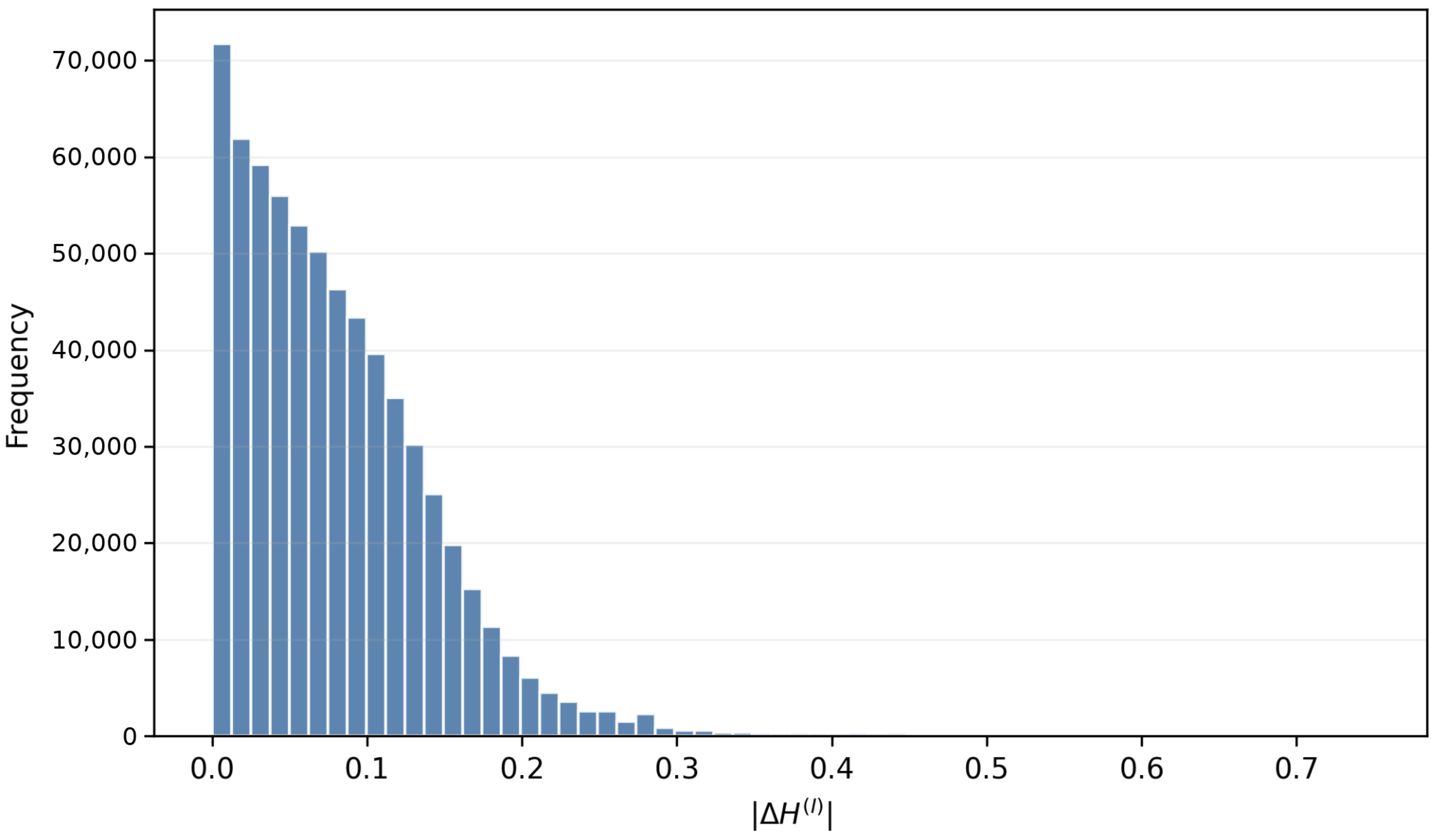
Threshold calibration starts with the intersection-level distribution. This level determines whether the whole intersection has entered a high-change state. The empirical distribution of the intersection-level entropy-difference magnitude has a low-value concentration and a high-value long tail. Most samples fall in low-value ranges. Only a small share falls in the upper tail. The cumulative distribution shows a notable change in slope near 0.14. After that point, the sample frequency drops quickly. This pattern indicates a transition from routine fluctuation to relatively rare high-change observations (
Figure 1).
Table 2 compares the candidate thresholds. It shows the trade-off between sensitivity and stability. The 80th percentile is more sensitive, but it may include routine fluctuation. The 90th percentile is more conservative, but it may exclude moderate events that persist over time. The 85th percentile lies near the turning region of the distribution. Therefore, it provides a practical balance. The mean-plus-one-standard-deviation reference is 0.142. This value is close to the 85th-percentile threshold of 0.141. It is reported as a descriptive reference rather than as an independent validation criterion.
The persistence analysis also supports this choice. Under the 85th-percentile threshold, the two-window constraint identifies 26,955 sustained structural-change events. A three-window constraint reduces the count to 8434. Under the 90th-percentile threshold, the two-window and three-window counts are 17,032 and 4610. This stricter threshold greatly reduces the event set. It may also remove moderate changes that persist. Based on the distribution boundary, candidate comparison, and event statistics, this study sets the intersection-level threshold at 0.141 for the case dataset.
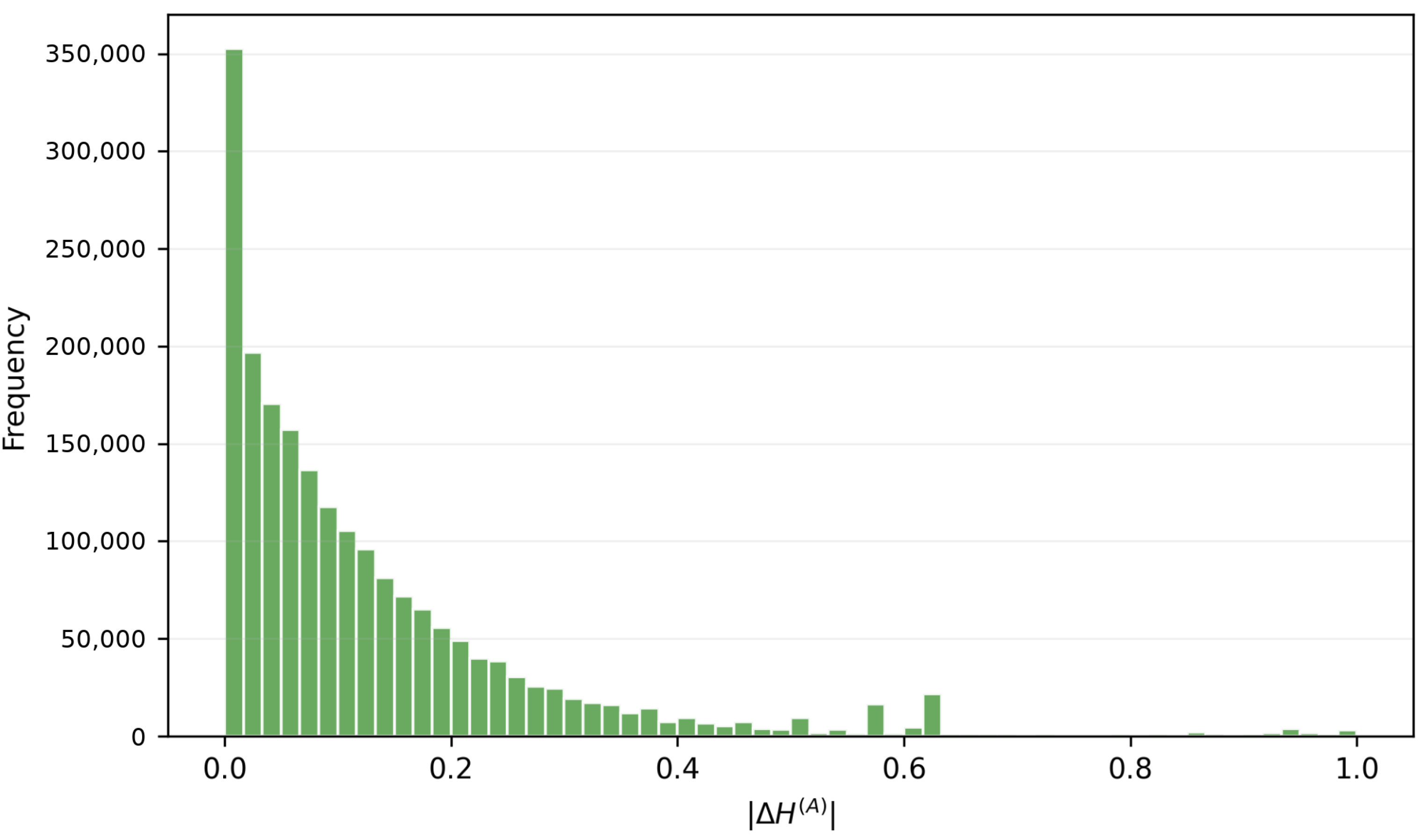
The approach-level distribution is then examined to support local diagnosis. The approach-level entropy-difference magnitude also shows low-value concentration and a high-value long tail (
Figure 2). Its value range is wider than that of the intersection-level measure. This pattern shows that local turning-composition changes are more sensitive to short-term demand fluctuation. It also shows that local changes can produce larger entropy differences.
Table 3 compares the approach-level candidate thresholds. The 85th percentile, again, gives a balanced choice. It filters routine fluctuation more strongly than the 80th percentile. It also keeps more sustained medium-intensity local events than the 90th percentile. Therefore, this study sets the approach-level threshold at 0.265 for the case dataset.
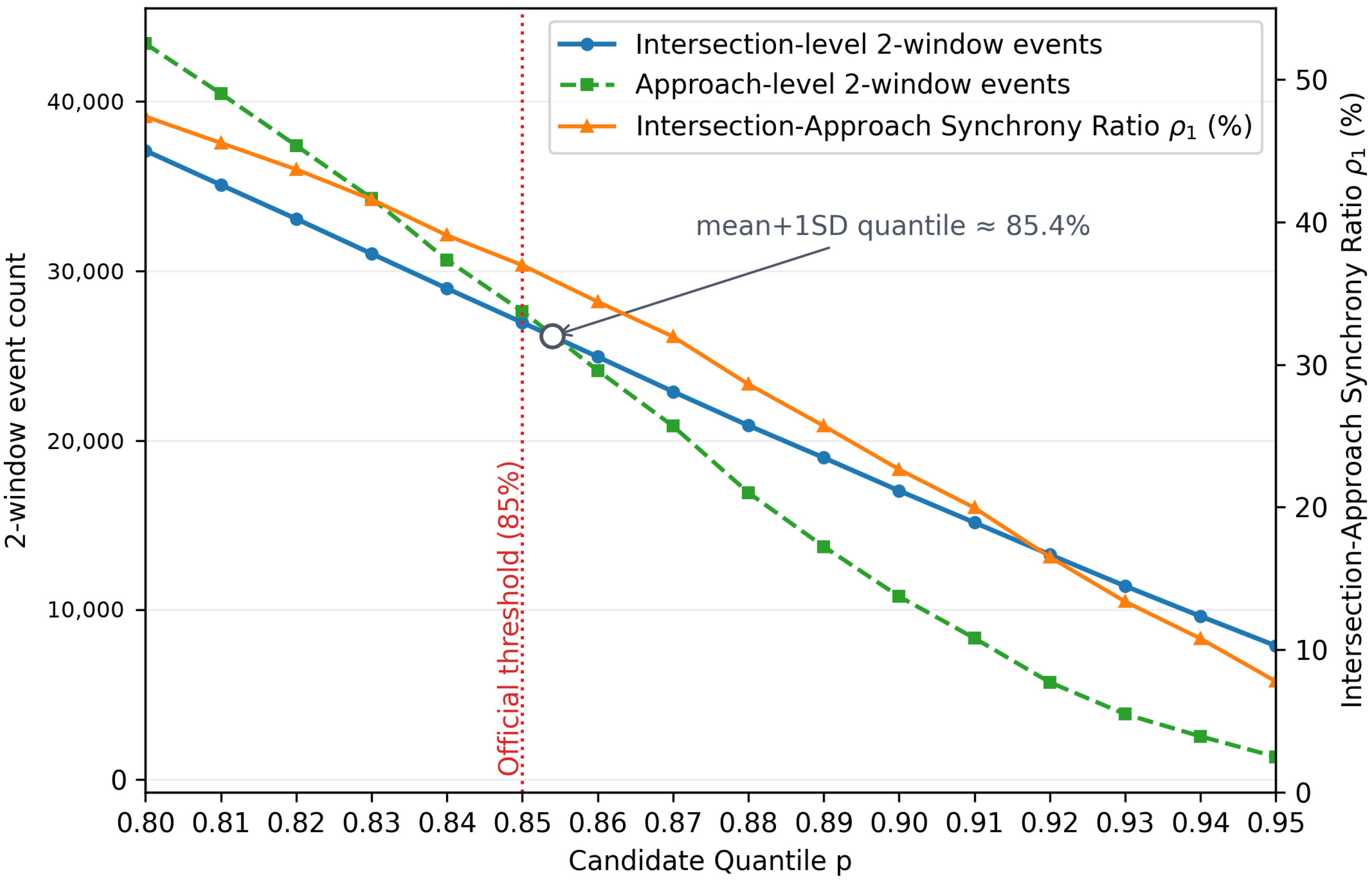
Finally, a continuous scan checks threshold stability. The candidate quantile changes from the 80th to the 95th percentile with a step of 0.01. The two-window event counts at both levels decline smoothly. No abrupt breakpoint appears. The intersection-level count decreases from 37,092 to 7887. The approach-level count decreases from 43,400 to 1338. The 85th percentile lies in the middle of the stable region. Therefore, it balances sensitivity and robustness in this case dataset (
Figure 3).
4.3. Threshold Reasonableness and Level-Specific
Characteristics
After threshold calibration, spatial heterogeneity is examined. This step checks whether one special structural node has a disproportionate effect on the results. At the intersection level, high-change observations are limited and are concentrated in selected periods. This pattern suggests that the whole-intersection turning-demand structure is stable in most windows. Significant changes occur only under specific operating conditions. The approach level provides higher spatial resolution. It helps locate the likely local sources of those changes.
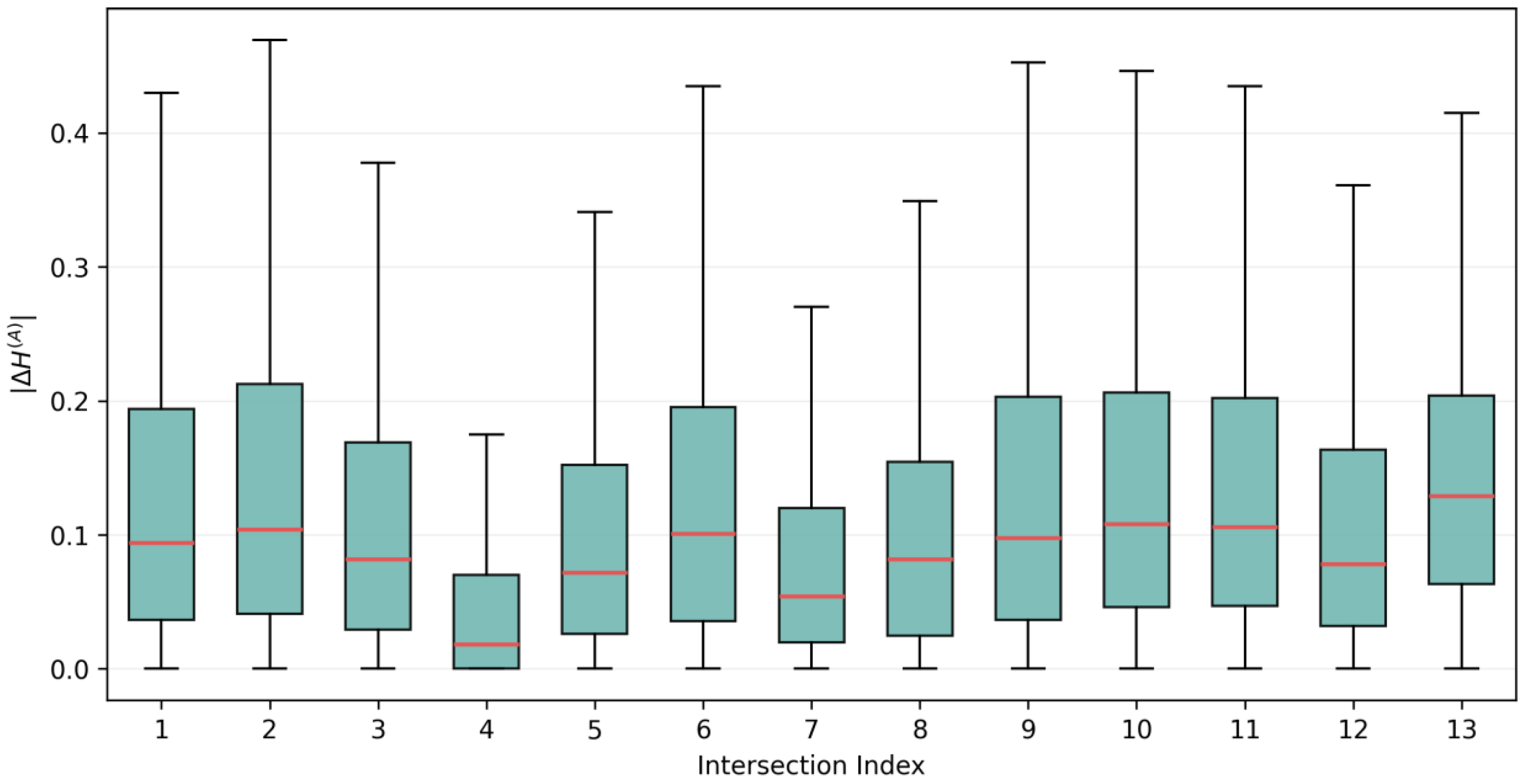
Figure 4 and
Table 4 report approach-level statistics for different intersections. The median, interquartile range, and tail values vary clearly across intersections. This variation shows strong spatial heterogeneity. Intersection 5 has the highest 85th- and 90th-percentile values, which are 0.347 and 0.518. This pattern is linked to long-term low-volume conditions on its north–south minor approaches. In those approaches, a small number of vehicles can amplify entropy variation. This result is retained as a diagnostic finding because it shows that the approach-level entropy difference can identify structurally low-volume nodes that may otherwise dominate local high-change statistics. A diagnostic check using a 20 pcu/5 min volume filter showed that about 57% of the diagnostically flagged low-volume cases were concentrated on the north–south approaches of Intersection 5, whereas all other intersections together accounted for less than 4%. The low-volume artifact is, therefore, mainly linked to one structurally special node. It has a limited impact on the corridor-wide interpretation.
At the approach-direction level, the north approach has a 90th-percentile value of 0.477 and a clearly right-skewed distribution (
Table 5). The north–south minor approaches show stronger structural disturbance than the east–west mainline approaches. This pattern is consistent with the functional hierarchy of the arterial corridor. The east–west direction carries more stable through traffic. The north–south side-road direction carries a higher share of turning traffic. It is, therefore, more sensitive to short-term turning-demand disturbance.
4.4. Two-Level Change-Linkage
Analysis
After the two levels are calibrated, their linkage is examined at the single-window scale. This analysis uses the single-window indicators rather than the formal persistent variables. The reason is direct. Same-window coexistence and one-window leading signals must remain visible. The study defines three linkage variables. They describe synchronous local support, local leading signals, and local high-change states that do not evolve into intersection-level threshold exceedance in the same window.
The variable
identifies synchronous local support for an intersection-level change. The variable
identifies a possible local leading signal. The variable
identifies local high change without same-window intersection-level exceedance. The corresponding proportions are
The symbol T is the number of valid adjacent-window pairs pooled across all intersections. The ratio is the share of intersection-level high-change windows with synchronous local support. The ratio is the share with at least one local leading signal in the previous window. The ratio is the frequency of local high change without same-window intersection-level high change. This section uses B rather than S. This choice preserves same-window co-occurrence and one-window-ahead local signals.
Table 6 summarizes the linkage statistics. Among the 98,152 intersection-level high-change windows above the 85th percentile, 59,380 have at least one synchronous approach-level high-change signal. This share is 60.5%. Another 46,156 windows have at least one significant approach-level change in the preceding time window. This share is 47.0%. Across all 654,346 valid adjacent-window pairs pooled across all intersections, 168,208 show local high change without an intersection-level threshold exceedance. This share is 25.7%. The dominant approach and the intersection-level change have the same sign in 95.4% of cases. This result indicates strong directional agreement between the two levels.
The moderate Pearson correlations do not indicate a weak linkage between the two levels. The intersection-level and approach-level entropy differences are not expected to be linearly interchangeable. An intersection-level high-change state may result from several approaches, each changing moderately at the same time. By contrast, a large approach-level change may remain localized or may be offset by changes on other approaches. Therefore, the linkage evidence should be interpreted jointly with the synchrony ratio, the local-leading ratio, the locally independent ratio, and the directional-consistency ratio.
The linkage results clarify the role of each level. Intersection-level high-change states are often supported by synchronous approach-level changes. Many intersection-level high-change states also have a local leading signal in the previous window. At the same time, local disturbance does not always become whole-intersection reorganization immediately, indicating some buffering capacity during structural evolution. The intersection level identifies overall structural change, whereas the approach level explains local sources and provides potential early warning information.
5. Discussion
The results should be interpreted by separating the transferable framework from the case-specific parameters. The transferable part includes the two-level entropy formulation, the evolution-intensity calculation based on adjacent-window entropy differences, the empirical quantile calibration procedure, the persistence constraint, and the linkage analysis between levels. The numerical thresholds of 0.141 and 0.265 are specific to this corridor, this observation period, this detection system, and the structural units defined in this study. When the method is applied to another city, corridor, detector system, or intersection geometry, the quantile thresholds and persistence length should be recalibrated.
Under this interpretation, the method output is a candidate pre-identification signal. It is not an intervention decision. The intersection-level variable indicates that the whole turning-demand structure may have entered a high-change state. The approach-level variable identifies the likely local source. A later decision may involve signal timing, lane-function switching, or another control action. Such a decision still depends on queue length, delay, saturation, downstream receiving capacity, lane-changing cost, switching cost, safety constraints, and operational policy. Structural change is a useful warning signal for structure-adaptive management, but it does not by itself prove control benefit.
To illustrate how the signal fits into practice, consider a representative traffic-engineering decision scenario. The framework runs alongside standard detector processing in near real time. When neither the intersection-level nor any approach-level threshold is exceeded for two consecutive windows, no structural control attention is required beyond routine monitoring. When the intersection-level trigger fires, the engineer or traffic management system receives a structural-change alert for that intersection. The engineer then checks the current queue length, delay, and saturation on each approach. If at least one approach-level trigger has also fired, the approach-level signal identifies the likely source of change. At this point, the engineer, or an automated decision layer, can evaluate whether a signal-timing adjustment, a temporary lane-function switch, or a change in coordination offset is warranted. The candidate trigger does not prescribe a response. It elevates attention and initiates a targeted operational check. The final decision still depends on downstream capacity, lane-changing cost, switching cost, safety constraints, and local operational policy.
Quantifying the incremental value of this signal over conventional aggregate detectors requires a structured validation program. A first stage would log the candidate-trigger signal alongside operational performance data—delay, queue length, and saturation—over several months without intervention, to determine how frequently high-change events precede or coincide with measurable performance deterioration. A second stage would correlate trigger events with before-and-after performance records at locations where control responses were already applied for independent reasons, providing indirect evidence of the signal’s discriminative value. A third stage would conduct a small-scale pilot study in which targeted control responses are applied when the trigger fires and outcomes are compared against matched non-intervention periods using conflict surrogates, delay, and queue length as evaluation metrics. This three-stage program would also support threshold recalibration for new networks, as the reported numerical thresholds were derived from one arterial corridor and should not be transferred without re-examination.
The framework is computationally lightweight and can be automated for real-time deployment. At each 5 min window boundary, the procedure reads movement-level turning-flow counts from the detector system, normalizes them into a composition vector, computes normalized structural entropy at the intersection and approach levels, computes the difference between the current entropy values and those of the previous window, and compares the absolute differences against the pre-calibrated thresholds. For a typical signalized intersection with 8–16 turning-movement units, the entire sequence involves on the order of hundreds of arithmetic and logarithmic operations. For a corridor of 13 intersections, the total computation per 5 min cycle remains negligible relative to the 5 min update interval on modern commodity hardware. The framework, therefore, imposes negligible computational overhead when integrated alongside standard detector data processing. No specialized hardware, graphics processing units, or real-time operating systems are required. The main implementation requirements are a reliable 5 min aggregated turning-flow data feed and a scripting environment capable of basic matrix arithmetic.
Several observations support the empirical selection of the 85th percentile. The entropy-difference distributions have low-value concentrations and high-value tails. The intersection-level distribution shows a notable change in slope near the selected threshold. The 80th-, 85th-, and 90th-percentile comparison shows the trade-off between sensitivity and conservatism. The two-window and three-window event counts show the effect of the persistence requirement. The continuous scan from the 80th to the 95th percentile shows a smooth event-count decline. The mean-plus-one-standard-deviation reference is also close to the selected intersection-level threshold, but it is treated only as a supplementary descriptive benchmark. These observations do not provide external validation. They do provide an internally consistent calibration basis for unlabeled data.
The two-window persistence rule should be read as an operational compromise rather than an optimal setting. A one-window rule would respond faster, but it would be more vulnerable to isolated noise. A three-window rule would be more stable, but it would remove many moderate sustained changes. In this case dataset, two windows correspond to 10 min, roughly 5–10 common urban signal cycles. This scale is compatible with near-real-time use while retaining enough persistence to suppress isolated fluctuation.
The entropy-difference indicator targets a class of structural-complexity changes that simple aggregate rules are not designed to detect. In the case dataset, this distinction is visible in both directions. Among all valid adjacent-window pairs with a defined flow-change ratio (, totaling 651,229 pairs), 388,349 windows where total intersection flow changed by more than 10% relative to the preceding window showed no entropy-difference exceedance (), reflecting volume shifts unaccompanied by structural reorganization. At the single-window diagnostic scale, a volume-change rule calibrated at a 10% threshold would flag all such windows as potential control events, generating 388,349 signals outside the structural-change target of this framework. In the opposite direction, 13,516 (13.8%) of the 98,152 high-entropy-change windows () occurred when total flow changed by less than 10%, and 6448 (6.6%) when total flow changed by less than 5%; these windows, in which turning-demand composition reorganized while overall volume remained nearly stable, would be systematically missed by the volume-change rule.
A similar two-sided pattern is observed with a dominant-direction proportion rule—flagging any window in which a single movement exceeds 50% of total intersection flow. Of the 98,152 high-entropy-change windows, 56,284 (57.3%) were not captured by this rule, indicating that more than half of the structural-complexity changes identified by the entropy framework occurred in windows where no single movement dominated. Conversely, the proportion rule produced 156,477 windows flagged with no corresponding entropy-difference exceedance, reflecting periods of persistently concentrated but structurally stable demand. The 95.4% directional-consistency finding in
Table 6 further shows that the entropy-difference signal aligns with the direction of dominant approach change in the overwhelming majority of cases, carrying directional information without being reduced to a single-proportion check. These comparisons are illustrative rather than constituting a formal evaluation; a rigorous side-by-side assessment would require design choices—threshold level, reference window length, and tie-breaking rules—that are outside the scope of this calibration study and are reserved for a structured future evaluation.
This study has several limitations. First, the case data come from one arterial corridor in one city. They cannot prove threshold stability across cities or road classes. Second, the calibration is unsupervised. The results show internal statistical consistency rather than direct reductions in delay, queue length, or safety risk. Third, the entropy-difference indicator is designed to detect dispersion-based structural-complexity change, not every possible directional reallocation. Pure dominant-direction switches that preserve dispersion fall outside this target scope. In the case dataset, these cases were mainly associated with very low-volume windows and had limited influence on the reported candidate triggers after the diagnostic volume check. Fourth, the persistence length and any diagnostic volume screen are engineering settings. They should be reconsidered when the framework is transferred to a new dataset.
These four limitations do not preclude geographic transfer of the methodology. The entropy formulation, the differencing operation, and the empirical quantile calibration procedure are not city-specific and can be applied to signalized intersections in other cities and countries wherever movement-level turning-flow counts are available at a regular aggregation interval. Population size, road-network extent, and vehicle volume affect the empirical distributions but do not prevent application; they make recalibration necessary rather than transfer infeasible. The main prerequisites for transfer are adequate detector coverage of all turning movements, an observation record long enough for robust quantile estimation (on the order of several months of representative operation), and an aggregation window matched to local signal-cycle lengths. Any detector technology that yields periodic movement-level counts—loop detectors, video detection, or connected-vehicle data feeds—is compatible with the framework.
Because the present study develops a candidate-trigger identification method rather than a complete control optimization or implementation method, it does not report a realized economic-benefit value. The economic effect depends on the downstream control response, the operational improvement achieved by that response, and the cost of false-positive responses, which are outside the scope of the present calibration study. Instead, the following expression provides a quantitative framework for future pilot or simulation-based evaluation. The economic value of the signal depends on two quantities: the reduction in delay achieved when a structure-aware control response is applied following a true trigger, with queue length serving as a supplementary operational indicator, and the cost of unnecessary responses following false triggers. In a future pilot study, let
denote the average per-vehicle delay saving (in seconds) per triggered event when the control response is appropriate,
v the number of affected vehicles during a high-change window,
the value of travel time (in monetary units per hour),
the true-positive rate of the trigger, and
the monetary cost of one false-positive response. Let
denote the expected net monetary benefit per candidate event:
Estimating
,
, and
requires outcome-linked validation through a downstream control policy, field pilot, or simulation experiment. Therefore, the expression is offered as a template for future evaluation rather than as a claim of realized savings.
A further consideration concerns statistical dependence. The 654,346 adjacent-window pairs are drawn from a continuous six-month record across 13 intersections. Consecutive pairs share one window, creating temporal autocorrelation within each intersection’s sequence. The 13 intersections lie on one arterial corridor, so spatial correlation across intersections is also plausible during peak periods. These dependencies mean that the effective sample size for quantile estimation is smaller than the nominal pair count, and that standard errors of event-count statistics are correspondingly larger. The calibration procedure does not formally correct for this dependence. However, the primary use of the empirical distribution is to set operational thresholds rather than to conduct formal hypothesis tests, so the effect on threshold selection is expected to be limited. The event counts reported in
Section 4 are descriptive rather than inferential. Block-wise resampling by day (approximately 180 daily blocks per intersection) or by intersection (13 blocks) would produce wider confidence intervals around the reported counts, but would not be expected to change the directional conclusions: that the two-window persistence rule substantially reduces single-window event counts, and that the two spatial levels carry complementary information.