Review

Acoustics as a Structural Health Monitoring Tool in Naval and Offshore Structures: A Comprehensive Review

by
Arturo Silva-Campillo
*,
M. A. Herreros-Sierra
and
Francisco Pérez-Arribas
Department of Naval Architecture, Shipbuilding and Ocean Engineering, Universidad Politécnica de Madrid (UPM), 28040 Madrid, Spain
*
Author to whom correspondence should be addressed.
Appl. Sci. 2026, 16(3), 1477; https://doi.org/10.3390/app16031477
Submission received: 4 December 2025 / Revised: 14 January 2026 / Accepted: 30 January 2026 / Published: 2 February 2026
(This article belongs to the Special Issue Application of Acoustics as a Structural Health Monitoring Technology)

Abstract

The increasing demand for reliability and safety in naval and offshore structures has accelerated the adoption of advanced Structural Health Monitoring (SHM) techniques. Among them, acoustic methods—ranging from passive acoustic emission monitoring to guided ultrasonic waves—have demonstrated exceptional potential for early detection, localization, and characterization of structural damage under harsh marine environments. This review provides a comprehensive and critical synthesis of the state-of-the-art in acoustic-based SHM applied to ships, submarines, offshore platforms, and floating renewable energy systems. Special emphasis is placed on the comparative performance of different acoustic techniques, their integration with numerical modeling and data-driven methods, and their suitability for real-world deployment considering hydrodynamic, operational, and environmental constraints. By bridging current achievements with future challenges, the paper highlights research gaps and outlines key directions to accelerate the transition of acoustic SHM technologies from laboratory studies to widespread industrial applications. This review aspires to serve as a reference work for both academic researchers and practitioners, consolidating knowledge and inspiring innovation in the field.

1. Introduction

Naval vessels and offshore installations represent indispensable components of the global economic and energy system. International commerce relies heavily on seaborne transportation, which accounts for the vast majority of cargo flow worldwide, while offshore infrastructures play an increasingly strategic role in supplying fossil and renewable energy resources. The reliability of such assets is intrinsically linked to their capacity to operate safely under highly demanding service conditions, characterized by cyclic hydrodynamic actions, aggressive corrosive environments, long-term fatigue loading, and occasional accidental events. Progressive material deterioration and the accumulation of damage over the service life gradually reduce structural safety margins, thereby elevating the probability of failure and exposing society to significant environmental, financial, and human risks [1,2,3].
Structural Health Monitoring (SHM) has become a fundamental strategy for safeguarding the performance and safety of complex maritime and offshore systems. Through the continuous acquisition and interpretation of physical, mechanical, or chemical response data from structural elements, SHM enables the early identification of damage processes, supports informed maintenance decision-making, and contributes to prolonging operational lifetimes. Recent progress in sensing technologies, signal analysis, and digital connectivity has driven a transition away from fixed-interval inspections toward condition-driven maintenance approaches, allowing real-time assessment of structural behavior under actual service conditions [4].
Within the broad spectrum of SHM strategies, acoustic-based approaches—encompassing passive acoustic emission and ultrasonic-guided wave techniques—offer distinctive advantages for monitoring structures operating in severe environments. Their high sensitivity to damage-related mechanisms such as micro-fracture initiation, delamination, corrosion activity, and fatigue progression enables the identification and localization of incipient defects well before they become apparent through conventional inspection methods. In addition, acoustic techniques are well suited to a wide range of structural materials, from metallic alloys to advanced composites, and can be effectively applied to the complex layouts and boundary conditions characteristic of ships, submarines, offshore installations, and floating renewable energy infrastructures [5].
Acoustic methods have a long-standing presence in the field of Structural Health Monitoring. Initial studies were largely confined to controlled laboratory experiments aimed at identifying fatigue cracking or localized corrosion damage. In contrast, over the last two decades, these techniques have evolved significantly, supported by large-scale international research initiatives—such as SHIP INSPECTOR—which have driven their transition from experimental validation to practical implementation on full-scale maritime structures [6] or MONITAS JIP [7] have proven their effectiveness in operational settings beyond the laboratory. At the same time, major classification societies—such as DNV, ABS and Bureau Veritas—have gradually incorporated hull condition monitoring frameworks in which acoustic-based techniques are recognized as either optional enhancements or, in some cases, mandatory elements for vessels operating under demanding environmental and loading conditions [8,9,10,11]. In recent years, investigation efforts have expanded toward offshore wind energy systems, compliant offshore platforms, and subsea pipeline networks, where the analysis of acoustic wave propagation and emission activity offers insights not only into structural integrity but also into the coupled effects between the structure and the surrounding hydrodynamic environment [12,13,14,15,16].
Recent progress in advanced signal analysis techniques, artificial intelligence, and Digital Twin paradigms has significantly strengthened the contribution of acoustic methods to SHM. Modern data-driven frameworks are increasingly effective at managing large-scale acoustic datasets, suppressing operational and environmental noise, and extracting weak signatures associated with early-stage damage. When integrated within Internet of Things (IoT) architectures, acoustic sensing systems are evolving toward decentralized, wireless, and self-adaptive solutions, enabling persistent and autonomous monitoring of offshore and remote maritime structures [17,18,19,20].
This review presents a comprehensive synthesis of the state-of-the-art in acoustic-based Structural Health Monitoring (SHM) for naval and offshore structures. Particular emphasis is placed on the theoretical foundations of acoustic monitoring techniques, their practical implementation, and their applicability to complex marine environments. The article is organized as follows: Section 2 introduces the fundamental principles of acoustic-based SHM, including wave propagation, sensor technologies, and signal characteristics in structural applications. Section 3 reviews Acoustic Emission (AE) techniques, focusing on their mechanisms, signal features, and damage characterization capabilities. Section 4 discusses representative applications of acoustic SHM in metallic and marine structures, highlighting damage mechanisms relevant to naval and offshore assets. Section 5 addresses ultrasonic-guided waves, with particular attention to Lamb wave propagation, excitation, and sensing strategies for damage detection. Section 6 examines passive acoustic monitoring approaches and their suitability for continuous, in-service surveillance. Section 7 explores hybrid and advanced acoustic SHM methodologies, including the integration of multiple acoustic techniques with data-driven approaches. Section 8 reviews applications across different industrial sectors, emphasizing transferability and lessons learned for naval and offshore contexts. Section 9 outlines current challenges, limitations, and emerging trends that will shape the future of acoustic SHM technologies. Finally, Section 10 presents the main conclusions and identifies key directions for future research.

2. Fundamentals of Acoustic-Based SHM

Acoustic Emission (AE) is a passive and highly sensitive non-destructive technique that detects ultrasonic waves generated by irreversible damage processes such as microcracking, fatigue and corrosion in stressed materials. By capturing damage at its earliest stages, AE plays a central role in predictive maintenance and Structural Health Monitoring (SHM). In naval and offshore structures, where complex interactions occur between plates, stiffeners, welds and joints, the propagation of elastic waves provides valuable information on both global structural behavior and localized degradation. Recent advances in signal processing and machine learning have further enhanced the reliability of AE for damage detection, localization and classification under noisy operating conditions, making it a robust and versatile tool for monitoring the integrity of large-scale engineering systems [21,22,23,24].
Acoustic Emission (AE) is a passive, highly sensitive NDT technique that captures elastic waves generated by microcracking, corrosion, delamination, or impact, offering earlier damage insights than deformation-based sensors. In acoustic-based SHM, these waves propagate through plates, stiffeners, welds, and joints, encoding both global responses and localized damage phenomena. Field implementations—such as the monitoring of fracture-critical eyebars in the San Francisco–Oakland Bay Bridge—demonstrate AE’s ability to detect and locate damage initiation and growth in real time, even under intense noise, thanks to robust pattern-recognition algorithms. Studies on steel bridges, pressure vessels and metallic components show that AE parameters such as amplitude, energy, duration and event count correlate not only with fatigue crack evolution, but also with corrosion activity, frictional damage, plastic deformation and stress-corrosion cracking, enabling reliable assessment of multiple degradation mechanisms and their progression. This multi-parameter, wave-based perspective makes AE a powerful and cost-effective component of modern Structural Health Monitoring, capable of diagnosing and tracking a wide range of damage processes across diverse engineering structures [25,26,27,28,29].

2.1. Elastic-Wave Generation and Propagation in Structural Media

This section introduces the physical and sensing principles that are common to all acoustic-based SHM techniques, including acoustic emission, guided ultrasonic waves and passive acoustic monitoring. Acoustic wave propagation in solids follows elastic theory, occurring as longitudinal, shear, and guided Lamb waves whose behavior is strongly governed by material anisotropy and structural boundaries. These mechanisms underpin advanced AE- and Lamb-wave-based SHM techniques, enabling reliable damage detection and localization in complex metallic and composite structures. Recent developments include energy-based source localization methods that bypass time-of-arrival assumptions and material property requirements, achieving accurate performance in noisy, orthotropic plates. In parallel, pattern-recognition strategies integrating clustering, Principal Component Analysis (PCA), and wavelet-based time–frequency features have demonstrated strong capability in discriminating damage mechanisms such as matrix cracking, debonding, and delamination. Furthermore, machine learning-driven Lamb wave analyses, particularly CNN-based models, have outperformed conventional spectral approaches in quantifying fatigue cracks in large-scale steel structures. Together with nonlinear and wavefield-based extensions, these advances significantly enhance the accuracy and robustness of guided-wave SHM, supporting real-time and quantitative damage assessment in modern structural systems [30,31,32,33,34,35,36].
When acoustic waves interact with geometric discontinuities—such as weld toes, stiffener junctions, and thickness changes—they undergo scattering, reflection, and mode conversion, generating complex signal patterns that can be exploited for damage detection and localization. Leveraging this behavior, recent advances in AE source localization have overcome key limitations of classical time-of-arrival methods, which rely on constant wave-speed assumptions and simplified propagation paths. Innovative approaches include compact triangular sensor configurations that combine S0/A0 modal separation with directional Time of Arrival (TOA) analysis, enabling accurate localization in plate-like structures with minimal instrumentation. For composite and heterogeneous systems, data-driven strategies such as automated delta-T mapping and Gaussian-process-based regression models have markedly improved robustness and generalization without requiring detailed material characterization. In parallel, advanced onset-picking techniques based on enhanced Akaike Information Criterion formulations provide more reliable first-arrival detection in noisy AE data, outperforming classical methods and reducing localization errors. Overall, these developments significantly enhance the accuracy, automation, and applicability of AE source localization in geometrically complex structures, strengthening its role within modern SHM frameworks [37,38,39,40,41,42].
Environmental and operational conditions strongly influence acoustic- and Lamb-wave-based SHM, particularly in marine environments where fluid coupling increases attenuation, dispersion, and hydrodynamic noise, requiring robust filtering to maintain diagnostic reliability. Solid–fluid interaction studies highlight the impact of fluid compressibility and guided-wave leakage on measured responses, demonstrating the diagnostic value of fluid-borne propagation paths for source characterization and depth estimation. While guided ultrasonic waves are discussed in detail in Section 5, their fundamental wave physics is introduced here as part of the common acoustic framework. Comparable multiphysics effects arise in corrosion monitoring, where long-term AE measurements demand advanced denoising strategies to reliably identify low-amplitude damage mechanisms and distinguish stages of corrosion evolution. In rotating machinery, AE provides high sensitivity to early-stage defects, and recent developments in signal demodulation and synchronous averaging have reduced acquisition demands while improving fault discrimination. Overall, these advances extend the applicability of AE across complex operating conditions and material systems, while emphasizing ongoing challenges in automated feature extraction and diagnostic algorithm robustness within next-generation SHM frameworks [43,44,45,46].

2.2. Sensor Technologies

Several sensor technologies are employed to capture acoustic responses in naval and offshore structures:
-
Piezoelectric transducers remain the backbone of AE- and guided-wave-based SHM, offering high strain sensitivity, although durable bonding and corrosion protection are critical in marine environments. Beyond conventional disks, fiber-based actuators such as Active Fiber Composites provide directional sensitivity and combined actuation–sensing capabilities, particularly suited to anisotropic composite laminates. Recent advances in piezoelectric sensor networks, integrating wavelet-based arrival extraction with nonlinear inverse solvers and Akaike Information Criterion (AIC)- assisted Delta-T mapping, have significantly improved impact and source localization accuracy while overcoming dispersion and anisotropy effects where classical TOA methods fail. Collectively, these developments enhance the robustness and applicability of piezoelectric-based SHM in heterogeneous and geometrically complex structures [47,48,49].
-
MEMS microphones and accelerometers increasingly complement piezoelectric AE sensors, enabling dense, low-cost, and edge-connected arrays for distributed monitoring of large-scale infrastructures and rotating machinery. Their compactness and compatibility with embedded processing support data-driven SHM architectures by reducing transmission and storage demands without compromising diagnostic capability. Recent implementations combining compressed AE representations with advanced machine learning models have demonstrated high accuracy in weld-leak detection and machinery fault classification under real operating conditions. Overall, Micro-Electro-mechanical Systems MEMS-based sensing integrated with AI-driven analytics is driving scalable, application-oriented AE monitoring, while challenges related to robustness, operating variability, and standardization remain active research topics [50,51,52].
-
Fiber-optic acoustic sensors, including Fiber Bragg Gratings and interferometric systems, provide a corrosion-immune and electromagnetically robust alternative to piezoelectric transducers for distributed AE and guided-wave monitoring, particularly in marine environments. Their embedment capability and inherent multiplexing support scalable long-range sensing architectures, while recent advances in intelligent processing—such as neural network-assisted localization—have improved accuracy under nonlinear and anisotropic propagation. Despite current cost limitations in interrogation hardware, comparative studies demonstrate superior sensitivity to low-frequency stress waves and high localization precision relative to Lead Zirconate Titanate (PZT) sensors, positioning fiber-optic AE systems as an increasingly mature solution for high-integrity SHM [53,54].
-
Hydrophones are fundamental to underwater SHM, capturing fluid-borne acoustic waves generated by structural–fluid interactions such as cavitation, impacts, and leakage, and enabling source localization when deployed in distributed arrays. In pipeline monitoring, where AE-based leak detection is a critical safety requirement, recent advances address the challenges posed by dispersive, multimodal wave propagation through enhanced signal processing and modal decomposition strategies. Techniques such as Hilbert–Huang-based energy analysis and modal acoustic emission (MAE) approaches enable reliable leak detection and localization, including single-sensor configurations that outperform conventional cross-correlation methods. Together, these developments support accurate, scalable, and regulation-compliant monitoring of submerged and buried pipeline systems [55,56,57].

2.3. Advantages and Limitations

Acoustic-based SHM offers high sensitivity to early damage, material versatility, and scalability via sensor networks, but its effectiveness is constrained by structural complexity and operational variability. Wind-turbine blades highlight both its capability and limitations: AE reliably detects damage initiation during testing, yet assessing damage criticality and enabling long-term in-service monitoring require robust instrumentation, autonomous operation, and automated data processing. These challenges have accelerated the adoption of machine learning and deep learning methods, which enable accurate damage classification, source localization, and prognostic assessment—even under complex geometries and limited sensor configurations. Overall, the integration of physics-based sensing with advanced AI frameworks is significantly extending the scope of acoustic SHM, while ongoing challenges remain in load representativeness, data imbalance, environmental effects, and model interpretability [58,59,60,61,62,63,64].
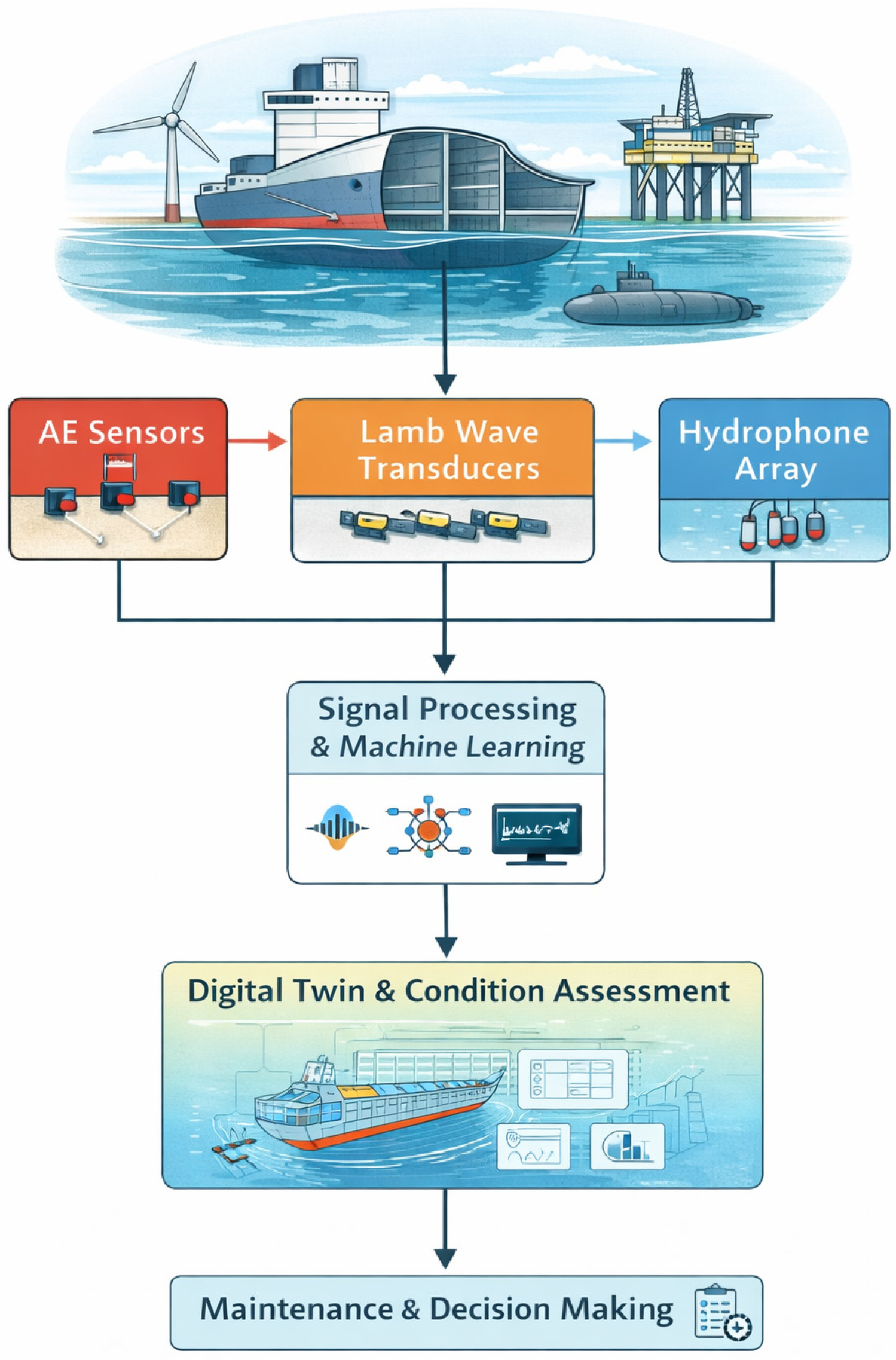
Despite its exceptional sensitivity to early-stage damage, acoustic-based SHM is constrained by environmental noise, calibration requirements, wave attenuation and dispersion, and the need to process large data volumes. These limitations are evident across applications, including composite manufacturing and concrete structures, where non-stationary signals and complex propagation complicate damage interpretation. Advanced time–frequency analysis, machine learning-driven crack sizing, and seismic-inspired statistical metrics have significantly improved damage classification, localization, and fracture-mode discrimination. Overall, these studies highlight both the diagnostic richness of AE and the necessity of physics-informed, automated analysis frameworks to robustly associate acoustic features with underlying damage mechanisms in complex materials and operating environments [65,66,67,68,69,70,71,72]. After introducing the general physical and sensing foundations of acoustic SHM, this section focuses specifically on Acoustic Emission (AE) as the most mature and damage-sensitive acoustic technique. To clarify the system-level perspective adopted in this review, Figure 1 summarizes the typical architecture of an acoustic-based Structural Health Monitoring (SHM) framework for naval and offshore structures. Rather than treating acoustic emission, guided ultrasonic waves and passive acoustic monitoring as independent techniques, they are here considered as complementary sensing layers operating at different spatial and temporal scales and feeding a unified diagnostic and prognostic framework. This architecture reflects how modern marine SHM systems are deployed in practice, combining distributed sensing, advanced signal processing and data-driven interpretation to support condition assessment and maintenance decisions under real operating conditions.
Although numerous studies have investigated individual acoustic techniques, their practical deployment in naval and offshore structures requires an integrated understanding of their respective capabilities, limitations and application domains. From an engineering standpoint, the key question is not which method is “best” in general, but which technique is most appropriate for a given structural scale, damage mechanism and operational environment. To provide this system-level perspective, Table 1 summarizes the main acoustic-based SHM approaches in terms of sensing scale, damage sensitivity, monitoring range, suitability for continuous in-service operation, robustness to environmental noise, and typical naval and offshore applications. This comparison highlights the complementary roles of acoustic emission, guided ultrasonic waves and passive acoustic monitoring, and explains why hybrid acoustic architectures are increasingly adopted for reliable condition assessment of complex marine structures.

3. Acoustic Emission (AE) Techniques

Acoustic Emission (AE) is a cornerstone NDE technique for SHM, based on transient elastic waves generated by rapid strain-energy release during damage processes such as cracking, corrosion, and delamination. Beyond well-established mechanisms, ongoing research continues to reveal AE signatures linked to micromechanical phenomena—including slip, twinning, residual stresses, and grain-scale effects—highlighting both the physical richness of AE and the need for deeper mechanistic interpretation. Advanced multi-parameter analyses combining dimensionality reduction and clustering have demonstrated robust discrimination of fatigue damage modes in composite laminates, in agreement with microscopic observations, and confirmed AE’s capability to track damage evolution. A key strength of AE lies in its sensitivity to the earliest stages of degradation, enabling identification of interfacial and microstructural processes well before macroscopic indicators emerge. This is exemplified in steel–concrete bond studies and cementitious composites, where AE waveform characteristics and frequency content reliably distinguish slip transitions, fracture origins, and chemically driven deterioration. Overall, these results underscore AE’s unique diagnostic reach while reinforcing the need for integrated physics-based and data-driven frameworks to interpret AE signals under increasingly demanding SHM conditions [73,74].

3.1. AE Signal Generation and Propagation

Acoustic Emission signals arise from irreversible microstructural events that release elastic energy and generate transient stress waves whose amplitude, spectral content, and arrival patterns encode information on the source mechanism. Leveraging these statistical wavefield properties, correlation-based localization methods have emerged as robust alternatives to classical time-of-arrival approaches. By estimating source position from inter-sensor correlation functions and incorporating advanced signal processing, these techniques improve localization accuracy under waveform distortion, dispersion, and low signal-to-noise conditions. Overall, they demonstrate how exploiting AE wavefield statistics enhances source characterization in complex structural environments [75]. In metallic materials, AE typically spans frequencies from ~100 kHz to 1 MHz and is strongly governed by microstructure, geometry, and boundary conditions, making it a powerful probe of micromechanical fracture processes. High-resolution studies in titanium-based alloys demonstrate that AE detects microcrack nucleation and evolution well before macroscopic failure, revealing how microstructural morphology controls fracture toughness and crack coalescence. In lamellar and acicular Ti alloys, AE activity at sub-yield stress levels indicates early damage accumulation that critically influences subsequent fatigue performance. Overall, these findings highlight AE’s capability to resolve microstructure-sensitive crack initiation and early damage development in advanced metallic systems, providing mechanistic insight into fracture and fatigue behavior [76,77,78].
Marine and offshore structures pose significant challenges for AE-based SHM due to strong attenuation, scattering, and mode conversion introduced by stiffeners, welds, and fluid–structure interaction. In FRP composites, where impact-induced delaminations evolve internally and remain visually undetectable, AE effectively captures damage progression arising from cascades of microstructural failure events. To interpret the resulting complex wavefields, recent studies increasingly adopt machine learning-assisted localization and classification, demonstrating robust source mapping in anisotropic composites using sparse sensor arrays and limited waveform features. Overall, these advances highlight both the potential of AE for offshore composite monitoring and the necessity of advanced signal compensation and data-driven methodologies to ensure reliable damage assessment [79,80].

3.2. AE Signal Parameters

AE waveforms are commonly characterized using parameters such as amplitude, energy, duration, and event rate, which provide indirect indicators of underlying damage mechanisms, from high-energy cracking events to lower-energy frictional or corrosion-driven processes. This parameter-based framework is increasingly enhanced by advanced spectral and statistical descriptors tailored to material-specific behavior. In cementitious and rubber-modified concretes, such descriptors enable robust discrimination of deformation and fracture regimes, capturing transitions in cracking mode, damage accumulation, and post-peak behavior. Overall, the integration of classical AE parameters with advanced signal metrics provides quantitative, mechanism-sensitive insight into deformation and damage evolution in quasi-brittle composites, supporting reliable SHM and condition-based maintenance [81,82].
Extensive laboratory and field evidence confirms that AE parameters can be robustly mapped to specific damage mechanisms, enabling practical diagnostics in critical infrastructure such as pipelines, bridges, and power-generation systems. In high-pressure piping, AE distinguishes creep- and erosion–corrosion-driven degradation through characteristic time–frequency signatures associated with crack initiation and growth. AE is also highly effective in fracture-toughness testing, where parameter evolution reliably identifies key transitions from yielding to crack initiation and unstable propagation, often with greater sensitivity than conventional methods. The resulting AE-derived metrics provide physically meaningful measures of damage evolution and initiation toughness, underscoring AE’s value for structural assessment and life-prediction applications [83,84].

3.3. AE Source Location

Accurate AE source localization is critical for identifying damage initiation and growth in complex structures, yet classical TDOA-based methods are often unreliable under anisotropy, dispersion, and mode conversion. Data-driven regression approaches, such as Gaussian Process models trained on laser-generated events, address these limitations by learning nonlinear time-of-flight–to–position mappings and enabling robust, transferable localization even with incomplete sensor data. In parallel, modal acoustic emission (MAE) frameworks exploit full guided-wave waveforms to distinguish Lamb-wave modes and enhance localization and imaging in composite structures. Together, these advances significantly improve AE localization capability while underscoring remaining challenges in mode-resolved analysis for anisotropic and geometrically complex systems [40,85].
Recent AE source-localization strategies increasingly integrate machine learning with physics-informed frameworks to address geometric, anisotropic, and modal complexities that invalidate classical TDOA assumptions. Neural-network-based localization trained on experimental AE data has demonstrated substantial accuracy gains in composite and metallic structures by implicitly learning complex wave-propagation effects. Complementary studies on metals under cyclic and creep loading show that AE activity provides clear early-warning indicators of deformation and damage transitions well before failure. Overall, these advances highlight the effectiveness of data-driven AE approaches for robust localization and early damage detection in structurally complex systems [86,87,88].

3.4. Advances AE Processing and Machine Learning

Machine learning has become central to modern AE analysis by enabling automated event classification, noise discrimination, and damage-evolution prediction, particularly in complex composite and hybrid structures where multimodal dispersion complicates traditional interpretation. Studies on laminated and sandwich composites demonstrate that ML-ready AE features reliably track damage progression and quantify the effects of material modifications on damage resistance and residual strength. At the structural scale, hybrid frameworks combining dispersion modeling, numerical simulation, and data-driven localization achieve accurate damage-source identification in highly dispersive environments, independent of sensor layout. Overall, the integration of physics-based modelling with machine learning-enabled AE interpretation substantially enhances the robustness and scalability of acoustic SHM in advanced structural systems [89]. Deep learning is increasingly enabling real-time interpretation of complex AE data, particularly in marine and offshore environments where noise, multipath propagation, and anisotropy limit classical analysis. In composite laminates, AE signatures and associated changes in wave-propagation behavior evolve systematically with damage progression, providing a rich basis for automated SHM. Hybrid prognostic frameworks combining feature selection with convolutional neural networks have demonstrated robust capability to track degradation and estimate residual structural capacity from high-dimensional AE datasets. Overall, deep learning emerges as a key enabler for scalable, adaptive, and predictive AE-based SHM under demanding operational conditions [62].

3.5. Integration with Advanced Data Analytics

The integration of AE with digital twins, IoT sensor networks, and edge computing enables continuous model updating, real-time condition assessment, and predictive maintenance in large-scale infrastructures. Physics-informed localization methods, combining dispersion-aware modeling with robust AE processing, provide a critical foundation for synchronizing digital twins with in-service structural behavior. In parallel, deep learning-based analytics embedded within distributed sensing frameworks enable automated damage-severity classification in rotating machinery and similar systems. Collectively, these advances signal a shift in AE-based SHM toward tightly coupled physical modelling, data-driven intelligence, and networked computational architectures for scalable, asset-level prognostics [51,90].

4. Applications in Metallic and Marine Structures

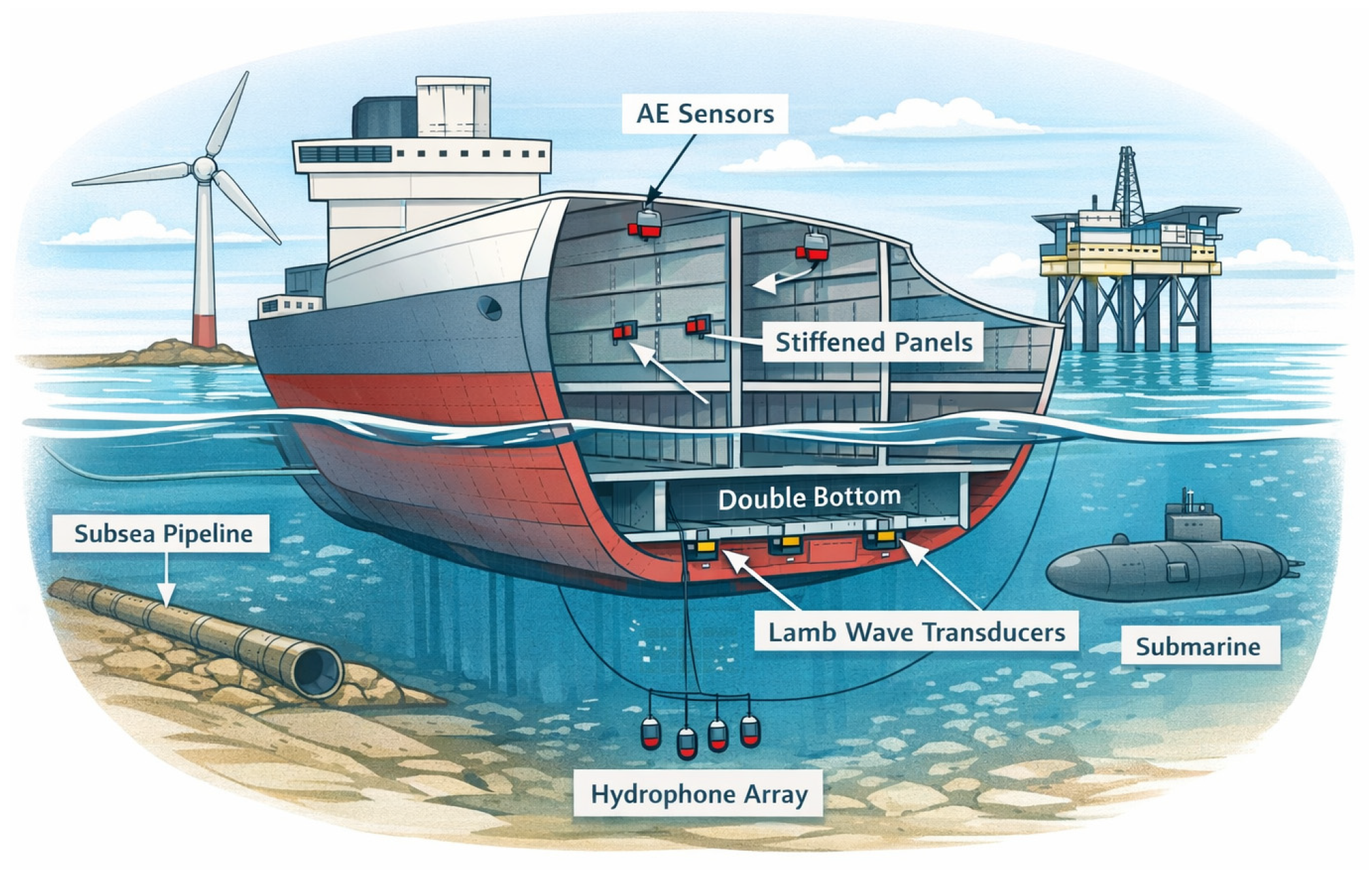
The use of Acoustic Emission (AE) monitoring in naval and offshore structures—including hull plating, stiffened panels, welded joints, piping systems, and offshore platforms—has expanded markedly over the past two decades, driven by the need for early damage detection and predictive maintenance. AE enables continuous in-service monitoring of critical degradation mechanisms such as fatigue cracking, corrosion and erosion–corrosion, and hydrodynamic load-induced microdamage, supporting life-extension strategies for marine assets. Figure 2 illustrates a representative naval and offshore structural scenario in which acoustic emission sensors, guided ultrasonic waves and passive acoustic monitoring are deployed on hull plating, stiffened panels, double-bottom structures and surrounding subsea assets. This configuration reflects typical applications of acoustic SHM in ship hulls, offshore platforms, pipelines and submarines.
Beyond metallic structures, the growing adoption of composites in naval and offshore applications has further increased AE relevance, as AE parameters reliably discriminate matrix damage, delamination, and fiber fracture, allowing identification of stress thresholds associated with damage accumulation. Parallel advances in metallic alloys demonstrate AE’s capability to resolve microstructure-sensitive deformation mechanisms and link grain size, plasticity, and damage evolution under marine-relevant loading. Collectively, these studies confirm AE as a powerful multi-scale diagnostic and prognostic tool for metallic and composite marine structures, enabling early damage detection, mechanistic interpretation, and predictive maintenance in demanding offshore environments [91,92].

4.1. Fatigue Crack Monitoring in Metallic Structures

Fatigue is a dominant degradation mechanism in naval and offshore steel structures subjected to cyclic wave and operational loading, particularly at welded joints and stiffened details. AE monitoring has proven highly reliable for tracking fatigue crack initiation and growth, as AE activity reflects crack-tip microphysics and stress-intensity evolution. Recent studies demonstrate that entropy-based AE parameters markedly enhance fatigue assessment under noisy, marine-relevant conditions, enabling clear discrimination between microcrack nucleation, plasticity-dominated crack-tip behavior, and stable crack propagation. Probabilistic models linking cumulative AE entropy to crack length provide accurate prognostic capability and are well suited for integration within digital-twin frameworks. Similar entropy-based indicators in high-strength aluminum alloys identify reproducible precursors to crack initiation, offering robust early-warning metrics. Collectively, these advances establish entropy-driven AE analysis as a powerful approach for fatigue monitoring and prognosis in critical marine structural components where accessibility is limited and failure consequences are severe [93,94].
Field deployments of AE systems on bridges, ship hulls, and large marine structures demonstrate their effectiveness in identifying high-stress regions and early crack activity well before visible deterioration, supporting condition-based maintenance where inspections are limited by accessibility, coatings, or marine growth. In ship hulls, AE activity consistently localizes at fatigue-critical details such as weld toes, stiffeners, and areas subjected to slamming loads, providing actionable early warnings. Data-driven interpretation further enhances diagnostics: neural-network classifiers successfully distinguish damage mechanisms in advanced cementitious materials, including UHPC used in marine infrastructure, revealing how energy dissipation and failure modes depend on microstructural features such as fiber orientation under multiaxial loading. Accurate source localization remains essential, and recent AIC-enhanced Delta-T mapping techniques significantly outperform classical TOA methods, reducing localization errors from centimeter to millimeter scale across metallic and composite marine structures. Collectively, these advances reinforce AE as a robust, scalable SHM tool capable of early damage detection, mechanism discrimination, and precise source localization in naval and offshore applications [95].
Controlled fatigue studies show that AE event clustering reliably delineates successive stages of crack propagation, a capability of high relevance for welded joints and pressure-boundary components in naval and offshore structures. In pressure-vessel steels and marine-grade alloys, AE parameters correlate with distinct micromechanical processes and differentiate crack growth in base metal, heat-affected zones, and welds. AE is also effective for in situ monitoring of stress-corrosion cracking in seawater-exposed piping, where waveform characteristics discriminate transgranular and intergranular mechanisms. Overall, these results confirm AE’s ability to classify damage mechanisms and track their evolution with the resolution required for fatigue and corrosion management in marine environments [96,97].

4.2. Corrosion and Environmental Degradation

AE has proven effective for detecting corrosion-related degradation in marine steels, including pitting, stress-corrosion cracking, and erosion–corrosion in seawater-exposed piping and flow systems where damage develops beneath coatings or insulation. Time-resolved AE studies in austenitic stainless steels show that acoustic parameters reliably capture depassivation, material removal, and transitions between erosion mechanisms through characteristic spectral and energy signatures. These responses correlate with mass-loss behavior and reveal precursory activity prior to severe material detachment. Overall, the integration of AE with electrochemical monitoring provides a powerful framework for real-time assessment of coupled corrosion processes, enabling early diagnosis and proactive maintenance in harsh marine and offshore environments [98].
AE signals generated during corrosion exhibit distinctive frequency–energy patterns that enable discrimination between electrochemical activity and mechanically driven cracking in marine alloys. Time–frequency analyses of additively manufactured aluminum alloys exposed to saline environments demonstrate that AE can track the progression from pit initiation to corrosion-product accumulation and corrosion-assisted cracking. Entropy-based denoising is critical for recovering low-amplitude corrosion signatures masked by environmental noise, allowing reliable extraction of key spectral features. Overall, these results confirm AE’s suitability for in situ corrosion monitoring and early pit detection in seawater-exposed ship and offshore components [44]. AE has become a key technique for early leak detection and localization in pipelines and offshore risers, exploiting its sensitivity to elastic waves generated by fluid escape before conventional pressure or flow indicators respond. Unsupervised learning approaches, such as growing neural gas models trained on healthy-state AE features, enable reliable detection of very small leaks under noisy operating conditions and scarce labeled data. Complemented by continued advances in signal processing and wireless monitoring, these developments confirm AE, coupled with modern analytics, as an effective framework for rapid, robust leak monitoring in marine pipeline systems [99,100].

4.3. AE in Composite and Hybrid Marine Structures

Composite structures in naval and marine renewable-energy applications exhibit complex subsurface damage modes that generate mechanism-specific AE signatures, making AE well suited for in-service diagnostics where visual inspection is impractical. Recent data-driven frameworks, including attention-enhanced deep learning models, achieve near-perfect classification of impact-related damage by extracting discriminative patterns directly from AE representations, outperforming conventional approaches. Complementary methodologies combining AE source localization with multi-technique classification further improve discrimination of concurrent failure mechanisms in buckling and multiaxial loading scenarios. Collectively, these advances establish AE, integrated with advanced signal processing and deep learning, as a powerful and scalable SHM solution for composite and hybrid marine structures [101,102].
Deep learning-based clustering and attention mechanisms have substantially improved AE interpretation in acoustically harsh marine environments dominated by hydrodynamic and operational noise. Energy-based localization methods further enhance robustness by avoiding reliance on material properties or layup information, enabling accurate AE source identification in anisotropic composite structures at low signal-to-noise ratios. Complementary advances in denoising and deep learning across related sectors demonstrate that modern AE processing pipelines can reliably isolate and classify damage-related emissions under variable environmental conditions. Together, these developments highlight the effectiveness of energy-based and deep learning-enhanced AE frameworks for robust SHM in marine and offshore structures [36,103].

4.4. Offshore and Subsea Structural Applications

In offshore wind turbines, fixed and floating platforms, and subsea risers, AE monitoring provides early detection of fatigue cracking in welded joints, tubular members, and anchoring systems subjected to persistent cyclic loading. Multi-parameter AE analyses in marine-relevant steels demonstrate clear delineation of fatigue-crack growth stages, with high-count and high-energy event clusters serving as early indicators of accelerated propagation. Correlations between AE metrics and crack-growth rate support quantitative fatigue assessment under operational conditions. For composite offshore components, integrated AE localization and classification frameworks enable reliable discrimination of delamination and matrix cracking under multiaxial loading, supporting robust SHM for both metallic and composite structures in harsh offshore environments [104,105].
The combined use of AE sensors and hydrophones enables separation of structure-borne and fluid-borne acoustic components, which is essential for SHM in submerged naval and offshore systems where fluid-mediated propagation obscures damage-related emissions. By jointly analyzing elastic waves in the structure and pressure waves in the surrounding fluid, this approach effectively discriminates structural damage from hydrodynamic noise and flow-induced effects. Advanced localization and classification techniques, integrating Delta-T mapping with neural networks, clustering, and amplitude-based metrics, demonstrate enhanced reliability under strong fluid–structure coupling. Overall, multi-sensor, multi-technique AE–hydrophone frameworks provide a robust foundation for dependable SHM in submerged marine structures [102].

5. Ultrasonic-Guided Waves (Lamb Waves)

Guided ultrasonic waves, particularly Lamb waves, are a core SHM modality for thin-walled marine structures, enabling large-area interrogation with sparse sensor networks and high sensitivity to surface and subsurface damage. Their low attenuation supports early detection of corrosion, weld degradation, and composite delamination in ship hulls, offshore panels, and composite marine components. Recent advances combining numerical modeling, wavelet-domain features, and neural-network classifiers enable quantitative delamination identification in composite laminates through digitally encoded damage fingerprints. Parallel studies on large stainless-steel plates demonstrate that guided waves can detect stress-corrosion cracking over long distances and inform optimal sensor placement. Together, these developments position Lamb-wave-based SHM as a scalable and highly sensitive solution for metallic and composite structures in naval and offshore environments [33,106].
Lamb waves propagate in symmetric and antisymmetric modes with distinct sensitivity to thickness variations and localized defects, providing strong diagnostic capability for marine structures. Symmetric modes are effective for monitoring wall thinning in corroded plating, while antisymmetric modes are suited to detecting localized cracking and delamination in welded and composite components. Machine learning-enhanced Lamb-wave processing has demonstrated millimetric accuracy in fatigue crack quantification in thin-walled, welded structures, offering a clear pathway for maritime adaptation under noisy conditions. Complementary integration of AE with fracture modeling further enables refined characterization of damage mechanisms in marine-grade alloys. Collectively, these advances establish guided waves as a powerful, physics-informed, and data-driven SHM modality for naval and offshore applications [32,107].
Despite their strong potential, Lamb-wave deployments in marine structures are challenged by dispersion, mode conversion, and hydrodynamic noise, which distort wave packets and generate complex multimodal fields over long propagation paths and around structural discontinuities. Even in controlled mechanical systems, guided-wave responses are strongly frequency-dependent and sensitive to micro-damage, necessitating advanced processing for reliable interpretation. Physics-guided, data-driven methods—such as neural-network-based feature extraction, entropy analysis, and wavelet techniques—have proven effective in isolating damage signatures under noisy conditions. These results highlight the need for similarly advanced algorithms to enable robust Lamb-wave SHM in the complex geometries and loading environments of ship hulls, offshore platforms, and marine machinery [108,109]. Under service conditions, marine structures experience significant acoustic clutter from wave loading, slamming, and machinery vibrations, which can obscure Lamb-wave responses, particularly in high-speed and floating platforms. Multi-sensor and multi-physics approaches offer effective mitigation strategies: combined AE and self-sensing CNT networks enable complementary, independent damage indicators under complex loading. While AE-based clustering distinguishes concurrent failure mechanisms, CNT-based resistance changes track damage progression, improving robustness against environmental interference. Together, these integrated sensing strategies enhance the reliability of SHM for composite naval and offshore structures operating in acoustically harsh environments [110].
To mitigate dispersion, mode conversion, and operational noise in marine structures, recent research increasingly adopts advanced signal processing and data-driven AE methodologies. Wavelet-based analysis, sparse representations, and machine learning classifiers enable reliable separation of damage-related emissions from hydrodynamic and machinery-induced noise. Sparse recovery and hybrid time–frequency/deep learning frameworks significantly improve source localization accuracy in large, complex structures by suppressing dispersion and multipath effects, outperforming conventional TOA-based methods. These advances provide robust, transferable processing pipelines for AE and guided-wave SHM in ship hulls, offshore platforms, and marine tubular structures [111,112].
The integration of Lamb-wave–based SHM within Digital Twin frameworks has emerged as a promising direction for offshore wind turbines and increasingly for naval structures, enabling real-time numerical models to be continuously updated using in situ acoustic measurements. In this paradigm, guided-wave data are not treated as isolated indicators but as dynamic inputs that refine structural states such as stiffness degradation, damage localization, and remaining life predictions. Recent advances in AE-based source localization for wind turbine blades illustrate how this integration can be realized [113,114]. Physics-informed localization algorithms combining semi-analytical finite-element dispersion analysis with attenuation and direction-dependent wave characterization enable robust AE and Lamb-wave source identification under noisy conditions. Optimized TDOA formulations significantly improve localization accuracy and demonstrate reliable performance on geometrically representative structures. These developments provide a direct foundation for Digital Twin frameworks, where acoustic measurements continuously update virtual models of blades, hull panels, or stiffened decks. Such approaches are readily transferable to naval and offshore structures, supporting condition-based maintenance and long-term structural integrity management [90].
Hybrid SHM strategies that combine guided ultrasonic waves with complementary sensing modalities—such as strain, vibration, and AE measurements—are increasingly adopted to enhance robustness and reduce false alarms in marine and offshore structures. By fusing global response indicators with localized damage-sensitive signals, these approaches improve diagnostic reliability under variable environmental and operational conditions. Recent developments in pipeline networks and composite plates demonstrate that physics-informed integration of AE, guided-wave processing, and connectivity-aware localization significantly improves damage and leak detection in complex geometries using sparse sensor arrays. Collectively, these advances highlight a shift toward multi-modal, physics-based SHM frameworks capable of reliable operation in the demanding conditions of naval and offshore environments [115,116].
Ultrasonic guided waves provide an efficient means for large-area monitoring of thin-walled naval and offshore structures, offering sensitivity to diverse damage mechanisms in metallic and composite components. While dispersion, geometric complexity, and environmental noise remain challenges, advances in transducer technology, signal processing, and physics-based modeling are steadily enabling practical Lamb-wave SHM in maritime applications. In parallel, AE-based monitoring increasingly leverages data-driven interpretation to support both manufacturing quality control and in-service assessment, including real-time crack detection and damage-state identification. Collectively, the integration of guided waves, AE sensing, and advanced analytics is driving the development of scalable and robust SHM solutions for production-stage defects and long-term structural degradation in naval and offshore systems [117,118].

6. Passive Acoustic Monitoring

Passive Acoustic Monitoring (PAM) exploits naturally occurring acoustic signals generated by structural response and environmental interactions, making it particularly suited to maritime systems continuously exposed to hydrodynamic loading, impacts, cavitation, and machinery excitation. By capturing these signals through hydrophones, accelerometers, or distributed sensors, PAM enables continuous condition monitoring and early detection of abnormal behavior without active excitation. Recent AE studies of welding-induced cracking provide a strong physical basis for PAM interpretation in naval structures, showing how thermo-mechanical effects and crack geometry govern emitted wavefields. Numerical analyses reveal that modal energy ratios between antisymmetric and symmetric Lamb waves correlate with crack depth under realistic thermal conditions. These insights reinforce PAM as a physically grounded approach for both in-service monitoring and quality assurance during fabrication and maintenance of naval and offshore structures [119].
Passive Acoustic Monitoring (PAM) is a highly relevant SHM approach in naval engineering, particularly for assessing hull response during navigation, where wave–structure interaction under slamming, whipping, or green-sea conditions generates acoustic fields indicative of stress concentration and early fatigue damage. In submarines, PAM extends beyond situational awareness to provide a means of detecting incipient structural flaws in pressure hulls and appendages under severe access and operational constraints. Recent advances in deep learning-based sound source localization address the limitations of classical beamforming and time-delay methods in complex marine environments characterized by multipath propagation and non-stationary noise. Data-driven approaches, including complex-valued neural networks and transfer learning, enable robust localization of structurally generated acoustic sources within cluttered hydroacoustic backgrounds. Looking ahead, further integration of physical wave-propagation knowledge into learning architectures, along with reduced data-dependence and real-time implementation, will be key to fully exploiting PAM as a robust monitoring tool for naval and offshore structures [120].
In high-speed naval craft, Passive Acoustic Monitoring (PAM) enables non-intrusive tracking of vibration and noise signatures induced by planning loads, wave impacts, and hull–water interaction, which are closely linked to local stresses and dynamic amplification in bottom plating and framing. Owing to the rapid variability of these loads with speed and sea state, PAM provides continuous operational assessment complementary to traditional vibration monitoring. Recent machine learning-based sound source localization techniques, trained on wave-arrival characteristics from combined numerical and experimental data, achieve robust event localization without reliance on simplified propagation models. Applied to naval hulls, such methods support accurate identification of slamming hot spots, impact events, and abnormal vibration sources under complex operational conditions [121].
Passive Acoustic Monitoring (PAM) is widely adopted in offshore renewable energy and oil-and-gas infrastructures, where floating wind turbines, platforms, and pipelines generate characteristic acoustic emissions linked to fatigue, corrosion, and leakage. Hydrophone arrays enable continuous detection and localization of structural anomalies under high background noise from waves and marine activity. Advanced interpretation methods further improve reliability: modal acoustic emission techniques exploit guided-wave dispersion to isolate propagation modes, enabling accurate leak localization in pipelines using single- or dual-sensor configurations with errors below 5%. Collectively, these developments demonstrate that PAM, supported by physics-informed modal analysis, provides a robust framework for anomaly detection and localization in subsea and offshore systems [122].
Passive Acoustic Monitoring (PAM) offers continuous, non-intrusive assessment of structural integrity under real operating conditions, making it especially attractive for ships, offshore platforms, and subsea systems where inspections are costly or impractical. Its effectiveness in marine environments, however, is challenged by high levels of hydrodynamic, machinery, and biological noise, necessitating advanced filtering and data-driven interpretation. Recent progress in AE signal classification demonstrates that machine learning-based feature extraction and pattern recognition can robustly separate damage-related emissions from background noise, even under highly non-stationary conditions. These developments underscore the central role of advanced analytics in enabling reliable PAM-based SHM within acoustically complex maritime environments [123,124].
A major limitation of PAM and AE-based SHM lies in reliably separating damage-related signals from concurrent environmental and operational acoustic sources in marine environments. To address this, hybrid decomposition strategies integrating entropy-based metrics, time–frequency analysis, and data-driven learning have been shown to effectively isolate structural degradation signatures under severe noise contamination. Wavelet-domain representations combined with deep neural networks enable robust classification and defect quantification, while studies on large pressure vessels demonstrate that optimized sensor layouts and attenuation-aware localization can detect incipient damage at early stages. Collectively, these advances highlight the necessity of integrating advanced signal decomposition, physics-informed interpretation, and machine learning to enable dependable SHM in the acoustically complex conditions of marine and offshore operation [125,126].
Despite challenges associated with high background noise and operational complexity, Passive Acoustic Monitoring is increasingly recognized as a valuable complementary SHM tool for naval and offshore structures. By exploiting naturally generated acoustic signatures, PAM is particularly suited to large-scale and remote systems where active excitation or frequent inspection is impractical. Recent advances in distributed sensing, machine learning-based interpretation, and hybrid integration with AE and guided-wave teDame el texto que prechniques have significantly improved robustness and diagnostic capability. Together, these developments support an integrated, multi-physics SHM paradigm in which passive acoustics delivers essential in-service information for condition-based maintenance and life-cycle management of marine structures [127,128].

7. Hybrid and Advanced Acoustic SHM Approaches

While Acoustic Emission, guided ultrasonic waves and passive acoustic monitoring can each provide valuable information on structural condition, their true potential in naval and offshore applications emerges when they are combined within a multi-scale and multi-physics monitoring framework. Marine structures are subjected to highly heterogeneous loading, where localized damage processes such as crack initiation at welded details coexist with large-scale phenomena such as corrosion, slamming, fluid–structure interaction and leakage. No single acoustic technique can capture this full range of mechanisms on its own.
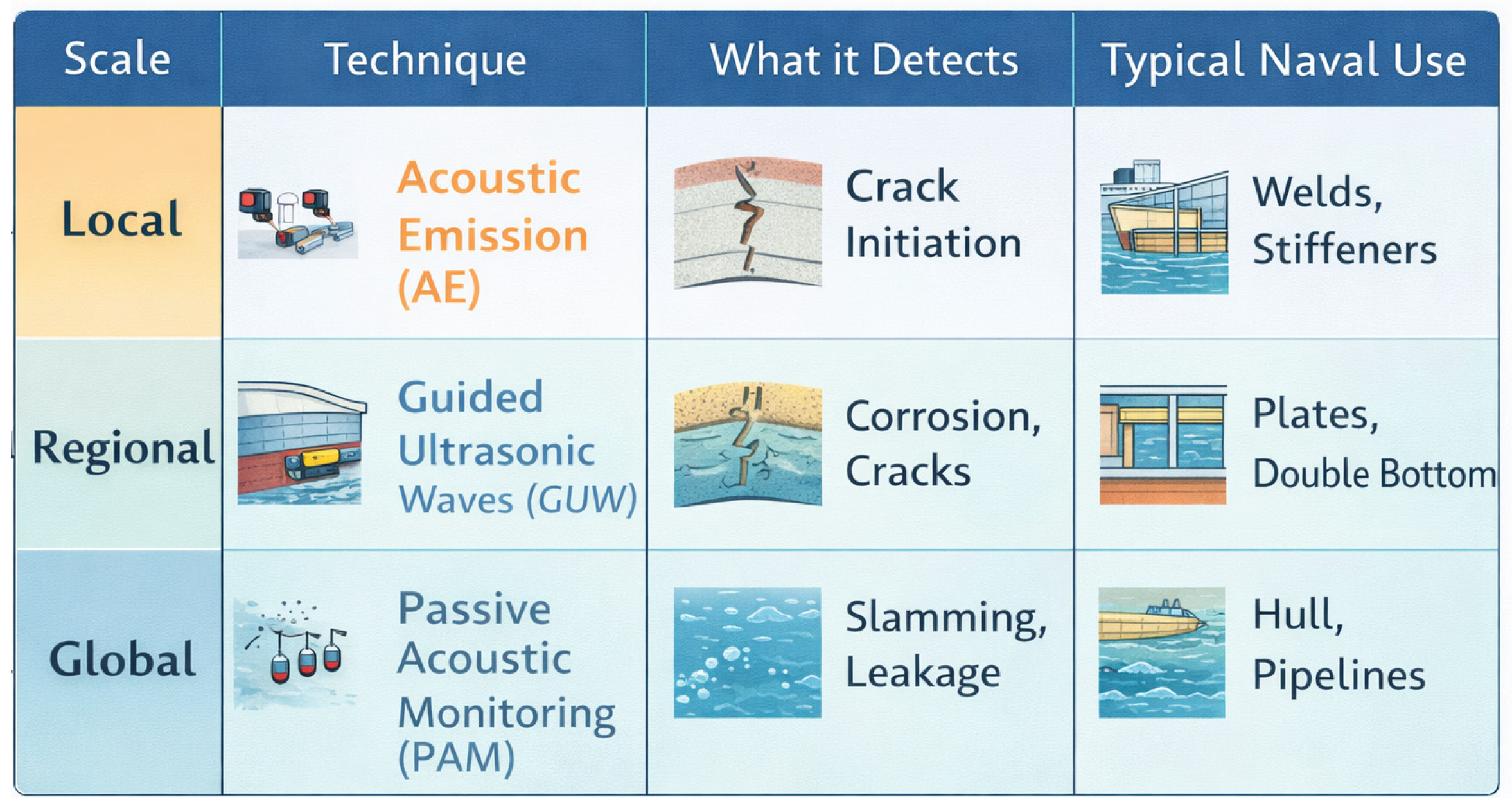
Figure 3 illustrates a conceptual classification of acoustic SHM techniques according to their characteristic spatial scale and diagnostic role in naval and offshore structures. Acoustic emission provides highly localized sensitivity to damage initiation at welds and stiffeners, guided ultrasonic waves enable regional inspection of plating and double-bottom structures, and passive acoustic monitoring delivers global awareness of hull response and submerged assets. This layered view forms the basis for hybrid acoustic SHM systems, in which complementary sensing modalities are integrated to achieve robust and comprehensive condition assessment under real operating conditions.
Recent advances in naval and offshore SHM increasingly rely on hybrid acoustic approaches that integrate AE, guided ultrasonic waves, and passive acoustic monitoring to enhance diagnostic reliability under complex hydrodynamic and operational loading. These complementary techniques enable multi-scale interrogation, with AE capturing localized damage initiation and Lamb waves providing long-range monitoring of extended structural components. Progress is further driven by data-driven analytics: deep learning frameworks combining convolutional, recurrent, and attention mechanisms enable robust interpretation of noisy acoustic data and accurate discrimination of fatigue damage stages. Together, hybrid sensing and advanced analytics support scalable, automated SHM solutions aligned with condition-based maintenance and life-extension needs in maritime structures [129]. In offshore wind turbine systems, hybrid acoustic monitoring schemes combining PAM and AE provide complementary insight into global aero-hydro-elastic response and localized damage mechanisms in composite blades. Recent studies highlight the importance of multi-parameter AE analysis—integrating amplitude, frequency content, energy, event rates, and clustering—to robustly discriminate damage modes and track their evolution in fiber-reinforced polymers. Such parameter-rich, hybrid acoustic frameworks are particularly suited to composite components in naval and offshore structures, where interacting failure mechanisms and harsh operating conditions necessitate robust, physics-informed SHM solutions [130].
Multi-scale acoustic monitoring strategies combine early damage sensitivity with large-area coverage, addressing the limitations of individual techniques in complex naval and offshore structures where global loads coexist with localized damage. Advances in signal processing and machine learning now enable robust discrimination of damage-related acoustic events from operational noise sources common in maritime environments. Data-driven frameworks, including deep learning architectures with physics-guided feature extraction, have demonstrated reliable separation of noise, incipient cracking, and severe damage under real operating conditions. These approaches, validated in welded and fatigue-critical components, are directly transferable to ship hulls, offshore structures, and wind-energy systems, supporting automated, long-term condition assessment in marine SHM programs [131]. More recently, deep learning architectures have shown a strong capability to extract damage-relevant features directly from raw acoustic data, significantly reducing the dependence on handcrafted descriptors and expert-driven interpretation. This is particularly advantageous in offshore and naval environments, where high background noise and complex propagation paths often limit traditional processing methods. Advanced architectures incorporating attention mechanisms and multimodal feature fusion have demonstrated enhanced sensitivity to subtle elastic-wave variations, enabling accurate characterization of microscopic crack features. Laser-based acoustic emission approaches combined with deep learning and modal decomposition have further extended this capability, achieving high-precision crack depth estimation well below the millimetric scale. Although primarily validated on metallic specimens under controlled conditions, these methods are highly relevant to ship hull plating, offshore structural components, and welded joints, where early detection of shallow surface cracks is critical for fatigue and corrosion management in harsh marine operating environments [132].
The Digital Twin paradigm is increasingly integrated into acoustic SHM to support condition-based maintenance and life-cycle management of naval and offshore structures. By coupling high-fidelity numerical models with real-time acoustic data from AE, guided waves, or passive monitoring, Digital Twins enable continuous updating of structural state, fatigue life, and damage accumulation under evolving service conditions. Recent advances in AE-based localization, particularly for thin-walled and orthotropic structures, demonstrate that hybrid optimization frameworks combining time-of-arrival and modal analysis achieve robust damage positioning in stiffened, dispersive environments. Embedded within Digital Twins, these capabilities allow continuous correction of virtual models for hulls, decks, and offshore structures, enhancing predictive reliability and enabling early, targeted maintenance actions [133,134]. For floating renewable-energy systems and large naval vessels, Digital Twins enriched with acoustic data are emerging as a core enabler of predictive maintenance. AE-based information provides real-time detection of damage initiation in welded joints, bolted connections, and stiffened panels, which is then used by Digital Twins to update structural models and forecast remaining useful life under realistic loads. Recent advances in geometry-aware AE source localization, accounting for stiffeners, obstructions, and complex wave paths, significantly outperform classical TDOA approaches while reducing reliance on large training datasets. Integrated within Digital Twin frameworks, these methods enhance state updating accuracy and support robust condition-based maintenance of large-scale maritime and offshore assets operating in harsh environments [135,136].
The integration of acoustic sensing into Internet of Things (IoT) frameworks is emerging as a key trend in acoustic SHM for naval and offshore structures. Wireless MEMS arrays, distributed fiber-optic sensors, and hydrophone clusters enable scalable, low-power monitoring architectures, while edge computing allows local signal conditioning, noise suppression, and event detection to reduce data transmission and ensure rapid response in safety-critical scenarios. In parallel, advances in artificial intelligence are addressing data-scarcity challenges through transfer learning and physics-informed strategies. Synthetic AE datasets generated via finite-element simulations, combined with domain-adaptation techniques, enable robust damage localization and assessment without extensive labeled in-service data. Together, these developments support deployable, intelligence-driven SHM systems for ships, offshore platforms, and floating renewable assets [137,138].
Hybrid and advanced acoustic SHM approaches represent a decisive step toward robust, intelligent, and increasingly autonomous monitoring of naval and offshore structures. By integrating Acoustic Emission, guided waves, and passive acoustic monitoring with data-driven analytics, these frameworks overcome longstanding limitations related to attenuation, noise sensitivity, and spatial coverage in marine environments, enabling both early detection of localized damage and global integrity assessment under realistic service conditions. Continued advances in sensor integration, optimized sensor placement, real-time analytics, and standardization are essential for large-scale deployment. Within this paradigm, optimal sensor configuration has emerged as a key enabler. Advanced placement strategies based on Bayesian optimization and evolutionary algorithms significantly improve localization accuracy while minimizing sensor count, a critical requirement for large maritime assets. In pipelines and offshore risers, optimized arrays coupled with advanced signal processing enable robust separation and localization of multiple fault mechanisms with high spatial accuracy. Collectively, these developments demonstrate how hybrid acoustic sensing, intelligent optimization, and advanced analytics are converging to deliver scalable, reliable, and economically viable SHM solutions for naval and offshore engineering [139,140,141].

8. Application Across Industries

The growing adoption of acoustic-based SHM across civil, aerospace, and energy sectors provides valuable cross-disciplinary evidence supporting its applicability to naval and offshore structures. In maritime applications, acoustic monitoring has been successfully used to assess fatigue damage in hull details subjected to severe cyclic loading, while bridge studies demonstrate clear correlations between AE features and fatigue crack initiation and growth under service conditions. Aerospace developments further highlight the benefit of combining AE-based local damage detection with guided-wave-assisted global assessment and fracture-mechanics-based life prediction. Parallel advances in composite structures show how multi-instrumentation and data-driven clustering resolve damage evolution from micro-scale initiation to final failure. Collectively, these cross-sector experiences confirm the versatility of acoustic techniques and establish a strong methodological foundation for SHM in complex naval and offshore structures operating under variable loads [142,143,144]. Warships and submarines represent some of the most demanding applications of acoustic-based SHM, where structural integrity and operational performance are both mission-critical. Guided ultrasonic waves support rapid inspection of composite and stiffened naval structures, while in submarines acoustic monitoring enables early damage detection in pressure hulls under severe accessibility constraints and stealth requirements. AE has also proven effective for monitoring propulsion and rotating components, providing early warning of degradation mechanisms affecting mission readiness. Laboratory studies on fretting fatigue and cyclic loading further demonstrate AE’s capability to resolve successive damage stages and crack-propagation modes, capturing damage accumulation well before macroscopic failure. Together, these findings reinforce the suitability of acoustic techniques for monitoring fatigue-sensitive naval and offshore structures operating under complex and variable load histories [15,145,146].
Acoustic methods have proven highly effective for offshore oil and gas platforms and floating production systems, where AE monitoring enables early detection of crack initiation and damage accumulation in jacket structures, tubular joints, tendons, and critical welds under severe cyclic loading. AE’s sensitivity to localized fracture and debonding is particularly valuable in geometrically complex and corrosive environments where conventional inspection is limited. Complementary laboratory studies demonstrate that AE parameters can reliably resolve damage initiation, crack coalescence, and dominant failure modes, reinforcing AE as a robust tool for proactive maintenance and structural integrity management in harsh offshore conditions [147].
Subsea pipelines and risers constitute some of the most inspection-challenging assets in offshore engineering, as access during operation is severely limited and failure consequences are significant. Acoustic-based techniques, including hydrophone monitoring and guided-wave propagation, have therefore been increasingly adopted to detect and localize leakage, corrosion activity, and crack growth along these submerged systems. By exploiting the wave-like nature of leak-induced and damage-related acoustic signals, such approaches enable continuous surveillance over long distances, even under high external pressure and hydrodynamic noise. Recent advances combining decomposition techniques, enhanced cross-correlation strategies, and neural-network-based correction further demonstrate that coupling physics-informed signal processing with data-driven optimization can substantially improve localization accuracy. These developments highlight the suitability of acoustic monitoring as a core technology for integrity management of subsea pipelines and risers, supporting early intervention and reducing the risk of environmentally and economically critical failures in offshore operations [148]. To improve applicability in deep sea and hard-to-access environments, additional leak and damage detection strategies have been developed for single-sensor or sparse-sensor acoustic deployments. Such approaches are particularly relevant for naval and offshore structures, where sensor installation and maintenance are constrained by depth, pressure, and cost. Recent studies demonstrate that even with limited sensing layouts, meaningful information on local damage mechanisms can be extracted by combining acoustic emission features with machine learning-based interpretation. Beyond leaks, this philosophy extends to critical mechanical connections in marine structures, such as bolted joints in deck structures, foundations, and offshore assemblies, where loosening and wear can compromise global integrity. By linking entropy-based and frequency-band AE features to underlying wear and friction mechanisms, data-driven models enable the identification of loosening severity and its progression over time. These results underline the potential of sparse acoustic sensing, augmented by advanced analytics, to deliver reliable condition assessment of both fluid-containing and load-bearing components in complex naval and offshore systems [149].
The renewable energy sector, and offshore wind in particular, has become a key testbed for acoustic SHM technologies with strong parallels to naval engineering. Floating wind turbines are subjected to complex coupled aero-hydro-elastic loads that closely resemble those experienced by lightweight marine structures, affecting towers, nacelles, and large composite blades. Acoustic emission monitoring has demonstrated its capability to detect critical damage mechanisms such as delamination, adhesive failure, and fatigue cracking during full-scale blade certification and endurance tests. Laboratory studies on multi-megawatt-class blades have shown that AE systems can identify the initiation and growth of localized defects under realistic cyclic loading, even in the presence of significant operational noise. The successful localization and tracking of small-scale damage relative to overall blade dimensions highlights the suitability of AE as an in-service monitoring tool, providing early warnings before damage reaches repair-critical stages. These results reinforce the relevance of AE-based SHM for both offshore renewable assets and analogous naval composite structures subjected to long-term cyclic loading [150].
Passive acoustic monitoring has also been successfully applied to capturing the vibrational and acoustic signatures of offshore towers and floating platforms subjected to combined wind–wave loading, offering a practical means of identifying the early onset of structural deterioration in remote and difficult-to-access locations. In parallel, acoustic emission techniques have been employed to assess erosion–corrosion processes in offshore pipeline steels operating under aggressive environmental conditions, where conventional inspection is limited by accessibility and operational constraints. Recent methodological advances address one of the central challenges in marine and offshore SHM: the accurate localization of AE sources in complex, stiffened, and surface-modified metallic structures typical of ship hulls, offshore jackets, and welded pipeline systems. Novel frequency-space sparse decomposition approaches exploit the subband structure of AE signals to enhance feature extraction and improve source localization robustness in near-field conditions. By combining frequency domain decomposition with spatial sparse reconstruction, these methods improve discrimination of coherent damage-related sources amid reflections, scattering, and surface treatments. Such developments provide a solid theoretical and practical foundation for AE-based monitoring of complex naval and offshore metallic structures, where geometry, weldments, and surface modifications strongly influence wave propagation [151].
Beyond the maritime domain, acoustic SHM has been extensively developed in civil and aerospace engineering, providing useful analogies for naval and offshore structures. In civil infrastructure, acoustic emission techniques have been applied to monitor cracking, corrosion, and bond degradation in reinforced and fiber-reinforced concrete, including the use of embedded piezoelectric sensors or smart aggregates for long-term monitoring. These approaches highlight both practical challenges—such as wave attenuation, noise, and sensor coupling—and methodological advances in signal filtering, localization, and uncertainty management. Probabilistic selection of acoustic signal features, particularly onset time determination from competing detection algorithms, has been shown to significantly improve source localization accuracy in heterogeneous materials. Such developments are directly relevant to ship hulls, offshore platforms, and composite naval structures, where complex geometries and material heterogeneity similarly demand robust data selection and uncertainty-aware processing strategies for reliable acoustic-based damage assessment [152,153]. These cross-sector developments are particularly instructive for offshore foundations, floating platforms, and advanced naval structures, which exhibit long-term deterioration patterns analogous to those observed in civil and aerospace systems. In aerospace engineering, acoustic emission has long been established as an effective tool for identifying fiber breakage, delamination, and matrix cracking in composite fuselages and wings, with recent progress driven by machine learning-based acoustic feature classification. These approaches translate naturally to maritime composites used in high-speed craft and offshore renewable devices. Similarly, offshore pipelines—critical components subjected to sustained cyclic and environmental loading—have benefited from advanced AE analysis strategies that combine adaptive signal decomposition with probabilistic neural networks, enabling robust leak detection even under high ambient noise typical of offshore installations. Beyond degradation monitoring, AE-based impact detection and localization methods using time–frequency analysis and optimization algorithms have demonstrated high accuracy and computational efficiency, offering reliable real-time assessment without requiring exhaustive prior calibration. Together, these advances reinforce the value of data-driven acoustic SHM across sectors and highlight their direct applicability to complex naval and offshore structures operating under harsh and variable service conditions [154,155].
Overall, the cross-industry adoption of acoustic SHM highlights its adaptability and robustness across widely varying structural and operational settings. Lessons learned from aerospace composites, civil infrastructures, rotating machinery, and pipeline networks provide essential benchmarks for advancing naval and offshore acoustic monitoring toward increased autonomy, reliability, and predictive maintenance capabilities.

9. Challenges and Future Trends

Despite the substantial progress achieved in acoustic-based Structural Health Monitoring, several challenges still limit its large-scale deployment in naval and offshore applications. These challenges are intrinsically linked to the harshness of the marine environment, the large dimensions and structural complexity of ships and offshore platforms, and the stringent safety, reliability, and availability requirements imposed by the sector. Environmental noise remains one of the dominant limitations. Hydrodynamic loading, wave impacts, slamming, cavitation, and machinery-induced vibrations generate strong and highly non-stationary acoustic backgrounds that often overlap with damage-related signatures. Discriminating between benign operational sounds and signals associated with crack initiation, corrosion, or material degradation continues to be difficult, even with advanced filtering and data-driven classification techniques. Closely related to this issue is the accurate determination of signal onset times, which remains a major source of uncertainty and directly affects source localization and damage interpretation accuracy.
From a materials perspective, the increasing adoption of advanced and sustainable composites introduces additional challenges. Recent studies on natural-fiber-reinforced composites highlight that damage mechanisms can exhibit lower acoustic energy levels and dispersed frequency bands compared with conventional synthetic composites, complicating detection thresholds and feature selection. These findings underline the need for material-specific acoustic characterization and adaptive algorithms capable of accounting for variability in microstructural behavior. Looking ahead, future research is expected to focus on physics-informed machine learning, improved sensor fusion strategies, and adaptive noise characterization tailored to real operational conditions. The integration of acoustic data into Digital Twin frameworks, combined with continuous learning from in-service measurements, offers a promising route to improve robustness, reduce uncertainty, and enable predictive maintenance. Advances in distributed sensing, edge computing, and autonomous data interpretation will be key to transforming acoustic SHM from an expert-driven diagnostic tool into a reliable, scalable, and routine technology for naval and offshore structures [156].
A second major challenge arises from signal attenuation and dispersion, which significantly limit the effective monitoring range of acoustic techniques in large-scale maritime structures. In stiffened ship hull panels, offshore risers, and submerged frameworks, long propagation paths combined with repeated reflections, scattering, and mode conversion at geometric discontinuities rapidly degrade signal clarity. As a result, reliable damage detection and localization often require dense sensor networks, increasing installation costs, maintenance complexity, and vulnerability in harsh subsea environments. To address these limitations, recent research has explored advanced data-driven localization strategies that can exploit sparse measurements more effectively. In particular, spatial–temporal graph-based learning approaches have been shown to efficiently integrate waveform features with sensor spatial relationships, enabling accurate AE source localization in composite panels despite attenuation and dispersive effects. Such methods illustrate a promising direction for reducing sensor density requirements while preserving localization accuracy, which is especially relevant for large naval and offshore structures where accessibility and long-term durability are critical constraints [157]. Advanced wavefield imaging and full-field reconstruction techniques have been proposed to mitigate the effects of dispersion and mode conversion, offering improved interpretation of complex acoustic responses in damaged structures. However, their application to large naval and offshore structures is still limited by high computational demands, the need for dense sensing grids, and the challenges associated with real-time implementation over extended structural domains. In this context, hybrid processing frameworks that combine adaptive signal decomposition, robust arrival-time detection, and optimization-based localization have attracted growing attention. Such approaches have demonstrated the ability to cope with severe attenuation, scattering, and operational noise, while enabling accurate identification and characterization of multiple damage types, including cracking and interface debonding, in complex composite and hybrid structural systems. Translating these concepts to ship hulls, offshore decks, and composite–metal joints offers a promising route to balance computational efficiency with diagnostic fidelity, particularly for large-scale maritime structures where practical deployment constraints remain a key consideration [158].
Sensor durability and long-term integration constitute another critical challenge for acoustic SHM in naval and offshore environments. Sensors operating in seawater are continuously exposed to corrosion, hydrostatic pressure, biofouling, and mechanical impacts, all of which can degrade signal quality or compromise sensor coupling over time. Conventional piezoelectric sensors, therefore, require robust encapsulation and periodic verification, which is difficult to guarantee in submerged or hard-to-access locations. In this context, fiber-optic sensing technologies—particularly Fiber Bragg Grating (FBG)-based acoustic emission sensors—have emerged as a promising alternative, offering immunity to electromagnetic interference, high corrosion resistance, multiplexing capability, and suitability for embedding within structural components. These advantages make FBG-based systems attractive for long-term deployment in ship hulls, offshore platforms, and subsea structures. Nevertheless, despite their improved durability, challenges related to installation complexity, repair, and recalibration persist, especially for deeply integrated or permanently inaccessible sensors, highlighting the need for maintenance-free designs and self-diagnostic capabilities in future acoustic SHM systems [53].
Another important limitation concerns the lack of standardized procedures and unified guidelines for deploying acoustic SHM in the maritime sector. Although classification societies have begun to introduce general notations for hull condition monitoring, specific recommendations for acoustic emission, guided waves, or passive acoustic techniques remain fragmented. As a result, system design, sensor layouts, threshold selection, and data interpretation are often project-specific and highly dependent on expert judgment, which hinders reproducibility and large-scale adoption. Recent studies on offshore pipelines illustrate this issue clearly: acoustic emission signals collected in real offshore environments are heavily contaminated by platform-induced noise, requiring advanced signal processing and learning-based correction strategies to achieve reliable damage localization. By combining empirical mode decomposition with probabilistic neural networks for noise recognition, followed by neural network-assisted correction of time difference-based localization, high identification accuracy and localization errors below a few percent have been demonstrated even under severe noise conditions. These results highlight both the technical feasibility of acoustic SHM in realistic offshore scenarios and the urgent need for standardized workflows that integrate noise characterization, signal processing, and data-driven correction methods into formally recognized maritime monitoring guidelines [159].
Finally, data management has emerged as a critical challenge for acoustic SHM systems. Continuous monitoring produces large volumes of high-frequency data that are difficult to store, transmit, and process in real time, particularly for offshore and remote assets. Machine learning and deep learning techniques have, therefore, been introduced to automate event clustering, source localization, and damage classification; however, their robustness under variable hydrodynamic and environmental conditions is still not fully established. Studies on three-dimensional acoustic emission localization in fiber-reinforced backfills demonstrate how spatial distributions of AE events and energy evolution trends can reliably track damage initiation, propagation, and rupture localization, even in complex heterogeneous materials. Similarly, investigations on environmentally aged high-performance composites show that AE features remain strongly correlated with changes in mechanical response induced by temperature, humidity, and thermal shock. Together, these works highlight both the potential of data-driven acoustic SHM for handling large datasets and the need for further research to ensure stable performance across diverse operational and environmental conditions typical of naval and offshore structures [160,161].
Looking ahead, the advancement of acoustic SHM in the maritime sector will rely on coordinated progress across materials science, signal processing, and digital engineering. Key priorities include the development of marine-grade, long-life sensors, the improvement of noise-robust processing algorithms adapted to hydrodynamic environments, and the formalization of deployment standards by regulatory and classification bodies. At the same time, tighter integration of acoustic monitoring within fleet-scale digital infrastructures and Digital Twin frameworks will be essential to move from isolated demonstrations toward scalable predictive maintenance strategies. Recent studies in manufacturing and complex metallic structures illustrate this trajectory: AE monitoring has been shown to capture crack initiation and growth under thermally driven laser processing through characteristic time- and frequency domain signatures, while deep learning approaches can exploit wave reflection, reverberation, and multimodal dispersion to localize AE sources even with sparse sensing. These developments highlight how physics-aware data analytics and advanced learning architectures can enhance robustness and scalability, offering a clear pathway for the future adoption of acoustic SHM in naval and offshore applications [162,163]. By overcoming these challenges, acoustic SHM has the potential to become a cornerstone of structural safety and operational efficiency in naval and offshore systems.

10. Conclusions

Acoustic-based SHM techniques—particularly Acoustic Emission, guided ultrasonic waves, and Passive Acoustic Monitoring—have proven to be effective tools for the early detection of damage in naval and offshore structures under real operating conditions. They enable the identification of micro-scale phenomena such as crack initiation, corrosion activity, leakage, and fatigue evolution well before visible damage or loss of structural performance occurs, which is essential in maritime systems with limited inspection accessibility and highly variable loads. Recent studies further confirm the quantitative potential of AE, showing that changes in cumulative parameters, signal entropy, and event rates can reliably track damage progression and provide early warning of critical transitions, such as the onset of unstable creep or impending failure in steels. These results underline the value of acoustic SHM not only as a qualitative diagnostic tool but also as a basis for condition assessment and prognostics in safety-critical marine and offshore structures [164].
Nevertheless, the implementation of acoustic SHM in maritime environments remains challenging. Hydrodynamic noise, cavitation, wave impacts, and machinery-induced vibrations can mask damage-related acoustic signatures, while signal attenuation and dispersion limit long-range monitoring in large hulls, risers, and composite structures. These factors complicate reliable acoustic source localization, which traditionally relies on precise time-of-arrival estimation and computationally demanding algorithms. Recent developments, such as energy-based localization approaches that avoid detailed material characterization and complex signal processing, offer promising alternatives for real-time and robust monitoring, particularly in large plate-like and marine structural components [165]. Additionally, sensor survivability is a critical issue, especially in submerged, corrosive, and high-pressure environments where long-term operation is required. Beyond environmental exposure, sensor performance must remain stable under mechanical loading and during damage evolution processes. Experimental studies on composite laminates have shown that acoustic emission parameters remain strongly correlated with material fracture behavior, with burst characteristics reflecting manufacturing-induced mechanisms such as fiber bridging, while energy-related features are governed primarily by matrix properties. These findings underline both the robustness of AE as a diagnostic tool and the importance of reliable sensor coupling and protection to ensure consistent data quality in demanding service conditions [166]. Recent advances in machine learning and deep learning have significantly strengthened the interpretation of acoustic data under the high noise levels typical of maritime environments. By extracting damage-sensitive patterns directly from AE features, data-driven models enable more reliable damage quantification and prognosis. Studies show that AE energy and signal strength can be translated into damage indices and hazard-rate functions, allowing the definition of reliability metrics and remaining-life predictions. When combined with techniques such as support vector regression, these approaches provide robust failure prediction frameworks that explicitly account for uncertainty, making them well suited for real-world structural health monitoring of marine and offshore structures [167]. These developments enable automated identification of damage mechanisms and support the integration of AE- and Lamb-wave-based monitoring within digital twin frameworks for real-time structural assessment. Recent studies demonstrate that end-to-end deep learning architectures combining convolutional neural networks with recurrent models such as LSTM can classify impact-induced damage in composite structures with high accuracy using raw AE signals. By learning both spatial features and temporal dependencies, such models achieve reliable discrimination between minor, intermediate, and severe damage states, highlighting their potential for continuous condition monitoring and data-driven updating of digital twins in complex marine structures [168].
Moreover, hybrid acoustic SHM systems that integrate Acoustic Emission, guided ultrasonic waves, fiber Bragg grating sensing, and hydroacoustic arrays are emerging as powerful solutions for multi-scale structural surveillance. These combined approaches exploit complementary sensitivities, enabling simultaneous detection of localized damage initiation and global structural degradation. Recent studies on fiber-reinforced composites demonstrate that AE-based prognostic frameworks coupled with feature selection and deep learning can effectively track damage evolution and estimate residual load-bearing capacity, providing a pathway toward reliable degradation assessment and predictive maintenance in complex maritime structures [169].
Looking ahead, the broad deployment of acoustic SHM in the maritime sector will crucially depend on the standardization of monitoring procedures and diagnostic criteria, ensuring consistent interpretation across shipyards, fleets, and regulatory bodies. Progress in other engineering domains illustrates the value of such rigor: for example, AE-based methodologies have been successfully used to quantify strain-energy release and damage evolution in concrete fracture process zones, enabling robust constitutive modeling under tensile loading. These results highlight how standardized AE metrics and physically grounded damage indices can support reliable comparison, validation, and certification—principles that are directly transferable to naval and offshore structural monitoring [62].
Another critical requirement for large-scale adoption of acoustic SHM is ensuring sensor durability and long-term reliability in corrosive, high-pressure, and thermally variable environments typical of marine and offshore service. While advances in fiber-optic, embedded, and protected acoustic sensors are addressing these challenges, lessons can also be drawn from civil engineering applications, where AE systems have been used successfully to monitor long-term damage evolution in complex cement-based composites. Studies on rubber–ceramic composite mortars demonstrate that AE metrics such as cumulative energy, hit counts, frequency content, and source localization remain robust indicators of fracture mechanisms even in heterogeneous and highly damped materials. These results underline the importance of sensor robustness, stable coupling, and durable packaging to ensure reliable AE-based diagnostics over extended service periods, a requirement that is directly transferable to naval and offshore structures [170,171,172].
Scalable data infrastructures are another key enabler for the deployment of acoustic SHM at fleet or asset-network level, as continuous monitoring generates large volumes of high-frequency data that must be stored, processed, and interpreted efficiently. Experience from civil engineering, such as AE-based damage evaluation of reinforced concrete beams with varying thickness, shows that meaningful structural indicators can be extracted from long-term datasets despite geometric variability and signal attenuation. These studies highlight the importance of robust data architectures and automated feature extraction capable of handling heterogeneous structures, providing a transferable framework for managing large-scale acoustic monitoring across ships, offshore platforms, and subsea systems [171]. If these advances are achieved, acoustic-based SHM will play a central role in the transition from periodic inspection to predictive, condition-based maintenance, increasing safety while reducing operational downtime across naval and offshore systems.

Author Contributions

Conceptualization, A.S.-C., M.A.H.-S. and F.P.-A.; methodology, F.P.-A. and A.S.-C.; software, A.S.-C.; validation, F.P.-A. and M.A.H.-S.; formal analysis, A.S.-C. and M.A.H.-S.; investigation, F.P.-A. and A.S.-C.; resources, A.S.-C.; data curation, F.P.-A. and M.A.H.-S.; writing—original draft preparation, F.P.-A., A.S.-C. and M.A.H.-S.; writing—review and editing, F.P.-A. and M.A.H.-S.; visualization, A.S.-C.; supervision, F.P.-A. and M.A.H.-S.; project administration, F.P.-A., A.S.-C. and M.A.H.-S. All authors have read and agreed to the published version of the manuscript.

Funding

This research received no external funding.

Institutional Review Board Statement

Not applicable.

Informed Consent Statement

Not applicable.

Data Availability Statement

Not applicable.

Acknowledgments

The authors would like to acknowledge the support received by the Universidad Politécnica de Madrid.

Conflicts of Interest

The authors declare no conflicts of interest.

References

  1. Hu, J.; Yang, S.; Lin, F.; Tsai, I. Efficiency and Input Congestion of Major Marine Transport Companies in the World. Res. Transp. Bus. Manag. 2022, 46, 100831. [Google Scholar] [CrossRef]
  2. Shama, B. Buckling of Ship Structures; Springer: Berlin/Heidelberg, Germany, 2013. [Google Scholar]
  3. Wang, H.; Liu, Z.; Wang, X.; Graham, T.; Wang, J. An Analysis of Factors Affecting the Severity of Marine Accidents. Reliab. Eng. Syst. Saf. 2021, 210, 107513. [Google Scholar] [CrossRef]
  4. Xu, Z.; Sampath, S.; Wang, X.; Dong, H.; Liu, Y.; Wang, Y.; Zhang, H.; Zhang, L.; Tham, J.; Liu, Z.; et al. Review on structural health monitoring of pipeline: From perspective on acoustic based crack detection. Measurement 2026, 263, 120075. [Google Scholar] [CrossRef]
  5. Karvelis, P.; Georgoulas, G.; Kappatos, V.; Stylios, C. Deep Machine Learning for Structural Health Monitoring on Ship Hulls Using Acoustic Emission Method. Ships Offshore Struct. 2021, 16, 440–448. [Google Scholar] [CrossRef]
  6. SHIP INSPECTOR. Detection of Safety Critical Cracks and Corrosion in Ships Using Novel Sensors and Systems Based on Ultrasonic Linear Phased Array Technology. Available online: https://cordis.europa.eu/project/id/218432/reporting (accessed on 3 October 2025).
  7. MONITAS JIP. Available online: https://www.marin.nl/en/jips/monitas (accessed on 3 October 2025).
  8. International Maritime Organization (IMO). Recommendations for the Fitting of Hull Stress Monitoring Systems. MSC/Circ. 646; International Maritime Organization (IMO): London, UK, 1994. [Google Scholar]
  9. Det Norske Veritas (DNV-GL). Rules for Classification. Part 6 Additional Class Notations Chapter 9 Survey Arrangements; Det Norske Veritas (DNV-GL): Bærum, Norway, 2022. [Google Scholar]
  10. Bureau Veritas (BV). Hull Stress and Motion Monitoring MON-HULL. Part F, Chapter 5, Section 1; Bureau Veritas: Neuilly-sur-Seine, France, 2022. [Google Scholar]
  11. American Bureau of Shipping (ABS). Guide for Hull Condition Monitoring System; American Bureau of Shipping (ABS): Houston, TX, USA, 2020. [Google Scholar]
  12. Mieloszyk, M.; Majewska, K.; Ostachowicz, W. Application of Embedded Fibre Bragg Grating Sensors for Structural Health Monitoring of Complex Composite Structures for Marine Applications. Mar. Struct. 2021, 76, 102903. [Google Scholar] [CrossRef]
  13. Silva-Muñoz, R.; Lopez-Anido, R. Structural Health Monitoring of Marine Composite Structural Joints Using Embedded Fiber Bragg Grating Strain Sensors. Compos. Struct. 2009, 89, 224–234. [Google Scholar] [CrossRef]
  14. Li, H.; Herszberg, I.; Davis, C.; Mouritz, A.; Galea, S. Health Monitoring of Marine Composite Structural Joints Using Fibre Optic Sensors. Compos. Struct. 2006, 75, 321–327. [Google Scholar] [CrossRef]
  15. Silva-Campillo, A.; Suárez-Bermejo, J.C.; Herreros-Sierra, M.A. Considerations About the Fatigue Strength Assessment of Local Cut-Out in the Double Bottom Floor. Appl. Ocean Res. 2023, 132, 103478. [Google Scholar] [CrossRef]
  16. Di Sante, R.; Donati, L. Strain Monitoring with Embedded Fiber Bragg Gratings in Advanced Composite Structures for Nautical Applications. Measurement 2013, 46, 2118–2126. [Google Scholar] [CrossRef]
  17. VanDerHorn, E.; Wang, Z.; Mahadevan, S. Towards a Digital Twin Approach for Vessel-Specific Fatigue Damage Monitoring and Prognosis. Reliab. Eng. Syst. Saf. 2022, 219, 108222. [Google Scholar] [CrossRef]
  18. Wu, Y.; Chen, D.; Xia, Z.; Yang, S. Development of Offshore Platform Stress Monitoring System Based on Internet of Things Technology. E3S Web Conf. 2019, 136, 02019. [Google Scholar] [CrossRef]
  19. Zahoor, R.; Cerri, E.; Vallifuoco, R.; Zeni, L.; De Luca, A.; Caputo, F.; Minardo, A. Lamb Wave Detection for Structural Health Monitoring Using a ϕ-OTDR System. Sensors 2022, 22, 5962. [Google Scholar] [CrossRef] [PubMed]
  20. Kawai, T.; Kawamura, Y.; Okada, T.; Mitsuyuki, T.; Chen, X. Sea State Estimation Using Monitoring Data by Convolutional Neural Network (CNN). J. Mar. Sci. Technol. 2021, 26, 947–962. [Google Scholar] [CrossRef]
  21. Ciaburro, G.; Iannace, G. Machine-Learning-Based Methods for Acoustic Emission Testing: A Review. Appl. Sci. 2022, 12, 10476. [Google Scholar] [CrossRef]
  22. Grosse, C.U.; Ohtsu, M.; Aggelis, D.G.; Shiotani, T. Acoustic Emission Testing: Basics for Research-Applications in Engineering; Springer Nature: London, UK, 2021. [Google Scholar]
  23. Gholizadeh, S.; Leman, Z.; Baharudin, B.H.T. A Review of the Application of Acoustic Emission Technique in Engineering. Struct. Eng. Mech. 2015, 54, 1075–1095. [Google Scholar] [CrossRef]
  24. Nair, A.; Cai, C.S. Acoustic Emission Monitoring of Bridges: Review and Case Studies. Eng. Struct. 2010, 32, 1704–1714. [Google Scholar] [CrossRef]
  25. Johnson, M.; Ozevin, D.; Washer, G.; Ono, K.; Gostautas, R.; Tamutus, T. Acoustic Emission Method for Real-Time Detection of Steel Fatigue Crack in Eyebar. J. Transp. Res. Board 2012, 2313, 72–79. [Google Scholar] [CrossRef]
  26. Megid, W.A.; Chainey, M.-A.; Lebrun, P.; Hay, D.R. Monitoring Fatigue Cracks on Eyebars of Steel Bridges Using Acoustic Emission: A Case Study. Eng. Fail. Anal. 2019, 211, 198–208. [Google Scholar] [CrossRef]
  27. Yu, J.; Ziehl, P.; Zárate, B.; Caicedo, J. Prediction of Fatigue Crack Growth in Steel Bridge Components Using Acoustic Emission. J. Constr. Steel Res. 2011, 67, 1254–1260. [Google Scholar] [CrossRef]
  28. Cui, J.; Qu, X.; Lv, C.; Du, J. Linking Acoustic Emission Signals to Fatigue Crack Growth in Metallic Materials: A New Approach for Structural Health Monitoring. Appl. Acoust. 2025, 235, 110689. [Google Scholar] [CrossRef]
  29. Cui, J.; Qu, X.; Lv, C.; Du, J.; Wang, H. Multi-Parameter Acoustic Emission Analysis for Fatigue Crack Evaluation in Structural Health Monitoring. Measurement 2025, 256, 118529. [Google Scholar] [CrossRef]
  30. Sen, N.; Kundu, T. A New Signal Energy-Based Approach to Acoustic Source Localization in Orthotropic Plates: A Numerical Study. Mech. Syst. Signal Process. 2022, 171, 108843. [Google Scholar] [CrossRef]
  31. Marec, A.; Thomas, J.-H.; El Guerjouma, R. Damage Characterization of Polymer-Based Composite Materials: Multivariable Analysis and Wavelet Transform for Clustering Acoustic Emission Data. Mech. Syst. Signal Process. 2008, 22, 1441–1464. [Google Scholar] [CrossRef]
  32. Shi, L.; Cheng, B.; Li, D.; Xiang, S.; Liu, T.; Zhao, Q. A CNN-Based Lamb Wave Processing Model for Field Monitoring of Fatigue Cracks in Orthotropic Steel Bridge Decks. Structures 2023, 57, 105146. [Google Scholar] [CrossRef]
  33. Su, Z.; Ye, L. Lamb Wave-Based Quantitative Identification of Delamination in CF/EP Composite Structures Using Artificial Neural Algorithm. Compos. Struct. 2004, 66, 627–637. [Google Scholar] [CrossRef]
  34. Wang, Y.; Guan, R.; Lu, Y. Nonlinear Lamb Waves for Fatigue Damage Identification in FRP-Reinforced Steel Plates. Ultrasonics 2017, 80, 87–95. [Google Scholar] [CrossRef] [PubMed]
  35. Chong, S.Y.; Todd, M.D. Dispersion Curve Estimation via a Spatial Covariance Method with Ultrasonic Wavefield Imaging. Ultrasonics 2018, 89, 46–63. [Google Scholar] [CrossRef]
  36. Ma, C.; Zhou, Z.; Liu, J.; Cui, Z.; Kundu, T. A Signal Energy-Based Approach for Acoustic Source Localization in Composite Laminates. Mech. Syst. Signal Process. 2024, 221, 111709. [Google Scholar] [CrossRef]
  37. Aljets, D.; Chong, A.; Wilcox, S.; Holford, K. Acoustic Emission Source Location on Large Plate-Like Structures Using a Local Triangular Sensor Array. Mech. Syst. Signal Process. 2012, 30, 91–102. [Google Scholar] [CrossRef]
  38. Eaton, M.J.; Pullin, R.; Holford, K.M. Acoustic Emission Source Location in Composite Materials Using Delta T Mapping. Compos. Part A Appl. Sci. Manuf. 2012, 43, 856–863. [Google Scholar] [CrossRef]
  39. Al-Jumaili, S.K.; Pearson, M.R.; Holford, K.M.; Eaton, M.J.; Pullin, R. Acoustic Emission Source Location in Complex Structures Using Full Automatic Delta T Mapping Technique. Mech. Syst. Signal Process. 2016, 72, 513–524. [Google Scholar] [CrossRef]
  40. Hensman, J.; Mills, R.; Pierce, S.G.; Worden, K.; Eaton, M. Locating Acoustic Emission Sources in Complex Structures Using Gaussian Processes. Mech. Syst. Signal Process. 2010, 24, 211–223. [Google Scholar] [CrossRef]
  41. Carpinteri, A.; Xu, J.; Lacidogna, G.; Manuello, A. Reliable Onset Time Determination and Source Location of Acoustic Emissions in Concrete Structures. Cem. Concr. Compos. 2012, 34, 529–537. [Google Scholar] [CrossRef]
  42. Kurz, J.H.; Grosse, C.U.; Reinhardt, H.-W. Strategies for Reliable Automatic Onset Time Picking of Acoustic Emissions and of Ultrasound Signals in Concrete. Ultrasonics 2005, 43, 538–546. [Google Scholar] [CrossRef] [PubMed]
  43. Burks, B.; Hamstad, M. The Impact of Solid–Fluid Interaction on Transient Stress Wave Propagation Due to Acoustic Emissions in Multi-Layer Plate Structures. Compos. Struct. 2014, 117, 411–422. [Google Scholar] [CrossRef]
  44. Barile, C.; Casavola, C.; Pappalettera, G.; Kannan, V.P.; Renna, G. Acoustic Emission Signal Processing for the Assessment of Corrosion Behaviour in Additively Manufactured AlSi10Mg. Mech. Mater. 2022, 170, 104347. [Google Scholar] [CrossRef]
  45. Bechhoefer, E.; Qu, Y.; Zhu, J.; He, D. Signal Processing Techniques to Improve an Acoustic Emissions Sensor. Annu. Conf. PHM Soc. 2013, 5. [Google Scholar] [CrossRef]
  46. Sherine, M.E.; Kumari, S.L. Study of Acoustic Emission Signals in Continuous Monitoring–A Review. In Proceedings of the International Conference on Circuit, Power and Computing Technologies (ICCPCT), Kollam, India, 20–21 April 2017. [Google Scholar]
  47. Barbezat, M.; Brunner, A.J.; Flüeler, P.; Huber, C.; Kornmann, X. Acoustic Emission Sensor Properties of Active Fibre Composite Elements Compared with Commercial Acoustic Emission Sensors. Sens. Actuators A Phys. 2004, 114, 13–20. [Google Scholar] [CrossRef]
  48. Ciampa, F.; Meo, M. A New Algorithm for Acoustic Emission Localization and Flexural Group Velocity Determination in Anisotropic Structures. Compos. Part A Appl. Sci. Manuf. 2010, 41, 1777–1786. [Google Scholar] [CrossRef]
  49. Pearson, M.R.; Eaton, M.; Featherston, C.; Pullin, R.; Holford, K. Improved Acoustic Emission Source Location During Fatigue and Impact Events in Metallic and Composite Structures. Struct. Health Monit. 2017, 16, 382–399. [Google Scholar] [CrossRef]
  50. Huang, J.; Zhang, Z.; Qin, R.; Yu, Y.; Wen, G.; Cheng, W.; Chen, X. Lightweight Neural Network Architecture for Pipeline Weld Crack Leakage Monitoring Using Acoustic Emission. IEEE Trans. Instrum. Meas. 2023, 72, 1–10. [Google Scholar] [CrossRef]
  51. Medina, R.; Cerrada, M.; Cabrera, D.; Sánchez, R.V.; Li, C.; De Oliveira, J.V. Deep Learning-Based Gear Pitting Severity Assessment Using Acoustic Emission, Vibration and Currents Signals. In Proceedings of the 2019 Prognostics and System Health Management Conference (PHM-Paris 2019), Paris, France, 2–5 May 2019; pp. 210–216. [Google Scholar] [CrossRef]
  52. Kundu, P. Review of Rotating Machinery Elements Condition Monitoring Using Acoustic Emission Signal. Expert Syst. Appl. 2024, 252, 124169. [Google Scholar] [CrossRef]
  53. Jinachandran, S.; Rajan, G. Fibre Bragg Grating Based Acoustic Emission Measurement System for Structural Health Monitoring Applications. Materials 2021, 14, 897. [Google Scholar] [CrossRef]
  54. Fu, T.; Zhang, Z.; Liu, Y.; Leng, J. Development of an Artificial Neural Network for Source Localization Using a Fiber Optic Acoustic Emission Sensor Array. Struct. Health Monit. 2015, 14, 168–177. [Google Scholar] [CrossRef]
  55. Lukonge, A.B.; Cao, X. Leak Detection System for Long-Distance Onshore and Offshore Gas Pipeline Using Acoustic Emission Technology. Trans. Indian Inst. Met. 2020, 73, 1715–1727. [Google Scholar] [CrossRef]
  56. Clark, M.A.; Rewerts, L.E.; Roberts, R.R. Experimental Studies on the Role of Backfill and Pipeline Characteristics in the Application of Acoustic Leak Location to Underground Pipelines. Rev. Prog. Quant. Nondestruct. Eval. 1997, 16, 33–36. [Google Scholar]
  57. Jiao, J.; He, C.; Wu, B.; Fei, R. A New Technique for Modal Acoustic Emission Pipeline Leak Location with One Sensor. Insight Non-Destr. Test. Cond. Monit. 2004, 46, 392–395. [Google Scholar]
  58. Dutton, A.; Blanch, M.; Vionis, P.; Lekou, D.; Van Delft, D.; Joosse, P.; Anastassopoulos, A.; Kouroussis, D.; Kossivas, T.; Philippidis, T.; et al. Acoustic Emission Monitoring During Certification Testing of Wind Turbine Blades. In Proceedings of the European Wind Energy Conference (EWEC 2001), Copenhagen, Denmark, 2–6 July 2001. [Google Scholar]
  59. Papasalouros, D.; Tsopelas, N.; Anastasopoulos, A.; Kourousis, D.; Lekou, D.J.; Mouzakis, F. Acoustic Emission Monitoring of Composite Blade of NM48/750 NEG-MICON Wind Turbine. 2013. Available online: https://api.semanticscholar.org/CorpusID:106398588 (accessed on 25 September 2025).
  60. Muir, C.; Swaminathan, B.; Almansour, A.; Sevener, K.; Smith, C.; Presby, M.; Kiser, J.; Pollock, T.; Daly, S. Damage Mechanism Identification in Composites via Machine Learning and Acoustic Emission. npj Comput. Mater. 2021, 7, 95. [Google Scholar] [CrossRef]
  61. Guo, F.P.; Li, W.; Jiang, P.; Chen, F.L.; Liu, Y.H.L. Deep Learning Approach for Damage Classification Based on Acoustic Emission Data in Composite Materials. Materials 2022, 15, 4270. [Google Scholar] [CrossRef]
  62. Xu, D.; Liu, P.F.; Chen, Z.P. A Deep Learning Method for Damage Prognostics of Fiber-Reinforced Composite Laminates Using Acoustic Emission. Eng. Fract. Mech. 2022, 259, 108139. [Google Scholar] [CrossRef]
  63. Sikdar, S.; Liu, D.Z.; Kundu, A. Acoustic Emission Data Based Deep Learning Approach for Classification and Detection of Damage Sources in a Composite Panel. Compos. Part B Eng. 2022, 228, 109407. [Google Scholar] [CrossRef]
  64. Ebrahimkhanlou, A.; Dubuc, B.; Salamone, S. A Generalizable Deep Learning Framework for Localizing and Characterizing Acoustic Emission Sources in Riveted Metallic Panels. Mech. Syst. Signal Process. 2019, 130, 248–272. [Google Scholar] [CrossRef]
  65. Okoroafor, E.U.; Hill, R. Relating Acoustic Emission Signal Parameters to the Strength of Fibres Used in the Manufacture of Polymeric Composites. Ultrasonics 1995, 33, 123–131. [Google Scholar] [CrossRef]
  66. Hamdi, S.; Le Duff, A.; Simon, L.; Plantier, G.; Sourice, A.; Feuilloy, M. Acoustic Emission Pattern Recognition Approach Based on Hilbert–Huang Transform for Structural Health Monitoring in Polymer-Composite Materials. Appl. Acoust. 2013, 74, 746–757. [Google Scholar] [CrossRef]
  67. Li, K.; Ma, Z.; Fu, P.; Krishnaswamy, S. Quantitative Evaluation of Surface Crack Depth with a Scanning Laser Source Based on Particle Swarm Optimization–Neural Network. NDT E Int. 2018, 98, 208–214. [Google Scholar] [CrossRef]
  68. Aggelis, D.G.; Mpalaskas, A.C.; Matikas, T.E.; Van Hemelrijck, D. Acoustic Emission Signatures of Damage Modes in Concrete: Smart Sensor Phenomena, Technology, Networks, and Systems Integration. Proc. SPIE 2014, 9062, 208–215. [Google Scholar] [CrossRef]
  69. Ren, D.; Liu, B.; Sun, J.; Song, Y.; Lin, Z.; Liu, B. Interevent Acoustic Emission Character of Three-Point-Bending Tests on Concrete Beams by the Nearest Neighbor Distance. Constr. Build. Mater. 2019, 224, 359–371. [Google Scholar] [CrossRef]
  70. Liu, P.F.; Chu, J.K.; Liu, Y.L.; Zheng, J.Y. A Study on the Failure Mechanisms of Carbon Fiber/Epoxy Composite Laminates Using Acoustic Emission. Mater. Des. 2012, 37, 228–235. [Google Scholar] [CrossRef]
  71. Schofield, B.H. Research on the Sources and Characteristics of Acoustic Emission; ASTM Symposium: Bal Harbour, FL, USA, 1971. [Google Scholar]
  72. Guo, Y.E.; Shang, D.G.; Zuo, L.X.; Qu, L.F.; Hou, G.; Cai, D.; Jin, T.; Yin, X. Identification of Fatigue Damage Modes for Carbon Fiber/Epoxy Composites Using Acoustic Emission Monitoring Under Fully Reversed Loading. Polym. Compos. 2022, 43, 3371–3385. [Google Scholar] [CrossRef]
  73. Gallego, A.; Benavent-Climent, A.; Suarez, E. Concrete–Galvanized Steel Pull-Out Bond Assessed by Acoustic Emission. J. Mater. Civ. Eng. 2016, 28, 04015109. [Google Scholar] [CrossRef]
  74. Farnam, Y.; Geiker, M.R.; Bentz, D.; Weiss, J. Acoustic Emission Waveform Characterization of Crack Origin and Mode in Fractured and ASR Damaged Concrete. Cem. Concr. Compos. 2015, 60, 135–145. [Google Scholar] [CrossRef]
  75. Grabec, I. Application of Correlation Techniques for Localization of Acoustic Emission Sources. Ultrasonics 1978, 16, 111–115. [Google Scholar] [CrossRef]
  76. Mashimo, S.; Mashimo, Y.; Horiya, T.; Shiwa, M.; Kishi, T. Analysis of Microfracture Mechanism of Titanium Alloy by Acoustic Emission Technique. Mater. Sci. Eng. A 1996, 213, 66–70. [Google Scholar] [CrossRef]
  77. Botten, R.; Wu, X.; Hu, D.; Loretto, M.H. The Significance of Acoustic Emission During Stressing of TiAl-Based Alloys. Part I: Detection of Cracking During Loading Up in Tension. Acta Mater. 2001, 49, 1687–1691. [Google Scholar] [CrossRef]
  78. Wu, X.; Hu, D.; Botten, R.; Loretto, M.H. The Significance of Acoustic Emission During Stressing of TiAl-Based Alloys. Part II: Influence of Cracks Induced by Pre-Stressing on the Fatigue Life. Acta Mater. 2001, 49, 1693–1699. [Google Scholar] [CrossRef]
  79. Bohse, J.; Brunner, A.J. Acoustic Emission in Delamination Investigation. In Delamination Behaviour of Composites; Woodhead Publishing: Cambridge, UK, 2008; pp. 217–277. [Google Scholar] [CrossRef]
  80. Hao, W.; Huang, Y.; Zhao, G. Acoustic Source Localization for Composite Plate Using Arrival Time and BP Neural Network. Polym. Test. 2022, 115, 107754. [Google Scholar] [CrossRef]
  81. Das, A.K.; Leung, C.K.Y. Power Spectral Entropy of Acoustic Emission Signal as a New Damage Indicator. Cem. Concr. Compos. 2019, 104, 103409. [Google Scholar] [CrossRef]
  82. Liu, M.; Lu, J.; Ming, P.; Yin, Y. Study of Fracture Properties and Post-Peak Softening Process of Rubber Concrete Based on Acoustic Emission. Constr. Build. Mater. 2021, 313, 125487. [Google Scholar] [CrossRef]
  83. Nohal, L.; Mazal, P.; Vlasic, F.; Svobodova, M. Acoustic Emission Response to Erosion–Corrosion and Creep Damage in Pipeline Systems. Procedia Struct. Integr. 2019, 23, 227–232. [Google Scholar] [CrossRef]
  84. Chai, M.; Lai, C.; Xu, W.; Song, Y.; Zhang, Z.; Duan, Q. Determination of Fracture Toughness of 2.25Cr1Mo0.25V Steel Based on Acoustic Emission Technique. Int. J. Press. Vessel. Pip. 2023, 205, 104998. [Google Scholar] [CrossRef]
  85. Liu, Y. Research Progress of Acoustic Emission Detection Technology Based on Modal Theory. J. Comput. Methods Sci. Eng. 2021, 21, 853–864. [Google Scholar] [CrossRef]
  86. Kalafat, S.; Sause, M.G. Acoustic Emission Source Localization by Artificial Neural Networks. Struct. Health Monit. 2015, 14, 633–647. [Google Scholar] [CrossRef]
  87. Liu, Z.H.; Peng, Q.L.; Li, X.; He, C.F.; Wu, B. Acoustic Emission Source Localization with Generalized Regression Neural Network. Exp. Mech. 2020, 60, 679–694. [Google Scholar] [CrossRef]
  88. Kawai, S.; Yoshida, Y.; Asano, H.; Miura, S.; Kobayashi, M.; Shibano, J.-I. Acoustic Emission Response of Magnesium Alloy During Cyclic and Creep Tests. Mater. Sci. Eng. A 2016, 668, 120–124. [Google Scholar] [CrossRef]
  89. Aggelis, D.G.; Barkoula, N.M.; Matikas, T.E.; Paipetis, A.S. Acoustic Structural Health Monitoring of Composite Materials: Damage Identification and Evaluation in Cross Ply Laminates Using Acoustic Emission and Ultrasonics. Compos. Sci. Technol. 2012, 72, 1127–1133. [Google Scholar] [CrossRef]
  90. Zhao, Z.; Chen, N.-Z. Acoustic Emission-Based Damage Source Localization for Structural Digital Twin of Wind Turbine Blades. Ocean Eng. 2022, 265, 112552. [Google Scholar] [CrossRef]
  91. Panasiuk, K.; Dudzik, K. Determining the Stages of Deformation and Destruction of Composite Materials in a Static Tensile Test by Acoustic Emission. Materials 2022, 15, 313. [Google Scholar] [CrossRef] [PubMed]
  92. Seisdedos, G.; Sarvesha, R.; Prisbrey, M.; Dolmetsch, T.; Agarwal, A. Investigating Acoustic Emission During Macro-Indentation of AZ31 Magnesium Alloy. J. Alloys Compd. 2024, 983, 173793. [Google Scholar] [CrossRef]
  93. Chai, M.; Zhang, Z.; Duan, Q.; Song, Y. Assessment of Fatigue Crack Growth in 316LN Stainless Steel Based on Acoustic Emission Entropy. Int. J. Fatigue 2018, 109, 145–156. [Google Scholar] [CrossRef]
  94. Karimian, S.F.; Modarres, M.; Bruck, H.A. A New Method for Detecting Fatigue Crack Initiation in Aluminum Alloy Using Acoustic Emission Waveform Information Entropy. Eng. Fract. Mech. 2020, 223, 106771. [Google Scholar] [CrossRef]
  95. Kravchuk, R.; Landis, E.N. Acoustic Emission-Based Classification of Energy Dissipation Mechanisms During Fracture of Fiber-Reinforced Ultra-High-Performance Concrete. Constr. Build. Mater. 2018, 176, 531–538. [Google Scholar] [CrossRef]
  96. Ennaceur, C.; Laksimi, A.; Hervé, C.; Cherfaoui, M. Monitoring Crack Growth in Pressure Vessel Steels by the Acoustic Emission Technique and the Method of Potential Difference. Int. J. Press. Vessel. Pip. 2006, 83, 197–204. [Google Scholar] [CrossRef]
  97. Zhang, Z.; Wu, X.; Tan, J. In-Situ Monitoring of Stress Corrosion Cracking of 304 Stainless Steel in High-Temperature Water by Analyzing Acoustic Emission Waveform. Corros. Sci. 2019, 146, 90–98. [Google Scholar] [CrossRef]
  98. Aftimi, S.; Kerroum, Y.; Idrissi, H.; Boulif, R.; Semlal, N.; Elhawary, M.; Bellaouchou, A.; Garcia, A.J.; Amin, H.M.A.; Boudalia, M. Acoustic Emission for Real-Time Monitoring of Interfacial Erosion–Corrosion of Austenitic Stainless Steel in Polluted Phosphoric Acid Environment. Wear 2025, 562–563, 205666. [Google Scholar] [CrossRef]
  99. Mishra, A.; Dhebar, J.; Das, B.; Patel, S.S.; Rai, A. Leak Detection in Pipelines Based on Acoustic Emission and Growing Neural Gas Network Utilizing Unlabeled Healthy Condition Data. Flow Meas. Instrum. 2025, 102, 102816. [Google Scholar] [CrossRef]
  100. Hu, Z.; Tariq, S.; Zayed, T. A Comprehensive Review of Acoustic-Based Leak Localization Method in Pressurized Pipelines. Mech. Syst. Signal Process. 2021, 161, 107994. [Google Scholar] [CrossRef]
  101. Du, J.B.; Zeng, J.; Chen, C.; Ni, M.X.; Guo, C.L.; Zhang, S.; Wang, H.; Ding, H. Acoustic Emission Monitoring for Damage Diagnosis in Composite Laminates Based on Deep Learning with Attention Mechanism. Mech. Syst. Signal Process. 2025, 222, 110987. [Google Scholar] [CrossRef]
  102. McCrory, J.P.; Al-Jumaili, S.K.; Crivelli, D.; Pearson, M.R.; Eaton, M.J.; Featherston, C.A.; Guagliano, M.; Holford, K.M.; Pullin, R. Damage Classification in Carbon Fibre Composites Using Acoustic Emission: A Comparison of Three Techniques. Compos. Part B Eng. 2015, 68, 424–430. [Google Scholar] [CrossRef]
  103. Jiang, L.; Zhang, S.P.; Shen, G.Q.; Zhou, L. Acoustic Emission-Based Wind Turbine Blade Icing Monitoring Using Deep Learning Technology. Renew. Energy 2025, 247, 122980. [Google Scholar] [CrossRef]
  104. Chai, M.; Lai, C.; Xu, W.; Duan, Q.; Zhang, Z.; Song, Y. Characterization of Fatigue Crack Growth Based on Acoustic Emission Multi-Parameter Analysis. Materials 2022, 15, 6665. [Google Scholar] [CrossRef]
  105. Zhou, W.; Pan, Z.-B.; Wang, J.; Qiao, S.; Ma, L.-H.; Liu, J.; Ren, X.-Y.; Liang, Y.-Z. Review on Acoustic Emission Source Location, Damage Recognition and Lifetime Prediction of Fiber-Reinforced Composites. J. Mater. Sci. 2023, 58, 583–607. [Google Scholar] [CrossRef]
  106. Ai, L.; Soltangharaei, V.; Greer, B.; Bayat, M.; Ziehl, P. Structural Health Monitoring of Stainless-Steel Nuclear Fuel Storage Canister Using Acoustic Emission. Dev. Built Environ. 2024, 17, 100294. [Google Scholar] [CrossRef]
  107. Chakraborty, S.; Banerjee, A. Acoustic Emission-Based Characterization of Void Nucleation in a Ductile Fracture Model. Eng. Fract. Mech. 2024, 302, 110051. [Google Scholar] [CrossRef]
  108. Zhang, L.; Wang, H.; Liu, D.; Zhang, Q.; Guo, W.; Yang, N.; Xu, J.; Fu, S.; Yang, B.; Liu, S.; et al. Research on Wear Detection Mechanism of Cylinder Liner–Piston Ring Based on Energy Dissipation and Acoustic Emission. Wear 2022, 508–509, 204472. [Google Scholar] [CrossRef]
  109. Li, J.; Jia, Z.; Qi, G. Study on the Microdamage Evolution of Two Aluminum Alloys Under Different Stress States Based on Acoustic Emission. Data-Enabled Discov. Appl. 2019, 3, 6. [Google Scholar] [CrossRef]
  110. Rubio-González, C.; de Urquijo-Ventura, M.d.P.; Rodríguez-González, J.A. Damage Progression Monitoring Using Self-Sensing Capability and Acoustic Emission on Glass Fiber/Epoxy Composites and Damage Classification Through Principal Component Analysis. Compos. Part B Eng. 2023, 254, 110608. [Google Scholar] [CrossRef]
  111. Fang, X.; Liu, G.; Wang, H.; Mu, W.; Xie, Y.; Tian, X.; Leng, D.; Li, G.; Li, G. Near-Field Acoustic Emission Source Localization Method Based on Orthogonal Matching Pursuit Under Nonuniform Linear Array. Mech. Syst. Signal Process. 2024, 220, 111694. [Google Scholar] [CrossRef]
  112. Li, D.; Nie, J.-H.; Ren, W.-X.; Ng, W.-H.; Wang, G.-H.; Wang, Y. A Novel Acoustic Emission Source Location Method for Crack Monitoring of Orthotropic Steel Plates. Eng. Struct. 2022, 253, 113717. [Google Scholar] [CrossRef]
  113. Saravanakumar, K.; Arumugam, V. Effect of Milled Glass Fibers on Quasi-Static Indentation and Tensile Behavior Under Acoustic Emission. Eng. Fract. Mech. 2018, 201, 36–46. [Google Scholar] [CrossRef]
  114. Sikdar, S.; Mirgal, P.; Banerjee, S.; Ostachowicz, W. Damage-Induced Acoustic Emission Source Monitoring in a Honeycomb Sandwich Composite Structure. Compos. Part B Eng. 2019, 158, 179–188. [Google Scholar] [CrossRef]
  115. Ozevin, D.; Harding, J. Novel Leak Localization in Pressurized Pipeline Networks Using Acoustic Emission and Geometric Connectivity. Int. J. Press. Vessel. Pip. 2012, 92, 63–70. [Google Scholar] [CrossRef]
  116. Draudviliene, L.; Ait Aider, H.; Tumsys, O.; Mazeika, L. The Lamb Waves Phase Velocity Dispersion Evaluation Using a Hybrid Measurement Technique. Compos. Struct. 2018, 184, 1156–1164. [Google Scholar] [CrossRef]
  117. Li, K.; Li, T.; Ma, M.; Wang, D.; Deng, W.; Lu, H. Laser Cladding State Recognition and Crack Defect Diagnosis by Acoustic Emission Signal and Neural Network. Opt. Laser Technol. 2021, 142, 107161. [Google Scholar] [CrossRef]
  118. Loutas, T.H.; Kostopoulos, V.; Ramirez-Jimenez, C.; Pharaoh, M. Damage Evolution in Center-Holed Glass/Polyester Composites Under Quasi-Static Loading Using Time/Frequency Analysis of Acoustic Emission Monitored Waveforms. Compos. Sci. Technol. 2006, 66, 1366–1375. [Google Scholar] [CrossRef]
  119. He, K.; Lu, W.; Liu, X.; Xiao, S.; Li, X. Extended Finite Element Method for Analysis of the Acoustic Emission Response by a Crack Under Moving Heat Source. Eng. Comput. 2018, 35, 1414–1443. [Google Scholar] [CrossRef]
  120. Xu, K.; Zong, Z.; Liu, D.; Wang, R.; Yu, L. Deep Learning-Based Sound Source Localization: A Review. Appl. Sci. 2025, 15, 7419. [Google Scholar] [CrossRef]
  121. Huang, Y.; Tang, C.; Hao, W.; Zhao, G. Acoustic Source Localization in Metal Plates Using BP Neural Network. Metals 2023, 13, 755. [Google Scholar] [CrossRef]
  122. Jiao, J.; Wu, B.; He, C.; Fei, R. The Pipeline Leak Location Techniques Based on Modal Acoustic Emission. In Proceedings of the 2004 International Pipeline Conference, Calgary, AB, Canada, 4–8 October 2004; Volumes 1–3, pp. 2275–2279. [Google Scholar]
  123. Kononenko, D.Y.; Nikonova, V.; Seleznev, M.; van den Brink, J.; Chernyavsky, D. An In Situ Crack Detection Approach in Additive Manufacturing Based on Acoustic Emission and Machine Learning. Addit. Manuf. Lett. 2023, 5, 100130. [Google Scholar] [CrossRef]
  124. Liang, P.; Zhang, Y.; Yao, X.; Yu, G.; Han, Q.; Liu, J. Objective Determination of Initiation Stress and Damage Stress in Rock Failure Using Acoustic Emission and Digital Image Correlation. Alex. Eng. J. 2025, 121, 156–166. [Google Scholar] [CrossRef]
  125. Ding, L.; Wan, H.; Lu, Q.; Chen, Z.; Jia, K.; Ge, J.; Yan, X.; Xu, X.; Ma, G.; Chen, X.; et al. Using Deep Learning to Identify the Depth of Metal Surface Defects with Narrowband SAW Signals. Opt. Laser Technol. 2023, 157, 108758. [Google Scholar] [CrossRef]
  126. Wuriti, G.; Chattopadhyaya, S.; Thomas, T. Acoustic Emission Test Method for Investigation of M250 Maraging Steel Pressure Vessels for Aerospace Applications. Mater. Today Proc. 2022, 49, 2176–2182. [Google Scholar] [CrossRef]
  127. Chelimilla, N.; Chinthapenta, V.; Kali, N.; Korla, S. Review on Recent Advances in Structural Health Monitoring Paradigm for Looseness Detection in Bolted Assemblies. Struct. Health Monit. 2023, 22, 4264–4304. [Google Scholar] [CrossRef]
  128. Xiong, S.; Yang, N.; Guan, H.; Shi, G.; Luo, M.; Deguchi, Y.; Cui, M. Combination of Plasma Acoustic Emission Signal and Laser-Induced Breakdown Spectroscopy for Accurate Classification of Steel. Anal. Chim. Acta 2025, 1336, 343496. [Google Scholar] [CrossRef] [PubMed]
  129. Cui, J.; Lv, C.; Qu, X.; Du, J.; Wang, H. Development of an Intelligent CNN–LSTM–Attention Model for Acoustic Emission-Based Fracture Detection and Structural Health Monitoring in Marine Steel Structures. Ocean Eng. 2025, 339, 122002. [Google Scholar] [CrossRef]
  130. Barile, C.; Casavola, C.; Pappalettera, G.; Kannan, V.P. Application of Different Acoustic Emission Descriptors in Damage Assessment of Fiber Reinforced Plastics: A Comprehensive Review. Eng. Fract. Mech. 2020, 235, 107083. [Google Scholar] [CrossRef]
  131. Li, D.; Chen, Q.; Wang, H.; Shen, P.; Li, Z.; He, W. Deep Learning-Based Acoustic Emission Data Clustering for Crack Evaluation of Welded Joints in Field Bridges. Autom. Constr. 2024, 165, 105540. [Google Scholar] [CrossRef]
  132. Wang, H.; Zhang, L.; Li, K.; Zhang, W.; Ma, Z.; Chen, X.; Ai, L.; Liu, D.; Yang, N.; Liu, S.; et al. Metal Surface Crack Depth Laser Acoustic Emission Detection Method Based on Multivariate Feature Adaptive Extraction and Cross-Modal Interaction Fusion. Measurement 2025, 242, 116020. [Google Scholar] [CrossRef]
  133. Nie, J.-H.; Li, D.; Wang, H.; Yu, T.; Kuang, K.S.C. Multi-Objective Optimization-Based Acoustic Emission Damage Location in Orthotropic Steel Decks Considering Complex Wave Paths. Eng. Struct. 2025, 330, 119956. [Google Scholar] [CrossRef]
  134. Silva-Campillo, A.; Suárez-Bermejo, J.C.; Herreros-Sierra, M.A.; de Vicente, M. Design Methodology in Transverse Webs of the Torsional Box Structure in an Ultra Large Container Ship. Int. J. Nav. Archit. Ocean Eng. 2021, 13, 772–785. [Google Scholar] [CrossRef]
  135. Nie, J.-H.; Li, D.; Wang, H.; Xiang, S.-L.; Yu, T.; Mao, J.-X. Acoustic Emission Source Location in Complex Structures Based on Artificial Potential Field-Guided Rapidly-Exploring Random Tree* and Genetic Algorithm. Mech. Syst. Signal Process. 2025, 224, 112061. [Google Scholar] [CrossRef]
  136. Pérez-Arribas, F.; Silva-Campillo, A.; Díaz-Ojeda, H.R. Defining Developable Ship Surfaces Considering Material Properties. Ocean Eng. 2022, 243, 110164. [Google Scholar] [CrossRef]
  137. Ai, L.; Zhang, B.; Ziehl, P. A Transfer Learning Approach for Acoustic Emission Zonal Localization on Steel Plate-Like Structure Using Numerical Simulation and Unsupervised Domain Adaptation. Mech. Syst. Signal Process. 2023, 192, 110216. [Google Scholar] [CrossRef]
  138. Silva-Campillo, A.; Suárez-Bermejo, J.C.; Herreros-Sierra, M.A. An Experimental and Numerical Investigation on Buckling Strength Assessment of Perforated Plates Under Combined In-Plane Loads. Ocean Eng. 2022, 259, 111919. [Google Scholar] [CrossRef]
  139. Raorane, S.; Ercan, T.; Papadimitriou, C.; Packo, P.; Uhl, T. Bayesian Optimal Sensor Placement for Acoustic Emission Source Localization with Clusters of Sensors in Isotropic Plates. Mech. Syst. Signal Process. 2024, 214, 110688. [Google Scholar] [CrossRef]
  140. Silva-Campillo, A.; Ulla-Campos, L.; Suárez-Bermejo, J.C.; Herreros-Sierra, M.A. Effect of Bow Hull Form on the Buckling Strength Assessment of the Corner Bracket Connection. Ocean Eng. 2022, 265, 112562. [Google Scholar] [CrossRef]
  141. Shehadeh, M.; Steel, J.A.; Reuben, R.L. Acoustic Emission Source Location for Steel Pipe and Pipeline Applications: The Role of Arrival Time Estimation. Proc. Inst. Mech. Eng. Part E J. Process Mech. Eng. 2006, 220, 121–133. [Google Scholar] [CrossRef]
  142. Maslouhi, A. Fatigue Crack Growth Monitoring in Aluminum Using Acoustic Emission and Acousto-Ultrasonic Methods. Struct. Control Health Monit. 2011, 18, 790–806. [Google Scholar] [CrossRef]
  143. Silva-Campillo, A.; Suárez-Bermejo, J.C.; Herreros-Sierra, M.A. Effect of Local Cut-Out on Fatigue Strength Assessment in Ship Structures. Int. J. Nav. Archit. Ocean Eng. 2023, 15, 100508. [Google Scholar] [CrossRef]
  144. Hamdi, K.; Moreau, G.; Aboura, Z. Digital Image Correlation, Acoustic Emission and In-Situ Microscopy in Order to Understand Composite Compression Damage Behavior. Compos. Struct. 2021, 258, 113395. [Google Scholar] [CrossRef]
  145. Meriaux, J.; Boinet, M.; Fouvry, S.; Lenain, J.C. Identification of Fretting Fatigue Crack Propagation Mechanisms Using Acoustic Emission. Tribol. Int. 2010, 43, 2166–2174. [Google Scholar] [CrossRef]
  146. De Smedt, M.; Vrijdaghs, R.; Van Steen, C.; Verstrynge, E.; Vandewalle, L. Damage Analysis in Steel Fibre Reinforced Concrete Under Monotonic and Cyclic Bending by Means of Acoustic Emission Monitoring. Cem. Concr. Compos. 2020, 114, 103765. [Google Scholar] [CrossRef]
  147. Liu, Z.; Han, Z.; Qin, L.; Cao, D.; Guo, C.; Wang, F.; Ma, B.; Wu, J. Identification of Bending Fracture Characteristics of Cement-Stabilized Coral Aggregate in Four-Point Bending Tests Based on Acoustic Emission. Constr. Build. Mater. 2023, 402, 132999. [Google Scholar] [CrossRef]
  148. Cui, J.; Du, J. Investigation into Acoustic Emission-Based Methodology for Precise Localization of Pipeline Leakage Sources. Measurement 2025, 250, 117194. [Google Scholar] [CrossRef]
  149. Wang, X.; Yue, Q.; Liu, X. Bolted Lap Joint Loosening Monitoring and Damage Identification Based on Acoustic Emission and Machine Learning. Mech. Syst. Signal Process. 2024, 220, 111690. [Google Scholar] [CrossRef]
  150. Tang, J.; Soua, S.; Mares, C.; Gan, T.-H. An Experimental Study of Acoustic Emission Methodology for In-Service Condition Monitoring of Wind Turbine Blades. Renew. Energy 2016, 99, 170–179. [Google Scholar] [CrossRef]
  151. Li, Y.; Lee, C.G.; Xu, F. Acoustic Emission Sources Localization and Identification of Complex Metallic Structures Based on Nearfield Frequency Space Sparse Decomposition. Struct. Control Health Monit. 2022, 29, e3053. [Google Scholar] [CrossRef]
  152. Van Steen, C.; Pahlavan, L.; Verstrynge, E. Smart Aggregates for Acoustic Emission Monitoring of Concrete Cracking and Reinforcement Corrosion. Constr. Build. Mater. 2024, 443, 137644. [Google Scholar] [CrossRef]
  153. Madarshahian, R.; Ziehl, P.; Caicedo, J.M. Acoustic Emission Bayesian Source Location: Onset Time Challenge. Mech. Syst. Signal Process. 2019, 123, 483–495. [Google Scholar] [CrossRef]
  154. Cui, J.; Zhang, M.; Qu, X.; Zhang, J.; Chen, L. An Improved Identification Method of Pipeline Leak Using Acoustic Emission Signal. J. Mar. Sci. Eng. 2024, 12, 625. [Google Scholar] [CrossRef]
  155. Ciampa, F.; Meo, M. Acoustic Emission Source Localization and Velocity Determination of the Fundamental Mode A0 Using Wavelet Analysis and a Newton-Based Optimization Technique. Smart Mater. Struct. 2010, 19, 045027. [Google Scholar] [CrossRef]
  156. Saleem, M.; Shahul Hamid Khan, B.; Arumugam, V. Damage and Failure Assessment of Banana/Ramie/Epoxy Composites Using Acoustic Emission Monitoring. Constr. Build. Mater. 2024, 449, 138489. [Google Scholar] [CrossRef]
  157. Zhao, Z.; Chen, N.-Z. Spatial–Temporal Graph Convolutional Networks (STGCN) Based Method for Localizing Acoustic Emission Sources in Composite Panels. Compos. Struct. 2023, 323, 117496. [Google Scholar] [CrossRef]
  158. Li, D.; Nie, J.-H.; Wang, H.; Yan, J.-B.; Hu, C.-X.; Shen, P. Damage Location, Quantification and Characterization of Steel–Concrete Composite Beams Using Acoustic Emission. Eng. Struct. 2023, 283, 115866. [Google Scholar] [CrossRef]
  159. Zhang, Z.; Yang, G.; Hu, K. Prediction of Fatigue Crack Growth in Gas Turbine Engine Blades Using Acoustic Emission. Sensors 2018, 18, 1321. [Google Scholar] [CrossRef]
  160. Xie, Y.; Gao, C.; Wang, P.; Qu, X.; Cui, H. Research on Vibration Fatigue Damage Identification of Oil and Gas Pipeline Under the Condition of Measured Noise Injection. Appl. Ocean Res. 2023, 134, 103512. [Google Scholar] [CrossRef]
  161. Zhao, K.; Yang, J.; Yu, X.; Yan, Y.; Zhao, K.; Lai, Y.; Wu, J. Damage Evolution Process of Fiber-Reinforced Backfill Based on Acoustic Emission Three-Dimensional Localization. Compos. Struct. 2023, 309, 116723. [Google Scholar] [CrossRef]
  162. Mouzakis, D.E.; Dimogianopoulos, D.G. Acoustic Emission Detection of Damage Induced by Simulated Environmental Conditioning in Carbon Fiber Reinforced Composites. Eng. Fract. Mech. 2019, 210, 422–428. [Google Scholar] [CrossRef]
  163. Liu, W.; Rong, Y.; Fan, X.; Xin, G.; Huang, Y. Crack Growth Analysis of Ultraviolet Nanosecond Laser Scanning Glass with Acoustic Emission. Ultrasonics 2023, 132, 106997. [Google Scholar] [CrossRef]
  164. Ebrahimkhanlou, A.; Salamone, S. Single-Sensor Acoustic Emission Source Localization in Plate-Like Structures Using Deep Learning. Aerospace 2018, 5, 50. [Google Scholar] [CrossRef]
  165. Chai, M.; Li, H.; Tang, Z.; Lai, C.; Song, Y.; Zhang, Z.; Duan, Q. In Situ Monitoring of High-Temperature Creep Damage in CrMoV High-Strength Structural Steel Using Acoustic Emission. Constr. Build. Mater. 2024, 446, 137996. [Google Scholar] [CrossRef]
  166. Ma, C.; Cui, Z.; Liu, J.; Kundu, T. A Signal Energy Approach of Acoustic Source Localization in Plate Structures Using a Discrete Sensor Array. Ultrasonics 2025, 148, 107555. [Google Scholar] [CrossRef] [PubMed]
  167. Lissek, F.; Haeger, A.; Knoblauch, V.; Hloch, S.; Pude, F.; Kaufeld, M. Acoustic Emission for Interlaminar Toughness Testing of CFRP: Evaluation of the Crack Growth Due to Burst Analysis. Compos. Part B Eng. 2018, 136, 55–62. [Google Scholar] [CrossRef]
  168. Behnia, A.; Ranjbar, N.; Chai, H.K.; Masaeli, M. Failure Prediction and Reliability Analysis of Ferrocement Composite Structures by Incorporating Machine Learning into Acoustic Emission Monitoring Technique. Constr. Build. Mater. 2016, 122, 823–832. [Google Scholar] [CrossRef]
  169. Du, J.; Zeng, J.; Wang, H.; Ding, H.; Wang, H.; Bi, Y. Using Acoustic Emission Technique for Structural Health Monitoring of Laminate Composite: A Novel CNN–LSTM Framework. Eng. Fract. Mech. 2024, 309, 110447. [Google Scholar] [CrossRef]
  170. Yue, J.G.; Kunnath, S.K.; Xiao, Y. Uniaxial Concrete Tension Damage Evolution Using Acoustic Emission Monitoring. Constr. Build. Mater. 2020, 232, 117281. [Google Scholar] [CrossRef]
  171. Xu, J.; Niu, X.; Ma, Q.; Han, Q. Mechanical Properties and Damage Analysis of Rubber Cement Mortar Mixed with Ceramic Waste Aggregate Based on Acoustic Emission Monitoring Technology. Constr. Build. Mater. 2021, 309, 125084. [Google Scholar] [CrossRef]
  172. Aldahdooh, M.A.A.; Bunnori, N.M.; Johari, M.A.M. Damage Evaluation of Reinforced Concrete Beams with Varying Thickness Using the Acoustic Emission Technique. Constr. Build. Mater. 2013, 44, 812–821. [Google Scholar] [CrossRef]
Figure 1. Architecture of an acoustic-based Structural Health Monitoring (SHM) system for naval and offshore structures.
Applsci 16 01477 g001
Figure 2. Schematic overview of acoustic-based structural health monitoring (SHM) in a representative naval and offshore environment.
Applsci 16 01477 g002
Figure 3. Conceptual multi-scale framework of Acoustic Emission, guided ultrasonic waves and Passive Acoustic Monitoring for hybrid structural health monitoring in naval and offshore structures.
Applsci 16 01477 g003
Table 1. Comparative overview of acoustic-based structural health monitoring techniques for naval and offshore structures.
Typical Sensing ScaleDamage SensitivityMonitoring RangeSuitability for in-Service MonitoringSensitivity to Environmental NoiseTypical Naval/Offshore Applications
Acoustic Emission (AE)Local (mm–cm)Very high (crack initiation, corrosion, delamination)Short to mediumExcellentHighWelded joints, stiffeners, fatigue-critical details, composite delamination
Guided Ultrasonic Waves (Lamb waves)Regional (dm–m)High (cracks, corrosion, thickness loss)LongGoodMediumHull plating, double bottom, stiffened panels, large composite panels
Passive Acoustic Monitoring (PAM)Global (m–100 m)Moderate to high (slamming, impacts, leaks, vibration)Very longExcellentVery highHull response, pipelines, subsea systems, offshore platforms
Hybrid acoustic SHMMulti-scaleVery highLong to very longExcellentReduced through fusionIntegrated monitoring of ship hulls, offshore structures and subsea assets
Disclaimer/Publisher’s Note: The statements, opinions and data contained in all publications are solely those of the individual author(s) and contributor(s) and not of MDPI and/or the editor(s). MDPI and/or the editor(s) disclaim responsibility for any injury to people or property resulting from any ideas, methods, instructions or products referred to in the content.