1. Introduction
Projects today unfold in volatile environments where outcomes emerge from dynamic interactions among planning, delivery, measurement, governance, and uncertainty—not from static adherence to “best practices” [
1]. The PMBOK
® Guide [
2] reflects this shift by organizing project management (PM) into eight
performance domains, emphasizing adaptability and value delivery. Yet, domain-based guidance is largely descriptive: it clarifies what to manage but leaves underspecified how domain interactions evolve over time, which feedback loops dominate performance, and how delays and nonlinearities amplify rework, volatility, and risk across the lifecycle [
3].
Traditional approaches to PM, which emphasized linear planning and stage-gate execution, are insufficient in this environment. This recognition is captured in the PM methodologies [
2,
4,
5]. In this paper, we used the PMBOK domain [
2] as a PM domain representative, which redefines PM through eight performance domains: Stakeholder, Team, Development Approach and Life Cycle, Planning, Project Work, Delivery, Measurement, and Uncertainty. Each domain represents an area of performance that must be dynamically managed for successful project outcomes.
Project managers are thus left with guidance on what matters, but little insight into how domain interactions unfold dynamically. This is where System Dynamics (SD) provides a crucial opportunity. SD has long been used to analyze complex systems characterized by feedback loops, accumulations, and delays [
6,
7]. Applications include industrial production, supply chains, healthcare operations, and organizational change. Within PM, SD has been applied selectively to analyze cost overruns, schedule slippage, or risk escalation [
6]. Yet there has never been a comprehensive SD model that captures all PM domains as interdependent stocks and flows evolving through the lifecycle of a project. Developing such a model can bridge the gap between descriptive frameworks and dynamic behavior.
Project managers are thus left with guidance on what matters, but with little insight into how domain interactions unfold dynamically. This is where SD provides a crucial opportunity. SD is a method for modeling how complex systems evolve over time. It captures behavior driven by feedback loops, stocks and flows, and time delays. In projects, SD helps test “what-if” policies and anticipate ripple effects across performance. SD has long been used to analyze complex systems characterized by feedback loops, accumulations, and delays [
6,
7]. Using SD explains how project decisions and conditions interact over time through feedback loops and time lags. It represents key project quantities as stocks (what accumulates, e.g., remaining work or stakeholder trust) and flows (what changes them, e.g., productivity or rework), making it easier to test “what-if” policies and anticipate unintended consequences. Applications include industrial production, supply chains, healthcare operations, and organizational change. Within PM, SD has been applied selectively to analyze cost overruns, schedule slippage, or risk escalation [
6]. Yet there has never been a comprehensive SD model that captures all PM domains as interdependent stocks and flows evolving through the lifecycle of a project. Developing such a model can bridge the gap between descriptive frameworks and dynamic behavior.
At the same time, PM is being reshaped by Artificial Intelligence (AI), with Generative AI (GenAI) in particular driving transformative advances in how planning, risk analysis, and knowledge management are conducted [
8]. The integration of AI into planning, monitoring, and decision support has accelerated in the last five years [
8,
9,
10]. Predictive analytics can forecast cost deviations, machine learning models can anticipate schedule bottlenecks, and natural language processing tools can analyze sentiment in stakeholder communication. AI has demonstrated potential in areas such as risk management, project performance monitoring [
9,
10], and resource optimization [
11]. These innovations point to a broader transformation: AI does not merely automate existing tasks, it alters how project information flows, how decisions are made, and how uncertainty is managed.
Recent systematic literature reviews indicate that AI research in project management has largely focused on discrete functional applications such as scheduling, risk prediction, and monitoring tools rather than examining AI as a systemic intervention affecting the dynamics of the project lifecycle [
12,
13]. The emerging research gap is clear. Most studies analyze AI applications in isolation. Few examine how AI affects the systemic structure of projects across all performance domains. Even fewer explore how AI might reshape the project lifecycle as a whole. This gap is increasingly consequential as AI and generative AI (GenAI) enter core project work (forecasting, anomaly detection, document automation, and decision support). Recent studies show AI adoption is contingent on task–technology fit and social influence, implying that benefits are uneven across contexts and tasks [
14]. Synthesis research also notes that AI-in-project-management scholarship remains fragmented and often methodologically under-specified, calling for stronger theorization and more rigorous evaluation designs linking AI capabilities to project outcomes [
8]. Evidence from systematic reviews similarly indicates that much of the literature evaluates AI as an isolated functional tool (e.g., scheduling or risk prediction) rather than a systemic intervention that reshapes lifecycle feedback dynamics [
1].
This paper seeks to address this gap by answering two fundamental research questions.
RQ1: How can the PM’s performance domains be represented as a dynamic system of interdependent variables, modelled through stocks, flows, and feedback loops.
RQ2: How does the introduction of AI capabilities across these domains alter the behavior of the system and reimagine the project lifecycle?
By addressing these questions, we aim to create both theoretical and practical contributions. Theoretically, we extend PM research by providing the first formal SD representation of the lifecycle of the PM domains. In practice, we offer insights into where AI integration yields the most significant systemic benefits and where its influence remains limited.
We test the following hypotheses:
H1: AI-enabled sensing/forecasting reduces peak uncertainty exposure and shortens stabilization time.
H2: AI-augmented planning increases early planning effectiveness and reduces rework-driven planning collapse.
H3: AI-improved measurement, strengthens corrective feedback, reducing delivery failures and accelerating cumulative delivery.
By addressing the research questions, we aim to create both theoretical and practical contributions. Theoretically, we extend PM research by providing the first formal SD representation of the lifecycle of the PM domains. In practice, we offer insights into where AI integration yields the most significant systemic benefits and where its influence remains limited.
Our study develops an SD model of project lifecycles structured around PM domains. The model includes key stocks such as Planning, Delivery, Stakeholder, Uncertainty, Team, and Measurement, used in the PMBOK. These evolve through inflows and outflows that reflect real project processes: planning input, requirement change, rework discovery, feedback from monitoring, stakeholder alignment, and team learning. We then construct two scenarios. In the baseline scenario, these dynamics evolve under conventional assumptions in the absence of AI. In the AI-enabled scenario, we introduce modifiers that represent AI’s impact in Planning (through faster analysis and forecasting), in Risk/Uncertainty (through earlier detection and mitigation), in Measurement (through real-time feedback and analytics), and in Delivery (through workflow optimization). In contrast, the Stakeholder and Team domains are assumed to receive limited or indirect AI benefits, reflecting the human-centric nature of trust, motivation, and collaboration. Simulation experiments allow us to compare lifecycle trajectories across scenarios.
The expected results highlight significant systemic differences. In the baseline, Planning effectiveness peaks slowly and declines as execution pressures mount, while Risk/Uncertainty exposure typically follows a bell curve, increasing as uncertainties materialize before declining as mitigation is applied. Delivery progress grows linearly but faces rework cycles, while measurement feedback is delayed, leading to lagging adjustments. In the AI-enabled scenario, planning effectiveness rises earlier and sustains longer due to predictive analytics, risk exposure is reduced with earlier identification of threats, delivery progress accelerates with fewer rework cycles, and measurement accuracy remains higher through real-time monitoring. Importantly, stakeholder engagement and team adaptability show only modest improvements, underscoring that technology cannot fully substitute for relational or cultural factors. The lifecycle, when viewed holistically, becomes smoother, faster, and more adaptive under AI influence, although with clear boundaries of effectiveness.
This work contributes in three ways. First, it establishes a novel dynamic model of project lifecycles aligned with PM domains. To our knowledge, no prior research has formalized all performance domains into a unified SD simulation framework. Second, it demonstrates that AI functions as a structural enabler rather than a mere efficiency tool [
15]. By reshaping feedback loops, reducing delays, and moderating uncertainty, AI changes the shape of lifecycle curves. Third, it offers practical implications for managers. Understanding that AI is most effective in Planning, Measurement, Uncertainty, and Delivery domains allows for strategic targeting of investments, while recognizing the limitations in human-centered domains prevents overreliance [
16,
17].
The relevance of this work to the project life cycle Reimagined is not only conceptual but operational: lifecycle trajectories are empirically simulated to show how AI alters systemic behavior. This approach moves beyond descriptive frameworks or isolated case studies. It provides a reproducible modelling framework for studying future project lifecycles under technological influence.
The rest of the paper contains the following sections:
Literature Review (
Section 2), which synthesizes work on PM domains, SD modelling in project contexts, and AI in PM, highlighting the research gap.
Methodology (
Section 3), which details the construction of the SD model, including variable definitions, equations, and AI effect functions, alongside hypotheses to be tested.
Results (
Section 4) presents simulation findings through graphs and comparative metrics.
Discussion (
Section 5) interprets results, considering theoretical contributions, managerial implications, and alignment with the call for reimagining project lifecycles.
Section 5 also acknowledges model assumptions and suggests directions such as empirical validation, integration of behavioral data, and cross-industry testing; and
Finally, the Conclusions (
Section 6) emphasizes that AI integration is not incremental. It reshapes project lifecycles, fostering resilience, adaptability, and early value realization.
In summary, this research bridges three critical dimensions. Using PMBOK as a domain-based framework, SD provides the method to model lifecycle dynamics, and AI provides the force that alters those dynamics. Bringing them together establishes a new trajectory for both theory and practice. Projects of the future will not only be better managed; they will be dynamically reconfigured to thrive in complex and uncertain environments.
2. Literature Review
Modern PM rests on a family of reference frameworks that articulate what to manage, how to decide, and who must be competent. PMBOK represents how other PM domains reframe the field around twelve principles and eight performance domains rather than prescriptive process groups and knowledge areas, reflecting the need for adaptability across life cycle choices and delivery cadences [
2]. The Development Approach & Life Cycle domain explicitly connects delivery pace, approach selection, and phase structure, positioning “lifecycle” as a design decision that shapes planning, uncertainty handling, and delivery behaviors.
This shift contrasts with PMBOK, 6th edition [
18], which centered on process-based guidance. Comparative overviews emphasize PMBOK move to value, principles, and domains [
2]. In parallel, ISO 21502:2020 [
4] provides global guidance on concepts and practices for projects across contexts, complementing PMI by framing high-level managerial practices rather than a single method [
19]. PRINCE2
® [
20] updates a methodical, governance-oriented approach with stronger people and agility alignment, offering a configurable method that organizations tailor to context [
21]. IPMA ICB4 contributes a competence baseline that specifies individual capabilities required for project, program, and portfolio roles, complementing process and principle standards with people competencies [
22].
PMI’s broader ecosystem also recognizes varied life cycle choices, with the Agile Practice Guide and Disciplined Agile positioning “ways of working” as context sensitive, and enterprise frameworks such as SAFe scaling cadence and synchronization across multiple teams [
23]. Within this landscape, PMBOK treats the project life cycle as part of the Development Approach & Life Cycle domain and links it to Planning, Delivery, Measurement, and Uncertainty, an orientation that invites dynamic modeling of cross-domain effects over time [
2].
2.1. From Prescriptive Methods to Hybrid Governance
PM standards and methods increasingly converge on the same managerial problem: how to govern delivery when requirements, uncertainty, and stakeholder expectations co-evolve. The PMBOK
® Guide’s recent principle- and domain-based framing encourages tailoring and explicitly legitimizes hybrid life cycles—deliberate combinations of predictive governance with iterative/agile delivery cadences [
2]. In contrast, AgilePM (rooted in the DSDM Agile Project Framework) operationalizes agility at the project level through timeboxing, MoSCoW prioritization, and defined roles that preserve project governance while enabling iterative delivery [
24]. A third popular PM framework is the Scaled Agile Framework (Safe) [
23].
Table 1 presents a comparison between the three governance methods of PM.
At the enterprise scale, SAFe emphasizes synchronized cadences, portfolio governance, and coordination mechanisms (e.g., PI planning) to manage dependencies across multiple teams; importantly, recent empirical evidence shows that SAFe transformations are strongly shaped by organizational context and entail recurring trade-offs between standardization and local autonomy [
25].
Rather than treating frameworks as interchangeable labels, recent comparative work suggests analyzing them through governance granularity, scaling logic, and how they handle uncertainty and feedback. For example, governance-heavy methods tend to foreground stage control and assurance, whereas agile-oriented methods foreground learning loops and adaptive scope negotiation; choosing between them is often less about “agile vs waterfall” and more about where control authority sits and how quickly signals travel through the organization [
21]. Building on the hybrid PM literature, recent reviews argue that hybrids should be modeled as configurations (governance × cadence × artifact discipline × autonomy) rather than as a midpoint on a linear spectrum [
26].
2.2. System Dynamics in Project Management
SD has long been applied as a method for understanding and improving PM performance, originally introduced by Forrester [
27,
28,
29,
30]. SD enables the modeling of feedback loops, delays, and nonlinear behaviors that characterize complex projects. The approach is particularly valuable for exploring issues such as schedule slippage, cost overruns, rework cycles, and resource bottlenecks [
27,
31,
32]. Over the past two decades, research has consistently highlighted that linear project control models fail to capture the dynamic complexity inherent in projects, making SD a more effective tool for strategic decision-making [
33,
34,
35,
36].
Recent studies have demonstrated renewed interest in SD as a way to evaluate modern project environments. Chang et al. [
37] applied SD to measure performance in engineering projects, showing that rework loops are still central determinants of outcomes. Ref. [
38] argued that SD is particularly relevant for sustainable development initiatives, where interdependencies across economic, social, and environmental dimensions are critical. Xu & Zou [
39] used SD to review complex construction projects, validating that feedback structures provide better predictive capacity than traditional Gantt-based planning. Other scholars have integrated SD with risk management [
40,
41] and innovation studies [
42], showing its applicability across domains.
The growing relevance of SD is further amplified by advances in simulation software and the integration with AI-driven analytics [
12,
19]. Together, these approaches suggest that SD can evolve from an explanatory tool into a prescriptive, AI-augmented methodology for project lifecycle management.
While SD offers a powerful lens to model feedback loops, delays, and interdependencies within project lifecycles, the emergence of AI introduces a new dimension: data-driven learning and adaptive decision support. Integrating SD’s structural insights with AI’s predictive and generative capabilities provides an opportunity to not only simulate project behaviors but also to enhance foresight, automate responses, and fundamentally reshape how projects are planned, monitored, and delivered. In System Dynamics, many managerial performance constructs are not modeled as standalone stocks but emerge from the interaction of feedback loops, accumulations, and delays within the system structure [
6,
31]. Accordingly, some performance indicators in project lifecycle modeling represent the behavioral outcome of subsystem dynamics rather than independent state variables.
SD explains why projects exhibit nonlinear behavior (slippage, cost growth, oscillatory rework) despite competent planning: feedback loops and delays dominate lifecycle trajectories [
6]. Recent work reframes SD as particularly relevant for contemporary projects characterized by innovation pressures, sustainability constraints, and cross-domain interdependencies, arguing that PM research must reconnect SD with modern governance questions and multi-stakeholder value logics [
7].
However, SD applications still often model a narrow slice of project behavior (e.g., cost/schedule control or rework) rather than representing governance, delivery approach, stakeholder dynamics, measurement, and uncertainty as a coupled system. This limitation becomes more salient when PM guidance itself moves toward domain interactions (e.g., PMBOK performance domains) and toward hybrid life cycles where governance and delivery cadence interact over time [
2].
2.3. AI and Generative AI in Project Management
Systematic reviews in leading outlets confirm a rapid expansion of AI-in-project-management research, but they also converge on a diagnosis that directly motivates this paper: the literature remains fragmented, often tool-centric, and weakly theorized about cross-domain dynamics. For example, an SLR in Applied Sciences maps AI techniques to PM performance domains and identifies strong opportunities in forecasting, monitoring, and decision support, while highlighting adoption barriers and evaluation gaps [
10]. Newer SLRs consolidate enablers/barriers and emphasize governance, data readiness, and human–AI interaction risks as limiting conditions for realizing value at scale [
12,
13].
Empirical studies since 2023 increasingly shift from “potential” to measurable patterns of use and limitation. A controlled comparison found GenAI can produce project plans that are competitive in structure and completeness, but it raises concerns about contextual tailoring and accountability—supporting an interpretation of GenAI as a co-planner rather than an autonomous planner [
43]. Survey evidence on project managers’ appropriation of generative chatbots shows that task–technology fit and peer influence shape adoption, implying that diffusion dynamics can amplify or dampen lifecycle benefits [
14]. In construction risk management, a mixed-method comparison reported that GPT-4 can outperform human experts on some risk-management outputs, but it reinforces the need for verification and governance controls [
44].
At the method level, the referee’s suggested source explicitly positions GenAI as a mechanism to mitigate recurring agile project challenges (e.g., documentation debt, communication overhead, backlog refinement), while warning that quality and security risks require governance embedded into the agile workflow [
45]. Looking forward, emerging 2026 work links effective GenAI use to professional capabilities (mindfulness, job crafting, and verification behavior) rather than tool availability alone, reinforcing that AI effects on lifecycle dynamics are mediated by human judgment and organizational routines [
46].
2.4. AI as a Structural Intervention on Lifecycle
AI is rapidly transforming the field of PM by moving beyond automation toward intelligent support and decision augmentation [
47,
48]. Early AI applications focused on expert systems for scheduling, rule-based risk alerts, and resource leveling. Recent years, however, have seen explosive growth in machine learning and generative AI tools that enhance predictive accuracy, automate communications, and support scenario-based planning [
12,
49,
50]. Empirical studies demonstrate that AI improves risk forecasting [
51,
52], delivery time prediction [
53,
54], and budget adherence [
55]. Natural language processing tools have been used to analyze stakeholder sentiment via email threads and meeting transcripts, supporting engagement strategies [
56], while AI chatbots now assist project managers with documentation and routine inquiries [
57].
Generative AI (GenAI) is a particularly disruptive advance. Large Language Models (LLMs) such as GPT are being tested to draft risk registers automatically, propose resource rebalance plans, and create meeting summaries [
43]. AI-driven “project copilots” can generate alternative what-if scenarios in real time [
58,
59,
60], enabling near-instantaneous response to changing conditions. Integrated platforms now combine simulation, real-time data, and AI-generated recommendations [
61]. However, several studies caution that over-reliance on AI may erode human judgment and reduce stakeholder trust if misused or misunderstood [
43,
62].
This growing body of research shows that AI is not merely a tool for efficiency; it is reshaping how projects are planned, communicated, and controlled. Nonetheless, few studies examine AI’s systemic effects across all performance domains or how it alters project lifecycle dynamics [
1]. This gap underscores the need for a systemic modeling approach to understand and validate AI’s transformative potential in PM.
While SD provides a structured lens for understanding lifecycle feedback and delays, the rise in Generative AI brings creative, adaptive capabilities that extend beyond predictive analytics into content generation, scenario synthesis, and conversational support. Together, these methodologies offer a powerful foundation for reimagining how project lifecycles behave and adapt.
Generative AI (GenAI), especially advanced LLMs, is transforming PM by enabling tools that can draft documents, simulate scenarios, and support decision-making in real time. Unlike traditional AI, which relies on pattern recognition and predictions, GenAI creates novel outputs, task descriptions, risk registers, stakeholder communications, based on learned context [
43,
58,
60]. Organizations are piloting GenAI for drafting project charters, generating alternative schedules, and auto-summarizing meetings [
63]. GenAI-enhanced tools are also being embedded into PM software to offer strategy recommendations based on evolving project data [
64,
65]. While early evidence shows gains in planning speed and documentation efficiency [
66,
67], scholars urge caution about potential risks—hallucinations in AI-generated outputs, over-reliance, and erosion of critical human oversight [
68,
69,
70]. Nonetheless, GenAI’s capacity for rapid generation, adaptation, and communication positions it as a watershed shift in how project information flows and decisions are shaped across the lifecycle.
The post-2023 evidence supports three propositions that guide an SD-based representation of AI-enabled project lifecycles:
Latency reduction and signal-quality improvement: AI primarily reduces information latency and increases signal quality (planning analytics, risk sensing, measurement), which in SD terms strengthens balancing feedback (earlier corrective action) and weakens reinforcing rework spirals [
10,
13].
Domain-asymmetric benefits: AI gains concentrate in analytical domains (planning/measurement/uncertainty) while human-centric domains (team cohesion, stakeholder trust) improve less directly and may even incur new risks (overreliance, reduced sensemaking) [
14,
44].
Configuration dependence (framework matters): AI impact depends on the delivery approach configuration because cadence and coordination structures determine how quickly AI-generated insights become action—hence differences across AgilePM, PMBOK-hybrid governance, and SAFe [
25,
26].
2.5. System Dynamics and AI Integration
The integration of these methods promises a powerful synergy: SD provides the structural behavioral model, while GenAI brings adaptive intelligence that can modify SD models in real time based on emerging data [
43,
58,
59]. Early practical applications include adjusting risk thresholds dynamically or reconfiguring planning flows based on ongoing performance data [
71]. Some researchers have demonstrated hybrid platforms combining SD simulation with AI decision support, enabling scenario planning powered by natural language triggers [
72]. This integration enhances the model’s responsiveness and helps project managers explore what-if scenarios more effectively.
Despite these advances, integration at the systemic level, where GenAI actively informs behavioral dynamics in SD models, is still sparse. The current gap underscores the value of our study: building an SD model of PM domains and embedding GenAI influence to observe how lifecycle curves reconfigure. This approach moves beyond static modeling or AI-as-a-tool and toward a new class of adaptive project lifecycle models.
While recent studies highlight the potential of merging SD with Generative AI, the current discourse remains fragmented and exploratory. To chart a clear contribution, it is necessary to identify where the literature converges, where it diverges, and what remains unaddressed. Across the reviewed streams, PM frameworks, SD modeling, AI in PM, and GenAI, the evidence underscores both progress and fragmentation. Most SD applications in project contexts remain siloed, focusing on schedule slippage, rework, or resource bottlenecks, rather than holistic lifecycle dynamics [
6,
73].
The convergence of these gaps suggests a distinct research opportunity: to build and test a SD representation of the PM domains lifecycle, enriched by Generative AI inputs, thereby reimagining how AI alters risk dynamics, planning trajectories, and stakeholder adaptation. By simulating project performance under alternative AI-integration scenarios, this study not only addresses a void in both PM and AI studies but also contributes to practice by offering adaptive lifecycle models that better reflect the turbulence of contemporary projects.
Having considered how Generative AI introduces creative and adaptive capacities in project work, the next step is to explore how combining GenAI with SD enables not just reactive automation but proactive reshaping of project lifecycle behaviors. SD models excel at simulating how variables such as planning effort, risk exposure, and delivery progress evolve through feedback loops and delays. Generative AI (GenAI), by contrast, accelerates insight creation, scenario generation, and content synthesis
3. Materials and Methods
This section presents the advantages of using SD for describing and analyzing the impact of AI on PM lifecycle. Thus, SD is a major methodology used in this research. To appreciate this argument note that projects can be understood as complex socio-technical systems that evolve across identifiable phases while simultaneously accumulating risks, resources, and knowledge. A basic analysis begins with decomposing the lifecycle into distinct stages: defining scope, planning tasks, executing deliverables, monitoring performance, and closing with outcomes and lessons learned. Each stage contributes not only to immediate outputs but also to accumulations that shape subsequent progress, such as residual risk exposure, stakeholder confidence, or organizational capability. Traditional PM tools often present these phases sequentially, but such representations underplay how early fluctuations cascade into later outcomes, creating delays, rework, or resource strain [
6,
31,
32].
SD offers a rigorous formalism to capture these interdependencies. Project lifecycles can be expressed as stocks, flows, and feedback loops that evolve over time. PM domain phases naturally map to these constructs; however, in this model, certain managerial constructs such as planning effectiveness are not represented as standalone stocks. Instead, they are treated as emergent behavioral indicators produced by the interaction of multiple stocks and flows, including planning progress, measurement feedback, uncertainty dynamics, and rework loops. This approach reflects the SD principle that performance outcomes often arise from feedback structures rather than from single state variables.
Executing is represented by flows into delivery progress; Monitoring and Controlling correspond to measurement accuracy and corrective feedback; and Closing reflects the stabilization or decline of active flows, including absorption of lessons learned. Reinforcing loops highlight virtuous cycles (e.g., improved planning reduces risks, enabling smoother execution), while balancing loops capture constraints such as fatigue or stakeholder conflict. Together, these dynamics form a simulation platform for testing interventions such as AI integration.
Building on this mapping, the modeling approach specifies how project behaviors are operationalized in the SD environment. Vensim is employed to construct causal loop diagrams (CLDs) and stock-and-flow models that capture the feedback-rich nature of projects. The Vensim simulation is a leading SD software and solver (Vensim™ 10.2 was used). It used a time step of 0.125 month for all calculations.
CLDs trace qualitative relationships, such as how delays in resource allocation propagate into rework, while stock-and-flow diagrams quantify these accumulations and flows over time.
The constructs represent core project dimensions. Stocks are accumulations of project performance attributes, including planning effectiveness, delivery progress, risk exposure, and measurement accuracy. Flows describe dynamic changes in these attributes, such as improvement from interventions or degradation due to uncertainty and resource strain. Feedback loops complete the structure: reinforcing dynamics accelerate progress under favorable conditions, while balancing dynamics impose limits through mechanisms such as fatigue or risk escalation. This formal representation enables controlled experiments where AI-enabled interventions can be introduced as policy levers, testing their impact across the project lifecycle.
Projects are governed by interacting subsystems that together determine their overall trajectory. To ensure clarity, the model is presented modularly: each subsystem is described and visualized separately, followed by an integrated view of the full project lifecycle. This modular presentation follows established practices in SD modeling, where decomposing large systems into manageable substructures improves transparency and interpretability.
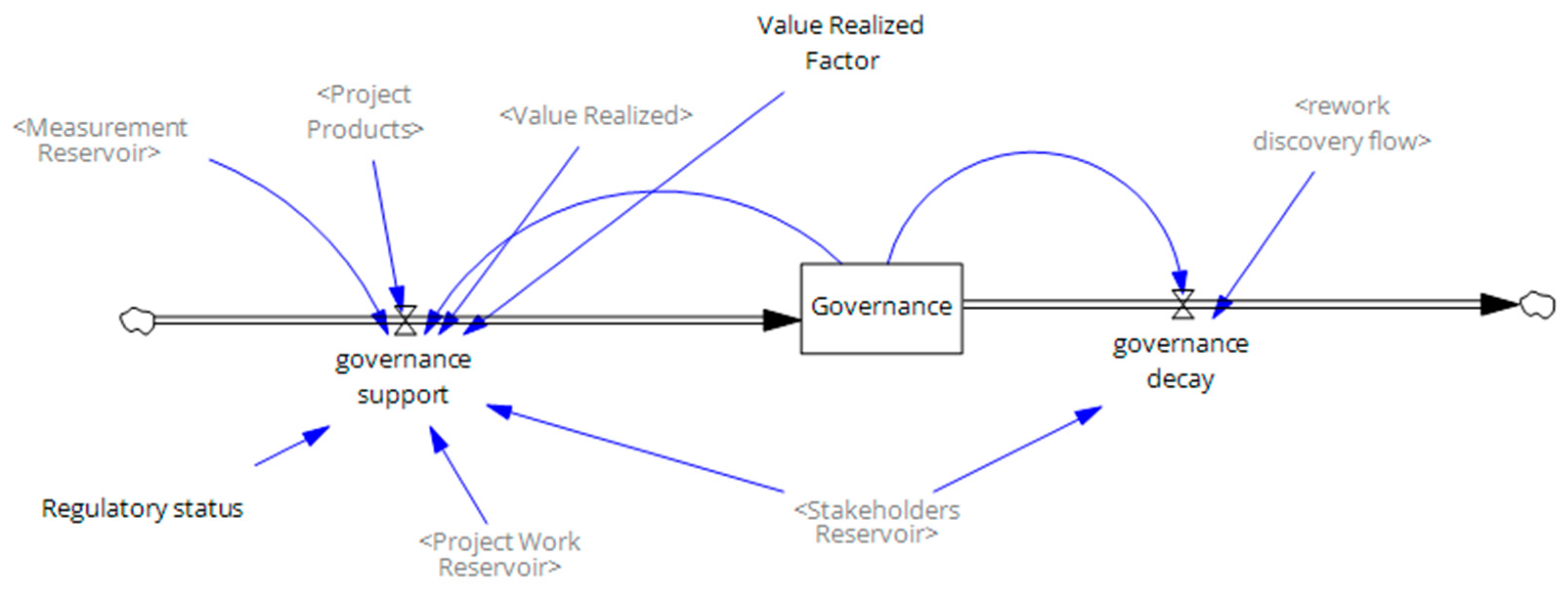
The governance subsystem, presented in
Figure 1, regulates project alignment with external and internal requirements. Governance capacity accumulates through effective oversight but decays naturally over time if not reinforced. It directly influences risk mitigation, stakeholder trust, and compliance with standards. Weak governance accelerates rework and delays, while strong governance creates a reinforcing loop with improved delivery performance.
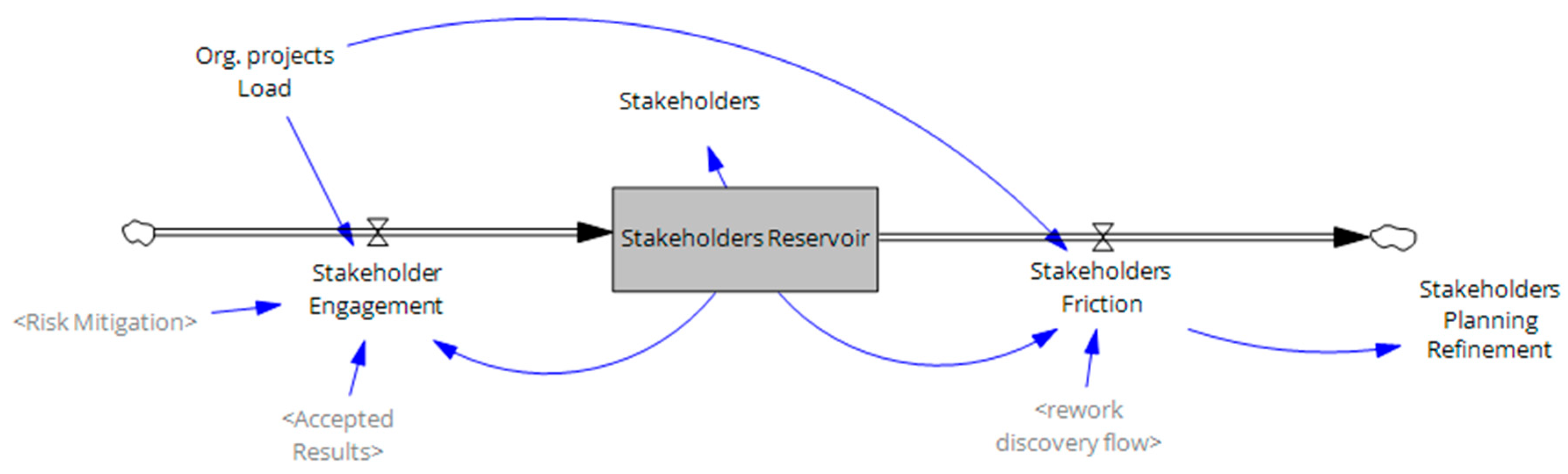
Stakeholder engagement, presented in
Figure 2, is modeled as a reservoir that rises with proactive communication and alignment activities, and erodes through disengagement or conflict. Engagement contributes to risk mitigation and smoother execution, but when neglected, it introduces balancing pressures that increase uncertainty and slow delivery. This subsystem captures PM domains emphasis on stakeholder performance domain.
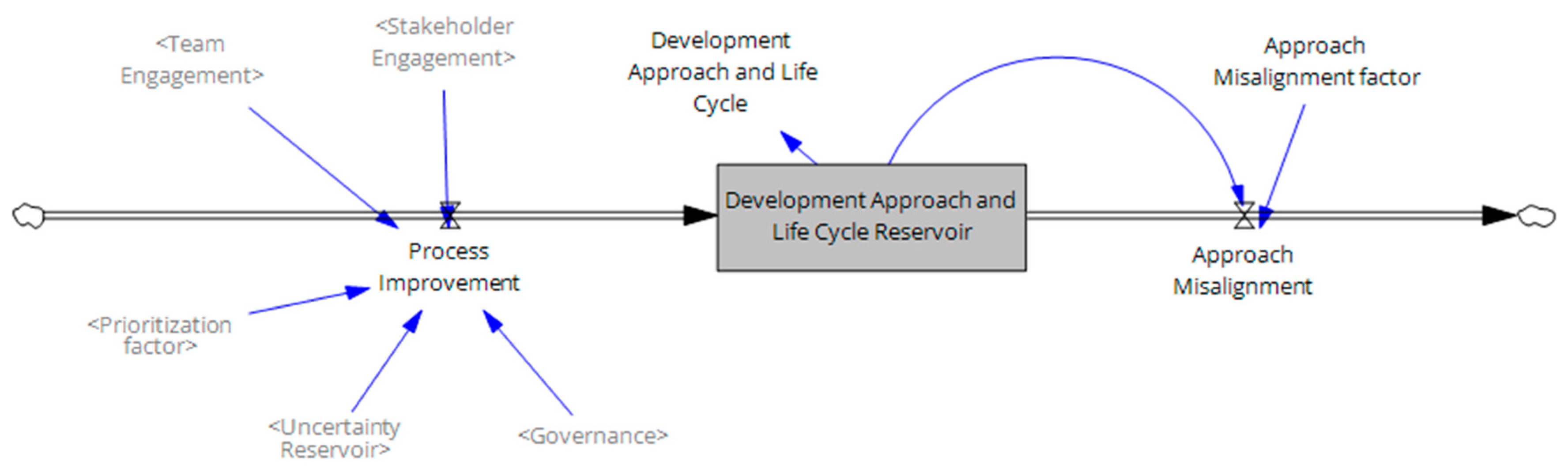
The development approach, presented in
Figure 3, represents process orientation and methodological fit. Strong alignment between chosen methodologies (e.g., agile, hybrid, or predictive) and governance structures reduces risks and improves planning effectiveness. Misalignment, however, increases rework and risk accumulation. This subsystem reflects PM domains domain of tailoring project development approaches.
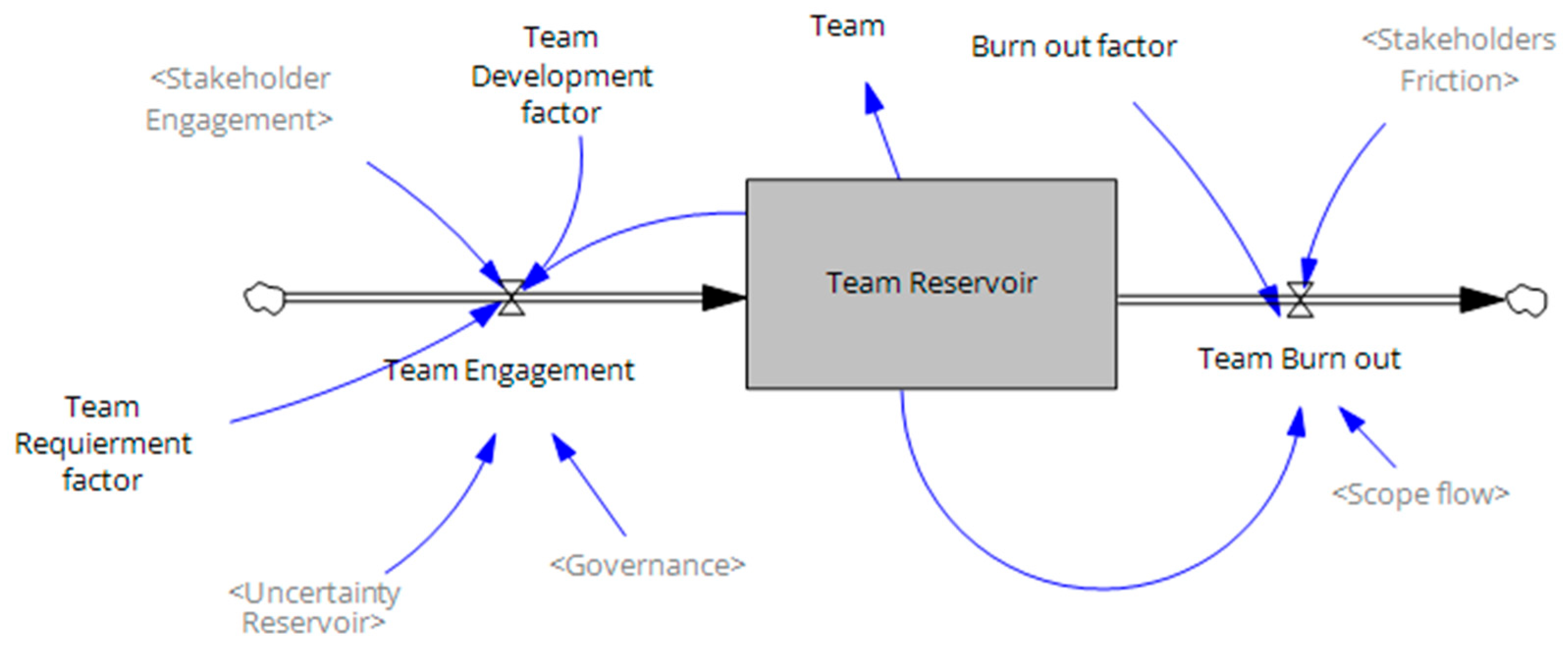
The team subsystem, presented in
Figure 4, models human capacity as a stock that grows through recruitment and training but diminishes under pressure, burnout, or attrition. Productivity loops show that a motivated, well-supported team accelerates task completion, while fatigue and disengagement create balancing loops that stall execution. This subsystem operationalizes PM domains team performance domain.
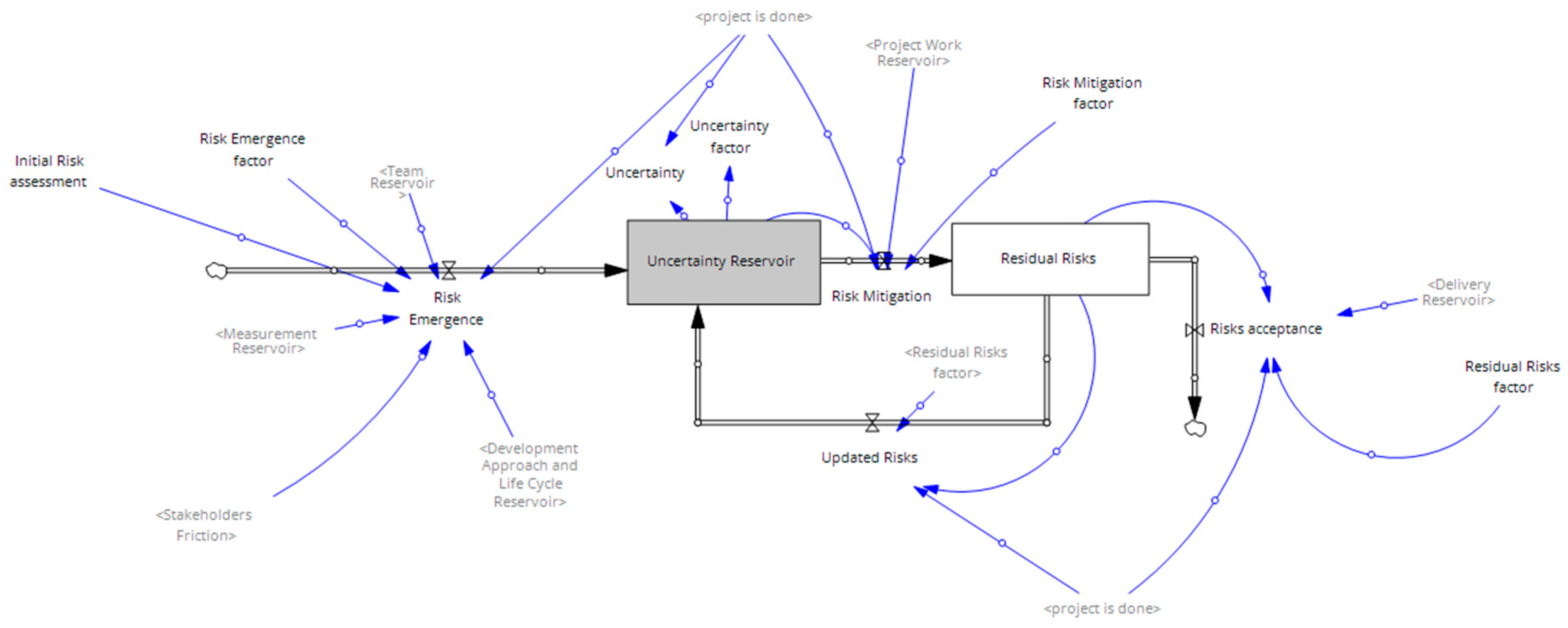
Uncertainty, presented in
Figure 5, is a constant inflow to project dynamics, generating risks that must be actively mitigated. Governance, stakeholder engagement, and AI-enabled analytics reduce exposure, but residual risk always persists. High risk amplifies rework and delays, forming balancing loops that check over-optimistic progress. This subsystem aligns with PM domains uncertainty performance domain.
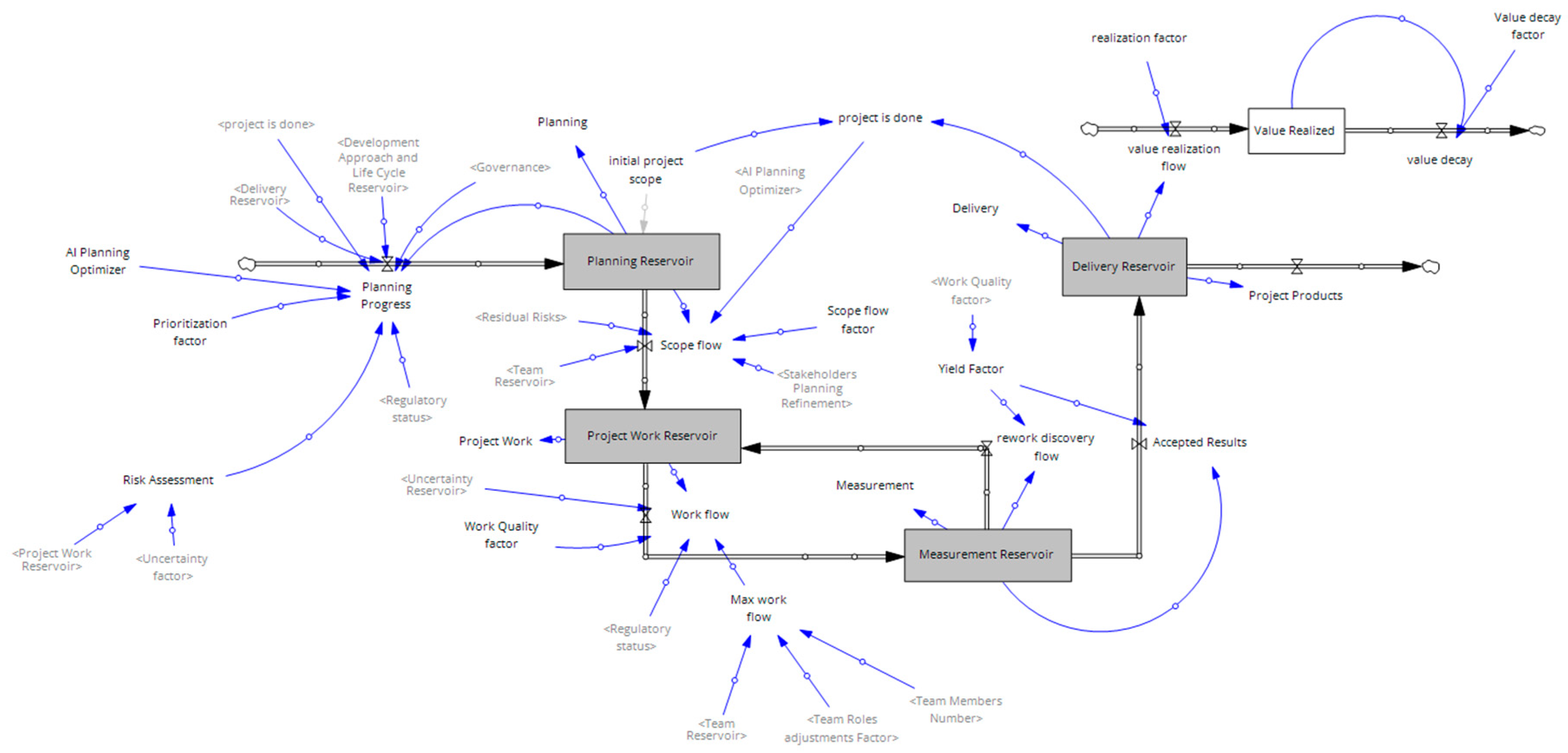
At the core lies the project work reservoir, presented in
Figure 6, which accumulates completed deliverables over time. Planning resources flow into execution, moderated by measurement accuracy and feedback loops. Risk exposure and team fatigue act as balancing forces, while effective governance and stakeholder alignment provide reinforcement. Together, these mechanisms create a dynamic structure where early planning choices and governance quality shape long-term delivery outcomes.
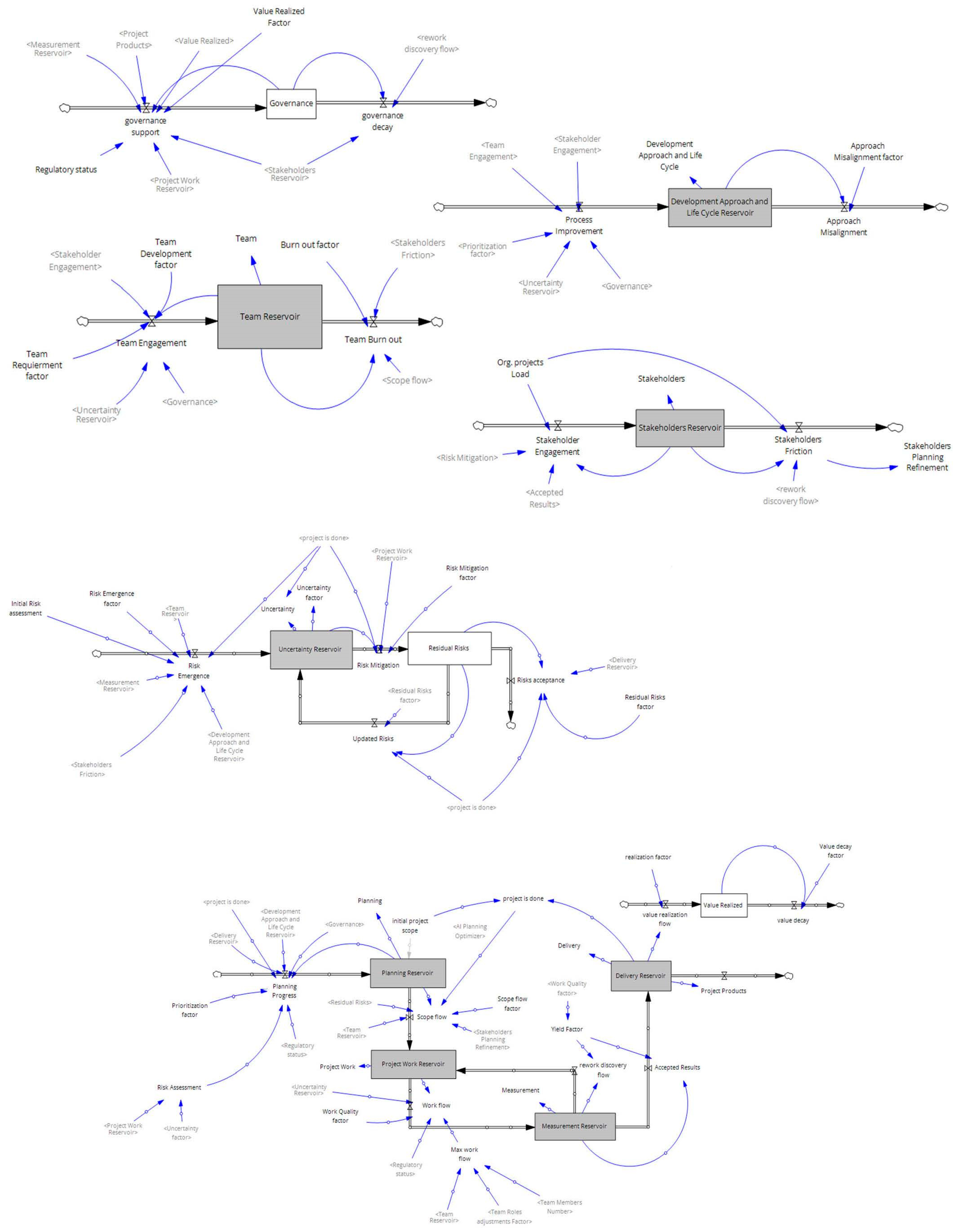
Finally, the subsystems are combined into a holistic framework of project governance and delivery, presented in
Figure 7. This integrated model illustrates how reinforcing and balancing loops interact across the lifecycle.
While the baseline SD model captures classical governance and delivery interactions, contemporary project environments increasingly embed AI into planning, monitoring, and execution. The model extends traditional dynamics by explicitly incorporating AI as both an enabler and a potential disruptor.
AI contributes to risk reduction by enhancing early warning signals, anomaly detection, and predictive forecasting of delays, thereby reducing effective Risk Exposure. Similarly, AI analytics improve Measurement Accuracy by filtering noise, identifying hidden dependencies, and enabling data-driven planning adjustments. These effects create reinforcing loops where better information leads to improved planning and execution, accelerating delivery performance [
40,
74].
At the same time, the model acknowledges potential challenges of human–AI interaction. Overreliance on AI recommendations can reduce managerial attention, while biased data or smoothing algorithms may amplify rather than mitigate risks [
74,
75]. These feedbacks are represented as balancing loops that temper overly optimistic reliance on automation.
The distinction between traditional and AI-augmented dynamics lies in the degree of responsiveness: while classical governance relies on periodic reviews and subjective judgments, AI-enabled governance provides continuous sensing and adaptive feedback [
76]. By embedding these mechanisms into the SD structure, the model reflects PM domains’ call for adaptability, resilience, and evidence-based decision-making in complex project ecosystems.
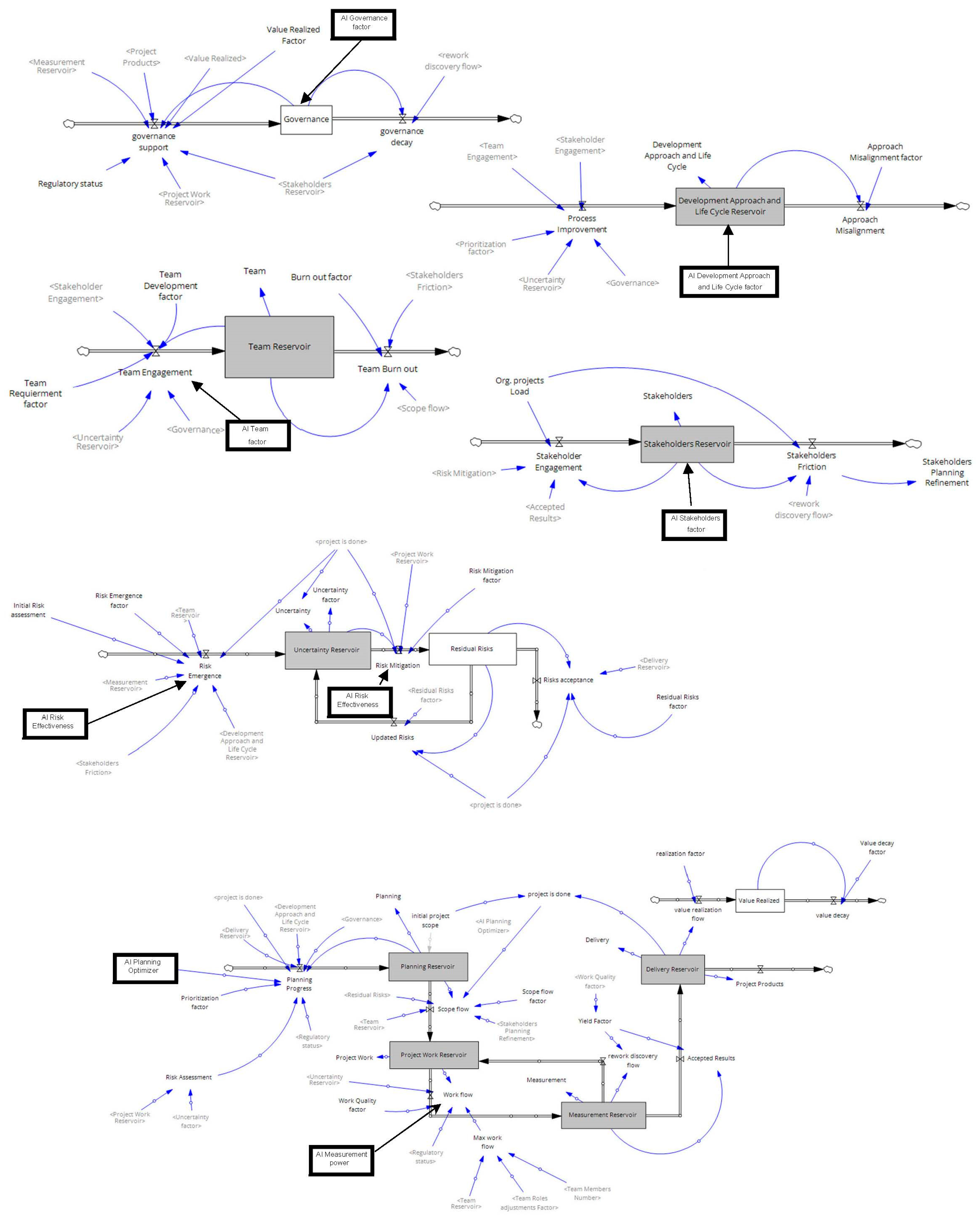
To extend the baseline project governance and delivery model, AI factors were embedded directly into the decision and feedback loops. This update allows the simulation to capture how intelligent systems reshape traditional project dynamics by reinforcing planning, risk, monitoring, and stakeholder processes.
The revised model, presented in
Figure 8, introduces AI as additional levers within existing subsystems. For example, AI Planning improves alignment of resources and scope, reducing leakage from planning into rework. AI Risk Effectiveness lowers exposure by enabling predictive risk identification and faster mitigation. AI Measurement enhances monitoring accuracy, strengthening corrective feedback loops. AI Stakeholder Sensing supports engagement by interpreting signals and reducing disengagement. Finally, AI Team Engagement moderates fatigue by providing decision support and automating routine tasks.
These AI factors do not replace human governance but interact with it, accelerating positive reinforcement loops and dampening balancing pressures that previously created delays or volatility. As shown in
Figure 8, the AI-augmented SD framework reflects a hybrid decision environment where human oversight is complemented by continuous algorithmic inputs. This integration enables comparative testing between traditional and AI-enhanced project dynamics within the same systemic structure.
Model Validation:
Model validation followed established structural validation procedures in the System Dynamics domain [
77].
Boundary adequacy test: The model boundary was systematically examined to ensure that all relevant PMBOK performance domains were included and that AI influences were embedded through all theoretically required mechanisms, including planning optimization, risk mitigation, measurement enhancement, and workflow acceleration. No critical domain influencing project completion was excluded.
Structure verification test: Causal directions, feedback loops, and governing equations were reviewed to confirm consistency with project management theory and managerial logic. All relationships were derived from the underlying process structure and validated to ensure sign correctness and behavioral plausibility.
Parameter verification test: Parameter robustness was assessed through sensitivity analysis. The model remained behaviorally stable under ±20 percent variation in key parameters, including AI effectiveness, risk emergence, and mitigation factors, indicating structural robustness.
Dimensional consistency test: A full dimensional consistency check was performed. All stocks, flows, and auxiliary variables were verified to maintain coherent time-based units across the entire system.
Extreme conditions test: Extreme scenario testing confirmed logical behavior. Setting AI effectiveness to zero produced behavior equivalent to a non-AI baseline configuration. Reducing risk emergence to zero led uncertainty to converge toward zero, consistent with theoretical expectations.
There are, however, limitations. The model simplifies reality by focusing on single projects, without portfolio effects or external inputs. AI is represented through aggregated factors (e.g., efficiency, accuracy), rather than specific algorithms, so results highlight systemic trends rather than tool-level outcomes. Human–AI interaction challenges, such as overreliance or resistance, are only partially captured. Even with these constraints, simulation design enables robust research. The framework thus provides a platform for exploring both performance improvements and potential unintended effects.
4. Results
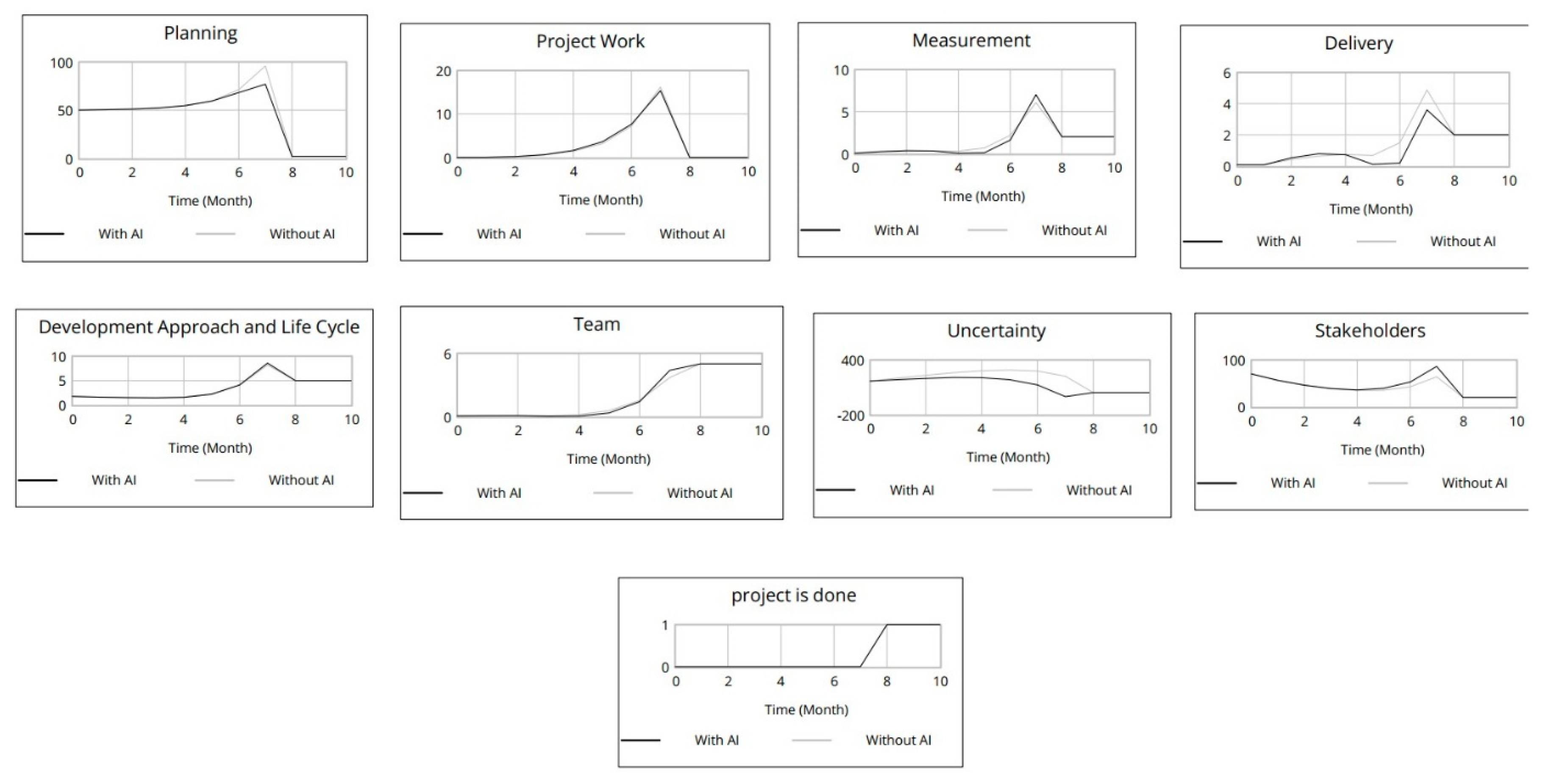
The simulation outputs provide a comparative view of project performance under baseline conditions and with AI-augmented parameters (see
Figure 9).
Figure 9 was created by the Vensim simulation software and solver (Vensim 10.2) and the time step for any calculation was defined by the system to 0.125 month for all computations, including continuous and differential.
Each PM domain performance is represented dynamically, evolving over time as feedback loops, reinforcing effects, and balancing pressures interact. The results show that AI generally stabilizes domain trajectories, reduces instability, and accelerates convergence toward project completion. We computed peak exposure, stabilization time, volatility and delivery smoothness from the simulated trajectories.
The Y axis in each graph represents the simulated magnitude of the respective PMBOK performance domain as a stock variable over time. These values reflect accumulated levels generated by the system dynamics model rather than direct empirical units such as hours or percentages.
Negative values of the Uncertainty variable emerge because it is modeled as a dynamic net balance rather than as a strictly non-negative stock. Specifically, Uncertainty reflects the difference between risk emergence and risk mitigation flows over time. When mitigation mechanisms exceed emerging risks, the net flow becomes negative, causing the stock to decline below its reference level. Thus, negative values indicate a state of enhanced systemic stability relative to the defined baseline, rather than “negative uncertainty” in a literal sense.
To remove ambiguity in execution and link the diagram to quantifiable behavior, we explicitly report the stock–flow equations underlying the team capacity subsystem (
Figure 4). In the model, team capacity is captured by
Team Reservoir, defined as:
The outflow from
Team-Reservoir is
Team Burn out, driven by baseline
Fatigue and compounded by stakeholder and scope pressures:
The inflow to the
Team-Reservoir is
Team Engagement, which is influenced by
AI Team Engagement Factor, team development/requirements factors, and an averaged term involving
Governance,
Uncertainty Reservoir, and
Stakeholder Engagement:
This stock translates into execution capacity through
As reported above, Workflow is then bounded by Max Workflow and further shaped by project work pressure, uncertainty, and measurement power (including AI Measurement Power). This explicit linkage provides a measurable pathway from team dynamics to delivery throughput and supports KPI quantification such as effective capacity utilization and throughput smoothness.
Planning effectiveness, as presented in
Figure 9, demonstrates one of the most notable differences between scenarios. The planning effectiveness curve therefore represents the behavioral outcome of the planning subsystem dynamics rather than the trajectory of a single stock variable.
In the baseline run, planning quality rises initially but collapses mid-project due to misalignment and rework. With AI augmentation, planning stabilizes earlier and avoids collapse altogether. This suggests that AI support improves scope–resource alignment and reduces planning instability, reinforcing positive cycles between high-quality planning and smoother execution.
Delivery performance shows more stabilization with AI. In the baseline, delivery rises sharply, overshoots, and then declines, reflecting inefficient handover from planning to execution. With AI, delivery is steadier and sustainable, avoiding overshoot. This indicates that AI strengthens alignment between upstream planning and downstream outputs, ensuring more predictable delivery trajectories.
Stakeholder engagement shows only modest differences. The baseline scenario experiences a mid-project incline in engagement, reflecting conflicts or disengagement under stress. AI support smooths this dip and enables earlier stabilization, but overall trajectories remain similar. This confirms that stakeholder engagement is influenced more by human interactions than by technical systems, although AI can assist by interpreting feedback and reducing communication lags.
Team capacity is moderately improved with AI. Without AI, the curve plateaus as burnout reduces effectiveness. With AI, growth is sustained for longer, suggesting reduced fatigue and better workload distribution. However, the improvement is less pronounced than in planning or risk domains, reflecting the fact that AI can support, but not replace human capacity.
Monitoring and measurement are among the domains most visibly transformed by AI. In the baseline, measurement accuracy spikes during mid-project, reflecting delayed or unreliable feedback. AI stabilizes measurement early in the lifecycle, producing smoother curves with fewer disruptions. This demonstrates the value of AI-driven monitoring in strengthening corrective loops and reducing rework.
Uncertainty reduction is one of the most dramatic outcomes. In the baseline, uncertainty remains high for most of the project and only declines late in the lifecycle. With AI, uncertainty steadily decreases from the start, reflecting predictive analytics that identify risks earlier and reduce exposure. This confirms AI’s central role in stabilizing project systems under uncertain conditions.
The governance and development approach domain shows instability in the baseline, with a mid-project spike caused by misalignment between methodology and governance. AI reduces this drift, producing a gradual and more stable curve. This indicates that AI contributes to maintaining coherence between chosen approaches (agile, hybrid, predictive) and governance structures, reducing systemic misfits.
Both scenarios reach completion, but the AI-augmented trajectory achieves earlier stabilization of the project closure phase, with fewer disruptions in the closing phase. This reflects AI’s systemic effect: by reinforcing stability in planning, risk, and monitoring domains, closure becomes smoother and more predictable. To consolidate the findings across all domains,
Table 2 summarizes the comparative behaviors observed in the baseline and AI-augmented simulations. The table highlights not only the directional changes but also the magnitude of AI’s influence in each project domain, making it clear where AI provided the strongest stabilization effects and where its impact was more limited.
The following analysis highlights where AI exerts stronger and weaker influences across the PM domains:
Stronger effects: Planning, Measurement, and Uncertainty domains show the greatest gains. These areas rely on data-driven decision-making and feedback loops where AI tools, such as predictive analytics and monitoring systems, directly strengthen system responsiveness. Delivery also benefits substantially as a downstream effect of these improvements.
Moderate effects: Team performance and Governance/Development Approach show improvements but remain partly dependent on organizational and cultural factors. AI reduces fatigue and misalignment but cannot fully overcome human or structural limits.
Weaker effects: Stakeholder engagement shows the smallest improvement. While AI reduces fluctuations, engagement dynamics remain primarily human driven.
Across multiple scenarios, AI integration reduced peak uncertainty exposure by up to 33%. Also, the AI-augmented system showed reduced planning effort by 15%, improved monitoring, and risk sensing by accelerating feedback and reducing delays by 25%. AI also improved measurement accuracy trajectories and accelerated cumulative delivery while lowering volatility in work completion rates.
Overall, these outcomes align with expectations: AI provides the most transformative effects where decision quality and system feedback are central, while effects are muted in human-centric or culturally contingent domains. Taken together, the results confirm that AI integration enhances stability, reduces volatility, and accelerates closure, reimagining the PM domains lifecycle as a more adaptive and resilient framework.
4.1. Tooling Layer—Operationalizing Quantitative Measures of Projects’ AI Levers
While our contribution is modeled at the dynamic feedback-and-decision layer, the simulated AI levers correspond directly to signals and actions available in common PM tool chains. Specifically, the quantitative differences summarized in
Table 2 (e.g., reduced volatility, earlier stabilization, and lower uncertainty exposure) can be operationalized in practice by instrumenting project data streams (work-item flow, schedule variance, defect/rework, risk events, stakeholder sentiment, and governance cadence adherence) using widely deployed platforms such as JIRA/Azure DevOps, MS Project/Primavera, and dashboarding/analytics layers.
Table 3 therefore maps each modeled PM-domain lever to typical tool signals and the SD parameter/variable it updates, clarifying how the framework can be implemented beyond a conceptual level.
4.2. Case Illustration and Empirical Anchoring of Model Outputs
To address empirical grounding and facilitate replication, we add a case-anchoring procedure that maps the model’s internal variables to a project dataset structure commonly available in practice (e.g., MS Project/Jira/Azure DevOps dashboards, risk registers, defect logs, and stakeholder pulse surveys). The intent is not to restrict the model to a single industry, but to demonstrate how the proposed SD structure can be instantiated and validated with real project traces.
In the model, execution progress is represented by Delivery Reservoir, which accumulates delivered outcomes through Accepted Results (and is offset by Project Products, defined as Delivery Reservoir), while remaining work pressure is represented by Project Work Reservoir. The operational analogues for empirical anchoring are as follows:
- (i)
Cumulative completed work (e.g., earned value, story points accepted, or milestones completed) for Delivery Reservoir.
- (ii)
Remaining backlog or remaining scope effort for Project Work Reservoir.
- (iii)
Throughput per time step for Workflow. In the SD formulation, workflow is bounded by Max workflow and further modulated by measurement and uncertainty terms, including the multiplier (1 + AI Measurement Power), thereby linking real-time monitoring improvements directly to throughput dynamics.
- (iv)
Risk/uncertainty is captured by Uncertainty Reservoir, which integrates Risk Emergence + Updated Risks − Risk Mitigation. For empirical anchoring, Uncertainty Reservoir can be proxied using (a) risk register time series (count × severity-weighted exposure), (b) issue and incident logs, and/or (c) volatility signals such as requirement churn and reopened defects. This is consistent with the model’s structure where Risk Emergence depends on a composite of measurement, stakeholder friction, team capacity, and development approach alignment, and is reduced by AI Risk Effectiveness through the term (1 − AI Risk Effectiveness). Likewise, Risk Mitigation is explicitly amplified by (1 + AI Risk Effectiveness), enabling a direct empirical interpretation of AI-enabled mitigation capacity.
Finally, stakeholder dynamics are represented as
Stakeholders Reservoir, integrating
AI Stakeholder factor ×
Stakeholder Engagement −
Stakeholders Friction. Empirically, this can be anchored using stakeholder sentiment/pulse measures, meeting attendance/participation indicators, and sponsor/customer satisfaction or alignment scores.
Stakeholder friction is operationally tied to both the stakeholder stock and rework discovery via
Stakeholder friction creates a traceable pathway between rework and stakeholder confidence erosion.
In summary, this anchoring procedure establishes a practical pathway to calibrate selected parameters (e.g., Scope flow factor, Burn out factor, Risk Emergence factor, Risk Mitigation factor) and to compare simulated trajectories against observed project traces using standard fit measures (e.g., time-to-completion error, peak-risk timing error, throughput volatility error).
4.3. KPI Definitions and Quantification for Scenario Comparison
To improve result transparency and address the need for measurable outcomes, the comparison between the baseline and AI-enabled scenarios is complemented with an explicit KPI set computed from the simulated time series. KPIs are defined directly from the model’s state variables and flows, ensuring reproducibility.
KPI-1: Completion time (months). Completion is reached when project is done = 1, where project is done = IF THEN ELSE (Delivery Reservoir >= initial project scope, 1, 0). Completion time is the first-time step at which this condition holds.
KPI-2: Peak uncertainty exposure. Peak uncertainty is defined as , where Uncertainty Reservoir = INTEG (Risk Emergence + Updated Risks − Risk Mitigation, 100).
KPI-3: Uncertainty stabilization time. Stabilization time is the first time after the peak at which for consecutive time steps, where . This KPI captures the speed at which the system transitions from risk amplification to effective absorption via mitigation and learning loops.
KPI-4: Throughput smoothness (work completion volatility). Throughput smoothness is defined as the standard deviation of Workflow over the execution window (or coefficient of variation if normalization is preferred).
Workflow is explicitly defined as:
This KPI directly quantifies the reduction in oscillations and rework-driven volatility when AI improves measurement feedback.
KPI-5: Rework intensity. Rework intensity is defined as . In the model, rework discovery flow = Measurement Reservoir × (1 − Yield Factor) and Yield Factor = Work Quality factor, linking rework to measurement accumulation and quality yield.
KPI-6: Stakeholder volatility and erosion. Stakeholder volatility is quantified as the standard deviation of Stakeholders Reservoir over time, and erosion is quantified as the net change from the initial value (70) to completion. Stakeholders dynamics are: Stakeholders Reservoir = INTEG(AI Stakeholder factor × Stakeholder Engagement − Stakeholders Friction, 70).
KPI-7: Effective capacity utilization. Utilization is quantified by
, where Max Workflow = Team Reservoir/100 × Team Members Number × Team Roles adjustments Factor. This KPI links
Figure 4 execution logic (team capacity) to observable delivery throughput.
These KPIs are reported for both scenarios (baseline and AI-enabled) and summarized as absolute values and relative improvements. This directly operationalizes hypotheses concerning reduced peak uncertainty, shortened stabilization time, and improved delivery smoothness under AI-enabled sensing, planning, and measurement.
4.4. Sensitivity and Robustness Analysis of AI Levers and Structural Uncertainties
To evaluate whether the AI-enabled improvements remain robust under plausible project variability, we perform sensitivity and robustness analyses across (i) the AI policy levers and (ii) key structural uncertainty parameters embedded in the SD equations.
4.4.1. One-Factor-At-a-Time Sensitivity
Each lever (factor) is perturbed while holding all others constant, and the impact on the KPI set is computed. The AI levers (each in the 0–1 range) are as follows:
AI Planning Optimizer,
AI Risk Effectiveness,
AI Measurement Power
These levers directly affect
- (a)
Planning progress through (1 + AI Planning Optimizer) in Planning Progress,
- (b)
Risk emergence through (1 − AI Risk Effectiveness) in Risk Emergence,
- (c)
Risk mitigation through (1 + AI Risk Effectiveness) in Risk Mitigation, and
- (d)
Throughput modulation through (1 + AI Measurement Power) in Workflow.
Structural uncertainty parameters include Burn out factor, Scope flow factor, Risk Emergence factor, and Risk Mitigation factor, each of which governs feedback strength and is therefore expected to influence volatility and completion time.
4.4.2. Sensitivity to Jointly Varying Parameters
We then jointly vary the structural parameters within plausible ranges and compute KPI envelopes for both baseline and AI-enabled scenarios. This produces an uncertainty band for Completion time, Peak Uncertainty Reservoir, and Rework intensity, showing whether AI-enabled improvements persist under adverse conditions such as high scope churn (Scope flow factor) and high fatigue dynamics (Burn out factor). The robustness analysis is directly motivated by the model’s coupling of burnout and stakeholder friction to scope pressure and rework (e.g., Team Burn out = Burn out factor × Team Reservoir + (Stakeholders Friction + Scope flow)/2 × Burn out factor × 0.7).
4.4.3. Interpretation of Dominant Levers
Finally, sensitivity ranking is interpreted mechanistically by tracing which KPI changes are driven primarily through: (a) planning acceleration (via Planning Progress), (b) uncertainty suppression (via Risk Emergence and Risk Mitigation), or (c) throughput stabilization (via Workflow and measurement yield). This interpretation clarifies why AI tends to be most effective in Planning/Measurement/Uncertainty loops while human-centric domains remain bounded.
5. Discussion
This study applied a SD model to reimagine the project lifecycle described in PM domains, with and without the integration of AI. The results show that AI provides substantial benefits in stabilizing planning, reducing uncertainty, and improving measurement accuracy, while its influence on human-centric domains such as stakeholder engagement and team dynamics remains more modest. In this discussion, we interpret these findings, relate them to existing research, and consider their implications for theory and practice in PM.
Table 4 describes the paper’s contribution vs. prior SD-PM literature.
5.1. Interpreting Case-Anchored KPIs: What Changes Under AI, and Why
The KPI-driven results provide a clearer interpretation of how AI reshapes lifecycle behavior beyond qualitative curve comparisons. The AI-enabled scenario is expected to reduce peak uncertainty exposure and shorten stabilization time primarily through the dual mechanism embedded in the uncertainty structure: Risk Emergence is dampened by (1 − AI Risk Effectiveness), while Risk Mitigation is amplified by (1 + AI Risk Effectiveness). This is not merely a “faster response” effect; it reweights the balance between reinforcing risk accumulation and balancing mitigation capacity in the Uncertainty Reservoir integrator, producing lower peaks and faster decay when the system transitions from risk discovery to mitigation dominance.
Similarly, improvements in delivery smoothness are interpretable through the throughput equation. Because Workflow includes the multiplier (1 + AI Measurement Power) and is bounded by Max Workflow, higher measurement power strengthens corrective feedback and increases usable throughput without necessarily increasing nominal capacity. This structure explains why volatility reductions and completion time improvements may be observed even when team capacity gains are modest: throughput stabilization can occur via measurement and prioritization loops before any material change in human-centered engagement.
At the same time, the model structure makes explicit why stakeholder and team improvements can be comparatively limited. Stakeholder erosion is strongly coupled to friction driven by rework and organizational load
and team burnout is explicitly increased by both stakeholder friction and scope pressure. These pathways imply that technology-driven improvements must compete with socio-organizational feedbacks that amplify friction during turbulence. Therefore, AI benefits may saturate unless governance and stakeholder management simultaneously reduce friction drivers.
5.2. Implications of Sensitivity Results: When AI Helps Most, and When It Does Not
The sensitivity analysis clarifies boundary conditions for AI impact. When Scope flow factor is high, scope expansion increases pressure in Project Work Reservoir and, via stakeholder refinement and friction channels, can elevate burnout and rework, counteracting gains from faster planning and measurement. Under these conditions, the marginal effect of AI Planning Optimizer may diminish because improved planning speed alone does not remove the structural driver of churn; it may even accelerate the system into higher-frequency oscillations if scope refinement and friction are not controlled.
Conversely, when baseline uncertainty drivers are high (e.g., elevated Risk Emergence factor or high initial risk assessment), AI Risk Effectiveness becomes a dominant lever because it simultaneously suppresses Risk Emergence and increases Risk Mitigation, lowering both peak Uncertainty Reservoir and the duration of elevated uncertainty (stabilization time). This sensitivity pattern supports a targeted managerial implication: AI investment yields the strongest lifecycle-level improvements when it strengthens the balancing loops that dampen uncertainty and stabilize measurement-driven corrections, whereas purely accelerating planning may have limited benefit in environments dominated by stakeholder friction, governance decay, or scope churn.
5.3. Risk Mapping and Stakeholder Roles: Bridging Aggregate Dynamics to Practical Governance
A common critique of aggregate SD project models is that they represent uncertainty and stakeholders as single reservoirs, whereas practitioners manage risks as categorized portfolios and stakeholders as role-bearing actors. The current model provides a rigorous aggregate mechanism—Uncertainty Reservoir integrates emergence and mitigation; Stakeholders Reservoir integrates engagement and friction—but to support practical risk governance, an explicit risk mapping layer is introduced as a reporting and (optionally) structural extension.
First, risk mapping is implemented by decomposing the aggregate uncertainty trajectory into interpretable categories aligned with project risk registers (e.g., requirements risk, technical risk, external/compliance risk). Operationally, category scores can be computed as proportions of Uncertainty Reservoir driven by the corresponding emergence drivers (e.g., stakeholder-friction-driven share vs development-approach-driven share) and then reported as probability–impact heatmaps at key time points (early execution, peak uncertainty, and late stabilization). This mapping preserves the model’s parsimony while translating its output into the managerial artifact most commonly used in practice.
Second, stakeholder roles are introduced to replace a purely undifferentiated stakeholder stock. While Stakeholders Reservoir currently aggregates engagement/fidelity, its friction term already suggests distinct mechanisms: a baseline friction proportional to stakeholder stock (misalignment/communication burden) and an additional friction term driven by rework under organizational load. Role stocks such as sponsor alignment, user/customer engagement, and compliance pressure allow differential coupling to governance support/decay and to the regulatory constraint. This is particularly relevant because Regulatory status is currently constant, and stakeholder-role decomposition creates a realistic pathway for regulatory/compliance stakeholders to influence constraint intensity and governance workload, thereby increasing realism in governance interpretation.
The results confirm that AI integration has the strongest influence in domains where feedback loops and data-driven decision-making are central. In the Planning domain, AI reduces volatility, stabilizing trajectories earlier and avoiding the mid-project collapse seen in the baseline scenario. This finding is consistent with recent studies that emphasize the role of AI in improving planning accuracy through predictive analytics and automated scenario generation [
78,
79,
80]. Similarly, in the Measurement domain, AI strengthens monitoring feedback loops by enabling continuous sensing and real-time error detection, confirming prior claims that digital dashboards and anomaly detection tools enhance control processes [
81,
82]. Finally, in the Uncertainty domain, predictive analytics substantially reduce exposure to risks and dampen volatility, aligning with literature on AI’s role in proactive risk identification [
83,
84].
By contrast, the Stakeholder domain showed only modest improvements. While AI-assisted sensing dampened mid-project disengagement and enabled earlier stabilization, engagement patterns remained largely dependent on human factors. This aligns with findings from [
85,
86], who argued that stakeholder alignment is more influenced by trust and organizational culture than by technical systems [
87]. Similarly, the Team domain benefited moderately, with AI mitigating burnout pressures and sustaining capacity longer, but without eliminating fatigue entirely [
17]. These outcomes reinforce the understanding that AI is most effective in analytical and data-driven areas, while human-centric performance domains remain less susceptible to automation.
This dynamic reconfiguration illustrates how AI transforms PM from a fragile, delay-prone process into a more adaptive and resilient system. The SD framework reveals non-linearities that are often invisible in static models: small improvements in planning or monitoring amplify over time, producing large system-level effects, while modest changes in stakeholder engagement or team support generate smaller ripples. These findings extend the work of Lyneis & Ford [
73], who emphasized the importance of understanding feedback-rich project dynamics, by demonstrating how AI alters these loops in practice.
The results also highlight the boundaries of AI’s influence. Domains such as stakeholder engagement and team dynamics demonstrated only limited improvements. These outcomes confirm that while AI can assist in communication, conflict detection, or workload management, the deeper drivers of performance in these areas remain human: trust, motivation, and cultural alignment [
88].
The results of this study are consistent with prior work in several areas. Previous research has highlighted AI’s promise in planning optimization [
78,
79,
80], predictive risk management [
83,
84], and monitoring performance [
81,
82]. This study confirms those findings, but advances the field by embedding these effects within a dynamic simulation framework. Unlike static frameworks that assess AI’s benefits in isolation, the SD model shows how improvements in one domain cascade into others, creating systemic effects.
At the same time, this study diverges from overly optimistic claims in the literature that AI can transform all aspects of PM equally. The weaker results in stakeholder and team domains suggest that the impact of AI is uneven and domain-specific. This resonates with more cautious perspectives in the literature, which argue that AI must be combined with human-centric approaches to realize full benefits [
89].
From a governance perspective, the findings suggest that AI can be conceptualized as an enhancer of resilience and adaptability. By stabilizing planning, reducing uncertainty, and improving feedback accuracy, AI strengthens the ability of governance structures to absorb shocks and maintain progress. This has direct implications for organizations adopting PM domains: integrating AI into governance frameworks could help projects respond more dynamically to change.
However, the study also highlights the risks of overreliance. If managers defer too heavily to AI outputs without maintaining vigilance, biases in data or algorithms could introduce new systemic vulnerabilities [
44,
90]. The model did not explicitly simulate these risks, but they remain a critical consideration. Governance frameworks must therefore embed AI cautiously, emphasizing transparency, explainability, and human oversight.
For practitioners, the results point toward prioritizing AI adoption in domains with the strongest leverage: planning, monitoring, and risk management. These areas offer the clearest performance gains and systemic stability. By contrast, organizations should temper expectations about immediate improvements in stakeholder or team dynamics, unless supported by complementary cultural and organizational changes. The results also imply that project managers should be trained not only in technical AI tools but also in managing the human–AI interface, ensuring that automation enhances rather than undermines trust and collaboration.
5.4. Limitations
This study has several limitations that should be considered when interpreting the results. First, the model is bounded at the single-project level and does not include portfolio interactions such as inter-project dependencies, shared resources, and shifting priorities. Second, it does not explicitly represent budget constraints, including cost overruns, funding limits, and investment trade-offs. Third, the model excludes external shocks such as regulatory changes, market disruptions, or supply interruptions, which may alter project behavior significantly.
In addition, the model does not capture strategic drift, where project goals gradually become misaligned with organizational strategy over time. It also does not explicitly include AI implementation costs. Another limitation is the absence of human resistance loops, including distrust of AI, reduced adoption, and resistance to changes in work practices.
Finally, the model is formulated as a continuous-time system dynamics model. This is appropriate for representing accumulations, delays, and feedback processes. However it is not a discrete project events simulation that have different purposes.
6. Conclusions
This paper advances a lifecycle view of PM by testing how AI changes behavior PM under a hybrid agile–predictive governance setting. Rather than treating AI as a collection of isolated tools, the SD formulation makes explicit where AI intervenes in the project system: it primarily reduces information latency, improves signal quality, and strengthens corrective (balancing) feedback in planning, measurement, and uncertainty management. The simulation results therefore support a clear synthesis: AI’s largest lifecycle benefits emerge when it accelerates sensing–decision–action cycles, reducing rework and stabilizing life-cycle trajectories.
Across the model experiments, the AI-enabled scenario reshapes lifecycle “curves” in a consistent way: planning stabilizes earlier and avoids mid-project degradation; measurement becomes smoother and less erratic; and uncertainty exposure peaks lower and dissipates faster—effects that propagate downstream into steadier, earlier delivery. Importantly, the model also clarifies the limits of technical intervention. Stakeholder engagement and team capacity improve only incrementally because their dominant drivers remain socio-behavioral (trust, motivation, conflict, workload norms) and are only partially mediated by faster analytics. In practical terms, AI is most valuable when deployed as a feedback amplifier (early warning, anomaly detection, dynamic prioritization, real-time progress interpretation) rather than as a replacement for human sensemaking, relationship management, or governance judgment.
The broader contribution is therefore twofold. First, the work offers a reusable SD “backbone” for studying lifecycle dynamics across PM domains—something descriptive standards cannot provide on their own. Second, it provides a mechanism-based explanation for why AI benefits are domain-asymmetric: analytical domains gain disproportionately because they are governed by information delays and feedback gains, while human-centric domains remain bounded by organizational and cultural constraints. This distinction is essential for avoiding overgeneralized claims about AI’s impact and for guiding targeted, governance-aware adoption strategies.
Future research agenda in specific, testable paths:
Integrate Monte Carlo simulation for uncertainty modeling (explicitly requested).
Replace single-point parameters (e.g., risk emergence/mitigation factors, scope-flow drivers, burnout coefficients) with probability distributions and run Monte Carlo experiments to derive confidence intervals for KPIs (completion time, peak uncertainty, volatility, rework intensity). This will move the findings from “trajectory comparisons” to risk-informed performance envelopes and robustness claims.
- 2.
Probabilistic calibration from real project traces (Bayesian or likelihood-based).
Use empirical time series (work-item flow, defect/rework logs, risk-register dynamics, stakeholder pulse surveys) to estimate uncertain parameters and validate structural assumptions. A Bayesian approach would enable posterior distributions for key feedback strengths and delays, aligning naturally with the Monte Carlo extension.
- 3.
Policy optimization on top of the SD model (AI for governance decisions, not just sensing).
Treat AI levers (planning optimizer, measurement power, risk effectiveness) and governance cadence as controllable policies, then apply reinforcement learning or multi-objective search to discover optimal intervention schedules under constraints (budget, compliance, staffing). The research output becomes a prescriptive “AI investment and cadence policy,” not only a descriptive simulation.
- 4.
Hybrid “SD + agent/actor layer” for stakeholders and teams.
Couple the aggregate SD reservoirs to an agent-based or role-segmented layer (sponsor, customer/users, regulator, delivery team leads) to model trust formation, conflict escalation, resistance, and adoption dynamics. This is the most direct path to improving the currently muted AI effects in human-centric domains.
- 5.
Endogenize AI risk: bias, hallucination, overreliance, and control loss.
Add explicit structures for (i) model drift/data quality decay, (ii) automation bias/overtrust, (iii) governance load created by verification and audit, and (iv) security/privacy constraints. This extension allows simulation of when AI increases volatility—a critical boundary condition for real deployments.
- 6.
Portfolio and multi-project coupling (resource contention and organizational load).
Extend from a single-project model to a portfolio setting where shared resources, priority shifts, and organizational load generate cross-project feedback. This will test whether AI’s stabilizing effects persist (or amplify) under system-wide congestion and shifting priorities.
- 7.
Operational “digital twin” implementation and longitudinal field evaluation.
Implement a lightweight digital twin where project tooling feeds key SD variables weekly/monthly, enabling real-time scenario testing and retrospective learning. A longitudinal study can compare AI-assisted governance versus conventional governance using matched projects and pre-registered KPIs.