


Abstract
Assessing COVID-19 vaccine effectiveness against emerging SARS-CoV-2 variants is crucial for determining future vaccination strategies and other public health strategies. When clinical effectiveness data are unavailable, a common method of assessing vaccine performance is to utilize neutralization assays using post-vaccination sera. Neutralization studies are typically performed across a wide array of settings, populations and vaccination strategies, and using different methodologies. For any comparison and meta-analysis to be meaningful, the design and methodology of the studies used must at minimum address aspects that confer a certain degree of reliability and comparability. We identified and characterized three important categories in which studies differ (cohort details, assay details and data reporting details) and that can affect the overall reliability and/or usefulness of neutralization assay results. We define reliability as a measure of methodological accuracy, proper study setting concerning subjects, samples and viruses, and reporting quality. Each category comprises a set of several relevant key parameters. To each parameter, we assigned a possible impact (ranging from low to high) on overall study reliability depending on its potential to influence the results. We then developed a reliability assessment tool that assesses the aggregate reliability of a study across all parameters. The reliability assessment tool provides explicit selection criteria for inclusion of comparable studies in meta-analyses of neutralization activity of SARS-CoV-2 variants in post-vaccination sera and can also both guide the design of future neutralization studies and serve as a checklist for including important details on key parameters in publications.
1. Introduction
SARS-CoV-2 has caused at least 500 million COVID-19 infections and 6 million deaths worldwide by May, 2022 [1]. Vaccines have been instrumental in controlling the spread of infection and drastically reducing disease severity and mortality [2]. The effectiveness of vaccination in preventing disease can depend on many factors, such as the specific vaccine being used, circulating variants, characteristics of the target population, etc., many of which are assessed by observational studies after the vaccines are approved for use [3,4]. However, obtaining results from clinical studies is a lengthy process, since a large enough number of cases for statistical significance needs time to accrue. For this reason, a quick assessment of vaccine performance against newly emerging SARS-CoV-2 variants is crucial. Neutralization assays are among the most valuable tools for evaluating viral immunity in vitro for many types of viruses including influenza, rabies, polioviruses, and MERS-CoV [5,6,7,8,9]. For this reason, these assays have been rapidly adopted for SARS-CoV-2, as they can provide early insights into potential reductions in vaccine performance [10,11,12]. Among the most useful such studies are in vitro neutralization studies that evaluate the ability of antibodies in post-vaccination specimens (e.g., sera) to bind and neutralize new SARS-CoV-2 variants, thereby preventing cellular infection [13,14]. Broadly speaking, there are four different types of in vitro neutralization assays: live virus neutralization; pseudo-virus neutralization; plaque-reduction neutralization; and focus reduction neutralization. A recent study evaluated all four types for SARS-CoV-2 and found each one to be robust, and the results comparable between assays [15].
However, such studies are not standardized in terms of design or methodology and thus pose a number of challenges when assessing them and trying to interpret their findings. For example, the reduction in neutralizing activity for a specific variant of concern following vaccination may range from 1-fold to 30-fold between studies [16], thus making the “true” degree of reduction unclear.
For over a year, we have been reviewing, evaluating and summarizing all available literature pertaining to SARS-CoV-2 variants and the respective neutralization activity of post-vaccination sera to inform WHO reports on vaccine performance in the context of emerging variants of concern [16]. Approximately 10% of the studies reviewed contained relevant neutralization data and were reported to the WHO, with pre-prints forming a large percentage of the earliest evidence. The lack of standardization of study design, methods and reporting quality posed a particular challenge in the interpretation of the results. We experienced increased uncertainty when attempting to compare studies with missing or poorly described study design or reporting parameters. For example, some articles did not report subject characteristics (such as age, sex, prior infection status) or did not stratify the results by important sub-groups (e.g., patients with clinical conditions affecting immune responses versus otherwise healthy patients, or young patients versus elderly patients). In other cases, the methods used were not always fully described, such as the quantity of virus used in neutralization assays, how pseudo-viruses were constructed and whether they contained the full complement of Spike protein mutations. In the race to contribute knowledge that could assist in arresting the pandemic, it is understandable that many of these details may have been overlooked. However, this inevitably renders a substantial number of otherwise valuable studies uninterpretable. These details are especially important for understanding the reasons for heterogeneous results between studies and for identifying which results are the least biased.
We expect that data coming from studies with high reliability will be less biased and thus more informative. To assist our work, we developed a tool that assesses the overall reliability of studies reporting neutralization activity of post-vaccination sera against SARS-CoV-2, where reliability was defined as a measure of methodological accuracy, proper study setting concerning subjects, samples and viruses, and reporting quality. The assessment is based on the presence or absence of key study design parameters and information pertinent to interpreting the results. In this manuscript, we describe the key parameters that neutralization studies should address, including the rationale for each and the impact they may have on study reliability. Finally, we present a tool to apply these parameters in a standardized way and that summarizes the overall level of reliability of the study across parameters.
2. Methods
We first aimed to identify and characterize aspects that might affect the reliability of results in studies assessing neutralizing antibody titers against SARS-CoV-2 in post-vaccination sera. Aspects identified included those with potential to affect the study outcome either because of technical limitations, such as poor assay standardization, statistical limits, such as small sample number, or because of insufficient or absent reporting, which prevents proper interpretation and evaluation of the reliability of results. Each aspect identified was described using specific, targeted parameters. All aspects and parameters were identified using our combined expertise in the design, conduct and analysis of neutralization assays, most importantly, through our experience screening and synthesizing all SARS-CoV-2 neutralization literature available since March 2021, and through extensive discussions and collaboration with recognized experts in this field [16].
Development of the Reliability Assessment Tool (RAT)
For a more convenient application of our method, we created an excel-based reliability assessment tool (RAT). The RAT required responses for each of 33 parameters; the nature of the response determines the reliability level linked to that particular parameter. We defined possible responses for each parameter, such as “not reported”, “yes” or “no”. For each parameter response, we considered whether its impact was likely to be low, medium or high on neutralization study reliability. For parameters with no information reported, an assessment of reliability of these studies is not possible, thus their reliability was defined as unclear. For example, the sampling period parameter assesses if all samples were collected at least 7 days post full vaccination (second vaccination in the case of two-dose regimens), and responses “yes”, “no” or “not reported” were assigned an impact on reliability of “no”, “high” or “unclear”, respectively. Some parameters with stratifications can have more complex outcomes. For parameters not applicable to all studies, “not applicable” is included as a response option and is assigned “no” impact on reliability when relevant.
The overall impact on reliability of each aspect is determined by the lowest reliability identified in any of that aspect’s parameters, with the order “no” < “low” < “medium” < “unclear” < “high” impact on reliability. Taking the “clinical characterization” aspect as an example, if the parameter “relevant clinical characterization reported” is reported or is not applicable, the result is “no impact on reliability”. However, if the results are not stratified for immunocompromised individuals (additional parameter for this aspect), the result is a “high impact on reliability”. Consequently, the overall aspect impact on reliability will be equally high. In a similar way, the overall reliability of a study is calculated as the lowest reliability recorded among 11 aspects. The association between parameter responses and reliability gradation allows for consistent and objective evaluation of each study and fair comparisons across studies.
To illustrate the application of the RAT, we selected 10 publications that we had previously screened for neutralization antibody titer results in the context of SARS-CoV-2 variants [16]. For reasons of consistency, we selected studies that provided data on Pfizer BioNTech-Comirnaty-vaccinated individuals against SARS-CoV-2 variant B.1.361 (Beta) and that included fold-changes of neutralization against this variant (compared to the parental strain) ranging from the highest changes reported to the lowest. The data for the assessment of each study are provided in Supplementary Data 2. We applied the RAT to all 10 studies and assessed the reliability of each aspect, as well as the overall study reliability.
3. Results
We identified three categories of study characteristics as important in ensuring the reliability of neutralization assay results: cohort details, assay details and data reporting details. Each comprised multiple aspects with potential to affect the results, including sample size, previous SARS-CoV-2 infections, vaccination regimen, sample collection period, detailed demographic characterization (while maintaining strict anonymity and protecting identifiable data), clinical history of the investigated subjects (with a special focus on pre-vaccination COVID-19), important technical details about the viruses and samples used, and how neutralization assays were performed and how details about the data were reported. A brief description of the 33 parameters identified for the various aspects and the rationale for each is shown in Table 1. Some parameters identified are relevant to many types of studies (e.g., sample size, age distribution, unbiased cohort selection, etc.), but some are specific to neutralization assays using post-vaccination sera. More detail including information on how the reliability assessment per parameter was assigned is provided in Supplementary Table S1. The RAT that facilitates assessing the study’s reliability is available for download for direct and free use (Supplementary Data 3). A graphic overview on how to use the tool is provided in Supplementary Data 4.

Table 1.
Aspects and parameters that are associated with possible risks of low reliability for studies assessing post-vaccination neutralization against SARS-CoV-2.
The results of our 10-study reliability assessment using the RAT are shown in Figure 1. One of the ten studies evaluated was assessed as ‘unreliable’. In this case, assay standardization was found to be insufficient because the authors accepted a variance of 500% in the virus input for neutralization assays. This study reported a much higher fold reduction in neutralization compared to all the other studies, suggesting this outlier response may be due to the insufficient assay standardization. Three of the ten studies lacked essential information in one or more aspects; these were the aspects of assay standardization (virus input), demographic characterization of the study cohort (age distribution) and clinical characterization (health status of subjects). The remaining six studies were deemed to have low or medium impact on reliability.
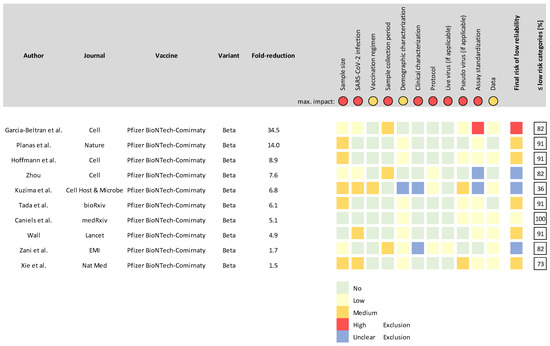
Figure 1.
Reliability assessment of ten selected studies reporting post-vaccination neutralization antibody titers against SARS-CoV-2 as determined using the RAT. Ten studies reporting fold-changes in neutralization capacity against the Beta variant and reflecting the full spectrum of the reported fold changes were assessed with the RAT. The aspect-specific impact on reliability is indicated in color-coded boxes on the right of the study, and the overall risk of low reliability is indicated in the same way as “Risk of low reliability”. In the last column, the cumulative percentage of aspects that returned only “no” or “low” risk of low reliability for each study is reported to further stratify the overall reliability.
4. Discussion
To facilitate the review and interpretation of time-sensitive information on vaccine effectiveness against emerging SARS-CoV-2 variants using post-vaccination neutralization antibody titers, we identified and characterized aspects that may affect the reliability of these studies. Identifying studies that may have moderate or high risk of bias is important when considering their results in the context of the pool of studies and might provide insights into some of the causes of heterogeneity when observed. Many neutralization studies produce important data that might help tackle the current pandemic, and we expect most are conducted with the highest technical and analytical standards. Yet, we often observe that technical methodological details or critical information on the study cohort are absent from the manuscript, especially in short communications. This creates a missed opportunity because it automatically diminishes the reliability of the reported results when the reader cannot informatively assess the study.
The list of parameters could serve as a guidance checklist for future publications on the type and level of detail needed to ensure their study’s contribution to the literature is maximized, as well as inform on study design and technical methodologies. Studies assigned high reliability by the RAT may be more likely to be included in meta-analyses or have their results being taken into consideration in policy-making decisions. We therefore strongly encourage authors to consider the list of key parameters as publication guidelines and to address all applicable aspects.
We designed an easy-to-use tool (the RAT) that assesses the overall reliability of these studies to facilitate synthesis and meta-analysis of study results by identifying studies with potentially high or unclear impact on reliability to consider their exclusion or down-weighting. We developed the RAT to allow an objective, structured and comparable assessment of the reliability of neutralization studies. Applying the RAT to ten relevant example studies demonstrated that it is able to distinguish studies on the basis of degrees of completeness and reliability of key parameters and identify which parameters within each study may lower its reliability. The RAT could be used to screen a wider body of available literature on SARS-CoV-2 post-vaccination neutralization to pinpoint the most common aspects responsible for reducing reliability or comparability. Specific recommendations could follow to avoid common mistakes and to harmonize studies across the globe.
This tool has several limitations. First, no experimental validation was performed to confirm the impact of these aspects. However, the aspects and their possible impact on reliability were identified and assessed based on our scientific expertise, our particular experience in screening all pertinent literature in the past year, as well as discussions with other experts in the field. Second, studies assessing post-vaccination neutralization antibody titers against SARS-CoV-2 cover a broad spectrum of clinical, technical or epidemiological settings, and not all aspects that are used in this tool may always apply to the specific setup of a study. Therefore, it is important to consider the study setting when using this tool. To address this limitation, we encourage a differentiated reporting which will identify the strengths and weaknesses of a particular study not only by considering the overall study reliability assessment, but also by focusing on the reliability of each individual aspect. This allows highlighting certain categories that may be more applicable or important than others in the study-specific setting. It is important to mention that, while we strived to develop the tool in a way that it is easy to use, it requires the assessment of technical details such as cell culture-associated effects or details about the neutralization assay itself, which may require the user to have at least a basic understanding of virological and serology techniques.
5. Conclusions
We hope that this tool will contribute to the usefulness of SARS-CoV-2 neutralization literature by identifying studies with low impact on reliability to target for evidence synthesis and to guide future studies in improving the impartiality of the results they report.
Supplementary Materials
The following supporting information can be downloaded at: https://www.mdpi.com/article/10.3390/vaccines10060850/s1.
Author Contributions
I.S. and H.J. developed the tool and wrote the manuscript. M.J., M.N.M., D.G., D.R.F., N.B.-Z., M.M.H. and M.D.K. revised the identified aspects, the tool and the conclusions drawn. All authors have read and agreed to the published version of the manuscript.
Funding
Coalition for Epidemic Preparedness Innovations (CEPI), grant number 138587.
Institutional Review Board Statement
Not applicable.
Informed Consent Statement
Not applicable.
Data Availability Statement
Not applicable.
Conflicts of Interest
The authors declare no conflict of interest.
References
- World Health Organization. WHO COVID-19 Dashboard. 2021. Available online: https://covid19.who.int/ (accessed on 10 June 2021).
- Liu, Q.; Qin, C.; Liu, M.; Liu, J. Effectiveness and safety of SARS-CoV-2 vaccine in real-world studies: A systematic review and meta-analysis. Infect. Dis. Poverty 2021, 10, 132. [Google Scholar] [CrossRef] [PubMed]
- Calzetta, L.; Ritondo, B.; Coppola, A.; Matera, M.; Di Daniele, N.; Rogliani, P. Factors Influencing the Efficacy of COVID-19 Vaccines: A Quantitative Synthesis of Phase III Trials. Vaccines 2021, 9, 341. [Google Scholar] [CrossRef] [PubMed]
- Zimmermann, P.; Curtis, N. Factors That Influence the Immune Response to Vaccination. Clin. Microbiol. Rev. 2019, 32, e00084-18. [Google Scholar] [CrossRef] [PubMed] [Green Version]
- Katz, J.M.; Hancock, K.; Xu, X. Serologic assays for influenza surveillance, diagnosis and vaccine evaluation. Expert Rev. Anti. Infect. Ther. 2011, 9, 669–683. [Google Scholar] [CrossRef] [PubMed] [Green Version]
- Gauger, P.C.; Vincent, A.L. Serum Virus Neutralization Assay for Detection and Quantitation of Serum Neutralizing Antibodies to Influenza A Virus in Swine. Methods Mol. Biol. 2020, 2123, 321–333. [Google Scholar]
- Ciconello, F.N.; Katz, I.S.S.; Fernandes, E.R.; Guedes, F.; Silva, S.R. A comparative review of serological assays for the detection of rabies virus-specific antibodies. Acta Trop. 2021, 226, 106254. [Google Scholar] [CrossRef]
- Moore, S.M.; Ricke, T.A.; Davis, R.D.; Briggs, D.J. The influence of homologous vs. heterologous challenge virus strains on the serological test results of rabies virus neutralizing assays. Biologicals 2005, 3, 269–276. [Google Scholar]
- Payne, S. Chapter 4-Methods to Study Viruses. In Viruses; Payne, S., Ed.; Academic Press: Cambridge, MA, USA, 2017; pp. 37–52. [Google Scholar]
- Galipeau, Y.; Greig, M.; Liu, G.; Driedger, M.; Langlois, M.A. Humoral Responses and Serological Assays in SARS-CoV-2 Infections. Front. Immunol. 2020, 11, 610688. [Google Scholar] [CrossRef]
- Younes, N.; Al-Sadeq, D.W.; Al-Jighefee, H.; Younes, S.; Al-Jamal, O.; Daas, H.I.; Nasrallah, G.K. Challenges in Laboratory Diagnosis of the Novel Coronavirus SARS-CoV-2. Viruses 2020, 12, 582. [Google Scholar] [CrossRef]
- Earle, K.A.; Ambrosino, D.M.; Fiore-Gartland, A.; Goldblatt, D.; Gilbert, P.B.; Siber, G.R.; Plotkin, S.A. Evidence for antibody as a protective correlate for COVID-19 vaccines. Vaccine 2021, 39, 4423–4428. [Google Scholar] [CrossRef]
- Matusali, G.; Colavita, F.; Lapa, D.; Meschi, S.; Bordi, L.; Piselli, P.; COVID, I. SARS-CoV-2 Serum Neutralization Assay: A Traditional Tool for a Brand-New Virus. Viruses 2021, 13, 655. [Google Scholar] [CrossRef]
- Dogan, M.; Kozhaya, L.; Placek, L.; Gunter, C.; Yigit, M.; Hardy, R.; Unutmaz, D. SARS-CoV-2 specific antibody and neutralization assays reveal the wide range of the humoral immune response to virus. Commun. Biol. 2021, 4, 129. [Google Scholar] [CrossRef]
- Riepler, L.; Rössler, A.; Falch, A.; Volland, A.; Borena, W.; von Laer, D.; Kimpel, J. Comparison of Four SARS-CoV-2 Neutralization Assays. Vaccines 2020, 9, 13. [Google Scholar] [CrossRef]
- Jacobsen, H.; Sitaras, I. Results of Studies Evaluating the Impact of SARSCoV-2 Variants of Concern on COVID-19 Vaccines: An Ongoing Systematic Review. 21 March 2022. Available online: https://view-hub.org/sites/default/files/2022-03/Neutralization%20Plots.pdf (accessed on 10 April 2022).
- Saadat, S.; Tehrani, Z.R.; Logue, J.; Newman, M.; Frieman, M.B.; Harris, A.D.; Sajadi, M.M. Binding and Neutralization Antibody Titers After a Single Vaccine Dose in Health Care Workers Previously Infected With SARS-CoV-2. JAMA 2021, 325, 1467–1469. [Google Scholar] [CrossRef] [PubMed]
- Stamatatos, L.; Czartoski, J.; Wan, Y.H.; Homad, L.J.; Rubin, V.; Glantz, H.; McGuire, A.T. mRNA vaccination boosts cross-variant neutralizing antibodies elicited by SARS-CoV-2 infection. Science 2021, 372, 1413–1418. [Google Scholar] [CrossRef] [PubMed]
- Vicenti, I.; Gatti, F.; Scaggiante, R.; Boccuto, A.; Zago, D.; Basso, M.; Parisi, S.G. Single-dose BNT162b2 mRNA COVID-19 vaccine significantly boosts neutralizing antibody response in health care workers recovering from asymptomatic or mild natural SARS-CoV-2 infection. Int. J. Infect. Dis. 2021, 108, 176–178. [Google Scholar] [CrossRef] [PubMed]
- Payne, R.P.; Longet, S.; Austin, J.A.; Skelly, D.T.; Dejnirattisai, W.; Adele, S.; Zawia, A.A. Immunogenicity of standard and extended dosing intervals of BNT162b2 mRNA vaccine. Cell 2021, 184, 5699–5714.e11. [Google Scholar] [CrossRef] [PubMed]
- Flaxman, A.; Marchevsky, N.G.; Jenkin, D.; Aboagye, J.; Aley, P.K.; Angus, B.; Belij-Rammerstorfer, S.; Bibi, S.; Bittaye, M.; Cappuccini, F.; et al. Reactogenicity and immunogenicity after a late second dose or a third dose of ChAdOx1 nCoV-19 in the UK: A substudy of two randomised controlled trials (COV001 and COV002). Lancet 2021, 398, 981–990. [Google Scholar] [CrossRef]
- Hillus, D.; Schwarz, T.; Tober-Lau, P.; Vanshylla, K.; Hastor, H.; Thibeault, C.; Jentzsch, S.; Helbig, E.T.; Lippert, L.J.; Tscheak, P.; et al. Safety, reactogenicity, and immunogenicity of homologous and heterologous prime-boost immunisation with ChAdOx1 nCoV-19 and BNT162b2: A prospective cohort study. Lancet. Respir. Med. 2021, 9, 1255–1265. [Google Scholar] [CrossRef]
- Barros-Martins, J.; Hammerschmidt, S.I.; Cossmann, A.; Odak, I.; Stankov, M.V.; Morillas Ramos, G.; Behrens, G. Immune responses against SARS-CoV-2 variants after heterologous and homologous ChAdOx1 nCoV-19/BNT162b2 vaccination. Nat. Med. 2021, 27, 1525–1529. [Google Scholar] [CrossRef]
- Hammerschmidt, S.I.; Bosnjak, B.; Bernhardt, G.; Friedrichsen, M.; Ravens, I.; Dopfer-Jablonka, A.; Förster, R. Neutralization of the SARS-CoV-2 Delta variant after heterologous and homologous BNT162b2 or ChAdOx1 nCoV-19 vaccination. Cell Mol. Immunol. 2021, 18, 2455–2456. [Google Scholar] [CrossRef] [PubMed]
- Doria-Rose, N.; Suthar, M.S.; Makowski, M.; O’Connell, S.; McDermott, A.B.; Flach, B.; Ledgerwood, J.E.; Mascola, J.R.; Graham, B.S.; Lin, B.C.; et al. Antibody Persistence through 6 Months after the Second Dose of mRNA-1273 Vaccine for COVID-19. N. Engl. J. Med. 2021, 384, 2259–2261. [Google Scholar] [CrossRef] [PubMed]
- Collier, A.-R.Y.; Yu, J.; McMahan, K.; Liu, J.; Chandrashekar, A.; Maron, J.S.; Atyeo, C.; Martinez, D.R.; Ansel, J.L.; Aguayo, R.; et al. Differential Kinetics of Immune Responses Elicited by COVID-19 Vaccines. N. Engl. J. Med. 2021, 385, 2010–2012. [Google Scholar] [CrossRef] [PubMed]
- Levin, E.G.; Lustig, Y.; Cohen, C.; Fluss, R.; Indenbaum, V.; Amit, S.; Doolman, R.; Asraf, K.; Mendelson, E.; Ziv, A.; et al. Waning Immune Humoral Response to BNT162b2 COVID-19 Vaccine over 6 Months. N. Engl. J. Med. 2021, 385, e84. [Google Scholar] [CrossRef] [PubMed]
- Bates, T.A.; Leier, H.C.; Lyski, Z.L.; Goodman, J.R.; Curlin, M.E.; Messer, W.B.; Tafesse, F.G. Age-Dependent Neutralization of SARS-CoV-2 and P.1 Variant by Vaccine Immune Serum Samples. JAMA 2021, 326, 868–869. [Google Scholar]
- Collier, D.A.; Ferreira, I.A.; Kotagiri, P.; Datir, R.P.; Lim, E.Y.; Touizer, E.; Gupta, R.K. Age-related immune response heterogeneity to SARS-CoV-2 vaccine BNT162b2. Nature 2021, 596, 417–422. [Google Scholar] [CrossRef]
- Müller, L.; Andrée, M.; Moskorz, W.; Drexler, I.; Walotka, L.; Grothmann, R.; Schaal, H. Age-dependent immune response to the Biontech/Pfizer BNT162b2 COVID-19 vaccination. Clin. Infect. Dis. 2021, 73, 2065–2072. [Google Scholar] [CrossRef]
- Grzelak, L.; Velay, A.; Madec, Y.; Gallais, F.; Staropoli, I.; Schmidt-Mutter, C.; Wendling, M.-J.; Meyer, N.; Planchais, C.; Rey, D.; et al. Sex Differences in the Evolution of Neutralizing Antibodies to Severe Acute Respiratory Syndrome Coronavirus 2. J. Infect. Dis. 2021, 224, 983–988. [Google Scholar] [CrossRef]
- Markmann, A.J.; Giallourou, N.; Bhowmik, D.R.; Hou, Y.J.; Lerner, A.; Martinez, D.R.; Bartelt, L.A. Sex Disparities and Neutralizing-Antibody Durability to SARS-CoV-2 Infection in Convalescent Individuals. mSphere 2021, 6, e0027521. [Google Scholar] [CrossRef]
- Liu, C.; Ginn, H.M.; Dejnirattisai, W.; Supasa, P.; Wang, B.; Tuekprakhon, A.; Screaton, G.R. Reduced neutralization of SARS-CoV-2 B.1.617 by vaccine and convalescent serum. Cell 2021, 184, 4220–4236.e13. [Google Scholar]
- Haidar, G.; Agha, M.; Lukanski, A.; Linstrum, K.; Troyan, R.; Bilderback, A.; Mellors, J.W. Immunogenicity of COVID-19 Vaccination in Immunocompromised Patients: An Observational, Prospective Cohort Study Interim Analysis. medRxiv. 2021. Available online: https://www.medrxiv.org/content/10.1101/2021.06.28.21259576v1 (accessed on 10 April 2022).
- Galmiche, S.; Nguyen, L.B.L.; Tartour, E.; de Lamballerie, X.; Wittkop, L.; Loubet, P.; Launay, O. Immunological and clinical efficacy of COVID-19 vaccines in immunocompromised populations: A systematic review. Clin. Microbiol. Infect. 2021, 28, 163–177. [Google Scholar] [CrossRef] [PubMed]
- Sekirov, I.; Petric, M.; Carruthers, E.; Lawrence, D.; Pidduck, T.; Kustra, J.; Morshed, M. Performance comparison of micro-neutralization assays based on surrogate SARS-CoV-2 and WT SARS-CoV-2 in assessing virus-neutralizing capacity of anti-SARS-CoV-2 antibodies. Access Microbiol. 2021, 3, 000257. [Google Scholar] [CrossRef] [PubMed]
- Von Rhein, C.; Scholz, T.; Henss, L.; Kronstein-Wiedemann, R.; Schwarz, T.; Rodionov, R.N.; Schnierle, B.S. Comparison of potency assays to assess SARS-CoV-2 neutralizing antibody capacity in COVID-19 convalescent plasma. J. Virol. Methods 2021, 288, 114031. [Google Scholar] [CrossRef] [PubMed]
- Chaudhry, M.Z.; Eschke, K.; Hoffmann, M.; Grashoff, M.; Abassi, L.; Kim, Y.; Brunotte, L.; Ludwig, S.; Kroeger, A.; Klawonn, F.; et al. Rapid SARS-CoV-2 Adaptation to Available Cellular Proteases. J. Virol. 2022, 96, e02186-21. [Google Scholar] [CrossRef]
- Lamers, M.M.; Mykytyn, A.Z.; Breugem, T.I.; Wang, Y.; Wu, D.C.; Riesebosch, S.; Haagmans, B.L. Human airway cells prevent SARS-CoV-2 multibasic cleavage site cell culture adaptation. Elife 2021, 10, e66815. [Google Scholar] [CrossRef]
- Davidson, A.D.; Williamson, M.K.; Lewis, S.; Shoemark, D.; Carroll, M.W.; Heesom, K.J.; Matthews, D.A. Characterisation of the transcriptome and proteome of SARS-CoV-2 reveals a cell passage induced in-frame deletion of the furin-like cleavage site from the spike glycoprotein. Genome Med. 2020, 12, 68. [Google Scholar] [CrossRef]
- Klimstra, W.B.; Tilston-Lunel, N.L.; Nambulli, S.; Boslett, J.; McMillen, C.M.; Gilliland, T.; Dunn, M.D.; Sun, C.; Wheeler, S.E.; Wells, A.; et al. SARS-CoV-2 growth, furin-cleavage-site adaptation and neutralization using serum from acutely infected hospitalized COVID-19 patients. J. Gen. Virol. 2020, 101, 1156–1169. [Google Scholar] [CrossRef]
- Kristiansen, P.A.; Page, M.; Bernasconi, V.; Mattiuzzo, G.; Dull, P.; Makar, K.; Knezevic, I. WHO International Standard for anti-SARS-CoV-2 immunoglobulin. Lancet 2021, 397, 1347–1348. [Google Scholar] [CrossRef]
- Sitaras, I. Antigenic Cartography: Overview and Current Developments. Methods Mol. Biol. 2020, 2123, 61–68. [Google Scholar]
Publisher’s Note: MDPI stays neutral with regard to jurisdictional claims in published maps and institutional affiliations. |
© 2022 by the authors. Licensee MDPI, Basel, Switzerland. This article is an open access article distributed under the terms and conditions of the Creative Commons Attribution (CC BY) license (https://creativecommons.org/licenses/by/4.0/).