

Aortic Valve Replacement: Totally Endoscopic versus Mini-Sternotomy
 , ,
, ,
Abstract
:1. Introduction
2. Materials and Methods
2.1. Patients
2.2. Surgical Technique
2.3. Outcomes
2.4. Statistical Analysis
3. Results
3.1. Patient Demographics
3.2. Perioperative Data
3.3. Postoperative Parameters
3.4. MACCE
3.5. All-Cause Mortality
4. Discussion
Limitations
5. Conclusions
Author Contributions
Funding
Institutional Review Board Statement
Informed Consent Statement
Data Availability Statement
Conflicts of Interest
References
- Van Praet, K.M.; Kampen, A.; Kofler, M.; Richter, G.; Sündermann, S.H.; Meyer, A.; Unbehaun, A.; Kurz, S.; Jacobs, S.; Falk, V.; et al. Minimally invasive surgical aortic valve replacement: The RALT approach. J. Card. Surg. 2020, 35, 2341–2346. [Google Scholar] [CrossRef] [PubMed]
- Bonacchi, M.; Dokollari, A.; Parise, O.; Sani, G.; Prifti, E.; Bisleri, G.; Gelsomino, S. Ministernotomy compared with right anterior minithoracotomy for aortic valve surgery. J. Thorac. Cardiovasc. Surg. 2021, 165, 1022–1032.e2. [Google Scholar] [CrossRef] [PubMed]
- Vola, M.; Fuzellier, J.F.; Chavent, B.; Duprey, A. First human totally endoscopic aortic valve replacement: An early report. J. Thorac. Cardiovasc. Surg. 2014, 147, 1091–1093. [Google Scholar] [CrossRef] [PubMed]
- Cresce, G.D.; Sella, M.; Hinna Danesi, T.; Favaro, A.; Salvador, L. Minimally Invasive Endoscopic Aortic Valve Replacement: Operative Results. Semin. Thorac. Cardiovasc. Surg. 2020, 32, 416–423. [Google Scholar] [CrossRef] [PubMed]
- Tokoro, M.; Sawaki, S.; Ozeki, T.; Orii, M.; Usui, A.; Ito, T. Totally endoscopic aortic valve replacement via an anterolateral approach using a standard prosthesis. Interact. Cardiovasc. Thorac. Surg. 2020, 30, 424–430. [Google Scholar] [CrossRef]
- Pitsis, A.; Boudoulas, H.; Boudoulas, K.D. Operative steps of totally endoscopic aortic valve replacement. Interact. Cardiovasc. Thorac. Surg. 2020, 31, 424. [Google Scholar] [CrossRef] [PubMed]
- Zhou, K.; Yang, L.; He, B.C.; Ke, Y.J.; Yang, Y.C.; Yan, Q.; Chen, Z.R.; Huang, H.L. Total thoracoscopic repair of ventricular septal defect: A single-center experience. J. Card. Surg. 2021, 36, 2213–2218. [Google Scholar] [CrossRef]
- Yilmaz, A.; Rehman, A.; Sonker, U.; Kloppenburg, G.T. Minimal access aortic valve replacement using a minimal extracorporeal circulatory system. Ann. Thorac. Surg. 2009, 87, 720–725. [Google Scholar] [CrossRef]
- Yilmaz, A.; Van Genechten, S.; Claessens, J.; Packlé, L.; Maessen, J.; Kaya, A. A totally endoscopic approach for aortic valve surgery. Eur. J. Cardiothorac. Surg. 2022, 62, ezac467. [Google Scholar] [CrossRef]
- Vahanian, A.; Beyersdorf, F.; Praz, F.; Milojevic, M.; Baldus, S.; Bauersachs, J.; Capodanno, D.; Conradi, L.; De Bonis, M.; De Paulis, R.; et al. 2021 ESC/EACTS Guidelines for the management of valvular heart disease: Developed by the Task Force for the management of valvular heart disease of the European Society of Cardiology (ESC) and the European Association for Cardio-Thoracic Surgery (EACTS). Eur. Heart J. 2021, 43, 561–632. [Google Scholar] [CrossRef]
- Généreux, P.; Piazza, N.; Alu, M.C.; Nazif, T.; Hahn, R.T.; Pibarot, P.; Bax, J.J.; Leipsic, J.A.; Blanke, P.; Blackstone, E.H.; et al. Valve Academic Research Consortium 3: Updated Endpoint Definitions for Aortic Valve Clinical Research. J. Am. Coll. Cardiol. 2021, 77, 2717–2746. [Google Scholar] [CrossRef] [PubMed]
- Mourad, F.; Abd Al Jawad, M. Mini Sternotomy and Mini Thoracotomy for Aortic Valve Replacement: Is There a Difference? Heart Surg. Forum 2021, 24, e855–e859. [Google Scholar] [CrossRef]
- Tokoro, M.; Ito, T.; Maekawa, A.; Sawaki, S.; Yanagisawa, J.; Ozeki, T.; Orii, M. Trans-right axillary aortic valve replacement: Propensity-matched comparison with standard sternotomy approach†. Interact. Cardiovasc. Thorac. Surg. 2017, 25, 521–525. [Google Scholar] [CrossRef] [PubMed]
- Vo, A.T.; Nguyen, D.H.; Van Hoang, S.; Le, K.M.; Nguyen, T.T.; Nguyen, V.L.; Nguyen, B.H.; Truong, B.Q. Learning curve in minimally invasive mitral valve surgery: A single-center experience. J. Cardiothorac. Surg. 2019, 14, 213. [Google Scholar] [CrossRef] [PubMed]
- Masuda, T.; Nakamura, Y.; Ito, Y.; Kuroda, M.; Nishijima, S.; Okuzono, Y.; Hirano, T.; Hori, T. The learning curve of minimally invasive aortic valve replacement for aortic valve stenosis. Gen. Thorac. Cardiovasc. Surg. 2020, 68, 565–570. [Google Scholar] [CrossRef] [PubMed]
- Glauber, M.; Gilmanov, D.; Farneti, P.A.; Kallushi, E.; Miceli, A.; Chiaramonti, F.; Murzi, M.; Solinas, M. Right anterior minithoracotomy for aortic valve replacement: 10-year experience of a single center. J. Thorac. Cardiovasc. Surg. 2015, 150, 548–556.e2. [Google Scholar] [CrossRef] [PubMed]
- Hancock, H.C.; Maier, R.H.; Kasim, A.S.; Mason, J.M.; Murphy, G.J.; Goodwin, A.T.; Owens, W.A.; Kirmani, B.H.; Akowuah, E.F. Mini-Sternotomy Versus Conventional Sternotomy for Aortic Valve Replacement. J. Am. Coll. Cardiol. 2019, 73, 2491–2492. [Google Scholar] [CrossRef]
- Fischlein, T.; Folliguet, T.; Meuris, B.; Shrestha, M.L.; Roselli, E.E.; McGlothlin, A.; Kappert, U.; Pfeiffer, S.; Corbi, P.; Lorusso, R. Sutureless versus conventional bioprostheses for aortic valve replacement in severe symptomatic aortic valve stenosis. J. Thorac. Cardiovasc. Surg. 2021, 161, 920–932. [Google Scholar] [CrossRef]
- Mack, M.J.; Leon, M.B.; Thourani, V.H.; Makkar, R.; Kodali, S.K.; Russo, M.; Kapadia, S.R.; Malaisrie, S.C.; Cohen, D.J.; Pibarot, P.; et al. Transcatheter Aortic-Valve Replacement with a Balloon-Expandable Valve in Low-Risk Patients. N. Engl. J. Med. 2019, 380, 1695–1705. [Google Scholar] [CrossRef]
- Young Lee, M.; Chilakamarri Yeshwant, S.; Chava, S.; Lawrence Lustgarten, D. Mechanisms of Heart Block after Transcatheter Aortic Valve Replacement—Cardiac Anatomy, Clinical Predictors and Mechanical Factors that Contribute to Permanent Pacemaker Implantation. Arrhythmia Electrophysiol. Rev. 2015, 4, 81–85. [Google Scholar] [CrossRef]
- Glauber, M.; Ferrarini, M.; Miceli, A. Minimally invasive aortic valve surgery: State of the art and future directions. Ann. Cardiothorac. Surg. 2015, 4, 26–32. [Google Scholar] [CrossRef] [PubMed]
- Claessens, J.; Goris, P.; Yilmaz, A.; Van Genechten, S.; Claes, M.; Packlé, L.; Pierson, M.; Vandenbrande, J.; Kaya, A.; Stessel, B. Patient-Centred Outcomes after Totally Endoscopic Cardiac Surgery: One-Year Follow-Up. J. Clin. Med. 2023, 12, 4406. [Google Scholar] [CrossRef] [PubMed]
- Zoni, D.; Cresce, G.D.; Hinna-Danesi, T.; Benvegnù, L.; Poddi, S.; Gallo, M.; Sella, M.; Salvador, L. Endoscopic aortic valve surgery in isolated and concomitant procedures. Interdiscip. Cardiovasc. Thorac. Surg. 2023, 36, ivad101. [Google Scholar] [CrossRef] [PubMed]
- Gu, W.; Zhou, K.; Wang, Z.; Zang, X.; Guo, H.; Gao, Q.; Teng, Y.; Liu, J.; He, B.; Guo, H.; et al. Totally endoscopic aortic valve replacement: Techniques and early results. Front. Cardiovasc. Med. 2022, 9, 1106845. [Google Scholar] [CrossRef]



| Mini-AVR (N = 323) | TEAVR (N = 392) | p-Value | |
|---|---|---|---|
| Age (years) | 72.65 ± 9.93 | 71.20 ± 10.85) | 0.063 |
| Octogenarians | 86 (26.63) | 96 (24.49) | 0.514 |
| Gender (male) | 179 (55.42) | 234 (59.69) | 0.249 |
| BMI (kg/m2) | 27.89 ± 4.68 | 27.57 ± 4.74 | 0.373 |
| EuroSCORE II | 2.54 ± 2.22 | 2.33 ± 2.24 | 0.251 |
| NYHA score | 0.015 | ||
| 98 (30.34) 157 (48.61) 62 (19.20) 2 (0.62) | 124 (31.63) 220 (56.12) 43 (10.97) 4 (1.02) | |
Comorbidities
| 45 (13.93) 105 (32.51) 4 (1.24) 78 (24.15) | 78 (19.90) 60 (15.31) 3 (0.77) 84 (21.43) | <0.001 0.544 |
| 223 (69.04) 204 (63.16) 95 (29.41) 72 (22.29) 11 (3.41) 38 (11.76) 58 (17.96) | 238 (60.71) 257 (65.56) 76 (19.39) 61 (15.56) 13 (3.32) 26 (6.63) 270 (68.88) | 0.019 0.504 0.002 0.021 0.661 0.018 <0.001 |
| History of: | 0.013 | ||
| 20 (6.19) 8 (2.48) | 12 (3.06) 12 (3.06) | |
| LVEF (%) | 58.12 ± 11.92 | 58.83 ± 35.82 | 0.9187 |
TTE
| 80.07 ± 23.48 50.86 ± 16.13 0.74 ± 0.21 | 73.2 ± 21.95 48.04 ± 15.78 0.78 ± 0.21 | 0.002 0.090 0.050 |
| Bicuspid valve | 30 (9.29) | 72 (18.37) | <0.001 |
| Mini-AVR (N = 323) | TEAVR (N = 392) | p-Value | |
|---|---|---|---|
| Indication for surgery | 0.202 | ||
| 289 (89.47) 10 (3.10) 24 (7.43) | 357 (91.07) 17 (4.34) 18 (4.59) | |
| Cross-clamping time (h) | 43.74 ± 13.73 | 61.93 ± 16.76 | <0.001 |
| CPB time (h) | 64.86 ± 23.02 | 93.23 ± 23.67 | <0.001 |
| Unplanned mechanical circulatory support | 0 (0) | 3 (0.77) | 0.115 |
| Perioperative bleeding (mL) | 706.40 ± 542.77 | 444.50 ± 515.84 | <0.001 |
Transfusion
| 111 (34.37) 2.03 ± 1.19 16 (4.95) 2.94 ± 1.12) 28 (8.67) 1.21 ± 0.42 | 57 (14.54) 1.84 ± 0.90 1 (0.26) 3 ± 0 1 (0.26) 1 ± 0 | <0.001 <0.001 <0.001 |
| Aortic prosthesis | <0.001 | ||
| 254 (78.64) 50 (15.48) 0 (0) 9 (2.79) 6 (1.86) 2 (0.62) 2 (0.62) | 218 (55.61) 70 (17.86) 9 (2.30) 1 (0.26) 72 (18.37) 14 (3.57) 7 (1.79) | |
| Conversion | 0.288 | ||
| 0 (0) / | 0 (0) 1 (0.26) |
| Continuous Data | |||||
|---|---|---|---|---|---|
| Mini-AVR (N = 323) | TEAVR (N = 392) | p-Value | Estimate | 95% CI | |
| Ventilation time (h) | 10.51 ± 18.93 | 12.85 ± 64.55 | 0.409 | 3.90 | −5.35–13.16 |
| Bleeding 24 h (mL) | 230.60 ± 159.04 | 297.30 ± 291.52 | <0.001 | 78.38 | 33.23–123.53 |
| ICU LOS (h) | 69.64 ± 68.68 | 60.41 ± 133.41 | 0.853 | −1.90 | −22.08–18.27 |
| Hospital LOS (days) | 10.12 ± 7.63 | 7.09 ± 10.96 | 0.002 | −2.78 | −4.56 to −0.99 |
LVEF (%)
| 56.39 ± 9.64 55.67 ± 11.37 | 55.88 ± 10.66 57.90 ± 10.39 | 0.883 0.295 | −0.17 1.64 | −2.47–2.12 −1.42–4.69 |
| TTE In-hospital
| 22.81 ± 8.31 13.05 ± 4.85 1.76 ± 0.40 | 20.21 ± 9.27 12.05 ± 6.10 1.93 ± 0.48 | 0.057 0.371 0.022 | −2.38 −0.85 0.22 | −4.83–0.07 −2.70–1.00 0.03–0.41 |
Follow-up
| 22.63 ± 11.19 14.09 ± 8.12 1.63 ± 0.51 1766 ± 1011.46 | 20.13 ± 12.19 12.01 ± 5.27 1.77 ± 0.42 605.5 ± 507.95 | 0.034 0.081 0.605 <0.001 | −3.27 −2.16 0.07 −1227.70 | −6.27 to −0.26 −4.57–0.25 −0.18–0.31 −1383.26 to −1072.14 |
| Clinical follow-up time (days) | 2 081 ± 895.43 | 742.9 ± 519.11 | <0.001 | −1381.11 | −1511.71 to −1250.50 |
| Clinical follow-up index | 0.91 ± 0.21 | 0.75 ± 0.34 | <0.001 | −0.20 | −0.25 to −0.15 |
| Categorical Data | |||||
| Mini-AVR (N = 323) | TEAVR (N = 392) | p-Value | OR | 95% CI | |
| Unplanned mechanical circulatory support | 3 (0.93) | 4 (1.02) | 0.077 | 0.08 | 0.002–1.03 |
Transfusions
| 75 (23.15) 3.05 ± 2.33 17 (5.25) 212.12 ± 0.78 21 (6.48) 1.33 ± 0.48 | 64 (16.33) 3.80 ± 3.05 13 (3.32) 1.85 ± 0.55 20 (5.10) 1.2 ± 0.41 | <0.001 0.002 <0.001 | 0.21 0.05 0.04 | 0.13–0.36 0.006–0.28 0.005–0.15 |
| Reoperation (<48 h) | 10 (3.09) | 16 (4.08) | 0.206 | 1.93 | 0.005–0.15 |
| 4 (1.23) 6 (1.85) 0 (0) | 13 (3.32) 5 (1.28) 0 (0) | |||
| Reoperation (>48 h) | 3 (0.93) | 2 (0.51) | 0.102 | 0.14 | 0.010–1.39 |
| 0 (0) 1 (0.31) 0 (0) 1 (0.31) 1 (0.31) 0 (0) | 0 (0) 1 (0.26) 0 (0) 0 (0) 0 (0) 1 (0.26) | |||
| Reoperation (>7 days) | 10 (3.09) | 7 (1.79) | 0.204 | 0.46 | 0.13–1.49 |
| 1 (0.31) 7 (2.16) 1 (0.31) 1 (0.31) 0 (0) | 2 (0.51) 3 (0.77) 0 (0) 1 (0.26) 1 (0.26) | |||
Paravalvular leakage
| 6 (1.85) 10 (3.09) | 2 (0.51) 11 (2.81) | 0.624 0.105 | 0.57 0.44 | 0.05–4.77 0.16–1.19 |
| Endocarditis | 10 (3.09) | 6 (1.53) | 0.357 | 0.57 | 0.16–1.84 |
| Valve mispositioning | 0 (0) | 0 (0) | - | - | - |
| Mediastinitis | 1 (0.31) | 0 (0) | - * | - * | - * |
| New-onset AF Electric cardioversion | 104 (32.10) 48 (14.81) | 97 (24.74) 22 (5.61) | 0.030 0.118 | 0.61 0.58 | 0.39–0.95 0.29–1.14 |
| Conduction disturbance | 44 (13.58) | 72 (18.37) | 0.028 | 1.79 | 1.07–3.04 |
| 30-day PPM | 12 (3.70) | 32 (8.16) | 0.001 | 4.29 | 1.80–10.80 |
| Vascular complications | 0.090 | 0.38 | 0.12–1.13 | ||
| 15 (4.63) 0 (0) | 7 (1.79) 1 (0.26) | |||
| Neurological complications | 30 (9.26) | 20 (5.10) | 0.026 | 0.44 | 0.21–0.90 |
| 13 (4.01) 4 (1.23) 13 (4.01) | 11 (2.81) 2 (0.51) 7 (1.79) | |||
| Neurological timing | 0.246 | 0.63 | 0.29–1.41 | ||
| 2 (0.62) 15 (4.63) 4 (1.23) 21 (6.48) | 3 (0.77) 11 (2.81) 3 (0.77) 9 (2.30) | |||
| AKI Renal replacement therapy | 29 (8.95) 2 (0.62) | 12 (3.06) 8 (2.04) | 0.464 0.365 | 0.73 2.48 | 0.30–1.67 0.41–22.97 |
| Cardiac related readmissions | 73 (22.53) | 72 (18.37) | 0.200 | 0.74 | 0.46–1.18 |
| Mini-AVR (N = 323) | TEAVR (N = 392) | p-Value | OR | 95% CI | |
|---|---|---|---|---|---|
| Periprocedural mortality | 0 (0) | 1 (0.26) | 0.999 | 2.12 × 10 24 | 0.00–Inf |
Causes of death
| 0 (0) 0 (0) 0 (0) 0 (0) | 1 (0.26) 0 (0) 0 (0) 0 (0) | |||
| 30-day mortality rate | 4 (1.24) | 7 (1.79) | 0.826 | 1.99 | −0.54–8.12 |
Causes of death
| 4 (1.24) 0 (0) 0 (0) 0 (0) | 4 (1.03) 0 (0) 3 (0.77) 0 (0) | |||
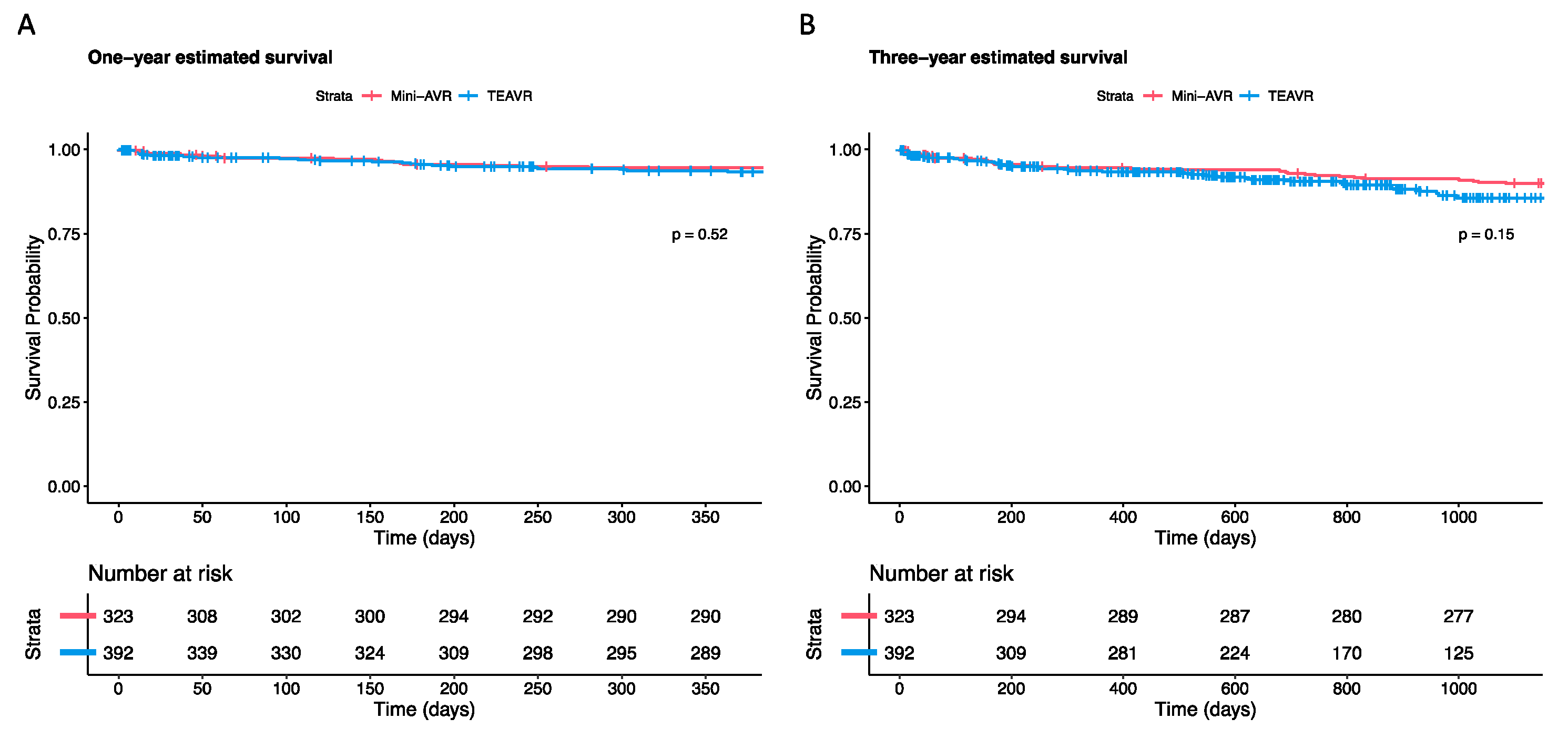
| One-year survival (%) | 94.5 | 93.3 | 0.520 * | ||
Causes of death
| 6 (1.86) 0 (0) 3 (0.93) 8 (2.48) | 5 (1.28) 0 (0) 11 (2.81) 7 (1.79) | |||
| Three-year survival (%) | 89.9 | 85.6 | 0.150 * | ||
Causes of death
| 8 (2.48) 0 (0) 8 (2.48) 15 (4.65) | 9 (2.30) 0 (0) 17 (4.34) 12 (3.06) |
Disclaimer/Publisher’s Note: The statements, opinions and data contained in all publications are solely those of the individual author(s) and contributor(s) and not of MDPI and/or the editor(s). MDPI and/or the editor(s) disclaim responsibility for any injury to people or property resulting from any ideas, methods, instructions or products referred to in the content. |
© 2023 by the authors. Licensee MDPI, Basel, Switzerland. This article is an open access article distributed under the terms and conditions of the Creative Commons Attribution (CC BY) license (https://creativecommons.org/licenses/by/4.0/).
Share and Cite
Yilmaz, A.; Claessens, J.; Packlé, L.; Van Genechten, S.; Dönmez, K.; Awouters, C.; Herbots, L. Aortic Valve Replacement: Totally Endoscopic versus Mini-Sternotomy. J. Clin. Med. 2023, 12, 7300. https://doi.org/10.3390/jcm12237300
Yilmaz A, Claessens J, Packlé L, Van Genechten S, Dönmez K, Awouters C, Herbots L. Aortic Valve Replacement: Totally Endoscopic versus Mini-Sternotomy. Journal of Clinical Medicine. 2023; 12(23):7300. https://doi.org/10.3390/jcm12237300
Chicago/Turabian StyleYilmaz, Alaaddin, Jade Claessens, Loren Packlé, Silke Van Genechten, Kübra Dönmez, Camille Awouters, and Lieven Herbots. 2023. "Aortic Valve Replacement: Totally Endoscopic versus Mini-Sternotomy" Journal of Clinical Medicine 12, no. 23: 7300. https://doi.org/10.3390/jcm12237300