

Episodic and Semantic Autobiographical Memory in Mild Cognitive Impairment (MCI): A Systematic Review

Abstract
:1. Introduction
2. Method
2.1. Research Questions
- Is autobiographical memory impaired, and to what degree in patients with MCI?
- Which components of AM are impaired and how are they impaired in MCI?
2.2. Search Strategy
2.3. Inclusion/Exclusion Criteria
2.4. Studies’ Risk of Bias
- (i)
- Attrition bias (which can be defined as the bias consequent of the presence of incomplete outcome data);
- (ii)
- Reporting bias (i.e., the bias resulting from the reporting of selective outcomes or the absence of reporting relevant results; reporting bias was considered low risk if all prespecified outcomes were reported, as suggested by Higgins et al. [20]).
- (i)
- Sample bias (i.e., bias resulting in samples that do not represent the general population, undermining the generalization of results, or lack of demographic information, such as female ratio, mean age, or mean schooling years);
- (ii)
- Measurement bias (i.e., bias due to using non-validated tasks to measure autobiographical memory).
3. Results
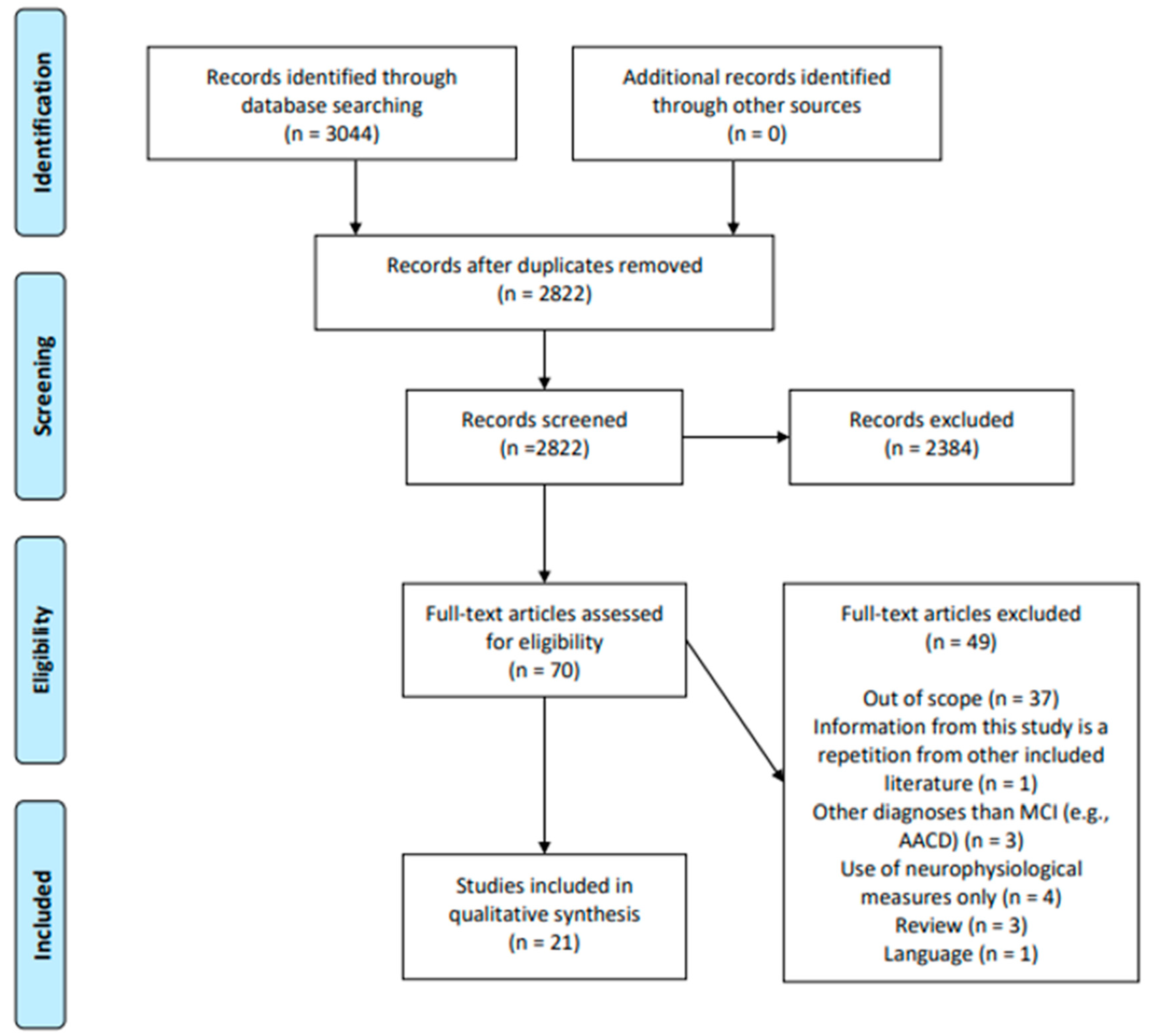
3.1. Overview
3.2. MCI Diagnosis
3.3. Episodic and Semantic Autobiographical Memory
3.4. Internal and External Details
3.5. Temporal Gradient

| Authors | Country | N | Groups | Sex (% F) | Mean Age (SD) | Mean Schooling Years (SD) | MCI Diagnostic Criteria | AM Assessment | Episodic/ Semantic | Cognitive Assessment | Results |
|---|---|---|---|---|---|---|---|---|---|---|---|
| Barnabe et al., 2012 [21] | Canada | 20 20 | aMCI HC | 40% 70% | 76.40 (6.87) 78.35 (5.75) | 14.60 (4.30) 14.45 (2.74) | Petersen et al., 2001 [5] | Episodic and semantic |
| Using AMI, HC had a better performance than patients with MCI (p < 0.01) in autobiographical episodic memory, and there were no differences in autobiographical semantic memory (p = 0.16). Using AI, HC recalled more internal details than the MCI (p < 0.001) group, while there were no differences in external details. | |
| Bastin et al., 2013 [34] | Belgium | 35 24 | aMCI HC | 34% 75% | 73.9 (6.6) 73.2 (7.2) | 13 (3.5) 12.5 (2.8) | Petersen and Negash, 2008 [43] | Episodic Autobiographical Memory Questionnaire | Episodic |
| HC recalled more internal details than aMCI (post hoc Tukey tests, p < 0.05), while there were no differences in external details (p > 0.71). |
| Berna et al., 2012 [35] | Germany | 63 138 | MCI HC | 46% 53% | 74.02 (0.87) 73.84 (0.89) | 12.29 (2.11) 13.84 (3.04) | Petersen et al., 2001 [5] | Semi-structured interview that assesses the episodic component. | Episodic |
| HC had a better performance in autobiographical episodic memory than MCI (p = 0.02). |
| Bizzozero et al., 2012 [22] | Italy | 19 19 | aMCI HC | 79% 79% | 74.9 (4.7) 75 (4.4) | 7.6 (2.6) 7.9 (2.5) | Petersen et al., 1999 [2] | AM enquiry by Borrini et al. [44] | Episodic and semantic |
| HC had a better performance than aMCI (t = 4.33, df = 36, p < 0.0001) in the overall autobiographical memory. After distinguishing a posteriori the contribution of the “personal semantics” component and the episodic component, it was shown that HC performed better in both of them compared to aMCI. |
| Buckley et al., 2014 [29] | Australia | 11 31 | MCI HC | 46% 48% | 79.09 (7.3) 77.23 (7.2) | - | Petersen et al., 1999 [2] | EAMI [45] | Episodic and semantic |
| HC (M = 0.01, SD = 1.0) had a better performance in episodic autobiographical memory than participants with MCI (M = −1.00, SD = 0.9). Instead, there were no significant differences in autobiographical semantic memory between the MCI group (M = −0.60, SD = 1.1) and the HC group (M = 0.03, SD = 0.8). |
| Buckley et al., 2014 [30] | Australia | 43 43 | MCI HC | 58% 56% | 79.6 (6.9) 73.77 (6.1) | - | Winblad et al., 2004 [46] | EAMI [45] | Episodic and semantic |
| MCI participants performed significantly worse on episodic autobiographical memory recall (M = 3.53, SD = 2) than HC (M = 5.16, SD = 1.2). Moreover, they also performed significantly worse on autobiographical semantic memory (M = 9.70, SD = 4.2) than the HC group (M = 12.91, SD = 1.3). |
| Davidson et al., 2016 [36] | Canada | 19 34 | MCI HC | 53% 62% | 75.63 (6.23) 70.09 (4.32) | 16.68 (3.96) 16.06 (2.80) | Petersen et al., 1999 [2] | Ad hoc telephone questionnaire regarding the lab visit (from 1 to 13 days after the visit). | Episodic |
| MCI had a worse performance than HC in remembering the details of the episodic event. |
| De Simone et al., 2017 [37] | Italy | 18 18 | aMCI HC | 55% 55% | 73.4 (6.3) 71.4 (7.8) | 12.1 (3.7) 13.7 (3.2) | Petersen et al., 2014 [47] | Ad hoc measure in which participants were asked to recall the personal events that occurred when they first learned about 50 famous events that were previously selected. | Episodic |
| HC group had a better performance (mean 2 SD ± 0.88) than the aMCI group (mean 1.07 SD ± 1.06). |
| Donix et al., 2010 [38] | Germany | 16 16 | aMCI HC | 44% 56% | 63.13 (5.78) 62.94 (5.73) | 9 (4.3) 9.82 (4.22) | Petersen, 2004 [48] | ABM task [49] | Episodic |
| HC had fewer extended (p = 0.004) memories and an increased number of specific memories (p < 0.001). Therefore, participants with aMCI showed less specificity than HC in episodic autobiographical memory. |
| Gamboz et al., 2010 [15] | Italy | 14 14 | aMCI HC | - | 74.7 (7.4) 73.5 (8) | 12.8 (5.1) 13 (2) | Petersen et al., 1999 [2] | Subjects had to respond to eight cue words, recalling (or imagining) four episodes (that occurred or will occur in the past or next year within their life) | Episodic and semantic |
| HC produced more internal details (M = 7.42; SD = 1.98) than aMCI (M = 4.42; SD = 1.87), t (27) = 4.11, p < 0.0001. aMCI produced more external details (M = 6.31; SD = 2.26) than HC (M = 3.23; SD = 1.36), t (27) =−4.37, p < 0.0001. |
| Irish et al., 2010 | Ireland | 16 18 | aMCI HC | 37% 78% | 71.8 (6.8) 76 (4.3) | 13.8 (4.7) 14 (3.1) | Winblad et al., 2004 [46] | EAMI [45] | Episodic and semantic |
| HC had a better performance than aMCI in autobiographical semantic memory (F (1,32 = 27.963; p < 0.0001) across all periods except childhood (p = 0.627) and early adulthood (p = 0.066). HC had a better performance than aMCI in episodic autobiographical memory (F (1,32) = 69.211; p < 0.0001) across all periods. |
| Leyhe et al., 2009 [24] | Germany | 20 20 | aMCI HC | 40% 70% | 72.6 (6.8) 71.6 (6.5) | 10.2 (5.2) 11.8 (2.8) | Petersen et al., 1999 [2] | AMI [42] | Episodic and semantic |
| HC had a better performance than aMCI (p < 0.05) in episodic autobiographical memory, while there were no differences in autobiographical semantic memory (p = 0.072). |
| Meléndez et al., 2016 [31] | Spain | 15 29 | aMCI HC | 73% 86% | 81.8 (7.8) 78.2 (5.1) | - | Petersen et al., 2001 [5] | AMI [42] | Episodic and semantic |
| HC had a better performance than aMCI in episodic autobiographical memory across all periods (p < 0.001). HC had a better performance than aMCI in autobiographical semantic memory, only in the recent life stage (p < 0.001). |
| Meléndez et al., 2019 [32] | Spain | 32 32 | aMCI HC | 62% 56% | 76.50 (5.44) 74.21 (4.67) | - | Petersen, 2004 [48] | AMT [49] | Episodic |
| HC had an increased number of specific responses than MCI (p = 0.010). |
| Meléndez et al., 2021 [33] | Spain | 17 26 | aMCI HC | 65% 61% | 77.35 (4.76) 74.53 (4.90) | - | Petersen, 2004 [48] | AMI [42] | Episodic and semantic |
| HC had a better performance than aMCI in episodic autobiographical memory (p = 0.010), while there were no differences in autobiographical semantic memory. |
| Müller et al., 2013 [25] | Germany | 20 20 | aMCI HC | 60% 65% | 72.6 (6.8) 71.9 (6.5) | 13.2 (5.2) 13.1 (2.6) | Petersen et al., 1999 [2] | AMI [42] | Episodic and semantic |
| aMCI has a significant different performance (p < 0.01) in the autobiographical episodic memory for recent life experiences compared to HC. Moreover, aMCI has a significantly different performance (p < 0.05) in the autobiographical semantic memory for recent life experiences compared to HC. |
| Müller et al., 2016 [26] | Germany | 20 21 | aMCI HC | 45% 48% | 73 (4.5) 72.4 (6.5) | 11.6 (3.4) 12.2 (3.2) | Petersen et al., 1999 [2] | AMI [42] | Episodic |
| HC had a better performance than aMCI in episodic autobiographical memories from early adulthood (p = 0.04) and recent life (p < 0.001), while there were no significant differences for the childhood period (p = 0.06). |
| Murphy et al., 2008 [16] | Canada | 17 18 | aMCI HC | 59% 44% | 76.2 (5.7) 74.2 (6.4) | 14.5 (2.8) 13.6 (3.5) | Petersen, 2004 [48] | AI [40] | Episodic and semantic |
| HC recalled an increased number of internal details (M = 89.83; SD = 39.21) than aMCI (M = 63.18; SD = 22.12). aMCI recalled more external details (M = 98.12; SD = 54.92) than HC (M = 62.39; SD = 27.42). |
| Serra et al., 2020 [39] | Italy | 17 13 | aMCI HC | 23% 61% | 71.8 (6.2) 69.6 (5.9) | 12.2 (4.2) 14.1 (2.7) | Albert et al., 2011 [1] | Modified version [50] of the AMI [42] | Episodic and semantic |
| HC performed better than aMCI in both the episodic and semantic autobiographical memory components. |
| Sheldon et al., 2015 [27] | Canada | 16 16 | aMCI HC | 38% 69% | 75.1 (5.7) 74.4 (7.4) | 15 (2.9) 15.1 (3) | Petersen, 2004 [48] | AI [40] | Episodic and semantic |
| HC produced more internal details (p = 0.09, d = 0.61) and fewer external details (p < 0.05, d = 0.79) than aMCI. |
| Tramoni et al., 2012 [28] | France | 14 14 | aMCI HC | 57% 57% | 75.1 (6.4) 70.4 (8.7) | 9.92 (3.43) 9.64 (2.59) | Petersen et al., 2001 [5] |
| Episodic and semantic |
| AMI: HC had a better performance than aMCI in both the episodic and the semantic autobiographical memory components, despite the time epochs. Test of familiar photographs: HC had a better performance than aMCI only for recently experienced episodes |
| Author | Diagnostic Criteria | Global Functioning | Subjective Complaint of Cognitive Decline | Objective Cognitive Impairment | Intact Functional Abilities | Absence of Dementia | Normal Mental Status |
|---|---|---|---|---|---|---|---|
| Barnabe et al., 2012 [21] | Petersen et al., 2001 [5] | √ | <1 SD | √ | √ | √ | |
| Bastin et al., 2013 [34] | Petersen and Negash, 2008 [43] | √ | √ | √ | |||
| Berna et al., 2012 [35] | Petersen et al., 2001 [5] | √ | <1 SD | √ | √ | √ | |
| Bizzozero et al., 2012 [22] | Petersen et al., 1999 [2] | CDR = 0.5 | <5% of the inferential tolerance limits in at least one task assessing the memory domain | ||||
| Buckley et al., 2014 [29] | Petersen et al., 1999 [2] | √ | <1.5 SD | √ | |||
| Buckley et al., 2014 [30] | Winblad et al., 2004 [46] | √ | <1.5 SD in tasks assessing the memory domain | √ | |||
| Davidson et al., 2016 [36] | Petersen et al., 1999 [2] | - | - | - | - | - | - |
| De Simone et al., 2017 [37] | Petersen et al., 2014 [47] | MMSE > 23.8 | √ | Scoring below age/education adjusted norms on at least one task assessing the memory domain | √ | ||
| Donix et al., 2010 [38] | Petersen, 2004 [48] | - | - | <1 SD | - | - | - |
| Gamboz et al., 2010 [15] | Petersen et al., 1999 [2] | MMSE ≥ 26 | √ | <1.5 SD in tasks assessing the memory domain | √ | √ | √ |
| Irish et al., 2010 [23] | Winblad et al., 2004 [46] | √ | <1.5 SD | √ | √ | ||
| Leyhe et al., 2009 [24] | Petersen et al.,1999 [2] | √ | <1 SD in the delayed word recall | √ | √ | √ | |
| Meléndez et al., 2016 [31] | Petersen et al., 2001 [5] | √ | MMSE < 23 | √ | √ | √ | |
| Meléndez et al., 2019 [32] | Petersen, 2004 [48] | - | - | - | - | - | - |
| Meléndez et al., 2021 [33] | Petersen, 2004 [48] | At levels 2 and 3 on the GDS | |||||
| Müller et al., 2013 [25] | Petersen et al., 1999 [2] | √ | √ | √ | √ | √ | |
| Müller et al., 2016 [26] | Petersen et al., 1999 [2] | √ | √ | √ | √ | √ | |
| Murphy et al., 2008 [16] | Petersen, 2004 [48] | Scores within 1 SD of the mean based on normative age data on the following tasks: MMSE, digit span, Boston naming test, Rey–Osterrieth complex figure copy and trail-making test | √ | Scoring below age/education/IQ adjusted norms in at least two tasks assessing memory | √ | √ | √ |
| Serra et al., 2020 [39] | Albert et al., 2011 [1] | MMSE > 23.8 | √ | Scoring below age/education adjusted norms on at least one task assessing the memory domain | √ | ||
| Sheldon et al., 2015 [27] | Petersen, 2004 [48] | √ | “Typical” < 1.5 SD in at least one task or “comprehensive” < 1 SD in at least two tasks | √ | √ | ||
| Tramoni et al., 2012 [28] | Petersen et al., 2001 [5] | MMSE > percentile 10 | √ | <1.5 SD in RL/RI-16 | CDR = 0.5 IADL = 0 | √ |
| Author | Diagnostic Criteria | Assessed Cognitive Domains | ||||||||
|---|---|---|---|---|---|---|---|---|---|---|
| Global Functioning | Intelligence | Memory | Attention | Executive Functions | Language | Praxia | Visuospatial Ability | Processing Speed | ||
| Barnabe et al., 2012 [21] | Petersen et al., 2001 [5] | MMSE; MoCA | LM-II WSM-III | |||||||
| Bastin et al., 2013 [34] | Petersen and Negash, 2008 [43] | Mill Hill vocabulary | Episodic memory cued recall; Episodic memory recognition (remember/know/guess); Episodic memory continuous recognition; Semantic memory cued recall; Semantic memory recognition | Reading span; Hayling test | ||||||
| Berna et al., 2012 [35] | Petersen et al., 2001 [5] | Similarities subtest of the HAWIE-R | NAI | Aufmerksamkeits-Belastungs-Test. | Verbal fluency subtest from the Leistungsprufsystem. | Raumliche Vorstellung from the Leistungsprüfsystem. | ||||
| Bizzozero et al., 2012 [22] | Petersen et al., 1999 [2] | CDR | MODA (prose memory, paired associates, and supraspan non-verbal learning) | |||||||
| Buckley et al., 2014 [29] | Petersen et al., 1999 [2] | CVLT-II short delay free recall and long delay free recall; WMS LM immediate and delayed recall measures (Story 1 only); RCFT 30 min delayed recall; CANTABeclipse v3.0 PAL Stage 6 | ||||||||
| Buckley et al., 2014 [30] | Winblad et al., 2004 [46] | CVLT-II new learning, post-interference recall, delayed recall, and measure; WMS LM immediate and delayed recall measure; RCFT 30 min delayed recall and recognition | FFS; Stroop test | 30-item BNT | ||||||
| Davidson et al., 2016 [36] | Petersen et al., 1999 [2] | MoCA | LM—I and LM—II from WMS; CVLT-II; 5-word delayed recall subtest from the MoCA | WCST; Forward and reverse DS from WAIS III; Stroop test | BNT; 1 min letter (F, A, and S) and category (animal) fluency | |||||
| De Simone et al., 2017 [37] | Petersen et al., 2014 [47] | MMSE | ||||||||
| Donix et al., 2010 [38] | Petersen, 2004 [48] | MMSE | CVLT | |||||||
| Gamboz et al., 2010 [15] | Petersen et al., 1999 [2] | MMSE | Episodic memory tasks included in the MDB | |||||||
| Irish et al., 2010 [23] | Winblad et al., 2004 [46] | MMSE | NART | Digit and spatial span (WMS-III); letter and category fluency; TMT; Stroop test | CDT | |||||
| Leyhe et al., 2009 [24] | Petersen et al., 1999 [2] | MMSE | Delayed word recall (CERAD) | |||||||
| Meléndez et al., 2016 [31] | Petersen et al., 2001 [5] | MMSE | ||||||||
| Meléndez et al., 2019 [32] | Petersen, 2004 [48] | - | - | - | - | - | - | - | - | - |
| Meléndez et al., 2021 [33] | Petersen, 2004 [48] | MMSE | DSF; DSB | TAVEC-I; TAVEC-D; Rey-D | VFTC; VFTP | Rey-I | ||||
| Müller et al., 2013 [25] | Petersen et al., 1999 [2] | MMSE | CERAD word list immediate and delayed recall; CERAD word list recognition; verbal learning of 10 words over 3 trials, as well as recall and recognition of the 10-word list | |||||||
| Müller et al., 2016 [26] | Petersen et al., 1999 [2] | MMSE | Word list learning (10 words, 3 trials); word list recall after distraction; word list recognition (10 target and 10 distractor words); delayed figure recall | A 15-item short version of the BNT; semantic word fluency test (animals, 1 min) | ||||||
| Murphy et al., 2008 [16] | Petersen, 2004 [48] | MMSE | HVLT-R; BVMT-R; LM or verbal paired associates | |||||||
| Serra et al., 2020 [39] | Albert et al., 2011 [1] | Raven’s colored progressive matrices; | Immediate and 15 min Delayed recall of a 15-word list test; immediate and 20 min delayed recall of a short story test; immediate and 20 min delayed recall of the RCFT; DS; Corsi block-tapping task forward and backward | Phonological word fluency; modified card sorting test | Naming objects subtest of the battery for the analysis of aphasic deficits | Copy of simple drawings; copy of drawings with landmarks; copy of RCFT | ||||
| Sheldon et al., 2015 [27] | Petersen, 2004 [48] | MMSE | HVLT-R; WMS-R LM subtest (immediate and delay recall); RCFT immediate recall | |||||||
| Tramoni et al., 2012 [28] | Petersen et al., 2001 [5] | MMSE | RL/RI-16; DMS48; WMS-III LM | WAIS-III matrix reasoning subtest; TMT; word fluency letter (P); word fluency category (animal); WAIS-III DS | WAIS-III information subtest; picture-naming task | Benton face perception; Benton line orientation | ||||
| Author | Episodic Memory | Semantic Memory |
|---|---|---|
| Barnabe et al., 2012 [21] | n.s. | Recent > childhood |
| Bastin et al., 2013 [34] | Recent > remote | - |
| Berna et al., 2012 [35] | Recent > school period early adulthood > school period | - |
| Bizzozero et al., 2012 [22] | n.s. | n.s. |
| Buckley et al., 2014 [29] | - | - |
| Buckley et al., 2014 [30] | - | - |
| Davidson et al., 2016 [36] | - | - |
| De Simone et al., 2017 [37] | Remote > recent | - |
| Donix et al., 2010 [38] | - | - |
| Gamboz et al., 2010 [15] | - | - |
| Irish et al., 2010 [23] | n.s. | n.s. |
| Leyhe et al., 2009 [24] | Childhood > recent early adulthood > recent | Childhood > recent early adulthood > recent |
| Meléndez et al., 2016 [31] | Childhood > recent early adulthood > recent | Early adulthood > childhood early adulthood > recent |
| Meléndez et al., 2019 [32] | - | - |
| Meléndez et al., 2021 [33] | - | - |
| Müller et al., 2013 [25] | Childhood > recent | Childhood > recent early adulthood > recent |
| Müller et al., 2016 [26] | Childhood > early adulthood childhood > recent early adulthood > recent | - |
| Murphy et al., 2008 [16] | Recent > remote | Recent > remote |
| Serra et al., 2020 [39] | Remote > recent | Recent > remote |
| Sheldon et al., 2015 [27] | - | - |
| Tramoni et al., 2012 [28] | Childhood > recent | Recent > childhood |
4. Discussion
4.1. Limits, Implications, and Suggestions for the Future
4.2. Conclusions
Author Contributions
Funding
Institutional Review Board Statement
Informed Consent Statement
Data Availability Statement
Conflicts of Interest
Abbreviations
| ADL | Activities of Daily Living |
| AI | Autobiographical Interview test |
| aMCI | amnestic mild cognitive impairment |
| AM/ABM/AuM | autobiographical memory |
| AMI | Autobiographical Memory Interview |
| AMT | Autobiographical Memory Test |
| BNT | Boston Naming Test |
| BVMT-R | Brief Visuospatial Memory Test-Revised |
| CDR | Clinical Dementia Rating scale |
| CDT | Clock Drawing Test |
| CERAD | Consortium to Establish a Registry for Alzheimer’s Disease test battery |
| CVLT | California Verbal Learning Test |
| DS | Digit Span |
| DSB | Digit Span Backward |
| DSF | Digit Span Forward |
| EAMI | Episodic Autobiographical Memory Interview |
| FAB | Frontal Assessment Battery |
| FFS | Fruit and Furniture Switching |
| GDS | Global Deterioration Scale |
| HAWIE-R | Hamburg-Wechsler-Intelligenztest fur Erwachsene Revision |
| HC | Healthy Control |
| HVLT-R | Hopkins Verbal Learning Test–Revised |
| IADL | Instrumental ADL |
| LM | Logical Memory |
| MCI | mild cognitive impairment |
| MDB | Mental Deterioration Battery |
| MoCA | Montreal Cognitive Assessment |
| MODA | Milan Overall Dementia Assessment |
| NAI | Nurnberger-Alters-Inventar |
| NART | National Adult Reading Test |
| n.s. | No significant differences |
| RCFT | Rey Complex Figure Test |
| Rey-I | Rey Immediate |
| Rey-D | Rey Delayed |
| RL/RI-16 | rappel libre/rappel indicé à 16 items |
| SD | standard deviation |
| TAVEC-I | Spain–Complutense Verbal Learning Test immediate |
| TAVEC-D | Spain–Complutense Verbal Learning Test delayed |
| TBR | Barcelona Test Revised |
| TMT | Trail Making Test |
| VFTC | Verbal Fluency Test Categorical |
| VFTP | Verbal Fluency Test Phonological |
| WAIS | Wechsler Adult Intelligence Scale |
| WCST | Wisconsin Card Sorting Test |
| WMS | Wechsler Memory Scale |
References
- Albert, M.S.; DeKosky, S.T.; Dickson, D.; Dubois, B.; Feldman, H.H.; Fox, N.C.; Gamst, A.; Holtzman, D.M.; Jagust, W.J.; Petersen, R.C.; et al. The diagnosis of mild cognitive impairment due to Alzheimer’s disease: Recommendations from the National Institute on Aging-Alzheimer’s Association workgroups on diagnostic guidelines for Alzheimer’s disease. Alzheimer’s Dement. 2011, 7, 270–279. [Google Scholar] [CrossRef] [PubMed] [Green Version]
- Petersen, R.C.; Smith, G.E.; Waring, S.C.; Ivnik, R.J.; Tangalos, E.G.; Kokmen, E. Mild cognitive impairment: Clinical characterization and outcome. Arch. Neurol. 1999, 56, 303–308. [Google Scholar] [CrossRef] [PubMed]
- Petersen, R.C.; Knopman, D.S. MCI is a clinically useful concept. Int. Psychogeriatr. 2006, 18, 394. [Google Scholar] [PubMed]
- Petersen, R.C. Clinical practice. Mild cognitive impairment. N. Engl. J. Med. 2011, 364, 2227–2234. [Google Scholar] [CrossRef] [PubMed] [Green Version]
- Petersen, R.C.; Doody, R.; Kurz, A.; Mohs, R.C.; Morris, J.C.; Rabins, P.V.; Ritchie, K.; Rossor, M.; Thal, L.; Winblad, B. Current concepts in mild cognitive impairment. Arch. Neurol. 2001, 58, 1985–1992. [Google Scholar] [CrossRef]
- Welze, H.; Markowitsch, H. Towards a bio-psycho-social model of autobiographical memory. Memory 2005, 13, 63–78. [Google Scholar] [CrossRef]
- Tulving, E. Episodic memory: From mind to brain. Annu. Rev. Psychol. 2002, 53, 1–25. [Google Scholar] [CrossRef] [Green Version]
- Nelson, K.; Fivush, R. The development of autobiographical memory, autobiographical narratives, and autobiographical consciousness. Psychol. Rep. 2020, 123, 71–96. [Google Scholar] [CrossRef]
- Nyberg, L. Classifying human long-term memory: Evidence from converging dissociations. Eur. J. Cogn. Psychol. 1996, 8, 163–184. [Google Scholar] [CrossRef]
- Tulving, E.; Schacter, D.L.; Mclachlan, D.R.; Moscovitch, M. Priming of semantic autobiographical knowledge: A case study of retrograde amnesia. Brain Cogn. 1988, 8, 3–20. [Google Scholar] [CrossRef]
- Piolino, P.; Desgranges, B.; Benali, K.; Eustache, F. Episodic and semantic remote autobiographical memory in ageing. Memory 2002, 10, 239–257. [Google Scholar] [CrossRef] [PubMed]
- Fivush, R. The development of autobiographical memory. Annu. Rev. Psychol. 2011, 62, 559–582. [Google Scholar] [CrossRef] [PubMed] [Green Version]
- El Haj, M.; Antoine, P.; Nandrino, J.L.; Kapogiannis, D. Autobiographical memory decline in Alzheimer’s disease, a theoretical and clinical overview. Ageing Res. Rev. 2015, 23, 183–192. [Google Scholar] [CrossRef] [PubMed] [Green Version]
- El Haj, M.; Gallouj, K.; Antoine, P. Mental imagery and autobiographical memory in Alzheimer’s disease. Neuropsychology 2019, 33, 609. [Google Scholar] [CrossRef] [PubMed]
- Gamboz, N.; De Vito, S.; Brandimonte, M.A.; Pappalardo, S.; Galeone, F.; Iavarone, A.; Della Sala, S. Episodic future thinking in amnesic mild cognitive impairment. Neuropsychologia 2010, 48, 2091–2097. [Google Scholar] [CrossRef] [PubMed] [Green Version]
- Murphy, K.J.; Troyer, A.K.; Levine, B.; Moscovitch, M. Episodic, but not semantic, autobiographical memory is reduced in amnestic mild cognitive impairment. Neuropsychologia 2008, 46, 3116–3123. [Google Scholar] [CrossRef] [PubMed] [Green Version]
- Jack, C.R.; Petersen, R.C.; Xu, Y.; O’brien, P.C.; Smith, G.E.; Ivnik, R.J.; Boeve, B.F.; Tangalos, E.G.; Kokmen, E. Rates of hippocampal atrophy correlate with change in clinical status in aging and AD. Neurology 2000, 55, 484–490. [Google Scholar] [CrossRef] [Green Version]
- Liberati, A.; Altman, D.G.; Tetzlaff, J.; Mulrow, C.; Gøtzsche, P.C.; Ioannidis, J.P.; Moher, D. The PRISMA statement for reporting systematic reviews and meta-analyses of studies that evaluate health care interventions: Explanation and elaboration. Ann. Intern. Med. 2009, 151, W-65. [Google Scholar] [CrossRef] [Green Version]
- Moher, D.; Liberati, A.; Tetzlaff, J.; Altman, D.G.; Altman, D.; Antes, G.; Tugwell, P. Preferred reporting items for systematic reviews and meta-analyses: The PRISMA statement (Chinese edition). J. Chin. Integr. Med. 2009, 7, 889–896. [Google Scholar] [CrossRef]
- Higgins, J.P.; Altman, D.G.; Gøtzsche, P.C.; Jüni, P.; Moher, D.; Oxman, A.D.; Savović, J.; Schulz, K.F.; Weeks, L.; Sterne, J.A. The Cochrane Collaboration’s tool for assessing risk of bias in randomised trials. BMJ 2011, 343, d5928. [Google Scholar] [CrossRef] [Green Version]
- Barnabe, A.; Whitehead, V.; Pilon, R.; Arsenault-Lapierre, G.; Chertkow, H. Autobiographical memory in mild cognitive impairment and Alzheimer’s disease: A comparison between the Levine and Kopelman interview methodologies. Hippocampus 2012, 22, 1809–1825. [Google Scholar] [CrossRef] [PubMed]
- Bizzozero, I.; Lucchelli, F.; Saetti, M.C.; Spinnler, H. Autobiographical memory in amnestic mild cognitive impairment. Neurol. Sci. 2012, 33, 1145–1153. [Google Scholar] [CrossRef] [PubMed]
- Irish, M.; Lawlor, B.A.; O’Mara, S.M.; Coen, R.F. Exploring the recollective experience during autobiographical memory retrieval in amnestic mild cognitive impairment. J. Int. Neuropsychol. Soc. 2010, 16, 546–555. [Google Scholar] [CrossRef] [PubMed] [Green Version]
- Leyhe, T.; Müller, S.; Milian, M.; Eschweiler, G.W.; Saur, R. Impairment of episodic and semantic autobiographical memory in patients with mild cognitive impairment and early Alzheimer’s disease. Neuropsychologia 2009, 47, 2464–2469. [Google Scholar] [CrossRef]
- Müller, S.; Saur, R.; Greve, B.; Melms, A.; Hautzinger, M.; Fallgatter, A.J.; Leyhe, T. Similar autobiographical memory impairment in long-term secondary progressive multiple sclerosis and Alzheimer’s disease. Mult. Scler. J. 2013, 19, 225–232. [Google Scholar] [CrossRef] [PubMed]
- Müller, S.; Mychajliw, C.; Reichert, C.; Melcher, T.; Leyhe, T. Autobiographical memory performance in Alzheimer’s disease depends on retrieval frequency. J. Alzheimer’s Dis. 2016, 52, 1215–1225. [Google Scholar] [CrossRef]
- Sheldon, S.; Vandermorris, S.; Al-Haj, M.; Cohen, S.; Winocur, G.; Moscovitch, M. Ill-defined problem solving in amnestic mild cognitive impairment: Linking episodic memory to effective solution generation. Neuropsychologia 2015, 68, 168–175. [Google Scholar] [CrossRef]
- Tramoni, E.; Felician, O.; Koric, L.; Balzamo, M.; Joubert, S.; Ceccaldi, M. Alteration of autobiographical memory in amnestic mild cognitive impairment. Cortex 2012, 48, 1310–1319. [Google Scholar] [CrossRef]
- Buckley, R.F.; Saling, M.M.; Irish, M.; Ames, D.; Rowe, C.C.; Villemagne, V.L.; Lautenschlager, N.T.; Maruff, P.; Macaulay, S.L.; Martins, R.N.; et al. Autobiographical narratives relate to Alzheimer’s disease biomarkers in older adults. Int. Psychogeriatr. 2014, 26, 1737–1746. [Google Scholar] [CrossRef] [Green Version]
- Buckley, R.F.; Saling, M.M.; Irish, M.; Ames, D.; Rowe, C.C.; Lautenschlager, N.T.; Maruff, P.; Macaulay, S.L.; Martins, R.N.; Masters, C.L.; et al. Personal memory function in mild cognitive impairment and subjective memory complaints: Results from the Australian Imaging, Biomarkers, and Lifestyle (AIBL) Study of Ageing. J. Alzheimer’s Dis. 2014, 40, 551–561. [Google Scholar] [CrossRef] [Green Version]
- Meléndez, J.C.; Redondo, R.; Torres, M.; Mayordomo, T.; Sales, A. Autobiographical memory for the differential diagnosis of cognitive pathology in aging. Geriatr. Gerontol. Int. 2016, 16, 1220–1225. [Google Scholar] [CrossRef] [PubMed]
- Meléndez, J.C.; Escudero Torrella, J.; Satorres Pons, E.; Pitarque Gracia, L.A. Type of memory and emotional valence in healthy aging, mild cognitive impairment, and Alzheimer’s disease. Psicothema 2019, 31, 60–65. [Google Scholar] [PubMed]
- Meléndez, J.C.; Pitarque, A.; Delhom, I.; Real, E.; Abella, M.; Satorres, E. A Longitudinal Study of Episodic and Semantic Autobiographical Memory in aMCI and Alzheimer’s Disease Patients. Int. J. Environ. Res. Public Health 2021, 18, 6849. [Google Scholar] [CrossRef]
- Bastin, C.; Feyers, D.; Jedidi, H.; Bahri, M.A.; Degueldre, C.; Lemaire, C.; Collette, F.; Salmon, E. Episodi. autobiographical memory in amnestic mild cognitive impairment: What are the neural correlates? Hum. Brain Mapp. 2013, 34, 1811–1825. [Google Scholar] [CrossRef] [PubMed]
- Berna, F.; Schönknecht, P.; Seidl, U.; Toro, P.; Schröder, J. Episodic autobiographical memory in normal aging and mild cognitive impairment: A population-based study. Psychiatry Res. 2012, 200, 807–812. [Google Scholar] [CrossRef] [PubMed]
- Davidson, P.S.; Cooper, L.; Taler, V. Remembering a visit to the psychology lab: Implications of Mild Cognitive Impairment. Neuropsychologia 2016, 90, 243–250. [Google Scholar] [CrossRef]
- De Simone, M.S.; Fadda, L.; Perri, R.; De Tollis, M.; Aloisi, M.; Caltagirone, C.; Carlesimo, G.A. Retrograde amnesia for episodic and semantic memories in amnestic mild cognitive impairment. J. Alzheimer’s Dis. 2017, 59, 241–250. [Google Scholar] [CrossRef] [Green Version]
- Donix, M.; Brons, C.; Jurjanz, L.; Poettrich, K.; Winiecki, P.; Holthoff, V.A. Overgenerality of autobiographical memory in people with amnestic mild cognitive impairment and early Alzheimer’s disease. Arch. Clin. Neuropsychol. 2010, 25, 22–27. [Google Scholar] [CrossRef] [Green Version]
- Serra, L.; Bozzali, M.; Fadda, L.; De Simone, M.S.; Bruschini, M.; Perri, R.; Caltagirone, C.; Carlesimo, G.A. The role of hippocampus in the retrieval of autobiographical memories in patients with amnestic Mild Cognitive Impairment due to Alzheimer’s disease. J. Neuropsychol. 2020, 14, 46–68. [Google Scholar] [CrossRef]
- Levine, B.; Svoboda, E.; Hay, J.F.; Winocur, G.; Moscovitch, M. Aging and autobiographical memory: Dissociating episodic from semantic retrieval. Psychol. Aging 2002, 17, 677. [Google Scholar] [CrossRef]
- Moscovitch, M.; Winocur, G. The neuropsychology of memory and aging. In The Handbook of Aging and Cognition; Lawrence Erlbaum Associates: Mahwah, NJ, USA, 1992; Volume 315, p. 372. [Google Scholar]
- Kopelman, M.D.; Wilson, B.A.; Baddeley, A.D. The autobiographical memory interview: A new assessment of autobiographical and personal semantic memory in amnesic patients. J. Clin. Exp. Neuropsychol. 1989, 11, 724–744. [Google Scholar] [CrossRef] [PubMed]
- Petersen, R.C.; Negash, S. Mild cognitive impairment: An overview. CNS Spectr. 2008, 13, 45–53. [Google Scholar] [CrossRef] [PubMed]
- Borrini, G.; Dall’Ora, P.; Della Sala, S.; Marinelli, L.; Spinnler, H. Autobiographical memory. Sensitivity to age and education of a standardized enquiry. Psychol. Med. 1989, 19, 215–224. [Google Scholar] [CrossRef] [PubMed] [Green Version]
- Irish, M.; Lawlor, B.A.; O’Mara, S.M.; Coen, R.F. Assessment of behavioural markers of autonoetic consciousness during episodic autobiographical memory retrieval: A preliminary analysis. Behav. Neurol. 2008, 19, 3–6. [Google Scholar] [CrossRef] [Green Version]
- Winblad, B.; Palmer, K.; Kivipelto, M.; Jelic, V.; Fratiglioni, L.; Wahlund, L.O.; Nordberg, A.; Bäckman, L.; Albert, M.; Almkvist, O.; et al. Mild cognitive impairment–beyond controversies, towards a consensus: Report of the International Working Group on Mild Cognitive Impairment. J. Intern. Med. 2004, 256, 240–246. [Google Scholar] [CrossRef] [PubMed]
- Petersen, R.C.; Caracciolo, B.; Brayne, C.; Gauthier, S.; Jelic, V.; Fratiglioni, L. Mild cognitive impairment: A concept in evolution. J. Intern. Med. 2014, 275, 214–228. [Google Scholar] [CrossRef] [Green Version]
- Petersen, R.C. Mild cognitive impairment as a diagnostic entity. J. Intern. Med. 2004, 256, 183–194. [Google Scholar] [CrossRef]
- Williams, J.M.; Broadbent, K. Autobiographical memory in suicide attempters. J. Abnorm. Psychol. 1986, 95, 144. [Google Scholar] [CrossRef]
- Buccione, I.; Fadda, L.; Serra, L.; Caltagirone, C.; Carlesimo, G.A. Retrograde episodic and semantic memory impairment correlates with side of temporal lobe damage. J. Int. Neuropsychol. Soc. 2008, 14, 1083–1094. [Google Scholar] [CrossRef] [Green Version]
- Benjamin, M.J.; Cifelli, A.; Garrard, P.; Caine, D.; Jones, F.W. The role of working memory and verbal fluency in autobiographical memory in early Alzheimer’s disease and matched controls. Neuropsychologia 2015, 78, 115–121. [Google Scholar] [CrossRef] [Green Version]
- Kulkofsky, S.; Koh, J.B.K. Why they reminisce: Caregiver reports of the functions of joint reminiscence in early childhood. Memory 2009, 17, 458–470. [Google Scholar] [CrossRef] [PubMed]
- Berrios, G.E. Confabulations: A conceptual history. J. Hist. Neurosci. 1998, 7, 225–241. [Google Scholar] [CrossRef] [PubMed]
- Ribot, T. Les Maladies de la Mémoire; Ancienne Librairie Germer Baillière et Cie: Paris, France, 1881. [Google Scholar]
- Casagrande, M.; Marselli, G.; Agostini, F.; Forte, G.; Favieri, F.; Guarino, A. The complex burden of determining prevalence rates of mild cognitive impairment (MCI): A systematic review. Front. Psychiatry 2022, 13, 960648. [Google Scholar] [CrossRef] [PubMed]
- Guarino, A.; Forte, G.; Giovannoli, J.; Casagrande, M. Executive functions in the elderly with mild cognitive impairment: A systematic review on motor and cognitive inhibition, conflict control and cognitive flexibility. Aging Ment. Health 2020, 24, 1028–1045. [Google Scholar] [CrossRef]
- Corbo, I.; Casagrande, M. Higher-Level Executive Functions in Healthy Elderly and Mild Cognitive Impairment: A Systematic Review. J. Clin. Med. 2022, 11, 1204. [Google Scholar] [CrossRef]
- Allen, A.P.; Doyle, C.; Commins, S.; Roche, R.A. Autobiographical memory, the ageing brain and mechanisms of psychological interventions. Ageing Res. Rev. 2018, 42, 100–111. [Google Scholar] [CrossRef]
- Wilson, F.C.L.; Gregory, J.D. Overgeneral autobiographical memory and depression in older adults: A systematic review. Aging Ment. Health 2018, 22, 575–586. [Google Scholar] [CrossRef]
- Lalanne, J.; Gallarda, T.; Piolino, P. “The Castle of Remembrance”: New insights from a cognitive training programme for autobiographical memory in Alzheimer’s disease. Neuropsychol. Rehabil. 2015, 25, 254–282. [Google Scholar] [CrossRef]
- Casagrande, M.; Forte, G.; Favieri, F.; Corbo, I. Sleep Quality and Aging: A Systematic Review on Healthy Older People, Mild Cognitive Impairment and Alzheimer’s Disease. Int. J. Environ. Res. Public Health 2022, 19, 8457. [Google Scholar] [CrossRef]
- Corbo, I.; Forte, G.; Favieri, F.; Casagrande, M. Poor Sleep Quality in Aging: The Association with Mental Health. Int. J. Environ. Res. Public Health 2023, 20, 1661. [Google Scholar] [CrossRef]
- Corbo, I.; Marselli, G.; Di Ciero, V.; Casagrande, M. The Protective Role of Cognitive Reserve in Mild Cognitive Impairment: A Systematic Review. J. Clin. Med. 2023, 12, 1759. [Google Scholar] [CrossRef] [PubMed]

| Database | Keywords | Restrictions | No. of Articles | Duplicates | Total |
|---|---|---|---|---|---|
| PubMed | (“mild cognitive impairment” OR MCI) AND (elder* OR aged OR old* OR geriatric OR senior OR aging) AND (“autobiograph* memor*”) | Languages: English, Italian, French, Spanish. | 54 | ||
| Web of Science | (“mild cognitive impairment” OR MCI) AND (elder* OR aged OR old* OR geriatric OR senior OR aging) AND (“autobiograph* memor*”) | Languages: English, Italian, French, Spanish. | 148 | ||
| Scopus | (“mild cognitive impairment” OR MCI) AND (elder* OR aged OR old* OR geriatric OR senior OR aging) AND (“autobiograph* memor*”) | Languages: English, Italian, French, Spanish. | 2794 | ||
| PsycInfo | (“mild cognitive impairment” OR MCI) AND (elder* OR aged OR old* OR geriatric OR senior OR aging) AND (“autobiograph* memor*”) | Languages: English, Italian, French, Spanish. | 48 | ||
| TOTAL | 3044 | 222 | 2822 |
| Study | Attrition Bias | Reporting Bias | Sample Bias | Measurement Bias |
|---|---|---|---|---|
| Barnabe et al., 2012 [21] | − | − | − | − |
| Bastin et al., 2013 [34] | − | − | − | + |
| Berna et al., 2012 [35] | − | − | − | + |
| Bizzozero et al., 2012 [22] | − | − | − | − |
| Buckley et al., 2014 [29] | − | − | + | − |
| Buckley et al., 2014 [30] | − | − | + | − |
| Davidson et al., 2016 [36] | − | − | − | + |
| De Simone et al., 2017 [37] | − | − | − | + |
| Donix et al., 2010 [38] | − | − | − | + |
| Gamboz et al., 2010 [15] | − | − | + | + |
| Irish et al., 2010 [23] | − | − | − | − |
| Leyhe et al., 2009 [24] | − | − | − | − |
| Meléndez et al., 2016 [31] | − | − | + | − |
| Meléndez et al., 2019 [32] | − | − | + | + |
| Meléndez et al., 2021 [33] | − | − | + | − |
| Müller et al., 2013 [25] | − | − | − | − |
| Müller et al., 2016 [26] | − | − | − | − |
| Murphy et al., 2008 [16] | − | − | − | − |
| Serra et al., 2020 [39] | − | − | − | + |
| Sheldon et al., 2015 [27] | − | − | − | − |
| Tramoni et al., 2012 [28] | − | − | − | − |
Disclaimer/Publisher’s Note: The statements, opinions and data contained in all publications are solely those of the individual author(s) and contributor(s) and not of MDPI and/or the editor(s). MDPI and/or the editor(s) disclaim responsibility for any injury to people or property resulting from any ideas, methods, instructions or products referred to in the content. |
© 2023 by the authors. Licensee MDPI, Basel, Switzerland. This article is an open access article distributed under the terms and conditions of the Creative Commons Attribution (CC BY) license (https://creativecommons.org/licenses/by/4.0/).
Share and Cite
Marselli, G.; Favieri, F.; Casagrande, M. Episodic and Semantic Autobiographical Memory in Mild Cognitive Impairment (MCI): A Systematic Review. J. Clin. Med. 2023, 12, 2856. https://doi.org/10.3390/jcm12082856
Marselli G, Favieri F, Casagrande M. Episodic and Semantic Autobiographical Memory in Mild Cognitive Impairment (MCI): A Systematic Review. Journal of Clinical Medicine. 2023; 12(8):2856. https://doi.org/10.3390/jcm12082856
Chicago/Turabian StyleMarselli, Giulia, Francesca Favieri, and Maria Casagrande. 2023. "Episodic and Semantic Autobiographical Memory in Mild Cognitive Impairment (MCI): A Systematic Review" Journal of Clinical Medicine 12, no. 8: 2856. https://doi.org/10.3390/jcm12082856