

Mediators of Placebo Response to Cannabinoid Treatment in Children with Autism Spectrum Disorder
Abstract
:1. Introduction
2. Materials and Methods
2.1. Standard Protocol Approvals and Patient Consent
2.2. The Design of CBA
2.3. Definition of ‘Placebo Responders’
2.4. Assessments of Possible Mediators of Placebo Response
2.5. Experience and Expectations Checklist
2.6. Statistical Analyses
3. Results
3.1. Placebo Response in the CBA Trial
3.2. Associations between Placebo Response and Baseline Characteristics
3.3. Associations between Placebo Response and Symptom Severity at Baseline
3.4. Associations between Placebo Response and Participant’s Experience and Expectations
4. Discussion
5. Conclusions
Supplementary Materials
Author Contributions
Funding
Institutional Review Board Statement
Informed Consent Statement
Data Availability Statement
Conflicts of Interest
Appendix A. Placebo Response in Previous Studies with Medical Cannabis
References
- American Psychiatric Association. Autism Spectrum Disorder, 299.00 (F84.0). In Diagnostic and Statistical Manual of Mental Disorders, 5th ed.; American Psychiatric Association: Washington, DC, USA, 2013; pp. 50–55. [Google Scholar]
- Sandler, A.D.; Sutton, K.A.; DeWeese, J.; Girardi, M.A.; Sheppard, V.; Bodfish, J.W. Lack of benefit of a single dose of synthetic human secretin in the treatment of autism and pervasive developmental disorder. N. Engl. J. Med. 1999, 341, 1801–1806. [Google Scholar] [CrossRef] [PubMed]
- Sikich, L.; Kolevzon, A.; King, B.H.; McDougle, C.J.; Sanders, K.B.; Kim, S.J.; Spanos, M.; Chandrasekhar, T.; Trelles, M.D.P.; Rockhill, C.M.; et al. Intranasal Oxytocin in Children and Adolescents with Autism Spectrum Disorder. N. Engl. J. Med. 2021, 385, 1462–1473. [Google Scholar] [CrossRef] [PubMed]
- Sprengers, J.J.; van Andel, D.M.; Zuithoff, N.P.A.; Keijzer-Veen, M.G.; Schulp, A.J.A.; Scheepers, F.E.; Lilien, M.R.; Oranje, B.; Bruining, H. Bumetanide for Core Symptoms of Autism Spectrum Disorder (BAMBI): A Single Center, Double-Blinded, Participant-Randomized, Placebo-Controlled, Phase-2 Superiority Trial. J. Am. Acad. Child Adolesc. Psychiatry 2021, 60, 865–876. [Google Scholar] [CrossRef] [PubMed]
- Limbu, B.; Deb, S.; Roy, M.; Lee, R.; Roy, A.; Taiwo, O. Randomised controlled trials of mood stabilisers for people with autism spectrum disorder: Systematic review and meta-analysis. BJPsych Open 2022, 8, e52. [Google Scholar] [CrossRef]
- Hollander, E.; Jacob, S.; Jou, R.; McNamara, N.; Sikich, L.; Tobe, R.; Smith, J.; Sanders, K.; Squassante, L.; Murtagh, L.; et al. Balovaptan vs Placebo for Social Communication in Childhood Autism Spectrum Disorder: A Randomized Clinical Trial. JAMA Psychiatry 2022, 79, 760–769. [Google Scholar] [CrossRef]
- Enck, P.; Bingel, U.; Schedlowski, M.; Rief, W. The placebo response in medicine: Minimize, maximize or personalize? Nat. Rev. Drug Discov. 2013, 12, 191–204. [Google Scholar] [CrossRef]
- Colloca, L.; Barsky, A.J. Placebo and Nocebo Effects. N. Engl. J. Med. 2020, 382, 554–561. [Google Scholar] [CrossRef]
- Evers, A.W.M.; Colloca, L.; Blease, C.; Annoni, M.; Atlas, L.Y.; Benedetti, F.; Bingel, U.; Büchel, C.; Carvalho, C.; Colagiuri, B.; et al. Implications of Placebo and Nocebo Effects for Clinical Practice: Expert Consensus. Psychother. Psychosom. 2018, 87, 204–210. [Google Scholar] [CrossRef] [Green Version]
- Dolgin, E. Fluctuating baseline pain implicated in failure of clinical trials. Nat. Med. 2010, 16, 1053. [Google Scholar] [CrossRef]
- Weimer, K.; Colloca, L.; Enck, P. Placebo eff ects in psychiatry: Mediators and moderators. Lancet Psychiatry 2015, 2, 246–257. [Google Scholar] [CrossRef] [Green Version]
- Khan, A.; Detke, M.; Khan, S.R.; Mallinckrodt, C. Placebo response and antidepressant clinical trial outcome. J. Nerv. Ment. Dis. 2003, 191, 211–218. [Google Scholar] [CrossRef]
- Benedetti, F.; Lanotte, M.; Lopiano, L.; Colloca, L. When words are painful: Unraveling the mechanisms of the nocebo effect. Neuroscience 2007, 147, 260–271. [Google Scholar] [CrossRef]
- Jacob, S.; Anagnostou, E.; Hollander, E.; Jou, R.; McNamara, N.; Sikich, L.; Tobe, R.; Murphy, D.; McCracken, J.; Ashford, E.; et al. Large multicenter randomized trials in autism: Key insights gained from the balovaptan clinical development program. Mol. Autism 2022, 13, 25. [Google Scholar] [CrossRef]
- Faraone, S.V.; Newcorn, J.H.; Cipriani, A.; Brandeis, D.; Kaiser, A.; Hohmann, S.; Haege, A.; Cortese, S. Placebo and nocebo responses in randomised, controlled trials of medications for ADHD: A systematic review and meta-analysis. Mol. Psychiatry 2022, 27, 212–219. [Google Scholar] [CrossRef]
- Siafis, S.; Çıray, O.; Schneider-Thoma, J.; Bighelli, I.; Krause, M.; Rodolico, A.; Ceraso, A.; Deste, G.; Huhn, M.; Fraguas, D.; et al. Placebo response in pharmacological and dietary supplement trials of autism spectrum disorder (ASD): Systematic review and meta-regression analysis. Mol. Autism 2020, 11, 66. [Google Scholar] [CrossRef]
- Turner, J.A.; Deyo, R.A.; Loeser, J.D.; Von Korff, M.; Fordyce, W.E. The importance of placebo effects in pain treatment and research. JAMA 1994, 271, 1609–1614. [Google Scholar] [CrossRef]
- Linde, K.; Witt, C.M.; Streng, A.; Weidenhammer, W.; Wagenpfeil, S.; Brinkhaus, B.; Willich, S.N.; Melchart, D. The impact of patient expectations on outcomes in four randomized controlled trials of acupuncture in patients with chronic pain. Pain 2007, 128, 264–271. [Google Scholar] [CrossRef]
- Harris, R.E.; Williams, D.A.; McLean, S.A.; Sen, A.; Hufford, M.; Gendreau, R.M.; Gracely, R.H.; Clauw, D.J. Characterization and consequences of pain variability in individuals with fibromyalgia. Arthritis Rheum. 2005, 52, 3670–3674. [Google Scholar] [CrossRef]
- Irizarry, M.C.; Webb, D.J.; Ali, Z.; Chizh, B.A.; Gold, M.; Kinrade, F.J.; Meisner, P.D.; Blum, D.; Silver, M.T.; Weil, J.G. Predictors of placebo response in pooled lamotrigine neuropathic pain clinical trials. Clin. J. Pain 2009, 25, 469–476. [Google Scholar] [CrossRef]
- Meister, R.; Abbas, M.; Antel, J.; Peters, T.; Pan, Y.; Bingel, U.; Nestoriuc, Y.; Hebebrand, J. Placebo response rates and potential modifiers in double-blind randomized controlled trials of second and newer generation antidepressants for major depressive disorder in children and adolescents: A systematic review and meta-regression analysis. Eur. Child Adolesc. Psychiatry 2020, 29, 253–273. [Google Scholar] [CrossRef] [Green Version]
- Evers, S.; Marziniak, M.; Frese, A.; Gralow, I. Placebo efficacy in childhood and adolescence migraine: An analysis of double-blind and placebo-controlled studies. Cephalalgia 2009, 29, 436–444. [Google Scholar] [CrossRef] [PubMed]
- Stockings, E.; Campbell, G.; Hall, W.D.; Nielsen, S.; Zagic, D.; Rahman, R.; Murnion, B.; Farrell, M.; Weier, M.; Degenhardt, L. Cannabis and cannabinoids for the treatment of people with chronic noncancer pain conditions: A systematic review and meta-analysis of controlled and observational studies. Pain 2018, 159, 1932–1954. [Google Scholar] [CrossRef] [PubMed]
- Wang, L.; Hong, P.J.; May, C.; Rehman, Y.; Oparin, Y.; Hong, C.J.; Hong, B.Y.; AminiLari, M.; Gallo, L.; Kaushal, A.; et al. Medical cannabis or cannabinoids for chronic non-cancer and cancer related pain: A systematic review and meta-analysis of randomised clinical trials. BMJ 2021, 374, n1034. [Google Scholar] [CrossRef] [PubMed]
- Häuser, W.; Welsch, P.; Klose, P.; Radbruch, L.; Fitzcharles, M.A. Efficacy, tolerability and safety of cannabis-based medicines for cancer pain: A systematic review with meta-analysis of randomised controlled trials. Schmerz 2019, 33, 424–436. [Google Scholar] [CrossRef]
- Chow, R.; Valdez, C.; Chow, N.; Zhang, D.; Im, J.; Sodhi, E.; Lock, M. Oral cannabinoid for the prophylaxis of chemotherapy-induced nausea and vomiting-a systematic review and meta-analysis. Support Care Cancer 2020, 28, 2095–2103. [Google Scholar] [CrossRef]
- Black, N.; Stockings, E.; Campbell, G.; Tran, L.T.; Zagic, D.; Hall, W.D.; Farrell, M.; Degenhardt, L. Cannabinoids for the treatment of mental disorders and symptoms of mental disorders: A systematic review and meta-analysis. Lancet Psychiatry 2019, 6, 995–1010. [Google Scholar] [CrossRef]
- Aran, A.; Harel, M.; Cassuto, H.; Polyansky, L.; Schnapp, A.; Wattad, N.; Shmueli, D.; Golan, D.; Castellanos, F.X. Cannabinoid treatment for autism: A proof-of-concept randomized trial. Mol. Autism 2021, 12, 6. [Google Scholar] [CrossRef]
- Lord, C.; Risi, S.; Lambrecht, L.; Cook, E.H., Jr.; Leventhal, B.L.; DiLavore, P.C.; Pickles, A.; Rutter, M. The autism diagnostic observation schedule-generic: A standard measure of social and communication deficits associated with the spectrum of autism. J. Autism Dev. Disord. 2000, 30, 205–223. [Google Scholar] [CrossRef]
- Uljarević, M.; Frazier, T.W.; Phillips, J.M.; Jo, B.; Littlefield, S.; Hardan, A.Y. Quantifying Research Domain Criteria Social Communication Subconstructs Using the Social Communication Questionnaire in Youth. J. Clin. Child Adolesc. Psychol. 2021, 50, 609–618. [Google Scholar] [CrossRef]
- Schopler, E.; Reichler, R.J.; DeVellis, R.F.; Daly, K. Toward objective classification of childhood autism: Childhood Autism Rating Scale (CARS). J. Autism Dev. Disord. 1980, 10, 91–103. [Google Scholar] [CrossRef]
- Sparrow, S.S.; Balla, D.A.; Cicchetti, D.V. Vineland Adaptive Behavior Scales: Survey Form Manual; American Guidance Service: Circle Pines, MN, USA, 1984. [Google Scholar]
- Chowdhury, M.; Aman, M.G.; Lecavalier, L.; Smith, T.; Johnson, C.; Swiezy, N.; McCracken, J.T.; King, B.; McDougle, C.J.; Bearss, K.; et al. Factor structure and psychometric properties of the revised Home Situations Questionnaire for autism spectrum disorder: The Home Situations Questionnaire-Autism Spectrum Disorder. Autism 2015, 20, 528–537. [Google Scholar] [CrossRef] [Green Version]
- McCracken, J.T.; McGough, J.; Shah, B.; Cronin, P.; Hong, D.; Aman, M.G.; Arnold, L.E.; Lindsay, R.; Nash, P.; Hollway, J.; et al. Risperidone in children with autism and serious behavioral problems. N. Engl. J. Med. 2002, 347, 314–321. [Google Scholar] [CrossRef]
- Constantino, J.N.; Gruber, C.P. The Social Responsiveness Scale (SRS) (Manual); Western Psychological Services: Los Angeles, CA, USA, 2005. [Google Scholar]
- Silva, L.M.; Schalock, M. Autism Parenting Stress Index: Initial psychometric evidence. J. Autism Dev. Disord. 2012, 42, 566–574. [Google Scholar] [CrossRef]
- Grelotti, D.J.; Kaptchuk, T.J. Placebo by proxy. BMJ 2011, 343, d4345. [Google Scholar] [CrossRef]
- Curie, A.; Yang, K.; Kirsch, I.; Gollub, R.L.; des Portes, V.; Kaptchuk, T.J.; Jensen, K.B. Placebo Responses in Genetically Determined Intellectual Disability: A Meta-Analysis. PLoS ONE 2015, 10, e0133316. [Google Scholar] [CrossRef] [Green Version]
- Hoover, D.W.; Milich, R. Effects of sugar ingestion expectancies on mother-child interactions. J. Abnorm. Child Psychol. 1994, 22, 501–515. [Google Scholar] [CrossRef]
- Jussim, L.; Harber, K.D. Teacher expectations and self-fulfilling prophecies: Knowns and unknowns, resolved and unresolved controversies. Pers. Soc. Psychol. Rev. 2005, 9, 131–155. [Google Scholar] [CrossRef]
- Whalley, B.; Hyland, M.E. Placebo by proxy: The effect of parents’ beliefs on therapy for children’s temper tantrums. J. Behav. Med. 2013, 36, 341–346. [Google Scholar] [CrossRef]
- Waschbusch, D.A.; Pelham, W.E., Jr.; Waxmonsky, J.; Johnston, C. Are there placebo effects in the medication treatment of children with attention-deficit hyperactivity disorder? J. Dev. Behav. Pediatr. 2009, 30, 158–168. [Google Scholar] [CrossRef] [Green Version]
- Czerniak, E.; Oberlander, T.F.; Weimer, K.; Kossowsky, J.; Enck, P. “Placebo by Proxy” and “Nocebo by Proxy” in Children: A Review of Parents’ Role in Treatment Outcomes. Front. Psychiatry 2020, 11, 169. [Google Scholar] [CrossRef]
- Quessy, S.N.; Rowbotham, M.C. Placebo response in neuropathic pain trials. Pain 2008, 138, 479–483. [Google Scholar] [CrossRef] [PubMed]
- Katz, J.; Finnerup, N.B.; Dworkin, R.H. Clinical trial outcome in neuropathic pain: Relationship to study characteristics. Neurology 2008, 70, 263–272. [Google Scholar] [CrossRef] [PubMed]
- Arnold, L.E.; Farmer, C.; Kraemer, H.C.; Davies, M.; Witwer, A.; Chuang, S.; DiSilvestro, R.; McDougle, C.J.; McCracken, J.; Vitiello, B.; et al. Moderators, mediators, and other predictors of risperidone response in children with autistic disorder and irritability. J. Child Adolesc. Psychopharmacol. 2010, 20, 83–93. [Google Scholar] [CrossRef]
- King, B.H.; Dukes, K.; Donnelly, C.L.; Sikich, L.; McCracken, J.T.; Scahill, L.; Hollander, E.; Bregman, J.D.; Anagnostou, E.; Robinson, F.; et al. Baseline factors predicting placebo response to treatment in children and adolescents with autism spectrum disorders: A multisite randomized clinical trial. JAMA Pediatr. 2013, 167, 1045–1052. [Google Scholar] [CrossRef] [PubMed]
- Tobe, R.; Zhu, Y.; Gleissl, T.; Rossomanno, S.; Veenstra-VanderWeele, J.; Smith, J.; Hollander, E. Predictors of placebo response in three large clinical trials of the V1a receptor antagonist balovaptan in autism spectrum disorder. Neuropsychopharmacology 2023. [Google Scholar] [CrossRef]
- Blasini, M.; Peiris, N.; Wright, T.; Colloca, L. The Role of Patient-Practitioner Relationships in Placebo and Nocebo Phenomena. Int. Rev. Neurobiol. 2018, 139, 211–231. [Google Scholar] [CrossRef]
- Batterman, R.C.; Lower, W.R. Placebo responsiveness--influence of previous therapy. Curr. Ther. Res. Clin. Exp. 1968, 10, 136–143. [Google Scholar]
- Colloca, L.; Benedetti, F. How prior experience shapes placebo analgesia. Pain 2006, 124, 126–133. [Google Scholar] [CrossRef]


| All (n = 88) | Group A (n = 46) | Group B (n = 42) | |
|---|---|---|---|
| Treatment—1st period | Placebo | Cannabinoids | |
| Treatment—2nd period | Cannabinoids | Placebo | |
| Sex | |||
| Males n (%) | 72 (82%) | 38 (83%) | 34 (81%) |
| Age | |||
| Mean ± SD | 11.7 ± 4.0 | 11.9 ± 3.8 | 11.5 ± 4.2 |
| (median, range) | (10.5, 5.1–20.3) | (10.7, 5.8–20.0) | (10.1, 5.1–20.3) |
| ADOS comparison score | |||
| Mean ± SD | 8.8 ± 1.5 | 8.5 ± 1.7 | 9.2 ± 1.3 |
| (median, range) | (10.0, 4.0–10.0) | (9.0, 4.0–10.0) | (10.0, 6.0–10.0) |
| VABS composite score | |||
| Mean ± SD | 52.4 ± 15.1 | 52.7 ± 15.4 | 52.2 ± 15.0 |
| (median, range) | (51.0, 26.0–102.0) | (51.0, 26.0–102.0) | (54.5, 28.0–89.0) |
| CARS total score | |||
| Mean ± SD | 45.5 ± 8.4 | 45.4 ± 8.5 | 45.6 ± 8.4 |
| (median, range) | (47.8, 30.5–59.0) | (47.8, 30.5–59.0) | (48.5, 31–57.5) |
| SRS T score | |||
| Mean ± SD | 83.7 ± 8.6 | 84.7 ± 7.9 | 82.7 ± 9.4 |
| (median, range) | (87, 58–91) | (87, 58–91) | (87, 62–91) |
| Total SCQ score | |||
| Mean ± SD | 19.3 ± 6.4 | 19.3 ± 5.8 | 19.4 ± 7.0 |
| (median, range) | (20, 7–33) | (20, 8–28) | (19.5, 7–33) |
| All (n = 67) | Group A (n = 32) | Group B (n = 35) | |
| Treatment—1st period | Placebo | Cannabinoids | |
| Treatment—2nd period | Cannabinoids | Placebo | |
| Parental expectations a | |||
| Mean ± SD | 39.3 ± 4.7 | 39.1 ± 4.6 | 39.5 ± 4.9 |
| (median, range) | (39, 27–49) | (38.5, 27–47) | (39, 30–49) |
| Child’s comprehension of the treatment purpose b | |||
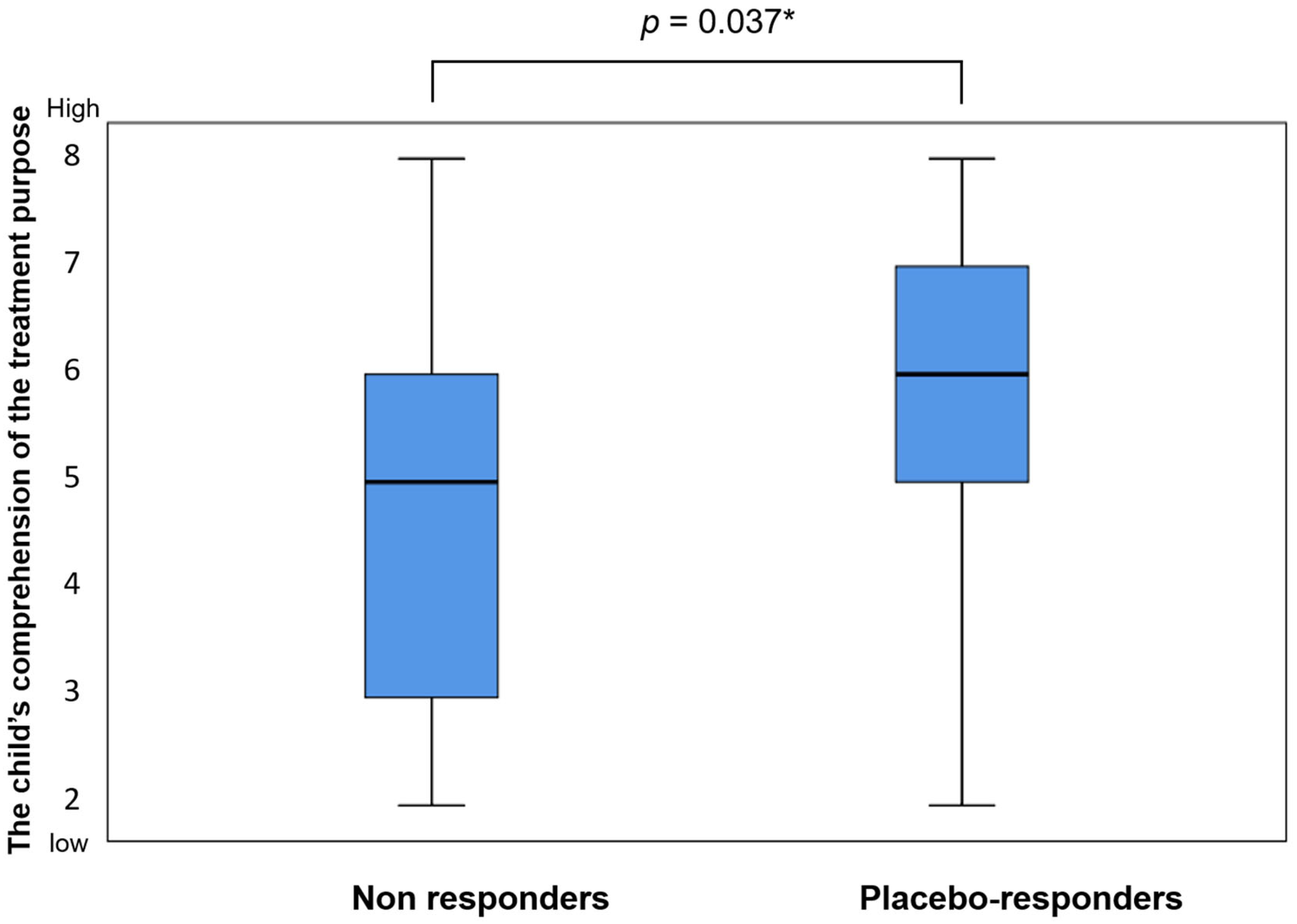
| Mean ± SD | 4.9 ± 2.0 | 5.2 ± 1.8 | 4.7 ± 2.1 |
| (median, range) | (5, 2–8) | (5, 2–8) | (5, 2–8) |
| Experience with similar treatment c | |||
| Mean ± SD | 6.7 ± 1.5 | 7.0 ± 1.5 | 6.4 ± 1.4 |
| (median, range) | (7, 4–11) | (7, 4–11) | (6, 4–9) |
| Parental locus of control d | |||
| Mean ± SD | 17.5 ± 2.2 | 17.7 ± 2.2 | 17.4 ± 2.2 |
| (median, range) | (17, 13–24) | (18, 14–24) | (17, 13–22) |
| Patient-physician relationships e | |||
| Mean ± SD | 2.7 ± 0.7 | 2.8 ± 0.7 | 2.7 ± 0.8 |
| (median, range) | (3, 1–4) | (3, 1–4) | (3, 1–4) |
| Relative severity at baseline e | |||
| Mean ± SD | 2.7 ± 1.1 | 2.8 ± 1.1 | 2.5 ± 1.0 |
| (median, range) | (3, 1–4) | (3, 1–4) | (3, 1–4) |
| Fluctuations in severity at baseline e | |||
| Mean ± SD | 2.8 ± 0.8 | 2.8 ± 0.8 | 2.7 ± 0.8 |
| (median, range) | (3, 1–4) | (3, 1–4) | (3, 1–4) |
| Adherence to study medications f | |||
| Mean ± SD | 3.8 ± 0.5 | 3.8 ± 0.4 | 3.7 ± 0.5 |
| (median, range) | (4, 2–4) | (4, 3–4) | (4, 2–4) |
| # | Statements | Strongly Agree (4) | Agree (3) | Somewhat Agree (2) | Disagree (1) |
|---|---|---|---|---|---|
| 1 | I can influence the health of my child. | ||||
| 2 | When my child is not feeling well, medication usually helps. | ||||
| 3 | When I am not feeling well, medication usually helps me. | ||||
| 4 | I tend to look at the glass as “half-full”. | ||||
| 5 | When I give my child medicine (e.g., to relieve pain) he/she usually understands that the treatment may help him/her. | ||||
| 6 | My child can understand that the treatment given in the study could improve his/her communication difficulties and regulate his/her behavior. | ||||
| 7 | I have full confidence in the physicians treating my child. | ||||
| 8 | When we started the study treatment, my child’s condition was worse compared to his/her average condition in the previous two years. | ||||
| 9 | When I have a problem, I usually manage to solve it. | ||||
| 10 | I can help my child greatly improve his or her communication difficulties and repetitive behavior. | ||||
| 11 | I can help my child greatly improve his or her behavioral regulation. | ||||
| 12 | During the months that preceded the study onset, my child’s condition varied greatly (very good weeks and very difficult weeks) | ||||
| 13 | When we joined the study, I believed that the treatment given in the study may greatly improve the communication difficulties and repetitive behavior of my child. | ||||
| 14 | When we joined the study, I believed that the treatment given in the study may greatly improve the regulation of my child’s behavior. | ||||
| 15 | During the study we were very careful to give the oil drops at the right time and in the right amount. | ||||
| 16 | Before we joined the study, I was exposed to publications that described children who were helped by medical cannabis treatment. | ||||
| 17 | Before we joined the study, I personally knew a child with autism who was helped by medical cannabis treatment. | ||||
| 18 | I do not despair easily. | ||||
| 19 | Before we joined the study, one of us (parents) feared that the treatment given in the study would not help. | ||||
| 20 | When I start a new treatment, I am usually afraid of possible side effects. | ||||
| 21 | If you put in enough effort, you can achieve almost any goal. | ||||
| 22 | Medication that my child received in the past due to behavioral difficulties caused severe side effects and was discontinued. | ||||
| 23 | During the year prior to the study onset, my child received a medication that helped him/her with his/her behavioral difficulties. | ||||
| 24 | ‘Natural’ treatments (diets, supplements or herbal or animal-based treatments) are usually more effective than ‘chemical’ treatments (medications). | ||||
| 25 | ‘Natural’ treatments are usually safer than ‘chemical’ treatments. | ||||
| 26 | Medical cannabis is usually more effective than ‘chemical’ drugs. | ||||
| 27 | Medical cannabis is usually safer than ‘chemical’ drugs. | ||||
| 28 | In the two years preceding the study, my child has been treated with at least two ‘natural’ treatments. | ||||
| 29 | In the two years preceding the study, at least one natural treatment has been very helpful to my child. |
| Domain | Related Items | Internal Consistency Cronbach’s Alpha |
|---|---|---|
| Parental expectations | 15 items: 3,4,13,14,16,17,19, 20, 22, 24–29 | 0.6 |
| Child’s comprehension of treatment purpose | #5, #6 | 0.86 |
| Previous positive experience with treatments | #2, #23, #29 | 0.19 |
| Parental locus of control | 6 items: 1,9,10,11,18,21 | 0.65 |
| Quality of the patient–physician relationships | #7 | N/A |
| Relative aggravation of symptoms at baseline | #8 | N/A |
| Fluctuations in symptom severity at baseline | #12 | N/A |
| Adherence to study medications | #15 | N/A |
| Period 1 (12 Weeks) | Period 2 (12 Weeks) | Period 1 + Period 2 | |
|---|---|---|---|
| Assigned to receive placebo (n) | 50 | 50 | 100 |
| Completed the treatment period (n) | 47 | 44 | 91 |
| CGI-I, valid rate (n) | 47 | 44 | 91 |
| CGI-I, positive response [n (%)] | 10 (21%) | 10 (23%) | 20 (22%) |
| HSQ-ASD, valid rate (n) | 39 | 35 | 74 |
| HSQ-ASD, positive response [n (%)] | 18 (46%) | 8 (23%) | 26 (35%) |
| SRS-2, valid rate (n) | 36 | 30 | 66 |
| SRS-2, positive response [n (%)] | 7 (19%) | 2 (7%) | 9 (14%) |
| APSI, valid rate (n) | 42 | 37 | 79 |
| APSI, positive response [n (%)] | 11 (26%) | 6 (16%) | 17 (22%) |
| At least one valid outcome measure (n) | 47 | 44 | 91 |
| A positive response in at least 1 outcome measure [n (%)] | 28 (60%) | 19 (43%) | 47 (52%) |
| At least 2 valid outcome measures (n) | 46 | 42 | 88 |
| A positive response in at least 2 outcome measures [n (%)] | 13 (28%) | 6 (14%) | 19 (22%) placebo responders |
| Domain | Z Score | p Value * |
|---|---|---|
| Parental expectations | −0.628 | 0.530 |
| Child’s comprehension of treatment purpose | −2.086 | 0.037 |
| Previous positive experience with treatments | −0.665 | 0.506 |
| Parental locus of control | −0.504 | 0.614 |
| Quality of the patient–physician relationships | −0.052 | 0.958 |
| Relative aggravation of symptoms at baseline | −1.933 | 0.053 |
| Fluctuations in symptom severity at baseline | −0.103 | 0.918 |
| Adherence to study medications | −0.756 | 0.450 |
Disclaimer/Publisher’s Note: The statements, opinions and data contained in all publications are solely those of the individual author(s) and contributor(s) and not of MDPI and/or the editor(s). MDPI and/or the editor(s) disclaim responsibility for any injury to people or property resulting from any ideas, methods, instructions or products referred to in the content. |
© 2023 by the authors. Licensee MDPI, Basel, Switzerland. This article is an open access article distributed under the terms and conditions of the Creative Commons Attribution (CC BY) license (https://creativecommons.org/licenses/by/4.0/).
Share and Cite
Aran, A.; Harel, M.; Ovadia, A.; Shalgy, S.; Cayam-Rand, D. Mediators of Placebo Response to Cannabinoid Treatment in Children with Autism Spectrum Disorder. J. Clin. Med. 2023, 12, 3098. https://doi.org/10.3390/jcm12093098
Aran A, Harel M, Ovadia A, Shalgy S, Cayam-Rand D. Mediators of Placebo Response to Cannabinoid Treatment in Children with Autism Spectrum Disorder. Journal of Clinical Medicine. 2023; 12(9):3098. https://doi.org/10.3390/jcm12093098
Chicago/Turabian StyleAran, Adi, Moria Harel, Aminadav Ovadia, Shulamit Shalgy, and Dalit Cayam-Rand. 2023. "Mediators of Placebo Response to Cannabinoid Treatment in Children with Autism Spectrum Disorder" Journal of Clinical Medicine 12, no. 9: 3098. https://doi.org/10.3390/jcm12093098
APA StyleAran, A., Harel, M., Ovadia, A., Shalgy, S., & Cayam-Rand, D. (2023). Mediators of Placebo Response to Cannabinoid Treatment in Children with Autism Spectrum Disorder. Journal of Clinical Medicine, 12(9), 3098. https://doi.org/10.3390/jcm12093098