Systematic Review

Protein Sources for Ruminant Feed: A Systematic Review of Nutritional Value and Sustainability
by
Michael López-Herrera
1,2,*,
Manuel Delgado-Pertíñez
1 and
Sara Muñoz-Vallés
1
1
Departamento de Agronomía, Escuela Técnica Superior de Ingeniería Agronómica, Universidad de Sevilla, Ctra. Utrera Km 1, 41013 Sevilla, Spain
2
Escuela de Zootecnia, Centro de Investigación en Nutrición Animal, Universidad de Costa Rica, Ciudad Universitaria Rodrigo Facio, San José 11501-2060, Costa Rica
*
Author to whom correspondence should be addressed.
Agriculture 2026, 16(5), 537; https://doi.org/10.3390/agriculture16050537
Submission received: 25 January 2026 / Revised: 20 February 2026 / Accepted: 25 February 2026 / Published: 27 February 2026

Abstract

Global demand for animal protein necessitates sustainable alternatives to soybean meal (SBM). This systematic review evaluated 177 peer-reviewed articles (2002–2023) across 12 categories to analyse the nutritional value of alternative protein sources for ruminant diets and to assess the associated environmental trade-offs. This was achieved through a targeted review, synthesising data from Life Cycle Assessments (LCAs) to create a multi-criteria matrix for ranking sustainability profiles. Results indicate that microalgae, insects, and single-cell proteins exhibit crude protein levels comparable to SBM. Moreover, insects, seaweeds, and animal by-products (ABPs) often present superior essential amino acid profiles and high intestinal digestibility. From an environmental perspective, insects, seaweeds and microalgae offer excellent land-use efficiency and significant enteric methane mitigation (17–74.6%), though current economic viability is hindered by high processing costs and emerging supply chains. Conversely, ABPs and agro-industrial by-products effectively embody circular economy principles, enhancing local system resilience. Ultimately, replacing SBM requires a multi-objective approach through a functional hybridisation model, carefully balancing metabolic efficiency with environmental sustainability. While microalgae, insects, and seaweeds demonstrate promising nutritional and mitigation potential, addressing economic barriers and ensuring biosecurity seems essential. Future LCA frameworks should prioritise bioavailable nutrient metrics to optimise the environmental impact of ruminant production.

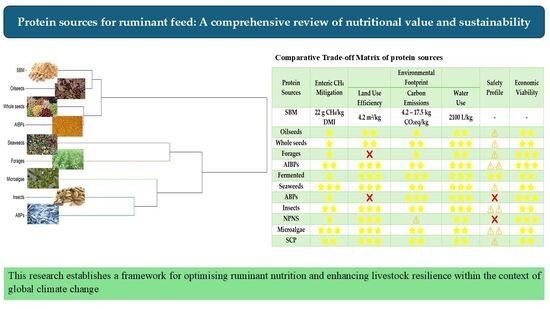
Graphical Abstract

1. Introduction

The growth of the global population is driving an increased demand for food production. As the annual global consumption of animal products—including meat, milk, and other dairy derivatives—continues to rise, livestock systems face mounting pressure to meet the significant demand for high-quality animal protein [1,2,3]. Protein is a critical nutrient in ruminant nutrition. It is degraded in the rumen and utilised by ruminal microbes for the synthesis of microbial protein [4], which is subsequently absorbed in the intestine alongside rumen-undegradable protein to meet metabolisable protein requirements [5,6,7].
In terms of animal productivity, crude protein content, protein fractions, amino acid (AAs) profile, and protein degradability and digestibility are key characteristics affecting feed quality and utilisation [5,8,9,10,11,12]. Understanding the nutritional composition of protein sources is essential for nutritionists, as protein degradability and digestibility vary significantly among sources [11,13,14]. Consequently, microbial protein synthesis may be limited in the rumen, and the feed may fail to meet the nutritional requirements for high-production animals [14,15]. Furthermore, replacing ingredients with differing protein concentrations can lead to nitrogen (N) and energy imbalances [16].
Economically, feed costs account for 60–75% of total production expenses, with proteins constituting 15–20% of concentrate costs [17,18]. Rising feed costs and a reliance on external protein sources are identified as primary factors affecting the vulnerability of ruminant production. This is of particular concern for traditional small ruminant farming and in regions where pasture is scarce or threatened by climatic conditions [19,20,21,22]. Additional concerns regarding feed protein production include environmental impacts such as land use, greenhouse gases (GHG) emissions, and nitrogen excretion leading to soil, water, and air pollution, as well as geographic imbalances, product dependency, food-feed competition, and food security [12,23,24,25]. These challenges are exacerbated by current climate scenarios and uncertainty [25].
Due to its high protein content, favourable balance of highly digestible amino acids (except for low methionine proportions), and high metabolisable energy value [26,27], soybean meal (SBM) is currently the predominant protein source in ruminant feeds worldwide [28,29]. SBM competes strongly with local products due to its price efficiency [30,31]. Nevertheless, SBM price and availability are influenced by global trade dynamics [32]; consequently, interest in reducing dependence on imported protein via locally produced alternatives is growing [32].
Additionally, the rising cost of SBM and the increasing land requirements for its production, within a global context of arable land scarcity [4,31], combined with its associated environmental impacts (e.g., deforestation and GHG emissions) [30,31,32,33,34], have highlighted the need for sustainable, alternative protein sources. Ideally, these should not compete with human food production or require arable land [35,36]. Furthermore, new strategies are being sought to reduce nitrogen excretion by ruminants due to its deleterious effects on the environment, human health, and aquifers [23], and to repurpose resources from other productive systems [37,38]. Life cycle assessment (LCA) offers a comprehensive evaluation of agricultural impacts, surpassing footprint analysis by integrating multiple categories, including global warming and biodiversity [39,40]. This holistic tool identifies systemic weaknesses to enhance sustainability. Several LCA models have been applied to the analysis of alternative protein sources. However, effective measurements require robust and detailed models to distinguish small changes in agroecosystems [41].
Against this background, the search for protein-rich feed alternatives has focused in recent decades on evaluating various feed sources for ruminants [36,42,43,44,45]. These alternatives fall mainly into plant-based, animal-based, microbial, and mineral (non-protein—NPN) nitrogen categories [45,46,47,48], with varying inclusion levels, total protein concentrations, AAs profiles, and utilisation rates [49]. Plant-based sources, derived from terrestrial plants including forages, grains, seeds, cakes, meals, and agro-industrial by-products [18,32,37,50,51], are widely used. Within this group, seaweed species have also been identified as potential alternatives [52,53], with nutritional composition varying by species and environmental factors [54].
Animal-based protein sources typically contain high levels of crude protein (>40%), fatty acids, vitamins, and minerals [47]; however, their use in ruminant feed is largely prohibited due to public health concerns, primarily the risk of bovine spongiform encephalopathy [55]. Despite this, hydrolysed by-products, non-ruminant collagen, and dairy by-products are permitted in feed formulations, though the use of these processed ingredients remains a subject of debate [56].
Novel alternatives such as insects [57] and single-cell protein (SCP) from microalgae, bacteria, and yeasts [46] have emerged as promising sustainable solutions. These sources can convert agro-industrial waste into high-quality protein without competing for arable land, thus mitigating land-use change and associated carbon emissions [4,58]. Likewise, post-extraction algal residues (PEAR) are becoming relevant due to their nutritive value [59,60]. However, production remains costly due to low cellular recovery rates, technological challenges, and concerns regarding heavy metal accumulation, which limits widespread use [46]. Finally, non-protein nitrogen sources—primarily food-grade urea—are widely used [61]. Although inexpensive and offering high potential crude protein equivalent (>100%), their use is typically limited to that of nutritional additives [62].
The increasing demand for diverse protein sources is currently driven by local needs and opportunistic resource availability rather than coordinated global recommendations. Consequently, a comprehensive understanding of both conventional and alternative protein sources remains underdeveloped. To date, there is a lack of systematic analysis concurrently evaluating nutritional value, environmental impact, resource consumption, safety, and economic viability. This study addresses this gap by conducting a systematic review and data analysis to assess the nutritional quality, production viability, and constraints of major and alternative protein sources for ruminant feed, within the essential context of climate change and sustainability, and with this, create a benchmark for future comparisons.

2. Materials and Methods

A systematic review was conducted to evaluate protein concentration, quality, and utilisation in raw materials, processed products, and by-products intended for ruminant nutrition. Peer-reviewed literature was identified using the ISI Web of Science and Scopus platforms (including databases such as CAB Abstracts, Springer Nature, Taylor & Francis, Oxford Academic, Cambridge, MDPI, BMC, Wiley, and those of the American Society of Animal Science and the American Dairy Science Association). This systematic review was managed in compliance with the Preferred Reporting Items for Systematic Reviews and Meta-Analyses (PRISMA) statement 2020 [63] including the recommended methodological steps and checklist items (Table S1 and Figure S1). The search criteria applied were “alternative AND protein AND source AND ruminant”, covering the period from 2002 (aligned with [36]) to 2023. The use of this descriptor aimed to ensure that the retrieved studies were explicitly framed within the thematic scope of protein transition or substitution.

2.1. Data Compilation, Study Variables, and Feed Categories

Documents were screened against the following inclusion criteria: (i) evaluation of protein-dense feedstuffs; (ii) provision of quantitative data in a standardised, extractable format; and (iii) the inclusion of tabular data pertinent to the research scope. Conversely, studies were excluded if they focused exclusively on Total Mixed Rations without explicit reporting of individual ingredient data. Furthermore, for studies employing repeated measures, only the final experimental mean was retrieved for analysis. Duplicate records were identified via Zotero 7.0.9 [64] bibliographic software by cross-referencing titles, authors, and publication years. These were subsequently removed manually, with priority given to the most comprehensive datasets, characterised by larger sample sizes or extended experimental durations. This process ensured that each unique dataset was included only once in our analysis, preventing overrepresentation of specific findings.
The initial search retrieved 408 articles; 182 were excluded as they predated 2002, and a further 49 were discarded due to insufficient data quality. Finally, 177 studies were selected for inclusion in the database. Bias was minimised via multi-database searches and pre-defined criteria, with discrepancies resolved by author consensus. Geographical and editorial reporting biases were mitigated using ISI Web of Science analytical tools. Furthermore, conference proceedings and poorly indexed documents were excluded to maintain data integrity, as they often lack the comprehensive detail necessary for robust knowledge synthesis and protocol evaluation.
Data from the 177 selected studies were collected from each report by three independent reviewers and then tabulated in a spreadsheet. Nutritional quality variables selected for analysis included: crude protein (CP); non-protein nitrogen (NPN); neutral detergent insoluble protein (NDIP); acid detergent insoluble protein (ADIP); rumen-degradable protein (RDP); and rumen-undegradable protein (RUP). Protein fractionation was categorised according to the Cornell Net Carbohydrate and Protein System (CNCPS; [65]) as follows: A (ammonia, nitrates, amino acids, and peptides), B1 (globulins and certain albumins), B2 (most albumins and glutelins), B3 (prolamins, extensin proteins, and denatured proteins), and C (Maillard products and lignin-bound nitrogen) in dry matter (DM) basis. Amino acid profiles were also recorded, including total essential amino acids (EAAs) and individual concentrations of lysine, methionine, histidine, threonine, leucine, isoleucine, arginine, phenylalanine, tryptophan, and valine, in DM basis.
Regarding protein utilisation, the parameters considered were: in situ protein degradability (isPD) (fractions a—soluble; b—potentially degradable; and c—degradation rate of fraction b; potential degradability [PD]; and effective degradability [ED] at 0.08/h); in vitro protein digestibility (ivPD); and intestinal protein digestibility (IPD). In situ degradation curves were estimated using the [66] equation [PD = a + b (1 − eᶜᵗ)], solving for the parameters based on the means obtained for each category.
The recorded data were categorised into twelve main feed sources: Soybean meal (SBM): Including meals and cakes from various oil extraction processes, excluding whole seeds. Oilseeds: Including whole oilseeds and the resulting cakes/meals post-extraction. Whole seeds: Primarily leguminous seeds (pulses) with CP > 20% and ether extract < 10% (DM basis), but also some non-leguminous seeds. Forages: Including whole plants, pods, and leaves in meal, pellet, silage, or fresh forms. Agro-industrial by-products (AIBPs): Non-legume/non-oilseed by-products, primarily cereal grains from ethanol production or pseudocereals. Fermented foods: Products derived from solid-state fermentation. Seaweeds (macroalgae): Multicellular marine and freshwater algae. Animal by-products (ABPs): Derived from terrestrial livestock, fish, and aquatic organisms, including rumen products and whey. Insects: Edible insect species. Non-protein nitrogen sources (NPNS): Primarily urea, biuret, and organic nitrogenous compounds. Microalgae: Unicellular algae species. Single-cell protein (SCP): Microorganisms, mainly bacteria, fungi, and yeasts, excluding microalgae. Specific sources and associated studies are detailed in Table S2.
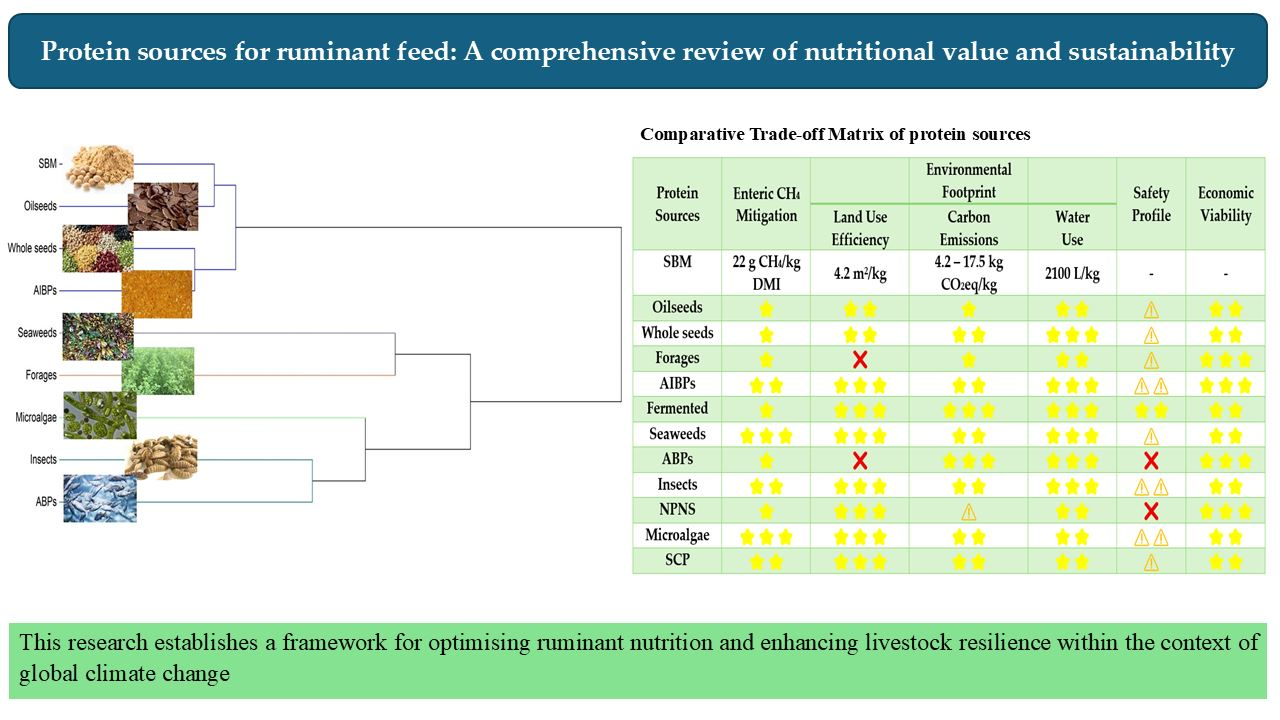
A comparative trade-off matrix was constructed to benchmark each protein alternative against SBM. Metrics involved methane (CH4) emissions, nitrogen excretion, eutrophication potential, land use and land-use change, alongside total energy and water requirements. To facilitate a comprehensive environmental assessment, a targeted literature review of 21 LCA studies was performed to evaluate data across all categories and identify specific trade-offs. Furthermore, feed safety and economic viability were integrated into the analysis. Ultimately, the results were tabulated and analysed to rank the alternatives relative to SBM. The rating inside the matrix was made considering the information obtained and classified as better/worse than SBM; moderate risk/high risk; high benefit; significant constraints or major trade-off. Consequently, the more effective a product was in eliciting the desired response, the higher the rating assigned.

2.2. Data Analysis

The database was subjected to analysis using R statistical software 4.3.2 [67]. First, effect sizes were calculated for each study based on the selected variables. Then, these effect sizes were used to estimate an average for each study group and perform the corresponding hypothesis tests. Only categories with sufficient data to ensure variance (n > 4) were included in the descriptive and inferential analysis. Nevertheless, in variables with n < 4, means and standard errors were reported as measures of dispersion but were excluded from statistical analysis, and if n = 1, dispersion was recorded as zero.
General Linear Mixed Models (GLMMs) were applied to determine differences between categories, specifically selected to facilitate a more nuanced treatment of variance at the group level and to manage unequal sample sizes within these groups. However, multivariate analysis was employed to establish relations among variables and integrate them for comparison of categories. Statistical significance was defined as p < 0.05, with Tukey’s test used for mean comparisons at a 95% confidence level. Trends were defined as 0.05 < p ≤ 0.10. For multivariate analysis, only categories with complete datasets were analysed. Principal Component Analysis (PCA) was used to incorporate protein value variables (CP and amino acid profiles) with the utilisation variables; all the variables were standardised as part of the DM. In the case of enteric CH4 mitigation, data were obtained from several studies and compared to estimate the media to each protein source and the standard error of the mean.

3. Results

The compiled database comprised 698 observations (categorised into 12 main feed groups) and 30 variables derived from the 177 selected studies (Figure S1). The specific sources investigated are detailed in Table S2. Analysis of the dataset indicated that data regarding CP content (1153 observations) covered all 12 (100%) defined feed categories. Information on the nutritional value of protein (NPN, NDIP, ADIP, RDP, and RUP) was available for 58–67% of the feed categories (75–131 records), while data on protein fractionation (fractions A, B1, B2, B3, and C) covered 50–67% (39–71 records). Regarding protein utilisation (isPD factors a, b, and c; PD, ED, ivPD, and IPD), data were available for 50–75% of categories (93–140 records). Finally, amino acid profiles (EAAs and individual essential amino acids) were reported for 67–84% of the feed categories (115–233 records). A detailed breakdown of the data records and the relative frequency of variables for each feed category is presented in Table S3.

3.1. Nutritive Value

3.1.1. Protein Quality

Table 1 outlines protein quality variables across the evaluated feed categories. Initial data suggest that CP content is most concentrated in SBM, microalgae, ABPs, insects, and SCP (43–49% DM), with no statistically significant differences currently observed between them. Lower CP levels appear to be associated with oilseeds (37.13% DM), followed by whole seeds, fermented foods, and AIBPs (28–32% DM), while forages and seaweeds yielded the lowest indicative values (~20% DM). Notably, the NPNS category recorded a nominal CP of 252.37% DM, a figure primarily attributable to the high nitrogen concentration inherent in urea (46% N).
Consistent with the category definition, NPN constituted 100% of CP in the NPNS group. NPN levels did not differ significantly between SBM, oilseeds, AIBPs, and forages (11–18% CP), whereas whole seeds exhibited a notably higher value (57.47% CP). Although excluded from formal statistical analysis due to limited replication (n = 1), ABPs and insects presented intermediate NPN values of 25.20% and 34.00% CP, respectively. Compared to the range observed in SBM and remaining categories (RDP: 40–58%; RUP: 43–57%), whole seeds and forages displayed higher RDP (67–75% CP) and correspondingly lower RUP (24–33% CP). Insects (n = 1) showed a transitional RUP mean of 36.33% CP. No significant variations were observed across categories for insoluble protein fractions (NDIP and ADIP).
These preliminary findings suggest that several alternative protein sources—notably microalgae, insects, and SCP—may be comparable to SBM in terms of nitrogen density. In contrast, the elevated RDP in forages and whole seeds implies rapid nitrogen release, which might necessitate dietary balancing to mitigate excessive nitrogen excretion. Conversely, the higher RUP levels observed in microalgae and fermented foods indicate a potential for enhanced bypass protein delivery to the small intestine. Consequently, microalgae and insect meals appear to be viable candidates as concentrated protein alternatives to SBM.

3.1.2. Protein Fractionation

The available literature regarding CNCPS protein fractionation remains relatively limited, with notable data gaps for fermented foods and SCP. Initial findings (Table 2) indicate that NPNS consists almost exclusively of fraction A (98.89 g/100 g CP), significantly exceeding all other categories (5.60–36.4 g/100 g CP). Fraction B1 appears most prominent in oilseeds and whole seeds (31.35 and 39.05 g/100 g CP, respectively), while SBM and ABPs exhibit the highest proportions of fraction B2. Conversely, fraction B3 was found to be more concentrated in oilseeds and forages (~12 g/100 g CP) relative to SBM or whole seeds. Furthermore, AIBPs exhibited the highest fraction C content (23.33 g/100 g CP), whereas SBM, whole seeds, seaweeds, and ABPs recorded significantly lower levels (1.24–5.51 g/100 g CP).
The elevated concentration of fraction C in AIBPs suggests that a substantial proportion of their protein may be complexed with lignin or Maillard products, potentially limiting digestibility. In contrast, the high B2 and B3 fractions observed in SBM and oilseeds imply intermediate degradation rates, which are generally considered nutritionally advantageous. However, the scarcity of data for fermented and microbial sources constitutes a significant knowledge gap that warrants consideration in future ruminant nutrition research.

3.1.3. Amino Acid Profile

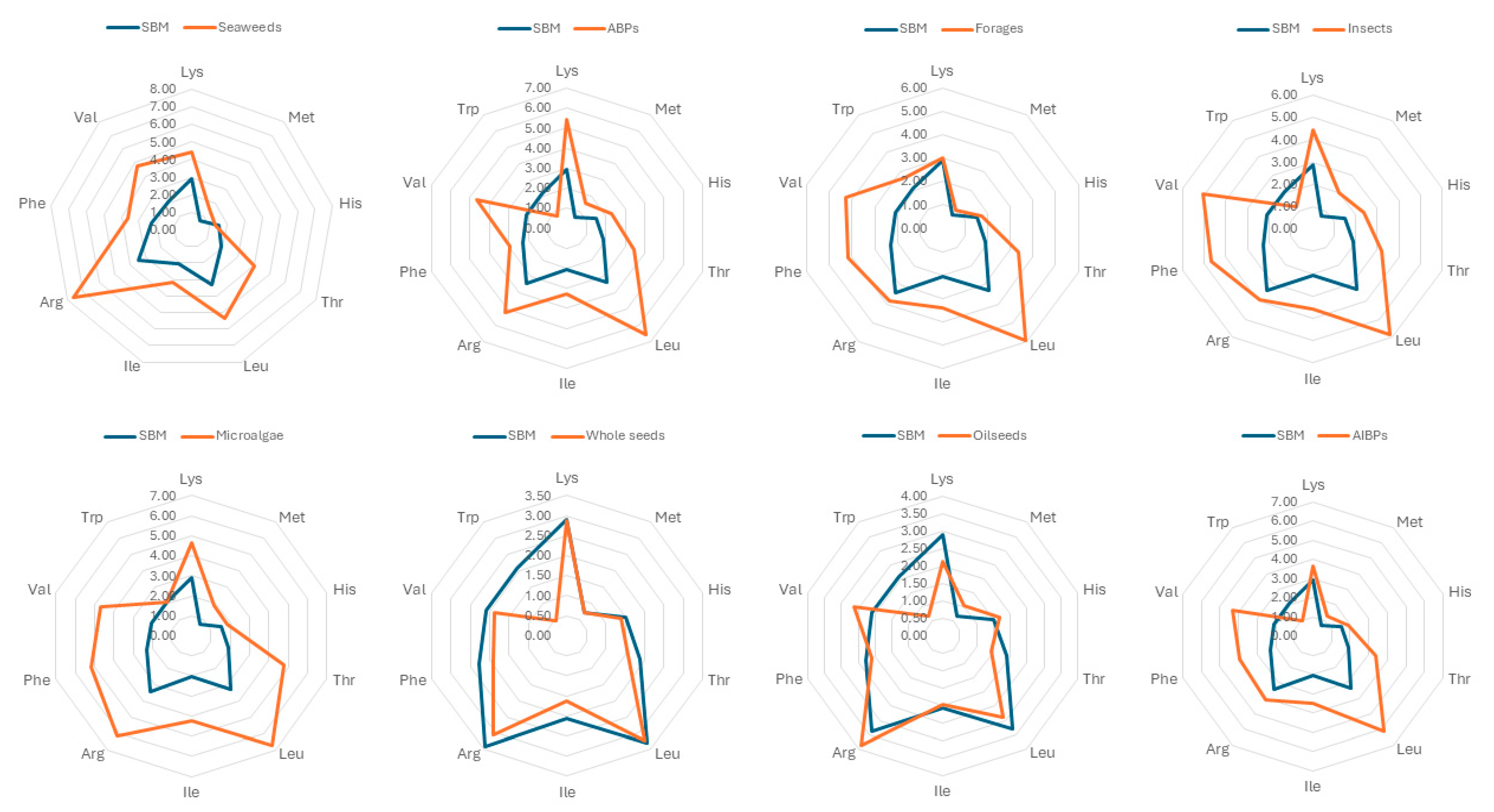
Amino acid profiles were unavailable for fermented feeds and the NPNS category; however, significant variations were noted across all other groups (Table 3). EAAs were significantly more concentrated in SBM, seaweeds, ABPs, insects, microalgae, and microorganisms (30.55–43.64% CP) than in oilseeds, whole seeds, and AIBPs (12.76–21.96% CP). Within the high-EAAs group, seaweeds, ABPs, insects, and microalgae provided approximately double the concentrations of lysine, methionine, isoleucine, and threonine relative to SBM. Notably, threonine was particularly abundant in seaweeds and microalgae. ABPs and insects exhibited higher histidine levels, while SBM and microalgae were characterised by higher tryptophan content. Radar charts (Figure 1) indicate that seaweeds, ABPs, insects, and microalgae offer a more comprehensive AA profile than SBM. Within the lower-EAAs group, AIBPs showed significantly higher methionine and tryptophan concentrations than oilseeds or whole seeds. These findings suggest that seaweeds, ABPs, insects, and microalgae may offer nutritional advantages over SBM, oilseeds, and whole seeds, particularly regarding EAAs density. Such profiles could potentially enhance EAA supply in diets for high-yielding dairy or beef cattle, potentially reducing the reliance on synthetic amino acid supplementation.

3.1.4. Protein Degradability and Digestibility

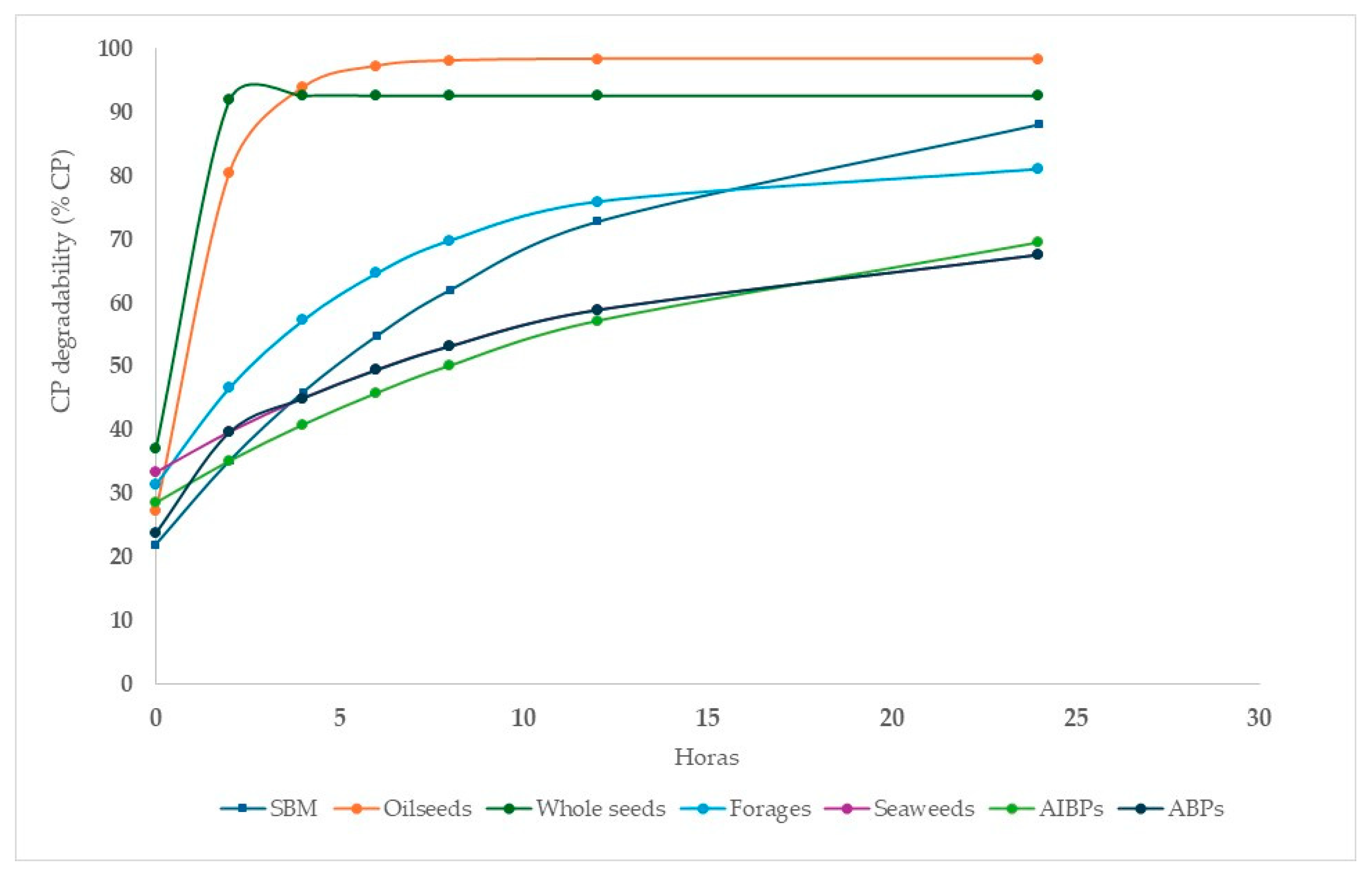
Utilisation variables were frequently reported, although data remained unavailable for NPNS and microbial sources (Table 4). Regarding in situ protein degradability (isPD), the soluble fraction (fraction a) was generally consistent across categories, with the exception of insects, which exhibited significantly higher levels (45.30% CP). For in vitro protein digestibility (ivPD), SBM, whole seeds, forages, and AIBPs yielded higher values (78–90%) than oilseeds, seaweeds, and insects (66–68%). Intestinal protein digestibility (IPD) was significantly higher in ABPs, SBM, AIBPs, and insects (>70% RUP) relative to oilseeds, whole seeds, and forages (50.07–71.32% RUP). Microalgae displayed lower IPD (59.04% RUP) and potential degradability (PD; 43.13% CP) values, similar to seaweeds in terms of rumen degradability, while their intestinal digestibility appears comparable to most plant-based sources. However, this group was excluded from Table 4 and Figure 2 due to a paucity of data, highlighting a notable research gap regarding the rumen kinetics of alternative protein sources.
The potentially degradable fraction (fraction b) was significantly more pronounced in SBM and oilseeds (72.86% and 71.29%) than in other categories. Conversely, seaweeds exhibited a lower fraction b, while insects may follow a similar trend based on their PD and fraction a value (Table 4). Although no significant differences were observed for the degradation rate (fraction c), PD remained high across most categories (65.84–86.60% CP), with seaweeds being significantly lower (45.77% CP). Only whole seeds exhibited significantly higher effective degradability (ED; 72.45%). Nevertheless, estimated degradation curves derived from parameters a, b, and c indicate variations in protein degradation profiles over a 24-h incubation period (Figure 2).
The high solubility (fraction a) of insect protein suggests more rapid rumen availability compared to traditional sources. Furthermore, the high IPD values of insects and AIBPs, comparable to SBM, indicate a potential to supply bypass protein to the small intestine. While seaweeds, AIBPs, and ABPs could serve as rumen-resistant sources, seaweeds might necessitate dietary balancing to compensate for their lower IPD. From a nutritional perspective, AIBPs and insects represent promising sustainable alternatives to SBM, though additional research focused on these two sources remains necessary.

3.1.5. Multivariate Analysis

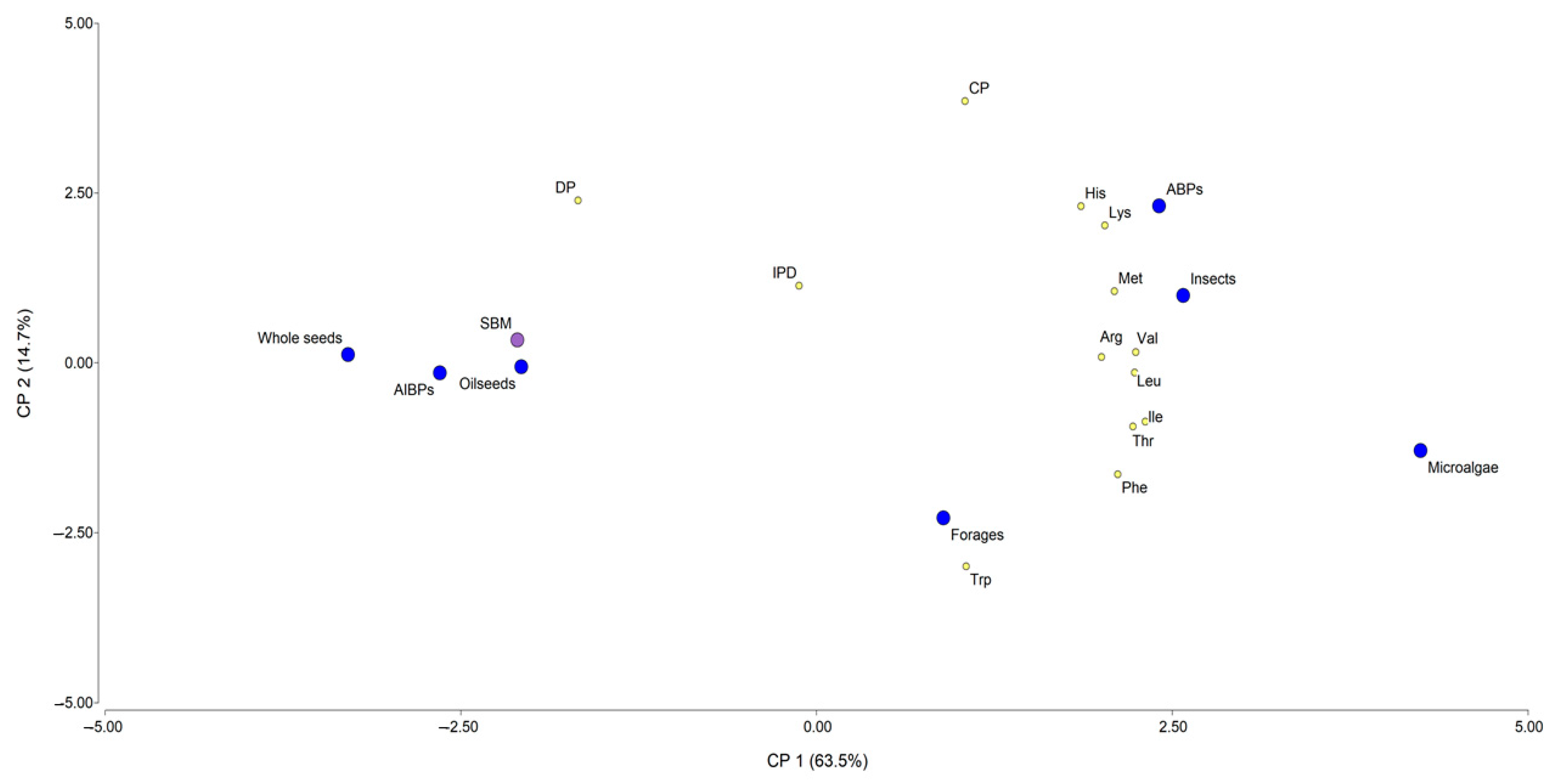
The PCA indicated that PC1 and PC2 accounted for 78.2% of the total variance (Figure 3). PC1 (63.5%) appears to reflect a protein and AAs density gradient; microalgae, insects, and ABPs showed strong positive associations with most EAAs, whereas whole seeds, oilseeds, and AIBPs grouped negatively. PC2 differentiated samples based on potential degradability and crude protein relative to tryptophan. SBM and oilseeds showed a closer association with degradation dynamics, while forages were distinguished by their tryptophan association.
Initial findings suggest that microalgae may provide a more favourable AA supply compared to other sources. The incorporation of microalgae or insect-based feeds could potentially enhance the biological value of dietary protein, allowing for reduced total protein inclusion whilst maintaining a balanced AA profile. A similar potential may exist for ABPs, given their apparent nutritional similarity to insects. Nevertheless, data regarding protein utilisation in SCP, fermented feeds, and seaweeds remain limited; further research is therefore necessary to address these knowledge gaps and to clarify their positioning relative to other protein alternatives.

3.2. Environmental Trade-Offs Matrix

The synthesis of 21 environmental impact categories within the LCA framework is summarised in the comparative trade-off matrix (Table 5). The analysis suggests a complex sustainability hierarchy among the evaluated protein sources. Disparities in GHG emissions across oilseed varieties appear to be influenced primarily by nitrogenous fertilisation rates, associated N2O emissions, and indirect land-use change; the latter is largely associated with deforestation processes in South America.
Current analysis indicates that land-use change may be a significant factor underlying the elevated emission profiles observed in rapeseed (2.49 kg CO2eq/kg), sunflower, and palm (7.13 kg CO2eq/kg), which exceeded those of SBM (1.34 kg CO2eq/kg). However, the results also suggest that fluctuations in crop yield could influence the relative GHG intensity of these oilseeds. Conversely, camelina emerges as a potentially sustainable alternative; its carbon footprint appears lower (0.32 kg CO2eq/kg) than that of SBM, ostensibly due to its reduced input requirements and lower irrigation demands. In parallel, pulses and other legumes (faba/peas) present a favourable plant-based profile (1.0 kg CO2eq/kg), likely attributable to natural nitrogen fixation.
Novel bioconversion systems—specifically microalgae, insects, and SCP—appear to achieve high levels of land-use efficiency. Preliminary data suggest that SCP and insect facilities may significantly reduce water consumption (20–100 L/kg) compared to irrigated grains (>1000 L/kg). However, a notable land-energy trade-off seems to persist; the electrical demand for bioreactor agitation and spray drying has the potential to elevate microalgae emissions to 15.0 kg CO2eq/kg, though industrial scaling (from 240 m2 to 2.5 ha) might mitigate this impact.
The analysis highlights seaweeds and microalgae as potentially effective for enteric CH4 mitigation, although they appear to face “moderate to high” economic and safety constraints. In contrast, AIBPs and ABPs offer low-impact profiles (<0.8 kg CO2eq/kg) and high economic viability, as ecological debts are typically allocated to the primary industry. Nevertheless, ABPs may remain constrained by perceived safety risks. At this stage, SCP and insects seem to provide a more balanced profile of land efficiency, methane reduction, and moderate safety, potentially positioning them as viable long-term environmental substitutes for SBM.

4. Discussion

4.1. Oilseeds

Oilseed by-products are primarily defined as the residues remaining after oil extraction. These include ‘cakes’, obtained via mechanical expeller pressing, and ‘meals’, which involve additional organic solvent extraction [211,212], though these terms are often used interchangeably in the literature [37]. While soybean, rapeseed (canola), and sunflower remain the global leaders, flaxseed, camelina, cottonseed, and hempseed have gained commercial significance [37]. Most commercial oilseeds are edible for both humans and livestock. In contrast, non-edible species such as Jatropha spp., castor bean, and neem cannot be used for animal feed as they pose significant health risks or lack a suitable AA balance [213] and may further compete for land resources [211].
The oilseed by-products possess notable protein levels, though CP content is generally lower than that of SBM. Although their AA profiles are broadly similar to SBM, they often exhibit lower intestinal digestibility and deficiencies in essential AAs, particularly lysine, methionine, threonine, and tryptophan [83,211]. Because methionine is a primary limiting AA in ruminant nutrition and is highly susceptible to rumen degradation, diets incorporating these oilseeds often require supplementation with rumen-protected AAs or RUP to ensure adequate flux to the small intestine [23]. Furthermore, higher fibre content [214,215], mineral imbalances (specifically phosphorus) [51] and residual oil levels [216] can further constrain their inclusion in ruminant rations.
The presence of antinutritional factors (ANFs) could adversely affect livestock health and performance; for example, canola meal contains high concentrations of phenolic acid esters (sinapine), while flaxseed cake may contain cyanogenic glycosides [81,217]. Other common ANFs include phytic acid, trypsin inhibitors, and saponins [212]. Additionally, the presence of alkaloids and mycotoxin contamination continues to be a critical safety concern, impacting both animal health and the human food chain [81,82]. While many ANFs can be inactivated through physical, chemical, or fermentative processing, their presence necessitates careful monitoring [14,81,96].
The environmental impact of oilseeds appears complex and sensitive to specific crop and processing methods. Enteric CH4 emissions range from −24.4% to +21.7% relative to SBM, with a mean increase of 5.35% found in this study. High levels of polyunsaturated fatty acids (PUFAs) in cold-pressed cakes (e.g., linseed or sunflower) might suppress methanogenesis more effectively than solvent-extracted meals, whereas higher fibre content can increase emissions [37,68,69].
Regarding land use, variances frequently emerge when comparing alternative oilseeds with imported genetically modified versus conventional soybean varieties [73,75]. Land-use change appears to be a significant factor influencing oilseed emission profiles; specifically, indirect land-use change stemming from deforestation may substantially increase emissions, which range from 1.34 to 7.13 kg CO2eq/kg for traditional oilseeds, relative to emerging crops such as camelina (0.32 kg CO2eq/kg) [73,79]. Local production might reduce transport-related emissions and water consumption relative to conventional SBM [74,78,218]. A substantial proportion of these emissions (60–70%) is likely attributable to the synthesis of nitrogenous fertilisers and field-based N2O emissions [80,93]. Consequently, intensive fertilisation could lead to nitrogen and phosphorus run-off, as evidenced in cottonseed production [51,73].
Camelina, sunflower, and rapeseed meals are the most promising candidates for SBM replacement [76,78] in ruminant diets. Current research in the field focuses on improving the intestinal protein utilisation and reducing ANFs to lower feed costs in intensive systems [38,83]. While some sources, such as camelina, show moderate potential for sustainable expansion [46], the economic viability of oilseed by-products is increasingly influenced by competition from the biofuel sector [14,50].

4.2. Whole Seeds

Whole seeds, particularly legumes, are protein-dense feeding stuffs widely utilised in ruminant nutrition [46,103]. Compared to SBM, this category exhibits lower CP and RUP levels but higher RDP. These differences are largely attributed to the preservation of starch and fibre within the whole seed [105]. While the AA profile and utilisation are comparable to SBM, small doses of synthetic AA supplementation are often required [23].
The primary species investigated include lupin (Lupinus spp.), faba beans (Vicia faba), peas (Pisum sativum), and chickpeas (Cicer arietinum), with linseed and vetch used to a lesser extent [32]. Due to their significant starch content, these seeds can partially replace maize in feed formulations [102,219]. Furthermore, their protein-energy balance complements pasture fibre effectively [220], making them preferred alternatives to SBM in organic and livestock systems [102,221]. Ruminant variable physiological requirements could necessitate diverse plant proteins; however, contemporary practices increasingly favour reduced crude protein diets supplemented with rumen-protected limiting amino acids to achieve precise nutrient delivery in ruminants [23,222].
Whole seeds are typically ground, though they may be fed fresh or cooked [223]. Processing significantly influences quality; for instance, raw pulses exhibit high rumen degradability, which can lead to excessive ammonia emissions and nitrogen excretion [94]. Consequently, heat treatments (such as extrusion or roasting) are recommended to increase bypass protein (RUP) to levels comparable with SBM, thereby improving N efficiency [86,96]. However, excessive heat treatments may induce protein–carbohydrate binding and thereby reduce protein availability due to the formation of Maillard products [5].
Legumes have frequently been identified as notably sustainable protein sources [92,93,94,95,96,97,98]. Indicative greenhouse gas emissions typically range between 0.5 and 1.2 kg CO2eq/kg; this is primarily attributable to their ability to fix atmospheric nitrogen, thereby reducing the requirement for synthetic fertilisers, though some nitrogen leaching might occur [93]. Furthermore, pulses appear to offer a lower land-use impact than SBM, particularly regarding rainforest deforestation [73,95]. Regarding water utilisation in contexts such as tropical conditions, cultivation for feed purposes exhibits a water footprint predominantly driven by evapotranspiration; consequently, in arid regions, water consumption might exceed 1000 L/kg [156].
However, replacing SBM with pulses may lead to feed-food competition, potentially affecting food security [92]. Another limit in using novel seeds or NUS (neglected and underutilised species) [224] is the presence of ANFs, including phytates, alkaloids, tannins, and trypsin inhibitors, which can impair digestibility or cause toxicity [81,97], but can be removed through heat treatments [104]. Furthermore, many pulses are susceptible to mycotoxin contamination, particularly during harvesting and storage in humid climates [102]. Establishing regulatory limits and protective storage strategies is essential to safeguard animal and human health [101,102,107].
Enteric methane (CH4) mitigation varies by seed type [84]. Traditional pulses like peas and faba beans show negligible differences compared to SBM, likely because their starch content promotes rumen propionate production, which competes with methanogenesis [85,87]. In contrast, non-traditional or oily seeds can reduce CH4 by over 50% due to bioactive compounds or residual oils [88,89,91].
Global pulse production is increasing to meet plant protein deficits [50,225]. However, adoption has been slowed by the perception of legumes as low-yielding secondary crops [105]. Despite their adaptation to diverse soils and low carbon footprint, legumes are sensitive to heat stress (>25 °C) during reproductive stages, necessitating the development of climate-resilient varieties [106,107]. From an economic perspective, the viability of using pulses appears to be contingent upon the balance between reduced fertilizer, the expenses related to heat processing and synthetic AA supplementation [73,98]. Furthermore, the conversion of plant protein into ultra-processed animal protein substitutes may substantially increase both its energy and water footprints [99], alongside associated economic costs.

4.3. Forages

Forages constitute the foundational component of ruminant diets [226] and are increasingly valued as local alternative protein sources capable of meeting global demand [227]. Ruminants possess a unique physiological capacity to convert cellulose-rich materials into high-quality human food through microbial fermentation within their pre-stomachs [228], due to diverse bacteria, fungi, and protozoa populations that transform cell wall components into utilisable energy [229].
Herbaceous plants, shrubs, and trees (predominantly from the Fabaceae family) are the most common forage protein sources [6]. While legumes typically offer higher protein content, they often produce lower biomass than grasses, and consequently, are used as a complement in the diet or using mixed swards to ensure complementary rumen function [230]. In grazing systems, bovine diets are predominantly grass-based [231], with shrubby plants serving as cost-effective protein alternatives [232]. Although the CP content of forages is generally lower than that of SBM, their total protein contribution can be substantial [6]. However, the high RDP and relatively low RUP levels can limit N efficiency in high-yielding animals, leading to increased urinary N excretion and reduced bypass protein availability [178,233]. Thus, forages are most effectively used to substitute concentrates in systems with lower nutrient requirements [46]. Furthermore, preservation methods such as ensiling significantly influence final quality, with poor management leading to substantial nutrient losses [120,234].
The primary challenges in forage utilisation arise from inter- and intra-species variability driven by climate, harvesting, and management [235,236]. While high fibre and lignin levels are traditionally linked to increased enteric CH4 [237], certain plants contain secondary metabolites, such as condensed tannins and phenolics, that suppress methanogenesis [238]. Also, these metabolites may concurrently impair forage degradability, increasing RUP by protein binding [239,240].
The incorporation of tropical legumes in ruminant diets can mitigate methane emissions compared to C4 grasses, due to their superior nitrogen content and secondary metabolites [237]. CH4 emissions from forages vary widely (−11% to 32.5%), influenced by the fibre content, forage to concentrate ratio and preservation techniques; for instance, silage may reduce emissions by 4.1% compared to fresh fodder [68,108,110].
Well-managed grasslands provide essential ecosystem services, including carbon sequestration, erosion control, and biodiversity conservation [112,114,117]. Adopting forage-based systems may escalate land-use requirements by as much as 41%, thereby heightening the risk of deforestation or ecological degradation if stocking rates exceed capacities [111,112]. Conversely, historical land-use change from the conversion of grasslands and forests into arable cropland has precipitated a substantial depletion of soil organic carbon stocks and a concomitant increase in atmospheric CO2 emissions [118].
Within this context, C4 plant species offer substantial biomass production and atmospheric carbon fixation in the soil, due to superior photosynthetic efficiency, especially in high-temperature environments compared to C3 plants [119]. Despite representing only 2% of plant species, C4 plants contribute 25% of terrestrial primary productivity, making them vital for agricultural resilience and carbon management [241]. Likewise, perennial grasslands and silvopastoral systems act as significant carbon sinks, potentially offsetting the higher GHG footprints (specifically CH4 and N2O) associated with grazing [114]. Intensification also poses risks of nitrate leaching into groundwater [116]. Nonetheless, the inclusion of tannin-rich forages can improve N utilisation, thereby reducing the environmental N load [109,110,116]. Consequently, achieving sustainable intensification requires a meticulous balance between economic, social, and environmental benefits [242].
Forages must meet stringent safety standards, yet they may contain ANFs such as alkaloids, glycosides, and nitrates that can impair animal health or contaminate animal products [121]. Pathogenic risks also exist through the use of slurry fertilisers or poor silage fermentation [120]. In developing regions, forages remain the primary nutrient source, and recent decades have seen the development of high-yielding, tolerant varieties [122]. Likewise, from an economic perspective, forages do not compete with human food [243]. Therefore, prioritising grain-based feeding often ignores the fundamental role of ruminants as converters of fibrous materials unsuitable for human consumption [244]. To enhance the role of forages in a circular food system, research must prioritise the breeding of climate-resilient varieties that maintain high nutritional value under thermal stress [245]. Exploiting dual-use crops and improved crop rotations remains the most promising strategy for the sustainable intensification of ruminant production [123].

4.4. Agro-Industrial Byproducts (AIBPs)

High protein AIBPs originate primarily from cereal processing (Gramineae) and pseudocereals [246]. Key sources include wheat, maize, barley, and sorghum, alongside pseudocereals such as quinoa and buckwheat [135]. The most prominent co-products are dried distillers’ grains with solubles (DDGS), gluten meals, polishes, and husks [125,247]. While some AIBPs possess high protein levels [248], their CP remains lower than that of SBM.
The nutritional density of AIBPs often surpasses that of whole grains because starch extraction during fermentation or milling concentrates the remaining protein, fat, and fibre [125,247]. However, this concentration effect also applies to undesirable compounds, such as phenolic acids and mycotoxins, which can impair ruminant health and protein utilisation [133,246]. The nutritional value of AIBPs is heavily influenced by processing techniques [248]. Thermal processes used for moisture reduction can impair protein quality and digestibility [249]. Notably, these by-products could exhibit a high proportion of indigestible protein (fraction C) due to Maillard reactions as a consequence of excessive heat treatment [5,250,251]. However, controlled thermal treatments may be needed in order to increase RUP and the amount of protein reaching the small intestine [131,135,250,251]. Furthermore, high levels of unsaturated fatty acids in AIBPs increase susceptibility to peroxidation, potentially reducing shelf life and necessitating the use of antioxidants to prevent rancidity [252,253]. Low intrinsic lysine levels and the presence of ANFs may also require the inclusion of synthetic amino acids or proteases to optimise performance [130,132,134].
The AIBPs present complex environmental trade-offs. The use of by-products could significantly lower emission profiles (potentially reaching <0.8 kg CO2eq/kg), as the initial ‘carbon debt’ is typically allocated to the primary product. This allocation may result in a minimal operational footprint for the alternative protein source [155,167]. Replacing SBM and maize with DDGS or gluten reduces arable land requirements and water consumption (particularly high in wheat-derived by-products) [126,130]. However, total GHG emissions can increase due to the energy-intensive cultivation, extraction, drying, transportation and reduced digestibility of protein [111,128,129].
Regarding enteric CH4, emissions vary widely (mean 46.37%; range 6.90–77.66%). Reductions are typically achieved through the presence of PUFAs or the promotion of microbial protein synthesis [124,127]. Conversely, high inclusion rates can lead to CP levels exceeding animal requirements, resulting in increased urinary N and P excretion [125,127,131]. These elevated N losses can increase manure-based N2O emissions, potentially offsetting the benefits of reduced enteric CH4 [96,131,132]. While generally recognised as safe, AIBPs are vulnerable to foodborne pathogens and concentrated mycotoxins due to poor storage or cross-contamination [133]. Interestingly, the rumen microbiome may adapt to certain plant bioactives, potentially acquiring the capacity to degrade specific contaminants over time [130].
Economically, AIBPs are increasingly popular as they lower feed costs by substituting SBM and maize. Although they were previously viewed as having an unsustainable long-term projection [46], emerging circular economy models suggest otherwise. For example, maize and wheat distillates are being integrated into biodiesel production loops; the subsequent oil extraction yields a refined by-product with higher protein content (>35% CP) and significant fibre (50–65% DM) [134,136]. Successfully managing the high variability in nutrient composition remains the primary challenge for the wider adoption of AIBPs in precision ruminant nutrition [135].

4.5. Fermented Feeds

Fermented feeds are primarily produced through solid-state fermentation (SSF), a process conducted within bioreactors where microbial growth—predominantly filamentous fungi—is stimulated in high-humidity environments without additional free-flowing water [141,143]. Historically utilised to produce enzymes, organic acids, and biofuels, there is increasing interest in SSF for ruminant nutrition [140,144]. These microorganisms fundamentally alter the nutritional profile of substrates, typically increasing CP content while simultaneously reducing fibre (lignin and cellulose) and anti-nutritional factors such as phytic acid and tannins [138,140].
Current findings indicate that CP levels derived from SSF processes, particularly those using agro-industrial by-products, are consistent with the values reported [140]. Although the CP content remains lower than that of SBM, the soluble protein content and potential degradability are statistically comparable. During SSF, protein synthesis occurs via substrate hydrolysis, microbial population expansion, and the enzymatic breakdown of macromolecules into peptides and amino acids [141,144]. While this enhances total and soluble protein, it necessitates precise dietary synchronisation with fermentable carbohydrates to avoid excessive N excretion [139,140,233].
One of the primary advantages of SSF is its versatility; it can valorise a wide range of materials, including bran, husks, stubble, and even industrial animal hides [141,143]. This capacity to upcycle waste into high-quality feed makes SSF a key driver of the circular economy. Environmentally, SSF is a low-energy and low-water consumption process (0.5–1.2 kg CO2/kg and <150 L/kg, respectively), often avoiding the need for sterile media [139,142]. Compared to conventional crops, fermented feeds demonstrate a lower environmental footprint and higher land-use efficiency, producing more protein per unit area [138]. Furthermore, substituting 30% of concentrate with fermented alternatives in beef cattle diets has been reported to reduce enteric CH4 emissions by 16.4% [137], suggesting significant potential for climate change mitigation.
Fermented feeds are generally regarded as safe for ruminant consumption, with the fermentation process actively inhibiting pathogens such as Salmonella [138,144]. Despite its cost-effectiveness and environmental benefits, several barriers to large-scale adoption persist [141,143]. The principal challenge at an industrial scale is to maintain optimal temperatures without excessive reliance on cooling water, thereby ensuring a low carbon footprint [44]. Variability in the final biochemical profile is common, driven by differences in substrate type, microbial strain quality, bioreactor design, and environmental parameters such as aeration and temperature [138,144]. While commercial production of microbial proteins has commenced, consumer concerns regarding social, cultural, and health values persist [141]. Consequently, further research is required to validate the applicability of SSF at an industrial scale and to provide more comprehensive data on nutrient availability to ensure stable, high-quality feed production.

4.6. Seaweeds (Macroalgae)

Macroalgae are traditional coastal feedstuffs currently gaining global recognition as alternative ruminant supplements due to their diverse concentrations of proteins, carbohydrates, and minerals [52,54,254]. Their nutritional value is highly species-dependent: the reviewed literature includes brown algae (Laminaria, Ascophyllum), green algae (Ulva, Cladophora), red algae (Asparagopsis, Palmaria), and the freshwater genus Lemna [154,255].
The CP content across this category varies significantly (6.8–47.0% DM), due to differences among species. Generally, brown algae exhibit lower protein levels (6–16%), while green and red species contain higher concentrations (12–34% and 14–47%, respectively) [53,256]. Likewise, freshwater Lemna also reports high CP values (20–45%) [257]. Notably, seaweeds can provide higher EAAs (specifically arginine, valine, leucine, and threonine) compared to SBM [258]. While some studies suggest seaweeds are low in sulphur-containing amino acids like methionine [259], this appears to be species-specific [54].
A primary driver for seaweed research in ruminants is enteric CH4 reduction. This capability is largely linked to bromoform content, particularly in red algae (Asparagopsis), which can achieve up to a 62.4% reduction in CH4 at dietary inclusion levels below 1% [52,145,146]. Brown and green algae offer more moderate mitigation (approx. 25–29%) at higher inclusion rates (10–25%) [52]. Seaweed production can offer other environmental advantages: it requires no arable land or fresh water and avoids the impacts associated with synthetic fertilisers [147,148]. Furthermore, macroalgae act as carbon sinks and bioremediators, extracting nitrogen and phosphorus from aquatic ecosystems to mitigate marine eutrophication [151,257]. While substituting SBM with seaweed avoids the ecological footprint of terrestrial crop production, the energy required for algal dehydration is a significant constraint (1.2–2.0 kg CO2/kg), though potentially offset by the avoided impacts of SBM cultivation [151]. A definitive assessment of seaweed dehydration’s carbon footprint requires further investigation.
Despite their potential, seaweeds pose risks regarding the bioaccumulation of minerals and heavy metals, particularly when wild-harvested [154,258]. There are also concerns regarding the transfer of specific metabolites to animal products, requiring further investigation [150]. Additionally, palatability can be hindered by rancid odours resulting from oxidative stress [258]. Regarding nitrogen efficiency, replacement of SBM with red or brown algae has shown no adverse changes in N excretion in dairy cattle and sheep, though outcomes vary by species [149,150]. Still, the macroalgae industry is growing rapidly, with global production reaching 30.2 million tonnes (primarily via Asian aquaculture) [52]. While seaweeds offer an accelerated market penetration potential, their use in animal feed is limited by the high costs of harvesting and processing (dehydration), and the variability of protein quality under differing environmental conditions [138,148].

4.7. Animal Byproducts (ABPs)

The ABPs are characterised by high nutritional density, exceptional utilisation efficiency, and superior AA profiles compared to SBM [260,261]. Key sources include fish meal, poultry meal, meat and bone meal, blood meal, and dairy by-products [160,262,263]. Despite their high nitrogen content, primarily in the form of RUP, their intestinal utilisation efficiency remains high [174,264]. Beyond their role as protein concentrates, ABPs can influence enteric CH4 emissions through their specific fatty acid profiles, particularly those rich in PUFAs. For example, fish meal has been shown to reduce CH4 emissions by 21.5% when substituting 100% of SBM in ovine rations [71].
The primary constraint regarding ABPs is the potential transmission of foodborne diseases (FBD) [159]. Improper processing can allow domestic animal reservoirs to perpetuate pathogens, posing significant risks to both animal and human health [159,161]. Consequently, a ban on feeding ABPs to ruminants has been in place in the European Union (EU) since 1994 [159,160,262]. However, recent regulatory shifts (EU 2021/1372) have authorised the use of certain ABPs for non-ruminant farmed animals, such as pigs and poultry [265]. Achieving appropriate processing at reasonable costs could eventually facilitate the safe reintroduction of these high-quality proteins into ruminant diets, further promoting the circular economy [46,161].
The environmental footprint of ABPs varies by origin. Fish meal typically requires less land use than SBM as it is derived from marine fisheries, whereas poultry and aquaculture-based meals require more significant land resources [98,155,156]. While poultry meal may slightly decrease GHG emissions relative to SBM, the high energy requirements for processing these by-products often result in GHG footprints similar to, or higher than, conventional plant proteins [128,158]. Furthermore, aquaculture- and livestock-derived meals can contribute to ecosystem eutrophication through nitrogen and phosphorus run-off if not strictly managed [115,157]. However, unlike SBM, ABPs are secondary products that would otherwise be classified as waste; thus, their use represents a significant reduction in the total waste stream of the food industry [157]. Utilizing by-products demonstrates a notably low environmental impact (potentially <0.8 kg CO2eq/kg), primarily because the initial carbon burden is generally assigned to the primary production sector [155,167]. Furthermore, the water footprint associated with production appears to be negligible, primarily accounting for cleaning and thermal processing requirements; consequently, values frequently fall below 50 L/kg [155].
It is probable that ABPs derived from C4-dominated grazing systems could exhibit a lower environmental footprint than those from C3 grasslands. Integrated C4 silvopastoral systems potentially offer an even more favourable ecological profile [114,118]; however, robust empirical evidence remains limited. These well-managed agroecosystems are hypothesised to enable higher carbon fixation [119,241] and mitigate enteric methane via tannin-rich forages [239], while theoretically reducing nitrate leaching [117]. To validate these statements and quantify the implied benefits comprehensive LCA could be considered to compare the holistic environmental impacts of the ABPs from these divergent grazing strategies.
From an economic perspective, the impact of ABPs is often lower when using economic allocation methods, as these materials are essentially repurposed waste [158]. The supply of poultry and aquaculture-derived meals is expected to remain stable, whereas fishmeal from wild fisheries is likely to decrease due to global policy shifts aimed at marine conservation [155,158]. Moreover, livestock production is important for the nutrition and socio-economic development of 900 million smallholders globally [266]. In non-arable landscapes, ruminants convert biomass into food and fibre, while managed grazing enhances ecosystem services and socio-ecological prosperity [267]. Briefly, while ABPs offer a sustainable and high-potential protein alternative for ruminants, their future use is contingent upon rigorous safety protocols to mitigate FBD risks and the development of cost-effective processing methods [159,160,161]. Within the framework of an efficient circular economy, it is suggested that the prioritisation of existing waste streams for protein biomass conversion should ideally precede the expansion of new cultivation [155,202].

4.8. Insects

Edible insects have emerged as a promising alternative for ruminant nutrition due to their high protein and fat content [165,268]. The most frequently analysed species include mealworm larvae (Tenebrio molitor L.), crickets (Gryllidae), silkworm larvae, and the black soldier fly (Hermetia illucens L.) [162,260]. Nutritional quality varies significantly depending on the species, life stage, and whether the material has undergone fat extraction [269].
In terms of protein and AA profiles, insects are comparable to ABPs. However, unlike ABPs or SBM, insect protein exhibits high solubility, despite having similar potential and effective degradability. A significant constraint could be a lower intestinal utilisation compared to SBM, which may limit their efficacy in high-production animals [7]. Furthermore, the high fat content in whole insect meals can impair fibre digestibility and protein utilisation [269]. To address these limitations, thermal treatments have been suggested to reduce solubility and increase bypass protein [97]. Efficient ruminant utilisation requires precise synchronisation with degradable energy sources to stimulate microbial protein synthesis and mitigate N excretion [178,270].
Insect production offers substantial environmental advantages, facilitating the conversion of low-value plant residues into high-quality nutrients within a circular economy framework [57]. Substituting SBM with insect meal can reduce enteric CH4 emissions by an average of 16.96% (ranging from 0% to 42%), depending on the species and larval stage. This mitigation is driven by rumen environment modulation, inhibition of methanogens, and the presence of PUFAs [71,162,164].
Additionally, compared to SBM and conventional livestock, insect farming requires significantly less land and water, thereby reducing the pressure on deforestation and potable water [165,167]. While insect-based systems generally exhibit lower GHG emissions than traditional livestock, energy demands may exceed those of plant-based sources, owing to the necessity for sustained temperatures above 25 °C [57,165]. Reported GHG emissions from insect production typically range from 0.6 to 2.5 kg CO2eq/kg [98,167] and water consumption could be 70–90% lower than SBM [27,166]. Furthermore, the environmental impact appears less inherent to the species than contingent upon the specific dietary inputs utilised. Preliminary evidence suggests that the environmental advantage relative to poultry could be effectively negated if insects are reared on food-grade cereals [158,167].
Insects are considered a safer substitute for ABPs regarding FBD transmission, provided biosecurity measures are enforced [160]. However, biological hazards exist; insects can act as vectors for pathogens or prions if reared on contaminated substrates [166]. In Europe, regulations restrict insect substrates to approved plant and animal materials to prevent the recycling of ruminant-derived pathogens [166,168]. If produced according to food safety standards, insect meal represents a minimal-risk alternative, although further research into potential allergenicity is required [160,167].
The global edible insect market is projected to reach 1.2 million tonnes by 2025 [138]. Despite this growth, production costs remain the primary barrier to their inclusion in ruminant diets, currently restricting their use to pet and aquaculture markets [171]. Many production systems are not yet mechanised and rely heavily on manual labour, driving up prices [172]. However, as production intensifies and scales up—with projections reaching 500,000 tonnes by 2030—costs are expected to decrease, making insects a more viable option for the livestock sector [271]. Finally, consumer perception regarding insect-based animal products remains a challenge that must be addressed to ensure wider market acceptance [168,171].

4.9. Non-Protein Nitrogen Sources (NPNS)

Non-protein nitrogen sources are widely utilised in ruminant nutrition due to their high equivalent CP content. The primary sources identified in the literature include urea, biuret, and ammonium salts [272]. Unlike true proteins, NPNS provide nitrogen in a form that is not part of a pre-defined protein structure [61]. In the rumen, these sources are rapidly hydrolysed into ammonia, which rumen microorganisms then utilise for microbial protein synthesis; however, sufficient available energy must be provided [273,274,275].
To optimise production and ensure efficient fibre fermentation, NPNS must be included in balanced diets with adequate fermentable carbohydrates [174,178]. Effective synchronisation between nitrogen release and energy availability is critical; without it, excess ammonia can escape into the bloodstream, leading to metabolic inefficiency or toxicity [276,277]. Furthermore, while NPNS can effectively substitute SBM, they must be used alongside other nutrients to prevent amino acid imbalances, particularly regarding sulphur deficiencies, which can limit growth and milk production [47,278].
The inclusion of NPNS offers several environmental advantages. By reducing reliance on high-input plant-based proteins like SBM, NPNS can release arable land for human food production [174]. Regarding GHG emissions, NPNS have been shown to reduce enteric CH4 by an average of 18.01% (ranging from 14.4% to 22.6%) at SBM substitution levels of approximately 60% [173]. This reduction could be attributed to a decrease in available hydrogen for methanogenesis during the synthesis of amino acids [173].
However, these benefits are countered by notable trade-offs arising from the carbon footprint of NPNS manufacturing, with urea’s carbon footprint standing at 3.88 kg CO2eq/kg [176,177]. Furthermore, poor dietary synchronisation can lead to N leaching into water sources via increased excretion in urine and milk [116,233]. Conversely, industrial water usage for urea synthesis is less than 10% of that needed to produce an equivalent amount of nitrogen through soy cultivation [176,177]. Moreover, integrating NPNS with optimised pasture management can reduce land use by 40–60% per unit of protein produced [174,175]. Consequently, transitioning to urea (particularly via decarbonised synthesis routes) and diversifying farm forages represent crucial mitigation strategies, offering potential reductions in both industrial carbon footprints and field N2O emissions [116,176,177].
Despite these environmental considerations, the primary risk associated with NPNS, particularly urea, is ammonia poisoning resulting from rapid hydrolysis in the rumen [273,276]. This typically occurs when urea exceeds 1% of total dietary dry matter (or 135 g/cow/day) or represents more than 20% of total dietary CP [61,175,178]. Toxicity is often exacerbated by a lack of dietary acclimatisation or an imbalance with fermentable energy [175,275,276]. To mitigate these risks, slow-release urea formulations and compounds like biuret have been developed to provide a more gradual release of ammonia, thereby improving nitrogen utilisation efficiency and animal safety [61,175].
From an economic perspective, NPNS are generally more cost-effective than SBM and other conventional protein concentrates [175,276]. There is strong evidence that urea can replace up to 60% of SBM in beef cattle diets without compromising performance, provided the formulation is precise [173]. While standard feed-grade urea remains the most accessible option, the development of slow-release and “green” formulations is expected to make NPNS more competitive from both a nutritional and environmental perspective in the future [175,177,178].

4.10. Microalgae

Microalgae are photosynthetic, unicellular or simple multicellular organisms inhabiting both saline and freshwater environments [4,279]. Primarily represented by the genera Chlorella, Arthrospira (Spirulina), Dunaliella, and Nannochloropsis, they have emerged as high-quality nutritional alternatives for ruminants [4,196]. The CP content of microalgae (43.3–73.3% DM) is comparable to, and often exceeds, that of SBM [196]. Furthermore, microalgae exhibit a balanced RDP to RUP ratio and a superior essential AA profile (specifically regarding lysine, methionine, threonine, and isoleucine) relative to SBM [280].
Nutritional quality varies based on species, cultivation methods (e.g., substrate, outdoor exposure), and processing techniques, such as whole dehydration versus PEAR [182,186]. Beyond primary nutrients, microalgae could provide functional benefits, including immune enhancement, cholesterol reduction, and improved feed conversion [181,194]. Microalgae also demonstrate significant potential for GHG mitigation. Enteric CH4 reduction averages 37.3% (ranging from −1.25% to 74.69%) when SBM is replaced by up to 80% microalgal meal. This effect is largely attributed to high PUFA concentrations in some species, which inhibit cellulolytic bacteria and restrict access to fibre [4,182,279].
Environmentally, microalgae could reduce the need for arable land as they can be cultivated on marginal, non-arable land, thereby reducing the pressure for deforestation associated with terrestrial crops [184,281]. However, sustainability trade-offs exist [182,187,189]. Microalgae production currently appears more energy-intensive than SBM, primarily due to the demands of thermal regulation in temperate climates and biomass dehydration [186,189]. Initial assessments suggest this could increase the carbon footprint to 5.5 kg CO2eq/kg if non-renewable energy sources are employed. However, utilising renewable energy in autotrophic systems can significantly mitigate this, reducing the footprint to 2.25 kg CO2eq/kg [189]. Water consumption remains high in warmer regions due to evaporation (500–1000 L/kg), though this can be substantially reduced in recirculation systems [183,189]. Moreover, microalgae present the advantage of thriving in saline, brackish, or wastewater environments [184,188].
Unlike SBM cultivation, where excessive fertiliser leads to runoff into aquatic ecosystems, microalgae are actively employed in eutrophication remediation [188]. They effectively absorb nitrogen and phosphorus from contaminated water bodies. Nevertheless, nitrogen excretion from animals fed microalgae remains comparable to those fed SBM and is dependent on dietary carbohydrate synchronisation [185,188]. While the long-term sustainability of microalgae is still evolving, preliminary findings indicate that scaling operations from a 240 m2 pilot plant to a 2.5 ha facility could substantially reduce the environmental footprint per unit of biomass produced [190].
Strains such as Arthrospira and Chlorella are generally recognized as safe (GRAS), though regulatory status varies by jurisdiction for other genera [192]. Safety risks include the bioaccumulation of heavy metals, high nucleic acid content and toxins from specific strains [193]. Continuous screening is essential to ensure that microalgae remain free from polycyclic aromatic hydrocarbons and allergenic factors at high inclusion levels [192].
Despite their high potential, microalgae currently face a 5-to-10-year horizon for full market integration as a primary protein source [46]. Production costs remain high due to infrastructure requirements and the challenge of developing uniform, low-cell-wall strains to enhance digestibility [186,282]. Practically, high inclusion rates may reduce dry matter intake due to poor palatability, necessitating sensory stimulants [195]. Furthermore, the high PUFA content can affect rumen microorganisms and potentially compromise the oxidative stability of meat and milk, requiring antioxidant supplementation [4,194,279]. While technological developments aim to scale production and reduce costs, microalgae are currently limited to low dietary inclusion levels in most commercial ruminant systems [187,189].

4.11. Single Cell Protein

Microbial protein or bioprotein refers to the purified, dried biomass of microorganisms such as bacteria, fungi, and yeasts [198,208]. Microorganisms can produce high-protein biomass suitable for both human and animal nutrition [196]. Compared to SBM, SCP exhibits comparable CP levels but superior concentrations of essential amino acids, particularly lysine and methionine [200]. Bacteria and fungi are preferred for production due to their rapid growth rates and high CP content, although yield and quality are highly dependent on substrate type, microbial strain, and fermentation infrastructure [198,283,284].
Bacterial protein is often cited as the highest quality SCP, though its inclusion can be limited by palatability issues [285]. Fungi offer intermediate protein levels and the ability to utilise a broader range of substrates, but their protein availability may be hindered by the presence of complex cell walls [196,286]. While yeast is widely recognised for its probiotic and prebiotic effects (due to the modulation of the rumen environment and supporting health in animals on high-concentrate diets), further research is required to evaluate similar effects in other bacterial and fungal SCP sources [197,287]. Regarding CH4 emissions, specific data for ruminants remain sparse. However, SCP has the potential to reduce enteric methanogenesis by promoting rumen microbial efficiency or modulating the fermentation environment [196,197].
A primary constraint in SCP utilisation is the high nucleic acid content (20–30% of total nitrogen), which could be considered the principal ANFs [208]. In high-output systems, rapid microbial growth further elevates RNA levels, which can lead to metabolic issues such as kidney stones or allergies [198]. Additionally, safety concerns include potential contamination with endotoxins from Gram-negative bacteria or mycotoxins from filamentous fungi, necessitating rigorous strain selection and quality control [199,207].
The SCP production could be a key driver of the circular economy, as it converts agro-industrial waste into high-value protein [196,210]. Its land-use footprint could be exceptionally low (<0.2 m2/kg), requiring up to ten times less area than pulse crops and two times less than meat production, thereby contributing to deforestation mitigation and food security [34,198,199,200]. While SCP production generally consumes less water (<100 L/kg) and emits fewer GHG (0.1–1.2 kg CO2eq/kg) than SBM, results vary by microbial type [201,202,203]. For instance, yeast SCP requires more land than bacterial SCP due to the crops needed for substrate growth [200,202]. Furthermore, although SCP production typically results in lower total environmental N and P loads than SBM production, animal excretion of these minerals is often higher when feeding SCP, with yeast-based diets exhibiting higher excretion rates than bacterial alternatives [34,201,203].
Despite its sustainable potential, SCP remains a niche product in the livestock market, largely restricted to aquaculture and pet food [46,198]. Market penetration is hampered by high production costs related to infrastructure and standardised fermentation, as well as consumer prejudice towards microbial-derived products [208,288]. Future viability as a large-scale SBM substitute in ruminant diets depends on reducing processing costs, addressing palatability through additives, and improving consumer familiarity with this novel protein source [138,209].

4.12. Protein Quality vs. Environmental Impact

Contemporary research increasingly indicates that advanced ruminant nutrition has evolved beyond merely seeking direct protein equivalents to SBM. It is now widely recognised that sustainability is not an inherent attribute of an organism (be it plant, algae, or insect) but rather a variable contingent upon technological management, growth substrates, and the biological quality of the resultant protein. Furthermore, animal performance and environmental sustainability are now understood to be functionally interdependent, rather than mutually exclusive.
Optimising ruminant performance necessitates the precise regulation of N partitioning throughout the gastrointestinal tract [260,273,289]. In this regard, protein fractionation systems and in situ degradability analyses offer a valuable roadmap for assessment [11,66]. While certain ingredients, including microalgae, ABPs, AIBPs, and oilseeds, can provide high levels of RUP, their intestinal digestibility can vary, largely contingent upon their inherent nature or the processing methods employed [11,14]. Bypass protein is often essential for effectively meeting the AA requirements of high-producing animals during critical phases such as peak of lactation or growth [5,14,290]. Although insects generally exhibit good intestinal digestibility, their protein frequently shows higher ruminal degradability, implying that a substantial proportion is directed towards microbial protein synthesis [274,275,276].
The integration of emerging protein sources, such as insects, SCP, microalgae, and fermented feeds, presents specific challenges. These include concerns regarding palatability [195,285], the potential for heavy metal bioaccumulation [46] in animal tissues or their subsequent transference into animal products [193] and the potential for disease transmission, such as those associated with spongiform encephalopathies [98,167,169]. Similarly, the use of novel whole seeds and oilseeds warrants caution due to the presence of ANF and toxic compounds [81,82], which can impair nutrient utilisation or adversely affect animal or human health. Moreover, AIBPs subjected to thermal processing may undergo Maillard reactions, thereby reducing the protein’s overall metabolic availability [5,250,251]. Consequently, animal productivity is influenced less by crude protein density and more significantly by specific AA profiles and their overall metabolic availability [276,289].
Environmental considerations pertaining to alternative proteins encompass land use, GHG emissions, and N excretion, all of which contribute to soil and water pollution [74,156,167]. These challenges, often exacerbated by climatic uncertainties and competition for food-feed resources [25], necessitate a careful weighing of resource trade-offs against potential productivity benefits. A recurring limitation in many LCAs is the persistent reliance on biomass (per kilogram of product) [79,191,202,291], which frequently fails to adequately account for the animal’s metabolic efficiency in utilising protein sources.
To address this methodological gap, the application of procedures analogous to the Digestible Indispensable Amino Acid Score (DIAAS) is necessary in ruminant diets, thereby enabling environmental impacts to be expressed per kilogram of absorbed EAAs [291]. According to LCA that integrate DIAAS, sources characterised by low emissions but poor nutritional value frequently result in sub-optimal yields, consequently requiring higher dry matter intake to meet physiological needs [29]. This can, paradoxically, increase the environmental footprint and elevate N excretion [233,289,291]. In contrast, high-value sources like microalgae and insects can provide limiting AAs, such as lysine and methionine, thereby enhancing metabolic efficiency and production without necessarily requiring synthetic additives [291]. The long-term viability of these emerging proteins is, however, strictly contingent upon their effective integration into circular economy frameworks, particularly through the upcycling of food waste or agricultural residues [196,210].
Consequently, ruminant nutrition could judiciously transition towards a functional hybridisation strategy designed to harmonise performance with environmental limits. This resilient feeding system might be constructively structured around the following principles: (i) The use of local resources, such as legumes, could help to minimise transport and reduce risks associated with land-use change, thereby providing a stable protein foundation. (ii) The careful inclusion of high-value corrector sources, such as insects, SCP, or microalgae, in the form of strategic concentrates, could help to balance amino acid profiles, enabling higher milk protein production and growth rates. (iii) Strategically situating alternative protein production in optimal climatic zones maximises efficiency while minimising environmental footprints. For instance, C4 plants in warmer regions could provide the base to ruminant agriculture, exploiting their superior carbon fixation capacity. (iv) The production of protein sources should ideally remain integrated within circular economy processes, avoiding the use of primary raw materials in favour of recycled substrates, where feasible, to maximise environmental benefits. (v) It must be acknowledged that the ruminant’s established role in agroecosystems remains centred on its capacity to convert fibrous, cellulose-rich materials. Consequently, any non-forage protein source would typically serve as no more than a supplement or a secondary feedstuff when integrated into a balanced diet.

5. Conclusions

The potential for substituting SBM in ruminant diets necessitates a multi-objective strategy to balance metabolic efficiency with environmental sustainability. Consequently, a functional hybridisation model is required to harmonise ruminant productivity with ecological limits. Such an approach should preserve the ruminant’s fundamental biological role as a cellulose converter, whereby non-forage protein sources are utilised strictly as strategic supplements to optimise metabolic efficiency.
Protein sources integrating circular economy principles facilitate the upcycling of agro-industrial waste and strengthen local production without competing with human food resources. Nevertheless, the integration of these novel feeds requires the establishment of rigorous protocols to mitigate risks associated with contaminants or toxic compounds. Further research is essential to evaluate the impact of these substances on ruminant health and their potential carry-over into animal-derived products.
Alternative proteins offer sustainability benefits in land-use, water, and carbon footprints. However, sustainability is not an inherent trait but a variable contingent upon technological management; thus, each source presents specific strengths and limitations. Future LCA should, therefore, incorporate models that accurately reflect environmental impacts per unit of bioavailable nutrient rather than simple biomass. These LCA models are vital for filling data gaps across diverse protein production methods.
From a nutritional perspective, microalgae, insects, and SCP demonstrate a crude protein density comparable to SBM, confirming their technical suitability in concentrate feeds. These sources, along with seaweeds and ABPs, frequently offer superior essential amino acid profiles, at times surpassing the lysine and methionine levels found in SBM. Nevertheless, their incorporation necessitates careful dietary formulation to optimise microbial protein synthesis and intestinal amino acid supply for high-yielding livestock. While NPNS and forages remain crucial for economic viability, their more limited capacity to reduce the overall environmental footprint might constrain their application in precision decarbonisation systems.
Despite persistent knowledge gaps and economic constraints such as high processing costs and underdeveloped supply chains, microalgae, insects, and seaweeds emerge as promising sustainable substitutes for SBM in low-impact ruminant production. Besides, further investigation is required into other alternatives, such as SCP and fermented feeds. Research should focus particularly on animal utilisation, AA profiles, and the potential transfer of hazardous compounds that could affect both animal health and consumer safety.

Supplementary Materials

The following supporting information can be downloaded at: https://www.mdpi.com/article/10.3390/agriculture16050537/s1, Figure S1: PRISMA 2020 flow diagram for the protein alternative sources for ruminant feed systematic review; Table S1: PRISMA checklist for the protein alternative sources for ruminant feed systematic review; Table S2: Categories obtained, description of the sources on each category and number of studies analysed per category.; Table S3: Data records and relative frequencies of each variable on each feed category.

Author Contributions

Conceptualization, M.L.-H., M.D.-P. and S.M.-V.; methodology, M.L.-H., M.D.-P. and S.M.-V.; formal analysis, M.L.-H.; investigation, M.L.-H.; resources, M.D.-P. and S.M.-V.; data curation, M.L.-H.; writing—original draft preparation, M.L.-H., M.D.-P. and S.M.-V.; writing—review and editing, M.L.-H., M.D.-P. and S.M.-V.; visualization, M.L.-H.; supervision, M.D.-P. and S.M.-V.; project administration, S.M.-V.; funding acquisition, S.M.-V. All authors have read and agreed to the published version of the manuscript.

Funding

This work has been funded by the project PROYEXCEL_00708 (Andalusian Ministry of Economic Transformation, Industry, Knowledge and Universities) and 3-years scholarship for university stays from the University of Costa Rica.

Institutional Review Board Statement

Not applicable.

Data Availability Statement

The original contributions of this study are included in the article. Further inquiries can be directed to the corresponding author.

Acknowledgments

Thank you to the University of Costa Rica for the financial support provided as a scholarship. Appreciation is also extended to the University of Seville and the Regional Government of Andalusia for granting access to databases, which contributed to strengthening the information gathered. Lastly, gratitude is expressed to the RETFEED project for its hospitality and for the opportunity to participate in this study.

Conflicts of Interest

The authors declare no conflicts of interest of any kind during the elaboration of this review.

Abbreviations

The following abbreviations are used in this manuscript:
AAsAmino acids
ABPsAnimal byproducts
ADIPAcid detergent insoluble protein
AIBPsAgro-industrial byproducts
ANFsAntinutritional factors
CH4Methane
CNCPSCornell Net Carbohydrate and Protein System
CO2Carbon dioxide
CPCrude protein
DDGSDried distillers’ grains with solubles
DMDry matter
EAAsTotal essential amino acids
EDEffective degradability
EUEuropean Union
FBDFoodborne diseases
GHGGreenhouse gases
GRASGenerally recognized as safe
IPDIntestinal protein digestibility
isPDIn situ protein degradability
ivPDIn vitro protein digestibility
LCALife cycle assessment
NNitrogen
N2ONitrous oxide
NDIPNeutral detergent insoluble protein
NPNNon-protein nitrogen
NPNSNon-protein nitrogen sources
PPhosphorus
PCAPrincipal component analysis
PDPotential degradability
PEARPost-extraction algal residues
PUFAsPolyunsaturated fatty acids
RDPRumen-degradable protein
RUPRumen-undegradable protein
SBMSoybean meal
SCPSingle cell protein
SSFSolid-state fermentation

References

  1. Alexandratos, N.; Bruinsma, J. World Agriculture Towards 2030/2050: The 2012 Revision; ESA Working Paper No. 12-03; FAO: Rome, Italy, 2012.
  2. HLPE. Sustainable Agricultural Development for Food Security and Nutrition: What Roles for Livestock? Report of the High-Level Panel of Experts on Food Security and Nutrition of the Committee on World Food Security; FAO: Rome, Italy, 2016. Available online: http://www.fao.org/fileadmin/user_upload/hlpe/hlpe_documents/HLPE_Reports/HLPE-Report-10_EN.pdf (accessed on 2 July 2025).
  3. Fukase, E.; Martin, W. Economic growth, convergence, and world food demand and supply. World Dev. 2020, 132, 104954. [Google Scholar] [CrossRef]
  4. Wild, K.J.; Steingaß, H.; Rodehutscord, M. Variability of in vitro ruminal fermentation and nutritional value of cell-disrupted and non-disrupted microalgae for ruminants. GCB Bioenergy 2019, 11, 345–359. [Google Scholar] [CrossRef]
  5. McDonald, P.; Edwards, R.A.; Greenhalgh, J.F.D.; Morgan, C.A.; Sinclair, L.A.; Wilkinson, R.G. Animal Nutrition, 7th ed.; Pearson Education UK: London, UK, 2010; p. 711. [Google Scholar]
  6. Corea, E.E.; Castro-Montoya, J.; Mendoza, M.V.; López, F.M.; Martinez, A.; Alvarado, M.E.; Dickhoefer, U. Effect of forage source and dietary rumen-undegradable protein on nutrient use and growth in dairy heifers. Anim. Feed Sci. Technol. 2020, 269, 114658. [Google Scholar] [CrossRef]
  7. Idowu, M.; Taiwo, G.; Sidney, T.; Treon, E.; Leal, Y.; Ologunagba, D.; Ogunade, I.M. Effects of rumen-bypass protein supplement on growth performance, hepatic mitochondrial protein complexes, and hepatic immune gene expression of beef steers with divergent residual feed intake. PLoS ONE 2024, 19, e0293718. [Google Scholar] [CrossRef]
  8. Gleghorn, J.F.; Elam, N.A.; Galyean, M.L.; Duff, G.C.; Cole, N.A.; Rivera, J.D. Effects of crude protein concentration and degradability on performance, carcass characteristics, and serum urea nitrogen concentrations in finishing beef steers. J. Anim. Sci. 2004, 82, 2705–2717. [Google Scholar] [CrossRef] [PubMed]
  9. Bateman, H.G., II; Clark, J.H.; Murphy, M.R. Development of a System to Predict Feed Protein Flow to the Small Intestine of Cattle. J. Dairy Sci. 2005, 88, 282–295. [Google Scholar] [CrossRef]
  10. Hall, M.B.; Huntington, G.B. Nutrient synchrony: Sound in theory, elusive in practice. J. Anim. Sci. 2008, 86, E287–E292. [Google Scholar] [CrossRef] [PubMed]
  11. Habib, G.; Khan, N.A.; Ali, M.; Bezabih, M. In situ ruminal crude protein degradability of by-products from cereals, oilseeds and animal origin. Livest. Sci. 2013, 153, 81–87. [Google Scholar] [CrossRef]
  12. FEFAC. Feed and Food 2023: Comprehensive Overview Yearbook; FEFAC: Brussels, Belgium, 2024; Available online: https://fefac.eu/wp-content/uploads/2024/03/FF_2023.pdf (accessed on 6 July 2025).
  13. Kumar, D.; Datt, C.; Das, L.K.; Kundu, S.S. Evaluation of various feedstuffs of ruminants in terms of chemical composition and metabolizable energy content. Vet. World 2015, 8, 605–609. [Google Scholar] [CrossRef]
  14. Rigon, F.; Pereira, D.A.; Loregian, K.E.; Magnani, E.; Marcondes, M.I.; Branco, R.H.; Paula, E.M. Use of Heating Methods and Xylose to Increase Rumen Undegradable Protein of Alternative Protein Sources: 1) Peanut Meal. Animals 2022, 13, 23. [Google Scholar] [CrossRef]
  15. Ma, Y.; Khan, M.Z.; Liu, Y.; Xiao, J.; Chen, X.; Ji, S.; Li, S. Analysis of nutrient composition, rumen degradation characteristics, and feeding value of Chinese rye grass, barley grass, and naked oat straw. Animals 2021, 11, 2486. [Google Scholar] [CrossRef] [PubMed]
  16. Romero-Huelva, M.; Ramírez-Fenosa, M.A.; Planelles-González, R.; García-Casado, P.; Molina-Alcaide, E. Can byproducts replace conventional ingredients in concentrate of dairy goat diet? J. Dairy Sci. 2017, 100, 4500–4512. [Google Scholar] [CrossRef] [PubMed]
  17. Astuti, D.A.; Komalasari, K. Feed and animal nutrition: Insect as animal feed. IOP Conf. Ser. Earth Environ. Sci. 2020, 465, 012002. [Google Scholar] [CrossRef]
  18. Mammi, L.M.E.; Buonaiuto, G.; Ghiaccio, F.; Cavallini, D.; Palmonari, A.; Fusaro, I.; Formigoni, A. Combined inclusion of former foodstuff and distiller grains in dairy cows ration: Effect on milk production, rumen environment, and fiber digestibility. Animals 2022, 12, 3519. [Google Scholar] [CrossRef]
  19. Devendra, C. Small Ruminants: Imperatives for Productivity Enhancement Improved Livelihoods and Rural Growth—A Review. Asian-Australas. J. Anim. Sci. 2001, 14, 1483–1496. [Google Scholar] [CrossRef]
  20. Hamadeh, S.K.; Bistanji, G.N.; Darwish, M.R.; Abi Said, M.; Abi Ghanem, D. Economic sustainability of small ruminants production in semi-arid areas of Lebanon. Small Rumin. Res. 2001, 40, 41–49. [Google Scholar] [CrossRef]
  21. Morales-Reyes, Z.; Barbosa, J.M.; Sánchez-Zapata, J.A.; Pérez-Ibarra, I. Farmer perceptions of the vulnerabilities of traditional livestock farming systems under global change. Ambio 2025, 54, 1353–1371. [Google Scholar] [CrossRef] [PubMed]
  22. Pardo, G.; del Prado, A. Guidelines for small ruminant production systems under climate emergency in Europe. Small Rumin. Res. 2020, 193, 106261. [Google Scholar] [CrossRef]
  23. Abbasi, I.H.R.; Abbasi, F.; Abd El-Hack, M.E.; Abdel-Latif, M.A.; Soomro, R.N.; Hayat, K.; Cao, Y. Critical analysis of excessive utilization of crude protein in ruminants ration: Impact on environmental ecosystem and opportunities of supplementation of limiting amino acids—A review. Environ. Sci. Pollut. Res. 2018, 25, 181–190. [Google Scholar] [CrossRef]
  24. Catarino, R.; Therond, O.; Berthomier, J.; Miara, M.; Mérot, E.; Misslin, R.; Angevin, F. Fostering local crop-livestock integration via legume exchanges using an innovative integrated assessment and modelling approach based on the MAELIA platform. Agric. Syst. 2021, 189, 103066. [Google Scholar] [CrossRef]
  25. Pexas, G.; Doherty, B.; Kyriazakis, I. The future of protein sources in livestock feeds: Implications for sustainability and food safety. Front. Sustain. Food Syst. 2023, 7, 1188467. [Google Scholar] [CrossRef]
  26. Nahashon, S.N.; Kilonzo-Nthenge, A.K. Advances in Soybean and Soybean Byproducts in Monogastric Nutrition and Health. In Soybean and Nutrition; El-Shemy, H., Ed.; IntechOpen: London, UK, 2011; p. 476. [Google Scholar] [CrossRef]
  27. Sánchez-Muros, M.J.; Barroso, F.G.; Manzano-Agugliaro, F. Insect meal as renewable source of food for animal feeding: A review. J. Clean. Prod. 2014, 65, 16–27. [Google Scholar] [CrossRef]
  28. Fraanje, W.; Garnett, T. Soy: Food, Feed, and Land Use Change; Food Climate Research Network; University of Oxford: Oxford, UK, 2020. [Google Scholar]
  29. Toral, P.G.; Hervás, G.; González-Rosales, M.G.; Mendoza, A.G.; Robles-Jiménez, L.E.; Frutos, P. Insects as alternative feed for ruminants: Comparison of protein evaluation methods. J. Anim. Sci. Biotechnol. 2022, 13, 21. [Google Scholar] [CrossRef] [PubMed]
  30. Karlsson, J.O.; Parodi, A.; Van Zanten, H.H.; Hansson, P.A.; Röös, E. Halting European Union soybean feed imports favours ruminants over pigs and poultry. Nat. Food 2021, 2, 38–46. [Google Scholar] [CrossRef]
  31. Voora, V.; Larrea, C.; Bermudez, S. Global Market Report: Soybeans; International Institute for Sustainable Development: Stockholm, Sweden, 2020; 21p, Available online: https://www.jstor.org/stable/pdf/resrep26554.pdf (accessed on 22 June 2025).
  32. Zagorakis, K.; Liamadis, D.; Milis, C.; Dotas, V.; Dotas, D. Nutrient digestibility and in situ degradability of alternatives to soybean meal protein sources for sheep. Small Rumin. Res. 2015, 124, 38–44. [Google Scholar] [CrossRef]
  33. Bay-Larsen, I.; Risvoll, C.; Vestrum, I.; Bjørkhaug, H. Local protein sources in animal feed-Perceptions among arctic sheep farmers. J. Rural Stud. 2018, 59, 98–110. [Google Scholar] [CrossRef]
  34. Tallentire, C.W.; Mackenzie, S.G.; Kyriazakis, I. Can novel ingredients replace soybeans and reduce the environmental burdens of European livestock systems in the future? J. Clean. Prod. 2018, 187, 338–347. [Google Scholar] [CrossRef]
  35. de Almeida Rufino, L.D.; Pereira, O.G.; Da Silva, V.P.; Ribeiro, K.G.; da Silva, T.C.; de Campos Valadares Filho, S.; e Silva, F.F. Effects of mixing Stylosanthes conserved as hay or silage with corn silage in diets for feedlot beef cattle. Anim. Feed Sci. Technol. 2022, 284, 115152. [Google Scholar] [CrossRef]
  36. FAO. Protein Sources for the Animal Feed Industry; Expert Consultation and Workshop; FAO: Rome, Italy, 2002.
  37. Rakita, S.; Kokić, B.; Manoni, M.; Mazzoleni, S.; Lin, P.; Luciano, A.; Pinotti, L. Cold-pressed oilseed cakes as alternative and sustainable feed ingredients: A review. Foods 2023, 12, 432. [Google Scholar] [CrossRef]
  38. Soren, N.; Chandrasekharaiah, M.; Rao, S.B.N. Ruminal degradability of bypass fat and protein of certain commonly used feedstuffs in dairy rations. Indian J. Anim. Sci. 2022, 92, 471–476. [Google Scholar] [CrossRef]
  39. Goglio, P.; Smith, W.N.; Worth, D.E.; Grant, B.B.; Desjardins, R.L.; Chen, W.; Lessard, R.; McBride, K.; Kroebel, R.; Burgess, P. Development of Crop-LCA, an adaptable screening life cycle assessment tool for agricultural systems: A Canadian scenario assessment. J. Clean. Prod. 2018, 172, 3770–3780. [Google Scholar] [CrossRef]
  40. Sieverding, H.; Kebreab, E.; Johnson, J.M.; Xu, H.; Wang, M.; Grosso, S.J.D.; Alvarez, S.; Stone, J.J. A life cycle analysis (LCA) primer for the agricultural community. Agron. J. 2020, 112, 3788–3807. [Google Scholar] [CrossRef]
  41. Nemecek, T.; Roesch, A.; Bystricky, M.; Jeanneret, P.; Lansche, J.; Stüssi, M.; Gaillard, G. Swiss agricultural life cycle assessment: A method to assess the emissions and environmental impacts of agricultural systems and products. Int. J. Life Cycle Assess. 2024, 29, 433–455. [Google Scholar] [CrossRef]
  42. Goetsch, A.L. Recent research of feeding practices and the nutrition of lactating dairy goats. J. Appl. Anim. Res. 2019, 47, 103–114. [Google Scholar] [CrossRef]
  43. Jezierny, D.; Mosenthin, R.; Bauer, E. The use of grain legumes as a protein source in pig nutrition: A review. Anim. Feed Sci. Technol. 2010, 157, 111–128. [Google Scholar] [CrossRef]
  44. Salter, A.M.; Lopez-Viso, C. Role of novel protein sources in sustainably meeting future global requirements. Proc. Nutr. Soc. 2021, 80, 186–194. [Google Scholar] [CrossRef]
  45. Te Pas, M.F.; Veldkamp, T.; de Haas, Y.; Bannink, A.; Ellen, E.D. Adaptation of livestock to new diets using feed components without competition with human edible protein sources—A review of the possibilities and recommendations. Animals 2021, 11, 2293. [Google Scholar] [CrossRef]
  46. Halmemies-Beauchet-Filleau, A.; Rinne, M.; Lamminen, M.; Mapato, C.; Ampapon, T.; Wanapat, M.; Vanhatalo, A. Alternative and novel feeds for ruminants: Nutritive value, product quality and environmental aspects. Animal 2018, 12, s295–s309. [Google Scholar] [CrossRef]
  47. Luthada-Raswiswi, R.; Mukaratirwa, S.; O’Brien, G. Animal protein sources as a substitute for fishmeal in aquaculture diets: A systematic review and meta-analysis. Appl. Sci. 2021, 11, 3854. [Google Scholar] [CrossRef]
  48. Silva, C.J.D.; Leonel, F.D.P.; Pereira, J.C.; Costa, M.G.; Moreira, L.M.; Oliveira, T.S.D.; Abreu, C.L.D. Sulfur sources in protein supplements for ruminants. Rev. Bras. Zootec. 2014, 43, 537–543. [Google Scholar] [CrossRef]
  49. Agwaan, K.; Waleed, H. Some physiological effect of different protein sources in ruminants ration: A comparative review. J. Appl. Vet. Sci. 2023, 8, 55–61. [Google Scholar] [CrossRef]
  50. Giagnoni, G.; Lund, P.; Sehested, J.; Johansen, M. Effect of exogenous dietary phytase and concentrate mixtures based on faba beans, rapeseed meal or soybean meal as main protein source on phytate and total phosphorus excretion in dairy cows. Anim. Feed Sci. Technol. 2021, 276, 114913. [Google Scholar] [CrossRef]
  51. Ogbuewu, I.P.; Modisaojang-Mojanaga, M.M.C.; Mokolopi, B.G.; Mbajiorgu, C.A. Nutritional and chemical composition of black velvet tamarind (Dialium guineense Willd) and its influence on animal production: A review. Open Agric. 2023, 8, 20220174. [Google Scholar] [CrossRef]
  52. de Bhowmick, G.; Hayes, M. Potential of seaweeds to mitigate production of greenhouse gases during production of ruminant proteins. Glob. Chall. 2023, 7, 2200145. [Google Scholar] [CrossRef]
  53. Tayyab, U.; Novoa-Garrido, M.; Roleda, M.Y.; Lind, V.; Weisbjerg, M.R. Ruminal and intestinal protein degradability of various seaweed species measured in situ in dairy cows. Anim. Feed Sci. Technol. 2016, 213, 44–54. [Google Scholar] [CrossRef]
  54. Gaillard, C.; Bhatti, H.S.; Novoa-Garrido, M.; Lind, V.; Roleda, M.Y.; Weisbjerg, M.R. Amino acid profiles of nine seaweed species and their in situ degradability in dairy cows. Anim. Feed Sci. Technol. 2018, 241, 210–222. [Google Scholar] [CrossRef]
  55. Islam, M.N.; Siddiqui, M.S.I.; Islam, M.T.; Islam, M.R.; Chowdhury, E.H. Usage of meat and bone meal in animal, poultry and fish feeds: A survey and risk analysis for the occurrence of bovine spongiform encephalopathy in Bangladesh. Vet. Med. Sci. 2022, 8, 377–386. [Google Scholar] [CrossRef]
  56. Woodgate, S.L.; Wilkinson, R.G. The role of rendering in relation to the bovine spongiform encephalopathy epidemic, the development of EU animal by-product legislation and the reintroduction of rendered products into animal feeds. Ann. Appl. Biol. 2021, 178, 430–441. [Google Scholar] [CrossRef]
  57. Khanal, P.; Pandey, D.; Næss, G.; Cabrita, A.R.; Fonseca, A.J.; Maia, M.R.; Overrein, H. Yellow mealworms (Tenebrio molitor) as an alternative animal feed source: A comprehensive characterization of nutritional values and the larval gut microbiome. J. Clean. Prod. 2023, 389, 136104. [Google Scholar] [CrossRef]
  58. Deng, L.; Wang, G.L.; Liu, G.B.; Shangguan, Z.P. Effects of age and land-use changes on soil carbon and nitrogen sequestrations following cropland abandonment on the Loess Plateau, China. Ecol. Eng. 2016, 90, 105–112. [Google Scholar] [CrossRef]
  59. Drewery, M.L.; Sawyer, J.E.; Wickersham, T.A. Post-extraction algal residue as a protein supplement for beef steers consuming forage: Palatability and nutrient utilization. Anim. Feed Sci. Technol. 2021, 273, 114796. [Google Scholar] [CrossRef]
  60. Tsiplakou, E.; Abdullah, M.A.M.; Skliros, D.; Chatzikonstantinou, M.; Flemetakis, E.; Labrou, N.; Zervas, G. The effect of dietary Chlorella vulgaris supplementation on micro-organism community, enzyme activities and fatty acid profile in the rumen liquid of goats. J. Anim. Physiol. Anim. Nutr. 2017, 101, 275–283. [Google Scholar] [CrossRef]
  61. Ma, S.W.; Faciola, A.P. Impacts of slow-release urea in ruminant diets: A review. Fermentation 2024, 10, 527. [Google Scholar] [CrossRef]
  62. Salami, S.A.; Moran, C.A.; Warren, H.E.; Taylor-Pickard, J. A meta-analysis of the effects of slow-release urea supplementation on the performance of beef cattle. Animals 2020, 10, 657. [Google Scholar] [CrossRef]
  63. Page, M.J.; McKenzie, J.E.; Bossuyt, P.M.; Boutron, I.; Hoffmann, T.C.; Mulrow, C.D.; Shamseer, L.; Tetzlaff, J.M.; Akl, E.A.; Brennan, S.E.; et al. The PRISMA 2020 statement: An updated guideline for reporting systematic reviews. BMJ 2021, 372, n71. [Google Scholar] [CrossRef]
  64. Roy Rosenzweig Center for History and New Media. Zotero, version 7.0.9; George Mason University: Fairfax, VA, USA, 2024. Available online: https://www.zotero.org/ (accessed on 1 December 2024).
  65. Licitra, G.; Hernandez, T.M.; Van Soest, P.J. Standardization of procedures for nitrogen fractionation of ruminant feeds. Anim. Feed Sci. Technol. 1996, 57, 347–358. [Google Scholar] [CrossRef]
  66. Ørskov, E.R.; McDonald, I. The estimation of protein degradability in the rumen from incubation measurements weighted according to rate of passage. J. Agric. Sci. 1979, 92, 499–503. [Google Scholar] [CrossRef]
  67. R Core Team. R: A Language and Environment for Statistical Computing, version 4.3.2; R Foundation for Statistical Computing: Vienna, Austria, 2019. Available online: https://www.R-project.org/ (accessed on 19 May 2025).
  68. Keller, M.; Kreuzer, M.; Reidy, B.; Scheurer, A.; Liesegang, A.; Giller, K. Methane emission, nitrogen and energy utilisation of beef cattle when replacing or omitting soybean meal in a forage-based diet. Anim. Feed Sci. Technol. 2022, 290, 115362. [Google Scholar] [CrossRef]
  69. Musati, M.; Menci, R.; Luciano, G.; Frutos, P.; Priolo, A.; Natalello, A. Temperate nuts by-products as animal feed: A review. Anim. Feed Sci. Technol. 2023, 305, 115787. [Google Scholar] [CrossRef]
  70. Ramirez-Bribiesca, J.E.; McAllister, T.; Ungerfeld, E.; Ortega-Cerrilla, M.E. In vitro rumen fermentation and effect of protein fractions of canola meals on methane production. Sci. Agric. 2018, 75, 12–17. [Google Scholar] [CrossRef]
  71. Renna, M.; Coppa, M.; Lussiana, C.; Le Morvan, A.; Gasco, L.; Maxin, G. Full-fat insect meals in ruminant nutrition: In vitro rumen fermentation characteristics and lipid biohydrogenation. J. Anim. Sci. Biotechnol. 2022, 13, 138. [Google Scholar] [CrossRef]
  72. Silveira, S.R.; Terry, S.A.; Biffin, T.E.; Maurício, R.M.; Pereira, L.G.R.; Ferreira, A.L.; Chaves, A.V. Replacement of soybean meal with soybean cake reduces methane emissions in dairy cows and an assessment of a face-mask technique for methane measurement. Front. Vet. Sci. 2019, 6, 295. [Google Scholar] [CrossRef]
  73. Bamber, N.; Turner, I.; Dutta, B.; Heidari, M.D.; Pelletier, N. Consequential life cycle assessment of grain and oilseed crops: Review and recommendations. Sustainability 2023, 15, 6201. [Google Scholar] [CrossRef]
  74. Sasu-Boakye, Y.; Cederberg, C.; Wirsenius, S. Localising livestock protein feed production and the impact on land use and greenhouse gas emissions. Animal 2014, 8, 1339–1348. [Google Scholar] [CrossRef]
  75. Schmidt, J.H. Life cycle assessment of five vegetable oils. J. Clean. Prod. 2015, 87, 130–138. [Google Scholar] [CrossRef]
  76. Van Zanten, H.H.E.; Bikker, P.; Mollenhorst, H.; Meerburg, B.G.; De Boer, I.J.M. Environmental impact of replacing soybean meal with rapeseed meal in diets of finishing pigs. Animal 2015, 9, 1866–1874. [Google Scholar] [CrossRef]
  77. White, R.R. Increasing energy and protein use efficiency improves opportunities to decrease land use, water use, and greenhouse gas emissions from dairy production. Agric. Syst. 2016, 146, 20–29. [Google Scholar] [CrossRef]
  78. Martínez, S.; Álvarez, S.; Capuano, A.; del Mar Delgado, M. Environmental performance of animal feed production from Camelina sativa (L.) Crantz: Influence of crop management practices under Mediterranean conditions. Agric. Syst. 2020, 177, 102717. [Google Scholar] [CrossRef]
  79. Moeller, D.; Sieverding, H.L.; Stone, J.J. Comparative Farm-Gate Life Cycle Assessment of Oilseed Feedstocks in the Northern Great Plains. Biophys. Econ. Resour. Qual. 2017, 2, 13. [Google Scholar] [CrossRef]
  80. Vinci, G.; Ruggieri, R.; Ruggeri, M.; Zaki, M.G. Application of Life Cycle Assessment (LCA) to cereal production: An overview. IOP Conf. Ser.: Earth Environ. Sci. 2022, 1077, 012004. [Google Scholar] [CrossRef]
  81. Ancuța, P.; Sonia, A. Oil press-cakes and meals valorization through circular economy approaches: A review. Appl. Sci. 2020, 10, 7432. [Google Scholar] [CrossRef]
  82. Ji, J.; Wang, D.; Wang, Y.; Hou, J. Relevant mycotoxins in oil crops, vegetable oils, de-oiled cake and meals: Occurrence, control, and recent advances in elimination. Mycotoxin Res. 2024, 40, 45–70. [Google Scholar] [CrossRef]
  83. Ma, Y.; Han, L.; Raza, S.H.A.; Gui, L.; Zhang, X.; Hou, S.; Alkhalil, S.S. Exploring the effects of palm kernel meal feeding on the meat quality and rumen microorganisms of Qinghai Tibetan sheep. Food Sci. Nutr. 2023, 11, 3516–3534. [Google Scholar] [CrossRef]
  84. Bachmann, M.; Kuhnitzsch, C.; Michel, S.; Thierbach, A.; Bochnia, M.; Greef, J.M.; Zeyner, A. Effect of toasting grain silages from field peas (Pisum sativum) and field beans (Vicia faba) on in vitro gas production, methane production, and post-ruminal crude protein content. Anim. Nutr. 2020, 6, 342–352. [Google Scholar] [CrossRef]
  85. Casasús, I.; Villalba, D.; Joy, M.; Costa-Roura, S.; Blanco, M. Replacement of soya bean meal and corn by field peas in young bulls fattening diets: Performance, rumen fermentation, nitrogen use and metabolism. Anim. Feed Sci. Technol. 2025, 322, 116273. [Google Scholar] [CrossRef]
  86. Cherif, C.; Hassanat, F.; Claveau, S.; Girard, J.; Gervais, R.; Benchaar, C. Faba bean (Vicia faba) inclusion in dairy cow diets: Effect on nutrient digestion, rumen fermentation, nitrogen utilization, methane production, and milk performance. J. Dairy Sci. 2018, 101, 8916–8928. [Google Scholar] [CrossRef]
  87. Johnston, D.J.; Theodoridou, K.; Ferris, C.P. The impact of field bean inclusion level in dairy cow diets on cow performance and nutrient utilisation. Livest. Sci. 2019, 220, 166–172. [Google Scholar] [CrossRef]
  88. Lins, T.D.A.; Terry, S.A.; Silva, R.R.; Pereira, L.G.R.; Jancewicz, L.J.; He, M.L.; Chaves, A.V. Effects of the inclusion of Moringa oleifera seed on rumen fermentation and methane production in a beef cattle diet using the rumen simulation technique (Rusitec). Animal 2019, 13, 283–291. [Google Scholar] [CrossRef]
  89. Morsy, T.A.; Kholif, A.E.; Adegbeye, M.J.; Olafadehan, O.A.; Gouda, G.A.; Fahmy, M.; Chahine, M. Lupin seed supplementation as a functional feed additive: In vitro ruminal gas, methane and carbon dioxide production, fermentation kinetics, and nutrient degradability. Animals 2024, 14, 2119. [Google Scholar] [CrossRef]
  90. Pepeta, B.N.; Hassen, A.; Tesfamariam, E.H. Quantifying the impact of different dietary rumen modulating strategies on enteric methane emission and productivity in ruminant livestock: A meta-analysis. Animals 2024, 14, 763. [Google Scholar] [CrossRef]
  91. Pulido, R.G.; Beltran, I.E.; Aleixo, J.A.; Morales, Á.G.; Gutierrez, M.; Ponce, M.; Melendez, P. Effect of Replacing Corn Grain and Soybean Meal with Field Peas at Different Levels on Feed Intake, Milk Production, and Metabolism in Dairy Cows under a Restrictive Grazing. Animals 2024, 14, 2830. [Google Scholar] [CrossRef]
  92. Haque, M.A.; Liu, Z.; Demilade, A.; Kumar, N.M. Assessing the environmental footprint of distiller-dried grains with soluble diet as a substitute for standard corn–soybean for swine production in the United States of America. Sustainability 2022, 14, 1161. [Google Scholar] [CrossRef]
  93. Heusala, H.; Sinkko, T.; Sözer, N.; Hytönen, E.; Mogensen, L.; Knudsen, M.T. Carbon footprint and land use of oat and faba bean protein concentrates using a life cycle assessment approach. J. Clean. Prod. 2020, 242, 118376. [Google Scholar] [CrossRef]
  94. Mendowski, S.; Chapoutot, P.; Chesneau, G.; Ferlay, A.; Enjalbert, F.; Cantalapiedra-Hijar, G.; Noziere, P. Effects of replacing soybean meal with raw or extruded blends containing faba bean or lupin seeds on nitrogen metabolism and performance of dairy cows. J. Dairy Sci. 2019, 102, 5130–5147. [Google Scholar] [CrossRef]
  95. Parrini, S.; Aquilani, C.; Pugliese, C.; Bozzi, R.; Sirtori, F. Soybean replacement by alternative protein sources in pig nutrition and its effect on meat quality. Animals 2023, 13, 494. [Google Scholar] [CrossRef]
  96. Jennings, J.S.; Meyer, B.E.; Guiroy, P.J.; Cole, N.A. Energy costs of feeding excess protein from corn-based by-products to finishing cattle. J. Anim. Sci. 2018, 96, 653–669. [Google Scholar] [CrossRef]
  97. Karlsson, L.; Ruiz-Moreno, M.; Stern, M.D.; Martinsson, K. Effects of temperature during moist heat treatment on ruminal degradability and intestinal digestibility of protein and amino acids in hempseed cake. Asian-Australas. J. Anim. Sci. 2012, 25, 1559. [Google Scholar] [CrossRef]
  98. Smetana, S.; Schmitt, E.; Mathys, A. Sustainable use of Hermetia illucens insect biomass for feed and food: Attributional and consequential life cycle assessment. Resour. Conserv. Recycl. 2019, 144, 285–296. [Google Scholar] [CrossRef]
  99. Detzel, A.; Krüger, M.; Busch, M.; Blanco-Gutiérrez, I.; Varela, C.; Manners, R.; Zannini, E. Life cycle assessment of animal-based foods and plant-based protein-rich alternatives: An environmental perspective. J. Sci. Food Agric. 2022, 102, 5098–5110. [Google Scholar] [CrossRef]
  100. Acuña-Gutiérrez, C.; Jiménez, V.M.; Müller, J. Occurrence of mycotoxins in pulses. Compr. Rev. Food Sci. Food Saf. 2022, 21, 4002–4017. [Google Scholar] [CrossRef]
  101. Ramirez, M.L.; Cendoya, E.; Nichea, M.J.; Zachetti, V.G.L.; Chulze, S.N. Impact of toxigenic fungi and mycotoxins in chickpea: A review. Curr. Opin. Food Sci. 2018, 23, 32–37. [Google Scholar] [CrossRef]
  102. Reinholds, I.; Jansons, M.; Fedorenko, D.; Pugajeva, I.; Zute, S.; Bartkiene, E.; Bartkevics, V. Mycotoxins in cereals and pulses harvested in Latvia by nanoLC-Orbitrap MS. Food Addit. Contam. Part B 2021, 14, 115–123. [Google Scholar] [CrossRef]
  103. Adjatin, R.C.; Koura, B.I.; Adewumi, M.; Houinato, M. Effects of supplementing processed velvet beans (Mucuna pruriens L. DC. var. utilis) on nutrients intakes, growth performance, and blood profile in goats. Trop. Anim. Health Prod. 2023, 55, 311. [Google Scholar] [CrossRef]
  104. Cerma, L.; Yu, P. Effect of thermal processing methods on structural, physicochemical and nutritional characteristics of cool-season chickpeas in ruminant systems. Anim. Feed Sci. Technol. 2023, 303, 115698. [Google Scholar] [CrossRef]
  105. Pelagalli, A.; Musco, N.; Trotta, N.; Cutrignelli, M.I.; Di Francia, A.; Infascelli, F.; Calabrò, S. Chemical characterisation and in vitro gas production kinetics of eight faba bean varieties. Animals 2020, 10, 398. [Google Scholar] [CrossRef]
  106. Robinson, G.H.J.; Balk, J.; Domoney, C. Improving pulse crops as a source of protein, starch and micronutrients. Nutr. Bull. 2019, 44, 202–215. [Google Scholar] [CrossRef]
  107. Ullah, A.; Shah, T.M.; Farooq, M. Pulses production in Pakistan: Status, constraints and opportunities. Int. J. Plant Prod. 2020, 14, 549–569. [Google Scholar] [CrossRef]
  108. Elghandour, M.M.Y.; Vallejo, L.H.; Salem, A.Z.M.; Mellado, M.; Camacho, L.M.; Cipriano, M.; Rojas, S. Moringa oleifera leaf meal as an environmental friendly protein source for ruminants: Biomethane and carbon dioxide production, and fermentation characteristics. J. Clean. Prod. 2017, 165, 1229–1238. [Google Scholar] [CrossRef]
  109. Özelçam, H.; İpçak, H.H.; Özüretmen, S.; Canbolat, Ö. Feed value of dried and ensiled paulownia (Paulownia spp.) leaves and their relationship to rumen fermentation, in vitro digestibility, and gas production characteristics. Rev. Bras. Zootec. 2021, 50, e20210057. [Google Scholar] [CrossRef]
  110. Yusuf, A.O.; Egbinola, O.O.; Ekunseitan, D.A.; Salem, A.Z.M. Chemical characterization and in vitro methane production of selected agroforestry plants as dry season feeding of ruminants livestock. Agrofor. Syst. 2020, 94, 1481–1489. [Google Scholar] [CrossRef]
  111. de Vries, M.D.; Van Middelaar, C.E.; De Boer, I.J.M. Comparing environmental impacts of beef production systems: A review of life cycle assessments. Livest. Sci. 2015, 178, 279–288. [Google Scholar] [CrossRef]
  112. Guyader, J.; Janzen, H.H.; Kroebel, R.; Beauchemin, K.A. Forage use to improve environmental sustainability of ruminant production. J. Anim. Sci. 2016, 94, 3147–3158. [Google Scholar] [CrossRef]
  113. Hünerberg, M.; Little, S.M.; Beauchemin, K.A.; McGinn, S.M.; O’Connor, D.; Okine, E.K.; McAllister, T.A. Feeding high concentrations of corn dried distillers’ grains decreases methane, but increases nitrous oxide emissions from beef cattle production. Agric. Syst. 2014, 127, 19–27. [Google Scholar] [CrossRef]
  114. Brook, R.; Forster, E.; Styles, D.; Mazzetto, A.M.; Arndt, C.; Esquivel, M.J.; Chadwick, D. Silvopastoral systems for offsetting livestock emissions in the tropics: A case study of a dairy farm in Costa Rica. Agron. Sustain. Dev. 2022, 42, 101. [Google Scholar] [CrossRef]
  115. Biagini, D.; Lazzaroni, C. Eutrophication risk arising from intensive dairy cattle rearing systems and assessment of the potential effect of mitigation strategies. Agric. Ecosyst. Environ. 2018, 266, 76–83. [Google Scholar] [CrossRef]
  116. Bryant, R.H.; Welten, B.G.; Costall, D.; Shorten, P.R.; Edwards, G.R. Milk yield and urinary-nitrogen excretion of dairy cows grazing forb pasture mixtures designed to reduce nitrogen leaching. Livest. Sci. 2018, 209, 46–53. [Google Scholar] [CrossRef]
  117. Rivera, J.E.; Chará, J.; Barahona, R. CH4, CO2 and N2O emissions from grasslands and bovine excreta in two intensive tropical dairy production systems. Agrofor. Syst. 2019, 93, 915–928. [Google Scholar] [CrossRef]
  118. Tiefenbacher, A.; Sandén, T.; Haslmayr, H.P.; Miloczki, J.; Wenzel, W.; Spiegel, H. Optimizing carbon sequestration in croplands: A synthesis. Agronomy 2021, 11, 882. [Google Scholar] [CrossRef]
  119. Wang, C.; Guo, L.; Li, Y.; Wang, Z. Systematic comparison of C3 and C4 plants based on metabolic network analysis. BMC Syst. Biol. 2012, 6, S9. [Google Scholar] [CrossRef]
  120. Queiroz, O.C.M.; Ogunade, I.M.; Weinberg, Z.; Adesogan, A.T. Silage review: Foodborne pathogens in silage and their mitigation by silage additives. J. Dairy Sci. 2018, 101, 4132–4142. [Google Scholar] [CrossRef]
  121. Yu, Z.; Fan, X.; Bai, C.; Tian, J.; Tharangani, R.M.H.; Bu, D.; Jia, T. Assessment of Forage Safety and Quality. In Research Progress on Forage Production, Processing and Utilization in China; Yang, F., Guo, X., Ni, K., Eds.; Springer Nature: Singapore, 2022; pp. 145–181. [Google Scholar] [CrossRef]
  122. Fuglie, K.; Peters, M.; Burkart, S. The extent and economic significance of cultivated forage crops in developing countries. Front. Sustain. Food Syst. 2021, 5, 712136. [Google Scholar] [CrossRef]
  123. Lukyanova, M.; Kovshov, V.; Zalilova, Z.; Lukyanov, V.; Araslanbaev, I. A systemic comparative economic approach efficiency of fodder production. J. Innov. Entrep. 2021, 10, 1–17. [Google Scholar] [CrossRef]
  124. de Araújo, T.L.D.R.; da Silva, W.L.; Berça, A.S.; Cardoso, A.D.S.; Barbero, R.P.; Romanzini, E.P.; Reis, R.A. Effects of replacing cottonseed meal with corn dried distillers’ grain on ruminal parameters, performance, and enteric methane emissions in young nellore bulls reared in tropical pastures. Animals 2021, 11, 2959. [Google Scholar] [CrossRef]
  125. Hamid, M.M.A.; Moon, J.; Yoo, D.; Kim, H.; Lee, Y.K.; Song, J.; Seo, J. Rumen fermentation, methane production, and microbial composition following in vitro evaluation of red ginseng byproduct as a protein source. J. Anim. Sci. Technol. 2020, 62, 801. [Google Scholar] [CrossRef]
  126. Manpreet, J.K.; Jasmine, K.; Hundal, J.S.; Parminder, S. Effect of replacement of soybean meal with rice gluten meal on in vitro fermentation characteristics of total mixed ration. Appl. Biol. Res. 2021, 23, 215–222. [Google Scholar] [CrossRef]
  127. Teklebrhan, T.; Wang, R.; Wang, M.; Wen, J.N.; Tan, L.W.; Zhang, X.M.; Tan, Z.L. Effect of dietary corn gluten inclusion on rumen fermentation, microbiota and methane emissions in goats. Anim. Feed Sci. Technol. 2020, 259, 114314. [Google Scholar] [CrossRef]
  128. de Boer, H.C.; Van Krimpen, M.M.; Blonk, H.; Tyszler, M. Replacement of Soybean Meal in Compound Feed by European Protein Sources: Effects on Carbon Footprint, Report No. 819; Wageningen UR Livestock Research: Wageningen, The Netherlands, 2014; Available online: https://edepot.wur.nl/324258 (accessed on 3 November 2025).
  129. Giannenas, I.; Bonos, E.; Anestis, V.; Filioussis, G.; Papanastasiou, D.K.; Bartzanas, T.; Skoufos, I. Effects of protease addition and replacement of soybean meal by corn gluten meal on the growth of broilers and on the environmental performances of a broiler production system in Greece. PLoS ONE 2017, 12, e0169511. [Google Scholar] [CrossRef]
  130. Benavides, P.T.; Cai, H.; Wang, M.; Bajjalieh, N. Life-cycle analysis of soybean meal, distiller-dried grains with solubles, and synthetic amino acid-based animal feeds for swine and poultry production. Anim. Feed Sci. Technol. 2020, 268, 114607. [Google Scholar] [CrossRef]
  131. Salami, S.A.; Luciano, G.; O’Grady, M.N.; Biondi, L.; Newbold, C.J.; Kerry, J.P.; Priolo, A. Sustainability of feeding plant by-products: A review of the implications for ruminant meat production. Anim. Feed Sci. Technol. 2019, 251, 37–55. [Google Scholar] [CrossRef]
  132. Sorensen, R.J.; Stewart, S.S.; Jones, C.K.; Crane, A.R.; Lattimer, J.M. Efficacy of corn dried distillers grains with solubles as a replacement for soybean meal in Boer-cross goat finishing diets. Small Rumin. Res. 2021, 201, 106411. [Google Scholar] [CrossRef]
  133. Pinotti, L.; Ottoboni, M.; Giromini, C.; Dell’Orto, V.; Cheli, F. Mycotoxin contamination in the EU feed supply chain: A focus on cereal byproducts. Toxins 2016, 8, 45. [Google Scholar] [CrossRef]
  134. Huda, M.S.; Nahar, N.; Monono, E.; Regmi, S. Oil recovery from fractionated dried distillers grains with solubles (DDGS) using enzymes. Processes 2021, 9, 1507. [Google Scholar] [CrossRef]
  135. Skendi, A.; Zinoviadou, K.G.; Papageorgiou, M.; Rocha, J.M. Advances on the valorisation and functionalization of byproducts and wastes from cereal-based processing industry. Foods 2020, 9, 1243. [Google Scholar] [CrossRef]
  136. Veljković, V.B.; Biberdžić, M.O.; Banković-Ilić, I.B.; Djalović, I.G.; Tasić, M.B.; Nježić, Z.B.; Stamenković, O.S. Biodiesel production from corn oil: A review. Renew. Sustain. Energy Rev. 2018, 91, 531–548. [Google Scholar] [CrossRef]
  137. Sommai, S.; Ampapon, T.; Mapato, C.; Totakul, P.; Viennasay, B.; Matra, M.; Wanapat, M. Replacing soybean meal with yeast-fermented cassava pulp (YFCP) on feed intake, nutrient digestibilities, rumen microorganism, fermentation, and N-balance in Thai native beef cattle. Trop. Anim. Health Prod. 2020, 52, 2035–2041. [Google Scholar] [CrossRef]
  138. Wang, J.; Huang, Z.; Jiang, Q.; Roubík, H.; Xu, Q.; Gharsallaoui, A.; Sun, P. Fungal solid-state fermentation of crops and their byproducts to obtain protein resources: The next frontier of food industry. Trends Food Sci. Technol. 2023, 138, 628–644. [Google Scholar] [CrossRef]
  139. Feng, X.; Ng, K.; Ajlouni, S.; Zhang, P.; Fang, Z. Effect of solid-state fermentation on plant-sourced proteins: A review. Food Rev. Int. 2024, 40, 2580–2617. [Google Scholar] [CrossRef]
  140. Shi, H.; Yang, E.; Yang, H.; Huang, X.; Zheng, M.; Chen, X.; Zhang, J. Dynamic changes in the chemical composition and metabolite profiles of drumstick (Moringa oleifera Lam.) leaf flour during fermentation. LWT 2022, 155, 112973. [Google Scholar] [CrossRef]
  141. Kumar, V.; Ahluwalia, V.; Saran, S.; Kumar, J.; Patel, A.K.; Singhania, R.R. Recent developments on solid-state fermentation for production of microbial secondary metabolites: Challenges and solutions. Bioresour. Technol. 2021, 323, 124566. [Google Scholar] [CrossRef]
  142. Catalán, E.; Komilis, D.; Sánchez, A. Environmental impact of cellulase production from coffee husks by solid-state fermentation: A life-cycle assessment. J. Clean. Prod. 2019, 233, 954–962. [Google Scholar] [CrossRef]
  143. Soccol, C.R.; Da Costa, E.S.F.; Letti, L.A.J.; Karp, S.G.; Woiciechowski, A.L.; de Souza Vandenberghe, L.P. Recent developments and innovations in solid state fermentation. Biotechnol. Res. Innov. 2017, 1, 52–71. [Google Scholar] [CrossRef]
  144. Olukomaiya, O.; Fernando, C.; Mereddy, R.; Li, X.; Sultanbawa, Y. Solid-state fermented plant protein sources in the diets of broiler chickens: A review. Anim. Nutr. 2019, 5, 319–330. [Google Scholar] [CrossRef]
  145. Wanapat, M.; Prachumchai, R.; Dagaew, G.; Matra, M.; Phupaboon, S.; Sommai, S.; Suriyapha, C. Potential use of seaweed as a dietary supplement to mitigate enteric methane emission in ruminants. Sci. Total Environ. 2024, 931, 173015. [Google Scholar] [CrossRef]
  146. Kinley, R.D.; Martinez-Fernandez, G.; Matthews, M.K.; de Nys, R.; Magnusson, M.; Tomkins, N.W. Mitigating the carbon footprint and improving productivity of ruminant livestock agriculture using a red seaweed. J. Clean. Prod. 2020, 259, 120836. [Google Scholar] [CrossRef]
  147. Spillias, S.; Valin, H.; Batka, M.; Sperling, F.; Havlík, P.; Leclère, D.; McDonald-Madden, E. Reducing global land-use pressures with seaweed farming. Nat. Sustain. 2023, 6, 380–390. [Google Scholar] [CrossRef]
  148. Nilsson, A.E.; Bergman, K.; Gomez Barrio, L.P.; Cabral, E.M.; Tiwari, B.K. Life cycle assessment of a seaweed-based biorefinery concept for production of food, materials, and energy. Algal Res. 2022, 65, 102725. [Google Scholar] [CrossRef]
  149. Thomas, J.-B.E.; Xu, V.W.; Krizsan, S.J.; Aasen, I.M.; Oliveira, A.; Ramos, H.; Tyedmers, P.; Hayes, M.; Gröndahl, F. Seaweed as a climate fix for meat and dairy production: An LCA perspective. Sci. Rep. 2025, 15, 32597. [Google Scholar] [CrossRef] [PubMed]
  150. Yong, W.T.L.; Thien, V.Y.; Rupert, R.; Rodrigues, K.F. Seaweed: A potential climate change solution. Renew. Sustain. Energy Rev. 2022, 159, 112222. [Google Scholar] [CrossRef]
  151. Gülzari, Ş.Ö.; Lind, V.; Aasen, I.M.; Steinshamn, H. Effect of supplementing sheep diets with macroalgae species on in vivo nutrient digestibility, rumen fermentation and blood amino acid profile. Animal 2019, 13, 2792–2801. [Google Scholar] [CrossRef]
  152. Muizelaar, W.; Groot, M.; van Duinkerken, G.; Peters, R.; Dijkstra, J. Safety and transfer study: Transfer of bromoform present in Asparagopsis taxiformis to milk and urine of lactating dairy cows. Foods 2021, 10, 584. [Google Scholar] [CrossRef]
  153. Seghetta, M.; Romeo, D.; D’este, M.; Alvarado-Morales, M.; Angelidaki, I.; Bastianoni, S.; Thomsen, M. Seaweed as innovative feedstock for energy and feed–Evaluating the impacts through a Life Cycle Assessment. J. Clean. Prod. 2017, 150, 1–15. [Google Scholar] [CrossRef]
  154. Costa, M.; Cardoso, C.; Afonso, C.; Bandarra, N.M.; Prates, J.A. Current knowledge and future perspectives of the use of seaweeds for livestock production and meat quality: A systematic review. J. Anim. Physiol. Anim. Nutr. 2021, 105, 1075–1102. [Google Scholar] [CrossRef]
  155. Campos, I.; Valente, L.M.P.; Matos, E.; Marques, P.; Freire, F. Life-cycle assessment of animal feed ingredients: Poultry fat, poultry by-product meal and hydrolyzed feather meal. J. Clean. Prod. 2020, 252, 119845. [Google Scholar] [CrossRef]
  156. Henriksson, P.J.G.; Mohan, C.V.; Phillips, M.J. Evaluation of different aquaculture feed ingredients in Indonesia using life cycle assessment. Indones. J. Life Cycle Assess. Sustain. 2017, 1, 3–21. Available online: https://hdl.handle.net/20.500.12348/20 (accessed on 15 November 2025). [CrossRef]
  157. Röös, E.; Bajželj, B.; Smith, P.; Patel, M.; Little, D.; Garnett, T. Protein futures for Western Europe: Potential land use and climate impacts in 2050. Reg. Environ. Change 2017, 17, 367–377. [Google Scholar] [CrossRef]
  158. Maiolo, S.; Parisi, G.; Biondi, N.; Lunelli, F.; Tibaldi, E.; Pastres, R. Fishmeal partial substitution within aquafeed formulations: Life cycle assessment of four alternative protein sources. Int. J. Life Cycle Assess. 2020, 25, 1455–1471. [Google Scholar] [CrossRef]
  159. Muñoz, I.; Rodríguez, C.; Gillet, D.; Moerschbacher, B.M. Life cycle assessment of chitosan production in India and Europe. Int. J. Life Cycle Assess. 2018, 23, 1151–1160. [Google Scholar] [CrossRef]
  160. Heredia, N.; García, S. Animals as sources of food-borne pathogens: A review. Anim. Nutr. 2018, 4, 250–255. [Google Scholar] [CrossRef]
  161. Alao, B.O.; Falowo, A.B.; Chulayo, A.; Muchenje, V. The potential of animal byproducts in food systems: Production, prospects and challenges. Sustainability 2017, 9, 1089. [Google Scholar] [CrossRef]
  162. Sapkota, A.R.; Lefferts, L.Y.; McKenzie, S.; Walker, P. What do we feed to food-production animals? A review of animal feed ingredients and their potential impacts on human health. Environ. Health Perspect. 2007, 115, 663–670. [Google Scholar] [CrossRef]
  163. Ahmed, E.; Nishida, T. Optimal inclusion levels of cricket and silkworm as alternative ruminant feed: A study on their impacts on rumen fermentation and gas production. Sustainability 2023, 15, 1415. [Google Scholar] [CrossRef]
  164. Rashmi, K.M.; Chandrasekharaiah, M.; Soren, N.M.; Prasad, K.S.; David, C.G.; Thirupathaiah, Y.; Shivaprasad, V. Defatted silkworm pupae meal as an alternative protein source for cattle. Trop. Anim. Health Prod. 2022, 54, 327. [Google Scholar] [CrossRef]
  165. Shah, A.M.; Qazi, I.H.; Matra, M.; Wanapat, M. Role of chitin and chitosan in ruminant diets and their impact on digestibility, microbiota and performance of ruminants. Fermentation 2022, 8, 549. [Google Scholar] [CrossRef]
  166. Halloran, A.; Roos, N.; Eilenberg, J.; Cerutti, A.; Bruun, S. Life cycle assessment of edible insects for food protein: A review. Agron. Sustain. Dev. 2016, 36, 57. [Google Scholar] [CrossRef] [PubMed]
  167. Smetana, S.; Palanisamy, M.; Mathys, A.; Heinz, V. Sustainability of insect use for feed and food: Life Cycle Assessment perspective. J. Clean. Prod. 2016, 137, 741–751. [Google Scholar] [CrossRef]
  168. Gasco, L.; Biasato, I.; Dabbou, S.; Schiavone, A.; Gai, F. Animals fed insect-based diets: State-of-the-art on digestibility, performance and product quality. Animals 2019, 9, 170. [Google Scholar] [CrossRef]
  169. Gałęcki, R.; Bakuła, T.; Gołaszewski, J. Foodborne diseases in the edible Insect industry in Europe—New challenges and old problems. Foods 2023, 12, 770. [Google Scholar] [CrossRef] [PubMed]
  170. Żuk-Gołaszewska, K.; Gałęcki, R.; Obremski, K.; Smetana, S.; Figiel, S.; Gołaszewski, J. Edible insect farming in the context of the EU regulations and marketing—An overview. Insects 2022, 13, 446. [Google Scholar] [CrossRef]
  171. Sogari, G.; Oddon, S.B.; Gasco, L.; Van Huis, A.; Spranghers, T.; Mancini, S. Recent advances in insect-based feeds: From animal farming to the acceptance of consumers and stakeholders. Animal 2023, 17, 100904. [Google Scholar] [CrossRef]
  172. Spykman, R.; Hossaini, S.M.; Peguero, D.A.; Green, A.; Heinz, V.; Smetana, S. A modular environmental and economic assessment applied to the production of Hermetia illucens larvae as a protein source for food and feed. Int. J. Life Cycle Assess. 2021, 26, 1959–1976. [Google Scholar] [CrossRef]
  173. Rebelo, L.R.; Luna, I.C.; Messana, J.D.; Araujo, R.C.; Simioni, T.A.; Granja-Salcedo, Y.T.; Berchielli, T.T. Effect of replacing soybean meal with urea or encapsulated nitrate with or without elemental sulfur on nitrogen digestion and methane emissions in feedlot cattle. Anim. Feed Sci. Technol. 2019, 257, 114293. [Google Scholar] [CrossRef]
  174. Cardoso, A.S.; Berndt, A.; Leytem, A.; Alves, B.J.; de Carvalho, I.D.N.; de Barros Soares, L.H.; Boddey, R.M. Impact of the intensification of beef production in Brazil on greenhouse gas emissions and land use. Agric. Syst. 2016, 143, 86–96. [Google Scholar] [CrossRef]
  175. Chojnacka, K.; Mikula, K.; Izydorczyk, G.; Skrzypczak, D.; Witek-Krowiak, A.; Gersz, A.; Korczyński, M. Innovative high digestibility protein feed materials reducing environmental impact through improved nitrogen-use efficiency in sustainable agriculture. J. Environ. Manag. 2021, 291, 112693. [Google Scholar] [CrossRef] [PubMed]
  176. Milani, D.; Kiani, A.; Haque, N.; Giddey, S.; Feron, P. Green pathways for urea synthesis: A review from Australia’s perspective. Sustain. Chem. Clim. Action 2022, 1, 100008. [Google Scholar] [CrossRef]
  177. Shi, L.; Liu, L.; Yang, B.; Sheng, G.; Xu, T. Evaluation of industrial urea energy consumption (EC) based on life cycle assessment (LCA). Sustainability 2020, 12, 3793. [Google Scholar] [CrossRef]
  178. Corte, R.R.; Brito, F.O.; Leme, P.R.; Pereira, A.S.C.; Freitas, J.E.; Rennó, F.P.; Nogueira Filho, J.C.M. The effects of partial substitution of soybean with urea or slow-release urea on finishing performance, meat quality, and digestion parameters of Nellore steers. Anim. Prod. Sci. 2018, 58, 2242–2248. [Google Scholar] [CrossRef]
  179. Salami, S.A.; Devant, M.; Apajalahti, J.; Holder, V.; Salomaa, S.; Keegan, J.D.; Moran, C.A. Slow-release urea as a sustainable alternative to soybean meal in ruminant nutrition. Sustainability 2021, 13, 2464. [Google Scholar] [CrossRef]
  180. Kebreab, E.; Liedke, A.; Caro, D.; Deimling, S.; Binder, M.; Finkbeiner, M. Environmental impact of using specialty feed ingredients in swine and poultry production: A life cycle assessment. J. Anim. Sci. 2016, 94, 2664–2681. [Google Scholar] [CrossRef]
  181. Altomonte, I.; Salari, F.; Licitra, R.; Martini, M. Use of microalgae in ruminant nutrition and implications on milk quality–A review. Livest. Sci. 2018, 214, 25–35. [Google Scholar] [CrossRef]
  182. Costa, D.F.A.; Quigley, S.P.; Isherwood, P.; McLennan, S.R.; Poppi, D.P. Supplementation of cattle fed tropical grasses with microalgae increases microbial protein production and average daily gain. J. Anim. Sci. 2016, 94, 2047–2058. [Google Scholar] [CrossRef]
  183. Usher, P.K.; Ross, A.B.; Camargo-Valero, M.A.; Tomlin, A.S.; Gale, W.F. An overview of the potential environmental impacts of large-scale microalgae cultivation. Biofuels 2014, 5, 331–349. [Google Scholar] [CrossRef]
  184. Elshamy, M.; Rösch, C. Animal feed from microalgae grown on biogas digestate as sustainable alternative to imported soybean meal. BioEnergy Res. 2022, 15, 2056–2075. [Google Scholar] [CrossRef]
  185. Lobo, R.R.; Siregar, M.U.; da Silva, S.S.; Monteiro, A.R.; Salas-Solis, G.; Vicente, A.C.S.; Faciola, A.P. Partial replacement of soybean meal with microalgae biomass on in vitro ruminal fermentation may reduce ruminal protein degradation. J. Dairy Sci. 2024, 107, 1460–1471. [Google Scholar] [CrossRef]
  186. Quiroz-Arita, C.; Shinde, S.; Kim, S.; Monroe, E.; George, A.; Quinn, J.; Davis, R.W. Bioproducts from high-protein algal biomass: An economic and environmental sustainability review and risk analysis. Sustain. Energy Fuels 2022, 6, 2398–2422. [Google Scholar] [CrossRef]
  187. Shekh, A.; Sharma, A.; Schenk, P.M.; Kumar, G.; Mudliar, S. Microalgae cultivation: Photobioreactors, CO2 utilization, and value-added products of industrial importance. J. Chem. Technol. Biotechnol. 2022, 97, 1064–1085. [Google Scholar] [CrossRef]
  188. Gil-Izquierdo, A.; Pedreño, M.A.; Montoro-García, S.; Tárraga-Martínez, M.; Iglesias, P.; Ferreres, F.; Gabaldón, J.A. A sustainable approach by using microalgae to minimize the eutrophication process of Mar Menor lagoon. Sci. Total Environ. 2021, 758, 143613. [Google Scholar] [CrossRef]
  189. Smetana, S.; Sandmann, M.; Rohn, S.; Pleissner, D.; Heinz, V. Autotrophic and heterotrophic microalgae and cyanobacteria cultivation for food and feed: Life cycle assessment. Bioresour. Technol. 2017, 245, 162–170. [Google Scholar] [CrossRef]
  190. Taelman, S.E.; De Meester, S.; Van Dijk, W.; Da Silva, V.; Dewulf, J. Environmental sustainability analysis of a protein-rich livestock feed ingredient in The Netherlands: Microalgae production versus soybean import. Resour. Conserv. Recycl. 2015, 101, 61–72. [Google Scholar] [CrossRef]
  191. McKuin, B.; Kapuscinski, A.R.; Sarker, P.K.; Cheek, N.; Lim, J.; Sabarsky, M. Comparative life cycle assessment of marine microalgae, Nannochloropsis sp. and fishmeal for sustainable protein ingredients in aquaculture feeds. Elem. Sci. Anthr. 2023, 11, 00083. [Google Scholar] [CrossRef]
  192. Aly, H.F.; Rizk, M.Z.; Shams, S.G.E. Microalgae in food and feed: Safety and toxicological aspects. In Handbook of Food and Feed from Microalgae; Jacob-Lopes, E., Queiroz, M.I., Manzoni Maroneze, M., Queiroz Zepka, L., Eds.; Academic Press: Cambridge, MA, USA, 2023; pp. 549–565. [Google Scholar] [CrossRef]
  193. Ampofo, J.; Abbey, L. Microalgae: Bioactive composition, health benefits, safety and prospects as potential high-value ingredients for the functional food industry. Foods 2022, 11, 1744. [Google Scholar] [CrossRef]
  194. Saadaoui, I.; Rasheed, R.; Aguilar, A.; Cherif, M.; Al Jabri, H.; Sayadi, S.; Manning, S.R. Microalgal-based feed: Promising alternative feedstocks for livestock and poultry production. J. Anim. Sci. Biotechnol. 2021, 12, 76. [Google Scholar] [CrossRef]
  195. Lamminen, M.; Halmemies-Beauchet-Filleau, A.; Kokkonen, T.; Jaakkola, S.; Vanhatalo, A. Different microalgae species as a substitutive protein feed for soya bean meal in grass silage based dairy cow diets. Anim. Feed Sci. Technol. 2019, 247, 112–126. [Google Scholar] [CrossRef]
  196. Bratosin, B.C.; Darjan, S.; Vodnar, D.C. Single cell protein: A potential substitute in human and animal nutrition. Sustainability 2021, 13, 9284. [Google Scholar] [CrossRef]
  197. Elghandour, M.M.; Khusro, A.; Adegbeye, M.J.; Tan, Z.; Abu Hafsa, S.H.; Greiner, R.; Salem, A.Z. Dynamic role of single-celled fungi in ruminal microbial ecology and activities. J. Appl. Microbiol. 2020, 128, 950–965. [Google Scholar] [CrossRef] [PubMed]
  198. Koukoumaki, D.I.; Tsouko, E.; Papanikolaou, S.; Ioannou, Z.; Diamantopoulou, P.; Sarris, D. Recent advances in the production of single cell protein from renewable resources and applications. Carbon Resour. Convers. 2024, 7, 100195. [Google Scholar] [CrossRef]
  199. Zhang, Z.; Chen, X.; Gao, L. New strategy for the biosynthesis of alternative feed protein: Single-cell protein production from straw-based biomass. GCB Bioenergy 2024, 16, e13120. [Google Scholar] [CrossRef]
  200. Aidoo, R.; Kwofie, E.M.; Adewale, P.; Lam, E.; Ngadi, M. Overview of single cell protein: Production pathway, sustainability outlook, and digital twin potentials. Trends Food Sci. Technol. 2023, 138, 577–598. [Google Scholar] [CrossRef]
  201. Pereira, A.G.; Fraga-Corral, M.; Garcia-Oliveira, P.; Otero, P.; Soria-Lopez, A.; Cassani, L.; Cao, H.; Xiao, J.; Prieto, M.A.; Simal-Gandara, J. Single-Cell Proteins Obtained by Circular Economy Intended as a Feed Ingredient in Aquaculture. Foods 2022, 11, 2831. [Google Scholar] [CrossRef]
  202. Martínez-Ibáñez, E.; Laso, J.; Pérez-Martínez, M.M.; Martínez-Vazquez, R.; Baptista de Sousa, D.; Méndez, D.; Olaya-Pérez, E.; Marchisio, V.; Aldaco, R.; Margallo, M. Environmental Insights into Single-Cell Protein Production: A Life Cycle Assessment Framework. ACS Sustain. Chem. Eng. 2025, 13, 8699–8710. [Google Scholar] [CrossRef]
  203. Bergman, K.; Woodhouse, A.; Langeland, M.; Vidakovic, A.; Alriksson, B.; Hornborg, S. Environmental and biodiversity performance of a novel single cell protein for rainbow trout feed. Sci. Total Environ. 2024, 907, 168018. [Google Scholar] [CrossRef]
  204. Kobayashi, Y.; Mohammad, E.W.; Guðmundsson, H.; Guðmundsdóttir, E.E.; Friðjónsson, Ó.H.; Karlsson, E.N.; Tuomisto, H.L. Life-cycle assessment of yeast-based single-cell protein production with oat processing side-stream. Sci. Total Environ. 2023, 873, 162318. [Google Scholar] [CrossRef] [PubMed]
  205. Järviö, N.; Maljanen, N.L.; Kobayashi, Y.; Ryynänen, T.; Tuomisto, H.L. An attributional life cycle assessment of microbial protein production: A case study on using hydrogen-oxidizing bacteria. Sci. Total Environ. 2021, 776, 145764. [Google Scholar] [CrossRef]
  206. Couture, J.L.; Geyer, R.; Hansen, J.Ø.; Kuczenski, B.; Øverland, M.; Palazzo, J.; Lenihan, H. Environmental benefits of novel nonhuman food inputs to salmon feeds. Environ. Sci. Technol. 2019, 53, 1967–1975. [Google Scholar] [CrossRef] [PubMed]
  207. Hadi, J.; Brightwell, G. Safety of alternative proteins: Technological, environmental and regulatory aspects of cultured meat, plant-based meat, insect protein and single-cell protein. Foods 2021, 10, 1226. [Google Scholar] [CrossRef]
  208. Sharif, M.; Zafar, M.H.; Aqib, A.I.; Saeed, M.; Farag, M.R.; Alagawany, M. Single cell protein: Sources, mechanism of production, nutritional value and its uses in aquaculture nutrition. Aquaculture 2021, 531, 735885. [Google Scholar] [CrossRef]
  209. Ahmed, M.G.; Gouda, S.A.; Donia, S.; Hassanein, N.M. Production of single cell protein by fungi from different food wastes. Biomass Convers. Biorefin. 2025, 15, 5447–5462. [Google Scholar] [CrossRef]
  210. Rischer, H.; Szilvay, G.R.; Oksman-Caldentey, K.M. Cellular agriculture—Industrial biotechnology for food and materials. Curr. Opin. Biotechnol. 2020, 61, 128–134. [Google Scholar] [CrossRef]
  211. Arrutia, F.; Binner, E.; Williams, P.; Waldron, K.W. Oilseeds beyond oil: Press cakes and meals supplying global protein requirements. Trends Food Sci. Technol. 2020, 100, 88–102. [Google Scholar] [CrossRef]
  212. Woyengo, T.A.; Beltranena, E.; Zijlstra, R.T. Effect of anti-nutritional factors of oilseed co-products on feed intake of pigs and poultry. Anim. Feed Sci. Technol. 2017, 233, 76–86. [Google Scholar] [CrossRef]
  213. Sarkar, N.; Chakraborty, D.; Dutta, R.; Agrahari, P.; Bharathi, S.D.; Singh, A.A.; Jacob, S. A comprehensive review on oilseed cakes and their potential as a feedstock for integrated biorefinery. J. Adv. Biotechnol. Exp. Ther. 2021, 4, 376–387. [Google Scholar] [CrossRef]
  214. do Amaral-Júnior, J.M.D.; Morais, E.D.; Lima, A.C.S.; Martorano, L.G.; Nahúm, B.D.S.; Sousa, L.F.; Maciel e Silva, A.G. Effect of Palm Kernel Cake Supplementation on Voluntary Feed Intake, In Situ Rumen Degradability and Performance in Buffaloes in the Eastern Amazon. Animals 2023, 13, 934. [Google Scholar] [CrossRef] [PubMed]
  215. Winders, T.M.; Neville, B.W.; Swanson, K.C. Effects of hempseed cake on ruminal fermentation parameters, nutrient digestibility, nutrient flow, and nitrogen balance in finishing steers. J. Anim. Sci. 2023, 101, skac291. [Google Scholar] [CrossRef]
  216. Silva-Oliveira, V.; Barbosa, A.M.; de Andrade, E.A.; Virginio Júnior, G.F.; Nascimento, T.V.; Lima, A.G.V.D.O.; Oliveira, R.L. Sunflower cake from the biodiesel industry in the diet improves the performance and carcass traits of Nellore young bulls. Animals 2022, 12, 3243. [Google Scholar] [CrossRef]
  217. Bárta, J.; Bártová, V.; Jarošová, M.; Švajner, J.; Smetana, P.; Kadlec, J.; Kozak, M. Oilseed cake flour composition, functional properties and antioxidant potential as effects of sieving and species differences. Foods 2021, 10, 2766. [Google Scholar] [CrossRef] [PubMed]
  218. Svanes, E.; Waalen, W.; Uhlen, A.K. Environmental impacts of rapeseed and turnip rapeseed grown in Norway, rape oil and press cake. Sustainability 2020, 12, 10407. [Google Scholar] [CrossRef]
  219. Cerna, L.; Espinosa, M.E.R.; Yu, P. Effect of cool-season adapted chickpea varieties on physicochemical and nutritional characteristics in ruminant systems. Anim. Feed Sci. Technol. 2022, 292, 115404. [Google Scholar] [CrossRef]
  220. Ojo, V.O.A.; Oyaniran, D.K.; Ogunsakin, A.O.; Aderinboye, R.Y.; Adelusi, O.O.; Odusoga, F.S. Effects of supplementing herbaceous forage legume pellets on growth indices and blood profile of West African dwarf sheep fed Guinea grass. Trop. Anim. Health Prod. 2019, 51, 867–877. [Google Scholar] [CrossRef] [PubMed]
  221. Titze, N.; Krieg, J.; Steingass, H.; Rodehutscord, M. Variation of lupin protein degradation in ruminants studied in situ and using chemical protein fractions. Animal 2019, 13, 709–717. [Google Scholar] [CrossRef]
  222. Nalluri, N.; Karri, V.R. Grain Legumes and Their By-Products: As a Nutrient Rich Feed Supplement in the Sustainable Intensification of Commercial Poultry Industry. In Sustainable Agriculture Reviews 51; Guleria, P., Kumar, V., Lichtfouse, E., Eds.; Sustainable Agriculture Reviews; Springer: Cham, Switzerland, 2021; Volume 51, pp. 71–110. [Google Scholar] [CrossRef]
  223. Abdoun, K.; Alsagan, A.; Altahir, O.; Suliman, G.; Al-Haidary, A.; Alsaiady, M. Cultivation and uses of Moringa oleifera as non-conventional feed stuff in livestock production: A review. Life 2022, 13, 63. [Google Scholar] [CrossRef]
  224. Padulosi, S.; Thompson, J.; Rudebjer, P. Fighting Poverty, Hunger and Malnutrition with Neglected and Underutilized Species (NUS): Needs, Challenges and the Way Forward; Bioversity International: Rome, Italy, 2013; pp. 1–40. Available online: https://hdl.handle.net/10568/68927 (accessed on 12 January 2026).
  225. Arbab Sakandar, H.; Chen, Y.; Peng, C.; Chen, X.; Imran, M.; Zhang, H. Impact of fermentation on antinutritional factors and protein degradation of legume seeds: A review. Food Rev. Int. 2023, 39, 1227–1249. [Google Scholar] [CrossRef]
  226. Bueno, I.C.; Brandi, R.A.; Fagundes, G.M.; Benetel, G.; Muir, J.P. The role of condensed tannins in the in vitro rumen fermentation kinetics in ruminant species: Feeding type involved? Animals 2020, 10, 635. [Google Scholar] [CrossRef] [PubMed]
  227. Damborg, V.K.; Stødkilde, L.; Jensen, S.K.; Weisbjerg, M.R. Protein value and degradation characteristics of pulp fibre fractions from screw pressed grass, clover, and lucerne. Anim. Feed Sci. Technol. 2018, 244, 93–103. [Google Scholar] [CrossRef]
  228. Dijkstra, J.; Oenema, O.; Bannink, A. Dietary strategies to reducing N excretion from cattle: Implications for methane emissions. Curr. Opin. Environ. Sustain. 2011, 3, 414–422. [Google Scholar] [CrossRef]
  229. Duncan, A.V.M. Reduction of Enteric Methane Production: A Nutritional Approach. Ph.D. Thesis, North Carolina A&T State University, Greensboro, NC, USA, 2014. Available online: https://www.proquest.com/dissertations-theses/reduction-enteric-methane-production-nutritional/docview/1626432728/se-2?accountid=14744 (accessed on 2 February 2026).
  230. Phelan, P.; Moloney, A.P.; McGeough, E.J.; Humphreys, J.; Bertilsson, J.; O’Riordan, E.G.; O’Kiely, P. Forage legumes for grazing and conserving in ruminant production systems. Crit. Rev. Plant Sci. 2015, 34, 281–326. [Google Scholar] [CrossRef]
  231. Poppi, D.P.; Quigley, S.P.; Silva, T.A.; Costa, D.F.C.; McLennan, S.R. Challenges of beef cattle production from tropical pastures. Rev. Bras. Zootec. 2018, 47, e20160419. [Google Scholar] [CrossRef]
  232. Franzel, S.; Carsan, S.; Lukuyu, B.; Sinja, J.; Wambugu, C. Fodder trees for improving livestock productivity and smallholder livelihoods in Africa. Curr. Opin. Environ. Sustain. 2014, 6, 98–103. [Google Scholar] [CrossRef]
  233. Calsamiglia, S.; Ferret, A.; Reynolds, C.K.; Kristensen, N.B.; Van Vuuren, A.M. Strategies for optimizing nitrogen use by ruminants. Animal 2010, 4, 1184–1196. [Google Scholar] [CrossRef]
  234. Herremans, S.; Decruyenaere, V.; Beckers, Y.; Froidmont, E. Silage additives to reduce protein degradation during ensiling and evaluation of in vitro ruminal nitrogen degradability. Grass Forage Sci. 2019, 74, 86–96. [Google Scholar] [CrossRef]
  235. Lee, M.A.; Davis, A.P.; Chagunda, M.G.; Manning, P. Forage quality declines with rising temperatures, with implications for livestock production and methane emissions. Biogeosciences 2017, 14, 1403–1417. [Google Scholar] [CrossRef]
  236. Moore, K.J.; Lenssen, A.W.; Fales, S.L. Factors affecting forage quality. In Forages: The Science of Grassland Agriculture II.; Moore, K.J., Collins, M., Nelson, C.J., Redfearn, D.D., Eds.; John Wiley and Sons Ltd.: Hoboken, NJ, USA, 2020; pp. 701–717. [Google Scholar] [CrossRef]
  237. Ku-Vera, J.C.; Castelán-Ortega, O.A.; Galindo-Maldonado, F.A.; Arango, J.; Chirinda, N.; Jiménez-Ocampo, R.; Solorio-Sánchez, F.J. Strategies for enteric methane mitigation in cattle fed tropical forages. Animal 2020, 14, s453–s463. [Google Scholar] [CrossRef] [PubMed]
  238. Orzuna-Orzuna, J.F.; Dorantes-Iturbide, G.; Lara-Bueno, A.; Mendoza-Martínez, G.D.; Miranda-Romero, L.A.; Hernández-García, P.A. Effects of dietary tannins’ supplementation on growth performance, rumen fermentation, and enteric methane emissions in beef cattle: A meta-analysis. Sustainability 2021, 13, 7410. [Google Scholar] [CrossRef]
  239. Archimède, H.; Eugène, M.; Magdeleine, C.M.; Boval, M.; Martin, C.; Morgavi, D.P.; Lecomte, P.; Doreau, M. Comparison of methane production between C3 and C4 grasses and legumes. Anim. Feed Sci. Technol. 2011, 166, 59–64. [Google Scholar] [CrossRef]
  240. Pellikaan, W.F.; Stringano, E.; Leenaars, J.; Bongers, D.J.; van Laar-van Schuppen, S.; Plant, J.; Mueller-Harvey, I. Evaluating effects of tannins on extent and rate of in vitro gas and CH4 production using an automated pressure evaluation system (APES). Anim. Feed Sci. Technol. 2011, 166, 377–390. [Google Scholar] [CrossRef]
  241. Eckardt, N.A.; Ainsworth, E.A.; Bahuguna, R.N.; Broadley, M.R.; Busch, W.; Carpita, N.C.; Castrillo, G.; Chory, J.; Dievart, A.; Dumas, F.; et al. Climate change challenges, plant science solutions. Plant Cell 2023, 35, 24–66. [Google Scholar] [CrossRef]
  242. Lascano, C.E.; Cárdenas, E. Alternatives for methane emission mitigation in livestock systems. Rev. Bras. Zootec. 2010, 39, 175–182. [Google Scholar] [CrossRef]
  243. Leitanthem, V.K.; Chaudhary, P.; Maiti, S.; Mohini, M.; Mondal, G. Impact of Moringa oleifera leaves on nutrient utilization, enteric methane emissions, and performance of goat kids. Animals 2022, 13, 97. [Google Scholar] [CrossRef] [PubMed]
  244. Grainger, C.; Beauchemin, K.A. Can enteric methane emissions from ruminants be lowered without lowering their production? Anim. Feed Sci. Technol. 2011, 166, 308–320. [Google Scholar] [CrossRef]
  245. Fariaszewska, A.; Aper, J.; Van Huylenbroeck, J.; De Swaef, T.; Baert, J.; Pecio, Ł. Physiological and biochemical responses of forage grass varieties to mild drought stress under field conditions. Int. J. Plant Prod. 2020, 14, 335–353. [Google Scholar] [CrossRef]
  246. Yang, K.; Qing, Y.; Yu, Q.; Tang, X.; Chen, G.; Fang, R.; Liu, H. Byproduct feeds: Current understanding and future perspectives. Agriculture 2021, 11, 207. [Google Scholar] [CrossRef]
  247. Zhao, J.; Wang, D.; Li, Y. Proteins in dried distillers’ grains with solubles: A review of animal feed value and potential non-food uses. J. Am. Oil Chem. Soc. 2021, 98, 957–968. [Google Scholar] [CrossRef]
  248. Galanakis, C.M. Sustainable applications for the valorization of cereal processing byproducts. Foods 2022, 11, 241. [Google Scholar] [CrossRef]
  249. Beloshapka, A.N.; Buff, P.R.; Fahey, G.C., Jr.; Swanson, K.S. Compositional analysis of whole grains, processed grains, grain co-products, and other carbohydrate sources with applicability to pet animal nutrition. Foods 2016, 5, 23. [Google Scholar] [CrossRef]
  250. Böttger, C.; Südekum, K.H. Protein value of distillers dried grains with solubles (DDGS) in animal nutrition as affected by the ethanol production process. Anim. Feed Sci. Technol. 2018, 244, 11–17. [Google Scholar] [CrossRef]
  251. Liu, K. Chemical composition of distillers grains, a review. J. Agric. Food Chem. 2011, 59, 1508–1526. [Google Scholar] [CrossRef]
  252. Chatzifragkou, A.; Kosik, O.; Prabhakumari, P.C.; Lovegrove, A.; Frazier, R.A.; Shewry, P.R.; Charalampopoulos, D. Biorefinery strategies for upgrading distillers’ dried grains with solubles (DDGS). Process Biochem. 2015, 50, 2194–2207. [Google Scholar] [CrossRef]
  253. Shurson, G.C.; Kerr, B.J.; Hanson, A.R. Evaluating the quality of feed fats and oils and their effects on pig growth performance. J. Anim. Sci. Biotechnol. 2015, 6, 10. [Google Scholar] [CrossRef]
  254. Makkar, H.P.; Tran, G.; Heuzé, V.; Giger-Reverdin, S.; Lessire, M.; Lebas, F.; Ankers, P. Seaweeds for livestock diets: A review. Anim. Feed Sci. Technol. 2016, 212, 1–17. [Google Scholar] [CrossRef]
  255. Cheng, J.J.; Stomp, A.M. Growing duckweed to recover nutrients from wastewaters and for production of fuel ethanol and animal feed. Clean–Soil Air Water 2009, 37, 17–26. [Google Scholar] [CrossRef]
  256. Corino, C.; Modina, S.C.; Di Giancamillo, A.; Chiapparini, S.; Rossi, R. Seaweeds in pig nutrition. Animals 2019, 9, 1126. [Google Scholar] [CrossRef] [PubMed]
  257. Sońta, M.; Rekiel, A.; Batorska, M. Use of Duckweed L. in Sustainable Livestock Production and Aquaculture–A Review. Ann. Anim. Sci. 2019, 19, 257–271. [Google Scholar] [CrossRef]
  258. Morais, T.; Inácio, A.; Coutinho, T.; Ministro, M.; Cotas, J.; Pereira, L.; Bahcevandziev, K. Seaweed potential in the animal feed: A review. J. Mar. Sci. Eng. 2020, 8, 559. [Google Scholar] [CrossRef]
  259. Mæhre, H.K.; Malde, M.K.; Eilertsen, K.E.; Elvevoll, E.O. Characterization of protein, lipid and mineral contents in common Norwegian seaweeds and evaluation of their potential as food and feed. J. Sci. Food Agric. 2014, 94, 3281–3290. [Google Scholar] [CrossRef]
  260. Murphy, S.P.; Allen, L.H. Nutritional importance of animal source foods. J. Nutr. 2003, 133, 3932S–3935S. [Google Scholar] [CrossRef] [PubMed]
  261. Lu, S.; Taethaisong, N.; Meethip, W.; Surakhunthod, J.; Sinpru, B.; Sroichak, T.; Paengkoum, P. Nutritional composition of black soldier fly larvae (Hermetia illucens L.) and its potential uses as alternative protein sources in animal diets: A review. Insects 2022, 13, 831. [Google Scholar] [CrossRef]
  262. Shen, X.; Zhang, M.; Bhandari, B.; Gao, Z. Novel technologies in utilization of byproducts of animal food processing: A review. Crit. Rev. Food Sci. Nutr. 2019, 59, 3420–3430. [Google Scholar] [CrossRef] [PubMed]
  263. Aspevik, T.; Oterhals, Å.; Rønning, S.B.; Altintzoglou, T.; Wubshet, S.G.; Gildberg, A.; Lindberg, D. Valorization of proteins from co-and byproducts from the fish and meat industry. In Chemistry and Chemical Technologies in Waste Valorization; Lin, C., Ed.; Springer: Cham, Switzerland, 2018. [Google Scholar] [CrossRef]
  264. Kazemi-Bonchenari, M.; Alizadeh, A.; Javadi, L.; Zohrevand, M.; Odongo, N.E.; Salem, A.Z. Use of poultry pre-cooked slaughterhouse waste as ruminant feed to prevent environmental pollution. J. Clean. Prod. 2017, 145, 151–156. [Google Scholar] [CrossRef]
  265. European Commission. Commission Regulation (EU) 2021/1372 of 17 August 2021 Amending Annex IV to Regulation (EC) No 999/2001 of the European Parliament and of the Council as Regards the Prohibition to Feed Non-Ruminant Farmed Animals, Other Than Fur Animals, with Protein Derived from Animals. Off. J. Eur. Union 2021, L297, 1–4. Available online: http://data.europa.eu/eli/reg/2021/1372/oj (accessed on 9 July 2025).
  266. Boote, K.J.; Adesogan, A.T.; Balehegn, M.; Duncan, A.; Muir, J.P.; Dubeux, J.C., Jr.; Rios, E.F. Fodder development in sub-Saharan Africa: An introduction. Agron. J. 2022, 114, 1–7. [Google Scholar] [CrossRef]
  267. Teague, W.R.; Apfelbaum, S.; Lal, R.; Kreuter, U.P.; Rowntree, J.; Davies, C.A.; Conser, R.; Rasmussen, M.; Hatfield, J.; Wang, T.; et al. The role of ruminants in reducing agriculture’s carbon footprint in North America. J. Soil Water Conserv. 2016, 71, 156–164. [Google Scholar] [CrossRef]
  268. Ahmed, E.; Fukuma, N.; Hanada, M.; Nishida, T. Insects as novel ruminant feed and a potential mitigation strategy for methane emissions. Animals 2021, 11, 2648. [Google Scholar] [CrossRef]
  269. Rodríguez-Rodríguez, M.; Barroso, F.G.; Fabrikov, D.; Sánchez-Muros, M.J. In vitro crude protein digestibility of insects: A review. Insects 2022, 13, 682. [Google Scholar] [CrossRef]
  270. Khonkhaeng, B.; Wanapat, M.; Wongtangtintharn, S.; Phesatcha, K.; Supapong, C.; Suntara, C.; Cherdthong, A. Tropical plant phytonutrient improves the use of insect protein for ruminant feed. Agriculture 2022, 12, 1628. [Google Scholar] [CrossRef]
  271. de Jong, B.; Nikolik, G. No Longer Crawling: Insect Protein to Come of Age in the 2020s; RaboResearch, Food & Agribusiness: Utrecht, The Netherlands, 2021; Available online: https://insectfeed.nl/wp-content/uploads/2021/03/Rabobank_No-Longer-Crawling-Insect-Protein-to-Come-of-Age-in-the-2020s_Feb2021-1.pdf (accessed on 15 November 2025).
  272. Currier, T.A.; Bohnert, D.W.; Falck, S.J.; Bartle, S.J. Daily and alternate day supplementation of urea or biuret to ruminants consuming low-quality forage: I. Effects on cow performance and the efficiency of nitrogen use in wethers. J. Anim. Sci. 2004, 82, 1508–1517. [Google Scholar] [CrossRef]
  273. Owens, F.N.; Basalan, M. Ruminal fermentation. In Rumenology; Millen, D.D., Arrigoni, M.D.B., Pacheco, R.D.L., Eds.; Springer International Publishing: Cham, Switzerland, 2016. [Google Scholar] [CrossRef]
  274. Zhang, S.; Cheng, L.; Guo, X.; Ma, C.; Guo, A.; Moonsan, Y. Effects of urea supplementation on rumen fermentation characteristics and protozoa population in vitro. J. Appl. Anim. Res. 2016, 44, 1–4. [Google Scholar] [CrossRef]
  275. Holder, V.B.; El-Kadi, S.W.; Tricarico, J.M.; Vanzant, E.S.; McLeod, K.R.; Harmon, D.L. The effects of crude protein concentration and slow-release urea on nitrogen metabolism in Holstein steers. Arch. Anim. Nutr. 2013, 67, 93–103. [Google Scholar] [CrossRef]
  276. Lu, Z.; Xu, Z.; Shen, Z.; Tian, Y.; Shen, H. Dietary energy level promotes rumen microbial protein synthesis by improving the energy productivity of the ruminal microbiome. Front. Microbiol. 2019, 10, 847. [Google Scholar] [CrossRef] [PubMed]
  277. Silva, L.F.P.; Dixon, R.M.; Costa, D.F.A. Nitrogen recycling and feed efficiency of cattle fed protein-restricted diets. Anim. Prod. Sci. 2019, 59, 2093–2107. [Google Scholar] [CrossRef]
  278. Saro, C.; Mateo, J.; Andrés, S.; Mateos, I.; Ranilla, M.J.; López, S.; Martín, A.; Giráldez, F.J. Replacing Soybean Meal with Urea in Diets for Heavy Fattening Lambs: Effects on Growth, Metabolic Profile and Meat Quality. Animals 2019, 9, 974. [Google Scholar] [CrossRef] [PubMed]
  279. Wild, K.J.; Steingaß, H.; Rodehutscord, M. Variability in nutrient composition and in vitro crude protein digestibility of 16 microalgae products. J. Anim. Physiol. Anim. Nutr. 2018, 102, 1–14. [Google Scholar] [CrossRef]
  280. Tibbetts, S.M.; Milley, J.E.; Lall, S.P. Chemical composition and nutritional properties of freshwater and marine microalgal biomass cultured in photobioreactors. J. Appl. Phycol. 2015, 27, 1109–1119. [Google Scholar] [CrossRef]
  281. Schuhmann, H.; Schenk, P.M. Physiology, biochemistry and genetics of microalgal growth and lipid production. In Biofuel Crops: Production, Physiology and Genetics; Singh, B.P., Ed.; CABI Publishing: Wallingford, UK, 2013; pp. 54–83. [Google Scholar] [CrossRef]
  282. Domozych, D.S.; Ciancia, M.; Fangel, J.U.; Mikkelsen, M.D.; Ulvskov, P.; Willats, W.G. The cell walls of green algae: A journey through evolution and diversity. Front. Plant Sci. 2012, 3, 82. [Google Scholar] [CrossRef]
  283. Bajpai, P. Cultivation of Microorganisms for Single Cell Protein Production. In Single Cell Protein Production from Lignocellulosic Biomass; Springer: Cham, Switzerland, 2017. [Google Scholar] [CrossRef]
  284. Suman, G.; Nupur, M.; Anuradha, S.; Pradeep, B. Single cell protein production: A review. Int. J. Curr. Microbiol. App. Sci. 2015, 4, 251–262. Available online: https://www.ijcmas.com/vol-4-9/Gour%20Suman,%20et%20al.pdf (accessed on 4 December 2025).
  285. Moran, C.A.; Morlacchini, M.; Keegan, J.D.; Fusconi, G. The effect of dietary supplementation with Aurantiochytrium limacinum on lactating dairy cows in terms of animal health, productivity and milk composition. J. Anim. Physiol. Anim. Nutr. 2018, 102, 576–590. [Google Scholar] [CrossRef]
  286. Bertasini, D.; Binati, R.L.; Bolzonella, D.; Battista, F. Single cell proteins production from food processing effluents and digestate. Chemosphere 2022, 296, 134076. [Google Scholar] [CrossRef]
  287. Baker, L.M.; Kraft, J.; Karnezos, T.P.; Greenwood, S.L. The effects of dietary yeast and yeast-derived extracts on rumen microbiota and their function. Anim. Feed Sci. Technol. 2022, 294, 115476. [Google Scholar] [CrossRef]
  288. Grasso, A.C.; Hung, Y.; Olthof, M.R.; Verbeke, W.; Brouwer, I.A. Older consumers’ readiness to accept alternative, more sustainable protein sources in the European Union. Nutrients 2019, 11, 1904. [Google Scholar] [CrossRef]
  289. Wang, Y.; Jin, L.; Wen, Q.N.; Kopparapu, N.K.; Liu, J.; Liu, X.L.; Zhang, Y.G. Rumen degradability and small intestinal digestibility of the amino acids in four protein supplements. Asian-Australas. J. Anim. Sci. 2015, 29, 241. [Google Scholar] [CrossRef] [PubMed]
  290. Molosse, V.L.; Pereira, D.A.B.; Rigon, F.; Loregian, K.E.; Magnani, E.; Marcondes, M.I.; Branco, R.H.; Benedeti, P.D.B.; Paula, E.M. Use of Heating Methods and Xylose to Increase Rumen Undegradable Protein of Alternative Protein Sources: 2) Cottonseed Meal. Animals 2023, 13, 41. [Google Scholar] [CrossRef] [PubMed]
  291. McAuliffe, G.A.; Takahashi, T.; Beal, T.; Huppertz, T.; Leroy, F.; Buttriss, J.; Collins, A.L.; Drewnowski, A.; McLaren, S.J.; Ortenzi, F.; et al. Protein quality as a complementary functional unit in life cycle assessment (LCA). Int. J. Life Cycle Assess. 2023, 28, 146–155. [Google Scholar] [CrossRef]
Figure 1. Radar plots illustrating the essential amino acid profiles of alternative protein sources relative to SBM. SBM, soybean meal; AIBP, agro-industrial by-products; ABPs, animal by-products.
Agriculture 16 00537 g001
Figure 2. Estimated crude protein degradation kinetics of the evaluated feed categories, modelled using the Ørskov and McDonald [64] equation based on the parameter means from Table 4. SBM, soybean meal; AIBP, agro-industrial by-products; ABPs, animal by-products.
Agriculture 16 00537 g002
Figure 3. Principal Component Analysis biplot illustrating the characterisation of evaluated protein source categories based on nutritional quality, amino acid profiles, and degradation kinetics. SBM, soybean meal; AIBP, agro-industrial by-products; ABPs, animal by-products; CP, crude protein; PD, potential degradability; IPD, intestinal protein digestibility. Purple dot is the reference from SBM.
Agriculture 16 00537 g003
Table 1. Comparative protein quality profiles (mean ± S.E.) of the evaluated feed categories 1 for ruminant nutrition.
Item 2Plant-Based SourcesAnimal-Based SourcesNPNS
SCP Sources
SBMOilseedsWhole
Seeds
ForagesAIBPsFermented FeedsSeaweedsABPsInsectsMicroalgaeMicroorganisms
CP ***48.48 ± 0.58 a37.13 ± 0.98 b28.08 ± 0.62 c20.35 ± 0.32 d31.88 ± 1.56 c31.37 ±
2.35 c
19.89 ±
1.65 d
45.56 ± 4.71 a47.14 ± 1.08 a252.37± 21.2 e43.30 ± 2.49 a44.95 ±
2.32 a
ADIP1.29± 0.222.74 ±
0.35
3.41 ±
1.64
2.33 ±
0.28
1.37 ±
1.07
----2.55 ±
0.81
3.82 ± 0.93------
NDIP2.65± 0.584.98 ±
0.28
6.77 ±
2.20
5.80 ±
0.78
2.16 ±
1.58
----5.56 ±
1.24
5.05 ± 1.12------
NPN ***17.80 ± 3.86 a11.27 ± 2.61 a57.47 ± 14.18 b13.86 ± 0.71 a13.86 ± 2.01 a----25.2034.00100 ±
0.00 c
----
RDP *57.21 ± 7.17 a54.35 ± 2.98 a74.16 ± 3.92 b67.29 ± 3.09 b40.11 ± 5.16 a--51.25 ±
11.44 a
------43.13 ± 3.23 a--
RUP *43.29 ± 7.46 a45.41 ± 2.29 a23.10 ± 3.17 b32.71 ± 3.09 b49.56 ± 5.18 a------36.33--56.87 ± 3.23 a--
1 SBM, soybean meal; AIBP, agro-industrial by-products; ABPs, animal by-products; NPNS, non-protein nitrogen sources; SCP, single-cell protein. 2 Mean values are expressed as g/100 g dry matter (CP, crude protein; ADIP, acid detergent insoluble protein; NDIP, neutral detergent insoluble protein) or g/100 g crude protein (NPN, non-protein nitrogen; RDP, rumen degradable protein; RUP, rumen undegradable protein). Significant differences among groups are indicated for each constituent: *: p ≤ 0.05; ***: p ≤ 0.001; letters indicate differences found in the Tukey’s test. Only variables with n > 4 were included in the statistical analyses (see Table S3 for relative frequencies).
Table 2. Distribution of protein fractions (g/100 g crude protein; mean ± S.E.) within selected feed categories 1 according to the Cornell Net Carbohydrate and Protein System framework.
Item 2Plant-Based SourcesAnimal-Based SourcesNPNS
SBMOilseedsWhole
Seeds
ForagesAIBPsSeaweedsABPsInsects
A **27.48 ± 4.08 9.34 ± 4.48 a28.47 ± 8.58 a14.23 ± 0.76 a14.82 ± 2.29 a--5.60 ± 0.64 a36.498.89 ± 1.11 b
B1 ***6.03 ± 5.5331.35 ± 2.56 b39.05 ± 5.48 b8.02 ± 2.69 a9.67--13.22 ± 4.35 a21.310.00
B2 ***60.88 ± 9.3238.22 ± 3.03 b26.79 ± 6.69 b32.76 ± 5.89 b56.02--60.53 ± 6.46 a15.30--
B3 *5.33 ± 0.0712.53 ± 1.66 b1.77 ± 0.91 a12.80 ± 2.54 b7.13--17.04 ± 9.12 b----
C ***1.81 ± 1.1258.22 ± 1.03 b1.24 ± 0.30 a--23.33 ± 7.85 c5.51 ± 0.75 a3.58 ± 0.87 a----
1 SBM, soybean meal; AIBP, agro-industrial by-products; ABPs, animal by-products; NPNS, non-protein nitrogen sources. 2 A, non-protein Nitrogen; B1, true soluble protein; B2, true insoluble protein; B3, slow true insoluble protein; C, indigestible protein. Significant differences among groups are indicated for each fraction: *: p ≤ 0.05; **: p ≤ 0.01; ***: p ≤ 0.001; letters indicate differences found in the Tukey’s test. Only variables with n > 4 were included in the statistical analyses.
Table 3. Essential amino acid profiles (mean ± S.E.) of evaluated protein source categories 1 for ruminant nutrition. Values expressed as g/100 g of dry matter.
Item 2Plant-Based SourcesAnimal-Based SourcesSCP Sources
SBMOilseedsWhole
Seeds
ForagesAIBPsSeaweedsABPsInsectsMicroalgaeMicroorganisms
EAAs **33.76 ± 7.53 b21.96 ± 1.63 c12.76 ± 2.36 c--16.61 ± 1.60 c30.56 ± 0.98 b30.55 ± 5.02 b35.12 ± 2.51 b43.64 ± 5.73 a--
Lys **2.90 ± 0.38 a2.21 ± 0.22 a2.87 ± 0.27 a3.01 ± 0.44 a2.03 ± 0.25 a4.42 ± 0.14 b5.39 ± 0.73 b4.42 ± 0.28 b4.65 ± 0.52 b6.22 ± 0.69 b
Met **0.70 ± 0.09 a1.08 ± 0.11 a0.70 ± 0.07 a0.93 ± 0.12 a0.88 ± 0.06 b1.54 ± 0.08 b1.53 ± 0.34 b2.01 ± 0.22 b1.90 ± 0.21 b1.92 ±
0.30 b
His *1.50 ± 0.20 a1.69 ± 0.15 a1.39 ± 0.17 a1.72 ± 0.22 a1.30 ± 0.10 a1.31 ± 0.06 a2.29 ± 0.45 b2.37 ± 0.32 b1.82 ± 0.18 a2.02 ±
0.14 a
Thr **1.88 ± 0.26 a1.45 ± 0.12 a1.56 ± 0.22 a3.35 ± 0.37 b2.17 ± 0.21 b4.06 ± 0.16 c3.47 ± 0.28 b3.19 ± 0.21 b4.76 ± 0.68 c--
Ile **2.06 ± 0.25 a1.98 ± 0.15 a1.62 ± 0.16 a3.42 ± 0.27 b1.85 ± 0.22 a3.18 ± 0.13 b3.25 ± 0.35 b3.55 ± 0.23 b4.22 ± 0.57 b--
Trp *2.08 ± 1.05 a0.70 ± 0.10 b0.48 ± 0.10 b2.660.42 ± 0.06 b---0.77 ± 0.10 b1.23 ± 0.32 b2.09 ± 0.33 a--
Leu ***33.76 ± 7.5 a21.96 ± 1.63 b12.76 ± 2.36 c--31.90 ± 0.46 a30.56 ± 0.98 a30.55 ± 5.02 a35.12 ± 2.50 a43.64 ± 5.73 a--
Arg ***2.90 ± 0.38 b2.10 ± 0.20 b2.87 ± 0.26 b3.01 ± 0.44 b3.67 ± 0.44 b4.42 ± 0.14 a5.39 ± 0.73 a4.42 ± 0.28 a4.65
± 0.52 a
--
Phe ***0.70 0.09 b1.04 ± 0.11 b0.695 ± 0.07 b0.93 ± 0.12 b1.26 ± 0.10 a1.54 ± 0.07 a1.53 ± 0.34 a2.01 ± 0.22 a1.90
± 0.21 a
--
Val *1.50 ± 0.19 b1.67 ± 0.15 b1.39
± 0.17 b
1.72 ± 0.22 b1.90 ± 0.11 b1.31 ± 0.05 b2.29 ± 0.45 a2.37 ± 0.32 a1.82
± 0.18 b
--
1 SBM, soybean meal; AIBP, agro-industrial by-products; ABPs, animal by-products; SCP, single-Cell Protein. 2 EAAs, essential amino acids; Lys, lysine; Met, methionine; His, histidine; Thr, threonine; Ile, isoleucine; Trp, tryptophan; Leu, leucine; Arg, arginine; Phe, phenylalanine; Val, valine. Significant differences among groups are indicated for each fraction: *: p ≤ 0.05; **: p ≤ 0.01; ***: p ≤ 0.001; letters indicate differences found in the Tukey’s test. Only variables with n > 4 were included in the statistical analyses.
Table 4. Ruminal and intestinal protein utilisation parameters (mean ± S.E.) across evaluated protein source categories 1 for ruminant nutrition.
Item 2Plant-Based SourcesAnimal-Based Sources
SBMOilseedsWhole
Seeds
ForagesAIBPsFermented FeedsSeaweedsABPsInsects
isPD (a) *21.95 ±
2.70 b
27.19 ± 2.14 b36.97 ± 2.99 b31.38 ± 2.99 b28.52 ± 6.80 b17.50 ±
1.06 c
33.24 ±
2.85 b
23.76 ±
3.20 b
45.30 ± 5.63 a
isPD (b) ***72.86 ±
7.51 a
71.29 ± 3.14 a55.75 ± 2.89 b50.41 ± 4.61 b50.38 ± 5.25 b--38.78 ±
4.98 c
48.98 ±
1.31 b
--
isPD (c)0.10 ±
0.03
0.695 ± 0.642.15 ± 0.970.18 ±
0.06
0.07 ± 0.01--0.09 ±
0.06
0.04 ±
0.01
--
PD *82.91 ±
4.92 a
66.53 ± 4.02 a86.60 ± 3.12 a67.65 ± 4.60 a68.02 ± 5.58 a65.84 ±
0.26 a
45.77 ±
3.55 b
72.70 ±
3.05 a
68.25 ± 6.80 a
ED ***60.52 ±
6.65 a
57.82 ± 3.95 a72.45 ± 2.13 b48.02 ± 3.96 a56.15 ± 8.39 a--40.52 ±
2.91 a
50.31 ±
5.92 a
--
ivPD ***90.12 ±
2.71 a
67.98 ± 1.91 b78.53 ± 1.37 a78.88 ± 2.34 a84.07 ± 2.44 a--66.19 ±
5.56 b
--66.15 ± 4.42 b
IPD *81.13 ±
6.76 a
50.07 ± 7.10 b53.74 ± 6.66 b65.70 ± 3.21 ab85.01 ± 4.17 a--58.60 ±
5.34 b
70.86 ±
6.99 a
71.32 ± 2.95 a
1 SBM, soybean meal; AIBP, agro-industrial by-products; ABPs, animal by-products. 2 isPD, in situ protein degradability: (a), soluble fraction (% CP); (b), potentially degradable fraction (% CP); (c), rate of degradation of b fraction (%/h); PD, potential degradability (%); ED, effective degradability at ruminal passage rate 8%; ivPD, in vitro crude protein digestibility; IPD, intestinal protein digestibility (% RUP). Significant differences among groups are indicated for each fraction: *: p ≤ 0.05; ***: p ≤ 0.001; letters indicate differences found in the Tukey’s test. Only variables with n > 4 were included in the statistical analyses.
Table 5. Comparative trade-off matrix of alternative protein sources as potential substitutes for SBM in ruminant nutrition. Assessment derived from directed review data.
Protein Sources 1Enteric CH4
Mitigation
Environmental Footprint Safety ProfileEconomic Viability
Land Use
Efficiency
Carbon
Emissions
Water
Use
SBM22 g CH4/kg DMI4.2 m2/kg4.2 kg CO2eq/kg *
17.5 kg CO2eq/kg **
2100 L/kg--
Oilseeds+
[37,68,69,70,71,72]
++
[73,74,75,76,77,78,79,80]
+
[73,74,75,76,77,78,79,80]
++
[73,74,75,76,77,78,79,80]
!
[81,82]
++
[14,74,83]
Whole
seeds
+
[84,85,86,87,88,89,90,91]
++
[74,86,92,93,94,95,96,97,98,99]
++
[74,86,92,93,94,95,96,97,98,99]
+++
[74,86,92,93,94,95,96,97,98,99]
!
[100,101,102,103,104]
++
[105,106,107]
Forages+
[68,108,109,110]
X
[111,112,113,114,115,116,117,118,119]
+
[111,112,113,114,115,116,117,118,119]
++
[111,112,113,114,115,116,117,118,119]
!
[120,121]
+++
[122,123]
AIBPs++
[124,125,126,127]
+++
[80,92,96,113,127,128,129,130]
++
[80,92,96,113,127,128,129,130]
+++
[80,92,96,113,127,128,129,130]
! !
[131,132,133]
+++
[131,134,135,136]
Fermented+
[137]
+++
[138,139,140,141,142,143]
+++
[133,134,135,136,137,138]
+++
[133,134,135,136,137,138]
++
[138,144]
++
[138,141,144]
Seaweeds+++
[52,145,146]
+++
[147,148,149,150,151,152,153]
++
[147,148,149,150,151,152,153]
+++
[147,148,149,150,151,152,153]
!
[146,148,149,150,151,152,154]
++
[52,138,146,148]
ABPs+
[71,155]
X
[98,111,123,155,156,157,158,159]
+++
[98,111,123,155,156,157,158,159]
+++
[98,111,123,155,156,157,158,159]
X
[160,161,162]
+++
[155,158,161]
Insects++
[71,163,164,165]
+++
[27,98,158,166,167]
++
[27,98,158,166,167]
+++
[27,98,158,166,167]
! !
[163,168,169,170]
++
[167,170,171,172]
NPNS+
[173]
+++
[116,174,175,176,177]
!
[116,174,175,176,177]
++
[116,174,175,176,177]
X
[61,178,179]
+++
[174,178,180]
Microalgae+++
[4,68,181,182,183]
+++
[34,184]
++
[34,183,184,185,186,187,188,189,190,191]
++
[34,183,184,185,186,187,188,189,190,191]
! !
[192,193]
++
[186,187,194,195]
SCP++
[196,197]
+++
[34,198,199,200,201,202,203,204,205,206]
++
[34,198,199,200,201,202,203,204,205,206]
++
[34,198,199,200,201,202,203,204,205,206]
!
[200,207,208]
++
[198,200,209,210]
+: Better than SBM/high benefit (the number of plus signs indicates whether the benefit is higher or lower). !: moderate risk (the number of exclamation signs indicates whether the benefit is higher or lower)/significant constraints. X: worse than SBM/high risk/major trade-off. 1 SBM, soybean meal; AIBP, agro-industrial by-products; ABPs, animal by-products; NPNS, non-protein nitrogen sources; SCP, single-cell protein. *, not consider land use change; **, considering land use change.
Disclaimer/Publisher’s Note: The statements, opinions and data contained in all publications are solely those of the individual author(s) and contributor(s) and not of MDPI and/or the editor(s). MDPI and/or the editor(s) disclaim responsibility for any injury to people or property resulting from any ideas, methods, instructions or products referred to in the content.