


Abstract
The electronic signature service has been causing various problems due to the rapid growth of e-commerce services. Therefore, in order to create an authentication service suitable for the era of the 4th Industrial Revolution, new security authentication technologies such as the cloud must be utilized. However, there is a lack of prior management studies on the intention to accept digital signatures. Therefore, this study conducted an empirical study to identify factors affecting the intention to adopt cloud-based digital signature services. This research proposed a model based on the technology–organization–environment framework and empirically analyzed the degree of mutual causality and influence between variables using the partial least squares structural equation model. The results show that technical characteristics, organizational characteristics, and environmental characteristics significantly affected the intention to adopt. However, there are still many concerns about the security of cloud-based services. It has been confirmed that solving this problem is the key to the activation of the electronic signature service.
1. Introduction
The authentication certificate service in Korea is a government-led electronic signature service that started on 1 July 1999. However, the service has several problems. First, a variety of security authentication technologies are being developed, but in Korea only one certificate is permitted by law, which makes it difficult for the service to be conducted in the private sector. Second, since all responsibilities arising from the authentication certificate service belong to the user, e-commerce operators and financial institutions have created a moral shortfall in that they will not take responsibility for authentication risks and damages. Third, the method of using the service is too strict and inconvenient, and many users suffer. Lastly, since an authentication certificate must be stored and carried on a physical storage medium (hard disk, USB, etc.), problems such as theft, loss, renewal, password leakage, and unusability arise when not being carried on such a medium.
As an alternative to these various problems, in 2017 the first cloud-based digital signature service using cloud technology and biometric authentication technology was launched in the United States and is currently spreading all over the world. However, most research on cloud-based digital signatures consists of engineering studies, and few have been carried out in the field of business administration.
Therefore, through empirical study this paper aims to investigate selected factors affecting the intention to adopt the next generation of digital signature services based on cloud and biometric authentication technologies. It further contributes to the generic acceptance model and its key factors on cloud computing adoption by exploiting the Technology Acceptance Model (TAM) and the Technology–Organization–Environment (TOE) application into a specific cloud security service area—that is, cloud-based digital signatures. The results of this study are expected to enhance the understanding and cognitive evaluation of companies and individual customers in the cloud digital signature field, which has witnessed relatively little research activity in the field of business administration. Additionally, since the legally mandated certified digital signature service in Korea has been gradually easing since March 2018, we believe that research on the next-generation authentication service—the cloud-based digital signature service—is very timely.
2. Literature Review
2.1. Cloud Computing Service
Cloud computing refers to a computing method in which users use leased servers, storage, and software, etc., as necessary and pay service providers only for what they use, even if they do not have specialized knowledge or skills [1]. This cloud service attracted attention as a new survival strategy for enterprises as the world faced an economic crisis in 2009, and related research has been conducted in the field of business administration [2].
Low et al. [3] used the TOE framework to conduct a study of the key factors affecting the acceptance of cloud computing. The results of the study confirmed that the technical characteristics, organizational characteristics, and environmental characteristics had a positive effect on acceptance. Mohammed et al. [4], as in previous studies, used the TOE framework, the work skill fit theory, and skill readiness variables. The main implication of their results is that uncertainty can be a major variable, and it was suggested that an integrated model can be built using the TOE theory, technology readiness, and work skill suitability in research on the acceptance of cloud computing services.
Park and Kim [5] conducted research using the TAM and suggested that the perceived mobility, usability, connectivity, security, and service and system quality are the main variables affecting the intention to accept mobile cloud services. Pańkowska et al. [6] also used the TAM model to study the factors influencing users’ adoption of sustainable cloud computing solutions and suggested that perceived availability and security affect the perceived usability and system service quality, and both variables affect attitudes and usage.
Oliveira et al. [7] used the theory of diffusion of innovation and the TOE model to confirm that technology readiness and top management support have a positive effect on acceptance, while complexity has a negative effect.
Gangwar et al. [8] conducted a study by integrating the TAM and TOE models. As a result, it was confirmed that relative advantage, fitness, organizational competence, education and training, and top management support positively affect perceived ease and usefulness, while competitor pressure and partner support positively influence acceptance intention.
2.2. Cloud Digital Signature Service
Cloud-based digital signature is a technology and service that stores authentication keys in the cloud to eliminate theft, leakage, renewal, and the inconvenience of portability and performs and guarantees the qualification and authentication of one’s transaction activities through biometric authentication technology [9]. These services have been expanding all over the world, starting in the United States in 2017; however, the corresponding research in business administration is still insufficient.
Quinting et al. [10] constructed a theoretical model for the adoption of a sustainable cloud digital signature service based on the TOE model and the theory of diffusion of innovation. Based on the TAM, Kim et al. [9] conducted an empirical study on factors affecting the intention to accept cloud digital signature services.
2.3. Technology–Organization–Environment Framework
The technology–organization–environment framework is a model that allows for the understanding of the adoption of technology and information systems in an organizational context rather than by an individual [11]. In addition, the TOE model is integrated with the theory of diffusion of innovation to explain the organization’s acceptance of technology and information systems [7,11,12].
2.4. UTAUT Model
The technology acceptance model has been actively used by scholars in many fields to study the introduction of new technologies, information systems, and services. However, the number of variables to be applied is limited and the explanatory power of the model is low; hence, there is a limit to the validity of the research [13]. Therefore, among scholars, the unified theory of the acceptance and use of technology (UTAUT) was proposed to overcome the limitations of TAM [14].
Venkatesh et al. [13] use performance expectation, effort expectation, social impact, and promotion conditions as the independent variables of the UTAUT model and gender, age, and spontaneity of experience as the control variables.
2.5. Task−Technology Fit Model
The task−technology fit (TFF) model represents how well information technology supports an individual when performing a task [15,16]. In addition, in the TTF model fit is closely related to personal satisfaction [17]. In the field of business administration, many researchers are deriving research results with a focus on the task−technology fit of individuals.
Raven et al. [18] applied the TTF model to digital video presentation and performance among students. The variables affecting the model were divided into general work characteristics and technical characteristics, and the fit was classified into suitability of work, ease of use, and ease of learning. As a result of the study, it was found that both job characteristics and technical characteristics had a positive effect on task−technology fit and fit had a positive effect on usefulness and student performance.
Kim et al. [19] conducted a study applying the TTF model to the study of the effect of big data analysis technology on expected performance. As a result of the study, the task−technology fit was found to have a moderating effect on intention to use and personal performance.
2.6. Service Readiness
The degree of readiness has been academically defined as the degree of technical readiness of the worker for the acceptance of technology, and corresponding research has been conducted [20]. Technology readiness is defined as the tendency of people to adopt new skills to achieve their goals in their home life and at work [20]. However, recently research on readiness has been applied to the service field beyond the scope of technology.
Kim [21] conducted a study on the customer satisfaction model of new services. The result of the study revealed that readiness had a positive effect on the perceived usefulness, ease, and enjoyment of new services.
3. Research Model and Hypothesis Testing
3.1. Research Model
In this study, a structural research model was designed by adding the economic characteristics that were not utilized in the previous studies to the technology–organization–environment theory to reveal the factors influencing the intention to accept the cloud-based digital signature service. The study model is shown in Figure 1.
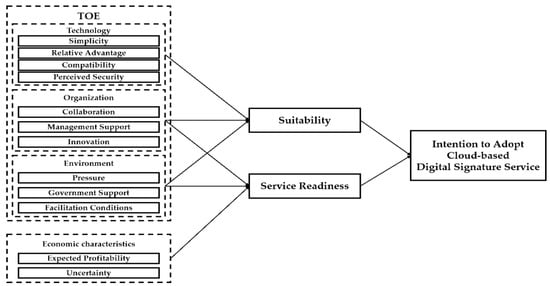
Figure 1.
Research model.
3.2. Hypothesis Development
3.2.1. Technical Characteristics and Suitability
Mohammed et al. [4] revealed that technological characteristics such as relative advantages, compatibility, complexity, trialability, and security affect the cloud computing adoption. In TOE theory, technical and business characteristics affect technical suitability [16]. When practitioners’ ability to perform work is improved through new technologies, the fitness of the practitioners’ skills will increase, and organizations will try to introduce new technologies accordingly [16]. Therefore, this study established the following hypotheses based on prior studies regarding technical characteristics and suitability.
Hypothesis 1 (H1).
Simplicity has a positive effect on suitability.
Hypothesis 2 (H2).
Relative advantage has a positive effect on suitability.
Hypothesis 3 (H3).
Compatibility has a positive effect on suitability.
Hypothesis 4 (H4).
Perceived security has a positive effect on suitability.
3.2.2. Organizational Characteristics and Suitability
In TOE theory, organizational characteristics are mainly divided into collaboration, management support, and organizational innovation [22]. The characteristics of work, such as collaboration within an organization and sufficient support therein, can significantly impact fitness and technical characteristics [15,18]. Therefore, this study established the following hypotheses based on previous studies on organizational characteristics and suitability.
Hypothesis 5 (H5).
Collaboration has a positive effect on suitability.
Hypothesis 6 (H6).
Management support has a positive effect on suitability.
Hypothesis 7 (H7).
Innovation has a positive effect on suitability.
3.2.3. Organizational Characteristics and Service Readiness
If the users of a new technology have a positive emotion, it is easy to accept the technology, but if they have a negative emotion they resist the technology [23]. Users’ emotions are influenced by the organization’s situation, and if the organization is more innovative and well supported the individual will have positive emotions [23]. Therefore, this study established the following hypotheses based on previous studies of organizational characteristics and service readiness.
Hypothesis 8 (H8).
Collaboration has a positive effect on service readiness.
Hypothesis 9 (H9).
Management support has a positive effect on service readiness.
Hypothesis 10 (H10).
Innovation has a positive effect on service readiness.
3.2.4. Environmental Characteristics and Suitability
In technology–organization–environment theory, environmental characteristics such as government support and competitor pressure have a direct impact on the organization’s acceptance of technology and services [24]. Facilitation conditions in introducing new technologies or services also affect the internal environmental characteristics felt by practitioners [13]. Therefore, this study established the following hypotheses based on previous studies on environmental characteristics and suitability.
Hypothesis 11 (H11).
Pressure has a positive effect on suitability.
Hypothesis 12 (H12).
Government support has a positive effect on suitability.
Hypothesis 13 (H13).
Facilitation condition has a positive effect on suitability.
3.2.5. Environmental Characteristics and Service Readiness
Positive emotions have a significant effect on service readiness and acceptance [23]. Government support and facilitation conditions were found to elicit positive emotions [23]. Therefore, this study established the following hypotheses based on prior studies of environmental characteristics and service readiness.
Hypothesis 14 (H14).
Pressure has a positive effect on service readiness.
Hypothesis 15 (H15).
Government support has a positive effect on service readiness.
Hypothesis 16 (H16).
Facilitation condition has a positive effect on service readiness.
3.2.6. Economic Characteristics and Service Readiness
This study’s expected profitability can be seen as an organization’s financial preparation for the introduction of new services. In research on the introduction and innovation of information systems, financial investment and financial readiness are considered important factors for organizations to adopt and develop technology [25]. Uncertainty acts as an impediment to the organization’s ability to prepare services, because it makes the results unpredictable [26]. Uncertainty will serve as a factor that hinders service readiness when an organization introduces a new service because it makes it impossible to accurately predict outcomes. Therefore, this study established the following hypotheses regarding economic characteristics and service readiness based on previous studies.
Hypothesis 17 (H17).
Expected profitability has a positive effect on service readiness.
Hypothesis 18 (H18).
Uncertainty has a positive effect on service readiness.
3.2.7. Suitability and Intention to Adopt
The suitability of work skills can be said to be a concept that acts as an influencing factor for organizations or individuals to introduce new technologies as a result. Organizations tend to adopt technology and services naturally when work is highly suitable [18,19,27,28]. Therefore, this study established the following hypothesis based on previous studies on suitability and intention to adopt.
Hypothesis 19 (H19).
Suitability has a positive effect on intention to adopt.
3.2.8. Service Readiness and Intention to Adopt
Technology readiness refers to the tendency of consumers to use new technologies to achieve their goals [23]. In addition, technical readiness can be said to be an open mind that embraces even obstacles [29]. In other words, the higher the service readiness, the more likely that an organization or individual will adopt new services and technologies. Therefore, this study established the following hypotheses regarding service readiness and intention to adopt based on prior studies.
Hypothesis 20 (H20).
Service readiness has a positive effect on intention to adopt.
3.3. Variable Operational Definition and Questionnaire
Table 1 shows the operational definition of the study variables included in the hypothesis and model of this study.

Table 1.
Operational definitions of variables and their questionnaire item.
4. Research Method and Results
4.1. Sample Design and Data Collection
In order to understand the factors affecting the intention to adopt a cloud-based digital signature service, this study collected data from participants through a seven-point Likert scale questionnaire based on prior research. The survey in this study was conducted by a professional survey company, the Korea Office of Entrust Survey, Seoul, South Korea, for around four weeks from 1 August to 31 August 2019. Data were collected through questionnaires distributed to 300 participants online. We requested data to be collected from companies in various industries. For research purposes, the total samples collected should include 200 from companies that use cloud services and 100 from companies that do not. Finally, after excluding 17 unusable responses, 283 samples were used for the analysis. There is no clear standard for sample size in the structural equation model, but the minimum number of samples for path analysis is 200 or more [38,39]. Therefore, this paper was considered to satisfy the criteria in using the structural equation model. For empirical analysis, a frequency analysis and normality test were conducted through the SPSS 23.0 statistical program, and a factor analysis as well as validity and reliability analysis were performed using the ‘plspm’ package provided by R programming. In addition, hypothesis testing was performed using partial least squares structural equation modeling (PLS-SEM). The demographic characteristics of the sample for empirical analysis are shown in Table 2.
Table 2.
Demographic characteristics of the sample.
4.2. Factor Analysis
Before evaluating the external model, an exploratory factor analysis was conducted through outer factor loading to confirm whether the questionnaire items in this study fit the purpose and intention of the study and to test the research model. The evaluation criterion should be that the factor loading of each indicator exceeds 0.6–0.7 and is higher than that of other indicators [40]. The results are as shown in Table 3.
Table 3.
Results of factor loading.
4.3. Reliability and Validity Analysis
4.3.1. Reliability Analysis
The PLS structural equation first analyzes the reliability and validity of each variable through an external model analysis [41]. When the results of the external model analysis satisfy the presented criteria, a structural model analysis, which is an internal model analysis, is performed to grasp the relationship between the variables [41]. The internal consistency reliability is evaluated using the Cronbach’s α value, DG’s rho value, and the eigenvalue [40]. As shown in Table 4, the Cronbach’s α value in this study meets the recommended criterion of 0.7 or higher [40,42]. In addition, the DG’s rho value, which is a criterion for evaluating internal reliability in the reflection indicator model, satisfies the cutoff of 0.7 or more, and the eigenvalue is also 1 or more, indicating that this study is suitable [40].
Table 4.
Reliability analysis.
4.3.2. Validity Analysis
A validity analysis consists of convergent validity and discriminant validity [41]. In a PLS analysis, the convergent validity is evaluated by the average variance extracted (AVE) value [43]. As shown in Table 5, the AVE values of this study were all higher than 0.5, and it was determined that convergent validity was secured [41]. On the other hand, in the case of discriminant validity it can be said that the criterion is satisfied when the value of the square root of the AVE values of latent variables is greater than or equal to the correlation value of the latent variable and other latent variables [43,44]. In this study, it was judged that the discriminant validity was also secured because the value of the square root of the AVE value of each latent variable met the criteria.
Table 5.
Discriminant validity analysis.
4.4. Statistical Hypothesis Testing
The PLS structural equation uses a nonparametric test method that applies the bootstrapping method to ensure statistically significant path coefficients are obtained through a path analysis [41]. In this study, the statistical significance of the path coefficient was secured through 1000 bootstrapping resampling and a hypothesis test was performed based on the t-value of 1.96 at the 5% level of statistical significance [41].
As shown in Table 6, of the 20 hypotheses 13 were adopted and 7 were rejected. First, the result of the hypothesis on the relationship between technical characteristics and suitability is presented. Hypothesis 1, which states that simplicity affects suitability, was adopted at a significance level of 0.019 with a path coefficient of 0.208 and a t-value of 2.352. Hypothesis 2, which states that the relative advantage affects suitability, was adopted at a significance level of 0.000 with a path coefficient of 0.247 and a t-value of 4.090. Hypothesis 3, which states that compatibility affects suitability, was adopted at a significance level of 0.050 with a path coefficient of 0.188 and a t-value of 1.962. Hypothesis 4, which states that perceived security affects suitability, was rejected at a significance level of 0.791 with a path coefficient of −0.033 and a t-value of −0.736.
Table 6.
Result of path analysis.
Second, the result of the hypothesis on the relationship between organizational characteristics and suitability is presented. Hypothesis 5, which states that collaboration affects suitability, was adopted at a significance level of 0.001 with a path coefficient of 0.156 and a t-value of 3.210. Hypothesis 6, which states that management support affects suitability, was adopted at a significance level of 0.048 with a path coefficient of 0.123 and a t-value of 1.980. Hypothesis 7, which states that innovation affects suitability, was rejected at a significance level of 0.612, with a path coefficient of 0.027 and a t-value of 0.508.
Third, the result of the hypothesis on the relationship between organizational characteristics and service readiness is presented. Hypothesis 8, which states that collaboration affects service readiness, was adopted at a significance level of 0.036 with a path coefficient of 0.190 and a t-value of 2.100. Hypothesis 9, which states that management support affects service readiness, was adopted at a significance level of 0.000, with a path coefficient of 0.316 and a t-value of 5.210. Hypothesis 10, which states that innovation affects service readiness, is rejected at a significance level of 0.066, with a path coefficient of 0.094 and a t-value of 1.84.
Fourth, the result of the hypothesis on the relationship between environmental characteristics and suitability is presented. Hypothesis 11, which states that pressure affects suitability, was rejected at a significance level of 0.878, with a path coefficient of 0.009 and a t-value of 0.154. Hypothesis 12, which states that government support affects suitability, was adopted at a significance level of 0.000, with a path coefficient of 0.209 and a t-value of 3.640. Hypothesis 13, which states that the facilitation condition affects suitability, was adopted at a significance level of 0.000 with a path coefficient of 0.417 and a t-value of 6.440.
Fifth, the result of the hypothesis on the relationship between environmental characteristics and service readiness is presented. Hypothesis 14, which states that pressure affects service readiness, was rejected at a significance level of 0.277 with a path coefficient of −0.061 and a t-value of −1.090. Hypothesis 15, which states that government support affects service readiness, was rejected at a significance level of 0.464, with a path coefficient of 0.035 and a t-value of 0.734. Hypothesis 16, which states that the facilitation condition affects the readiness, was adopted at a significance level of 0.000 with a path coefficient of 0.407 and a t-value of 6.810.
Sixth, the result of the hypothesis about the relationship between economic characteristics and service readiness is presented. Hypothesis 17, which states that expected profitability affects service readiness, was adopted at a significance level of 0.036 with a path coefficient of 0.192 and a t-value of 2.100. Hypothesis 18, which states that uncertainty affects service readiness, was rejected at a significance level of 0.150 with a path coefficient of −0.046 and a t-value of −1.440.
Finally, the result of the hypothesis on the relationship between suitability, service readiness, and intention to adopt is presented. Hypothesis 19, which states that suitability affects intention to adopt, was adopted at a significance level of 0.012 with a path coefficient of 0.125 and a t-value of 2.510. Hypothesis 20, which states that service readiness affects intention to adopt, was adopted at a significance level of 0.000 with a path coefficient of 0.666 and a t-value of 13.400.
5. Discussion and Conclusions
This study attempted to identify factors that could affect the acceptance of cloud-based electronic signature services. To this end, based on the TOE theory used in prior research a research model was proposed by combining work technology suitability and service readiness, and the main results of the empirical analysis are as follows.
First, simplicity, relative advantage, and compatibility in the technical characteristics significantly impacted the suitability, but the perceived security did not significantly affect the suitability. Since this can be seen as a result of a lack of trust by consumers in the complementarity of cloud services, it is necessary to improve consumers’ perception that the cloud service is safe, and this will take some time. In addition, simplicity, relative advantages, and compatibility lower resistance to the adoption of new technologies. Therefore, the cloud-based digital signature service should provide clarity and easy to use than the existing digital signature service and should eliminate difficulties in use and feel convenient by increasing compatibility with the company’s infrastructure. This applies not only to cloud services but also to existing ICT-related services.
Second, it was found that collaboration and support from management in organizational characteristics had a significant effect on both suitability and service readiness, but innovation did not significantly affect either of them. This is consistent with the findings of Gil [22], in that collaboration and support from management have a significant effect on suitability. In addition, the innovation does not significantly affect suitability and service readiness. This result supports the results of Parasuraman [23] and Maduku et al. [34], in that organizations show resistance to innovation in the early stage, and such resistance acts as an impediment to innovation acceptance. Therefore, in order to introduce a cloud-based digital signature service, the interest and willingness of the decision-makers in an organization are indispensable, and the support of the management layer can be achieved only if the interest and willingness are the basis. Through this, it was found that departmental collaboration can be achieved. In order for this to work smoothly, the cloud-based digital signature being provided must be tailored to the organization compared to the existing service.
Third, in the relationship between environmental characteristics and suitability, both facilitation conditions and government support were found to have a significant effect. Through this, it is judged that the government’s support is recognized as appropriate and causes the intention to adopt the investment to rise. In order to expand the government’s willingness to support the policy, companies must first actively seek support for this service and propose improvements to related laws and systems. However, only the facilitation condition was found to have a significant effect in relation to service readiness. It implied that the degree of influence of government support varies depending on the size of the company.
Lastly, it was found that the expected profitability in economic characteristics had a significant effect on service readiness. This supports the findings of Iacovou et al. [25]. In other words, it was concluded that the use of the cloud digital signature service raises the expectation that better profits can be generated than when using the existing service, and this could affect service preparation and intention to use. On the other hand, it was found that uncertainty did not significantly affect service readiness. This is in line with the existing research results of Das and Teng [26]. It was concluded that if the organization does not support the cloud-based digital signature service’s reliability, this will lower expectations for service preparation.
However, this study has the following limitations. First, users’ perceptions of cloud-based digital signature services have not been established. Since the current cloud-based digital signature service has just been introduced, there may be a difference in people’s perception of it in the future.
Second, research from an individual perspective is also necessary. The survey used in the study sought to review the organizational perspective on accepting related services. As related services expand to the individual domain, future research needs to develop and analyze individual-level variables.
Lastly, there are limitations on variables for explaining all cloud-based digital signature services. In future research, it is expected that more interesting research results can be obtained by developing additional factors that can better describe cloud services, apart from variables originating from existing ICT research.
Author Contributions
All of the authors contributed equally to the writing of the paper. Conceptualization, K.W.C. and J.C.; methodology, K.W.C., Y.S.K. and J.C.; formal analysis, Y.S.K. and J.C.; resources, K.W.C.; writing—original draft preparation, K.W.C. and Y.S.K.; writing—review and editing, J.C.; visualization, K.W.C. and Y.S.K.; supervision, J.C.; project administration, K.W.C. and J.C. All authors have read and agreed to the published version of the manuscript.
Funding
This research received no external funding.
Institutional Review Board Statement
Ethical review and approval could be waived for this study because the unit of analysis in this research is at the firm level.
Informed Consent Statement
Informed consent was obtained from all subjects involved in the study.
Data Availability Statement
The data presented in this study are available on request from the corresponding author.
Conflicts of Interest
The authors declare no conflict of interest.
References
- Shin, W.; Ahn, H. Effects of innovation characteristics of cloud computing services, technostress on innovation resistance and acceptance intention: Focused on public sector. Knowl. Manag. Rev. 2019, 20, 59–86. [Google Scholar]
- Min, Y.G. An Empirical Study on Factors Affecting Acceptance and Avoidance of Cloud Service for Each Industry. Ph.D. Thesis, Sangmyung University, Chungnam, Korea, 2016. [Google Scholar]
- Low, C.; Chen, Y.; Wu, M. Understanding the determinants of cloud computing adoption. Ind. Manag. Data Syst. 2011, 111, 1006–1023. [Google Scholar] [CrossRef]
- Mohammed, F.; Ibrahim, O.; Ithnin, N. Factors influencing cloud computing adoption for e-government implementation in developing countries: Instrument development. J. Syst. Inf. Technol. 2016, 18, 297–327. [Google Scholar] [CrossRef]
- Park, E.; Kim, K.J. An integrated adoption model of mobile cloud services: Exploration of key determinants and extension of technology acceptance model. Telemat. Inform. 2014, 31, 376–385. [Google Scholar] [CrossRef]
- Pańkowska, M.; Pyszny, K.; Strzelecki, A. Users’ adoption of sustainable cloud computing solutions. Sustainability 2020, 12, 9930. [Google Scholar] [CrossRef]
- Oliveira, T.; Thomas, M.; Espadanal, M. Assessing the determinants of cloud computing adoption: An analysis of the manufacturing and services sectors. Inf. Manag. 2014, 51, 497–510. [Google Scholar] [CrossRef]
- Gangwar, H.; Date, H.; Ramaswamy, R. Understanding determinants of cloud computing adoption using an integrated TAM-TOE model. J. Enterp. Inf. Manag. 2015, 28, 107–130. [Google Scholar] [CrossRef]
- Kim, A.Y.; Kim, T.S.; Oh, H.-K. Factors influencing the intention to adopt new electronic authentication services: Focusing on mobile financial service. J. Korean Inst. Commun. Inf. Sci. 2018, 43, 461–474. [Google Scholar]
- Quinting, A.; Lins, S.; Szefer, J.; Sunyaev, A. Advancing the adoption of a new generation of certifications–A theoretical model to explain the adoption of continuous cloud service certification by certification authorities. In Proceedings of the 13th Internationale Tagung Wirtschaftsinformatik, St. Gallen, Switzerland, 12–15 February 2017. [Google Scholar]
- Behrend, T.S.; Wiebe, E.N.; London, J.E.; Johnson, E.C. Cloud computing adoption and usage in community colleges. Behav. Inf. Technol. 2011, 30, 231–240. [Google Scholar] [CrossRef]
- Lee, S.W. Research on Determinants for Big Data System Adoption in Organizations. Ph.D. Thesis, Sungkyunkwan University, Seoul, Korea, 2016. [Google Scholar]
- Venkatesh, V.; Morris, M.G.; Davis, G.B.; Davis, F.D. User acceptance of information technology: Toward a unified view. MIS Q. 2003, 27, 425–478. [Google Scholar] [CrossRef]
- Jeon, S.H.; Park, N.R.; Lee, C.C. Study on the factors affecting the intention to adopt public cloud computing service. Entrue J. Inf. Technol. 2011, 10, 97–112. [Google Scholar]
- Goodhue, D.L. Development and measurement validity of a task-technology fit instrument for user evaluations of information system. Decis. Sci. 1998, 29, 105–138. [Google Scholar] [CrossRef]
- Goodhue, D.L.; Thompson, R.L. Task-Technology Fit and individual performance. MIS Q. 1995, 19, 213–236. [Google Scholar] [CrossRef]
- Goodhue, D.L. Understanding user evaluations of information systems. Manag. Sci. 1995, 41, 1827–1844. [Google Scholar] [CrossRef]
- Raven, A.; Leeds, E.; Park, C. Digital video presentation and student performance: A task technology fit perspective. Int. J. Inf. Commun. Technol. Educ. (IJICTE) 2010, 6, 17–29. [Google Scholar] [CrossRef]
- Kim, S.; Park, J.; Kim, E.; Park, J. A study on big-data application methods and their expected effect analysis—Impact of data analysis to improve employee decision making in domestic firms. J. Inf. Technol. Archit. 2015, 12, 159–170. [Google Scholar]
- Kim, J.K. A Study on the Usage Intention of Category Types in the Mobile Application Based on the Technology Readiness and Acceptance Model. Ph.D. Thesis, Kongju National University, Kongju, Korea, 2013. [Google Scholar]
- Kim, C.S. A Study on the Consumer Satisfaction Model Incorporating the Technology Readiness Model and the Technology Paradox Theory. Ph.D. Thesis, Korea Aerospace University, Goyang, Korea, 2018. [Google Scholar]
- Gil, H.C. An Empirical Study on Adoption Factor and Performance Analysis of Smart Factory through Technical Acceptance Model: Focusing on TOE and IS Success Model. Ph.D. Thesis, Hansung University, Seoul, Korea, 2019. [Google Scholar]
- Parasuraman, A. Technology Readiness Index (Tri): A multiple-item scale to measure readiness to embrace new technologies. J. Serv. Res. 2000, 2, 307–320. [Google Scholar] [CrossRef]
- Tornatzky, L.G.; Fleischer, M.; Chakrabarti, A.K. The Processes of Technological Innovation; Lexington Books: Lexington, KY, USA, 1990. [Google Scholar]
- Iacovou, C.L.; Benbasat, I.; Dexter, A.S. Electronic data interchange and small organizations: Adoption and impact of technology. MIS Q. 1995, 19, 465–485. [Google Scholar] [CrossRef]
- Das, T.K.; Teng, B.S. The risk-based view of trust: A conceptual framework. J. Bus. Psychol. 2004, 19, 85–116. [Google Scholar] [CrossRef]
- Koo, S.H.; Shin, M.S. The study on the impact of the task-technology fit model and organizational characteristics of the mobile office system on the job performance. J. Korea Acad. Ind. Coop. Soc. 2013, 14, 644–654. [Google Scholar]
- Son, H.T. A Study on the Performance of Public Official’s Decision Making Using GeoPros: Focused on Perceived Task-Technology Fit. Ph.D. Thesis, Soongsil University, Seoul, Korea, 2019. [Google Scholar]
- Lin, J.S.C.; Hsieh, P.L. The role of technology readiness in customers’ perception and adoption of self-service technologies. Int. J. Serv. Ind. Manag. 2006, 17, 497–517. [Google Scholar] [CrossRef]
- Yang, Z.; Sun, J.; Zhang, Y.; Wang, Y. Understanding SaaS adoption from the perspective of organizational users: A Tripod Readiness Model. Comput. Hum. Behav. 2015, 45, 254–264. [Google Scholar] [CrossRef]
- Ahmadi, H.; Nilashi, M.; Shahmoradi, L.; Ibrahim, O. Hospital information system adoption: Expert perspectives on an adoption framework for Malaysian public hospitals. Comput. Hum. Behav. 2017, 67, 161–189. [Google Scholar] [CrossRef]
- Lee, S.M.; Lee, Y.G.; Lee, K.Y. The impacts of SCM partnership on the corporate performance. J. Korean Prod. Oper. Manag. Soc. 2007, 18, 105–133. [Google Scholar]
- Lee, S.J.; Han, P.K.; Kang, B.G. The effect of collaboration and organization’s performance depending on the partnership by information technology using level: Key subject is moderating variable of information technology using level. Inf. Syst. Rev. 2009, 11, 67–90. [Google Scholar]
- Maduku, D.K.; Mpinganjira, M.; Duh, H. Understanding mobile marketing adoption intention by South African SMEs: A multi-perspective framework. Int. J. Inf. Manag. 2016, 36, 711–723. [Google Scholar] [CrossRef]
- Venkatesh, V.; Bala, H. Adoption and impacts of interorganizational business process standards: Role of partnering synergy. Inf. Syst. Res. 2012, 23, 1131–1157. [Google Scholar] [CrossRef]
- Venkatesh, V.; Thong, J.Y.L.; Xu, X. Consumer acceptance and use of information technology: Extending the Unified Theory of Acceptance and Use of Technology. MIS Q. 2012, 36, 157–178. [Google Scholar] [CrossRef]
- Zhou, T.; Lu, Y.; Wang, B. Integrating TTF and UTAUT to explain mobile banking user adoption. Comput. Hum. Behav. 2010, 26, 760–767. [Google Scholar] [CrossRef]
- Hoogland, J.J.; Boomsma, A. Robustness studies in covariance structure modeling: An overview and a meta-analysis. Sociol. Methods Res. 1998, 26, 329–367. [Google Scholar] [CrossRef]
- Nunnally, J.C. Psychometric Theory; McGraw-Hill: New York, NY, USA, 1967. [Google Scholar]
- Yoon, C.; Kim, S. A tutorial on PLS structural equating modeling using R: (Centering on) Exemplified research model and data. Inf. Syst. Rev. 2014, 16, 89–112. [Google Scholar]
- Hair, J.F.; Ringle, C.M.; Sarstedt, M. PLS-SEM: Indeed a silver bullet. J. Mark. Theory Pract. 2011, 19, 139–152. [Google Scholar] [CrossRef]
- Cortina, J.M. What is coefficient alpha? An examination of theory and applications. J. Appl. Psychol. 1993, 78, 98–104. [Google Scholar] [CrossRef]
- Fornell, C.; Larcker, D.F. Structural equation models with unobservable variables and measurement error: Algebra and statistics. J. Mark. Res. 1981, 18, 382–388. [Google Scholar] [CrossRef]
- Chin, W.W. The partial least squares approach to structural equation modeling. In Modern Methods for Business Research; Marcoulides, G.A., Ed.; Lawrence Erlbaum Associates: Mahwah, NJ, USA, 1998; pp. 295–336. [Google Scholar]
Publisher’s Note: MDPI stays neutral with regard to jurisdictional claims in published maps and institutional affiliations. |
© 2021 by the authors. Licensee MDPI, Basel, Switzerland. This article is an open access article distributed under the terms and conditions of the Creative Commons Attribution (CC BY) license (http://creativecommons.org/licenses/by/4.0/).