Review

Decellularization Techniques for Tissue Engineering: Towards Replicating Native Extracellular Matrix Architecture in Liver Regeneration


1
Department of Biomedical Engineering, University College of Engineering (UCE), Osmania University, Hyderabad 500007, India
2
School of Medicine, McGowan Institute for Regenerative Medicine, University of Pittsburgh, Pittsburgh, PA 15219, USA
3
Faculty of Chemistry, Nicolaus Copernicus University in Torun, Jurija Gagarina 11, 87-100 Torun, Poland
4
Faculty of Health Sciences, Calisia University, Nowy Świat 4, 62-800 Kalisz, Poland
*
Authors to whom correspondence should be addressed.
These authors contributed equally to this work.
J. Funct. Biomater. 2023, 14(10), 518; https://doi.org/10.3390/jfb14100518
Submission received: 13 September 2023 / Revised: 9 October 2023 / Accepted: 10 October 2023 / Published: 16 October 2023

Abstract

The process of tissue regeneration requires the utilization of a scaffold, which serves as a structural framework facilitating cellular adhesion, proliferation, and migration within a physical environment. The primary aim of scaffolds in tissue engineering is to mimic the structural and functional properties of the extracellular matrix (ECM) in the target tissue. The construction of scaffolds that accurately mimic the architecture of the extracellular matrix (ECM) is a challenging task, primarily due to the intricate structural nature and complex composition of the ECM. The technique of decellularization has gained significant attention in the field of tissue regeneration because of its ability to produce natural scaffolds by removing cellular and genetic components from the extracellular matrix (ECM) while preserving its structural integrity. The present study aims to investigate the various decellularization techniques employed for the purpose of isolating the extracellular matrix (ECM) from its native tissue. Additionally, a comprehensive comparison of these methods will be presented, highlighting their respective advantages and disadvantages. The primary objective of this study is to gain a comprehensive understanding of the anatomical and functional features of the native liver, as well as the prevalence and impact of liver diseases. Additionally, this study aims to identify the limitations and difficulties associated with existing therapeutic methods for liver diseases. Furthermore, the study explores the potential of tissue engineering techniques in addressing these challenges and enhancing liver performance. By investigating these aspects, this research field aims to contribute to the advancement of liver disease treatment and management.
Keywords: decellularization; liver; tissue engineering; extracellular matrix; scaffold decellularization; liver; tissue engineering; extracellular matrix; scaffold
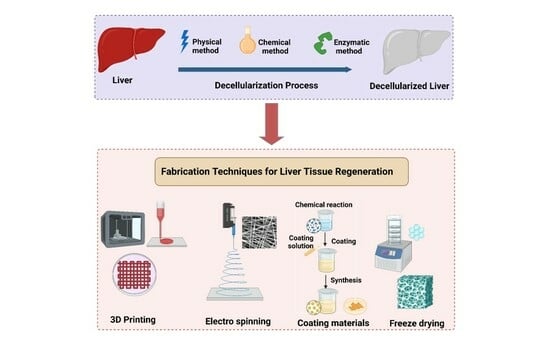
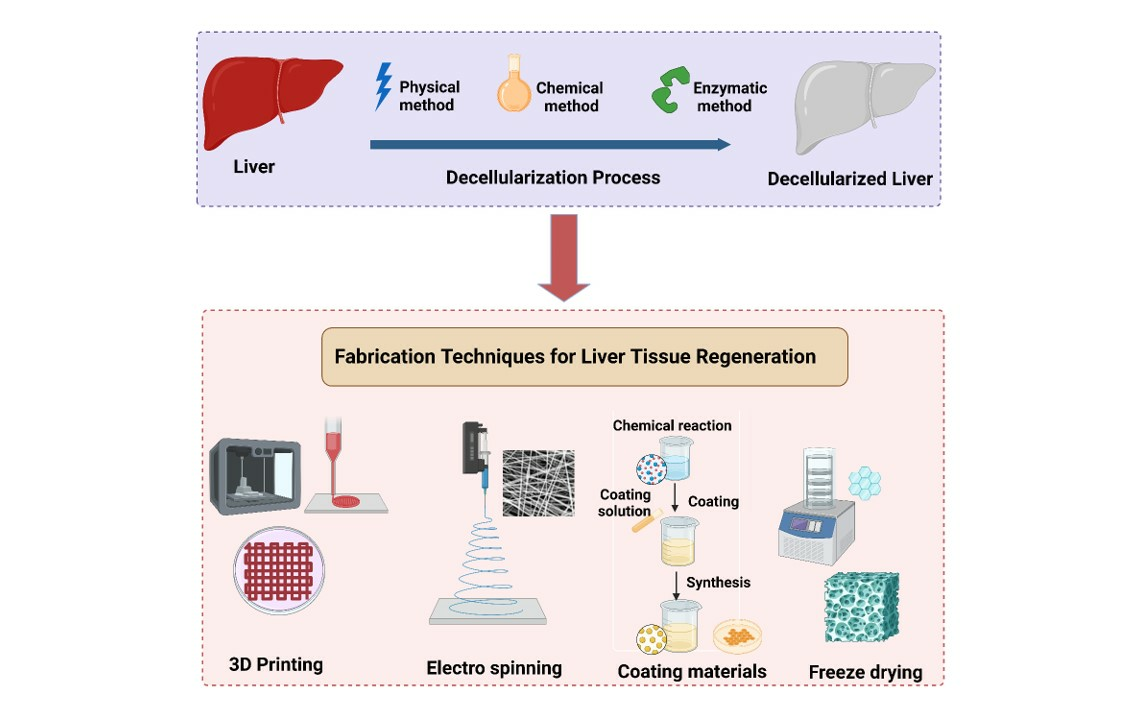
Graphical Abstract