


Abstract
Oil separation from water becomes a challenging issue in industries, especially when large volumes of stable oil/water emulsion are discharged. The present short review offers an overview of the recent developments in the nanofiber membranes used in oily wastewater treatment. This review notes that nanofiber membranes can efficiently separate the free-floating oil, dispersed oil and emulsified oil droplets. The highly interconnected pore structure nanofiber membrane and its modified wettability can enhance the permeation flux and reduce the fouling. The nanofiber membrane is an efficient separator for liquid–liquid with different densities, which can act as a rejector of either oil or water and a coalescer of oil droplets. The present paper focuses on nanofiber membranes’ production techniques, nanofiber membranes’ modification for flux and separation efficiency improvement, and the future direction of research, especially for practical developments.
1. Introduction
Discharging large volumes of oily wastewater is unavoidable due to the rapid growth of industries, such as food and beverage, textile, cosmetic, metallurgical manufacturing and petroleum production. In addition, the frequent accidents of oil spillages and chemical leakages have worsened the environmental pollution. The oily wastewater generally exists in three main categories [1]: suspended and free-floating oil (>150 μm), dispersed and unstable oil/water emulsion (20–150 μm) and stable oil/water emulsion (<20 μm). The oil fractions in the wastewaters’ first and second categories are easier to remove by conventional physical separation techniques, e.g., gravity separation, skimming, floatation, burning, etc. At the same time, the stable oil/water emulsion is treated with chemical and biological techniques. However, the conventional physical treatment techniques suffer low separation efficiency, high cost and high energy consumption. The chemical treatment method generates secondary pollutants and is costly; the biological treatment requires vast space and the processes are sensitive to temperature and pH.
Membrane separation technologies have recently received significant attention in oily wastewater treatment [2,3]. The strengths of using membrane separation for the oily wastewater treatment include high flux, excellent oil removal, light weight, mechanical flexibility, compact design with small space requirement, low energy consumption and low cost. However, fouling is the major challenge, which causes the flux declination.
Nanofibrous membranes have obtained significant attention in membrane separation, starting ten years ago. The nanofibrous membrane is a thin film comprising nanofibers that overlap with each other in a completely random manner. The nanofibrous membrane is well known in separation applications because of the fibers’ fine diameters, making the membrane highly porous. Although the foulants block some pore channels, the highly interconnected pore structures in the nanofibrous membrane permit the liquids to flow through other alternative paths. The permeation flux in the nanofibrous structures has been three-times higher than that of the phase inversion membranes [4,5]. Thus, the nanofiber membrane serves as a better fouling resistance. This short review article describes the techniques that are commonly used to produce the nanofibers, the membrane modification techniques which have further improved the permeation flux and the separation efficiency of oil/water, and the remarks of future research directions.
2. An Overview of Nanofiber Production Techniques
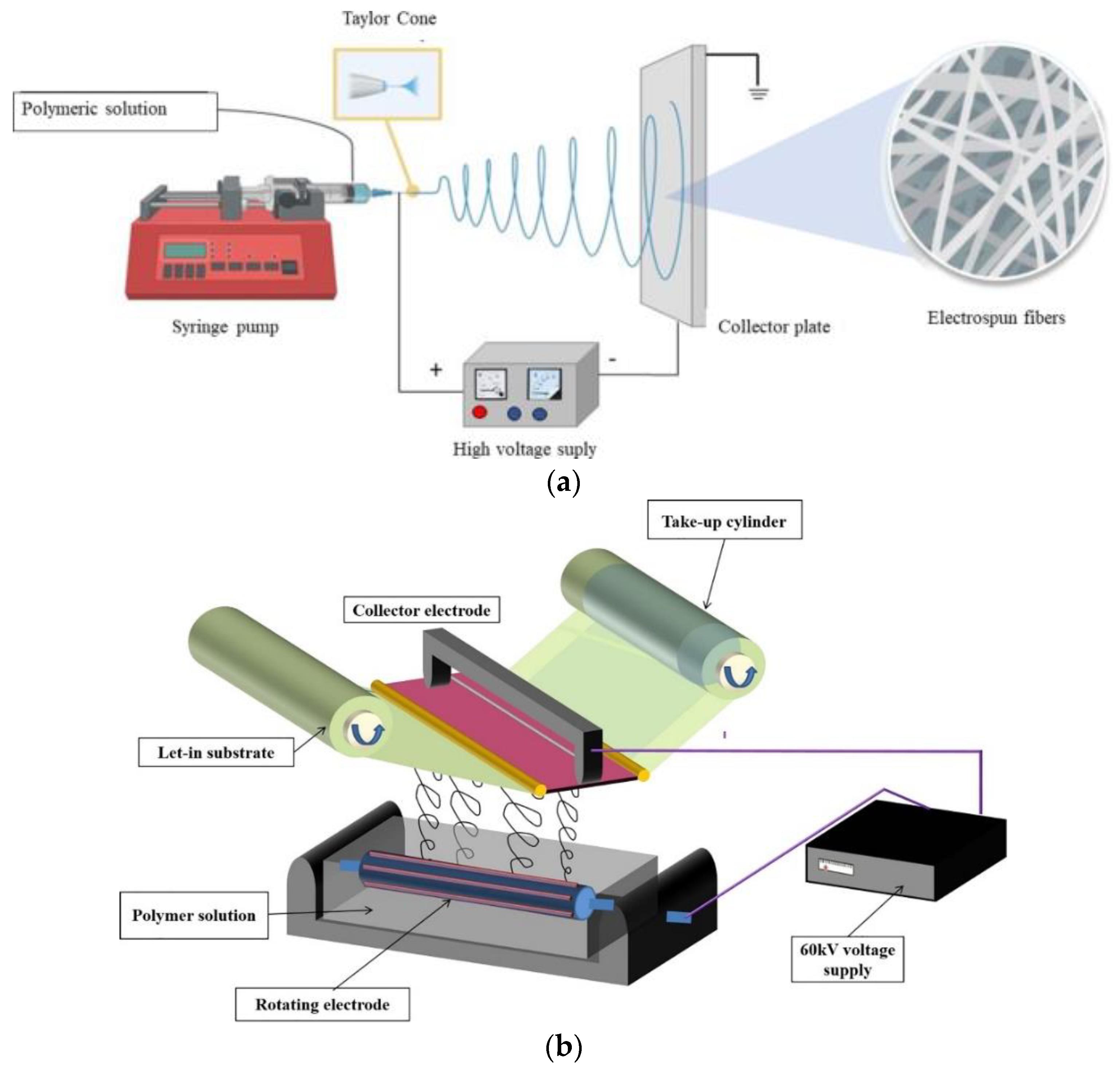
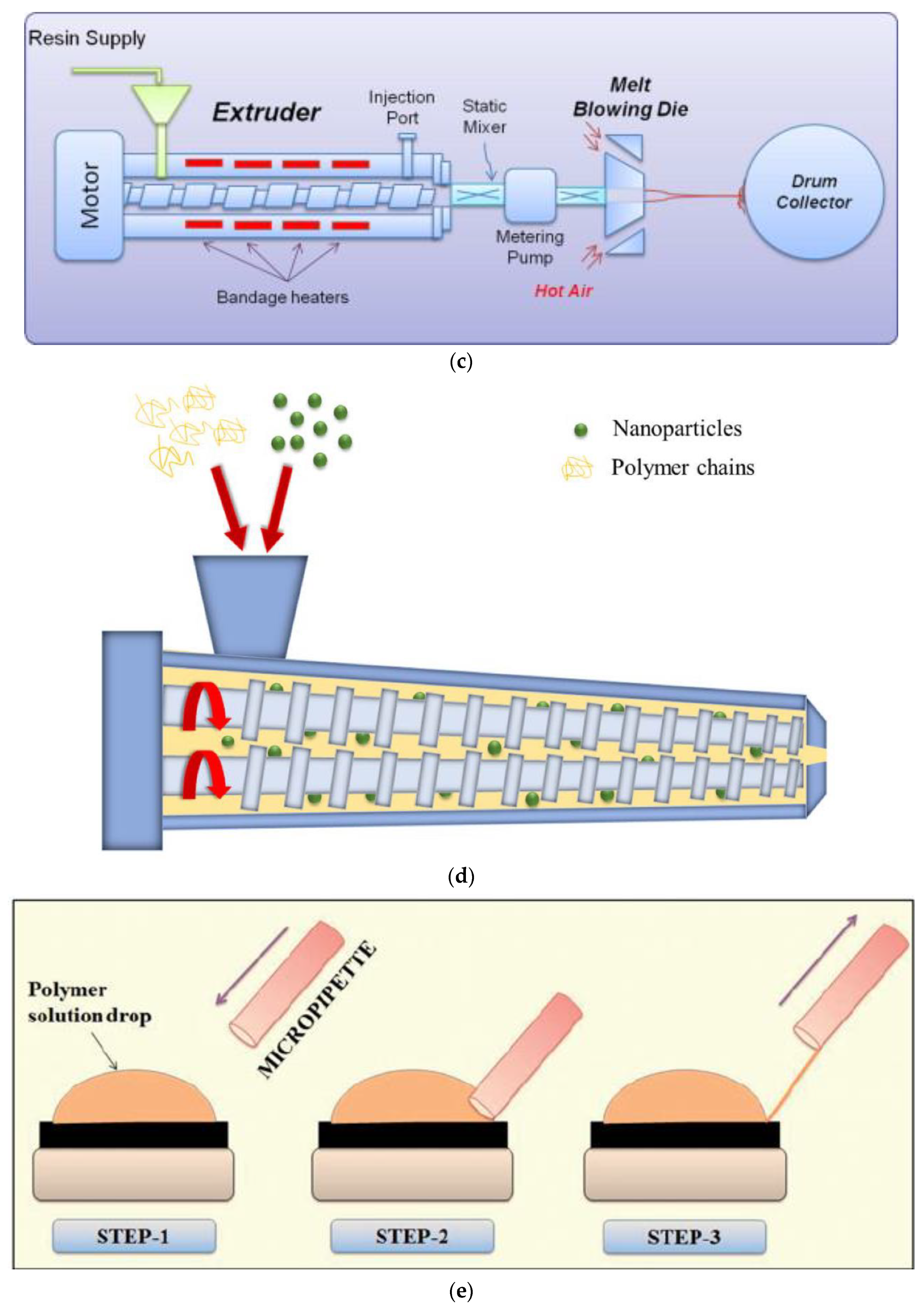
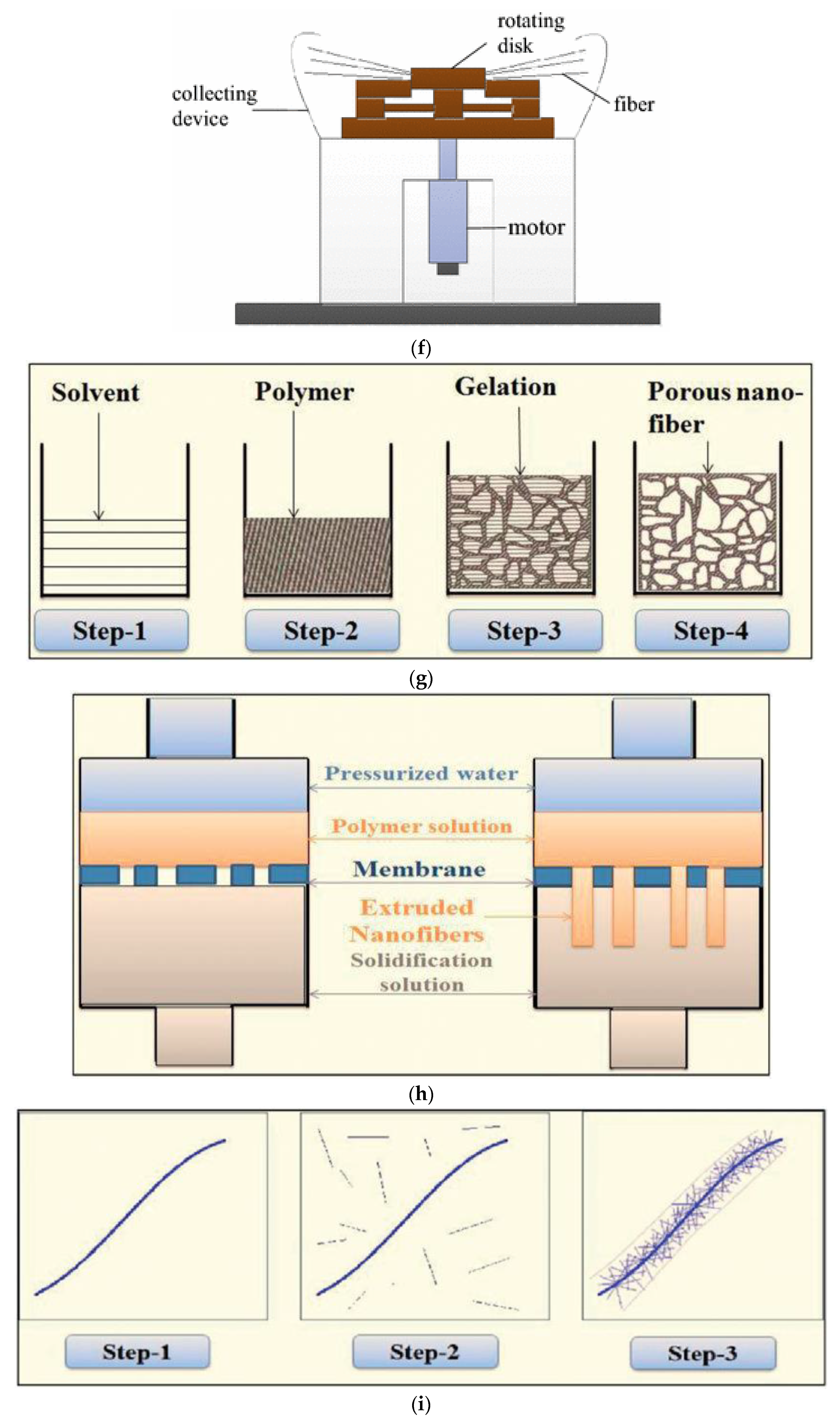
Nanofiber membranes are popular in their wide range of applications in water separation and purification [6,7,8]. As shown in Figure 1, the nanofibers can be produced from various techniques, such as needle electrospinning [9], needleless electrospinning [10], melt-blowing [11], melt-blending extrusion [12], drawing [13], centrifugal force spinning [14], phase separation [15], template synthesis [16], self-assembly [17], etc. Table 1 shows the different techniques and the polymeric materials used to produce the nanofibers. A comparison of different nanofiber production techniques is summarized in Table 2. To date, the electrospinning technique is the most applied to produce nanofiber membranes for the oil/water separation [18], followed by melt-blowing [19] and melt-blending extrusion [20].
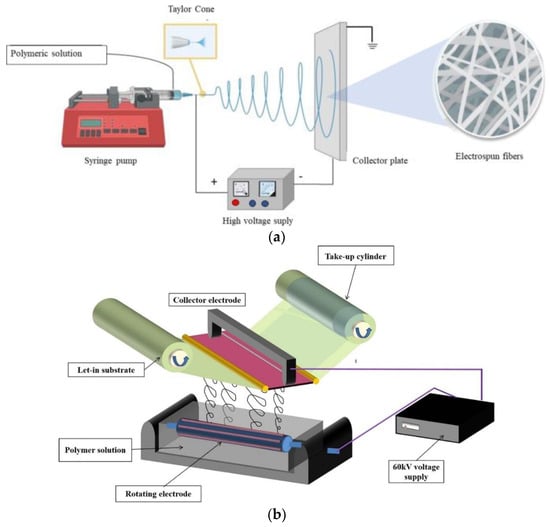
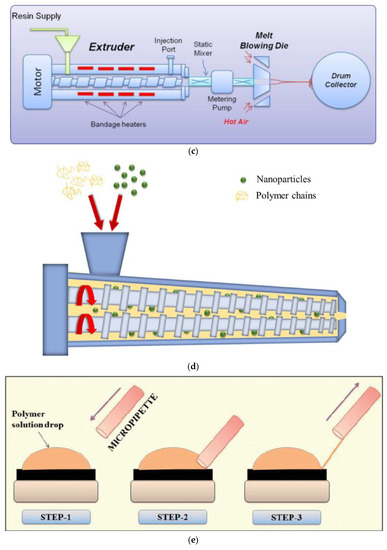
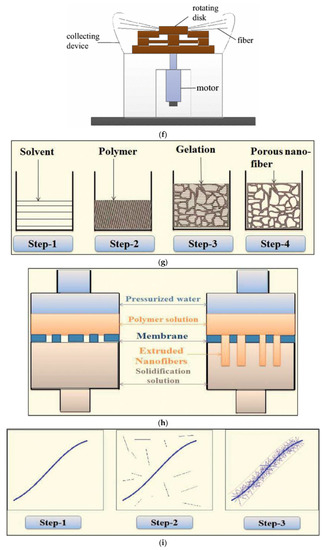
Figure 1.
Various types of nanofiber production techniques. (a) Needle electrospinning, reproduced with permission from [21], copyright 2021 Springer Nature; (b) needleless electrospinning, reproduced with permission from [22], copyright 2021 Elsevier; (c) melt-blowing, reproduced with permission from [23], copyright 2013 Elsevier; (d) melt-blending, reproduced with [24], (e) drawing, reproduced with permission from [25], copyright 2014 Taylor & Francis; (f) centrifugal force spinning, reproduced with permission from [26], copyright 2018 Springer Nature; (g) phase separation, reproduced with permission from [25], copyright 2014 Taylor & Francis; (h) template synthesis, reproduced with permission from [25], copyright 2014 Taylor & Francis; and (i) self-assembly, reproduced with permission from [25], copyright 2014 Taylor & Francis.

Table 1.
Types of polymeric materials used in different nanofiber production techniques.
Table 2.
Comparison of different nanofiber production techniques.
Electrospinning was first patented by Formhals in 1934 [72]. Electrospinning, also known as ‘electrostatic spinning’, is a versatile technique that applies electric force to produce fibers with diameters as small as hundreds of nanometers. The pressurized polymeric liquid exits from the syringe needle and is subjected to high-voltage DC power. The syringe needle is charged positively and the collector plate is negatively charged using a DC power supply. The collector plate is grounded. The nonwoven fibers are formed when the electrostatic repulsion curbs the surface tension of the polymeric liquid ejected from the syringe needle. The polymer–solvent evaporates during the electrospinning process. The diameters of the fibers that can be fabricated from the electrospinning process range from 3 nm to 5 μm [73,74,75] or greater [76,77]. The diameters of the fibers are basically controlled by the properties in the polymer solution, such as the polymer concentration [78,79], molecular weight of the polymer [80], conductivity [81] and solvent volatility [82]. The process parameters also significantly affect the diameter of the fibers, such as the spinning throughput and the applied voltage [83], temperature [79] and humidity [81,82].
The melt-blowing process to form fibers with diameters below 10 μm was first demonstrated by Van A. Wente in 1954 [84]. Melt-blowing is a one-step process, whereby the molten polymer emerges through an orifice of a die and is blown into fibers by hot and high-velocity air. The fibers are collected on a rotary drum. The melt-blowing process can produce nano- and micro-fibers with different operating settings. The average fiber diameter generally ranges from 2 to 4 μm; the minimum can range from 0.3 to 0.6 μm and the maximum is between 15 and 20 μm [85]. Hassan et al. [23] fabricated nanofiber melt-blown membranes from a metallocene isotactic polypropylene and the average fiber diameter ranged between 1 and 2 μm, with different die designs as a new strategy to produce the fiber size in a range of 300–500 nm. The melt-blowing process is a mass-producing fiber technique without using any polymer solvent, which can produce the fiber at rates between 500 and 1000 g/h. The melt-blowing process does not require massive-scale solvent recovery from the dilute air stream as the electrospinning method does.
Two polymers are blended and fed into the co-rotating twin-screw extruder in the melt-blending extrusion. The dispersed phase is stretched into nanofibers and the nanofiber membrane is obtained after removing the matrix phase. The diameters of the nanofibers range from 60 to 900 nm [20,53].
3. Parameters of Nanofiber Membrane Affecting the Oil/Water Separation Performance
In most laboratories, various binary oil/water systems are tested as the models of oily wastewater. The oil/water models are categorized into two types, which are the oil/water mixtures and the oil/water emulsions. Gravity-driven filtration [86] is the most straightforward testing process for oil/water separation. Some researchers have also used dead-end [87] and cross-flow filtration [88] methods to perform oil/water separation experiments. The water is recovered in the permeate stream and the oil is harvested in the rejection stream when a hydrophilic and oleophobic membrane is used, while a hydrophobic and oleophilic membrane rejects the water and permits the oil to permeate. The separation performance of the membrane is determined in terms of flux, separation efficiency, oil rejection and, sometimes, demulsification efficiency.
The flux () is measured as the volume of permeate produced per unit time per unit membrane area [86,87,88]:
where is the volume of the permeate, is the membrane area and is the duration time to collect the permeate. The flux is determined by the nanofiber membrane properties, such as pore size, porosity and fiber diameter. The flux increases with increasing the pore size, porosity and the number of interconnected pores due to the presence of more flow channels [89,90]. In addition, the nanofiber membrane exhibits good permeability and the flux increases when the nanofiber diameter increases [91] because the pore size and porosity of the nanofiber membrane increase correspondingly [91,92,93].
The separation efficiency () of the membrane is calculated as the total amount of the oil removed divided by the initial amount of the oil [94,95]:
where and are the oil contents in the permeate and feed, respectively, for the hydrophilic and oleophobic membrane used, i.e., water-removing mode. For oil-removing mode, and are the water contents in the permeate and feed, respectively, when the hydrophobic and oleophilic membrane is employed. Equation (2) is also known as oil rejection when water-removing mode is applied [96,97]. However, some researchers also defined the separation efficiency differently, such as [98]:
where and are the mass of the water and oil before and after the separation process, respectively. Zhang et al. [99] defined the separation efficiency as follows:
where and are the volume of permeate and feed, respectively.
Coalescence is a demulsification process and it is an irreversible process. The destabilized oil droplets collide and combine into larger oil droplets and eventually form the oil slick floating on the water surface. The wettability and pore size of the nanofiber membrane are the main factors to determine the coalescence of the oil droplets [100,101,102]. The demulsification efficiency () can be employed to evaluate the ratio of residual emulsion in the permeate [103]:
where is the total volume of the water phase layer and the oil/water emulsion layer in the permeate, is the water content in the feed oi/water emulsion and is the volume of the permeate.
4. Thin-Film Composite Nanofiber Membrane for Oil/Water Separation
The crosslinked coating was used to improve the hydrophilicity in the electrospun nanofiber membranes and, thus, provide good antifouling characteristics. The coating materials must possess hydrophilic and highly water-permeable properties. The coating layer deposits on the electrospun nanofiber membrane surface must be sufficiently thin, but too thin a layer can lead to structural disintegration. Hence, optimization of the coating layer thickness must be investigated carefully. Although the added hydraulic resistance due to the coating layer can reduce the flux, the declination in the flux caused by the fouling of a membrane without the hydrophilic coating layer is much more severe, especially for the extended operation [104,105]. Yoon’s group successfully fabricated thin-film nanofibrous composite (TFNC) membranes by coating the electrospun PAN nanofibrous scaffolds with chitosan and PVA, which rejected the oil emulsion by at least 99%, respectively, in 24 and 190 h of operations [106,107].
Metal ions in the oily wastewater make the oil/water separation more challenging because the tiny sizes of the ions are difficult to retain by the membranes. The membrane surface charges used in the oil/water emulsion treatment significantly influence the demulsification and fouling [108,109]. Zhu et al. [110] fabricated the PVA-charged hydrogel nanofibrous membranes (CHNMs) by the electrospinning and crosslinking processes with glutaraldehyde and phytic acid. The surfaces of PVA CHNMs are negatively charged, which modified the stability in the negatively charged oil/water emulsion. The collision of the unstable oil droplets results in coalescence. The electrostatic repulsion between the negatively charged membrane surface and the negatively charged emulsion reduces the fouling. The separation between the oil and water is further enhanced when the PVA CHNMs are superhydrophilic and oleophobic. However, the investigation into various foulants, such as the natural organic matter, synthetic organic compounds produced during disinfection processes and soluble microbial products contained in the real oily wastewaters using the crosslinked nanofiber membranes, is scarcely reported.
5. Nanomaterials in Nanofiber Membrane for Oil/Water Separation
Different types of nanomaterials are used to modify the electrospun nanofiber membranes and, thus, improve the wettability properties and the antifouling characteristics in the new nanofiber membranes. For the oil/water separation application, the nanomaterials include silver (Ag) nanoparticles [101], gold (Au) nanoparticles [99], TiO2 nanoparticles [111], Fe3O4 nanopowder [112], silica nanoparticles [113], polydopamine nanoparticles [114], graphene oxide [115] and electrospun polystyrene nanofibers [116]. The modification process for the electrospun nanofiber membranes using the nanomaterials includes graft polymerization [117], coating [118], electrospinning [116], spraying [119] and incorporation of the nanoparticles in the base polymer solution before electrospinning [112].
Although most studies revealed the successful modified membranes can achieve high separation efficiencies, as shown in Table 3 and Table 4, for oil/water mixtures and oil/water emulsions, respectively, there are a few major concerns. The concerns include the reduction in the mechanical properties in the modified membranes [120,121]; adhesion of the nanomaterials [122]; applicability of the modified membranes in corrosive and harsh environment [123]; and health and safety of the use of chemicals [124].
Table 3.
Application of nanomaterials in the nanofiber membranes for the oil/water mixture separation.
Table 4.
Application of nanomaterials in the nanofiber membranes for oil/water emulsion separation.
6. Sustainable Development of Nanofiber Membrane for Oil/Water Separation
The nanomaterials were successfully applied in developing the nanofiber membranes for both oil/water mixture and oil/water emulsion treatments by upgrading the wettability to be either superhydrophilic or superhydrophobic. The superwetting nanofiber membranes can achieve separation efficiency of at least 90% and improve the flux simultaneously, as reported in the literatures. Despite that, the utilization of the chemicals is various and expensive. Bio-based nanomaterials derived from renewable materials, such as agricultural wastes, would be a better choice to increase the values of sustainability. Obaid et al. [115] reported that silica nanoparticles extracted from rice husk significantly improved the PSF electrospun nanofiber membrane fluxes for petroleum oil fractions/water separation. However, the separation efficiencies were not revealed in the study. Bioinspired silica nanoparticles have been synthesized from many biomass resources [135], such as rice husk [136,137], sugarcane bagasse [138], bamboo sticks and leaves [139], palm kernel shell [140], etc. Lignin-derived nanomaterials [141] are also potential precursors of nanofiber membranes for oily wastewater treatment in the future.
7. Conclusions and Remarks for Future Directions
Nanofiber membrane filtration is a promising technique to treat oily wastewater, either in the form of free-floating oil (>150 μm), dispersed and unstable oil/water emulsion (20–150 μm) or stable oil/water emulsion (<20 μm). The application of nanofiber membranes can compete with existing oil separation technologies in terms of economic, environmental and safety considerations. Even though many publications in scientific journals have been found in recent years, practical development on a commercial scale is still lacking. A few suggestions for future research are summarized as follows:
- Most of the oil/water emulsions tested in laboratories comprise two components. However, the real oily wastewaters discharged from numerous industries may contain abundant organic and inorganic compounds. These compounds may induce the nanofiber membranes to perform differently than the findings obtained from the binary mixtures. Some the organic compounds can swell the polymeric nanofibers and, eventually, may alter the nanofiber membrane properties. Investigation of using the real oily wastewaters in fouling and swelling could be an attractive topic in future research.
- Membrane surface modification to produce super wetting properties can improve the oil removal efficiencies. However, the preparation of the modified nanofiber membranes involves sophisticated procedures. Significant types of chemicals are expensive. Natural and sustainable resources with simple techniques for modified nanofiber membrane preparation are recommended in future studies.
- Most current oil/water separation studies use simple gravity-driven filtration systems and the membrane sizes are approximately 40–50 cm in diameter. To manage the large volumes of the oily wastewaters discharged from industries, a large-scale filtration system that can run for long-term operation is required.
- Modelling studies on oily wastewater and even oil/water separation using nanofiber membranes are hardly found in the literature. A vigorous model, which can accurately predict the nanofiber membrane performance, is required when scaling up the filtration system.
Author Contributions
Writing—original draft preparation and editing C.-K.C.; paper framework, writing and editing, R.S. All authors have read and agreed to the published version of the manuscript.
Funding
This research was partly funded by the Ministry of Higher Education Malaysia through the research grant code PRGS/2/2019/TK02/UMS/01/1 and the Research Management Centre, Universiti Malaysia Sabah.
Institutional Review Board Statement
Not applicable.
Informed Consent Statement
Not applicable.
Data Availability Statement
Not applicable.
Conflicts of Interest
The authors declare no conflict of interest.
References
- Cheryan, M. Ultrafiltration and Microfiltration Handbook, 2nd ed.; Taylor & Francis: New York, NY, USA, 1998; p. 376. [Google Scholar]
- Tanudjaja, H.J.; Hejase, C.A.; Tarabara, V.V.; Fane, A.G.; Chew, J.W. Membrane-based separation for oily wastewater: A practical perspective. Water Res. 2019, 156, 347–365. [Google Scholar] [CrossRef] [PubMed]
- Dmitrieva, E.S.; Anokhina, T.S.; Novitsky, E.G.; Volkov, V.V.; Borisov, I.L.; Volkov, A.V. Polymeric membranes for oil-water separation: A review. Polymers 2022, 14, 980. [Google Scholar] [CrossRef] [PubMed]
- Choong, L.T.; Lin, Y.M.; Rutledge, G.C. Separation of oil-in-water emulsions using electrospun fibre membranes and modelling of the fouling mechanism. J. Membr. Sci. 2015, 15, 229–238. [Google Scholar] [CrossRef] [Green Version]
- Bilad, M.R.; Azizo, A.S.; Wirzal, M.D.H.; Jia, L.J.; Putra, Z.A.; Nordin, N.A.H.M.; Mavukkandy, M.O.; Jasni, M.J.F.; Yusoff, A.R.M. Tackling membrane fouling in microalgae filtration using nylon 6,6 nanofiber membrane. J. Environ. Manag. 2018, 223, 23–28. [Google Scholar] [CrossRef] [PubMed]
- Foong, C.Y.; Wirzal, M.D.H.; Bustam, M.A. A review on nanofibers membrane with amino-based ionic liquid for heavy metal removal. J. Mol. Liq. 2020, 297, 111793. [Google Scholar] [CrossRef]
- Saleem, H.; Trabzon, L.; Kilic, A.; Zaidi, S.J. Recent advances in nanofibrous membranes: Production and applications in water treatment and desalination. Desalination 2020, 478, 114178. [Google Scholar] [CrossRef]
- Pan, T.; Liu, J.; Deng, N.; Li, Z.; Wang, L.; Xia, Z.; Fan, J.; Liu, Y. ZnO nanowires@PVDF nanofiber membrane with superhydrophobicity for enhanced anti-wetting and anti-scaling properties in membrane distillation. J. Membr. Sci. 2021, 612, 118877. [Google Scholar] [CrossRef]
- Xue, J.; Wu, T.; Dai, Y.; Xia, Y. Electrospinning and electrospun nanofibers: Methods, materials, and applications. Chem. Rev. 2019, 119, 5298–5415. [Google Scholar] [CrossRef]
- Wei, L.; Sun, R.; Liu, C.; Xiong, J.; Qin, X. Mass production of nanofibers from needleless electrospinning by a novel annular spinneret. Mater. Des. 2019, 179, 107885. [Google Scholar] [CrossRef]
- Ellison, C.J.; Phatak, A.; Giles, D.W.; Macosko, C.W.; Bates, F.S. Melt blown nanofibers: Fiber diameter distributions and onset of fiber breakup. Polymer 2007, 48, 3306–3316. [Google Scholar] [CrossRef]
- Ma, H.; Zeng, J.; Realff, M.L.; Kumar, S.; Schiraldi, D.A. Processing, structure, and properties of fibers from polyester/carbon nanofiber composites. Compos. Sci. Technol. 2003, 63, 1617–1628. [Google Scholar] [CrossRef]
- Xing, X.; Wang, Y.; Li, B. Nanofiber drawing and nanodevice assembly in poly(trimethylene terephthalate). Opt. Express 2008, 16, 10815–10822. [Google Scholar] [CrossRef] [PubMed]
- Gu, J.; Yagi, S.; Meng, J.; Dong, Y.; Qian, C.; Zhao, D.; Kumar, A.; Xu, T.; Lucchetti, A.; Xu, H. High-efficiency production of core-sheath nanofiber membrane via co-axial electro-centrifugal spinning for controlled drug release. J. Membr. Sci. 2022, 654, 120571. [Google Scholar] [CrossRef]
- Ji, X.; Li, R.; Liu, G.; Jia, W.; Sun, M.; Liu, Y.; Luo, Y.; Cheng, Z. Phase separation-based electrospun Janus nanofibers loaded with Rana chensinensis skin peptides/silver nanoparticles for wound healing. Mate. Des. 2021, 207, 109864. [Google Scholar] [CrossRef]
- Vakhrushev, A.Y.; Boitsova, T.B. TiO2 and TiO2/Ag nanofibers: Template synthesis, structure, and photocatalytic properties. J. Porous Mater. 2021, 28, 1023–1030. [Google Scholar] [CrossRef]
- Zhang, Y.; Zhang, Y.; Qu, R.; Geng, X.; Kong, X.; Sun, C.; Ji, C.; Wang, Y. Ag-coordinated self-assembly of aramid nanofiber-silver nanoparticle composite beads for selective mercury removal. Sep. Purif. Technol. 2022, 282, 120147. [Google Scholar] [CrossRef]
- Ma, W.; Zhang, Q.; Hua, D.; Xiong, R.; Zhao, J.; Rao, W.; Huang, S.; Zhan, X.; Chen, F.; Huang, C. Electrospun fibers for oil-water separation. RSC Adv. 2016, 6, 12868. [Google Scholar] [CrossRef]
- Zhang, Z.; Yu, D.; Xu, X.; Li, H.; Mao, T.; Zheng, C.; Huang, J.; Yang, H.; Niu, Z.; Wu, X. A polypropylene melt-blown strategy for the facile and efficient membrane separation of oil-water mixtures. Chin. J. Chem. Eng. 2021, 29, 383–390. [Google Scholar] [CrossRef]
- Xu, D.; Zheng, X.; Xiao, R. Hydrophilic nanofibrous composite membrane prepared by melt-blending extrusion for effective separation of oil/water emulsion. RSC Adv. 2017, 7, 7108–7115. [Google Scholar] [CrossRef] [Green Version]
- Kerwald, J.; de Moura Junior, C.F.; Freitas, E.D.; de Moraes Segundo, J.D.P.; Vieira, R.S.; Beppu, M.M. Cellulose-based electrospun nanofibers: A review. Cellulose 2022, 29, 25–54. [Google Scholar] [CrossRef]
- Patil, N.A.; Gore, P.M.; Prakash, N.J.; Govindaraj, P.; Yadav, R.; Shanmugarajan, D.; Patil, S.; Kore, A.; Kandasubramanian, B. Needleless electrospun phytochemicals encapsulated nanofiber based 3-ply biodegradble mask for combating COVID-19 pandemic. Chem. Eng. J. 2021, 416, 129152. [Google Scholar] [CrossRef] [PubMed]
- Hassan, M.A.; Yeom, B.Y.; Wilkie, A.; Pourdeyhimi, B.; Khan, S.A. Fabrication of nanofiber meltblown membranes and their filtration properties. J. Membr. Sci. 2013, 427, 336–344. [Google Scholar] [CrossRef]
- Paszkiewicz, S.; Pypeć, K.; Irska, I.; Piesowicz, E. Functional polymer hybrid nanocomposites based on polyolefins: A review. Processes 2020, 8, 1475. [Google Scholar] [CrossRef]
- Garg, T.; Rath, G.; Goyal, A.K. Biomaterials-based nanofiber scaffold: Targeted and controlled carrier for cell and drug delivery. J. Drug Target. 2015, 23, 202–221. [Google Scholar] [CrossRef]
- Sun, J.; Zhang, Z.; Lu, B.; Mei, S.; Xu, Q.; Liu, F. Research on parametric model for polycaprolactone nanofiber produced by centrifugal spinning. J. Braz. Soc. Mech. Sci. 2018, 40, 196. [Google Scholar] [CrossRef]
- Kuchi, C.; Harish, G.S.; Reddy, P.S. Effect of polymer concentration, needle diameter and annealing temperature on TiO2-PVP composite nanofibers synthesized by electrospinning technique. Ceram. Int. 2018, 44, 5266–5272. [Google Scholar] [CrossRef]
- Wu, S.H.; Qin, X.H. Uniaxially aligned polyacrylonitrile nanofiber yarns prepared by a novel modified electrospinning method. Mater. Lett. 2013, 106, 204–207. [Google Scholar] [CrossRef]
- Mansouri, S.; Sheikholeslami, T.F.; Behzadmehr, A. Investigation on the electrospun PVDF/NP-ZnO nanofibers for application in environmental energy harvesting. J. Mater. Res. Technol. 2019, 8, 1608–1615. [Google Scholar] [CrossRef]
- Jatoi, A.W. Polyurethane nanofibers incorporated with ZnAg composite nanoparticles for antibacterial wound dressing applications. Compos. Commun. 2020, 19, 103–107. [Google Scholar] [CrossRef]
- Gutierrez-Gonzalez, J.; Garcia-Cela, E.; Magan, N.; Rahatekar, S.S. Electrospinning alginate/polyethylene oxide and curcumin composite nanofibers. Mater. Lett. 2020, 270, 127662. [Google Scholar] [CrossRef]
- Song, X.; Gao, J.; Zheng, N.; Zhou, N.; Mai, Y.W. Interlaminar toughening in carbon fiber/epoxy composites interleaved with CNT-decorated polycaprolactone nanofibers. Compos. Commun. 2021, 24, 100622. [Google Scholar] [CrossRef]
- Mohandesnezhad, S.; Pilehvar-Soltanahmadi, Y.; Alizadeh, E.; Goodarzi, A.; Davaran, S.; Khatamian, M.; Zarghami, N.; Samiei, M.; Aghazadeh, M.; Akbarzadeh, A. In vitro evaluation of Zeolite-nHA blended PCL/PLA nanofibers for dental tissue engineering. Mater. Chem. Phys. 2020, 252, 123152. [Google Scholar] [CrossRef]
- Homaeigohar, S.S.; Buhr, K.; Ebert, K. Polyethersulfone electrospun nanofibrous composite membrane for liquid filtration. J. Membr. Sci. 2010, 365, 68–77. [Google Scholar] [CrossRef] [Green Version]
- Sayed, M.M.; Mousa, H.M.; El-Aassar, M.R.; El-Deeb, N.M.; Ghazaly, N.M.; Dewidar, M.M.; Abdal-hay, A. Enhancing mechanical and biodegradable properties of polyvinyl alcohol/silk fibroin nanofibers composite patches for Cardiac Tissue Engineering. Mater. Lett. 2019, 255, 126510. [Google Scholar] [CrossRef]
- Šišková, A.O.; Frajová, J.; Nosko, M. Recycling of poly(ethylene terephthalate) by electrospinning to enhanced the filtration efficiency. Mater. Lett. 2020, 278, 128426. [Google Scholar] [CrossRef]
- Neibolts, N.; Platnieks, O.; Gaidukovs, S.; Barkane, A.; Thakur, V.K.; Filipova, I.; Mihai, G.; Zelca, Z.; Yamaguchi, K.; Enachescu, M. Needle-free electrospinning of nanofibrillated vellulose and graphene nanoplatelets based sustainable poly(butylene succinate) nanofibers. Mater. Today Chem. 2020, 17, 100301. [Google Scholar] [CrossRef]
- Kundrat, V.; Vykoukal, V.; Moravec, Z.; Simonikova, L.; Novotny, K.; Pinkas, J. Preparation of polycrystalline tungsten nanofibers by needleless electrospinning. J. Alloys Compd. 2022, 900, 163542. [Google Scholar] [CrossRef]
- Partheniadis, I.; Athanasiou, K.; Laidmäe, I.; Heinämäki, J.; Nikolakakis, I. Physicomechanical characterization and tablet compression of theophylline nanofibrous mats prepared by conventional and ultrasound enhanced electrospinning. Int. J. Pharm. 2022, 616, 121558. [Google Scholar] [CrossRef]
- Wei, L.; Liu, C.; Dong, L.; Fan, X.; Zhi, C.; Sun, R. Process investigation of nanofiber diameter based on linear needleless spinneret by response surface methodology. Polym. Test. 2022, 110, 107577. [Google Scholar] [CrossRef]
- Erben, J.; Klicova, M.; Klapstova, A.; Háková, M.; Lhotská, I.; Zatrochová, S.; Šatínský, D.; Chvojka, J. New polyamide 6 nanofibrous sorbents produced via alternating current electrospinning for the on-line solid phase extraction of small molecules in chromatography systems. Microchem. J. 2022, 174, 107084. [Google Scholar] [CrossRef]
- Klicova, M.; Oulehlova, Z.; Klapstova, A.; Hejda, M.; Krejcik, M.; Noval, O.; Mullerova, J.; Erben, J.; Rosendorf, J.; Palek, R.; et al. Biomimetic hierarchical nanofibrous surfaces inspired by superhydrophobic lotus leaf structure for preventing tissue adhesions. Mater. Des. 2022, 217, 110661. [Google Scholar] [CrossRef]
- Morel, A.; Domaschke, S.; Kumaran, V.U.; Alexeev, D.; Sadeghpour, A.; Ramakrishna, S.N.; Ferguson, S.J.; Rossi, R.M.; Mazza, E.; Ehret, A.E.; et al. Correlating diameter, mechanical and structural properties of poly(L-lactide) fibres from needless electrospinning. Acta Biomater. 2018, 81, 169–183. [Google Scholar] [CrossRef] [PubMed]
- Sun, F.; Li, T.T.; Zhang, X.; Shiu, B.C.; Zhang, Y.; Ren, H.T.; Peng, H.K.; Lin, J.H.; Lou, C.W. In situ growth polydopamine decorated polypropylene melt-blown membrane for highly efficient oil/water separation. Chemosphere 2020, 254, 126873. [Google Scholar] [CrossRef] [PubMed]
- Kang, Y.O.; Im, J.N.; Park, W.H. Morphological and permeable properties of antibacterial double-layered composite nonwovens consisting of microfibers and nanofibers. Compos. B. Eng. 2015, 75, 256–263. [Google Scholar] [CrossRef]
- Wang, Z.; Liu, X.; Macosko, C.W.; Bates, F.S. Nanofibers from water-extractable melt-blown immiscible polymer blends. Polymer 2016, 101, 269–273. [Google Scholar] [CrossRef] [Green Version]
- Yesil, Y.; Bhat, G.S. Strcuture and mechanical properties of polyethylene melt blown nonwovens. Int. J. Cloth. Sci. Technol. 2016, 28, 780–793. [Google Scholar] [CrossRef]
- Deng, N.; He, H.; Yan, J.; Zhao, Y.; Ticha, E.B.; Liu, Y.; Kang, W.; Cheng, B. One-step melt-blowing of multi-scale micro/nano fabric membrane for advanced air-filtration. Polymer 2019, 165, 174–179. [Google Scholar] [CrossRef]
- Yu, Y.; Xiong, S.; Huang, H.; Zhao, L.; Nie, K.; Chen, S.; Xu, J.; Yin, X.; Wang, H.; Wang, L. Fabrication and application of poly(phenylene sulfide) ultrafine fiber. React. Funct. Polym. 2020, 150, 104539. [Google Scholar] [CrossRef]
- Cabello-Alvarado, C.; Andrade-Guel, M.; Medellin-Banda, D.I.; Ávila-Orta, C.A.; Cadenas-Pliego, G.; Sáenz-Galindo, A.; Radillo-Radillo, R.; Lara-Sánchez, J.F.; Melo-Lopez, L. Non-woven fabrics based on Nylon 6/carbon black-graphene nanoplatelets obtained by melt-blowing for adsorption of urea, uric acid and creatinine. Mater. Lett. 2022, 320, 132382. [Google Scholar] [CrossRef]
- Feng, J. Preparation and properties of poly(lactic acid) fiber melt blown non-woven disordered mats. Mater. Lett. 2017, 189, 180–183. [Google Scholar] [CrossRef]
- Lin, C.A.; Ku, T.H. Shear and elongational flow properties of thermoplastic polyvinyl alcohol melts with different plasticizer contents and degrees of polymerization. J. Mater. Process. Technol. 2008, 200, 331–338. [Google Scholar] [CrossRef]
- Zeng, J.; Saltysiak, B.; Johnson, W.S.; Schiradi, D.A.; Kumar, S. Processing and properties of poly(methyl methacrylate)/carbon nanofiber composites. Compos. B. Eng. 2004, 35, 245–249. [Google Scholar] [CrossRef]
- Li, M.; Xue, X.; Wang, D.; Lu, Y.; Wu, Z.; Zou, H. High performance filtration nanofibrous membranes based on hydrophilic poly(vinyl alcohol-co-ethylene) copolymer. Desalination 2013, 329, 50–56. [Google Scholar] [CrossRef]
- Wang, H.; Xiao, R. Preparation and characterization of CNTs/PE micro-nanofibers. Polym. Adv. Technol. 2012, 23, 508–515. [Google Scholar] [CrossRef]
- Li, M.; Xiao, R.; Sun, G. Preparation of polyester nanofibers and nanofiber yarns from polyester/cellulose acetate butyrate immiscible polymer blends. J. Appl. Polym. Sci. 2012, 142, 28–36. [Google Scholar] [CrossRef]
- Xu, T.C.; Han, D.H.; Zhu, Y.M.; Duan, G.G.; Liu, K.M.; Hou, H.Q. High strength electrospun single copolyacrylonitirle (coPAN) nanofibers with improved molecular orientation by drawing. Chinese J. Polym. Sci. 2021, 39, 174–180. [Google Scholar] [CrossRef]
- Wang, J.; Langhe, D.; Ponting, M.; Wnek, G.E.; Korley, L.T.J.; Baer, E. Manufacturing of polymer continuous nanofibers using a novel co-extrusion and multiplication technique. Polymer 2014, 55, 673–685. [Google Scholar] [CrossRef]
- Bajáková, J.; Chaloupek, J.; Lukáš, D.; Lacarin, M. Drawing–The Production of Individual Nanofibers by Experimental Method. In Proceedings of the 3rd International Conference on Nanotechnology-Smart Materials, Brno, Czech Republic, 21–23 September 2011. [Google Scholar]
- Akia, M.; Rodriguez, C.; Materon, L.; Gilkerson, R.; Lozano, K. Antibacterial activity of polymeric nanofiber membranes impregnated with Texas sour orange juice. Eur. Polym. J. 2019, 115, 1–5. [Google Scholar] [CrossRef]
- Agubra, V.A.; Zuniga, L.; Garza, D.D.; Gallegos, L.; Pokhrel, M.; Alcoutlabi, M. Forcespinning: A new method for the mass production of Sn/C composite nanofiber anodes for lithium ion batteries. Solid State Ion. 2016, 286, 72–82. [Google Scholar] [CrossRef] [Green Version]
- Upson, S.J.; O’Haire, T.; Russell, S.J.; Dalgarno, K.; Ferrerira, A.M. Centrifugally spun PHBV micro and nanofibers. Mater. Sci. Eng. C 2017, 76, 190–195. [Google Scholar] [CrossRef]
- Wang, L.; Shi, J.; Liu, L.; Secret, E.; Chen, Y. Fabrication of polymer fiber scaffolds by centrifugal spinning for cell culture studies. Microelectron. Eng. 2011, 88, 1718–1721. [Google Scholar] [CrossRef]
- Loordhuswamy, A.M.; Krishnaswamy, V.R.; Korrapati, P.S.; Thinakaran, S.; Rengaswami, G.D.V. Fabrication of highly aligned fibrous scaffolds for tissue regeneration by centrifugal spinning technology. Mater. Sci. Eng. C 2014, 42, 799–807. [Google Scholar] [CrossRef] [PubMed]
- Papenburg, B.J.; Bolhuis-Versteeg, L.A.M.; Grijpma, D.W.; Feijen, J.; Wessling, M.; Stamatialis, D. A facile method to fabricate poly(L-lactide) nanofibrous morphologies by phase inversion. Acta Biomater. 2010, 6, 2477–2483. [Google Scholar] [CrossRef] [PubMed]
- Miao, L.; Wu, Y.; Hu, J.; Wang, P.; Liu, G.; Lin, S.; Tu, Y. Hierarchical aramid nanofibrous membranes from a nanofiber-based solvent-induced phase inversion process. J. Membr. Sci. 2019, 578, 16–26. [Google Scholar] [CrossRef]
- Tao, S.L.; Desai, T.A. Aligned arrays of biodegradable poly(ε-caprolactone) nanowires and nanofibers by template sunthesis. Nano Lett. 2007, 7, 1463–1468. [Google Scholar] [CrossRef]
- Ikegame, M.; Tajima, K.; Aida, T. Template synthesis of polypyrrole nanofibers insulated within one-dimensional silicate channels: Hexagonal versus lamellar for recombination of polarons into bipolarons. Angew. Chem. Int. Ed. 2003, 42, 2154–2157. [Google Scholar] [CrossRef]
- Koh, E.; Lee, Y.T. Preparation of an omniphobic nanofiber membrane by the self-assembly of hydrophobic nanoparticles for membrane distillation. Sep. Purif. Technol. 2021, 259, 118134. [Google Scholar] [CrossRef]
- Weir, N.; Stevens, B.; Wagner, S.; Miles, A.; Ball, G.; Howard, C.; Chemmarappally, J.; McGinnity, M.; Hargreaves, A.J.; Tinsley, C. Aligned poly-L-lactic acid nanofibers induce self-assembly of primary cortical neurons into 3D cell clusters. ACS Biomater. Sci. Eng. 2022, 8, 765–776. [Google Scholar] [CrossRef]
- Yang, G.; Gong, J.; Yang, R.; Guo, H.; Wang, Y.; Liu, B.; Dong, S. Modification of electrode surface through electrospinning followed by self-assembly multilayer film of polyoxometalate and its photochromic. Electrochem. Commun. 2006, 8, 790–796. [Google Scholar] [CrossRef]
- Formhals, A. Process and Apparatus for Preparing Artificial Threads. US Patent 1975504, 2 October 1934. [Google Scholar]
- Doshi, J.; Reneker, D.H. Electrospinning process and applications of electrospun fibres. J. Electrostatic. 1995, 35, 151–160. [Google Scholar] [CrossRef]
- Grafe, T.; Graham, K. Polymeric nanofibers and nanofiber webs: A new class of nonwovens. Int. Nonwovens J. 2003, 12, 51–55. [Google Scholar] [CrossRef] [Green Version]
- Banik, B.L.; Brown, J.L. Polymeric Biomaterials in Nanomedicine. In Natural and Synthetic Biomedical Polymers; Kumbar, S.G., Laurencin, C.T., Deng, M., Eds.; Elsevier: Amsterdam, The Netherlands, 2014; pp. 387–395. [Google Scholar]
- Reneker, D.H.; Chun, I. Nanometer diameter fibres of polymer, produced by electrospinning. Nanotechnology 1996, 7, 216–223. [Google Scholar] [CrossRef] [Green Version]
- Fridrikh, S.V.; Yu, J.H.; Brenner, M.P.; Rutledge, G.C. Controlling the fibre diameter during electrospinning. Phys. Rev. Lett. 2003, 90, 144502. [Google Scholar] [CrossRef] [PubMed] [Green Version]
- Heikkilä, P.; Harlin, A. Parameter study of electrospinning of polyamide-6. Eur. Polym. J. 2008, 44, 3067–3079. [Google Scholar] [CrossRef]
- Tsou, S.Y.; Lin, H.S.; Wang, C. Studies on the electrospun Nylon 6 nanofibers from polyelectrolyte solutions: 1. Effects of solution concentration and temperature. Polymer 2011, 52, 3127–3136. [Google Scholar] [CrossRef]
- Filip, P.; Peer, P. Characterization of poly(ethylene oxide) nanofibers–Mutual relations between mean diameter of electrospun nanofibers and solution characteristics. Processes 2019, 7, 948. [Google Scholar] [CrossRef] [Green Version]
- Topuz, F.; Satilmis, B.; Uyar, T. Electrospinning of uniform nanofibers of polymers of intrinsic microporosity (PIM-1): The influence of solution conductivity and relative humidity. Polymer 2019, 178, 121610. [Google Scholar] [CrossRef]
- Cai, Y.; Gevelber, M. The effect of relative humidity and evaporation rate on electrospinning: Fiber diameter and measurement for control implications. J. Mater. Sci. 2013, 48, 7812–7826. [Google Scholar] [CrossRef]
- Cramariuc, B.; Cramariuc, R.; Scarlet, R.; Manea, L.R.; Lupu, I.G.; Cramariuc, O. Fiber diameter in electrospinning process. J. Electrostat. 2013, 71, 189–198. [Google Scholar] [CrossRef]
- McCulloch, J.G. The history of the development of melt blowing technology. Int. Nonwovens J. 1999, 8, 1–11. [Google Scholar] [CrossRef] [Green Version]
- Wehmann, M.; McCulloh, W.J.G. Melt blowing technology. In Polypropylene; Karger-Kocsis, J., Ed.; Springer: Dordrecht, The Netherlands, 1999; Volume 2, pp. 415–420. [Google Scholar]
- Shah, A.A.; Yoo, Y.; Park, A.; Cho, Y.H.; Park, Y.I.; Park, H. Poly(ethylene-co-vinyl alcohol) electrospun nanofiber membranes for gravity-driven oil/water separation. Membranes 2022, 12, 382. [Google Scholar] [CrossRef] [PubMed]
- Guo, W.; Guo, R.; Pei, H.; Wang, B.; Liu, N.; Mo, Z. Electrospinning PAN/PEI/MWCNT-COOH nanocomposite fiber membrane with excellent oil-in-water separation and heavy metal ion adsorption capacity. Colloids Surf. A. Physicochem. Eng. Asp. 2022, 641, 128557. [Google Scholar] [CrossRef]
- Zhang, L.; He, Y.; Luo, P.; Li, S.; Nie, Y.; Zhong, F.; Wang, Y.; Chen, L. Photocatalytic GO/M88A “interceptor plate” assembled nanofibrous membrane with photo-Feton self-cleaning performance for oil/water emulsion separation. Chem. Eng. J. 2022, 427, 130948. [Google Scholar] [CrossRef]
- Bae, J.; Baek, I.; Choi, H. Mechanically enhanced PES electrospun nanofiber membranes (ENMs) for microfiltration: The effects of ENM properties on membrane performance. Water Res. 2016, 105, 406–412. [Google Scholar] [CrossRef]
- Liu, Z.; Zhao, J.; Li, W.; Xing, J.; Xu, L.; He, J. Humidity-induced porous poly(lactic acid) membrane with enhanced flux for oil-water separation. Adsorp. Sci. Technol. 2019, 37, 389–400. [Google Scholar] [CrossRef] [Green Version]
- Shahabadi, S.M.S.; Mousavi, S.A.; Bastani, D. High flux electrospun nanofiberous membrane: Preparation by statistical approach, characterization, and microfiltration assessment. J. Taiwan Inst. Chem. Eng. 2016, 50, 474–483. [Google Scholar] [CrossRef]
- Wang, R.; Liu, Y.; Li, B.; Hsiao, B.S.; Chu, B. Electrospun nanofibrous membranes for high flux microfiltration. J. Membr. Sci. 2012, 392–393, 167–174. [Google Scholar] [CrossRef]
- Rosman, N.; Salleh, W.N.W.; Jamalludin, M.R.; Adam, M.R.; Ismail, N.H.; Jaafar, J.; Harun, Z.; Ismail, A.F. Electrospinning parameters evaluation of PVDF-ZnO/Ag2CO3/Ag2O composite nanofiber affect on porosity by using response surface methodology. Mater. Today: Proc. 2021, 46, 1824–1830. [Google Scholar] [CrossRef]
- Li, L.; Xu, Z.; Sun, W.; Chen, J.; Dai, C.; Yan, B.; Zeng, H. Bio-inspired membrane with adaptable wettability for smart oil/water separation. J. Membr. Sci. 2020, 598, 117661. [Google Scholar] [CrossRef]
- Xu, Z.; Li, L.; Liu, J.; Dai, C.; Sun, W.; Chen, J.; Zhu, Z.; Zhao, M.; Zeng, H. Mussel-inspired superhydrophilic membrane constructed on a hydrophilic polymer network for highly efficient oil/water separation. J. Colloid Interf. Sci. 2022, 608, 702–710. [Google Scholar] [CrossRef]
- Jiang, Y.; Hou, J.; Xu, J.; Shan, B. Switchable oil/water separation with efficient and robust Janus nanofiber membranes. Carbon 2017, 115, 477–485. [Google Scholar] [CrossRef]
- Mousa, H.M.; Fahmy, H.S.; Abouzeid, R.; Abdel-Jaber, G.T.; Ali, W.Y. Polyvinylidene fluoride-cellulose nanocrystals hybrid nanofiber membrane for energy harvesting and oil-water separation applications. Mater. Lett. 2022, 306, 130965. [Google Scholar] [CrossRef]
- Ji, H.; Zhao, R.; Li, Y.; Sun, B.; Li, Y.; Zhang, N.; Qiu, J.; Li, X.; Wang, C. Robust and durable superhydrophobic electrospun nanofibrous mats via a simple Cu nanocluster immobilization for oil-water contamination. Colloids Surf. A 2018, 538, 173–183. [Google Scholar] [CrossRef]
- Zhang, Z.; Yang, Y.; Li, C.; Liu, R. Porous nanofibrous superhydrophobic membrane with embedded Au nanoparticles for the integration of oil/water separation and catalytic degradation. J. Membr. Sci. 2019, 582, 350–357. [Google Scholar] [CrossRef]
- Lin, Y.M.; Rutledge, G.C. Separation of oil-in-water emulsions stabilized by different types of surfactants using electrospun fiber membranes. J. Membr. Sci. 2018, 563, 247–258. [Google Scholar] [CrossRef]
- You, X.; Liao, Y.; Tian, M.; Chew, J.W.; Wang, R. Engineering highly effective nanofibrous membranes to demulsify surfactant-stabilized oil-in-water emulsions. J. Membr. Sci. 2020, 611, 118398. [Google Scholar] [CrossRef]
- Zhu, X.; Zhu, L.; Li, H.; Zhang, C.; Xue, J.; Wang, R.; Qiao, X.; Xue, Q. Enhancing oil-in-water emulsion separation performance of polyvinyl alcohol hydrogel nanofibrous membrane by squeezing coalescence demulsification. J. Membr. Sci. 2021, 630, 119324. [Google Scholar] [CrossRef]
- Shi, P.; Zhang, R.; Pu, W.; Liu, R.; Fang, S. Coalescence and separation of surfactant-stabilized water-in-oil emulsion via membrane coalesce functionalized by demulsifier. J. Clean. Prod. 2022, 330, 129945. [Google Scholar] [CrossRef]
- Nunes, S.P.; Sforça, M.L.; Peinemann, K.L. Dense hydrophilic composite membranes for ultrafiltration. J. Membr. Sci. 1995, 106, 49–56. [Google Scholar] [CrossRef]
- Ju, H.; McCloskey, B.D.; Sagle, A.C.; Wu, Y.H.; Kusuma, V.A.; Freeman, B.D. Crosslinked poly(ethylene oxide) fouling resistant coating materials for oil/water separation. J. Membr. Sci. 2008, 307, 260–267. [Google Scholar] [CrossRef]
- Yoon, K.; Kim, K.; Wang, X.; Fang, D.; Hsiao, B.S.; Chu, B. High flux ultrafiltration membranes based on electrospun nanofibrous PAN scaffolds and chitosan coating. Polymer 2006, 47, 2434–2441. [Google Scholar] [CrossRef]
- Yoon, K.; Hsiao, B.S.; Chu, B. High flux ultrafiltration nanofibrous membranes based on polyacrylonitrile electrospun scaffolds and crosslinked polyvinyl alcohol coating. J. Membr. Sci. 2009, 338, 145–152. [Google Scholar] [CrossRef]
- Mulyati, S.; Takagi, R.; Fujii, A.; Ohmukai, Y.; Maruyama, T.; Matsuyama, H. Improvement of the antifouling potential of an anion exchange membrane by surface modification with a polyelectrolyte for an electrodialysis process. J. Membr. Sci. 2012, 417–418, 137–143. [Google Scholar] [CrossRef]
- Wu, J.; Wei, W.; Li, S.; Zhong, Q.; Liu, F.; Zheng, J.; Wang, J. The effect of membrane surface charges on demulsification and fouling resistance during emulsion separation. J. Membr. Sci. 2018, 563, 126–133. [Google Scholar] [CrossRef]
- Zhu, X.; Zhu, L.; Li, H.; Xue, J.; Ma, C.; Yin, Y.; Qiao, X.; Sun, D.; Xue, Q. Multifunctional charged hydrogel nanofibrous membranes for metal ions contained emulsified oily wastewater purification. J. Membr. Sci. 2021, 621, 118950. [Google Scholar] [CrossRef]
- Wang, Y.X.; Li, Y.J.; Yang, H.; Xu, Z.L. Super-wetting, photoactive TiO2 coating on amino-silane modified PAN nanofiber membranes for high efficient oil-water emulsion separation application. J. Membr. Sci. 2019, 580, 40–48. [Google Scholar] [CrossRef]
- Moatmed, S.M.; Khedr, M.H.; El-dek, S.I.; Kim, H.Y.; El-Deen, A.G. Highly efficient and reusable superhydrophobic/superoleophilic polystyrene@ Fe3O4 nanofiber membrane for high-performance oil/water separation. J. Environ. Chem. Eng. 2019, 7, 103508. [Google Scholar] [CrossRef]
- Jiang, S.; Meng, X.; Chen, B.; Wang, N.; Chen, G. Electrospinning superhydrophobic-superoleophilic PVDF-SiO2 nanofibers membrane for oil-water separation. J. Appl. Polym. Sci. 2020, 137, 49546. [Google Scholar] [CrossRef]
- He, B.; Ding, Y.; Wang, J.; Yao, Z.; Qing, W.; Zhang, Y.; Liu, F.; Tang, C.Y. Sustaining fouling resistant membranes: Membrane fabrication, characterization and mechanism understanding of demulsification and fouling-resistance. J. Membr. Sci. 2019, 581, 105–113. [Google Scholar] [CrossRef]
- Obaid, M.; Tolba, G.M.K.; Motlak, M.; Fadali, O.A.; Khalil, K.A.; Almajid, A.A.; Kim, B.; Barakat, N.A.M. Effective polysulfone-amorphous SiO2 NPs electrospun nanofiber membrane for high flux oil/water separation. Chem. Eng. J. 2015, 279, 631–638. [Google Scholar] [CrossRef]
- Liang, Y.; Kim, S.; Kallem, P.; Choi, H. Capillary effect in Janus electrospun nanofiber membrane for oil/water emulsion separation. Chemosphere 2019, 221, 479–485. [Google Scholar] [CrossRef] [PubMed]
- Liao, Y.; Tian, M.; Wang, R. A high-performance and robust membrane with switchable superwettability for oil/water separation under ultralow pressure. J. Membr. Sci. 2017, 543, 123–132. [Google Scholar] [CrossRef]
- Zhao, H.; He, Y.; Wang, Z.; Zhao, Y.; Sun, L. Mussel-inspired fabrication of PDA@PAN electrospun nanofibrous membrane for oil-in-water emulsion separation. Nanomaterials 2021, 11, 3434. [Google Scholar] [CrossRef] [PubMed]
- Cao, W.; Ma, W.; Lu, T.; Xiong, R.; Huang, C. Multifunctional nanofibrous membranes with sunlight-driven self-cleaning performance for complex oily wastewater remediation. J. Colloid Interface Sci. 2022, 608, 164–174. [Google Scholar] [CrossRef]
- Huang, L.; Arena, J.T.; Manickam, S.S.; Jiang, X.; Willis, B.G.; McCutcheon, J.R. Improved mechanical properties and hydrophilicity of electrospun nanofiber membranes for filtration applications by dopamine modification. J. Membr. Sci. 2014, 460, 241–249. [Google Scholar] [CrossRef]
- Ding, Y.; Wu, J.; Wang, J.; Lin, H.; Wang, J.; Liu, G.; Pei, X.; Liu, F.; Tang, C.Y. Superhydrophilic and mechanical robust PVDF nanofibrous membrane through facile interfacial Span 80 welding for excellent oil/water separation. Appl. Surf. Sci. 2019, 485, 179–187. [Google Scholar] [CrossRef]
- Huo, L.; Luo, J.; Huang, X.; Zhang, S.; Gao, S.; Long, B.; Gao, J. Superhydrophobic and anti-ultraviolet polymer nanofiber composite with excellent stretchability and durability for efficient oil/water separation. Colloids Surf. A: Physicochem. Eng. Asp. 2020, 603, 125224. [Google Scholar] [CrossRef]
- Gao, J.; Li, B.; Wang, L.; Huang, X.; Xue, H. Flexible membranes with a hierarchical nanofiber/microsphere structure for oil adsorption and oil/water separation. J. Ind. Eng. Chem. 2018, 68, 416–424. [Google Scholar] [CrossRef]
- Ma, W.; Zhang, M.; Liu, Z.; Kang, M.; Huang, C.; Fu. Fabrication of highly durable and robust superhydrophobic-superoleophilic nanofibrous membranes based on a fluorine-free system for efficient oil/water separation. J. Membr. Sci. 2019, 570–571, 303–313. [Google Scholar] [CrossRef]
- Sadeghi, I.; Govinna, N.; Cebe, P.; Asatekin, A. Superoleophilic, mechanically strong electrospun membranes for fast and efficient gravity-driven oil/water separation. ACS Appl. Polym. Mater. 2019, 1, 756–776. [Google Scholar] [CrossRef] [Green Version]
- Zhang, M.; Ma, W.; Wu, S.; Tang, G.; Cui, J.; Zhang, Q.; Chen, F.; Xiong, R.; Huang, C. Electrospun frogspawn structured membrane for gravity-driven oil-water separation. J. Colloid Interface Sci. 2019, 547, 136–144. [Google Scholar] [CrossRef] [PubMed]
- Qing, W.; Shi, X.; Deng, Y.; Zhang, W.; Wang, J.; Tang, C.Y. Robust superhydrophobic-superoleophilic polytetrafluoroethylene nanofibrous membrane for oil/water separation. J. Membr. Sci. 2017, 540, 354–361. [Google Scholar] [CrossRef]
- Sun, F.; Li, T.T.; Ren, H.; Jiang, Q.; Peng, H.K.; Lin, Q.; Lou, C.W.; Lin, J.H. PP/TiO2 melt-blown membranes for oil/water separation and photocatalysis: Manufacturing techniques and property evaluations. Polymers 2019, 11, 775. [Google Scholar] [CrossRef] [Green Version]
- Zhang, J.; Wang, L.; Zhang, H.; Long, X.; Zheng, Y.; Zuo, Y.; Jiao, F. Biomimetic modified polypropylene membranes based on tea polyphenols for efficient oil/water separation. Prog. Org. Coat. 2022, 164, 106723. [Google Scholar] [CrossRef]
- Yang, Y.; Li, Y.; Cao, L.; Wang, Y.; Li, L.; Li, W. Electrospun PVDF-SiO2 nanofibrous membranes with enhanced surface roughness for oil-water coalescence separation. Sep. Purif. Technol. 2021, 269, 118726. [Google Scholar] [CrossRef]
- Islam, M.S.; McCutcheon, J.R.; Rahaman, M.S. A high flux polyvinyl acetate-coated electrospun nylon 6/SiO2 composite microfiltration membrane for the separation of oil-in-water emulsion with improved antifouling performance. J. Membr. Sci. 2017, 537, 297–309. [Google Scholar] [CrossRef]
- Shi, H.; He, Y.; Pan, Y.; Di, H.; Zeng, G.; Zhang, L.; Zhang, C. A modified mussel-inspired method to fabricate TiO2 decorated superhydrophilic PVDF membrane for oil/water separation. J. Membr. Sci. 2016, 506, 60–70. [Google Scholar] [CrossRef]
- Fang, S.; Zhang, Z.; Yang, H.; Wang, G.; Gu, L.; Xia, L.; Zeng, Z.; Zhu, L. Mussel-inspired hydrophilic modification of polypropylene membrane for oil-in-water emulsion separation. Surf. Coat. Technol. 2020, 403, 126375. [Google Scholar] [CrossRef]
- Yang, Y.; Li, L.; Zhang, Q.; Chen, W.; Lin, S.; Wang, Z.; Li, W. Enhanced coalescence separation of oil-in-water emulsions using electrospun PVDF nanofibers. Chin. J. Chem. Eng. 2021, 38, 76–83. [Google Scholar] [CrossRef]
- Sarkar, J.; Mridha, D.; Sarkar, J.; Orasugh, J.T.; Gangopadhyay, B.; Chattopadhyay, D.; Roychowdhury, T.; Acharya, K. Synthesis of nanosilica from agricultural wastes and its multifaceted applications: A review. Biocatal. Agric. Biotechnol. 2021, 37, 102175. [Google Scholar] [CrossRef]
- Lee, J.H.; Kwon, J.H.; Lee, J.W.; Lee, H.S.; Chang, J.H.; Sang, B.I. Preparation of high purity silica originated from rice husks by chemically removing metallic impurities. J. Ind. Eng. Chem. 2017, 50, 79–85. [Google Scholar] [CrossRef]
- Chun, J.; Lee, J.H. Recent progress on the development of engineered silica particles derived from rice husk. Sustainability 2020, 12, 10683. [Google Scholar] [CrossRef]
- Falk, G.; Shinhe, G.P.; Teixeira, L.B.; Moraes, E.G.; Novaes de Oliveira, A.P. Synthesis of silica nanoparticles from sugarcane bagasse ash and nano-silica via magnesiothermic reactions. Ceram. Int. 2019, 45, 21618–21624. [Google Scholar] [CrossRef]
- Dirna, F.C.; Rahayu, I.; Maddu, A.; Darmawan, W.; Nandika, D.; Prihatini, E. Nanosilica synthesis from betung bamboo sticks and leaves by ultrasonication. Nanotechnol. Sci. Appl. 2020, 13, 131–136. [Google Scholar] [CrossRef]
- Imoisili, P.E.; Ukoba, K.O.; Jen, T.C. Green technology extraction and charaterisation of silica nanoparticles from palm kernel shell ash via sol-gel. J. Mater. Res. Technol. 2020, 9, 307–313. [Google Scholar] [CrossRef]
- Sajjadi, M.; Ahmadpoor, F.; Nasrollahzadeh, M.; Ghafuri, H. Lignin-derived (nano)materials for environmental pollution remediation: Current challenges and future perspectives. Int. J. Biol. Macromol. 2021, 178, 394–423. [Google Scholar] [CrossRef]
Publisher’s Note: MDPI stays neutral with regard to jurisdictional claims in published maps and institutional affiliations. |
© 2022 by the authors. Licensee MDPI, Basel, Switzerland. This article is an open access article distributed under the terms and conditions of the Creative Commons Attribution (CC BY) license (https://creativecommons.org/licenses/by/4.0/).