


Abstract
Antibiotic resistance still remains a major global public health problem and the dispensing of antibiotics without a prescription at community pharmacies is an important driver of this. MEDLINE, Pubmed and EMBASE databases were used to search and identify studies reporting the dispensing of non-prescribed antibiotics in community pharmacies or drugstores that sell drugs for human use, by applying pharmacy interviews/questionnaires methods and/or simulated patient methods. Of the 4683 studies retrieved, 85 were included, of which 59 (69.4%) were published in low-and middle-income countries. Most of the papers (83.3%) presented a percentage of antibiotic dispensing without a prescription above 60.0%. Sixty-one studies evaluated the active substance and the most sold antibiotics without a prescription were amoxicillin (86.9%), azithromycin (39.3%), ciprofloxacin (39.3%), and amoxicillin-clavulanic acid (39.3%). Among the 65 articles referencing the diseases/symptoms, this practice was shown to be mostly associated with respiratory system problems (100.0%), diarrhea (40.0%), and Urinary Tract Infections (30.8%). In sum, antibiotics are frequently dispensed without a prescription in many countries and can thus have an important impact on the development of resistance at a global level. Our results indicate the high need to implement educational and/or regulatory/administrative strategies in most countries, aiming to reduce this practice.
1. Introduction
Antibiotic resistance remains one of the major global public health problems, due to its impact on morbidity, mortality, and healthcare costs. Despite the alerts from international organizations [1,2,3], the trend towards antibiotic consumption is continuing to increase in some countries, especially in low-and middle-income countries [4]. In recent years, some high-income countries have manged to decrease the consumption of antibiotics, suggesting that the educational/regulatory strategies developed over the past few years are having some impact on slowing down the consumption [5] projections of global antibiotic consumption in 2030, assuming no policy changes, by up to 200% [4].
Although many factors can explain these increases in antibiotic use and resistance, the dispensing of antibiotics without prescription in community pharmacies is still one of the most important factors [6,7]. It is estimated that over-the-counter dispensing may account for half of the antibiotic sales worldwide [8], even though in North America, Northern Europe, and Australia this pratically doe not exist [7]. This self-medication is associated with an inadequate use of antibiotics, inadequate dosages, and duration of treatments that increase the risk of resistant bacteria selection [9].
To assess the magnitude of dispensing antibiotics without prescription, several methods have been proposed, mainly in simulated patients and pharmacy interviews, each with its advantages and limitations. On the one hand, simulated patients (an individual visiting a pharmacy simulating specific symptoms and requiring an antibiotic) avoid the Hawthorne effect (changes in the behavior of the studied pharmacists because they feel observed), and make it impossible to speak about complacency, since these patients are generally unknown to the pharmacist [10]. In contrast, pharmacy interviews allow a qualitative analysis and the possibility of introducing open questions, thus displaying a greater Hawthorne effect and an evaluation of antibiotics dispensing due to complacency. Therefore, it seems that both methods can provide complementary information.
This systematic review aims to identify and compare the frequency of dispensing antibiotics without a prescription in the community pharmacies or drugstores that sell drugs for human use, by using two different methods, pharmacy interviews/questionnaires and simulated patients.
2. Results
2.1. Search Results
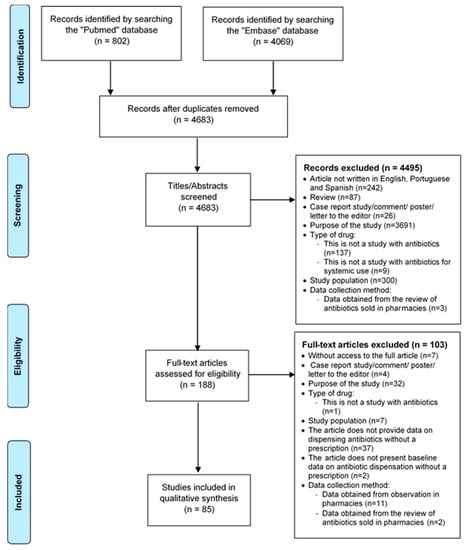
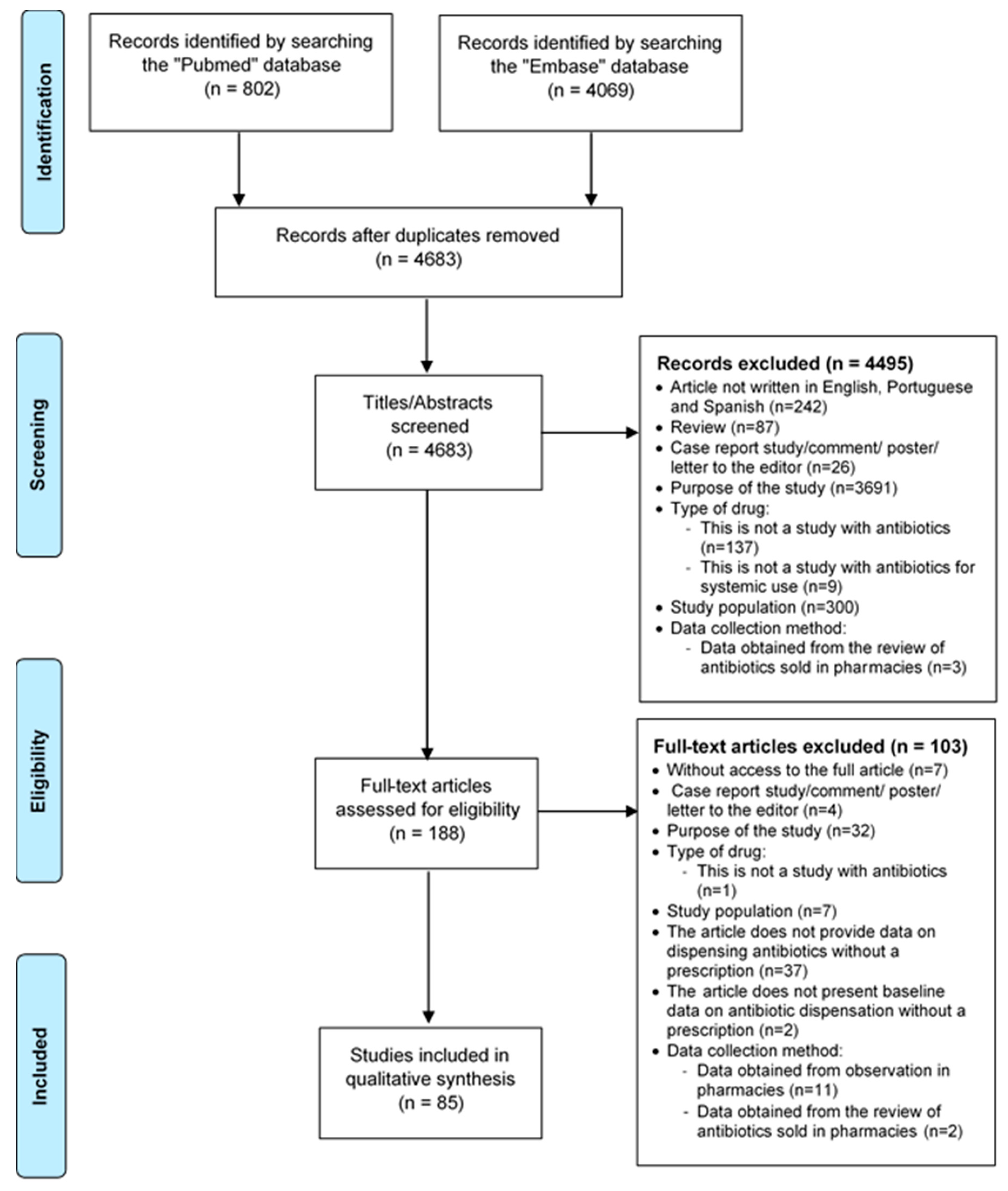
The chosen search strategy identified a total of 4871 articles in MEDLINE Pubmed and Embase databases, being that 188 articles were duplicated. After screening for title and abstract, 188 articles potentially met the inclusion criteria and were selected for a reading of the complete text. Following an in-depth reading, a total of 85 papers were finally included in this systematic review (Figure 1).
Figure 1.
Study selection flowchart.
2.2. Quality Assessment
All the studies included in the systematic review complied with most of the questions in the AXIS tool (Table 1). A high proportion of articles (64/85) fulfilled almost all of the criteria and were thus regarded as displaying a high methodological quality and a low susceptibility to bias. Nineteen articles failed to comply with four to six of the exploratory questions and were considered to have a medium level of methodological quality. Two of the remaining articles failed to comply with more than 6 exploratory questions and were classified as having a low level of methodological quality.
2.3. Characteristics of the Studies Selected
A description of the general characteristics of the 85 included studies is presented in Table 1.
Among the included studies, 51 were conducted in Asia, 17 in Africa (including Egypt), 14 in Europe (including Turkey), 2 in South America, and 1 in North America.
Regarding the study design, almost all of the included papers were cross-sectional studies (72 of 85), 7 were prospective studies, 3 were cross-sectional prospective studies, 1 was a qualitative exploratory study, 1 was a quantitative study, and 1 was an interventional study.
2.4. Study Outcomes—Articles that Use the Simulated Patient Method
Table 2 summarizes the extent of antibiotic dispensation without prescription and additional outcomes of the included articles that use the simulated patient method.
2.4.1. Frequency of Antibiotic Dispensation without a Prescription
Among the 52 articles that used a simulated patient method, 6 of them did not explicitly mention throughout the full article that it was about dispensing antibiotics without a prescription, but rather the management of diseases/symptoms in pharmacies/drug stores [11,12,13,14,15,16]. The inclusion of these articles is justified by the fact that they present data related to the dispensing of antibiotics, without mentioning the presence of a prescription anywhere in the article.
The frequency of antibiotic dispensation without a prescription is presented to (i) the total number of pharmacies/drugstores/medicine retail outlets visited (40 articles); (ii) total number of visits made (9 articles); (iii) total number of interactions (2 articles); and finally about (iv) the total number of drugs dispensed (1 article).
Among the 40 articles that were presented, the dispensation of antibiotics to the total number of pharmacies/drug stores/medicine retail outlets, the percentage of dispensation without a prescription of these establishments, varied from 8.0% to 100.0%. About 25 articles made a percentages of dispensation without a prescription above 60.0%.
Of the 9 articles that presented the percentage of dispensation without a prescription regarding the total number of visits made, the percentage ranged from 5.0% to 87.6% of visits, resulting in an antibiotic being dispensed without a prescription.
The two articles that presented the percentage of dismissal without a prescription in relation to the total number of interactions varied from 4.0% to about 59.3%. Finally, only the article by Ibrahim M.I.B. et al. [13] presented the percentage of dispensation without a prescription concerning the total number of medicines dispensed, and obtained a value of 43.2%.
Those by Al-Tannir M. et al. [17], held in Saudi Arabia, and Marković-Peković V et al. [18], held in Republic of Srpska and Herzegovina, compared the frequency of dispensing antibiotics without prescription in two different years, 2011 and 2018 and 2010 and 2015, respectively. In both articles, it is possible to observe a decrease in the frequency of dispensing antibiotics without a prescription from the past to the most recent year (Al-Tannir M. et al. [17] (2011: 77.6%; 2018: 12.5%); Marković-Peković V et al. [18] (2010: 58.0%; 2015: 18.5%)).
The highest percentages of antibiotic dispensation without a prescription associated with the simulated patient method corresponded to studies carried out in Asian countries. However, the lowest percentage of antibiotic dispensation without a prescription was recorded in a study conducted in India [19].
Three articles conducted in Tanzania and Thailand [20,21,22] presented the percentage of antibiotic dispensing without a prescription related to class I, legally authorized to dispense antibiotics without prescription and class II that only sell them with a medical prescription. Two [20,22] of these articles presented the percentage related to the two pharmacy classes, while 1 article [21] only presented the percentage related to class I pharmacies. By comparing the percentages presented linked to both types of pharmacy, it is possible to verify that a higher percentage is related to the type II pharmacies in the two articles presented.
Additionally, the article by Minzi O et al. [23], held in Tanzania, also presents the percentage of antibiotic dispensation without a prescription related to the accredited drug dispensing outlets (ADDO) and the duka la dowa baridi (DLDB) also know as class II shops. According to the regulations in Tanzania, DLDB are not authorised to sell prescription drugs, such as antibiotics. In contrast, ADDO have been developed to improve the availability of medicines and are authorised to sell a limited range of prescription medicines, among which are a restricted number of antibiotics. [23] In this article, the authors reported a higher percentage related to ADDO, when compared to DLDB.
2.4.2. Name/Class of Antibiotics Most Often Dispensed without a Prescription
There were several antibiotics dispensed without a prescription. The antibiotics most commonly mentioned in the included articles were amoxicillin (40 articles), azithromycin (24 articles), ciprofloxacin (24 articles), and amoxicillin-clavulanic acid (21 articles).
2.4.3. Types of Disease/Symptoms Most Commonly Associated with Dispensation without a Prescription
The most used diseases/symptoms in the simulated patient methodology were diarrhea (23 articles), urinary tract infections (UTI) (12 articles), upper respiratory tract infections (URTI) (11 articles), sore throat (11 articles), common cold (6 articles), and bronchitis (6 articles). Others included cough (5 articles), fever (5 articles), sinusitis (3 articles), otitis media (3 articles), rhinitis (3 articles), and gastroenteritis (2 articles).
2.4.4. Level of Insistence by Patients
Of the 52 articles included in the systematic review, 21 used different levels of demand to obtain antibiotics. Of these, 15 studies applied 3 levels of demand, 4 studies used 2 levels and, finally, 2 studies presented 4 levels.
From the results obtained, it was possible to verify that most of the articles that presented 3 levels of demand indicated that the majority of antibiotics were obtained at level 1, meaning they were only obtained when something was asked for to alleviate the symptoms (6 articles).
In contrast, of the 4 articles that used 2 levels of demand, most indicated that antibiotics were obtained according to level 2, that is when asking for a stronger medication or, more specifically, an antimicrobial.
Of the 2 articles that used 4 levels of demand, only 1 presented information about the level at which the highest amount of antibiotics was obtained, namely level 4, corresponding to the specific request of the amoxicillin antibiotic.
Table 1.
Characteristics of the selected studies.
2.4.5. Questions and Advice Made at the Time of Dispensing Antibiotics without a Prescription
The information regarding the type of questions and advice given when dispensing antibiotics without a prescription and the resulting percentage for each is summarized in Table 4.
Among the 52 articles that used the simulated patient method, 16 mentioned the question about possible drug allergies. Of these, seven articles presented that none of the pharmacies/pharmacists asked this question at the time of dismissal. The remaining nine had percentages between 8.1% and 59.4%.
Seven articles mentioned the question about the concomitant use of other drugs/medication history and, of these, two papers mentioned that none of the pharmacies/pharmacists did it at the time of dispensation. The remaining articles mentioned percentages ranging from 2.0% to 25.0%.
The article by Hadi U et al. [80] stated that patients were never questioned before dispensing antibiotics without prescription.
Eight articles mentioned the information provided by pharmacies/pharmacists about possible adverse effects, with percentages ranging from 0.0% to 27.9%. Five articles mentioned that none of the pharmacies/pharmacists provided this information.
The information given when dispensing antibiotics without a prescription about drug–drug interactions is mentioned in three of the included articles. Of these, two articles presented percentages of 0.0%. The third article, by Al-Tannir M. et al. [17], showed a growth in the percentage related to this advice, increasing from 0.0% in 2011 to 51.2% in 2018.
Most of the information provided when dispensing without a prescription corresponded to explanations of how to use antibiotics and the duration of treatment.
2.5. Study Outcomes—Articles that Used the Pharmacy Interviews/Questionnaires Method
Table 3 synthesizes the extent of antibiotic dispensation without a prescription and additional outcomes of the studies that used the pharmacy interviews/questionnaires method.
2.5.1. Frequency of Antibiotic Dispensation without a Prescription
As in the case of articles using the simulated patient method, the articles where the pharmacy method interviews/questionnaires were applied presented the frequency of dispensation without a prescription in relation to the (i) total number of pharmacies (6 articles); (ii) total number of pharmacists/pharmacy staff (23 articles), (iii) total number of interactions (2 articles) and (iv) number of drugs dispensed without prescription (2 articles).
Of the articles indicating the frequency of dispensing antibiotics without a prescription to the total number of pharmacists, the percentage ranged from 9.1% to 100.0% of pharmacists/pharmacy staff who recognized dispensing antibiotics without a prescription. Four studies presented a percentage of 100.0%, all carried out on Asian countries. Among the articles that presented the percentage about the total number of pharmacists, eight presented the percentage referring to pharmacists who acknowledged dispensing antibiotics without a prescription sometimes/occasionally, with percentages varying from 5.3% to 67.3%.
Of the articles that presented the percentage in relation to the total number of visited pharmacies, the percentage varied from 51.0% in a study conducted in Vietnam in 2002 to 100.0% in two studies, one conducted in Zambia in 2016 and the other conducted in India in 2015.
Among the two articles that presented the percentage in relation to the total number of interactions, it was possible to verify that the percentage varied from 26.4% to 36.4% regarding the interactions that resulted in antibiotic dispensing without a prescription.
The remaining two articles showed the percentage of antibiotics dispensed without prescription in relation to the number of drugs dispensed without a prescription. The article by Paes M.R. et al. [45] showed that in 63.4% of the total dispensing encounters, 5.8% consisted of antibiotics. The article by Nawab A. et al. [60] revealed that out of 100 drugs dispensed without a prescription, 12.2% corresponded to antibiotics.
2.5.2. Name/Class of Antibiotics Most Often Dispensed without a Prescription
The antibiotics most often dispensed without a prescription included amoxicillin (13 articles), cotrimoxazole (3 articles), and amoxicillin-clavulanic acid (3 articles). Some of the articles mentioned the most dispensed antibiotic class, instead of the most dispensed antibiotics, with classes most commonly cited including cephalosporins (3 articles), tetracyclines (2 articles), penicillins (2 articles), and macrolides (2 articles).
2.5.3. Types of Disease/Symptoms Most Commonly Associated with Dispensation without a Prescription
The diseases/symptoms most commonly associated with dispensing antibiotics without a prescription included UTI (9 articles), sore throat (8 articles), cough (7 articles), cold and flu (5 articles), fever (5 articles), diarrhea (4 articles), wound infections (4 articles), and toothache (4 articles).
2.5.4. Questions and Advice Made at the Time of Dispensing Antibiotics without a Prescription
As in the case of articles using the simulated patient method, Table 4 also summarizes the questions and advices provided when dispensing antibiotics without a prescription for articles using the pharmacy interviews/questionnaires method.
The most frequently mentioned question was about the indication of the requested antibiotic (3 articles). The percentages obtained related to this question varied from 36.0% to 94.0%.
Only one article mentioned the question about possible drug allergies, reporting that none of the pharmacists admitted to questioning it before dispensing.
Two articles mentioned information related to possible adverse drug reactions, reporting that the percentage of pharmacists providing this information was of 30.1% [58] and 58.0% [68]. Regarding the articles that mentioned the advice given when dispensing, only three indicated the percentage of pharmacists/pharmacies that do not give any advice or information. This percentage varied from 4.1% to 66.0%.
2.6. Study Outcomes—Comparison of the Results Obtained by Using the Two Different Methods
By comparing the results obtained through the two methodologies used, it was possible to verify that the pharmacy interview/questionnaire method showed a higher proportion of articles presenting percentages of antibiotic dispensation without a prescription above 60.0%, when compared to the simulated patient method (pharmacy interview/questionnaire method: 22 of 36 articles; simulated patient method: 29 of 52 articles).
Only 1 of the 52 articles using the simulated patient method recorded that in all pharmacies visited the antibiotic was obtained without a prescription, that is, a percentage of 100.0%. In contrast, six articles using the pharmacy interview/questionnaire method reported that 100.0% of the interviewed pharmacists/pharmacy staff acknowledged dispensing antibiotics without a prescription.
Regarding the antibiotics most commonly dispensed without a prescription, it was possible to verify that amoxicillin was the one most distributed in the two different methods. Moreover, the same also happened with amoxicillin-clavulanic acid. The remaining most dispensed antibiotics differed in the two methods, with articles using a simulated patient method mentioning azithromycin and ciprofloxacin and articles using the pharmacy interview/questionnaire method mentioning cotrimoxazole.
Additionally, it turns out that the diseases/symptoms most used in the simulated patient method were equivalent to the diseases/symptoms most commonly mentioned by pharmacists/pharmacy staff surveyed in the pharmacy interview/questionnaire method.
Table 5 shows the comparison of the frequency of dispensing antibiotics without a prescription obtained within each country using the different methods. The table summarizes the number of studies carried out in the indicated countries, as well as their nature (if a simulated patient method or a pharmacy interview/questionnaire method was used), together with the frequency values of antibiotic dispensing recorded in each study, thus allowing us to analyze the trend of data over time.
For example, it was possible to verify that six articles were conducted in Saudi Arabia, with three using the simulated patient method, 2 using the pharmacy interview/questionnaire method and 1 using both methods. The articles that used the simulated patient method revealed an increase in the frequency of dispensing antibiotics without a prescription from 82.0% [92] to 97.9% [78] and then a slight decrease to 92.2% [34]. The study by Al-Tannir M. et al. [17] registered the lowest value both in 2011 (77.6%) and 2018 (12.5%).
Regarding the articles that used the pharmacy interview/questionnaire method, it was possible to verify that the percentage registered remained at the value of 100.0% for pharmacists who recognized dispensing antibiotics without a prescription [41,68]. Conversely, there was a decrease to 70.7% in the study by Alrasheedy AA. et al. [34]
In Ethiopia, it was possible to observe a decrease in the frequency of dispensing antibiotics without a prescription between studies published in 2016 and 2019, when using the pharmacy interview/questionnaire method [11,56]. However, the same did not happen with studies using the simulated patient method, where it was possible to observe an increase between the study published in 2016 and the studies published in 2019 [11,14,35,37].
When analyzing the data referring to the three articles [11,34,86] that used both methods, it was possible to verify that in two of them [11,34], the highest percentage of antibiotic dispensation without a prescription was associated with the simulated patient method, in the article by Alrasheedy AA. et al. [34] carried out in Saudi Arabia (92.2% versus 70.7%) and the article by Mengistu G et al. [11] conducted in Ethiopia (86.7% versus 50.5%). Alternatively, the article by Nyazema N et al. [86] carried out in Zimbabwe presented a higher percentage of antibiotic dispensation without a prescription associated with the pharmacy interview/questionnaire method (8.0% in the simulated patients method versus 31.0% in the pharmacy interview/questionnaire method).
Table 2.
Study Outcomes—Articles that use the simulated patient method.
Table 3.
Study Outcomes—articles that used the Pharmacy interviews/questionnaires.
Table 4.
Questions and advice provided when dispensing antibiotics without a prescription.
Table 5.
Comparison of the frequency of antibiotic dispensation without a prescription between the two methods.
3. Discussion
The dispensing of antibiotics without a prescription remains a common practice worldwide, especially in low- and middle-income countries, and the community pharmacies/drugstores continue to be a major source of antibiotic acquisition without a medical prescription [95,96]. With this is mind, there is an urgent need to improve prescription practices in low- and middle-income countries, starting from the integration of treatment recommendations into their national guidelines, and reinforcement of the awareness of this public health problem, togeher with their possible consequences to humanity. In high income countries this is a less common practice as several factors may affect prescribing behaviors, such as socio-cultural context, financial incentives, personal beliefs, patients’ attitudes and greater awareness of the antibiotic resistance problem due to an easier information access when compared to low- and middle-income countries [97,98]. The development of educational strategies in high-income countries has proven to be not enough, since the sale of antibiotics without prescription continues to emerge. So, there is a need to intensify these strategies, through the involvement of all stakeholders, with more advertising campaigns, more workshops, and more publicity. Likewise, law enforcement to reduce non-prescription sales of antibiotics with significant penalties and revocation of professional licenses in case of non-compliance also seems to be a good strategy to be adopted [99,100].
To the best of our knowledge, this is the first study that compares the frequency of dispensing antibiotics without a prescription by using two different data collection methods. Most of the studies included in this review used the simulated patient method. This may be related to the fact that the interview/questionnaire method implies greater participation and proximity to the pharmacy professional, with the lack of anonymity potentially leading to less honest answers. On the other hand, the simulated patient is an effective data collection method which provides internal validity [101].
The analysis of the results obtained in the systematic review, reveal that the values for this practice remain high, reaching 100% in some of the studies. Since the average value of the percentage of antibiotic dispensation without a prescription in the simulated patient method is very similar to the percentage found through the method with interviews/questionnaires, it seems that the Hawthorne effect did not have much impact in the studies using the first method. Furthermore, in the simulated patient method, most antibiotics were easily dispensed at low insistence levels by patients. A study conducted in 2018 in European and Anglo-Saxon countries showed that, although the consumption of antibiotics is decreasing, patients still see antibiotics as available products that can be easily bought [102].
Results of this study highlight that the highest percentages of antibiotic dispensation without a prescription occurred in Asia. The overuse of antibiotics is an evident concern in this part of the world, with these drugs being often available for sale without a prescription [103]. A large number of studies analyzed in this review took place in Asia (51 articles representing 60% of the total), which may influence the fact that they also display the highest percentage of antibiotics dispensed without prescription, since they stand out more in relation to studies carried out in other parts of the world. Our results reveal that there were few studies in Anglo Saxon countries. Thus, we alert researchers to develop studies in these countries.
Another important aspect to highlight is that in some of the articles it was possible to observe a decrease in the frequency of dispensing antibiotics without a prescription, which led us to think that the growing approach taken worldwide on this public health problem is beginning to have an impact on the practices of health professionals.
The most commonly non-prescribed antibiotics sold identified in our review were amoxicillin (53 articles), azithromycin (24 articles), ciprofloxacin (24 articles), and amoxicillin-clavulanic acid (24 articles). These findings are in agreement with results found in a previous study that identified as antibiotics mostly used for self-medication the penicillins, macrolides, cephalosporins, fluoroquinolones, and tetracycline [96]. These specific classes of drugs have been associated for some time with increased development of resistance to microorganisms such as Streptococcus pneumoniae, Acinetobacter baumannii, Campylobacter jejuni, Enterococcus faecalis, and many others [104].
The pathologies/symptoms most commonly associated with dispensing antibiotics without a prescription were respiratory system problems like sore throat, URTI, common cold, bronchitis, cough, cold and flu, diarrhea, and UTI. Previously, another study concluded that the main pathologies associated with the consumption of antibiotics without a prescription were sore throat, fever, and respiratory problems, such as cold/flu and cough [96]. Patients should be educated and encouraged by pharmacists to go to primary health care units whenever they have these minor illnesses.
A systematic review recently carried out identified the main intrinsic factors that influence the dispensing of antibiotics without a prescription, such as the low level of training of professionals working in pharmacies, as well as their attitudes such as complacency, ignorance, responsibility, indifference, and economic benefit [105]. In our study, concerning questions and advice provided by pharmacists at the time of dispensing antibiotics without a prescription showed very low percentages, with the advice being absent a few times. When this occurred, the information primarly provided corresponded to explanations about how to use antibiotics and the duration of treatment. Pharmacy professionals have an essential role in dispensing antibiotics, so interventions must be implemented with them. Most community pharmacists are aware that the irrational use of antibiotics is one of the main causes of increased antibiotic resistance and that all healthcare professionals, including themselves, need to think rationally and stop prescribing and dispensing so many antibiotics inadequately [95]. However, a previous study has found that the implementation of multiple activities among pharmacists, like national campaigns and programs, workshops for health professionals, creation of posters and flyers, television programs, newspapers and lauch of guidelines for counseling patients, improved antibiotic use and consequently reduced inappropriate antibiotic prescription and dispensation [18]. We can see that there are discrepancies between knowledge and practice.
One strengh of this review is the heterogeneous composition of the included studies that were analyzed, which increased the generalization of the results and, consequently, the external validation of this review.
A limitation of our study is that it does not take into account any intervention implemented to decrease the dispensation of antibiotics without a prescription in the countries, after the studies were carried out. Another limitation of this review concerns with the lack of inclusion of studies concerning veterinary use. A large portion of all antibiotic use is for veterinary use. Additionally, an increase in global consumption is expected to occur in livestock between 2010 and 2030, thus leading to a rise in the incidence of bacteria resistant to antimicrobials in animals, with a possible high transmission to humans [106,107].
4. Materials and Methods
4.1. Search Strategy/Search Methods for Identification of Studies
This systematic review followed the PRISMA (Preferred Reporting Items for Systematic Reviews and Meta-Analyses) guidelines, which is a template developed to help authors improving the reporting of systematic reviews and meta-analyses [108], and was registered in the PROSPERO network (registration number: CRD42020189331).
The databases MEDLINE Pubmed and Embase were searched in June 2020 using the query: “(antibiotic OR antibiotics OR antimicrobial OR antimicrobials) AND (over-the-counter OR nonprescription OR without-prescription OR self-medication) AND (community-pharmacy OR community-pharmacies OR pharmacy OR pharmacies OR pharmacist OR pharmacists OR community-pharmacist OR community-pharmacists)”, to identify studies that reported the dispensing of non-prescribed antibiotics in community pharmacies and drugstores that sell drugs for human use.
4.2. Study Inclusion Criteria
Studies were considered eligible for this review if they met the following criteria: (i) studies published in English, Portuguese, or Spanish; (ii) the study population was defined as pharmacies or drugstores that sell drugs for human use; (iii) studies whose data collection method consists of the simulated patient method and/or questionnaires/interviews with pharmacies; (iv) studies with original/primary data, namely observational studies, and interventional studies since they present pre-intervention/baseline data and (v) data referring to antibiotics for systemic use. Population-based studies that explored public opinion and attitudes on the sources and use of non-prescription antibiotics were excluded, as well as qualitative studies that did not present quantitative measures of non-prescription supply of antibiotics. Studies focused on the administration of antiretroviral, antimalarial, antifungal, and antiparasitic drugs were also excluded.
In articles addressing other target populations, only data referring to studies carried out in pharmacies and with pharmacy workers were extracted.
All articles extracted were independently reviewed by two authors, who decided whether or not these met the selection criteria. In case of disagreement, the paper in question was examined by a third and fourth reviewer who took the final decision.
4.3. Quality Assessment
All selected studies were assessed for quality and risk of bias through the Appraisal tool for Cross-Sectional Studies (AXIS). This tool consists of a 20 items questionnaire that addressed study quality and reporting, assessing whether the published conclusions are reliable and credible about the objective, methods, and results [109]. For each study, the risk of bias and quality was conducted by two researchers and, in case of disagreement, a third reviewer acted as a referee to reach a consensus.
4.4. Data Extraction
To summarise the general characteristics of the studies selected in the previous analysis, Table 1 was drawn up showing the following parameters: author (year of publication), study location/country, study design, and data collection method.
Additionally, to indicate the extent of antibiotic dispensation without a prescription and additional outcomes, two tables were created, one referring to the simulated patient method and the other referring to the interview/questionnaire method in pharmacies. The table related to the simulated patient method (Table 2) presents the following parameters: sample size, frequency/prevalence of antibiotic dispensing without a prescription, name/class of antibiotics most dispensed, types of diseases/symptoms most commonly associated with dispensing without a prescription and level of insistence by simulated patients.
Regarding the outcome “level of insistence by simulated patients”, the levels of insistence recorded are those defined by the authors of each study. These have been recorded in Table 2, specifically in the associated column, before the percentage for each level of insistence is presented. Regardless of the divergence in the definition of the levels by the various authors, the common issue between them is that the lower level is associated with a lower level of insistence by the simulated patient of generally only asking for medication for symptom relief. As the level increases, the simulated patients start asking for stronger medication and even specifically for antibiotics.
The pharmacy interview/questionnaire method table (Table 3) shows the following outcomes: sample size, frequency/prevalence of antibiotic dispensation without a prescription, name/class of antibiotics most often dispensed and types of diseases/symptoms most commonly associated with dispensation without a prescription.
Another table (Table 4) was constructed to record the addressed questions, the advice given at the time of antibiotics dispensing without a prescription, as well as the percentage of pharmacies/pharmacists who performed them.
Subsequently, data on the comparison of the frequency of dispensing antibiotics without a prescription between the two methods were extracted and introduced in Table 5.
Data were extracted by two reviewers and any discrepancy was resolved by a third and fourth reviewer.
5. Conclusions
The dispensing of antibiotics without prescription is one of the major drivers of antibacterial resistance. Our results suggest that this practice is still common in many countries, especially in low- and middle-income countries. Pharmacies and their work professionals play a critical role in the conservation of effective antibiotics, through denying the dispensing of antibiotics without a prescription and improving patient pharmaceutical counseling, overall in respiratory and UTI and in diarrhea. It becomes urgent to empower these health professionals, especially in developing countries, through the implementation of educational and/or administrative strategies in order to reduce the dispensation of antibiotics without a prescription.
Author Contributions
Conceptualization, M.T.H., A.F., F.R. and M.Z.-C.; Methodology, M.T.H., A.F., F.R. and M.Z.-C.; Formal analysis, M.T.H., A.F., F.R., M.Z.C., A.D.B. and D.A.R.; Investigation, M.T.H., A.F., F.R., M.Z.-C., A.D.B. and D.A.R.; Data curation, M.T.H., A.F., F.R., M.Z.-C., A.D.B. and D.A.R.; Writing—original draft, A.D.B. and D.A.R.; Writing-review and editing, M.T.H., A.F., F.R., M.Z.-C.; Supervision, M.T.H., A.F., F.R., M.Z.-C.; Project administration, M.T.H.; Funding acquisition, F.R. and M.T.H. All authors have read and agreed to the published version of the manuscript.
Funding
This research was funded by the project PTDC/SAU-SER/31678/2017, supported by the Operational Program on Competitiveness and Internationalization (POCI) in its FEDER/FNR component, POCI-01-0145-FEDER-031678, and by the Foundation for Science and Technology in its state budget component (OE).
Acknowledgments
We thank Tânia Magalhães Silva, (iBiMED/UA) for her collaboration in the revision of the manuscript.
Conflicts of Interest
The authors declare no conflict of interest. The funders had no role in the design of the study; in the collection, analyses, or interpretation of data; in the writing of the manuscript, or in the decision to publish the results.
References
- World Health Organization (WHO). Antibiotic Resistance. Newsroom, 2020. Available online: https://www.who.int/news-room/fact-sheets/detail/antibiotic-resistance (accessed on 24 September 2020).
- World Health Organization (WHO). Antimicrobial Resistance. Newsroom, 2020. Available online: https://www.who.int/news-room/fact-sheets/detail/antimicrobial-resistance (accessed on 24 September 2020).
- United Nations. UN Health Agency Steps Up Fight against ‘Invisible Pandemic’ of Antimicrobial Resistance. UN News, 2019. Available online: https://news.un.org/en/story/2019/06/1040741 (accessed on 24 September 2020).
- Klein, E.Y.; Van Boeckel, T.P.; Martinez, E.M.; Pant, S.; Gandra, S.; Levin, S.A.; Goossens, H.; Laxminarayan, R. Global increase and geographic convergence in antibiotic consumption between 2000 and 2015. Proc. Natl. Acad. Sci. USA 2018, 115, E3463–E3470. [Google Scholar] [CrossRef] [Scilit] [PubMed]
- O’Neill, J. Tackling drug-resistant infections globally: Final report and recmmendations. Rev. Antimicrob. Resist. 2016. [Google Scholar] [CrossRef] [Scilit]
- Abu Al-Halawa, D.; Sarama, R.; Abdeen, Z.; Qasrawi, R. Knowledge, attitudes, and practices relating to antibiotic resistance among pharmacists: A cross-sectional study in the West Bank, Palestine. Lancet 2019, 393, S7. [Google Scholar] [CrossRef] [Scilit]
- Chang, J.; Xu, S.; Zhu, S.; Li, Z.; Yu, J.; Zhang, Y.; Zu, J.; Fang, Y.; Ross-Degnan, D. Assessment of non-prescription antibiotic dispensing at community pharmacies in China with simulated clients: A mixed cross-sectional and longitudinal study. Lancet Infect. Dis. 2019, 19, 1345–1354. [Google Scholar] [CrossRef] [Scilit]
- (PDF) Antibiotic Resistance—The Faceless Threat. Available online: https://www.researchgate.net/publication/228636583_Antibiotic_resistance-The_faceless_threat (accessed on 24 September 2020).
- Grigoryan, L.; Haaijer-Ruskamp, F.M.; Burgerhof, J.G.M.; Mechtler, R.; Deschepper, R.; Tambic-Andrasevic, A.; Andrajati, R.; Monnet, D.L.; Cunney, R.; Di Matteo, A.; et al. Self-medication with antimicrobial drugs in Europe. Emerg. Infect. Dis. 2006, 12, 452–459. [Google Scholar] [CrossRef] [Scilit] [PubMed]
- Björnsdottir, I.; Granas, A.G.; Bradley, A.; Norris, P. A systematic review of the use of simulated patient methodology in pharmacy practice research from 2006 to 2016. Int. J. Pharm. Pract. 2020, 28, 13–25. [Google Scholar] [CrossRef] [Scilit] [PubMed]
- Mengistu, G.; Gietnet, K.; Amare, F.; Sisay, M.; Hagos, B.; Misganaw, D. Self-Reported and Actual Involvement of Community Pharmacy Professionals in the Management of Childhood Diarrhea: A Cross-Sectional and Simulated Patient Study at two Towns of Eastern Ethiopia. Clin. Med. Insights Pediatr. 2019, 13. [Google Scholar] [CrossRef] [Scilit]
- Ibrahim, I.R.; Palaian, S.; Ibrahim, M.I.M. Assessment of diarrhea treatment and counseling in community pharmacies in Baghdad, Iraq: A simulated patient study. Pharm. Pract. (Granada) 2018, 16. [Google Scholar] [CrossRef] [Scilit]
- Ibrahim, M.I.B.M.; Palaian, S.; Al-Sulaiti, F.; El-Shami, S. Evaluating community pharmacy practice in Qatar using simulated patient method: Acute gastroenteritis management. Pharm. Pract. (Granada) 2016, 14. [Google Scholar] [CrossRef] [Scilit] [PubMed]
- Abegaz, T.M.; Belachew, S.A.; Abebe, T.B.; Gebresilassie, B.M.; Teni, F.S.; Woldie, H.G. Management of children’s acute diarrhea by community pharmacies in five towns of Ethiopia: Simulated client case study. Clin. Risk Manag. 2016, 12, 515–526. [Google Scholar] [CrossRef] [Scilit]
- Malik, M.; Hassali, M.A.; Shafie, A.A.; Hussain, A.; Aljadhey, H.; Saleem, F. Manejo de casos de malaria en farmacias comunitarias de Pakistán: Amenaza al uso racional de medicamentos. Pharm. Pract. (Granada) 2013, 11, 8–16. [Google Scholar] [CrossRef] [Scilit] [PubMed]
- Chalker, J.; Chuc, N.T.K.; Falkenberg, T.; Do, N.T.; Tomson, G. STD management by private pharmacies in Hanoi: Practice and knowledge of drug sellers. Sex. Transm. Infect. 2000, 76, 299–302. [Google Scholar] [CrossRef] [Scilit] [PubMed]
- Al-Tannir, M.; Altannir, Y.; Altannir, M.; AlFayyad, I. Community pharmacy sales of non-prescribed antibiotics in Riyadh, Saudi Arabia: A simulated patient study. Int. J. Clin. Pharm. 2020, 42, 341–346. [Google Scholar] [CrossRef] [Scilit] [PubMed]
- Marković-Peković, V.; Grubiša, N.; Burger, J.; Bojanić, L.; Godman, B. Initiatives to Reduce Nonprescription Sales and Dispensing of Antibiotics: Findings and Implications. J. Res. Pharm. Pract. 2017, 120–125. [Google Scholar] [CrossRef] [Scilit]
- Nafade, V.; Huddart, S.; Sulis, G.; Daftary, A.; Miraj, S.S.; Saravu, K.; Pai, M. Over-the-counter antibiotic dispensing by pharmacies: A standardised patient study in Udupi district, India. BMJ Glob. Heal. 2019, 4. [Google Scholar] [CrossRef] [Scilit]
- Horumpende, P.G.; Sonda, T.B.; van Zwetselaar, M.; Antony, M.L.; Tenu, F.F.; Mwanziva, C.E.; Shao, E.R.; Mshana, S.E.; Mmbaga, B.T.; Chilongola, J.O. Prescription and non-prescription antibiotic dispensing practices in part I and part II pharmacies in Moshi Municipality, Kilimanjaro Region in Tanzania: A simulated clients approach. PLoS ONE 2018, 13. [Google Scholar] [CrossRef] [Scilit]
- Jaisue, S.; Phomtavong, S.; Eua-anant, S.; Borlace, G.N. Dispensing pattern for acute non-infectious diarrhoea in children at community pharmacies in Thailand. J. Pharm. Pract. Res. 2017, 47, 383–388. [Google Scholar] [CrossRef] [Scilit]
- Saengcharoen, W.; Lerkiatbundit, S. Practice and attitudes regarding the management of childhood diarrhoea among pharmacies in Thailand. Int. J. Pharm. Pract. 2010, 18, 323–331. [Google Scholar] [CrossRef] [Scilit]
- Minzi, O.M.; Manyilizu, V.S. Application of basic pharmacology and dispensing practice of antibiotics in accredited drug-dispensing outlets in tanzania. Drug. Healthc. Patient Saf. 2013, 5, 5–11. [Google Scholar] [CrossRef] [Scilit]
- Abubakar, U.; Tangiisuran, B. Knowledge and practices of community pharmacists towards non-prescription dispensing of antibiotics in Northern Nigeria. Int. J. Clin. Pharm. 2020, 42, 756–764. [Google Scholar] [CrossRef] [Scilit]
- Abubakar, U. Practices and Perception of Nigerian Community Pharmacists Towards Antimicrobial Stewardship Program. Int. J. Pharm. Pharm. Sci. 2020, 37–42. [Google Scholar] [CrossRef] [Scilit]
- Badro, D.A.; Sacre, H.; Hallit, S.; Amhaz, A.; Salameh, P. Good pharmacy practice assessment among community pharmacies in Lebanon. Pharm. Pract. (Granada) 2020, 18. [Google Scholar] [CrossRef] [Scilit]
- Bahta, M.; Tesfamariam, S.; Weldemariam, D.G.; Yemane, H.; Tesfamariam, E.H.; Alem, T.; Russom, M. Dispensing of antibiotics without prescription and associated factors in drug retail outlets of Eritrea: A simulated client method. PLoS ONE 2020, 15. [Google Scholar] [CrossRef] [Scilit]
- Chen, J.; Wang, Y.; Chen, X.; Hesketh, T. Widespread illegal sales of antibiotics in Chinese pharmacies—A nationwide cross-sectional study. Antimicrob. Resist. Infect. Control 2020, 9, 12. [Google Scholar] [CrossRef] [Scilit] [PubMed]
- Gajdács, M.; Paulik, E.; Szabó, A. Knowledge, attitude and practice of community pharmacists regarding antibiotic use and infectious diseases: A cross-sectional survey in Hungary (KAPPhA-HU). Antibiotics 2020, 9, 41. [Google Scholar] [CrossRef] [Scilit]
- Halboup, A.; Abdi, A.; Ahmed, M.; Al-Qadasi, F.; Othman, G.Q. Access to antibiotics without prescription in community pharmacies in Yemen during the political conflict. Public Health 2020, 183, 30–35. [Google Scholar] [CrossRef] [Scilit]
- Shi, L.; Chang, J.; Liu, X.; Zhai, P.; Hu, S.; Li, P.; Hayat, K.; Kabba, J.A.; Feng, Z.; Yang, C.; et al. Dispensing antibiotics without a prescription for acute cough associated with common cold at community pharmacies in Shenyang, Northeastern China: A cross-sectional study. Antibiotics 2020, 9, 163. [Google Scholar] [CrossRef] [Scilit]
- Wang, X.; Xuan, Z.; Storella, T.H.; Zhou, X. Determinants of non-prescription antibiotic dispensing in Chinese community pharmacies from socio-ecological and health system perspectives. Soc. Sci. Med. 2020, 256, 113035. [Google Scholar] [CrossRef] [Scilit]
- Abdelaziz, A.I.; Tawfik, A.G.; Rabie, K.A.; Omran, M.; Hussein, M.; Abou-Ali, A.; Ahmed, A.S.F. Quality of community pharmacy practice in antibiotic self-medication encounters: A simulated patient study in upper Egypt. Antibiotics 2019, 8, 35. [Google Scholar] [CrossRef] [Scilit] [PubMed]
- Alrasheedy, A.A.; Alsalloum, M.A.; Almuqbil, F.A.; Almuzaini, M.A.; Aba Alkhayl, B.S.; Albishri, A.S.; Alharbi, F.F.; Alharbi, S.R.; Alodhayb, A.K.; Alfadl, A.A.; et al. The impact of law enforcement on dispensing antibiotics without prescription: A multi-methods study from Saudi Arabia. Expert Rev. Anti. Infect. Ther. 2019, 18, 87–97. [Google Scholar] [CrossRef] [Scilit]
- Damisie, G.; Hambisa, S.; Yimam, M. Over the Counter Sale of Antibiotics at Drug Stores Found in Mizan-Aman Town, Southwest Ethiopia: A Cross-Sectional Simulated Client Visit Study. J. Pharm. 2019, 2019, 1–6. [Google Scholar] [CrossRef] [Scilit]
- Hallit, S.; Zahreddine, L.; Saleh, N.; Shakaroun, S.; Lahoud, N. Practice of parents and pharmacists regarding antibiotics use in pediatrics: A 2017 cross-sectional study in Lebanese community pharmacies. J. Eval. Clin. Pract. 2019, 26, 181–189. [Google Scholar] [CrossRef] [Scilit] [PubMed]
- Koji, E.M.; Gebretekle, G.B.; Tekle, T.A. Practice of over-the-counter dispensary of antibiotics for childhood illnesses in Addis Ababa, Ethiopia: A simulated patient encounter study. Antimicrob. Resist. Infect. Control 2019, 8. [Google Scholar] [CrossRef] [Scilit]
- Zawahir, S.; Lekamwasam, S.; Aslani, P. Community pharmacy staff’s response to symptoms of common infections: A pseudo-patient study. Antimicrob. Resist. Infect. Control 2019, 8, 60. [Google Scholar] [CrossRef] [Scilit] [PubMed]
- Zawahir, S.; Lekamwasam, S.; Aslani, P. A cross-sectional national survey of community pharmacy staff: Knowledge and antibiotic provision. PLoS ONE 2019, 14. [Google Scholar] [CrossRef] [Scilit] [PubMed]
- Ajie, A.A.D.; Andrajati, R.; Radji, M. Factors affecting the sale of non-prescribed antibiotics in Jakarta, Indonesia: A cross-sectional study. Int. J. Appl. Pharm. 2018, 10, 243–247. [Google Scholar] [CrossRef] [Scilit]
- Alhomoud, F.; Almahasnah, R.; Alhomoud, F.K. “You could lose when you misuse”—Factors affecting over-the-counter sale of antibiotics in community pharmacies in Saudi Arabia: A qualitative study 11 Medical and Health Sciences 1117 Public Health and Health Services. BMC Health Serv. Res. 2018, 18. [Google Scholar] [CrossRef] [Scilit]
- Awosan, K.J.; Ibitoye, P.K.; Abubakar, A.K. Knowledge, risk perception and practices related to antibiotic resistance among patent medicine vendors in Sokoto metropolis, Nigeria. Niger. J. Clin. Pract. 2018, 21, 1476–1483. [Google Scholar] [CrossRef] [Scilit]
- Erku, D.A.; Aberra, S.Y. Non-prescribed sale of antibiotics for acute childhood diarrhea and upper respiratory tract infection in community pharmacies: A 2 phase mixed-methods study. Antimicrob. Resist. Infect. Control 2018, 7. [Google Scholar] [CrossRef] [Scilit]
- Mohamed Ibrahim, M.I.; Awaisu, A.; Palaian, S.; Radoui, A.; Atwa, H. Do community pharmacists in Qatar manage acute respiratory conditions rationally? A simulated client study. J. Pharm. Heal. Serv. Res. 2018, 9, 33–39. [Google Scholar] [CrossRef] [Scilit]
- Rachel Paes, M.; De Sa, S. Drug dispensing practices in private pharmacies in Goa. Natl. J. Physiol. Pharm. Pharmacol. 2018. [Google Scholar] [CrossRef] [Scilit]
- Rehman, I.; Asad, M.; Bukhsh, A.; Ali, Z.; Ata, H.; Dujaili, J.; Blebil, A.; Khan, T. Knowledge and Practice of Pharmacists toward Antimicrobial Stewardship in Pakistan. Pharmacy 2018, 6, 116. [Google Scholar] [CrossRef] [Scilit] [PubMed]
- Sarwar, M.R.; Saqib, A.; Iftikhar, S.; Sadiq, T. Knowledge of community pharmacists about antibiotics, and their perceptions and practices regarding antimicrobial stewardship: A cross-sectional study in Punjab, Pakistan. Infect. Drug Resist. 2018, 11, 133–145. [Google Scholar] [CrossRef] [Scilit]
- Zapata-Cachafeiro, M.; Piñeiro-Lamas, M.; Guinovart, M.C.; López-Vázquez, P.; Vázquez-Lago, J.M.; Figueiras, A. Magnitude and determinants of antibiotic dispensing without prescription in Spain: A simulated patient study. J. Antimicrob. Chemother. 2018, 74, 511–514. [Google Scholar] [CrossRef] [Scilit] [PubMed]
- Zawahir, S.; Lekamwasam, S.; Aslani, P. Antibiotic dispensing practice in community pharmacies: A simulated client study. Res. Soc. Adm. Pharm. 2018, 15, 584–590. [Google Scholar] [CrossRef] [Scilit]
- Ansari, M. Evaluation of community pharmacies regarding dispensing practices of antibiotics in two districts of central Nepal. PLoS ONE 2017, 12. [Google Scholar] [CrossRef] [Scilit]
- Barker, A.K.; Brown, K.; Ahsan, M.; Sengupta, S.; Safdar, N. What drives inappropriate antibiotic dispensing? A mixed-methods study of pharmacy employee perspectives in Haryana, India. BMJ Open 2017, 7. [Google Scholar] [CrossRef] [Scilit]
- Chang, J.; Ye, D.; Lv, B.; Jiang, M.; Zhu, S.; Yan, K.; Tian, Y.; Fang, Y. Sale of antibiotics without a prescription at community pharmacies in urban China: A multicentre cross-sectional survey. J. Antimicrob. Chemother. 2017, 72, 1235–1242. [Google Scholar] [CrossRef] [Scilit]
- Mansour, O.; Al-Kayali, R. Community pharmacists’ role in controlling bacterial antibiotic resistance in Aleppo, Syria. Iran. J. Pharm. Res. 2017, 16, 1612–1620. [Google Scholar] [CrossRef]
- Okuyan, B.; Savan, M.A.; Izzettin, F.V.; Sancar, M. Evaluation of rational antibiotic dispensing in the community pharmacy setting: A simulated patient study. Acta Pharm. Sci. 2017, 55, 7–16. [Google Scholar] [CrossRef] [Scilit]
- Abood, E.A.; Wazaify, M. Abuse and Misuse of Prescription and Nonprescription Drugs from Community Pharmacies in Aden City—Yemen. Subst. Use Misuse 2016, 51, 942–947. [Google Scholar] [CrossRef] [Scilit] [PubMed]
- Erku, D.A. Antimicrobial Stewardship: A Cross-Sectional Survey Assessing the Perceptions and Practices of Community Pharmacists in Ethiopia. Interdiscip. Perspect. Infect. Dis. 2016, 2016. [Google Scholar] [CrossRef] [Scilit]
- Guinovart, M.C.; Figueras, A.; Llor, C. Selling antimicrobials without prescription—Far beyond an administrative problem. Enferm. Infecc. Microbiol. Clin. 2016, 36, 290–292. [Google Scholar] [CrossRef] [Scilit]
- Kalungia, A.C.; Burger, J.; Godman, B.; Costa, J.d.O.; Simuwelu, C. Non-prescription sale and dispensing of antibiotics in community pharmacies in Zambia. Expert Rev. Anti Infect. Ther. 2016, 14, 1215–1223. [Google Scholar] [CrossRef] [Scilit] [PubMed]
- Khan, M.U.; Hassali, M.A.A.; Ahmad, A.; Elkalmi, R.M.; Zaidi, S.T.R.; Dhingra, S. Perceptions and Practices of Community Pharmacists towards Antimicrobial Stewardship in the State of Selangor, Malaysia. PLoS ONE 2016, 11, e0149623. [Google Scholar] [CrossRef] [Scilit]
- Nawab, A.; Kalim, M.; Sheikh, J.; Shoukat, N. DISPENSING OF MEDICATION WITHOUT PRESCRIPTION IN KARACHI, PAKISTAN. Int. Res. J. Pharm. 2016, 7, 39–43. [Google Scholar] [CrossRef] [Scilit]
- Satyanarayana, S.; Kwan, A.; Daniels, B.; Subbaraman, R.; McDowell, A.; Bergkvist, S.; Das, R.K.; Das, V.; Das, J.; Pai, M. Use of standardised patients to assess antibiotic dispensing for tuberculosis by pharmacies in urban India: A cross-sectional study. Lancet Infect. Dis. 2016, 16, 1261–1268. [Google Scholar] [CrossRef] [Scilit]
- Almaaytah, A.; Mukattash, T.L.; Hajaj, J. Dispensing of non-prescribed antibiotics in Jordan. Patient Prefer. Adherence 2015, 9, 1389–1395. [Google Scholar] [CrossRef] [Scilit]
- Bahnassi, A. A qualitative analysis of pharmacists’ attitudes and practices regarding the sale of antibiotics without prescription in Syria. J. Taibah Univ. Med. Sci. 2015, 10, 227–233. [Google Scholar] [CrossRef] [Scilit]
- Dorj, G.; Hendrie, D.; Parsons, R.W.; Sunderland, B. A questionnaire study of injections prescribed and dispensed for patients diagnosed with mild/moderate community-acquired pneumonia in Mongolia. PeerJ 2015, 2015. [Google Scholar] [CrossRef] [Scilit]
- Shet, A.; Sundaresan, S.; Forsberg, B.C. Pharmacy-based dispensing of antimicrobial agents without prescription in India: Appropriateness and cost burden in the private sector. Antimicrob. Resist. Infect. Control 2015, 4, 55. [Google Scholar] [CrossRef] [Scilit] [PubMed]
- Study on Medicines Delivered by Pharmacists Relating to Dental Pain, without Prescriptions. Available online: https://www.jpsr.pharmainfo.in/Documents/Volumes/vol8Issue09/jpsr08091624.pdf (accessed on 24 September 2020).
- Alabid, A.H.M.A.; Ibrahim, M.I.M.; Hassali, M.A. Antibiotics dispensing for URTIs by community pharmacists and general medical practitioners in Penang, Malaysia: A comparative study using simulated patients. J. Clin. Diagn. Res. 2014, 8, 119–123. [Google Scholar] [CrossRef] [Scilit]
- Bahnassi, A. Pharmacists views and practices in regard to sales of antibiotics without a prescription in Madinah, Saudi Arabia. J. Patient Saf. 2014, 12, 159–164. [Google Scholar] [CrossRef] [Scilit]
- Farah, R.; Lahoud, N.; Salameh, P.; Saleh, N. Antibiotic dispensation by Lebanese pharmacists: A comparison of higher and lower socio-economic levels. J. Infect. Public Health 2014, 8, 37–46. [Google Scholar] [CrossRef] [Scilit] [PubMed]
- (PDF) Assessment of the First 10 Years Institutional Programme on Rational Use of Antibiotics in Gipuzkoa: 1999–2009. Available online: https://www.researchgate.net/publication/289112591_Assessment_of_the_first_10_years_institutional_programme_on_rational_use_of_antibiotics_in_Gipuzkoa_1999-2009 (accessed on 24 September 2020).
- Sabry, N.A.; Farid, S.F.; Dawoud, D.M. Antibiotic dispensing in Egyptian community pharmacies: An observational study. Res. Soc. Adm. Pharm. 2014, 10, 168–184. [Google Scholar] [CrossRef] [Scilit]
- Zapata-Cachafeiro, M.; González-González, C.; Váquez-Lago, J.M.; López-Vázquez, P.; López-Durán, A.; Smyth, E.; Figueiras, A. Determinants of antibiotic dispensing without a medical prescription: A cross-sectional study in the north of Spain. J. Antimicrob. Chemother. 2014, 69, 3156–3160. [Google Scholar] [CrossRef] [Scilit]
- A Comparative Study between Prescribed and over-the-Counter Antibiotics. Available online: https://www.researchgate.net/publication/258065195_A_comparative_study_between_prescribed_and_over-the-counter_antibiotics (accessed on 24 September 2020).
- Marković-Peković, V.; Grubiša, N. Self-medication with antibiotics in the Republic of Srpska community pharmacies: Pharmacy staff behavior. Pharmacoepidemiol. Drug Saf. 2012, 21, 1130–1133. [Google Scholar] [CrossRef] [Scilit]
- (PDF) A Study on the Sale of Antimicrobial Agents without Prescriptions in Pharmacies in an Urban Area in South India. Available online: https://www.researchgate.net/publication/234155875_A_Study_on_the_Sale_of_Antimicrobial_Agents_without_Prescriptions_in_Pharmacies_in_an_Urban_Area_in_South_India (accessed on 24 September 2020).
- Simó, S.; Fraile, D.; Sánchez, A.; García-Algar, O. Dispensación de medicamentos sin prescripción médica en oficinas de farmacia. An. Pediatr. 2012, 79, 10–14. [Google Scholar] [CrossRef] [Scilit]
- Al-Faham, Z.; Habboub, G.; Takriti, F. The sale of antibiotics without prescription in pharmacies in Damascus, Syria. J. Infect. Dev. Ctries. 2011, 5, 396–399. [Google Scholar] [CrossRef] [Scilit] [PubMed]
- Al-Mohamadi, A.; Badr, A.; Bin Mahfouz, L.; Samargandi, D.; Al Ahdal, A. Dispensing medications without prescription at Saudi community pharmacy: Extent and perception. Saudi Pharm. J. 2011, 21, 13–18. [Google Scholar] [CrossRef] [Scilit]
- Puspitasari, H.P.; Faturrohmah, A.; Hermansyah, A. Do Indonesian community pharmacy workers respond to antibiotics requests appropriately? Trop. Med. Int. Heal. 2011, 16, 840–846. [Google Scholar] [CrossRef] [Scilit]
- Hadi, U.; van den Broek, P.; Kolopaking, E.P.; Zairina, N.; Gardjito, W.; Gyssens, I.C. Cross-sectional study of availability and pharmaceutical quality of antibiotics requested with or without prescription (Over The Counter) in Surabaya, Indonesia. BMC Infect. Dis. 2010, 10, 203. [Google Scholar] [CrossRef] [Scilit]
- Llor, C.; Monnet, D.L.; Cots, J.M. Small pharmacies are more likely to dispense antibiotics without a medical prescription than large pharmacies in Catalonia, Spain. Eurosurveillance 2010, 15, 1–4. [Google Scholar] [CrossRef] [Scilit]
- Plachouras, D.; Kavatha, D.; Antoniadou, A.; Giannitsioti, E.; Poulakou, G.; Kanellakopoulou, K.; Giamarellou, H. Dispensing of antibiotics without prescription in Greece, 2008: Another link in the antibiotic resistance chain. Eurosurveillance 2010, 15, 1–4. [Google Scholar] [CrossRef] [Scilit]
- Llor, C.; Cots, J.M. The sale of antibiotics without prescription in pharmacies in catalonia, Spain. Clin. Infect. Dis. 2009, 48, 1345–1349. [Google Scholar] [CrossRef] [Scilit]
- Rauber, C.; Feltrin, M.R.; Piovezan, A.P. Evaluation of antibiotics dispensing profile in Tubarão, Santa Catarina, Brazil. Braz. J. Pharm. Sci. 2009, 45, 787–793. [Google Scholar] [CrossRef] [Scilit]
- Viberg, N.; Mujinja, P.; Kalala, W.; Kumaranayake, L.; Vyas, S.; Tomson, G.; Lundborg, C.S. STI management in Tanzanian private drugstores: Practices and roles of drug sellers. Sex. Transm. Infect. 2009, 85, 300–307. [Google Scholar] [CrossRef] [Scilit]
- Nyazema, N.; Viberg, N.; Khoza, S.; Vyas, S.; Kumaranayake, L.; Tomson, G.; Lundborg, C.S. Low sale of antibiotics without prescription: A cross-sectional study in Zimbabwean private pharmacies. J. Antimicrob. Chemother. 2007, 59, 718–726. [Google Scholar] [CrossRef] [Scilit]
- Caamaño, F.; Tomé-Otero, M.; Takkouche, B.; Gestal-Otero, J.J. Influence of pharmacists’ opinions on their dispensing medicines without requirement of a doctor’s prescription. Gac. Sanit. 2005, 19, 9–14. [Google Scholar] [CrossRef] [Scilit]
- Volpato, D.E.; de Souza, B.V.; Dalla Rosa, L.G.; Melo, L.H.; Daudt, C.A.S.; Deboni, L. Use of antibiotics without medical prescription. Braz. J. Infect. Dis. 2005, 9, 288–291. [Google Scholar] [CrossRef] [Scilit]
- Caamaño Isorna, F.; Tomé-Otero, M.; Takkouche, B.; Figueiras, A. Factors related with prescription requirement to dispense in Spain. Pharmacoepidemiol. Drug Saf. 2004, 13, 405–409. [Google Scholar] [CrossRef] [Scilit]
- Larson, E.; Grullon-Figueroa, L. Availability of antibiotics without prescription in New York City. J. Urban Heal. 2004, 81, 498–504. [Google Scholar] [CrossRef] [Scilit] [PubMed]
- Chalker, J.; Chuc, N.T.K.; Falkenberg, T.; Tomson, G. Private pharmacies in Hanoi, Vietnam: A randomized trial of a 2-year multi-component intervention on knowledge and stated practice regarding ARI, STD and antibiotic/steroid requests. Trop. Med. Int. Heal. 2002, 7, 803–810. [Google Scholar] [CrossRef] [Scilit]
- Al-Ghamdi, M.S. Empirical treatment of uncomplicated urinary tract infection by community pharmacist in the eastern province of Saudi Arabia. Saudi Med. J. 2001, 22, 1105–1108. [Google Scholar]
- Wachter, D.A.; Joshi, M.P.; Rimal, B. Antibiotic dispensing by drug retailers in Kathmandu, Nepal. Trop. Med. Int. Heal. 1999, 4, 782–788. [Google Scholar] [CrossRef] [Scilit] [PubMed]
- Wolffers, I. Drug information and sale practices in some pharmacies of Colombo, Sri Lanka. Soc. Sci. Med. 1987, 25, 319–321. [Google Scholar] [CrossRef] [Scilit]
- Jamshed, S.; Padzil, F.; Shamsudin, S.; Bux, S.; Jamaluddin, A.; Bhagavathula, A.; Azhar, S.; Hassali, M. Antibiotic Stewardship in Community Pharmacies: A Scoping Review. Pharmacy 2018, 6, 92. [Google Scholar] [CrossRef] [Scilit]
- Alhomoud, F.; Aljamea, Z.; Almahasnah, R.; Alkhalifah, K.; Basalelah, L.; Alhomoud, F.K. Self-medication and self-prescription with antibiotics in the Middle East—do they really happen? A systematic review of the prevalence, possible reasons, and outcomes. Int. J. Infect. Dis. 2017, 57, 3–12. [Google Scholar] [CrossRef] [Scilit] [PubMed]
- Sulis, G.; Adam, P.; Nafade, V.; Gore, G.; Daniels, B.; Daftary, A.; Das, J.; Gandra, S.; Pai, M. Antibiotic prescription practices in primary care in low- And middle-income countries: A systematic review and meta-analysis. PLoS Med. 2020, 17, 1–20. [Google Scholar] [CrossRef] [Scilit]
- Thompson, W.; Tonkin-Crine, S.; Pavitt, S.H.; McEachan, R.R.C.; Douglas, G.V.A.; Aggarwal, V.R.; Sandoe, J.A.T. Factors associated with antibiotic prescribing for adults with acute conditions: An umbrella review across primary care and a systematic review focusing on primary dental care. J. Antimicrob. Chemother. 2019, 74, 2139–2152. [Google Scholar] [CrossRef] [Scilit]
- Md Rezal, R.S.; Hassali, M.A.; Alrasheedy, A.A.; Saleem, F.; Md Yusof, F.A.; Godman, B. Physicians’ knowledge, perceptions and behaviour towards antibiotic prescribing: A systematic review of the literature. Expert Rev. Anti. Infect. Ther. 2015, 13, 665–680. [Google Scholar] [CrossRef] [Scilit]
- Jacobs, T.G.; Robertson, J.; van den Ham, H.A.; Iwamoto, K.; Bak Pedersen, H.; Mantel-Teeuwisse, A.K. Assessing the impact of law enforcement to reduce over-the-counter (OTC) sales of antibiotics in low- and middle-income countries; a systematic literature review. BMC Health Serv. Res. 2019, 19, 536. [Google Scholar] [CrossRef] [Scilit] [PubMed]
- Caamaño, F.; Ruano, A.; Figueiras, A.; Gestal-Otero, J.J. Data collection methods for analyzing the quality of the dispensing in pharmacies. Pharm. World Sci. 2002, 24, 217–223. [Google Scholar] [CrossRef] [Scilit]
- Lescure, D.; Paget, J.; Schellevis, F.; van Dijk, L. Determinants of self-medication with antibiotics in European and Anglo-Saxon countries: A systematic review of the literature. Front. Public Heal. 2018, 6, 1–11. [Google Scholar] [CrossRef] [Scilit] [PubMed]
- Miller, R.; Goodman, C. Performance of retail pharmacies in low- and middle-income Asian settings: A systematic review. Health Policy Plan. 2016, 31, 940–953. [Google Scholar] [CrossRef] [Scilit]
- Istúriz, R.E.; Carbon, C. Antibiotic Use in Developing Countries. Infect. Control Hosp. Epidemiol. 2000, 21, 394–397. [Google Scholar] [CrossRef] [Scilit]
- Servia-Dopazo, M.; Figueiras, A. Determinants of antibiotic dispensing without prescription: A systematic review. J. Antimicrob. Chemother. 2018, 73, 3244–3253. [Google Scholar] [CrossRef] [Scilit] [PubMed]
- O’neill, J. Antimicrobials in Agriculture and the Environment: Reducing Unnecessary Use and Waste the Review on Antimicrobial Resistance. Available online: https://amr-review.org/sites/default/files/Antimicrobials%20in%20agriculture%20and%20the%20environment%20-%20Reducing%20unnecessary%20use%20and%20waste.pdf (accessed on 22 October 2020).
- Van Boeckel, T.P.; Brower, C.; Gilbert, M.; Grenfell, B.T.; Levin, S.A.; Robinson, T.P.; Teillant, A.; Laxminarayan, R. Global trends in antimicrobial use in food animals. Proc. Natl. Acad. Sci. USA 2015, 112, 5649–5654. [Google Scholar] [CrossRef] [Scilit]
- Liberati, A.; Altman, D.G.; Tetzlaff, J.; Mulrow, C.; Gøtzsche, P.C.; Ioannidis, J.P.A.; Clarke, M.; Devereaux, P.J.; Kleijnen, J.; Moher, D. The PRISMA Statement for Reporting Systematic Reviews and Meta-Analyses of Studies That Evaluate Health Care Interventions: Explanation and Elaboration. PLoS Med. 2009, 6, e1000100. [Google Scholar] [CrossRef] [Scilit] [PubMed]
- Downes, M.J.; Brennan, M.L.; Williams, H.C.; Dean, R.S. Development of a critical appraisal tool to assess the quality of cross-sectional studies (AXIS). BMJ Open 2016, 6. [Google Scholar] [CrossRef] [Scilit]
Publisher’s Note: MDPI stays neutral with regard to jurisdictional claims in published maps and institutional affiliations. |
© 2020 by the authors. Licensee MDPI, Basel, Switzerland. This article is an open access article distributed under the terms and conditions of the Creative Commons Attribution (CC BY) license (http://creativecommons.org/licenses/by/4.0/).